1-1-2018
Learning Convolutional Neural Network For Face
Verification
Elaheh Rashedi
Wayne State University,
Follow this and additional works at:https://digitalcommons.wayne.edu/oa_dissertations
Part of theElectrical and Computer Engineering Commons, and theLibrary and Information Science Commons
This Open Access Embargo is brought to you for free and open access by DigitalCommons@WayneState. It has been accepted for inclusion in Wayne State University Dissertations by an authorized administrator of DigitalCommons@WayneState.
Recommended Citation
Rashedi, Elaheh, "Learning Convolutional Neural Network For Face Verification" (2018).Wayne State University Dissertations. 2059.
by
ELAHEH RASHEDI DISSERTATION
Submitted to the Graduate School of Wayne State University,
Detroit, Michigan
in partial fulllment of the requirements for the degree of
DOCTOR OF PHILOSOPHY 2018
MAJOR: COMPUTER SCIENCE Approved By:
Prof. Xue-wen Chen Date
Dr. Loren Schwiebert Date
Dr. Zichun Zhong Date
my PhD. I am also grateful to Dr. Matthew Nokleby for serving as my committee and providing valuable feedback.
I thank my beloved mom, who dedicated her whole life to me and my siblings. She did everything she could to make sure we received higher education. I never got a chance to say goodbye to her when she passed away, but making her proud was the strongest encouragement for me to overcome all the diculties.
Special thanks to my dad and my siblings Esmat, Elham and Basir, who always love me, believe in me, and support me in every moment of my life.
I am grateful to my friends who gave me unconditional love during all these years, including Fatemeh Jalali and her daughter Yasi, Shivesh Sharma, Nasim Hamid-ian, Noor Muna and Samaneh Chamani.
I am also thankful to GEOC (Graduate Employees Organizing Committee) for teaching me how to advocate for myself.
Last but not least, I am very grateful to Patricia Dixon, who helped me get through my grief and thought me how to be a stronger person.
Acknowledgments . . . iii
List of Figures . . . viii
List of Tables . . . ix
1 Introduction to Convolutional Neural Network . . . 1
1.1 Introduction . . . 1
1.2 Background . . . 3
1.2.1 Neural Networks . . . 3
1.2.2 Convolutional neural networks . . . 4
1.2.3 General ConvNet-based Face Recognition Schema . . . 7
1.3 Face Recognition Methods Based on ConvNet . . . 11
1.3.1 DeepFace Model . . . 11
1.3.2 Web-Scaled DeepFace Model . . . 13
1.3.3 DeepID Model Series . . . 13
1.3.4 CASIA Model . . . 17
1.3.5 FaceNet Model . . . 18
1.3.6 VGG Model . . . 18
1.3.7 Lightened-CNN Model . . . 19
1.4 Common ConvNet Training and Testing Datasets . . . 20
1.4.1 CASIA-WebFace Dataset . . . 21 1.4.2 MegaFace Dataset . . . 22 1.4.3 IJB-A Dataset . . . 23 1.4.4 VGG Dataset . . . 24 1.5 Summary . . . 25 1.6 Future Work . . . 26 iv
2.2 Related Work . . . 31
2.3 Methodology . . . 33
2.3.1 Detection-Verication-Tracking (DVT) . . . 33
2.3.2 System Framework . . . 36
2.4 Experiments and Results . . . 38
2.5 Summary . . . 42
3 Learning ConvNets for Face Verication Using Videos in the Wild . . . . 43
3.1 Introduction . . . 43
3.2 Related Work . . . 46
3.2.1 ConvNet-based Loss Learning Methods for Face Recognition . 47 3.2.2 ConvNet-based Face Recognition Methods for Video Streams . 48 3.3 Proposed Stream-based ConvNet Learning Method . . . 51
3.3.1 Architecture Design . . . 51
3.3.2 Stream Loss Learning . . . 51
3.3.3 Stream Sample Collection . . . 56
3.4 Experimental Results . . . 58
3.4.1 Experiments on LFW and YTF datasets . . . 58
3.4.2 Experiments on IJB-A video dataset . . . 60
3.4.3 Comparison of FaceSequence to other face datasets . . . 64
3.5 Summary & Future Work . . . 65
4 Conclusion . . . 67
Appendix . . . 70
References. . . 83
of a neuron . . . 3
Figure 1.2 General Convolutional Neural Network structure in face recog-nition problems . . . 4
Figure 1.3 An example of Gabor kernels . . . 5
Figure 1.4 General face recognition pipeline. . . 8
Figure 1.5 DeepFace ConvNet architecture for face identication. . . 12
Figure 1.6 Siamese structure for face verication . . . 12
Figure 1.7 The main architecture of Web-scaled DeepFace . . . 13
Figure 1.8 The architecture of DeepID1 model . . . 15
Figure 1.9 The architecture of DeepID2 model . . . 15
Figure 1.10 The architecture of DeepID2+ model . . . 16
Figure 1.11 Triplet loss learning . . . 19
Figure 1.12 The lightened-CNN architecture . . . 20
Figure 2.1 Flowchart of long-term face tracking system . . . 34
Figure 2.2 User interface visualization of the long-term face tracking system 38 Figure 2.3 A sample of DVT output sequence. . . 42
Figure 3.1 The architecture of Input Aggregated Network for face video representation [19]. . . 49
Figure 3.2 The architecture of NAN for video face recognition [95]. . . . 50
Figure 3.3 The architecture of Trunk-Branch Ensemble CNN (TBE-CNN) [18]. . . 50
base ConvNets with shared parameters, joining together in a (P + 2)-way loss layer, where P represents number of frames
in the stream. . . 52
Figure 3.5 An example of stream of frames available in FaceSequence
dataset for 5 identities. The rst column includes the orig-inal example xo, the last column includes the negative
exam-plexn, and the middle columns indicate the stream of positive
examples{xpj} 19
j=1. . . 56
Figure 3.6 The proposed owchart for face verication. For a given pair of {xo, xu}, we map them to a feature space of {yo, yu}. The
two feature spaces are concatenated in a joint layer with an additional feature vector of size 1×1. The output of the joint layer is utilized in a softmax layer to determine whether the input pairs belong to the same identity or not. . . 63
Table 2.1 The comparison between TLD, Face-TLD and the proposed DVT method . . . 41 Table 3.1 Characteristics of the FaceSequence dataset, including total
number of videos, number of streams extracted from videos, and number of frames per each stream. . . 58
Table 3.2 Comparison of Verication Performance of Dierent Methods
on the LFW and YTF Datasets. . . 61
Table 3.3 Performance comparison on the IJB-A dataset. TAR/FAR:
True/False Acceptance Rate for verication. . . 62
CHAPTER 1 INTRODUCTION TO CONVOLUTIONAL NEURAL NETWORK
Convolutional neural networks (ConvNet) have improved the state of the art in many applications, specially the face recognition area. In this chapter, we present a review on latest face verication techniques based on Convolutional Neural Networks. In addition, we give a comparison on these techniques regarding their architecture, depth level, number of parameters in the network, and the obtained accuracy in iden-tication and/or verication. Furthermore, as the availability of large scale training dataset has signicant eect on the performance of ConvNet-based recognition meth-ods, we present a preface to the most common large scale face datasets, and then we describe some of the successful automatic data collection procedures.
1.1 Introduction
A face recognition system is typically consist of two parts: i) face identication, and ii) face verication. Face identication is the process of classifying input images into identity classes, while face verication is the process of classifying a pair of images in order to verify whether they belong to the same person or not.
One challenge in recognition is intra-class (intra-personal) variations; i.e. the same identity may have variations in appearance that is caused by alternation in illumination, facial expressions, poses, makeup and hair style, aging, etc. The other challenge is inter-class (inter-personal) similarity; i.e. dierent identities may have similar appearance, like the similarities which are common between twins, relatives, or even strangers.
On one hand, having dierent light directions on the same identity makes it hard for even human to verify the face. On the other hand, the dierence between two images of the same identity having distinct poses is higher than the dierence between two distinct identity having the same pose. Besides the pose variance, the
facial expressions also make signicant deformation on the surface of the face. In addition to that, disguising can cause a greater level of diculty to recognize a face. Accordingly, the face recognition is a complicated problem, and it can be even more complicated on images which are taken in wild with so many varieties rather than controlled circumstances.
To overcome these challenges, many identication/verication methods have been proposed, e.g. in [69, 70, 92, 15, 52, 56]. These methods are known as shallow methods, as the deep learning concepts has not been used in their procedure [57]. In these methods, a representation of the face image is generated by using handcrafted local image descriptors. Then, the local descriptors are aggregated into one single descriptor through a pooling mechanism like Fisher vector [67].
Other than the shallow approaches, the deep learning techniques also enter to the area of face recognition. Since the earliest face recognition techniques based on ConvNet introduced in 1990's, ConvNet has become a point of interest for many face recognition areas such as identication, verication or detection [42, 40].
Recently, the ConvNet-based face recognition techniques have reached to a near perfect verication accuracy on some datasets. This achievement has motivated us to review the latest techniques of this category, with the main focus on verication area.
The organization of this report is as follows: in section 1.2 a brief explanation is presented on convolutional neural networks. In addition, the general architecture of ConvNet-based face recognition methods is given. Thereafter, in section 1.2 the most recent successful applications of face identication / verication which use ConvNet networks are introduced. The characteristics of the related ConvNet architecture and the obtained accuracy is also given in this section. Then, in section 1.4 the most common datasets which are used for training and testing the ConvNet-based
techniques are introduced. Some specications of these datasets are also given in this part. Following that, in section 1.5 a summary of all reviewed techniques is given in a table-wise manner. Finally, in section 1.6, a list of suggestions is given for future research.
1.2 Background
In the following, we give a brief explanation on neural network structure in subsection 1.2.1. Thereafter, we will describe the convolutional neural networks as a customized neural network, and their characteristics in subsection 1.2.2. Then, in subsection 1.2.3, we represent a general schema for most face recognition methods which are built on ConvNet.
1.2 Neural Networks
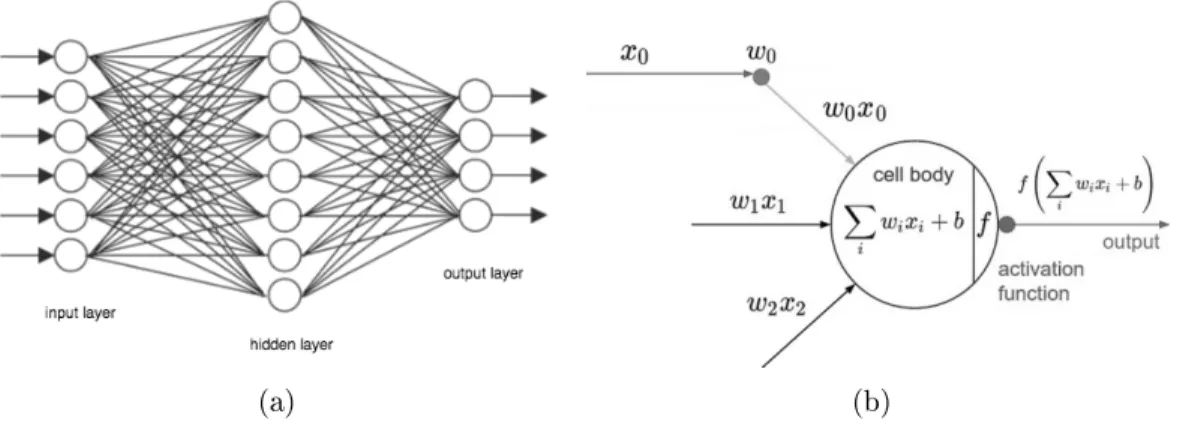
Regular Neural Networks include an input layer, one or more hidden layers, and an output layer. The input layer receives a vector of inputs and pass it to the hidden layers. Each hidden layer contains a set of non-connected individual neurons which are fully connected to all neurons in the previous hidden layer. The output layer has the same structure as the hidden layers. The structure of a regular Neural Network is illustrated in Fig. 1.1.
(a) (b)
1.2 Convolutional neural networks
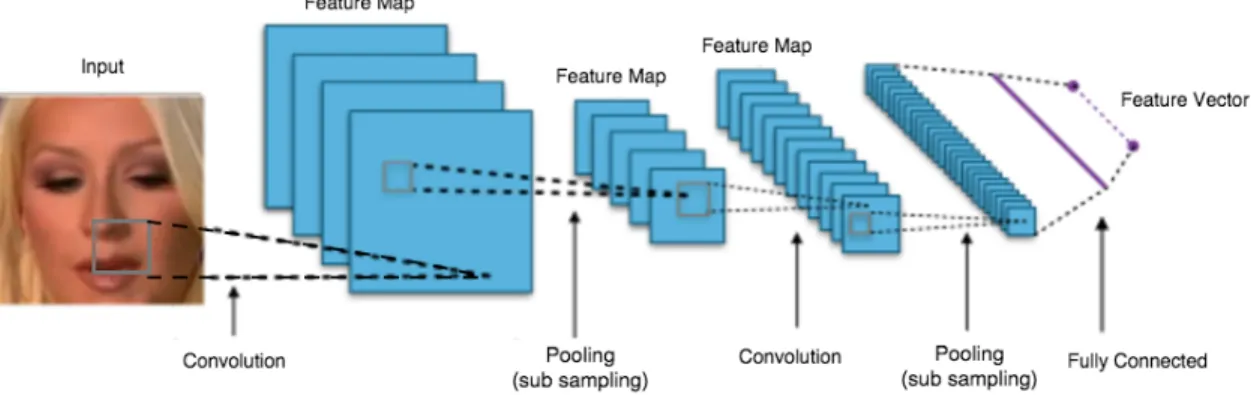
The regular neural networks can not eciently apply to images, as the fully connected layers cause each neuron to deal with a massive number of weights. Regard-ing this issue, the Convolutional Neural Networks are proposed as one type of Neural Networks with the assumption that the inputs are in format of images. ConvNets contain less fully-connectivity between neurons to avoid dealing with large number of weights in each neuron. ConvNet is generally built up from input layer, convolutional layer, pooling (sub-sampling) layer, normalization layer, fully connected layer, and an output layer. A general structure of Convolutional Neural Networks is illustrated in Fig. 1.2. In the following an explanation is given on each of the ConvNet layers.
Figure 1.2: General Convolutional Neural Network structure in face recognition prob-lems
Input layer: The input layer maps the input image into a matrix of pixel values with three channels of RGB colors, or one channel of gray-scale values.
Convolutional layer: Convolution is the operation of convolving an input by a kernel in order to generate a feature map. In face recognition problems, the input is the pixel-valued matrix which is received from the previous layers, and the kernel is a lter matrix. According to this, the convolution operation can be mapped to a
matrix multiplication operation between the input matrix and lter matrix, which results in another matrix viewed as feature map [6].
As the kernels (lters) are designed to be smaller than the input, the inter-action between the layers becomes less than the interinter-actions that happens in regular neural network. This directly means the next layer deals with less parameters.
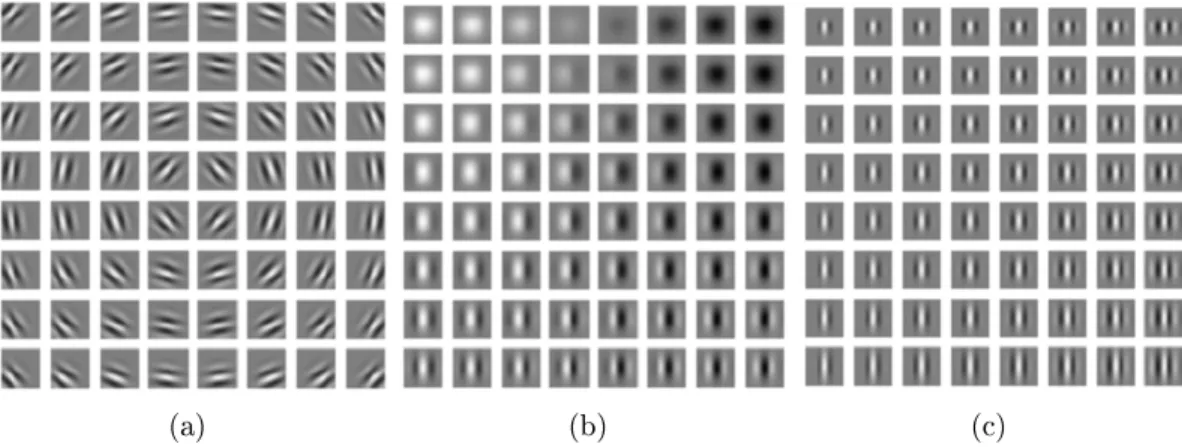
There are three strategies to generate the convolutional kernels, i) handcraft designation, ii) unsupervised learning of the kernels, and iii) randomly initialization of the kernels [6]. Some examples of handcrafted kernels are Gabor lters, curvlets, contoutlets, bandlets, Surfacelets, and etc. [53]. An example of Gabor lters is given in Fig. 1.3. Also, many unsupervised kernel learning approaches has been introduced in [6]. But random lters are reported to work better in practice [65, 16].
(a) (b) (c)
Figure 1.3: An example of Gabor kernels with (a) dierent coordinate parameters, (b) dierent sinusoid parameters, and (c) dierent Gaussian scale parameters.
Pooling layer: Almost all ConvNet designs employ a pooling layer after some convolutional stages. Pooling is considered as a non-linear down-sampling method. In pooling layer, a pooling function is applied to modify the output of the previous stages. In the other words, the pooling function summarizes the results over a whole neighborhood.
Some example of pooling techniques are max-pooling [8], average-pooling, L2-norm pooling [44], and weighted average pooling. The max-pooling function calculate the output as the maximum value within a rectangular neighborhood, while average-pooling calculates the average value presented as output. Similarly, L2-norm and weighted average pooling functions respectively report the L2-norm and weighted average of the a rectangular neighborhood presented as the output. Among these functions, max-pooling is proved to work better for face recognitions problems in practice [6]. In [9] the authors describe that which of pooling functions works better for various applications of visual recognition.
In a regular ConvNet architecture, each convolutional layer is followed by a pooling one, while it should be mentioned that convolution and pooling can lead to under-tting. This order is useful only when the assumptions made by the previous layers are reasonably accurate [6].
Normalization layer: Contrast normalization, inter-map normalization, or across maps normalization are some example of normalization functions that can apply in this layer. Recently, it has been reported that these layers don't have much contribution in practice, and thus they are not included in many recent ConvNet architectures [73].
Fully connected layer: After several convolutional and max pooling layers, fully connected layers are added to the network. Fully connected layers are similar to regular neural networks layers in which the neurons are connected to all neurons of the previous layer.
Loss layer: The last layer of ConvNet is usually a loss layer which applies a loss function (e.g. SVM or SoftMax) to the last fully connected layer to calculate the error between predicted labels and true labels.
The rst implementation of Convolutional Neural Networks was LeNet pro-posed in 1998 [44]. This network included two convolutional layers individually fol-lowed by two sub-sampling layers, and attached to two fully connected layers at the end. This network was mainly designed for digit recognition. Thereafter, the rst face recognition ConvNet developed in 2012, named AlexNet [38]. AlexNet includes 5 convolutional layers, 3 pooling layers, and 3 fully connected layer. AlexNet con-tains 60M parameters. This network was the rst ConvNet structure in which not all convolutional layers were followed by a pooling layer.
Another famous implementation of ConvNet is VGGNet proposed in 2014 [68]. VGGNet is considered to be very deep, as it includes 16 layers of convolution con-taining 140M parameters. the pre-trained model of this network is publicly available. Besides to VGGNet, another common ConvNet is GoogleNet developed in 2014 [79], which contains 22 layers with only 4M parameters (compare to 140M parameters in VGGNet). GoogleNet outperforms VGGNet in terms of classication.
In the following, we will give more explanation on face recognition architectures which are designed based on Convolutional Neural Networks in order to apply the identication/verication on face images.
1.2 General ConvNet-based Face Recognition Schema
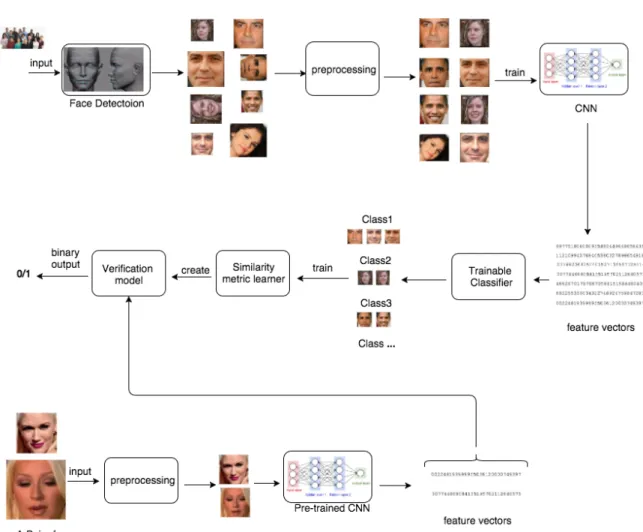
The face recognition methods based on ConvNet generally follow some com-mon steps, although there are varieties for performing each step. These steps are illustrated in Fig. 1.4. In the following a brief explanation on each step is given. Face Detection
In face recognition problems, the rst step is usually to prepare a collection of face images. The face detection algorithms are used to detect a human face within an image or a video frame.
Figure 1.4: General face recognition pipeline. In this structure, two dierent frame-works are employed for identication and verication
One example of of detection techniques is the Viola-Jones method [84] and its variances [10]. The original Viola-Jones performs with a speed of 3 frames per second and the detection rate of dierent versions of this method varies between 50% to 70% [10].
Another example of detection methods is Cascade-CNN [46] which is a deep learning based detection technique with the speed of 14 frame per second. This detector is more robust to variations of face appearance as a result of using ConvNet.
The ConvNet architecture in this method includes 3 ConvNets for binary classication of face/non-face images, and another 3 ConvNets for calibration of bounding boxes. Pre-processing
The detected face images are usually passed through a processing channel before being fed to the learner. The reason behind pre-processing is to compensate the face illumination or position, in order to minimize the variance that caused by these two while keeping the variations that caused by deformation of the faces. As the result, the images will be characterized under the similar conditions. Some pre-processing examples are geometric normalization (i.e. alignment) and lighting normalization [102].
The geometric normalization can include cropping, rotating, frontalization and scaling. The goal of this function is to create a constant image size with almost frontal orientation and known position of eyes.
The lighting normalization can include ltering, histogram modication (like stretching or equalization), mirror reection, . The goal of this function is to minimize the eect of lighting conditions.
ConvNet Training
After the pre-processing task, the designated ConvNet needs to be trained by the processed face images. The characteristics of ConvNet such as depth, number of convolutional layers and number of parameters in each layer varies in dierent implementations. The face images will be fed to the ConvNet through a feed forward process. Based on the availability of the labels, there can be a back-propagation step in order to to ne-tune the network weights; the ConvNets which apply the back-propagation of classication error are considered to be supervised. The output of the ConvNet is a set of feature vectors related to face images.
Identication
The identication process can be perform by applying a classier on the feature vector which is obtained for each face image. The classier categorizes similar feature vectors in the same group to be considered as a unique identier. The trainable classier can be any generic classier like SVM.
Metric Learning
After completing the identication process, the classied feature vectores can be used to learn a verication metric. The goal of metric learning is to train a verication model. Dierent models can be used here, like Joint-Bayesian [12], Co-sine similarity [54], energy-based similarity metric [14], deep metric learning [27], or Triplet-similarity [64]. The chosen model is trained with pair of similar/non-similar feature vectors. The trained model is then used to verify whether a pair of feature vectors belong to the same identity or not.
Face Verication
Having the trained model, the verication can be applied directly to a pair of images. For this purpose, the pair of face images pass through the same pre-processing channel as described in the rst steps of recognition (see Fig. 1.4). Thereafter, the processed images are fed into the ConvNet which was trained in the previous steps. The result of this task is a pair of feature vectors. After creating the feature vectors for each of the test images, the trained model will apply to the feature pairs and presents the result as a yes or a no (i.e. same identity or dierent identities).
The above explanation presents a general face recognition method based on ConvNet. Although, dierent varieties have been proposed for face recognition till
now. In the next section we will introduce the state of the art in ConvNet based face recognition methods following with a summary on these algorithms.
1.3 Face Recognition Methods Based on ConvNet
In this work, we focus on face recognition specially the verication task in videos. We can categorize the face recognition methods into two parts from the deep learning (DL) point of view: the shallow methods, which don't use DL techniques, and the deep methods, which are based on DL. In shallow methods, a representation of the face images is extracted using local image descriptors. Then the local image descriptors are aggregated into a single face descriptor during a pooling mechanism, like Fisher vector [56]. Whereas in deep methods, the representation of face images is extracted using ConvNet. The performance of deep methods is widely related to the structure of ConvNet and the scale of the training dataset.
In the following, we introduce some of the latest face recognition methods which are built based on ConvNet, and we will briey explain the contribution of each work.
1.3 DeepFace Model
The rst convolution based face recognition method is known as "DeepFace" presented by Taigman et. al. in 2014 [80]. This method was introduced as a Deep Neural Network (DNN) for face verication tasks.
The architecture proposed in this model includes four main parts: i) detec-tion, ii) aligning, iii) representadetec-tion, iv) classication. In this method, after detecting the face images, they are aligned through a 3D-alignment pipeline. Thereafter, the 3D-aligned RGB images pass through a ConvNet network to generate the face repre-sentatives. This ConvNet includes two convolutional layers, one max-pooling layer, three locally connected layers, and two fully connected layers. The output of this
network is a set of image representatives. At the end, a classier is applied on face image representatives to perform face Identication task. The designated architecture is illustrated in Fig. 1.5.
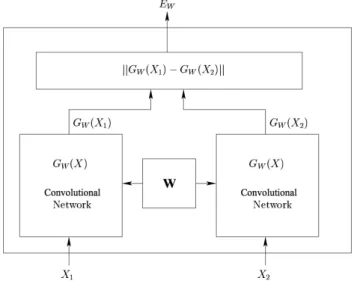
Besides the presented structure, a Siamese neural network is used to perform face verication. Siamese is a symmetric network including two networks which are joined with an energy function. In this network, two similar images will map to two locations which has a short distance in a space (lower energy); As the similarity decreases, this distance increases (higher energy). An example of Siamse network is given in [14] (see Fig. 1.6).
Figure 1.5: DeepFace ConvNet architecture for face identication [80]
1.3 Web-Scaled DeepFace Model
Web-Scale [81] is another ConvNet-based model which was designed based on DeepFace [80]. The architecture of this method is shown in Fig. 1.7.
Web-Scale benets from a bootstrapping method that is applied on the large training dataset to select an ecient training subset. The ecient subset contains more of the hardest recognition cases and ignores the easy ones.
Web-Scale achieves a lower verication accuracy in comparison to DeepFace, whereas its obtains higher identication accuracy. The identication accuracy over LFW and YTF dataset is reported as 95.0% and 80.7% respectively. Based on the fact that Web-Scale identication outperforms DeepFace whilst it has comparatively lower feature vector dimension, the authors claim that high dimensional feature vectors are not necessarily result in better accuracy.
Figure 1.7: The main architecture of Web-scaled DeepFace [81] 1.3 DeepID Model Series
Inspired by DeepFace, many ConvNet based methods have been designed to improve the accuracy of identication/verication. DeepID model series are among the popular successful methods which maid alternations in the structure of the net-work to achieve higher accuracy. In the following, the DeepId model series, including
DeepID [76], DeepID2 [74], DeepID2+ [77], and DeepID3 [75] are introduced and their architectures are briey explained.
DeepID Model
DeepID model was introduces as a ConvNet based identication/verication technique in 2014 [76]. The proposed ConvNet architecture includes three convolu-tional layers where each of them is followed by a max-pooling layer. On the top of these layers, there is a nal convolutional layer which is joined to a fully connected one. The features related to the rst three convolutional layers are local, while the ones related to the forth layer are more global. The schema of this model is presented in Fig. 1.8.
In this model, ve parts of the aligned face are detected: the centers of two eyes, two corners of mouth and the nose tip. The ConvNet uses dierent patches of the face to extract features from dierent parts of it. Then, a multi-classier is trained to classify 10k unique identities. After training, the face representative features are extracted from nal layers of ConvNet network.
DeepID model uses the Joint Bayesian technique for face verication tasks [12]. Before training the Joint Bayesian model the feature space should be reduced by using PCA.
DeepID2 Model
Based on DeepID, the method DeepID2 is proposed by Sun et al. [74]. The structure of this model is presented in Fig. 1.9.
In DeepID2, the face identication/verication signals are used as supervisory signals in order to decrease the intra-identity variations and increase the inter-identity dierences.
Figure 1.8: The architecture of DeepID1 model [76].
Figure 1.9: The architecture of DeepID2 model [74]. DeepID2+ Model
DeepID2+ designed based on DeepID2, and it includes three convolutional layers, each connected to a max-pooling layer, where the last max-pooling layer is connected to one locally connected layer and one nal fully connected layer [77]. The terminal features are extracted from the nal fully connected layer. In addition to this, there are also three other fully connected layers which are attached to each of the max-pooling layers. The goal of these early bind fully connected layers is to perform early feature extraction. The supervisory signals are added to all fully connected layers. The structure of this model is presented in Fig. 1.10.
Based on the description, one can claim that two of the main dierences in DeepID2+ in comparison to DeepID2 are to create a more deep network and also to send supervisory signals to early convolutional layers, which both leads to a higher accuracy. Besides, The authors claim that the deep ConvNet-based face identica-tion/verication systems are more robust. The author support this claim by the demonstrating the evidence that the neurons in nal layers of ConvNet are more robust to corruption of image than lower level neurons.
Figure 1.10: The architecture of DeepID2+ model [75]. DeepID3 Model
DeepID3 oers a model which contains two very deep neural network for face identication / verication [75]. Similar to DeppID2+, the two architecture also contain early fully connected layers, whist they are much deeper than the DeepID2+
[74]; i.e. DeepID2+ uses 5 feature extraction layers, while DeepID3 uses up to 15 feature extraction layers.
As mentioned, DeepID3 has two networks; network #1 includes 8 convolutional layers, where each pair is followed by a pooling layer. The last (i.e. fourth) max-pooling layer is followed by one locally connected layer and one nal fully connected layer. In addition to this, there are also four other fully connected layers which are attached to each of the max-pooling layers. In companion with network #1, there is network #2 which contains 2 pairs of convolutional network, where each pair is followed by a max-pooling layer. There after, the network is followed by 3 plus 2 layers of inception, which both are followed by a max-pooling layer. Finally a fully connected layer is attached to the end of network to represent the features. The presented model is deeper than previous versions, but less shallow than GoogleNet [79].
The model is rst trained by the CelebFaces+ dataset [76] and WDref dataset [12]. Then a joint bayesian model is also trained on the extracted features to be used for verication tasks [12]. The verication accuracy of this method is reported as 99.53% on LFW dataset.
1.3 CASIA Model
At 2014, the institue of CASIA presented a strategy to collect a face dataset named CASIA-WebFace [97]. Based on the dataset, the CASIA ConvNet network designed with 11 layers of convolution and max-pooling. The verication accuracy of this model is reported as 96.33% and 90.60% on LFW and YTF dataset respectively. Although this result is not much satisfactory in comparison to the previous methods, but the contribution of this work is considerable in creating the state of the art of largest training face dataset which is publicly available.
1.3 FaceNet Model
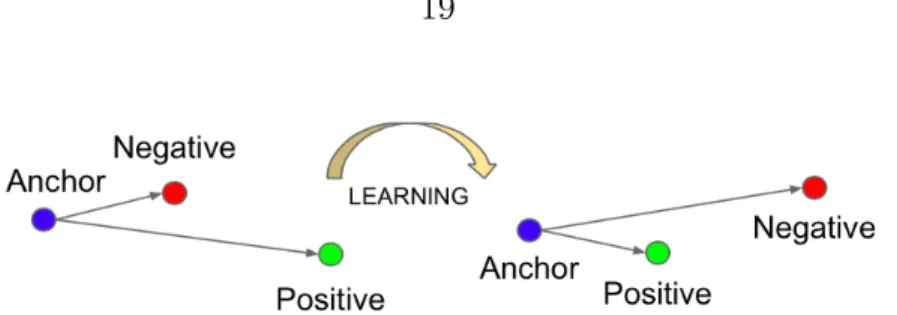
Almost all of the ConvNet based methods proposed in 2014 need to perform the identity recognition perior to run the verication task. In 2015, the Google research group introduced a face verication method named FaceNet [66], in which verication and identication can perform in the same framework. In FaceNet, a deep ConvNet network is designed, which includes 11 convolution layers, 4 pooling layers, and 3 fully connected layers. This ConvNet network is trained by an aligned triplet matching/non-matching face patches in order to learn an Euclidean embedding for each image. Accordingly, a triplet loss is also presented to train the embedding. The training is such that the Euclidean distance between two face image in embedding space directly represents their similarity, i.e. the small distances testify that the two face images belong to the same person, and long distances shows that the two face images belong to distinct people. After creating the embedding, a threshold on the distances between two embedding can be chosen; this threshold is used for face verication procedure. Moreover, for face identication purpose a simple K-NN classication technique can be used, e.g. k-means method.
FaceNet is reported to achieve an ecient representation of features, so that for each image only a 128 dimension of representative information is created. It should be mentioned that the triplet selection is one of the challenges in this model which aect the performance of verication. The schema of triplet loss learning is illustrated in Fig. 1.11.
1.3 VGG Model
VGG model is another method which used triplet loss learning in ConvNet network [57]. In an study by VGG group, dierent architectures of ConvNet were explored and a nal ConvNet architecture were designed for recognition. In the
Figure 1.11: Triplet loss learning based on minimizing the distance between the anchor and the image from the same identity, and maximizing the distance between the anchor and the image from a very dierent identity [66].
proposed architecture only one ConvNet network exists, while in many of other models an ensemble of ConvNet networks are used. The proposed ConvNet includes 16 convolution layers, 5 max-pooling layers, and 3 fully connected layers. Besides that, this method used triplet loss to learn the face embedding as explained in [66]. The authors claim that the single ConvNet architecture is comparable to ensemble base methods while it is much simpler. The verication accuracy in this model is reported as 98.95% on LFW dataset.
Another major contribution in this study is to present a routine to collect a large dataset by a combination of automation and human in loop. The result dataset contains hundreds of images for thousands of unique identities.
Based on this model, Berkeley vision and learning center has oered the Caf-feNet model [1] which trained the VGG-CNN model [80] using the ImageNet dataset [2]. CaeNet is proclaimed to be one of the best models presented in the ImageNet ILSVCR Challenge 2014 [63].
1.3 Lightened-CNN Model
Although the previous methods achieved a high accuracy in verication task, but they are considered to be highly computational intensive. To overcome this isuue, Wu et. al. proposed a lightened ConvNet-based face verication method [93]. In this method two ConvNet models are designed, where the rst one is a shallow ConvNet
model which includes 4 layers of convolution and 4M parameters, and the second one is a ConvNet with reduced kernel size which includes Network in Network (NIN) layers between its convolutional layers. The CASIA-WebFace [97] dataset has been used to train the model. The structure of this method is shown in Fig. 1.12.
The authors claimed that although the number of layers are shallow in this model, the results of this model is comparable to VGG-CNN model, while it has reduced the computational cost by 9 times.
Figure 1.12: The lightened-CNN architecture. In this model, the MFM (Max-Feature-Map) has been used as the activation function, instead of ReLU [93].
1.4 Common ConvNet Training and Testing Datasets
One of the important challenges for any face identication/verication problem is to choose the right training and testing data. In this section a brief description on common datasets that have been used in recent methods is given (Table 1.1).
In the beginning, a more detailed description is presented on CASIA-Webface as the largest public training dataset, and MegaFace as the largest public testing dataset. Thereafter, a description is given on IJB-A dataset as the most varied testing dataset. Furthermore an explanation is given on recent VGG dataset collection strategy, which can be followed by research groups to create large databases with less human eort.
1.4 CASIA-WebFace Dataset
Goal: Up to now, The CASIA-WebFace has the largest scale among face image public datasets. This dataset has been generated in 2014 [97] and its goal is mainly to present a large training dataset to be used in face identication/verication algorithms.
Source: The images are initially extracted from celebrity web pages in IMBD. Table 1.1: The common face recognition datasets and their characteristics, includ-ing description, number of images, number of identities, availability, testinclud-ing/traininclud-ing type, and published year.
Database Name #Images #Identities Availability Type Year
LFW [29] 13,233 5,749 Public Test 2007
YTF [92] 3,425 videos 1,595 Public Test 2011
WDref [12] 99,773 2,995 Public
(Feature only)
Train 2012
CASIA WebFace [97] 494,414 10,575 Public Train 2014
CACD [11] 163,446 2,000 Public Train 2014
CelebFaces+ [76] 202,599 10,177 Private Train 2014
SFC [80] 4,400,000 4,030 Private Train 2014
MegaFace [33] 1M 690,572 Public Test 2015
IJB-A [37] 5,712 images
2,085 videos 500 Public Test 2015
VGG-dataset [57] 2.6M 2,622 Private Train 2015
Dataset Collection steps: In order to create this dataset, a list of candidate celebrities extracted and crawled from IMBD. Then, the photos were obtained from each celebrity web page in IMBD. Since most photos contain more than one human face, a fast clustering method was used to annotate the identity of faces. Moreover, a multi-view face detector was applied to detect the faces and crop them. Thereafter, to ensure that the subjects in the dataset are not overlapping to LFW, the duplication removed by using edit distance between names. Finally, the whole dataset were checked manually and the false annotations were corrected.
1.4 MegaFace Dataset
Goal: the MegaFace [33] has mainly generated to improve the performance evaluation of face identication/verication algorithms at a scale of millions of images. The number of distractors in this dataset goes from 10 to 1M. The motivation behind creating this database was the fact that face recognition algorithms achieved a near to perfect accuracy on LFW dataset; LFW includes only 13K photos, while MegaFace is about 100 times larger, with a large number of distractors. Therefor, this database can be considered as a good candidate for testing purposes.
Source: The images are extracted from Flickr (Yahoo's dataset), and are publicly available.
Dataset Collection steps: the MegaFace dataset collection steps from Flicker are described in the below:
1. At rst, 500K unique users were selected from Flicker.
2. Then, for each user, the rst photo which the containing face is larger than 50x50 was selected and added to dataset. If the image contained more than one face, most probably it is a dierent identity, so it added to the database as a false positive example.
3. A total number of 690K faces were gathered in this way, which are unique identities with a high probability.
4. The process nished after collecting 1.2M total images.
Resolution: More than 50% of images have a resolution of 40 pixels in Infor-mation Object Denition (IOD).
It has been reported in [33] that most of the algorithms that achieve 95% accuracy on LFW dataset, achieve only up to 75% accuracy of face identication on MegaFace.
1.4 IJB-A Dataset
Goal: In 2015, the IJB-A dataset was introduced by Klare et. al. [37], which was inspired by a need to push the frontiers of unconstrained face recognition. The IJB-A dataset contains images which has a lot of variations in poses of each unique identity.
The set includes 500 subjects, where each subject has an average of 11 images and 4 videos related to it. The IJB-A is reported to have some benecial character-istics as below:
• Containing huge number of pose variations for each subject • Containing many geographical variations for each subject • Including eye and nose positions
• Including both images and videos
Source: The images and videos are extracted from world wide web, and are publicly available.
Dataset Collection steps: Most of collection steps for creating IJB-A dataset has been performed manually with use of human eort. In the beginning, a collection of images and videos were collected for some unique identities. Then, the position of all the faces inside the images and videos were annotated manually by human. The face detection algorithms has not been used here, in order to avoid the the false detection of non-faces.
Resolution: One of the characteristics of this dataset is to have a variety of resolutions, as the face images are collected in the wild.
1.4 VGG Dataset
Goal: The goal of Vgg group in creating the VGG dataset was to utilize a combination of automation and human in the loop to build a large face dataset whilst requiring only a limited amount of person-power for annotation [57]. VGG dataset has used the knowledge sources available on the world wide web and the contributors have announced that it will be publicly available to the research community.
Source: The images are initially extracted from IMBD, and then searched through the web by using Bing and Google image search engines.
Dataset Collection steps: the VGG dataset collection steps are described as below:
1. A list of candidate identity names were Bootstrapped and ltered by utilizing the following strategies:
(a) In the beginning, a list of 5K candidate identities extracted from IMBD celebrity list which ranked by popularity. The list included males and females with some other attributes like age.
(b) Then, the identities which did not possess enough distinct images removed from the candidate list. Thereafter, a set of 200 images downloaded for each of the remaining identities. Then the images were given to some human annotators to validate whether the set is 90% pure for each identity. After this ltering, a list of 3,250 identities were remained.
(c) Thereafter, any names appearing on LFW and YTF dataser were removed, so that the dataset is fair for algorithms which use LFW and YTF as their testing data. After this step, a list of 2,622 identities were remained. 2. Each of the remaining identities in the candidate list queried in Google and
Bing search engines, and 2000 images obtained for each.
3. Then, the purity improved with an automatic lter. For this goal, a linear SVM classier trained for each identity by using the Fisher Vector Faces descriptor and used to rank the 2000 images for each identity. The top 1000 images retained to be placed in dataset.
4. Afterward, the near duplicate images for each identity removed. For this pur-pose, the VLAD descriptor for each image calculated and clustered using a very tight threshold. As a result, each cluster contain very similar or near duplicate images. So, a single image from each cluster retained.
5. Finally, a manual ltering applied to increase the purity of the results. To do so, blocks of 200 images were shown to annotators to be validated.
1.5 Summary
By reviewing the successful applications of ConvNet-based face recognition methods the following points can be concluded:
• The size of the training dataset and the degree of variety in images aects the perforamance of the trained model. One can claim that bigger dataset with more varieties creates more accurate trained models [57].
• Most of the mentioned recognition methods use alignment techniques in pre-processing steps to align the face. Most authors claim that alignment improves the accuracy of identication / verication. FaceNet is one of the rare methods that doesn't use alignment, and the reason is that the model is trained with a super huge training dataset [66].
• Among the similarity metrics, the Joint Bayesian metric is proved to work better in practice [12].
• Using multiple patches in training improves the feature representation of the network.
• Although the verication performance achieves a near to perfect level, the iden-tication hasn't reach to human performance yet.
1.6 Future Work
In future research path, we will mainly focus on designing a real-time face verication system based on ConvNet which is applicable on videos. The following steps will be performed to complete the target system: i) automatic collection of training dataset, and ii) ConvNet designation and training.
ConvNet Designation and Training
The goal of this step is to design a ConvNet which after being trained by WayneFace dataset will be able to perform the verication task under the speed close to the speed of the video frame rate, i.e. while the video is representing, the
faces can be detected and veried simultaneously. Some decisions should be maid on the depth of the network, number of parameters, verication function, and having patch/non-patch input.
The architectural design of the ConvNet is the most important key for speed. Although less deep ConvNets are faster models, it has been proved that deeper Con-vNets usually achieve higher accuracy. On the other hand, the ConCon-vNets that are trained with bigger dataset containing many face varieties obtain more accurate re-sults [66].
Automatic Collection of Training Dataset
Collecting a reliable training dataset is one of the requirements for creating a successful verication method. Since our main focus is to design a video face recognition application, we have to design a new strategy for creating a big dataset. The dataset should contains large number of identities where each identity includes face images. To achieve this goal, a big dataset named WayneFace is gathered by following these steps:
1. Gathering videos: The videos which contain face images will be gathered. the videos need to have varieties on illumination, resolution, races, gender, age, etc. 2. Detection: The viola-Jones face detection algorithm will be applied on each
video to collect all face images which exists in that video.
3. Classication: The VGG pre-trained ConvNet [57] will apply on the faces ex-tracted from the each video to classify the faces which belongs to the same identity.
4. Merging repeated identities: In this part the identities which repeated in dataset will merge together. To do so, one single representative image will be selected
from each folder. Then, the VGG face verication model will apply to all representatives to nd the repeats. After this step, the dataset will remain with most likely all unique subjects.
5. Removing duplicate images: In this step, some of the images for each subject which are duplicated or near to duplicate will be deleted. We will use a similar duplication removal method as in [57]. That is, assume that there are 1000 images for a subject. The VLAD descriptor will be computed for each image, and the descriptors will be clustered within 300 (or another suitable numbers) clusters using a very tight threshold. A single image per cluster is then retained. By applying this duplication removal method, we will end up with 300 or less images for each identity.
6. Manually purifying: The goal in the nal step is to purify the data as much as possible. In this step, before using the human eort to validate the dataset, an automatic ranking will apply to subject images to help the annotators to work faster. For this purpose, a multi-way ConvNet will be trained to discriminate between all subjects. We will ne-tune the VGG pre-trained ConvNet on our data set. After training of the ConvNet, the softmax scores will be used to rank the images of each subject. Then the ranked images of each subject will be shown to human workers to be validated. The blocks with purity less than 90% (45 out of 50) will be excluded from the dataset.
CHAPTER 2 LEARNING CONVNETS WITH APPLICATION TO LONG-TERM FACE TRACKING
This Chapter investigates long-term face tracking of a specic person given his/her face image in a single frame as query in a video stream. Through taking ad-vantage of pre-trained deep learning models on big data, a novel system is developed for accurate video face tracking in the unconstrained environments depicting various people and objects moving in and out of the frame. In the proposed system, we present a detection-verication-tracking method (dubbed as 'DVT') which accomplishes the long-term face tracking task through the collaboration of face detection, face veri-cation, and (short-term) face tracking. An oine trained detector based on cascaded convolutional neural networks localizes all faces appeared in the frames, and an oine trained face verier based on deep convolutional neural networks and similarity metric learning decides if any face or which face corresponds to the query person. An online trained tracker follows the face from frame to frame. When validated on a sitcom episode and a TV show, the DVT method outperforms tracking-learning-detection (TLD) and face-TLD in terms of recall and precision. The proposed system is also tested on many other types of videos and shows very promising results.
2.1 Introduction
Consider a video stream taken in unconstrained environments depicting various people and objects moving in and out of the camera's eld of view. Given a bounding box dening a face of a specic person in a single frame, the goal is to automatically determine his/her face's bounding box or indicate that this person is available or not in the rest frames of the video. The desired output is the person's faces and the corresponding time slot when he/she appears in the video. This task is referred to as long-term face tracking [32, 31, 78].
Long-term face tracking is an appealing research direction with increasing demands. For example in the era of social networking, when more and more videos are continuously uploaded to the Internet via video blogs, social networking websites, face tracking technology can track and retrieve all the shots containing a particular celebrity from thousands of short videos captured by a digital camera; or it can locate and track suspects from masses of city surveillance videos (e.g., Boston marathon bombings event).
Long-term real-time tracking of human faces in the wild is a challenging prob-lem because the video may include frame cuts, sudden appearance changes, long-lasting occlusions, etc. This requires the tracking system to be robust and invariant to such unconstrained changes. Since most of tracking methods [47, 71, 87] in the literature have been aimed at the videos in which the target person is visible in every frame, these methods cannot easily handle the long-term tracking situations.
In this work, we develop a new system for accurate long-term video face track-ing in the wild by taktrack-ing advantage of pre-trained deep learntrack-ing models on big data. The main idea is based on a detection-verication-tracking (DVT) method in which we propose to decompose the long-term face tracking task into a sequence of face detection, face verication, and (short-term) face tracking. Specically, given a query face of a specic person, the oine pre-trained detector based on cascaded convolu-tional neural networks localizes all faces appeared in the frames, the oine pre-trained face verier based on deep convolutional neural networks and similarity metric learn-ing decides if any face or which face corresponds to the query person, and the online trained tracker follows the veried face from frame to frame. The system repeats this procedure until the end of a video. To speed up the system or even make it to be real-time, we can skip a number of frames in two cases: when each short-term track-ing is done, and when no face in the current frame is veried to belong to the query
person. Since we apply deep convolutional neural networks trained on big data in the wild to face detection and face verication, the system is able to tackle videos taken in unconstrained conditions. Fig. 3.4 provides an overall owchart of the proposed system which will be described in details in Section 2.3.
Our main contributions in this chapter are two-fold. (i) A DVT method is presented which accomplishes the long-term face tracking task through the collab-oration of face detection, face verication, and (short-term) face tracking. To the best of our knowledge, the face verication is, for the rst time, performed to guide the (long-term) face tracking. (ii) Built on the DVT method, a novel and accurate long-term face tracking system is designed and developed, which can handle various types of video in the wild. Also, this system is an end-to-end one.
The rest of the chapter is organized as follows. Section 2.2 gives a brief in-troduction on related works on face tracking. The proposed DVT method and the developed system is elaborated in Section 2.3, which is followed by the experimental results in Section 2.4. Finally, this chapter is concluded in Section 2.5.
2.2 Related Work
Many approaches have performed detection to improve the tracking procedure while some of them used oine trained detector [91, 48], and some others used online learned detectors [32, 23, 5, 31]. For example, in [91] the object tracking algorithm applied a detection strategy to validate the tracking results. If the validation was failed, the whole frame would have to be searched again to nd the target. Another example of tracking with oine detector [48] employed a detection strategy with particle ltering to improve the tracking algorithm. While these methods utilized pre-trained detectors, adaptive discriminative trackers with an online learned detectors to distinguish the target from the background were presented in [23, 5]. Although these
methods achieves promising performance in continuous tracking, but if the target leaves the scene slowly and gradually then there will a probability that the procedure may lose tracking the main target and replace it with a wrong subject.
Tracking-learning-detection (TLD) [32] is a method to tackle long-term object tracking in video. In TLD, starting from a single frame, the tracking procedure ex-changed information with an online learned detector while the two procedures worked independently. By using a randomized forest as classier the decision boundary be-tween the object and its background can be represented. In [31], the TLD framework was specied to the application of long-term human face tracking. A validator was employed to decide whether a face patch corresponds to the query face or not. The method used the frontal face detector algorithm [30], and on top of that a module was incorporated to analyze a face patch as a validator. The output was a condence level which indicated the correspondence of the patch to the specic face. The validator was performed on a collection of example frames which was initialized by a single example in one frame and then extended during tracking by inserting more examples. A tracking framework presented in [103] combined tracking and detection to support precision and eciency of tracking under heavy occlusion conditions. Two dierent strategies based on TLD and wider search window approaches were used for detection. Objects in tracking were represented by sparse representations learned online with update.
Similarly, in this work we also use face detection to improve the tracking procedure. Furthermore, we propose to perform face verication as a validator to guide the tracking. More importantly, we take advantage of deep learning models for face detection and face verication in our system, which enables high accuracy in tracking.
2.3 Methodology
In this section, we will present the proposed DVT method and the developed system for long-term face tracking.
2.3 Detection-Verication-Tracking (DVT)
We utilize face detection and face verication to improve the tracking proce-dure. In the DVT method, we propose to decompose the problem of long-term face tracking into a sequence of face detection, face verication, and (short-term) face tracking. Specically, given a query face of a specic person, the oine pre-trained detector based on cascaded convolutional neural networks localizes all faces appeared in the frames, the oine pre-trained face verier based on deep convolutional neural networks and similarity metric learning decides if any face or which face corresponds to the query person, and the online trained tracker follows the veried face from frame to frame.
Face Detection
Recently, the deep learning techniques have revolutionized the performance of face detection. A survey on the most successful face detection methods is given in [99]. Although several state-of-the-art face detection methods reached almost perfect accuracy, they are not fast enough to be suitable for real-time applications. For ex-ample, a novel deep learning convolutional network for face detection in [96] achieved high accuracy but was computationally intensive and comparably slow. This impedes its use to real-time purposes like online video tracking.
Considering a balance between eectiveness and eciency, we need a detection algorithm which not only works well under unconstrained circumstances but also performs at an acceptable speed. Here, we choose a convolutional neural network
Figure 2.1: Flowchart of the proposed system for long-term face tracking. The input is given as a cropped face which is rst detected and then tracked for ve frames. Feature query is the average of ve feature vectors which are obtained by applying a pre-trained deep convolutional neural network to the ve detected faces on the ve frames. Tracking continues until there is no frame or the query person disappears from the scene. When he/she appears again, after detection and verication, tracking will be started. The procedure repeats until the end of a video. Ideally, the output is all tracked faces of the query person and their corresponding time slots.
(ConvNet) detection algorithm, named a cascaded-CNN [46], that can achieve high accuracy with a fast speed. This ConvNet cascade includes 6 ConvNets worked in a cascaded way in 3 stages. In each stage, one ConvNet is used for detecting faces vs. non-faces and the other ConvNet is used for bounding box calibration. The output of one stage is used to adjust the detection window position which will be input to the subsequent stage. This method reduces the number of face candidates at later stages by using a ConvNet based calibration after each detection. More details can be found in [46].
Face Verication
In recent years, ConvNet-based face recognition techniques have obtained a near perfect verication accuracy on some datasets [57, 74, 66]. VGG-face net [57] investigates ConvNet architecture for face identication and verication with a deep network in the sense that a long sequence of convolutional layers is used. This Con-vNet was trained on 2.6 million face images from more than 2600 people and achieved comparable verication accuracy with the state-of-the-art methods on benchmark data sets. The pre-trained ConvNet model is also publicly available from this link1.
In this work, we take advantage of the pre-trained model of VGG-face network to extract features for faces. Specically, the detected faces are rst preprocessed in the same way as in [57], and then we apply the VGG-face ConvNet to the faces and take the output of the last fully connected layer (without the nonlinearity) as feature representations each of which is a 4096-dimensional vector. Thereafter, we consider the query feature vector and the feature vector of a detect face as a pair of feature vectors. Cosine similarity metric learning is used to verify a pair of features to belong to the same face or dierent faces.
In the TLD method [32] the frames are treated as to be independent and the whole frame is being scanned to detect the target. Unlike the TLD method, our verication strategy make the assumption that consecutive frames are related to each other to some extent, therefore the scanning process is performed around the area where the latest detected bounding box was located. This assumption decrease the scanning process time in comparison to TLD.
Face Tracking
Most tracking algorithms employ a bounding box given in the rst frame and continue tracking based on the initial bounding box. Despite the fact that researchers have been making progress in this eld, it still remains highly challenging to design a tracker which can handle all various situations, such as object deformations, illumi-nation changes, fast motions, occlusion, and background clutters, etc. Furthermore, another big challenge of tracking is to handle long-term tracking situations, in which tracking algorithm will continuously confront dierent conditions as the target may leave the scene and re-appears later.
Most of the tracking algorithms use only one bounding box (or patch) to be tracked [39, 22]. In this work, we employ the reliable patch tracker (RPT) method [47] which identies and exploits multiple reliable patches instead of only one, where the reliable patches can be tracked eectively through the tracking procedure. With the collaborative use of face detection and verication, the RPT method can handle long-term tracking under the assumption that the object's motion between consecutive frames is limited and whenever the object leaves the scene the verication procedure will stop the tracking.
2.3 System Framework
The goal is to design and implement a system which can track a specied human face in an unconstrained video with the long-term setting. Algorithm 1 gives the pseudo code for this system framework. Details on the work ow of the system are described as follows.
The system starts by asking the user to select a face by cropping it in some frame of the video. The ConvNet cascade-based face detection (see Section 2.3.1) is then performed on the cropped face to obtain a bounding box which indicates
the position of the target face in the selected frame. The bounding box is fed into the RPT based tracking algorithm (see Section 2.3.1). At this point, the tracking continues only for ve frames to create a sequence of ve face images. After the preprocessing (i.e., resize the images to be 224x224x3 and subtract a mean image) of the ve face images, the VGG-face ConvNet (see Section 2.3.1) is applied to the ve images to produce ve feature vectors. The dimension of each feature vector is 4096. We consider the average of the ve extracted feature vectors as a feature query (of the query face).
Thereafter, the tracking continues until there is a signicant dierence in the distance of the position of target face in 2 two-consecutive frames. If the distance dierence is signicant, the tracking is stopped and face verication on the face in the latest frame is performed. In order to conduct face verication, the feature rep-resentation of the face in the latest frame is extracted using VGG-face ConvNet as before and then is compared to the feature query using the cosine similarity metric. If the cosine similarity score is larger than a predened threshold, tracking continues; otherwise, tracking stops.
The system then moves on to the face detection procedure. Face detection is applied to the whole frame to nd all possible human faces. Subsequently, the system performs face verication again on each of the detected faces as aforementioned. If the cosine similarity between one of the detected faces and the query face is higher than the threshold, the tracking continues; otherwise, a number of following frames are skipped and the face detection procedure is conducted again. The skipping number of frame can be dened based on the video type and the frame rate of the video. For example, if faces in the video change fast and move fast, a small value should be set for the skipping number of frame; otherwise, a larger value should be set.
Thus, a sequence of detection, verication and tracking will repeat until the end of a video. All tracked faces of the query person and their corresponding time slots are the output. In our system demo, we show the output in the video with highlighted parts where tracked faces have been appeared in the frames.
2.4 Experiments and Results
(a) (b)
(c) (d)
Figure 2.2: A visualization of the user interface of the developed long-term face tracking system, (a) the user selects a query face in some desired frame, (b, c, d) the tracking system tracks the query face within the entire video. The time-bar represents the duration of the video, and the highlighted parts in cyan indicate the time slots when the query person appears in the video. The query face is also bounded in a yellow box in each frame the query person appears.
This section presents the implementation of the system, the experiments and the evaluation of tracking performances. The proposed DVT method was imple-mented in Matlab using single thread without further optimization. The graphical user interface (GUI) of the system was designed and implemented with Java in Intellij
Algorithm 1 Long-term Video Face Tracking.
1: Video ← Read sample video
2: similarity-threshold←Set to a predened value based on desired level of similarity
3: distance-threshold← Set to a predened value
4: skip-frame ← set to a predened value based on the length of video
5: continue-tracking ← True: A ag that indicates whether to stop or continue
tracking
6: if-reappear←False: A ag that indicates whether the face reappears in proceed-ing frames or not
7: f# ←Get the number of the frame where the target face exists: dened by user
8: initial-bounding-box←Get the position box of the target face in a specic frame from the user
9: detected-face[f#]← DETECT-FACE(initial-bounding-box, f#)
10: for i=f# : f# + 5 do
11: detected-face[i+ 1] ← TRACK-ONE-FRAME (detected-face[i] , f#)
12: feature-vectors[i] ←EXTRACT-FEATURE (detected-face[i])
13: f#←f# + 1
14: query ←Calculate the average of feature-vectors
15: while hasFrame(Video) do
16: while continue-tracking == True do
17: detected-face[f#+1] ←TRACK-ONE-FRAME(detected-face [f#] , f#)
18: if DISTANCE(detected-face[f#], detected-face[f#+1]) >
distance-threshold then
19: continue-tracking← False
f# ←f# + 1
20: feature-vector ← EXTRACT-FEATURE(detected-face[f#])
21: cosine-score ← COSINE-SIMILARITY(feature-vector, query)
22: if cosine-score > similarity-threshold then
23: continue-tracking← True
24: else
25: face-list← DETECT-ALL-FACES(Video, f#)
26: if face-list is not empty then
27: for face ∈ face-list do
28: feature-vector ← EXTRACT-FEATURE(f ace)
29: cosine-score ← COSINE-SIMILARITY(feature-vector, query)
30: if cosine-score > similarity-threshold then
31: continue-tracking← True
32: detected-face[f#]← face
33: if-reappear← True
34: break the loop
35: if if-reappear == false then
36: f#←f# +skip-frame
37: f rame ←readFrame(Video, f#)
38: else
39: f# ← f#+skip−f rame
IDEA, where all Matlab codes were compiled into Java Libraries. As the result, this system is a Java Package that can be executed on any computer which has the Java Virtual Machine and a Matlab compiler installed on it. This tracking model allows users to adjust dierent parameters based on their needs. These types of models can be ambiguous since dierent parameters may carry various meaning to dierent users. for example, the user can relate the "speed" parameter to either the "skip-frame" parameter, or the "skip-time" parameter, or both. This ambiguity can be avoided by adding semantic to the tracking model. In [36] three dierent techniques are introduced for adding semantics to the models.
For the evaluation, we test the proposed DVT method and the developed system on a sitcom episode and a TV show on which the face-TLD method was also validated [20]. In addition, we also conduct experiments on one short type of TV show to visualize the results in a qualitative trend.
We compare the proposed DVT method with the standard TLD and face-TLD by testing them on the sitcom IT-Crowd (rst series, rst episode). The episode duration is 1418 seconds, with the frame rate of 29 frame per second. Table 1 provides the performance comparison of the three methods in term of precision and recall measures as described in [31] (computing precision and recall is a common practice in many elds such as software engineering [35, 82]). The developed system with DVT method is able to detect the query face through the whole video. The overall recall is 75%, and the precision is 92%, both of which are much larger than TLD and face-TLD methods. Moreover, for the initialization, the developed system is initialized with a bounding box on the character Roy at any desired time within the video, while the TLD and face-TLD methods need to perform the initialization on the rst appearance of the character.
A visualization of the user interface of the DVT system is also given in Figure 2.2. In the provided graphical user interface, the user selects a query face in some desired frame by drawing a bounding box around the target face. Thereafter, the tracking system tracks the query face within the entire video regardless of the fact that the selected query face might not be the rst appearance of the target in the video. After the tracking is completed, the GUI shows a time-bar which represents the duration of the video with the highlighted parts in cyan which indicate the time slots when the query person appears in the video. The query face is also bounded in a yellow box in each frame the query person appears for better visualization.
In all experiments, the similarity threshold (Algorithm 1, line 2) is set to 70%. The number of skipping frames (Algorithm 1, line 4) can be specied by the user through the GUI, where the default setting is 60. The number of skipping frames indicates how many frames are skipped by the system when face verication is failed. Although decreasing this number will lead to an increase in recall value, it will increase the running time of the system which is in contradiction to the goal of tracking in real-time. A sample of DVT output sequence is given in Fig. 2.3.
Table 2.1: The comparison between TLD, Face-TLD and the proposed DVT method in terms of precision and recall.
Method Precision RecallCharacter Roy
TLD 0.70 0.37
Face-TLD 0.75 0.54
Figure 2.3: A sample of DVT output sequence. 2.5 Summary
In this chapter, we presented a deep-learning based detection-verication-tracking method and develops a system for long-term detection-verication-tracking of human faces in unconstrained videos. The proposed system employs face detection and face veri-cation to boost the performance of long-term tracking. By testing the system with DVT method on a sitcom episode, a TV show, and other types of videos, its ecacy is validated, and the system is promising to be used in real-time applications.
CHAPTER 3 LEARNING CONVNETS FOR FACE VERIFICATION USING VIDEOS IN THE WILD
Face recognition tasks have seen a signicantly improved performance due to ConvNets. However, less attention has been given to face verication from videos. This Chapter makes two contributions along these lines. First, we propose a method, called stream loss, for learning ConvNets using unlabeled videos in the wild. Sec-ond, we present an approach for generating a face verication dataset from videos in which the labeled streams can be created automatically without human annota-tion intervenannota-tion. Using this approach, we have assembled a widely scalable dataset, FaceSequence, which includes 1.5M streams capturing∼500K individuals. Using this dataset, we trained our network to minimize the stream loss. The network achieves accuracy comparable to the state-of-the-art on the LFW and YTF datasets with much smaller model complexity. We also ne-tuned the network using the IJB-A dataset. The validation results show competitive accuracy compared with the best previous video face verication results.
3.1 Introduction
Face verication aims to determine whether two faces in a given pair of im-ages or videos belong to the same identity or not, without having any prior knowledge about that identity. A variety of image descriptors such as SIFT [70], LBP [92, 52], HOG [21], and Fisher Vector [67, 24] has been proposed to be used for extracting fea-tures in face verication. However, due to variations in pose, illumination, resolution, and facial expression, face verication is still a challenging problem.
In the eld of face recognition, deep learning models such as DeepFace [80], and FaceNet [66] are proven to outperform the traditional shallow methods on the widely used benchmarks such as LFW [29] and YTF [92]. In video-based face recognition, these models fall into two main branches.

![Figure 1.7: The main architecture of Web-scaled DeepFace [81]](https://thumb-us.123doks.com/thumbv2/123dok_us/1284991.2672520/23.918.143.763.606.767/figure-main-architecture-web-scaled-deepface.webp)
![Figure 1.8: The architecture of DeepID1 model [76].](https://thumb-us.123doks.com/thumbv2/123dok_us/1284991.2672520/25.918.146.781.149.393/figure-the-architecture-of-deepid-model.webp)
![Figure 1.10: The architecture of DeepID2+ model [75].](https://thumb-us.123doks.com/thumbv2/123dok_us/1284991.2672520/26.918.287.635.401.816/figure-the-architecture-of-deepid-model.webp)