Home Equity
Ian Ayres and Joshua Mittst
The Consumer Financial Protection Bureau's recently-released
"qualified mortgage" rules effectively discourage predatory lending but miss an equally important source of systemic risk: low-equity clustering. Specific "volatility-inducing" mortgage terms, when present in a substantial cluster of mortgage contracts, exacerbate macroeconomic risk by increasing the chance that the housing and lending markets will have to absorb a wave of simultaneous defaults after a downturn in housing prices. This Article shows that these terms became prevalent in a substantial proportion of residential mortgages in the years leading up to the home mortgage crisis. In contrast, during the earlier "amortization era" (when mortgagors were more likely to borrow at different times, with more substantial down payments, and more continual rates of amortization, without a need to refinance), an equally-sized negative shock to housing prices would likely produce less negative equity and confine it to a smaller set of borrowers. Instead of prohibiting the volatility-inducing terms, this Article proposes three policies to better assure a greater diversification in the distribution of equity: (a) a modified home-mortgage interest deduction; (b) a modified "qualified residential mortgages" standard; and most importantly, (c) direct macroprudential regulation through a "cap-and-trade" system of leverage licenses and through instituting varying degrees of "conforming mortgages" for Fannie Mae and Freddie Mac. Limiting the simultaneous clustering of negative equity mortgages could reproduce the structural advantages of the amortization era, when inevitable downturns disparately impacted homeowners with different levels of equity and could more easily be absorbed by the market.
Introduction ...... 787...8..
I. The Limited Legal Response to Low-Equity Clustering ... 83
A. Consumer Protection, Predatory Lending, and Qualified
Mortgages Under the Dodd-Frank Act... 83
B. Qualified Residential Mortgages and Minimum Down Payments .... 88
t Ian Ayres is the William K. Townsend Professor & Anne Urowsky Professorial Fellow in Law at Yale Law School. He can be reached at [email protected]. Joshua Mitts is an Associate at Sullivan & Cromwell LLP. The views in this paper are those of Mr. Mitts and not those of his employer. He can be reached at [email protected].
Yale Journal on Regulation
II. The Economic Effect of Low-Equity Clustering... ... 90
A. Existing Research on Low-Equity Clustering ... ... 92
B. An Original Empirical Study on Low-Equity Clustering ... 98
1. Research Design... 98
2. Econometric Model and Regression Results.... ... 100
3. Home Price Regressions ... ... 102
4. Default Rate Regressions ... ... 105
III. Reforms to Promote Greater Diversity in the Distribution of Home Equity... ... 107
A. Current Policies Increase Low-Equity Clustering ... ... 108
1. The Mortgage Interest Tax Deduction ... 108
2. Government-Insured Mortgages ... ... 110
B. Reforming the Home Mortgage Interest Deduction .. ... 112
C. Reforming the Dodd-Frank Risk-Retention Proposal... 116
IV. Direct Macroprudential Regulation of the Distribution of Equity... 122
A. A System of Tradable Leverage Licenses ... 122
1. Why Licensing? The Advantages of Tradable Permits... 125
2. Toward a New Regulatory Regime... 128
3. Setting the Size of the Caps and Defining the Jurisdictions .... 130
4. Transition and Enforcement ... ... 134
B. Varying Conforming Mortgages for Fannie Mae and Freddie Mac... ... 136
1. The Role of the GSEs in the U.S. Mortgage Market ... 136
2. A New Paradigm of Variation in Conforming Mortgages... 139
Conclusion ... ... 141
Introduction
One lesson from the Great Recession is abundantly clear: the terms of other people's mortgages can affect our financial security. When other people finance their housing purchases with little or no down payment, it increases systemic risk in the housing market. But the legislative response to the crisis has largely focused on trying to correct consumer errorI and has left the external impacts of individual lending decisions unaddressed.
The Dodd-Frank Act instituted two regulatory regimes to discourage the risky mortgage lending that led to the housing crisis: "qualified mortgages"
(QM) and "qualified residential mortgages" (QRM). One of these regulatory
responses to the crisis even found its way into the 2012 presidential elections. In the first presidential debate, Governor Romney claimed:
I. See discussion infra Section I.A.
Dodd-Frank correctly says we need to have qualified mortgages, and if you give a mortgage that's not qualified, there are big penalties, except they didn't ever go on and define what a qualified mortgage was. It's been two years. We don't know what a qualified mortgage is yet. So banks are reluctant to make loans,
2
mortgages.
Two of these claims were incorrect. There are not "big penalties" for originating non-QM loans. On January 10, 2013, the Consumer Financial Protection Bureau (CFPB)' released rules giving lenders a safe harbor of compliance with a statutory mandate to verify a borrower's ability-to-repay for qualified mortgages.3 But lenders can still offer non-qualified mortgages by performing the requisite verification.4 And the delay in promulgating the QM rules could not have kept banks from lending because the ability-to-pay mandate was suspended until the QM rules were promulgated.5
On the other hand, Dodd-Frank's "qualified residential mortgages" (QRM) rules do impose a penalty for noncompliance. Under a proposal by six federal agencies in April 2011, mortgage securitizers must retain 5% of the credit risk of any mortgage with a down payment lower than 20%.6 While this and other requirements for a QRM loan-such as fully amortizing payments with no deferring principal or balloons, no negative amortization, and no debt-to-income ratio greater than 28%7-effectively reduce predatory lending, a 20% minimum down payment imposes a harsh burden on borrowers who are creditworthy but lack the wealth to provide such a large amount of cash up front.
More fundamentally, the proposed QRM rules do not effectively address the systemic consequences of mortgage terms that, in aggregate, can exacerbate market volatility. There is nothing individually irrational about a borrower and lender agreeing that the borrower will borrow with a small down payment or opting for a large repayment balloon in the future. But when millions of borrowers make the same kind of bet, too many of these highly-leveraged loans
2. Suzy Khimm, How a Moderate Mitt Romney Says He'd Regulate Wall Street, WASH.
POST: WONKBLOG (Oct. 4, 2012, 11:18 AM), http://www.washingtonpost.com/blogs/wonkblog/wp
/2012/10/04/how-a-moderate-mitt-romney-would-regulate-wall-street.
3. Ability-to-Repay and Qualified Mortgage Standards under the Truth in Lending Act, 12 C.F.R. § 1026.43(e)(1)(i) (2013).
4. See 15 U.S.C. § 1639c(b)(1) (2012) ("Any creditor with respect to any residential mortgage loan, and any assignee of such loan subject to liability under this subchapter, may presume that the loan has met the requirements of subsection (a), if the loan is a qualified mortgage." (emphasis added)).
5. See id. § 1639c(a)(1) ("In accordance with regulations prescribed by the Bureau, no creditor may make a residential mortgage loan unless the creditor makes a reasonable and good faith determination based on verified and documented information that, at the time the loan is consummated, the consumer has a reasonable ability to repay the loan ... (emphasis added)).
6. See Credit Risk Retention Proposed Rules, 76 Fed. Reg. 24,090, 24,099 (Apr. 29,
2011).
7. See id. at 24,125. For an in-depth discussion of the QRM standard, see infra Section III.C.
Yale Journal on Regulation
make our housing markets less stable. QM and QRM thus under- and over-reach: they largely fail to address the negative externality that high-risk lending can have on the remainder of the economy, and when they try to do so-i.e., by requiring a 20% down payment-they strike with a heavy hand not narrowly tailored to the goal of reducing systemic risk.
A more effective regulatory solution begins by identifying the
phenomenon of "low-equity clustering." In the not-so-distant past, borrowers were more likely to take out amortizing loans, which pay back principal and interest with relatively constant monthly payments. During this amortization era (which lasted roughly from the end of World War II until roughly the beginning of President Clinton's term), at any point in time, different homeowners would have varying degrees of equity built up in their houses. Older homeowners would tend to own a larger proportion of their homes.
8
Younger families not as much. This diversity in the degree of accrued equity reduced market volatility because economic shocks causing housing prices to drop would drive underwater only a relatively small proportion of the most recent mortgages.
In contrast, the Great Recession shows the macroeconomic dangers of uniformly high leverage. When a substantial proportion of the population has less than 5% equity in their homes, a 15% drop in housing prices is likely to cause a massive wave of defaults-further depressing housing prices and prompting even more defaults. From the perspective of market stability, low down payment mortgages with deferred or even negative amortization of principal robbed our nation of the diverse equity cushion that it enjoyed in the past.
In this Article, we focus on four different types of mortgage terms that, when present in a substantial number of loans, make the housing and banking markets more vulnerable to negative impacts from downturns in housing prices. The four mortgage terms are: (1) high loan-to-value (LTV) ratios; (2) low or delayed rates of amortization (including, for example, interest only loans); (3) substantial balloon payment obligations; and (4) artificial interest rate increases (for example, when interest rates rise at the end of a teaser rate period).
The first two of these terms directly reduce the size of the equity cushion that will exist at any point in time during the mortgage repayment-either because the initial down payment is a lower percentage of the purchase price or because the subsequent monthly payments are structured to more slowly pay back the outstanding principal. Even homeowners who initially borrow with more traditional mortgages (larger down payments and amortizing over fifteen to thirty years) are dynamically susceptible to "equity stripping," in which the homeowner takes out subsequent loans that extract the value that is built up
8. See, e.g., U.S. Census Bureau, RESIDENTIAL VACANCIES AND HOMEOWNERSHIP IN
THE FOURTH QUARTER 2013, at 8, http://www.census.gov/housing/hvs/files/currenthvspress.pdf (last visited Feb. 14, 2014) (showing increasing homeownership rate with age from 2007-13).
through the amortized repayment of the loan principal or through capital appreciation of the underlying home. In the extreme case, repeated equity stripping can dynamically transform amortizing mortgages into what in effect are interest-only loans and even ratchet the outstanding principal toward any capital appreciation in the home value. The combined impact of lower down payments, lower amortization, and increased equity stripping when adopted by a substantial group of homeowners leads to a phenomenon that we call "low-equity clustering." Low-"low-equity clustering can exacerbate the impact of normal housing price fluctuations by unleashing a simultaneous wave of defaults (that would not have occurred under more traditional amortization distributions) as a large segment of homeowners walk away from underwater mortgages.
The second two types of terms (balloons and artificial resets) increase the risk of default when refinancing markets dry up after an initial fall in housing prices. Traditional amortizing mortgages do not require homeowners to return to the lending market to refinance the original principal. But mortgages with balloon payments or payment resets (that outstrip homeowners' ability to pay) force just this kind of refinancing. After an initial negative shock to housing prices, prudent lenders may be unwilling to refinance the outstanding principal of a mortgage when there is negative equity in a home at the time of the refinancing.
Taken together, these four volatility-inducing loan terms (individually or in combination) can exacerbate defaults either by increasing the number of underwater mortgages or by undermining lenders' willingness to refinance underwater mortgages. A central claim of this Article is that when substantial segments of mortgagors include such terms in their mortgages, the housing and lending markets are exposed to more systemic risk, because normal downturns in housing prices will be magnified by the secondary wave of foreclosure-based supply offered to the market after a rash of defaults. To absorb this term-induced foreclosure supply, the market price will fall further (which can in turn cause subsequent term-induced defaults) than it would in a world with more traditional mortgage terms.
Surprisingly, the regulatory response to the housing crisis has done little to nothing to address the macroeconomic externalities of homeowners bunching at very low levels of equity. The Dodd-Frank Act has attempted to address this concern through the proposed exemption to risk retention rules for qualified residential mortgages,9 but there is still no federal law prohibiting interest-only mortgages with zero percent down. It is as if regulators are resigned to the idea that the amortization era is gone and there is nothing we can do about it, or believe that the primary role for regulation is paternalistic-to protect individual home lenders from making ill-advised borrowing decisions.
Yale Journal on Regulation
We support the consumer protection agenda. But there are also feasible interventions to reduce the negative externalities caused by risk-inducing loan terms. In this Article, we propose that the government auction off a limited number of "leverage licenses," which lenders would need to obtain before originating loans with particular kinds of terms. The licenses would directly limit the degree of low-equity clustering. Instead of prohibiting low-equity loans, the leverage licensing scheme would limit the number of high-leverage loans so as to produce the kind of equity distribution that is more robust to the unavoidable fluctuations in housing prices. Our licensing approach has distinct advantages over a more traditional prohibitory model. First, from a libertarian
perspective, licensing grants more contractual liberty.'0 Second, from the
perspective of macroeconomic stability, there is nothing wrong with a handful of contractors including low-equity terms (or balloons or resets) in their mortgages. The housing market can easily absorb the low-equity induced defaults of a few highly leveraged loans. The systemic problem arises only when substantial segments of loans include such terms.
The impulse to simply prohibit contractors from including the offending terms derives from a kind of reverse aggregation fallacy. The traditional aggregation fallacy stems from failing to consider whether the individual benefits of a behavior would persist if everyone adopted the behavior. Thus, for example, the individual benefits gained in standing at a football game are eliminated if everyone stands. But we commit the reverse aggregation fallacy when we fail to consider the comparatively small negative externalities that would accrue if only a few people adopt a behavior. The social ills stemming from mass clustering of equity loans do not imply that unclustered low-equity lending produces the same harms. In the mortgage setting the football analogy does not hold. Unlike the first football fans, who block others by standing, the first few borrowers with low-equity or low-amortization terms produce at most only imperceptible negative effects on others in the market. A system of limited licensing more narrowly tailors the restrictions of contractual freedom to the specific externality concerns. With traded licenses, the right to include the license terms will naturally flow to the contractors who value them most highly.
Indeed, traditional prohibitory regulation may perversely induce just the kinds of clustering that stability regulation should strive to eliminate. For example, regulation that simply prohibits originations with loan-to-value ratios
of more than 95% may induce a large segment of borrowers to cluster just next
to the 5% down payment requirement-leaving the system particularly
vulnerable to downturns in housing prices of, say, 6-10%. Traditional prohibitions may be particularly ill suited to the regulatory goal of inducing the
10. A libertarian commitment to freedom of contract does not preclude limitations on liberty in order to reduce social externalities.
optimal macroeconomic distributions in contracting equilibria. Or put in terms of traditional contract theory, mandatory rules are well suited to inducing pooling equilibria, but can be less useful when the regulatory goal is to produce non-pooling equilibria in which different contractors opt for different contract terms.
In this Article, we propose three complementary reforms that could be used individually or together to reduce the problems of low-equity clustering. First, we suggest that the home equity deduction be limited to loans that are more likely to amortize over time and have no balloon payments or artificial
interest rate resets. Second, we suggest reforms to the proposed QRM
risk-retention rules to give originating lenders better incentives to offer loans that would produce better distributions of risk. And lastly we propose direct macroprudential regulation of the distribution of home equity through (1) a system of tradable leverage licenses that would allow a limited number of loans at different equity ranges, and (2) a new paradigm of "conforming mortgages" for Fannie Mae and Freddie Mac.
Part I of this Article demonstrates that the legal response to the recent housing crisis fails to address low-equity clustering. Part II presents evidence establishing (1) the rising prevalence of particular mortgage terms and (2) the link between low-equity clustering and the downturn in housing prices during the recent crisis. Part III critiques existing policies that encourage low-equity clustering and suggests two reforms to promote greater diversification in the distribution of equity. Part IV proposes direct macroprudential regulation of the distribution of home equity through a system of tradable leverage licenses and reforms to the "conforming mortgage" system for Fannie Mae and Freddie Mac to increase stability in the housing market.
I. The Limited Legal Response to Low-Equity Clustering
A. Consumer Protection, Predatory Lending, and Qualified Mortgages Under the Dodd-Frank Act
The Dodd-Frank Act and the related regulatory responses to the housing and financial crisis of 2007-2009 fall short of comprehensively addressing a fundamentally important source of systemic risk to housing markets: the aggregate effect of the distribution of certain types of risky individual mortgage terms. In its report on the financial crisis, the Financial Crisis Inquiry Commission (FCIC) described the growth in the mid-2000s of high-risk mortgage terms that would later have a devastating effect on society:
Direct-mail solicitations flooded people's mailboxes. Dancing figures, depicting happy homeowners, boogied on computer monitors. Telephones began ringing off the hook with calls from loan officers offering the latest loan products: One percent loan! (But only for the first year.) No money down! (Leaving no equity
Yale Journal on Regulation
if home prices fell.) No income documentation needed! (Mortgages soon dubbed "liar loans" by the industry itself.) Borrowers answered the call, many believing that with ever-rising prices, housing was the investment that couldn't lose.II
There is widespread consensus that mortgage terms such as these-e.g., "one percent for the first year" or "no money down"-played a substantial role in the causal chain leading to the meltdown in housing markets beginning in 2007.12
However, the regulatory response to the explosive growth of these terms has focused almost exclusively on consumer protection. The FCIC emphasized that borrowers "were misled by salespeople who came to their homes and persuaded them to sign loan documents on their kitchen tables. Some borrowers naively trusted mortgage brokers who earned more money placing them in risky loans than in safe ones."1 3 When characterizing the growth of option "adjustable rate mortgages" (ARM) loans-which featured interest rate resets and negative amortization payment options-the FCIC quotes testimony that borrowers were "steered or defrauded into entering option ARMs with teaser rates or pick-a-pay loans forcing them to [pay] loans that they could never pay
off."l4
When the FCIC discusses the role these mortgage terms played in leading to the housing crisis, the clear implication is that consumers did not realize the risk their loans entailed. 1
It is no surprise, then, that the Dodd-Frank Act, and rules promulgated under the Act, have focused on protecting consumers from predatory lending. Dodd-Frank established a new section 129C of the Truth-in-Lending Act, which provides that "no creditor may make a residential mortgage loan unless the creditor makes a reasonable and good faith determination based on verified and documented information that, at the time the loan is consummated, the consumer has a reasonable ability to repay the loan."'6 The statute expressly mandates that the creditor consider:
11. THE FINANCIAL CRISIS INQUIRY REPORT: FINAL REPORT OF THE NATIONAL
COMMISSION ON THE CAUSES OF THE FINANCIAL AND ECONOMIC CRISIS IN THE UNITED STATES, FIN.
CRISIS INQUIRY COMM'N 9 (2011), http://www.gpo.gov/fdsys/pkg/GPO-FCIC/pdf/GPO-FCIC.pdf.
12. See, e.g., id. at 105. 13. Id. at 7.
14. Id. at 109 (quoting The Financial Crisis at the Community Level-Sacramento, CA,
FIN. CRISIS INQUIRY COMM'N 228 (Sept. 23, 2010) (statement of Mona Tawatao), http://fcic-static.law .stanford.edulcdnmedia/fcic-testimony/2010-0923-transcript.pdf). "Pick-a-pay" loans, also known as option adjustable-rate mortgages, permit making "a partial-interest payment that adds the unpaid interest to the loan's balance." Marshall Eckblad, Pick-a-Pay Loans: Worse than Subprime, WALL ST. J., July 14, 2009, http://online.wsj.com/article/SB124744382165530247.html.
15. See FIN. CRISIS INQUIRY COMM'N, supra note 11, at 6-7 ("Soon there were a
multitude of different kinds of mortgages available on the market, confounding consumers who didn't examine the fine print, baffling conscientious borrowers who tried to puzzle out their implications, and opening the door for those who wanted in on the action.").
16. 15 U.S.C. § 1639c(a)(1) (2012).
[T]he consumer's credit history, current income, expected income the consumer is reasonably assured of receiving, current obligations, debt-to-income ratio or the residual income the consumer will have after paying non-mortgage debt and mortgage-related obligations, employment status, and other financial resources other than the consumer's equity in the dwelling or real property that secures repayment of the loan. A creditor shall determine the ability of the consumer to repay using a payment schedule that fully amortizes the loan over the term of the
loan.
The statute also requires that creditors verify a borrower's income to prevent
fraud and take into account nonstandard terms when determining ability to
repay. For example, creditors must "take into consideration any balance
increase that may accrue from any negative amortization provision,20 and "use
the payment amount required to amortize the loan by its final maturity" for interest-only loans.21 Section 129C also encourages creditors to refinance borrowers into higher quality loans-e.g., with a lower interest rate, fully amortizing payment schedule, and no balloon payment-by exempting such
refinancing loans from income verification.2 2
But the most important provision in section 129C is the presumption of
compliance with the ability-to-repay requirement for "qualified mortgages."23
Under the statute, a mortgage must contain the following elements to be a "qualified mortgage": (1) fully amortizing with no deferring principal
repayment; (2) no balloon payment;25 (3) verification of the borrower's
income;26 (4) for fixed-rate loans, underwriting based on a fully amortizing
payment schedule including all taxes, insurance, and assessments;27 (5) for
ARM loans, underwriting based on the maximum interest rate over the first five
years with the same payment schedule requirements for fixed-rate loans;28 (6)
compliance with any maximum debt-to-income ratios set by the CFPB, which has rulemaking authority for qualified mortgages;29 (7) no more than 3% in
points and fees;30 and (8) maximum length of thirty years.31
17. Id. § 1639c(a)(3). 18. Id. § 1639c(a)(4). 19. Id. § 1639c(a)(6). 20. Id. § 1639c(a)(6)(C). 21. Id. § 1639c(a)(6)(B). 22. Id. § 1639c(a)(5).
23. Id. § 1639c(b)(1) ("Any creditor with respect to any residential mortgage loan, and any assignee of such loan subject to liability under this subchapter, may presume that the loan has met the requirements of subsection (a), if the loan is a qualified mortgage.").
24. Id. § 1639c(b)(2)(A)(i). 25. Id. § 1639c(b)(2)(A)(ii). 26. Id. § 1639c(b)(2)(A)(iii). 27. Id. § 1639c(b)(2)(A)(iv). 28. Id. § 1639c(b)(2)(A)(v). 29. Id. § 1639c(b)(2)(A)(vi). 30. Id. § 1639c(b)(2)(A)(vii). 85
Yale Journal on Regulation
On January 10, 2013, the CFPB promulgated final rules implementing the ability-to-repay standard and qualified mortgage exemption.32 These rules clarified several ambiguities in the statutory definition. Specifically, the CFPB provided for a safe harbor-a presumption of compliance with the ability-to-repay standard-for qualified mortgages that are not "higher-priced" as defined
by the Federal Reserve Board's 2008 truth-in-lending rule.3 3 The bureau also
used its authority under the statute to define a maximum total debt-to-income
34
ratio of 43% for qualified mortgages. Finally, the CFPB provided for a
second, temporary category of qualified mortgages, which will enjoy the benefit of the safe harbor based on somewhat looser criteria if they comply with the underwriting criteria of the government-sponsored enterprises (GSEs) (while they remain under federal conservatorship), the Department of Housing and Urban Development, the Department of Veterans Affairs, or the
Department of Agriculture or Rural Housing Service.35
The qualified mortgage standard as a safe-harbor proxy for a borrower's ability to repay is predominantly driven by a regulatory consumer protection
concern. We support this type of soft paternalism. 36 It is reasonable to protect
borrowers from making ill-advised loans.
But inadequate consumer protection should not be the government's only concern. Macroprudential considerations militate in favor of regulating terms of mortgage contracts that produce negative externalities in the form of exacerbated systemic market risk. Individual lending decisions can have negative externalities when they increase the risk of synchronized default. A vast body of economic research has found a strong connection between
negative equity-so-called "underwater" borrowers-and default.
Theoretically, it is not in a rational homeowner's interest to make payments on
a mortgage with a principal balance greater than the value of the house.37 In a
31. Id. § 1639c(b)(2)(A)(viii). There is also a provision for reverse mortgages, see id. §
1639c(b)(2)(A)(ix).
32. Ability-to-Repay and Qualified Mortgage Standards Under the Truth in Lending Act, 12 C.F.R. § 1026 (2013).
33. Id. § 1026.43(e)(1)(i). 34. Id. § 1026.43(e)(2)(vi).
35. Id. § 1026.43(e)(4).
36. Indeed, one of us recently advocated requiring lenders "who use non-default terms to undertake consumer surveys to establish that typical borrowers in real-world contexts understand the non-default terms of the mortgage." Ian Ayres, Regulating Opt-Out: An Economic Theory ofAltering
Rules, 121 YALE L.J. 2032, 2102 (2012).
37. This is known as the "put option" theory of mortgage default, which was first articulated in Chester Foster & Robert Van Order, An Option-Based Model of Mortgage Default, 3 HOUSING FIN. REv. 351 (1984). The model was later developed through literature described and evaluated in Kerry D. Vandell, How Ruthless is Mortgage Default? A Review and Synthesis of the
Evidence, 6 J. HOUSING RES. 245 (1995); and Roberto G. Quercia & Michael A. Stegman, Residential Mortgage Default: A Review of the Literature, 3 J. HOUSING RES. 341 (1992). See also Yongheng Deng
et al., Mortgage Terminations, Heterogeneity and the Exercise ofMortgage Options, 68 ECONOMETRICA
275, 275 (2000) (synthesizing the put option literature and concluding that the model "in its most
straightforward version, does a good job of explaining default and prepayment, but it is not enough by
world of zero transaction costs, he or she should simply default on the loan and
obtain a lower mortgage on an equivalent substitute house that now costs less.38
Of course, the real world is not free of transaction costs,39 and subsequent empirical studies have shown that "liquidity shocks" such as losing a job, divorce, or unplanned medical expenses are usually necessary for negative
equity to lead to default.40 But more recent empirical studies demonstrate that
negative equity remains a primary determinant of default.41
The consumer protection approach reflected in the ability-to-repay mandate and the qualified mortgage safe harbor does not address the contribution that low-equity loans make to systemic risk as a result of these
itself'); Anthony Pennington-Cross & Giang Ho, The Termination of Subprime Hybrid and Fixed-Rate
Mortgages, 3 REAL ESTATE ECON. 399 (2010) (applying option theory to the subprime mortgage
termination).
38. Theoretically, at least, a true substitute house should cost the same as the borrower's current house, which has now dropped in value.
39. See James B. Kau et al., Default Probabilities for Mortgages, 35 J. URB. ECON. 278
(1994). Kau et al. argue that it is essential to take into account the loss of the possibility of future prepayment of the mortgage when the termination option is exercised. See id. at 282. In their view, transaction costs have no effect on the exercise of the termination option. But see John M. Quigley & Robert Van Order, Explicit Tests of Contingent Claims Models of Mortgage Default, 11 J. REAL ESTATE FIN. & EcoN. 99, 112 (1995) ("[E]mpirical analysis suggests that a zero transaction cost model is not consistent with the data.").
40. See Wayne R. Archer et al., The Effect of Income and Collateral Constraints on Residential Mortgage Terminations, 26 REGIONAL SCI. & URB. ECON. 235, 237 (1996) (finding that "the
termination behavior of households that are income- or collateral-constrained differs markedly from unconstrained households"); Christopher L. Foote et al., Negative Equity and Foreclosure: Theory and
Evidence, 64 J. URB. EcON. 234, 245 (2008) ("The default decision involves weighing the payments on
the mortgage against the income, imputed or actual, that accrues from retaining ownership of the house.").
41. See Ronel Elul et al., What "Triggers" Mortgage Default?, 100 AM. EcoN. REV.
490 (2010) (finding support for both the negative equity and illiquidity theories of default); Laurie S. Goodman et al., Negative Equity Trumps Unemployment in Predicting Defaults, 19 J. FIXED INCOME 67 (2010) (concluding that while negative equity is a stronger predictor of default than unemployment, unemployment can function as a trigger of default when there is high negative equity); Patrick Bajari et al., An Empirical Model of Subprime Mortgage Default from 2000 to 2007 (Nat'l Bureau of Econ. Research, Working Paper No. 14625, 2010), http://www.econ.umn.edu/-bajari/research/subprime.pdf (concluding that negative equity is an important determinant of default but insufficient on its own); Kristopher Gerardi et al., Subprime Outcomes: Risky Mortgages, Homeownership Experiences, and
Foreclosures 1 (Fed. Reserve Bank of Bos. Working Paper No. 07-15, 2007),
http://www.bos.frb.org/economic/wp/wp2007/wp07l5.pdf (conducting an empirical study of subprime mortgage borrowers and finding indirect support for the put option theory because "homeowners who have suffered a 20 percent or greater fall in house prices are about fourteen times more likely to default on a mortgage as compared to homeowners who have enjoyed a 20 percent increase"); Julapa Jagtiani & William W. Lang, Strategic Default on First and Second Lien Mortgages During the Financial Crisis (Fed. Reserve Bank of Phila. Working Paper No. 11-3, 2010), http://ssrn.com/abstract-1724947 (finding empirical support for the put option theory but noting that many homeowners did not default on second liens, particularly home equity lines of credit); Thomas Schelkle, Mortgage Default During the
U.S. Mortgage Crisis (Job Market Paper, Sept. 16, 2013) (concluding that the double-trigger model is
better supported by empirical data), http://typo3-8442.rrz.uni-koeln.de/fileadmin/wisofak/cmr/pdf/Sche lkle Publication List/MD.pdf; see also Andra C. Ghent & Marianna Kudlyak, Recourse and Residential
Mortgage Default: Evidence from U.S. States, 24 REV. FIN. STUD. 3139 (2011) (finding that differences
in state recourse laws have a significant effect on mortgage default among negative equity borrowers); Neil Bhutta et al., The Depth of Negative Equity and Mortgage Default Decisions (Fed. Reserve Bd. Working Paper No. 2010-35, 2010), http://ssm.com/abstract-1 895493.
Yale Journal on Regulation
economic incentives. An individual borrower with a 3% down payment is more likely to default than a borrower with a 20% down payment if home prices fall 15%. Since foreclosure typically leads to a fire sale at a depressed price, one borrower's default and foreclosure can lead to a cascading cycle of falling prices and default by additional low-equity homeowners. The systemic implications of a high number of borrowers having low levels of home equity are simply not addressed by the ability-to-repay or qualified mortgage standards.
B. Qualified Residential Mortgages and Minimum Down Payments
The Dodd-Frank Act also established a second regulatory framework for mortgage lending, which contains an admirable-but somewhat misguided-attempt to address the danger posed by low-equity borrowing. Somewhat confusingly termed "qualified residential mortgages," this standard has only the slightest connection to the "qualified mortgage" framework discussed previously: the statute specifies that regulators' definition of "qualified residential mortgage" shall be "no broader" than the definition of "qualified
,42
mortgage". Indeed, under rules proposed in April 2011 by six federal
agencies, the definition of a "qualified residential mortgage" (QRM) is identical to that of a "qualified mortgage" (QM), but contains additional
restrictions.43 But there are two fundamental differences between the two
regimes that demonstrate the shortcomings of the current regulatory approach with respect to low-equity clustering.
The QRM definition arises in the very different context of credit risk retention by mortgage securitizers. The Dodd-Frank Act added section 15G to the Securities Exchange Act of 1934, which directs federal agencies to promulgate regulations requiring "any securitizer to retain an economic interest in a portion of the credit risk for any residential mortgage asset that the securitizer, through the issuance of an asset-backed security, transfers, sells, or conveys to a third party."44 Specifically, the statute mandates that the regulations "require a securitizer to retain not less than 5 percent of the credit risk for any asset that is not a qualified residential mortgage that is transferred, sold, or conveyed through the issuance of an asset-backed security by the securitizer."45 The securitizer must retain 5% of the credit risk "if 1 or more of the assets that collateralize the asset-backed security are not qualified residential mortgages," even if the remainder of the collateral consists of QRM loans.4
42. 15 U.S.C. § 78o-1 1(e)(4)(C) (2012).
43. For a comprehensive discussion, see infra Section III.C.
44. 15 U.S.C. § 78o-1 1(b)(2) (2012).
45. Id. § 78o-1 1(c)(1)(B)(i)(I). 46. Id. § 78o-l l(c)(1)(B)(i)(II).
The consequences of originating a non-QRM loan thus differ from those of originating a non-QM loan.47 Under section 129C of the Truth-in-Lending Act, a lender may freely originate non-QM loans as long as the ability-to-repay requirement is met.48 This means that if a lender chooses to originate a non-QM loan, it need only be able to demonstrate that it considered the borrower's credit history, income, employment status, etc.49 and performed the requisite income verification.so On the other hand, originating a non-QRM loan forces a securitizer to retain 5% of the credit risk of that loan. As the securitization market drives the demand for mortgage origination, this direct financial penalty will render non-QRM loans more expensive and less prevalent.
The stronger incentive provided by the QRM standard reinforces the importance of its primary substantive difference from the QM definition. Under the proposed rules, a QRM must have a minimum down payment of 20% and maximum loan-to-value ratio of 80%.51 Giving lenders a financial incentive to offer 20% down payment loans would certainly reduce the prevalence of low-equity loans, as long as appraisals are not wildly inflated. But as we discuss below,52 a high minimum down payment would also impose a heavy burden on creditworthy borrowers who lack the financial resources to come up with such a large cash payment. More fundamentally, imposing a minimum down payment reflects an inadequate approach to addressing the systemic risk posed
by low-equity clustering. The proportion of homeowners left with negative
equity when home prices fall is not only a function of the average down payment size, which is what the QRM proposal affects. As we explain in the next Part, the distribution of private contracting terms likely to induce low levels of equity is equally important.
QRM's strong incentive for lenders not to offer mortgages with less than a 20% down payment reflects a detrimentally narrow focus on reducing risky contracting. There is always a risk-reward tradeoff: greater risk often implies greater reward, and the QRM proposal makes no mention of the beneficial effects of limited amounts of speculation in the housing market. When the
47. But see discussion of new QRM proposed rule infra note 150.
48. 15 U.S.C. § 1639c(b)(1) (2012) ("Any creditor with respect to any residential mortgage loan, and any assignee of such loan subject to liability under this subchapter, may presume that the loan has met the requirements of subsection (a), if the loan is a qualified mortgage." (emphasis added)). This indicates that the qualified mortgage standard is merely a presumption of compliance with the ability-to-repay standard.
49. Id. § 1639c(a)(3).
50. Id. § 1639c(a)(4). However, some lenders have pointed out that QM may end up defining the contours of most mortgage products offered because lenders will wish to avoid any potential legal liability. See CFPB Considers Protecting Lenders Under Qualified Mortgage Rule, HOUSINGWIRE (Oct. 16, 2012), http://www.housingwire.com/articles.cfpb-considers-protecting-lenders -under-qualified-mortgage-rule (citing a Compass Point research note concluding that "the QM rulemaking will largely define the contours of mortgage lending").
51. Credit Risk Retention Proposed Rule, 76 Fed. Reg. 24,090, 24,124 (Apr. 29, 2011). For a detailed discussion of the 20% down payment requirement, see infra Section III.C.
Yale Journal on Regulation
economy is mired in a recession or even a temporary slowdown, erecting artificial barriers to credit-such as a 20% minimum down payment requirement-can needlessly reduce liquidity and cripple demand. The overbroad down payment requirement in the proposed QRM standard is simply not narrowly tailored to the goal of reducing systemic risk.
Indeed, a regulatory paradigm that focuses on the distribution of privately contracted terms permits calibrating the precise level of risky terms that would
be socially optimal. For example, through a system such as the leverage
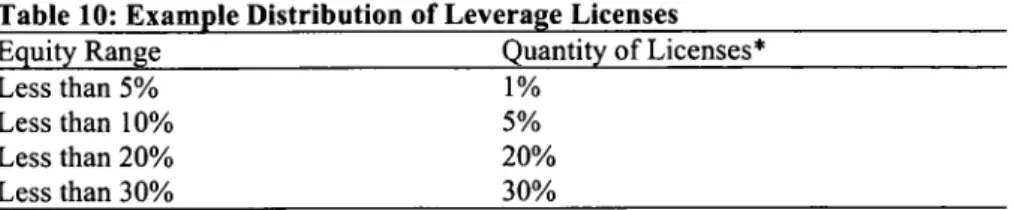
licensing regime we propose below,54 regulators could permit 2% of new mortgages to have a very low down payment, which would bring society the benefits of a low quantity of risky contracting without the costs of too much. And of course, regulating the distribution of contract terms permits raising the mean (or median) level of equity as well. Regulators could simply license 51% of new mortgages at a 20% down payment level and thereby ensure that on average new mortgages would remain low-risk from an initial equity standpoint.
In short, QM and QRM both reflect an overly narrow regulatory paradigm of prohibiting risky contract terms rather than considering the distribution of those terms in the borrower population. In particular, the regulatory response to the crisis has not adequately considered the aggregate effect of low-equity clustering among the borrower population when home prices drop and liquidity dries up. The next Part will show that the housing crisis beginning in 2007 was preceded by a high concentration of low levels of equity, which amplified the harm caused by falling home prices by pushing a larger cohort of borrowers underwater. As this leads to higher levels of default and foreclosures, reducing home prices even further, low-equity clustering contributes directly to systemic risk in the housing market.
II. The Economic Effect of Low-Equity Clustering
One factor affecting the overall stability of the housing market is the system-wide distribution of home equity. Average equity levels are undoubtedly important: a population with greater home equity on average would have fewer homeowners below the zero-percent level when housing prices fall. Yet the distribution of equity levels is also crucial: if more homeowners are tightly clustered together at a low level of equity, a drop in housing prices beyond this level pushes proportionately more homeowners into negative equity than if borrowers are spread evenly across the equity spectrum. As increased default can lead to a cycle of falling housing prices through
53. Put differently, where the marginal benefit of a certain quantity of risky terms is equal to its marginal cost.
54. See discussion infra Section IV.A.
foreclosures and short sales, low-equity clustering represents a form of systemic risk to the housing market.5
Mechanisms that prevent low-equity clustering can be likened to flood levies that provide multiple layers of protection in the event of a disaster. Each additional level of home equity provides an additional safeguard. For example, if all of the homeowners in a given population are clustered around the 5% equity level, a drop in home values of 10% pushes every homeowner in the population into negative equity. However, if half of the population held 15% equity loans (and the remainder held 5% equity), that half would remain in positive equity even if home values dropped by 10%. Similarly, if 1/3 of the population were at the 5% equity level, 1/3 at the 12% level, and 1/3 at the 15% level, even fewer homeowners would be facing negative equity in the scenario where home prices dropped by 10%. This simple example illustrates that increased distribution of home equity reduces the danger from low-equity clustering. Indeed, since the exact drop in home prices is unknown in advance, it might seem prudent to encourage an even and smooth distribution of equity so as to minimize the number of homeowners who would be pushed into negative equity with any decrease in home prices. In terms of flood levies, one might argue that more levies are better because they provide redundant protection.
However, such an approach carries its own risks. In particular, equity that is spaced too smoothly can lead to a "domino effect" in which one small drop in prices triggers a cascading cycle of default and decreasing prices. For example, a drop in prices of 2% would push homeowners at the 1% equity level into negative equity and subsequent default. Even if the resulting foreclosure or distressed sale only further depressed prices by 1%, that would push homeowners at the 2% equity level into negative equity and subsequent default. This cascading cycle of dropping prices and default would expose the housing market to a much higher level of systemic risk than the scenario in which homeowners were clustered at the 10% level. Indeed, in this example, no homeowner would be pushed into negative equity in the clustering scenario, whereas a smooth distribution of equity could expose every homeowner located along the cascading chain of falling prices to negative equity and subsequent default.
Admittedly, this scenario of cascading default might seem unrealistic in light of the economic research that shows that homeowners do not necessarily default in response to very small levels of negative equity. Moreover, the requisite liquidity shocks might not be present in cases where exogenous
55. Reducing low-equity clustering also has informational benefits in addition to reducing systemic risk. Greater diversity in the distribution of equity provides a "miner's canary," an early warning system that something is wrong without triggering the cascading effect of foreclosures leading to prices falling further. We discuss these informational benefits in detail in Ian Ayres & Joshua Mitts, Anti-Herding Regulation (2013) (unpublished manuscript) (on file with authors).
Yale Journal on Regulation
factors lead to only a minor drop in home prices. As substantial decreases in home values often result from asset bubbles whose popping leads to increased credit constraints, the more typical scenario would see drops in home values on the order of 10-15% rather than 1%. Nonetheless, the concern of a domino effect is present even at higher levels of home equity: a drop in prices by 10% might trigger a cascading cycle of falling prices at the 9% equity level, followed by 10%, 11%, etc. Thus, when considering mechanisms to reduce low-equity clustering, it might be beneficial to consider "circuit breakers"-empty ranges of equity levels that could absorb small decreases in prices by keeping homeowners above the range in positive equity. For example, in the case where home prices fall by 10%, a gap in equity between 10-12% would ensure that any subsequent drops in home values from 10% to 11% would not lead to a further drop from 11% to 12%. Indeed, the regulatory regime proposed in this Article includes a monitoring component that enables maintaining these "circuit breakers" alongside a non-clustered distribution of
mortgage leverage.56
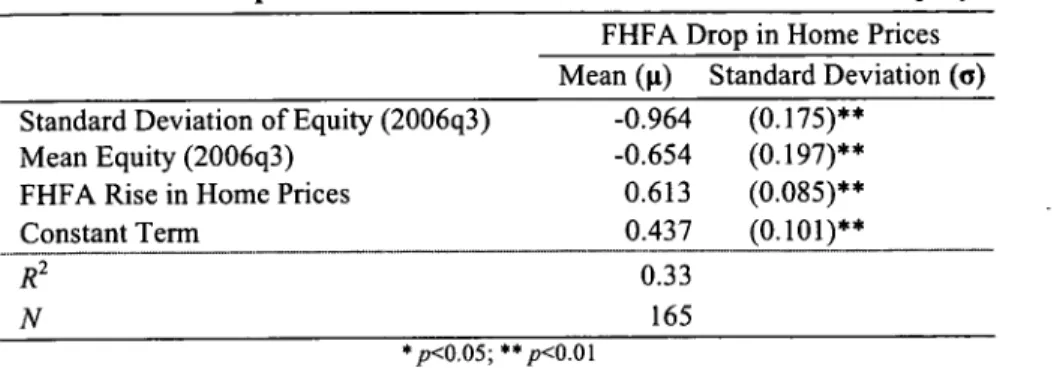
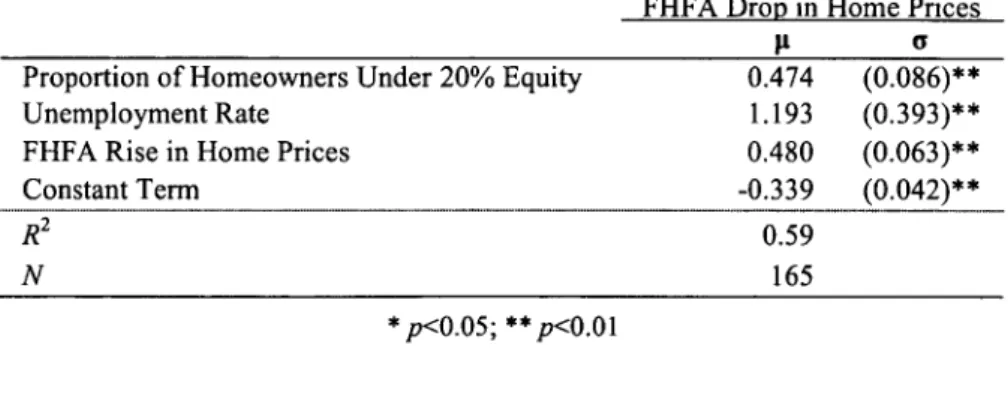
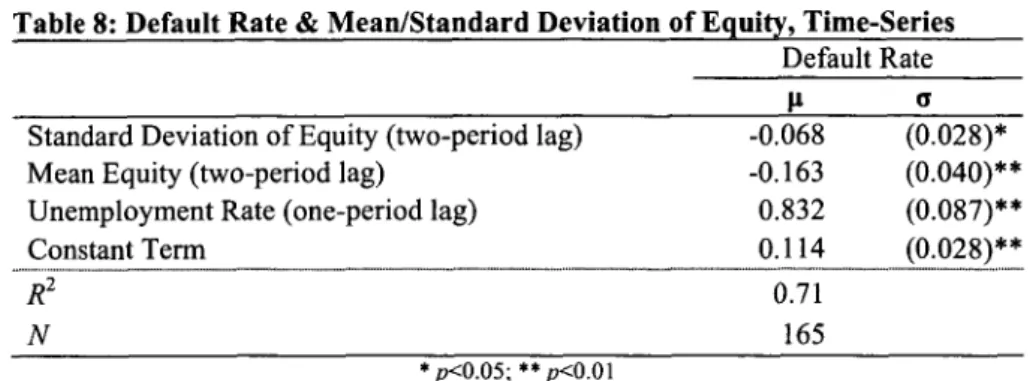
This discussion is not merely hypothetical, for the effect of low-equity clustering is ultimately an empirical question. In Section II.A, we summarize existing empirical research that suggests that certain mortgage terms and equity extractions preceded the housing crisis. In Section II.B, we present the results of an original empirical study we conducted, which are consistent with the hypothesis that more concentrated levels of equity led to greater declines in home prices and higher levels of mortgage default during the crisis period.
A. Existing Research on Low-Equity Clustering
To demonstrate the importance of regulating the distribution of home equity, this Section presents empirical studies of the impact of low-equity
clustering on home prices and default over the past decade.57 One recent study
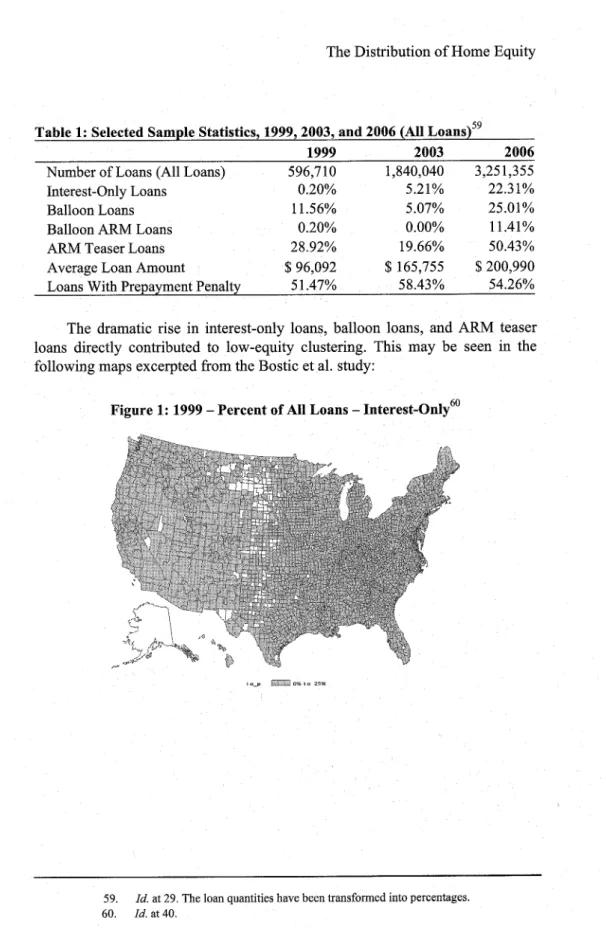
by Bostic et al. shows that the prevalence of risky mortgage terms rose
dramatically during the housing bubble, as indicated in the table below, which contains a breakdown of home mortgages in 1999, 2003, and 2006 :
56. See discussion infra Subsection IV.A.3.
57. We define equity as the difference between the purchase price of the home and the mortgage principal balance, which typically includes closing costs as well.
58. Raphael W. Bostic et al., Mortgage Product Substitution and State Anti-Predatory
Lending Laws. Better Loans and Better Borrowers? (U. Penn Inst. Law & Econ. Research Paper No. 09-27, 2012), http://ssm.com/abstracy=1460871. The following tables, maps, and headings are directly
excerpted from this research paper.
Table 1: Selected Sample Statistics, 1999, 2003, and 2006 (All Loans)5 9
1999 2003 2006
Number of Loans (All Loans) 596,710 1,840,040 3,251,355
Interest-Only Loans 0.20% 5.21% 22.31%
Balloon Loans 11.56% 5.07% 25.01%
Balloon ARM Loans 0.20% 0.00% 11.41%
ARM Teaser Loans 28.92% 19.66% 50.43%
Average Loan Amount $ 96,092 $ 165,755 $ 200,990
Loans With Prepayment Penalty 51.47% 58.43% 54.26%
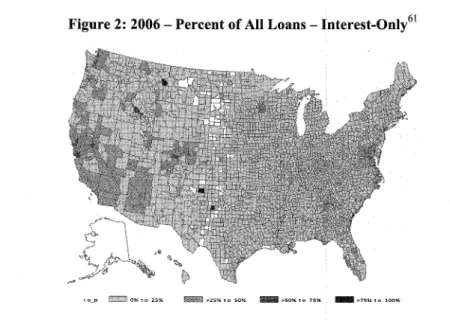
The dramatic rise in interest-only loans, balloon loans, and ARM teaser loans directly contributed to low-equity clustering. This may be seen in the following maps excerpted from the Bostic et al. study:
Figure 1: 1999 - Percent of All Loans - Interest-Only60
lop 2 %ta 25%
59. Id. at 29. The loan quantities have been transformed into percentages. 60. Id. at 40.
Yale Journal on Regulation
Figure 2: 2006 - Percent of All Loans - Interest-Only6 1
ooo g
In these maps showing the proportion of interest-only loan originations in
1999 and 2006, one can quickly see these terms were concentrated in California
and a few select non-California counties where more than 25% of originations-and at times more than 50% of originations-were made on an interest-only basis.
Figure 3: 1999 - Percent of All Loans - Balloon62
-alIo-n o0 to 25% I IM5% >Sa to 7% I 75s t .oo0G%
61. Id. 62. Id. at 41.
Figure 4: 2006 - Percent of All Loans - Balloon6 3
W1 I _II-o M s o 1oo
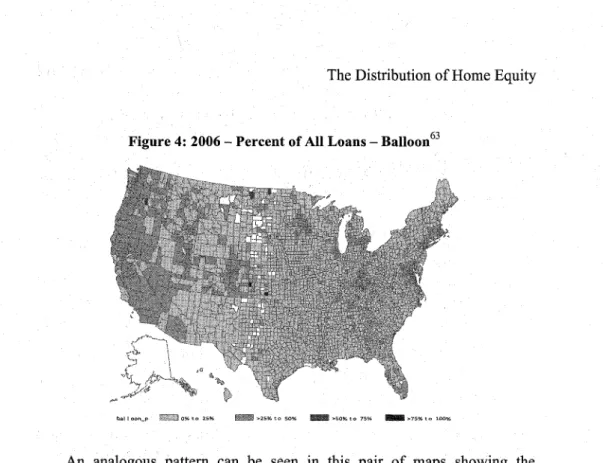
An analogous pattern can be seen in this pair of maps showing the increased prevalence and concentration of mortgage originations with balloon payment conditions.
Finally, the following figure taken from the study shows the nearly
universal dominance of teaser rates in the 2006 market, as more than 75% of
the originations in virtually all counties were teaser ARM loans:
Figure 5: 2006 - Percent of Adjustable Rate Loans with a Teaser6 4
t sep EM0 oIIII 2st % 2s5toso% s 0il 1>1so%
63. Id. 64. Id. at 42.
Yale Journal on Regulation
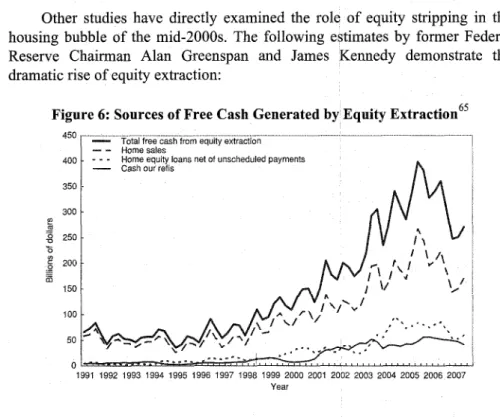
Other studies have directly examined the role of equity stripping in the housing bubble of the mid-2000s. The following estimates by former Federal Reserve Chairman Alan Greenspan and James Kennedy demonstrate the dramatic rise of equity extraction:
Figure 6: Sources of Free Cash Generated by Equity Extraction65
- Total free cash from equity extraction
- - Home sales
400 - - Home equity loans net of unscheduled payments
- Cash our refis 350 300 0 250 200 150 100 50 1991 1992 1993 1994 1995 1996 1997 1998 1999 2000 2001 2002 2003 2004 2005 2006 2007 Year
Figure 6 shows that equity extractions rose dramatically over the prior decade, rarely topping $100 billion in the years 1991-2000 yet skyrocketing to approximately $400 billion in 2005.66 Surveys of cashout refinance borrowers suggest that a substantial proportion of funds converted to cash were used for personal consumption expenditures (including vacations).67 These findings are consistent with evidence that homeowners utilized home equity loans to finance discretionary spending.68
In a study that strongly supports this paper's thesis, Amir E. Khandani, Andrew W. Lo, and Robert C. Merton estimated the extent to which "equity extractions" in the years leading up to the housing crisis led to an "unintentional synchronization of leverage" that increased the correlation of
65. This figure and the following graph and heading are excerpted from Alan Greenspan & James Kennedy, Sources and Uses of Equity Extracted from Homes, 24 OXFORD REV.
EcoN. POL'Y 120, 125 (2008).
66. Id.
67. Id. at 126. For an example found in a news story at the height of the bubble, see Michael Rubinkam, Home Equity Used to Finance Super Bowl Trips, HOUS. CHRON., Feb. 2, 2005, http://www.chron.com/business/article/Home-equity-used-to-finance-Super-Bowl-trips-1660034.php.
68. E.g., Atif Mian & Amir Sufi, House Prices, Home Equity-Based Borrowing, and the U.S. Household Leverage Crisis, 101 AM. ECON. REv. 2132, 2152 (2011) (finding that "a large
fraction of home equity-based borrowing is used for consumption or home improvement").
mortgage default among homeowners.69 An equity extraction occurs when a homeowner obtains a "cash-out" refinancing loan or home equity loan, or sells his or her home and obtains a new mortgage with a higher loan-to-value ratio,
retaining the proceeds from the sale as cash.70 Khandani et al. explain the
"self-synchronizing ratchet effect," which renders low-equity clustering such a potent source of systemic risk:
[R]efinancing-related increases in leverage cannot be symmetrically reduced when property values decline because homes are indivisible .... Once property values decline, a wave of defaults becomes unavoidable because mortgage lenders have no mechanism such as a margin call to compel homeowners to add more equity to maintain their leverage ratio, nor can homeowners reduce their leverage in incremental steps by selling a portion of their homes and using the proceeds to reduce their debt. This self-synchronizing "ratchet effect" of the refinancing market can create significant systemic risk in an otherwise geographically and temporally diverse pool of mortgages, steadily increasing the aggregate leverage of the housing market until it reaches a systemically critical threshold.7 1
Indeed, this is what fundamentally distinguishes mortgage leverage
synchronization from similar synchronization in liquid securities: unlike with stocks or bonds in an investment portfolio, a homeowner cannot sell a portion of his or her physical home to reduce leverage.72 Greater leverage synchronization thus increases systemic risk because a drop in home prices leads to highly correlated set of defaults among homeowners clustered at low
levels of equity.73
Khandani et al. provide empirical support for the ratchet effect by using data regarding accumulated equity in mid-2006, once housing prices began to fall, to simulate the expected level of negative equity at the end of 2008.74 In their simulation, "approximately 18% of all mortgage loans exhibit negative equity as of December 2008, which is nearly identical to the actual figure
reported by industry sources."75 The simulated incidence of negative equity for
that period without equity extractions is 3%, meaning that the refinancing ratchet effect caused 15% of mortgages to have negative equity in the
69. Amir E. Khandani et al., Systemic Risk and the Refinancing Ratchet Effect 3 (Nat'l Bureau of Econ. Research Working Paper No. 15362, 2009); see also Greenspan & Kennedy, supra note 65 (estimating equity extractions from 1991-2006).
70. See Greenspan & Kennedy, supra note 65, at 122; Alan Greenspan & James Kennedy, Estimates of Home Mortgage Originations, Repayments, and Debt on One-to-Four-Family Residences 5-6 (Fed. Reserve Bd. Fin. & Econ. Discussion Series No. 2005-41, 2005).
71. Khandani et al., supra note 69, at 2. 72. See id. at 2.
73. Cf id. at 3. 74. See id. at 4.
75. Id.
Yale Journal on Regulation
simulation.76 Accordingly, low-equity clustering through cash-out refinancing
made a substantial contribution to systemic risk in the housing market by placing more owners at risk of falling into negative equity.
B. An Original Empirical Study on Low-Equity Clustering
As an additional demonstration of the contribution of low-equity clustering, we conducted an empirical study that examined home equity levels of over 20,000 homeowners across eleven states from 1999 to 2011. Our results found that higher levels of low-equity clustering correlate with increased mortgage delinquency even after controlling for macroeconomic shocks. While imperfections in the data preclude establishing strong causal explanations, the results nonetheless serve as heuristic evidence of the need to attend to the problem of low-equity clustering.
1. Research Design
When conducting this study, we set out to examine the impact of low-equity clustering on home prices and mortgage default. As falling home prices and increased default feed each other in a cascading cycle, we measure the effect of low-equity clustering on each independently. We examine these two variables on a quarterly basis from the first quarter of 1999 to the first quarter of 2011 across eleven highly populated states: Arizona, California, Florida, Illinois, Michigan, Nevada, New Jersey, New York, Ohio, Pennsylvania, and
Texas.77 State-level quarterly home price data were obtained from the Federal
Housing Finance Agency (FHFA). State-level quarterly mortgage
delinquency rates were obtained from the Federal Reserve Bank of New
York.79
Data on home equity levels were derived from the U.S. Department of Labor Bureau of Labor Statistics Consumer Expenditure Survey, a quarterly survey of consumers on household income and expenditures. The survey asks
76. Id.
77. These states and years were selected because data on mortgage default were freely available from the Federal Reserve Bank of New York for these states and years alone. See Quarterly
Report on Household Debt and Credit, FED. RESERVE BANK OF N.Y. 22 (2011),
http://www.newyorkfed.org/research/nationaleconomy/householdcredit/DistrictReporQ32011.xlsx.
78. These data may be found at Downloadable HPI Data, FED. HOUSING FIN. AGENCY, http://www.fhfa.gov/Default.aspx?Page=87 (last visited Feb. 14, 2014). The study utilized the data through 2011Q3 from the dataset entitled "States through 2013Q4 (Not Seasonally Adjusted)" under "All-Transactions Indexes (Estimated using Sales Prices and Appraisal Data)."
79. See FED. RESERVE BANK OF N.Y., supra note 77, at 22 (showing the state-level data
as "Percent of Mortgage Debt 90+ Days Late by State").
80. Consumer Expenditure Survey, U.S. DEP'T OF LABOR BUREAU OF LABOR STATISTICS, http://www.bls.gov/cex (last visited Feb. 14, 2014). For a detailed description of how the
survey is conducted, see Consumer Expenditures and Income, in BLS HANDBOOK OF METHODS (2013), http://www.bls.gov/opub/hom/pdf/homchl6.pdf.
homeowners to state their outstanding mortgage principal balance for each month as well as the estimated current value of their home. We divided the monthly principal balances by the estimated home value to produce a monthly equity level, which we averaged to produce a quarterly equity level for each
homeowner. While homeowners' estimates of the value of their own homes
may be imprecise and may even systematically understate or overstate house values, these estimates will be sufficient for our purposes so long as they are correlated with homes' true values and any bias is orthogonal to the degree of leverage (and other potential influences on market behavior).
We estimate the prevalence of low-equity clustering in several ways. First, we compute the standard deviation of home equity levels in each state-quarter. The standard deviation can serve as a useful measure of the dispersion of the data in general: the lower the standard deviation, the more the data are clustered around their mean. Of course, for the standard deviation to be useful for measuring low-equity clustering, it is essential to measure the mean as well. The study thus computed the mean of home equity levels in each state-quarter. When taken together, the mean and standard deviation of equity levels provide a useful picture of the degree of low-equity clustering. In addition, as an alternative measure of low-equity clustering, the proportion of homeowners with less than 20% equity was computed by dividing the number of homeowners with less than 20% equity by the number of homeowners with mortgages in each state-quarter.
Finally, we obtained the state-level seasonally adjusted unemployment rates from the U.S. Department of Labor Bureau of Labor Statistics.82 The unemployment rate reflects crisis conditions at the macroeconomic level and
81. At a technical level, this computation was conducted as follows. First, the microdata for each year in the Consumer Expenditure Survey dataset were downloaded. (The following column/table names refer to the CES microdata.) Next, the monthly mortgage principal balances were extracted from the "QBLNCMI," "QBLNCM2," and QBLNCM3" columns in the "MOR" table. Property values were obtained from the "PROPVALX" column in the "OPI" table by matching the "NEWID" and "PROPNO" columns from the "MOR" table with the same columns in the "OPI" table. Finally, the geographic state of the consumer was obtained by matching the "NEWID" column in the "MOR" table with the "NEWID" column in the "FML" quarterly tables, which contain biographical information on the consumer unit. An objection might be raised that it is inaccurate to compute average quarterly equity based on the estimated property value at the time the survey is completed because that estimate occurs at the end of the quarter when the survey is taken. Admittedly, this estimation lacks sufficient specificity to capture precise intra-quarter equity levels, e.g., on a month-by-month basis. However, it seems to be the best available alternative. Using solely the third-month principal balance in the equity computer would arguably lead to a greater distortion because it would omit any intra-quarter change in principal, which might be much more substantial. For example, a homeowner might refinance into a lower-equity loan in the second month, leading to a higher principal balance in the third month. In such a scenario, it would be inaccurate to utilize an equity level reflecting the third month alone because the prior two months of the quarter had a lower principal level. This increased leverage should be weighted appropriately as one third of the quarter, not 100%.
82. Local Area Unemployment Statistics, U.S. DEP'T OF LABOR BUREAU OF LABOR STATISTICS, http://www.bls.gov/lau (last visited Feb. 14, 2014).