NORA LEÓN RESETTLEMENT + COMMUNITY CENTER
1 RICE UNIVERSITY
RESETTLEMENT + COMMUNITY CENTER
by Nora León
A THESIS SUBMITTED IN PARTIAL FULFILLMENT OF THE REQUIREMENTS FOR THE DEGREE
Master of Architecture
HOUSTON, TEXAS MAY 2017
APPROVED, THESIS COMMITTEE:
______________________ Sarah Whiting, William Ward Watkin Professor, Dean ______________________ Gordon Wittenberg, Professor of Architecture, Director of Graduate Studies ______________________ Scott Colman, Assistant Professor, Thesis Director and Coordinator
3
Abstract
Resettlement + Community Center...4
Research Need For A New Type of Urban Catalyst...6
Lewiston: Past, Present, Future...12
Cities With Dynamics Similar to Lewiston...18
Community Investment and Phasing...28
Programmatic Breakdown...36
Urban Engagement...54
Facade Design and Edge Strategy...64
Economic Incentives of Proposal...74
Project Floor Plans...86 Building Elevations...96 Sections...101 Renderings...105 CONTENTS
4
ABSTRACT
RESETTLEMENT + COMMUNITY CENTER Following decades of steady population decline, the former mill town of Lewiston, Maine has recently experienced significant resettlement. Among Lewiston’s 36,000 inhabitants, 6,000 are Somali refugees who have relocated to the city since 2001. A new Resettlement + Community Center, a major architectural intervention for the city of Lewiston, will bolster two worldwide dynamics—assisting resettled refugees and revitalizing shrinking downtowns in an unprecedented way. Resettlement centers in declining industrial cities can foster entrepreneurship, stimulate the economy, and act as mechanisms for inclusion and integration. This program functions as a framework to bridge the ambitions of the emerging immigrant population with the recovery of American cities, often in the Rustbelt, that have suffered decades of economic decline, population loss, and urban decay due to deindustrialization. In addition, the center bridges the Riverfront and Downtown districts, working to reactivate Lewiston’s neglected canal network for maximum impact. An integrated resettlement and community center is a new type of urban typology that maximizes investment in the city by providing social services to both new and existing Lewiston populations.
8
American small-town industrial decline and global political economic instability are interconnected. The recent US presidential election have shown how Americans are reacting to the issue of immigration. While cities across the globe are being shaped by political unrest and mass migration, American legacy cities (older industrial urban areas that have experienced significant population decline and job loss, resulting in high residential vacancy rates and diminished services and resources), are particularly primed to benefit from embracing a new wave of refugee migration.
8
The former mill town of Lewiston, Maine has followed a pattern of significant resettlement. Among Lewiston’s 36,000 residents, 6,000 are Somali refugees who have relocated to the city since 2001. Refugee resettlement has curbed significant population loss and reversed the city’s slow decline.
10
Resettlement centers in declining industrial cities like Lewiston can foster entrepreneurship, stimulate the economy, and act as mechanisms for inclusion and integration. This program functions as a framework to bridge the ambitions of the emerging immigrant population with the recovery of American cities, often in the Rustbelt, that have suffered decades of economic decline, population loss, and urban decay due to deindustrialization.
12
In Lewiston, the textile industry collapsed after World War I when Lewiston’s water mills became outmoded and companies moved to the South. Subsequently, other businesses closed and the economy went into a sharp decline. Today, much of the infrastructure constructed during that period – the canals, buildings – remain idle or underused even as Lewiston’s economy is facing an identity crisis and is struggling to grow.
13
14
Fig 10. Bates Mill and canal c. 1915, Lewiston, Maine
HISTORIC LEWISTON
Fig 9. Main Street c. 1915, Lewiston, Maine
Fig 8. Textile Mills and canal c. 1915, Lewiston, Maine Fig 7. Textile Mills and canal c. 1915, Lewiston, Maine
15 MASTER’S DEGREE
0% 15%
BORN IN STATE OF RESIDENCE
0% 86%
RESIDENTS BELOW POVERTY LINE
0% 55%
— “Lewiston, Maine.” City Data. Web. 19 Sept. 2016
MEDIAN INCOME
$10,000 $140,000
UNEMPLOYMENT
0% 26%
MEDIAN FAMILY INCOME
$15,000 $105,000
HOUSE BUILT BEFORE 1939
88% 0%
LEWISTON CITY DATA
DOWNTOWN
16
While refugee resettlement initially can be costly, investing in refugees yields tangible economic benefits. Refugee resettlement grows the labor pool and increases local revenues through investment, taxes and increased consumption. Resettlement centers can strengthen the economy, bolster civic pride, and make cities work better for all residents.
18
American legacy cities including Syracuse, Buffalo, Minneapolis and St. Louis share many of the same economic challenges and urban conditions with Lewiston—a long history as industrial powerhouses with distressed downtowns. The city centers of these post-industrial cities can benefit most from resettlement and revitalization.
19 200 MI 400 MI 600 MI 800 MI ST LOUIS 62.7% 116 AKRON 34.5% ALBANY 27.5% BALTIMORE 34.6% BIRMINGHAM 37.7% BUFFALO 53.4% 361 CAMDEN 37.9% CINCINNATI, 41.1% CLEVELAND 56.6% DAYTON 46.1% DETROIT 61.4% ERIE 26.5% 207 FLINT 48% GARY 55% HAMMOND 27.6% HARTFORD 30.1% MINNEAPOLIS 26.7% 646 NEWARK 37.3% NEW HAVEN 21.1% NIAGARA FALLS 51% PITTSBURGH, PA 54.8% PROVIDENCE 29.6% READING 20.8% ROCHESTER 36.7% 126 SCRANTON 46.9% SOUTH BEND 23.6% SYRACUSE 34.2% 307 TOLEDO 25.2% TRENTON 33.7% UTICA 38.8% WILMINGTON 37% YOUNGSTOWN 60.6% COLUMBUS 412 DURHAM 108 LOUISVILLE 236 GRAND RAPIDS 114 LANSING 117 PORTLAND 108 MILWAUKEE 87 KANSAS CITY 145 ST CLOUD 243 FARGO 90 SIOUX FALLS 89 LEWISTON 12.9% 426 BOSTON 108 WORCHESTER 82
CITIES RECEIVING SOMALI REFUGEES: # DURING 2015-16 SHRINKING CITIES: % DECLINE FROM PEAK
20 RACES IN LEWISTON, ME (2013) WHITE ALONE ASIAN ALONE HISPANIC OTHER BLACK ALONE 2+ RACES RACES IN LEWISTON, ME (2010)
WHITE ALONE ASIAN ALONE HISPANIC OTHER 2+ RACES
Fig 14. Lewiston Downtown Fig 13. Lewiston Youth Anti-Bullying Advisory Council
DEMOGRAPHICS DATA
22
In Lewiston, Somali immigrants already are making a positive impact. Leveraging this momentum, the new Lewiston Resettlement complex consolidates and formalizes the existing scattered resettlement network into a centralized catalyst to help revitalize Lewiston’s downtown and its underutilized historical infrastructure.
23
CONSOLIDATE ADD
RESETTLEMENT SOCIAL SERVICES COMMUNITY ASSETS
SOCIAL SERVICES
RESETTLEMENT
24
An integrated resettlement and community center (RRC) is a new type of urban catalyst that maximizes investment in the city by providing social services to both new and existing Lewiston populations.
26
1996 PRESIDENTIAL ELECTION RESULTS 2000 PRESIDENTIAL ELECTION RESULTS 2008 PRESIDENTIAL ELECTION RESULTS
DOLE (26%) OTHER (18%) CLINTON (57%) BUSH (41%) OTHER (6%) GORE (53%) MCCAIN (41%) OTHER (2%) OBAMA (57%)
2012 PRESIDENTIAL ELECTION RESULTS 2016 PRESIDENTIAL ELECTION RESULTS
ROMNEY (42%) OTHER (3%) OBAMA (55%) TRUMP (50%) OTHER (7%) CLINTON (41%) LEWISTON ELECTION DATA
28
This Center uses economies of scale to provide the maximum impact toward making Lewiston a more vibrant and equitable destination for everyone, in turn, creating a sense of optimism, to help stop the flight of long-time locals and recent resettlers alike. A major architectural investment of new construction (as opposed to the reuse of existing buildings) helps create this sense of progress and concretizes refugee resettlement as a mechanism of urban revitalization.
29
30
The RRC hosts a spectrum of social services and community support resources designed to serve both new immigrants (Somali or other refugees) AND the longtime Lewiston residents. The wide array of programming offered includes temporary and transitional housing, job training, childcare, English as a Second Language tutoring, legal counseling, citizenship assistance, computer resources, a library and cafe, several classrooms, meeting rooms, studios, economic empowerment support spaces including a market and bazaar and over 100,000 square feet of programmed recreation spaces including basketball courts, a flex space, exercise rooms, a playground, a vegetable garden, and facilities for canoing on the canal.
31 LANDSCAPE 100,000SF CAFE 4,000SF LIBRARY 5,000SF GALLERY 2,000SF MARKET/ COMMERCIAL 40,000SF GYMNASIUM/ FLEX SPACE 14,000SF TEMPORARY HOUSING (28 FLEXIBLE UNITIS) 30,000SF
TRANSITIONAL HOUSING (32 UNITS) 50,000SF
INDIVIDUAL STUDY ROOMS 3,000SF CO-WORKING SPACE 4,000SF MEETING ROOMS 2,000SF MEDIA LAB 5,000SF
CLASSROOMS/ STUDIOS 5,000SF ADMINISTRATION 2,000SF JOB TRAINING CENTER 4,000SF
CHILDCARE 4,000SF
TOTAL AREA 270,000SF (INTERIOR) 170,000SF
RESETTLEMENT HOUSING Private program accessed by immigrants only
JOB PREPAREDNESS Program intended to quickly aid immigrant success
PUBLIC PRIVATE
RESETTLEMENT COMMUNITY
SOCIAL SERVICES Program aimed to advance specific job, computer & financial literacy skills
COMMUNITY ASSETS Program intended for all residents. Cultivate cross-cultural dialogue and community engagement in Lewiston
LANDSCAPE
Outdoor courtyard programs engage surrounding city fabric
32
The Resettlement and Community Center is situated blocks away from the Androscoggin River. Almost 200 years ago, this river drew industry to the area when a now antiquated canal system harnessed the river’s mighty power to turn water wheels that served the textile mills.
B
0%
34
The old textile mills closed 70 years ago and the city has encouraged re-branding these industrial relics as the “Riverfront District,” in an attempt to reorient the city center to face the Androscoggin River, and make it a revived “urban destination, a place for recreation, cultural activities, work and urban living.” The Resettlement + Community Center will leverage and enhance this anticipated “destination.”
The Center also borders the historic Downtown District to the east. The RCC’s program includes commercial “practice spaces,” where immigrants can set up shop and launch careers. These practice spaces help activate Lewiston’s Main Street corridor, and, in turn, stimulate nearby businesses, and capitalize upon the existing resettlement success in Lewiston.
35
SITE
Textile mills (re-branded as “Riverfront District”)
OLD MILLS RIVERFRONT DISTRICT
Main Street Corridor
DOWNTOWN DISTRICT
36
The RRC consists of four buildings totaling 170,000 square feet, and spanning two downtown blocks. This central location acts as a bridge, not only between new and existing populations, but also between the Riverfront and Downtown districts, working to reactivate Lewiston’s neglected canal network and have maximum impact on the urban area.
37 CANALS NETWORK DOWNTOWN DISTRICT RIVERFRONT DISTRICT + MILLS
38
The Resettlement and Community Center activates not only the Main Street and Canal, but also opens to an alley passage that is energized with a variety of market stall and programmed courtyards that foster interaction between diverse communities through technology, art, culture, and, education.
39 “Residents ranging from high school
students to city officials discussed the need to increase cross-cultural dialogue and opportunities for community engagement in Lewiston and in the Downtown specifically.”1
“Invest in connecting Downtown residents with consistent employment – English language learning and job preparedness training need to be better aligned with immigrant residents’ needs.”1
“Housing, jobs, and social services are all interconnected: questions about one topic prompt discussion of the others, and planning should therefore be directed towards strategies that address these three elements in combination.”1
— Harvard Community Development Project in Partnership with the Downtown Neighborhood Action Committee. Downtown Lewiston: Recommendations for Neighborhood Redevelopment. Harvard University, 2014. 6.
“Suggestions for improving connections among Downtown residents include introducing a new community center that can be programmed with activities for all residents in the area.”1
Fig 24. Protesters at City Hall after Lewiston
may-or made comments about Somali refugees, 2012
Fig 25. The audience at recent Lewiston mayoral
debate
40
The most private spaces of the RRC exist on the third and upper levels. These floors consist of 28 units of new immigrant transitional housing (in the Main Street-facing buildings)
41
TRANSITIONAL HOUSING
MAIN STREET
42
and 32 units of temporary housing (in the canal-facing buildings).
43 MAIN STREET
CANAL
44
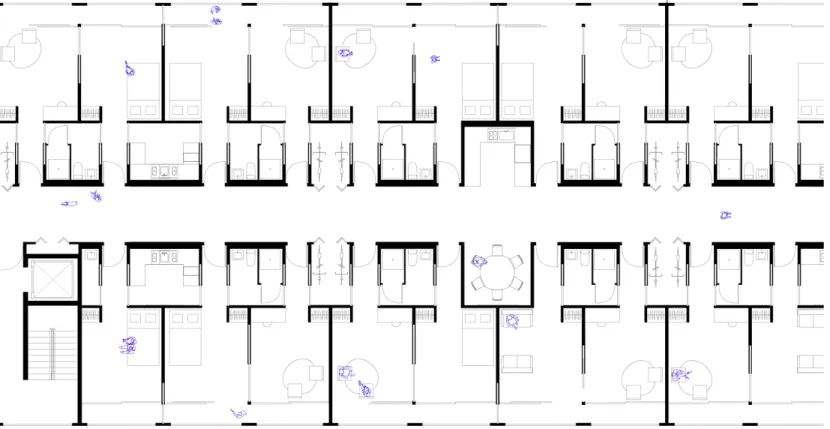
In the temporary housing, each unit is linked by a series of sliding doors, so the size of the “apartment” can grow or shrink depending on the size of the family occupying it.
45 TWO BEDROOMS
THREE BEDROOMS ONE BEDROOM
46
In addition, a childcare center anchors the first floor, allowing immigrant adults access to affordable childcare while they attend job training classes, workshops, or focus on growing their businesses.
47
CHILDCARE
MAIN STREET
48
The Education and Job Training Center consists of several classrooms, meeting rooms, co-working spaces, and a media center. Programs provide assistance, training, and resources in finding a lasting career.
49
EDUCATION/JOB TRAINING
50
In addition, there is a public library, flex space and a gallery for large events, a cafe and a gym. These community-based programs add additional (Resettlement) resources and amenities not only to immigrants, but provide accessible social services open to all of Lewiston’s residents.
51 COMMUNITY PROGRAM CAFE LIBRARY GYM FLEX SPACE
52
The primary approach to attract the existing communities to the site is to offer the varied commercial programs. These include small market stalls lining the alley and an interior pop-up market for fledgling entrepreneurs to develop their businesses. These spaces provide a new zone to incubate local entrepreneurial activity and help reinforce the district’s longtime commercial identity.
53
54
The four buildings of the complex are integrated with each other and the surrounding urban fabric through three programmed plazas. These outdoor spaces blend with the indoor spaces through continued ground and surface conditions, drawing people into the RRC and leading them out into the city.
55
56
Each of these plazas has a unique identity.
57
URBAN ENGAGEMENT
ALLEY PLAZA
CANAL PLAZA
58
The Alley Plaza acts as a formal square linking the job training center with the more commercial programs.
59
60
The Canal Plaza extends across the canal to link the four buildings to the urban farm, where agriculture skill training takes place. Many of the job skills immigrants bring to Maine are agriculture-based, so the urban farm and the resettlement center are designed to feed off each other.
61
62
The Play Plaza is programmed with equipment to encourage child and adult play.
63
64
This indeterminate site edge condition imbricates the life of the building and the life of the urban street, interfacing between street and interior. Formal and informal spaces of encounter add positive and porous relationships between newcomers and existing residents aiming to maximize social interaction.
65
66
The RRC has a commercial facade and arcade facing Lewiston’s Main Street, designed to draw passersby into the interior courtyards, commercial alley, and other public programs.
The arcade, one of several points of entry to the center, directs visitors to the pedestrian alley lined with market stalls where entrepreneurs, artists, and makers sell goods and provide services and wares.
67
WEST ELEVATION - MAIN STREET
Scale: 1’ = 1/80” ARCADE
68
The arcade and the alley lane aim to produce a porous pedestrian precinct connecting the new plazas, Main Street, the canal, and the riverfront district beyond, placing the resettlement community center at the heart of a new Lewiston and promoting exchange between recently arrived and longstanding residents.
70 Fig 41. View from vegetable garden across canalFig 42 (opposite). View of pedestrian alley VEGETABLE
GARDEN TEMPORARY
B MARKET STALLS ALLEY PLAZA MEDIA LAB TRANSITIONAL HOUSING
72
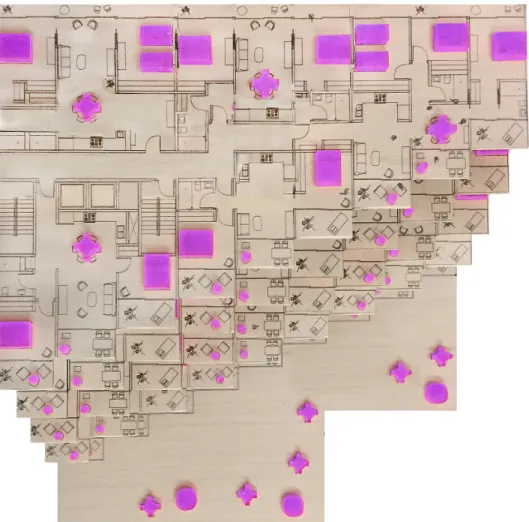
The four buildings are united as one object through colored panels that link the buildings’ facades.
The cohesive system engages with the surrounding fabric through the red and purple hues that mimic the brick colors seen in buildings nearby, without seeking to hide through contextualism.
73
74
Investing in Resettlement Centers is an investment in the future. The US Office of Housing and Human Services should partner with the office of Housing and Urban Development to provide federal funding. The Lewiston Resettlement Community Center is the first of its kind, developing critical infrastructure that pays dividends in the long run. While immigration resettlement may be the mechanism, the impact of design-based development touches nearly every aspect of the city’s economy by attracting investment, boosting local tax revenues and increasing consumer spending, offering multiple touch points, including retail, and growing dense, unique commercial districts.
76
Under the new administration, The Department of Housing and Urban Development should prioritize more time and funding for intercity regeneration and refugee resettlement in cities like Lewiston. Ignoring the two critical situations would fore go legitimate possibilities to regenerate depressed urban cores in Republican leaning states.
78
Resettlement centers leverage refugees as community and civic assets, injecting new energy and perspectives into the declining urban centers. Over time, the locus of activity will begin to permeate into the broader city fabric.
79 Fig 47. New Lane
Fig 48. Program to Exterior
Fig 49. Program Massing
Fig 50. Building Massing
Fig 51. Facade Strategy Fig 46. Urban Engagement
80
The program allows new populations to tap into resources, build public-private alliances and eventually reach out into the urban neighborhood to revitalize unused downtown spaces in creative and unconventional ways. Immigrants are specifically well-suited to activate Lewiston’s many unused spaces and see opportunity in areas that may not be apparent to the native-born population. According to the Small Business Administration, immigrants are 30% more likely to start a business in the United States than non-immigrants, and 18% of all small business owners in the United States are immigrants.
82
America is a nation of immigrants. Immigrants have built and strengthened the US economy and continue to do so in many ways, including boosting demand for local consumer goods, creating new jobs for themselves, and generating jobs for American workers.
Immigrant populations participating as small business owners, artists, or other community actors, if equipped with the right tools, will become key players in future city development. When this happens, and if the building no longer needs to serve its Resettlement purpose, it can still exist and transition over time into a Community Center. This premise is predicated on a shared vision for how resettlement centers can be a force for good and can serve the city as a whole.
84
With any form of economic development, the true impact comes only after decades of strategic investment and planning. This proposal acts as a template and demonstration project for other cities to follow. Differing from other speculative more formal solutions, like Andrew Zago’s proposal for the 2016 Venice Architecture Biennale, this proposal emphasizes social connections and programmatic relationships to the urban fabric.
Through a major architectural intervention on behalf of the city of Lewiston, the built outcome will architecturally bolster two worldwide dynamics—assisting resettled refugees and revitalizing shrinking downtowns in an unprecedented way. In this case, both Somali immigrants and the city of Lewiston are the beneficiaries.
FLOOR ONE - SITE PLAN Scale: 1’ = 1/80”
88
COMMERCIAL
89 FLOOR TWO - MEZZ. Scale: 1’ = 1/80” JOB TRAINING CENTER
90
FLOOR TWO - COMMERCIAL Scale: 1’ = 1/80”
TRANSITIONAL HOUSING TEMPORARY HOUSING
91 FLOOR THREE - 8 UNITS Scale: 1’ = 1/80” TRANSITIONAL HOUSING
92
FLOOR FIVE - 8 UNITS Scale: 1’ = 1/80”
TEMPORARY HOUSING
FLOOR FOUR - 8 UNITS Scale: 1’ = 1/80”
93 FLOOR SIX - 5 UNITS Scale: 1’ = 1/80 FLOOR SEVEN - 5 UNITS Scale: 1’ = 1/80”
94
TRANSITIONAL HOUSING
Scale: 1’ = 1/16”
96
TEMPORARY HOUSING
Fig 55. Transitional housing from above Fig 56. View of transitional housing and Alley Courtyard
98
WEST ELEVATION Scale: 1’ = 1/80”
EAST ELEVATION Scale: 1’ = 1/80”
101 NORTH SECTION 1
103 NORTH SECTION 3
Scale: 1’ = 1/80”
WEST SECTION Scale: 1’ = 1/80”
105
107
109
111
113
115
117
119
121
123
125
127