Comparative Analysis of Policies of Architectural Heritage
Conservation in East Asian and European Countries
(Legislation, Administration and Finance)
A Dissertation Submitted for the Degree of Doctor of Engineering (Dr.-Ing.) to the
Fakultät Architektur, Technische Universität Dresden
by
Ke Xu
born on 01 July 1982 in Dalian, P.R.China
Supervisors:
Prof. Dipl.-Ing. Thomas Will
Prof. Dr.-Ing. Wolfgang Wende
Acknowledgement
This dissertation has been financially supported by the Chinese Scholarship Council(CSC). I would like to use the opportunity to thank some people without whom this dissertation would not have been possible.
First of all, I would like to express my sincere gratitude to my supervisor Prof. Thomas Will for his patient and specialized direction to my dissertation. Special thanks to his support and
encouragement in the year when I was at the lowest point in my life because of the death of my farther. I might not persist in this dissertation without his encouragement. There is an old saying in China "Give a man a fish, feed him for a day; Teach him to fish, feed him for life", which serves as the highest evaluation to a tutor. If the knowledge required for dissertation can be seen as "fish", I have got the "fish" from him. Furthermore, I also learned from him that "how to fish": disciplined and rigorous work which benefit for life.
I would also give my sincerely thanks to Prof. Wolfgang Wende for his direction and advice about my dissertation, especially for the concept of network he imparts to me, which is very helpful in my work.
Special thanks go to Ms. Sharon Larner for the elaborate and professional work of language editing of this dissertation.
I wish to offer my most heartfelt thanks to my mother. Although our family suffered big changes during my study years, she has been insisting that I should complete my study. She encouraged, inspired, motivated me in the past years, I am so proud of her, the greatest mother.
Last but not least, I would like to thank all of my friends who was or is in Dresden, giving me many help for life here, especially Ms. Qian Xiang's help in translation of my dissertation.
Contents
Contents
CONTENTS ... I LIST OF TABLES ... V LIST OF FIGURES ... VII LIST OF ABBREVIATIONS ... IX I. INTRODUCTION ... 1 1.1 Background ... 1 1.2 Object of Research... 31.3 Method for Research ... 5
1.4 Definitions and Scope of Study ... 6
1.5 Research Objectives ... 8
1.6 Chapter Organization ... 9
II. LEGISLATION FOR ARCHITECTURAL HERITAGE CONSERVATION IN EAST ASIAN AND EUROPEAN COUNTRIES ... 11
A ‐ EAST ASIAN COUNTRIES ... 11
2.1 Japan: Law for the Protection of Cultural Properties ... 11
2.1.1 Historical Background ... 11
2.1.2 Highlights ... 12
2.2 China: Law of the People's Republic of China on the Protection of Cultural Heritage ... 14
2.2.1 Historical Background ... 14
2.2.2 Highlights ... 16
2.3 Singapore: Planning Act/Preservation of Monuments Act ... 17
2.3.1 Historical Background ... 17
2.3.2 Highlights of Planning Act ... 19
2.3.3 Highlights of Preservation of Monuments Act ... 20
B ‐ EUROPEAN COUNTRIES ... 21
2.4 Italy: Code of the Cultural and Landscape Heritage ... 21
2.4.1 Historical Background ... 21
2.4.2 Highlights ... 22
2.5 Britain: Planning (Listed Buildings and Conservation Areas) Act ... 24
2.5.1 Historical Background ... 24
2.5.2 Highlights ... 26
2.6 Germany (exemplified for Bavaria): Bavarian Law for the Protection and Preservation of Monuments ... 28
2.6.1 Historical Background ... 28
Comparative Analysis of Policies of Architectural Heritage Conservation in East Asian and European Countries
II
C ‐ COMPARISON OF CONSERVATION LAWS ... 32
2.7 Main Contents of the Laws ... 32
2.7.1 Designation and Catalog of Heritage ... 35
2.7.2 Preservation Measures ... 36
2.7.3 Compulsory Enforcement ... 38
2.7.4 Other Prescriptions ... 39
III. ADMINISTRATION OF ARCHITECTURAL HERITAGE CONSERVATION IN EAST ASIAN AND EUROPEAN COUNTRIES ... 41
A ‐ EAST ASIAN COUNTRIES ... 41
3.1 Japan ... 41
3.1.1 Administration at the National Level ... 43
3.1.2 Administration at the Local Level ... 46
3.1.3 Consultation Commissions ... 50
3.1.4 Civic Organizations ... 51
3.2 People's Republic of China ... 54
3.2.1 Administration at the National Level ... 56
3.2.2 Administration at the Local Level ... 60
3.2.3 Consultation Commissions ... 62
3.2.4 Civic Organizations ... 65
3.3 Singapore ... 68
3.3.1 Administration at the National Level ... 71
3.3.2 Administration at the Local Level ...76
3.3.3 Consultation Commissions ... 77
3.3.4 Civic Organizations ... 78
B ‐ EUROPEAN COUNTRIES ... 80
3.4 Italy ... 80
3.4.1 Administration at the National Level ... 83
3.4.2 Administration at the Regional/Local Level ... 85
3.4.3 Consultation Commissions ... 92
3.4.4 Civic Organizations ... 93
3.5 Britain (exemplified for England) ... 95
3.5.1 Administration at the National Level ... 98
3.5.2 Administration at the Local Level ... 101
3.5.3 Consultation Commissions ... 108
3.5.4 Civic Organizations ... 110
3.6 Federal Republic of Germany (exemplified for Bavaria) ... 113
3.6.1 Administration at the Federal Level ... 115
3.6.2 Administration at the State/Local Level ... 117
3.6.3 Consultation Commissions ... 121
Contents
C ‐ COMPARISON OF THE ADMINISTRATION OF ARCHITECTURAL HERITAGE CONSERVATION IN EAST ASIAN AND EUROPEAN COUNTRIES .. 125
3.7 Administrative Structures and Development Tendency ... 125
3.7.1 Decentralization in Horizontal Structure ... 126
3.7.2 Tendency of Moving towards Decentralization ... 128
3.8 Motives for Decentralization ... 132
3.8.1 Promotion of Autonomy Driven by Post War Democratization ... 132
3.8.2 Relief of Financial Stress in the Context of Economic Crisis ... 135
3.9 How Decentralized Administration Develops ... 137
3.9.1 Development Status of Decentralization in Terms of Local Authorities' Discretion ... 138
3.9.2 Development Status of Decentralization in Terms of Local Financial Autonomy ... 140
3.10 Possible Ways to Deepen Decentralized Administration ... 142
IV. FINANCE OF ARCHITECTURAL HERITAGE CONSERVATION IN EAST ASIAN AND EUROPEAN COUNTRIES ... 145
A ‐ EAST ASIAN COUNTRIES ... 145
4.1 Japan ... 145
4.1.1 Direct Public Financial Sources ... 146
4.1.2 Indirect Financial Sources ... 151
4.2 People's Republic of China ... 154
4.2.1 Direct Public Financial Sources ... 155
4.2.2 Indirect Financial Sources ... 163
4.3 Singapore ... 165
4.3.1 Financing from URA ... 166
4.3.2 Financing from PSMD ... 168
B ‐ EUROPEAN COUNTRIES ... 170
4.4 Italy ... 170
4.4.1‐‐‐ Direct Public Financial Sources ... 171
4.4.2‐‐‐ Indirect Financial Sources ... 176
4.5 Britain (Exemplified for England) ... 181
4.5.1 Direct Public Financial Sources ... 182
4.5.2 Indirect Financial Sources ... 187
4.6 Germany (Exemplified for Bavaria)... 191
4.6.1 Direct Public Financial Sources ... 193
4.6.2 Indirect Financial Sources ... 197
C ‐ COMPARISON OF FUNDING FOR ARCHITECTURAL HERITAGE CONSERVATION IN EAST ASIAN AND EUROPEAN COUNTRIES ... 200
4.7 Status of Direct Public Finance ... 200
4.7.1 Composition of Central and Local Subsidies ... 200
4.7.2 Role of Direct Public Finance ... 202
4.8 Importance of Indirect Finance ... 204
4.8.1 Incentive Measures ... 204
Comparative Analysis of Policies of Architectural Heritage Conservation in East Asian and European Countries
IV
V. CONCLUSION ... 209
5.1 Results of Study... 209
5.2 Limitations and Expansion of Study ... 211
APPENDIX ... 213
List of Tables
List of Tables
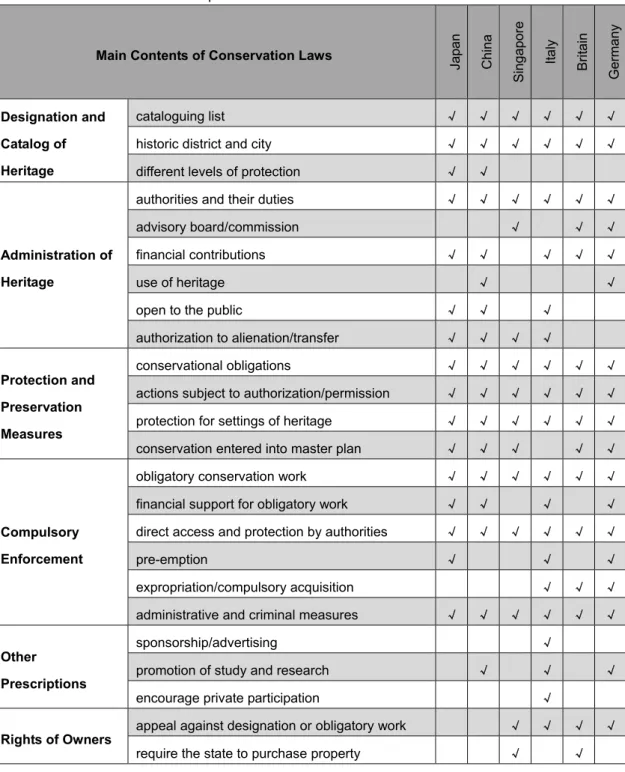
Table 1 ‐ Comparison of the Main Contents of Conservation Laws ... 34
Table 2 ‐ ACA's Expenditure for Preservation, Utilization and Accession of Japan's Precious Cultural Properties (2013‐2015) ... 150
Table 3 ‐ Proportion of Central Grant for SACH to Expenditure on Central Government Departments (2009‐2014) 155 Table 4 ‐ SACH's Expenditure on the Field of Culture, Sport and Media (2009‐2014) ... 156
Table 5 ‐ Composition of MHURD's Income (2011‐2012) ... 157
Table 6 ‐ Special Transfer Payments (STP) in Heritage Conservation Field (2010‐2014) ... 158
Table 7 ‐ Proportion of Expenditures in the Field of Culture to Expenditures for Provincial Government Departments (2015 Fiscal Year) ... 161
Table 8 ‐ MIBACT's Budget (2000‐2014 Fiscal Year) ... 172
Table 9 ‐ Proportion of Provincial/Municipal Cultural Expenditures to Provincial/Municipal Total Expenditure (2008‐2012) ... 175
Table 10 ‐ Lottery Funds in the Italian Cultural Field between 2004 and 2014 ... 180
Table 11 ‐ Composition of Funds in Architectural Heritage Conservation Projects ... 187
Table 12 ‐ HLF's Grant Programs ... 189
List of Figures
List of Figures
Figure 1 ‐ Administrative Structure of Architectural Heritage Conservation in Japan...42
Figure 2 ‐ Administrative Structure of Architectural Heritage Conservation in China...55
Figure 3 ‐ Administrative Structure of Architectural Heritage Conservation in Singapore...70
Figure 4 ‐ Administrative Structure of Architectural Heritage Conservation in Italy...82
Figure 5 ‐ Administrative Structure of Architectural Heritage Conservation in England...96
Figure 6 ‐ Administrative Structure of Architectural Heritage Conservation in Bavaria...114
Figure 7 ‐ Financial System of Architectural Conservation in Japan...146
Figure 8 ‐ Financial System of Architectural Conservation in China...154
Figure 9 ‐ Financial System of Architectural Conservation in Singapore...166
Figure 10 ‐ Financial System of Architectural Conservation in Italy...171
Figure 11 ‐ Financial System of Architectural Conservation in England...182
Figure 12 ‐ Financial System of Architectural Conservation in Bavaria...192
List of Abbreviations
List of Abbreviations
ACA Agency for Cultural Affairs (Japan)
ACSA Association for Corporate Support of the Arts (Japan)
AHA Architectural Heritage Awards (Singapore)
AOSD Architecture and Other Structures Division (Japan)
APAA Arts Projects Assistance Approval Program (Japan)
ASEF Asia-Europe Foundation
ASEM Asia-Europe Meeting
ASEM CMM Culture Ministers' Meeting of Asia-Europe Meeting
BKM Federal Government Commissioner for Culture and Media (Germany) (Beauftragte der Bundesregierung für Kultur und Medien)
BLfD Bavarian State Conservation Office (Germany)
(Bayerisches Landesamt für Denkmalpflege)
BMVBS Federal Ministry of Transport, Building and Urban Development (Germany)
(Bundesministerium für Verkehr, Bau und Stadtentwicklung)
CCTPC Carabinieri Headquarters for the Protection of Cultural Heritage (Italy)
(Comando Carabinieri Tutela Patrimonio Culturale)
DCMS Department for Culture, Media and Sport (Britain)
DG Director Generals (Italy)
(Direzione Generale)
DRBCP Regional Directorates for Cultural Heritage and Landscape (Italy)
(Direzione Regionale per i Beni Culturali e Paesaggistici)
FRG Federal Republic of Germany
GDR German Democratic Republic
GFA Gross Floor Area (Singapore)
Historic England Historic Buildings and Monuments Commission for England (Britain)
HLF Heritage Lottery Fund (Britain)
IAA Incorporated Administrative Agencies (Japan)
JACAM Japanese Association for Conservation of Architectural Monuments (Japan)
LPA Local Planning Authorities (Britain)
MBCA Ministry for Cultural Property and Environment (Italy)
(Ministero per i Beni Culturali ed Ambientali)
MCCY Ministry of Culture, Community and Youth (Singapore)
Comparative Analysis of Policies of Architectural Heritage Conservation in East Asian and European Countries
X
MHURD Ministry of Housing and Urban-Rural Development (China)
MIBACT Ministry for Heritage, Cultural Activities and Tourism (Italy)
(Ministero dei Beni e delle Attività Culturali e del Turismo) MND Ministry of National Development (Singapore)
NHB National Heritage Board (Singapore)
NMF National Monuments Fund (Singapore)
PMB Preservation of Monuments Board (Singapore)
PSMD Preservation of Sites and Monuments Department (Singapore)
SACH State Administration of Cultural Heritage (China)
Schlösserverwaltung Bavarian Department of State Owned Palaces, Gardens and Lakes (Germany)
(Bayerische Verwaltung der staatlichen Schlösser, Gärten und Seen)
Secretary of State Secretary of State for Culture, Media and Sport (Britain)
SFG Special Funds of The Grant (China)
SSCA Society for the Study of Chinese Architecture (China)
StMUK Bavarian State Ministry of Sciences, Research and the Arts (Germany)
(Bayerisches Staatsministerium für Bildung und Kultus, Wissenschaft und Kunst)
STP Special Transfer Payments (China)
TES Tax Exemption Scheme for Donation to National Monuments in Singapore URA Urban Redevelopment Authority (Singapore)
Chapter I ‐ Introduction
I. Introduction
1.1 Background
“Preservation is one popular use of the past”,1 and the history of a city can be maintained and protected by safeguarding its historic buildings and heritage. Urban history comprises many elements, counted among the essential elements is architectural heritage. Architectural heritage conservation has become an important aspect of urban redevelopment and renewal. Successful conservation of architectural heritage “attracts a higher value to that building and will generally attract further investment to the area and provides a much wider regeneration process”.2 Thus, architectural heritage conservation holds increasing importance for the preservation planners in many countries, and there is a shared common view in the world that to protect architectural heritage reasonably and based on scientific methods is a necessity of our age.
In this context, many countries have invested in the field of architectural heritage conservation. This is especially true of some developing countries in Asia, which have focused more on legislation towards historic conservation and provided more financial support for architectural heritage conservation. Furthermore, many countries have begun to be more involved in cooperation and communication activities of architectural heritage conservation. Regarding political, economic and cultural matters, there has always been an important strategic relationship between Asia and Europe. As for architectural heritage conservation, the
cooperation and communication between Asia and Europe has become more intensive in recent years.
In 2010 the fourth Culture Ministers' Meeting of Asia-Europe Meeting (ASEM CMM)3
emphasized preservation of cultural heritage and its challenges as a subject,4 and in 2012 the fifth ASEM CMM discussed the technological methods employed to protect and administer
1 Lowenthal, 1985, p. 38.
2 Said, Syed Zainal, Thomas & Goodey, 2014, p. 270.
3 ASEM CMM means Culture Ministers' Meeting of Asia-Europe Meeting. Asia-Europe Meeting (ASEM) was
established in 1996, which is an informal process of dialogue and cooperation bringing together 51 members, including European Union member states and some European and Asian countries. And Culture Ministers' Meeting of ASEM is held per twice years and its inaugural meeting was held in 2003.
Comparative Analysis of Policies of Architectural Heritage Conservation in East Asian and European Countries
2
natural and cultural heritage within the framework of sustainable development theory.5
In 2008, the Han Yangling-Pisa project was formally implemented with financial support from the European Commission. This project was developed by Chinese experts of historic conservation, the Pisa University, the Technology University of München and the Ename Center for Public Archaeology and Heritage Presentation in order to exchange historic conservation experiences and apply best practice to the Han Yangling Museum and the ancient Pisa ships. This project was one part of the European Commission’s framework of Culture 2007-2013 and was also one significant point of cooperative historic conservation between Asia and Europe.6
The Asia-Europe Foundation (ASEF) organized an Experts’ Meeting in June of 2013, with the theme of Investing in Heritage Cities: Stimulus for Sustainable Tourism and Livelihoods in Yangon, Myanmar. This meeting was aimed at providing a platform for exchanging policies and practices of historic conservation between Asia and Europe, and strengthening communication and cooperation between experts of architectural heritage conservation of Asia and of Europe.7
Architectural heritage conservation is a systematic program, which includes architectural design, technologies of preservation and policies that architectural heritage conservation should follow, like how to evaluate the historic importance of buildings, how to protect, manage and operate a program of architectural heritage conservation, and how this must comply with established corresponding policies. A review of the professional literature in the field reveals the scholars that have made comparative studies on architectural heritage conservation of different countries. Will (1984) has summarized an overview of the formal mechanisms of historic preservation in Germany, Switzerland and Austria.8 Sanz Salla (2009) has conducted a comparative study of the protection of historic properties in international laws, European Union laws, American, United Kingdom and Spanish laws, and summarized the administrative policies of historic property preservation in the framework of these laws.9 Stubbs (2009) has researched architectural conservation from a global viewpoint and summarized the contemporary practices of
architectural conservation in Europe, North Africa, Sub-Saharan Africa, Asia, the Austro-Pacific region, North America, as well as Latin America and the Polar regions, providing an overview of
5 Asia-Europe Foundation (ASEF), 2012. 6 Hanyangling Museum, 2010.
7 Asia-Europe Foundation (ASEF), 2013. 8 Will, 1984.
Chapter I ‐ Introduction
the situation of architectural conservation in the world.10 Stubbs and Makaš (2011) have compared architectural conservation in Europe and the Americas, including legislation and development of architectural conservation.11 Glendinning (2013) has analyzed the preservation movements of some countries and summarized a history of architectural preservation from the global viewpoint.12 Among these academic achievements, most focus on architectural heritage conservation of European countries and America, comparatively there are fewer academic studies on architectural heritage conservation of Asian countries. Moreover, in the existed limited studies, the knowledge about the performance and development of Asian conservation policies were not presented in details. For example, Stubbs (2009) placed much attention to describing some challenges faced by Asian countries such as Japan and China and their current status of architectural conservation, but did not put emphasis on their conservation policies like how they administer, guarantee and finance their conservation projects, nevertheless all of which are exactly what this dissertation intends to study.
Architectural heritage conservation has become a focus of interest in the world. Asian and especially East Asian and European countries have been paying more attention to cooperation and communication in this field. The increasing demand of conservation practice often motivates relevant academic studies. In the context, this dissertation intends to study policies of
architectural heritage conservation. Three countries in East Asia and Europe have been chosen in order to conduct comparative research into their diverse policies of architectural heritage conservation, with the aim of finding out their possible common points or differences. The dissertation intends to provide some possible comparisons of architectural conservation in East Asian and European countries with the aim of making some possible contributions to the discipline of architectural conservation.
1.2 Object of Research
The foci of the research in the dissertation are the legislative, financial and administrative policies in the field of architectural heritage conservation. Achievements of historic conservation, the development of historic conservation, and social development, will be taken into account. The dissertation selected several representative countries in East Asia and Europe in order to conduct comparative research into their architectural heritage conservation policies. Japan,
10 Stubbs, 2009.
11 Stubbs & Makaš, 2011. 12 Glendinning, 2013.
Comparative Analysis of Policies of Architectural Heritage Conservation in East Asian and European Countries
4
China and Singapore were selected as the East Asian countries and Italy, Britain and Germany were selected as the European countries for the following reasons:
“Japan has a long-standing heritage conservation and preservation tradition initiated by the national and local government. This has led to the successful restoration and protection of local, prefectural, and national heritage (including World Heritage)”,13 thus the achievements and experiences of heritage conservation in Japan may provide some references for other countries. Accounting from the Qin dynasty (221-206BC),14 China has a more than two thousand year old history and is one of the world’s oldest civilizations. In the course of history, numerous heritage sites have been inherited from past generations. China is ranked second in the world for its 50 world heritage sites; Italy is ranked first in the world with 51 world heritage sites.15 In recent years, because of economic development and greater attention focused upon heritage
conservation, China has acquired some conservation experiences that may be drawn upon by other countries. Singapore has a comparatively short history of development, since it gained its independence in 1965, it does not have a long-established tradition of heritage conservation. Since the 1980s, for economic reasons, Singapore began to lead its urban development "in the direction of environmental conservation, historic preservation".16 “Singapore is an interesting example of the marriage of history to livability”,17 thus the study of architectural heritage conservation in Singapore may be important to represent countries that develop heritage conservation comparatively late.
Italy has a long-standing and strong tradition in historic conservation. “In Italy, the home of classical antiquity, where legislation for the protection of ancient monuments had already been developed since the Renaissance … patriotic expressions had often justified acts of
preservation”.18 It may be said that conservation is like the blood running in the veins of Italian people. Because of its preservation tradition, there exist some remarkable achievements of heritage conservation in Italy, which can also be compared to some other countries. During the 18th century the theory of organized architectural conservation spread in France and England,
13 Kaminski, Angela & Arnold, 2013, p. 90.
14 Qin dynasty (221-206BC) was the first dynasty of Imperial China. Chinese historians often refer to Qin
dynasty as beginning of Imperial China.
15 About world heritage: The states parties, n.d. retrieved 10 June 2016.
16 Rowe, 2011, p. 8.
17 Allison & Peters, 2011, p. 211. 18 Jokilehto, 2006, p. 75.
Chapter I ‐ Introduction
which resulted in the historic conservation movement in Western Europe.19 "There is a long history in Britain of interest in, and the legislative enforcement of, the conservation of historic towns and of buildings in towns",20 thus some other countries may have drawn upon
experiences of British conservation practices. Germany today is a federal republic, and the federal states of Germany are autonomous in cultural matters such as heritage conservation. The administrative policies and systems of each state can be distinguished to varying degrees, but the state heritage conservation is still well organized and has gained some achievements respectively, thus the study of German heritage conservation may provide special practical examples for other countries.
1.3 Method for Research
The main research method used in the dissertation is the documentary analysis. There are three types of literature/documents (described as follows) being collected and used as the sources in this study. In analyzing and interpreting data generated from such literature/documents, the dissertation's author applied a comparative analysis of their content by focusing on some issues (legislation, administration, finance), which were critically discussed respectively in chapter II, III, IV.
It is noteworthy that as the author speaks only English and Chinese and the dissertation focuses on international groups of potential readers, the majority of literature used in the dissertation are available in English, including literature related to heritage conservation in Japan, Singapore, and Italy as well as Britain and Germany. The exception to this is that most literature concerning China used in the study is in Chinese.
Scientific Publications The main literature reviewed and studied in the dissertation are scientific
publications that relate to the aforesaid object of research: books written by one or a small number of co-authors, edited volumes, and scientific articles as well as published presentations at academic conferences or forums. This type of literature is the main source of information and data used in the dissertation.
Law All of the laws extracted from legal literature are available in English and downloaded
from official websites. It is noteworthy that the laws of Japan, Italy and Germany were not
19 Stubbs & Makaš, 2011, p. 10. 20 Slater & Shaw, 2011, p. 297.
Comparative Analysis of Policies of Architectural Heritage Conservation in East Asian and European Countries
6
originally written in English, but translated into English by specialists in the field of heritage conservation. The author's native language is Chinese, so Chinese laws are translated by the author based on the 2007 English edition of the UNESCO Database of National Heritage Laws.
Grey Literature Grey literature has been collected and used in the dissertation, including
conference papers, dissertations, working papers, as well as government and annual reports. Because this grey literature is made available to the public but normally lacks a systematic means of distribution and collection,21 it was mostly collected from internet websites. For research purposes, the author also conducted additional searches for information from some relevant organizations/authorities' websites.
1.4 Definitions and Scope of Study
Definition of Architectural Heritage: all the contents of heritage conservation mentioned in the
dissertation refer to architectural heritage conservation. As defined by the Convention for the Protection of the Architectural Heritage of Europe (1985), "architectural heritage" should be defined according to three categories:22 a) monuments, i.e. all buildings and structures including their fixtures and fittings; b) groups of buildings, i.e. homogeneous groups of urban or rural buildings; c) sites, i.e. the combined works of man and nature, being areas which are partially built upon.
Based on this principle, in most countries the definitions of architectural heritage are more or less alike. However, they have different appellations for architectural heritage: a) in Japan, heritage is often known as Cultural Property and Preserved District for a Group of Historic Buildings; b) in China, heritage is known as Immovable Cultural Heritage, Famous Historical and Cultural City and Historical and Cultural District; c) in Singapore, heritage is known as Protected Historic Buildings and National Monuments; d) in Italy, heritage is known as Cultural Property; e) in Britain, heritage is normally known as Listed Buildings and Conservation Areas - the majority of Britain's architectural heritage; f) in Germany, heritage is known as Built Monuments that are often simplified as monuments in the dissertation. Moreover, when describing architectural heritage conservation in the aforesaid six countries, the author often refers to such appellations as architectural heritage.
21 Grey literature, n.d., retrieved 25 September 2016, para.2.
22 Convention for the Protection of the Architectural Heritage of Europe 1985, retrieved 25 September 2016,
Chapter I ‐ Introduction
Definition of Finance: finances in the field of heritage conservation involve a wide range of
content areas, including: revenues, funding, government subsidies, financial compositions, and financial sources. In this dissertation, based on the means of governmental financial support, the finances are categorized into two types: direct public and indirect finance.
Direct public finance is a method of financing where the governments or relevant authorities provide financial support for heritage conservation through direct means, like grants. Indirect finance happens when the governments or relevant authorities provide financial support by using fiscal devices to modify individual behaviors so as to stimulate private monetary assistance such as donations and sponsorships. There is a crucial difference between direct public and indirect finance: the decisions concerning the amount and composition of direct financial support are taken by the public decision makers, but such decisions on indirect financial support are private.23
In the dissertation, direct public finance comes from sources such as: grants, subsidies, and funding programs as well as transfer payments through budgets or revenues from the
governments or other authorities. Indirect finance comes from sources such as: tax incentives, lottery funds, donations and sponsorship as well as privatization (sale of state owned heritage to private entities).
Chinese Heritage Conservation – Scope of Study: the scope of the work involving China only
refers to mainland China; Hong Kong, Macau and Taiwan are not included in the scope of the dissertation.
Italian Heritage Conservation - Scope of Study: the scope of the work about Italy excludes
three special autonomous regions (Valle d'Aosta, Sicily, and Trentino Alto Adige), because these three regions have their own departments, separate budget, special statutory provisions, and regional staff for heritage conservation.24 In addition, they can exercise independent legislative and administrative powers for their own heritage assets through their own Soprintendenze who are under the direction and management of the regional instead of the state heritage department, therefore, the administration of these three regions is absolutely distinct from other regions.25
Britain's Heritage Conservation – Scope of Study: the background and conservation
23 Rizzo & Throsby, 2006, p. 999. 24 Agostino, 1984, p. 78.
Comparative Analysis of Policies of Architectural Heritage Conservation in East Asian and European Countries
8
movement of Britain's heritage conservation are described from a macro perspective of the nation, but the study of conservation legislation - the analysis of the main conservation law focuses on the Planning (Listed Buildings and Conservation Areas) Act of England. This is similar to the study of the administrative and financial aspects, where some background information and a few relevant points might involve other British countries but the main aspects of the administrative structure and financial policies, center on England.
Among the four constituent countries of Britain, England constitutes over half of the total territory.26 Moreover, the great number of historic buildings and conservation areas located in England corresponds with the numerous conservation practices there, and nearly cover the majority of conservation practices in the whole of Britain.27
German Heritage Conservation – Scope of Study: the federal states of Germany have
autonomy over heritage conservation. It is beyond the scope of this dissertation to respectively describe the situation of heritage conservation in each state, thus most contents in the field of heritage conservation of Germany are based on the Free State of Bavaria. Specifically, for studying legislation the historical background of German heritage conservation was analyzed from a macro perspective, while involving the conservation movement and legislation of different states, the analysis of the main conservation law only focuses on the Bavarian Law for the Protection and Preservation of Monuments. In the study of administration and finance, the administrative structures and financial policies on both the federal level and the state/local level are analyzed, but the contents on the state/local level are based on the Bavarian state.
To some extent, each state has similar heritage conservation institutions. Among the sixteen states, Bavaria is the largest federal state in Germany. It boasts a great number of heritage sites counted among the states in Germany.28 It is possible that the large number of monuments located in Bavaria are the reason why many conservation practices occur there and stem from Bavaria’s long tradition of organized protection of historic buildings and monuments.29
1.5 Research Objectives
Architectural heritage conservation is a systematic and complex program with policy being an
26 William, 2010, pp. 15-16, 27-28. 27 Mynors, 2006, p. 7.
28 Monument, n.d. retrieved 25 June 2015.
Chapter I ‐ Introduction
important component. The objective of this dissertation is to make comparative investigations into policies of architectural heritage conservation in East Asian and European countries. It is hoped that these inquiries can aid heritage conservation professionals to acquire a general understanding of the state of architectural heritage conservation policies in East Asian and European countries, and can promote communication and cooperation in the field of architectural heritage conservation between East Asia and Europe.
China is the author’s home country. The architectural heritage conservation of China started comparatively late compared with other developed countries, but from the 1980s the Chinese government focused efforts toward every aspect of architectural heritage conservation. However, some problems still exist in Chinese architectural heritage conservation, and policy may be one of the crucial problems identified. As a non-empirical dissertation, this study intends to analyze conservation policies in some issues (legislation, administration, finance) within historic background, in order to understand policies well in corresponding contexts. By this way, this dissertation could provide information concerning architectural conservation, such as different countries' development of conservation movements, up-to-date systematic explanation of their administrative and financial policies, and legal foundation for their exercises. Those information forms the findings of this dissertation, which can help colleagues who work in the field of heritage conservation in China and make some contributions to architectural heritage conservation in China.
Another objective of the dissertation is to help East Asian countries gain from the experience and ideas of architectural heritage conservation of European countries, and thereby advance the state of architectural heritage conservation in Asia. Reciprocally, East Asian countries also have acquired some experiences in the development process of architectural heritage conservation, which can be beneficial to European countries.
1.6 Chapter Organization
Chapter 1 - Introduction: aims to give readers a general idea about the dissertation’s purpose,
methodology and scope, as well as how one could further develop the research.
Chapter 2 - Legislation for Architectural Heritage Conservation in East Asian and European
Countries: reviews the historical background of architectural heritage conservation in the six countries being studied in the dissertation and explores the main conservation laws. As
legislation is the premise of publicly organized heritage conservation, the chapter also describes some of the important provisions concerning architectural conservation that were provided by
Comparative Analysis of Policies of Architectural Heritage Conservation in East Asian and European Countries
10
these main laws with the aim of delivering a general understanding about the legal framework or institutions in these countries' heritage conservation. The chapter also compares these main laws to find out their possible similarities and differences.
Chapter 3 - Administration of Architectural Heritage Conservation in East Asian and European
Countries: conservation practices are dependent upon a successfully run administration. The administrative structures of architectural heritage conservation can be distinguished in the six countries by their different historical backgrounds and individual heritage conservation situations. The chapter summarizes the administrative structures of the six countries from four levels: national, regional or local, consultation commissions and civic organizations. Then, the administrative structures of the six countries were comprehensively analyzed.
Chapter 4 - Finance of Architectural Heritage Conservation in East Asian and European
Countries: successful architectural heritage conservation should depend on one essential condition: to establish a working financial system for providing sufficient financial support for conservation practices. The chapter aims to summarize financial policies of architectural heritage conservation in the six countries from two aspects: direct public and indirect finance. On the basis of summarizing such policies, the roles that direct public and indirect finance has played in the field of heritage conservation are also analyzed in order to discover a common point in many East Asian and European countries.
Chapter 5 - Conclusion: aims to summarize the results of previous chapters. The limitations in
Chapter II ‐ Legislation
II. Legislation for Architectural Heritage Conservation in East
Asian and European Countries
A - East Asian Countries
2.1 Japan: Law for the Protection of Cultural Properties
2.1.1 Historical Background
"Japan was among the first countries in the world to legislate for the protection of cultural heritage",30 there is a close link between the beginning of the nation's conservation legislation and the religious reform of 1868. In the early years of the Meiji period (1868-1912), the Meiji government initiated the religious reform in order to make Shinto31 the national religion, which resulted in serious damage to many Buddhist temples.32 It is fortunate that the Meiji government soon realized the threat that the practice of destroying temples represented for Japan's heritage conservation, and some government officials began to promote conservation legislation in order to change the situation. In this context, the Council of State issued the Edict for the Preservation of Antiquities in 1871. This edict is the first governmental order for the preservation of Japanese cultural properties. It provided that temples, shrines, and individuals should make inventories of cultural properties in their possessions and compile a list.33 However, in the interest of
modernization, the Meiji government sent the Iwakura Diplomatic Mission to visit fifteen
European countries and the United States from 1871 to 1873.34 As a result of this visit, the Meiji government became fascinated by the ideas of the Enlightenment. They attempted to reshape Japanese society by promoting and fostering cultural projects through whole-scale
Westernization with the cost being the abandonment of a long-established traditional culture. Therefore, the inventory and the compilation of a list of cultural properties that was intended to create a national register of important buildings and works of art was suspended. But due to the
30 Cang, 2007, p. 47.
31 Shinto is an ethnic religion of Japanese, focusing on ritual practices. 32 Gibbon, 2005, p. 331.
33 Larsen, 1994, p. 31. 34 Scott, 2003, p. 326.
Comparative Analysis of Policies of Architectural Heritage Conservation in East Asian and European Countries
12
insistence from some influential foreigners like Ernest Fenollosa35 to preserve Japanese traditional culture, the government was persuaded to reappraise its official attitude towards Japanese tradition.36 This change of attitude was reflected in the enactment of the Law for the Preservation of Old Shrines and Temples in 1897. The passing of this law is important because it represents the government’s move to give special attention to the protection and conservation of cultural properties. This law is the first conservation act covering immovable and movable properties.37 In the subsequent decades, the government promulgated a series of conservation laws, the main emphasis of which was to extend the scope of cultural properties.
During the period of the Second World War, more than 200 designated buildings were destroyed due to the bombing campaigns.38 In the early postwar period, the fire of Hōryū-ji39 ruined one of the most integral and ancient timber structures in the world and its wall paintings.40 These events accelerated the enactment of a comprehensive conservation law. In 1950, the Law for the Protection of Cultural Properties was promulgated. It further extended the scope of cultural properties; the categories of cultural properties provided by the Law are still valid and have not been changed.41 The Law has been amended seven times and is still in force.42
2.1.2 Highlights
Since the 1870s, a number of laws concerning conservation of cultural properties were enacted (some of them are shown in Appendix 1), but the Law for the Protection of Cultural Properties plays an irreplaceable role in the field of cultural heritage. The Law synthesized previous
conservation laws that had been promulgated since the Meiji period, such as the Historical Sites, Places of Scenic Beauty, and Natural Monuments Preservation Law of 1919 and the National Treasures Preservation Law of 1929, and thus provided a new comprehensive legal mechanism for the protection and conservation of cultural properties.43 "The framework for the current
35 Ernest Fenollosa (1853-1908) was a wealthy Boston art connoisseur. He had arrived in Japan in 1877.
During his stay in Japan, he helped to draft the text of Law for the Preservation of Old Shrines and Temples.
36 Coaldrake, 1996, p. 248. 37 Noriaki, 2015, p. 82. 38 Henrichsen, 1998, p. 12.
39 Hōryū-ji is a Buddhist temple, one of the oldest wooden buildings. 40 Gibbon, 2005, p. 332.
41 Jokilehto, 2006, p. 280.
42 Cultural Properties Department & Agency for Cultural Affairs (ACA), 2015, pp. 4-5. 43 Akagawa, 2016, p. 76.
Chapter II ‐ Legislation
Japanese heritage-protection system was forged in 1950 by the establishment of the Cultural Properties Protection Act [known as Law for the Protection of Cultural Properties]",44 thus the Law is seen as the bedrock of the legal institution of heritage conservation in Japan. The main and significant provisions concerning protection and conservation of Japanese architectural heritage are described as follows:45
Scope of Preservation Buildings with significant historical or artistic value to Japan can be
designated as "Cultural Property" for their preservation and utilization in order to enhance the cultural quality of the nation (art.1&2(1)). Based on national significance, cultural property can also be designated as "Important Cultural Property" and "Registered Cultural Property" (art.2). The ensemble of historic buildings and surrounding environment, which possess value to the nation, can be designated as "Preserved District for a Group of Historic Buildings" (art.142). The Law provides for the strictest control over the preservation of "Important Cultural Property".
Management or Repair of Important Cultural Property An owner, or a responsible manager appointed
by the owner on his behalf, is responsible for the management and repair of his property (art.31&34bis). The Commissioner for Cultural Affairs may ask the owner or manager to report on the status quo of his property or if necessary, may appoint a person to investigate whether the property is at risk of destruction (art.55(1)). In the case where a property is in danger of
destruction, the commissioner may issue orders or advice on repairs to the owner (art.37), or may directly carry out the repair (art.38). If the owner is unable to bear the expenses required for the management or repairs of his property, the government may grant a subsidy to cover part of such expenses (art.35). If the owner or the manager is extremely unqualified, the commissioner may appoint a "Managerial Body" to manage and repair the property (art.32bis&34ter). No one may alter the status quo of a property without the permission of the commissioner (art.43(1)). In granting such permission or aforesaid subsidy, the commissioner may issue any instructions in respect of management and repairs as a condition (art.35&43(2)).
Group of Historic Buildings A municipality may designate a "Preserved District for a Group of
Historic Buildings" in its city plan, and may determine necessary control of the alteration and any other necessary measures for its preservation (art.143(1)). Preserved districts which possess an especially high value to Japan can be designated as "Important Preserved District" by the Minister of Education, Culture, Sports, Science and Technology (art.144(1)). The nation may
44 Noriaki, 2015, p. 84.
45 Law for the Protection of Cultural Properties, retrieved 30 May 2015, was enacted in 1950 and latest
Comparative Analysis of Policies of Architectural Heritage Conservation in East Asian and European Countries
14
grant a subsidy to cover part of the expenses required for the preservation of the preserved districts, especially for the management and repair of buildings located in a "Important Preserved District" and their environment (art.146).
2.2 China: Law of the People's Republic of China on the Protection of
Cultural Heritage
2.2.1 Historical Background
In 1911, the Xinhai Revolution46 terminated the despotic feudalism which lasted over two thousand years in China. In 1915, Western educated people like, Hu Shih47 and Chen Duxiu48 initiated the New Culture Movement49 that was an ideological enlightenment which had a profound impact on Chinese society. This movement is regarded as the continuity of the Xinhai Revolution in terms of ideology and culture, and it shook the status of feudalism in the minds of Chinese people. Some movements, which occurred between the 1910s and 1920s, affected the formation of a social tide of anti-traditional culture in China. During this time, many cultural properties with historic and artistic value were neglected and even destroyed by people, which aroused the concern of the Kuomin government50. In 1930, the government passed the Edict for Preservation of Ancient Antiques that specified and defined the protection requirements of ancient antiques and rules for excavation. This was the first conservation law in China's modern history and represented the beginning of Chinese conservation legislation. In 1931, the
Implementation Rules on Edict for Preservation of Ancient Antiques was issued by the
government, which added supplementary articles concerning the protection and conservation of historic buildings.51 But these conservation laws were not well implemented due to limited
46 Xinhai Revolution occurred in 1911 and finished in the early 1912. It was a revolution that overthrew
China's last imperial dynasty and established the Republic of China.
47 Hu Shih (1891-1962) was a Chinese philosopher, essayist and diplomat.
48 Chen Duxiu (1879-1942) was a Chinese revolutionary socialist, educator, philosopher, and author. He
co-founded the Chinese Communist Party in 1921.
49 The New Culture Movement was a revolt against traditional Chinese culture and Confucianism and
occurred in 1915.
50 Kuomin government, was the ruling governmental authority established by Kuomintang (also known as
the Chinese Nationalist Party, KMT), established in 1925 and ended in 1948. After Northern Expedition in 1928, China was reunified and Kuomin government became the only legal government on behalf of China.
51 Chinese Mayors Association & China Science Center of International Eurasian Academy of Sciences,
Chapter II ‐ Legislation
resources and a lack of the necessary authorities.52 Since 1937, because of the Second Sino-Japanese War (1937-1945)53 and Second Chinese Civil War (1945-1949)54, China again experienced a long period of social upheaval. In times of war, numerous cultural heritage sites were destroyed. For saving and protecting war-damaged heritage, after the establishment of the People's Republic of China in 1949, the national government immediately promulgated a series of ordinances, such as the Order for Prohibition of Exporting Precious Ancient Antiques and Archives, the Order for Investigation and Excavation of Ancient Cultural Remains and Tombs, and Instructive Rules on Preservation of Ancient Buildings of 1950, which provided the foundation for heritage conservation between the 1950s and the early 1960s.55
The early achievements of heritage conservation in China were ravaged in the 1960s. The protection and conservation of Chinese heritage was suspended due to the Cultural Revolution56 which lasted from 1966 to 1976, large numbers of architectural heritage were ruined and demolished in the Revolution. After it ended, the nation placed emphasis on economic development. In the process of promoting the economy, the governments were passionate advocates of a "demolish the old, build the new" philosophy (i.e. tear down historic buildings and build new buildings) in order to construct a new townscape for attracting foreign investment. Thus, a conflict of interest arose between heritage conservation and economic development. The attention focused upon this growing conflict made the national government realize that
demolishing old buildings was a threat to the nation's heritage. The Law of the People’s Republic of China on the Protection of Cultural Heritage was issued in 1982 with the aim of harmonizing the relationship between heritage conservation and economic development. It is a significant landmark in the field of heritage conservation in China.57 In the subsequent decades, following
52 Yao, 2014, p. 180.
53 Second Sino-Japanese War (1937-1945) was a military conflict fought between the P. R. China and the
Empire of Japan.
54 Chinese Civil War (1927-1949) was a civil war in China fought between forces loyal to the
Kuomingtang-led government of the Republic of China (also known as Kuoming government), and forces loyal to the Communist Party of China. This war was divided into two wars: first war began in August 1927 and ended in 1937, second war began in 1945 and ended in 1949. This conflict eventually resulted in two de facto states, the Republic of China in Taiwan and the People's Republic of China in mainland China. Source: Yao, 2013, pp. 84-85.
55 Lv, 2003, p. 154.
56 The Cultural Revolution was a sociopolitical movement of P.R. China, and occurred from 1966 to 1976,
which affected the country's economy and society negatively.
Comparative Analysis of Policies of Architectural Heritage Conservation in East Asian and European Countries
16
the economic growth of China, the Law was amended five times, and it is currently still the primary law for protecting and conserving Chinese heritage.
2.2.2 Highlights
Since the 1930s, a series of conservation laws were promulgated (some of them are listed in Appendix 2), but it was not until the 1980s that the first comprehensive conservation legislation was passed, namely, the Law of the People’s Republic of China on the Protection of Cultural Heritage. The Law has provided the foundation for the legal institution of heritage conservation in China.58 The provisions concerning architectural heritage conservation of this law are described as follows:59
Designation A building with historic, artistic and scientific value may be designated as
"Immovable Cultural Heritage" (art.2). Based on the level of importance, immovable cultural heritage can be categorized into three types: national, provincial or prefectural cultural heritage (art.13). A city or district with a large amount of buildings that are of significant historical value can be respectively designated as "Famous Historical and Cultural City" or "Historical and Cultural District" (art.14).
Protection Measures in Urban Development The local authorities for heritage conservation and
local departments for urban-rural development shall cooperate in the formulation of conservation prescriptions for each designated heritage site. The prescriptions shall also be included in the urban master plan (art.16). Any new construction activity concerning urban development should make certain it is separate from immovable cultural heritage. If this is not possible, the plan of protecting the status quo of the heritage shall be given priority when deciding on the new construction. In addition to this, any demolition or alteration of heritage is forbidden and only possible with consent from the relevant authorities (art.20).
Duty of Protection The State Administration of Cultural Heritage is responsible for
promulgating the criteria for determining designation and protection guidelines. Each level of local government is responsible for carrying out protection and conservation work within their jurisdiction, and is obligated to pay for the necessary conservation through their local
58 Zhang, 2009, p.29.
59 中华人民共和国文物保护法[Law of the People’s Republic of China on the Protection of Cultural Heritage],
retrieved 10 August 2016, was enacted in 1982 and latest amended in 2015. The highlights analyzed here is in accordance with the text of the 2015 amendment law.
Chapter II ‐ Legislation
government revenues (art.8&10). The occupier has a legal obligation to repair and maintain the state owned heritage (art.21), which should not be alienated or mortgaged (art.24). State owned heritage sites are only allowed to be used for their original purposes or they must be open to the public. (art.23). The owner has the same obligations as the occupier in the case of privately owned heritage (art.21), which should not be alienated or mortgaged to foreigners (art.25). The occupier or owner must prevent the status quo of heritage from being altered (art.26). The local governments shall provide financial and technical support for the owner incapable of properly carrying out preservation work (art.21).
2.3 Singapore: Planning Act/Preservation of Monuments Act
2.3.1 Historical Background
Since the 19th century, Singapore's history followed a long period of non-independence and colonialism: British colonialism (1819-1942), the Japanese Occupation (1942-1945), the postcolonial period (1946-1963), and union with Malaya (1963-1965).60 In 1965, Singapore gained independence and established the Republic of Singapore. During the immediate period after independence, faced with the difficulties of housing shortages, population expansion and overcrowding in slums and the strong demand for economic development, Singapore placed emphasis on urban renewal projects.61 In the social environment of that period, the national government saw historic building conservation as unaffordable due to the country's scarce land resources, thus, the government intended to use the "displace, destroy, replace" tactic in the early phases of urban redevelopment.62 Between the 1960s and 1970s, a large number of historic buildings located in the city center were torn down for constructing a new modern townscape.63
Until 1985, Singapore was in an economic recession.64 In order to stimulate economic growth, the Economic Committee began to gradually implement a diversification strategy from the 1980s onward.65 Under the influence of this strategy, the national government began to rethink
60 Saunders, 2005, p. 160. 61 Boey, 1998, pp. 133-134. 62 Huang, 2013, p. 90. 63 Chang, 1997, p. 50. 64 Rigg, 1988, p. 340. 65 Kong, 2000, p. 413.
Comparative Analysis of Policies of Architectural Heritage Conservation in East Asian and European Countries
18
previous urban redevelopment strategies and realized the importance of architectural heritage for creating unique characteristics of townscape. Therefore, the government began to adaptively reuse architectural heritage by emphasizing their historic value and vernacular traditions.66 For a systematic and effective conservation of architectural heritage, the government delegated conservation duties and functions to its two national authorities: Urban Redevelopment Authority (URA) - subordinate to the Ministry of National Development; Preservation of Sites and
Monuments Department (PSMD) - subordinate to the National Heritage Board. The two authorities protect and conserve architectural heritage in different legal frameworks: buildings designated as Protected Historic Buildings are under the care of the URA, buildings designated as National Monuments are protected by the PSMD.
Legal Base for URA's Conservation The Planning Act was passed in 1989.67 The Act defined
conservation for the first time and formally introduced it into planning.68 In Singapore, "urban planning ... is not only about the construction of new buildings but increasingly also about conservation planning".69 The URA carries out its designation and protection for Protected Historic Buildings throughout the process of urban planning, actually the performance of the URA's conservation duties depends on planning instruments (such as a statutory Master Plan) that are designed in accordance with the Planning Act;70 therefore, the Act has become the primary legal basis for the URA's conservation practices. The Act has two important
amendments listed in Appendix 3.71
Legal Base for PSMD's Conservation The Preservation of Monuments Act was passed in 1971, it
was the first comprehensive law for the protection and conservation of monuments from
Singapore's independence. The Act specified criteria for designation of national monuments and provided for the establishment of the Preservation of Monuments Board.72 According to the Act, the Board was empowered to designate buildings that fully complied with the criteria as national monuments and to protect them. The Board was reorganized several times and in 2009 it
66 Huang, 2013, p. 90. 67 Boey, 1998, p. 137. 68 Yuen, 2013, p. 130. 69 Yuen, 1998, p. 5. 70 Francesch-Huidobro, 2008, p. 188.
71 Planning Act, retrieved 10 August 2016, was enacted in 1989. The highlights analyzed here is in
accordance with the text of the Planning (Amendment) Act of 2003 that incorporates revisions from 1998 revised edition.
Chapter II ‐ Legislation
merged with the National Heritage Board and was renamed the Preservation of Sites and Monuments Department (PSMD) in 2013.73 The conservation practices of the PSMD follow the rules of the Act,74 and has thus become the principal legal basis for the Department's
architectural conservation. The Act has two main amendments listed in Appendix 3.75
2.3.2 Highlights of Planning Act
Designation of Conservation Area This Act is designed to allow amendments to the Master Plan
issued in 1958 (art.6). The Minister may appoint a "competent authority" responsible for the operation of this Act (art.5). In any area of special architectural, historic or aesthetic interest, the Minister may approve a proposal to amend the Master Plan to designate the area as a
conservation area. This designation (also known as Protected Historic Buildings) may comprise an area, a group of buildings or a single building (art.9). The competent authority may issue guidelines for the conservation of buildings or land within a conservation area and for the protection of their setting (art.11).
Conservation Permission The competent authority should seek to determine an application for
"Conservation Permission" that is a prerequisite for carrying out any works within a conservation area (art.12&13). In specified documents required for any application, a special certificate from a qualified person shall be requested in order to prove the truth and authenticity of all material particulars in the application. The competent authority may, without checking the documents, determine the application in accordance with the certificate of the qualified person (art.14A(1)). However, if during random checks any false information is found, the permission shall be revoked, and the qualified person will receive a much more severe penalty than the applicant (art.14A(2)-(5)). The Minister may issue directions to the competent authority, and may impose any conditions on the conservation permission (art.21(1)&(2)). It is noteworthy that a tax known as a "Development Charge" is paid to the competent authority. This tax is levied upon land development authorized by any conservation permission (art.35&40A).
Enforcement Notice The competent authority responsible for exercising this Act may send an
"Information Notice" to the owner, or enter any conservation area for the purpose of inspection
73 Preservation of Monuments Board is Established, n.d. retrieved 18 March 2015.
74 About Preservation of Sites and Monuments, n.d. retrieved 18 March 2015.
75 Preservation of Monuments Act, retrieved 18 March 2015, was enacted in 1971 and latest amended in
Comparative Analysis of Policies of Architectural Heritage Conservation in East Asian and European Countries
20
(art.25&27). If any contravention of this Act has been found, the competent authority may issue an "Enforcement Notice", which contains a requirement and a list of the required steps to be taken in order to alleviate the effects of the unauthorized works or to restore the buildings to the original state (art.28). If the owner fails to fulfill the enforcement notice, the competent authority may take direct actions to prevent the demolition or alteration of the conservation area; expenses resulting from the prescribed actions shall be undertaken by the owners (art.31).
2.3.3 Highlights of Preservation of Monuments Act
National Heritage Board The Board serves as the responsible authority for the administration of
this Act (art.3), whose main functions include identification, research, determining standards, advice, grants, etc. (art.4&5). The National Monuments Advisory Committee shall be appointed by the Board and serves in an advisory capacity to the Board in its functions (art.7). The articles 8 and 9 respectively describe the appointment of "Director of National Monuments" and
"Monument Inspectors".
Preservation Order and Notice A "Preservation Order" can be made by the Minister after
consulting with the Board (art.11(1)). The order shall specify the protected monument and also extend to the land containing or adjacent to the monument in order to preserve the monument in its setting (art.11(3)). Monument conservation is the duty of the owners (art.13(1)), the Board may specify the owners' work for preservation, maintenance or repair through a "Preservation Notice" in writing (art.13(2)). The owners have the right to submit their objections against the making, amendment, or revocation of the preservation order to the Board (art.11(7)). The owners may also appeal to the Minister against the requirements of the preservation notice (art.13(3)).
Contravention Without permission of the Board, the activities of demolishing, altering, or
repairing monuments are in contravention of this Act (art.15(1)). If a contravention exists, the Board may serve an "Information Notice" to require the relevant persons to submit information in writing for investigation, such as whether a required operation on a monument has been carried out or the required use realized (art.16). The Board may require the relevant persons to stop the disallowed activities by issuing an "Enforcement Notice" (art.18). The non-fulfillment of the aforesaid two notices is also in contravention. This Act provides for strict penalties for such contraventions and specifies details towards a sentence including a fine and even imprisonment (art.15(1),17&20).
Chapter II ‐ Legislation
B - European Countries
2.4 Italy: Code of the Cultural and Landscape Heritage
2.4.1 Historical Background
The Italian tradition of heritage conservation can be traced to the Cum almam nostram urbem of 1462.76 Since 1462, "[Italy] took a relatively long time before deeper interest was shown in the protection and conservation of mediaeval or later buildings".77 During the period of Italian political and cultural unification (1860-1870) the Kingdom of Italy (1861-1946) continually
addressed the public's nationalistic feelings that played a role in arousing public interest in Italian heritage conservation.78 After unification, the kingdom sought to "shake off its old status as a playground of northern European antiquarians, and appropriate its own heritage, it began synthesising relevant architectural conservation theory from France and Britain from the 1870s and adapting it to its own characteristic conditions of urban multi-layering".79 For example, in 1882 the Italian Ministry of Education promulgated a decree concerning the restoration of monuments and monumental buildings, which was drafted in accordance with Viollet-le-Duc's theory.80 As further examples of this trend, the kingdom also enacted laws such as Law No.286 of 1871 and Law No.6030 of 1879.81 These decrees or laws issued during the 19th century represent the beginning of the establishment of national legislation for heritage conservation.82
In the early part of 20th century, Italy came under Benito Mussolini's Fascist Regime (1922-1943). Some conservation laws passed by the fascist government played an important role in the field of Italian heritage, especially two main laws concerning the protection of built heritage and landscape that were issued in 1939.83 Because many Italian cities were destroyed during the war, in its aftermath there was a strong demand for urban reconstruction and there also arose a popular appreciation of the nation's architectural heritage.84 In that period, conservation
76 Stubbs, 2009, p. 134. 77 Jokilehto, 2006, p. 198. 78 Jokilehto, 2006, p. 198. 79 Glendinning, 2013, p. 155. 80 Gianighian, 2001, p. 185. 81 Degrassi, 2012, p. 5. 82 Jokilehto, 2006, p. 198. 83 Gianighian, 2001, p. 184. 84 Stubbs & Makaš, 2011, p. 27.