TECHNOLOGY ACCEPTANCE IN ORGANIZATIONS
by
LAURIE STEWART
B.S., Kansas State University, 2011
A THESIS
submitted in partial fulfillment of the requirements for the degree
MASTER OF ARTS
Department of Communication Studies College of Arts and Sciences
KANSAS STATE UNIVERSITY Manhattan, Kansas
2013
Approved by: Major Professor Sarah Riforgiate
Abstract
New technology has changed how people do business. With rapid development of technology, it has been difficult for businesses and organizations to successfully implement technology advancements. This problem has spurred research in the area of technology acceptance. The Technology Acceptance Model (Davis, 1989) is a dominant theory used to explain technology use. Although many researchers have copied, expanded, and altered this model through quantitative research, making it robust, this study will further the model by using qualitative methods to explore how members understand and classify technology use. This study adds to the existing knowledge of computer-mediated communication and technology acceptance by exploring information technology use within a volunteer or not-for-profit organization (NPO). In order to offer a unique perspective to exploring how organizational members understand and adopt new technology, this study employs qualitative methodology to a topic traditionally explored through quantitative surveys and measurements. Research questions specifically consider why organizational members accept or reject new technology and how organizational membership affects technology acceptance. Using the third iteration of the technology
acceptance model (TAM 3), data confirm perceived usefulness and perceived ease as determinants of technology acceptance. The influencing factors of perceived usefulness and perceived ease of use were also confirmed. Two new influencing factors of perceived usefulness emerged in this study: appropriateness and information overload. Also, insight into the role of age and technology adoption calls into question stereotypical misconceptions of technology use and acceptance. Overall, this study confirms and expands on research in the area of technology acceptance.
iii
Table of Contents
Table of Contents... iii
List of Figures... v
Acknowledgements... vi
Chapter 1 - Introduction... 1
Chapter 2 - Review of Literature ... 8
Computer-Mediated Communication ... 8
Technology Acceptance... 10
Original TAM ... 11
Testing of TAM ... 13
TAM 2... 14
Continuing TAM Testing... 15
TAM 3... 18 Volunteer/Not-For-Profit Organizations ... 21 Chapter 3 - Method ... 25 Participants ... 25 Procedures... 27 Observations ... 27 Interviews... 28 Focus Groups ... 30 Analysis ... 31 Chapter 4 - Findings ... 33
Technology Acceptance and Rejection... 33
Qualitative Support for TAM 3... 34
Perceived Ease of Use... 34
Perceived Usefulness ... 37
Emerging Themes ... 40
Appropriateness ... 41
Respect... 41
iv
Professional verses Personal... 45
Information Overload ... 47
Email Overload ... 47
Adding New Technology... 49
Member Influence & Technology Acceptance... 52
Generational Misconception ... 52 Chapter 5 - Discussion... 58 Theoretical Implications ... 58 Theory Confirmation ... 59 Theory Expansion ... 60 Practical Implications ... 63 Email Communication ... 63 Social Networking ... 65 Technology Etiquette ... 67 Volunteer Implications... 68 Age... 69
Limitations & Future Directions... 70
Chapter 6 - Conclusion ... 72
References... 74
Appendix A - Original TAM ... 80
Appendix B - Revised TAM... 81
Appendix C - TAM 2... 82
Appendix D - TAM 3... 84
Appendix E - Interview & Focus Group Questions... 86
v
List of Figures
Figure A-1 Original TAM... 80
Figure B-2 Revised TAM ... 81
Figure C-3 TAM 2 ... 82
Figure D-4 TAM 3... 84
vi
Acknowledgements
I would like to give a special thanks to my committee members: Dr. Sarah Riforgiate, Dr. Charles Griffin, Dr. William Schenck-Hamlin, and Dr. Noel Schulz. Thank you for all your time and investing in my success.
1
Chapter 1 - Introduction
Welcoming over 11 million visitors per year, Disney’s theme park Epcot is home to Spaceship Earth, an attraction that captures the spirit of innovation as it takes you on a journey through time, depicting the story of human connection from the dawn of recorded time to the 21st century’s cyber age (Niles, 2010). In the last minutes of the ride, hover trains, flying vehicles, self-cleaning houses, and more create a picture of what life could be in the future as technology keeps advancing.
Although one might think that the Disney ride is exaggerating the truth of innovation for the mere purpose of amusement or forecasting technology for the very distant future, if one considers the technological advances of the last ten years, it is not hard to see that technology developments are abundant. A New York Times article predicts that in as little as a year there will be automated restaurants, in less than 10 years there will be real time translating abilities, and in less than 20 years there will be flying cars (Predicting the Future, 2011). Imagining these technological advances becoming a reality is not too difficult considering a computer mouse that acts as a scanner, a 3D TV that requires no glasses, and more are current new technologies making the list of “Coolest Tech Toys of 2012” (CNBC, 2012).
As defined by the Merriam-Webster Dictionary, technology is “the practical application of knowledge especially in a particular area” (Merriam-Webster, 2012). Therefore, new
technology not only impacts personal living and entertainment, but also has a dramatic influence on businesses and organizations. New technology, specifically information technology, shapes how, when, and where people do business. In particular, information technology deals with communication and information processing; it is what maintains many of the day-to-day tasks of
2
an organization (McKenney, 1995). The widespread influence of information technology is notable for several reasons.
First, technology has made business faster by nearly eliminating the wait time to receive information. For example, smart phones, instant messaging, video conferencing and other technology communication devices create a real time communication environment where
synchronous and asynchronous messages are exchanged within seconds regardless of geography. A quick Google search provides the technology user with access to numerous websites, articles, books, and more almost instantly. This speed has led to a more flexible and responsive work environment (Global Guru, 2009) and allows for quicker product development times (Simon, 2010). Efficiency can be gained by adopting new technology (Lin, Vassar, & Clark, 1993; Cyert & Mowery, 1987; Hameed & Counsell, 2012; Alonso, Verdun, & Caro, 2010).
Furthermore, technology encourages a more collaborative environment by linking organizations, employees, and consumers in real time without regard to geography (McKenney, 1995). Without these geographical restrictions, diverse teams are able to join forces and create new ideas resulting in higher productivity and a greater blend of talents, abilities, and viewpoints (Global Guru, 2009). Cisco Systems has responded to the changing work environment to capture the spirit of collaboration by using technology. The company decided that they would reach more people by switching from in-person meetings to virtual interactions. By mandating that employees use Cisco’s own video technologies and other collaborative tools, Cisco saved more than $100 million in travel and business expenses over an 18-month period. Also, an internal survey showed that 78 percent of targeted employees reported increased productivity and improved lifestyles without hurting customer satisfaction (Raj, 2011).
3
Innovations in technology also flatten business structures and exchanges by allowing for global market interactions, while simultaneously connecting suppliers directly with consumers (McKenney, 1995). This information technology allows buyers and sellers around the world to easily communicate, share information, provide services, and conduct business together (Global Guru, 2009). From a messenger service in Seattle to delivering packages each day for 1.1 million shipping customers to 7.7 million consignees in over 220 countries and territories, the United Parcel Service, Inc. (UPS) has taken advantage of technology to expand globally (United Parcel Service Inc., 2010). UPS was able to see the importance of electronic information to the
transportation industry. With the use of technology, UPS was able to enhance communication with customers and increase efficiency by tracking over 200 data elements for every single package that they ship (Levy, 2001). Therefore, technology allows companies to reach a larger market (Lin et al., 1993).
While technology encourages business interactions and changes the hierarchy of market structure, information technology also encourages innovation by allowing people to see that there are infinite possibilities (Global Guru, 2009). Competition keeps people on their toes challenging them to create new ways of doing things, resulting in improved performance and growth in the organization (Hameed & Counsell, 2012). Technological changes improve creativity (Lin et al., 1993). As technology advances, people don’t have to settle. This stretches businesses to always be thinking of ways they can improve and serve their customers better (Global Guru, 2009). Google is a prime example of a company that continues to innovate and explore these infinite possibilities. They see the future of search engines as a tool that
understands human meaning, not just words. For example, Google has created a new voice search tool that will allow a user to have a conversation with the computer (Miller, 2012). As
4
companies continue to develop new products, services, and ideas, the information technology must also keep up if they want to be successful (McKenney, 1995).
Lastly, technology changes the relationship between the customers and businesses. Technology provides multiple channels for communication between different groups of people (Stevens, Williams & Smith, 2000). Many boundaries are removed with technology such as location, age, and language. Therefore, people who previously would not have communicated have the chance because of technology. For example, a person in Virginia can easily read a review from a person in Kansas about a company. Customers spread across the world can now share information more easily, allowing clients to come to businesses with prior access to information about the organization (Global Guru, 2009). The one-way relationship of seller to customer is collapsing due to digital technology. Technology allows for people to share their opinions openly and to be more involved in the creation or customization of products (Cramer, 2012). Consumers are much more a part of the process of product and service development than they were in the past.
Considering the extensive impact technology has in changing the way organizations and individuals conduct business, it is worthwhile to study and better understand how these
technologies can be incorporated into organizations effectively. Computer-mediated
communication (CMC) or use of technology to communicate with others has become a primary means of communication in organizations (Sproull & Kiesler, 1991). Because information technology allows for communication through multiple channels, giving people many communication choices, knowing why an individual chooses a certain medium or adopts a certain technology is important (Stevens, Williams, & Smith, 2000).
5
Furthermore, with the rapid development of technology, the need to understand what influences acceptance and use of new technology has never been greater, as businesses and organizations have found it difficult to successfully implement new technology (Venkatesh et al., 2008). For example, in 2004 Hewlett-Packard (HP) lost $160 million from a failed IT
implementation (Koch, 2004). HP is not alone in facing technology implementation problems; therefore, these issues have spurred research in the area of technology acceptance. In fact, advancements in technology have led to the need to reconsider and reconceptualize the nature of work in organizations (Santra & Giri, 2009). Organizations that are slow to accept new
technological tools are likely to lose money or even risk going out of business (Simons, 2010). Benefits of technology acceptance include reduced product development time, better
understanding of customers, expedited innovation and new product development, and enhanced employee communication and productivity (Simons, 2010). However, knowing the benefits of technology adoption has not been sufficient for businesses and organizations to accept and implement technology consistently.
As technological innovations are not going to stop, it is necessary to better understand technology acceptance and use in organizations. Scott (2009) contends that although individuals and organizations cannot keep up with these technological innovations, scholars still need theory and models that can. The studies and findings are not helpful if they only apply to a specific technology. Broader findings are needed so they can be applied across technologies and used in the future as more technology is created. Therefore, since technology innovation is not slowing down, communication scholars need continue to study this topic to produce more encompassing theories and models.
6
This study hopes to add to the existing knowledge of computer-mediated communication and technology acceptance by exploring information technology use within an international volunteer or not-for-profit organization (NPO). NPOs are an important part of the economy and civil society, providing contributions to societal well-being by supporting various interests from sports to arts to social services (Zorn, Flanagin, & Shoham, 2010). Specifically, NPOs have been known to lag behind for-profit organizations in information and communication technology (ICT) investment (Schneider, 2003). However, recently this is changing as technology adoption in NPOs has been slowly increasing (Hackler & Saxton, 2007). Successful technology adoption has led to many thriving for-profit businesses such as the previous examples of UPS and Cisco. However, as will be explained in further detail below, the nature of NPOs being volunteer based presents different challenges in implementing new technology. Therefore, studying NPOs will expand the knowledge of technology acceptance.
Furthermore, this study offers a unique perspective to exploring how organizational members understand and adopt new technology by employing qualitative methodology to a topic traditionally explored through quantitative surveys and measurements. The Technology
Acceptance Model (TAM; Davis, 1989) is the dominant theory used to explain technology use. Many researchers have copied (Henderickson, Massey, & Cronan, 1993; Subramanian, 1994; Szajna, 1994), expanded (Gefen & Straub, 1997; Venkatesh & Davis, 1996, 2000), and altered (Venkatesh, 2008; Venkatesh, Morris, Davis, & Davis, 2003) TAM using quantitative research designs, making it a robust model. This study seeks to further the model by using qualitative methods to explore how members understand and classify technology use, potentially offering new categories or dimensions of TAM that have not previously been conceptualized and included on surveys.
7
In the following section, a review of literature will be presented over technology
acceptance. Next, the methodology for this study will be explained. Finally, the research findings will be reported and discussed, followed by suggestions for future research directions.
8
Chapter 2 - Review of Literature
As previously discussed, technology has and will continue to impact organizations and businesses, leading to extensive research on the subject of technology acceptance. In order to extend the current research regarding technology acceptance, the following discussion highlights studies that have been conducted to better understand both computer-mediated communication (CMC) and technology acceptance.
Computer-Mediated Communication
The study of communication takes into account that the content (message) and the
medium (channel) in which the message is delivered are influential factors in how organizational members use and evaluate information (Rice, 1987). Technological advances create new ways for messages to be exchanged, leading to the development of a whole new field of study in communication. Computer-mediated communication (CMC) “is the process by which people create, exchange, and perceive information using networked telecommunications systems (or non-networked computers) that facilitate encoding, transmitting, and decoding messages” (December, 1996). With the advent of technology advancements, CMC has become a prime communication channel by providing different options such as email, teleconferencing,
asynchronous chat tools, and more in addition to the traditional forms of communication such as letters, face-to-face (FTF), or the telephone (Stevens, Williams, & Smith, 2000). Interest in the impact of CMC has generated research to examine social psychological effects, organizational influences, human factor assessments, and education use in comparison to other channels of communication (Bordia, 1997).
Further, many CMC research studies focus on comparing FTF and CMC, noting pros and cons for organizational activities based on the message channel. CMC has become an integral
9
part of organizational effectiveness and changes how organizations communicate (Santra & Giri, 2009). As previously explained, benefits of incorporating CMC into business practices include allowing for greater participation, equalizing hierarchies by reducing status, connecting people in different geographical locations, and allowing for flexibility in response times (Rhoads, 2010). Essentially, the growth in technological innovations allows businesses increased ability to store, transport, and communicate information. Also, CMC changes workplace communication by offering increased flexibility. Specifically, CMC allows people in different locations to work together and coordinate activity by removing the time constraints of FTF communication that depended on physical proximity (Santra & Giri, 2009).
However, research studies note that CMC loses some of the richness of nonverbal and social cues experienced in FTF communication (Rhoads, 2010). Some technologies such as email interactions tend to lack visual and audio cues that help with message interpretation and there is no gatekeeper to manage the quantity or content of the information (Barnes & Greller, 1994). FTF interactions are associated with higher levels of satisfaction and quicker assignment completion times, but are less flexible and have increased geographical constraints (Rhoads, 2010). Studies comparing CMC and FTF communication have been beneficial to research regarding accepting new communication technology because of the importance of establishing a good fit between the medium and communication activities (Rice, 1987). Understanding the benefits and drawbacks of CMC can help organizations decide whether to implement a new technology or not (Rice 1987). However, organizations also need to consider how a new CMC will be received and adopted by members; therefore, the next section discusses explanations for how members accept and implement new technology.
10
Technology Acceptance
In order for organizations to reap the benefits of CMC, adoption or acceptance of new technology must occur both organizationally and individually. Organizations implement technology in order to alter worker’s existing communication patterns and improve
communication effectiveness for the ultimate purpose of organizational change (DeSanctis & Poole, 1994; Jackson, Poole, & Kun, 2002). This change creates three primary tensions surrounding the adoption of communication technology: espoused management values vs. mandated technological practice, integrating business process vs. alienating work relationships, and enterprise-wide practices vs. local practices (Jian, 2007). The first tension arises when managerial values do not align with technological practices. The second tension occurs when business processes intervene and hurt work relationships. The last tension occurs when there is a disconnect within the organization; a lack of cohesion of how a technology should be utilized (Jian, 2007).
Organizational tensions are not the only factor influencing technology acceptance. People’s interpretations of new technology are formed from social aspects such as conversations with their coworkers or boss, as well as from direct experience with the new technology. First organizational members develop an interpretation of the new technology through social
interactions (Leonardi, 2009). Before they even use the new technology they have a perception of what it should do. Then while individuals interact with the material features of the technology, they decide if their previous interpretation are supported or not (Leonardi, 2009). Both social interactions and material interactions play an important role in the process of interpretation formation.
Without considering all the factors that influence the success of technology adoption, many organizations have invested time and money into IT projects that resulted in limited
11
success or even at times failure (Venkatesh & Bala, 2008). Choosing and successfully
implementing new technology presents a challenge for organizations seeking criteria to predict if employees will utilize a new technology. Researchers recognize the need to address this
“productivity paradox” in which there is a contradictory relationship between technology investment and organizational performance created by a lack of technology adoption by members (Venkatesh & Bala, 2008) by studying and developing theories to better understand why people accept or reject new technology.
Fred Davis introduced the technology acceptance model (TAM) in 1989 as an information systems theory arising from the question of how to increase user acceptance of technology. TAM is the dominant theory used to explain technology acceptance and continues to be relevant to address the disconnect between new technology investment and usage as CMC innovations continue (Davis, 1989). Since its emersion into the field almost twenty years ago, TAM has been tested, developed, and expanded through three models.
Original TAM
TAM was created to predict user behavior and discover what motivates users to adopt new technology with the intention of assisting organizations in decision making regarding technology selection (Chuttur, 2009). TAM is influenced by Fishbein and Ajzen’s (1975) theory of reasoned action (TRA), in which attitudes toward the behavior and subjective norm are determinants of behavioral intention. In terms of TRA, a behavioral intention is what a person plans to do prior to his/her actual behavior. Attitude is the positive or negative consequences a person believes will occur if he/she performs a certain behavior, which can be measured by considering all the salient beliefs about the consequences of performing that behavior. Finally, the subjective norm is a person’s motivation to comply with what other people think he/she
12
should do (Fishbein & Ajzen, 1975). Davis (1989) removed the subjective norm from TRA to create TAM, leaving the attitude of a person as the focal point. Instead of concentrating on many salient beliefs, TAM focuses on two variables as key determinants of user acceptance: perceived usefulness and perceived ease of use (Chuttur, 2009).
Perceived usefulness is “the degree to which a person believes that using a particular system would enhance his or her job” (Davis, 1989, p. 320). Whereas, perceived ease of use is “the degree to which a person believes that using a particular system would be free from effort” (Davis, 1989, p. 320). The determinants of perceived usefulness and perceived ease of use were chosen by considering previous research. First, self-efficacy research is influential for TAM in the selection of the determinants. Bandura (1982) defines self-efficacy as “judgments of how well one can execute courses of action required to deal with prospective situations” (p. 122). According to self-efficacy, behavior is associated with outcomes (Bandura, 1982), directly relating with perceived usefulness in TAM. For example, does a person believe that using a new technology (behavior) will help them do their job better (outcome)?
Second, contingent decision behavior research shapes the choice of the key determinants in TAM, explaining how people make choices using a variety of decision-making strategies (Payne, 1982). Specifically, the cost-benefit paradigm is one area of the decision behavior research that explains why people choose certain decision-making strategies in terms of
cognitive tradeoff between the effort required to use the strategy and the quality of the resulting decision (Jarvenpaa, 1989; Kleinmuntz & Schkade, 1993). In other words, are the advantages of the new technology (benefits) greater than the effort (cost) to learning how to use it?
Third, adoption of innovation is also influential to TAM, focusing on complexity or “the degree to which an innovation is perceived as relatively difficult to understand and use” (Rogers
13
& Shoemaker, 1971, p. 154). Adoption of innovation inspires perceived ease of use in TAM based on research by Tornatzky and Klein (1982), which indicates that complexity is negatively correlated with adoption rates. In particular, higher complexity of an innovation corresponds to fewer adopters of that innovation (Tornatzky & Klein, 1982). Knowledge of self-efficacy, contingent decision behavior, and adoption of innovations provides the theoretical support for perceived usefulness and perceived ease of use as key determinants of behavior.
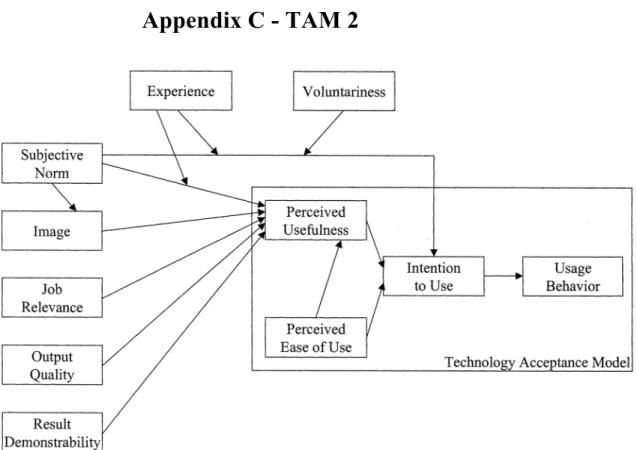
The theoretic basis for TAM and resulting research led to the development of a six item psychometric scale to measure perceived usefulness and perceived ease of use (Davis, 1989). This scale provides evidence for the validity and reliability through its testing in three stages: pretesting, empirical field study, and laboratory experiment (Chuttur, 2009). The scale for a new technology (email) was administered to a group of people who were asked to self-report their usage of that new technology (see Appendix A for original model). Davis’ (1989) initial study indicates that perceived usefulness is more important than perceived ease of use. Since perceived usefulness and perceived ease of use have a direct effect on behavioral intention, Davis (1989) revised the model by eliminating attitude (see Appendix B for TAM revision).
Testing of TAM
Numerous tests were done between the introduction of TAM and the expansion to TAM 2. A comparison study between TRA and TAM reports that the 6-item psychometric scale can be effectively reduced to a 4-item scale (Davis, Bagozzi, & Warshaw, 1989). These additional studies and tests of TAM 2 also affirm that perceived usefulness is the primary determinant and perceived ease of use provides a secondary determinant of behavioral intention (Davis et al, 1989). Replications of Davis’ study of perceived usefulness and ease of use examine many different technology applications from email and voicemail (Subramanian, 1994), to spreadsheet
14
and database applications (Henderickson, Massey, & Cronan, 1993), to database management system software packages (Szjna, 1994). The findings support the model in addition to providing validity and reliability of the psychometric scales. Results indicate that the scales can be used to retrieve user feedback on different technology systems/design approaches, diagnose a problem after implementation, make selections between two systems, and understand factors that influence the success of a system (Adams, Nelson, & Todd, 1992). These replication research efforts affirm Davis’s original study and conceptualization of TAM (Adams et al., 1992; Davis et al., 1989; Henderickson et al., 1993; Subramanian, 1994; Szajna, 1994).
While many studies replicate the original TAM, less was being done to explore and expand the original model. To address this concern, Venkatesh and Davis (1996) revisited Davis’ model to look more closely at the antecedents of perceived ease of use. Their study finds that an individual’s perception of a particular system’s ease of use is grounded in the person’s computer self-efficacy (Venkatesh & Davis, 1996). Computer self-efficacy is the degree of knowledge and comfort a person has with general computer use. They also report that objective usability
(response time, keystroke, comparison between beginners and experts) only affects perceived ease of use after direct experience. Through the new findings, they suggest focusing on
increasing people’s computer self-efficacy is more effective than improving the system’s design (Venkatesh & Davis, 1996).
TAM 2
While reproducible research endeavors served to consistently validate TAM, the model still did not do enough to explain factors that affect perceived usefulness and perceived ease of use. The desire to better understand additional contributing factors spurred efforts to expand and develop TAM 2 (Chuttur, 2009). A longitudinal study over four organizations and four different
15
technology systems provided the basis for the development of TAM 2 (Venkatesh & Davis, 2000). One goal of the longitudinal study was to include additional key determinants of perceived usefulness and perceived ease of use while also considering how time affects these determinants. TAM 2 adds social influence processes (subjective norm, voluntariness, and image) and cognitive instrumental processes (job relevance, output quality, result
demonstrability and perceived ease of use) (Venkatesh & Davis, 2000) (see Appendix C for TAM 2). Results indicate that perceived usefulness remains the most stable determinant in TAM 2, while subjective norms also play a role in user acceptance (Venkatesh & Davis, 2000).
Continuing TAM Testing
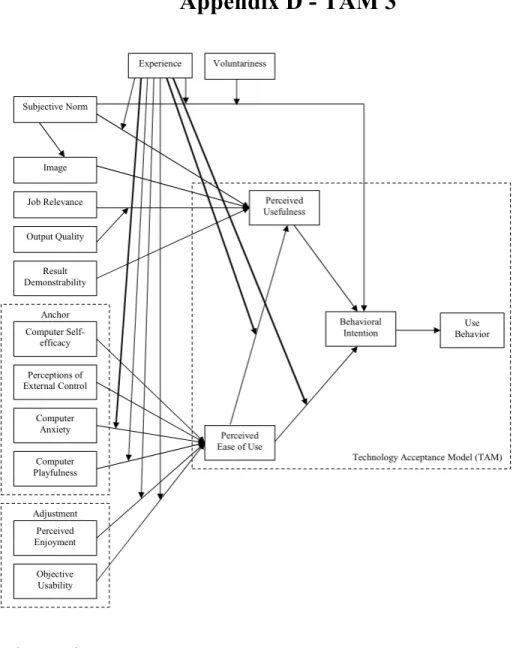
While TAM 2 expands the determinants of perceived usefulness, calls for studies to further understand perceived ease of use led to continuing research efforts (Venkatesh, 2000). Prior to using a new technology, perceived ease of use is based on people’s general beliefs about technology. These general beliefs or anchors are computer self-efficacy, perceptions of external control, computer anxiety, and computer playfulness (Venkatesh, 2000). Computer self-efficacy concerns a person’s belief in their ability to perform tasks using a computer (Venkatesh & Bala, 2008). Perceptions of external control are “the degree to which an individual believes that
organizational and technical resources exist to support the use of the system” (Venkatesh & Bala, 2008, p. 279). Computer anxiety deals with the fear or apprehension one has with computer usage (Venkatesh & Bala, 2008). Finally, computer playfulness is “the degree of cognitive spontaneity in microcomputer interactions” (Venkatesh & Bala, 2008, p. 279). These general beliefs or anchors play a major role in people’s perceptions before they physically encounter a new technology.
16
However, over time individuals adjust these beliefs as they become more familiar with the new technology. Perceived enjoyment and objective usability are two adjustments
influencing perceived ease of use over time. Perceived enjoyment is “the extent to which the activity of using a specific system is perceived to be enjoyable in its own right, aside from any performance consequences resulting from system use” (Venkatesh & Bala, 2008, p. 279). Whereas, objective usability is “a comparison of systems based on the actual level (rather than perceptions) of effort required to completing specific tasks” (Venkatesh & Bala, 2008, p.279). When a person begins enjoying the new technology and finding it usable, their perceptions are adjusted. Venkatesh’s (2000) study affirms that beliefs about perceived ease of use are first anchored using computer self-efficacy, perceptions of external control, computer anxiety, and computer playfulness, but over time beliefs are adjusted by perceived enjoyment and objective usability.
Continued expansion of TAM 2 research includes key determinants of perceptions of usefulness and ease of use, while expanding to add the variables of gender and age as important model factors. For example, Gefen and Straub (1997) report that men and women differ in their perceptions of email, but not in their use of email. In particular, women perceive the social presence of email and rate the perceived usefulness of email higher than men (Gefen & Straub, 1997). In another study conducted by Venkatesh and Morris (2000), results indicate that while men’s usage of technology is more strongly influenced by their perceptions of usefulness, women are more strongly influenced by perceived ease of use and subjective norms. Also, men are more motivated by instrumental factors and women by process and social factors (Venkatesh & Morris, 2000).
17
To look further at age and gender a unified model was created taking tenets from TAM and seven other models about technology acceptance. The unified theory of acceptance and use of technology (UTAUT) includes four constructs, which are key determinants of user acceptance and usage behavior: performance expectancy, effort expectancy, social influence, and facilitating conditions (Venkatesh, Morris, Davis, & Davis, 2003). Performance expectancy is the degree to which a person believes that using the system (or new technology) will increase his or her job performance. Effort expectancy has to do with how easy a person perceives the system to use. Social influence is the degree to which a person thinks that other important people think he or she should use the system. Lastly, facilitating conditions is the degree to which a person believes the organization is supporting the system use (Venkatesh et al., 2003). UTAUT also includes four moderators: gender, age, voluntariness, and experience. The moderating variables determine the strength of the relationship between behavioral intention and the four constructs. This model tests the relationship of performance expectancy, effort expectancy, social influence, and
facilitating conditions moderated by gender, age, experience, and voluntariness on behavioral intention with behavioral intention leading to actual use. Therefore, the model reveals that certain relationships are affected by the moderating factors of gender, age, experience, and voluntariness with technology acceptance or use (Venkatesh et al., 2003).
First, the model shows that performance expectancy is stronger for men, especially younger men, on behavioral intention. If the new system or technology is perceived to increase a person’s job performance, a person is more likely to intend to use the new technology and according to this relationship men and younger people are influenced highly by this construct (Venkatesh et al., 2003).
18
Second, UTAUT indicates that effort expectancy is stronger for women, older workers, and workers with limited experience in terms of behavioral intention. The easier a system is perceived to be, the more likely a person will intend to use it. In this case, women, older people, and limited experienced workers are influenced more by this construct (Venkatesh et al, 2003).
Third, the model shows that social influence will be stronger for women, older workers, workers under mandatory conditions, and workers with limited experience in terms of behavioral intention. If a person perceives that their superiors believe he or she should be using the
technology, then he or she will be more likely to intend to use the technology. According to Venkatesh et al. (2003), women, older workers, and mandatory conditions strengthen this relationship.
Lastly, UTAUT indicates that facilitating conditions are stronger for older workers with increasing experience on usage. Organizational support for the technology increases the intent to use, where older workers and more experience with the technology indicating a stronger
relationship between support and intent (Venkatesh et al 2003). These are the four situations in which the study reports that moderating variables affect the strength of the relationship between construct and behavioral intention.
TAM 3
A third iteration of the TAM model (TAM 3) was created, combining TAM 2 and the determinants based on perceived ease of use by incorporating the findings of previous research in order to improve acceptance rates of new technologies (see Appendix D for model and new component definitions). The TAM 3 model contains both factors influencing perceived ease of use (computer self-efficacy, computer anxiety, computer playfulness, perceptions of external control, perceived enjoyment and objective usability) and perceived usefulness (perceived ease
19
of use, subjective norm, image, and result demonstrability). The goal of the revised model is to produce practical guidance and suggestions to practitioners (Venkatesh & Bala, 2008).
TAM 3 longitudinal testing by Venkatesh and Bala (2008) identifies many new
relationships between variables. Specifically, perceived ease of use, subjective norm, image, and result demonstrability are significant predictors of percevied usefulness at all time periods. When participants experience increasing output quality, job relevance has a strong positive effect on percevied usefulness. Additionally, with increasing experience, the subjective norm has less effect than perceived usefulness. The anchors (computer self-efficacy, computer anxiety,
computer playfulness, and perceptions of external control) are significant predictors of perceived ease of use at all points in time and adjustments of perceived enjoyment and objective usability become significant at later times to perceived ease of use. Finally, perceived usefulness is the strongest predictor of technology acceptance and use at all times (Venkatesh & Bala, 2008).
While research efforts to develop TAM and TAM 2 were interested in identifying relationships between variables, TAM 3 focuses on producing actionable points for practioners. Researchers divide their advice into two stages: preimplementation interventions and
postimplementation (Venkatesh & Bala, 2008). The preimplementation stage occurs during the development and deployment of a technology. Venkatesh & Bala (2008) suggest that
managers/adminstrators encourage user participation by allowing the employees to help pick out new technology. Also, good managerial support of the new system is needed. Lastly, they suggest managers/adminstrators implement an incentive alignment, which entails matching the individual’s perception of the new technology with his/her job requirements and value system (Venkatesh & Bala, 2008).
20
Postimplemntation occurs after the deployment of the technology has taken place. Venkatesh and Bala (2008) recommend that organizational members receive adequate training and support through help desks, bringing in experts, and sending employees to off-the-job training, which is linked to increasing employees’ perception of usefulness of the new
technology. Increases in perceived usefulness postively influence acceptance. Furthermore, an increase in peer support by having coworkers help each other also assists in technology acceptance. TAM 3 furthers the study of technology acceptance because it offers practical intervention suggestions to organizations (Venkatesh & Bala, 2008).
Although the technology acceptance model has been intensely studied and expanded to reach its current model (TAM 3), there have been limitations. One limitation noted from the studies is that it relies on participant self-reporting (Davis, 1989; Venkatesh & Davis, 2000). Past study participants filled out the psychometric scales and then later self-reported if they used the technology or not. This can be problematic for a few reasons. Self-reporting is easily fabricated or altered and individuals may provide answers that are not factual, but appear to be socially desirable. A person may base answers on perceptions which may not reflect what actually
happened. Also, filling out a survey before they use the technology could change their perception of the new technology, which may affect their use.
Another limitation is that researchers have done a significant amount of testing on student populations (Davis 1989; Davis & Bagozzi, 1989; Henderickson, 1993; Szjna, 1994). Student populations tend to represent a younger demographic with less work experience. One goal of the study of technology acceptance is to find how organizations can implement technology more effectively; therefore, it would be beneficial to test the model on a population that matches organizations (older workers with greater work experience).
21
Lastly, perceived ease of use and perceived usefulness have been thoroughly studied; however, there has not been any consideration for other determinants of technology acceptance. As the TAM studies moved forward, the model was only expanded to include factors that
influenced perceived ease of use and perceived usefulness. More consideration for expanding the determinants of technology acceptance could prove useful in enhancing technology adoption.
Volunteer/Not-For-Profit Organizations
NPOs are an important part of the economy and civil society, providing contributions to societal well being by supporting various interests from sports to arts to social services
(Schneider, 2003). Most large NPOs have a large diverse membership that spans many
geographical locations; therefore, limiting face to face interactions. Also members voluntarily belong to these organizations and they likely have other higher priorities such as family and careers. Limited face time and balancing other commitments are constraints of many volunteer members. These limitations influence the important role communication technology can play in NPOs. CMC allows organizations to work around geographical restraints by connecting
members via email, conference calls, video conference calls, or more (Santra & Giri, 2009). CMC also allows for flexibility, which caters to the busy volunteer members (Santra & Giri, 2009). Therefore, communication technology acceptance is critical to these organizational members who are limited in their ability to meet face to face due to the geographical dispersion of members and their time availability due to work and personal commitments.
Organizational progress and viability is dependent on some technology acceptance so that members can maintain communication. The findings from TAM 3 offer practical suggestions for technology implementation that voluntary organizations can use (Venkatesh & Bala, 2008). However, in a voluntary organization mandating technology use or training is difficult, providing
22
another important reason to examine member technology acceptance within voluntary organizations.
Research of information and communication technology (ICT) use in the NPO sector can be categorized by three types of influences: organizational characteristics, environmental
characteristics, and pressures to establish legitimacy (Zorn, Flanagin & Shoham, 2010). The first category ICT use in NPOs is organizational characteristics. Research in this area has focused on tangible resources such as size, budget, and ICT support affecting technology acceptance (Hikmet, Bhattacherjee, Menachemi, Kayhan, & Brooks, 2008; Hackler & Saxon, 2007; Schneider, 2003). The underlying view is that technology is an efficiency-enhancing tool and NPOs should seek efficiency-enhancing tools to “stretch their dollar”, expand their market reach by using the internet, and enhance communication with stakeholders (Elliott, Katsioloudes & Weldon, 1998).
The second category of influence on ICT adoption in NPOs is environmental
characteristics. Research finds that as competition heightens there is more pressure to adopt new technologies; the competitive environment drives technology acceptance (Corder, 2001; Hackler & Saxton, 2007; Schneider, 2003; Ticher, Maison, & Jones, 2002). The last category of influence is legitimacy. In this area of research, technology is seen as a way to establish legitimacy. Most stakeholders only fund and support NPOs with a certain organizational reputation and the use of technology can influence the organizational reputation (Schneider, 2003). Therefore, by adopting ICT, nonprofits can increase efficiency, fit in with the environment, and establish legitimacy (Zorn et al, 2010).
Zorn, Flanagin, & Shoham (2010) expand the forces behind the acceptance of information and communication technology (ICT) in nonprofit organizations to include
23
institutional forces. The institutional forces of the decision makers’ IT knowledge, expected practice, competitor scanning, and leadership in the field are also consistent predictors of successful technology adoptions (Zorn et al., 2010). Organizational characteristics,
environmental characteristics, pressures to establish legitimacy, and institutional forces play a role in technology acceptance in nonprofit organizations.
Although there has been much research done in the area of technology acceptance, research can be expanded in three ways. First, although this research has been conducted in organizations (Adams et al, 1992; Segars, 1993; Venkatesh, 2008) many studies have used student populations (Davis 1989; Davis & Bagozzi, 1989; Henderickson, 1993; Szjna, 1994). This is problematic because the general student population is a younger demographic with little work experience. The younger demographic also tends to be more “tech savvy” or at least has been exposed to technology from an early age, which increases their overall comfortableness with technology. The student demographic does not match that of an organization and the main goal of this research in technology acceptance is to help organizations implement new
technology successfully. Therefore, this study looks at professionals in an existing organization who represent a wide age range. Looking at a different demographic could result in different results of why people accept new technology, possibly expanding the theory.
Second, the organization for this study represents an international population.
Organizations and businesses continue to expand into international markets. CMC has played a major role in globalization as it encourages global participation; communication across the globe is easier now. Today’s marketplace is one that is globalized and internet-driven (Global Guru, 2009). Therefore, international populations are an important player in technology acceptance and
24
it will be interesting to see if this model is truly transcendent, upholding in international populations.
Lastly, examining technology acceptance in volunteer organizations offers new insight and could possibly expand the model. NPOs are volunteer-based, which makes mandating use of new technology practically impossible and the organization may miss out on the many benefits CMC brings. Therefore, this research considers an important population to study because there may be other factors driving technology acceptance amongst members of nonprofit
organizations, allowing for potential expansion of TAM 3.
Adding these three dimensions (age variation, an international population, and
volunteers) to the study of technology acceptance, the researcher hopes to extend the technology acceptance model. Therefore, the first research question asks:
RQ1: In addition to perceived ease of use and perceived usefulness, why do organizational members accept or reject new technology?
Furthermore, TAM 3 offers practical suggestions to organizations about how to
implement new technology successfully among members. One of these suggestions is increased peer-to-peer support (Venkatesh & Bala, 2008). In order to address this suggestion and verify the importance of peer support through research, the second research question asks:
RQ2: How do organizational members influence each other’s technology acceptance and use?
25
Chapter 3 - Method
Technology acceptance has predominantly been studied quantitatively (Adams et al, 1992; Segars, 1993; Venkatesh, 2008; Davis 1989; Davis & Bagozzi, 1989; Henderickson, 1993; Szjna, 1994). These quantitative research endeavors have made significant contributions to the study of technology acceptance with the most substantial findings being that perceived ease of use and perceived usefulness are strong predictors of technology acceptance. These quantitative studies relied on surveys to collect their data; however, surveys are limited because they ask specific questions and do not capture information that is not contained in the survey.
Specifically, existing quantitative research has focused on studying perceived ease of use and perceived usefulness, which does not allow for expanding the determinants of technology use. While this existing research is beneficial it provides a snapshot, where incorporating qualitative methodology is better suited to address processes (Charmaz, 2000).
Qualitative research allows for field observations, interactions, and opportunities for participants to talk about technology in relation to others. This study expands on the previous research by examining actual interactions and asking questions that may uncover additional determinants of technology acceptance. Therefore, this study uses thematic analysis, a qualitative method, to identify other themes that were not considered in the previous quantitative studies (Aronson, 1994; Braun & Clark, 2006).
Participants
For this study, the researcher was granted access to observe and interview members of an international, volunteer run NPO. The researcher assumed a participatory-observant role by becoming a student member of the organization. In addition, the researcher was invited to observe meetings of leadership in the organization that a typical student member would not have
26
access to normally. Approximately 29,000 members pay dues to this organization, volunteering their time and expertise in running a range of meetings, including local, regional, national, and international meetings, events, and conferences. A small paid staff (approximately 15
individuals) provides support for technical communication, event planning, and daily operations. The organization strives to be the leading developer of standards and the newest research for their field. It is a highly technical society. With membership split between professional paid careers in academia and industry, the organization provides an interesting dynamic to study.
The international non-profit organization (NPO) of study is a predominately United States based organization with slightly over 50% of its membership residing in the U.S. Over 80% of members are male and approximately 65% of the membership is over 40 years old. Therefore, the average member of this organization is an older American male. However, the sample included all types of people from early career to retired, people in both academia and industry, and from the tech savvy to the tech illiterate. Canada, Singapore, Sweden, and Greece are just a few of the countries represented in this study. Women were also included, providing a diverse sample to capture all membership demographics.
In order for members to be interviewed and participate in focus groups, IRB approval was attained. Before data collection began, members were asked to sign an informed consent form bringing to their attention several things: they would be recorded, no names or identifying information would be shared by the researcher, and the interview/focus group data would be used for research purposes. Also, participants were informed that they could choose to stop their participation at any time and they could remove their data from the study upon request.
27
Procedures
The researcher began this study by collecting field observations. Observations were used to gain the trust of the leadership team in the organization and also to get a better understanding of the organizational structure. The observations were beneficial to help shape the questions asked during the next stage of data collection: interviews and focus groups. Another benefit of observing was that actual technology use among members could be observed and noted in field notes. Further, observations served to provide prompts to inquire about technology use during conversations and interviews. Extensive field notes were taken during and after meetings to capture interactions with group members. As interesting events or comments triggered questions, informal conversations were used to explain or clarify the observations.
Observations
Observations included attending six organizational meeting series and related events (each approximately five days long) to observe the members of the volunteer organization. This activity resulted in 240 hours of observation and 196 pages of typed single-spaced notes. These notes were gathered by collaboration; therefore, some observed events resulted in field notes by two researchers, which gave two perspectives on the same event. At these meetings the
researchers had the opportunity to attend a variety of meetings from the governing board of the organization to specialized working groups. Governing board meetings represent the most involved volunteer members; these are the people who decide the future directions of the organization. Governing board meetings usually had 20-30 attendees and were conducted as formal meetings. Working groups are responsible for producing the standards for the
organization’s field; these groups are more focused on specific tasks and are not as concerned with organizational initiatives or planning. Working groups can range from a small group of
28
people to a very large group; however, observations indicated that the participation level of members in the meeting varied greatly from actively participating to sitting along the wall in the back of the room. Observations were also made in casual social events sponsored for members by the organization, including lunches, dinners, and opening receptions.
The researchers also attended main sessions open to all members and interacted with the general membership that attends large conferences. These open events provided an opportunity to observe and interact with less involved members who were not volunteering in the
organization; generally these participants pay their dues and attend conferences to consume information. Therefore, the researchers were able to observe different types of member involvement and technology use by attending different meetings and observing different demographic groups.
Interviews
In order to obtain more detailed information on technology use, interviews were used. Interviews allowed the researcher to ask participants open-ended and follow-up questions. The interviewer had the opportunity to ask for more clarity or more details, which cannot be done in open-ended survey questions (Lindlof & Taylor, 2011). Open-ended questions about
communication practices that participants liked or did not like allowed for emergent data in regards to technology use.
A majority of the interviews were audio taped. Each interview lasted approximately 45 minutes with the shortest interview lasting 20 minutes and the longest 90 minutes. Eleven individuals participated in the interviews. The transcripts resulted in 142 typed single-spaced pages. The researchers did not collect any additional demographic information to ensure the anonymity of the participants.
29
The interviews were not focused specifically about technology acceptance, but rather, were designed to look at the organization’s communication practices as a whole. Data regarding technology acceptance was largely emergent and generated by participants. For the interviews, participants were asked to share their story of how they became a member of the organization and to explain their organizational involvement. This prompt allowed the participants to share information about themselves and open up while building rapport. As the interviews progressed, interview questions were asked that addressed the research questions.
The first research question asked, “In addition to perceived ease of use and perceived usefulness, why do organizational members accept or reject new technology?” Some interview questions that addressed this research question were “how do you find information about the organization’s conferences and activities?” or “do you use Facebook, LinkedIn, Twitter, or any other social media to get information about the organization?” or “what communication
technology do you use most frequently and why?” or “would you like to see a greater use of technology at conferences?” These interview questions were asked to determine how members gain organizational information and perceive communication technology, allowing for data to emerge about technology acceptance.
The second research question asked, “How do organizational members influence each other’s technology acceptance and use?” To address this, some interview questions included “what’s working/not working in terms of communication in the organization?” or “if there was one thing you would change about the organization’s communication practices, what would it be?” The intent of these interview questions was to determine the overall impressions of communication within the organization; however, as the organization utilizes technology to disseminate information, the topic of technology acceptance among fellow organizational
30
members was frequently discussed. An expanded listing of the questions asked during the interviews and focus groups can be found in Appendix E.
Focus Groups
Focus groups were the last means of data collection employed. Focus groups allow participants to “cultivate new kinds of interaction dynamics and thus, access to new kinds of information” (Kamberelis & Dimitriadis, 2005, p. 903). This dynamic allows for participants to build off one another’s experiences. As one person shares a story, it can spark an idea in another person and allow more data to emerge (Kamberelis & Dimitriadis, 2005). Another reason that focus groups are a beneficial technique is that they allow for a greater number of participants. The use of focus groups for this study was crucial to answering the second research question “how do organizational members influence each other’s technology acceptance and use?” Focus group interactions allowed the researchers to observe interaction and influence behaviors
between members. According to TAM 3, image, which is how other people perceive a person based on that individual’s use of technology, influences technology acceptance (Venkatesh & Bala, 2008). As members of the organization sat face-to-face with other members and heard their opinions about using technology, realizations about image emerged in member conversations.
A majority of focus group responses were audio taped. Thirteen focus groups were conducted, with each lasting approximately 60 minutes. Eighty individuals participated in the focus groups averaging four to five people per focus group, with two participants in the smallest group and 10 participants in the largest group. The transcripts resulted in 261 typed single-spaced pages of data. The researchers did not collect any additional demographic information to ensure the anonymity of the participants.
31
Questions asked in focus group interactions were not specifically geared towards technology acceptance; however, this provided a benefit because the topic of technology use, acceptance, and perceptions of peers occurred naturally. The theme of technology emerged from questions asked in the focus groups such as “what is working well in terms of communication for the organization?” or “what do you think is not working well in terms of communication in the organization?” These questions were followed up with probing questions about different
channels of communication including face-to-face and CMC. Questions on the focus group guide were created to look at the broader communication practices of the organization; however, technology was a theme that arose frequently in terms of communication. A listing of the focus group questions can be found in Appendix E.
Analysis
Upon completion of observations, interviews and focus groups, the data was then sent out for transcription. Once the data was transcribed, the researcher carefully listened to each
transcript to review, correct any inaccuracies, and immerse herself in the data. As detailed earlier, the combined transcriptions from the interviews and focus groups totaled 403 single-spaced pages of data and the field notes totaled 196 single-single-spaced pages of data for a combined total of 599 typed single-spaced pages of data.
To explore this rich data set, qualitative analysis began by sorting the information into two groups: 1) information pertaining to technology acceptance and 2) data not pertaining to technology acceptance to save for future research. Once the initial data had been sorted, three interviews included no pertinent information; therefore findings used in this study included eight interviews and 13 focus groups for a total of 88 participants.
32
The researcher then used open-coding to identify themes (Charmaz, 2006; Saldana, 2012) contained in the comments and observations specifically related to technology acceptance and use. This process was important in order for the researcher to become immersed and familiar with the data, allowing the researcher to know the depth and breadth of the content (Braun & Clarke, 2006). The research questions were considered individually in the transcripts and field notes. Specific quotes or observations were retained to address each of the research questions. Following the sorting of the initial data and clustering related quotations, data themes were compiled using memo writing (Charmaz, 2006) as a way to analyze and code the data early in the research process. Then the researcher theoretically sorted, diagramed, and integrated the memos to create robust categories and penetrating analyses (Charmaz, 2006). Reoccurring codes were grouped together and given a theme or category. All the quotes that related to that category were gathered and carefully read again. Then the researcher used the emerging themes to answer the research questions. The following chapter discusses these emerging themes as the findings from this data set.
33
Chapter 4 - Findings
As previously discussed, technology has and will continue to shape and influence how organizations are run. Successful technology adoption in organizations is therefore critical. While research has been conducted to explain technology acceptance, this study expands on the original research to look at technology acceptance in a not-for-profit, international organization using qualitative research methods. While the study supports previous research findings, three additional prominent themes arose that add to the understanding of the technology acceptance process. Specifically, the themes of appropriateness, information overload, and generational misconception surfaced throughout participant interactions and were strongly supported both in field observations and discussions with participants. This section details the study’s findings in relation to the research questions and is followed by a discussion of the finding implications and directions for future research.
Technology Acceptance and Rejection
Research question one asked: In addition to perceived ease of use and percevied usefulness, why do organizational members accept or reject new technology? It is important to note that data collected for this study confirm previous research findings in technology
acceptance, solidifying the theoretical conceptualizations of TAM 3 (Venkatesh & Bala, 2008). First, qualitative findings in support of TAM 3 are presented. Second, additional qualitative themes not explained by TAM 3, including appropriateness and information overload are described and supported through participant examples.
34
Qualitative Support for TAM 3
From the beginning, perceived ease of use and perceived usefulness have been the focal point of technology acceptance research. The most recent iteration TAM 3, expands on the model by providing factors that influence perceived ease of use and perceived usefulness (Venkatesh & Bala, 2008). As previously explained, perceived ease of use is influenced by computer self-efficacy, perceptions of external control, computer anxiety, computer playfulness, perceived enjoyment, and objective usability (Venkatesh & Bala, 2008). Whereas, perceived usefulness is influenced by subjective norm, image, job relevance, output quality, and result demonstrability (Venkatesh & Bala, 2008). Data collected throughout observations, interviews, and focus groups in this study confirm these primary (i.e. perceived ease of use) and influencing (i.e. computer self-efficacy) factors represented in existing TAM 3 conceptualizations. The following section highlights supporting data validating the model. Additionally, a more detailed description and support for new emerging themes follows.
Perceived Ease of Use
Perceived ease of use determines if a person believes that using a certain technology will be free from effort (Davis, 1989). Interview and focus group participants consistently validated this TAM 3 determinant by explaining how they want technology that is easy to use. This theme was confirmed in 10 of the 13 focus groups, one of the eight interviews, and throughout field observations. For example, Jerry shared that he personally would use the technology and the volunteer organization could accomplish more if there were “a couple of really basic things to use, those tools, and an easy to use collaboration site that you don’t have to be a super wiz-bang webmaster to use.” Jim echoed this affirmation for ease when he said how he liked that the “organization’s website is user-friendly.” Participants repeatedly stated that they shouldn’t be
35
expected to learn very complicated, technical skills to get tasks done for the organization. This again was confirmed by Jacob’s concern about technology that is “not entirely intuitive”.
This study also confirms the influencing factors of perceived ease of use in TAM 3. Computer anxiety refers to a person’s uneasiness about the possibility of using a computer (Venkatesh & Bala, 2008). Closely related is another influencing factor, computer self-efficacy, which refers to a person’s belief in their own ability to use a computer (Venkatesh & Bala, 2008). Participants explained their apprehensions and disbelief in their ability to accomplish tasks using certain technologies. For example Paul questioned, “ I wonder, what’s the best way to communicate? I created a group in LinkedIn and invited all the chapter chairs, but I observed that some of them are not using computers, they do not feel comfortable using computers.” In this quote, Paul’s indication of people’s discomfort (computer anxiety) and their refusal to use a computer (computer self-efficacy) highlight his experience of other’s perceived ease of use, providing support for TAM 3. Again, lack of belief in ability and hesitation was demonstrated when Greg confessed, “But I realize that I’m probably behind,” referring to his discomfort in using Twitter.
The data also indicated participant’s desire for adequate training and support, which supports perceptions of external control as an influencing factor. Perceptions of external control refers to an individual’s belief that the organization supports a technology (Venkatesh & Bala, 2008). For example, Robert explained:
I’ll be honest if we really want to do that action I should recommend some training. I had a hell of time. I was on the phone with the help desk twice for like an hour trying to get on it. They didn’t really understand how to use it.
36
Robert’s statement demonstrates a desire for proper support from the organization and the connection between using a new technology and available training. Further, the relationship between use and perceived support from the organization was affirmed by Megan’s observation that “I think those tools are available through the organization, but people don’t know how to get at them and that’s not communicated all that well.”
The influencing factors of computer playfulness and perceived enjoyment were easily confirmed through participants excitement about implementing new technologies into the
organization. Computer playfulness describes a person’s spontaneity with computers (Venkatesh & Bala, 2008). This was confirmed as participants described how they were “open” and willing to “try” new technologies out. Perceived enjoyment describes a person’s liking of a new
technology (Venkatesh & Bala, 2008). This was confirmed as participants described new technology as “fun”, “cool”, and “neat”. For example, Molly stated “I do think the tweeting, the Facebook linking, all those new tools we’re doing pretty well. I think the fact that we’re
embracing the LinkedIn groups is a hugely positive thing and a step in the right direction.” Participants’ openness and enjoyment of new technology is confirmed by these positive comments.
Lastly, many participants were able to talk about their direct exposure with using a new technology and how that experience affected their use, confirming objective usability as an influencing factor of perceived ease of use. Objective usability refers to a person’s actual interaction with a system to complete a task (Venkatesh & Bala, 2008). For example, Craig shared:
And you’d be amazed how well people self maintain…we’ve got the 700