Elsevier Editorial System(tm) for Food Chemistry
Manuscript Draft Manuscript Number: FOODCHEM-D-18-00114R2
Title: Comparative analysis of phytochemicals and activity of endogenous enzymes associated with their stability, bioavaibility and food quality in five Brassicaceae sprouts
Article Type: VSI: 3-ISPMF
Keywords: Brassicaceae sprouts, phytochemicals, antioxidant activity, myrosinase activity, polyphenol-oxidase
Corresponding Author: Dr. Dunja Samec, Ph.D.
Corresponding Author's Institution: Institute Ruđer Bošković First Author: Dunja Samec, Ph.D.
Order of Authors: Dunja Samec, Ph.D.; Iva Pavlović; Ivana Radojčić-Redovniković; Branka Salopek-Sondi
Abstract: Five Brassicaceae sprouts (white cabbage, kale, broccoli, Chinese cabbage, arugula) were comparatively analyzed based on
phytochemicals (polyphenols, glucosinolates, carotenoids, chlorophylls, ascorbic acid) content and accompanying enzymes associated with
phytochemical stability and bioavailability (peroxidases, myrosinase, and polyphenol-oxidase) that consequently impact food quality. Significantly high content of polyphenols and glucosinolates, as well as a high
antioxidant activity were found in white cabbage, followed by kale
sprouts. In addition, white cabbage contained higher amount of fibers and lower polyphenol-oxidase activity which potentially indicates prevention of browning and consequently better sprout quality. Arugula and broccoli showed higher activity of myrosinase that may result in higher
bioavailability of active glucosinolates forms. According to our data, sprouts are cheap, easy- and fast-growing source of phytochemicals but also they are caracterized by different endogenous enzymes activity. Consequently, this parameter should also be taken into consideration in the studies related to the health benefits of the plant-based food.
Highlights:
Cruciferous vegetables are recognized as a functional food.
Endogenous enzymes may influence phytochemical stability, bioavaibility and food quality. Cruciferous sprouts contain phytochemicals with health-promoting activity.
Cruciferous sprouts have different endogenous enzyme activity. Sprouts are cheap, easy and fast-growing source of phytochemicals. *Highlights (for review)
0
Comparative analysis of phytochemicals and activity of endogenous enzymes associated with their stability, bioavaibility and food quality in five Brassicaceae sprouts
Dunja Šamec1
*, Iva Pavlović1, Ivana Radojčić-Redovniković2, Branka Salopek-Sondi1 1Ruđer Bošković Institute, Department of Molecular Biology, Bijenička c. 54, 10000 Zagreb,
Croatia
2
Faculty of Food Technology and Biotechnology, University of Zagreb, Pierottijeva 6, 10000 Zagreb, Croatia
*Corresponding author: Dunja Šamec
Department of Molecular Biology
Ruđer Bošković Institute,
Bijenička cesta 54, 10000 Zagreb, Croatia
tel. (385) 1 4561 002
fax. (385) 1 4561 177
e-mail: [email protected] *Manuscript
0
Abstract
Five Brassicaceae sprouts (white cabbage, kale, broccoli, Chinese cabbage, arugula) were comparatively analyzed based on phytochemicals (polyphenols, glucosinolates, carotenoids, chlorophylls, ascorbic acid) content and accompanying enzymes associated with phytochemical stability and bioavailability (peroxidases, myrosinase, and polyphenol-oxidase) that consequently impact food quality. Significantly high content of polyphenols and glucosinolates, as well as a high antioxidant activity were found in white cabbage, followed by kale sprouts. In addition, white cabbage contained higher amount of fibers and lower polyphenol-oxidase activity which potentially indicates prevention of browning and consequently better sprout quality. Arugula and broccoli showed higher activity of myrosinase that may result in higher bioavailability of active glucosinolates forms.According to our data, sprouts are cheap, easy- and fast-growing source of phytochemicals but also they are caracterized by different endogenous enzymes activity. Consequently, this parameter should also be taken into consideration in the studies related to the health benefits of the plant-based food.
Keywords: Brassicaceae sprouts, phytochemicals, antioxidant activity, myrosinase activity, polyphenol-oxidase
1
1. Introduction 1
Cruciferous (Brassicaceae) vegetables include many species used in culinary and as
2
traditional medicine. Due to the good environmental adaptation cruciferous vegetables have
3
been grown and used by different cultures worldwide. They are recognized as a functional
4
food because different epidemiological and meta-analysis suggested that consumption of
5
cruciferous has preventive role against a variety of chronic disease, several cancers etc.
6
(Šamec, Pavlović & Salopek-Sondi, 2017). Beneficial effects include antioxidant,
anti-7
inflammatory, gastro protective and anti-obesity activity associated with the presence of
8
different phytochemicals such as glucosinolates, polyphenols, carotenoids etc. (Šamec et al.,
9
2017). Cruciferous also can be used in different forms, as a salad, fresh or dried as a spice,
10
cooked, fried, baked or fermented. In the last couple of years new culinary trend introduced
11
cruciferous vegetable in a germinating stage, as sprouts. Consumption of such as vegetables
12
provide unique taste, and additional health benefits due to the fact that Brassicaceae sprouts
13
are rich in health-promoting phytochemicals, vitamins, amino acids, and minerals (Vale et al.,
14
2015a; Vale et al., 2015b; Deng et al., 2017). During extensive period of growth and
15
development, seedlings and young plantlets accumulate more phytochemicals (Šamec,
Piljac-16
Žegarac, Bogović, Habjanič & Grúz, 2011), and, consequently, young seedlings or sprouts
17
could contain from 2 to 10-fold more phytochemicals than vegetables in mature stage
18
(Baenas, Gómez-Jodar, Morenoa, García-Viguera & Periago, 2017). 19
However, the bioaccessibility and bioavailability of each compound differs greatly. It is well
20
known that endogenous plant enzymes may significantly influence postharvest stability of
21
phytochemicals, food quality, consumer preferences and bioavaibility (Toivonen and
22
Sweeney, 1998; Queiroz, Lopes, Filaho & Valente-Mesquita, 2008; Martinez-Ballesta and
23
Carvajal, 2015). Antioxidant enzymes such as peroxidases are important in retention green
24
color in vegetables and their activity are critical in controlling yellowing (Toivonen &
2
Sweeney, 1998;). Additionally, peroxidases could be an indicator of quality deterioration
26
such as flavor loss and various biodegradation reactions. It is also relevant to enzymatic
27
browning since diphenols may function as reducing substrate in the enzyme reaction and
28
could promote darkening in fruit and vegetable products during processing and preservation
29
(Jang & Moon, 2011). Although peroxidases are involved in browning, polyphenol oxidases
30
(PPO) are the major cause of the brown coloration of many fruits and vegetables during
31
ripening, handling, storage and processing. In the presence of oxygen and PPO, phenolic
32
compounds present in plant tissue serve as precursors in the formation of quinones which
33
consequently polymerize and form brown pigments (melanosis). Formed quinones can bind
34
plant proteins reducing protein digestibility, amount of available polyphenols and nutritive
35
value of the food. Therefore, PPO activity affects the nutritional quality, appearance and
36
consumer’s acceptability (Queiroz et al., 2008). Myrosinase is an enzyme found in all
37
glucosinolate-containing vegetables from Brassicaceae family where catalyzes the hydrolysis
38
of glucosinolates into D-glucose and an aglycone which may be spontaneously converted into
39
isothiocyanates or indoles, the biologically active forms of glucosinolates associated with
40
numerous health benefits. Therefore, myrosinase is the most important issue for glucosinolate
41
turnover and its activity in plants substantially influences bioavailability and glucosinolates
42
health benefits (Martinez-Ballesta & Carvajal, 2015).
43
In recent years several studies reported content of health benefits compounds in Brassicaceae
44
sprouts (Vale et al., 2015a; Vale et al., 2015b; Deng et al., 2017) although data which directly
45
compare phytochemicals with endogenous enzymes in different cruciferous species are
46
limited. Taking into consideration importance of endogenous enzyme activity in
47
phytochemicals stability and bioavaibility as well as in food quality, we aimed to study those
48
parameters in five different Brassicaceae sprouts: white cabbage (Brassica olearcea var.
49
capitata), kale (B. oleracea var. acephala), broccoli (B. oleracea var. italic), Chinese
3
cabbage (B. rapa ssp. pekinensis), and arugula (Eruca sativa). In addition, we analyzed data
51
using principal component analysis, a statistical tool which allows visualization of the
52
interrelationships of the investigated parameters in the five different sprouts.
53
2. Material and methods 54
2.1. Plant material and sprouting conditions 55
Seeds of Brassicaceae species were purchased from the specialized seeds producers as listed:
56
broccoli (Brassica oleracea var. italica cv. Corveti F1) and white cabbage (Brassica oleracea
57
var. capitata cv. Varaždinski) from Semenarna Ljubljana, Chinese cabbage (Brassica rapa
58
var. pekinensis cv. Lour) from International Seeds Processing GmbH Germany and arugula
59
(Eruca sativa cv. Riga) from Vita Bella Italy. Kale seeds (Brassica oleracea var. acephala)
60
were obtained from the local grower. Prior sprouting, seeds were washed several times with
61
distilled water and placed on the 1% agar plates at 4°C on 24 h hydration. Afterwards, seeds
62
were transferred to plates containing cotton wool covered with filter paper and set in the
63
growing chamber at 22°C, and photoperiod 16/8 h (light/dark). To obtain moisture during
64
whole sprouting process plates were supplied with distilled water. Ten days after germination
65
started, sprouts were collected and immediately frozen using liquid nitrogen. For the
66
enzymatic assays, quickly frozen tissue was stored at -80°C until analysis. Samples for
67
phytochemical analysis were freeze-dried and stored in dark and dry place until use.
68
2.2. Dietary fibers and proteins 69
Dietary fiber content was determined using the Total dietary fiber assay kit (Megazyme
70
International Ireland, Bray, Ireland). Total soluble proteins were isolated in 100 mM
71
potassium phosphate buffer (pH 7.0, 0.1 mM EDTA) with addition of the insoluble
72
polyvinylpirolidone (PVPP). Protein content was determined according to the Bradford
73
(1976).
4 75
2.3. Phytochemicals analysis 76
2.3.1. Total ascorbic acid
77
Levels of total ascorbic acid were determined using the dinitrophenylhydrazine (DNPH)
78
method adapted to small scale analysis as we reported earlier (Šamec, Maretić, Lugarić,
79
Mešić, Salopek-Sondi & Duralija, 2016.)
80
2.3.2. Polyphenolic compounds
81
Extractions were carried out in a Mixer Mill MM 400 (Retsch, Haan, Germany)for 5 min at
82
30 Hz using 60 mg of freeze-dried tissue in 2 mL of 80% methanol, followed by 10 min
83
sonication and 1 h mixing at 15 rpm on tube rotator. Extracts were centrifuged and
84
supernatants recovered for the analysis. All extractions were performed in triplicates (Šamec
85
et al., 2011.). The total polyphenol content (TP) was determined according to the Folin–
86
Ciocalteu method (Singleton & Rossi, 1965) adapted to small volumes and results were
87
expressed as equivalents of gallic acid per dry weight (mg GAE/g dw). The total flavonoids
88
(TF) were analyzed using the AlCl3 method adapted to small scale (Šamec et al., 2011) and 89
presented as catechin equivalents per dry weight (mg CE/g dw). The total flavanols (TFL)
90
were determined using the p-dimethylaminocinnamaldehyde (DMACA) reagent and
91
proanthocyanidins (PRAN) were determined using the vanillin-HCl method (Šamec,
92
Bogović, Vincek, Martinčić & Salopek-Sondi, 2014) and expressed as catechin equivalents
93
per dry weight (mg CE/g dw). Total phenolic acids (TPA) were measured according to the
94
European Pharmacopoeia (2004)and shown as caffeic acid equivalents per dry weight (mg
95
CAE/g dw).
96
2.3.3. Glucosinolates
5
The extraction, isolation and desulphation of glucosinolates were carried out according to the
98
ISO method 10633-1 (1995) with modifications. In brief, triplicates of lyophilized tissue (30
99
mg) were extracted twice with 900 µL of 70% methanol at 70°C for 15 min by addition of an
100
internal standard glucotropeolin (20 µL of 5 mM glucotropeolin). After centrifugation,
101
recovered extracts were passed through an ion-exchange resin Fast DEAE Sepharose CL-6B
102
microcolumn for desulphation with purified sulphatase (from Helix pomatia) and left
103
overnight at the room temperature. Desulphoglucosinolates were eluted with 1.5 mL of
104
deionized water and separated on a ZORBAX C18 column (250 mm x 4.6 mm id; particle
105
size 5 µm) using a Perkin-Elmer Series 200 HPLC system (Waltham, MA, USA) (Jakovljević
106
el al., 2013). A two-component solvent system consisting of water (A) and 20% acetonitrile
107
in water (B) was used. A constant flow rate of 1 mL min-1 was employed with gradient
108
elution: 0-1 min 100% A, 1-30 min linear gradient change to 100% B, 30-35 min linear
109
gradient change to 100% A and 35-40 min 100% A. Detection was performed with a
UV-110
Diode Array Detector at 229 nm. Positive identification of desulphglucosinolates was
111
accomplished by comparing elution order with the retention time of a sinigrin and internal
112
standard glucotropeolin based on ISO standard method for determination of glucosinolates
113
content (ISO, 10633-1:1995) and UV-DAD peak spectral analyses. Individual glucosinolates
114
were recalculated from HPLC peak areas using the response factors to correct the absorbance
115
differences between the internal standard (glucotropeolin) and other identified glucosinolates
116
(ISO, 10633-1:1995). Results are expressed as µmol/g dw (dry weight).
117
2.3.4. Pigments
118
Plant pigments (chlorophylls and carotenoids) were extracted and quantified according to the
119
Lichtenthaler and Buschmann (2001) with modification (Šamec et al., 2014). Results are
120
expressed as mg/g dw (dry weight).
6
2.4. Antioxidant capacity 122
Methanol extracts used for spectrophotometric polyphenols analysis were used for
123
determination of antioxidant capacity of samples by DPPH radical scavenging capacity assay
124
(Brand-Williams, Cuvelier, & Berset, 1995) and ferric reducing/antioxidant power assay
125
(FRAP) as reported by Benzie and Strain (1999).
126
2.5. Enzymes activity 127
2.5.1. Antioxidant enzymes activity
128
Activity of antioxidant enzymes was determined in fresh frozen tissue. Plant material was
129
grounded in mortar with pestle using liquid nitrogen prior analysis and around 130 mg of
130
tissue was extracted with 1.5 mL of cold extraction buffer (100 mM potassium phosphate
131
buffer pH 7.0, 0.1 mM EDTA) with addition of the insoluble polyvinylpirolidone (PVPP) and
132
centrifuged for 20 min at 15000 g (at 4°C) (Salopek-Sondi et al., 2013).
133
Activity of guaiacol peroxidase (GPOD) was determined in 1 mL of total reaction volume
134
containing 50 mM potassium buffer pH 7.0., 18 mM guaiacol and 5 mM H2O2. Reaction was 135
started by adding 10 µL of extract and an increase in absorbance was monitored at 470 nm in
136
linear range of reaction (Chance & Maehly, 1955). One unit of enzymatic activity was
137
defined as 1 µmol of formed tetraguaiacol per minute calculated using molar extinction
138
coefficient (26.6 mM-1 cm-1). Results are shown as units per dry weight (U/mg dw).
139
Ascorbate peroxidase (APX) was determined according to the Nakano and Asada (1981) with
140
modifications. Reaction mixture in total volume of 1 mL consisted of 50 mM potassium
141
buffer pH 7.0, 0.1 mM EDTA and 0.1 mM ascorbic acid and 100 µL of extract. Reaction was
142
started by adding 100 µL of H2O2 in final concentration of 0.6 mM and decrease in 143
absorbance was monitored at 265 nm. Activity was calculated using the molar extinction
144
coefficient for ascorbic acid (12.45 mM-1 cm-1). One unit of enzymatic activity was defined
7
as 1 µmol of catalyzed ascorbic acid per minute. Results are shown as units per dry weight
146
(U/mg dw).
147
Catalase activity (CAT) was determined in 1 mL reaction mixture containing 100 µL of
148
extract and 50 mM potassium buffer pH 7.0 and 10 mM H2O2 (Aebi, 1984). Decrease in 149
absorbance was monitored at 240 nm and activity was recalculated using extinction
150
coefficient for hydrogen peroxide (40 mM-1 cm-1). One unit of enzymatic activity was defined
151
as 1 µmol of catalyzed hydrogen peroxide per minute. Results are shown as units per dry
152
weight (U/mg dw).
153
2.5.2. Polyphenol oxidase activity
154
Extraction of polyphenol oxidase (PPO) enzymes was performed by overnight shaking (at 4
155
°C) of 100 mg grounded tissue with 1 mL of extraction buffer (50 mM sodium phosphate pH
156
7.0, 0.1% Triton x-100, 1 M NaCl) with subsequent centrifugation (15000 rpm, 4 °C). PPO
157
activity was monitored in 1 mL of 50 mM sodium phosphate buffer pH 6.5 containing 50
158
mM catechol as a substrate. Reaction was started by addition of 20 µL of extract and
159
monitored at 420 nm for 1 minute. One unit of PPO activity was defined as the amount of
160
enzyme that caused an increase in absorbance of 0.01 per minute. Results are expressed as
161
units per dry weight (U/mg dw).
162
2.5.3. Myrosinase activity
163
Approximately 100 mg of grounded frozen tissue was extracted with 1.5 mL of cold
164
extraction buffer (0.2 M Tris-HCl, 10 mM EDTA, pH 5.5) with addition of the insoluble
165
polyvinylpirolidone (PVPP) and centrifuged at 4 °C for 20 min at 15000 g. Removal of
166
internal glucosinolates was performed as described by the Travers-Martin, Kuhlmann, and
167
Müller (2008). Enzymatic reactions were performed in 0.5 mL of total reaction volume (50
168
mM Tris-HCl pH 5.5,) for 30 min at 37 °Cusing 100 µL of extract without (blanks) or with
8
substrate sinigrin (final conc. 0.2 mM). Reaction was stopped by boiling at 95 °C for 5 min
170
and glucose level was determined by glucose assay kit (Glucose (GO) assay kit, Sigma, St.
171
Louis, USA). One unit of myrosinase (MYR) activity corresponds to 1 µmol of produced
172
glucose per minute. Results were expressed as units per dry weight (U/mg dw).
173
2.6. Statistical analysis 174
Statistical analysis was performed in Microsoft Excel 2010 upgraded with XLStat Premium
175
(version 19.01). The data are presented as the mean ± standard deviations (SD). Values 176
presented in tables and figures not sharing a common letter are significantly different at p < 177
0.05 by analysis performed using ANOVA and post hoc multiple mean comparison (Tukey’s 178
HSD test). 179
Since data were obtained using different methods before principle component analysis (PCA)
180
we did mean-centering and auto scaling to put all parameters on an equal level. Standardized
181
data contribute equally to the data set variance and to the principal component calculation.
182
3. Results and discussion 183
3.1. Dry weight, protein and dietary fiber content 184
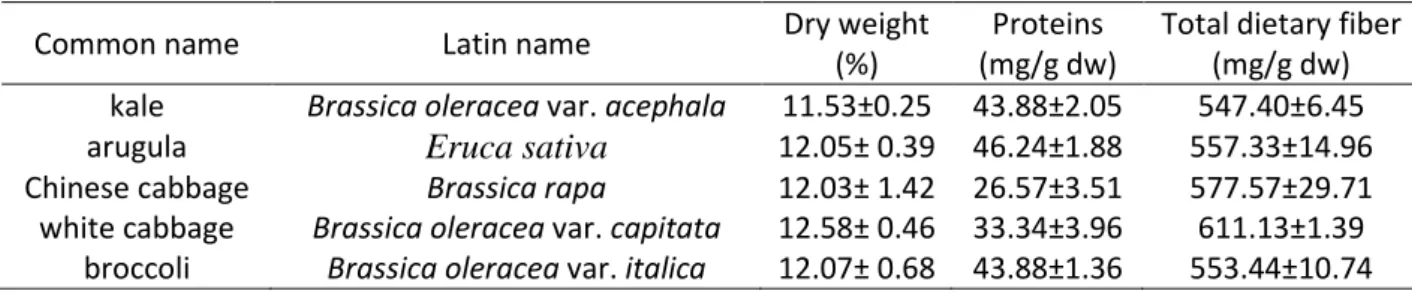
In our experimental setup analyzed Brassicaceae sprouts contain approximately 12% of dry
185
weight (dw) with slight differences depend on species/variety (Table 1). In order to make
186
results comparable with literature data, we expressed all data per dry weight basis. Kale,
187
arugula and broccoli contain 28-42% more proteins (43.88 – 46.24 mg/g dw) than Chinese
188
and white cabbage (26.57 and 33.34 mg/g dw, respectively) (Table 1). Dietary fiber content
189
of herein examined sprouts vary from 553.44 - 611.13 mg/g dw with higher content in white
190
and Chinese cabbages in comparison to others (Table 1), and those results are comparable
191
with total dietary fiber contents of cruciferous sprouts reported by Zielinski, Frias, Piskuła,
192
Kozłowska and Vidal-Valverde (2005). Our results therefore support previous findings that
9
sprouts are an excellent and easy to prepare source of dietary fibers (Vale et al., 2015a). Total
194
fiber is the sum of dietary fiber and functional fiber. Dietary fiber consists of nondigestible
195
carbohydrates and lignin that are intrinsic and intact in plants, while functional fiber consists
196
of isolated, nondigestible carbohydrates that have beneficial physiological effects in humans
197
(USDA, 2015).
198
3.2. Phytochemical content and antioxidant activity 199
The main phytochemicals associated with health benefits in Brassicaceae species include
200
polyphenols, carotenoids and glucosinolates which we evaluated in this study (Table 2 and
201
3). White cabbage sprouts showed the highest amount of total polyphenols (18.34 GAE/g dw,
202
respectively) and total glucosinolates (81.67±4.90 µmol/g dw). Total polyphenolic content of
203
white cabbage sprouts was around 80% higher than those, previously reported by our group,
204
in two-month old white cabbage plants (around 10 mg GAE/g dw) (Šamec et al., 2014).
205
Considering glucosinolates, we found that all examined sprouts contain higher amounts of
206
aliphatic glucosinolates than indolic ones (Table 3). Among aliphatic glucosinolates the
207
highest were sinirgin in white cabbage (59.93±4.38 µmol/g dw) and glucoraphanin in
208
broccoli (60.04±2.39 µmol/g dw), similar as in previous studies where the same
209
glucosinolates were reported as predominant ones in the mature white cabbage and broccoli
210
(Cartea, Velasco, Obregon, Padilla & Haro, 2008; Radošević, Gaurina-Srček,
Cvjetko-211
Bubalo, Rimac-Brnčić, Takács & Radojčić-Redovniković, 2017) indicating that presence of
212
individual glucosinolates is genetically defined. Presence of sinirgin in food is associated
213
with the anti-cancer, anti-inflammatory, antibacterial, antifungal, antioxidant, and wound
214
healing effects (Mazumder, Dwivedi & Plessis, 2016). Glucoraphanin, detected in broccoli, is
215
precursor for sulforaphane, an isothiocyanate with anticancerogenic activity (Atwell et al.,
216
2015). Significantly higher total glucosinolates content we found in white cabbage and kale
217
followed by commonly studeied broccoli. Total glucosinolates content in broccoli sprouts in
10
our experiment was 65.40±2.62 µmol/g dw, comparable with previous reports on broccoli
219
sprouts (Pereira, Rosa, Fahey, Stephenson, Carvalh & Aires, A, 2002). In our experiments
220
analyzed samples showed total ascorbic acid (vitamine C) content in all examined sprouts
221
around 1 mg/g with the exception of Chinese cabbage which had significantly lower ascorbic
222
acid content. High amount of ascorbic acid was detected in kale sprouts which contained, in
223
addition, the highest glucobrassicin content. Hydrolysis product of glucosinolate
224
glucobrassicin, indole-3-carbinol, received considerable interest as cancer chemoprotective
225
agent and has been studied in vitro and in vivo. In the presence of ascorbic acid, dependent on
226
the pH and temperature, indole-3-carbinol may be converted to ascorbigen, another
227
glucosinolates derivatives associated with anticancerogenic effects (Wagner & Rimbach,
228
2009). Therefore, considering presence of glucobrassicin and ascorbic acid, kale is potent
229
source of ascorbigen. Total carotenoids content in analyzed sprouts did not show significantly
230
different value among different sprouts and was, in average, lower than total carotenoid
231
content in four-week old white cabbage plants as reported in previous study (Šamec et al.,
232
2014). Arugula and kale, showed significantly higher total chlorophylls content what is
233
evident in their more intensive green color.
234
In parallel with the high content of polyphenolic compounds, known for their antioxidant
235
activity, white cabbage shown the highest DPPH radical scavenging activity (Figure 1a) and
236
ferric reducing antioxidant capacity (FRAP activity) (Figure 1b). These findings once more
237
confirmed previous observation that polyphenolic compounds (Vale, Cidade, Pinto, Beatriz
238
& Oliveira, 2014; Šamec et al., 2014) are the main compounds with antioxidant activity in
239
Brassicaceae. Interestingly, broccoli is, so far, the most commonly studied Brassicaceae
240
regarding health benefits recognized as a vegetable with high antioxidant capacity. However,
241
our data confirmed that, regarding sprouts, also other Brassicaceae species could be good
242
candidates as a source of health-promoting compounds and surely they deserve more
11
scientific attention. This is supported by recent paper that compared antioxidative and
244
antiproliferative activity in mature collard and broccoli and authors found that both plants
245
possess promising antitumor activities (Radošević et al., 2017).
246
3.3. Enzymes activity 247
Activities of the enzymes associated with stability and bioavaibility of phytochemicals and
248
consequently food quality of five Brassicaceae sprouts are shown in Figure 2 a-e. Green
249
vegetables such as sprouts are attractive and eye-catching to a large degree because of the
250
richness of chlorophyll pigments that they contain. Green color of vegetables is associated
251
with freshness and quality, and consequently, preservation of chlorophyll is of vital
252
importance to maintain quality. Two groups of enzymes which can influence loss of green
253
color and/or browning are peroxidase and polyphenol oxidase. Peroxidases are one of the key
254
antioxidant enzymes, widely distributed in nature and catalyze oxidation of various electron
255
donor substrates concomitant with the decomposition of H2O2. The plant peroxidases are 256
involved in various essential physiological processes of plant growth and development as
257
well as biotic and abiotic stress responses (Pandey, Awasthi, Singh, Tiwari and Dwivedl,
258
2017). In plant based food, peroxidase activity in plant tissue can produce free radicals which
259
react with food components (ascorbic acid, carotenoids and fatty acids) leading to the loss of
260
nutrients and the development of damage symptoms including deterioration in flavor, color,
261
and nutritional quality (Jang & Moon, 2011). In order to monitor a peroxidase activity in
262
cruciferous sprouts, activities of GPOD and APX were measured. As is evident from the
263
Figure 2a and 2c, Chinese cabbage showed significantly highest level GPOD, and together
264
with white cabbage high APX activity in comparison to other sprouts. High APX activity in
265
Chinese cabbage may be consequently connected with lower AA level when compared with
266
other varieties (Fig, 2c, Table 2). Singh, Sharma and Singh (2010) measured antioxidant
267
enzymes activity in 36 diverse white cabbage genotypes and found that peroxidase together
12
with catalase activity varied significantly among genotypes. Catalase (CAT) is another
269
important antioxidant enzyme for plants growth but according to the Toivonen and Sweeney
270
(1998) it is less important for food quality regarding chlorophyll loss than peroxidase. In our
271
study, catalase just showed significantly different activity between arugula and kale (Figure
272
2b). In kale, that in our study showed the lowest CAT and APX activity, according to the
273
literature data antioxidant enzyme activity depend on the cultivar and maturity stage (Korus,
274
2011).
275
One of the most important and widely studied enzyme for food quality is polyphenol oxidase
276
(PPO) (Figure 2e) which mediate first step in undesirable reaction of enzymatic browning
277
and lead to brown, and, even in some cases reddish-brown, blue-gray and even black
278
discolorations. Some cultivars can have higher PPO activity and/or high concentration or
279
types of phenolic PPO substrates which, under appropriate conditions lead to a higher
280
tendency to brown (Queiroz et al., 2008). Herein, sprout samples did not show significant
281
variations in PPO activity, expect white cabbage which has significantly lower activity in
282
comparison to broccoli and kale. PPO activity depends on the cultivar, growing location and
283
maturity stage (Korus, 2011). Since all sprouts in herein reported experiment were grown
284
under identical growing condition, variations in PPO activities are more probably determined
285
by genetic background. Interesting, Korus (2011) reported that PPO activity in kale
286
significantly increase with the age of the plant which may indicate that PPO is less likely to
287
influence food quality in plants at younger age, such as sprouts.
288
Brassicaceae vegetables are known to contain specialized metabolites glucosinolates whose
289
degradation products, isothiocyanates, have been widely identified as beneficial compounds
290
to human diet (Martinez-Ballesta & Carvajal, 2015). The enzymes myrosinase plays an
291
important role in the glucosinolate turnover to active products, and therefore it plays an
292
important role in Brassicaceae health benefits. Results presented on Figure 2d shows the
13
highest myrosinase activity in arugula and broccoli sprouts. Broccoli sprouts contain
294
glucosinolate glucoraphanin (Table 3) which could be hydrolyzed by an endogenous plant
295
myrosinase to the potent chemopreventive agent sulforaphane (Liang & Yuan, 2012).
296
Presence of active myrosynase in food matrix is of the great importance for sulforaphane
297
bioavailability (Atwell et al., 2015). For example, the study reported by Fahey, Holtzclaw,
298
Wehage, Wade, Stephenson and Talalay (2015) showed that when broccoli sprouts are
299
administered directly to subjects without prior extraction, and consequent inactivation of
300
endogenous myrosinase, the sulforaphane is 3- to 4-fold more bioavailable than sulforaphane
301
from glucoraphanin delivered without active plant myrosinase.
302
3.4. Relationship between phytochemicals and enzymes activity 303
Recent studies have demonstrated the effectiveness of PCA plotting using phytochemical
304
parameters in different food quality studies (Šamec et al. 2014, Šamec et al., 2016) including
305
studies on vegetable sprouts (Vale et al., 2015c, Viacava & Roura, 2015; Raimondi,
306
Rouphael, Kyriacou, Stasio, Barbieri & Pascale, 2017). In order to visualized relationship
307
between phytochemical content and enzyme activity we performed principle component
308
analysis (PCA), where first two principle components explained 82.65% variability. Bi-plot
309
at Figure 3 represents the observations and variables simultaneously in the new space whose
310
analysis and examination of the component loadings by extracting eigenvectors enabled as an
311
assessment of which individual parameters were associated with samples differences. On the
312
separation in first principle component (F1) the great influence had antioxidant activity
313
(DPPH and FRAP) and content of polyphenol and glucosinolate (TF, TGL, TFL, TPA)
314
compounds. It can be seen the strong positive loadings of the white cabbage which had high
315
amounts of those phytochemicals. Kale, in addition to white cabbage showed high content of
316
phytochemicals, but due to the higher content of PRAN, TF and AA which caused separation
317
in second principle component (F2), it is located in upper part of bi-plot. Chinese cabbage
14
which shows the highest catalase (CAT) and peroxidase activities (GPOD and APX) is
319
located in the lower part of the bi-plot. Arugula is positioned on the left side of the bi-plot
320
due to the highest amount of chlorophylls and carotenoids.
321
4. Conclusions 322
Obtained results showed that all five analyzed sprouts contain phytochemicals with
health-323
promoting benefits. Significantly high content of polyphenols and glucosinolates, and
324
antioxidant activity were found in white cabbage sprouts, followed by kale sprouts. Both
325
varieties have not so far been widely used for food as sprouts. Another advantage of white
326
cabbage is lower PPO activity which potentially indicates phytochemical stability, and
327
consequently, better food quality. Based on presented results, examined Brassicaceae sprouts,
328
with particular focus to white cabbage deserve more scientific attention as a cheap source of
329
phytochemicals with health-promoting benefits.
330
Acknowledgments: 331
This work has been supported by The Foundation of Croatian Academy of Sciences and Arts,
332
by The Croatian Science Foundation (project no. IP-2014-09-4359) and by the Unity
333
Through Knowledge Fund (contract no 12/17). The authors give sincere thanks to Ivana
334
Lugarić for technical assistant.
0
References
Aebi, H. (1984). Catalase in vitro. Methods in Enzymology 105, 121–126.
Atwell, L.L., Hsu, A., Wong, C.P., Stevens, J.F., Bella, D., Yu, T.-W., Pereira, C.B., Löhr, C.V., Christensen, J.M., Dashwood, R.H., Williams, D.E., Shannon, J., & Ho, E. (2015) Absorption and chemopreventive targets of sulforaphane in humans following consumption of broccoli sprouts or a myrosinase-treated broccoli sprout extract. Molecular Nutrition &
Food Research 59, 424–433.
Baenas, N., Gómez-Jodar, I., Morenoa, D.A, García-Viguera, C., Periago P.M. (2017). Broccoli and radish sprouts are safe and rich in bioactive phytochemicals. Postharvest
Biology and Technology 127, 60–67.
Benzie I. F. F., & Strain J. J. (1999). Ferric reducing/antioxidant power assay: Direct measure of total antioxidant activity of biological fluids and modified version for simultaneous measurement of total antioxidant power and ascorbic acid concentration. Methods in
Enzymology 299, 15–27.
Bradford, M. M. (1976). A rapid and sensitive method for the quantitation of microgram quantities of protein utilizing the principle of protein-dye binding. Analytical Biochemistry
72, 248–254.
Brand-Williams, W., Cuvelier, M. E., & Berset, C. (1995). Use of a free radical method to evaluate antioxidant activity. LWT- Food Science and Technology 28, 25–30.
Cartea, M.E., Velasco, P., Obregon, S., Padilla, G., & Haro, A. (2008) Seasonal variation in glucosinolate content in Brassica oleracea crops grown in northwestern Spain.
0
Chance, B., & Maehly, A.C. (1955). Assay of catalases and peroxidases. Methods in
Enzymology 2, 764–775.
Deng, M., Qian, H., Chen, L., Sun, B., Chang, J., Miao, H., Cai, C., & Wang, Q. (2017) Influence of pre-harvest red light irradiation on main phytochemicals and antioxidant activity of Chinese kale sprouts. Food Chemistry 222, 1-5.
European Pharmacopoeia (2004). 4th ed. Council of Europe, Strasbourg. pp. 2377–2378.
Fahey, J.W., Holtzclaw, W.D., Wehage, S.L., Wade, K.L., Stephenson, K.K., & Talalay, P. (2015) Sulforaphane bioavailability from glucoraphanin-rich broccoli: control by active endogenous myrosinase. Plos One, doi:10.1371/journal.pone.0140963
Jakovljević, T., Cvjetko, M., Sedak, M., Đokić, M., Bilandžić, N., Vorkapić-Furač, J., & Radojčić-Redovniković, I. (2013). Balance of glucosinolates content under Cd stress in two
Brassica species. Plant Physiology and Biochemistry 63, 99–106.
Jang, J.-H., & Moon, K.-D. (2011) Inhibition of polyphenol oxidase and peroxidase activities on fresh-cut apple by simultaneous treatment of ultrasound and ascorbic acid. Food
Chemistry 124, 444-449.
Korus, A. (2011) Level of vitamin C, polyphenols, and antioxidant and enzymatic activity
in three varieties of kale (Brassica oleracea L. var. acephala) at different stages of maturity.
International Journal of Food Properties 14, 1069-1080.
Liang, H., & Yuan, Q. (2012) Natural sulforaphane as a functional chemopreventive agent: including a review of isolation, purification and analysis methods. Critical Reviews in
0
Lichtenthaler, H. K., & Buschmann, C. (2001). Chlorophylls and carotenoids: Measurement and characterization by UV–VIS spectroscopy. Current protocols in food analytical chemistry, John Wiley & Sons, Inc.F, F4.3.1–F4.3.8.
Martinez-Ballesta, M.C., & Carvajal, M. (2015). Myrosinase in Brassicaceae: the most important issue for glucosinolate turnover and food quality. Phytochemical Review 14, 1045– 1051.
Mazumder, A., Dwivedi, A., & Plessis, J. (2016). Sinigrin and its therapeutic benefits.
Molecules 21, 416.
Nakano, Y., & Asada, K. (1981). Hydrogen peroxide is scavenged by ascorbate-specific peroxidase in spinach chloroplasts. Plant and Cell Physiology 22, 867–880.
Pandey, V.P., Awasthi, M., Singh, S., Tiwari S., Dwivedi, U.N. (2017). A comprehensive review on function and application of plant peroxidases. Biochemistry & Analytical
Biochemistry 6, 1.
Pereira, F.M.V., Rosa, E., Fahey, J.W., Stephenson, K.K., Carvalho, R., & Aires, A. (2002) Influence of temperature and ontogeny on the levels of glucosinolates in broccoli (Brassica oleracea Var. italica) sprouts and their effect on the induction of mammalian Phase 2 enzymes. Journal of Agriculture and Food Chemistry 50, 6239-6244.
Queiroz, C., Lopes, M.L.M, Filaho, E., & Valente-Mesquita, V.L. (2008). Polyphenol Oxidase: Characteristics and Mechanisms of Browning Control. Food Reviews International, 24, 361–375.
Radošević, K., Gaurina-Srček, V., Cvjetko-Bubalo, M., Rimac-Brnčić, S., Takács, K., & Radojčić-Redovniković, I. (2017). Assessment of glucosinolates, antioxidative and
0
antiproliferative activity of broccoli and collard extracts. Journal of Food Composition and
Analysis 61, 59-66.
Raimondi, G., Rouphael, Y., Kyriacou, M.C., Stasio, E.D., Barbieri, G., & Pascale, S.D. (2017) Genotypic, storage and processing effects on compositional and bioactive components of fresh sprouts. LWT - Food Science and Technology 85, 394-399.
Šamec, D., Bogović, M., Vincek, D., Martinčić, J., & Salopek-Sondi, B. (2014). Assessing the authenticity of the white cabbage (Brassica oleracea var. capitata f. alba) cv. ‘Varaždinski’ by molecular and phytochemical markers. Food Research International 60, 266-272.
Šamec, D., Piljac-Žegarac, J., Bogović, M., Habjanič, K., & Grúz, J. (2011). Antioxidant potency of white (Brassica oleracea L. var. capitata) and Chinese (Brassica rapa L. var.
pekinensis Lour.) cabbage: The influence of development stage, cultivar choice and seed
selection. Scientia Horticulturae 128, 78-83.
Šamec, D., Maretić, M., Lugarić, I., Mešić, A., Salopek-Sondi, B., & Duralija, B. (2016). Assessment of the differences in the physical, chemical and phytochemical properties of four strawberry cultivars using principal component analysis. Food Chemistry 194, 828-834. Šamec, D., Pavlović, I., & Salopek-Sondi, B. (2017). White cabbage (Brassica oleracea var.
capitata f. alba): botanical, phytochemical and pharmacological overview. Phytochemistry
Reviews 16, 117-135.
Salopek-Sondi, B., Šamec, D., Mihaljević, S., Smolko, A., Pavlović, I., Janković, I., & Ludwig-Müller, J. (2013). Influence of stress hormones on auxin homeostasis in Brassica rapa seedlings. Plant Cell Reports 32, 1031-1042.
1
Singh, B.K., Sharma, S.R., & Singh, B. (2010) Antioxidant enzymes in cabbage: Variability and inheritance of superoxide dismutase, peroxidase and catalase. Scientia Horticulturae 124, 9–13.
Singleton, V. L., & Rossi, J. A. (1965). Colorimetry of total phenolics with phosphomolybdic – phosphotungstic acid reagents. American Journal of Enology and Viticulture 16, 144–158.
0
Toivonen, P. M. A., & Sweeney, M. (1998) Differences in Chlorophyll Loss at 13 °C for Two Broccoli (Brassica oleracea L.) Cultivars Associated with Antioxidant Enzyme Activities. Journal of Agriculturae and Food Chemistry 46, 20-24.
Travers-Martin, N., Kuhlmann, F., & Müller, C. (2008). Revised determination of free and complexed myrosinase activities in plant extracts. Plant Physiology and Biochemistry, 46 506–516.
U.S. Department of Agriculture. 2015–2020 Dietary Guidelines for Americans. 8th Edition. December 2015. Available at http://health.gov/dietaryguidelines/2015/guidelines/.
Vale, A.P., Cidade, H., Pinto, M, Beatriz, M., & Oliveira, P.P. (2014). Effect of sprouting and light cycle on antioxidant activity of Brassica oleracea varieties. Food Chemistry 165, 379-387.
Vale, A.P., Santos, J., Brito, N.V., Peixoto, V., Carvalho, R, Rosa E., Beatriz, M., & Oliveira, P.P.. (2015a) Light influence in the nutritional composition of Brassica oleracea sprouts. Food Chemistry 178, 292-300.
Vale, A.P., Santos, J., Melia, N., Peixoto, V., Brito, N.V., Beatriz, M., & Oliveira, P.P. (2015b). Phytochemical composition and antimicrobial properties of four varieties of
Brassica oleracea sprouts. Food Control 55, 248-256.
Vale, A.P., Santos, J., Brito, N.V., Fernandes, D., Rosa, E., Beatriz, M., & Oliveira, P.P. (2015c) Evaluating the impact of sprouting conditions on the glucosinolate content of
Brassica oleracea sprouts. Phytochemistry 115, 252-260.
Viacava, G. E, & Roura, S.I. (2015) Principal component and hierarchical cluster analysis to select naturalelicitors for enhancing phytochemical content and antioxidantactivity of lettuce
0
Wagner, A.E., & Rimbach, G. (2009). Ascorbigen: chemistry, occurrence, and biologic properties. Clinics in Dermatology 27, 217–224.
Zielinski, H., Frias, J., Piskuła, M.K., Kozłowska, H., & Vidal-Valverde, C. (2005) Vitamin B1 and B2, dietary fiber and minerals content of Cruciferae sprouts. European Food
1
Figure 1. Antioxidant capacities of five Brassicaceae sprouts measured by DPPH (a) and FRAP (b). Values with different superscript letters in the same column differ significantly at p < 0.05.
Figure 2. Activity of enzymes in five Brassicaceae sprouts: a) guaiacol peroxidase, GPOD; b) catalase, CAT; c) ascorbate peroxidase, APX; d) myrosinase, MYR and e) polyphenol oxidase, PPO. Values with different superscript letters in the same column differ significantly at p < 0.05.
Figure 3. The principal component analysis (PCA) bi-plot performed on the correlation matrix of average values of phytochemicals content (Total polyphenols, TP; total flavonoids, TF; total flavanols, TFL; proanthocyanidins, PRAN; total phenolic acids, TPA; total ascorbic acid, AA; total glucosinolates, TGL; chlorophyll a, Chl a; chlorophyll b, Chl b; total chlorophylls, TChls; carotenoids, Car), antioxidant capacity (DPPH, FRAP) and measured enzymes activity (catalase, CAT; ascorbate peroxidase, APX; guaiacol peroxidase, GPOD; polyphenol oxidase, PPO; myrosinase, MYR) of five analysed Brassicacea sprouts.
Table 1. Common name, Latin name, dry weight and content of proteins and total dietary fibers in five analysed Brassicacea species
Common name Latin name Dry weight
(%)
Proteins (mg/g dw)
Total dietary fiber (mg/g dw) kale Brassica oleracea var. acephala 11.53±0.25 43.88±2.05 547.40±6.45 arugula Eruca sativa 12.05± 0.39 46.24±1.88 557.33±14.96 Chinese cabbage Brassica rapa 12.03± 1.42 26.57±3.51 577.57±29.71 white cabbage Brassica oleracea var. capitata 12.58± 0.46 33.34±3.96 611.13±1.39
broccoli Brassica oleracea var. italica 12.07± 0.68 43.88±1.36 553.44±10.74
Table2. Total polyphenols (TP), total flavonoids (TF), total flavanols (TFL), proanthocyanidins (PRAN), total phenolic acids (TPA), total ascorbic acid, chlorophyll a, chlorophyll b, total chlorophylls and carotenoids content of five analysedBrassicacea species
kale arugula Chinese cabbage white cabbage broccoli TP (mg GAE/g dw) 15.13±0.43 b 13.48±0.39c 13.20±0.63c 18.34±0.50a 15.02±0.25b TF (mg CE/g dw) 3.67±0.19 a 2.71±0.23c 2.57±0.07c 3.58±0.17ab 3.18±0.06b TFL (mg CE/g dw) 0.20±0.01 a 0.09±0.01c 0.15±0.01b 0.21±0.00a 0.19±0.01a PRAN (mg CE/g dw) 1.89±0.11 a 1.94±0.11a 0.98±0.16c 1.39±0.18b 1.25±0.09bc TPA (mg CAE/ g dw) 4.44±0.14 a 3.33±0.15c 3.21±0.21c 4.77±0.21a 3.89±0.03b AA (mg/g dw) 1.09±0.01 a 0.92±0.15ab 0.78±0.04c 0.91±0.10ab 0.95±0.08ab chlorophyll a (mg/g dw) 2.27±0.11 ab 2.38±0.21a 1.88±0.12bc 1.30±0.12d 1.77±0.18c chlorophyll b (mg/g dw) 1.19±0.09 ab 1.29±0.16a 0.85±0.20bc 0.53±0.10c 0.74±0.09c total chlorophylls (mg/g dw) 3.46±0.09 a 3.67±0.14a 2.73±0.32b 1.86±0.23c 2.51±0.26b Carotenoids (mg/g dw) 0.53±0.08 a 0.55±0.11a 0.38±0.05a 0.37±0.01a 0.46±0.02a
Table 3. Glucosinolates content (µmol/g dw) in analysed Brassicacea species kale arugula Chinese
cabbage White cabbage broccoli ali p h atic glucoiberin 24.41±0.70 0.88±0.07 n.d. 6.37±0.49 2.43±0.23 progoitrin 9.69±0.98 n.d. 15.43±1.44 6.86±0.28 n.d. sinigrin 30.65±1.72 n.d. 0.23±0.03 59.93±4.38 n.d. glucoraphanin 2.70±0.45 5.10±0.54 nd 0.77±0.08 60.04±2.39 glucoalyssin 0.66±0.03 1.42±0.05 0.16±0.01 nd nd gluconapin nd nd 1.8 ±0.10 nd 0.22±0.01 glucobrassicanapin 6.15±0.76 6.00±0.37 4.92±0.26 1.92±0.11 n.d. in d o lic 4-hydroxyglucobrassicin 0.63±0.13 0.08±0.01 0.24±0.01 0.23±0.03 0.13±0.01 glucobrassicin 2.55±0.50 1.81±0.06 0.43±0.03 1.19±0.02 1.07±0.16 4-methoxyglucobrassicin 1.32±0.04 3.36±0.13 0.65±0.02 1.95±0.42 0.12±0.02 neoglucobrasscin 1.58±0.18 1.95±0.51 0.97±0.10 2.46±0.06 1.39±0.13 total 80.33±2.04a 20.59±0.90c 24.90±1.68c 81.67±4.90a 65.40±2.62b nd, not detected
Figure 1
Figure 2
Figure 3
Supplementary Material