Networks Using Data Mining
Slah A. Alsaleh
MIT. Hons. (Griffith University, Australia), BEd. (CS) (King
Saud University, Saudi Araibia)
Thesis submitted in fulfilment of the degree of Doctor of
Philosophy
School of Electrical Engineering and Computer Science
Science and Engineering Faculty
Queensland University of Technology
Brisbane, Queensland, Australia
Recommendation, recommender system, implicit data, explicit data, pre-processing, profiling, collaborative, content-based, knowledge-based, demographic, hybrid, social networks, community detection, clustering, constraints, ranking.
Social networks continue to receive significant attention in academia and busi-ness practices. The increasing number of users, along with the amount of im-plicit and exim-plicit information available, poses challenges in finding, matching and recommending people in social networks. The people recommendations need to be accepted by both parties and presented in a reasonable time period. Existing social matching systems can be seen as recommender systems that recommend people to each other, in lieu of recommending products to users. Existing systems use two popular approaches: (1) content-based matching, using the users’ profiles; and (2) collaborative-based, using users’ activities to facilitate the matching. Only a few social networks use a hybrid-based ap-proach in which both profiles and activities are used. However, with the rapid growth of users in social matching networks and with the increasing amount of information that social matching systems obtain about their users, recom-mender techniques are less adept at matching people in the social networks.
This thesis presents a hybrid recommendation system for matching people in social networks with the use of clustering. Two incremental constraint-based clustering algorithms were developed to produce fine clustering solutions that improve the accuracy of the recommendation. The proposed clustering algorithms combine the similarity measurement and constraints validation in one step and execute it at the cluster level, which makes these algorithms viable for large datasets, such as social networks. Two personalised ranking methods were developed that employ the users’ constraints and past communications
to rank the recommendations in the social networks.
The proposed system and methods are evaluated using the data collected from a real life social network. The empirical analysis confirms that the pro-posed system and methods achieved great improvements in the accuracy and efficiency of matching and recommending people. Using clustering algorithms helps the proposed system to reduce the computation complexity (through re-ducing the number of users that the matching system needs to consider) by up to 99.98% compared to the baseline. More importantly, it improves the accuracy of the recommendation from 25% to up to 71%. It also helps to over-come other problems that social matching systems usually suffer, including the absence of knowledge, when a new user joins (cold-start problem). Fur-ther improvements to the quality of the recommendations were made using the proposed ranking methods. Finally, this research advances the current state of recommending people in a social network by proposing an efficient social matching system that uses the clustering technique and employs different data sources, profiles and ranking methods.
Keywords iii
Abstract v
List of Figures xi
List of Tables xiii
Glossary xv
Statement of Original Authorship xvii
Publications xix
Acknowledgements xxi
Chapter 1 Introduction 1
1.1 Research Problem Statement . . . 5
1.2 Research Questions . . . 6
1.3 Research Aims and Objectives . . . 7
1.4 Research Significance and Contributions . . . 8
1.5 Thesis Structure . . . 10
Chapter 2 Literature Review 13 2.1 Introduction . . . 13
2.2 Social Networks . . . 15
2.2.1 Social Matching Techniques . . . 17
2.2.1.1 Rules-based Approach . . . 18
2.2.1.2 Content-based Approach . . . 19
2.2.1.3 Collaborative Approach . . . 20 vii
2.2.1.4 Hybrid Approach . . . 21
2.2.2 An Example of Social Matching Network . . . 21
2.3 Recommender Systems . . . 24
2.3.1 Collaborative Recommender Systems . . . 25
2.3.2 Content-Based Recommender Systems . . . 29
2.3.3 Knowledge-Based Recommender Systems . . . 32
2.3.4 Demographic Recommender Systems . . . 34
2.3.5 Hybrid Recommender Systems . . . 35
2.4 Clustering Users in Social Networks . . . 36
2.4.1 General Clustering Algorithms . . . 37
2.4.2 Clustering Large Datasets . . . 40
2.4.3 Constraints Clustering and Semi-supervised Clustering . 42 2.4.4 Clustering Users in Social Networks . . . 44
2.4.5 Community Detection in Social Networks . . . 46
2.5 Recommendation Ranking . . . 47
2.6 Discussion and Research Gap . . . 50
2.7 Summary . . . 51
Chapter 3 The Proposed Research Methodology 53 3.1 Introduction . . . 53
3.2 Research Design . . . 55
3.2.1 Phase-One: Pre-processing and Profiling . . . 56
3.2.2 Phase-Two: Clustering . . . 57
3.2.3 Phase-Three: Recommendation . . . 59
3.3 Case Study of Social Network . . . 60
3.3.1 Data Pre-Processing and Profiling . . . 63
3.3.2 Data Filtering . . . 64
3.3.3 Data Integration and Transformation . . . 67
3.3.4 Datasets . . . 69
3.3.5 Social Network Analysis . . . 70
3.3.5.1 The Bow Tie Structure Analysis . . . 71
3.3.5.2 Degree Centrality . . . 73
3.3.6 Social Networks Users’ Profiling . . . 74
3.3.6.1 Constraints’ Construction in Social Networks . 75 3.3.6.2 Personalised Weighting for Users’ Attributes . . 79
3.4.1 Clustering . . . 81
3.4.2 Matching and Recommendation . . . 85
3.5 Summary . . . 87
Chapter 4 Clustering People in Social Networks 89 4.1 Introduction . . . 89
4.2 Clustering People in Social Networks: An Overview . . . 92
4.3 Semi-supervised Constrained Clustering Algorithm . . . 93
4.3.1 Closeness Function . . . 94
4.3.2 SCClust Algorithm . . . 96
4.4 Weighted Semi-supervised Constrained Clustering Algorithm . . 99
4.4.1 Closeness Function . . . 99 4.4.2 WSCClust Algorithm . . . 101 4.5 Empirical Evaluation . . . 102 4.5.1 Intra-similarity . . . 104 4.5.2 Inter-similarity . . . 107 4.5.3 Constraints Satisfaction . . . 108 4.5.4 Success Rate . . . 110 4.5.5 Scalability Evaluation . . . 112
4.6 Discussion and Summary . . . 113
4.7 Summary . . . 117
Chapter 5 Matching and Recommending People in Social Networks 119 5.1 Introduction . . . 119
5.2 Clustering Based Social Matching System . . . 121
5.2.1 Clustering Users in Social Networks . . . 124
5.2.2 Matching Clusters and Recommendation . . . 125
5.2.3 Explicit Matching . . . 128
5.2.4 Two-way Compatibility of Recommendations . . . 129
5.2.5 Clustering to Reduce the Computational Complexity . . 130
5.2.6 Clustering to Solve Cold Start Problem . . . 131
5.3 Recommendation Ranking . . . 133
5.3.1 Constrained Ranking Method . . . 133
5.3.2 Personalised Weighted Attributes Ranking Method . . . 135
5.4.1 Complexity . . . 138
5.4.2 Success Rate . . . 140
5.4.3 Recall . . . 147
5.4.4 Recommendation Ranking . . . 148
5.5 Discussion and Summary . . . 153
5.6 Summary . . . 158
Chapter 6 Conclusion 161 6.1 Overview . . . 161
6.2 Summary of Contributions . . . 162
6.3 Summary of Findings . . . 165
6.4 Limitations and Future Extensions . . . 169
6.5 Final Remarks . . . 170
Bibliography 171
Appendices 191
Chapter A Details of the Real-life Datasets 191
2.1 Flow and Relations of Information from the Literature Review . 14 2.2 Different Categories of Social Media (www.fredcavazza.net (2012)) 16
2.3 Basic Model for Social Network Systems . . . 17
2.4 Visualization for Users’ Communications in Social Network . . . 23
2.5 Clustering Algorithms’ Categories [23] . . . 40
3.1 Research Design . . . 56
3.2 Relationships Between Social Networks’ Users . . . 61
3.3 Data Pre-Processing . . . 64
3.4 Bow Tie Structure . . . 72
3.5 Messages’ Degree Centrality . . . 74
3.6 The Constraints’ Construction Algorithm . . . 77
3.7 Personalised Weighted Attributes Algorithm . . . 80
4.1 SCClust Algorithm . . . 98 4.2 Intra-similarity . . . 106 4.3 Inter-similarity . . . 108 4.4 Constraints Satisfaction . . . 110 4.5 Success Rate . . . 112 4.6 Scalability performance . . . 114
5.1 Clustering and Matching Users . . . 125
5.2 High Level Definition of ClustMatch Method . . . 128
5.3 Two-way Matching . . . 130
5.4 Using Previous Communications to Rank New Recommendations135 5.5 Computational Complexities of Social Matching Systems . . . . 140
5.6 Ratio of Complexity Reduction . . . 141
5.7 Success Rate of Different Matching Techniques . . . 143
5.8 Success Rate of Matching System Using SCClust . . . 144 xi
5.9 Success Rate of Matching System Using WSCClust . . . 145
5.10 Success Rates After Solving Cold Start Problem . . . 146
5.11 Recall of Matching System Using Different Matching Techniques 148 5.12 Recall of Matching System Using SCClust . . . 149
5.13 Recall of Matching System Using WSCClust . . . 150
5.14 Comparison Between Recalls . . . 151
5.15 Ranking Methods vs Different Clustering Algorithms . . . 152
5.16 Ranking Methods vs Different Datasets . . . 153
5.17 Correlation Between Success Rate and Number of Communica-tions Per User Using PersonRank . . . 154
2.1 Examples of Social Networks . . . 19
2.2 Recommender Techniques . . . 26
3.1 Users’ Attributes and their Distinct Values . . . 62
3.2 Age Groups for Users . . . 63
3.3 Inactive Users . . . 65
3.4 Total Number of Records per Attribute . . . 67
3.5 No. of Values per User . . . 68
3.6 Data Sets Used in This Research . . . 69
3.7 Bow Tie Structure Values . . . 73
3.8 Constructed Constraints . . . 78
4.1 Acronyms . . . 104
4.2 Average Results for Clustering Female Datasets . . . 106
4.3 Average Results for Clustering Male Datasets . . . 107
4.4 Success Rates . . . 111
5.1 Acronyms . . . 139
A.1 Data Sets . . . 191
B.1 Male Dataset 1 . . . 193 B.2 Male Dataset 2 . . . 194 B.3 Male Dataset 3 . . . 194 B.4 Male Dataset 4 . . . 195 B.5 Female Dataset 1 . . . 195 B.6 Female Dataset 2 . . . 196 B.7 Female Dataset 3 . . . 196 B.8 Female Dataset 4 . . . 197 xiii
DM Data Mining
CD Community Detection RS Recommender System SN Social Network
IR Information Retrieval VSM Vector Space Model TF Term Frequency
SCClust Semi-supervised Constrained Clustering
WSCClust Weighted Semi-supervised Constrained Clustering ClustMatch Clustering Based Social Matching System
ConstRank Constrained Ranking Method
PersonRank Personalised Weighted Attributes Ranking Method
The work contained in this thesis has not been previously submitted to meet requirements for an award at this or any other higher education institution. To the best of my knowledge and belief, the thesis contains no material previously published or written by another person, except where due reference is made.
Signature:
Date:
xvii
QUT Verified Signature
1. Alsaleh, S., Nayak, R., & Xu, Y. (2012). Grouping People in Social Networks Using a Weighted Multi-Constraints Clustering Method. Pa-per presented at the The 2012 IEEE World Congress on Computational Intelligence (WCCI 2012 ), Brisbane, Australia
2. Alsaleh, S., Nayak, R., & Xu, Y. (2012). SCClust: Semi-Supervised Con-strained Clustering Algorithm for Grouping People in Social Networks. Paper presented at the The Pacific-Asia Conference on Knowledge Dis-covery and Data Minin (PAKDD 2012) workshops, Kuala Lumpur, Malaysia. 3. Alsaleh, S., Nayak, R., & Xu, Y. (2011). Finding and Matching
Com-munities in Social Networks Using Data Mining. Paper presented at the International Conference on Advances in Social Networks Analysis and Mining (ASONAM 2011), Kaohsiung, Taiwan.
4. Alsaleh, S., Nayak, R., Xu, Y., & Chen, L. (2011). Improving match-ing process in social network usmatch-ing implicit and explicit user information. Paper presented at the Asia-Pacific Web Conference (APWeb 2011), Bei-jing, China.
In the name of Allah, most gracious, most merciful
All praises and thanks are due to Almighty Allah, who in his infinite mercies has given me the grace to accomplish this work. The peace and blessing of Allah be upon the Prophet Mohammad (Peace be upon him).
It gives me great pleasure to express my sincere gratitude and deep appre-ciation to my principal supervisor, Associate Professor Richi Nayak, for the continuous guidance, encouragement, and support throughout this research. The achievements in this thesis would not be possible without her supervi-sion. I also thank Associate Professor Yue Xu, my associate supervisor, for the valuable suggestions concerning my research and for helping me with my publications.
My special thanks to QUT’s High Performance Computing (HPC) team for providing the facilities to conduct experiments on HPC systems.
The completion of my thesis is due to the support and encouragement of many people. I thank my parents, Abdulrahman and Latefah for their support and patience during my absence. I thank my wife, Sereen, and my sons, Rayan and Abdulrahman, for their love, encouragement, support, care and concern, without it I would not have succeeded in achieving this goal. I am also appreciative of the support and prayers given by my brothers and sisters, and all my relatives.
Further thanks are for my colleagues in the Science and Engineering fac-ulty for creating a friendly environment to share our knowledge, and for their suggestions and co-operation throughout this research.
Thank you everyone for providing me with the opportunity to do this re-search.
Chapter
1
Introduction
Online social networks is an online service that simulates the human social interactions and relations of real life. It allows users within the social network to communicate with other users, interact with them and add them to their friends lists. Research shows that users connect to friends they already know in real life and also new friends they discover on the online social network [15]. Some users are interested in finding new people with whom they share similar interests, personalities or even research and work domains [28]. Thus, the number of online social networks and their members is rapidly increasing. This makes the process of finding new friends on the social network very challenging and illustrates the need for a social matching system that provides users with a list of recommended friends. A social matching system can be defined as a recommender system that recommends people to people instead of items to
people.
Recommender systems have been commonly used over the last ten years to provide recommendations of products and services to users, based on their in-terests, preferences and online behaviour [111]. Such applications have gained popularity, especially due to the information overload problem, as they present the most relevant recommendations to users. The recommendations are based on implicit and/or explicit data obtained from the user. The implicit data are collected by recording the user behaviours while interacting with the system. These data include navigations, preferences and rating. The explicit data are usually obtained during the registration when the user is asked to answer a number of questions. Examples of the recommender systems are movie recom-mender systems [80], job search systems [120], news personalisation systems, and advertisement delivery systems [50].
The increasing number of users in social networks, and the rich informa-tion they provide, illustrate the need for recommender system that helps users find their preferred matches. The task of recommending people is more com-plicated and sensitive compared to the task of recommending products [111]. The reason behind this is the special nature of the relationships between the users in social matching systems like online dating networks. An online dating network is a web-based service that allows people to make contact and com-municate with each other, and where the user is the sender and receiver at the
same time. Therefore, social matching needs to consider both parties in the matching process (two way matching). Analysis of an underlying online dating network shows that it is not always true that, when two users share the same attributes (such as values that describe themselves, including age, personality, and smoking habit), they can be recommended to each other. However, if two users in a traditional recommender system are similar to each other in their interests, personalities and/or ratings then they will receive the same recom-mendations. As a result, the standard recommendation techniques may not be appropriate to match people in online dating networks.
Another difficulty is the increasing numbers of social network members and their information, which builds up the computational complexity. In Facebook, for example, there are more than 500 million active users, with 50% of the ac-tive users logging on in any given day (www.facebook.com, 2012). Another ex-ample is RSVP, which is considered as the largest dating network in Australia, with more than 2 million members, and an average of 1,200 new members ev-ery day (http://www.rsvp.com.au/, 2012). In such social networks, the huge amount of information obtained about the users is required to achieve accurate and efficient recommendations. This information can be divided into explicit and implicit information. The explicit information is collected by asking the user to answer a series of questions which represent his/her characteristics and preferences. The user’s behaviour on the network (such as sending messages
and watching profiles) is also recorded in majority of social networks which; it is referred to as implicit information.
Even though social matching systems are increasingly used and attract more attention from both academic and industrial researchers, many aspects still need to be explored and developed. A major problem is the low accuracy of matching users in social networks. Hence, two-way matching process is needed to deal with compatibility between the users who have been recommended to each other. The majority of existing social matching systems consider the similarity between userx and usery, and produce the recommendation without checking that user y is also compatible with user x. Terveen and McDonald (2005) have also emphasized the importance of this area of research and raised some general questions, namely: What is the information that should be used to achieve high quality matching? How does the system make a good match? Is it possible to evaluate the matching process and then use the evaluation outcome as a feedback? The authors argue that data mining techniques can be used to improve recommendations in the social networks [110].
Clustering is one data mining technique that can be used to improve the matching process in social networks [30]. It reduces the data size and cuts down the complexity that the matching process has. Moreover, a clustering technique assists the recommendation process by overcoming some existing problems, such as cold start and sparsity. For example, cold start problem
oc-curs when a new user joins the social network and the system has not gathered enough information about the user to be matched. Assigning this user to an existing cluster, which already has been matched with the appropriate oppo-site gender cluster (as it has been used in this research and will be explained later in chapter 3), allows him/her to receive recommendations instantly. For these reasons, clustering is used in the current research to group together users who have similar characteristics.
To clearly understand the objective of this research, this chapter outlines the research problem, the research questions and aims and objectives as well as the significance and contributions of the research. The chapter concludes with the structure of this thesis.
1.1
Research Problem Statement
A new type of recommender system, the social matching system, has been introduced in the last few years due to the popularity of social networks. Such social matching systems recommends people to people, which is its main differ-ence from standard recommender systems that recommend products to people. However, recommending people to each other is much more complicated and challenging as many aspects are involved, including privacy, different types of data, and the relationships’ nature. As a consequence, using the standard
recommender systems’ techniques to match people in social networks results in low accuracy recommendations [111]. Another major problem is the high complexity of the social matching system using normal recommender system techniques. Although a number of social networks are already widely used, their accuracy and efficiency need development and improvement for a num-ber of reasons from different perspectives [110].
The current research aimed to improve the matching process in online dat-ing social networks by employdat-ing clusterdat-ing techniques [83]. The application of data mining techniques (of which clustering is one) is usually expensive, especially with the huge set of data as in social networks. Other challenges in data mining people in social networks that need consideration include mining different types of data, how often the data needs to be mined, and the con-straints that need to be considered in the social matching process. To date, the work on applying data mining techniques to improve the social matching process has been limited, with many areas needing investigation.
1.2
Research Questions
The following research questions have been examined in the current research:
networks using clustering techniques?
– What clustering algorithms can be used to cluster large numbers of people in social network?
– How to utilise the people’s constraints in clustering, and matching them in social matching systems?
How to rank the users’ recommendations in social networks ensuring personalised and compatible recommendations?
What are the appropriate metrics for evaluating clustering and matching people in social networks?
1.3
Research Aims and Objectives
The research was designed to explore and improve the recommendations in online dating social networks by employing data mining techniques. Firstly, the research focused on pre-processing and profiling users’ information in so-cial networks. The second focused on clustering the users in soso-cial networks. The third focused on improving the matching and ranking processes in so-cial networks, utilising clustering outcomes to achieve accurate and reliable recommendations.
Develop a hybrid social matching system based on clustering techniques to increase the accuracy of recommendations, to reduce the complexity of the matching process, and to overcome current social matching system problems.
Identify the data sources (implicit and explicit data) of social networks’ members that can be used to improve the matching process.
Develop incremental constraints-based clustering algorithms that can be used efficiently to group people in social networks.
Develop a matching and ranking model for presenting the recommenda-tions.
Develop new methods for evaluating the appropriation of clustering al-gorithms when they are used in social matching systems.
1.4
Research Significance and Contributions
This research significantly improves the matching process in social networks, particularly in online dating social networks. As discussed earlier, matching people with each other is an extremely sensitive task and needs to have a high accuracy rate. Employing data mining techniques, such as clustering in the matching process, increases the efficiency and accuracy and, therefore, the
users’ satisfaction.
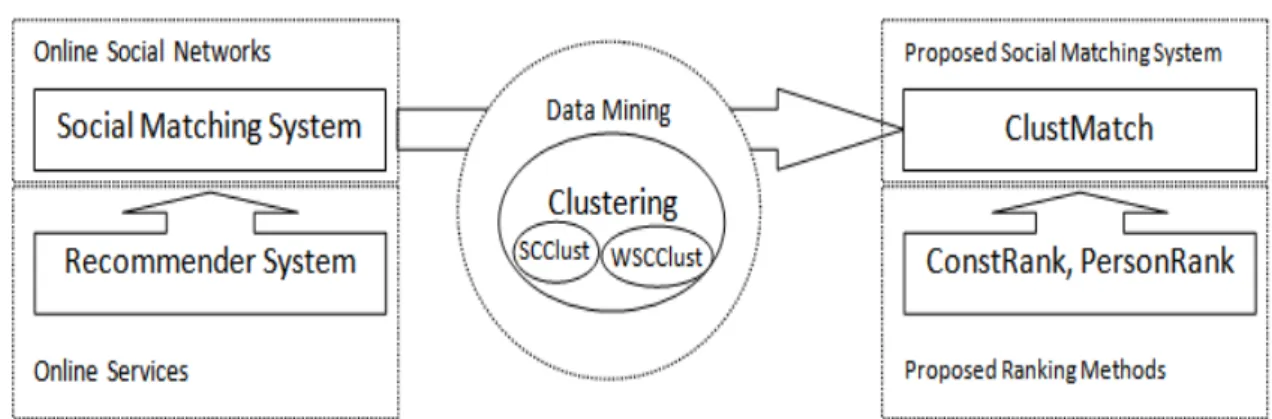
Further, the research makes important contributions to matching and rec-ommending people in social networks in three areas: 1) designing a new recom-mender system that uses clustering; 2) developing new clustering algorithms; and 3) developing a new method of ranking recommendations.
The research presents a novel hybrid recommender system that employs the clustering technique; it uses both implicit and explicit data to achieve better accuracy in the recommendation with less computation complexity. Moreover, the design helps social networks to overcome some existing problems, such as a cold start and sparsity.
As the clustering is a main component in this study, two incremental constraints-based clustering algorithms were developed to improve grouping people in social networks. These algorithms were designed to overcome the shortcomings in existing clustering algorithms, and to take to consideration the special needs and requirements of people in social networks.
The final contribution made by the present research is in the area of rank-ing the recommendations; two new methods (constraint similarity-based and personalised similarity-based) were developed to order the recommendations and present them in a way that increases their acceptance.
sys-tems by presenting a new recommendation system that bridges the gaps in clustering and recommending people in social networks.
1.5
Thesis Structure
The remainder of the thesis is organised as follows:
Chapter 2 reviews recent developments in the main topics, that is, so-cial matching systems and clustering people in soso-cial networks. It also includes the recommendations ranking for social networks, and provides an insight into the methods used to identify the weaknesses in the state-of-the-art methods for both social matching systems and clustering. Fur-ther, presentation outlines how to identify the research gaps in both of these tasks.
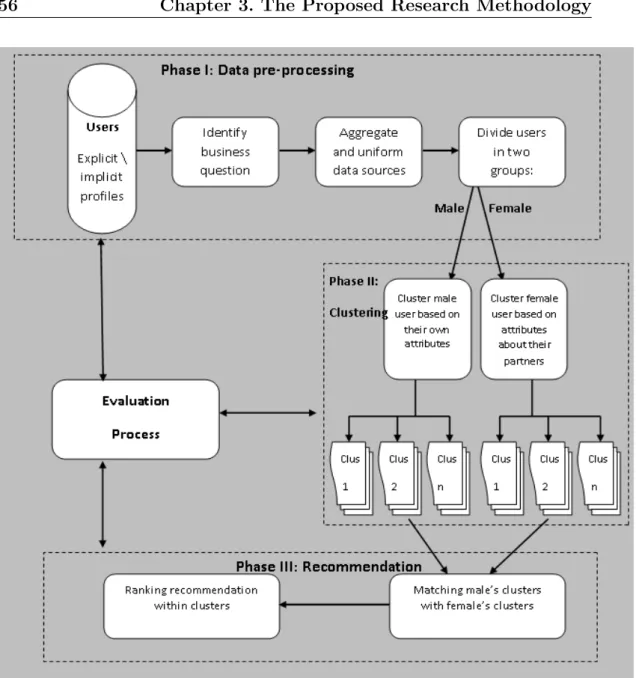
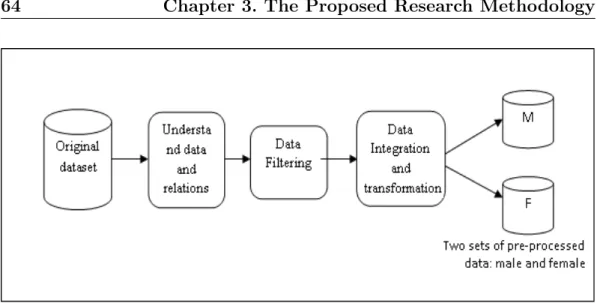
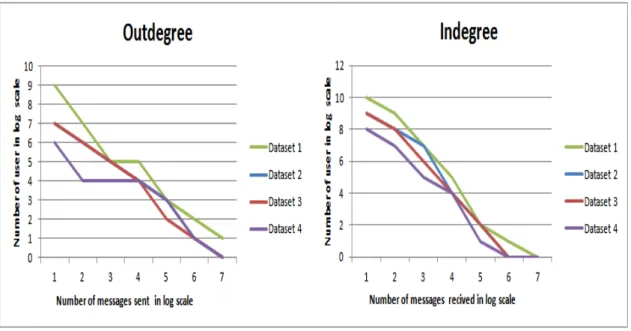
Chapter 3describes the research design used in this thesis, including the experimental design, a detailed description of the social network and its datasets, and the various evaluation metrics used to evaluate the cluster-ing methods. The chapter also covers the pre-processcluster-ing and profilcluster-ing of users information in social networks. It shows how to deal with multiple data types and different data sources in social networks. Finally, it in-troduces the evaluation metrics that were used to evaluate the proposed
methods.
Chapter 4presents the methods for clustering people in social networks, which were evaluated using the metrics defined in Chapter 3. The empiri-cal results and the analysis of the experiments for the method against the benchmarks conducted on the datasets are also covered in this chapter.
Chapter 5 provides an overview of the methods designed to match and rank the recommendations in social networks.
Chapter 6 presents the final conclusions, summarises the findings, and lists the main contributions of the work developed in this thesis. Further research extensions are also offered.
Chapter
2
Literature Review
2.1
Introduction
The main objective of the literature review provides a background knowledge of the related research areas, including social networks and social matching systems, recommender systems, and clustering and matching people in social networks. The chapter also presents a critical review of relevant recent work on these techniques. As discussed earlier, social matching systems have gained in importance and popularity. These systems are considered as an extension of the recommender system. However, the difference is that the recommender system suggests items, while the social matching system recommends people. However, the matching process in social networks still require improvements so that they can produce quality recommendations. One way to improve the
matching process in social matching systems is to employ data mining tech-niques. Examples of data mining algorithms, that can be used to improve the matching process in social networks, include clustering and association rules (see Figure 2.1).
Figure 2.1: Flow and Relations of Information from the Literature Re-view
Figure 2.1 shows the flow and relations between the literature review com-ponents. The chapter outline is as follows: Section 2.2 introduces the social networks and social matching systems, along with real world examples.; Sec-tion 2.3 provides the background to the recommender systems as the majority of today’s social matching systems are based on the recommender system; Sec-tion 2.4 discusses the clustering techniques that can be used to cluster the users in the social systems; Section 2.5 discusses the ranking techniques; Section 2.6 presents the limitations of the related works in identifying the research gaps to be addressed in the current research; and, finally, Section 2.7 concludes the chapter.
2.2
Social Networks
Most of today’s communications have changed to online interactive dialogues between organizations, communities, and individuals; they use the social me-dia, including web-based and mobile based technologies. Andreas Kaplan and Michael Haenlein (2010) define social media as ”a group of Internet-based ap-plications that builds on the ideological and technological foundations of Web 2.0, and that allows the creation and exchange of user-generated content” [58]. Figure 2.2 shows the categories and forms of the social media tech-nologies where each technology supports a different type of communication (www.fredcavazza.net (2012)). Therefore, the focus of the current research is on social network sites like Facebook, Myspace, RSVP, and eHarmony; they help their members to connect by recommending people to each other using a social matching system.
Social matching systems, in general, are based on recommender systems (which will be discussed in Section 2.3) [111]. However, normal recommender systems are not appropriate to match people in social networks. In social net-work systems, much personal information about the users is required, along with their explicit and implicit profiles. The explicit profile is generated by asking the user to answer a series of questions which represent his/her char-acteristics and preferences. Some advanced social network systems keep an
Figure 2.2: Different Categories of Social Media (www.fredcavazza.net (2012))
implicit profile for every single user where the user’s behaviour (such as send-ing messages and watchsend-ing profiles) is kept as well.
A similar technique to social matching is social personalisation. The social matching and social personalisation systems always overlap [21]. However, social personalisation systems deal with both items and users, while social
matching systems deal with users only.
In social matching systems, users start by creating their profiles and de-scribing themselves; they choose appropriate answers to a series of questions. Users are also required to identify what they like and dislike about their po-tential partner. The next step involves applying matching algorithms that use all sources of data to recommend the best matching people. Once the system presents the recommended people, the user is allowed to interact with them electronically via email and chat. The process is summarised in Figure 2.3.
Figure 2.3: Basic Model for Social Network Systems
2.2.1
Social Matching Techniques
Social matching systems employ different techniques to produce their recom-mendation. Such systems consist of two main phases: the data collection phase and the recommendation phase [83]. In the data collection phase, information about the user was collected from implicit and explicit profiles, whereas, in the recommendation phase, the collected data were used to identify the relevant
users. Three learning approaches, obtained from the recommendation tech-niques discussed in the previous sections, are widely used to match people in social networks: rules-based approach; content-based approach; collaborative approach; and hybrid approach [17]. More details about each approach are in the following sections.
There are many examples of online social networks. Each one has it own way of profiling users, matching them, and allowing them to contact each other. Table 2 compares four social networks; two are general social matching systems (Facebook and Myspace) and two are dating systems (RSVP and eHarmony).
2.2.1.1 Rules-based Approach
Rule-based systems recommend partners to users, based on manually or auto-matically generated decision rules. In the manually generated systems, admin-istrators are allowed to specify the rules, based on the users’ characteristics. These rules affect the delivered recommendation to the users in which they satisfy their profiles. The user profile is built explicitly by the user answering a range of questions, and implicitly by obtaining information about the users as they interact with the system. The main concern in relation to the rule-based system is that they are rule-based mainly on information provided by the users, which is subjective and static [92].
Table 2.1: Examples of Social Networks
Social Profiles Matching Property
network
Explicit profile Demographic: Standard interface (information that based on users’ and properties for Facebook users provided profiles (e.g. all users
when they school, university, register) city, interests,
etc.) and emails
Explicit profile Content-based: Customisable (information that based on users’
Myspace users provided profiles (e.g school, when they university, city, register) interests, etc.) and
emails
Explicit and Content-based: When searching, Implicit profiles based on user’s user filters out (information profiles (users’ inactive profiles provided from variables)
RSVP users, and
information traced from the user interacting with the website)
Explicit profile Content-based: Only allows users (twenty-nine based on to contact those eHarmony different personality the system has
personality variables determined to be
variables) highly compatible
2.2.1.2 Content-based Approach
Content-based filtering systems are based on what users have specified in their profiles. The users are represented by sets of features which enable them to be matched with a similar user profile. To achieve that outcome, user profiles are represented as weighted term vectors, and then a weighting model, such
as term frequencyinverse document frequency (TF.IDF), is used. The main problem with content-based filtering systems is that they depend on what the users have specified in their profiles, which limits the recommendation [91]
2.2.1.3 Collaborative Approach
Collaborative filtering systems have advantages over the previous two ap-proaches. These systems perform much better, overcoming the shortcomings in both the rules-based and content-based filtering approaches. In collabora-tive filtering systems, the user preferences are considered, along with those preferences of similar users (nearest neighbours). An advanced work utilizes tensor models which have the ability to correlate and find latent relation-ships between similar users based on both information [66]. Another interested work utilizes the recognition of the reciprocal recommender as an important class of recommender along with the identification of its distinctive characteristics and the exploration of how these impact the recommendation process in the domain of social networks [94]. However, the collaborative filtering approach still suffers from a lack of scalability. Additionally, explosions in the number of users means the process takes a very long time.
2.2.1.4 Hybrid Approach
Hybrid filtering systems use a combination of collaborative and content-based filtering techniques to produce the recommendations [107]. Two sources of data are utilised and unified in hybrid filtering systems, namely: interaction data (implicit) and content information (explicit). These systems achieve more accurate recommendations when compared to other matching systems. How-ever, hybrid filtering systems suffer from some problems, such as scalability and data sparsity, and cold-start problems.
2.2.2
An Example of Social Matching Network
This section discusses in details the social matching network RSVP (www.rsvp.com.au). RSVP is one of the largest dating networks in Australia, with more than 2
mil-lion members, and an average of 1,200 new members every day [52]. Addition-ally, users can join, view other users’ profiles, and send predefined messages for free. However, users need to buy stamps if they decide to go for further contacts with the recommended partners.
There are two sources of data within RSVP: an explicit profile, and an implicit profile (web server log files). In the explicit profile, users answer some structured and unstructured questions. The structured data includes: personality, smoking habits, dietary habits, whether they have pets, political
persuasion, date of birth, gender, whether they have children, relationship sta-tus, location, height, body type, eye colour, hair colour, cultural background, religion, education level, job role, and industry. On the other hand, for the unstructured questions, the user is free to write his/her opinion about the fol-lowing topics: about me, music, reading, movie and TV interests, and sport.
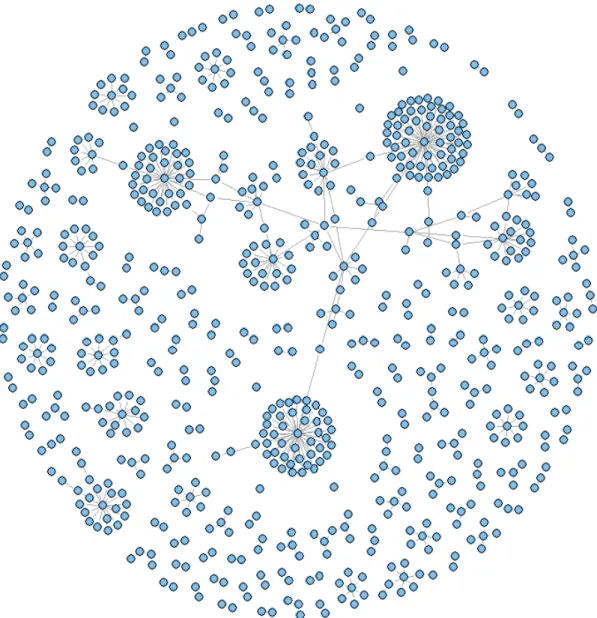
There are also some implicit data that represents the user’s behaviour; RSVP traces them in an implicit file. The implicit data includes user’s searches, viewed profiles, predefined messages, emails, instant messages, and calls. Fig-ure 2.4 shows an example of the implicit data which represent the communi-cations between the users.
Even though social matching systems are increasingly used, and attract more attention from both academic and industrial researchers, a great many aspects still need to be explored and developed. Terveen and McDonald (2005) raised some general questions, namely: What is the user information that should be used to achieve high quality matching? How does the system make a good match? Is it possible to evaluate the matching process and then use the evaluation outcome as feedback? The authors argue that data mining techniques can be used to discover the social relationships within the social networks. It is possible to mine patterns of communications, find out the association rules from the users who get together, and divide users into clusters, based on their similarities [110].
Figure 2.4: Visualization for Users’ Communications in Social Network
Another large-scale measurement study has been conducted to analyse the structure of multiple online social networks [82]. In the current study, four popular online social networks have been used to gather the data. The study shows that the social networks are structurally different from other networks, especially in terms of the fraction of symmetric links and the level of local
clustering. Mislove et al. (2007) reiterated that much work needs to be done in this direction [82]. Also a conceptual, historical and scholarly survey about social networks was presented by Boyd and Ellison (2008) [15]. They reviewed research in social networks, addressing their strengths and weaknesses. Fur-ther, they confirmed that this area of research required large-scale quantitative and qualitative research.
The current study provides a new design of social matching system; it makes use of all previous matching and filtering approaches. Moreover, the hybrid social matching system overcomes the majority of shortcomings existing in today’s social matching systems, especially the scalability problem. As mentioned earlier, social matching systems are based on standard recommender systems and, therefore, the standard recommender systems are introduced in the following section.
2.3
Recommender Systems
As a result of the exponential increase in the volume of information available on the web, recommender systems have been developed and used widely in the last decade. This overloading of information makes the process of choosing an item (such as movies or books) complicated. The recommender systems sup-port users by recommending the right items to the right users, as well as helping
e-businesses to deliver products that meet the users’ interests. A famous ex-ample of an online recommender system is Amazon.com [51]. At Amazon.com, the recommendation system is used to personalise the online store for every individual customer. Every time a user logs in, a list of recommended items appear. These recommendations are based on the users browsing history and rating items. Amazon.com also uses a collaborative filtering approach, which is discussed later in this chapter [44].
The recommender systems can be divided into five categories: collabora-tive, content-based, demographic, knowledge-based, and hybrid filtering [33]. These categories are based on the filtering techniques used in producing the recommendations and the data sources used to obtain the required knowledge, as shown in Table 2.2. In the following sections, each one of these categories are discussed in detail.
2.3.1
Collaborative Recommender Systems
Collaborative filtering is one of the most promising and widely used recom-mender techniques [100]. It recommends items to users by determining the items that similar users have positively rated or selected. For example, if two customers are similar to each other in their interests and behaviours, the system will recommend the items bought by one to another.
Table 2.2: Recommender Techniques
Techniques Data source Process
Collaborative User rating and Find user X, who rated similar user history items to what user Y rated, and
exchange their items
Content-based Item attributes Classify items based on their attributes and then use user
behaviour to match users with item classes
Knowledge-based Implicit data (such as Use implicit data to predict items users’ opinions, requests that the users may
and clicks), along with like, along with explicit data Explicit data ( such
as users’ profiles)
Demographic Users’ demographic Find the relationships between information people and the item they like. Hybrid filtering Mix of the previous techniques.
The advantages of the collaborative recommender systems, that allow them to be highly sought and widely used, is summarised as follows. First, recom-mendations in a collaborative system are based on the preferences of many users who are similar to the targeted user, which extend the items that are recommended to users, as well as the recommendation of items that are not part of the user’s direct interest. Additionally, the collaborative recommender systems are not dependent on either the items’ preferences or the users’ pref-erences. As a result, the system can be used with any type of items, including items that do not have enough preferences, or their preferences are left null [26].
On the other hand, the collaborative recommender systems suffer from two main problems. The first problem is the lack of user feedback or user rating
in some types of websites. For example, a recommender system in a movie website is expected to receive more preference ratings than a real estate or car website. While a user may search for movies several times a week, he/she may search for a home or a car only once a year or less. A similar problem, referred to as a cold-start problem, is the absence of knowledge when a new system starts or a new user joins. In such cases the recommender system has no basic knowledge about the users’ preferences and, hence, it produces poor recommendations. Therefore, the quality of recommendations depends on the volume of available knowledge.
Another significant problem in collaborative recommender systems is the coverage of the users’ rating, which is referred to as a sparsity problem [54]. It occurs when a website, such as an online book store, contains a massive increase in the number of books when compared to the increase in the number of users. In such cases, many items may be left unrated and, therefore, they may not be included in the recommendations. It is also possible that users rate different items where they do not have overlapped items; this can negatively affect the process of finding the recommendations. In other words, the number of active users who provide preference ratings should be large enough to obtain accurate recommendations.
Many collaborative recommender systems have been developed and pro-posed. An interesting research outcomes have overcome the problem of rating
sparsity in collaborative recommender systems using a coefficient factor [124]. The coefficient factor, used to calculate the similarity between the users, is the ratio between the number of items being rated by more than one user to the total number of items. A number of efficient techniques have improved the collaborative recommender systems, including: using item based cluster-ing methods instead of user-based clustercluster-ing methods; uscluster-ing the recommender system as a classification approach; and using dimensionality reduction tech-niques, such as Single Value Decomposition (SVD), to reduce the dimension-ality of sparse rating matrices [69]. Other work has demonstrated that simple clustering to the preference ratings improves the local density of the rating and solves the sparsity problem [26].
A limited work has been done in using collaborative filtering to recom-mend people in social networks. One interesting work utilised the traditional collaboration recommendation methods and used them in online dating web-site. In this method, ratings are the only parameter which affects the matching algorithm. The results sowed that collaborative filtering can provide good rec-ommendations to users in online dating services [16]. Another work claims that not only the users’ interests and demographic data need to be considered, but also their activities and relationships with other users [60]. This work gives a comprehensive theoretical view over how a matching algorithm should be implemented.
Although using collaborative recommendation techniques to recommend people in social networks can be effective for some users, it does not work for the majority of the users because the common behaviour of people in so-cial networks includes users joining the soso-cial network and staying passive for some time before starting to communicate with others. Such behaviour re-moves users from both receiving recommendation and being recommended to others. Nevertheless, the collaborative recommendation techniques are very useful with recommender systems having extremely large numbers of interac-tions between their members.
2.3.2
Content-Based Recommender Systems
Content-based recommender systems rely on item features to produce the rec-ommendation. Two approaches are used: the classification approach, and the nearest-neighbour approach [25]. In the classification approach, items are clas-sified, based on their characteristics. Then, the items of the relevant classes are recommended, based on the user rating information and the user profile. In contrast, the nearest-neighbour approach uses the information of previously rated items for a specific user to recommend new items to him/her. Once a user positively rates or buys an item, the system searches for other items which are similar to the previous one, and introduces them to the user as recommendations [33].
Content-based recommender systems do not suffer from the problems of a cold-start or new items, as do the collaborative recommender systems. This is because content-based recommender systems have access to item characteris-tics which are identified, for both old items and new items. It involves building sufficient user profiles and improving the profile every time a user performs a new rating.
However, the quality and accuracy of the item features in the content-based recommender systems are not always sufficient, which negatively affects the recommendations. As mentioned above, the users’ profiles are updated, based on the item characteristics that they have rated. If the characteristics are not sufficient (usually the case for movies, music and photographs) or are over specified, then the accuracy of the recommendations will be low. Another problem occurs when the item attributes need to be in the same structure so that the comparison process can take place. While this may be possible in some domains (such as online book stores), they present very difficult problems in many other domains (such as music recommenders).
Today, many techniques have been employed in content-based recommender systems, including: neural networks, decision trees, rule inductions, and Bayesian networks. These techniques help the content-based recommender systems to perform better in their different forms. For example, using a decision tree with structured data can improve the performance and the recommendation
accuracy [91]. In the Bayesian network, when users are allowed to rate items as relevant or irrelevant, there is an improvement in the performance of the recommender system when it is used to recommend unrated data sets [2]. For more examples of recommender systems that incorporate these techniques see [32], [33] and [91].
In the context of social matching system, the majority of social match-ing systems are based on content-based approach. An example is RECON, a content-based reciprocal recommender, that match and recommend people in the online dating website [95]. One advantage of RECON is that it deals with the cold-start problem, providing a substantial improvement of more than 60% in success rates for new users. Another example is Beehive, a social net-working that helps users to communicate, share information, and connecting with each other [21]. Chen et al. explored the use of four algorithms, two content-based and two collaborative filtering, and evaluated the accuracy of these algorithms. The content-based technique provided the highest percent-age of good recommendations among contacts who were not previously known; collaborative filtering worked well in finding previously known contacts.
To conclude, the majority of basic social matching systems which based only on content-based recommendation techniques, have low accuracy rates [7]. Thus, the use of user behaviour is an important and accurate source of information, along with their profile information. Also if users provide more
information on their profiles the content-based matching process will be much improved.
2.3.3
Knowledge-Based Recommender Systems
Recommender systems that utilise advanced data sources, other than those used by collaborative recommender systems and content-based recommender systems, are known as knowledge-based recommender systems [32]. In these systems, implicit data (such as users’ opinions, requests and clicks) are traced and used to improve the recommendation, along with the explicit data. Two approaches are widely used in knowledge-based recommender systems: case-based recommendations and constraint-case-based recommendations.
In case-based recommender systems, the process of producing recommen-dations is a similarity-assessment problem. The system attempts to find items that are similar to what the users are seeking. Such recommendations require more data sources (especially explicit data sources) so that the data profile can be built and improved. Therefore, the processes of identifying what the user likes, and defining what is similar to that like, are critical in such rec-ommender systems. Examples of case-based recrec-ommender systems include: discovering useful compound critiques during the recommendation session to improve recommendation efficiency [104]; combining feature entropy with an
appropriate measure of feature relevance using feature-selection methods [81]; and applying critique-based recommendation methodology to the acquisition and revision of user preferences to improve mobile recommender systems [99].
The other knowledge-based recommender approach, the constraint-based recommendations are based on the implicit and explicit constraints which are used as a filtering or compatibility process. The uniqueness of the constraint-based recommender system is that it omits undesirable recommendations from the recommendations list, based on the user constraints. Examples of constraint-based recommender systems are: VITA (Virtualis Tanacsado), a financial ser-vices recommender system that was developed and maintained to support cus-tomer selections in complex and high involvement product domains, based on knowledge-based techniques [34]. A number of other systems that employ constraint-based techniques have been discussed by Felfernig and Burke [32].
The knowledge-based recommendation techniques are rarely used in so-cial matching system due to their vast complexity. However, in the current research, constraints are used to improve the accuracy and efficiency of the recommendations in ways that do not increase the complexity.
2.3.4
Demographic Recommender Systems
Demographic recommender systems rely on users’ characteristics (such as their age, education and interests) to find the relationships between them and oth-ers, and to find out what they like. Such a system categorises items, based on their characteristics, and recommends them to the user, based on their de-mographic attributes. For example, when making movie recommendations to a user, who is interested in cultural documentaries, a range of demographic information needs to be considered, including: language, age, nationality and cultural background.
One major weakness in demographic recommender systems is that the sys-tem uses static user profiles, which do not get updated when the users interests change. On the other hand, the collaborative recommender system and the content-based system are both adaptable to changing user ratings and inter-ests. Demographic recommendation techniques are already used by the ma-jority of social matching systems. Users tend to seek out and disclose much demographic information and, as such, they appear to be sensitive to some de-mographic factors, even when they are not explicitly disclosed [110]. While the techniques are sufficient to be used in some domains, social matching systems need more implicit and explicit information to obtain more accurate recom-mendations. They also require more dynamic profiles which are updated when
the users’ behaviours change.
2.3.5
Hybrid Recommender Systems
The hybrid recommender systems are based on a combinations of the tech-niques that have been discussed above. The combination allows the systems to gain benefits from different techniques, which improves the performance and increases the recommendations’ accuracy. In order to achieve this outcome, hybrid recommender systems incorporate different data sources that are used with other recommender systems. The hybrid recommender systems can be divided into seven categories: weighted, mixed, switching, feature combina-tion, cascade, feature argumentacombina-tion, and meta-level [18]. Examples of recent hybrid recommender systems are presented below.
Hydra is a hybrid recommender system that uses a combination of collabo-rative and content-based filtering techniques to produce its recommendations [107]. Two sources of data are utilised and unified in Hydra, namely: rating data and content information. Experiments have shown that Hydra achieves more accurate recommendations when compared to traditional collaborative recommender systems. Another hybrid recommender system, that combines collaborative, content-based and demographic filtering techniques, was devel-oped by Ghazanfar and Prugel-Bennett [40]. Their system overcomes a number
of problems, such as scalability, data sparsity, and cold-start problems. Other recommender systems using the hybrid techniques are discussed by Burke [18].
The hybrid recommender systems are popular today as they use different data sources and employ more than one technique. This approach improves the quality of the recommendations and, at the same time, increases the process cost. Importantly, the recommender system is the base for social matching systems, as many of its techniques are used in social matching systems.
2.4
Clustering Users in Social Networks
Clustering, one data mining technique, can be used to improve the matching process in social networks. It reduces the data size and the processes that need to be performed. For this reason, clustering was used in the current research to group together users who have similar characteristics. In the context of social networks, clustering results in groups of users who share the same preferences and behaviours. The social network data are classified into two categories: usage and user profile. Usage refers to the users interaction with the system (explicit data), while the user profile contains information about the user that he or she is required to provide when joining the system. The user profile may be static or dynamic [43].
The process of clustering the users into social networks can be divided into two phases. The first phase is the data pre-processing phase, where the relevant data are collected, cleaned and transformed into user profiles. The second phase is the data mining process, where users are clustered and the groups are identified [30].
Data pre-processing in social networks is an important step, as unsuccessful pre-processing will lead to unsuccessful mining. A number of challenges may occur during this stage. As a result a variety of algorithms and techniques have been designed and improved to deal with such situations, including: data fusion and cleaning, user and session identification, and pageview identification [43], [83], [37].
2.4.1
General Clustering Algorithms
Clustering algorithms can be classified into four categories, based on the em-ployed techniques, namely: partitional, hierarchical, density-based and grid-based [117]. These categories are discussed in the following sections.
Partitional clustering algorithms assume that there are k clusters, based on the a priori knowledge. They randomly choose k objects from the data set. Each chosen object is considered as a single cluster. Then, the partitional clustering algorithms iteratively reallocate other data points to their closest
cluster until a stopping criterion is met. As a result, k clusters are gener-ated. However, partitional clustering algorithms suffering from the number of clusters k needing to be known. This requires that users have at least some domain knowledge, which is often not available since the users, mostly, do not have any idea of how many clusters are in the data set. Another problem is the difficulty of identifying clusters with large variations in size. Finding the stopping criterion for the partitional clustering algorithm requires all pos-sible partitions to be considered. This is almost impospos-sible and, therefore, partitioning algorithms do not consider all partitions in a large data set.
To overcome this problem, hierarchical clustering algorithms attempt to partition objects into nested grouping relationship clusters. The results of hi-erarchical clustering algorithms are represented by either a binary tree or a dendrogram. In the dendrogram, the root node represents all the data objects while each leaf node represents a single data object. The intermediate nodes are regarded as extensions of the objects that are proximal to each other; and the height of the dendrogram represents the distance (similarity) between each pair of objects or clusters, or between an object and a cluster. Hierarchical clustering algorithms follow two methods in the clustering process: agglomer-ative or divisive. Agglomeragglomer-ative methods form clusters from the ”bottom-up”. At the start, each object is a separate cluster; then the small clusters are merged into bigger clusters at each level of the hierarchy until, at the top of
the hierarchy, all the objects are in one cluster. Divisive methods form clusters from the ”top-down”. They start with all objects in a single cluster; then the cluster is split until all points are divided into one small cluster.
Density-based clustering algorithms group clusters, based on the density of the data points in regions. All the regions that are reachable from each other are merged to form clusters. These algorithms perform well to find clusters of arbitrary shapes.
Grid-based clustering algorithms are used primarily for spatial data sets. They first calculate the clustering space into a fixed number of cells, and then perform the required operations on the quantified space. The cells that contain more than a certain number of data objects are marked as dense. All close dense cells are connected together to form clusters.
The previous categories cover the majority of clustering algorithms. How-ever, there are some clustering algorithms that are designed differently so that they cluster special datasets, for example: constraint-based clustering, model-based clustering, and evolutionary methods. Figure 2.5 illustrates the cat-egories of clustering algorithms, along with examples of algorithms for each category [23].
Figure 2.5: Clustering Algorithms’ Categories [23]
2.4.2
Clustering Large Datasets
The large-scale clustering algorithms address the challenge of clustering ex-tremely large datasets with a large number of attributes, as well as large num-ber of observations. Examples of such algorithms include k-means, BIRCH, CLARONs, Clique and Rock [56]. K-means, a basic clustering algorithms,
ef-fectively clusters large-scale data. It aims to partition n items into k clusters, where each item belongs to the cluster with the nearest mean. Many improved versions of k-means have been released in order to overcome its disadvantages. For example, one extension to k-means was able to handle categorical domains and domains with mixed data [53]. Another example, an efficient disk-based k-mean clustering algorithm, works inside a relational database management system to handle large high dimensionality datasets [90].
However, algorithms such as k-means require the pair-wise similarity to be computed. This process can be expensive and unnecessary for clustering some types of data. To address this challenge, another class of clustering algorithms, the incremental algorithms, were developed and do not require each pair of objects to be matched. These methods define a criterion function at cluster level: the global similarity measure. An example of this algorithm is LargeItem [113], which uses a new clustering criterion based on the notion of large items (without using any measure of pairwise similarity). LargeItem assumes that there are many large items within a cluster and little overlapping of such items across the clusters. Another efficient and effective algorithm, Clope, used for clustering transactional data, introduces the notion of the cluster histogram [119]. The clustering criterion function (Profit) as defined, takes into account the shape of the cluster histrogram and the number of transactions in it. Another incremental clustering algorithm XCLS [86], was clusters XML
documents with level similarity; the XML documents are grouped according to structural similarity using a global criterion function.
2.4.3
Constraints Clustering and Semi-supervised
Clus-tering
Most existing clustering algorithms do not consider the constraints in the clustering process. The traditional clustering algorithms were designed to find clustering solutions that group similar objects together, whereas, for the constrained clustering problem, users who share high commonality may not be clustered together due to the conflict in their attribute values, which are deemed as constraints. For example, if two users in a social network are similar to each other in the majority of their attributes, except for the attribute that has been identified as a constraint (have kids attribute, for example), they will be placed in the same group using traditional clustering algorithms. In contrast, a constrained clustering algorithm identifies such a constraint and maintains it in the clustering process. Consequently, that user would not be placed in the same cluster.
In addition, any external information available along with the dataset is ex-tremely useful in finding a good partitioning of the data. Clustering algorithms that utilize such information are called semi-supervised clustering algorithms
[19]. This additional information is usually in the form of pair-wise constraints, such as a must-link constraint, which means that the point pair connected by the constraint belongs to the same cluster. On the other hand, a can-not link constraint specifies that the point pair connected by the constraint does not belong to the same cluster. It is generally assumed that the constraints are provided by the domain expert. However, there has been only limited work on automatically deriving constraints from the data. Some attempts in de-riving the constraints from the domain ontology, and other external sources, into clustering algorithms include the use of ontology, or Wikipedia to guide the clustering solutions [13]. Nevertheless, these are mostly feature constraints and not constraints based on the Instances [55]. In the newly developed meth-ods, the constraints are driven from the data, itself, by analysing the profiles of successful communicating users to increase the reliability and accuracy of these constraints.
Most algorithms in the semi-supervised clustering technique modify the existing clustering algorithms to incorporate the pair-wise constraints. One example, BoostCluster [75], follows a boosting framework to improve the per-formance of any given clustering algorithm using pair-wise constraints. It iteratively modifies the input to the clustering algorithm by generating new data representations, such that the pair-wise constraints are satisfied while also maintaining the integrity of the clustering output. Some semi-supervised
clustering algorithms consider the label information, where pairs of instances are labelled as belonging to the same or different clusters. However this algo-rithm is not applicable in some domains, including social networks, because of the absence of such label information.
2.4.4
Clustering Users in Social Networks
A number of clustering algorithms have been proposed to group users in social networks; some of the current work is presented below. Harper, Sen and Frankowski (2007) designed an algorithm that automatically groups users into social networks and describes the resulting user groups. Their algorithm does not require pre-existing groups but, instead, is based on activity balanced clustering which considers both user activity and user interest. The results show that the activity balanced clustering algorithm outperformed the k-means algorithm for both compactness and separation. It also produced far more uniform clusters than the k-means in terms of the total number of users per cluster and the number of active users [48]. Constrained clustering is also employed to cluster users into social networks. This type of algorithms helps to overcome some clustering problems, such as near-duplicate [118].
Another semi-supervised pairwise constrained clustering algorithm, designed to cluster a large amount of labelled and unlabeled data, has pairwise
must-link and can-not must-link constraints [12]. This algorithm significantly improves the accuracy of clustering data, especially when small amounts of supervision is provided. It is also able to handle very high dimensional data with large datasets. Furthermore, an interesting paper, by Sun et al. (2005), used a ten-sor model to improve the personalisation of the web search. The data collected from a search engine are represented by a 3-order tensor model. The authors then performed a 3-mode analysis using the higher-order singular value de-composition technique to automatically capture the latent factors that govern the relations among the multi-type objects: users, queries, and Web pages. Kutty et al.’s (2011) work developed a clustering method, XCT, for effectively combining both the structure and the content features in the XML documents using TSM model [67]. Their work clearly ascertained that the XCT improved the accuracy of the clustering solution.
In conclusion, clustering the users into social networks is a promising tech-nique that helps improve the efficiency and accuracy of the recommendations. However, the existing algorithms need to be improved to more effectively clus-ter users in the social networks. The community detection techniques, a topic related to the current research, are based on the clustering techniques to or-ganize data based on the common features of the actors.The techniques are discussed in relation to social networks in the following section.

![Figure 2.5: Clustering Algorithms’ Categories [23]](https://thumb-us.123doks.com/thumbv2/123dok_us/1821880.2762972/62.892.139.761.187.800/figure-clustering-algorithms-categories.webp)