programming, integer programming and local search for
two combinatorial optimisation problems. PhD thesis,
University of Nottingham.
Access from the University of Nottingham repository:
http://eprints.nottingham.ac.uk/14208/1/Fang_He_PhD_thesis_submit_5_April_2012.pdf
Copyright and reuse:
The Nottingham ePrints service makes this work by researchers of the University of Nottingham available open access under the following conditions.
· Copyright and all moral rights to the version of the paper presented here belong to the individual author(s) and/or other copyright owners.
· To the extent reasonable and practicable the material made available in Nottingham ePrints has been checked for eligibility before being made available.
· Copies of full items can be used for personal research or study, educational, or not-for-profit purposes without prior permission or charge provided that the authors, title and full bibliographic details are credited, a hyperlink and/or URL is given for the original metadata page and the content is not changed in any way.
· Quotations or similar reproductions must be sufficiently acknowledged.
Please see our full end user licence at:
http://eprints.nottingham.ac.uk/end_user_agreement.pdf
A note on versions:
The version presented here may differ from the published version or from the version of record. If you wish to cite this item you are advised to consult the publisher’s version. Please see the repository url above for details on accessing the published version and note that access may require a subscription.
Integer Programming and Local Search for Two
Combinatorial Optimisation Problems
Fang He, BSc, MSc
Thesis submitted to the University of Nottingham for
the degree of Doctor of Philosophy
Contents
Abstract... vii
Acknowledgements... ix
Chapter 1 Introduction... 1
1.1 Hybrid methods to Nurse Rostering Problem... 1
1.1.1 Constraint Programming method to NRPs... 2
1.1.2 Hybrid methods to NRPs... 3
1.2 Hybrid methods to Portfolio Selection Problem... 6
1.3 Scope and aim... 7
1.4 Structure of the thesis... 8
Chapter 2 Preliminaries: an overview of optimisation techniques... 12
2.1 Introduction... 12
2.2 Combinatorial optimisation problems... 13
2.3 Summary of solution approaches to combinatorial optimisation problems. 15 2.4 Constraint Programming... 17
2.4.1 Propagation... 19
2.4.2 Search... 23
2.4.3 Global constraint... 29
2.4.4 Soft constraint... 30
2.5 Operational Research techniques... 33
2.5.1 Linear Programming... 33
2.5.2 Integer Programming... 34
2.5.3 Quadratic Programming... 38
2.6 The IBM ILOG suite... 38
2.7 Heuristics and local search approaches... 40
2.8 Decomposition and solution algorithm... 43
2.8.1 Dantzig-Wolfe decomposition... 43
2.8.2 Variable fixing... 48
2.8.3 Decomposition in NRPs... 49
2.9 The integration of CP and OR with LS... 49
2.9.1 Integration of two exact methods... 50
2.9.2 Integration of exact method with local search... 55
2.10 Conclusions... 60
Chapter 3 Introduction to the application problems... 62
3.1 Introduction... 62
3.2 The nurse rostering problem... 62
3.2.1 Modelling the nurse rostering problem... 64
3.2.2 Solution approaches to nurse rostering problems... 66
3.3 The portfolio selection problem... 71
3.3.1 Modelling the portfolio selection problem... 71
3.3.2 Solution approaches to portfolio selection problems... 75
Chapter 4 Hybrid CP with Variable Neighbourhood... 78
Search approach to nurse rostering problems... 78
4.1 Introduction... 78
4.3 CP approach to NRPs... 82
4.3.1 Modelling the constraints... 83
4.3.2 CP approach to NRPs... 88
4.4 Problem decomposition and hybrid CP approach to NRPs... 91
4.4.1 Problem decomposition... 92
4.4.2 Direct initial solution construction... 93
4.4.3 Sequence based initial solution construction... 94
4.4.4 Second stage local search... 100
4.5 Experimental results... 102
4.6 Conclusions... 110
Chapter 5 Constraint-directed Large Neighbourhood Search to nurse rostering problems... 111
5.1 Introduction... 111
5.2 Literature review on global constraints applied to local search... 114
5.3 Modelling nurse rostering problems... 116
5.4 Constraint-directed Large Neighbourhood Search... 116
5.4.1 The framework... 116
5.4.2 Fragment selection strategies... 118
5.4.3 Re-optimisation on the fragment... 122
5.5 Experimental results... 122
5.5.1 Pre-processing and framework... 122
5.5.2 Test on fragment selection strategies in the constraint-directed LNS.. 123
5.5.3 Test on the effort of search... 125
5.5.4 Comparison with other approaches in the literature... 127
5.6 Conclusions... 129
Chapter 6 CP based column generation approach to nurse rostering problems.. 130
6.1 Introduction... 130
6.1.1 Background... 130
6.1.2 Motivations... 132
6.2 Modelling the nurse rostering problem... 134
6.2.1 Formulating the master problem as Integer Program... 134
6.2.2 Formulating the pricing subproblem in CP... 136
6.3 Solution Procedure... 138
6.3.1 Initial solution... 141
6.3.2 Depth Bounded Discrepancy Search to obtain diverse columns... 141
6.3.3 Pricing subproblem with threshold... 143
6.4 Experimental results... 145
6.4.1 Algorithm setting... 145
6.4.2 Performance of strategies in CP-CG... 145
6.4.3 CP-CG compared with existing approaches in the literature... 149
6.5 Conclusions... 151
Chapter 7 A Layered Branch-and-Bound algorithm to portfolio selection problems with real-world constraints... 154
7.1 Introduction... 154
7.2 Problem formulation... 155
7.3 The Layered Branch-and-Bound algorithm... 159
7.3.2 The Layered Branch-and-Bound algorithm... 161
7.3.3 Branching rules and the node selection heuristic... 163
7.4 Experimental results... 166
7.4.1 Test problems... 166
7.4.2 Evaluation of the Layered Branch-and-Bound algorithm... 167
7.4.3 The efficient frontier... 174
7.5 Conclusions... 178
Chapter 8 A hybrid local search and Branch-and-Bound approach to constrained portfolio selection problems... 180
8.1 Introduction... 180
8.2 Problem description... 181
8.2.1 Portfolio selection problem with transaction cost... 181
8.2.2 Problem formulation... 183
8.3 Related work of hybrid local search with B&B... 187
8.3.1 Local Branching... 188
8.3.2 Relaxation Induced Neighbourhood Search (RINS)... 189
8.3.3 Other approaches... 190
8.4 Local search branching B&B algorithm... 190
8.4.1 Framework of Local search branching B&B... 190
8.4.2 Notations and definitions of variable fixing... 193
8.4.3 Solution information reusing and cut-off bound... 193
8.4.4 Local search techniques... 195
8.5. Experimental results... 196
8.5.1 Test problems... 196
8.5.2 Evaluations on the local search branching B&B algorithm... 197
8.6 Conclusions... 205
Chapter 9 Conclusions and future work... 208
9.1 Conclusions... 208
9.1.1 Research overviews... 208
9.1.2 Research contributions... 209
9.2 Future work... 212
9.2.1 Future research directions for nurse rostering problems... 212
9.2.2 Future research for portfolio selection problems... 213
9.2.3 Future research for hybrid algorithms... 214
Appendix... 217
List of Publications... 220
List of Figures
Fig. 1.1 Structure of the thesis ... 8
Fig. 2.1 AC3/GAC3 [4] ... 22
Fig. 2.2 A search tree for a CSP [4]... 25
Fig. 2.3 Limited Discrepancy Search [14] ... 27
Fig. 2.4 Solution quality in a minimization problem... 35
Fig. 2.5 High-level template of local search [36] ... 41
Fig. 2.6 The column generation method for Linear Program [45] ... 47
Fig. 2.7 Structural classification of exact methods and meta-heuristics combinations [57] ... 56
Fig. 3.1 Efficient Frontier (EF) which defines the trade-off between returns and risk in a portfolio of assets... 73
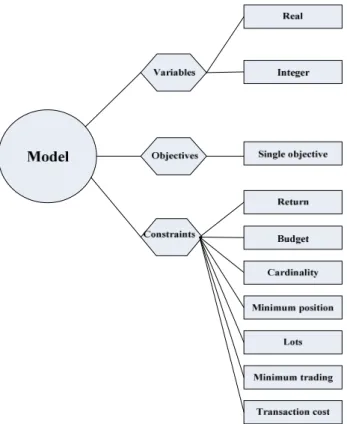
Fig. 3.2 Variables, objective and constraints of portfolio selection problems... 75
Fig. 4.1 Initial solution generation... 91
Fig. 4.2 Pseudo-code of the iterative forward search algorithm ... 99
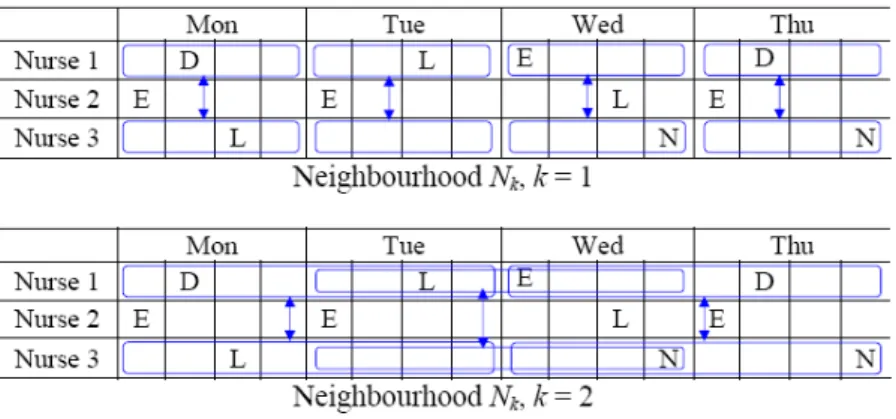
Fig. 4.3 Two neighbourhood structures ... 101
Fig. 4.4 Pseudo-code of the Variable Neighourhood Search algorithm [124] ... 101
Fig. 4.5 Behaviour of the hybrid CP approach on the ORTEC January and February instances... 106
Fig. 4.6 Behaviour of the hybrid CP approach on the ORTEC January instances with different initial solutions... 107
Fig. 5.1 The large neighbourhood search scheme with CP as the re-optimiser... 118
Fig. 5.2 Fragment selection strategy 1: sliding window ... 119
Fig. 5.3 Fragment selection strategy 2: sliding window with overlap ... 120
Fig. 5.4 Fragment selection strategy 3: selection according to the cost of horizontal constraints ... 121
Fig. 5.5 The decrease of objective function value over iterations of LNS using three different fragment selection strategies for problem Gpost ... 123
Fig. 5.6 The decrease of objective function value over iterations of LNS using three different fragment selection strategies for problem ORTEC... 125
Fig. 5.7 The decrease of objective function value over iterations of LNS with different fragment size for strategies 1 and 2 for problem ORTEC ... 126
Fig. 5.8 Size of fragment for strategy 3, denoted bynfor problem ORTEC ... 126
Fig. 6.1 The CP based column generation solution procedure ... 140
Fig. 6.2 Depth Bounded Discrepancy Search ... 143
Fig. 6.3 The decrease of objective function value over iterations of CP-CG with different search strategies for the three problems. ... 147
Fig. 7.1 The Branch-and-Bound algorithm [8] ... 160
Fig. 7.2 Illustration of layered B&B algorithm. Spots without descendant nodes represent the leaf nodes and circles represent the open nodes as shown in Fig. 7.1 .... 161
Fig. 7.3 The pseudo-code of the layered B&B algorithm... 162
Fig. 7.4 Efficient frontiers from the default B&B and layered B&B ... 175
Fig. 8.1 The transaction cost function... 184
Fig. 8.2 Local Search Branching B&B algorithm for minimization ... 192
Fig. 8.3 Initialization phase of Local Search Branching B&B approach ... 195
Fig. 8.5 Part of a log file in CPLEX for solving a MIQP subproblem for Société
Générale ... 200 Fig. 8.6 The local search branching B&B with heuristic initialization and random
initialization ... 201 Fig. 8.7 The gap between the local search branching B&B and approximate optimal by default B&B... 205
List of Tables
Table 2.1 Variable-based violation measure for assignments ... 33
Table 2.2 Summarizing other applications which apply basic CP based CG in the literature [64] ... 52
Table 3.1 Part of a weekly roster in a nurse-day view... 64
Table 4.1 Shift types and demand during a week. ... 80
Table 4.2 Summary of constraints in the benchmark nurse rostering problems... 80
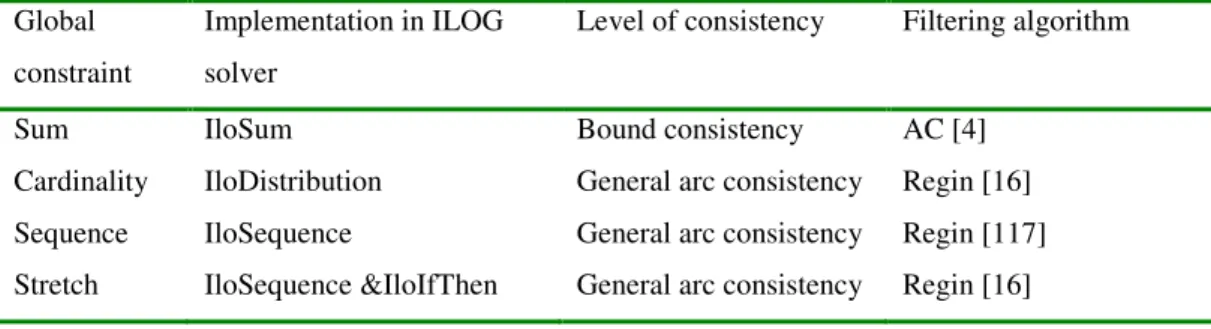
Table 4.3 Summary of the global constraints in modelling nurse rostering problems ... 87
Table 4.4 An illustrative example of weekly (partial) roster. ... 98
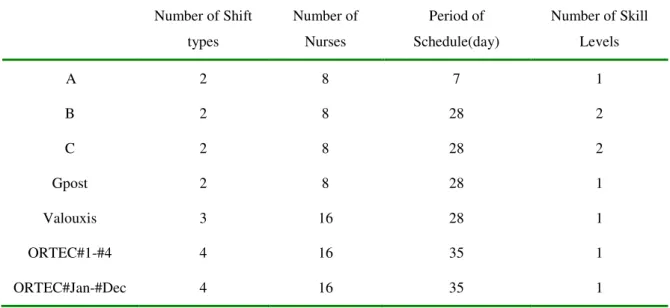
Table 4.5 Characteristics of the benchmark nurse rostering problems... 103
Table 4.6 Results of pure CP and hybrid CP approaches to nurse rostering problems of different characteristics... 104
Table 4.7 Results with random and heuristic variable and value selection rules in the hybrid CP approach. Mean values of 6 running results are presented... 105
Table 4.8 Evaluation of six variable ordering heuristics for problem Gpost... 105
Table 4.9 Results from the hybrid CP approach ... 108
Table 5.1 Results from the pre-processing method ... 123
Table 5.2 Comparison of solution improvement and computational time of LNS with different fragment sizes for problem ORTEC ... 127
Table 5.3 Results compared with other methods in the literature. The best results are shown in bold... 128
Table 6.1 Parameter settings for the CP-CG approach ... 145
Table 6.2 DDS with and without cost thresholds in CP-CG ... 146
Table 6.3 Numerical results of CP-CG with DFS, DDS and DDS + adaptive cost threshold... 148
Table 6.4 Existing approaches on ORTEC benchmarks in the literature, best results shown in bold... 150
Table 7.1 Properties of problem instances for portfolio selection problems ... 167
Table 7.2 Branch rule and node selection heuristics without layer the B&B tree ... 170
Table 7.3 Layered B&B, search aborts after finding the first feasible solution at the top layer ... 172
Table 7.4 Layered B&B. search aborts after obtaining the optimal solution ... 173
Table 7.5 Comparisons of the layered B&B with existing approaches in the literature ... 177
Table 8.1 Properties of problem instances... 197
Table 8.2 Size of the original MIQP problem and MIQP subproblems ... 198
Table 8.3 Information of subproblem processing... 199
Abstract
This thesis focuses on the construction of effective and efficient hybrid methods based on the integrations of Constraint Programming (CP), Integer Programming (IP) and local search (LS) to tackle two combinatorial optimisation problems from different application areas: the nurse rostering problems and the portfolio selection problems. The principle of designing hybrid methods in this thesis can be described as: for the combinatorial problems to be solved, the properties of the problems are investigated firstly and the problems are decomposed accordingly in certain ways; then the suitable solution techniques are integrated to solve the problem based on the properties of substructures/subproblems by taking the advantage of each technique.
For the over-constrained nurse rostering problems with a large set of complex constraints, the problems are first decomposed by constraint. That is, only certain selected set of constraints is considered to generate feasible solutions at the first stage. Then the rest of constraints are tackled by a second stage local search method. Therefore, the hybrid methods based on this constraint decomposition can be represented by a two-stage framework “feasible solution + improvement”. Two integration methods are proposed and investigated under this framework. In the first integration method, namely a hybrid CP with Variable Neighourhood Search (VNS)
approach, the generation of feasible initial solutions relies on the CP while the improvement of initial solutions is gained by a simple VNS in the second stage. In the second integration method, namely a constraint-directed local search, the local search is enhanced by using the information of constraints. The experimental results demonstrate the effectiveness of these hybrid approaches.
Based on another decomposition method, Dantzig-Wolfe decomposition, in the third integration method, aCP based column generation, integrates the feasibility reasoning of CP with the relaxation and optimality reasoning of Linear Programming. The experimental results demonstrate the effectiveness of the methods as well as the knowledge of the quality of the solution.
For the portfolio selection problems, two integration methods, which integrate Branch-and-Bound algorithm with heuristic search, are proposed and investigated. In layered Branch-and-Boundalgorithm, the problem is decomposed into the subsets of variables which are considered at certain layers in the search tree according to their different features. Node selection heuristics, and branching rules, etc. are tailored to the individual layers, which speed up the search to the optimal solution in a given time limit. In local search branching Branch-and-Bound algorithm, the idea of local search is applied as the branching rule of Branch-and-Bound. The local search branching is applied to generate a sequence of subproblems. The procedure for solving these subproblems is accelerated by means of the solution information reusing. This close integration between local search and Branch-and-Bound improves the efficiency of the Branch-and-Bound algorithm according to the experimental results.
The hybrid approaches benefit from each component which is selected according to the properties of the decomposed problems. The effectiveness and efficiency of all the hybrid approaches to the two application problems developed in this thesis are demonstrated. The idea of designing appropriate components in hybrid approach concerning properties of subproblems is a promising methodology with extensive potential applications in other real-world combinatorial optimisation problems.
Acknowledgements
I would like to acknowledge so many people who helped me accomplish this thesis. First of all, I would like to thank my supervisor, Dr Rong Qu, for her constant guidance, support and encouragement throughout this research, and for giving me a wonderful opportunity to study at the University of Nottingham.
I would like to thank every staff and researcher in the Automated Scheduling, Optimisation and Planning (ASAP) research group for their help and assistance. I would like to thank Dr. Andrew Parkes for the discussions that directly or indirectly contribute to my work.
I would also like to thank Mick Pont, the deputy manager of NAG development division and David Sayers, the principal technical consultant of NAG, because they gave me the opportunity to work on the portfolio selection project, and to validate on this project where many of the ideas in this thesis are presented.
I would like to thank my husband, Lin. He not only gave me consistent help and support during my PhD study, but also made the last few years a truly wonderful time with his love and company.
I would like to thank my parents and brother for believing in me and supporting me in all that I have done. Without their love and support, I could not have made it this far.
Finally, to the new member of our family, Emily my love, who was born at the same time as this thesis, Mummy loves you forever!
Chapter 1 Introduction
This thesis focuses on the construction of effective and efficient hybrid methods to tackle two combinatorial optimisation problems from different application areas. These two problems both come from real-world applications where essential and complex features of problems are present. The first one is the nurse rostering problem which is a type of o personnel scheduling problem and the second one is the portfolio selection problem in the financial domain.
Although these two problems come from different application domains, they share some common features: (1) they are complex due to the presence of the large set of constraints which represent the real-world restrictions, e.g. logical restriction, and resources restriction, etc. For example, in the nurse rostering problem, large set of logical restrictions regulate the working patterns, such as an early shift should not be assigned after a late shift, etc. In the portfolio selection problem, resources restriction regulates that the amount of assets can be invested in a portfolio should be within the budget, etc. (2) they tend to be large. For example, in the nurse rostering problem, usually, a variety of shifts needs to be assigned along the scheduling horizons. The number of nurses that need to be scheduled is usually large. In the portfolio selection problem, hundreds of assets in the finance market need to be optimised.
Due to these two main features of the problems, in general, solving these problems is computationally challenging. To tackle these complex and large-scale problems efficiently, we construct hybrid solution methods in this thesis. These hybrid methods integrate and take the advantage of different techniques from different disciplines.
1.1 Hybrid methods to Nurse Rostering Problem
The Nurse Rostering Problem (NRP) consists of assigning a certain set of tasks to a certain set of nurses, subject to a large set of constraints which are related to the working regulations and personnel preferences. On the one hand, this problem
represents an important administration activity in modern hospitals, thus solving the problem efficiently is important for both practitioners and administrators in hospitals, and has a positive impact on nurses’ working conditions, which is firmly related to the quality of the healthcare [1]. On the other hand, most of NRPs in real-world are NP-hard [2]. In computational complexity theory, NP stands for nondeterministic polynomial. NP is the class of the problems that can be solved inpolynomial time by a
nondeterministicalgorithm. NP-hard is the class of the problems that “at least as hard as any problem in NP”. Solving the complex NRPs which are NP-hard efficiently can make great contributions to the research community.
Usually, a variety of shifts needs to be assigned along the scheduling horizons. The number of nurses that need to be scheduled is usually large. Most importantly, the number of constraints in the problems is large. These constraints which are related with working regulations and personnel preferences make the problem over-constrained. These are key features of NRPs.
1.1.1 Constraint Programming method to NRPs
Constraint Programming, originated from Artificial Intelligence, is a solution method to the combinatorial optimisation problems from different applications [3]. It models the problem as a set ofvariableswhich take values in their finitedomainsand are linked by a set of constraints that can be mathematical or symbolic. Global constraints which capture the interesting substructure of a problem have fundamental modelling capability in a Constraint Programming system. What’s more, constraint propagation algorithms which are embedded in each global constraint can reduce the search space by removing the value assignments that are proven to be infeasible, which is called feasibility reasoning. The effectiveness of global constraints has been shown for solving practical problems such as rostering and scheduling, etc. in literature [4, 5].
Due to the key features of NRPs we introduced above, Constraint Programming techniques are chosen as main techniques in this thesis to solve NRPs for following reasons:
Constraint Programming has the strength of modelling the problem with
global constraints[5]. Global constraints serve declaratively as building blocks of the problem modelling. It has been shown in the literature that global constraints can model the complex constrained NRPs well [1].
Propagation algorithmsof the global constraints have been shown to be efficient to find feasible solutions to the problem, i.e. propagation algorithms enable the powerful feasibility reasoning of Constraint Programming. This feasibility reasoning of Constraint Programming is well recognized in literature and we will take the advantage of it in the construction of the hybrid methods in this thesis.
Most importantly, the solution approach of Constraint Programming which consists of modelling, propagation and searching in the solution procedure makes it easy to be integrated with other techniques. This paves the way of hybridizing other techniques to solve NRPs.
1.1.2 Hybrid methods to NRPs
In literature, solution methods to NRPs based on Constraint Programming have been widely investigated where NRPs are usually modelled as Constraint Satisfaction Problems [1, 6, 7]. The feasibility reasoning of Constraint Programming plays an important role in these methods.
However, the real-world large-scale NRPs we tackle in this thesis are over-constrained. That is, nurses have conflicting preferences. A feasible solution does not exist that
satisfies all the preferences when we model the problem as a Constraint Satisfaction Problem. Hence, Constraint Satisfaction Problem model cannot be applied directly, because no solutions can be found. However, we still want to find some solutions, preferably one that minimizes the total number of conflicts. In this thesis, soft
constraints are applied to model the conflicting preferences of nurses. We seek an (optimal) feasible solution that minimizes the violation of soft constraints.
Constraint Programming is powerful with respect to feasibility reasoning due to the efficient propagation algorithms associated with constraints [3, 4]. But it is less efficient on optimality reasoning without the dedicated cost propagation [4]. This motivates us to hybridize other techniques to tackle the optimality reasoning in over-constrained NRPs in this thesis.
Based on the above description of features of the complex and large-scale NRPs and features of Constraint Programming techniques, we investigate two different ways of
decomposition of NRPs. After the problem is decomposed, the hybrid methods are designed where the suitable solution techniques are integrated to solve the problem according to the decompositions.
The first way to decompose NRPs is designed according to the constraint of the problem. That is, we are first concerned with certain selected set of constraints only. First, a feasible solution is generated by Constraint Programming techniques with respect to this set of constraint first. Then the rest of constraints are tackled by a second stagelocal searchmethod. Therefore, this hybrid method can be represented by a two-stage framework “feasible solution + improvement”.
Due to their efficiency, a great variety oflocal searchandmeta-heuristicsmethods have been applied to complex and large-scale NRPs [1, 6, 7]. A local search algorithm typically starts from an initial solution (an assignment of values to all the decision variables) and iteratively moves to their neighbouring solutions, defined by neighbourhood operator(s), with the hope of improving the quality of the solution measured by a function f. Many advanced heuristic approaches, called meta-heuristics (or extensions of local search), have been developed to prevent simple local search methods from getting trapped at local optima [6]. In this thesis, we investigate the integration of Constraint Programming with local search methods under the two-stage
framework “feasible solution + improvement”. With this two-stage framework, two hybrid methods are proposed and investigated. In the first hybrid method, the feasible solution is constructed by applying the feasible reasoning of Constraint Programming at the first stage. A simple Variable Neighourhood Search method is applied at the second stage to improve the feasible solution in limited computational time by taking the advantage of efficient optimality reasoning of local search. The effort is focus on the construction of feasible solution by Constraint Programming techniques in this hybrid method.
Another hybrid method is investigated under the same “feasible solution + improvement” framework. The local search in the second stage is enhanced by using the information of constraints.
Local search and meta-heuristics are efficient for heuristically improving solutions. However, optimality cannot be guaranteed or proven. We desire to know the quality of solutions, e.g. how far obtained solution is away from the optimal one. Therefore, we propose another decomposition method and corresponded hybrid solution method to NRPs.
The second decomposition method comes from Operational Research. As classic methods for solving combinatorial optimisation problems, Operational Research methods have been used for a long time. They are based on the mathematical representation of the problem, which is typically modeled as an Integer Program. The Integer Programming method, by relaxing some constraints (e.g. in the form of Linear Program), defines a new problem that usually can be optimally solved. The value of the optimal solution to the relaxed problem represents an optimistic estimation of the optimal solution to the original problem, and it can be used to reduce the search space. This shows the strength of optimality reasoning. Our integration of feasibility reasoning in Constraint Programming and optimality reasoning in the form of Linear Program relaxation is well motivated. Both of them can be used to solve combinatorial optimisation problems and they have complementary strengths. OR techniques are
expert at relaxation techniques and optimality analysis. Constraint programming is distinguished by its inference techniques and modeling power[5]. Rather than choose between these methods, we will integrate them to tackle the problems in this thesis.
NRPs can be modelled as Integer Programs. For these large-scale Integer Programs, one classic decomposition method, Dantzig-Wolfe decomposition, can be applied to decompose them. The column generation is an efficient algorithm for solving the decomposed problem efficiently. We apply a Constraint Programming based column generation method to NRPs. The complex NRPs are decomposed and modeled based on the column generation scheme, where the master problem is formulated as an Integer Program and the pricing subproblem is modeled and solved in Constraint Programming paradigm.
1.2 Hybrid methods to Portfolio Selection Problem
The second problem we investigate in this thesis is the Portfolio Selection Problem (PSP). PSPs arise in the financial domain. The problem is primarily concerned with finding a combination of assets that satisfies an investor’s needs the best. These needs can be basically expressed as minimizing the risk and guaranteeing a given level of
returns[7].
The basic problem of PSP can be modelled and solved by Linear Programming or Quadratic Programming. However, in reality the investors usually have to include side constraints which reflect the restrictions of the market into the basic model of the problems and the problems quickly become too computationally expensive for exact methods.
The key feature of the problems is the discrete optimisation feature due to the presence of these side constraints. Branch-and-Bound method is a classic method to solve the problem and seeks the optimal solution to the problem while the computational time is not restricted. However, the investors highly desire to seek good quality solutions, not
necessarily the optimal one, in a very limited computational time. At the same time, the investors desire to have the knowledge of the quality of this solution. That is, the quality of the solution should be measurable, e.g. it can be measured by the gap between this solution and optimal solution (or lower bound of the optimal solution).
As recognized by many researchers, the efficiency of Branch-and-Bound highly relies on the branching rule heuristic and the node selection heuristic, etc. Therefore, in this thesis, we aim to investigate how to integrate heuristic search into Branch-and-Bound algorithm in the forms of node selection heuristics, and branching rules, etc. to obtain measurable quality solutions in a given time limit.
Two integration methods, which integrate Branch-and-Bound algorithm with heuristic search, are proposed and investigated in this thesis. In layered Branch-and-Bound
algorithm, the problem is decomposed into the subsets of variables which are considered at certain layers in the search tree according to their different features. Node selection heuristics, and branching rules, etc. are tailored to the individual layers, which speed up the search to the optimal solution in a given time limit. In local search branching Branch-and-Bound algorithm, the idea of local search is applied as the branching rule of Branch-and-Bound. The local search branching is applied to generate a sequence of subproblems. The procedure for solving these subproblems is accelerated by means of the solution information reusing. This close integration between local search and Branch-and-Bound improves the efficiency of Branch-and-Bound algorithm according to the experimental results.
1.3 Scope and aim
The aim of this thesis is to investigate how to efficiently integrate Constraint Programming, Operational Research techniques and heuristic search methods to solve the two combinatorial optimisation problems from real-world applications—the Nurse Rostering Problem and the Portfolio Selection Problem, taking the advantage and the strengths of each well developed component. The design of the integration methods
needs to consider the strength and weakness of each component, as well as the interface/interaction between them. Therefore, the design procedure of the hybrid methods in this thesis starts from the observations of the features of each problem. The problem is firstly decomposed into subproblems in certain ways, and then the suitable methods are chosen to solve the subproblems. At last the solution to the original problem is obtained by merging the solutions to the subproblems.
1.4 Structure of the thesis
This thesis investigates the construction of hybrid methods to tackle two combinatorial optimisation problems from different application domains. This thesis begins with an overview to combinatorial optimisation in chapter 2. Chapter 3 presents an introduction to two application problems we investigate in this thesis.
Chapter 6 CP-CG to
NRP Chapter 5
Constraint-directed LS to NRP
Chapter 7 Layered B&B to PSP Chapter 8 LS branching B&B to PSP
CP feasibility reasoning Local search OR (IP/LP, CG) optimality reasoning Chapter 4 Hybrid CP with VNS to NRP efficiency
Fig. 1.1 Structure of the thesis
The structure of main body of this thesis, consisting of chapter 4 to chapter 8, is showed in Fig. 1.1. The three vertices of the triangle represent the three techniques which are investigated in this thesis. The three edges represent the integration of each two techniques which are investigated in the corresponding chapters denoted on the edges.
The right edge of the triangle in Fig. 1.1 represents the first decomposition of the NRPs and the corresponding hybrid method we investigate. This decomposition is based on the constraint. That is, certain set of constraints are considered only to generate feasible
solution. Then the rest of constraints are tackled by a second stage local search to obtain the improvement solution. Therefore, this hybrid method can be represented by a two-stage framework “feasible solution + improvement”. Both chapter 4 and chapter 5 are based on this two-stage framework.
In chapter 4 we propose a hybrid Constraint Programming (CP) with Variable Neighourhood Search (VNS)solution approach to the NRPs in CP paradigm.
The model is built with primitive and global constraints. The solving of the model mainly depends on the feasibility reasoning of CP. Therefore, we first tested a small instance of NRPs. For larger-scale instances, the decomposition approach which is based on constraint is applied. The feasible solution subject to a subset of constraints only is firstly generated by solving the corresponding CSP model. Then the complete feasible solution is constructed using an iterative forward search method. The further improvement of the feasible solution is gained by using a second stage local search method.
The aim of this chapter is to investigate three fundamental and important elements in CP: (1) how to model the problem as a Constraint Satisfaction Problem (CSP), (2) design the search heuristics (variable/value ordering heuristic) and (3) design the search strategy. The experimental results show the strength of our CP approach on feasibility reasoning, as well as the weakness on optimality reasoning.
In chapter 5, we integrate Constraint Programming with local search to implement a
constraint-directed local search to NRPs. The local search is enhanced by using the information of constraints (i.e. violation of a constraint and the set of variables violating the constraint) to detect and re-optimise the fragment (set of variables) that need to be improved. With this information we can define the neighbourhood of local search more generally, and the search can be guided by the cost function of these constraints. Different fragment selection strategies and the search effort that need to re-optimise the corresponding fragment are investigated. The proposed approach benefits from both the
feasibility reasoning of CP and efficiency of local search. The experimental results show the proposed approach is simple yet efficient to large and constrained NRPs.
In chapter 6, aConstraint Programming based Column Generation (CP-CG)approach is proposed to solve the NRPs. The complex NRPs are decomposed and modeled based on the column generation scheme, where the master problem is formulated as an Integer Program and the pricing subproblem is modeled and solved in CP paradigm. It integrates the relaxation and optimality reasoning of Linear Programming with the powerful expressiveness and feasibility reasoning of Constraint Programming to model and solve the complex constrained NRPs. To increase the efficiency of column generation procedure, we propose two strategies in solving the CP pricing subproblem. A Depth Bounded Discrepancy Search is employed to obtain diverse columns. A cost threshold which is adaptively tightened based on the information collected during the search is used to generate columns of good quality. These strategies show the contribution to a faster convergence in the CP-CG approach.
In the next two chapters, we investigate the integration approaches to another application problem - PSPs. The basic form of the problem, modeled as a Mixed Integer Quadratic Program, is usually solved by Branch-and-Bound algorithms. Therefore, the integration methods to the extended form of the problems are mainly based on Branch-and-Bound algorithm, integrated with heuristic/local search methods as node selection heuristic, and branching rules, etc. The integration of heuristic/local search methods into Branch-and-Bound can potentially improve the efficiency of Branch-and-Bound.
In chapter 7, we study the PSPs based on the extended classical Markowitz’s mean-variance model. We consider several real-world trading constraints simultaneously in a single model. These trading constraints are modelled using integer variables (binary variable and general integer variable) that lead to a Mixed Integer Quadratic Program. The PSP with these real-world trading constraints thus has variables with different features. In this chapter we propose a multi-level Branch-and-Bound algorithm, named as layered Branch-and-Bound. The problem is decomposed into the subsets of
variables, and layered to several levels in the tree according to their different features. The search is firstly performed on the top layer to produce partial solutions which define the interesting neighbourhoods of complete solutions in the search space. It then goes down to the deeper layers to obtain the complete solutions. Two branching heuristics and one node selection heuristic are tailored to the individual layers in the tree, which speed up the search to the optimal solution in given limited time.
In chapter 8, we study the PSP with non-convex transaction cost based on the extended mean-variance model using a new hybrid approach which integrates local search into Branch-and-Bound algorithm. The PSP is modelled as a Mixed Integer Quadratic Program and solved heuristically by solving a sequence of subproblems. The problem is decomposed into subproblems using variable fixing. The variables to be fixed are the core variables of the problem which are selected according to the property of the problem. The newly proposed local search branching strategy is performed on this set of core variables to generate a sequence of subproblems. Then intense Branch-and-Bound search dives into these restricted subproblems which are easier to solve compared with the original one. Due to the inherent similar structures of the subproblems, the solution information reusing accelerates the Branch-and-Bound solving procedure in solving the subproblems. The upper bound identified at early stage can prune more nodes in the tree to speed up the search to the optimal solution.
Chapter 9 concludes the thesis. The contributions of the research are summarised and the possible future research directions are discussed.
Chapter 2 Preliminaries: an overview of optimisation
techniques
2.1 Introduction
This chapter introduces the fundamental concepts and solution approaches to the combinatorial optimisation problems.
Firstly, we give the definitions of the general optimisation problem and the general combinatorial optimisation problem. Then we define the scope of the research in this thesis by listing several important classes of combinatorial optimisation problems. These particular classes of combinatorial optimisation problems capture the basic structures of the two application problems that will be extensively investigated in this thesis. Hereafter, the term “combinatorial optimisation problems” refer to this list of particular problems. Secondly, we summarize the solution approaches to the combinatorial optimisation problems by generally categorising the techniques into two groups: exact solution approaches and heuristic solution approaches. Thirdly, we examine the Constraint Programming techniques to solve the combinatorial optimisation problems. The important concepts and techniques in Constraint Programming are introduced. Fourthly, we present another exact solution approach--Integer Programming and the related techniques from Operational Research. Fifthly, we present an introduction to heuristics and local search/meta-heuristics. Then we present decomposition methods and the corresponding solution approaches. These methods include domain independent, general decomposition methods as well as ones related with the application problems we will tackle in this these. Finally, we review the current mainstream integration approaches based on Constraint Programming, Integer Programming and local search. We do not intend to give an exclusive review of the integration methods. We focus on the integration methods related with the two application problems we will tackle in this thesis.
2.2 Combinatorial optimisation problems
The optimisation problemIn mathematics and computer sciences, an optimisation problem, or a mathematic program, is the problem of finding the best solution from all the feasible solutions[8]. More formally, an optimisation (minimization) problem can be stated as:
min{ ( ) / n}
f x x F R (2-1)
where n
x R is the vector of problem variables, Rdenotes the real number, n
R denotes an n-dimensional vector space over R, F is the feasible region (the set of all feasible solutions), and f: FR is the objective function. EveryxF is called a feasible solution to (2-1). If there is a * F x satisfying: * ( ) ( ), f x f x x F
then x*is called the (global) optimal solution and ( )*
f x is called the (global) minimum with regard to (2-1).
Equivalently, an optimisation problem can be stated as follows where xF is explicitly expressed by constraint (2-2) and (2-3):
min ( )f x . . i( ) 0; 1... s t g x i n (2-2) ( ) 0; 1... j h x j m (2-3)
where giand hjare the functions n
R R, and (2-2) (2-3) represent the constraints of the optimisation problem.
The combinatorial optimisation problem
When an optimisation problem has afinitenumber of feasible solutions, the problem is called combinatorial optimisation problem [8]. Several important classes of combinatorial optimisation problems will be extensively investigated in this thesis.
These problems capture the basic structures of the two application problems we will tackle in this thesis. They are listed as follows:
Linear Program: a combinatorial optimisation problem is a Linear Program if the objective function f in (2-1) and constraints gi,hjin (2-2) and (2-3) are the linear functions.
Finite domain optimisation problem: a combinatorial optimisation problem is a finite domain optimisation problem if the domain of variable x is a finite set:
[ , ], 1...
i i i
x a b i n . In this thesis, the Constraint Satisfaction Problem and Constraint Optimisation Problem in Constraint Programming paradigm are finite domain optimisation problems.
Integer Program: If the unknown variables are all required to be integers, then the problem is called an Integer Program or Integer Linear Program.
Quadratic Program: If the objective function f is a quadratic function and constraintsgi,hjare linear functions, the problem is a quadratic program. When some or all of the variables are required to be integers, the problem is called Mixed Integer Quadratic Program or Integer Quadratic Program. In this thesis, we only focus on the convex quadratic objective function.
Linear Program is a special class of combinatorial optimisation problem and can be solved efficiently using the standard well-known algorithms (e.g. the Simplex algorithm) [8].
The Quadratic Program with convex quadratic objective function (for minimisation problem) can also be efficiently solved by a group of algorithms such as the extension of Simplex algorithm, etc [8].
We obtain an Integer Program (IP) when the integrality constraint is added on the variables of Linear Program. To solve the IP, We can relax the integrality constraint to obtain the Linear Program relaxation of the problem. If the solution to the Linear Program relaxation is integer, the Integer Program is solved. This happens with certain
network problems [8]. In general, however, when theintegrality constraint is added, the problems are much harder, especially in many practical situations where variables are bounded. Therefore, in this thesis we focus on the integrality (discrete) feature of the problem. With regard to the convex quadratic term, since the algorithms solving Linear Program can be extended and are well studied to solve the linear system with convex quadratic objective function, the algorithms and solution techniques we investigated and proposed for Integer Program and finite domain optimisation problem can also be applied to the Mixed Integer Quadratic Program.
2.3 Summary of solution approaches to combinatorial
optimisation problems
To summarise the solution approaches to the combinatorial optimisation problems, we can generally categorise the techniques into two groups: the exact solution approaches and the heuristic solution approaches. The exact solution approaches refer to the techniques that can obtain the optimal solution and prove its optimality. In the scope of this thesis, we refer solution methods from Constraint Programming as exact methods. Integer Programming techniques (e.g. Branch-and-Bound algorithm etc.) which are one branch of Operational Research are also referred as exact methods.
In general, the solution approach to the combinatorial optimisation problems requires the exploration of the search space represented by all the possible combinations of the assignments of values to the variables. The search space is explored to find thefeasible
solutions and the optimal solutions. Some parts of the search space can be pruned (no need to be visited). This can be done based on the feasibility or optimality. The feasibility prune (also called constraint propagation) is based on the feasibility reasoning which removes the assignments of values to variables that do not lead to any feasible solutions [3]. Actually, this is the main strength of Constraint Programming.
Integer Programming techniques can also be seen as exact solution approaches [8]. Branch-and-Bound algorithm is a classic method to solve the Integer Program [8]. It
systematically enumerates all candidate solutions through a tree search. The main idea of Branch-and-Bound is to avoid visiting a large subset of unpromising candidates during the tree search by using estimated upper and lower bounds of the objective function being optimised.
Actually, the Branch-and-Bound framework has been extensively used in both Constraint Programming and Operational Research; while in general, Constraint Programming emphasizes more on feasibility reasoning and Operational Research on optimality reasoning (based on the relaxation). This Branch-and-Bound framework will be described in more detail in both Constraint Programming and Integer Programming in the following sections with regard to their emphases in each domain.
The search space can be explored completely or incompletely depending on the requirement of the proof of optimality (the proof of optimality is when an optimal solution has been found, we need to prove that there is no solution that can be obtained better than that). An exact method explores the search space completely so that the optimal solution can be found with the proof of optimality. An incomplete method explores the search space (usually guided by some heuristics) to find good solutions but without the guarantee of optimality. They are used toheuristically andefficiently solve large combinatorial optimisation problems. Local search belongs to this class of methods.
Local search approaches solve the combinatorial optimisation problems from a very different angle from the systematic Branch-and-Bound applied by Constraint Programming and Integer Programming. It explores the search space by moving from solutions to neighbourhood solutions in the hope improving the value of the objective function [6]. Theoretically, it cannot guarantee the quality of the solution, but it is particularly appropriate to find good solutions for large-scale problems with reasonable time constraints.
In the following sections, we will give an introduction to each solution method as well as basic notations, concepts and techniques.
2.4 Constraint Programming
In this thesis, the term of Constraint Programming (CP) refers to the techniques that are used to represent and solve the Constraint Satisfaction Problem and Constraint Optimisation Problem arising from Artificial Intelligence. This section gives a brief introduction and basic notation of CP. A large part of this section is written based on the books [3] and [4].
Definition 1 (Variable and domain): Let x be a variable. The domain ofx is a set of values that can be assigned tox. A single value is assigned to a variable. In this thesis we only consider the variables with finite domains.
Example 1:x1x2x3are variables and their respective domains are D1= {2, 3},D2= {1, 2,
3, 4},D3= {1, 2}.
Definition 2 (Constraint): Consider a finite sequence of variables X = x1, x2 … xn
where n > 0, with respective domains D = D1, D2… Dnsuch that xi Di for all i. A constraintCon Xis defined as a subset of the Cartesian product of the domains of the variables inX, i.e. C D1×D2×…× Dn. A constraintCis called aunary constraint if it
is defined on one variable. A constraintCis called abinary constraintif it is defined on two variables. IfCis defined on more than two variables, we call it aglobal constraint.
Example 2: On variables x1 x2 x3 we impose the binary constraint x1+x2 ≤4 and the
global constraint AllDifferent(x1, x2, x3). The latter states that the variables x1 x2 x3
should be pair wise different.
Definition 3 (Constraint Satisfaction Problem): A Constraint Satisfaction Problem (CSP), is defined by a finite sequence of variables X = x1, x2… xn with respective
domains D = D1, D2… Dn, together with a finite set of constraints C, each on a
subsequence ofX. So a CSP can be denoted asP=(X,D,C).
Example 3(CSP): Based on the variables given in Example 1 and constraints given in Example 2, we denote the resulting CSP as:
1 2 3 1 2 1 2 3 {2, 3}, {1, 2,3, 4}, {1, 2} 4, ( , , ) x x x x x AllDifferent x x x
Definition 4 (Satisfaction): For a CSPP=(X,D, C)withX = x1, x2… xn,D= D1, D2…
Dn, and set of constraintC, a tuple (d1, d2,… dn)D1×D2×…× Dnsatisfies a constraint
Con the variables 1, 2,... m i i i x x x if 1 2 ( , ,... ) m i i i d d d C. A tuple (d1, d2… dn) D1×D2×…×
Dnis a solution to a CSP if it satisfies every constraintCinP=(X, D, C).
Example 4: For the CSP given in Example 3, a tuple (3, 1, 2) satisfies both of the constraints. It is a solution to the CSP.
Definition 5 (Constraint Optimisation Problem): Often we want to find a solution to a CSP that is optimal with respect to a certain criteria. A Constraint Optimisation Problem(COP) is a CSP(X, D, C)where D= D1, D2… Dn, together with an objective
function f: D1×D2×…× Dn Rto be optimised. An optimal solution to a constraint
optimisation problem is a solution to P that is optimal with respect to f. The objective function value is often represented by a variable z, together with maximizing z or minimizingzfor maximization or a minimization problem, respectively.
In CP, the goal is to find a solution (or all solutions) to a given CSP, or an optimal solution (or all optimal solutions) to a given COP. The solution process interleaves
constraint propagationorpropagationin short, andsearch.
In summary, we can list a basic structure of CP program describing an optimisation problem as the following:
posting of the constraints among variables;
definition of the objective function and its link with the problem decision variables;
definition of the search strategy (which is interplayed with the constraint propagation).
2.4.1 Propagation
Constraint propagation removes (some) inconsistent values from their corresponding domains, based on the considerations on the individual constraints. By doing so, the search space can be significantly reduced. Hence, constraint propagation is essential to make constraint programming solvers efficient.
LetCbe a constraint on the variables x1, x2… xnwith respective domainsD= D1, D2…
Dn, apropagation algorithmforCremoves the values fromD= D1, D2… Dnthat do not
participate in a solution toC.
Let P=(X, D, C) be a CSP. We transform P into a smaller CSP P’ by repeatedly applying the propagation algorithms for all constraints in C until there is no more domain reduction. This process is called constraint propagation. When the process terminates, we say that each constraint, and the CSP, is locally consistent and that we have achieved a notion of local consistency on the constraints and the CSP. The term
local consistencyreflects that we do not obtain a globally consistent CSP, but a CSP in which each constraint is locally consistent.
We begin by introducing the node consistency that deals with the unary constraints. Then we introduce the most popular notion of local consistency, thearc consistencythat deals with the binary constraints. Then we discuss its natural generalisation to arbitrary constraints, called the hyper-arc consistency (also called generalised arc consistency GAC). Other consistency and a thorough description of the process of constraint propagation are given by [3].
Definition 6 (node consistent): We call a CSP node consistent if for every variable x,
every unary constraint onxcoincides with the domain ofx.
Example 5 (node consistent): Consider a CSP with constraints defined in the form (C, x1≥0… xn≥0; x1N x... nN),where C does not contain any unary constraints and N
denotes the set of natural numbers. This CSP is node consistent, since for each variable its unique unary constraint is satisfied by all the values in the variable domain.
Definition 7 (arc consistent): Consider a binary constraint C on the variables x and y
with a domain of Dxand Dy respectively, that is CDxDy. We call Carc consistent
if , , ( , ) , , , ( , ) , x y y x a D b D a b C b D a D a b C
We call a CSP arc consistent if all its binary constraints are arc consistent.
Example 6 (arc consistent): Consider a CSP with two variables x and y over the domainDx= [5…10] andDy= [3…7], and only one constraint,x<y. This CSP is not arc
consistent. For instance, take the value 8 on the domain of x, there is no y in domain such that 8<y.
Definition 8 (generalised arc consistent): The notion of arc consistency can be generalised in a natural way to arbitrary constraints. A constraint C is generalised arc consistent if for every involved domain, each element of it participates in a solution toC. We call a CSP generalised arc consistent if all its constraints are generalised arc consistent.
Example 7 (generalised arc consistent):Consider again the CSP in Example 3, i.e.
1 2 3 1 2 {2, 3}, {1, 2,3, 4}, {1, 2}, 4, (2-4) ( , , ) (2-5) x x x x x AllDifferent x x x
We apply constraint propagation until both constraints are generalised arc consistent: 1 2 3 {2, 3} {1, 2, 3, 4} (2 4) {1, 2} x x x 1 2 3 {2,3} {1, 2} (2 5) {1, 2} x x x 1 2 3 {3} {1, 2} (2 4) {1, 2} x x x 1 2 3 {3} {1} (2 5) {1, 2} x x x 1 2 3 {3} {1} {2} x x x
The two constraints are examined sequentially, as indicated above by the arcs. We first examine constraint (2-4), and deduce that values 3 and 4 in D2 do not appear in a
solution to it. Then we examine the constraint (2-5) and remove value 2 fromD1. This is
becausex2 and x3saturate values 1 and 2. Next we need to re-examine constraint (2-4)
and remove value 2 fromD2. Then we consider constraint (2-5) again and remove value
1 from D3. The resulting CSP is generalised arc consistent. In fact, we have found a
solution to the CSP.
Constraint propagation algorithms are the algorithms that achieve local consistency. In the literature, it is also called filtering algorithm. There are general constraint propagation algorithms to achieve the node consistency and arc consistency, etc. (see book [3]). Arc consistency is the basic propagation mechanism that is used in almost all solvers. The most well-known algorithm for arc consistency is AC3[9], proposed by Mackworth for the binary constraint network and was extended to GAC in arbitrary constraints in [10].
The main component of GAC3 (illustrated in Fig. 2.1) is the revision of an arc, that is, the update of a domain with respect to a constraint. Updating a domainDiof variablexi
with respect to a constraint C means removing every value in its domain which is not consistent with C. The function Revise(xi,C) takes each valuedi in Di in turn (line 2),
and looks for a support on Cfordi(line 3). If such a support is not found,diis removed
from the domain Di and the fact that Di has been changed is flagged (line 4-5). The
Fig. 2.1 AC3/GAC3 [4]
The main algorithm is a simple loop that revises the arcs until no change occurs, to ensure that all domains are consistent with all constraints. To avoid too many useless calls to Revise function (as this is the case in every basic AC algorithm such as AC1or AC2 [9]), the algorithm maintains a list ofQof all the pairs (xi,C) for which we are not
guaranteed thatDi is arc consistent onC. In line 7,Qis filled with all possible pairs (xi,
C) such thatxiX C( ). Then the main loop (line 8) picks the pairs (xi, C) inQone by
one (line 9) and calls Revise (xi,C) (line 10). If Di is wiped out, the algorithm returns
false (line 11). Otherwise, ifDi is modified, it can be the case that a value for another
variable xj has lost its support on a constraint C’ involving both xi and xj. Hence, all
pairs (xj,C’) such that x xi, jX C( ')must be again recorded in Q (line 12). When Q is
empty, the algorithm returns true (line 13) as we are guaranteed that all arcs have been revised and all remaining values of all variables are consistent with all constraints.
Algorithm: AC3/GAC3
FunctionRevise (inxi: variable;C: constraint): Boolean: Begin
1: CHANGE=false; 2: for each diD x( )i do
3: ifvalue didoes not have a support on constraintCthen 4: remove di fromD x( )i
5: CHANGE=true 6 : return CHANGE
FunctionAC3/GAC3(inX):Boolean: Begin
/*initialization*/
7: Q{( , )x C Ci C,xiX C( )}; /* propagation*/
8: while Q do
9: select and remove ( , )x Ci fromQ 10: if Revise( , )x Ci then
11: if D x( )i thenreturn false:
12: else Q Q {( , ')x Cj C' C C' C x xi, jX C( ') j i}
13: return true end
AC4 is proposed by Mohr and Henderson to improve the time complexity [11] [12]. AC 6 and AC 2001 are other improvements of the arc consistency algorithms. Here we only present the main techniques to enforce arc consistency. Other techniques exist to reduce the cost of arc consistency. They are usually based on one of the arc consistency algorithms presented above to improve its performance. For more details about the algorithms we refer to [4].
There are also specific constraint propagation algorithms tailored for certain global constraints. Actually, this is the field that attracts research on the integration of CP with OR techniques. The integration of specialized graph algorithms, such as matching and network flow algorithms [13] for reducing variable domains in global AllDifferent and cardinality constraint are some of such successful examples.
Constraint propagation is usually applied each time when a domain has been changed. Consequently, the propagation algorithm that we apply to make a CSP locally consistent should be as efficient as possible. However, a propagation algorithm does not need to remove all such values, as this may lead to an exponential running time due to the nature of some constraints (see the complexity analysis of arc consistency in [4]).
2.4.2 Search
After constraint propagation, we usually encounter three kinds of scenarios:
the problem is inconsistent, which means no feasible solution exist;
there is only one value in each variable’s domain, which means we found the solution;
there is more than one value in each variable’s domain, which means we have to start to search for the solution.
The solution process of CP uses a search tree, which is a particular rooted tree. The vertices of search trees are often referred to as nodes. The arcs of search trees are often
referred to as branches. Further, if (u, v) is an arc of a search tree, we say that v is a direct descendant ofuanduis the parent ofv.
Definition 9 (Search tree): Let P be a CSP. A search tree for P is a rooted tree such that:
its nodes are CSPs,
its root isP,
if P1… Pmwhere m>0 are all direct descendants of P0, then the union of the
solution sets ofP1…Pmis equal to the solution set ofP0.
We say that a nodePof a search tree is at depthdif the length of the path from the root toPisd.
Definition 9 is a very general notion. In CP, a search tree is dynamically built by
splitting a CSP into smaller CSPs, until we reach a failed or a solved CSP. A CSP is split into smaller CSPs either by splitting a constraint (for example a disjunction) or by splitting the domain of a variable. For more information about splitting we refer readers to [3]. In this thesis we only apply the latter.
At each node in the search tree we apply constraint propagation to the corresponding CSP. As a result, we may detect that the CSP is inconsistent, or we may reduce some domains of the CSP. In both cases fewer nodes need to be generated and traversed, so the propagation can speed up the solution process. An example of a search tree in which we refer explicitly to constraint propagation and splitting is depicted in Fig. 2.2.
In Fig. 2.2, the constraint propagation (as introduced in section 2.4.2) and splitting are applied in an alternated fashion. Such a general definition allows to model arbitrary forms of constraint propagation and splitting [3]. The most common form of domain splitting consists of labeling of the domain of a variable. Informally, it consists of taking a variable, sayx, and splitting its domain into singleton sets. Each such singleton set, say {a}, corresponding to a CSP in which the domain of the variable x is replaced by {a}. Another domain splitting consists of enumerating a domain of a variable,
known asbinary tree. In the implementation of the algorithms, binary tree is applied in the solver system we applied.
Fig. 2.2 A search tree for a CSP [4]
Variable and value ordering heuristics
To split the domain of a variable, we first select a variable and then decide how to split its domain. This process is guided by variable and value orderingheuristics.Heuristicis defined as a ‘rule of thumb’ based on domain knowledge from a particular application, which gives guidance in the solution of a problem [6]. Heuristic plays an important role in solving procedure not only in CP paradigm, but also in local search and meta-heuristics which will be detailed in section 2.7.
Variable and value ordering heuristics impose an ordering on the variables and values, respectively. The order in which variables and values are selected has a great impact on the search process. A variable ordering heuristic imposes a partial order on the variables with non-singleton domains. An example is the “most constrained first” variable ordering heuristic. It orders the variables with respect to the number of their appearance in the constraints. A variable that appears the most often is ordered first. It is likely that changing the domains of such variables will cause more values to be removed by constraint propagation. Another variable ordering heuristic is the “smallest domain
first” heuristic. This heuristic orders the variables with respect to the size of their domains. A variable that has the smallest domain is ordered first. The advantages of this heuristic are that less nodes are needed to be generated in the search tree, and that inconsistent CSPs are detected earlier. In case two or more variables are incomparable, we can for example apply the lexicographic ordering to these variables and obtain a total order.
A value ordering heuristic induces a partial order on the domain of a variable. It orders the values in the domain according to a certain criterion. An example is the lexicographic value ordering heuristic, which orders the values with respect to the lexicographic ordering [6]. Another example is the random value ordering heuristic, which orders the variables randomly. In case a value ordering heuristic imposes a partial order on a domain, we can apply the lexicographic or random value ordering heuristic to incomparable values to create a total order. A value ordering heuristic is also referred to as a branching heuristic because it decides the order of the branches in the search tree.
Search strategies
A search strategy defines the traversal of the search tree. In this thesis we apply the search strategies such as Depth First Search and Limited Discrepancy Search. We assume that all direct descendants of a node in a search tree are totally ordered, for example based on the value ordering heuristic.
First we describe Depth First Search (DFS) [3] which starts at the root node and proceed by descending to its first descendant. This process continues until a leaf is reached. Then it backtracks to the parent of the leaf and descends to its next descendant, if it exists. This process continues until it backtracks to the root node and all its descendants have been visited.
Next we describe Limited Discrepancy Search (LDS), introduced by Harvey and Ginsberg [14] (illustrated by Fig. 2.3). LDS is motivated by the following idea. Suppose
![Table 2.2 Summarizing other applications which apply basic CP based CG in the literature [64]](https://thumb-us.123doks.com/thumbv2/123dok_us/9920117.2484986/63.892.140.796.749.1079/table-summarizing-applications-apply-basic-cp-based-literature.webp)
![Fig. 2.7 Structural classification of exact methods and meta-heuristics combinations [57]](https://thumb-us.123doks.com/thumbv2/123dok_us/9920117.2484986/67.892.171.766.181.388/fig-structural-classification-exact-methods-meta-heuristics-combinations.webp)