S
EMANTICALLY
E
NHANCED
D
OCUMENT
C
LUSTERING
IVAN DIMITROV STANKOV
A thesis submitted to the School of Engineering, Cardiff University In partial fulfilment of the requirements for the degree of Doctor of Philosophy
2012
Professor
Rossi Setchi
Leader of the Knowledge Engineering Systems Group
Leader of the Institute of Mechanical and Manufacturing Engineering
Invited Lectures at
China Agricultural University,
17-21 September 2012,
3 Abstract
This thesis advocates the view that traditional document clustering could be significantly improved by representing documents at different levels of abstraction at which the similarity between documents is considered. The improvement is with regard to the alignment of the clustering solutions to human judgement.
The proposed methodology employs semantics with which the conceptual similarity be-tween documents is measured. The goal is to design algorithms which implement the meth-odology, in order to solve the following research problems: (i) how to obtain multiple deter-ministic clustering solutions; (ii) how to produce coherent large-scale clustering solutions across domains, regardless of the number of clusters; (iii) how to obtain clustering solutions which align well with human judgement; and (iv) how to produce specific clustering solu-tions from the perspective of the user’s understanding for the domain of interest.
The developed clustering methodology enhances separation between and improved coher-ence within clusters generated across several domains by using levels of abstraction. The methodology employs a semantically enhanced text stemmer, which is developed for the pur-pose of producing coherent clustering, and a concept index that provides generic document representation and reduced dimensionality of document representation. These characteristics of the methodology enable addressing the limitations of traditional text document clustering by employing computationally expensive similarity measures such as Earth Mover’s Distance (EMD), which theoretically aligns the clustering solutions closer to human judgement. A threshold for similarity between documents that employs many-to-many similarity matching is proposed and experimentally proven to benefit the traditional clustering algorithms in pro-ducing clustering solutions aligned closer to human judgement.
4 The experimental validation demonstrates the scalability of the semantically enhanced document clustering methodology and supports the contributions: (i) multiple deterministic clustering solutions and different viewpoints to a document collection are obtained; (ii) the use of concept indexing as a document representation technique in the domain of document clustering is beneficial for producing coherent clusters across domains; (ii) SETS algorithm provides an improved text normalisation by using external knowledge; (iv) a method for measuring similarity between documents on a large scale by using many-to-many matching; (v) a semantically enhanced methodology that employs levels of abstraction that correspond to a user’s background, understanding and motivation.
The achieved results will benefit the research community working in the area of document management, information retrieval, data mining and knowledge management.
5 Acknowledgements
I would like to thank the supervisors of my studies, Professor Rossi Setchi and Dr Yulia Hicks, for their invaluable guidance and support throughout my work.
All members of the KES research group from School of Engineering in Cardiff University are thanked for their friendship and help.
My deepest gratitude is to my family who has given continuous support and encourage-ment to me.
i TABLE OF CONTENTS ABSTRACT --- 3 ACKNOWLEDGEMENTS --- 5 LIST OF FIGURES --- 6 LIST OF TABLES --- 8 LIST OF PUBLICATIONS --- 10 CHAPTER 1 : INTRODUCTION --- 11 1.1.MOTIVATION --- 11
1.2.AIMS AND OBJECTIVES --- 15
1.3.OUTLINE OF THE THESIS --- 17
CHAPTER 2 : LITERATURE REVIEW --- 20
2.1. CLUSTERING METHODOLOGIES AND TECHNIQUES --- 20
2.1.1. Clustering methods --- 21
2.1.2. Clustering techniques --- 23
2.1.3. Clustering procedure --- 24
2.1.4. Feature selection--- 25
2.1.5. Clustering algorithm design and selection --- 26
2.1.6. Evaluation of clustering solutions --- 27
2.1.6.1. Evaluation methodology in information retrieval and cognitive psychology --- 28
2.1.6.2. Evaluation methodology employed --- 30
2.2. MODEL-BASED DOCUMENT CLUSTERING --- 35
2.2.1. Partitional approach to clustering --- 35
2.2.2. Hierarchical approach to clustering --- 39
2.3. SIMILARITY-BASED DOCUMENT CLUSTERING --- 43
ii
2.3.2. Document representations --- 45
2.3.3. Similarity measures --- 47
2.3.4. Clustering techniques --- 51
2.3.5. External semantic source --- 55
2.4. SUMMARY --- 57
CHAPTER 3 : CONCEPTUAL MODEL OF SEMANTICALLY ENHANCED DOCUMENT CLUSTERING -- --- 59
3.1. LIMITATIONS OF TRADITIONAL DOCUMENT CLUSTERING --- 59
3.1.1. Clustering solutions generated are inconsistent and poorly aligned to human judgement - 59 3.1.2. Document similarity across domains --- 60
3.1.3. Meaningful clustering solutions--- 62
3.2. REQUIREMENTS TOWARDS THE METHODOLOGY --- 63
3.2.1. Reduced Dimensionality --- 64
3.2.2. Multiple viewpoints to clustering solutions --- 65
3.2.3. Consistent to human judgement clustering solutions --- 68
3.2.4. Meaningful clustering solutions and intuitive browsing --- 70
3.2.5. Deterministic clustering solutions on a large scale --- 72
3.3. TOWARDS ADVANCED DOCUMENT CLUSTERING --- 73
3.3.1. Advanced document representation --- 73
3.3.2. Advanced document similarity --- 79
3.4. CONCEPTUAL MODEL --- 80
3.4.1. Pair-wise similarity measure --- 83
3.4.2. Concept indexing in clustering --- 85
3.4.3. Text normalisation --- 86
3.5. SUMMARY --- 88
CHAPTER 4 : SEMANTICALLY ENHANCED TEXT NORMALISATION --- 89
iii
4.1.1. Document normalisation – text stemmers --- 90
4.1.2. Document representation in reduced dimensionality --- 92
4.2. DOCUMENT REPRESENTATION – CHALLENGES, LIMITATIONS AND ADVANTAGES --- 93
4.2.1. Feature selection and feature extraction --- 93
4.2.2. Improvement of the suffix stripping stemming --- 97
4.2.3. Document representation --- 99
4.2.4. Traditional approach to document clustering --- 102
4.3. SEMANTICALLY ENHANCED STEMMING --- 104
4.3.1. External knowledge source (OntoRo) --- 105
4.3.2. Semantically Enhanced Text Stemming (SETS) algorithm --- 108
4.4. ILLUSTRATIVE EXAMPLE --- 111
4.5. EVALUATION OF CLUSTERING SOLUTIONS WITH SILHOUETTES --- 119
4.6. SUMMARY --- 129
CHAPTER 5 : EVALUATION OF DOCUMENT SIMILARITY MEASURES TO HUMAN JUDGEMENT --- --- 131
5.1. SIMILARITY MEASURE AND CONSISTENCY WITH HUMAN JUDGEMENT --- 131
5.1.1. Document representation towards human judgment --- 131
5.1.2. Similarity measure towards human judgment --- 133
5.1.3. Matching of features for measuring similarity --- 134
5.2. MULTI-DIMENSIONAL APPROACH TO PAIR-WISE DOCUMENT SIMILARITY --- 136
5.2.1. Similarity between documents using distributions--- 136
5.2.2. Advantages of distributional similarity --- 137
5.3. ANALYSIS OF EMD,OM, AND COSINE SIMILARITY MEASURES --- 139
5.3.1. Performance of similarity measures --- 139
5.3.2. Complexity of similarity measures --- 141
5.4. ASIMILARITY MEASURE BASED ON EXTERNAL KNOWLEDGE STRUCTURE --- 142
iv
5.6. ILLUSTRATIVE EXAMPLE --- 148
5.7. EVALUATION --- 154
5.8. SUMMARY --- 164
CHAPTER 6 : METHODOLOGY FOR SEMANTICALLY ENHANCED CLUSTERING --- 167
6.1. EVALUATION OF TRADITIONAL CLUSTERING APPROACH --- 167
6.2. IMPROVEMENT OF CLUSTERING ALGORITHMS --- 168
6.2.1. Strategies to improve model-based clustering --- 169
6.2.1.1. Kernel-based clustering --- 170
6.2.1.2. Computationally expensive similarity measure --- 171
6.2.1.3. Noise reduction --- 171
6.2.1.4. Context-aware dimensionality reduction --- 172
6.2.1.5. Kernel-based document representation --- 173
6.2.1.6. High number of clusters --- 174
6.2.1.7. Transactional clustering --- 175
6.2.1.8. Itemset clustering --- 175
6.2.1.9. Strategies for improvement of clustering --- 177
6.2.2. Similarity-based Clustering --- 177
6.2.2.1. Word sense disambiguation improves clustering --- 178
6.2.2.2. Reduced number of observations simplifies clustering --- 180
6.2.2.3. Semantic relations between words improve clustering --- 182
6.3. METHODOLOGY FOR IMPROVED CLUSTERING SOLUTIONS --- 183
6.3.1. Document concept similarity --- 183
6.3.2. Levels of abstraction --- 186
6.4. ILLUSTRATIVE EXAMPLE --- 188
6.5. EVALUATION --- 194
6.6. SUMMARY --- 206
CHAPTER 7 : CONTRIBUTIONS AND CONCLUSIONS --- 208
v
7.2. CONCLUSIONS --- 211
7.3. FUTURE WORK --- 213
REFERENCES --- 215
APPENDIX A DATA SUPPORTING THE ILLUSTRATIVE EXAMPLE IN CHAPTER 5 --- 223
6 List of figures
Figure 2.1 Clustering procedures ... 25
Figure 2.2. Comparison of clustering solutions ... 34
Figure 2.3 . The hierarchical structure of a thesaurus is resembled by the OntoRo ... 57
Figure 3.1 Conceptual model of a semantically enhanced document clustering system ... 81
Figure 3.2 Measuring similarity between documents ... 84
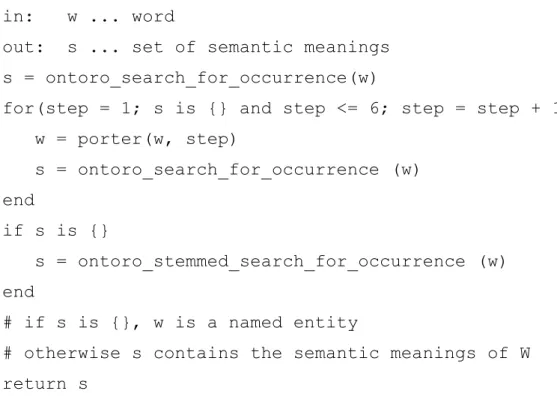
Figure 4.1 Semantically enhanced text stemming algorithm ... 110
Figure 4.2 Performance evaluation of the Porter stemmer, SETS, and Human Judgement (full-feature space) ... 122
Figure 4.3 An example of clustering silhouettes ... 124
Figure 4.4 Clustering silhouettes (one hundred dimensions) ... 126
Figure 4.5 Clustering silhouettes (two hundred dimensions) ... 127
Figure 4.6 Clustering silhouettes (three hundred dimensions) ... 128
Figure 5.1 Maximal matching ... 135
Figure 5.2 Optimal matching ... 135
Figure 5.3 Plot of a clustering solution of 5 clusters with 1000 files ... 159
Figure 5.4 Plot of a clustering solution of 5 clusters with 1000 files ... 160
Figure 5.5 Plot of a clustering solution of 5 clusters with 1000 files ... 161
Figure 6.1 Clustering solution of 5 clusters ... 181
Figure 6.2 Presentation of documents with concept indexing: a - same concepts different place (SCDP); b - same concepts same place (SCSP); c - different concept most appropriate place (DCMAP) ... 184
Figure 6.3 LoA and matching limitation... 186
7
Figure 6.5 A clustering solution according to Human Judgment - LoA ≥ 1.5: ... 198
Figure 6.6 A clustering solution according to a base line algorithm - LoA ≥ 1.5 ... 199
Figure 6.7 A clustering solution according to the proposed algorithm - LoA ≥ 1.9 ... 203
Figure 6.8 A clustering solution according to Human Judgment - LoA ≥ 1.9 ... 204
8 List of tables
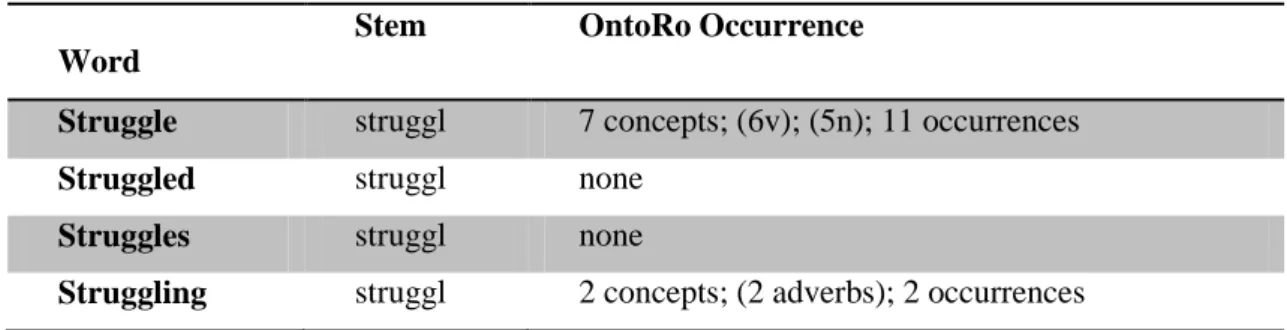
Table 3.1 Occurrence of a word in OntoRo after stemming ... 87
Table 4.1 Suffix stripping algorithm by the Porter Stemmer ... 95
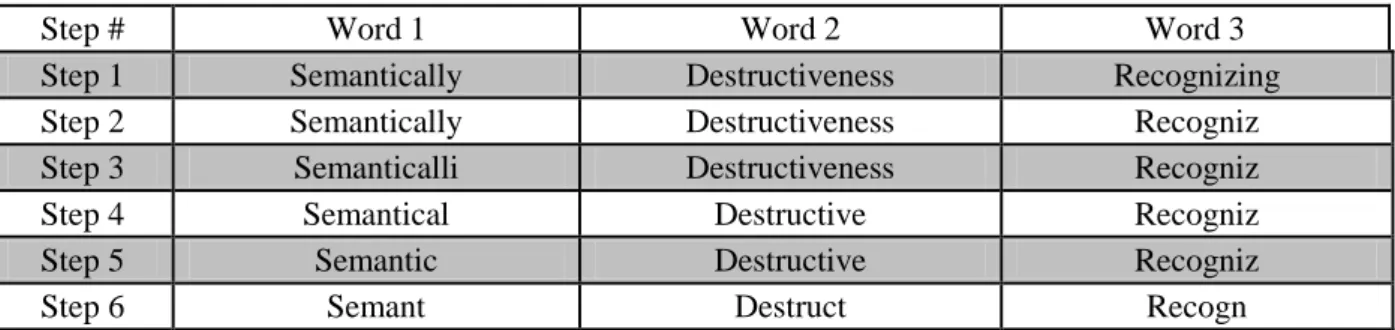
Table 4.2 Illustrative example through the porter steps ... 97
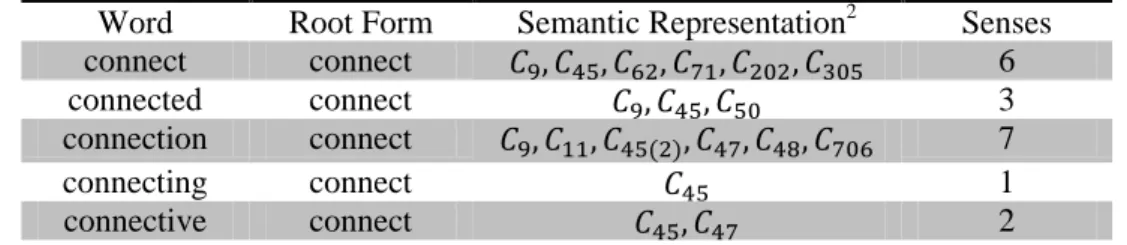
Table 4.3 Semantic representations of word stems in OntoRo ... 108
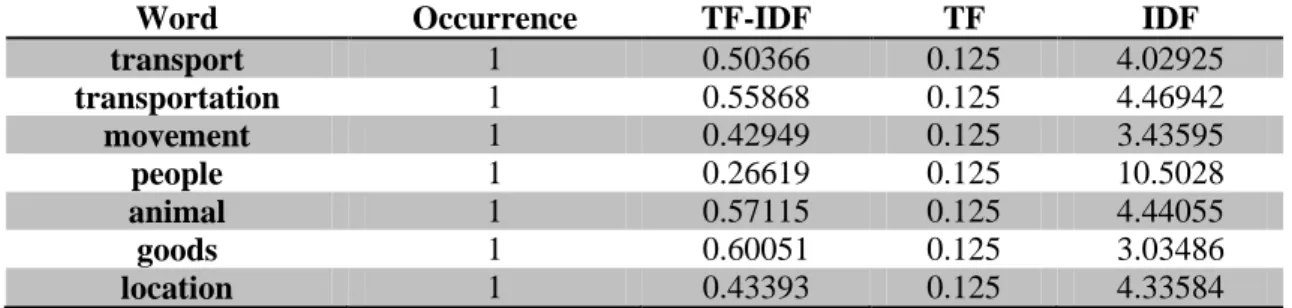
Table 4.4 Article “Transport” from Wikipedia ... 112
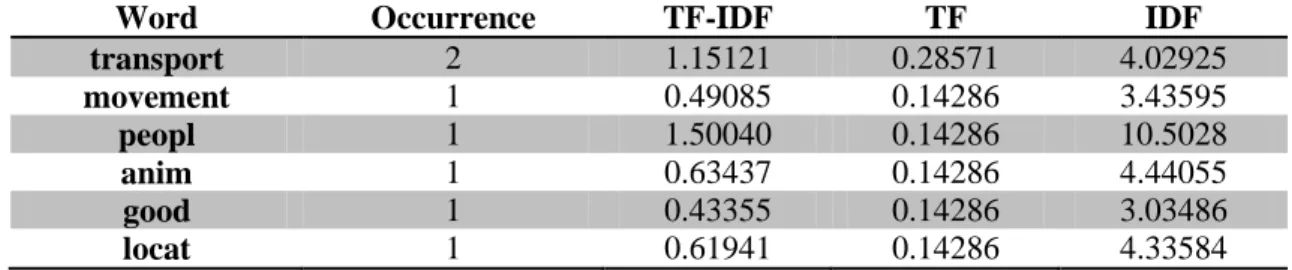
Table 4.5 Words co-occurrence in article “Transport” stemmed with the Porter stemmer (see Table 4.4) ... 112
Table 4.6 Document-term matrix for article “Transport” stemmed with the Porter stemmer ... 113
Table 4.7 Words co-occurrence in article “Transport” stemmed with the SETS algorithm .. 113
Table 4.8 Morphological forms of the word good ... 113
Table 4.9 Semantic ambiguity of grammatically inflected forms of the word good ... 115
Table 4.10 Concept indexing of the first sentence of article “Transport” (only the first 11 out of all 51 concepts shown) ... 117
Table 4.11 Semantic ambiguity and similarity of the words goods, transport, cargo, and ship ... 118
Table 5.1 Concept distance matrix produced using the OntoRo’s structure... 144
Table 5.2 Distance matrix ... 146
Table 5.3 Concept indexing of the Wikipedia collection ... 150
Table 5.4 Document similarity measured for AYwiki00011 (top 40) ... 151
Table 5.5 Concept index and relevance of concepts ... 153
Table 5.6 Silhouette values obtained with different document representations and similarity measures ... 157
9
Table 5.7 Values in percentages of overlapping clustering solutions ... 163
Table 6.1 Distance matrix with level of abstraction ... 188
Table 6.2 Document similarity measured (LoA ≥ 1.5, top 40) ... 191
Table 6.3 Document similarity measured (LoA < 1.5, top 40) ... 192
Table 6.4 Comparison of silhouette values of clustering solutions (LoA ≥ 1.5) ... 195
Table 6.5 Consistency of clustering solutions with human judgement (LoA ≥ 1.5) ... 196
Table 6.6 Comparison of silhouette values of clustering solutions (LoA ≥ 1.9) ... 201
10 List of publications
1. Setchi R, Tang Q, Stankov I, Semantic-based information retrieval in support of concept design, Advanced Engineering Informatics, invited paper for a Special Issue on Infor-mation Mining and Retrieval in Design , 25 (2) (2011) 131-146 ISBN/ISSN: 1474-0346 10.1016/j.aei.2010.07.006
2. Stankov I, Todorov D, Setchi R, Semantically Enhanced Text Stemmer (SETS) for Doc-ument Clustering, In proceedings of the 16th International Conference on Knowledge-Based and Intelligent Information and Engineering Systems, San Sebastian, 10-12 Sep 2012, Spain
3. Stankov I, Todorov D, Setchi R, Towards enhanced crossed-domain document clustering with Semantically Enhanced Text Stemmer (SETS), Invited paper for a Special Issue on Innovation in Knowledge-Based and Intelligent Engineering Systems, submitted to Knowledge Engineering Systems Journal , September 2012
11 Chapter 1 : Introduction
1.1.Motivation
The success of the World Wide Web offers people the opportunity to share knowledge via textual documents contained in web sites, digital libraries and document re-positories. A large number of these documents have been made freely available and acces-sible, and there is a growing need for specific (vertical) and general document search and retrieval, which bene-fits the document browsing and the knowledge discovery across do-mains through more ef-fective document clustering (Huang, 2008, Grefenstette, 2009).
A problem in document clustering is the fragmentation of knowledge across do-mains, which results in specific and topic oriented approaches to grouping documents (Grefenstette, 2009). Therefore, clustering is traditionally used to produce specific groupings within pre-defined domains and cannot be used effectively by the search/retrieval algorithms in cross disciplinary tasks. This conflicts with the large variety of digital content consumption across domains (Andrews and Fox, 2007). As a result the desktop-based core search/retrieval market has begun to experience its first declines. The total number of core searches declined by 3% in 2012, driven primarily by a decline in searches per user (down 7%) despite growth in the number of searchers (up 4%) (Lipsman et al., 2013). The two reasons for the decline in the core search/retrieval intensity are (1) the shift towards vertical search/retrieval and (2) the shift to searching (retrieving) on mobile plat-forms, where the amount of mobile data traffic, speed and accuracy of retrieval are vital (Lipsman et al., 2013). With respect to vertical search/retrieval, users are increasingly likely to search for a product on dedicated market plat-forms such as Amazon or eBay, and search for people on Facebook, LinkedIn or Whitepages.
12 Meanwhile, vertical searches/retrievals are up by 8%, whereas core searches/retrievals are decreasing (Lipsman et al., 2013).
Since document clustering is focused in dealing with specific content within a domain of interest prevents its effective use in a general document search and/or retrieval across do-mains (Zhang et al., 2011). A vertical search/retrieval engine is distinct from a general docu-ment search/retrieval engine by its focus on a specific segdocu-ment of content relevant to a pre-defined topic or set of topics. Therefore, document clustering needs improvement of the co-herence of groupings produced by algorithms from documents that belong to various do-mains. Thus, the documents within a cluster will share higher degree of similarity unlike doc-uments that belong to other clusters.
The degree of similarity is a measure, which formally characterises or recognises, either by processing text or through the use of ontologies, the contextual properties shared by two doc-uments. The properties employed to measure the similarity between documents depend on the pragmatic context of the task they are used for (Grefenstette, 2009). Documents within a clus-ter are much more inclus-terconnected to each other and in this thesis they are considered similar. However, this definition does not exclude the possibility for a document from one cluster to share a certain degree of similarity with documents belonging to other clusters. Such docu-ments are called in this work related.
Clustering algorithms can be divided into two types: model-based (Cadez et al., 2000), e.g. hierarchical and partitional, and similarity-based (Karypis et al., 1999). Most of them use the words in the documents as properties to measure pair-wise document similarity, ignoring their sequence or semantic relation, i.e. a relation explicitly stated in an external knowledge source (Li et al., 2008). However, it is proven that clustering algorithms, which incorporate background knowledge, achieve better performance than word-based algorithms (Hotho et
13 al., 2003b, Yong and Hodges, 2006). In the context of document clustering, background knowledge represents existing connections between terms in a document which indicate vari-ous entities, even if they do not exist literally (Hotho et al., 2003b).
Users of a document management system have certain background knowledge based on their previous experience. However, only domain experts have objective understanding of their domain of expertise and can actively contribute to the knowledge formalisation of that domain by explicitly discovering abstractions and existing relationships in it (Denaux et al., 2011). This process may result in a domain ontology, which is defined as an external repre-sentation of experts’ subject-related knowledge (Engelbrecht and Dror, 2009). Therefore, different domain experts would create different domain ontologies based on the different per-spective of the domain knowledge they have or different project specifications they follow (Wang et al., 2005, Denaux et al., 2011).
Ontologies are intended to be used by both machines and humans, yet they represent knowledge differently. The representations employed by humans are flexible and dynamic whereas ontologies are relatively static and contain fixed constructs. These constructs are established mental representations, which can be accessed by using knowledge elicitation techniques. However, evidence suggests that human internal representations of concepts are not stable entities but are the product of a dynamic, context dependant process (Barsalou and Neisser, 1987). Therefore, there is a mismatch between how people understand natural lan-guage and the assumptions inherent in formal logic. This may lead to using computational ontologies that contain contradictory statements; i.e. statements that do not comply with for-mal logic (Engelbrecht and Dror, 2009).
Cognitive psychology addresses this problem by focusing on the representation of the hu-man knowledge in the process of creating ontologies. It analyses how huhu-man cognitive
sys-14 tem structures and processes conceptual information and suggests that these aspects can be used in knowledge elicitation as a model for structuring formal ontologies (Engelbrecht and Dror, 2009).
Cognitive psychology assumes that concepts have static mental representations in the hu-man mind and can be retrieved from the long-term memory when needed (Barsalou and Neisser, 1987). On the other hand, concepts within text documents can encompass context-sensitive and context-independent information. The latter is considered to be highly accessi-ble and relatively staaccessi-ble whereas the former is less accessiaccessi-ble and is subject to interpretation (Barsalou and Neisser, 1987). Consequently, the cognitive processes that emerge during knowledge elicitation can be very subtle (Boroditsky, 2007). Therefore, efficient document clustering needs different perspectives for comparing objects by employing subjective criteria that allow for a diversity of views from which to look at the clustering task (Hotho et al., 2001).
Cognitive studies show that the comparison of similar objects makes them appear more similar, while comparing dissimilar objects makes them appear less similar (Boroditsky, 2007). As highlighted by Engelbrecht and Dror, 2009, this implies that certain knowledge elicitation methods may lead to the omission of identifying properties that are not shared, and increasing the actual similarity of the acquired properties.
Moreover, a controlled experiment, conducted in 2005 with a corpus of 50 short documents (Lee et al., 2005), reveals that existing clustering methods fail to emulate human expectations of similarity when comparing text documents. The results show that none of the clustering methods employed in the study could produce clustering solutions close to what the partici-pant in the study expects. Further studies indicate that the problem might be due to the fact that all these methods are word-based and relate documents using identical terminology
15 (Hotho et al., 2003b). The evaluation of the proposed methodology employs the Reu-ters21578 corpus, which is tagged with words by linguists. The tags are used to emulate hu-man judgement and provide objective evaluation.
This thesis advocates the view that document clustering could be improved by employing semantics to measure the conceptual similarity between documents. In addition to being se-mantic-based, the approach to be developed should provide different viewpoints of the doc-ument collection and consider the high computational complexity in large scale experiments where large memory footprints and CPU usage are setting challenges for high-dimensional vector space analysis (Zhang et al., 2010).
The main hypothesis of this research is that the effectiveness, which refers to the quality of document clustering in relation to human judgement, and the algorithmic efficiency, which refers to the speed of execution, can be improved by employing semantics. The improvement will result in providing better separation between and improved coherence within clustering solutions by organising large sets of documents into meaningful clusters. The clustering ef-fectiveness, which refers to the quality of document clustering in relation to human judge-ment, and the algorithmic efficiency, which refers to the speed of execution, will improve as well. Producing clusters with improved coherency will enable the current state-of-the-art in-formation retrieval algorithms to perform better across domains.
1.2.Aims and objectives
The goal of the research reported in this thesis is to develop an approach to producing co-herent clusters from large-scale collections that provides multiple viewpoints to facilitate navigational, browsing, knowledge discovery and knowledge management tasks. The overall aim is to develop a semantically enhanced method, which generates multiple clusters that are
16 more topically homogenous and better aligned to human judgement1. The specific objectives of this research are as follows:
1. To develop a conceptual model that provides multiple deterministic clustering solutions and different viewpoints to a collection of documents, and enables large scale experiments; 2. To develop a semantically enhanced text stemming algorithm that provides reduced
di-mensionality and better separation between clusters;
3. To develop a method for measuring document similarity on a large scale by using many-to-many matching;
4. To design a methodology for semantically enhanced clustering that produces topically homogenous clustering solutions that are better aligned to human judgement;
The methodology proposed in chapter 3 (objective 1) outlines a general overview of the clustering and establishes a connection between the proposed functional blocks. An approach for multiple views to a document collection is suggested. Then (objective 2, chapter 4) an ontology driven dimensionality reduction is explored and tested on a large scale. The results reveal that concept indexing (Setchi et al., 2009) can be employed in the domain of document clustering and applied for all and not only pre-selected words contained in text documents when semantically enhanced text stemmer is used to normalise text prior to clustering. In ad-dition, the approach to dimensionality reduction by replacing a group of words with a generic entity (Hotho et al., 2003b) is proven to work even when all words are replaced because the
1
The tags assigned to the documents of the Reuters21578 corpus by linguists are assumed to be human judgement used in this thesis. The tags are used to cluster documents using the same algorithms as the proposed or used methodology in the relevant chapters and the clustering solutions produced are then compared.
17 concept index preserves the statistical information of word co-occurrence. The clustering so-lutions produced by the method proposed in chapter 5 (objective 3) is compared to human judgement on a large scale. The experimental investigation demonstrates that the methodolo-gy proposed in the literature fails on a large scale. Therefore, chapter 6 (objective 4) proposes a methodology for semantically enhanced clustering by using levels of abstraction which al-leviates this problem.
1.3.Outline of the thesis
The rest of the thesis is organised as follows. Chapter 2 reviews clustering methodologies and techniques and contrasts methods for model-based and similarity-based discriminative clustering. A particular attention is devoted to acquiring document representation index, i.e. the process of feature selection and extraction, and how it is used by different strategies to measure pair-wise document similarity.
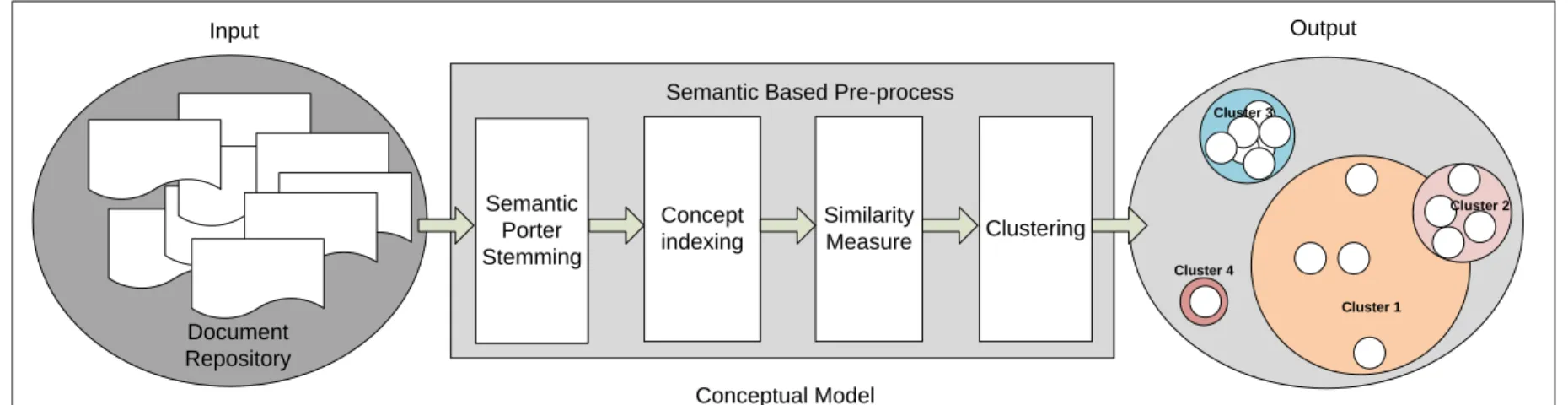
Chapter 3 addresses the first objective of this thesis, which is to develop a conceptual mod-el that overcomes the problems and limitations of current state-of-the-art clustering algo-rithms with regard to their scalability. The model aims to provide multiple deterministic clus-tering solutions to the users. The chapter discusses semantic-based approaches to clusclus-tering as a prerequisite to producing clustering solutions that are consistent with and better aligned to human judgment. This chapter proposes a semantically enhanced document clustering model that provides multiple deterministic clustering solutions and different viewpoints to a document collection.
Chapter 4 addresses the second objective of the reported research by proposing a semanti-cally enhanced text stemming algorithm. It discusses text normalisation techniques and ap-proaches, and focuses on improving the clustering solutions produced by partitional
cluster-18 ing methods in terms of coherence within and separation between the clusters. The chapter firstly discusses approaches to document representation and techniques for document index-ing. It then proposes a technique that improves clustering solutions by using a document in-dex with reduced dimensionality. The proposed technique is compared to the word-based TF-IDF weighting system (calculated after the Porter stemmer normalises the document collec-tion) and human judgement in a generic non-domain specific environment, through an analy-sis of the clusters’ coherence. This chapter provides evidence if concept indexing as a docu-ment representation technique can be used to represent docudocu-ments and successfully preserve the statistical information for words’ co-occurrence on a large scale when semantically en-hanced text stemmer is used for text normalisation prior to clustering. In addition, the cluster-ing solutions produced will be aligned to human judgement for comparison.
Chapter 5 addresses the third objective of the thesis by proposing a method for measuring document similarity on a large scale by using many-to-many matching. It introduces the use of the Earth Mover’s Distance (EMD) algorithm, used in image processing as a pair-wise document similarity measure as it offers a multidimensional approach to measuring similarity based on content distribution. In addition, the chapter outlines inadequacies and deficiencies of traditional document similarity measures. A comparison between the robust cosine and enhanced EMD measures in relation to human judgement is also conducted. This chapter proposes a method for measuring similarity between documents by using many-to-many matching on a large scale.
Chapter 6 addresses the fourth objective of this research, which is to develop a methodolo-gy for semantically enhanced clustering that improves the consistency and alignment of clus-tering solutions to human judgement. The methodology introduces levels of abstraction at which the similarity between documents is considered. The chapter firstly discusses
tradition-19 al clustering approaches and identifies areas for improvement. It then introduces the devel-oped technique and evaluates it against a traditional clustering algorithm in comparison with human judgement. This chapter proposes a semantically enhanced methodology that employs levels of abstraction at which similarity between documents is measured.
20 Chapter 2 : Literature review
This chapter reviews methods and techniques for text document clustering. First, clustering methodologies and techniques are reviewed. Then model-based approaches are compared to similarity-based discriminative methods. Particular attention is devoted to feature selection and extraction from text, used for indexing documents, and the different strategies for meas-uring similarity between documents.
2. 1. Clustering methodologies and techniques
Clustering, also known as numerical taxonomy (Xu and Wunsch, 2005), is unsupervised classification or exploratory data analysis carried out on unlabelled data (Jain and Dubes, 1988, Everitt et al., 2001). Categorisation, on the other hand, known as predictive modelling or supervised learning, constructs models to predict the value of a dependant variable using values of other known attributes (Ženko, 2007), i.e. it uses prior data assigned to the objects. Since clustering is not using such data it is regarded to be different from the predictive learn-ing problems such as vector quantisation, probability function estimation, and entropy maxi-misation (Xu and Wunsch, 2005), even though predictive vector quantisation algorithms are used in non-predictive clustering analysis (Cherkassky and Mulier, 2007).
The goal of clustering is rather grouping unlabeled documents into finite sets, using an in-dex, than providing inaccurate characterisation based on unobserved samples derived from the same probability distribution (Baraldi and Alpaydin, 2002, Cherkassky and Mulier, 2007). Document clustering is employed by many disciplines thus the approaches and as-sumptions used vary. Information retrieval defines users need for information as a query submitted to a search engine (Jain et al., 1999). In this scenario, which deals with text, the choice of words used in the query is important as it pre-determines the returned result.
There-21 fore, when users are not familiar with the terminology or the appropriate vocabulary in the topic of interest, they may commit to an inappropriate choice of words, which may lead to a poor search result. However, navigation within returned documents facilitates finding the information needed (Cutting et al., 1992). Furthermore, document clustering has a key role in refining the results returned from the search engines (Carpineto et al., 2009). Browsing a col-lection of documents and organising them into clusters to find specific information (Cutting et al., 1992, Carpineto et al., 2009) are of particular interest to the research reported in this thesis.
2.1.1. Clustering methods
Clustering methods can be divided into generative, also known as model-based (Cadez et al., 2000), and discriminative approaches also called similarity-based because of the use of a similarity measure (Karypis et al., 1999). The former approaches learn generative models from data, with each model corresponding to one particular cluster. They are driven by a pre-defined parameter, which sets the number of clusters. The discriminative approaches rely on a distance measure or a similarity function to determine the similarity (or dissimilarity) be-tween documents and the most similar documents are then grouped together.
Selecting an appropriate methodology for grouping documents in a collection depends on the adopted document representation, which includes the assumptions made on the data to achieve certain abstraction (Jain et al., 1999). Data abstraction is a process of building a sim-ple and compact representation of documents. The process aims simplicity from the perspec-tive of automation analysis or/and ease of comprehension of the results from the human per-spective. Data abstraction is purpose-oriented and subjective in nature. As a result even unsu-pervised classification such as clustering produces subjective results and disqualifies the
ab-22 solute judgment to the relative efficacy of all clustering techniques (Jain et al., 1999, Baraldi and Alpaydin, 2002). This finding is supported by the view that objects are grouped together into smaller homogeneous subgroups on a subjective basis, using a subjective measure of similarity, which provides the ability to create interesting clusters (Backer and Jain, 1981, Xu and Wunsch, 2005). However, clusters can still be described in terms of their internal homo-geneity and external separation (Gordon, 1999), i.e. feature patterns within the same cluster should be similar to each other, whilst in different clusters they should be not, and yet it should be also possible to identify relation between patterns (Xu and Wunsch, 2005, Yang et al., 2008). This indicates the need to develop methods and techniques that provide multiple subjective views to a document collection where documents can belong to more than one cluster.
Fuzzy clustering (Zadeh, 1965) uses a degree of membership to assign a membership coef-ficient to a document, which belongs to more than one cluster. This coefcoef-ficient satisfies cer-tain constraints and makes every document a member of one or more clusters. However, a study conducted by cognitive scientists (Boroditsky, 2007) show that comparing two similar objects makes them appear more similar, while comparing dissimilar objects makes them appear less similar. The same study indicates that human judgement as a cognitive process during knowledge elicitation of comparing two categories leads to an increase in the per-ceived similarity between them even when the differences are listed. This finding suggests that certain knowledge elicitation methods which involve comparison of concepts in order to group them, may lead to omitting the attributes that are not shared by the categories been compared (Engelbrecht and Dror, 2009). Hence, it is difficult to define so called “gold stand-ards” in clustering, except for document collections that belong to a narrow sub-domain (Jain et al., 1999).
23 2.1.2. Clustering techniques
Clustering techniques group documents together using similarity measures and thresholds. Model-based approaches measure similarity using distance functions such as Euclidean dis-tance, cosine similarity, overlap measure, relative entropy, dice measure, Jaccard measure or itemset-based measure. In contrast, similarity-based clustering methods consider existing re-lationships between words or the internal structure of documents to calculate similarity by using multi-dimensional scaling and in particular OM-based (Optimal Matching) and EMD-based (Earth Mover’s Distance) techniques (Wan and Peng, 2005a).
Xu and Wunsch (2005) state that clustering differs from multi-dimensional scaling, which goal is to depict all evaluated objects to minimise the topological distortion using as few di-mensions as possible. However, Wan and Peng (2005b) have proven that statement wrong by employing EMD (Rubner et al., 2000) to measure the similarity between two documents.
Model-based clustering algorithms employ hierarchical or partitional clustering techniques (Jain and Dubes, 1988). The former techniques organise clusters into tree structures (den-dograms), which allow identifying relationships between documents. Each intermediate level is either a combination of two clusters from the next lower level (agglomerative approach) or a breakdown of a cluster from the next higher level (divisive approach). These techniques produce nested sequences of partitions that contain an all-inclusive cluster at the top and sin-gleton clusters at the bottom. The nodes inside the tree structure display the merging process and the intermediate clusters, thus providing a taxonomy (hierarchical index). The latter tech-niques create one-level (un-nested) partitioning of documents. The predefined number of clusters into which the documents are grouped drives document partitioning. Hierarchical clustering is considered to provide better-quality clustering. However, its implementations are
24 limited because of its algorithmic complexity, which is dependent on the number of docu-ments. On the contrary, partitional clustering has complexity, which grows linearly with the number of considered features, but it produces inferior clusters. It has been proven that algo-rithms, which combine both techniques (e.g. ‘bisecting’ k-means algorithm) perform better than traditional partitional approaches and as well or better than the hierarchical approaches (Steinbach et al., 2000).
Similarity-based techniques first measure the similarity between all pairs of data samples, and then group similar ones together into clusters (Karypis et al., 1999). The main steps of similarity-based techniques are: 1) calculating the distance matrix between all pairs of docu-ments; 2) using the distance matrix to merge the two closest clusters; and 3) modifying and rebuilding the distance matrix by treating the merged clusters as one object. The process stops if the number of desired clusters is reached, otherwise step 2 is repeated. These tech-niques are difficult for people to follow through due to the use of external knowledge and the high complexity of the word dimensional space employed (Punitha et al., 2011).
2.1.3. Clustering procedure
Selecting an appropriate clustering technique or any of its variants depends on the task it is employed for. The effectiveness and the efficiency of the selected technique depends on the chosen feature selection, which provides indices for the documents. Clustering algorithms use an index extracted from the documents to group them. Document indices used in document clustering include words, phrases, concepts, and topics.
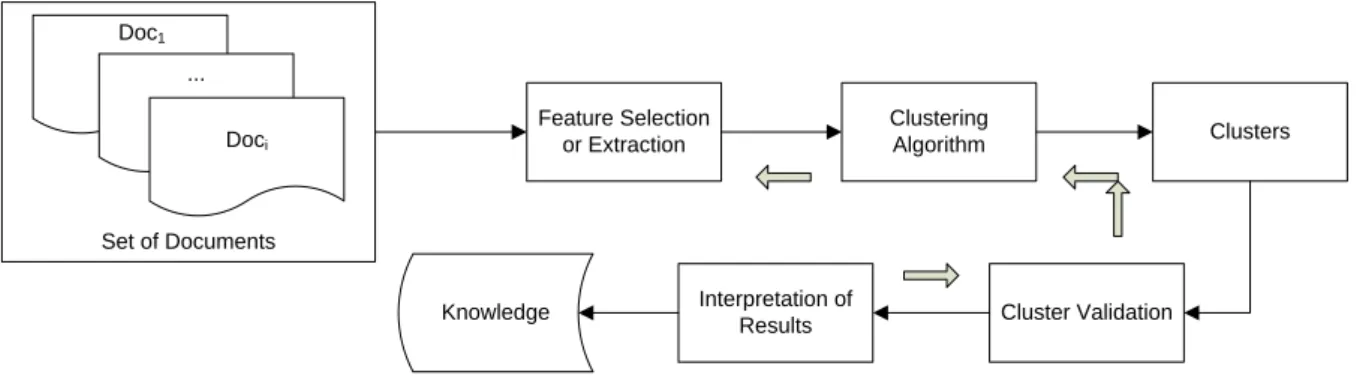
Clustering analysis typically consists of four steps with a feedback pathway (Xu and Wunsch, 2005). The procedure is shown in figure 2.1.
25 Doc1 ... Doci Set of Documents Feature Selection or Extraction Clustering Algorithm Clusters Cluster Validation Interpretation of Results Knowledge
Figure 2.1 Clustering procedures
2.1.4. Feature selection
The first step of the clustering procedure is to distinguish subset of features from a set of candidates (Jain et al., 1999, Jain et al., 2000). The process is called feature selection and it differs from feature extraction as the latter utilises transformations needed to generate fea-tures from the original ones. In document clustering, document pre-processing can vary de-pending on the assumptions and abstractions made. Model-based algorithms normalise the words by employing stemming. The most commonly used stemming algorithm is the Porter stemmer (Porter, 1997). After the text is normalised, the statistical co-occurrence of words and phrases is calculated by weighting the indices produced (Lewis, 1992). Then, similarity-based algorithms are employed to generate an index, which takes into consideration existing relationships in an external knowledge resource (Setchi and Tang, 2007, Xiao, 2010).
Feature selection and extraction are crucial to effective and efficient clustering. Good fea-ture selection or extraction can result in decreased workload and simplified subsequent clus-tering algorithm or/and improved clusclus-tering (Xu and Wunsch, 2005).
The rest of this chapter reviews methodologies for feature selection and extraction that use words/phrases, ontologies and semantics.
26 2.1.5. Clustering algorithm design and selection
The design of clustering starts with selecting a similarity measure and constructing a crite-rion function for measuring similarity between documents (Xu and Wunsch, 2005). Feature patterns are grouped together if they resemble each other, i.e. proximity measure over two feature patterns is applied and if the result corresponds to a pre-defined criterion function, they are placed in the same cluster. Therefore, the proximity measure, which can be defined in explicit or implicit manner, affects the formation and the quality of the clusters.
Clustering addresses problems associated with high dimensionality, scalability of the algo-rithms, measuring the accuracy and the quality of the produced clusters. The first problem is with regard to the spectral requirements of the documents, i.e. the large number of features used for document representation (Fung et al., 2005). The large feature set and the fact that every feature constitutes a dimension in the feature term-based space can be addressed by placing documents in a sub-space. However, this is a very challenging task and dimensional spaces which include all features are not used on a large scale.
The next problem is scalability. Algorithms which produce good results on a small data set (Fung et al., 2005) or in a specific domain (Zhang et al., 2011) fail to perform on larger scale or across domains. The first scenario considers algorithms with very high computational complexity which is impractical on a larger scale. The second scenario deals with the poly-semy of words and the fact that many domains share common terms, which may contribute to low quality in the document groupings (Steinbach et al., 2000).
27 2.1.6. Evaluation of clustering solutions
The third problem refers to measuring the accuracy of the produced clusters. Following the similarity criteria for high homogeneity inside the clusters and diversity between clusters is used to project certain quality of the clustering structure produced by clustering algorithms from all documents, but have no practical value in terms of human judgement. Therefore, a methodology that aligns the produced clustering solutions to human judgement is discussed further in this section.
The accuracy of clustering depends on the quality of the document index (Facolta et al., 2008), which is selected in the view of a particular task (Lewis, 1992). Each index acquired from the same documents incorporates different assumptions and leads to a different clus-tering result. An important benefit of clusclus-tering is that it provides unseen groupings of fea-tures, but these groupings need to be viewed and evaluated from the perspective of human judgement. Thus, users will have a certain degree of confidence for the derived clusters and therefore, the validation of clustering becomes a crucial part of it. The evaluation should provide objective assessment of the derived clusters and have no preference to any algo-rithm. In addition, the evaluation standards and criteria should provide evidence whether the obtained clusters are meaningful to users or just a manifestation of the employed algo-rithm (Xu and Wunsch, 2005).
Generally, model-based clustering uses testing criteria based on external, internal and rela-tive indices (Jain and Dubes, 1988). Criteria using external indices compare the new clusters to a pre-defined structure of the clustering data. This method for validation is used by parti-tional methods. Criteria using internal indices on the other hand, test the data without any prior knowledge by examining the clustering structure directly from the original data (used
28 by hierarchical methods). Relative criteria compare different clustering structures and provide a reference to decide which one is best (Xu and Wunsch, 2005).
Conversely, as reported by Wan (2007), there is no standard dataset for evaluation of doc-ument similarity, which can be used to validate the clustering structure produced. However, researchers adopt text classification experimentation corpora to validate their approaches (Hotho et al., 2003b, Hotho et al., 2003c, Wan, 2007, Wan et al., 2007) and the following two sections discuss similar approaches.
2.1.6.1. Evaluation methodology in information retrieval and cognitive psychology
In the domain of cognitive psychology the evaluation methodology usually involves people who participate in a study in which different algorithms or approaches are used to acquire or compare results with human judgement (Goldsmith et al., 1991, Lee et al., 2005). In 1991 a study assesses the cognitive representation of the structural knowledge of students by com-paring it with that of their instructor for the purpose of constructing a predictive model (Goldsmith et al., 1991). This approach employs extensive analysis, which uses all features pdefined by the researchers. Therefore, the study is comprehensive and accurate but re-quires a long time to manually analyse the results. This makes it impractical for large scale experiments.
Another study in the domain of information science evaluates existing document similarity methods in terms of their ability to emulate human judgement (Lee et al., 2005). This study reveals that existing similarity methods fail to emulate human expectations of similarity when comparing text documents. However, it presents very detailed analysis of the quality of the similarity measures on a small scale, where a small number of documents are manually ana-lysed by the researchers. The analysis involves the researchers’ subjective decision whether
29 the documents within the clusters are correctly grouped. It is noted that the similarity measure is an essential part of any clustering model. Therefore, these similarity measures if employed by clustering should perform similarly and the clustering solutions produced should have similar alignment to human judgement. However, the produced clustering solutions need to be compared for all documents in all clusters independently and then aligned to human judgement. A methodology which provides such comparison is discussed in the next section.
The quality of the similarity measures are further investigated with respect to the infor-mation retrieval domain. The measures employed by the evaluation methodology in this do-main are divided into two groups. The first group includes measures of single-value metrics such as precision, recall, P@N (which considers precision and recall of the topmost results) and f-measure (Blair, 1979), which also involves precision and recall. These measures are based on the complete list of documents returned by the algorithms. However, in this case all relevant and retrieved documents must be known prior to execution for every query upon which documents are retrieved. The corpora used for evaluation must have a list of prede-fined and analysed queries against which the comparison of the results is evaluated.
The second group includes measures which return a ranked sequence of documents. These measures consider the order in which the returned documents are presented. By computing a precision and recall at every position in the ranked sequence of documents, the precision-recall curve can be plotted, where the precision is a function of the precision-recall. In information re-trieval the average precision measure is widely used (Voorhees, 1998). It computes the aver-age precision of the retrieval as a value in the interval from 0 to 1. The positive predictive value or precision of the results is used to indicate the retrieval accuracy. Mean average pre-cision (MAP) measures the retrieval performance of algorithms for a set of queries, where the mean is the average precision scores for each query. The second group of measures evaluates
30 the retrieval value for a given number of the top ranked documents. Document (web) search engines retrieve a certain number of documents, which are sorted in descending order of their rank. Hence, the algorithms can be evaluated by the quality of their retrieval based on a pre-selected number N from the top ranked documents. Then, for N number of documents is measured as the number of correctly retrieved documents using the following equation:
∑ ( ( ) ( ))
where rel(k) is an indicator function, which equals to 1, if the item at rank k is a relevant document, or zero otherwise. The average is calculated for all relevant documents and the relevant documents not retrieved get a precision score of zero.
The mean average precision (MAP) is calculated using the equation below: ∑ ( )
where Q is the number of queries.
The aforementioned methods for measuring correctness of retrieval are useful for testing similarity functions or retrieval power of information retrieval algorithms. However, it is not enough to address the overall performance of clustering algorithms because (i) it is impracti-cal for large simpracti-cale experiments (ii) to consider the quality of all groupings for the entire col-lection. Therefore, a comprehensive evaluation approach to a clustering is obtained if the en-tire structure of the clustering solutions produced is explored. This approach is similar to the method for evaluation of clustering solutions with silhouettes.
2.1.6.2. Evaluation methodology employed
It is important to note, that there are no gold standards (Jain et al., 1999) for evaluation of clustering solutions and researchers use different corpora and methods. The evaluation
meth-31 odology used in this thesis targets objective evaluation of the structure of the clustering solu-tions produced with all the documents from a collection. The evaluation needs to represent the alignment of the produced results to human judgements. A condition to the methodology is to carry out the evaluation on a large scale.
The selected corpus for the evaluation is Reuters21578. This collection consists of 21578 news articles on different economic subjects published in 1987. An important property of the corpus is the presence of tags (the total number of which is 445) manually assigned to every article (up to 29 tags per article) by linguists. The tags are separated in different categories. The tags that indicate the topics of the documents are 140 and a few additional sets of total 305 unique tags are used to indicate properties that articles convey with regard to entities such as people, places, dates, orgs, exchanges and companies. Since the tags are morphologi-cal words or named entities provided by the linguists (not necessarily contained in the text) they are all used in the evaluation of the document groupings to provide a perspective of hu-man judgement. All tags are used to cluster the corpus and compare the results against other methods. The evaluation demonstrates how the clusters produced by different clustering techniques align to human judgement (i.e. clusters produced by using the Reuters collection’s tags). The tags are considered by the reported research as a judgement provided by humans. This is as a consequence of the fact that the linguists have the same background and motiva-tions. Therefore, the assigned to the documents tags are consistent in representing the content of articles. There are no constraints applied for the choice of tags. All tags are assigned man-ually. In addition, the motivation of the task the linguists are assigned with is to represent an article with words. They were not given the task to group similar documents. Therefore, the clustering results obtained by using the tags are not manipulated by the task.
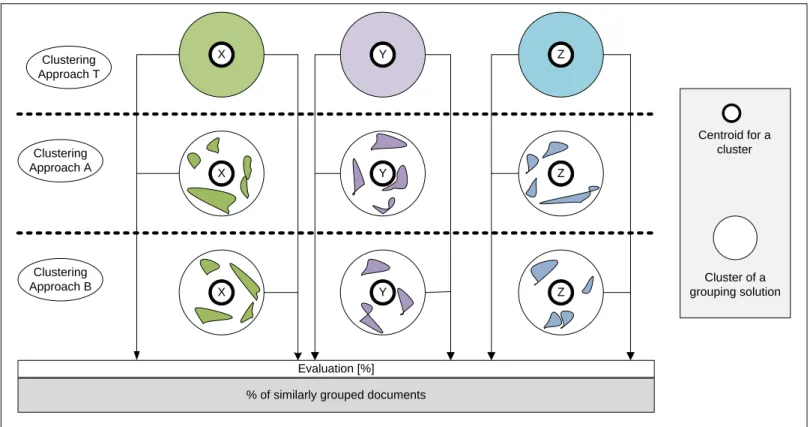
32 In figure 2.2 is shown a comparison between clustering solutions. Clustering approach T employs the tags of the Reuqters21578 collection to cluster all or a pre-defined set of articles. This clustering solution represents how the linguists would have clustered the articles by em-ploying the selected clustering algorithm. Then, the same collection (the same set of articles) is clustered two more times by clustering approaches A and B. Documents X, Y and Z are used as centroids for the clusters in the relevant clustering solutions. Then, the evaluation measures the number of similarly grouped documents for the individual clusters in per-cents [%]. The clusters build up around document X by clustering approach A and B are compared with the cluster X produced by the clustering approach T. The number of documents, which are clustered the same by clustering approaches A and B in comparison to T are calculated. Finally, when the same procedure is applied for every cluster (X, Y and Z) the calculated re-sults are summed up. The equation below explains the procedure:
( | ) ∑ ∑ ∑
where, comparison (A│T) is the result of similarly clustered documents by clustering so-lutions A and T [%], l, n and m are the total number of documents respectively in clusters X, Y and Z and | | is an article from the relevant cluster. The total number of documents in the collection is l+n+m. Thus, in fig. 2.2 are presented clustering solutions of 3 clusters pro-duced by clustering approaches T, A and B. The higher number of documents is clustered similarly to the clustering solution produced by approach T, the better alignment of the clus-tering results to human judgement.
An objective evaluation of different document representational techniques in relation to human judgement, for example, is obtained by firstly, producing a clustering solution using
33 the tags, and then compare that solutions with the clustering solution produced by the same clustering algorithm but using other document representation techniques (such as vector space model and concept indexing). Then, the comparison will demonstrate the difference of the document representation techniques in clustering in relation to human judgement.
34 Clustering Approach T Clustering Approach A Clustering Approach B X Y Z Centroid for a cluster Cluster of a grouping solution X X Y Y Z Z
% of similarly grouped documents Evaluation [%]
35 Section 2.2 reviews approaches which employ words and phrases as features used to index documents and acquire model-based patterns of the features to calculate the similarity be-tween documents. In section 2.3 similarity-based approaches, which rely on external knowledge, are discussed and reviewed.
2. 2. Model-based document clustering
Model-based algorithms use various document representations, such as the vector space model (VSM), that treat documents as a bag of words (BOW) (Salton and Mcgill, 1986), set of repetitive words (Wang et al., 1999, Beil et al., 2002) or word-sequences (Li et al., 2008). Syntactic and semantic information (Yun et al., 2010) including word senses (Peng and Choi, 2005) is outside the scope of model-based clustering. This section reviews partitional and hierarchical clustering, which are the two main types of model-based approaches used. Doc-ument grammar is outside the scope of this research and is not reviewed.
2.2.1. Partitional approach to clustering
Partitional clustering, also known as hard partitioning, creates flat, non-hierarchical clus-ters, whose number is controlled by a value given to the algorithms prior to execution. As highlighted by Fung et al. (2005), the number of clusters k drives the process of partitioning documents in k clusters by employing the standard k-means algorithm or any of its variants. However, selecting the number of clusters without any domain knowledge in the area of in-terest may worsen the results. In addition, if documents cover a broader thematic area, the clusters produced would be inferior. Kernel-based partitional methods such as kernel k-means algorithms, which consider mapping of the input prior to clustering (Karatzoglou and
36 Feinerer, 2006) using string kernels (Huma et al., 2002) or word-sequence kernels (Cancedda et al., 2003), perform better than the standard k-mean partitional algorithms.
Partitional algorithms use VSM document representation. They have two main disad-vantages. Firstly, they do not consider semantic relations between words. Not only words with similar meaning (Yun et al., 2010) but also relationships between words, which share similar semantic context, are treated as irrelevant features (Hotho et al., 2003b, Hotho et al., 2003a). Secondly, same words with different meaning in different context are not considered either (Yun et al., 2010). Furthermore, the number of dimensions has to be of the same length for all vectors, i.e. short and long text documents should have the same number of words rep-resenting them in the vocabulary space of the document collection (Steinbach et al., 2000).
VSM represents each document d as a vector D in the vocabulary space. It represents a document using terms co-occurrence (TF–term frequency) within a document so that ( ), where is the frequency of the ith term contained in the document. However, not all terms have the same discriminative power, and determining what the dis-criminative power of the words is can be considered as a two-stage process. Firstly, stop words are removed and then words that are used often in the documents within the collection are given less discriminative power. The second stage employs the common practice of weighting the words’ significance within the document collection. This is achieved by calcu-lating IDF (inverse document frequency) for every word, or classifying words with eliteness (Robertson, 2004). Words that are very frequent in the collection gain less discriminative power (less IDF weight) than the more unique words. The presumption is that words with higher statistical value are more relevant to the topic of a document. Before IDF is calculated, words that occur in different grammatical forms are normalised to their canonical form using a stemming algorithm (Porter, 1997). Then the weights of the document indices are
calculat-37 ed by multiplying TF and IDF. However, computing the weight of all words within all docu-ments leads to high computational complexity (Beil et al., 2002), which motivates considera-ble interest in low-dimensional document representation that overcomes this particular issue (Matveeva, 2006).
The k-means algorithm uses the robust cosine measure to compute the similarity between documents. It is defined as ( ) ( ) || || || || , where indicates the vector dot product and || || is the length of the vector. The k-means algorithm computes ran-domly a k number of vectors in the feature space to identify the closest documents to the cen-troids and then uses these vectors to form clusters. The algorithm iteratively refines the ran-domly chosen initial k centroids, minimising the average distance (homogenising the clusters by increasing the similarity within clusters).
Improvement of the standard k-means algorithm is the “bisecting” k-means algorithm pro-posed by Steinbach et al. (2000). It randomly selects k documents and creates k initial clus-ters, which are incrementally updated with every consecutive document rather than at the end of the assignment pass. The basic “bisecting” step is when a cluster is selected, using basic k-means algorithm, to find two sub-clusters and to repeat that step until the k number of clus-ters is reached. The “bisecting” approach produces better overall similarity and lower entropy and has better accuracy and efficiency (Zhao and Karypis, 2002). However, both algorithms are found to be not only relatively efficient and scalable but also sensitive to noise (Fung et al., 2005). The authors state that not only the noise, which can be easily introduced in the preparation step and will influence the construction of centroids, can cause poor performance but also if the number of k clusters is incorrectly estimated. Although, the noise problem is addressed by the k-medoids algorithm (Krishnapuram et al., 1999), its computational cost
38 makes it impractical. In addition, these algorithms are considered not suitable for discovering clusters of varying sizes, which is the case with document clustering.
Alternative strategy for achieving better performance and scalability of the k-means family of algorithms is addressed by the dimensionality reduction techniques (Xiao, 2010). Latent Semantic Analysis (LSA) is one of the best known dimensionally reduction algorithms in information retrieval (Deerwester et al., 1990, Zhang et al., 2011). It is an algebraic indexing method, which provides a mechanism for low dimensional document representation. The al-gorithm uses statistical data of word co-occurrence (TF-IDF), but it further employs a higher-order document- term (semantic) structure. This approach aims to find the best sub-space ap-proximation to the original space in terms of minimising the global reconstruction error. Us-ing sUs-ingular vector decomposition, LSA projects the representUs-ing vectors into an approximate sub-space. The sub-space represents the original feature space with fewer dimensionality, which enables the cosine similarity to compute semantic similarity between documents accu-rately. The semantic structure is acquired from external knowledge and is used to improve the detection of relevant documents (Zhang et al., 2011). This is necessary because word-based document representation is challenged by word polysemy and the fact that in information retrieval, relevant documents might be indexed with words that users with perspective differ-ent to the encoded knowledge would not use in their retrieval queries. Semantic-based ap-proaches to clustering that address this shortcoming are reviewed in section 2.3.
The kernel-based technique is another method for dimensionality reduction. It is success-fully used for document ranking and filtering in information retrieval and text classification when dealing with large collections. Exploring kernel methods such as kernel k-means and spectral clustering (Ng et al., 2001) in the area of document clustering is needed due to the inadequacy of the standard k-means algorithms to separate clusters that are not linearly
sepa-39 rable in the input space. Kernel algorithms first map the input data into a high dimensional non-linear space and then a kernel function places the result of the mapping implicitly into a pre-selected feature space. Then Euclidian distance is used to measure the distance between the properties. The spectral clustering uses affinity matrix and leads to easier to solve cluster-ing problems since points tend to form tight clusters in the eigenvector subspace (Karatzoglou and Feinerer, 2006). However, this is an application oriented (specific) ap-proach and therefore, full string kernel is considered as a more general technique for cluster-ing. The comparison between spectral clustering with string matrix, kernel k-means with full string matrix, and simple k-means with term matrix demonstrates that spectral clustering with string kernel performs better than all other methods (Ng et al., 2001). Computing the kernel matrix is a very time consuming task and the performance of the kernel-based algorithms strongly depends on the length of the string.
2.2.2. Hierarchical approach to clustering
There are two types of hierarchical approaches: agglomerative and divisive. The first fami-ly of algorithms builds the cluster hierarchy bottom-up by computing iterativefami-ly the similarity between every two pairs of clusters and merging the most similar pair (Kaufman and Rousseeuw, 2005). The difference in the variants of this family of algorithms is in the select-ed function for calculating similarity between documents (Zhao and Karypis, 2001). The sec-ond family of algorithms builds the hierarchy top-down starting from the top with all ments in one cluster, as the similarity measure considers the global distribution of the docu-ment representation (Manning et al., 2008). The cluster is split by using a flat clustering algo-rithm with a certain similarity measure. This procedure is applied recursively until each doc-ument is in its own singleton cluster.
40 Although top-down clustering is conceptually more complex, it can be more efficient if the complete hierarchy of the tree structure is not generated. In addition to that, the evaluation of the results carried out by Steinbach et al. (2000) using the f-measure shows that the divisive approach produces more accurate hierarchies when combined with partitional clustering. The main disadvantage of both approaches is their high computational complexity in similarity calculation. In addition, early decisions cannot be undone, i.e. previous splitting or merging of clusters cannot be adjusted, which lowers their clustering accuracy (Fung et al., 2005).
The algorithms that implement the agglomerative techniques maintain very high homoge-neity within the clusters. Alternatively, the intra-cluster similarity technique (IST) uses the agglomerative approach to merge a pair of clusters that results in slight decrease of the ho-mogeneity within the merged cluster. This technique measures the hoho-mogeneity by compar-ing all members of a cluster; it has a quadratic complexity to the number of documents. An-other technique, the centroid similarity technique (CST), reduces the complexity by measur-ing the similarity between clusters based only on their centroids. It uses cosine similarity measure and is faster than the IST. UPGMA (Unweighted Pair Group Method with Arithme-tic Mean) is another technique, which is similar to IST, but it uses altered cosine measure for calculating the similarity. Steinbach et al. (2000) prove that UPGMA and IST perform equal-ly, although UPGMA’s performance is better when the number of clusters is high. UPGMA is later proven not scalable and unsuitable for large data sets because of its complexity (Fung et al., 2003).
The same study (Fung et al., 2003) compares the standard k-means algorithm, “bisecting” k-means approach (partitional approach, which produces hierarchies) and UPGMA, which is the best agglomerating hierarchical technique. The results indicate that “bisecting” k-means is better that the standard k-means algorithm and as good as or even better than UPGMA. The