Working Paper No. 28
Attention Competition
Andreas M. Hefti
September 2011
University of Zurich
Department of Economics
Working Paper Series
ISSN 1664-7041 (print)
ISSN1664-705X(online)
Attention Competition
∗Andreas M. Hefti†
September 2011
Abstract
I present a game-theoretic model where economic competition and attention competition are interdependent. On the one hand the effort to attract consumer attention depends on the value of attention to the firm which depends on the grade of price competition among all perceived firms. On the other hand attracting attention involves costs which must be covered by the earnings from competition. It is the task of this paper to clarify the consequences of such an interdependence between attention competition and economic competition for prices, attention effort and market structure as determined by the strategic equilibrium. Under lim-ited attention the market as perceived by consumers and not the effective market is relevant to the firms which implies that prices also reflect the scarcity of attention. Less attentive consumers lead to higher prices but at the same time getting attention is more valuable which intensifies the competition for attention and leads to higher attention costs. I show that if attention competition is relatively inelastic or the commodities are strong substitutes then the gains from consumer inattention outweigh the costs of attracting attention which leads to higher profits and larger effective markets.
Keywords: Limited Attention, Competition, Pricing, Strategic equilibrium JEL Classification: D43, D83, L13, C72
∗
My special thanks go to Armin Schmutzler and Josef Falkinger. I also wish to thank Larry Samuelson, Rani Spiegler and Nick Netzer for valuable comments on this and related research projects.
†
University of Zurich, Department of Economics, Bluemlisalpstr. 10, CH-8006 Zurich. E-mail: [email protected]
1
Introduction and related literature
The main task of this paper is to provide a static game-theoretic framework that can account for the well-documented fact that decision-makers (consumers) acquire their resources (commodi-ties) under limited attention.
Limited attention means the existence of an upper bound on how many different items are perceived by an individual. If an individual is confronted with more alternatives, an attention allocation problem exists: which alternatives are perceived (i.e. considered in the economic decision of the individual) and which not?
The model is solved in the special but empirically important case where the information sender (the firm) can directly affect the attention allocation of an attention-constrained consumer by increasing its effort to attract attention relative to the other senders. The possibility to increase their chance of perception leads the firms to engage in a competition for the scarce consumer attention - besides competing for the consumer budget in a conventional economic sense. Al-though the marketing science reports clear evidence for the existence of both limited attention and competition for attention (see section 1.2), questions regarding the implications of the inter-dependence between attention competition and conventional economic competition for market prices and market structure have not been posed previously. In this paper I provide first answers to such questions in a rather general setting. The framework may be adapted to more specific models (such as the Salop model of circular product differentiation) which then even allow a normative investigation of attention competition.
The paper is organised as follows. In the rest of section 1 I revise the relevant literature in psychology and the marketing science on attention which motivate the main two psychological building blocks of my model, namely the existence of limited attention and stimulus-driven attention allocation. Further, I discuss the related literature in economics and finance that has previously dealt with limited attention. In section 2 I give an informal and intuitive description of the attention problem and the main model of this paper (introduced in section 3) basically formalizes the ideas presented there. In section 4 I show that in case of symmtric firms a symmetric price-attention equilibrium exists both for a given number of firms or when the number of active firms is determined by free-entry. The (comparative-static) implications of attention competition are discussed in detail in section 5. In the appendix to this paper I take the formal analysis one step further by addressing questions concerning uniqueness and stability
of the (symmetric) equilibrium.
1.1 Psychological literature on attention
In psychological work on attention there is a clear distinction between ”whether attention is goal-driven, controlled in a top-down fashion, or stimulus driven, controlled in a bottom-up fashion” (e.g. Yantis (1998), p. 223).
The modern literature on experimental psychology provides evidence for both the active and the passive role of attention in the context of visual stimulus processing1: ”goal-driven” and ”stim-ulus driven” attention are important in explaining how subjects perform during visual search experiments. Nevertheless ”stimulus-driven attentional control is both faster and more potent than goal-driven attentional control” (Yantis (1998), p. 251-252) - especially in experiments where attention cannot be focused on a certain region in advance. This literature argues that attention operates as a gating mechanism if multiple stimuli use the same neural pathway by ”restricting the amount of information that is processed at once” (Mozer and Sitton (1998), p. 342) because parallel processing of information is not possible due to mental capacity limitations. Then the relative strength of a stimulus that enters the neural network of a person determines whether or not it is further transmitted into the neural network and eventually reaches the recognition network (Mozer and Sitton (1998), p. 343-356). That capacity limitations impose a ”bottleneck” to visual stimulus processing is convincingly illustrated in experiments on visual search: response time of subjects to a stimulus is flat if few objects are displayed but increases exponentially with the number of displayed objects (Mozer and Sitton (1998), p. 378-340). Hence perception gets distracted under many signals which ultimately slows down response time. In explaining search time in visual search the ”relative salience of a target” is much more important than ”the occurrence of specific features” (Nothdurft (2000), p. 1184). Hence in order to generate a ”pop-up” or ”salience effect” the motion, color or luminance of an object matters only relatively to the local and global surrounding of the object. Experiments conducted to assess the spatial distribution of attention on the visual field suggest that attention works as a ”spotlight”: once a location is selected, all features at that location are processed and moved on to the recognition network (e.g. Kahneman and Henik (1981)) or at least ”receive enhanced
1In such experiments subjects are usually required to identify the orientation of some geometric object that e.g. briefly flashes up where there might also be distractive stimuli present and response time of subjects is measured. See Yantis (Yantis (1998)) for an overview of such experiments.
processing” (Maunsell and Treue (2006)).
We may summarise the key messages of the psychological research in case of visual attention as follows:
P1) In the case of multiple stimuli relative signal strength matters whether a signal is processed or not.
P2) For a given spatial array of objects, if a region successfully attracts attention then all features of this region are considered.
Note that P1) also means that in case of multiple overlapping stimuli certain signals are inhib-ited2 and not processed to the recognition network.
1.2 Limited attention in the marketing science
In the marketing literature it is a well-documented fact that the placement of a link on the screen of some online search site is a crucial determinant of the number of clicks that a site receives. For example using a dataset of a price listing service Baye et al. find that ”a firm receives about 17% fewer clicks for every competitor listed above it on the screen” (Baye et al. (2009), p. 938) but that the relationship between clicks and screen location is far from being linear. That ranking matters for clicks on search pages is also confirmed by Smith and Brynjolfsson (Smith and Brynjolfsson (2004)) in the context of online book markets and by Ghose and Yang in the context of sponsored search advertising (Ghose and Yang (2009)). Having sales data in case of memory modules Ellison and Ellison (Ellison and Ellison (2009), p. 442) report that on a price search engine ”moving from first to seventh on the list reduces a websites sales [...] by 83%”. Dreze and Zufryden, using data on the web traffic of Amazon and Ebay, point out that a site can increase its visibility to potential consumers most by altering its linkage in the web and thereby improving its indexing by search engines (Dreze and Zufryden (2004), p. 35). Most noteworthy is the finding that the first three positions get about 75% out of all clicks of the first ten positions on the screen (Baye et al. (2009), p. 945) and positions with rank larger than three do not differ substantially from each other. This finding is also confirmed by Ghose and Yang who additionally document a non-monotonic relationship between rank and profitability (Ghose
2
See Milliken and Tipper (1998), p. 204-206 for experiments on the importance of inhibition in selection experiments.
and Yang (2009), p. 1614). This is explained by the fact that both costs and clicks decrease with a higher rank (a lower on-screen position) but that clicks decrease slower than costs. Hence it may be of less importance to be the first on the list but what matters is to be among the first few entries. A related finding of Smith and Brynjolfsson is that in case of the market for books being on the first page of a search page is of central relevance for receiving a high number of clicks and might even be more important than being the overall first in the list (Smith and Brynjolfsson (2004), p. 548-549). First-page dominance is also found by Jansen et al. (Jansen et al. (2000), p. 215). Finally, Pan et al. show in an eyeball-tracking experiment that the first entries on a Google search page get by far most viewing-time but there is no statistical difference between the first and the second item on the list (Pan et al. (2007), p. 814). In their online experiment Pan et al. further show that people frequently select the upper items of a list in a quality based search experiment even if these upper items systematically are of inferior quality. Hence the Pan finding suggests that people consider the first few alternatives in making their decisionsindependent of the overall quality of these alternatives.
The theoretical literature in marketing has recognised the empirical fact that consumers make their decision conditional on a subset of all possible alternatives. In such models consumers are believed to phase their decision in two parts using simple heuristics to screen all possible alternatives and then make a more thorough analysis of the reduced consideration set (Manrai and Andrews (1998); see Payne et al. (1993), Chapter 2, for an overview of different decision strategies). Hauser and Wernerfeld (Hauser and Wernerfelt (1990)) provide an overview of marketing studies that find empirical evidence for the existence of such consideration sets and emphasise that these sets usually are very small (a size of 3−6 alternatives) compared to the complete set of possible alternatives3. Moreover, the consideration sets of supermarket shoppers seem to depend heavily on what is promoted strongly (Fader and McAlister (1990), p. 330-331). This is also supported by Mitra who reports that advertising does not alter the average size of the consideration set but it does influence which alternatives are in the consideration set in an experimental setting (Mitra (1995), p. 91). Mehta et al. use a structural model of quality-adjusted price search to estimate in-shop brand selection in case of liquid detergents and find that consumers frequently purchase low quality products ”simply because they fail to notice the prices of the other brands” (Mehta et al. (2003), p. 76) and, at the same time, it
3
In case of shampoos the mean consideration set contained only four shampoos out of more than 30 (Hauser and Wernerfelt (1990)).
is ”the most feature-advertised and displayed brand”. Similarly, Alba and Chattopadhyay find experimental evidence that higher salience of a brand inhibits the recall of other brands (Alba and Chattopadhyay (1986), p. 365).
The key messages of marketing and internet research are:
M1) The on-screen ranking of links determines the clicking distribution and is sale relevant. M2) There appears to be a discontinuity and non-linearity between the clicks of the first few
entries and the later entries of search pages and there is first-page relevance.
M3) Consideration sets of consumers exist and are small. The size of the set is not affected e.g. by advertising. Firms can influence their chance of consideration e.g. by means of promotion.
Note that P1) and P2) can explain M1) in the sense that people cannot process all information on a search screen in parallel and thus perceive the links from top to bottom. That flashy links by means of position or different color attract attention and hence clicks (the finding of Ghose and Yang (2009)) coincides with Nothdurft’s (2000) observation that the relative salience of objects determines the speed of their detection and also is reflected by the fact that sponsored search advertising (purchasing advertising space and a different link color in the Google top-and sideframe) has become ”the largest source of revenues for search engines” (Ghose top-and Yang (2009), p. 1605). Further P2) and M2) seem related as the empirical evidence suggests the clicking behavior to cluster around the first search page and the first entries of a page. Finally, M2) and M3) are related as the discontinuity could be explained by the fact that people consider only a small subset of all information and their selection rule follows a simple top-down logic. The facts documented in the last two sections suggest that:
1. Decision-makers have limited attention: They focus only on a subset of all available infor-mation.
2. Relative salience of the information (e.g. its on-screen ranking) crucially determines which information receives attention.
1.3 Limited attention in economics and finance
In a seminal paper Herbert Simon revises the notion of the “rational economic man” by intro-ducing ”internal constraints” which account for the fact that besides the conventional budget constraint that represents economic scarcity an agent also faces physiological and psycholog-ical limitations to which he must obey (Simon (1955)). Consecutively, much theoretpsycholog-ical and empirical effort was undertaken to comprehend what such bounds might imply for economic models. In many cases bounds on the information processing capabilities of agents have been found of central importance. The claim of these models usually is that acquiring and processing information imposes some cost on the agent. The existence of such deliberation costs then leads to a trade-off in decision-making (see Payne et al. (1993)): better decisions are available only at the expense of purchasing more information.
However, the information problem in a modern economy might be less one of getting information but one of receiving too much information. Maybe the central phenomen of the digital age is that ”Information has gone from scarce to superabundant4”.
Together with such limitations the ”wealth of information” then implies a ”scarcity of attention” (Simon (1971)). Managing scarce attention is seen to be the central task of modern business: ”If you want to be successful in the current economy, you’ve got to be good at getting attention” (Davenport and Beck (2001), p. 8).
This distinction of attention as an active or passive part of perception as was introduced in section 1.1 is reflected in the modern economic literature on attention. Taken to economic theory the dichotomy translates into the question whether the individual itself allocates its attention, i.e. the allocation problem is a part of the individuals optimization problem, or the attention allocation depends on the (relative) strength of different stimuli the individual is exposed to. Other than the strong evidence for the stimulus-driven attention allocation suggests the vast part of the economic literature on attention is concerned with goal-driven allocation meachanisms.
4
Cited in: The Economist, ”Data, data everywhere. A special report on managing information” Feb 27th 2010, p.3.
1.3.1 Goal-driven attention allocation
In models of rational inattention (Reis (2006a) and Reis (2006b), also Gifford (2005)) infor-mation acquisition is costly and a part of the agent’s maximization problem. In the dynamic context of these models the consumers only sporadically update their information which is interpreted as an agent being inattentive for some time concerning further information. Sims investigates the implications of rational inattention on macroeconomic topics such as the perma-nent income hypothesis using Shannon’s information theory (Sims (2003)). Gabaix and Laibson develop a cost-benefit model that endogenously explains how subjects allocate their limited mental resources to different elements of a decision problem and provide experimental evidence in support of their directed cognition effect (Gabaix et al. (2003) and Gabaix et al. (2006)). In finance limited attention of market actors has been taken into account by different researchers. For example, Mondria et al. show that the magnitude of home bias in investments can be ex-plained substantially by the allocation of investor’s limited attention (Mondria et al. (2010)). Gifford presents a dynamic principal-agent model of venture capital where the venture capital-ist (the agent) must decide in each period how much attention (or time) to allocate towards managing a current venture or towards funding new ventures (Gifford (1997)). Using an NYSE dataset from 2002 Corwin and Coughenour show that the ability of specialist traders to provide liquidity to a stock is negatively correlated with the attention required by the other stocks in the portfolio (Corwin and Coughenour (2008)). Peng shows that investors allocate their limited attention across sources of uncertainty to minimize total portfolio uncertainty (Peng (2005)), and Huberman (Huberman (2001)) as well as Barber and Odean (Barber and Odean (2008)) provide evidence that investors tend to focus on familiar stocks and that information may not be incorporated into prices until it attracts sufficient investor attention. These are all examples of economic models that deal with a goal-driven type of attention allocation.
1.3.2 Stimulus-driven attention allocation
The smaller part of the economic literature on attention focuses on stimulus-driven attention allocation. If attention is stimulus-driven this naturally moves the behaviour of the information sender into the centre of interest. For example, Falkinger (Falkinger (2007), Falkinger (2008)) works with a macroeconomic model where consumer attention is not a decision variable and attention is allocated only by the strength of the signals the consumers receive. Such a passive
allocation process exists if and only if there is an abundance of information compared to a certain information overflow threshold. Such an economy is called information-rich as opposed to an information-poor economy where the receivers of information are capable of perceiving all information. Falkinger shows that whether an economy is information-rich or information poor is determined by fundamentals such as preferences, budget, information technology and production technology.
Hirshleifer and Teoh illustrate the implications of limited investor attention on stock prices if the manager of a firm can influence the perception of a financial report by disclosing additional material (Hirshleifer and Teoh (2003)). They show that managers have an incentive to include additional pro forma (non-GAAP) measures on earnings to improve the perception of the firm as inattentive investors treat pro forma earnings as if they were adjusted by the manager to be maximally informative. This failure of the inattentive investors to account for the strategic incentive of the manager implies that i) pro forma earnings are upward biased predictions of terminal cash flows and ii) stock prices are too high compared to a situation were reporting of pro forma earnings were forbidden.
Although the model of this paper is principally general enough to accomodate both types of attention allocation mechanisms I will, inspired by the strong empirical evidence, concentrate solely on the stimulus-driven mechanism throughout the paper.
2
An informal description of the attention problem
In this section I illustrate the attention problem in a schematic and intuitive way. The main part of this paper formalises these schematics and derives a game-theoretic model where firms (information senders) compete for consumer attention and consumer budget.
2.1 A simple consumer choice problem
Suppose for the sake of illustration that there aren= 4 firms. Each firm produces one commodity and sets a priceyj. Consumeridecides how much to purchase from each commodity. ϕi is the
choice function of consumer i. How much of which commodity the consumer purchases (xij)
depends on his preferences and budgetv and on the prices of the commodities. This standard decision problem is illustrated in figure 1.
1 2
3 4
x11, x12, x13, x14 iy1, y2, y3, y4, v
Figure 1: A classical consumer decision problem
2.1.1 Informative advertising and limited information
In models of informative advertising consumers are ex ante uninformed about existing commodi-ties (e.g. Grossman and Shapiro (1984), Goeree (2008)). They learn about the commodicommodi-ties only by the information (ads) they receive from the firms and choose only among the commodities they are aware of. Such a situation is depicted in figure 2. In the figure we see that only firms
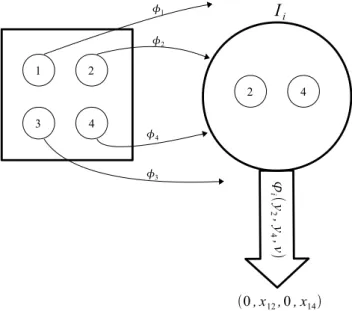
1 2 3 4 2 4 1 2 4 3 0, x12,0, x14 Ii i y 2 ,y 4 ,v
Figure 2: Limited information
two and four managed to inform consumeri. That is, the consumer received ads only from these firms but not of firm one and three and he decides only among those firms he is informed of. If the firms can choose how many consumers to inform (for example if they can decide in how many different newspaper to put an ad) then the information set Ii is endogenously determined and
variableφj. The literature on informative advertising says that a consumer who considers a set
of alternatives that is smaller than the set of all existing alternatives has limited information
(see e.g. Goeree (2008)).
2.1.2 Scarce attention
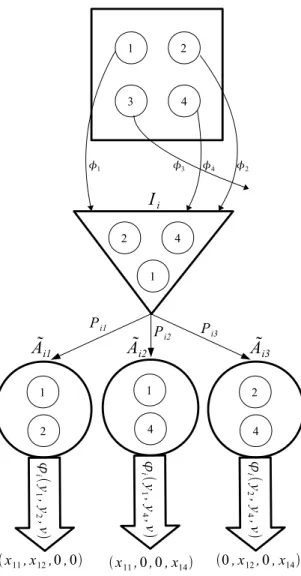
In this paper limited attention means that an upper bound,R <∞, on how much information can be perceived by a consumer exists. Suppose for the sake of illustration that R = 2. If a consumer receives information of not more than two firms then he considers all alternatives he is informed about in making his decision. Such a situation is captured by figure 2. Now suppose consumerireceived information from firms one, two and four but not from firm three, as depicted in figure 3. Limited attention means the the consumer bases his decision on a subset of Ii that
containsR= 2 different alternatives. As figure 3 suggests there are three possibilities to pick two alternatives out of the set of three alternatives and Piα forα = 1,2,3 withPi1+Pi2+Pi3 = 1 denotes the probability with which consumer i observes a certain attention set ˜Aiα. In this
paper I will argue that the firms which are a part of Ii have means to influence the probability
distribution (Pi1, Pi2, Pi3). Formally, this means that the probability vector (Pi1, Pi2, Pi3) will
depend on the (relative) choice of attention effort of the firms. That is, firms can influence their
chance of perception.
Note however that other mechanisms that determine the vector can be imagined. In the case of recommender systems the probability to observe a certain subset would depend on how the alternatives in Ii are rated by the community. Or we could think of a filter mechanism that
excludes or includes certain alternatives with a certain probability. For example, in figure 3 a 1-pass filter would pass only subsets containing alternative 1, i.e. Pi3 = 0. In the case of goal driven attention allocation we can think of the vector as determined by the individual itself. This makes sense e.g. if the alternatives in Ii are different assets (rather than commodities)
and the individual can only manage (e.g. compare) these assets pairwise. Then the probability vector could be interpreted e.g. as the fraction of time an individual decides to spend by comparing the different pairs of assets in his portfolio. However, in this paper I stick to the case where the attention probabilities represent the effort of the attention-seeking firms. I think that this properly captures how people who use the internet, especially search engines, make their decision: they are presented with a large list of alternatives and consider only a few alternatives
1 2 3 4 2 4 3 x11, x12,0,0 4 2 Ii 1 Ai1 Ai2 Ai3 1 4 2 4 1 2 1 Pi1 P i2 Pi3 x11,0,0, x14 0, x12,0, x14 i y 1 ,y 2 ,v i y 2 ,y 4 ,v i y 1 ,y 4 ,v
Figure 3: Limited attention
- especially those alternatives that have top positions or are highlighted by some other means (e.g. in the Google sideframe).
Note that by the notion of the literature on informative advertising the consumer in figure 3 also has limited information - but for a very different reason: the cause is not that he received only little information but rather that he received more information than he considers. My contribution essentially shows that if limited information is caused by limited attention rather than scarce information this generates a very different strategic environment and implies very different results compared to standard models of informative advertising.
As figure 3 suggests in order to earn money from a consumer a firm must achieve three goals: i) the firm must inform the consumer (e.g. receive an index by a Google search bot), ii) it must
be perceived by a consumer (e.g. because it has a high index and a top on-screen placement) and iii) it must provide a satisfying offer in a conventional economic sense compared to all other firms that the consumer perceives5. One contribution of this paper is to provide a specification of how the firms in Ii can influence their chance of perception. This means that the
probabil-ity distribution (Pi1, Pi2, Pi3) in figure 3 will be endogenously determined and depends on the strategic attention efforts of the firms inIi. What I want the model to capture is that if in figure
3 firm one’s messages arerelatively conspicuouscompared to the messages of firms two and four then we should havePi1+Pi2≈1.
To make the difference between figure 2 and figure 3 as clear as possible suppose firms can advertise only by posting ads in different newspapers. Consumers do not read all newspapers. If a firm places its ads in more newspapers this increases the number of people that could see the ad. Put differently, this increases the number of information sets that contain the firm. Suppose now a consumer reads a newspaper that contains many ads of different firms. Then it is reasonable to assume that a large or colorful ad or an ad placed on the front page has a larger chance of getting the readers attention than a small ad somewhere on the last pages. That is, contrary to the theory of informative advertising, a firm that advertises in many newspapers but has very non-salient ads may go unnoticed by most consumers. In essence, it is this struggle for attention which is the main concern of this paper.
3
A formal model of attention and price competition
3.1 The Internet economy
For many people the internet nowadays is the main source of information and, as e.g. the stories of Google’s or facebook’s success document, the internet also offers great business opportunities. But the internet, especially a search page such as Google, also provides the most convincing example of the prevalence of limited attention. A typical Google search query usually results in an enormous number of hits6. As suggested by the observations documented in the introduction, the typical user of a search engine focuses on the first few entries (or on the first few pages) instead of threading through the entire list. Moreover, this information is accessible for any
5
Suppose that consumer iperceives the set ˜Ai1 in figure 3. Then firm one competes with firm two for the consumer budgetv.
6
For example, the keyword ”Hawaii” gives approximately 123’000’000 hits and the query ”Hawaii vacations” gives approximately 8’160’000 hits (January 09, 2011).
consumer in the world provided he has access to the internet. This clearly illustrates that the contemporaneous (and future) information problem of an advertising firm is less one of reaching more consumers (more information sets) but one of making its messages salient. In the Google example this e.g. means to be listed on the first page of a search query.7 In this paper I extrapolate this observation by assuming that every active firm that pays a fixed cost F > 0 reaches the entire population ∆. Hence all consumers have the same information set: Ii =I. In
the Google example this means that if a firm designs a web page and puts it online (achieving this requires some fixed amount of money) it is found and indexed by a Google bot. However, whether the firm has a high or a low index (a top rank position or not) depends on further investments8 of the firm. SettingIi =I appears also to be adequate for mature product classes.
For such products, e.g. Coke and Pepsi, the role of advertising is not information provision about the features but ”keeping a product top-of-mind” (Iyer et al. (2005), p. 464) for which ”these companies spend a significant amount of their budget on reminder-advertising”. I simply call an economy where a firm is either in all or in no information set an ”internet economy”. If a firm pays the setup costF then I call the firm active. Suppose there arenactive firms indexed by 1, ..., nin the internet economy. Then n=|I|.
3.2 Attention and price competition in the internet economy
In this section I formalise the schematics of figure 3. First, I develop a model that determines how the attention efforts of the active firms influence their probability of being perceived by a consumer. Then I combine this model with a model of imperfect price competition. I will provide a simple example that accompanies and illustrates the abstract theory developed in this section. In the end of section 3 we will have a completely specified model of n active firms that simultaneously and non-cooperatively choose their attention effort and their price. I will restrict myself to the case of symmetric firms. Thus formally we will have to deal with a static two-dimensional symmetric n-player game.
7
As a Web commentator puts it: ”Simply, you want to be found at the common meeting point...page 1 of a Google search” (see www.optimum7.com).
8
For example, the firm can try to get more cross-links to its webpage or can bid for a placement in the Google sideframe. In both cases there is some kind of variable cost involved.
3.2.1 Attention probabilities
Suppose there are n active firms in the internet economy and hence n = |I|. The power set of I is denoted by P ≡ P(I) and I call an element A ∈ P an attention set. Limited attention
means that only attention sets not larger than some 1< R <∞ are considered by a consumer. I denote the attention set of consumer i (the set of alternatives that the consumer effectively perceives) by ˜Ai ⊂ I. Limited attention means that
˜ Ai
≤ R. The attention constraints of
the consumers are strictly binding if and only if n > R. If n≤ R then we have ˜Ai =I for all
consumers in the internet economy. If however n > R then we have ˜Ai ( I and ˜Ai 6= ˜Ah is
possible for any two consumers. In case of a binding attention constraint literally spoken only some commodities can make it into the attention set ˜Ai of a consumer and the next question is
which alternatives succeed in doing so. To answer this question we need to specify a rule that for a given I tells whether j ∈ I implies j ∈ A˜i or not. The general way to map a larger set
into a smaller one is to specify a probability distribution on the set of all possible attention sets. Define the indicator variablez by
z= min{R, n} (1)
LetA(I, z)⊂Pbe the set of all subsets of I with size z.9 For every consumer iI now define a functionPi on A that assigns to every possible attention setA ofA with sizez a probability10
of realising this particular set:
Pi:A →s|A| , A7→PiA (2)
wheres|A| is the (|A| −1)-dimensional simplex11 and A∈ Ais an attention set of size z. Thus PiA is the probability that ˜Ai = A, i.e. PiA is the probability that consumer i perceives the
attention set A. Note that we havez=nifR≥n. But then we must haveA=I and |A|= 1. The only possible function satisfying (2) in this case is the unit function which gives ˜Ai =I for
all consumers. Hence the entire apparatus I am about to construct only comes into play when we have n > R, i.e. when the attention constraints of the consumers bind.
Before continuing it should be noted that by definition of (2) I only allow the attention sets to be proper sets (instead of multisets). This can be justified by the assumption that
attention-9Because by definition of the internet economy we haveI
i=Ifor all consumers the setAof possible attention
sets is the same for all consumers. This would not be the case if we allowed forIi6=Ih.
10Of course, the probability of a certain set could also be one ore zero. 11 s|A|≡ P∈R|A|+ : P A∈A PiA= 1 .
constrained decison-makers cannot be fooled in the sense that they always recognize and consider R truly distinct alternatives.12
The probabilitypij that firmj is perceived by consumeri given thatj∈I is calculated by
pij =
X
A∈A
PiA1 [j ∈A] (3)
where 1 [j∈A] is a variable indicating whether alternative j is in attention setA or not. The following proposition establishes an aggregate relationship on Pi and pij.
Proposition 1 If Pi is a probability function as defined by (2) then P j∈I
pij =z.
Proof: Appendix B (8.2)
Conversely, it generally only is possible to constructPi from the set ofpij wherej∈I in certain
trivial cases.13 The vectorpAi ≡(pij)j=1,...,nforj = 1, ..., ncan be interpreted as the distribution
of attention of consumer i. Likewise, if there are ∆ consumers then then-vector
pA≡ ∆ P i=1 pAi ∆
is the average distribution of attention in the market. Then thej-th entry ofpAcorresponds to the average fraction of consumers in the economy that consider an attention set containingj.
3.2.2 Limited attention and economic competition: the problem of the firm
From an economic perspective the functionPibecomes interesting if actions chosen by the market
agents such as advertising efforts by firms (or search efforts by consumers) affect the probability distribution. Throughout this paper I will maintain the assumption that Pi is determined only
by the attention efforts of the firms in I. Suppose every active firmj can choose its attention effortfj ≥0. I denote byf−j the vector of attention efforts chosen by all active firms other than
j. Let F ≡(f1, ..., fn) ∈Rn+ denote the vector of attention efforts. I assume that the attention probabilitiesPAdepend onF. Further, for any active firmjdefine the setBj ≡ {A∈ A:j∈A}.
12
This means that even if a firmjby some reason has a high chance of perception, i.e. P
A∈A:j∈A
PiA≈1, then
forR >1 this does not mean that it is the only firm that is perceived. 13
Assumption 1 (Relative salience) For all consumersPi =P where the functionP is defined
by (2). If P
A∈Bj
PA<1 then PA(F) is an increasing function of fj for all A∈Bj.
The first part of assumption 1 means that all consumers have the same function P which determines the probability that a particular attention set A∈ A is perceived. This assumption is mainly for simplicity. The second part of assumption 1 means that under limited attention (n > R) a firm can positively influence the chance that a consumers perceives an attention set
A withj∈A.
Lemma 1 Under assumption 1 we have for any active firmj and any consumerithatpij =pj.
If R ≥n thenpj = 1 for any active firm j. If n > R then pj =pj(fj, f−j) where pj(fj, f−j) is
an increasing function of fj if pj <1.
Proof: Appendix B (8.3)
To formalise the interdependence of economic competition and attention competition I assume that every firm non-cooperatively chooses one variableyj, henceforth interpreted as its price.
Let YA≡(yu1, ..., yuz)∈Rz with uk∈A denote the vector of prices of those firms that belong
toA. For every A∈ A define a functionVj(YA) :Rz →R1 with the property that Vj(YA) = 0
ifj /∈A. ThenVj(YA) is the value of attention setAto firmj and summarises the value earned
by firm j from the economic competition between the firms in attention setA. As an example think of price competition with substitute products and linear production costs. Then
Vj(YA) = (yj−c)xj(YA) (4)
wherexj(YA) is the demand function of a consumer facing attention setAwith price vectorYA.
The second assumption I impose with the goal of eventually writing down the payoff function of firmj is the following:
Assumption 2 (Separability) For any active firm j and any A∈Bj the function Vj(YA) is
independent of (f1, ..., fn).
This is a very important assumption. It means that conditional on an attention set consumers make decisionsindependent of all attentional activities.14 Taken to the Google example the
as-14
This is a crucial difference between attention competition as understood by my contribution and persuasive advertising: persuasive advertising would mean that the advertising effort of a firm could influence the function
sumption means that the rank of an alternative only influences its chance of perception but does not convey more economically relevant information to the consumer. Formally, this assump-tion enables me to separate the competiassump-tion for an attenassump-tion set from the economic competiassump-tion within an attention set and leads to an analytically highly tractable structure of such a problem. Under assumptions 1 and 2 the expected profit function of firmj is
Πj((y1, f1), ...,(yj, fj), ...,(yn, fn)) =
X
A∈Bj
PA(F)Vj(YA)∆−F−C(fj) (5)
whereC(fj) denotes the cost firmj must incur under effort levelfj. The properties ofCwill be
discussed below. The fixed setup cost F > 0 can be thought of as summarizing infrastructure costs for production and IT.
In case of (4) the profit function (5) becomes
Πj = (yj−c)
X
A∈Bj
PA(F)xj(A)∆−F −C(fj) (6)
Concerning the costs of attention I assume the following properties to hold forf ∈[0,∞)
C(0) = 0, C(f >0)∈(0,∞), C0(0)∈[0,∞), C0(f >0)∈(0,∞), C00(f)∈[0,∞) (7)
An example which provides useful later is given by
C(f) =θfη θ >0 η≥1 (8)
As the elasticity of the cost function will play a major role for the comparative statics of the model it is appropriate to discuss the cost function in greater detail which is accomplished in the remainder of this section. In case of sponsored search advertising firms can purchase certain keywords (called adwords) by offering a cost-per-click (CPC) rate in an ongoing online auction. For a purchased keyword the rank of the link within the frame for sponsored ads depends on the relative bid and on the PageRank measure of the page15. Thus for a given set of keywords and identifying attention probabilities with the on-screen ranking we might expect constant unit
Vj. Attention competition means that the chance of perception depends on firm actions but has no further
influence on the choice behavior of consumers.
costs to be reasonable. Imagine a situation where all initial bids are the same for a fixed set of keywords. Assuming that only relative bids determine the ranking the on-screen position then is random and the probability to be among the first R ranks is R/nfor every competitor. Then if all competitors double their bids my firm can get the same chance as before (R/n) only if I also double my bid which simply implies doubling advertising expenditure. However, as Williamson and Rusmevichientong point out, sponsored search advertising is highly complex as it is a multidimensional issue if the set of keywords is not fixed and novel keywords are associated with an unknown number of click-through rates (Williamson and Rusmevichientong (2006), p. 260). Nonlinear costs of attention may arise e.g. if retrieving new click-generating keywords gets more difficult the more keywords are already employed. Nonlinearity is more generally also supported by the finding of Nothdurft that it gets increasingly difficult to generate a higher salience (pop-up effect) of some visual stimulus at higher levels of salience (Nothdurft (2000), p. 1195): combining the salience of two features (e.g. color and movement of a visual object) does not lead to the sum of the saliences of the two features for the same background. Finally, in case of adword competition how narrow the set of possible keywords is might be a market-specific feature which then implies different elasticities of the cost functions for different markets. The market for a specialised set of screwdrivers might encompass less critical keywords than the market of holiday destinations.
3.3 The symmetric price-attention game
LetSy ≡[c, ymax],Sf ≡[0,∞) andS≡[c, ymax]×[0,∞). Further, I assume (5) to be symmetric,
i.e.
Πj((y1, f1), ...,(yj, fj), ...,(yn, fn)) = Πσ(j) (yσ(1), fσ(1)), ...,(yσ(j), fσ(j)), ...,(yσ(n), fσ(n))
where σ is a permutation of {1, ..., n} All active firms simultaneously and non-cooperatively choose their strategy, the pair (yj, fj)∈S in order to maximize (5) and take (y−j, f−j) as given.
Hence (n, Sn,Π) is a static symmetric game. In the main part of this paper I restrict myself to the case of symmetric equilibria.16 To establish a symmetric equilibrium I apply the symmetric opponents form approach. In the next section I derive the symmetric opponent form of (5). It is convenient to impose all further assumptions relevant for the analysis of the symmetric
equilibrium directly on the symmetric opponent form.
3.3.1 The symmetric opponent form
To derive the symmetric opponent form of the profit function of (5) I take firm j as the rep-resentative firm and set yj =y and yg = ¯y as well as fj =f and fg = ¯f for any g 6=j. Then
Vj(A) = Vj(A0) if A, A0 ∈ Bj and I define V (y,y, z)¯ ≡Vj(YA:A∈Bj) (remember that the
number of arguments inVj is z) and17
p f,f , n, R¯ ≡ 1 n≤R pj(f, f−j)|fg= ¯f ∀g6=j n > R
Lemma 2 If n > R the symmetric opponent form of (5) is
Π(y, f) =p(f,f , n, R)V¯ (y,y, R) ∆¯ −F−C(f) (9)
If R≥nthe symmetric opponent form of (5) is
Π(y, f) =V (y,y, n) ∆¯ −F−C(f) (10)
Proof: Appendix B (8.4)
Note thatp(f,f , n, R)∆ is the fraction of consumers which perceive firm¯ j. That is,p(f,f , n, R)∆¯ is the number of realised attention sets ˜Athat containj.
Because C(f) is an injective function of f it is possible to rewrite (9) directly in terms of attention costs rather than in terms of attention effortf. For f =ρ(ω) withC(ρ(ω)) =ω and
¯
f =ρ(¯ω) withC(ρ(¯ω)) = ¯ω we get
Π(y, ω) =p(ρ(ω), ρ(¯ω), n, R)V(y, y, R)∆−F −ω
This reformulation makes sense as firms rather observe attention costs than attention effort of their opponents. However, it is convenient to solve the model in terms of effort f rather than in terms of attention cost and I continue to use this specification.
17ForR < nthe functionp(f,f , n, R¯ ) generally depends onRbecause there are|A|=
n R
possible attention sets and the probability assignment as defined by (2) depends on how many attention sets there are.
It is possible to establish a simple relationship between the probabilitypthat firmj is perceived by a consumer and the probability, ¯p, that one of its opponents is perceived. Let pg be the
probability thatg6=j is perceived by a consumer. Thenfg = ¯f for allg6=jimplies thatpg = ¯p
for all g6=j.18 Proposition 1 shows that
¯
p= R−p
n−1 R < n (3’)
3.3.2 Assumptions on the symmetric opponent form
In this section I impose and discuss the main assumption on the value function V(y,y, z¯ ) and the probability function p(f,f , n, R). I take these assumptions to be satisfied in the main part¯ of this paper.
Assumption 3 The functionV(y,y, z¯ )is twice continuously differentiable iny, y¯fory,y¯∈Sy
and decreasing in z. V2(y,y, z)¯ >0.
The assumptionV2(y,y, z)¯ >0 means that higher prices of the opponents ceteris paribus increase the revenue that the firm can extract from its attention sets. In case of (4) this means that higher prices of the opponents ceteris paribus increases demand (as the opponents loose some consumers to the firm) and hence also revenue for the firm. The assumption that V(y,y, z)¯ decreases inz means that if consumers perceive more alternatives then ceteris paribus the firm earns less value from the consumer. In case of (4) a standard intuition for this is that consumers allocate their budget over the set of all firms they perceive. If they perceive more firms then, for a fixed budget v, they divide their budget over more firms which leaves less budget for a single firm.
As an example for a function that satisfies assumption 3 suppose consumers have CES-preferences over all z commodities they perceive andc >0. Then it is straightforward to show that
V(y,y, z¯ ) = (y−c) vy −σ y1−σ+ (z−1)¯y1−σ | {z } x(y,y,z¯ ) (11) 18
Moreover, if we knowp(f,f , n¯ ) then we can determinePA(F) for allA∈Bjas well asPA0(F) whereA0∈/Bj
(see the remark in section 8.4 of the appendix). This means that, if we restrict ourselves to the symmetric opponent form, whenever we determinep(f,f , n¯ ) then the probability set function P is also determined which means that every possible attention setA∈ Ahas a well defined probability of being realised.
wherex(y,y, z) denotes demand of a consumer for commodity¯ j who perceivesj and alsoz−1 other firms. The parameter σ > 1 denotes the elasticity of substitution19 and v > 0 is a consumer’s budget.
Assumption 4 Let p ∈[0,1] denote the probability of firm j of being in the attention set of a consumer.
a)
p=p f,f , n, R¯ (12)
If n > R, f,f >¯ 0 and p < 1 then the following properties of the function p f,f , n, R¯ are postulated:
b) p λf, λf , n, R¯
=p f,f , n, R¯
for λ >0.
c) p f,f , n, R¯ is twice continuously differentiable in f,f¯and
p1(f,f , n, R)¯ >0 p11(f,f , n, R)¯ <0 p2(f,f , n, R)¯ <0
Moreover, p(f,f , n, R)¯ is strictly increasing inR and strictly decreasing in n.
Because of assumption c)p(f,f , n, R) is an increasing strongly concave function of¯ f. Note that p1 >0 directly follows from lemma 1 if we assume the functionp(f,f , n, R) to be differentiable¯ in f. The assumption that p2 < 0 means that attention efforts impose a negative externality of senders on each other.20 The assumption that p(f,f , n, R) is strictly increasing in¯ R means that the probability to be perceived ceteris paribus increases with the size of the attention set which is intuitively clear: if people perceive more (less) alternatives then, ceteris paribus, the probability of a single firm to be perceived should increase (decrease). Similarly, the assumption
that p(f,f , n, R) decreases in¯ n means that if there are more (less) active firms then, ceteris
paribus, the chance of a single firm to be perceived should decrease (increase).
19V2(y,y, z¯ )>0 follows becauseσ >1.
20Generally, a positive effect of aggregate attention effort, Σ = Pn
j=1
fjon a market could be imagined if ∆ were
not exogenously fixed but depends on Σ. Think of a market where by some reason fierce attention competition between the firms for those consumers that are already aware of the market leads to a high Σ. But this may imply that information about the market leads to a strong general coverage in the media which may attract new consumers to that marketwithout the firms explicitly wooing them. If there is an aggregate effect of attention competition in the sense that louder markets attract more consumers (have a higher ∆) then attention driven spillover effects between markets may exist. This is the subject of my mimeo ”Attention markets”.
Ifn > Rand all active firms choose the same effort levelf then the probability of being perceived by a consumer is the same for all firms:
Lemma 3 If n > R andf = ¯f thenp= ¯p=R/n.
Proof: f = ¯f implies p= ¯p. The result then follows immediately from (3’).
3.3.3 An example: The Attention Contest Function
In this section I present an important example of a functionp(f,f , n, R) that satisfies assumption¯ 4. Besides having a nice intuition this function also has some analytically convenient properties. Let p(f,f , n, R) = 1¯ − R Y i=1 1− f f + (n−i) ¯f (13)
Throughout this paper I refer to (13) as the (symmetric) Attention Contest Function (ACF).
Proposition 2 The symmetric ACF satisfies all properties from assumption 4.
Proof: Appendix B (8.5)
Note that we cannot partially differentiate the ACF as stated in (13) with respect toRbecause the function is not continuous in R.21
The remainder of this section provides an intuitive derivation of the ACF. The following deriva-tion is from the perspective of firm j. Let
Fn= fj n P k=1 fk (14)
measure the relative effort of firm j. Now assume that getting a consumer’s attention can be described by a stochastic process similar to making random draws without repetition in a simple urn model. Hence the consumer will drawRtimes from this urn which corresponds to selecting Rdifferent alternatives. Firmjis in the attention set of a consumer if it gets either the first, the second ... or theR-th draw. Fncorresponds to the probability of getting the first of theRdraws.
21It is formally possible to extend (13) to a continuous function inR by using a Gamma function expansion. See the appendix for details.
This probability depends (positively) on the mass of firmj’s ball (fj) versus the aggregate mass
of all balls in the urn (
n
P
k=1
fk). Iffk = ¯f and fj =f then (14) becomes22
Fn=
f f + (n−1) ¯f
and 1−Fncorresponds to the probability of not getting the first draw. Similarly,
(1−Fn)(1−Fn−1) = 1− f f+ (n−1) ¯f 1− f f + (n−2) ¯f
is the probability of not getting the first and second draw (which obviously never is larger than 1−Fn) and generally
R
Q
i=1
(1−F1+n−i) is the probability of not getting any of the R draws.
Consequently, the probability of being in one of theR draws is given by (13).
3.3.4 Best response of the representative firm
In this section I discuss and illustrate the best-response function of the representative firm. Suppose that n > R. Assuming an interior solution the two first-order conditions of (9) are
V1(y,y, R) = 0¯
p1 f,f , n, R¯ ∆V(y,y, R) =¯ C0(f)
(15)
From (15) we see thaty=y(¯y, R) andf =f( ¯f ,y, n, R,¯ ∆). This means that the strategic choice of price of our firm is independent of attention efforts but it depends on the perceived market size (R) and not on the total amount of information that a consumer receives (which is|I|=n). Also note that f depends on n because the marginal probability of perception depends on n and f depends on R because both the marginal probability and the value function V depend
on R. This will have an important consequence for the comparative statics of the symmetric
equilibrium later. Because the marginal probability of perception decreases inf (assumption 4) and V2(y,y, R)¯ >0 (assumption 3) we immediately get f0(∆) >0 and also f0(¯y) >0.23 More consumers (a larger audience) means more potential budgets which increases the marginal value of attention and leads to a higher effort level. Similarly, if ¯y increases this means that our firm
22
In Appendix A (7.1) I discuss the ACF without imposingfk= ¯f. This is technically necessary when dealing
with the possibility of asymmetric equilibria. 23
f0(¯y) = p1V2∆
can earn more value from every attention set that it is contained in which increases the marginal value of attention and hence also effort level f. In the CES-example (11) we get y0(¯y)>0 and alsoy0(R)<0 (see section 8.6, Part I, for the calculations). The last result means that, because consumers are less attentive, our firm sets a higher price and originates from the fact that if a consumer has a fixed budget but perceives less commodities then he spends his funds over fewer firms. This means that, ceteris paribus, the demand for the commodity of our firm increases and the optimal action of the firm then is to exploit this by setting a higher price.24 How does f depend on ¯f? Formally, the answer to this question depends on how ¯f affects the marginal chance of perceptionp1(f,f , n, R):¯ f0( ¯f) = p12(f,f , n, R)¯ >0 z }| { V(y,y, R)∆¯ C00(f)−p11(f,f , n, R)V¯ (y,y, R)∆¯ | {z } >0
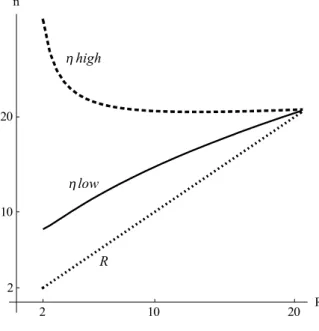
Intuitively, we could imagine ¯f to have a complementary effect on f by a defensive-type of argument: if all opponents increase their effort level then the representative firm must also increase its effort level in order to remain salient. But we could also expect that more ”noise” means that it gets more difficult for our firm to influence its chance of perception. In such a case we would expect thatp1(f,f , n, R) decreases in ¯¯ f. It turns out that the ACF incorporates both features which implies a non-monotonic relationship between ¯f and f. Figure 4 depicts f as a function of ¯f and n in case of the ACF with R = 2 and cost function25 (8). What these
Out[3]= f 1 2 3 f 0.5 1 f 5 10 n 0.5 1 f
Figure 4: ACF (n= 10 left, ¯f = 1 right)
24Note that such an effect cannot exist in Falkinger’s model of limited attention (which also uses the CES demand function) as firms have no mass and the price does not depend on the measure of the perceived market size (Falkinger (2008)).
25
I imposeV(y,y,¯2)∆ = 10, θ = 1 and η = 2. The pictures do not change qualitatively if other numerical values are used (or ifR >2).
pictures generally tell us is that with the ACF if there is little aggregate attentional activity of the opponents (”low noise”), because ¯f is small or n is small (close to R), then f increases in the noise whereas if the level of noise is already high then the opposite occurs.
4
Existence of a symmetric equilibrium
In this section I derive the conditions which assert the existence of exactly one symmetric equilibrium in the price-attention game as described in section 3.3. I start with the case where nis given exogenously and then proceed to the case wherenis endogenously determined by the free-entry condition of the two-stage game. I show that the CES-ACF example has exactly one symmetric equilibrium.
4.1 Symmetric equilibrium for exogenous n
The fundamentals of the symmetric game are the parameter set {n, R,∆}, the cost function C(f), the value function V(y,y, z¯ ) with z = min{R, n} as defined by assumption 3 and the probability function p(f,f , n, R) as defined by assumption 4. In a symmetric equilibrium all¯ n firms choose the same strategy (y, f). To find a symmetric equilibrium we can rely on the SOFA.
Suppose that n > R. Assuming an interior solution, the first-order conditions of the represen-tative firm’s optimisation problem are given by (15). Then, a solution (y, f) to
V1(y, y, R) = 0
p1(f, f, n, R) ∆V(y, y, R) =C0(f)
(16)
corresponds to an interior symmetric equilibrium of the game.
IfR≥nthen it is easy to see from (10) and (7) that a symmetric equilibrium (y, f) of the game withy∈(c, ymax) must havef = 0 and satisfiesV1(y, y, n) = 0.
game satisfies V1(y, y, z) = 0 f : p1(f, f, n, R)∆V(y, y, R)−C0(f) = 0 R < n f = 0 R≥n z= min{R, n} (17)
Assumption 5 a) The following boundary conditions are satisfied:
i) For any z >1 we have V1(c, c, z)>0 and V1(ymax, ymax, z)<0. ii) If n > R we have lim
f→0 p1(f, f, n, R) =∞ andflim→∞ p1(f, f, n, R) = 0
b) For any z >1 and y∈(c, ymax) we have V(y, y, z)∈(0,∞), V11(y, y, z)<0 and26
V1(y, y, z) = 0 ⇒ − ∂
∂y(V1(y, y, z))>0 (18)
c) For any R >1 and any n with n > R andf ∈(0,∞)
− ∂
∂f(p1(f, f, n, R))>0 (19)
The boundary conditions exclude the possibility of symmetric boundary equilibria which simpli-fies the comparative-static analysis later. The assumptions of monotony (18) and (19) exclude the possibility of multiple symmetric equilibria.
Proposition 3 If assumption 5 is satisfied then for any R, n > 1 there exists a unique vector
(y, f) that solves (17). Hence there exists only one symmetric equilibrium. In the equilibrium we have y ∈ (c, ymax). If R ≥ n we have f = 0 and y = y(n). If n > R then y = y(R) and
f =f(n, R,∆)∈(0,∞).
Proof: Appendix B (8.7)
Hence if R ≥ n then all active firms choose the minimal effort level f = 0. Because in this case the consumer perceives all alternatives he is informed of there is no benefit from choosing a higher level of f.
26Note that ∂
∂y(V1(y, y, z)) =V11(y, y, z) +V12(y, y, z), i.e. ∂
∂y(V1(y, y, z)) is the total derivativeofV1(y, y, z)
with respect toy. Similarly, ∂
A nice property of the ACF is that this functional form forp(f,f , n, R) satisfies the boundary¯ conditions in assumption 5 as well as condition (19).
Lemma 4 Suppose n > R and the function p(f,f , n, R)¯ is given by the ACF (13). Then for
f >0 p1(f, f, n, R) = n−R nf R X i=1 1 1 +n−i (20)
The ACF satisfies assumption 5. A good approximation to (20) if n is large relative to R is given by
p1(f, f, n, R)∼=
n−R
n2f R (21)
Proof: Appendix B (8.8)
Almost all results in this paper are proved by using (20) and not its approximation. In any case the results hold also if (21) were used instead and the proofs usually are less technical. In applications we can use (21) rather than (20) because (21) is differentiable also in R and generally simpler to work with. Because the ACF satisfies assumption 5 then whenever we combine the ACF with a function V(y, y, R) that satisfies assumption 5 we always end up with a single symmetric equilibrium (forn > R).
Corollary 1 If for n > R the function p(f,f , n, R)¯ is given by the ACF and V(y, y, R) sat-isfies assumption 5 then there exists exactly one symmetric equilibrium (y, f) ∈ Int(S). f is approximately determined by
n−R
n2f R∆V(y, y, R) =C
0
(f) (22)
Proof: Follows from proposition 3, lemma 4 and (21).
4.2 Free-entry equilibrium: existence and uniqueness
In the symmetric equilibrium the level of profits is determined by
Π(y, f, n) = ∆V(y, y, n)−F−C(f) n≤R R n∆V(y, y, R)−F−C(f) n > R (23)
for any givenR >1. The entry game then is a two-stage game where firms first decide whether or not to enter. A firm that chooses to enter pays the fixed costsF >0. All firms that chose to enter then play the symmetric price-attention game from the last section. In a pure subgame perfect equilibrium (SPE) given any decision in the first stage a Nash equilibrium follows in the second stage. In a free-entry equilibrium each active firm makes non-negative profits (Π(n) ≥0) and further entry would result in negative profits (Π(n+ 1)<0). Concerning the Nash-equilibrium of the second stage we already know that for any givenn, R >1 there exists a single symmetric equilibrium. Ignoring the integer-value problem of nthe free-entry equilibrium (y, f, n) then is described by V1(y, y, min{R, n}) = 0 (24) f : p1(f, f, n, R)∆V(y, y, R)−C0(f) = 0 R < n f = 0 R≥n (25) Π(f, y, n) = 0 (26)
With symmetry we can only hope to determine n, the number of active firms in a SPE and not which firm enters and which firm stays out. I call a SPE unique if there only is one vector (y, f, n) that solves (24) - (26). The fundamentals of the symmetric game with free entry are the parameter set{R,∆}, the cost functionC(f), the value functionV(y,y, z¯ ) withz=min{R, n}
as defined by assumption 3 and the probability functionp(f,f , n, R) as defined by 4.¯
Assumption 6 The following properties are imposed:
a) The function V(y, y, z) is twice continuously differentiable in z and V3 < 0 as well as
V13<0.
b) The function p1(f, f, n, R) is continuously differentiable inn
c) Forf >0 we have lim
n→R+ p1(f, f, n, R) = 0
The assumption V3(y, y, z) < 0 is just the differentiable version of assumption 3 and the last assumption means that the marginal value of an attention set decreases if more alternatives are being considered. Let ˆy be implicitly defined by V1(ˆy,y,ˆ 2) = 0.
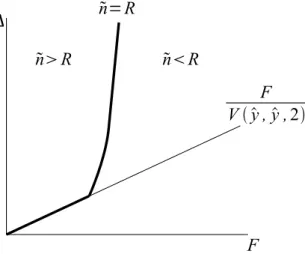
Proposition 4 Let 2≤R <∞. Suppose that assumptions 5 and 6 are satisfied and ∆V(ˆy,y,ˆ 2)/F ≥1 (27) If the condition ∂ ∂f (p1(f, f, n, R)) p1(f, f, n, R) < p13(f, f, n, R) n2 R (28)
holds then the free-entry game has a single symmetric SPE(y, f, n) with2≤n <∞
Proof: Appendix B (8.9)
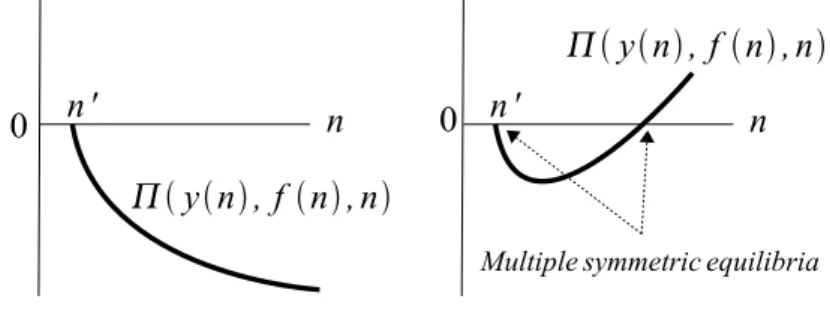
To understand intuitively why condition (28) excludes the possibility of multiple symmetric equilibria note that (28) is satisfied if p13 >0. Suppose thatp13>0 holds for any n > n0 and assume that (y0, f0, n0) is an equilibrium of the free-entry game withn0> R. From (16) it is not difficult to see that p13 > 0 implies that f0(n) >0 for n ≥n0. That is, equilibrium attention effort increases if weexogenously increase n. From (23) we see that an exogenous increase ofn has two effects on the value of Π(y(n), f(n), n): equilibrium profits decrease in n because R/n decreases in n. This is the direct effect of n on the profit level and originates from the fact that more senders means thatequilibrium chances of being perceived decrease for a single firm which means less (expected) revenue. But there also is an indirect effect on the level of profits because C(f) depends on n in the equilibrium. f0(n) >0 implies that attention costs increase in n which means that profits decrease in n also over this channel. Thus we see that p13 > 0 unambiguously implies profits to decrease in n forn > n0. But as we have n0 in the free-entry equilibrium this means that profits must be negative for anyn > n0. Consequently, there cannot exist a free-entry equilibrium with n > n0. This is illustrated in the left picture of figure 5. If
n'
n
0
y
n
, f
n
, n
n'
n
y
n
, f
n
, n
Multiple symmetric equilibria
0
however we have p13 < 0 then the indirect effect of a change of n on profits is positive as a higher n means lower f and thus lower costs C(f). If this indirect effect is very strong then profits might also increase in n. In this case we might have multiple symmetric equilibria as is illustrated in the right picture of figure 5.
A very nice property of the ACF is that condition (28) holds.
Corollary 2 Let 2≤R <∞. The ACF (see (20)) satisfies assumption 6. IfV(y, y, z) satisfies assumptions 5 and 6, the function p(f, f, n, R) is given by the ACF and condition (27) holds then the free-entry game has a single symmetric SPE (y, f, n) with 2≤n <∞
Proof: The ACF satisfies assumption 5 because of lemma 4. It is not hard to see that the ACF also satisfies b) and c) of assumption 6. Finally, the ACF also satisfies condition (28) (see lemma 7 in the appendix (8.1)). The claim then follows from proposition 4.
4.3 The ACF-CES example
Suppose that n > R is given exogenously. If p(f,f , n, R) is given by the ACF and¯ V(y,y, z)¯ by the CES example (11) then exactly one symmetric equilibrium (y, f) exists and is approxi-mately27 determined by (see 8.6, Part II, for the calculations)
y =c+ cR (R−1)(σ−1) (29) (n−R)Rv∆ f n2(1 + (R−1)σ) =C 0(f) (30) Moreover, we have V(y, y, z) = y−c y v z (31)
Hence V3 < 0 and V13 < 0 hold. Suppose that V (ˆy,y,ˆ 2) = 1+v∆σ ≥ F. Then by corollary 2 we may conclude that in the ACF-CES example there exists exactly one symmetric SPE with
n≥2.
27
5
Comparative statics
In this section I discuss the comparative-static results of the symmetric price-attention equi-librium. I begin with an exogenous number of firms and then proceed to the case where n is determined endogenously in a free-entry equilibrium. I always take assumptions 5 and 6 to be satisfied. I extend the cost function from (7) by a parameter α, i.e. C = C(f, α) with the property thatC2(f, α)>0 andC12(f, α)>0. For notational simplicity I set C0 ≡C1(f, α) and C00≡C11(f, α).
5.1 Comparative statics for an exogenous number of firms
In this section I derive the comparative statics of the symmetric price-attention game wheren is given exogenously. I only discuss the case where n > R is given exogenously. The equilib-rium conditions are given by (16). The game has the following set of exogenous parameters:
{R, n,∆, F, α}.
Proposition 5 The comparative statics of (16) are given byy =y(R
−) andf =f(R?, n?,∆+, α−).
Proof: Appendix B (8.10)
The only parameter that matters for equilibrium prices is the size of the attention set. y0(R)<0 results because V13(y, y, R) < 0. This assumption means that the equilibrium marginal value that can be earned from an attention set decreases if people compare more alternatives. This is a very intuitive assumption and many examples (such as the CES example) satisfy this property. In the CES case this follows because consumers spend their fixed budgetvover more alternatives if they perceive a larger set which means that less budget is available for the single firm. To offset this loss of demand the best-response is to decrease the price which explains why equilibrium prices are lower if the perceived market is larger.
However, the fact thatyis determined only by the perceived market size and does not depend on other parameters implies that the aggregate level of attention competitionnf (e.g. advertising intensity) observed may be a bad predictor of market power. Suppose we have two almost identical economies E1 ={R, n,∆, F, α1} and E2 ={R, n,∆, F, α2} withα1 > α2. Then nf1 < nf2. The classical theory of informative advertising holds that higher aggregate advertising levels should deteriorate market power of the firms which in equilibrium manifests itself in lower prices. The intuition behind this theory is that limited information of consumers because of
scarce information leaves the firm with market power (see Goeree (2008)). In such a case means to increase advertising intensity would be beneficial for consumers as competition is reinforced and prices are decreased. We see that under limited attention this conjecture does not hold as consumers have limited information because of their limited attention capacities andnotbecause of scarce information.
Search models usually predict lower equilibrium prices if search costs are reduced and electronic marketplaces or the internet with its powerful search engines are generally thought of dramat-ically lowering the search costs (e.g. Bakos (1997)). In such models this usually means that people become aware of more (or better) alternatives. However, in many cases the anticipated price-reduction was a lot smaller as suggested by these models (Ellison and Ellison (2005), p.149) or on the contrary online prices even were found to be higher than offline prices (e.g. Lee (1998)). The model of this paper provides an explanation why such gaps between theory and empirics exist. Search models do not distinguish the information set from the attention set. If we agree to V13 < 0 then larger attention sets will always imply lower prices in such models. If however the attention set is a subset of the information set with fixed size then larger information sets have no (or at least less) impact on equilibrium prices. The massive evidence on top-rank clicking-behaviour and also on the fact that people often do not use more than one search query (e.g. Jansen et al. (2000), p. 212) means that people concentrate their decision on just a few alternatives which suggests that not search cost theories but an attention theory adequately models the contemporaneous and future information problems.
As is shown in the appendix (see 8.10) we have sign(f0(n)) = sign(p13) and sign(f0(R)) = sign
p1V2V13−∂y∂ (V(y, y, R)) (p14V +p1V3)
. These expressions cannot be signed without further assumptions. In case of a change of R there are two effects at work28. First, a decrease ofRincreases the equilibrium value of an attention set because i) an attention set must be shared with fewer competitors and ii) equilibrium prices are higher29. This set value effect increases the marginal revenue of attention and increases attention levelsf. Second, the marginal probability of attention also depends on R. Depending on the sign of p14 the effect of R on p1 may either reinforce or offset the set value effect. A sufficient condition for f0(R)<0 is that p14R
p1 < −V3R
V
holds in equilibrium. If V(y, y, R) = ˜V(y)/Rwith ˜V(y)0 >0 then30 the RHS of this inequality
28Recall the discussion of strategic behavior in section 3.3.4 29 Formally: dV dy =V3+V2y 0 (R)<0. 30
This is a property that many demand functions share, e.g. demand derived from the circular ideal variety model. Also the CES example has this property: V(y, y, R) =v(Ryy−c) = (y−yc) v
is one. As for the ACFp1(f, f, n, R) is a strongly concave function of Rwhich goes through the origin (see (21) in case of the approximation and lemma 6 in the appendix for the general case) we may conclude thatf0(R) <0 in such a case because p14R
p1 <1. Hence less attention implies
higher prices and higher effort levels (stronger attention competition) in this example.
Suppose now that n increases exogenously. We see that the sign of f0(n) depends entirely on how the marginal probability p1 depends on n. This is different from the case of an exogenous change of R as a change of n has no set value effect. In case of the ACF it can be shown (see 7 in the appendix (8.1)) that p1(f, f, n, R) is a hump-shaped function of n. Consequently,f(n) takes on a hump-shaped form in this example.
Summarising, we see that limited attention implies equilibrium prices to be independent of the size of the information set (n) which is different from models of informative advertising. In equilibrium, prices reflect the scarcity of attention in the