ECONOMIC TURMOIL AND CRANIOFACIAL CARE: THE IMPACT OF A NATIONAL RECESSION ON CHILDREN WITH CLEFT LIP/PALATE
Allison Cavenaugh Eggleston, DDS
A thesis submitted to the faculty of the University of North Carolina at Chapel Hill in partial fulfillment of the requirements for the degree of Master of Science in Dentistry in the School of Dentistry (Pediatric Dentistry).
Chapel Hill 2012
Approved by:
ii
ABSTRACT
ALLISON CAVENAUGH EGGLESTON, DDS: Economic Turmoil and Craniofacial Care: The Impact of a National Recession on Children with Cleft Lip/Palate
(Under the direction of Ronald Strauss, DMD, PhD)
iii
This work is dedicated to my parents, Bruce & Alice Cavenaugh; to my brother and sister-in-law, Matt & Noelle Cavenaugh; to my in-laws, David & Mary Eggleston; to my cat,
iv
ACKNOWLEDGEMENTS
v
PREFACE
Sometimes, a single experience can alter the entire pathway of one’s life; my first encounter with the UNC Craniofacial Center in 2005 has held such a lasting impression. I am always intrigued by the complex nature of the multidisciplinary treatment planning required by these patients and often touched by the length to which the families I meet go to get the best care possible for their children.
Growing up, my parents’ hard work afforded me the luxury of financial comfort and stability, and as much as I wish to deny this I often took for granted the ability to purchase everything I need and even wanted (within reason). Our circumstances were humbled in April 2009 however, when the staggering economic recession forced us to close the doors of our family business. Although these unfortunate circumstances brought our tightly-knit family even closer together, my days were fraught with worry over the uncertainty of the future; chiefly, the health of my parents as they aged and their ability to access care.
One day, mulling over these worries, I thought suddenly of the patients at the Craniofacial Center. Clearly, the impact of the recession was far-reaching across socioeconomic boundaries. If these families experience obstacles to obtaining care even during periods of economic stability, how has this been affected by the recent downturn?
vi
TABLE OF CONTENTS
LIST OF TABLES………...vii
LIST OF FIGURES………viii
LIST OF ABBREVIATIONS………...ix
Chapter I. EXTENDED LITERATURE REVIEW……… …1
II. MANUSCRIPT………..8
Introduction………8
Methods………10
Results………..12
Discussion………14
Conclusion………...20
TABLES AND FIGURES………...21
APPENDIX: ONLINE SURVEY...……….25
vii
LIST OF TABLES
viii
LIST OF FIGURES
Figure 1. Negative impact of economic downturn on access to craniofacial care...23 Figure 2. Barriers to accessing craniofacial care experienced unrelated to
ix
LIST OF ABBREVIATIONS
CDC……….Centers for Disease Control and Prevention CL/P……….Cleft lip with or without cleft palate
COBRA………...Consolidated Omnibus Budget Reconciliation Act CSHCN………Children with Special Health Care Needs
NBER………...National Bureau of Economic Research OFC………..Orofacial Cleft(ing)
I. EXTENDED LITERATURE REVIEW
A gradient of disparities in access to health care exists in the United States (U.S), wherein a disparity is defined as a clinically and statistically significant difference in health care use between vulnerable and less vulnerable populations (Aday and Anderson, 1984; Braveman, 2003; Spencer, 2003; Seid et al, 2004; Kilbourne et al, 2006; Sobo et al, 2006). Vulnerable populations are considered to be those groups that have faced discrimination because of underlying differences in social status, due to race/ethnicity, gender, age, regionalization, insurance status, transient or long-term limited economic resources, literacy and health literacy levels, chronic illness/disability, and many other characteristics (Spencer, 2003; Kilbourne et al, 2006). These factors have been coined in the literature “barriers to care,” and can be viewed as a complex of sociobehavioral processes that interfere with the ability of an individual to effectively access the health care system (Seid et al, 2004; Sobo et al, 2006). A major branch of health care research aims to understand why disparities exist, identify barriers to care, and explain their influence on vulnerable populations in a way that is useful for the development of interventions that can reduce or eliminate health care disparities (Seid et al, 2003; Kilbourne et al, 2006; Sobo et al, 2006).
2
support for funds allocation. Structural barriers address such topics as limited accessibility of practitioners for continuity of care, organizational aspects of primary care offices, and availability of transportation to and from appointments (Margolis et al, 1995). The topic of personal barriers, while often avoided or carefully skirted in a physician’s office, may in fact have a sizeable impact on an individual’s use of the health care system. These personal barriers include culture, language, attitude, education, income, expectations, knowledge and beliefs, and feelings of marginalization (Margolis et al, 1995; Seid et al, 2004).
Studies from the National Survey on Children with Special Health Care Needs have shown that affected children encounter more obstacles (financial and otherwise) in the quest for care than those without special needs (McPherson et al, 1998; Newacheck and Kim, 2005; Strickland et al, 2009). Commonly cited barriers to routine and specialty care include low household income, low maternal education levels, lack of insurance coverage, and area of low provider supply (Mayer, 2004).
In the public health arena birth defects remain an important concern, affecting not only infant morbidity and mortality but also having a substantial financial impact on the U.S. health care system. An updated national prevalence estimate for 21 major birth defects cites cleft lip with or without cleft palate to be the second most common condition (after Down Syndrome), occurring every 1 in 940 live births in the U.S. in 2004-2006 (Parker et al, 2010).
3
research were addressed: (1) genetic and environmental risk factors and their role in the etiology of OFC, and (2) long-term psychological and social outcomes. These areas were prioritized according to importance and feasibility by the 45 public health experts attending the workshop. The two topics receiving the most support for further research concerned genetic characterization, environmental risk factors and the translation of these into primary prevention strategies, and the third involved early screening measures for learning outcomes in affected children. Fourth on the list emphasizes quality of life as viewed by affected children, parents, and health care providers, including access to multidisciplinary team care. Closely following are topics including elucidation of associated costs (both direct and indirect), and the effect of payer status on seeking care (Yazdy et al, 2007). Among others, these aspects of care are important components of assessing the impact of OFC on affected children and their families (Strauss, 2009a).
4
than stays for non-obstetrical conditions, although actual charges for OFC were among the lowest of the birth defects studied, with neonatal costs averaging less than $40,000 per child (Russo and Elixhauser, 2004; CDC, 2007). Two studies looked at payer expenditures and found that children with OFC incurred significantly higher health-related costs than children without OFC under both Medicaid and private insurance coverage. These studies only considered direct health-care costs by examining insurance claims and emphasized a need for additional study of nonmedical costs incurred by families due to OFC (Cassell et al, 2008; Boulet et al, 2009).
5
A recent study examined maternal perspectives of perceived barriers to care for children with OFC using a combination mail/phone survey distributed to the parents of all children with OFC registered in the North Carolina Birth Defects Monitoring program between 0-6 years old. Thirty-three percent of respondents in this study reported problems obtaining primary craniofacial care for their child, although 88% felt that their child received all the care he or she needed within the past year. The authors suggested this discrepancy could be due to demographic differences in age, diagnosis, and family support structure. Reported problems obtaining care were also attributed to structural barriers such as lack of availability of providers, referral systems, and/or awareness of coordinated care for the family unit. While this study provides valuable insight to maternal perspectives on barriers to obtaining craniofacial care, the sample was from one state only, limiting the generalizability of the findings (Cassell et al, 2011).
6
A large part of research design concerns creating and maintaining an equilibrium between maximizing external validity while upholding internal validity (Eysenbach and Wyatt, 2002). A fundamental principle of web-based surveys can also compromise the external validity of the study: an individual needs at least one-time internet access and basic technological literacy to even participate (Ahern, 2007). Individuals who lack Internet access also tend to have lower income and education levels, although this disparity has been decreasing steadily across socioeconomic boundaries since 2000 (US Department of Commerce, Economics and Statistics Administration, 2002; Ahern 2007). Their exclusion therefore affects the generalizability of the findings to the extent that they differ from members of the target population who have Internet access (Ahern, 2007; Couper 2007).
A major threat to the internal validity of a web-based survey is the possible lack of adherence to the established sample inclusion and exclusion criteria, as this method affords little control with regard to verification of subject eligibility (Risko et al, 2006; Couper, 2007). Suggested techniques to minimize this bias include employing cookies or IP addresses to eliminate duplicate responses; explaining criteria for participation in recruitment letter and verifying these criteria with questions throughout the survey; and placing the survey and/or recruitment advertisements in targeted areas or websites (Risko et al, 2006).
7
to promote general public awareness about facial differences and the networking of individuals and families for support purposes… a nationally-recognized program offering a toll-free support hotline, on-line support forums, comprehensive websites, newborn outreach programs at area birthing hospitals throughout the country, an annual family conference and periodic newsletters” (www.ameriface.org/about.html). AmeriFace® has a history of hosting craniofacial-related surveys on their homepage, and has member listservs which are valuable for recruitment purposes.
From December 2007 to June 2009 the United States economy was officially in a recession according to the National Bureau of Economic Research (NBER), making it the longest post-Depression economic downturn, and recovery remains sluggish with high unemployment and foreclosure rates (NBER, 2008; NBER, 2010). This has prompted an interest in the association between economic stability and health care utilization. A meta-analysis in 2008 found a gradient of access to care exists even within disadvantaged socioeconomic groups (Reid et al, 2008). This was attributed to the theory of competing priorities by Gelberg which states that individuals lacking financial stability may prioritize basic survival needs above access to health care (Gelberg et al, 1997; Reid et al, 2008). This progressive inverse relationship between financial security and health care access may have a unique impact on the multidisciplinary care required for cleft patients.
This study aims to describe the association between financial security and health care access and their impact on multidisciplinary OFC treatment in the context of the recent
II. MANUSCRIPT
Introduction
In the public health arena birth defects remain an important concern, regarding not only infant morbidity and mortality but also the substantial financial impact these conditions have on the health care system. An updated national prevalence estimate for 21 major birth defects cites cleft lip with or without cleft palate to be the second most common condition (after Down Syndrome), occurring every 1 in 940 live births in the United States in 2004-2006 (Parker et al, 2010). Despite this high occurrence rate there is a paucity of existing data in this field, and in 2006 the National Center on Birth Defects and Developmental
Disabilities at the CDC developed a prioritized list of 18 research topics necessary to close critical gaps in current knowledge. Fourth on the list emphasizes quality of life as viewed by affected children, parents, and health care providers, including access to multidisciplinary team care. The list also includes elucidation of associated costs (both direct and indirect) and the effect of payer status on seeking care (Yazdy et al, 2007).
These factors are pieces of a larger concept termed “barriers to care,” which can be viewed as a complex of sociobehavioral processes that interfere with the ability of an
9
shown that children with special health care needs and encounter more obstacles (financial and otherwise) in the quest for care than those without special needs (McPherson et al, 1998; Newacheck and Kim, 2005; Strickland et al, 2009). Financial barriers include direct medical expenses which are well documented; however, financial barriers in the form of indirect costs as well as non-financial barriers to care are not well established (Margolis et al, 1995; Betz et al, 2004; Newacheck and Kim, 2005; Cassell et al, 2011). Non-financial barriers can be personal (cultural, psychosocial) or structural (related to structure of health care system) (Margolis et al, 1995).
The qualitative data needed to provide a complete picture of perceived barriers to craniofacial health care for children with orofacial clefting (OFC) is lacking. One study looked at access to dental care in Alabama for children with birth defects including OFC, but dental care is only one portion of the multidisciplinary treatment required for a child with a cleft (Al Agili et al, 2004). A recent study examined maternal perspectives of perceived barriers to care for children with orofacial clefts but the sample was from one state, limiting the generalizability of the study (Cassell et al, 2011).
10
basic survival needs above access to health care (Gelberg et al, 1997; Reid et al, 2008). This progressive inverse relationship between financial security and health care access may have a unique impact on the multidisciplinary care required for cleft patients.
This study aims to describe financial security and health care access and their impact on multidisciplinary cleft and craniofacial treatment during an economic recession.
Methods
A cross-sectional web-based survey containing multiple choice, Likert scale, and open-ended questions was developed to obtain demographic information on OFC parents and children along with parental perception of barriers to obtaining craniofacial care for their child both in general and with respect to the recent national economic downturn. The survey was pilot-tested with ten families at the University of North Carolina Craniofacial Center. The survey was approved by the University of North Carolina Biomedical Institutional Review Board, and can be viewed in the Appendix.
11
the survey. Three reminder emails were sent until receipt of 200 eligible surveys. Potential participants not on the AmeriFace® listservs were also able to access the survey by simply visiting the AmeriFace® website homepage, which they found either by web-surfing or by word of mouth from previous participants.
Survey responses were included if the respondent was a parent/legal guardian of a child (under 18 years old) with a cleft lip and/or a cleft palate; had internet access for a one-time survey completion; was able to read the English language; and was a resident of the United States. In addition to listing these criteria in the recruiting emails and in the disclosure information accessed upon clicking the link on the AmeriFace® website, the first four survey questions were demographic in nature (child age and diagnosis, participant’s relationship to child) and served as an additional confirmation of appropriate enrollment. The participants were also asked their state of residence to ensure inclusion of only those living in the United States.
12
never an issue” were combined and categorized as not a perceived barrier while responses of “sometimes,” “often,” and “almost always an issue” were combined and considered to be perceived barriers to care. Financial security was assessed throughout the survey by seven Likert questions, as well as five open-ended and two multiple choice questions. Additionally, two multiple choice questions and six Likert questions addressed health insurance status and costs as an indicator of financial stability.
Results
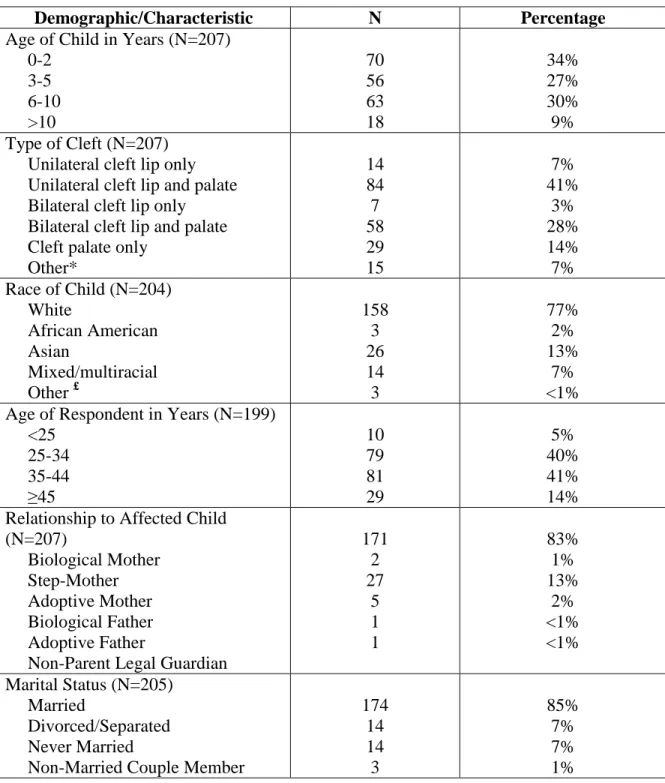
A total of 207 eligible surveys were analyzed with 74 surveys excluded due to lack of completion, duplicate IP addresses, and/or the age of the affected child reported as over 18 years. Ages of children with CL/P ranged from one week to 16 years old. Ages of respondents ranged from 20-56 years old, with a mean age of 36 years. A majority of the children were White (77%); the next most represented race was Asian with 15%. The respondents were primarily married (85%) and earned an annual yearly household income
≥$50,000 before taxes (63%). Fifty-nine percent of participants had a college degree and only 1% did not hold a high school diploma or equivalent (Table 1).
13
of an obstacle to obtaining care. Other widely perceived barriers included loss of flexibility relative to work hours (35%) and an increase in insurance denials (31%). Cuts to government and/or community services negatively affected the ability to obtain cleft-related care for 26% of respondents, and 12% reported their affected child losing their health insurance altogether due to the economic downturn.
Unrelated to recent national economic changes, many participants perceive to have at some point experienced barriers to obtaining craniofacial-related health care for their child (Figure 2). Missing work for appointments was the most common obstacle reported (57%). Closely following was the cost of health insurance co-pays and deductibles; 53% viewed this as an issue independent from the recent national economic changes. Slightly less than half considered distance traveled to medical appointments (48%), insurance denials (47%), and cost of health insurance premiums (45%) significant barriers to obtaining their child’s care. Financial concerns other than direct costs of medical care were perceived as barriers by a number of respondents, including transportation (29%), overnight lodging (23%), and other travel expenses (29%). Nineteen percent reported issues finding a doctor/team that would treat their child although 93% claim to be followed by a cleft or craniofacial team.
Family, budgetary, and household matters are complex issues difficult to capture by multiple-choice or even Likert scale questions. This study encouraged open-ended responses to explain how the economy had affected each respondent and their family. Qualitative analysis revealed three main themes in response to the question “Please tell us how your family has been affected by the recent economic downturn.”
14
owner seeing decreased business, salary freeze, difficulty finding employment, loss of income due to caring for a Child w Special Health Care Needs, and job change resulting in reduced salary.
The second theme, reported by 22% of respondents, concerned difficulty with health benefits and/or government assistance. This was further categorized into complete loss of benefits; government assistance programs changes or freezes; increased insurance costs, increased coverage denials, and stricter stipulations; insurance dictating employment opportunities; and change in craniofacial team/surgeon due to economy.
The final theme, cited by 23% of parents, was general lifestyle and financial difficulties. These could be serious or minor and included a parent or older child obtaining additional employment to support the family as well as stress associated with uncertainty of what the future holds for their family and their ability to access craniofacial care.
Discussion
15
downturn has affected the ability of families to access care for their children affected by OFC.
A critical aspect to consider when illustrating the barriers these parents perceive to obtaining craniofacial care is the change in family dynamics, however minor, that accompanies the birth of a child with OFC. An OFC child requires parental education on specialized feeding practices and multiple physician visits with respect to future surgical repair. Some families (11% of this sample, from open-ended responses) make arrangements for one parent to stay at home to care for their child; some plan to return to work after a few years while others must take permanent leave to care for a child with complex functional and medical needs. These families depend heavily on the remaining income and benefits; the recent volatile economy therefore presented an elevated threat to their household budgets, as described by this 32 year old mother from Indiana on October 27, 2010:
“I was forced out of a job due to my son’s medical condition. I currently get unemployment
that runs out in June of 2011… Our income went down, and our co-pays went up. We pay
more out of pocket for our son’s medical care now as well. We are in collections with 5
different medical facilities due to his medical conditions and a recent broken arm.”
16
Often those caregivers who opt to stay home with their affected infant intend to return to work when the child is old enough to attend daycare or school. While this is not a new development, the high unemployment rate and scarcity of opportunities due to the recent economic downfall left nearly three quarters of parents in this study unable to resume employment (70%, according to open-ended responses) after taking a childcare leave. The budgetary stress and resulting competing priorities for these families will, at best, continue until employment is obtained or, at worst, intensify as any emergency funds dwindle, as passionately illustrated by this 47 year old mother from New Jersey:
“My husband’s family has owned a car dealership for over 50 years. With the implosion of
the car industry, the factory has shut them down… Our entire lives have been turned upside
down and we take things day by day. We have health insurance—where we can go out of
network—but hey deny, deny, deny… I could go on and on and on. We have some money left
but we’re draining our accounts to get our kids the care WE know is best.”
Of those parents who have maintained or found new employment, 35% of them claimed decreased work hour flexibility had introduced a challenge in scheduling and attending appointments for their child.
17
recession elevated the impact of these burdens for 57% and 61% of respondents, respectively. As explained by this 24 year old father from Alabama:
“Wife/Mother lost job due to school proration cuts. Insurance premiums increased, co-pays
increased, deductibles increased. Could not afford group plan. Applied for low cost/state
policy to cover cleft and related issues and encountered problems with 1 year waiting
periods, pre-existing condition clauses.”
Even more concerning is that during the recession, 12% of respondents reported that their child lost health insurance altogether. This is in addition to 7% reporting loss of children with special health care needs benefits and 4% reporting loss of Medicaid and/or Supplemental Security Income (SSI) benefits.
18
Department of Health and Human Services, 2010; Kaiser Commission on Medicaid and the Uninsured, 2011a).
Another possible explanation for this discrepancy could be coverage through the Consolidated Omnibus Budget Reconciliation Act of 1985 (better known as COBRA) following a job loss or while between jobs (which we unfortunately did not include as an option). As the former employee is no longer subsidizing a portion of the premiums the parent may perceive this as “total loss of insurance,” but may classify their child’s insurance status as either obtained through an employer or as privately purchased. Despite a temporary subsidy reducing the cost of COBRA by 65% for workers laid-off during the recession, this relative increase in premium expense also can introduce a strain on the family budget.
Less frequently reported barriers included other indirect costs of obtaining craniofacial health care, such as out-of-pocket expenses. Of particular note is the cost of transportation, which has increased as a barrier from 29% of respondents pre-recession to 52% as a result of the recession. The cost of gasoline in 2007 alone rose by 32%, and while it has fluctuated somewhat over subsequent years, supply and demand keep oil prices significantly elevated (Orszag, 2007). As 48% of respondents considered distance from home to medical appointments an issue in obtaining care for their child, it follows that the price of transportation was also perceived as a barrier to care as described by this 38 year old mother from Washington state:
“Due to our daughter’s medical needs I don’t work anymore. It is too hard to maintain a job
19
first 1 ½ years of her birth. But we were very stressed for money to cover the expenses to get
her to her Hospital (2 ½ hours away, by ferry) and covering gas.”
The online survey method for data collection is relatively new but is considered accurate and reliable if designed and conducted properly, however with inherent limitations and strengths (Atienza et al, 2007). One limitation is the possible lack of adherence to the established sample inclusion and exclusion criteria, which could affect the internal validity of the findings. Although online surveys present the potential for recruitment of a sample unlimited by geographical boundaries, little control is afforded with regard to verification of subject eligibility (Risko et al, 2006; Couper, 2007). In addition to the respondents’ confirmation of their inclusion as part of informed consent for this study, an additional layer of selection was employed within the survey in the form of demographic and diagnostic questions (Risko et al, 2006). Placing the survey on a OFC parental support and advocacy website also served to target the population of interest and to hopefully discourage non-eligible responses (Risko et al, 2006). AmeriFace® was chosen as the vehicle for this survey because of the ability to access a national sample and due to the success of previous projects utilizing this approach (Strauss et al, 2009b).
20
therefore affects the generalizability of the findings to the extent that they differ from members of the target population who have Internet access (Ahern, 2007; Couper 2007). While the majority of the sample classified their race as White (77%), this accurately reflected the national population according to the United States Census Bureau, which reported the White population as 72.4% in 2010 (US Census Bureau, 2010). Spanish speakers were excluded from the sample because the survey was only available in English. White, followed by Asian populations are also known to have a higher prevalence of OFC compared to other races (Croen et al, 1998; Hashmi et al, 2005; Gundlach and Maus, 2006).
Conclusion
21
Table 1. Demographic information for child and respondent.
Total N varies per question; percentage based on number of respondents who answered each question. Total N for each question represented in parentheses. For study, N=207.
*All “other” responses were specified as some combination of the above choices.
£
All “other” responses were specified as either American Indian (N=1, <1%) or Native Hawaiian/Pacific Islander (N=2, <1%).
Demographic/Characteristic N Percentage
Age of Child in Years (N=207) 0-2 3-5 6-10 >10 70 56 63 18 34% 27% 30% 9% Type of Cleft (N=207)
Unilateral cleft lip only Unilateral cleft lip and palate Bilateral cleft lip only
Bilateral cleft lip and palate Cleft palate only
Other* 14 84 7 58 29 15 7% 41% 3% 28% 14% 7% Race of Child (N=204)
White
African American Asian
Mixed/multiracial Other £
158 3 26 14 3 77% 2% 13% 7% <1% Age of Respondent in Years (N=199)
<25 25-34 35-44 ≥45 10 79 81 29 5% 40% 41% 14% Relationship to Affected Child
(N=207) Biological Mother Step-Mother Adoptive Mother Biological Father Adoptive Father
Non-Parent Legal Guardian
171 2 27 5 1 1 83% 1% 13% 2% <1% <1% Marital Status (N=205)
Married
Divorced/Separated Never Married
Non-Married Couple Member
22
Demographic/Characteristic N Percentage
Education Level of Respondent (N=206)
Some high school High school grad/GED
Some college/technical school 4 year college degree or higher
2 16 67 121
1% 8% 32% 59% Total Annual Household Income
(N=204) <$20,000
$20,000-$49,999 ≥$50,000
17 58 129
23
*Total N varies per question; percentage based on number of respondents who answered each question. Total N for each question represented in parentheses. Respondents could “check all that apply.”
** For analysis purposes, a response of “no change” was categorized as “not a perceived barrier.” Responses of “slight,” “moderate,” or “substantial change” were combined under a single category of “change,” indicating a “perceived barrier to care.”
48%, N=99 (205) 12%, N=25 (205)
57%, N=117 (205) 61%, N=125 (206) 31%, N=63 (201)
4%, N=8 (198) 7%, N=13 (197)
26%, N=53 (200) 35%, N=71 (203) 11%, N=22 (203)
52%, N=106 (203) 17%, N=35 (204)
-10% 0% 10% 20% 30% 40% 50% 60% 70%
Decrease or loss of income Loss of health insurance altogether Cost of health insurance premiums Cost of health insurance deductibles/co-pays Health insurance denials Loss of Medicaid/SSI benefits Loss of CSHCN benefits Cuts to government and/or community services Loss of flexibility relative to work hours Loss of transportation Cost of transportation Change in residence for economic reasons
Percentage of respondents experiencing change in access to craniofacial care
E co n o m ic e ff e ct s
24
*Total N varies per question; percentage based on number of respondents who answered each question. Total N for each question represented in parentheses. Respondents could “check all that apply.”
** For analysis purposes, responses of “never” or “almost never an issue” were combined and categorized as “not a perceived barrier.” Responses of “sometimes,” “often,” and “almost always an issue” were combined and considered “perceived barriers to care.”
16%, N=32 (205)
45%, N=92 (205) 53%, N=108 (205)
47%, N=96 (203) 31%, N=63 (204)
30%, N=60 (201)
57%, N=116 (204) 19%, N=38 (204)
32%, N=65 (202) 11%, N=23 (204)
29%, N=59 (203)
48%, N=98 (204) 23%, N=47 (201)
29%, N=59 (204) 27%, N=55 (203)
39%, N=80 (204) 47%, N=95 (202)
-10% 0% 10% 20% 30% 40% 50% 60% 70%
Lack of health insurance Cost of health insurance premiums Cost of health insurance co-pays/deductibles Insurance denials Insurance stipulations (exclusions, pre-existing
conditions)
School hours/days missed by children Missing work for medical appointments Finding a doctor/team that will treat your child Availability of medical appointments Availability of transportation Cost of transportation Distance from home to medical appointments Overnight lodging Other travel expenses Obtaining/paying for childcare for siblings Meeting the needs of other family members Tending to other family/household duties
Percentage of respondents affected
B a rr ie rs t o o b ta in in g c ra n io fa ci a l ca re
25
APPENDIX: ONLINE SURVEY
Thank you so much for joining us in this survey.
AmeriFace® and the University of North Carolina seek to learn more about how economic hard times and the recession have impacted your experience in obtaining medical care for your child with a cleft lip and/or a cleft palate.
If you have a child under 18 years old with a cleft lip and/or a cleft palate, please check here and proceed: ____
If you do not have a child under 18 years old with a cleft lip and/or a cleft palate, please exit this survey. Thanks so much.
Now, please tell us about your youngest child with a cleft lip and/or a cleft palate: What type of cleft lip and/or cleft palate does this child have?
o Unilateral (one side) cleft lip only o Bilateral (both side) cleft lip only o Cleft palate only
o Unilateral (one side) cleft lip with cleft palate o Bilateral (both side) cleft lip with cleft palate
Other, please specify _______________________________________ How old is this child with a cleft lip and/or a cleft palate: _____ years old What is your relationship to this child?
o Biological mother o Step-mother o Adoptive mother o Biological father o Step-father o Adoptive father
o Non-parent legal guardian
o Other, please specify _______________________________________ Which would you say is the race of this child?
o White
26 o American Indian
o Alaska Native o Asian
o Native Hawaiian/ Pacific Islander
o Other, please specify _______________________________________
Tell us about other medical condition(s) this child might have in addition to the cleft:
________________________________________________________ ________________________________________________________ ________________________________________________________
How many children younger than 18 years old live in your household: _______
How many other children with a cleft lip and/or a cleft palate do you have? _______
Are there any other people other than your child with a cleft lip and/or a cleft palate, with special health care needs living in your home? Please tell us about these people:
27
Our interest is learning how the recent economic downturn has affected your family and your ability to obtain medical care for your child with a cleft.
Please tell us how your family has been affected by the recent economic downturn. Have you or a household member lost your job, experienced reduced work hours, or other change:
________________________________________________________ ________________________________________________________ ________________________________________________________
Please tell us how your living situation has been affected by the recent economic downturn. Has your family experienced a home foreclosure, a rental eviction, or otherwise changed residence or living situations for economic reasons?
________________________________________________________ ________________________________________________________ ________________________________________________________
Please tell us how obtaining medical, dental or speech services has been affected by the recent economic downturn:
________________________________________________________ ________________________________________________________ ________________________________________________________
Please rate to what extent the downturn of the economy has affected your ability to access medical care for your child with a cleft:
No change
Slight change
Moderate change
28
*Loss of health insurance altogether *Cost of health insurance premiums *Cost of health insurance
deductibles/co-pays *Health insurance denials *Loss of Medicaid/SSI benefits *Loss of CSHCN benefits (Children with Special Health Care Needs) *Cuts to government and/or community services
*Loss of flexibility relative to work hours
*Loss of transportation *Cost of transportation
*Change in residence for economic reasons
Which of the following have been issues for you, past or present, in accessing medical care for your child with a cleft? Please rate:
Never an issue Almost never an issue Sometimes an issue Often an issue Almost always an issue Lack of health insurance
Cost of health insurance premiums
Cost of health insurance co-pays and deductibles
Insurance denials Insurance stipulations
(e.g., exclusions, pre-existing conditions)
School hours/days missed by child
Missing work for medical appointments
Finding a doctor/team that will treat your child
Availability of medical appointments
Availability of transportation Cost of transportation
Distance from home to medical appointments
29 Other travel expenses
Obtaining/paying for childcare for siblings
Meeting the needs of other family members
Tending to other
family/household responsibilities
Please tell us about types of doctors or clinics where you get cleft-related health care for your child with a cleft lip and/or cleft palate:
________________________________________________________ ________________________________________________________ ________________________________________________________
Do you go to a cleft or a craniofacial team for evaluation or care for your child?
YES NO DON’T KNOW
What is your affected child’s primary health insurance plan? This is the plan which pays the medical bills first or pays most of the medical bills.
o No health insurance o State employee health plan
o Group health insurance plan provided by or purchased through an employer o Employer’s self-insured (self-funded) plan
o Private family/individual health insurance plan purchased directly from an insurance company or through a broker
o Medicaid
o SSI
o Children with Special Health Care Needs (CSHCN) program o A state-specific government-sponsored program
o Military/veteran health services o The Indian Health Services o Do not know/not sure
o Other, please specify ___________________________________________ What is your affected child’s primary dental insurance plan?
30
o Group health insurance plan provided by or purchased through an employer o Employer’s self-insured (self-funded) plan
o Private family/individual health insurance plan purchased directly from an insurance company or through a broker
o Medicaid
o SSI
o Children with Special Health Care Needs (CSHCN) program o A state-specific government-sponsored program
o Military/veteran health services o The Indian Health Services o Do not know/not sure
31
REFERENCES
Aday LA and Anderson RM. The National Profile of Access to Medical Care: Where Do We Stand? Am J Public Health. 1984;74(12):1331-9.
Ahern DK. Challenges and opportunities of eHealth research. Am J Prev Med. 2007;32(5S):S75-82.
Al Agili DE, Roseman J, Pass MA, Thornton JB, Chavers LS. Access to dental care in Alabama for children with special Needs: Parents’ perspectives. J Am Dent Assoc. 2004;135(4):490-5.
Atienza AA, Hess BW, Baker TB, Abrams DB, Rimer BK, Croyle RT, Volckmann LN. Critical Issues in eHealth Research. Am J Prev Med. 2007;32(5S):S71-4.
Berk NW and Marazita ML. Costs of cleft lip and palate: personal and societal implications. In: DF Wyszynski, ed. Cleft lip and palate: from origin to treatment. New York: Oxford University Press, 2002:458-67.
Betz CL, Baer MT, Poulsen M, Vahanvaty U, Bare M, Haddad Y, Nwachuken G. Secondary analysis of primary and preventive services accessed and perceived service barriers by
children with developmental disabilities and their families. Issues Compr Prediatr Nurs. 2004;27(2):83-106.
Boulet SL et al. Children with Orofacial Clefts: Health-Care Use and Costs among a Privately Insured Population. Public Health Rep. 2009 May-Jun;124(3):447-53.
Braveman PA. Monitoring Equity in Health and Healthcare: A Conceptual Framework. J
Health Popul Nutr. 2003;21(3):181-92.
Cassell CH et al. Healthcare Expenditures among Medicaid Enrolled Children with and without Orofacial Clefts in North Carolina, 1995-2002. Birth Defects Res A Clin Mol Teratol. 2008 Nov;82(11):785-94.
Cassell CH, Mendez DD, Strauss RP. Maternal Perspectives: Qualitative Responses About Perceived Barriers to Care among Children with Orofacial Clefts in North Carolina. Cleft
Palate Creniofac J. 2011 Jul 8 [epub ahead of print].
Centers for Disease Control and Prevention. Hospital stays, hospital charges, and in-hospital deaths among infants with selected bierth defects—United States, 2003. MMWR Morb
Mortal Wkly Rep. 2007;56:25-9.
Couper MP. Issues of Representation in eHealth Research (with a Focus on Web Surveys).
32
Croen LA, Shaw GM, Wasserman CR, Tolarova MM. Racial and ethnic variations in the prevalence of orofacial clefts in California, 1983-1992. Am J Med Genet. 1998;79(1):42-7. Eysenbach G, Wyatt J. Using the Internet for surveys and health research. J Med Internet
Res 2002;4:e13.
Gelberg L, Gallagher TC, Anderson RM, Koegel P. Competing priorities as a barrier to medical care among homeless adults in Los Angeles. Am J Public Health. 1997;87(2):217-20.
Gundlach KK, Maus C. Epidemiological studies on the frequency of clefts in Europe and world-wide. J Craniomaxillofac Surg. 2006;34(S2):1-2.
Hashmi SS, Waller DK, Langlois P, Canfield M, Hecht JT. Prevalence of oral clefts in Texas: 1995-1999. Am J Med Genet A. 2005;124(4):368-72.
Kaiser Commission on Medicaid and the Uninsured; October 2011a. The Uninsured: A
Primer. Available at: http://www.kff.org/uninsured/7451.cfm. Accessed February 27, 2012.
Kaiser Commission on Medicaid and the Uninsured; December 2011b. Medicaid
Enrollment: December 2010 Data Snapshot. Available at:
http://www.kff.org/medicaid/upload/8050-04.pdf. Accessed February 27, 2012.
Kilbourne AM, Switzer G, Hyman K, Crowley-Matoka M, Fine MJ. Advancing Health Disparities Research Within the Health Care System: A Conceptual Framework. Am J Public
Health. 2006;96(12):2113-21.
Margolis PA, Carey T, Lannon CM, Earp JL, Leininger L. The Rest of the Access-to-Care Puzzle: Addressing Structural and Personal Barriers to Health Care for Socially
Disadvantaged Children. Arch Pediatr Adolesc Med. 1995;149(5):541-5.
Mayer ML et al. Unmet Need for Routine and Specialty Care: Data From the National Survey of Children With Special Health Care Needs. Pediatrics. 2004 Feb;113(2):e109-15. McPherson M, Arango P, Fox H, Lauver C, McManus M, Newacheck PW, Perrin JM, Shonkoff JP, Strickland B. A new definition of children with special health care needs.
Pediatrics. 1998;102(1 Pt 1):137-40.
National Bureau of Economic Research, Business Cycle Dating Committee. Determination of the December 2007 Peak in Economic Activity. Released December 1, 2008. Available at: http://www.nber.org/cycles/dec2008.html. Accessed September 9, 2001.
33
Newacheck PW, Kim SE. A national profile of health care utilization and expenditures for children with special health care needs. Arch Pediatr Adolesc Med. 2005;159(1):10-7. Orszag PR. CBO Testimony: The Current Economic Situation. Presented before the Committee on the Budget, U.S. House of Representatives; December 2007; Washington, D.C.
Parker SE, Mai CT, Canfield MA, Pickard R, Wang Y, Meyer RE, Anderson P, Mason CA, Collins JS, Kirby RD, Correa A. Updated National Birth Prevalence Estimates for Selected Birth Defects in the United States, 2004-2006. Birth Defects Res A Clin Mol Teratol. 2010;88(12):1008-16.
Reid KE, Vittinghoff E, Kushel MB. Association between the level of housing instability, economic standing and health care access: a meta-regression. J Health Care Poor
Underserved. 2008;19(4):1212-28.
Risko EF, Quilty LC, Oakman JM. Socially desirable responding on the web: investigating the candor hypothesis. J Pers Assess. 2006;87(3):269-76.
Russo CA and Elixhauser A. Hospitalizations for Birth Defects, 2004. Centers for Disease Control and Prevention, national Center on Birth Defects and Developmental Disabilities. http://www.cdc.gov/node.do/id/0900f3ec8000dff3. Accessed December 21, 2006.
Seid M, Sobo EJ, Gelhard LR, Varni JW. Parents’ reports of barriers to care for children with special health care needs: development and validation of the barriers to care
questionnaire. Ambul Pediatr. 2004;4:323-31.
Sobo EJ, Seid M, Reyes Gelhard L. Parent-identified barriers to pediatric health care: a process-oriented model. Health Serv Res. 2006;41:148-72.
Snowden CB et al. Costs of medically treated craniofacial conditions. Public Health Rep. 2003;118:10-7.
Spencer N. Social, Economic, and Political Determinants of Child Health. Pediatrics. 2003;112(3 Part 2):704-6.
Strauss RP and Cassell CH. Critical Issues in Craniofacial Care: Quality of Life, Costs of Care, and Implications of Prenatal Diagnosis. Acad Pediatr. 2009a;9(6):427-32.
34
US Census Bureau. 2010 Census Redistricting Data (Public Law 94-171) Summary File, Table P1.
US Department of Commerce, Economics and Statistics Administration, National Telecommunications and Information Administration; 2002. A Nation Online: How Americans are Expanding Their Use of the Internet. Available at:
http://www.ntia.doc.gov/ntiahome/dn/nationonline_020502.htm. Accessed January 8, 2012. US Department of Health and Human Services; 2010. Connecting Kids to Coverage:
Continuing the Progress. 2010 Annual CHIPRA Report. Available at:
http://www.insurekidsnow.gov/professionals/reports/chipra/2010_annual.pdf. Accessed February 27, 2012.