J. Plankton Res. (2017) 39(5): 763–771. First published online August 9, 2017 doi:10.1093/plankt/fbx042
HORIZONS
Controlling harmful cyanobacterial
blooms in a climatically more extreme
world: management options
and research needs
HANS W. PAERL*
INSTITUTE OF MARINE SCIENCES,UNIVERSITY OF NORTH CAROLINA AT CHAPEL HILL,MOREHEAD CITY,NC,USA AND COLLEGE OF ENVIRONMENT, HOHAI UNIVERSITY,NANJING,P.R.CHINA
*CORRESPONDING AUTHOR: [email protected]
Received May 30, 2017; editorial decision July 16, 2017; accepted July 18, 2017
Corresponding editor: Karl Havens
Cyanobacteria have a long evolutionary history that has been instrumental in allowing them to adapt to long-term geochemical and climatic changes, as well as current human and climatic alterations of aquatic ecosystems; e.g. nutrient over-enrichment, hydrologic modifications and warming. Harmful (toxic, hypoxia-generating, food web altering) cyanobacterial bloom (CyanoHAB) genera are particularly adept at taking advantage of these changes and perturbations. In addition, they have developed numerous mutualistic and symbiotic associations with other microbes and higher flora and fauna, and they modulate positive biogeochemical feedbacks, instrumental in their survival and dominance in diverse ecosystems. CyanoHABs are controlled by the combined and often synergistic effects of nutrient (nitrogen and phosphorus) inputs, light, temperature, water residence/flushing times, and biotic interactions. Accordingly, mitigation strategies are oriented towards manipulating these dynamic factors. Physical, chemical (nutrient) and biological manipulations can be effective in reducing CyanoHABs. However, these manipu-lations should also be accompanied by nutrient (both nitrogen and phosphorus in most cases) input reductions to ensure long-term success and sustainability. A major research and management goal for long-term control of CyanoHABs is to develop strategies that are adaptive to climatic variability and change, because nutrient-CyanoHAB thresholds are likely to be altered in a climatically more extreme world.
KEYWORDS: Cyanobacteria; nutrients (nitrogen and phosphorus); hydrology; climate change; water quality; bloom control and management
available online at academic.oup.com/plankt
© The Author 2017. Published by Oxford University Press. All rights reserved. For permissions, please e-mail: [email protected]
I N T R O D U C T I O N
Cyanobacteria were thefirst oxygen-evolving phototrophs on Earth, having made their appearance well over 2.5 billion years ago (Knoll, 2008). Today, they remain an important
and at times dominant component of the phytoplankton, with specific taxa as key indicators of declining water quality as harmful (toxic, hypoxia-generating, food web altering) blooms or CyanoHABs (Fig.1).
Fig. 1. Examples of globally distributed harmful cyanobacterial blooms (CyanoHABs). (a) Lake Taihu (NASA-MODIS), China. (b) Lake Atitlan, Guatamala (NASA Earth Observatory). (c) Lake Erie, USA-Canada (NASA-MODIS). (d) Ichetucknee Springs, Florida, USA (H. Paerl). (e, f) Lake Taihu, China (H. Paerl). (g) Zaca Lake, California, USA (A. Wilson). (h, i) St. Johns River, Florida (J. Burns). (j) Liberty Lake, Washington, USA (Liberty Lake Sewer and Water District). (k) Canal near Haarlem, the Netherlands (H. Paerl), (l) Lagoon near St. Lucie River, Florida (Ft. Pierce News Tribune).
From an evolutionary perspective, cyanobacteria
“invented” oxygenic photosynthesis, a quantum step in shaping the Earth’s modern-day oxic biosphere. This capability opened up diverse aquatic habitats for cyano-bacterial colonization, ranging from the open ocean to alpine lakes, spanning polar to tropical climes (Potts and Whitton, 2000). Cyanobacteria have also developed the ability to survive and at times flourish in physically and chemically extreme environments. This capability is most likely attributed to their long evolutionary history, during which cyanobacteria experienced major climatic changes and extremes on geological timescales. These included ice ages, periods of extreme heat, desiccation, volcanism and altered incident solar radiation. Diverse cyanobacterial taxa exhibit widespread adaptations to these extremes, including the formation of heat and tolerant resting cells or akinetes, desiccation-resistant sheaths and capsules. They also have highly effective photoprotective (including UV protective) cel-lular pigments (Paerl et al., 1985), and can rapidly migrate throughout the water column by regulating their buoyancy, enabling them to optimize their position with regard to vertical light and nutrient gradients (Potts and Whitton, 2000; Huisman et al., 2005; Paerl and Otten, 2013a). They can take advantage of periodic nutrient-rich conditions by rapidly taking up and storing (as polyphosphate granules) phosphorus (P) and nitrogen (N) (as N-rich phycobilin pigments). They can cope with nutrient deplete conditions, including the ability to con-vert or “fix” atmospheric nitrogen (N2), sequester (by chelation) iron (Wilhelm and Trick, 1994; Huisman
et al., 2005; Paerl and Otten, 2013a). Cyanobacteria produce a wide array of secondary metabolites (Paul
et al., 2007), thought to counter stressful environmental conditions, such as photooxidation and osmotic stress (Paerl and Otten, 2013a, 2013b) Lastly, cyanobacteria participate in associations with other microorganisms as well as higher plants and animals that provide mutual ben-efits and protection under adverse and stressful environ-mental conditions (Paerl, 1982;Paerl and Millie, 1996).
These attributes make cyanobacteria well-adapted to aquatic ecosystems undergoing human and climatically driven environmental change, including anthropogenic nutrient over-enrichment (eutrophication) and hydro-logic modifications (e.g. water withdrawal, construction of dams and reservoirs) (Huismanet al., 2005;Paerl and Otten, 2013a). In addition, warming, more intense and frequent storms, and extreme droughts, appear favor-able for CyanoHAB proliferation in diverse aquatic environments (Paerl and Huisman, 2008,2009) (Fig.2).
N U T R I E N T S AN D
E U T R O P H I C A T I O N
We have long recognized the connection between human nutrient over-enrichment, eutrophication and CyanoHAB expansion (Huisman et al., 2005;Paerl and Otten, 2013a). Traditional approaches for addressing the “CyanoHAB problem” have focused on reducing phosphorus (P) inputs, based on the fact that excessive P relative to N inputs (or low N:P ratios) were correlated with a tendency of receiving waters to be dominated by cyanobacterial biomass (Smith, 1983). This relation-ship was in part attributed to the fact that some CyanoHAB genera (e.g.Aphanizomenon,Cylindrospermopsis,
Fig. 2. Conceptual diagram, illustrating multiple interacting environmental factors controlling harmful cyanobacterial blooms. Figure adapted fromPaerlet al.(Paerlet al., 2011).
Dolichospermum, Nodularia) can “fix”atmospheric N2into biologically available NH3, thus potentially supporting N requirements of CyanoHAB-impacted ecosystems (Schindleret al., 2008). However, recent analysis of data from CyanoHAB-impacted lakes indicates that N2fixers do not provide enough biologically available N to satisfy ecosystem-scale N requirements (Scott and McCarthy, 2010; Paerlet al., 2016a). This indicates that externally supplied N plays a critical role in supporting ecosystem N requirements and eutrophication.
Much has changed, nutrient loading wise, since the 1960–1970s when the“P input control” paradigm was introduced. While efforts have been focused on reducing P inputs since then, and many such efforts were success-ful in stemming a rise in cyanobacterial bloom activity during that period, N loads have increased dramatically in watersheds and airsheds globally, due to the acceler-ating use of synthetic N fertilizers, increasing amounts of N-enriched urban and rural wastewaters, stormwater runoff, and increased atmospheric N deposition from fossil fuel combustion and agricultural emissions. We are literally‘awash’in anthropogenic N (Gallowayet al., 2002), and the CyanoHABs that have aggressively responded to this N“glut”are largely non-N2fixing (i.e. requiring exogenous N supplies) genera such as
Microcystis and Planktothrix. Furthermore, it should be noted that aquatic ecosystems can to some extent purge themselves of gaseous N2 via denitrification, while P does not have a gaseous form that can escape. This leads to a situation where much of the P supplied to impacted systems remains there as “legacy P”, cycling between sediments and the water column, while these systems remain N deficient and open to watershed and airshed inputs of “new” biologically available N (Paerl
et al., 2016a, 2016b).
Given the observed proliferation of non-diazotrophic CyanoHABs, and recentfindings of N-limited and N+ P co-limited receiving waters worldwide, recent studies have advocated that both N and P reductions are likely needed in the “long haul” to stem eutrophication and CyanoHABs (Elser et al., 2007; Conley et al., 2009; Lewiset al., 2011;Paerlet al., 2016a, 2016b).
G LOB AL WARMI NG
Today, the Earth is experiencing significant climatic changes and extremes, with warming as the most wide-spread and pervasive symptom (IPCC, 2014); with pro-found effects on the activities, distributions, and survivability of many plant and animal species (Walther
et al., 2002). Virtually everywhere the globe is warming,
but the symptoms are most obvious in temperate and high latitude regions, where temperatures have increased most rapidly over both seasonal and inter-annual timescales. This has extended both the period-icity and range of cyanobacterial species (Jöhnk et al., 2008; Paul, 2008; Kosten et al., 2012). Warmer tem-peratures favor surface bloom-forming cyanobacterial genera, because they are well-adapted to hot conditions, with maximal growth rates occurring at relatively high temperatures, often in excess of 25°C (Paerl and Huisman, 2008;Paerl et al., 2011). Considering growth rates, at these elevated temperatures, cyanobacteria can compete most effectively with eukaryotic algae. Warmer surface waters are also prone to more intense vertical strati-fication, which would favor buoyant CyanoHAB taxa.
In marine systems, salinity gradients also induce strati-fication. As mean temperatures rise as a result of climate change, both fresh- and marine waters will stratify earl-ier in the spring, and stratification tends to persist longer into the fall (Paul, 2008; Paerl and Huisman, 2009; Paerl and Paul, 2012). High latitude regions, lakes, riv-ers and estuarine ecosystems have shown most profound warming of surface waters, leading to earlier “ice out” and later “ice on” periods and stronger vertical tem-perature stratification. This is thought to be responsible for expansion of latitudinal range of cyanobacterial spe-cies and blooms (Paul, 2008;Kostenet al., 2012), evident in lakes in northern Europe and North America, some of which no longer have ice on them during wintertime (Wiedner at al., 2007;Wagner and Adrian, 2009).
Increasing temperatures, combined with vertical stratification will increase respiration and oxygen con-sumption. This can directly affect the magnitude, dur-ation and spatial extent of low oxygen (hypoxia and anoxia) conditions in hypolimnetic bottom waters, which in turn will be enhanced under more strongly stratified conditions. Increased hypoxia (<2 mg L−1 O2) and anoxia (~0 mg L−1 O2) will benefit cyanobacteria over eukaryotic algae because the former are tolerant to H2S, which can accumulate under these conditions. Furthermore, motile CyanoHAB species are able to take advantage of these conditions by periodically utilizing soluble (and hence utilizable) hypolimnetic supplies of phosphorus, nitrogen, iron and trace metals. After“ dip-ping”into nutrient-rich hypolimnetic waters and taking up and potentially storing nutrients (e.g. polyphosphates, phycobilins), they can subsequently be utilized to sup-port growth and bloom formation in surface waters. Typically, strongly stratified hypoxic and anoxic condi-tions are most frequent and severe during summer months, when absolute temperatures are highest; and when blooms and their metabolic activities (including
O2 consumption) are maximal. Microbial and larger invertebrate biomass and grazing rates are generally highest in the summer months. Increased grazer activity also promotes nutrient regeneration and cycling, which enhances nutrient availability and sustenance of cyano-bacterial blooms during this period when nutrient limi-tation is usually most intense (Paerl and Millie, 1996).
INCREASED H YDRO LOGIC
VARI AB ILI T Y
Climate change is also increasing variability and extre-meness of the amounts and patterns of precipitation. Storm events, including tropical cyclones, nor’easters, and summer thunderstorms, are becoming more extreme, with higher amounts and intensities of rainfall (Trenberth, 2005; IPCC, 2014). Droughts are also intensifying and more persistent (Trenberth, 2005). From an aquatic ecosystem perspective, this is leading to more extreme freshwater events accompanied by large nutrient input pulses, much of it coming from increasing diffuse, non-point sources, such as agricul-tural urban and rural runoff. If followed by more exten-sive, pervasive droughts, conditions will be optimal for cyanobacterial dominance and bloom development. If this scenario develops during the transition from spring to summer warming, cyanobacteria will particularly benefit because as a group their growth rates are opti-mized at relatively high temperatures (Paerl and Huisman, 2009;Paerlet al., 2011).
Larger freshwater runoff events also promote enhanced vertical density stratification. Stronger vertical
stratification will favor phytoplankton capable of vertical migration to position themselves at physically chemically optimal depths (Paerl and Huisman, 2009). CyanoHAB species able to rapidly alter their buoyancy in response to varying light, temperature and nutrient regimes would be favored under these conditions (Walsbyet al., 1997). Surface CyanoHABs can avoid being grazed by zooplankton, which often avoid these waters due to excessive irradiance and the potential of being preyed upon by planktivorousfish. Lastly, sub-surface algal taxa will be shaded by dense surface blooms, leaving them at sub-optimal light conditions (Fig.2)
S Y NER GI SM , F E E DB AC KS A ND
C YA N O B A C T E R I A L D O M I N A N C E
Thermal and hydrologic, bioactivity and diversity changes accompanying climatic changes operate in a synergistic fashion; that is, their effects are additive in promoting growth, activity and dominance of CyanoHABs. This is accomplished through a series of positive feedback “loops” that jointly promote bloom development, intensity and maintenance (Fig. 3). This scenario is described below.
Generally, bloom-forming cyanobacteria are not effectively grazed due to inedibility and toxicity, while non-cyanobacterial phytoplankton taxa are readily grazed (Paerl et al., 2001; Ghadouani et al., 2003). Nutrient regenerating activities associated with selective grazing and bacterial metabolism tend to favor bloom-forming cyanobacterial genera, at a time of the year (summer months) when these genera are already
Fig. 3. Conceptual diagram, showing the synergistic interactions and feedback loops between nutrient supply, freshwaterflow (fl ushing/resi-dence time), temperature and vertical stratification and CyanoHAB growth potential in a eutrophic system experiencing anthropogenic nutrient loading and climatically driven (altered freshwaterflow, warming) environmental change.
selectively favored by elevated temperatures. In add-ition, the enhanced O2 consumption, nutrient cycling and CyanoHAB production associated with grazing will tend to promote bottom water hypoxia, which is further promoted by intensification of vertical temperature stratification and nutrient-rich anoxic bottom waters, thereby ensuring a source of nutrients needed to sustain blooms, while eukaryotic algae will be shut off from this nutrient source due to their inability to tolerate sulfide. This“winning”scenario can be maintained during sum-mer bloom periods if intense vertical stratification persists.
In a sense, this constitutes a positive feedback scen-ario, where blooms, once established, can perpetuate their dominance through enhanced nutrient recycling supported by the bloom biomass, which can cycle through several “bloom and bust” periods where the organic matter from senescent or dying blooms drives nutrient regeneration in hypolimnetic waters. This in turn can support new blooms, as long as warm, adequate light conditions prevail. In this manner bloom succession can persist for the entire spring-through fall growing season in temperate zones and throughout the entire year in the tropics. Unless major flushing events or persistent cold periods associated with vertical mixing occur, there is little environmental pressure to break these cycles; in essence, CyanoHABs can determine their own destiny unless an unpredictable and significant climatic or hydrologic perturbation takes place.
C Y A N O H A B RE S E A R C H AN D
M A N A G E M E N T CH AL L E N G E S IN
A CLIMATICALLY MORE
E X T RE M E W O RL D
Ecosystem level, physical, chemical and biotic regulatory variables often co-occur and interact synergistically and antagonistically to control the activities (e.g. N2fixation, photosynthesis) and growth of CyanoHABs (Huisman
et al., 2005;Paerl and Otten, 2013a). Breaking this syn-ergism would be desirable as a means of controlling CyanoHABs. Effective and achievable means of control-ling blooms include: (i) nutrient input reduction and manipulation (e.g. altering N:P ratios) (Paerl and Otten, 2013a; Paerl, 2014), (ii) applications of algaecides, including copper sulfate and more environmentally friendly hydrogen peroxide (Matthijs et al., 2012), (iii) altering nutrient cycling by chemical binding of nutri-ents (Robbet al., 2003), (iv) clay algalflocculation treat-ments (Sengco and Anderson, 2004), (v) disrupting vertical stratification, through either mechanically or
hydrologically induced vertical mixing (Visser et al., 1996), (vi) reducing retention time (increasing flushing) of bloom-impacted waters (Mitrovicet al., 2003) and (vii) biological manipulation (Jeppesen et al., 2007). Options (ii) through (vii) have been used in small impoundments, such as ponds and small reservoirs. These approaches often are neither practical nor effective in larger systems, or waters to be used for fishing, drinking water and other animal and human use purposes. If the bloom-affected water body is small and accessible enough for installing destratification equipment, option (iii) may be feasible. If abundant low nutrient water supplies (i.e. upstream reservoirs) are available for hydrodynamic manipulative (flushing) purposes, option (vi) may be pos-sible. Biological manipulation (vii) includes a number of approaches to change the aquatic food web to increase grazing pressure on cyanobacteria or to reduce recycling of nutrients. Biomanipulation approaches can include introducing fish and benthic bivalve mollusk filter fee-ders capable of consuming cyanobacteria. The most common biomanipulation approaches are intended to increase the abundance of herbivorous zooplankton by removing zooplanktivorousfish or introducing (by stock-ing) piscivorous fish (Jeppesen et al., 2007), an approach most commonly used in tropical systems. Alternatively, removal of benthivorousfish can reduce resuspension of nutrients from the bottom sediments.
Questions have been raised about the long-term effi -cacy of curtailing cyanobacterial blooms by increasing grazing pressure, because this may lead to dominance by ungrazable or toxic strains (McQueen, 1990; Ghadouani et al., 2003). Several aspects of biological control need further clarification. In particular, more detailed studies of the population dynamics within cyanobacterial blooms are needed. For example, com-petition between toxic and non-toxic strains affects the toxicity of cyanobacterial blooms (Kardinaal et al., 2007). More detailed studies are needed in case of changes in toxicity within one species/strain of cyano-bacteria, depending on environmental conditions. Lastly, viruses may attack cyanobacteria, and mediate bloom development and succession (Honjo et al., 2006). How these processes are affected by global warming is, as yet, unknown.
Presently, biomanipulation is viewed as one compo-nent of an integrated approach to water quality man-agement in circumstances in which nutrient reductions alone are insufficient to restore water quality (Paerl
et al., 2016b). Otherwise, option (i) (nutrient manage-ment) is the most practical, economically feasible, envir-onmentally friendly, long-term option.
It is noted that many of the physical–chemical–biotic management procedures presented above are quite
drastic and can have major side effects on ecosystem function (e.g. habitat alterations, which could alter bio-geochemical cycling, biodiversity and food web interac-tions). Therefore, minimal disruption of ecosystem processes should be practiced, or the “cure” to CyanoHABs may be worse than the symptoms. The most prudent “bottom line” approach for long-term CyanoHAB control is to practice reductions in external nutrient (both N and P) inputs, regardless of any other management procedure under consideration or being implemented.
C L I M A T I C A L L Y A L T E R E D
BLOO M TH RESH OLDS
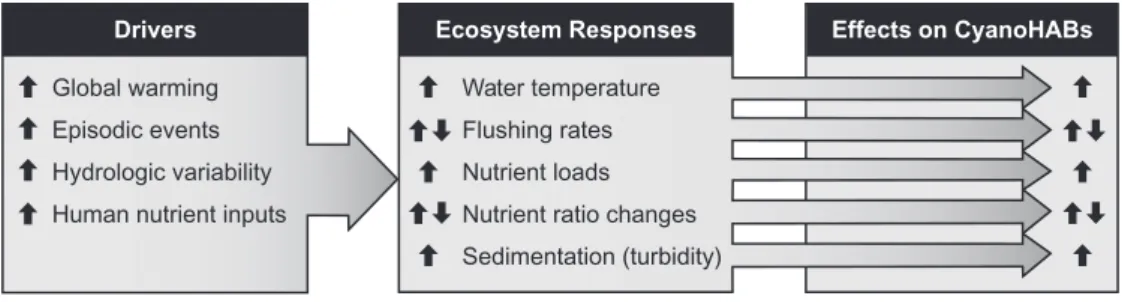
It is very likely that changes in climatic conditions and extremes will lead to altered relationships between fresh-water discharge and flushing rates (residence times), nutrient inputs and ratios (N:P), temperature, water col-umn stability and stratification, sedimentation and sedi-ment resuspension, and clarity (turbidity), all of which will impact cyanobacterial growth rates, biomass and bloom intensities, successional patterns and competitive interactions with other phytoplankton groups (Fig.4).
These important growth, biomass production and community compositional characteristics will strongly rely on changing threshold relationships between envir-onmental drivers and metabolic and growth responses of resident phytoplankton communities. For cyanobac-teria, faster growth rates and nutrient transformation and hence availability rates can be expected under warming conditions. It follows that demands on nutrient supplies will increase under such a scenario. Respiration and mineralization rates will also increase, leading to increasing oxygen demand and rising potentials for hyp-oxia and anhyp-oxia to develop. Also, stronger vertical strati-fication is likely to occur, increasing hypoxia and anoxia potentials. In concert, these changing conditions will promote mobilization of phosphorus and nitrogen as well as most micronutrients (e.g. Fe, and a range of
trace metals) from sediments, which will, in addition to changing the kinetic relationships between nutrient con-centrations, supply rates and cyanobacterial growth rates, lead to enhanced growth and bloom potentials. This constitutes a positive feedback loop between rising temperatures, increased CyanoHAB potentials and the nutrients to sustain them.
Likewise, larger, more extreme rainfall events, inter-spersed with more extreme droughts create a “perfect storm”scenario, where the former will lead to increased rates and amounts of nutrients discharged to a water body, with the latter creating increased water column stability and longer residence times (reduced flushing rates); the combined effect being an increase in magni-tudes and duration of blooms.
It is likely that in a warmer, more hydrologically vari-able and extreme world, nutrient input reductions will have to be greater than under more predictable, season-ally stable conditions for CyanoHAB control. Particular emphasis will need to be placed on controlling diffuse non-point nutrient sources, such as agricultural, urban and rural stormwater runoff, as they will be most severely impacted by a predictably more “flashy” pat-tern of rainfall events (Trenberth, 2005). The extent to which nutrient input reductions will need to be adjusted will likely be system-specific, creating additional research and management challenges.
C O NC L US IO N S
The synergistic combination of anthropogenic nutrient loading, rising temperatures, enhanced vertical stratifi -cation, increased residence time and more extreme cli-matic conditions overall will favor cyanobacterial dominance in a wide range of aquatic ecosystems (Paerl and Paul, 2012). Ecosystem-scale physical–chemical– biotic mitigation strategies will have to incorporate nutrient (most often N and P) input reductions. Magnitudes of these reductions will need to be system-specific and will likely need to be adjusted with changing
Effects on CyanoHABs
Global warming
Episodic events
Hydrologic variability
Human nutrient inputs
Water temperature
Flushing rates
Nutrient loads
Nutrient ratio changes
Sedimentation (turbidity)
Drivers Ecosystem Responses
Fig. 4. The relationship between human and climatic environmental pressures on aquatic ecosystems, ecosystem responses and their effects on CyanoHABs. Figure is adapted fromPaerl (Paerl, 2014).
climatic conditions. Research and management efforts will have to consider and accommodate warming and greater hydrologic variability and extremeness resulting from climate change in formulating their strategies. A key long-term control we can exert to reduce the rate and extent of global warming is curbing greenhouse gas emissions. Without this essential step, future warming trends, hydrologic extremes and their impacts on aquatic ecosystems will continue to promote opportunis-tic CyanoHABs.
A C K N O W L E D G E M E N T S
I appreciate the technical assistance and input of A. Joyner, W. Gardner and R. Sloup.
FUNDING
Research discussed in this chapter was partially sup-ported by the National Science Foundation (DEB 1119704; CBET 0826819, 1230543 and Dimensions of Biodiversity 1240851), the North Carolina Department of Natural Resources and Community Development/ UNC Water Resources Research Institute (Neuse River Estuary Monitoring and Modeling Project, ModMon) and the Chinese Ministry of Science and Technology (MOST), contract 2014zx07101-011.
R E F E R E NCE S
Conley, D. J., Paerl, H. W., Howarth, R. W., Boesch, D. F., Seitzinger, S. P., Havens, K. E., Lancelot, C. and Likens, G. E. (2009) Controlling eutrophication: nitrogen and phosphorus.Science, 323, 1014–1015.
Elser, J. J., Bracken, M. E. S., Cleland, E. E., Gruner, D. S., Harpole, W. S., Hillebrand, H., Bgai, J. T., Seabloom, E. W., Shurin, J. B. and Smith, J. E. (2007) Global analysis of nitrogen and phosphorus limitation of primary producers in freshwater, marine and terrestrial ecosystems.Ecol. Lett.,10, 1124–1134.
Galloway, J. N., Cowling, E. B., Seitzinger, S. P. and Sokolow, R. H. (2002) Reactive nitrogen: too much of a good thing. Ambio., 31, 60–66.
Ghadouani, A., Pinel-Alloul, B. and Prepas, E. E. (2003) Effects of experimentally induced cyanobacterial blooms on crustacean zoo-plankton communities.Freshw. Biol.,48, 363–38.
Honjo, M., Matsui, K., Ueki, M., Nakamura, R., Fuhrman, J. A. and Kawabata, Z. (2006) Diversity of virus-like agents killingMicrocystis aeruginosain a hyper-eutrophic pond.J. Plank. Res.,28, 407–412.
Huisman, J. M., Matthijs, H. C. P. and Visser, P. M. (2005) Harmful cyanobacteria.Springer Aquatic Ecology Series 3. Springer, Dordrecht, The Netherlands, p. 243.
Intergovernment Panel on Climate Change (IPCC). Climate Change (2014) Synthesis Report. Contribution of Working Groups I, II and III to the Fifth Assessment Report of the Intergovernmental Panel on Climate Change [Core Writing Team, R.K. Pachauri and L.A. Meyer (eds.)]. IPCC, Geneva, Switzerland, 151 pp.
Jeppesen, E., Meerhoff, M., Jacobsen, B. A., Hansen, R. S., Søndergaard, M., Jensen, J. P., Lauridsen, T. L., Mazzeo, N. and Branco, C. W. C. (2007) Restoration of shallow lakes by nutrient control and biomanipulation: the successful strategy varies with lake size and climate.Hydrobiology,581, 269–285.
Jöhnk, K. D., Huisman, J., Sharples, J., Sommeijer, B., Visser, P. M. and Stroom, J. M. (2008) Summer heatwaves promote blooms of harmful cyanobacteria.Glob. Change Biol.,14, 495–512.
Kardinaal, W. E. A., Janse, I., Kamst-van Agterveld, M., Meima, M., Snoek, J., Mur, L. R., Huisman, J., Zwart, G. and Visser, P. M. (2007) Microcystis genotype succession in relation to microcystin concentrations in freshwater lakes.Aquat. Microb. Ecol.,48, 1–12.
Knoll, A. H. (2008) Cyanobacteria and earth history. In Herrero, A. Flores, E. (Eds). The Cyanobacteria, Molecular Biology, Genetics and Evolution.Caister Academic Press, Norfolk, UK pp: 1–20
Kosten, S., Huszar, V. L. M., Bécares, E., Costa, L. S., van Donk, E., Hansson, L. A., Jeppesen, E., Kruk, C., Lacerot, G., Mazzeo, N., De Meester, L., Moss, B., Lürling, M., Nõges, T., Romo, S. and Scheffer, M. (2012) Warmer climates boost cyanobacterial domin-ance in shallow lakes.Glob. Change Biol.,18, 118–126.
Lewis, W. M., Wurtsbaugh, W. A. and Paerl, H. W. (2011) Rationale for control of anthropogenic nitrogen and phosphorus in inland waters.Environ. Sci. Technol.,45, 10030–10035.
Matthijs, H. C. P., Visser, P. M., Reeze, B., Meeuse, J., Slot, P. C., Wjin, G., Talens, R. and Huisman, J. (2012) Selective suppression of harmful cyanobacteria in an entire lake with hydrogen peroxide.
Water Res.,46, 1460–1472.
McQueen, D. J. (1990) Manipulating lake community structure: where do we go from here?Freshw. Biol.,23, 613–620.
Mitrovic, S. M., Oliver, R. L., Rees, C., Bowling, L. C. and Buckney, R. T. (2003) Criticalflow velocities for the growth and dominance ofAnabaena circinalisin some turbid freshwater rivers. Freshw. Biol., 48, 164–174.
Paerl, H. W. (1982) Chapter 17. Interactions with bacteria. In Carr, N. G. and Whitton, B. A. (eds),The Biology of Cyanobacteria,1982. Blackwell Scientific Publications Ltd, Oxford, pp. 441–461. Paerl, H. W. (2014) Mitigating harmful cyanobacterial blooms in a
human- and climatically-impacted world. Life., doi:10.3390/ life40×000x.
Paerl, H. W., Bland, P. T., Bowles, N. D. and Haibach, M. E. (1985) Adaptation to high intensity, low wavelength light among surface blooms of the cyanobacterium Microcystis aeruginosa. Appl. Environ. Microbiol.,49, 1046–1052.
Paerl, H. W. and Millie, D. F. (1996) Physiological ecology of toxic cyanobacteria.Phycologia,35, 160–167.
Paerl, H. W., Fulton, R. S.III, Moisander, P. H. and Dyble, J. (2001) Harmful freshwater algal blooms, with an emphasis on cyanobac-teria.Sci. World J.,1, 76–113.
Paerl, H. W. and Huisman, J. (2008) Blooms like it hot.Science,320, 57–58.
Paerl, H. W. and Huisman, J. (2009) Climate change: a catalyst for global expansion of harmful cyanobacterial blooms. Environ. Microbiol. Rep.,1, 27–37.
Paerl, H. W., Hall, N. S. and Calandrino, E. S. (2011) Controlling harmful cyanobacterial blooms in a world experiencing anthropogenic and climatic-induced change.Sci. Total Environ.,409, 1739–1745.
Paerl, H. W. and Paul, V. J. (2012) Climate change: links to global expansion of harmful cyanobacteria.Water Res,46, 1349–1363.
Paerl, H. W. and Otten, T. G. (2013a) Harmful Cyanobacterial blooms: causes, consequences and controls.Microb. Ecol.,65, 995–1010.
Paerl, H. W. and Otten, T. G. (2013b) Blooms bite the hand that feeds them.Science,342, 433–434.
Paerl, H. W., Scott, J. T., McCarthy, M. J., Newell, S. E., Gardner, W. S., Havens, K. E., Hoffman, D. K., Wilhelm, S. W. and Wurtsbaugh, W. A. (2016a) It takes two to tango: when and where dual nutrient (N & P) reductions are needed to protect lakes and downstream ecosystems.Environ. Sci. Technol.,50, 10805–10813.
Paerl, H. W., Gardner, W. S., Havens, K. E., Joyner, A. R., McCarthy, M. J., Newell, S. E., Qin, B. and Scott, J. T. (2016b) Mitigating cyanobacterial harmful algal blooms in aquatic ecosys-tems impacted by climate change and anthropogenic nutrients.
Harmful Algae,54, 213–222.
Paul, V. J. (2008) Global warming and cyanobacterial harmful algal blooms. In Hudnell, H. K. (ed.),Cyanobacterial Harmful Algal Blooms: State of the Science and Research Needs. Advances in Experimental Medicine and Biology,Vol. 619. Springer, Berlin, Germany, pp. 239–257.
Paul, V. J., Arthur, K. E., Ritson-Williams, R., Ross, C. and Sharp, K. (2007) Chemical defenses: from compounds to communities.
Biol. Bull.,213, 226e251.
Potts, M. and Whitton, B. A. (2000) The Biology and Ecology of Cyanobacteria. Blackwell Scientific Publications, Oxford, UK. Robb, M., Greenop, B., Goss, Z., Douglas, G. and Adeney, J. (2003)
Application of Phoslock, an innovative phosphorous binding clay, to two Western Australian waterways: preliminary findings.
Hydrobiologia,494, 237–243.
Schindler, D. W., Hecky, R. E., Findlay, D. L., Stainton, M. P., Parker, B. R., Paterson, M., Beaty, K. G., Lyng, M. and Kasian, S.
E. M. (2008) Eutrophication of lakes cannot be controlled by redu-cing nitrogen input: results of a 37 year whole ecosystem experi-ment.Proc. Natl. Acad. Sci. U.S.A.,105, 11254–11258.
Scott, J. T. and McCarthy, M. J. (2010) Nitrogenfixation may not bal-ance the nitrogen pool in lakes over timescales relevant to eutrophi-cation management.Limnol. Oceanogr.,55, 1265–1270.
Sengco, M. and Anderson, D. M. (2004) Controlling harmful algal blooms throughflocculation.J. Eukaryot. Microbiol.,52, 169–172. Smith, V. H. (1983) Low nitrogen to phosphorus ratios favor
domin-ance by blue-green algae in lake phytoplankton. Science, 221, 669–671.
Trenberth, K. E. (2005) The impact of climate change and variability on heavy precipitation,floods, and droughts. In Anderson, M. G. (ed.), Encyclopedia of Hydrological Sciences. John Wiley and Sons, Hoboken, NJ, USA, pp. 1–11.
Visser, P. M., Ibelings, B. W., Van der Veer, B., Koedood, J. and Mur, L. R. (1996) Artificial mixing prevents nuisance blooms of the cyanobacterium Microcystis in Lake Nieuwe Meer, the Netherlands.
Freshw. Biol.,36, 435–450.
Wilhelm, S. W. and Trick, C. G. (1994) Iron-limited growth of cyano-bacteria: multiple siderophore production is a common response.
Limnol. Oceanogr.,39, 1979–1984.
Wagner, C. and Adrian, R. (2009) Cyanobacteria dominance: quanti-fying the effects of climate change.Limnol. Oceanogr.,54, 2460–2468.
Walsby, A. E., Hayes, P. K., Boje, R. and Stal, L. J. (1997) The select-ive advantage of buoyancy provided by gas vesicles for planktonic cyanobacteria in the Baltic Sea.New Phytol.,136, 407–417.
Walther, G.-R., Post, E., Convey, P., Menzel, A., Parmesan, C., Beebee, T. J. C., Fromentin, J.-M., Hoegh-Guldberg, O. and Bairlein, F. (2002) Ecological responses to recent climate change.
Nature,416, 389–395.
Wiedner, C., Rücker, J., Brüggemann, R. and Nixdorf, B. (2007) Climate change affects timing and size of populations of an invasive cyanobacterium in temperate regions.Oecologia,152, 473–484.