Urine Injury Biomarkers and Risk of Adverse Outcomes
in Recipients of Prevalent Kidney Transplants: The
Folic Acid for Vascular Outcome Reduction in
Transplantation Trial
Nisha Bansal,* Myra A. Carpenter,
†Daniel E. Weiner,
‡Andrew S. Levey,
‡Marc Pfeffer,
§John W. Kusek,
|Jianwen Cai,
†Lawrence G. Hunsicker,
¶Meyeon Park,** Michael Bennett,
††Kathleen D. Liu,** and Chi-yuan Hsu**
*Kidney Research Institute, Division of Nephrology, University of Washington, Seattle, Washington;†Department of Biostatistics, University of North Carolina, Chapel Hill, North Carolina;‡Division of Nephrology, Tufts Medical Center, Boston, Massachusetts; §Division of Cardiology, Brigham and Women’s Hospital, Boston, Massachusetts;|National
Institute of Diabetes and Digestive and Kidney Diseases, National Institutes of Health, Bethesda, Maryland;¶College
of Medicine, Department of Medicine, University of Iowa, Iowa City, Iowa; **Division of Nephrology, University of California, San Francisco, California; and††Department of Pediatrics, Cincinnati Children’s Hospital, Cincinnati, Ohio
ABSTRACT
Recipients of kidney transplants (KTR) are at increased risk for cardiovascular events, graft failure, and death. It is
unknown whether urine kidney injury biomarkers are associated with poor outcomes among KTRs. We
conducted a
post hoc
analysis of the Folic Acid for Vascular Outcome Reduction in Transplantation (FAVORIT)
Trial using a case-cohort study design, selecting participants with adjudicated cardiovascular events, graft failure,
or death. Urine neutrophil gelatinase
–
associated lipocalin (NGAL), kidney injury molecule-1 (KIM-1), IL-18, and
liver
–
type fatty acid binding protein (L-FABP) were measured in spot urine samples and standardized to urine
creatinine concentration. We adjusted for demographics, cardiovascular risk factors, eGFR, and urine
albumin-to-creatinine ratio. Patients had 291 cardiovascular events, 257 graft failure events, and 359 deaths. Each log increase
in urine NGAL/creatinine independently associated with a 24% greater risk of cardiovascular events (adjusted
hazard ratio [aHR], 1.24; 95% confidence interval [95% CI], 1.06 to 1.45), a 40% greater risk of graft failure (aHR,
1.40; 95% CI, 1.16 to 1.68), and a 44% greater risk of death (aHR, 1.44; 95% CI, 1.26 to 1.65). Urine KIM-1/creatinine
and IL-18/creatinine independently associated with greater risk of death (aHR, 1.29; 95% CI, 1.03 to 1.61 and aHR,
1.25; 95% CI, 1.04 to 1.49 per log increase, respectively) but not with risk of cardiovascular events or graft failure.
Urine L-FABP did not associate with any study outcomes. In conclusion, among prevalent KTRs, higher urine
NGAL, KIM-1, and IL-18 levels independently and differentially associated with greater risk of adverse outcomes.
J Am Soc Nephrol27: 2109–2121, 2016. doi: 10.1681/ASN.2015030292
Despite improvements in short
–
term patient and graft
outcomes, long
–
term clinical outcomes of recipients
of kidney transplants (KTRs) remain suboptimal.
1,2The leading cause of death in KTRs is cardiovascular
disease (CVD), and KTRs also have signi
fi
cant risk of
long
–
term graft failure.
1Identi
fi
cation of biomarkers
that are independent risk factors for adverse outcomes
may provide insight into underlying pathophysiologic
mechanisms relevant to KTRs.
Urine biomarkers of kidney tubular injury have
been studied in patients with native CKD
3,4and the
general population.
5–7A number of these
bio-markers, including neutrophil gelatinase
–
associated
lipocalin (NGAL), kidney injury molecule-1
Received March 17, 2015. Accepted September 22, 2015.
Published online ahead of print. Publication date available at www.jasn.org.
Correspondence:Dr. Nisha Bansal, Kidney Research Institute, University of Washington, 908 Jefferson Street, 3rd Floor, Seattle, WA 98104. Email: [email protected]
Copyright © 2016 by the American Society of Nephrology
CLI
NI
CAL
EP
IDE
MI
OLO
(KIM-1), IL-18, and liver
–
type fatty acid binding protein
(L-FABP), were initially described in patients with acute
tu-bular necrosis/AKI.
8–11NGAL is a 25-kD protein expressed
in the kidney, liver, and epithelial cells in response to various
pathologic states, such as in
fl
ammation, infection,
intoxica-tion, ischemia, AKI, and neoplastic transformation.
12NGAL
is
filtered in the glomerulus, and luminal NGAL is
reabsor-bed in the proximal tubule. In the setting of kidney injury,
proximal tubule reabsorption of systemically produced
NGAL is impaired, and NGAL production is increased in
the distal nephron and shed into the urine, leading to higher
urine NGAL levels.
13,14Urine KIM-1 is a phosphatidylserine
receptor that recognizes apoptotic cells, directing them to
lysosomes, and it also serves as a receptor for oxidized
lipo-proteins.
15–17KIM-1 transforms kidney proximal epithelial
cells into phagocytes and may act to modulate immune
re-sponse in kidney injury.
16,17IL-18 is a known mediator of
in
fl
ammation and found in monocytes,
fi
broblasts, and
proximal renal tubular epithelial cells.
18,19IL-18 mediates
ischemic proximal tubule injury and proin
fl
ammatory
re-sponses through its actions on Toll-like receptor 4.
20L-FABP
expression and urinary excretion increase under
condi-tions of tubular stress. It is hypothesized that free fatty
acids, which are, in part, albumin bound, exert oxidative
stress on cells and that L-FABP inhibits the
accumula-tion of intracellular fatty acids by promoting fatty acid
metabolism.
21–24Among KTRs, previous studies have shown strong
asso-ciations of serum creatinine and albuminuria with poor
clinical outcomes, similar to patients with native CKD.
Numerous studies in patients with CKD have recently
suggested that, independent of serum creatinine, eGFR,
and levels of albuminuria, tubular injury markers are risk
factors for adverse outcomes, such as kidney failure, death,
and CVD.
3,4,6,25–28It has been suggested that GFR and
albu-minuria mostly re
fl
ect glomerular disease, whereas these
in-jury biomarkers reflect renal tubular disease. Published
studies of urine injury biomarkers among KTRs largely
have been limited to the peritransplant setting and focused
on associations with short-term outcomes, such as delayed
graft function or in-hospital mortality.
29–33It is plausible
that these biomarkers of tubular injury or stress may signal
earlier systemic disease or graft disease that contributes to
adverse cardiovascular or renal outcomes among KTRs. We
studied the associations of urine NGAL, KIM-1, IL-18, and
L-FABP with long
–
term adverse outcomes, including
car-diovascular events, graft failure, and all-cause mortality,
among prevalent KTRs enrolled in the Folic Acid for
Vascu-lar Outcome Reduction in Transplantation (FAVORIT)
Trial, a randomized clinical trial of homocysteine lowering
by B vitamins. We hypothesized that, similar to patients
with native kidney disease,
3,4elevations in these urine
in-jury biomarkers would be associated with poor clinical
outcomes among KTRs, independent of traditional kidney
measures.
RESULTS
Participant Characteristics
The mean age (
6
SD) of the random subcohort was 51 (
6
9)
years old, and eGFR was 46 (
6
18) ml/min per 1.73 m
2. Median
(interquartile range) urine albumin-to-creatinine ratio (ACR)
was 24.5 (9.5
–
104.7)
mg/mg, urine NGAL was 20.2 (8.2
–
51.3)
ng/ml, urine KIM-1 was 658 (319
–
1364) pg/ml, urine IL-18 was
29.1 (11.5
–
62.5) pg/ml, and urine L-FABP was 6.1 (3.0
–
17.6)
ng/ml (Supplemental Table 1, column 1). Participants with the
highest quartile of urine NGAL/creatinine were more likely to be
women, have a lower eGFR, and have a higher urine ACR
(Sup-plemental Table 1a). Participants with the highest quartile of
urine KIM-1/creatinine were more likely to be women and
have higher urine ACR and less likely to have received a living
donor kidney (Supplemental Table 1b). Participants with the
highest quartile of urine IL-18/creatinine were more likely to
be women and have higher urine ACR. Graft vintage was longer
among participants in the lowest quartile of urine
IL-18/creati-nine, and the biomarker distributions differed by country
(Sup-plemental Table 1c). Participants with the highest quartile of
urine L-FABP/creatinine were more likely to use sirolimus and
have higher BP, lower eGFR, and higher urine ACR
(Supplemen-tal Table 1d). Overall, only 3% of KTRs (16 of 489 from the
random subcohort) were in the highest quartile of all four urine
biomarkers (as illustrated in Figure 1, with the Venn diagram
showing overlap).
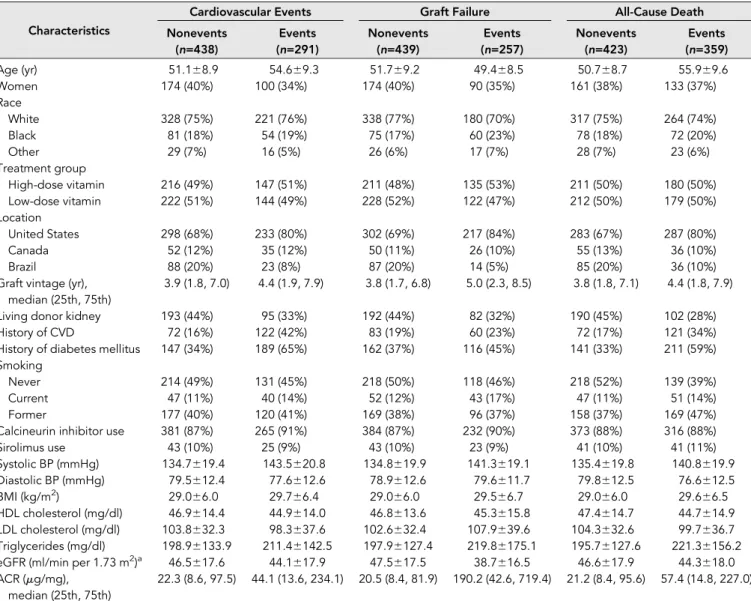
Participants who had a cardiovascular event or a graft failure
or died were more likely to be from the United States, have older
graft vintage, have higher systolic BP, have lower eGFR, and
have higher urine ACR (Table 1).
Correlations among Measures of Kidney Function and
Urine Injury Biomarkers
Among participants in the subcohort, eGFR level was
nega-tively correlated with urine NGAL and urine L-FABP
(Sup-plemental Figure 1, Table 2). Urine albumin was positively
correlated with all four biomarkers. There were moderately
strong positive correlations among urine NGAL, KIM-1, IL-18,
and L-FABP; the strongest correlation was between urine NGAL
and L-FABP (correlation coefficient =0.47;
P
,
0.001)
(Supple-mental Figure 1, Table 2).
Urine Injury Biomarkers and Risk of Cardiovascular
Events
Overall mean follow-up time was 3.9 (
6
1.6) years. Among
par-ticipants in the subcohort, the crude event rate was 2.7 per
100 person-years for cardiovascular events. The cumulative
in-cidence of cardiovascular events was greater for participants in
the highest quartile of urine NGAL/creatinine, KIM-1/creatinine,
and L-FABP/creatinine but not IL-18/creatinine and seemed
fairly constant over the follow-up period (Figure 2).
In the full study population, in unadjusted analyses, there
was a statistically significant association of urine NGAL/
creatinine, urine KIM-1/creatinine, and urine L-FABP/
creatinine (but not IL-18/creatinine) with risk of cardiovascular
events (Table 3). These associations remained statistically
sig-nificant after adjustment for participant demographics and
other cardiovascular risk factors. With additional adjustment
for urine ACR, only the association between urine NGAL/
creatinine and cardiovascular events remained statistically
sig-nificant. For each log higher urine NGAL/creatinine, the risk of
cardiovascular events was 24% higher (adjusted hazard ratio
[HR], 1.24; 95% con
fi
dence interval [95% CI], 1.06 to 1.45)
(Table 3).
Table 1.
Baseline participant characteristics by outcome in the case-cohort study
Characteristics
Cardiovascular Events Graft Failure All-Cause Death
Nonevents (n=438)
Events (n=291)
Nonevents (n=439)
Events (n=257)
Nonevents (n=423)
Events (n=359)
Age (yr) 51.168.9 54.669.3 51.769.2 49.468.5 50.768.7 55.969.6
Women 174 (40%) 100 (34%) 174 (40%) 90 (35%) 161 (38%) 133 (37%)
Race
White 328 (75%) 221 (76%) 338 (77%) 180 (70%) 317 (75%) 264 (74%)
Black 81 (18%) 54 (19%) 75 (17%) 60 (23%) 78 (18%) 72 (20%)
Other 29 (7%) 16 (5%) 26 (6%) 17 (7%) 28 (7%) 23 (6%)
Treatment group
High-dose vitamin 216 (49%) 147 (51%) 211 (48%) 135 (53%) 211 (50%) 180 (50%)
Low-dose vitamin 222 (51%) 144 (49%) 228 (52%) 122 (47%) 212 (50%) 179 (50%)
Location
United States 298 (68%) 233 (80%) 302 (69%) 217 (84%) 283 (67%) 287 (80%)
Canada 52 (12%) 35 (12%) 50 (11%) 26 (10%) 55 (13%) 36 (10%)
Brazil 88 (20%) 23 (8%) 87 (20%) 14 (5%) 85 (20%) 36 (10%)
Graft vintage (yr), median (25th, 75th)
3.9 (1.8, 7.0) 4.4 (1.9, 7.9) 3.8 (1.7, 6.8) 5.0 (2.3, 8.5) 3.8 (1.8, 7.1) 4.4 (1.8, 7.9)
Living donor kidney 193 (44%) 95 (33%) 192 (44%) 82 (32%) 190 (45%) 102 (28%)
History of CVD 72 (16%) 122 (42%) 83 (19%) 60 (23%) 72 (17%) 121 (34%)
History of diabetes mellitus 147 (34%) 189 (65%) 162 (37%) 116 (45%) 141 (33%) 211 (59%) Smoking
Never 214 (49%) 131 (45%) 218 (50%) 118 (46%) 218 (52%) 139 (39%)
Current 47 (11%) 40 (14%) 52 (12%) 43 (17%) 47 (11%) 51 (14%)
Former 177 (40%) 120 (41%) 169 (38%) 96 (37%) 158 (37%) 169 (47%)
Calcineurin inhibitor use 381 (87%) 265 (91%) 384 (87%) 232 (90%) 373 (88%) 316 (88%)
Sirolimus use 43 (10%) 25 (9%) 43 (10%) 23 (9%) 41 (10%) 41 (11%)
Systolic BP (mmHg) 134.7619.4 143.5620.8 134.8619.9 141.3619.1 135.4619.8 140.8619.9 Diastolic BP (mmHg) 79.5612.4 77.6612.6 78.9612.6 79.6611.7 79.8612.5 76.6612.5
BMI (kg/m2) 29.066.0 29.766.4 29.066.0 29.566.7 29.066.0 29.666.5
HDL cholesterol (mg/dl) 46.9614.4 44.9614.0 46.8613.6 45.3615.8 47.4614.7 44.7614.9
LDL cholesterol (mg/dl) 103.8632.3 98.3637.6 102.6632.4 107.9639.6 104.3632.6 99.7636.7
Triglycerides (mg/dl) 198.96133.9 211.46142.5 197.96127.4 219.86175.1 195.76127.6 221.36156.2 eGFR (ml/min per 1.73 m2)a 46.5617.6 44.1617.9 47.5617.5 38.7616.5 46.6617.9 44.3618.0 ACR (mg/mg),
median (25th, 75th)
22.3 (8.6, 97.5) 44.1 (13.6, 234.1) 20.5 (8.4, 81.9) 190.2 (42.6, 719.4) 21.2 (8.4, 95.6) 57.4 (14.8, 227.0)
When participants with prevalent CVD at study entry were
excluded, none of the urine biomarkers were associated with
risk of cardiovascular events (although the 95% CIs were
wider) (Supplemental Table 2).
Urine Injury Biomarkers and Risk of Graft Failure
Within the subcohort, the crude graft failure event rate was
2.7 per 100 person-years. The cumulative incidence of graft
failure was greatest among participants in the highest quartile
of each urine biomarker/urine creatinine (Figure 3).
Among participants in the full study population, in
un-adjusted models, there was a statistically signi
fi
cant association
of higher urine NGAL/creatinine, urine KIM-1/creatinine,
urine IL-18/creatinine, and urine L-FABP/creatinine with
increased risk of graft failure (Table 4). These associations
remained robust after adjustment for participant
demograph-ics and other risk factors. After adjustment for urine ACR,
only the association between urine NGAL/creatinine and graft
failure remained statistically significant. For each log increase
in urine NGAL/creatinine, there was a 40% (adjusted HR,
1.40; 95% CI, 1.16 to 1.68) higher risk of graft failure (Table 4).
Urine Injury Biomarkers and Risk of All-Cause Mortality
Within the subcohort, the crude mortality rate was 3.3 per 100
person-years. The cumulative incidence of all-cause mortality
was greatest among participants in the highest quartile of each
urine biomarker/creatinine (Figure 4).
Among participants in the full study population, in
un-adjusted analyses, all four urine injury biomarkers/creatinine,
considered as continuous measures or quartiles, were
associ-ated with an increased risk of all-cause mortality (Table 5).
These associations remained statistically significant after
adjustment for demographic characteristics and other
cardiovascular risk factors. After adjustment
for urine ACR, the associations of urine
NGAL/creatinine (HR, 1.44; 95% CI, 1.26 to
1.65 per log increase), urine KIM-1/creatinine
(HR, 1.29; 95% CI, 1.03 to 1.61 per log
in-crease), and urine IL-18/creatinine (HR,
1.25; 95% CI, 1.04 to 1.49 per log increase)
remained statistically significant (Table 5).
When participants with CVD at study
entry were excluded, in multivariable analysis
including adjustment for urine ACR, the
association between NGAL/creatinine and
all-cause mortality remained statistically
sig-nificant but not for urine KIM-1/creatinine
or urine IL-18/creatinine (although the 95%
CIs were wider) (Supplemental Table 2).
Sensitivity Analyses: Analyses of Urine
Biomarkers Not Standardized to Urine
Creatinine
In the full study population, in multivariable
models that examined raw urine biomarker
concentrations (
i.e.
, not standardizing them to urine
creati-nine concentration) and after adjusted for urine ACR, urine
NGAL was associated with increased risk of cardiovascular
events, graft failure, and all-cause mortality(Supplemental
Table 3), similar to the main analysis (Tables 3
–
5). In
multi-variable models, urine IL-18 was significantly associated with
increased risk of all-cause mortality (Supplemental Table 3),
similar to the main analysis, whereas the association between
urine KIM-1 and mortality was attenuated and no longer
sta-tistically signi
fi
cant (Supplemental Table 3).
Sensitivity Analyses: Composite Outcomes
To assess whether our conclusions regarding cardiovascular
events or graft failure could be biased by competing risk of
death, we repeated our multivariable models examining two
composite outcomes: cardiovascular events or all-cause
mor-tality and graft failure or all-cause mormor-tality. Overall, reassuring
results were obtained (Supplemental Table 4).
Post Hoc
Exploratory Analyses: Interactions by Sex
Given the substantial differences in biomarker levels in men
and women (Supplemental Table 1), we tested for interaction
by sex in exploratory
post hoc
analyses. Across four biomarkers
and three outcomes, we found a statistically signi
fi
cant
inter-action by sex only in the association of IL-18/creatinine with
all-cause death (
P
value =0.01). In strati
fi
ed analyses, the
as-sociation was stronger in men.
DISCUSSION
In prevalent KTRs, urine tubular injury biomarkers are
asso-ciated with greater risk of adverse cardiovascular outcomes,
Table 2.
Spearman correlations of eGFR and urine biomarkers in a random
subcohort (
n
=489)
Kidney/Urine Measure
Urine Albumin (mg/dl)
Urine NGAL (ng/ml)
Urine KIM-1 (pg/ml)
Urine IL-18 (pg/ml)
Urine L-FABP (ng/ml) eGFR (ml/min
per 1.73 m2)
Rho 20.17 20.21 20.02 0.02 20.21
Pvalue ,0.001 ,0.001 0.64 0.69 ,0.001
Urine albumin (mg/dl)
Rho 0.39 0.42 0.29 0.62
Pvalue ,0.001 ,0.001 ,0.001 ,0.001
Urine NGAL (ng/ml)
Rho 0.36 0.42 0.47
Pvalue ,0.001 ,0.001 ,0.001
Urine KIM-1 (pg/ml)
Rho 0.35 0.39
Pvalue ,0.001 ,0.001
Urine IL-18 (pg/ml)
Rho 0.35
graft failure, and all-cause mortality. Specifically, elevations
in urine NGAL/creatinine were significantly associated with
higher risk of cardiovascular events as well as increased risk
of graft failure. Furthermore, elevations in urine NGAL/
creatinine, KIM-1/creatinine, and IL-18/creatinine were
associ-ated with greater risk of all-cause mortality, with urine NGAL/
creatinine being the most robust. The observed associations were
independent of known cardiovascular risk factors as well
as established markers of kidney disease, including eGFR and
urine ACR. Our study suggests that urine injury markers may
signal early biologic injury that may contribute to higher risk of
adverse outcomes among prevalent KTRs.
Among the FAVORIT Trial participants that we studied
(median graft vintage of 3.8 years), levels of urine injury
biomarkers were moderately elevated, although overall,
bio-marker levels (not standardized to urine creatinine) were
several magnitudes lower than those seen in patients with AKI
after cardiac surgery
10or the immediate perikidney transplant
setting.
29For example, in a study of KTRs, urine NGAL and
IL-18 were markedly higher in the
first 48 hours after kidney
transplant in those who developed delayed or slow graft
func-tion compared with our patient populafunc-tion.
29Interestingly,
seen among prevalent KTRs in our study.
29The levels of
urine injury biomarkers seen in prevalent KTRs are similar
to those reported in studies of the general CKD population
4or a community
–
based elderly study population.
5For
exam-ple, urine NGAL levels at baseline among participants in the
Chronic Renal Insuf
fi
ciency Cohort (CRIC) Study, an
obser-vational cohort study of persons with CKD (mean eGFR of
44 ml/min per 1.73 m
2), were similar to levels that we observed
among our study of prevalent KTRs (mean eGFR of subcohort of
46 ml/min per 1.73 m
2).
4In multivariable models, we found that urine NGAL was
significantly associated with higher risk of atherosclerotic
cardiovascular events. A similar association was not observed
for KIM-1, IL-18, or L-FABP when adjustment for urine ACR,
in particular, attenuated associations between biomarkers and
adverse outcomes. Consistent with our
findings, a recent report
from the CRIC Study showed a signi
fi
cant association of urine
NGAL with atherosclerotic cardiovascular events.
4Another
study of patients with CKD also noted a
.
3-fold higher risk
of cardiovascular events among those with the highest urine
NGAL levels.
26Also, similar to our
fi
ndings, a study of older
adults reported no association of urine KIM-1 or IL-18 with
risk of CVD.
5Although we did not
find an association between
urine L-FABP and cardiovascular events, a prior study noted a
strong association among patients with type 2 diabetes.
34Un-like the other urine injury biomarkers, urine NGAL is
filtered
through the glomerulus and thus, may reflect more systemic
processes, including in
fl
ammation, which may possibly
ex-plain the association with atherosclerotic CVD.
Of four urine injury biomarkers that we investigated, only
urine NGAL was signi
fi
cantly associated with higher risk of
graft failure among prevalent KTRs. A prior study of prevalent
KTRs also noted an association of urine NGAL with graft
failure.
35Among incident KTRs in the peritransplant setting,
multiple urine injury biomarkers have been associated with
both delayed graft function
29,30,36and ESRD after 1 year.
36The associations of these urine injury biomarkers with kidney
outcomes in the nontransplant CKD setting are
conflict-ing.
6,37–44Similar to our
findings, among patients with native
CKD, elevated urine NGAL has been shown to be significantly
associated with progression of CKD or incident ESRD.
3,45,46Some studies
39but not all
6have also noted associations of
higher urine NGAL with incident CKD. For example, among
high
–
risk American Indians with type 2 diabetes, elevations in
urine NGAL were signi
fi
cantly associated with risk of ESRD.
40However, these
fi
ndings were not observed among persons
with type 1 diabetes.
42,43We did not
fi
nd an association
be-tween urine KIM-1 and graft failure. Although some studies
have concluded that urine KIM-1 was an independent risk
factor for more rapid loss of renal function,
6others have
not.
39,40,42,43With regard to IL-18, there have been relatively
fewer studies of this biomarker. A prior study of HIV-infected
Table 3.
Unadjusted and adjusted HR estimates for risk of cardiovascular events according to urine biomarker (
n
=780
participants)
Urine Biomarker Unadjusted HR (95% CI) Model 1 HR (95% CI) Model 2 HR (95% CI)
Urine NGAL/creatinine
Per log increase 1.23 (1.11 to 1.37)a 1.31 (1.13 to 1.52)a 1.24 (1.06 to 1.45)a
Quartile 1 Reference Reference Reference
Quartile 2 1.41 (0.91 to 2.19) 1.67 (0.97 to 2.88) 1.52 (0.87 to 2. 63)
Quartile 3 1.48 (0.96 to 2.28) 1.19 (0.64 to 2.20) 1.10 (0.59 to 2.05)
Quartile 4 2.05 (1.34 to 3.14)a 2.21 (1.21 to 4.05)a 1.79 (0.95 to 3.34)
Urine KIM-1/creatinine
Per log increase 1.33 (1.11 to 1.59)a 1.28 (1.03 to 1.58)a 1.14 (0.91 to 1.43)
Quartile 1 Reference Reference Reference
Quartile 2 1.21 (0.78 to 1.87) 1.40 (0.78 to 2.50) 1.21 (0.68 to 2.17)
Quartile 3 1.43 (0.93 to 2.20) 1.42 (0.80 to 2.52) 1.22 (0.69 to 2.17)
Quartile 4 1.83 (1.21 to 2.79)a 1.84 (1.06 to 3.18)a 1.39 (0.79 to 2.44)
Urine IL-18/creatinine
Per log increase 1.03 (0.91 to 1.16) 1.11 (0.93 to 1.32) 1.03 (0.86 to 1.23)
Quartile 1 Reference Reference Reference
Quartile 2 1.06 (0.71 to 1.60) 0.98 (0.58 to 1.65) 0.90 (0.53 to 1.53)
Quartile 3 1.17 (0.78 to 1.76) 1.61 (0.97 to 2.68) 1.36 (0.80 to 2.31)
Quartile 4 1.06 (0.69 to 1.63) 1.28 (0.68 to 2.43) 1.05 (0.55 to 1.99)
Urine L-FABP/creatinine
Per log increase 1.24 (1.10 to 1.39)a 1.17 (1.01 to 1.36)a 1.0 (0.83 to 1.20)
Quartile 1 Reference Reference Reference
Quartile 2 0.96 (0.62 to 1.48) 0.67 (0.36 to 1.24) 0.59 (0.32 to 1.11)
Quartile 3 1.64 (1.08 to 2.50)a 1.45 (0.85 to 2.48) 1.16 (0.66 to 2.03)
Quartile 4 1.73 (1.14 to 2.64)a 1.15 (0.67 to 1.98) 0.69 (0.36 to 1.30)
Model 1 was adjusted for demographics, treatment, country, history of CVD, diabetes, smoking, graft vintage, donor, BP, lipids, BMI, and eGFR. Model 2 was adjusted for demographics, treatment, country, history of CVD, diabetes, smoking, graft vintage, donor, BP, lipids, BMI, eGFR, and urine ACR.
women found a strong independent association between
higher levels of urine IL-18 and risk of rapid decline in kidney
function,
25which is not what we observed. Finally, we did not
fi
nd an association between urine L-FABP and graft failure in
our study, although prior studies of persons with diabetes have
noted both inverse
40and linear associations between urine
L-FABP and risk of progression of CKD.
34,41,47,48Because
rea-sons for progressive loss of renal function after kidney
trans-plant likely include both traditional kidney disease risk factors
(such as elevated BP) as well as rejection/immunologic factors,
it is perhaps not surprising that
findings among prevalent
KTRs would be different from nontransplant populations.
In our analysis of prevalent KTRs, we found a significant
association of urine NGAL, KIM-1, and IL-18 with risk of
all-cause mortality. Prior investigations have examined these
associations in select populations, yielding con
fl
icting results.
For example, in the CRIC Study, urine NGAL was not
associated with all-cause mortality after multivariable
adjust-ment.
4Similarly, in a study of older men recruited from the
community, urine NGAL was associated with higher risk of
death in univariate analyses but not after multivariable
adjust-ment.
49In a study of American Indians, higher urine NGAL
but not KIM-1 was associated with increased risk of all-cause
mortality.
40Community-based studies have also noted
associations between elevated urine KIM-1 and higher risk of
all-cause mortality.
27,28We did not
fi
nd an association of urine
L-FABP with all-cause mortality. Similar to other biomarkers,
the data on L-FABP and risk of mortality also have been
con-fl
icting. In HIV-infected women, a J-shaped association was
noted between urine L-FABP and risk of long-term
mortal-ity.
50In a study of persons with type 1 diabetes, a positive
association was found between L-FABP and risk of death.
41Thus, data from our study and others suggest that urine injury
biomarkers may have differential associations with risk of
all-cause death on the basis of the study population and acuity of
injury as well as the specific urine biomarker of interest.
It is interesting that, among the outcomes that we studied,
the highest HRs were seen for all-cause mortality, despite the
fact that the markers of kidney tubular injury are expressed
from a transplanted kidney. There are severe possible
expla-nations for these
fi
ndings. First, these biomarkers may be
indicators of levels or dimensions of kidney injury not captured
by traditional markers of kidney function (
e.g.
, serum
creati-nine and urine ACR). It is recognized that CKD is strongly
associated with all-cause mortality
51,52; therefore, it is possible
that numerous different dimensions of kidney damage are risk
factors for mortality. For example, many important
physio-logic pathways are regulated by the kidney tubules, including
mineral metabolism, erythropoiesis, and acid-base regulation.
Therefore, tubular dysfunction may lead to alterations in these
important metabolic pathways, contributing to higher risk of
death.
53Second, these biomarkers may re
fl
ect systemic injury
from ischemia and other processes, which involve multiple
organs in parallel, ultimately contributing to higher risk of
death. For example, urine NGAL is thought to be a marker
of both kidney damage and systemic in
fl
ammation.
12Addi-tional studies are needed to elucidate the precise mechanisms
to explain the observed associations.
Our study had several strengths. We studied a large, well
characterized, international cohort of prevalent KTRs with
rigorously adjudicated outcomes. We used a case-cohort study
design, which efficiently allowed us to study multiple
impor-tant clinical outcomes. Urine injury biomarkers were measured
at a very experienced laboratory simultaneously from samples
that had not undergone a previous freeze-thaw cycle. We were
able to adjust for a substantial number of possible confounders.
A few limitations should be noted as well. The FAVORIT Trial
did not collect biospecimens starting from the time of
trans-plant, and therefore, we could only study prevalent KTRs
(rather than longitudinal measures starting at the time of
surgery when injury is likely to be maximal). We only had single
measures of each urine injury biomarker at study baseline. The
urine samples were collected from 2002 to 2007. Although we
used previously unthawed urine samples to measure our urine
biomarkers, it is unclear how age of the sample may have
affected the assays. Any nonspecific degradation would likely
Table 4.
Unadjusted and adjusted HR estimates for risk of graft failure according to urine biomarker (
n
=744 participants)
Urine Biomarker Unadjusted HR (95% CI) Model 1 HR (95% CI) Model 2 HR (95% CI) Urine NGAL/creatinine
Per log increase 1.58 (1.40 to 1.79)a 1.66 (1.42 to 1.94)a 1.40 (1.16 to 1.68)a
Quartile 1 Reference Reference Reference
Quartile 2 3.39 (1.99 to 5.77)a 3.48 (1.91 to 6.34)a 2.45 (1.26 to 4.76)a
Quartile 3 2.37 (1.37 to 4.09)a 2.22 (1.17 to 4.22)a 1.27 (0.61 to 2.67)
Quartile 4 5.99 (3.55 to 10.13)a 5.86 (3.03 to 11.36)a 2.60 (1.17 to 5.78)a
Urine KIM-1/creatinine
Per log increase 1.37 (1.12 to 1.69)a 1.44 (1.17 to 1.78)a 0.93 (0.71 to 1.22)
Quartile 1 Reference Reference Reference
Quartile 2 1.14 (0.71 to 1.82) 1.50 (0.83 to 2.70) 0.75 (0.38 to 1.48)
Quartile 3 1.32 (0.84 to 2.09) 1.44 (0.82 to 2.54) 0.69 (0.37 to 1.29)
Quartile 4 2.05 (1.31 to 3.19)a 2.22 (1.29 to 3.81)a 0.72 (0.38 to 1.36)
Urine IL-18/creatinine
Per log increase 1.22 (1.07 to 1.39)a 1.37 (1.14 to 1.65)a 1.15 (0.93–1.43)
Quartile 1 Reference Reference Reference
Quartile 2 1.18 (0.75 to 1.87) 1.22 (0.72 to 2.09) 0.87 (0.48 to 1.59)
Quartile 3 1.47 (0.94 to 2.30) 1.88 (1.08 to 3.28)a 0.95 (0.49 to 1.84)
Quartile 4 1.90 (1.22 to 2.98)a 2.85 (1.54 to 5.26)a 1.42 (0.71 to 2.86)
L-FABP/creatinine
Per log increase 1.77 (1.56 to 2.02)a 1.67 (1.41 to 1.97)a 1.07 (0.85 to 1.35)
Quartile 1 Reference Reference Reference
Quartile 2 1.08 (0.63 to 1.86) 1.00 (0.53 to 1.89) 0.74 (0.36 to 1.52)
Quartile 3 2.61 (1.59 to 4.29)a 2.50 (1.36 to 4.59)a 1.17 (0.57 to 2.42)
Quartile 4 5.22 (3.21 to 8.51)a 3.80 (2.07 to 6.96)a 0.81 (0.36 to 1.86)
Model 1 was adjusted for demographics, treatment, country, diabetes, smoking, graft vintage, donor, BP, lipids, BMI, and eGFR. Model 2 was adjusted for de-mographics, treatment, country, diabetes, smoking, graft vintage, donor, BP, lipids, BMI, eGFR, and urine ACR.
have biased our results toward the null. This was a clinical trial
study population enrolling those with serum homocysteine level
above a certain cutoff, and there was a relatively high proportion
of living donor transplants; therefore, our results may not be
generalizable to all KTRs. Finally, there needs to be some caution
takenwhen comparing absolute biomarkerconcentrations across
studies that used different platforms and assays.
In conclusion, elevations in baseline urine injury
bio-markers NGAL, KIM-1, and IL-18 were significantly but
differentially associated with a higher risk of long
–
term
car-diovascular events, graft failure, and all-cause mortality,
in-dependent of known risk factors, including albuminuria.
Elevations in these urine biomarkers may signal some
dimen-sion of kidney disease or systemic disease that contributes to
adverse outcomes. Additional studies are needed to explore the
possible mechanisms to explain these
fi
ndings.
CONCISE METHODS
Study Population
homocysteine levels with vitamin therapy reduced the rate of pooled
arteriosclerotic cardiovascular outcomes. The FAVORIT Study protocol
was approved by the Institutional Review Boards at the participating
institutions, and all participants provided written informed consent.
The design of the trial and the primary results have been described
in detail elsewhere.
54–56In total, 4110 KTRs were enrolled from
August of 2002 to January of 2007 and randomized to either a
stan-dard multivitamin with high doses of folic acid, vitamin B6, and
vitamin B12 or a multivitamin containing low doses of vitamin B6
and vitamin B12 with no folic acid. Men and women ages 35
–
75 years
old who were at least 6 months postkidney transplant were enrolled at
30 transplant centers in the United States, Canada, and Brazil. Entry
criteria included elevated serum homocysteine level (
$
11
m
mol/L for
women and
$
12
m
mol/L for men) and stable kidney function de
fi
ned
by an estimated creatinine clearance
$
30 ml/min in men and
$
25 ml/min in women. Follow-up contacts occurred every 6 months
through January 31, 2010 to obtain study-related outcomes through
June 24, 2009. The primary outcome was pooled incident or recurrent
CVD events. Graft failure and all-cause mortality were secondary
out-comes. As reported previously, there was no signi
fi
cant difference
be-tween treatment groups for primary or secondary outcomes.
57Urine Injury Biomarkers
Urine NGAL, urine KIM-1, urine IL-18, and urine L-FABP were
measured at a single laboratory at Cincinnati Children
’
s Hospital in
previously unthawed urine samples obtained at baseline and stored at
2
80°C. All assays were performed in June of 2013. The urine NGAL
ELISA was performed using a commercially available assay (NGAL
ELISA Kit 036; Bioporto, Grusbakken, Denmark) that speci
fi
cally
detects human NGAL.
58The intra
–
assay coef
fi
cient of variation
(CV) was 2.1%, and interassay CV was 9.1%. The urine KIM-1 ELISA
was constructed using commercially available reagents (Duoset
DY1750; R&D Systems, Inc., Minneapolis, MN) as described
previ-ously.
59Intra- and interassay CVs for KIM-1 were 2% and 7.8%,
respectively. Urine IL-18 and L-FABP were measured using
commer-cially available ELISA kits (Medical & Biologic Laboratories Co.,
Na-goya, Japan and CMIC Co., Tokyo, Japan, respectively). CVs for IL-18
and L-FABP were 7.3% and 6.1% (interassay) and 7.5% and 10.9%
(intra-assay), respectively. There were 128 participants whose
sam-ples were below the lower limit of detection (LLD; 10.3 pg/ml) for
IL-18 and 19 below the LLD (3 ng/ml) for L-FABP. For these
partic-ipants, values halfway between zero and the LLD were assigned. Urine
creatinine was assayed using the modi
fi
ed Jaffe method. Intra-assay
CV was 2%, and interassay CV was 4%.
To correct for the effects of urine concentration and dilution, all
biomarker levels were standardized by urine creatinine concentration in
our main analysis. Because of the skewed distribution, urine biomarker/
urine creatinine was log transformed. To avoid assumptions of linearity,
biomarkers were modeled in quartiles as well as continuously.
Study Outcomes
Three outcomes were considered in our analysis: adjudicated CVD
events, graft failure, and all-cause mortality. The CVD outcome was a
composite of cardiovascular death, myocardial infarction, resuscitated
Table 5.
Unadjusted and adjusted HR estimates for risk of all-cause death according to urine biomarker (
n
=848 participants)
Urine Biomarker Unadjusted HR (95% CI) Model 1 HR (95% CI) Model 2 HR (95% CI) Urine NGAL/creatinine
Per log increase 1.38 (1.25 to 1.53)a 1.55 (1.36 to 1.76)a 1.44 (1.26 to 1.65)a
Quartile 1 Reference Reference Reference
Quartile 2 1.93 (1.25 to 2.97)a 2.19 (1.27 to 3.81)a 1.98 (1.13 to 3.45)a
Quartile 3 1.78 (1.15 to 2.73)a 1.73 (0.96 to 3.11) 1.55 (0.85 to 2.80)
Quartile 4 3.26 (2.15 to 4.95)a 4.08 (2.32 to 7.18)a 3.12 (1.73 to 5.64)a
Urine KIM-1/creatinine
Per log increase 1.53 (1.28 to 1.83)a 1.44 (1.16 to 1.78)a 1.29 (1.03 to 1.61)a
Quartile 1 Reference Reference Reference
Quartile 2 1.21 (0.79 to 1.86) 1.19 (0.71 to 2.02) 1.03 (0.60 to 1.74)
Quartile 3 1.64 (1.08 to 2.48)a 1.56 (0.93 to 2.60) 1.32 (0.79 to 2.21)
Quartile 4 2.51 (1.69 to 3.75)a 2.33 (1.41 to 3.86)a 1.76 (1.05 to 2.93)a
Urine IL-18/creatinine
Per log increase 1.21 (1.07 to 1.36)a 1.35 (1.14 to 1.61)a 1.25 (1.04 to 1.49)a
Quartile 1 Reference Reference Reference
Quartile 2 0.98 (0.65 to 1.46) 1.04 (0.62 to 1.74) 0.93 (0.55 to 1.57)
Quartile 3 1.25 (0.84 to 1.85) 1.85 (1.11 to 3.11)a 1.55 (0.91 to 2.65)
Quartile 4 1.72 (1.17 to 2.53)a 2.31 (1.30 to 4.08)a 1.77 (0.98 to 3.17)
Urine L-FABP/creatinine
Per log increase 1.33 (1.18 to 1.49)a 1.31 (1.14 to 1.51)a 1.12 (0.94 to 1.35)
Quartile 1 Reference Reference Reference
Quartile 2 0.98 (0.65 to 1.49) 0.78 (0.44 to 1.36) 0.69 (0.39 to 1.21)
Quartile 3 1.47 (0.99 to 2.19) 1.11 (0.66 to 1.86) 0.84 (0.49 to 1.43)
Quartile 4 1.93 (1.29 to 2.88)a 1.55 (0.93 to 2.57) 0.85 (0.47 to 1.53)
Model 1 was adjusted for demographics, treatment, country, history of CVD, diabetes, smoking, graft vintage, donor, BP, lipids, BMI, and eGFR. Model 2 was adjusted for demographics, treatment, country, history of CVD, diabetes, smoking, graft vintage, donor, BP, lipids, BMI, eGFR, and urine ACR.
sudden death, and stroke. Each of these outcomes was centrally
reviewed and adjudicated by the FAVORIT Clinical Endpoints
Committee.
54–57The same committee also reviewed medical records
for occurrence of unstable angina and urgent coronary
revasculari-zation procedures to identify additional patients with myocardial
in-farction. Graft failure was de
fi
ned as initiation of dialysis ascertained
by local study staff. Study staff also identi
fi
ed deaths from review of
medical records, regular participant contact, and contact with family.
For each outcome, participants were censored at either the time of last
follow-up visit or the end of study period. For the outcomes of CVD
and graft failure, participants were also censored at time of death.
Covariates
At time of study enrollment (baseline), demographic characteristics (age,
sex, race, and country of origin [United States, Canada, or Brazil]);
smoking status (current, former, or never); past medical history by
self-report (baseline CVD and diabetes mellitus); transplant characteristics
(living donor kidney and time since transplant); physical examination
fi
ndings (body mass index [BMI] and systolic and diastolic BPs); and
laboratory measurements (total cholesterol, HDL cholesterol, and
triglycerides) were obtained. Race was recorded as white, black, or
other, including mixed race. LDL cholesterol was estimated using the
Friedewald equation at triglyceride levels
,
400 and measured directly in
82 participants with triglyceride levels
.
400 mg/dl. Baseline BP was the
average of two measurements. Diabetes was de
fi
ned by the use of insulin
or oral hypoglycemic medications or participant self-report. Prior
his-tory of CVD was determined by self-report at baseline and included
prior myocardial infarction, coronary artery revascularization, stroke,
carotid arterial revascularization, abdominal or thoracic aortic
aneu-rysm repair, and/or lower extremity arterial revascularization or
ampu-tation above the ankle. BMI was calculated using the formula weight
(kg)/height (m)
2. GFR was estimated from serum creatinine using the
Chronic Kidney Disease Epidemiology Collaboration 2009 equation.
60Serum creatinine was measured using an alkaline picrate kinetic method
on an Olympus AU 400e (Olympus America Inc., Center Valley, PA)
instrument that was calibrated to an isotope dilution mass spectrometry
traceable standard. Urine albumin and creatinine were measured in spot
urine samples to calculate urine ACR. Urine albumin was measured
using an immunoturbidimetric assay. Intra-assay CV was 2%, and
in-terassay CV was 4%.
Study Design
To evaluate the association between urine kidney injury biomarkers
and outcomes, we performed a case-cohort study. Both patients and
nonpatients are drawn from the entire cohort, with patients identi
fi
ed
at study completion. Participants can contribute to more than one
type of case; for example, one participant can be included because of
both CVD disease and death. Members of the subcohort are randomly
selected from the entire cohort and can include individuals who are
also selected as patients. After excluding 104 participants with missing
urine samples at baseline (
n
=53) or missing key covariates (
n
=51), all
patients with cardiovascular events (
n
=291), graft failure (
n
=257),
and all-cause mortality (
n
=359) were included. We also sampled a
random subcohort (
n
=489) of FAVORIT Trial participants, with a
fi
nal study population of 1027 for this analysis.
Statistical Methods
Chi-squared test, ANOVA, and Kruskal
–
Wallis test were used as
ap-propriate to compare baseline data across quartiles of each urine
in-jury biomarker/urine creatinine in the random subcohort of 489
participants. We also reported characteristics of study participants
who did and did not have an outcome of interest. We generated a
Venn diagram to evaluate overlap among participants in the highest
quartiles of each urine biomarker. Among the random subcohort
participants, we then calculated the Spearman correlation coef
fi
cients
and generated scatterplots between eGFR, urine albumin, urine
NGAL, urine KIM-1, urine IL-18, and urine L-FABP.
Kaplan
–
Meier survival analysis was used to estimate the
cumula-tive incidence of each outcome among subcohort study participants
by quartile of each urine injury biomarker/urine creatinine. To take
into account the case-cohort study design, weighted Cox
propor-tional hazards regression
61,62was used to examine the association
between baseline urine injury biomarkers and time to study
out-comes. We examined the Schoenfeld residual plots from model 2
for each biomarker and outcome to check the proportional hazard
assumption (which did not seem to be violated). Models were
ad-justed for baseline age, sex, race, randomly assigned treatment,
coun-try from which participants were recruited (United States, Canada, or
Brazil), diabetes, smoking, graft vintage, donor type, diastolic BP,
systolic BP, BMI, and eGFR. Models for the outcomes of CVD and
death were additionally adjusted for history of CVD and lipids. In a
fi
nal model, we further adjusted for urine ACR to test whether the
association of each urine injury biomarker with our outcome of
in-terest was independent of this established urine biomarker.
We performed three sensitivity analyses. First, we examined the
asso-ciation of each urine injury biomarker with risk of cardiovascular events
and all-cause mortality, excluding participants with prevalent CVD at
study entry. Second, we repeated our analyses without standardizing each
urine biomarker to urine creatinine concentration. Third, to evaluate for
possible competing risk, we repeated our multivariable models, examining
the association of each urine biomarker with risk of (
1
) cardiovascular
events or all-cause mortality and (
2
) graft failure or all-cause mortality.
All analyses were performed using SAS 9.3, SAS 9.4, and JMP.
ACKNOWLEDGMENTS
This work was supported by Grants K23 DK088865 (to N.B.) and K24
DK92291 (to C.-y.H.) from the National Institutes of Health (NIH)/
National Institute of Diabetes and Digestive and Kidney Diseases
(NIDDK). K.D.L. and C.-y.H. are also supported by Grant U01DK85649
as members of the CKD Biomarker Consortium. The Folic Acid for
Vascular Outcome Reduction in Transplantation Study was supported
by Cooperative Agreement U01 DK61700-01 from the NIDDK, and
additional
fi
nancial support was from the Of
fi
ce of Dietary
Supple-ments, Department of Health and Human Services, the NIH. Vitamins
were provided by Pamlab, LLC.
REFERENCES
1. Available at: http://www.usrds.org/adr.htm. Accessed February 12, 2015
2. Djamali A, Samaniego M, Muth B, Muehrer R, Hofmann RM, Pirsch J, Howard A, Mourad G, Becker BN: Medical care of kidney transplant recipients after thefirst posttransplant year.Clin J Am Soc Nephrol1: 623–640, 2006
3. Liu KD, Yang W, Anderson AH, Feldman HI, Demirjian S, Hamano T, He J, Lash J, Lustigova E, Rosas SE, Simonson MS, Tao K, Hsu CY; Chronic Renal Insufficiency Cohort (CRIC) study investigators: Urine neutrophil gelatinase-associated lipocalin levels do not improve risk prediction of progressive chronic kidney disease.Kidney Int83: 909–914, 2013 4. Liu KD, Yang W, Go AS, Anderson AH, Feldman HI, Fischer MJ, He J,
Kallem RR, Kusek JW, Master SR, Miller ER 3rd, Rosas SE, Steigerwalt S, Tao K, Weir MR, Hsu CY; CRIC Study Investigators: Urine neutrophil gelatinase-associated lipocalin and risk of cardiovascular disease and death in CKD: Results from the Chronic Renal Insufficiency Cohort (CRIC) Study.Am J Kidney Dis65: 267–274, 2015
5. Sarnak MJ, Katz R, Newman A, Harris T, Peralta CA, Devarajan P, Bennett MR, Fried L, Ix JH, Satterfield S, Simonsick EM, Parikh CR, Shlipak MG; Health ABC Study: Association of urinary injury biomarkers with mortality and cardiovascular events.J Am Soc Nephrol25: 1545–1553, 2014 6. Peralta CA, Katz R, Bonventre JV, Sabbisetti V, Siscovick D, Sarnak M,
Shlipak MG: Associations of urinary levels of kidney injury molecule 1 (KIM-1) and neutrophil gelatinase-associated lipocalin (NGAL) with kidney function decline in the Multi-Ethnic Study of Atherosclerosis (MESA).Am J Kidney Dis60: 904–911, 2012
7. Driver TH, Katz R, Ix JH, Magnani JW, Peralta CA, Parikh CR, Fried L, Newman AB, Kritchevsky SB, Sarnak MJ, Shlipak MG; Health ABC Study: Urinary kidney injury molecule 1 (KIM-1) and interleukin 18 (IL-18) as risk markers for heart failure in older adults: The Health, Aging, and Body Composition (Health ABC) Study.Am J Kidney Dis64: 49–56, 2014 8. Han WK, Wagener G, Zhu Y, Wang S, Lee HT: Urinary biomarkers in the
early detection of acute kidney injury after cardiac surgery.Clin J Am Soc Nephrol4: 873–882, 2009
9. Koyner JL, Vaidya VS, Bennett MR, Ma Q, Worcester E, Akhter SA, Raman J, Jeevanandam V, O’Connor MF, Devarajan P, Bonventre JV, Murray PT: Urinary biomarkers in the clinical prognosis and early detection of acute kidney injury.Clin J Am Soc Nephrol5: 2154–2165, 2010
10. Parikh CR, Coca SG, Thiessen-Philbrook H, Shlipak MG, Koyner JL, Wang Z, Edelstein CL, Devarajan P, Patel UD, Zappitelli M, Krawczeski CD, Passik CS, Swaminathan M, Garg AX; TRIBE-AKI Consortium: Post-operative biomarkers predict acute kidney injury and poor outcomes after adult cardiac surgery.J Am Soc Nephrol22: 1748–1757, 2011 11. Siew ED, Ware LB, Bian A, Shintani A, Eden SK, Wickersham N, Cripps
B, Ikizler TA: Distinct injury markers for the early detection and prog-nosis of incident acute kidney injury in critically ill adults with preserved kidney function.Kidney Int84: 786–794, 2013
12. Cowland JB, Borregaard N: Molecular characterization and pattern of tissue expression of the gene for neutrophil gelatinase-associated lip-ocalin from humans.Genomics45: 17–23, 1997
13. Schmidt-Ott KM, Mori K, Li JY, Kalandadze A, Cohen DJ, Devarajan P, Barasch J: Dual action of neutrophil gelatinase-associated lipocalin. J Am Soc Nephrol18: 407–413, 2007
14. Paragas N, Qiu A, Zhang Q, Samstein B, Deng SX, Schmidt-Ott KM, Viltard M, Yu W, Forster CS, Gong G, Liu Y, Kulkarni R, Mori K, Kalandadze A, Ratner AJ, Devarajan P, Landry DW, D’Agati V, Lin CS, Barasch J: The Ngal reporter mouse detects the response of the kidney to injury in real time.Nat Med17: 216–222, 2011
15. Bonventre JV, Yang L: Kidney injury molecule-1.Curr Opin Crit Care 16: 556–561, 2010
16. Bailly V, Zhang Z, Meier W, Cate R, Sanicola M, Bonventre JV: Shedding of kidney injury molecule-1, a putative adhesion protein involved in renal regeneration.J Biol Chem277: 39739–39748, 2002
17. Ichimura T, Asseldonk EJ, Humphreys BD, Gunaratnam L, Duffield JS, Bonventre JV: Kidney injury molecule-1 is a phosphatidylserine re-ceptor that confers a phagocytic phenotype on epithelial cells.J Clin Invest118: 1657–1668, 2008
18. Siew ED, Ikizler TA, Gebretsadik T, Shintani A, Wickersham N, Bossert F, Peterson JF, Parikh CR, May AK, Ware LB: Elevated urinary IL-18 levels at the time of ICU admission predict adverse clinical outcomes. Clin J Am Soc Nephrol5: 1497–1505, 2010
19. Gracie JA: Interleukin-18 as a potential target in inflammatory arthritis. Clin Exp Immunol136: 402–404, 2004
20. Melnikov VY, Ecder T, Fantuzzi G, Siegmund B, Lucia MS, Dinarello CA, Schrier RW, Edelstein CL: Impaired IL-18 processing protects caspase-1-deficient mice from ischemic acute renal failure.J Clin Invest107: 1145–1152, 2001
21. Kamijo-Ikemori A, Sugaya T, Kimura K: Urinary fatty acid binding pro-tein in renal disease.Clin Chim Acta374: 1–7, 2006
22. Martin GG, Danneberg H, Kumar LS, Atshaves BP, Erol E, Bader M, Schroeder F, Binas B: Decreased liver fatty acid binding capacity and altered liver lipid distribution in mice lacking the liver fatty acid-binding protein gene.J Biol Chem278: 21429–21438, 2003
23. Atshaves BP, McIntosh AL, Payne HR, Mackie J, Kier AB, Schroeder F: Effect of branched-chain fatty acid on lipid dynamics in mice lacking liver fatty acid binding protein gene.Am J Physiol Cell Physiol288: C543–C558, 2005
24. Huang H, Starodub O, McIntosh A, Atshaves BP, Woldegiorgis G, Kier AB, Schroeder F: Liver fatty acid-binding protein colocalizes with per-oxisome proliferator activated receptor alpha and enhances ligand distribution to nuclei of living cells.Biochemistry43: 2484–2500, 2004 25. Shlipak MG, Scherzer R, Abraham A, Tien PC, Grunfeld C, Peralta CA, Devarajan P, Bennett M, Butch AW, Anastos K, Cohen MH, Nowicki M, Sharma A, Young MA, Sarnak MJ, Parikh CR: Urinary markers of kidney injury and kidney function decline in HIV-infected women.J Acquir Immune Defic Syndr61: 565–573, 2012
26. Hasegawa M, Ishii J, Kitagawa F, Takahashi K, Hayashi H, Koide S, Tomita M, Takahashi H, Ozaki Y, Yuzawa Y: Urinary neutrophil gelatinase-associated lipocalin as a predictor of cardiovascular events in patients with chronic kidney disease.Heart Vessels30: 81–88, 2015
27. Carlsson AC, Larsson A, Helmersson-Karlqvist J, Lind L, Ingelsson E, Larsson TE, Bottai M, Sundström J, Ärnlöv J: Urinary kidney injury molecule-1 and the risk of cardiovascular mortality in elderly men.Clin J Am Soc Nephrol9: 1393–1401, 2014
28. O’Seaghdha CM, Hwang S-J, Larson MG, Meigs JB, Vasan RS, Fox CS: Analysis of a urinary biomarker panel for incident kidney disease and clinical outcomes.J Am Soc Nephrol24: 1880–1888, 2013
29. Hall IE, Yarlagadda SG, Coca SG, Wang Z, Doshi M, Devarajan P, Han WK, Marcus RJ, Parikh CR: IL-18 and urinary NGAL predict dialysis and graft recovery after kidney transplantation.J Am Soc Nephrol21: 189–197, 2010 30. Parikh CR, Jani A, Mishra J, Ma Q, Kelly C, Barasch J, Edelstein CL, Devarajan P: Urine NGAL and IL-18 are predictive biomarkers for de-layed graft function following kidney transplantation.Am J Transplant 6: 1639–1645, 2006
31. Szeto CC, Kwan BC, Lai KB, Lai FM, Chow KM, Wang G, Luk CC, Li PK: Urinary expression of kidney injury markers in renal transplant recipi-ents.Clin J Am Soc Nephrol5: 2329–2337, 2010
32. Lee EY, Kim MS, Park Y, Kim HS: Serum neutrophil gelatinase-associated lipocalin and interleukin-18 as predictive biomarkers for delayed graft function after kidney transplantation.J Clin Lab Anal26: 295–301, 2012 33. Hollmen ME, Kyllönen LE, Inkinen KA, Lalla ML, Salmela KT: Urine neutrophil gelatinase-associated lipocalin is a marker of graft recovery after kidney transplantation.Kidney Int79: 89–98, 2011
35. Nauta FL, Bakker SJ, van Oeveren W, Navis G, van der Heide JJ, van Goor H, de Jong PE, Gansevoort RT: Albuminuria, proteinuria, and novel urine biomarkers as predictors of long-term allograft outcomes in kidney transplant recipients.Am J Kidney Dis57: 733–743, 2011 36. Hall IE, Doshi MD, Reese PP, Marcus RJ, Thiessen-Philbrook H, Parikh
CR: Association between peritransplant kidney injury biomarkers and 1-year allograft outcomes.Clin J Am Soc Nephrol7: 1224–1233, 2012 37. Nielsen SE, Reinhard H, Zdunek D, Hess G, Gutiérrez OM, Wolf M, Parving HH, Jacobsen PK, Rossing P: Tubular markers are associated with decline in kidney function in proteinuric type 2 diabetic patients. Diabetes Res Clin Pract97: 71–76, 2012
38. Conway BR, Manoharan D, Manoharan D, Jenks S, Dear JW, McLachlan S, Strachan MWJ, Price JF: Measuring urinary tubular biomarkers in type 2 diabetes does not add prognostic value beyond established risk factors.Kidney Int82: 812–818, 2012
39. Bhavsar NA, Köttgen A, Coresh J, Astor BC: Neutrophil gelatinase-associated lipocalin (NGAL) and kidney injury molecule 1 (KIM-1) as predictors of incident CKD stage 3: The Atherosclerosis Risk in Com-munities (ARIC) Study.Am J Kidney Dis60: 233–240, 2012
40. Fufaa GD, Weil EJ, Nelson RG, Hanson RL, Bonventre JV, Sabbisetti V, Waikar SS, Mifflin TE, Zhang X, Xie D, Hsu CY, Feldman HI, Coresh J, Vasan RS, Kimmel PL, Liu KD; Chronic Kidney Disease Biomarkers Con-sortium Investigators: Association of urinary KIM-1, L-FABP, NAG and NGAL with incident end-stage renal disease and mortality in American Indians with type 2 diabetes mellitus.Diabetologia58: 188–198, 2015 41. Nielsen SE, Sugaya T, Hovind P, Baba T, Parving HH, Rossing P: Urinary
liver-type fatty acid-binding protein predicts progression to nephrop-athy in type 1 diabetic patients.Diabetes Care33: 1320–1324, 2010 42. Nielsen SE, Andersen S, Zdunek D, Hess G, Parving HH, Rossing P:
Tubular markers do not predict the decline in glomerularfiltration rate in type 1 diabetic patients with overt nephropathy.Kidney Int79: 1113–
1118, 2011
43. Nielsen SE, Hansen HP, Jensen BR, Parving HH, Rossing P: Urinary neutrophil gelatinase-associated lipocalin and progression of diabetic nephropathy in type 1 diabetic patients in a four-year follow-up study. Nephron Clin Pract118: c130–c135, 2011
44. Chou K-M, Lee C-C, Chen C-H, Sun C-Y: Clinical value of NGAL, L-FABP and albuminuria in predicting GFR decline in type 2 diabetes mellitus patients.PLoS One8: e54863, 2013
45. Smith ER, Lee D, Cai MM, Tomlinson LA, Ford ML, McMahon LP, Holt SG: Urinary neutrophil gelatinase-associated lipocalin may aid prediction of renal decline in patients with non-proteinuric Stages 3 and 4 chronic kidney disease (CKD).Nephrol Dial Transplant28: 1569–1579, 2013 46. Bolignano D, Lacquaniti A, Coppolino G, Donato V, Campo S, Fazio
MR, Nicocia G, Buemi M: Neutrophil gelatinase-associated lipocalin (NGAL) and progression of chronic kidney disease.Clin J Am Soc Nephrol4: 337–344, 2009
47. Kamijo-Ikemori A, Sugaya T, Yasuda T, Kawata T, Ota A, Tatsunami S, Kaise R, Ishimitsu T, Tanaka Y, Kimura K: Clinical significance of urinary liver-type fatty acid-binding protein in diabetic nephropathy of type 2 diabetic patients.Diabetes Care34: 691–696, 2011
48. Panduru NM, Forsblom C, Saraheimo M, Thorn L, Bierhaus A, Humpert PM, Groop P-H; FinnDiane Study Group: Urinary liver-type fatty acid-binding protein and progression of diabetic nephropathy in type 1 diabetes.Diabetes Care36: 2077–2083, 2013
49. Helmersson-Karlqvist J, Larsson A, Carlsson AC, Venge P, Sundström J, Ingelsson E, Lind L, Arnlöv J: Urinary neutrophil gelatinase-associated
lipocalin (NGAL) is associated with mortality in a community-based cohort of older Swedish men.Atherosclerosis227: 408–413, 2013 50. Peralta C, Scherzer R, Grunfeld C, Abraham A, Tien P, Devarajan P,
Bennett M, Butch A, Anastos K, Cohen M, Nowicki M, Sharma A, Young M, Sarnak M, Parikh C, Shlipak M: Urinary biomarkers of kidney injury are associated with all-cause mortality in the Women’s Interagency HIV Study (WIHS).HIV Med15: 291–300, 2014
51. Hallan SI, Matsushita K, Sang Y, Mahmoodi BK, Black C, Ishani A, Kleefstra N, Naimark D, Roderick P, Tonelli M, Wetzels JF, Astor BC, Gansevoort RT, Levin A, Wen CP, Coresh J; Chronic Kidney Disease Prognosis Consortium: Age and association of kidney measures with mortality and end-stage renal disease.JAMA308: 2349–2360, 2012 52. Go AS, Chertow GM, Fan D, McCulloch CE, Hsu CY: Chronic kidney
disease and the risks of death, cardiovascular events, and hospitaliza-tion.N Engl J Med351: 1296–1305, 2004
53. Dominguez JR, Shlipak MG, Whooley MA, Ix JH: Fractional excretion of phosphorus modifies the association betweenfibroblast growth factor-23 and outcomes.J Am Soc Nephrol24: 647–654, 2013
54. Bostom AG, Carpenter MA, Hunsicker L, Jacques PF, Kusek JW, Levey AS, McKenney JL, Mercier RY, Pfeffer MA, Selhub J; FAVORIT Study Investigators: Baseline characteristics of participants in the Folic Acid for Vascular Outcome Reduction in Transplantation (FAVORIT) Trial. Am J Kidney Dis53: 121–128, 2009
55. Bostom AG, Carpenter MA, Kusek JW, Hunsicker LG, Pfeffer MA, Levey AS, Jacques PF, McKenney J; FAVORIT Investigators: Rationale and design of the Folic Acid for Vascular Outcome Reduction In Trans-plantation (FAVORIT) trial.Am Heart J152: 448.e1–448.e7, 2006 56. Weiner DE, Carpenter MA, Levey AS, Ivanova A, Cole EH, Hunsicker L,
Kasiske BL, Kim SJ, Kusek JW, Bostom AG: Kidney function and risk of cardiovascular disease and mortality in kidney transplant recipients: The FAVORIT trial.Am J Transplant12: 2437–2445, 2012
57. Bostom AG, Carpenter MA, Kusek JW, Levey AS, Hunsicker L, Pfeffer MA, Selhub J, Jacques PF, Cole E, Gravens-Mueller L, House AA, Kew C, McKenney JL, Pacheco-Silva A, Pesavento T, Pirsch J, Smith S, Solomon S, Weir M: Homocysteine-lowering and cardiovascular dis-ease outcomes in kidney transplant recipients: Primary results from the Folic Acid for Vascular Outcome Reduction in Transplantation trial. Circulation123: 1763–1770, 2011
58. Bennett M, Dent CL, Ma Q, Dastrala S, Grenier F, Workman R, Syed H, Ali S, Barasch J, Devarajan P: Urine NGAL predicts severity of acute kidney injury after cardiac surgery: A prospective study.Clin J Am Soc Nephrol3: 665–673, 2008
59. Chaturvedi S, Farmer T, Kapke GF: Assay validation for KIM-1: Human urinary renal dysfunction biomarker.Int J Biol Sci5: 128–134, 2009 60. Levey AS, Stevens LA, Schmid CH, Zhang YL, Castro AF 3rd, Feldman
HI, Kusek JW, Eggers P, Van Lente F, Greene T, Coresh J; CKD-EPI (Chronic Kidney Disease Epidemiology Collaboration): A new equation to estimate glomerularfiltration rate.Ann Intern Med150: 604–612, 2009
61. Barlow WE: Robust variance estimation for the case-cohort design. Biometrics50: 1064–1072, 1994
62. Barlow WE, Ichikawa L, Rosner D, Izumi S: Analysis of case-cohort designs. J Clin Epidemiol52: 1165–1172, 1999