DIVIDED WE BLUR: INTERNAL PARTY DYNAMICS AND POSITION CLARITY
Stephanie N. Shady
A thesis submitted to the faculty at the University of North Carolina at Chapel Hill in partial fulfillment of the requirements for the degree of Masters of Arts in the Department
of Political Science in the Graduate School of Arts and Sciences.
Chapel Hill 2018
c
2018
ABSTRACT
Stephanie N. Shady: Divided We Blur: Internal Party Dynamics and Position Blurring (Under the direction of Gary Marks)
ACKNOWLEDGEMENTS
TABLE OF CONTENTS
LIST OF TABLES . . . vi
LIST OF FIGURES . . . vii
INTRODUCTION . . . 1
STRATEGY IN A MULTIDIMENSIONAL ARENA . . . 2
COSTS AND BENEFITS OF BLURRING . . . 4
BLURRING: A BYPRODUCT OF INTRA-PARTY DISSENT . . . 5
DATA AND METHODS . . . 6
Key variables . . . 6
Controls . . . 8
Method . . . 10
RESULTS . . . 11
CONCLUSION . . . 12
APPENDIX 1: DESCRIPTION OF VARIABLES . . . 14
APPENDIX 2: DESCRIPTIVE STATISTICS OF VARIABLES . . . 15
APPENDIX 3: FULL MODEL WITH CONTROLS . . . 17
LIST OF TABLES
TABLE 1 - Models of blurred positions...11
TABLE 2 - Description of variables...14
TABLE 3 - Descriptive statistics of variables...15
TABLE 4 - Correlation of variables...16
LIST OF FIGURES
INTRODUCTION
“Brexit means Brexit,” Theresa May’s slogan as she bid to be the next British prime minister, was supposed to be a clarifying statement on her position on the 2016
referendum to leave the European Union.1 Yet the British public, experts, and journalists alike have puzzled over the meaning of her words as her Conservative-led government negotiates the terms on which the narrow “Leave” vote is carried out. Indeed, May’s Brexit slogan may have been just malleable enough to prevent the new prime minister from alienating members of her own party, who have been quite publicly divided on the issue of Brexit, both before and after the referendum. What precisely is May’s position on Brexit, and does her view reflect the position of the Tory party as a whole? In light of division among party members, to what extent is the public clear on the Conservative position on Brexit and other contemporary issues in British politics? In this paper, I argue that, as illustrated by the case of Brexit and the Tories, a chief cause of ambiguous party positions is intra-party dissent.
The Brexit referendum highlights issues such as immigration and national identity that have solidified a new dimension of political competition over the last couple decades, a dimension that political elites continue to grapple with years after its emergence. In light of the evolution of this second, cultural dimension of politics (denoted GAL-TAN in Hooghe et al. 2002 and the libertarian-authoritarian divide in Kitschelt 1994), recent literature has postulated that parties position themselves firmly along their primary dimension (in the Tory case, the economic left-right) and less definitively along their secondary dimension (for the Tories, a cultural dimension), with the goal of maximizing 1
vote share.2 Although the literature on the blurring hypothesis (Rovny 2013) has made important strides from the perspective of elite party strategy, it has paid scarce attention to the question of whether, or under what conditions, blurring is strategic or unintentional. Rovny (2012) originally defines “position blurring” as “the deliberate misrepresentation of party positions on the part of party leaders,” but in this paper, I conceive of blurring as anoutcomethat people outside of the party may observe, as the product of action(s) rather than the action itself. I make use of a new survey item in the 2017 Chapel Hill Expert Survey (CHES) to operationalize the clarity of dimension positions more directly than previous research (Bakker et al. 2015), which uses the standard deviations of expert evaluations of positions as a proxy for blurring (Rovny 2012). A new question in the 2017 CHES asks experts to place parties’ clarity of position along several dimensions on the same 0-10 scale as the position and salience questions in the survey. With this improved measure, I examine party characteristics that shape the clarity of a party’s positions on issue dimensions. When do political parties project ambiguous positions? Under what conditions might we observe a party taking an unclear position as a strategic action v. as the result of
divisions within the party? Although the survey question does not explicitly ask experts to evaluate thereasonfor a party’s unclear positions, it does provide a new and useful tool for analyzing and comparing the nature of parties within an electoral arena in the European context. With this new operationalization, I show that party disunity fosters, perhaps unintentionally, the outward projection of ambiguous party positions.
Strategy in a Multidimensional Arena
In the last several years, the literature on multidimensional electoral arenas has encompassed not only defining position-taking along each dimension but also explaining clarity of positions across dimensions. Neo-cleavage theory says that social cleavages evolve and are articulated as new dimensions of political competition, and this evolution also transforms the party system (Hooghe and Marks 2018). Changes in dimensions of political competition allow for new parties
2
to emerge and require existing parties to adapt. Particularly when the changes to issue dimensions are new (in relative historical terms), it can take time for all parties to strategize and execute a plan of positioning along every dimension. To some extent, as the literature has previously found, taking an ambiguous position along one dimension may be an intentional, strategic decision. Jan Rovny’s (2012, 2013) original blurring hypothesis posits that parties whose primary dimension is economic will take clear positions on economic issues and more ambiguous positions on cultural issues along the GAL-TAN spectrum, and vice versa for GAL or TAN parties. From this starting point, scholarship has begun to examine the conditions under which parties take unclear positions and the ways in which parties might blur. Most generally, Somer-Topcu (2015) argues that broad issue appeals can increase a party’s vote share by expanding the set of voter ideal points that align with the party’s position. Elias, Sz¨ocsik, and Zuber (2015), in their introduction to a special issue ofParty Politicson party strategy in a multidimensional arena, identify four ways that parties can adapt to the emergence of a second dimension: 1) continuing to position themselves only on a single (primary) dimension, 2) positioning on both dimensions, 3) blurring as articulated by Rovny, and 4) subsuming, or re-framing issues on their secondary dimension to fit into their primary dimension (Basile 2012; Rovny and Edwards 2012).
Costs and Benefits of Blurring
However, taking vague positions is not always a strategic move that maximizes a party’s utility in terms of vote share or other goals. Why might blurring not always be a strategic choice at the party level? Historically, scholars have been divided on the extent to which blurring or ambiguity is benefitical or costly to parties. While the blurring strategies articulated in the literature (Alonso et al. 2015; Basile 2015; Downs 1957; Elias et al. 2015; Koedam n.d. a, b; Rovny 2012; Rovny 2013) conceptualize rational relationships among parties, voters, and issue positions and salience, these strategies are nonetheless risky (Shepsle 1972). Blurring strategically may help a party win votes if the party is uncertain about median voter preferences (Glazer 1990), but it also can incur electoral costs for the party (Bartels 1986; Enelow and Hinich 1981), depending on voters’ levels of information and risk aversion (Alvarez 1998), as well as parties’ centrism or extremism (Lo et al. 2014). Early blurring or obfuscation literature relies heavily on the unidimensional US party system; nevertheless, some of the highlighted costs, particularly as they relate to voter preferences and information levels, can also apply to the multidimensional electoral arenas in contemporary Europe.
More recent blurring literature focuses on the salience of issue dimensions to the party, but it places less emphasis on the salience of issues/issue dimensions to the electorate. Parties have an incentive to take clear positions on issues and/or dimensions that are highly salient to the public in a given electoral cycle. If a party blurs on a publicly salient issue, then voters may struggle to reconcile their ideal positions on issues that inform their vote with the candidates’ positions, which can carry meaningful electoral consequences to the extent that voters rely upon spatial and directional considerations (Enelow and Hinich 1981).3 Furthermore, other parties can take advantage of competitors’ vague positioning by 1) taking clearer positions on that
issue/dimension (on either end of the position spectrum), and 2) publicly pointing out when a competing party blurs positions, both with the goal of either capturing the competing party’s
3
would-be voters or deterring the party’s constituents from turning out. Whether or not opposition parties are successful in such endeavors, a party still faces considerable risk if it intentionally blurs its positions, and as I show below, unclear positions are derived from more than unified strategic moves.
Blurring: A Byproduct of Intra-party Dissent
Up to this point, much of the contemporary literature on blurring in a multidimensional electoral arena conceives of blurring as a party strategy.Partystrategy implictly assumes that parties are unitary actors, and much of the existing literature rests on this assumption. However, parties are not unitary actors (Lo et al. 2014). They consist of individual members and leaders, all of whom have individual policy preferences, career goals, and geographic constituencies.
Politicians join parties to reap benefits of collective mobilization and resources as well as crediblity vis `a vis voters (Levy 2004), but this does not negate the individuality of the organization’s members. Particularly when faced with multiple and new dimensions of competition, individual membership implies the potential for dissentwithinparties, not only between them.
When multiple members of a party publicly take conflicting positions on an issue, it is difficult for the public to ascertain the true position of the party. This is especially true if key figures in party leadership, who are most visible to the public at large, disagree on an issue. Thus, even if individual party members take clear positions on an issue, if they do not take thesameclear position, then the party’s overall position may be perceived as ambiguous. The party may have a clear, unified position on the official party platform, but if intra-party dissent on this issue is visible to the public through the statements or actions of individual party members, then voters will observe a blurredde factoparty position.
leaving.4 The leadership in the cabinet, too, was divided on Brexit, with 24 members wishing to remain and six wishing to leave. Hence, although Conservative Prime Minister David Cameron set the referendum in motion, one would be hard-pressed to declare a single Tory position on the vote. Indeed, Cameron permitted cabinet members to campaign for the side of their choice, thereby allowing for potential internal party division on Brexit that would be visible to the public.
Once May replaced Cameron as prime minister, members of the party publicly lamented the way she muddied the waters on her Brexit position. One senior member stated anonymously to theGuardian, “It comes back to the fact that no one knows what the prime minister really thinks–everyone’s projecting their [sic] worst fears on to her.”5The outward ambiguity of May’s stance as the leader of her party allows members within her party the freedom to interpret May’s position to help advance their own pro-Leave or pro-Remain positions when they communicate with their constituents. As a result, even though individual members may take clear stances on Brexit, the netpartyposition is not clear. Therefore, I expect that the greater degree of intra-party dissent, the more ambiguous the party’s positions will be.
Data and Methods
Key Variables
The dependent variable in this paper is the degree of ambiguity of a party’s positions. I expect the theory above to be generalizable to any issue dimension; however, in this paper I test my hypothesis with the GAL-TAN dimension because I have data for an appropriate measure of my corresponding key independent variable, intra-party dissent. The GAL-TAN dimension is newer than the economic left-right, and it encompasses a wide variety of issues related to
multiculturalism, social behaviors, and civil liberties, which may not always be in alignment with each other. Therefore, operationalizing my dependent variable of position ambiguity with the
4
BBC. “EU vote: Where the cabinet and other MPs stand.” 22 June 2016. http://www.bbc.com/news/uk-politics-eu-referendum-35616946 MPs who had not yet declared a position omitted from count.
5
less-solidified GAL-TAN dimension is a conservative test of my hypothesis. While the most common measure of blurring in the literature to date, the standard deviation of expert placements of a party’s position, could measure variation in expert perception of position, the measurement I use in this paper is more direct. I measure blurred possitions using the 2017 CHES survey item that asks experts to place the clarity of a party’s position on dimensions using the same 0-10 scale as the position and salience questions in the survey (Bakker et al. 2015).6 I reverse the scale of the variable such that 0 represents the clearest position and 10 the most blurred.
The key independent variable in my analysis is intra-party dissent, which I operationalize using a measure of dissent on immigration policy. Like the dependent variable above, intra-party dissent is measured in the CHES by expert placements on a 0-10 scale, where higher values indicate greater dissent. The dependent variable evaluates blurred positions along an entire dimension (GAL-TAN), while my independent variable evaluates dissent along a single policy (immigration) within the GAL-TAN dimension. Data availability does not allow me to measure both dissent and blurred positions on a dimension alone, nor on a single issue alone. However, immigration policy positions are strongly correlated with GAL-TAN positions (ρ= 0.87); strict immigration policies are positively associated with more extreme TAN positions. While
immigration encompasses a blend of economic and cultural considerations, recent research has shown that it is the cultural aspect that leads public opinion and thus is most relevant for political competition (Hainmueller and Hopkins 2014). Therefore, intra-party dissent on immigration policy is an appropriate indicator of dissent on the GAL-TAN dimension in contemporary
electoral arenas. Figure 1 below illustrates the positive association between intra-party dissent on immigration and blurring on GAL-TAN, and I test the strength of this relationship under the controls outlined below. As a secondary, more general indicator of internal dissent, I include a measure in the CHES that asks experts to evaluate the extent to which party leadership v. members wield control over party policy positions, which is scaled from 0 (members have
complete control) to 10 (leadership has complete control). I expect that the more control members
6
have over official party positions, the less ambiguous positions will be, because there is an official means by which intra-party disagreement is mediated before the party as a unit takes an official position. In contrast, if control over official positions is concentrated in the hands of a few
leaders, then other members have less voice in the official party platform and may have incentives to defect from the leadership’s decisions.
Controls
Following Rovny (2012, 2013), I control for the salience of both the GAL-TAN and economic left-right dimensions to the party, both of which are measured by expert placement on a scale from 0 to 10, with 10 being the most salient (see also Abou-Chadi 2014; Meguid 2005).7 Additionally, I control for extremity of party position on GAL-TAN, measured by the absolute distance of the party’s position from the median position, with the expectation that the more extreme a party is along GAL-TAN, the less ambiguous its position will be.8 The positions are measured by expert placement on a scale from 0 (most left/GAL) to 10 (most right/TAN).9 Finally, a potential reason that experts might perceive blurred positions on a dimension is a shift in the party’s position in recent history. Therefore, I include a measure of the absolute value of the difference between parties’ 2017 and 2014 positions on the GAL-TAN dimension in the CHES. Since the 2017 survey includes some new parties, I run models with and without the position shift measure so that I do not obscure the role of new parties in shaping behavior in the electoral arena.
7
Since salience of dimensions to the party is a more fine-grained measure of party type than categories of party family, I do not control for party family in the models presented in this paper. However, when party family is added to my models as a control, the central findings do not change.
8
The median GAL-TAN position for 2017 is 5.0357.
9The 2017 CHES includes two measures of GAL-TAN position and salience, one that has been used over time and simply asks
experts to place parties on the GAL-TAN scale, and a new one that cues experts to think about a variety of issues that fall under the GAL-TAN dimension before asking them to place parties. The two measures are strongly correlated,ρ= 0.97for position and
In addition to salience and position controls, I control for the party’s level of populism since populist appeals (and the rebuke of them) have proliferated over the last several years and are relevant to party strategy in contemporary European electoral arenas (c.f. Rooduijn et al. 2016). The 2017 CHES has two questions that tap into the populist nature of parties, so I take the average of each party’s scores on these two measures to create an indicator of populism. The first question asks to what extent the use of anti-elite rhetoric is central to a party’s strategy, and the second asks to what extent parties favor
decision-making by elites v. “the people.” Both measures are scaled from 0 to 10, with higher numbers indicating greater salience of anti-elite rhetoric and favor of “the people” making decisions over political elites. I also include a measure of government
Relatedly, on the grounds that today’s older parties emerged on the basis of the
historically salient economic left-right cleavage (Lipset and Rokkan 1967), whereas the GAL-TAN dimension is the raison d’ˆetre for contemporary political entrepreneurship, I control for party age by calculating the number of years since the party was first included in the CHES.10Finally, I control for a party’s vote share in the most recent election as of 2017. I choose to control for vote share rather than legislative seat share because vote share is more consistently measurable across party systems, whereas seat share depends on country-specific electoral rules.
Method
To test my hypothesis, I run linear mixed effects models with country random effects to allow for varying intercepts by country.11 By holding country effects constant, I control for variation in electoral systems, issues salient to the public, and other
country-specific nuances. My theory should hold across countries, since its crux rests on variation inparty-level, not party system-level, characteristics. I opt for a random
intercept model rather than country fixed effects because I assume that relevant political characteristics of the EU member states in the data are drawn from the same distribution, given that they share some political and economic authority and face similar external shocks such as the 2008 eurocrisis and influx of refugees in 2015. The models discussed below can be generalized in the following form for each party i in country j:
galtan ambiguityij =β0 +β1immigration dissentij +β2members v leadershipij
+β3galtan salienceij+β4galtan extremityij +βncontrolsij +ij
10
The first CHES was fielded in 1999. I subtract the first survey year where the party is included from 2017 since I am using the 2017 CHES in this paper.
11
Results
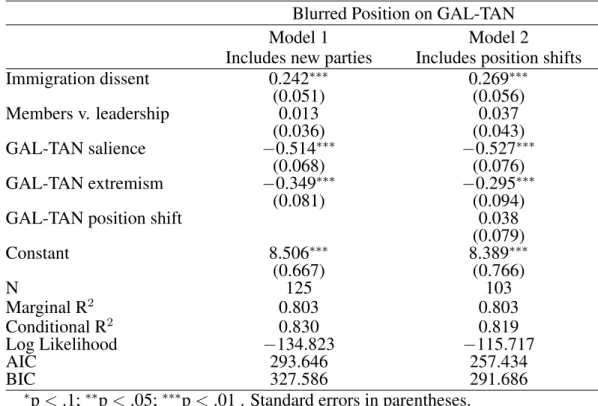
The results in Table 1 below present strong evidence to support my hypothesis that intra-party dissent increases the ambiguity of a party’s positions. Model 1 includes new parties as of the 2017 CHES; Model 2 includes the position shift control (which does not yield statistically significant results) and this drops new parties from the analysis.12 Under controls and in both models, there is a positive, statistically significant (p < .01) relationship between dissent on immigration policy and degree of ambiguity of the party’s position along the GAL-TAN dimension. A second measure of internal party dynamics, the extent to which members v. leadership wield control over official party policy positions, also has a positive association with GAL-TAN opaqueness, in line with my expectation, though it does not reach statistical significance.
Table 1: Models of Blurred Positions
Blurred Position on GAL-TAN
Model 1 Model 2
Includes new parties Includes position shifts
Immigration dissent 0.242∗∗∗ 0.269∗∗∗
(0.051) (0.056)
Members v. leadership 0.013 0.037
(0.036) (0.043)
GAL-TAN salience −0.514∗∗∗ −0.527∗∗∗
(0.068) (0.076)
GAL-TAN extremism −0.349∗∗∗ −0.295∗∗∗
(0.081) (0.094)
GAL-TAN position shift 0.038
(0.079)
Constant 8.506∗∗∗ 8.389∗∗∗
(0.667) (0.766)
N 125 103
Marginal R2 0.803 0.803
Conditional R2 0.830 0.819
Log Likelihood −134.823 −115.717
AIC 293.646 257.434
BIC 327.586 291.686
∗p<.1;∗∗p<.05;∗∗∗p<.01 . Standard errors in parentheses.
Across models, the negative and statisically significant (p < .01) effect of GAL-TAN 12
salience to the party on GAL-TAN blurring corroborates Rovny’s (2012, 2013) original blurring hypothesis; parties have clearer positions along their primary dimension of electoral competition and more ambiguous positions along their secondary dimension of electoral competition. As expected, the more extreme a party is along GAL-TAN, the less ambiguous its position is on the dimension (p < .01). In Model 2, although the effects of GAL-TAN position shift do not reach statistical significance, it is in the expected
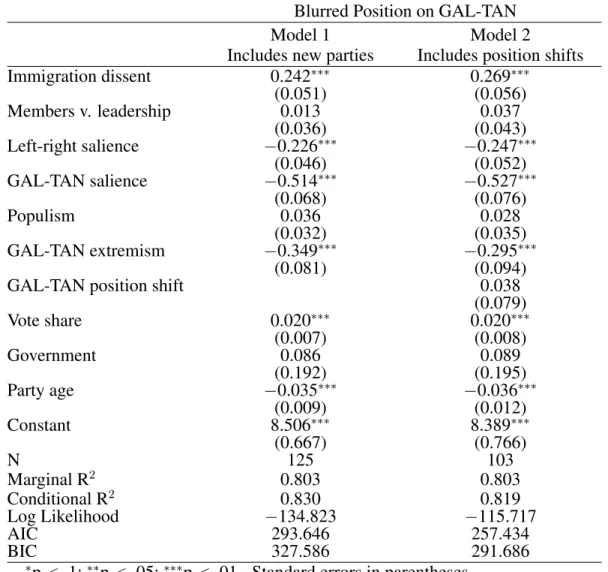
direction; shift in GAL-TAN position increases opaqueness along this dimension. The models in Table 1 present the results for the key variables of interest under controls; additional information about the residual effects of control variables are presented in Appendix 3. Several of the control variables exert substantively small but statistically significant effects on blurred GAL-TAN positions. Parties with higher vote share blur more on GAL-TAN (p <0.05). Additionally, there is a negative, though substantively small, relationship (p < 0.01) between party age and blurring; older parties are less likely than newer parties hold ambiguous positions on GAL-TAN. This result is somewhat surprising given the historical primacy of the economic left-right to these older parties, but given the size of the effect, it may be a residual of internal cohesion over time that is not picked up by the dissent on immigration policy measure.
Conclusion
Using a newly available measure of dimension blurring that is more direct than
positions with a new measure, which has thus far been a useful survey item that is ripe for further analysis. Although this paper has focused on blurring along the GAL-TAN
dimension, similar work should be conducted on blurring along the economic left-right dimension for a fruitful comparison as appropriate data becomes available.
APPENDIX 1: DESCRIPTION OF VARIABLES
Table 2: Description of variables
Variable Description
Blurred position on GAL-TAN Clarity of a party’s position on libertarian-authoritarian is-sues. Original scale reversed such that scale runs from 0 (completely clear) to 10 (not at all clear). Source: Chapel Hill Expert Survey (CHES) 2017.
Immigration dissent Expert placement of party on scale from 0 (party was completely united) to 10 (party was completely divided). Source: CHES 2017.
Members v. leadership Expert placement of party on scale from 0 (members and ac-tivists have complete control over party policy) to 10 (lead-ership has complete control over party policy). Source: CHES 2017.
Left-right salience Expert placement of salience to party on scale from 0 (no importance) to 10 (great importance). Source:CHES 2017. GAL-TAN salience Expert placement of salience to party on scale from 0 (no importance) to 10 (great importance). Source:CHES 2017. Populism Mean score on two expert evaluations of party positions on 1) People v. elite: scaled from 0 (elected office holders should make the most important decisions) to 10 (“the peo-ple,” not politicians, should make the most important deci-sions), and 2) Salience of anti-elite rhetoric: scaled from 0 (not important at all) to 10 (extremely important). Source: CHES 2017.
GAL-TAN extremism Absolute distance of a party’s GAL-TAN position from the median GAL-TAN position across all parties in data set. Expert placement of party on scale from 0 (GAL) to 10 (TAN).Source:CHES 2017.
GAL-TAN position shift Absolute value of the difference between GAL-TAN party positions in 2017 and 2014. Source:CHES 2014, 2017. Vote share Percentage of votes party received in most recent legislative
election as of 2017. Source: CHES 2017.
Party age Number of years since a party is first included in the CHES, which has been released in 1999, 2002, 2006, 2010, 2014, and 2017. Equal to 2017 - year included. Source: Ches 1999-2017.
APPENDIX 2: DESCRIPTIVE STATISTICS OF VARIABLES
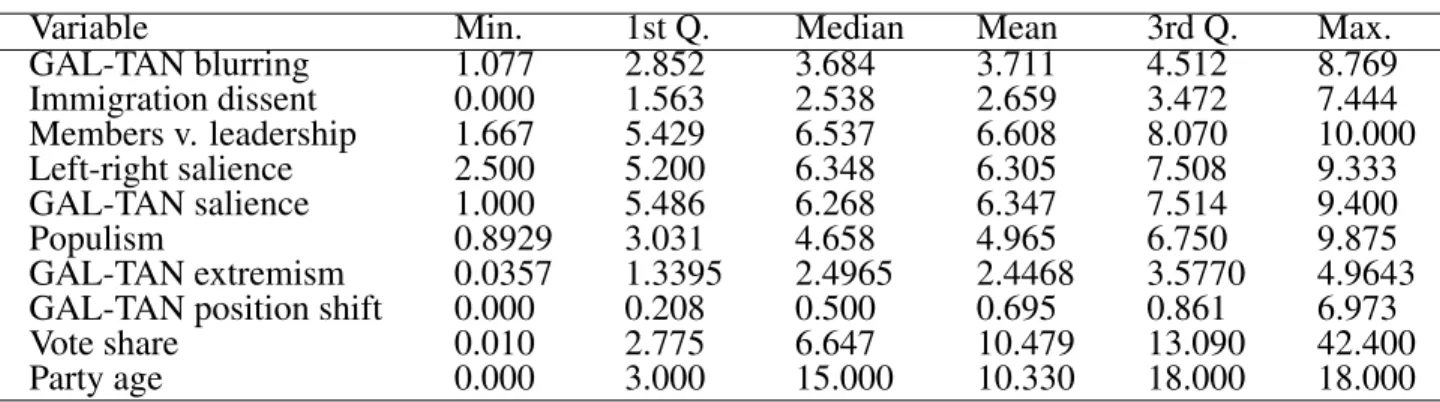
Table 3: Descriptive statistics of variables
Variable Min. 1st Q. Median Mean 3rd Q. Max.
GAL-TAN blurring 1.077 2.852 3.684 3.711 4.512 8.769
Immigration dissent 0.000 1.563 2.538 2.659 3.472 7.444
Members v. leadership 1.667 5.429 6.537 6.608 8.070 10.000
Left-right salience 2.500 5.200 6.348 6.305 7.508 9.333
GAL-TAN salience 1.000 5.486 6.268 6.347 7.514 9.400
Populism 0.8929 3.031 4.658 4.965 6.750 9.875
GAL-TAN extremism 0.0357 1.3395 2.4965 2.4468 3.5770 4.9643
GAL-TAN position shift 0.000 0.208 0.500 0.695 0.861 6.973
Vote share 0.010 2.775 6.647 10.479 13.090 42.400
Party age 0.000 3.000 15.000 10.330 18.000 18.000
Note:Government is an indicator of position in the year 2017. It takes on the value of 0 (no participation, frequency= 99), 0.5 (participation during part of the year,
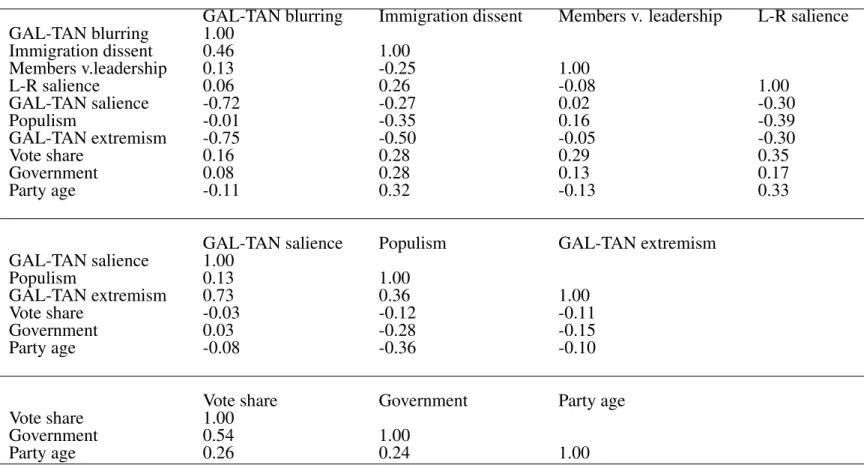
Table 4: Correlation of variables
GAL-TAN blurring Immigration dissent Members v. leadership L-R salience GAL-TAN blurring 1.00
Immigration dissent 0.46 1.00
Members v.leadership 0.13 -0.25 1.00
L-R salience 0.06 0.26 -0.08 1.00
GAL-TAN salience -0.72 -0.27 0.02 -0.30
Populism -0.01 -0.35 0.16 -0.39
GAL-TAN extremism -0.75 -0.50 -0.05 -0.30
Vote share 0.16 0.28 0.29 0.35
Government 0.08 0.28 0.13 0.17
Party age -0.11 0.32 -0.13 0.33
GAL-TAN salience Populism GAL-TAN extremism
GAL-TAN salience 1.00
Populism 0.13 1.00
GAL-TAN extremism 0.73 0.36 1.00
Vote share -0.03 -0.12 -0.11
Government 0.03 -0.28 -0.15
Party age -0.08 -0.36 -0.10
Vote share Government Party age
Vote share 1.00
Government 0.54 1.00
Party age 0.26 0.24 1.00
APPENDIX 3: FULL MODEL WITH CONTROLS
Table 5: Full models with controls
Blurred Position on GAL-TAN
Model 1 Model 2
Includes new parties Includes position shifts
Immigration dissent 0.242∗∗∗ 0.269∗∗∗
(0.051) (0.056)
Members v. leadership 0.013 0.037
(0.036) (0.043)
Left-right salience −0.226∗∗∗ −0.247∗∗∗
(0.046) (0.052)
GAL-TAN salience −0.514∗∗∗ −0.527∗∗∗
(0.068) (0.076)
Populism 0.036 0.028
(0.032) (0.035)
GAL-TAN extremism −0.349∗∗∗ −0.295∗∗∗
(0.081) (0.094)
GAL-TAN position shift 0.038
(0.079)
Vote share 0.020∗∗∗ 0.020∗∗∗
(0.007) (0.008)
Government 0.086 0.089
(0.192) (0.195)
Party age −0.035∗∗∗ −0.036∗∗∗
(0.009) (0.012)
Constant 8.506∗∗∗ 8.389∗∗∗
(0.667) (0.766)
N 125 103
Marginal R2 0.803 0.803
Conditional R2 0.830 0.819
Log Likelihood −134.823 −115.717
AIC 293.646 257.434
BIC 327.586 291.686
∗
REFERENCES
Abou-Chadi, Tarik. 2014. “Niche party success and mainstream party policy shifts: How green and radical right parties differ in their impact.”British Journal of Political Science 46: 417-436.
Achen, Chris. 2002. “Parental socialization and rational party identification.”Political Behavior 24(2): 151-170.
Alvarez, R. Micahel. 1998. Information and elections.University of Michigan Press. Bakker, Ryan, Catherine de Vries, Erica Edwards, Liesbet Hooghe, Seth Jolly, Gary
Marks, Jonathan Polk, Jan Rovny, Marco Steenbergen, and Milada Vachudova. 2015. “Measuring party positions in Europe: The Chapel Hill expert survey trend file, 1999-2010.”Party Politics 21(1): 143-152.
Bartels, Larry. 1986. “Issue voting under uncertainty: An empirical test.”American Journal of Political Science 30(4): 709-728.
Bartels, Larry. 2002. “Beyond the running tally: Partisan bias in political perceptions.” Political Behavior 24(2): 117-50.
Basile, Linda. 2012. “Party competition on the issue of decentralisation: Sharp conflict or shared consensus? Empirical evidences from the Italian case (1994-2008),” in
Biennial Conference of the PSA Territorial Politics Specialist Group, Brussels, Belgium, 13-14 September 2012.
Benoit, Kenneth, and Michael Laver. 2012. “The dimensionality of political space: Epistemological and methodological considerations.”European Union Politics 13(2): 194-218.
Budge, Ian, and David Farlie. 1983. “Party competition: Selective emphasis or direct confrontation? An alternative view with data,” in Hans Daalder and Peter Mair (eds.) Western European Party Systems: Continuity and Change.Beverly Hills, London, New Delhi: Sage.
Downs, Anthony. 1957.An Economic Theory of Democracy. New York: Harper Row. Elias, Sz¨ocsik, and Zuber. 2005. “Position, selective emphasis and framing: How parties
deal with a a second dimension in competition.”Party Politics 21(6): 839-850. Enelow, James, and Melvin J. Hinich. 1981. “A new approach to voter uncertainty in the
Glazer, Amihai. 1990. “The strategy of candidate ambiguity.”American Political Science Review 84(1): 237-241.
Hainmueller, Jens, and Daniel J. Hopkins. 2014. “Public Attitudes Towards Immigration.”Annual Review of Political Science 17: 225-249.
Hooghe, Liesbet, and Gary Marks. 2018. “Cleavage theory meets Europe’s crises: Lipset, Rokkan, and the transnational cleavage.”Journal of European Public Policy 25(1): 109-135.
Hooghe, Liesbet, Gary Marks, and Carole Wilson. 2002. “Does left/right structure party positions on European integration?”Comparative Political Studies 35(8): 965-989. Hotelling, Harold. 1929. “Stability in competition.”Economic Journal 39(153): 41-57. Huber, John, Georgia Kernell, and Eduardo Leoni. 2005. “Institutional Context,
Cognitive Resources and Party Attachments Across Democracies.”Political Analysis 13(4): 365-386.
Kitschelt, Herbert. 1994.The Transformation of European Social Democracy. Cambridge University Press.
Koedam, Jelle. n.d. “A change of heart? Analyzing stability and change in European party systems.” Working paper.
Koedam, Jelle. n.d. “Deconstructing blurring: Party strategy in a multidimensional environment.” Working paper.
Levy, Gilat. 2004. “A model of political parties.”Journal of Economic Theory 115: 250-277.
Lipset, Seymour Martin, and Stein Rokkan, eds. 1967. Party Systems and Voter Alignments: Cross National Perspectives. New York: Free Press.
Lo, James, Sven-Oliver Proksch, and Jonathan B. Slapin. 2016. “Ideological clarity in multiparty competition: A new measure and test using election manifestos.”British Journal of Political Science 46(3): 591-610.
Mair, Peter, and Cas Mudde. 1998. “The party family and its study.”Annual Review of Political Science 1: 211-229.
Jelle Koedam, Filip Kostelka, Gary Marks, Gijs Schumacher, Marco Steenbergen, Milada Vachudova, and Marko Zilovic. 2017. “Explaining the salience of anti-elitism and reducing political corruption for political parties in Europe with the 2014 Chapel Hill Expert Survey data.”Research and PoliticsDOI: 10.1177/2053168016686915. Riker, William H. 1986.The Art of Political Manipulation. New Haven: Yale University
Press.
Robertson, David. 1976.A Theory of Party Competition. London: J. Wiley.
Rooduijn, Matthijs, Wouter van der Brug, and Sarah L. de Lange. 2016. “Expressing or fueling discontent? The relationship between populist voting and political
discontent.”Electoral Studies 43: 32-40.
Rovny, Jan. 2013. “Where do radical right parties stand? Position blurring in multidimensional competition.”European Political Science Review 5(1): 1-25. Rovny, Jan, and Erica Edwards. 2012. “Struggle over dimensionality: Party competition
in Western and Eastern Europe.”East European Politics and Societies 26(1): 56-74. Shepsle, Kenneth A. 1972. “The strategy of ambiguity: Uncertainty and electoral
competition.”American Political Science Review 66(2): 555-568.
Somer-Topcu, Zeynep. 2015. “Everything to everyone: The electoral consequences of the broad-appeal strategy in Europe.”American Journal of Political Science 59(4): 841-854.
Tomz, Michael, and Robert Van Houweling. 2008. “Candidate Positioning and Voter Choice.”American Political Science Review 102(3): 303-318.
Whitefield, Stephen, Milada Anna Vachudova, Marco R. Steenbergen, Robert
Rohrschneider, Gary Marks, Matthew P. Loveless, and Liesbet Hooghe. 2007. “Do expert surveys produce consistent estimates of party stances on European integration? Comparing expert surveys in the difficult case of Central and Eastern Europe.”