ON SUBCATEGORIZATION AND PRIORITY:
EVIDENCE FROM WELSH ALLOMORPHY
Mykel Loren Brinkerhoff
A thesis submitted to the faculty of the University of North Carolina at Chapel Hill in partial fulfillment of the requirements for the degree of Master of Arts in the
Department of Linguistics.
Chapel Hill 2019
Approved by:
Jennifer L. Smith
Brian Hsu
©2019
ABSTRACT
Mykel Loren Brinkerhoff: On Subcategorization and PRioRity: Evidence from Welsh Allomorphy (Under the direction of Jennifer L. Smith)
ACKNOWLEDGEMENTS
This thesis would never have been possible without the help of a large number of people. To name all who have had an impact or who have contributed in any way to this thesis would fill a vast number of tomes. If I inadvertently leave someone out who is deserving of acknowledgment, know it is not out of spite or a slight against you.
First and foremost, I wish to express eternal gratitude to my wife Betsy, without whose love and support I would never have considered going to graduate school and would not have been able to complete this thesis. Additional thanks is owed to my parents, who pushed me to be better and for their support and encouragement.
I wish to express my gratitude and thanks for the countless hours of discussion, assistance, and advise that my advisor, Jennifer L. Smith, has given me during my time here at the University of North Carolina at Chapel Hill. Without her help, I would not be where I am today. I wish to also thank the rest of the members of my thesis committee, Brian Hsu and Katya Pertsova, for the assis-tance that they have given me as we discussed various aspects of the thesis.
I am indebted to the wonderful members of the UNC P-side research group for the feedback that they gave me as they heard various aspects and parts of this thesis.
I wish to thank the many friends and acquaintances that I have made during my time here: Steven Kramer, Mel Klein, Haley Boone, Brent Eisenbarth, Will Carter, Jen Boehm, Amy Reynolds, Simon Wolf, John Kidd, Stephen Kudlacek, Tayler Billings, and many more. You all have helped to make my experience here one of the best and helped to provide me with an outlet from the rigors of academic life.
I also wish to thank several of the other professors in the linguistics department that have helped me. Specifically, Mike Terry, for always being there with an open door when I needed to talk or had concerns and Paul Roberge, thank you for providing me with a final year full of stories from our pre-history to the northern lands.
TABLE OF CONTENTS
LIST OF TABLES . . . viii
LIST OF FIGURES . . . ix
LIST OF ABBREVIATIONS AND SYMBOLS. . . x
1 IntRoduction . . . 1
2 Data and DescRiptive GeneRalizations . . . 3
2.1 Welsh phonology . . . 3
2.1.1 Consonants . . . 4
2.1.2 Vowels . . . 4
2.1.3 Orthography . . . 6
2.1.4 Syllables and phonotactics . . . 7
2.1.5 Summary . . . 9
2.2 Definite Article allomorphy . . . 10
2.2.1 Summary . . . 13
2.3 Initial Consonant Mutation . . . 13
2.3.1 Initial Consonant Mutation Patterns . . . 14
2.3.2 Soft Mutation triggers . . . 16
2.3.3 Exceptions to mutation . . . 18
2.4 Interaction of the Definite Article and Initial Consonant Mutation . . . 18
2.5 Summary . . . 19
3 TheoRetical BacKgRound . . . 21
3.1.1 Lexical listing . . . 22
3.1.2 Prioritization . . . 24
3.1.3 Lexical Prespecification . . . 28
3.1.4 Summary . . . 30
3.2 Clitics . . . 31
3.3 Prosodic Subcategorization . . . 32
3.3.1 Subcategorization frames . . . 34
3.3.2 Summary . . . 36
3.4 Summary . . . 36
4 Definite ARticle Analysis . . . 38
4.1 Main proposal . . . 38
4.2 Alternative approaches . . . 48
4.2.1 Hannahs & Tallerman’s (2006) account . . . 48
4.2.2 PRioRity alone . . . 51
4.2.3 Subcategorization . . . 53
4.3 Summary . . . 56
5 Initial Consonant Mutation . . . 58
5.1 Initial Consonant Mutation Analysis . . . 58
5.2 Initial Consonant Mutation and the Definite Article Analysis. . . 62
5.3 Alternative Analyses. . . 64
5.3.1 Kibre’s (1995) Floating Features . . . 64
5.3.2 Green’s (2006) Lexical Listing . . . 66
5.3.3 Hannahs’s (2013a) Pattern Extraction . . . 68
5.3.4 Hannahs & Tallerman (2006) . . . 69
5.4 Summary . . . 71
6 Conclusion . . . 72
LIST OF TABLES
2.1 Correspondence for consonants . . . 7
2.2 Correspondence for vowels . . . 7
2.3 Mutation table showing soft, nasal, and aspirate mutation (Borsley et al. 2007: 20) . . . 14
3.1 Table of the gender allomorphs in Catalan taken from Bonet et al. (2007: 917) . . . 29
3.2 Correspondence table between the syntactic and prosodic structure (Tyler 2019: 5) . . . 33
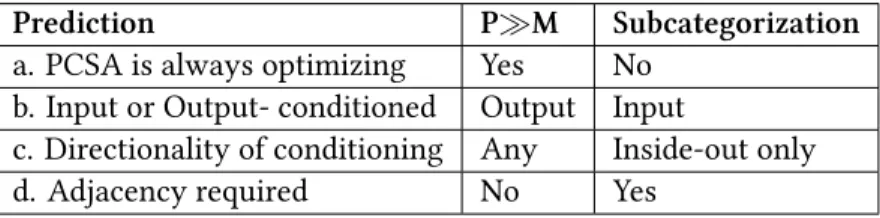
4.1 Predictions and results of the two approaches to PCSA . . . 54
4.2 Welsh Data against the two approaches to PCSA . . . 56
5.1 Welsh Mutations table . . . 59
LIST OF FIGURES
2.1 Consonant inventory for Northern Welsh varieties . . . 4
2.2 Consonant inventory for Southern Welsh varieties . . . 4
2.3 Welsh Vowel Inventory . . . 5
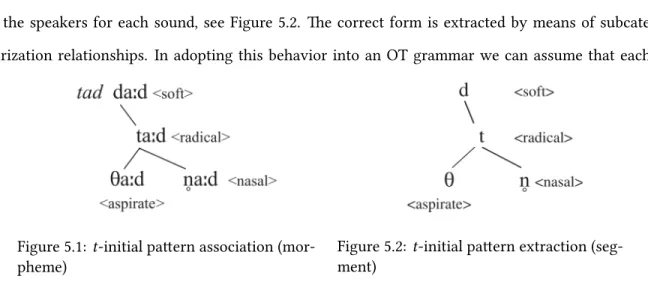
5.1 t-initial pattern association (morpheme) . . . 59
LIST OF ABBREVIATIONS AND SYMBOLS
AM Aspirate mutation
ICM Initial consonant mutation
LS Lexical Selection
NM Nasal Mutation
OT Optimality Theory
PCSA Phonologically Conditioned Suppletive Allomorphy
SM Soft Mutation
xo Soft Mutation
xn Nasal Mutation
CHAPTER 1
Introduction
This thesis is concerned with the interaction of the phonological and morphological compo-nents of grammar within a constraint-based theory, specifically within Optimality Theory (Prince & Smolensky 2004 [1993]). This interaction is explored in the specific context of the Welsh language’s definite article allomorphy. The selection of the correct definite article allomorph is conditioned by the syntactic, phonological, and morphological component at the intersection of these components. I show that the interaction of both prosodic subcategorization(Inkelas 1990; Zec 2005; Bye 2007; Bennett et al. 2018; Tyler 2019) and Lexical Selection’s constraints on morpheme and allomorph se-lection, in the form of PRioRity and Respect (Mascaró 2007; Bonet et al. 2007; Brinkerhoff 2019), are necessary for giving a complete and adequate account of the Welsh definite article allomorphy. This is because of the clitic status of the Welsh definite article with its allomorphs exhibiting different cliticizing patterns. Additionally, this proposal is necessary to account for the phonologically non-optimizing nature of one of the definite article allomorphs.
This thesis provides an account for initial consonant mutations within Optimality Theory and Lexical Selection. This is accomplished by the listing of the mutation patterns into sets that the gram-mar selects through lexical subcategorization, which is accounted for by means of the morphological constraint Respect (Bonet et al. 2007).
This thesis contributes to our understanding of morpho-phonology by addressing the claims made by Paster thatmorphological subcategorization alone can account for all cases of allomorphy (Paster 2005, 2006, 2015). I demonstrate that this is not the case and that morphological constraints are needed to account for the definite article.
al-lomorphs are associated with different prosodifications, with one being enclitic and the others being proclitic. By allowing the different allomorphs of the definite article to have their prosodic subcatego-rizations, the facts of the definite article can be accounted for within Optimality Theory.
CHAPTER 2
Data and Descriptive Generalizations
For any discussion of Welsh phonology or any part of the grammar interacting with the phonol-ogy, it is vital to note that there does not exist a unified spoken standard for the language. It is com-monly known that the Welsh language is divided into two larger dialect areas: the Northern varieties and the Southern varieties (Morris-Jones 1913; Thorne 1993; King 2015; Borsley et al. 2007; Hannahs 2013b). These differences between the Northern and Southern varieties amount to changes in the lex-icon, syntactic structures, morphology, and most noticeably phonological and phonetic differences. This chapter introduces first a summary of the Welsh phonology with an emphasis on the segment inventories, syllables, and phonotactics in Section 2.1. The data concerning the definite article allo-morphy is introduced in Section 2.2. The fundamental aspects of initial consonant mutation in Welsh are introduced in Section 2.3. Finally, the data concerning the interaction of the definite article allo-morphy and initial consonant mutations are presented in Section 2.4. This chapter concludes with a summary in Section 2.5.
2.1 Welsh phonology
vowel inventory. A discussion of the orthography is given in Section 2.1.3. Finally, a discussion of the syllable structure and phonotactics is given in Section 2.1.4.
All information in this section is based on Hannahs (2013b), unless otherwise noted.
2.1.1 Consonants
Figures 2.1 and 2.2 below lay out the basic consonant inventories in the Northern and Southern vari-eties respectively. The main differences between the two varivari-eties lie in their treatment of the glottal fricative. Southern varieties do not have this sound and additionally lack the voiceless nasals1 and
voiceless aspirated rhotic whereas the Northern varieties have them. Additionally, the Southern vari-eties have [ z ] which is only found in English loanwords such assw [ zuː ] ‘zoo’.2
Bilabial Labio-dental Dental Alveolar Lateral Post-aveolar Palatal Velar Uvular Glottal
Stop p b t d k g
Nasal m̥ m n̥ n ŋ̊ ŋ
Affricate tʃ dʒ
Fricative f v θ ð s ɬ ʃ χ h
Liquid r̥ʰ r l
Glide w j w
Figure 2.1: Consonant inventory for Northern Welsh varieties
Bilabial Labio-dental Dental Alveolar Lateral Post-aveolar Palatal Velar Uvular Glottal
Stop p b t d k g
Nasal m n ŋ
Affricate tʃ dʒ
Fricative f v θ ð s z ɬ ʃ χ
Liquid r l
Glide w j w
Figure 2.2: Consonant inventory for Southern Welsh varieties
2.1.2 Vowels
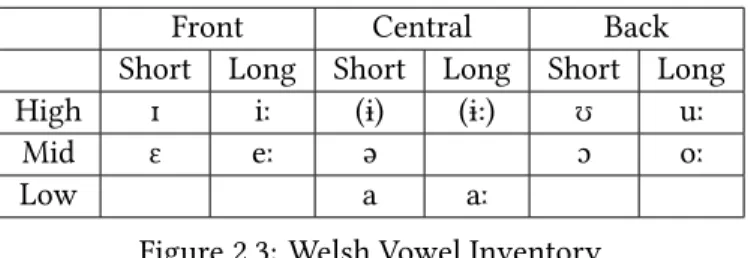
The Welsh vowel inventory consists of between 11-13 monophthongs, depending on which variety is under consideration. Just as with the consonants, Southern varieties have a more restrictive vowel system than Northern varieties. Southern varieties, in general, do not contain the high central vowels
1This has led some researchers to the conclusion that all of these forms are better analyzed as consisting of a nasal followed
by aspiration, [ mʰ nʰ ŋʰ ] or [ m̥ʰ n̥ʰ ŋ̊ʰ ].
which have merged with the high front vowels, whereas the Northern varieties have retained this sound. This difference is indicated in Figure 2.3 by the high central vowels being in parentheses.
Front Central Back
Short Long Short Long Short Long
High ɪ iː (ɨ) (ɨ:) ʊ uː
Mid ɛ eː ə ɔ oː
Low a aː
Figure 2.3: Welsh Vowel Inventory
As can be seen in Figure 2.3, all Welsh vowels—except for schwa—make a distinction between long and short. Just as in English, the difference between long and short also corresponds to a change in vowel quality for the mid and high vowels ,with the long vowels being pronounced tensed and the short vowels lax. However, unlike English, the mid tense vowels are not diphthongs but monoph-thongs.
Welsh also has a series of diphthongs with different quantities between the North/South divide. In Southern varieties, there are a total of eight diphthongs which symmetrically fall into two cate-gories with four diphthongs closing to the high front vowel and four diphthongs closing to the high back vowel.
(1) Southern diphthongs (Hannahs 2013b: 24)
a. [aɪ] [taɪ] tai ‘houses’ [ɔɪ] [trɔɪ]troi ‘turn’ [əɪ] [nəɪd] neud ‘make, do’ [ʊɪ] [mʊɪ]mwy ‘more’
b. [aʊ] [ɬaʊ]llaw ‘hand’ [ɛʊ] [ɬɛʊ]llew ‘lion’ [əʊ] [ˈbəʊɪd]bywyd ‘life’ [ɪʊ] [ɬɪʊ]lliw ‘colour’
(2) Northern diphthongs (Hannahs 2013b: 25)
a. High front closing [aɪ] [tʰaɪ] tai ‘houses’ [ɔɪ] [tʰr̥ɔɪ]]troi‘turn’ [əɪ] [tʰəɪ] tei ‘tie’
b. High back closing [aʊ] [ɬaʊ]llaw ‘hand’ [ɛʊ] [ɬɛʊ]llew ‘lion’ [əʊ] [ˈbəʊɪd]bywyd ‘life’ [ɪʊ] [ɬɪʊ]lliw ‘colour’ [ɨʊ] [ɨʊ]yw ‘is’
c. High central closing [aɨ] [kʰaɨ]cau ‘close’ [ɑɨ] [kʰɑɨ]cae ‘field’3
[ɔɨ] [kʰɔɨd] coed ‘wood’ [ʊɨ] [mʊɨ]mwy ‘more’ [əɨ] [nəɨ]neu‘or’
2.1.3 Orthography
Any discussion of the Welsh phonology is neglectful if it fails to mention the orthography of this lan-guage. One reason that this is necessary, is that almost all descriptions and accounts of various as-pects of Welsh present the data solely in the orthography. This is done both because of the lack of a standardized spoken language and the differences in the pronunciation between the Northern and Southern varieties.
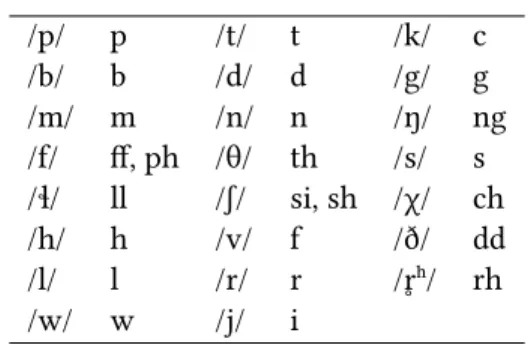
The Welsh orthography is relatively phonemic (Thorne 1993), which greatly aids in knowing the pronunciation of any given word, even across the North/South divide, as the differences between the two varieties are systematic. However, the correspondence is not always clear due to a large number of digraphs that are employed in Welsh. The following tables modified from Thorne (1993) present the phoneme and the grapheme associated with it for the consonants and vowels in Tables 2.1 and 2.2 respectively.
Welsh also employs a series of diacritics to encode other phonetic information (Thomas 1996). These include the circumflex (ˆ), grave accent (‘), acute accent (´), and diaeresis (¨). The circumflex indicates that the vowel is long or to differentiate between two homophones. However, not all long vowels have the circumflex because the length of the vowel can be predicted by the orthography. As noted by Williams (1983: 179), in stress syllables monophthongs are short if they are followed by /p t k m ŋ/ or if followed by two or more consonants, in all other cases the vowel is pronounced long.4
3The low back vowel is only in this diphthong and is only found in Northern varieties. This vowel is not anywhere else part
of the vowel inventory.
4Hannahs (2013b: Chapter 3) attributes this to a word minimality requirement that words must be minimally bimoraic,
Table 2.1: Correspondence for consonants
/p/ p /t/ t /k/ c
/b/ b /d/ d /g/ g
/m/ m /n/ n /ŋ/ ng
/f/ ff, ph /θ/ th /s/ s /ɬ/ ll /ʃ/ si, sh /χ/ ch
/h/ h /v/ f /ð/ dd
/l/ l /r/ r /r̥ʰ/ rh
/w/ w /j/ i
Table 2.2: Correspondence for vowels /iː/ /ɪ/ i, y (in the South)
/eː/ /ɛ/ e /aː/ /a/ a /oː/ /ɔ/ o /uː/ /ʊ/ w
/ɨː/ /ɨ/ u, y (in the North)
/ə/ y
/əɪ/ ei /ɪʊ/ iw, yw, uw /əɨ/ eu
/aɪ/ ai /ɛʊ/ ew /aɨ/ au
/ɔɪ/ oi /aʊ/ aw /ɑɨ/ ae
/ʊɪ/ wy /oʊ/ ow /ɔɨ/ oe
/ɨʊ/ yw, uw /ʊɨ/ wy /əʊ/ yw
The grave accent occasionally indicates that a vowel is short where a long vowel is expected from the orthography and is primarily found with foreign borrowings. The acute accent shows where stress is when it is different than the default stress placement. Both the grave and acute accent are commonly omitted in everyday communications. The last diacritic is the diaeresis, which indicates that two adja-cent vowels are pronounced as monophthongs instead of as a diphthong (i.e., they are pronounced as belonging to two different syllables).
2.1.4 Syllables and phonotactics
As noted by Hannahs (2013b), there has not been much work on the syllable and its divisions beyond a few indications by Morris-Jones (1913) and Pilch (1957: 49–54).
Welsh allows syllables to lack onsets and codas. This means that a syllable is allowed to consist solely of a nucleus.
(3) Welsh syllable consisting of only a nucleus a. [aː]â ‘with’
b. [ʊɨ]ŵy ‘egg’
(4) Welsh monosyllables with simple onsets and/or simple codas a. [tʰɨː]tŷ ‘house’
b. [aʊχ]awch ‘edge’ c. [ɬaːð]lladd ‘kill’
Welsh also allows both complex onsets and codas (i.e., onsets and codas with more than one seg-ment). For complex onsets, the maximum number of segments is limited to three. Thanks to the ex-tensive initial consonant mutations found in Welsh there is a large number of two-member consonant clusters that are permissible in Welsh, see (5a). All of the permissible three-member complex onsets involve the phone [s] as the first member of the cluster, see (5b).
(5) Complex onsets in Welsh
a. Permissible two-member onset clusters, including both citation and mutation forms: pl, pr, fl, fr, bl, br, m̥l, m̥r, vl, vr, ml, mr
tl, tr, θr, θl, dl, dr, n̥l, n̥r, ðr, nr
kl, kr, kn, χl, χr, χn, ɡl, ɡr, ɡn, ŋ̊l, ŋ̊r, ŋ̊n, ŋl, ŋr ɡw, kw, χw
sb, st, sɡ
b. Permissible three member onset clusters: sbr, sbl, str, sɡl, sɡr
Regarding coda clusters, Welsh allows two-segment coda clusters at maximum. These coda clus-ters strictly adhere to the sonority sequencing principle and because they do not take part in conso-nant mutations these clusters are not as extensive as the onset clusters. As noted by Hannahs (2013b), “[t]hese [clusters] may consist of an obstruent followed by an obstruent, Pasg [pask] ‘Easter’,hollt [hɔɬt] ‘split’, or a sonorant followed by a sonorant, e.g. darn[darn] ‘piece’, talm [talm] ‘portion’, or a sonorant followed by an obstruent, e.g. barf [barv] ‘beard’,balch [balχ] ‘proud’,gardd [garð] ‘gar-den’,merch [mɛrχ] ‘girl’.”
(6) Apparent sonority sequencing violations in Welsh pobl ‘people’ cwbl ‘all’
llestr ‘vessel’ ffenestr ‘window’ posibl ‘possible’ perygl ‘danger’
Welsh takes several different approaches in resolving these clusters which include svarabhakti (i.e., copy-epenthesis) of the preceding vowel, deletion of the liquid, or metathesis. These different processes all result in resolving violations of sonority sequencing. A detailed account is given in (Hannahs 2013b: Ch. 5) and is beyond the scope of this thesis.
In regards to the syllabification of words and phrases, syllabification occurs at the prosodic word and will not syllabify across prosodic word boundaries (Hannahs 2013b: 38f). At the level of the prosodic word, syllables will be formed that will make the word most phonologically and phonotacti-cally optimal.5 For example, if we consider the phrasegyda’r afon‘with the river’ the syllabification
at the word level would be as follows (the # indicates a prosodic word boundary):
(7) Word level syllabification of gyda’r afon [ gɨ.dar # a.vɔn ]
2.1.5 Summary
This section presents the basic descriptions of the phonology and syllable structure for Welsh. Al-though there is a lack of a spoken standard, there is still significant overlap between the Northern and Southern varieties which allows for their mutual discussion.
5Because words are rarely pronounced in isolation, there is some evidence that syllabification is fluid across word
2.2 Definite Article allomorphy
The Welsh definite article has three phonologically conditioned allomorphic forms (y/yr/’r). The al-lomorph y appears when the following word begins with a consonant, while theyr allomorph is present when the following word begins with a vowel, glide, or the phone [ h ] (Hannahs & Taller-man 2006: 782).6 The third allomorph of the definite article, ’r, takes precedence over the other
al-lomorphs whenever the preceding word is vowel-final regardless of the following context. This gen-eralization is summarized below in (8). All examples in this section are from Hannahs & Tallerman (2006), unless otherwise noted. Welsh examples are primarily left in their orthographic forms because of a lack of a standardized pronunciation for Welsh as discussed above. IPA transcriptions will be used where necessary to help clarify a point.
(8) Welsh definite article by environment with examples.
a. yr/_V, h, G yr afon‘the river’
b. y/_C
y llyfr ‘the book’
c. ’r/V_
o’r afon ‘from the river’ o’r llyfr ‘from the book’
Based on the generalizations described in the preceding paragraph and in (8), the behavior ap-pears to be a simple case of phonologically conditioned suppletive allomorphy (PCSA). PCSA is when the phonology triggers the allomorphy of a given lexeme but the choice of which allomorph is morpheme-specific and does not reflect language-wide phonological processes. Hannahs & Tallerman (2006),
however, claim that this is not the case because the ’r allomorph takes precedence over the other allomorphs whenever its environment is present, regardless if the environments for the other allo-morphs are present or not.
6This is not entirely true as it has been remarked that in Modern Welsh the two glides behave differently in this regard. It
was noted at least as far back as Morris-Jones (1913: 192) that the labio-velar glide patterns with the consonants in respect to the definite article allomorphy and the palatal glide patterns as a vowel, which is consistently transcribed by Morris-Jones as [ i ̯ ] instead of [ j ], which others follow (e.g. Iosad 2007, 2016, 2017). Others have noticed this pattern as well and frequently mentioned this pattern in contemporary grammatical accounts of the language (Thorne 1993; King 2015).
(9) The precedence of’r a. o’r
from-the
llyfr/*o book
yllyfr (Preposition)
b. Brynaist bought.2sg
ti’r you-the
llyfr?/*Brynaist book
tiyllyfr? (Determiner)
‘Did you buy the book?’ c. Pwy
Who ydy’r is-the
meddyg?/*Pwy doctor
ydyymeddyg? (Verb)
‘Who is the doctor?’ d. rhieni’r
parents-the
ysgolfeistr/*rhieni schoolmaster
yrysgolfeistr (Noun)
‘the parents of the schoolmaster’
In Welsh, there exists a small class of morphemes which alternate between a vowel-final form and a consonant-final form, see (10). The consonant-final form of these morphemes surfaces only when the following word is vowel-initial, in all other cases the vowel-final form is observed.
(10) Functional morphemes that have vowel-/consonant-final alternations (Information collected from King 2015)7
gyda/gydag ‘with’
â/ag ‘with’
tua/tuag ‘towards, about’ na/nag ‘than’
a/ac ‘and’
na/nac ‘neither/nor’
When these morphemes (hereafter referred to as the gyda-like morphemes) are spoken in conjunc-tion with the definite article two potential forms are logically possible. The first is with the enclitic definite article, ’r, and the vowel final form of the gyda-like morphemes, such asgyda. The other pos-sibility is the consonant-final form of thegyda-like morpheme, such asgydag and one of the proclitic allomorphs,y/yr. Of these two possible forms only one is ever encountered in the data; the vowel-final form of the gyda-like morphemes and the enclitic definite article allomorph.
7All of the morphemes that have this alternation are functional morphemes that end in a velar stop. Because they all end in
(11) The interaction ofgyda and the definite article before a C-initial word
a. First possibilitygyda’r nod gyda’r nod [ gɨ.darnɔd] ‘with the aim’
b. Second possibility *gydag y nod *gydag y nod [ *gɨ.dag ə.nɔd] ‘with the aim’
I show in Chapter 4 that the interaction of these two classes of morphemes is still phonologically conditioned. The choice of the different allomorphs is the result of the lexical listing of the allomorphs and the interaction of the prosodic structure of the definite article which has been demonstrated to be a clitic for over a hundred years (Morris-Jones 1913) and will be further discussed in Section 4.1. This is still the result of the phonological conditioning of the allomorphs.
In addition to the facts already presented, one further aspect of the definite article is commonly encountered in the data. As previously stated, the enclitic form of the definite article takes prece-dence whenever its environment is present. This is true for most instances, except in certain circum-stances where the enclitic form is suppressed, which results in the proclitic forms of the definite ar-ticle surfacing. In Welsh, the enclitic form is required to be pronounced in in conjunction with its phonological host and as such cannot be stressed. In circumstances where one wishes to stress the definite article for emphasis then one of the other allomorphs (y/yr) is present depending on the fol-lowing phonological contexts. In the folfol-lowing examples, the environments and definite article are in italics.
(12) a. Caffi cafe Morgan M. ydy is Y the lle place i to fynd! go ‘Cafe Morgan isthe place to go!’ b. Caffi cafe Morgan M. ydy is YR the unig only lle place i to fynd! go ‘Cafe Morgan isthe only place to go!’
(13) a. Citations. Er although mai comp ‘y the pobloedd’ peoples a Rel ddisgwylir expect:pRes:psv ‘althoughy pobloedd is expected’
b. Part of a title or name8
Mae is yr the Arolwg survey Ordnans ordnance yn pRog adolygu review 30,000 30,000 o of fapiau maps y the flwyddyn. year ‘The Ordnance Survey revises 30,000 maps a year.’
c. Deliberate pause. Ni neg alwodd called neb no-one yma here ||y the dydd day o’r blaen before
|| = pause
‘No one called here the other day.’
According to (Hannahs & Tallerman 2006: 792f), the suppression of the enclitic form of the definite article is attributed to the presence of an intonational phrase boundary which, as noted by Nespor & Vogel (2007 [1986]), blocks various kinds of segmental rules from applying.9
2.2.1 Summary
We have seen in this section that the definite article has three distinct allomorphs which appear to have a skewed preference for one of the allomorphs, in this case, the allomorph’r [r], being chosen over the other two forms whenever its environment is present. This asymmetry between the allo-morphs will be crucial to their analysis and will need to be accounted for in any analysis of the defi-nite article.
2.3 Initial Consonant Mutation
Initial consonant mutation is a well-known process among the members of the modern Celtic lan-guages (see Hannahs 2011 for a discussion given to the long history of initial consonant mutations
8In this example a further position that one expects to find the encliticized definite article is withfapiau y flwyddyn.
How-ever, because the phrasey flwyddynis an adjunct to the verb phrase instead of forming a constituent with the preceding noun encliticization is blocked.
9Under Match Theory (Selkirk 2009, 2011), this cannot be caused by an intonational phrase boundary, because intonational
in the Celtic language within linguistics and philology). In these languages, certain word-initial con-sonants undergo a series of systematic and phonetically distinct alternations which are conditioned by specific contexts and environments (Hannahs 2011). These contexts are generally understood to have originated historically as phonetic processes of external sandhi of the word-initial consonant in various phonologically conditioned environments which have undergone a process of grammaticaliza-tion followed by the loss of the phonological triggers of mutagrammaticaliza-tion.10 This process of
grammaticaliza-tion has resulted in specific lexical items governing the different mutagrammaticaliza-tions, with each of the former phonological processes now associated with the different mutation types.
2.3.1 Initial Consonant Mutation Patterns
In Modern Welsh, three different mutations can occur on the initial consonants which are referred to asradicals, which are specifically the non-mutated consonants and word forms.11 These mutations
are: Soft, Nasal, and Aspirate Mutation. These mutations only happen with a subset of the consonant inventory of the language. Those consonants that undergo mutation are summarized in Table 2.3 be-low. Cells that are left blank indicate that this mutation does not occur with the associated radical.
Table 2.3: Mutation table showing soft, nasal, and aspirate mutation (Borsley et al. 2007: 20) Radical Soft Nasal Aspirate
p [p] b [b] mh [m̥] ph [f] t [t] d [d] nh [n̥] th [θ] c [k] g [g] ngh [ŋ̊] ch [χ] b [b] f [v] m [m]
d [d] dd [ð] n [n] g [g] – zero ng [ŋ] m [m] f [v]
ll [ɬ] l [l] rh [r̥ʰ] r [r]
Of these mutations, the soft mutation is the only one in which all the radicals take part. Soft mutation is also the most varied in terms of the phonological changes that the radicals undergo. Un-der soft mutation, voiceless stops become voiced, and voiced stops become fricatives with the excep-tion of /g/ which, descriptively speaking, deletes. Addiexcep-tionally for the remaining three sounds that participate in soft mutation, [ m ] becomes [ v ], [ ɬ ] becomes [ l ], and [ r̥ʰ ] becomes [ r ]. In nasal
10See Hannahs (2011) and the citations therein for a detailed discussion.
mutation, each of the stops become nasal stops while preserving their voicing.12 Finally, aspirate
mu-tation causes the voiceless stops to become fricatives.
In (14), we see the mutations that the wordtad ‘father’ undergoes with the different mutation triggers (with the radical—or citation—form given first). As shown, the soft mutation form of tad is shown to be triggered by the second person singular possessive pronoun (dy) resulting in dad. Next, we see that nasal mutation is triggered by the first person singular possessive (fy) resulting in nhad and finally we see aspirate mutation which is triggered by the third person feminine possessive pro-noun (ei) and results in thad.
(14) Examples of Welsh initial consonant mutations ontad ‘father’ (Hannahs 2011: 2807)
radical tad [taːd] ’father’
soft mutation dy dad [də daːd] (2sg.poss father) ’your father’ nasal mutation fy nhad [ə n̥aːd] (1sg.poss father) ’my father’ aspirate mutation ei thad [i θaːd] (3fem.sg.poss father) ’her father’
We saw that each type of mutation is triggered by different sets of lexical items. There is only a small class of lexical triggers for each of the associated mutations with the sole exception of soft mu-tation, which will be discussed below. In (15), we see the specific lexical triggers associated with the nasal and aspirate mutations. These lexical triggers are commonly listed in Welsh grammars, and this list of some of the triggers are drawn from King (2015: Section 9) specifically. Each of these forms is also listed with the typical diacritic found in those same grammars and in most dictionaries to indi-cate what mutation is associated with those lexemes.
(15) Lexical triggers for nasal and aspirate mutation a. Nasal Mutation
fyn ,’(y)nn ‘my’
ynn ‘in’
12This is only true of the Northern varieties of Welsh. In Southern varieties all nasal mutations are voiced regardless of the
b. Aspirate Mutation
a/ach ‘and’
â/ach ‘with’
chweh ‘six’
eih ‘her [poss.]’
gyda/gydagh ‘with’
trih ‘three (m)’
tua/tuagh ‘towards, about’
2.3.2 Soft Mutation triggers
Soft mutation is by far the most widespread of the different types of mutation found in Welsh. In ad-dition to a list of over 20 lexical triggers, this mutation also has at least three purely morphosyntactic contexts.
(16) Some of the lexical triggers for soft mutation aº [relative]
dacwº ‘(over) there is/are…’ dauº ‘two (m)’
eiº ‘his’ rhyº ‘too’ neuº ‘or’
One of these morphosyntactic contexts is observed when feminine singular nouns follow the definite article. This context presents some unique issues related to the distribution of the definite article allo-morphs, which will be discussed further in Section 2.4.
(17) Morphosyntactic contexts for SM (Borsley et al. 2007) a. Pre-nominal adjective trigger of SM on nouns
hen gath (cath >gath)
‘old cat’
b. Feminine singular noun trigger of SM on all following adjectives merch dal gerf (tal >dal,cerf >gerf)
girl.fem.sg tall strong
‘(a) tall, strong girl’
An additional context that soft mutation occurs in is called “syntactic soft mutation.” According to many authors, this mutation is purely syntactic, hence the name (see Tallerman 2006 and Bors-ley et al. 2007 for a detailed discussion and review of syntactic soft mutation and previous accounts). According to Borsley et al. (2007: 223-226), there has been extensive debate over the last twenty-five years as to what exactly causes or triggers “syntactic soft mutation.” The examples in (18) show the range of syntactic positions and categories in which this mutation occurs, including objects (18a), VPs (18b), embedded clauses (18c), and subjects (18d) as possible targets for syntactic soft mutation.
(18) Examples of syntactic soft mutations which are marked with an underline (taken from Borsley et al. 2007: 224)
a. Direct objectbeic Prynodd buy.past.3s y the ddynes woman feic. bike ’The woman bought a bike.’ b. VP with initial wordgwerthu
Gwnaeth do.past.3s y the dyn man [werthu sell.inf beic]. bike ’The man sold a bike.’
d. Subject of the sentence ci Mae
be.pRes.3s yn in
yr the
ardd garden
gi. dog ’There’s a dog in the the garden.’
This mutation and its conditioning are beyond the scope of this thesis and will not be discussed here. Instead, I refer the interested reader to Borsley et al. (2007: Ch 7) and Tallerman (2006) for a detailed discussion concerning this mutation.
2.3.3 Exceptions to mutation
One issue that remains to be discussed concerning mutation is the lexical exceptions that do not un-dergo mutation or that only unun-dergo a subset of the mutations. It has been noted by many that there exists a series of lexical items that are impervious to the effects of mutation (e.g., Thorne 1993; Green 2006, 2007; Hannahs 2011; King 2015). According to King, these exceptions for mutation are: words that are already mutated such asbeth? ‘what’ (frompeth ‘thing’) or dros‘across, over’ (originally tros), miscellaneous words such asdyº ‘your’,byth‘ever/never’, andlle ‘where’; non-Welsh place-names, personal place-names, and some foreign words (especially those that begin with [g]). This excep-tionality will prove crucial to the analysis of initial consonant mutations presented in Chapter 5.
2.4 Interaction of the Definite Article and Initial Consonant Mutation
As was mentioned in the previous section, feminine singular nouns undergo mutation when there is a definite article directly proceeding them in the sentence.
(19) y ‘the
ddynes
woman.fem.sg’
(dynes>ddynes)
with a consonant cluster when soft mutation occurs, the resultant form will be consonant-initial. If, however, the word begins with the radical /g-/ only, then it would result in a vowel-initial form after soft mutation, see (20). These forms then become the basis for which allomorph will appear for the definite article.
(20) Definite article trigger of SM on feminine singular nouns
a. y ‘the
lasog
gizzard.fem.sg’
(glasog>lasog) b. yr
‘the ardd
garden.fem.sg’
(gardd>ardd)
As stated by Hannahs & Tallerman (2006): “We seem then to have a paradox, a classic chicken and egg situation. The lenition on the noun…is triggered when the noun follows the article, but the correct form of the article (y or yr) cannot be inserted unless the initial segment of the noun is known, which depends on whether or not lenition has applied.” This is indeed the case if we consider this from a Distributed Morphology (Halle & Marantz 1993) perspective and the order in which lexical items are inserted into the derivation. However, this is not a problem from a parallel insertion of the lexical material into the morpho-phonological component of the grammar like the one presented in this thesis in Chapter 5.
2.5 Summary
This chapter has laid out the basics of the Welsh phonology as well as information regarding the syl-lable structure. Most importantly this chapter has presented the facts concerning the definite article and the initial consonant mutations that occur in Welsh. These facts will prove vital for further dis-cussion throughout this thesis; especially the allomorphy of the Welsh definite article and its phono-logical environments. I demonstrate in Chapter 4 that the clitic status of the definite article will prove vital to the analyses throughout this thesis. Clitics will require the use of prosodic subcategorization to explain their effects on the rest of the prosodic elements surrounding it, because of their phonolog-ical dependence on a host.
CHAPTER 3
Theoretical Background
This chapter lays out the theoretical tools that I will be implementing for my analysis of the Welsh definite article allomorphy and initial consonant mutations. This chapter lays out the neces-sary information to understand how these theories function before proceeding to the analyses that will make use of these theories in the following chapters. This chapter will first describe two theo-retical additions to the constraint-based grammar framework of Optimality Theory (Prince & Smolen-sky 2004 [1993]): Lexical Selection and Prosodic Subcategorization. Lexical Selection is discussed in Section 3.1. This theoretical device is primarily concerned with the capturing of phonologically con-ditioned allomorphy—especially in instances of suppletive allomorphy—through the introduction of ordered allomorph sets and the constraint PRioRity (Mascaró 2007; McCarvel 2016). In addition to phonologically conditioned allomorphy, Lexical Selection is concerned with the modeling of lexical subcategorization, where lexical items encode various phonological or morphological information that they require to surface in the output. This is accounted for through the constraint Respect (Bonet et al. 2007). A brief discussion of clitics is given in Section 3.2 to provide background to prosodic sub-categorization(Inkelas 1990, 1993; Zec 2005; Bye 2007; Bennett et al. 2018; Tyler 2019) which is dis-cussed in Section 3.3. This framework is concerned with capturing the prosodic organization of af-fixes and clitics. These discussions will be followed by a general summary that will lay out the main points of each theoretical device and make reference to how they will be vital for the analyses in the following chapters.
3.1 Lexical Selection
ex-ceptional allomorphy (Bonet et al. 2007; Mascaró 2007; McCarvel 2016). The theory functions by re-stricting the way in which morphology interacts with the phonology. The interactions that the mor-phology is restricted to are the lexical listing of allomorphs, the prioritization of an allomorph or sub-set of allomorphs when needed, the use of the constraint PRioRity to regulate the prioritization, and the accounting for lexical subcategorization by means of the constraint Respect.
3.1.1 Lexical listing
Within Lexical Selection, a lexical listing of all the allomorphs of a given morpheme is in the input to the phonological grammar. The lexical listing of the allomorphs is necessary when there are cases of arbitrary, unmotivated instances that are not phonologically natural. In other words, if there is an alternation between the allomorphs that appears to be idiosyncratic to the rest of the grammar (e.g., the alternation betweena andan in English is determined by the morpheme avoiding vowel hiatus, which is tolerated elsewhere in the language) then the allomorphs are lexically listed into a set that forms the input to an OT grammar. In order to incorporate and explain this behavior, Mascaró (2007) formalized a correspondence relationship for these lexical listing in (21) below.
(21) a. The set of allomorphs of a morpheme M (m1, m2, …, mn) can be represented as a partially
ordered set.
b. For M = /m1, m2, … , mn/, Gen(/m1, m2, …, mn/) = Gen(m1)∪Gen(m2) …∪Gen(mn).
(Given a set of allomorphs, the candidate set is the collection of the individual candidate sets of each allomorph.)
c. Each candidate morph in b. stands in a correspondence relation to one of the underlying allomorphs (i.e., if cand1 ∈ Gen(/mj/), then cand1ℜmj)
d. Under input allomorphy, candidate faithfulness violations are computed with respect to the candidate’s corresponding underlying allomorph.
According to 21b, each allomorph of the morpheme is listed in the input as an allomorph set {ə, ən}, in no particular order. The interaction with the constraints during Eval will always select the correct output as can be seen in (22) below.
(22) OT/LS analysis ofa/an allomorphy in English (Mascaró 2008: 517) a. an [ən]
{ə1, ən2}impossible Max Dep Onset NoCoda
a. ə.n2impossible ∗
b. ə1.impossible ∗∗!
b. a[ə]
{ə1, ən2}possible Max Dep Onset NoCoda
a. ən2.possible ∗ ∗!
b. ə1.possible ∗
Because the allomorphs in the input stand in direct correspondence to an allomorph in the output, allomorphs only receive faithfulness violations when there is a change in phonological structure to their correspondent. Because there is no change to the phonological structure between the corre-spondents for the allomorphs, there are no correspondence violations in either Max or Dep. This is in agreement with how faithfulness constraints interact with allomorphs as outlined in (21d) and the correspondence relationships expressed in (21c). This results in the markedness violations determining the optimum with the least phonologically marked candidate winning.
The only instance of a faithfulness violation would be when there is a phonological mismatch between the corresponding allomorphs in the input and output, see (21d).
(23) Faithfulness violations in OT/LS (Mascaró 2007: 721) ilun-{tu1, du2} Ident(voice) *NC̥ *VoicedObst
a. ilun-tu1 ∗!
b. ilun-du2 ∗
c. ilun-du1 ∗! ∗
Candidates (23.c-d) each receive a single Ident violation as the voicing of the corresponding allo-morphs in the input and output do not agree in voicing. This then allows the two phonologically faithful candidates to compete against one another in markedness violations.
In summary, the use of allomorph sets allows for the grammar to select the correct allomorph for each of the phonological environments. These allomorphs in the input stand in direct correspon-dence to an allomorph in the output. Because of these corresponcorrespon-dence relationships, allomorphs only receive faithfulness violations when there is a change in phonological structure to their correspon-dent. However, these allomorph sets cannot account for the selection of an apparently non-optimizing output of the grammar.
3.1.2 Prioritization
Per (21a), the listing of allomorphs can be ordered when the language prefers one or more allomorphs (Mascaró 2007: 716). This is represented in the formalism by the symbol “>” and represents a
domi-nance relation between the allomorphs or, in other words, a prioritization of one allomorph or a sub-set of allomorphs over the other allomorphs. If we have a sub-set of allomorphs {m1 > m2 >m3} then
m1dominates m2, which in turn dominates m3.
An example of prioritization in allomorph sets is found in Mascaró (2007). Mascaró discusses the allomorphy of the verbal infinitival affix from Baix Empordà Catalan. In this variety of Catalan, the infinitival morpheme for verbs is generally [ɾ], which assimilates to the following pronominal enclitic’s initial consonant but remains as [ɾ] in all other environments see (24).
(24) a. Nonassimilation of [ɾ] pɔzaɾ-u ‘to put it’ pɔzaɾ-i ‘to put there’ pɔzaɾ ‘to put’
Based on this data, Mascaró (2007) proposes that all of these allomorphs are lexically listed with the [ɾ] being given priority because it appears in the least restrictive environment. This yields the allo-morph set in (25).
(25) Allomorph set for the infinitival morpheme {ɾ1 >(n2, l3, t4, s5, m6)}
In order to account for the allomorph prioritization during Eval Mascaró (2007: 726) introduces a morphological faithfulness constraint PRioRity.
(26) PRioRity
Respect lexical priority (ordering) of allomorphs.
“Given an input containing allomorphs m1, m2, …, mn, and a candidate mi’, where mi’ is in
correspondence with mi, PRioRity assigns as many violation marks as the depth of ordering
between mi and the highest dominating morph(s).”
This constraint will take an allomorph set like the one above in (25) and it will assign violations for not using the highest ranked allomorph. Additionally, as stated by this definition there can be mul-tiple rankings within the allomorph sets. If a set of allomorphs like { m1 >m2 >m3 } existed in
which m1 is ranked above m2 which in turn is ranked above m3 than Mascaró’s (2007) PRioRity
con-straint will assign no violations for m1, it will assign one violation for m2, and m3 will receive two
violations.
Subsequent work by Wolf (2008, 2015) in phonologically conditioned suppletive allomorphy (PCSA) shows that this use of allomorph ordering is too powerful as there is no limit to the number of dom-inance relations. Wolf also claims that PRioRity is evaluated and assigns violations gradiently which is generally an undesirable trait of any phonological constraint. Building on Wolf and data from Jèr-riais, McCarvel (2016) restricts the use of these dominance relations to a single allomorph having pri-ority over one or more other allomorphs which would then mean that the new set would consist of { m1 > m2, m3} where m1 is prioritized over both m2 and m3. This new understanding of the
(27) PRioRity: (McCarvel 2016) Assign one violation mark for the use of any allomorph other than the default allomorph.
This constraint means that there can only ever be a single allomorph that is given prominence over one or more allomorphs. McCarvel gives the following allomorph set for the Jèrriais plural definite article
(28) Allomorph set for Jèrriais’s plural definite article according to McCarvel (2016) {lei, (lz >leiz)}
In this set—according to McCarvel (2016)—there is only a ranking between the allomorphs [lz] and [leiz]. This is illustrated by having the two allomorphs that are ranked in parentheses. In this ranking [lz] is ordered above [leiz] and the remaining allomorph is left unordered to both. What this means during evaluation with the constraint PRioRity only the allomorph [leiz] receives a violation, and the other allomorphs do not result in any violations.
This redefinition is not wholly adequate for the behavior of PRioRity as more than one morph can be prioritized over one or more allomorphs which is a better way to analyze the allo-morphy in Jèrriais because only the allomorph [leiz] receives a violation of the constraint PRioRity. This then means that both of the other allomorphs should be ordered over this allomorph instead of saying that one never receives a violation because it is unordered and that the other does not re-ceive one because it is ordered over another allomorph. This unnecessarily complicates the evalua-tion which runs counter to Occam’s Razor. Because of this fact, I revised the constraint PRioRity in Brinkerhoff (2019) to better reflect this observation.
(29) PRioRity: (Brinkerhoff 2019)
Assign one violation mark for the use of any allomorph other than the prioritized allomorph(s).
This constraint and rethinking of lexical ordering now allows for a single ranking to be placed any-where in the allomorph set. Suppose there is a set of allomorphs: { m1, m2, m3, m4 }. This set—according
to this definition—could have a single ranking anywhere there is a comma resulting in one, two or three allomorphs being ranked above three, two, or one other allomorph. This constraint will then assign a violation for the use of any allomorph that is dominated. For example in the allomorph set {m1, m2 >m3 }, candidates m1’ and m2’ will be faithful to PRioRity and m3’ would incur one
Returning to the Baix Empordà Catalan data, the constraint PRioRity is required, according to Mascaró, because the alternative would result in any of the allomorphs satisfying the grammar when there is a clitic that is vowel-initial, as illustrated in (30).
(30) Exceptional over-assimilation in Baix Empordà Catalan. Infinitive = /ɾ>(n, l, t, s, m)/
(Mas-caró 2007: 726)1
a. Prevocalic
pɔzá-{ɾ1 >(n2, l3, t4, s5, m6)}-u Ident(F) AgRee/C PRioRity a. puzá-ɾ1-u
b. puzá-n2-u ∗!
c. puzá-l3-u ∗!
d. puzá-t4-u ∗!
e. puzá-s5-u ∗!
f. puzá-m6-u ∗!
b. Preconsonantal
pɔzá-{ɾ1 >(n2, l3, t4, s5, m6)}-lə Ident(F) AgRee/C PRioRity
a. puzá-ɾ1-lə ∗!
b. puzá-l3-lə ∗
When there is a clitic beginning with a consonant than there is place agreement between the infini-tival morpheme and the clitic’s word initial consonant which is what the grammar in (13) correctly predicts.
In summary, Lexical Selection restricts the role of morphology in a grammar to three points. These points are the use of allomorph sets, the prioritization of the allomorphs within a set, and the introduction of the constraint PRioRity.2 These points collectively restrict grammars to generate some
patterns but not others.
1There is a process in Catalan of vowel reduction that changes the unstressed vowels to [i u a ə] or [ə] depending on the
variety which will not be addressed. The stressed vowel is marked with an acute accent on the vowel (i.e., á).
2There is also the possibility that when there are multiple morphemes that each have an ordered allomorph set then there
3.1.3 Lexical Prespecification
It was proposed in Bonet et al. (2007), that in addition to the use of PRioRity and lexical ordering of allomorphs there exist “idiosyncratic lexical specifications” which also have to bear on the choice of which allomorph is allowed to appear in a given context. This involves a morpheme determining the exponence of another morpheme (i.e., the lexical entry of that lexeme includes subcategorization for what allomorph is allowed to occur with said lexeme). This involves a morpheme determining the exponence of another morpheme.
An example of this comes again from Catalan. Like other Romance languages, Catalan makes use of specific gender morphology in order to indicate the grammatical gender of the word. Mascu-line words typically do not inflect for gender; however, some mascuMascu-line words are found to be indi-cated by [u] or [ə]. For feminine words, the allomorphs indicating gender are [ə] or is not marked.
(31) Examples showing Catalan gender allomorphy (Bonet et al. 2007: 916)
a. Masculine
i. /gɔ́t-∅/: [gɔ́t] ‘glass’ ii. /mós-u/: [mósu] ‘lad’ iii. /páɾ-ə/: [páɾə] ‘father’
b. Feminine
i. /mós-ə/: [mósə] ‘lass’ ii. /sál-∅/: [sál] ‘salt’
Based on this evidence we can conclude that these allomorphs each form two sets that distin-guish whether a noun is masculine or feminine. Additionally, it is claimed that these allomorph sets are ordered with the least morphologically marked allomorph ranked highest over the marked and most marked.3. Their results are summarized in Table 3.1 below.
3The evidence used by Bonet et al. (2007) to decide whether or not an allomorph was unmarked or marked was based on the
statistical distribution of the different allomorphs. Based on their results they found that the masculine gendered allomorphs were ordered with the null allomorph being considered the morphologically unmarked form of the morpheme, because it had the highest statistical distribution being the unmarked and the allomorph with the lowest statistical distribution being the most marked.
Bonet et al. (2007) probably base this on the distribution of the allomorphs in the lexicon, with the allomorph with the highest proportion being considered the unmarked and the allomorph with the lowest proportion being considered the most marked. However, there is a problem with this as this does not work cross-linguistically.
Table 3.1: Table of the gender allomorphs in Catalan taken from Bonet et al. (2007: 917) Unmarked Marked Most marked
Masculine ∅ u ə
Feminine ə ∅
(32) Allomorph sets for the masculine and feminine gender allomorphs
a. Masculine: {∅>u>ə }
b. Feminine: { ə> ∅}
In order to account for the fact that some lexical items can only appear with specific gender allo-morphs, the authors claim that these lexical items come specified from the mental lexicon with which gender allomorph it can take. These preferences are represented with a subscript of that allomorph on the underlying form of the lexical item and are to be understood as a subcategorization require-ment.
(33) Lexical specification of atypical gendered nouns in Catalan.
a. Masculine: /mosu/, /paɾə/
b. Feminine: /sal∅/
From this claim the authors also posit the addition of a new constraint that govern faithfulness to these lexical subcategorization requirements. This constraint is given as Respect and receives vio-lations for every subcategorization that is not met. In their paper the definition was not the most informative according to the criteria laid out by McCarthy (2008), where definitions need to make ref-erence to how violations are assigned. Following this criteria we can give the formal definition of this constraint as the following.
(34) Respect:
Assign one violation for every mismatch between the lexical subcategorization in the input and the output.
markedness constraints. In the next two examples, we see that when there is no lexical specification the constraint PRioRity will ensure that the unmarked gender allomorph is selected (Note that this is using Mascaró’s (2007) original constraint definition and evaluation for PRioRity and multiple allo-morph orderings).
(35) Evaluation of words without lexical specification
a. Masculinepas [pás] ‘step’
pás-{ ∅>u >ə } Respect PRioRity a. pás
b. pásu ∗
c. pásə ∗!∗
b. Femininetaca [tákə] ‘stain’
ták-{ ə >∅} Respect PRioRity a. tákə
b. ták ∗!
In words that do have an underlying lexical specification the constraint Respect ensures that the subcategorization is found in the output. We see in the following examples that even with a violation of PRioRity for the use of the non-prioritized allomorph the higher ranked Respect will eliminate any candidate that does not respect the lexical specification of the base.
(36) Evaluation of words with lexical specification
a. Masculinemosso [mósu] ‘lad’
mósu-{∅ >u>ə } Respect PRioRity
a. mós ∗!
b. mósu ∗
c. mósə ∗! ∗∗
b. Femininesal [sál] ‘salt’
sál∅-{ ə >∅} Respect PRioRity
a. sálə ∗!
b. sál ∗
3.1.4 Summary
the preference of the allomorph ’r in Welsh as well as which initial consonant mutation is chosen. In addition to these aspects of Lexical Selection, the addition of lexical subcategorization in the gram-mar allows lexical items to select material that is required to appear in conjunction with them. This subcategorization is regulated by means of the constraint Respect. This will prove important for the evaluation of initial consonant mutations, which analysis is given in Chapter 5.
3.2 Clitics
In order to obtain an accurate picture of the definite article and its allomorphy, a discussion of cli-tics is necessary. As will be illustrated in Section 4.1, the definite article’s allomorphs are clicli-tics both enclitic and proclitic.4
Clitics are lexical items that are syntactically free (i.e., they form the head of a syntactic phrase) but form a phonological constituent with either the proceeding or the following word thus giving us enclitics and proclitics respectively. For example, in English, the clitic=’s is an independent syntactic element that is the reduced form of the verbis.
(37) Examples of the clitic=’s (Inkelas 1990: 81)
a. The [pilot’s] in the cockpit b. The pilot I [met’s] in the cockpit
This word stands on its own syntactically but must be pronounced in conjunction with the preceding word. This results in the clitic combining with the prosodic word in some structure in the vein of Selkirk (1981, 1984), and Nespor & Vogel (2007 [1986]).
Clitics are very similar to affixes in their behavior, but there are a few key differences that dif-ferentiate a lexical item from being a clitic or an affix. Zwicky & Pullum claim that several tests are used to differentiate between clitics and affixes. A summary of these tests are given below in (38) which is taken from (Anderson 2005: 33).
(38) Summary of Clitic tests from Zwicky & Pullum (1983) summarized by Anderson (2005)
a. Clitics have a low degree of selection with respect to their hosts; affixes a high degree of selection.
b. Affixed words are more likely to have accidental or paradigmatic gaps than host+clitic combinations.
c. Affixed words are more likely to have idiosyncratic shapes than host+clitic combinations. d. Affixed words are more likely to have idiosyncratic semantics than host+clitic
combina-tions.
e. Syntactic rules can affect affixed words, but not groups of host + clitic(s). f. Clitics, but not affixes, can be attached to material already containing clitics.
These tests also reveal that clitics are often associated with functional morphemes and do not bear stress. This is the primary criteria that led researchers to declare that the definite article is a clitic in Welsh (Morris-Jones 1913; Hannahs 2013b). In the following section, I discuss how the prosodic status of clitics is accounted for within this thesis.
3.3 Prosodic Subcategorization
Prosodic subcategorization was developed as a tool to capture the dependence relationships of affixes and clitics (Inkelas 1990, 1993). Inkelas claims that all affixes and clitics have as part of their lexi-cal entriesprosodic subcategorization frames which focus on the prosodic relationships and are actual pieces of the prosodic structure for these lexical items. This is in contrast to morphological subcatego-rization frames as proposed by Lieber (1980) which focus on—as Inkelas (1990: 78) puts it—“passively constraining the immediate context of the bound morpheme”.
One of the motivations for the development of prosodic subcategorization over the continued use of morphological subcategorizationwas the unique place of clitics within the grammar. As Inkelas (1990: 80f) says:
units of their own but must be pronounced in conjunction with another word to produce a well-formed prosodic constituent.”
In short, what Inkelas means by this is that clitics form prosodic constituents with their host. These prosodic constituents are represented by prosodic subcategorization frames, which encode the obligatory dependence of clitics on other prosodic constituents.
I follow recent work by Bennett et al. (2018) and Tyler (2019) in assuming the syntactic and prosodic structure correspondence found in Match Theory (Selkirk 2009, 2011). Match Theory is a theory of the correspondence between the syntactic structure and prosodic structure. Match Theory further assumes that Complementizer Phrases (CP) and Force Phrases (ForceP) in the syntactic struc-ture correspond to intonational phrases (ι) in the the prosodic hierarchy. All other syntactic phrases
(XP) correspond to phonological phrases (ϕ). Lastly, syntactic heads (X0) correspond to prosodic
words (ω).5 These basic correspondence relationships are summarized in Table 3.2.
Table 3.2: Correspondence table between the syntactic and prosodic structure (Tyler 2019: 5) Syntactic (typeα) Prosodic (typeπ)
CP/ForceP ι
XP ϕ
X0 ω
Each of these relationships is enforced by a correspondence constraint which is evaluated within an OT-grammar. These constraints come in two types which describe either correspondence from the syntactic input structure to the output prosodic structure (i.e., Input-Output correspondence) or the correspondence between the output prosodic structure to the syntactic input structure (i.e., Output-Input correspondence). These constraints are given in Selkirk (2011) which are repeated in (39) below. In these constraints, α represents a syntactic element andπ a prosodic element.
5Bennett et al. (2016) propose syntactic phrases that are both maximal and minimum (i.e., syntactic phrases that consist of
(39) Match constraints (Selkirk 2011) a. Match(α,π) [= S-P faithfulness]
The left and right edges of a constituent of typeα in the input syntactic representation
must correspond to the left and right edges of a constituent of typeπ in the output
phono-logical representation.
b. Match(π,α) [= P-S faithfulness]
The left and right edges of a constituent of typeπ in the output phonological
represen-tation must correspond to the left and right edges of a constituent of typeα in the input
syntactic representation.
These constraints then interact with a series of prosodic markedness constraints such as the con-straint BinMin—which assigns a violation for every instance of a phonological phrase (ϕ) that does
not contain at least two prosodic words (ω). By ranking these prosodic markedness constraints above
the Match constraints the non-correspondence between the syntax and prosodic structures is able to be resolved. This can be seen in the tableau below with a simple syntactic clause as the input.
(40) Interaction of BinMin and Match(XP,ϕ)
clause[ [ verb [ noun ]NP ]VP ]clause BinMin Match(XP,ϕ)
a.ι(ϕ(verb ϕ( noun )ϕ)ϕ)ι ∗!W L
b.ι(ϕ(verb noun)ϕ)ι ∗
In this tableau, the constraint BinMin will assign a violation to candidate (a) because theϕthat
con-tains the noun does not contain at least two prosodic words. By having it ranked above the Match constraint this will select as the optimal candidate the candidate that violates this constraint—by “deleting” a set of phrase boundaries.
3.3.1 Subcategorization frames
relation-ships that affixes and clitics have with the rest of the prosodic structure. The following example from Inkelas (1990); Bennett et al. (2018) and Tyler (2019) illustrates what a prosodic subcategorization frame is and how such a frame functions within OT-based frameworks.
In English, adjectives primarily have ante-penultimate stress which may or may not shift de-pending on what is affixed to the base. For example, the affix un- does not cause stress shift to oc-cur on the base. This is captured by the fact that the lexical entry of this affix in the mental grammar includes a subcategorization frame which is read as “the affixun- requires that its mother and sister nodes be of the prosodic category ofω, andun- must be the left branch.” This is shown in (41). It is
generally understood that prosodic words already have stress assigned and as such by stating that un-takes a prosodic word as its prosodic sister then stress shift cannot happen, which is indeed the case.
(41) Subcategorization frame forun-: [ω un- [ω … ]]
a. [ω un- [ω fínished ]]
b. *[ω ún- finished]
In contrast, the affix in- does cause stress shift to occur when joined to its adjectival base. This affix corresponds to a slightly different subcategorization frame which states: “the affix in- requires that its mother node is of categoryω andin- must be the left branch.”
(42) Subcategorization frame forin-: [ω in- [ … ]]
a. *[ω in- [ω fínite ]]
b. [ω ín- finite]
These subcategorization frames have been adopted into constraint-based grammars in the form of the constraint SubCat(X).
(43) SubCat(X): (Tyler 2019: 9)
Assign one violation for every instance of morpheme X where X’s prosodic subcategorization frame is not satisfied.
To illustrate how these constraints function let us consider the prepositional phrase to Andy. Following Tyler (2019), the prepositionto corresponds to the subcategorization frame in (44) which shows that—in English at least—prepositions are associated with subcategorization frames. This frame is read as “to requires its mother node to be categoryω, and it requires a sister node of any category
on its right.” This constraint is evaluated in (45).
(44) Subcategorization frame forto: [ω to [ … ]]
(45) Illustration of SubCat in an OT-grammar (Tyler 2019) [P P to [DP Andy ]] SubCat(to) MW MP
a. (ϕ(ω to)(ω Andy)) ∗!
b. (ϕto (ω Andy)) ∗! ∗
c. (ω (ω to)(ω Andy)) ∗! ∗ ∗
d. (ω to Andy) ∗∗∗! ∗
e. (ω to (ω Andy)) ∗∗ ∗
Because SubCat is ranked higher than Match WoRd (MW) and Match PhRase (MP), any prosodic structure that is not in compliance with the subcategorization frame forto will lose even if they fare better in MW or MP. This is what occurs with candidates (a-c) in the tableau in (45). Because the re-maining two candidates (d-e) do not violate SubCat the violations in MW and MP are left to deter-mine the optimum leaving candidate (e) as the optimum because of the fewer violations in MW than candidate (d).
3.3.2 Summary
These prosodic subcategorization frames allow for the modeling and capturing of the prosodic rela-tionships that clitics have with their prosodic constituents. This will prove vital to the discussion of the Welsh definite article which is a clitic (Morris-Jones 1913; Hannahs & Tallerman 2006; Hannahs 2013b) in Chapter 4.
3.4 Summary
conditioned allomorphy. This will be thanks to partially-ordered allomorph sets and the constraint PRioRity.
The addition of lexical subcategorization into Lexical Selection allows for the grammar to ac-count for lexemes to come prespecified to select for various lexical items. These lexical subcategoriza-tions are regulated in the grammar through the morphological constraint Respect. Lexical subcate-gorization will prove vital for accounting for the relationship that Initial Consonant Mutations have with the rest of the grammar.
CHAPTER 4
Definite Article Analysis
This chapter presents an analysis of the definite article. I will show that in order to account for the behavior of the allomorphs the use of prosodic subcategorization and the constraint PRioR-ity are required. The use of prosodic subcategorization and its corresponding SubCat constraints are required because of the clitic status of the definite article and its allomorphs. This allows for the prosodic structure that is associated with the allomorphs to be considered during allomorph selection, which has been an issue of previous accounts which has ignored the prosodic structure of the clitic. By allowing the enclitic allomorph to be ranked above the other allomorphs the constraint PRioRity allows for the enclitic allomorph to surface during allomorph selection.
In Section 4.1, I present my analysis of the definite article making special reference to prosodic structure and the preferential treatment of the enclitic and show that by considering the definite ar-ticle’s prosodic status the analysis is possible within OT. Section 4.2 describes several alternative ex-planations of the definite article allomorphy with the analysis from Hannahs & Tallerman (2006) in Section 4.2.1. My previous account in Brinkerhoff (2019) which uses only PRioRity is given in Section 4.2.2. Section 4.2.3 is a consideration of using only morphological subcategorization to explain the definite article allomorphy as proposed by Paster (2015) for all cases of phonologically conditioned allomorphy. A summary of the chapter and key points for further analysis are given in Section 4.3.