ERASING THE COLOR LINE: THE RACIAL FORMATION OF CREOLES OF COLOR AND THE PUBLIC SCHOOL INTEGRATION MOVEMENT IN NEW ORLEANS, 1867-1880
Mishio Yamanaka
“A thesis submitted to the faculty of the University of North Carolina at Chapel Hill in partial fulfillment of the requirements for the master’s degree of History in the Department of History
(United States History).”
Chapel Hill 2013
ABSTRACT
MISHIO YAMANAKA: Erasing the Color Line: The Racial Formation of Creoles of Color and the Public School Integration Movement in New Orleans, 1867-1880
(Under the direction of Heather A. Williams)
This thesis examines the public school racial integration movement of Creoles of color, a francophone interracial group in New Orleans, from 1867 to 1880. During Reconstruction, Creoles of color succeeded in desegregating about one-third of the city public schools. This thesis argues that the integration campaign of Creoles of color was an attempt to maintain their in-between identity—being neither fully whites nor fully blacks and being both Creoles and Americans—and an effort to erase the color line by improving the social status of black Americans to equal that of white Americans. Creoles of color forged desegregation by manipulating their ambiguous ethno-racial heritage and by
TABLE OF CONTENTS
LIST OF MAP ... v
INTRODUCTION ... 1
Section I. LEGALIZING INTEGRATION, 1867-68 ... 8
II. ENFORCING INTEGRATION, 1868-1873 ... 21
III. LOSING INTEGRATION, 1874-79 ... 38
CONCLUSION ... 54
LIST OF MAP
MAP
ABBREVIATIONS
ARC The Amistad Research Center
CBRP Charles Barthelmy Roussève Papers
HNOC The Historic New Orleans Collection
LRC Louisiana Research Collection
LSC Louisiana and Special Collection
NRDP Nils R. Douglas Papers
SCLC Supreme Court of Louisiana Collection
TU Tulane University
UNO University of New Orleans
WORC William O. Rogers Collection
INTRODUCTION
On November 7, 1867, Creoles of color in New Orleans called for racial integration of public schools in their political organ, the New Orleans Tribune. In French, they
questioned the injustice of racial segregation; “if every citizen is equal before the law, what reason can one give to exclude our children from public schools to relegate them as plague victims of the Middle Ages in separate places?”1 The article was written to press the state constitutional convention, which was to begin in sixteen days, to ensure racially integrated public schools. Creoles of color called it “a duty of the convention.”2 The 1867-68 state constitutional convention was a testing ground to define the degree of post-bellum freedom, and public education was a particularly important topic. Creoles of color worked for desegregating public schools for social equality and envisioned a future in which children would learn in the same place regardless of their race with both black and white teachers educating pupils of either race. They achieved considerable success. Not only did they succeed in assuring black children their rights to public education, but also about one-third of the schools were desegregated from 1871 to 1877.3 Although the schools were
re-segregated after Reconstruction, the achievement was significant as no other Southern
1 New Orleans Tribune, “Les Droits de la Population de Couleur,” November 7, 1867.
2 Ibid.
3
Louis R. Harlan, “Desegregation in New Orleans Public Schools during Reconstruction,” The American
state accomplished integration to this degree. The convention thus marked the beginning of struggle for school racial integration. This thesis examines the reason why Creoles of color advocated for racial integration and the ways in which their movement influenced race relations in Reconstruction New Orleans.
The history of Creoles of color gained prominence in scholarly discussion of Creoles and Americanization in nineteenth-century New Orleans since the late 1980s.4 Situating the city as a contested ground of Creoles’ “three-tiered Caribbean racial structure alongside with its two-tiered American counterpart,” scholars rediscovered Creoles of color as distinct historical agents.5 They have defined Creoles of color as a group of “gens des couleurs libres,” typically of mixed French, Spanish and African descent who tended to be racially classified as mulattos. The scholars have found that Creoles of color created a distinct class as free people of color in-between white masters and black slaves from the colonial to ante-bellum period.6 Creoles of color remained restricted but still had more
4 Creoles, in this case, mean the French-Spanish colonial culture, society, and people. Americanization
means the changes caused by the influx of Anglo-Saxon Americans and Anglo-American culture that emerged after the Louisiana Purchase in New Orleans. In colonial Louisiana, Creole was used to differentiate the Louisiana-born population from European or African-born groups. The word gradually changed its meaning from place of birth to French-ness and heritage in the ante-bellum period. Creole did not originally have a racial connotation. See Virginia R. Dominguez, White by Definition: Social Classification in Creole
Louisiana (New Brunswick: Rutgers University Press, 1986).
5 Arnold Hirsh and Joseph Logsdon, “Introduction” in Creole New Orleans: Race and Americanization
(Baton Rouge: Louisiana State University, 1992), 189. Many scholars had recognized the distinctive cultural and interracial characters of Creoles of color since the early twentieth century; however, they had interpreted their works as part of the achievement of the black population. The conflict between Creoles of color and Anglophone blacks had been largely neglected. Alice Dunbar-Nelson, “People of Color in Louisiana: Part I,”
The Journal of Negro History, 1 no. 4 (1916): 361-76 and “People of Color in Louisiana: Part II,” The Journal of Negro History, 2 no. 1 (1917): 51-78; Charles B. Roussève, The Negro in Louisiana: Aspects of His History and His Literature (New Orleans: The Xavier University Press, 1937). Revisionist scholars
rights than free blacks in any other part of the South.7 They believed in Catholicism, spoke French and maintained the French colonial culture as free people of color as opposed to many black Americans who were Protestants, spoke English and mostly were enslaved. Scholars argued that the in-between-ness of Creoles of color reflected permeable race and ethnic relations in New Orleans. Assessing the distinctiveness of Creoles of color has become important in understanding the motivation behind their racial integration movement.
A major body of scholarship interpreted the racial integration movement of Creoles of color as a heroic and pioneering action for civil rights against the increased power of the dichotomous white and black American racial hierarchy. Scholars argued that Creoles of color attempted to fulfill the universal equality embedded in the French revolution slogan: “liberté, égalité, fraternité.” In so doing, Creoles of color struggled along with Anglophone blacks to construct a sense of racial community with new rights and freedom. However, scholars determined that Creoles of color failed because Anglophone blacks preferred gradual improvement of race relations and emphasized self-autonomy. Creoles of color also had ethnic conflicts with Anglophone blacks. Scholars thus interpreted Creoles of color as victims of the American binary racial structure and racism. In addition, integration was understood as a forgotten opportunity that Anglophone blacks might have achieved
Gwendolyn Midlo Hall, Africans in Colonial Louisiana: the Development of Afro-Creole Culture in the
Eighteenth Century (Baton Rouge: Louisiana State University Press, 1992); Kimberly S. Hanger, Bounded Lives, Bounded Place: Free Black Society in Colonial New Orleans, 1769-1803 (Durham: Duke University
Press, 1997); Judith Kelleher Schafer, Becoming Free, Remaining Free: Manumission and Enslavement in
New Orleans (Baton Rouge: Louisiana State University Press, 2003); Shannon Lee Dawdy, Building the Devil’s Empire: French Colonial New Orleans (Chicago: University of Chicago Press, 2009).
7
with them.8
This framework, however, minimized the fact that Creoles of color influenced the racial discourses of New Orleans by identifying themselves concomitantly as Americans and Creoles. Cultural historian Shirley Elizabeth Thompson criticized scholars for
considering Creoles as Americans’ peculiar counterpart. Not only she found the interracial identity of Creoles of color, but she also discovered a dual consciousness of Creoles of color—being Creoles and Americans in an attempt to create a middle ground of race relations in New Orleans society throughout the nineteenth century. She argued that Creoles of color crossed multifaceted boundaries between class, race and ethnicities to maintain their group identity and even influenced American dichotomous racial discourse by emphasizing their interracial heritage. Her arguments suggested that the relationships that Creoles of color had with Anglophone blacks and the white population in New Orleans were far more intertwined and ambivalent than previous scholars recognized.9
Studies of public education in New Orleans have revealed that Creoles of color formed the most radical group in the fight for black Americans’ civil rights. Historian Louis R. Harlan found that Creoles of color were the major contributors to the racial integration movement and determined that Republican radical politics sustained the success of the movement. Roger A. Fischer agreed with Harlan’s point about Creoles of color. However, Fischer found that the Republican members had diverse ideas for
8 Caryn Cossé Bell, Revolution, Romanticism, and the Afro-Creole Protest Tradition in Louisiana,
1718-1868 (Baton Rouge: Louisiana State University Press, 1997); Joseph Logsdon and Caryn Cossé Bell,
“The Americanization of Black New Orleans 1850-1900,” in Creole New Orleans.
9 Shirley Elizabeth Thompson, Exiles at Home: The Struggle to Become American in Creole New Orleans
integration. Anglophone black Republicans showed ambivalent reactions toward integration, and some white Republicans clearly opposed the campaign. Importantly, Fischer also revealed that many white New Orleanians and the city school board supported racial segregation to maintain white supremacy. As Howard Rabinowitz argued,
post-bellum city race relations made a transition from exclusion to segregation.
Anglophone blacks and most white Republicans preferred segregation on the premise of separate but equal facilities for both whites and blacks, while white New Orleanians forged segregation to sustain racial hierarchy. The previous studies suggested that Creoles of color needed to negotiate among the groups with a range of opinions over the years. These scholars, however, focused less on what kind of discussion Creoles of color had with Anglophone blacks, white Republicans and white New Orleanians. They also did not question how the ethno-racial identity of Creoles of color influenced discussions about integration. The New Orleans public school racial integration movement has to be reconsidered from the viewpoint of Creoles of color.10
Considering these historiographical debates, I argue that Creoles of color organized the racial integration movement to create a society in which they could achieve social equality while maintaining their in-between ethno-racial identity. Their racial
in-between-ness—being neither fully whites nor blacks and being both Americans and Creoles—led them to envision a future in which race would no longer be a determinative factor for their educational opportunities.11 In order to succeed in their campaign, they
10
Harlan, “Desegregation in New Orleans Public Schools during Reconstruction”; Rogers A. Fischer, The
Segregation Struggle in Louisiana, 1862-1879 (Urbana: University of Illinois Press, 1974); Howard N.
Rabinowitz, Race Relations in the Urban South, 1865-1890 (Athens: The University of Georgia Press, 1996).
11
sought cooperation from various political groups during Reconstruction by manipulating the wide range of ways in which others perceived them. Various racial terms that were used during Reconstruction demonstrate that Creoles of color caused racial confusion. Words such as “colored” were almost universally utilized for any sort of population of African descent, whereas “negro” and “blacks” were often associated with the notion of pure African descent. The words such as mulatto, octoroon and quadroon were frequently used to describe Creoles of color because these terms indicated their interracial heritage. However, Creoles of color were often called colored and negro, as well. The existence of Creoles of color influenced a discussion of whether segregation was practicable for the racially diverse New Orleans population. Each political group attempted to choose either integration or segregation to solve the problem of racial uncertainty and to improve the social status of the black population in New Orleans.
This thesis considers the integration campaign of Creoles of color during three periods while focusing on their relations with Anglophone blacks, white Republicans and white New Orleanians.12 The first section studies the period of legalization struggle for racial integration, focusing on the 1867-68 state constitutional convention. I find that the
they internalized a white racial identity and transformed themselves into American working class people. In this thesis, however, I argue racial in-between-ness as an identity rather than a process. See, David Roediger and James Barrett, “Inbetween Peoples: Race, Nationality and the “New Immigrant” Working Class,”
Journal of American Ethnic History, 16, no. 3 (1997): 3-44.
12 In this thesis, I define Creoles of color as a group whose status was gens des couleur libres and retained the
educational experiences of Creoles of color in the ante-bellum period became a foundation of their campaign for the state racial integration act. At the convention, Creoles of color comprised a radical faction along with white radical Republicans such as Thomas W. Conway. However, moderate and conservative whites, preferred a segregated public school system. Anglophone blacks, represented by Pinkney Benton Stuart Pinchback also
supported segregation for fear of racial discrimination. I examine what circumstances enabled Creoles of color to change the moderates’ vision to support racial integration. The second section explores the implication of the state racial integration act for the city schools and its success from 1868 to 1873. Creoles of color took political, legal and grass-roots actions to enforce the state act since the city school board ignored the state act. In addition to white radical Republicans led by Thomas W. Conway, Anglophone blacks including Pinchback shifted their policy and supported Creoles of color. I argue that white radicals chose integration as a solution to complicated New Orleans race relations, whereas Anglophone blacks found integration better than segregation for their educational
opportunities. Anglophone blacks and white radicals became important allies for the success of integration. The third section examines the re-segregation backlash from 1874 to 1880. I argue that segregationists insisted that segregation offered equal facilities for whites and blacks. This justification strengthened legitimacy to re-segregate the public schools and include the interracial population into the category of blacks. Segregationists gained power along with the resurgence of Democrats. Creoles of color gradually lost support of radical whites due to violence and racial hatred. Anglophone blacks supported Creoles of color to file lawsuits against re-segregation. However, they abandoned
I. LEGALIZING INTEGRATION, 1867-68
Before Creoles of color started the public school racial integration movement, ‘colored schools’ were a symbol of the social advancement of the black population in New Orleans. Colored schools were independent from the city’s all-white public school system and satisfied the strong demand for education by freedpeople. As soon as the Union army occupied New Orleans in April 1862, white Northern private teachers founded colored schools “in response to the strong desire of the colored people for instruction.”13 In January 1864, the American Missionary Association joined the movement and established its first school in the city.14 Soon, the Union army stepped into freedpeople’s education to systematize it. In March 1864, General Nathaniel Banks established a Board of Education for freedpeople. The board rapidly expanded its system, and within nine months, it
operated “95 schools, with 162 teachers and 9,571 pupils.”15 Furthermore, in 1865, the Freedmen’s Bureau took over the jurisdiction of these schools and expanded the system.
13 Department of the Gulf, Report of the Board of Education for Freedmen for the Year 1864 (New Orleans:
The Office of the True Delta, 1865), 5. The Union army led by David G. Farragut attacked New Orleans in late April 1862, and General Benjamin Butler moved to New Orleans in May to control the city.
Reconstruction had already started in New Orleans before the end of the Civil War.
14 Joe M. Richardson, “The American Missionary Association and Black Education in Louisiana, 1862-1878”
in Louisiana’s Black Heritage, eds. Robert R. Macdonald, John R. Kemp and Edward F. Hass (New Orleans: Louisiana State Museum, 1977), 148-49.
15 Department of the Gulf, Report of the Board of Education for Freedmen for the Year 1864, 6; John W.
Blassingame, “The Union Army as an Educational Institution for Negroes, 1862-1865,” The Journal of
The majority of Anglophone blacks praised colored schools as a major advancement. The Black Republican, a weekly English and Baptist black newspaper, celebrated General
Banks’s school policy as “the blow that would stagger slavery.”16 Reconstruction increased educational opportunities for the black population, but the city public schools were not essentially responsible for this new circumstance.
White New Orleanians considered education for freedpeople jarring because it symbolized the ascendancy of freedpeople but tolerable because they could maintain their white-only public school system. The city public schools, exclusively for whites since its first founding during the ante-bellum period, had experienced the color line as an ongoing problem. During the antebellum period, Creoles of color obtained “occasional admission to the white schools,” due to their light-colored skin and mixed parentage.17 Chaotic social instability caused by the war and reconstruction increased the chance of racial passing. In 1862, the board of visitors in the French Quarter reported that a free black child was admitted to the Barracks School, located on Barracks street, in the Tréme neighborhood, north of the French Quarter. They found that the teacher named Miss Snyder passed as white and helped her relative to enroll in the school. They immediately expelled both the teacher and student. White New Orleanians needed to tighten the color line in order to keep the white-only public schools and their privilege. They expected colored schools to be a buffer zone against attempts to cross the color line.18
16 Black Republican, “General Banks’s Labor and School Systems,” May 13, 1865; Joseph Logsdon and
Caryn Cossé Bell, “The Americanization of Black New Orleans,” in Creole New Orleans, 239.
17 Department of the Gulf, Report of the Board of Education for Freedmen for the Year 1864, 3.
18
Creoles of color, however, were not satisfied with this ‘colored school’ system. While they had been excluded from the public school system since the ante-bellum period, they already had several other means to achieve education. First, it was very common for wealthy families of Creoles of color to send their children to France for their higher education. Moreover, Catholic churches and nuns ran parochial schools for educating Creoles of color. Private tutoring was popular as well. Most importantly, they had their own institution for education. In 1848, they established L’Institution Catholique des Orphelines Indigents, also known as the Couvent Institute, using funds provided through the will of Madame Couvent, a Creole woman of color. In spite of these educational opportunities, they saw their children’s access to integrated public schools as a next step to improve their social situation.19
The experience at the Couvent Institute united Creoles of color in developing their sense of community and their ideal of racial integration of public schools. Many
community leaders and literati of Creoles of color ran the school as teachers,
administrators and philanthropists. The principal, Armand Lanusse was known for never classifying students based on the color of their skin. Rodolphe Lucien Desdunes, historian of Creoles of color, wrote that “the question of color never arose among them to disturb the calm of their innocence” because of Lannusse’s racial policy.20 Creoles of color knew the
E. Devore and Joseph Logsdon, Crescent City Schools: Public Education in New Orleans, 1841-1991 (Lafayette, LA: The Center for Louisiana Studies, 1991), 55.
19 Ibid., 41-43.
20; Rodolphe Lucien Desdunes, Our People and Our History: Fifty Creole Portraits, trans., and ed. Sister
advantage of whiteness through white-only New Orleans public schools. However, many of them nurtured the awareness that color did not determine the quality of human beings in their school. In order to extend their degree of freedom, they needed to advance a
discussion of public education for integration.
Many members of the Couvent Institute drew public attention by using their pens. In 1862, Louis Charles Roudanez, with a financial aid of the Union army, began publishing l’Union, a French newspaper. Born to a French merchant and a free woman of color in
1823, Roudanez was a physician who gained a medical degree at Faculté de Médicine de Paris.21 In 1864, the New Orleans Tribune, a Republican official organ and a
French-English bilingual newspaper, succeeded l’Union. Paul Trévigne, a teacher of the Couvent Institute, served as an editor for both newspapers. Born in New Orleans in 1825, Trévigne was a son of a veteran of the Battle of New Orleans. Although the details of his early life are murky, he was highly educated in both French and English literature and, as a linguist; he led a literary circle of Creoles of color. During and after the Civil War, he utilized his talent in writing to “defend the rights of man.”22 The New Orleans Tribune became the focus of public attention through its bilingual and intelligent writing style. By early 1865, the New Orleans Tribune had created the ideological backbone of the public school racial integration movement. As spokesmen for the black population, it emphasized the equality of races and the unity of Creoles of color with Anglophone blacks in order to criticize segregation. According to an article published in February 1865,
21
David Rankin, “Introduction,” in Jean-Charles Houzeau, My Passage at the New Orleans Tribune, ed., David Rankin, trans., Gerald F. Denaut (Baton Rouge: Louisiana State University Press, 1984), 27.
22
segregation demonstrated “the aristocracy of color.”23 To illuminate their integration principles, Creoles of color welcomed Jean-Charles Houzeau, a white man originally from Belgium, to help publish the newspaper both in English and French. His presence was a symbol of white radicals who cooperated with their cause and their ideal of racial
equality.24 At the same time, Creoles of color sought an alliance with Anglophone blacks. In their opinion, the “colored population in Louisiana” was “one by blood as they are by political principle.”25 The Tribune criticized Reconstruction politics for “delaying salutary reform” and called for more direct and strong action against segregationists.26 In 1867, the newspaper stressed the idea that “separation is not equality,” while insisting on integrated schools.27
The 1867-68 state constitutional convention was an opportunity for Creoles of color to directly institute an integration policy over city public schools by utilizing state power. The convention consisted of an equal number of white and black delegates and they were divided into multiple political factions. The white delegates were composed of Republican radicals, moderates and conservatives. Creoles of color participated in the convention as black delegates along with Anglophone blacks. While Creoles of color formed a radical faction, Anglophone blacks formulated a moderate group. Among Creoles
23
New Orleans Tribune, “Public Schools,” February 17, 1865.
24 Houzeau, My Passage at the New Orleans Tribune, 80.
25 New Orleans Tribune, “Newman on the Situation, Creoles and Freedmen,” May 21, 1867.
26 New Orleans Tribune, “Power versus Prejudices,” March 26, 1865.
27
of color, for instance, Arnold Bertonneau, a wine merchant, director of the Couvent Institute, and a former captain of the Louisiana Native Guards in the Union army, was elected from the third District of New Orleans.28 As a representative of the Anglophone black community, P. B. S. Pinchback became a prominent delegate. A light-skinned mulatto born in Mississippi, he was educated as a freedman in Cincinnati. He joined the Union army and moved to New Orleans when the Civil War ended.29
Creoles of color saw radical white Republicans as their allies for school integration. On June 5, 1867, Thomas W. Conway expressed his support for racial integration, stating, “all children shall be admitted and instructed, regardless of color.”30 On June 18, the radical Republican platform declared that it would pursue “perfect equality under the law to all men without distinction of race or color,” and proposed to open “all schools…to all children.”31 Most of the radical whites were Northerners like Conway. Nonetheless, some white Louisiana natives, such as George M. Wickliffe and Benjamin Flanders, joined the radical group.
Moderate white Republicans countered that desegregation was too dangerous for the situation in Louisiana. The increasing power of the freed population had already
28 Vincent, Black Legislators in Louisiana during Reconstruction, 55. Board of Directors, History of the
Catholic Indigent Orphan Institute (New Orleans: Board of Directors, 1917), 8, Folder 20, CRP, ARC, TU.
29 James Haskins, The Black Governor: Pinkney Benton Stewart Pinchback (New York: Macmillan, 1973).
30 New Orleans Tribune, “Mr. Conway at Vicksburg, Immense Meeting at the Courthouse. Bishop
Campbell’s Speech—Republicans Organizing and Working,” June 5, 1867. Thomas W. Conway arrived in Louisiana as a chaplain and served as the assistant commissioner of the Freedmen’s Bureau in 1866. See Beasley, “A History of Education in Louisiana during the Reconstruction Period,” 128-29.
31 New Orleans Tribune, “Radical Republican Convention. Reports of the Committee on Platform. Majority
antagonized many whites, culminating in a riot called the Mechanics’ Hall Massacre in 1866, the city’s largest race riot during Reconstruction. The moderates supported public education of blacks but proposed the maintenance of segregated schools. The New Orleans Tribune criticized their action by calling them “timid Republicans.”32 The outstanding figure of this group was Henry C. Warmoth, a so-called carpetbagger and lawyer from Illinois. In response to the criticism made by Creoles of color, Warmoth described them as “a class of colored people in Louisiana who really hoped and believed that the change in affairs would result in the Africanization of the State.”33 He feared that the political power of blacks, including Creoles of color might surpass that of whites. Overall, the moderate faction maintained the paternalistic view that whites should guide the mass of freedpeople. Therefore gradual improvement of race relations and continued maintenance of segregated schools was consonant with the principles.
While Creoles of color consistently supported radicals, a large part of the
Anglophone black population in New Orleans rallied behind the moderates. Many of them harbored concerns for their autonomy and feared racial hatred. Some teachers at colored schools reported that children and their parents opposed integration of their schools. A black principal named Bowie of a Congregational school held in St. Paul Methodist Church explained; “it is the best interest of the colored child” to have public schools but “separate schools should be established for white and colored children” in order to prevent
32
New Orleans Tribune, “The Schools,” October 24, 1867.
33 Henry C. Warmoth, War, Politics and Reconstruction: Stormy Days in Louisiana (New York: The
racial discrimination.34 Their political leader P. B. S. Pinchback agreed that forced
integration might worsen race relations. He believed that “social equality, like water, must be left to find its own levels, and no legislation can affect it.”35 He judged that integration was too radical for race relation in New Orleans. The choice of separation enabled the large portion of the black population to support the moderates as their political allies.
The all-Southern white city school board members supported the moderate Republican group as well. They essentially did not intend to have a public education system for blacks. However, expecting that the radical group would insist on racial integration, they compromised to establish ‘a colored school board,’ a separate public school system for the black children before the convention commenced. They refused integration reasoning that the white schools did not have enough room for welcoming black students.36 Instead, the city school board suggested that it would take over the schools managed by the Freedmen’s Bureau. On November 7, the Daily Picayune, New Orleans’ major newspaper reported “all the colored school are now under the control and direction of the Board of Public School Directors.”37 The New Orleans public school board created a fait accompli of segregated public school system before the constitutional convention began in order to demonstrate its resistance and thus aided the moderates so that the convention delegates could not enact any sort of desegregation act.
34 Daily Picayune, “The City: Board of School Directors,” September 17, 1867.
35 Daily Picayune, September 29, 1868, quoted in John Rose Ficklen, Reconstruction in Louisiana (through
1868) (Baltimore: The Johns Hopkins Press, 1910), 208.
36 Daily Picayune, “The School Board, The School Funds and Universal Education,” August 12, 1867.
37
The debate over public education started on November 30, a week after the convention began at the Mechanics’ Institute in New Orleans. On this day, a white radical Republican George Wickliffe proposed eleven ordinances on public education. The first and second proposed articles were particularly related to racial integration. The first article mandated that “all children…shall be admitted to the public schools…without distinction of race, color, or previous condition.” It further ordered that “there shall be no separate schools established for any race.” The second proposed article stipulated that “no municipal corporation shall make any rules or regulations contrary to the spirit and intention of this Constitution.” His proposal was sent to the Committee on Public Education, which was specially created for this convention.38
The committee consisted of the eleven members, whose decisions over Wickliffe’s proposal radically split into two factions: radicals and conservatives. While radicals became the majority and supported Wickliffe, conservative members rejected the idea of public education for blacks as the minority group of the committee. There were seven radical members in the committee. Among them, Ovide C. Blandin and H. Bonseigneur were Creoles of color who represented the Orleans Parish. P. G. Deslonde was also a Creole man of color. He was born and grew up in New Orleans yet represented the Iberville Parish, located close to Baton Rouge.39 A. J. Demarest and D. Douglass were whites. William Butler and Dennis Burrell were Anglophone black delegates. The minorities who opposed Wickliffe’s proposal were John Lynch, John L. Barret, G. Snyder and Peter Harper,
38
Official Journal of the Proceedings of the Convention, for Framing a Constitution for the State of
Louisiana (New Orleans: J. B. Roudanez & Co., Printers to the Convention, 1867-1868), 17.
39
all of whom were white conservative representatives. They submitted a modified proposal that omitted any reference to racial integration. Instead, it mostly concentrated on the financial management of public schools.40 The committee opinions were divided into two, and the convention members argued whether to have integrated schools or ignore an opportunity for the education of black Americans.
The controversy over public education resulted in a victory for Creoles of color. Anglophone blacks and moderate whites shifted their support in favor of enacting a racial integration act. The moderate faction which consisted of Anglophone blacks and moderate whites saw no possibility to support the minority report, since it did not even acknowledge any guarantee of public education for blacks. The committee submitted the final proposal based on Wickliffe’s proposal on February 4, 1868. It gained sixty-one ayes and twelve nays, and was adopted. Every Anglophone black delegate including Pinchback voted for the public education clause. They also succeeded in gaining twenty-two whites votes. The integration clause was enacted as Article 135, and New Orleans public schools were included as targets of integration.41
Creoles of color, however, faced backlash from moderates during the gubernatorial election in 1868. Despite the result of the racial integration act, radicals and moderates did not cooperate. Radical Republicans, including Creoles of color, proposed that Major Francis E. Dumas campaign for the governorship. He was a Creole man of color and a legendary hero of the Civil War. Moderate Republicans chose Henry Warmoth as a rival candidate. Dumas lost by only two votes in the primary, and Warmoth immediately offered
40 Official Journal of the Proceedings of the Convention, 60-61.
41
him a position of lieutenant governor, however, Dumas rejected it. Instead, Warmoth allied with Oscar J. Dunn, an ex-slave from New Orleans. While the majority of Anglophone blacks supported the Warmoth and Dunn ticket, Creoles of color could not support Warmoth due to his reluctance to ensure racial integration. In the end, though, Warmoth won the election. Creoles of color had succeeded at the state convention, but subsequently had lost the gubernatorial election.42
The election controversy strengthened the social perception of Creoles of color as dangerously radical black elites. The New Orleans Tribune lost confidence in New Orleans society and state politics for not supporting the Warmoth-Dunn coalition and it quickly lost its official status as a Republican organ. Many whites, including conservatives and
moderate white Republicans, interpreted the action of Creoles of color as an unrealistic attempt to overturn white supremacy. In his autobiography, Warmoth remembered Creoles of color as a distinct radical black faction as “San Domingo Negroes…who urged the Negroes of Louisiana to assert themselves and follow Hayti, San Domingo and Liberia.”43 The criticism toward Creoles of color came even from their radical allies. Jean-Charles Houzeau quit a position at the New Orleans Tribune. He criticized his fellow Creoles of color for not supporting Dunn, stating that “the old aristocratic spirit of the mulatto has reawakened.”44 The New Orleans Tribune suspended operation for eight months after the gubernatorial election. It restarted circulation in 1869 but it only continued for two months.
42 Logsdon and Bell, “The Americanization of Black New Orleans 1850-1900,” in Creole New Orleans,
248-50.
43 Warmoth, War, Politics and Reconstruction, 51.
44
Although Creoles of color succeeded in enacting the public school integration clause, the controversy of the gubernatorial election of 1868 paralyzed their political activism in state politics.
While Reconstruction improved educational opportunities for the black population through private and federally supported schooling, Creoles of color particularly envisioned public school racial integration. They had nurtured the idea for integration through their ante-bellum educational experiences. The fragile color line made it easy for some of them to pass as white. However, many Creoles of color represented themselves as blacks to preserve their interracial community and to project the unity and equality of races through desegregation. At the constitutional convention, Creoles of color actively campaigned for racial integration and cooperated with radical whites. Nonetheless, moderate white Republicans supported a separate public school system. Anglophone blacks and the city school board sided with the moderates. Creoles of color succeeded in enacting a racial integration law due to the conservative group’s attempt to eliminate altogether the
possibility of public education for blacks. However, the new law did not mean that radicals and moderates reconciled. Creoles of color lost a considerable power due to the
gubernatorial election.
gubernatorial election, Creoles of color shifted their focus to the reformation of the city school system. For this city-level struggle, Anglophone black politicians began supporting integration, and became an indispensable force to implement racial integration.
II. ENFORCING INTEGRATION, 1868-1873
Although Creoles of color succeeded in including a racial integration clause in the state constitution, they faced a new problem: how to implement integration in the city schools. In 1868, the New Orleans city school board had jurisdiction over fifty-five public schools scattered around the city. Among them sixteen schools were for blacks.45 The city school board showed indifference toward the state constitution. The directors of the board insisted that the state law had no authority to ban their segregation doctrine of city schools. In order to change the situation, Creoles of color returned to the state legislature and court for further action. They also directly negotiated with white schools to open doors to their children. Meanwhile, Thomas W. Conway, state superintendent of public education, sought a way to mandate segregation. Anglophone blacks also began promoting the integration movement as they saw that integration offered higher-level educational opportunities. Creoles of color drove the expansion of integrated public schools from 1868 to 1873 with the support of white radicals and Anglophone blacks.
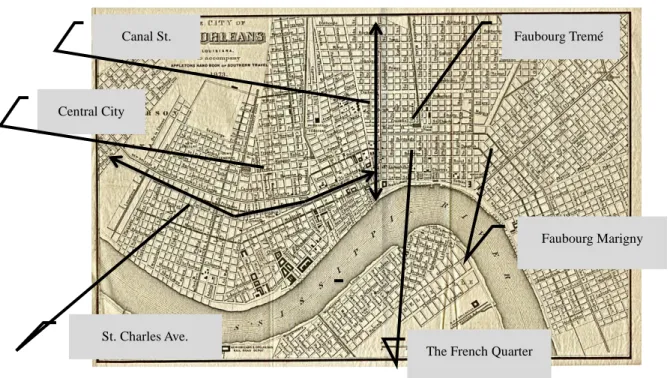
Geography is important to trace the integration struggle of Creoles of color. An ethnic line characterized the New Orleans’ residential pattern. The areas northeast from Canal Street were predominantly francophone neighborhoods while to the west were Anglophone areas. Many Creoles of color lived in the francophone residential areas such as the Faubourg Tremé and Faubourg Marigny. These districts held the white Creole
45
population as well. Anglophone blacks lived in the “back-of-town” neighborhoods such as present-day Central City, the area southwest of Canal Street and a couple blocks north to St. Charles Avenue.46 They tended to live in separate spaces from Anglophone whites.
Although Creoles of color and Anglophone blacks interacted politically, there were social and geographical distances between them. The location of the public schools helps to explain who committed to the racial integration movement.
Fig. 1. New Orleans City Map, 1873 47
Despite the state constitutional convention, the city school board worked hard to maintain a color line. The New Orleans Republican reported in February 1868 that one “colored” father attempted to send his child to the De Soto School, a white school in
46 Richard Campanella, Geographies of New Orleans: Urban Fabrics Before the Storm (Lafayette, LA:
Center for Louisiana Studies, 2006), 300.
47 Charles H. Jones, ed. and complied, Appleton’s Hand-Book of American Travel, Southern Tour, 1873, the
University of Texas Libraries, http://www.lib.utexas.edu/maps/historical/new_orleans_1873.jpg. (Accessed November 10, 2012)
The French Quarter
Faubourg Tremé
Faubourg Marigny Canal St.
Central City
Faubourg Tremé. Although the newspaper did not report his name, he was possibly a Creole man of color as he chose the school in the predominantly Creole neighborhood. He insisted that he was not a “contraband.”48 The city school board, however, instantly rejected his petition. In April 1868, William O. Rogers, city superintendent of public schools, received a report of “the rumor that colored children have [been] admitted” to the Bayou Road School, another white school in Tremé. On May 7, Rogers requested the details of the situation from Madam S. Bigot, principal of the school. On May 21, Bigot submitted a list of twenty-eight girls, who were possibly not whites.49 In response, the board ordered that “all children of color, who may be found in any of the white schools of the City, shall be immediately furnished with a written transfer to the school to which they properly belong.”50 The city school board insisted on adhering to a segregated racial order.
The Bayou Road School incident illustrates the difficulty of drawing a color line against Creoles of color. Many of the girls in the schools were daughters of Creoles of color and their physical appearances were similar to white Creoles.51 Sisters Alice and Anais Meilleur, for instance, were the daughters of Eugene G. Meilleur, a mulatto and free Creole man of color who worked as a constable during Reconstruction.52 Emma Gondales was a
48 New Orleans Republican, “Monthly School Board Meeting,” February 6, 1868.
49 Letter, William O. Rogers to S. Bigot, May 7, 1868; Letter, S. Bigot to William O. Rogers, May 21, 1867,
reprinted in the Orleans Parish School Board Minutes, August 29, 1865 to June 2, 1869, 322-23, LSC, UNO.
50 Minutes, August 29, 1865-June 2, 1869, 327-28, LSC, UNO.
51 New Orleans Republican, “Public School Examination, Second District,” June 24, 1868.
52
niece of Charles. S. Sauvinet, an alderman and prominent Creole man of color. Sauvinet was classified as mulatto in the census, and filed a lawsuit against a coffee house that refused to serve him on account of his race in 1875.53 Madame Bigot reported that Olivia Edmunds, another girl under suspicion, was even “admitted upon a certificate of white birth.”54 The Daily Picayune reported that among the girls, “two are said to be quite dark, while the others are lighter complexion.”55 Eventually, six children submitted proof that they were white, while six other children refused to explain their racial background. The remaining students acknowledged that they were not whites.56 The board determined to send all the children who could not prove their white racial status to the Rampart Girls’ School, the neighboring school for black girls.
In response to the action of the city school board, Creoles of color returned to state politics to strengthen state control over the city school system. Among them, Henry Louis Rey became chairman of the committee on education in the House of Representatives in 1868. He was a “bright mulatto” born in New Orleans in 1831 to a wealthy and prestigious
City Directories, 1821-1989 (Beta), (2011); David Rankin, “The Origin of Negro Leadership in New Orleans
during Reconstruction,” in Southern Black Leaders of the Reconstruction Era, Howard N. Rabinowitz ed., (Urbana: University of Illinois Press, 1982), 185.
53 Year: 1870; Census Place: New Orleans Ward 7, Orleans, Louisiana; Roll: M593_522; Page: 583B;
Image: 714; Family History Library Film: 552021, Ancestry.com, 1870 United States Federal Census [database online] (2009); C. S. Sauvinet v. Joseph A. Walker, 27 La. Ann. 14, (1875); Roger A. Fischer,
Segregation Struggle in Louisiana, 1862-1877 (Urbana: University of Illinois Press. 1974), 111.
54 Letter, Bigot to Rogers, May 21, 1867, Minutes, 323, LSC, UNO.
55
Daily Picayune, “The Board of Public School Directors-Colored Children in the White Schools,” May 22, 1868.
56
family of Creoles of color of Haitian origin.57 He started working for the Couvent Institute in the antebellum period and entered politics after serving as a captain of the Native Guard in the Confederate Army and later the Union Army during the Civil War.58 In August 1868, he made a first attempt to ensure school integration through proposing an additional state law. He proposed to grant the governor, at the time, Henry C. Warmoth, authority to appoint ten members of the city school board with the consent of the state senate.59 The act passed the House of Representatives, however, the Senate hampered it. There were two opinions among the opponents in the Senate. Democrats like A. J. Bacon opposed the bill in favor of maintaining school segregation in New Orleans. Republicans feared to increase the power of the governor. P. B. S. Pinchback, one of black senators at the time, voted against the act because he refused to give the governor authority to control public education.60
In January 1869, at the state legislature, Rey presented another act to abolish the city school board and give the state board of education authority over the management of a new city school board. Although the act granted Governor Warmoth the power to appoint five board members, Thomas W. Conway, an integrationist, was the head of the state board.
57 U.S. Pension Record no. 1127637, Department of the Interior, Bureau of Pensions, quoted in Melissa
Daggett, “Henry Louis Rey, Spiritualism, and Creoles of Color in Nineteenth-Century New Orleans,” (M.A. Thesis, University of New Orleans, 2009), 33n.
58 Desdunes, Our People and Our History, 114-19. Many Creoles of color joined the Confederate Louisiana
Native Guards before the Union occupation. Mary F. Berry, “Negro Troops in Blue and Gray: The Louisiana Native Guards, 1861-1863,” Louisiana History, 8, no. 2, (1967): 165-90.
59 The city school board was under jurisdiction of the city at that time. City council chose the members of the
city board.
60 Daily Picayune, “The City Schools in the Senate,” and “The City Schools in the Legislature,” September
If the law passed, Conway could increase his power over the city school board. Rey’s law was enacted as Act no. 121, with the general agreement of the state legislature that every school should be under the consolidated state school system by March 10, 1869.61 The law divided the state into six divisions; each division consisted of a school board and
superintendent under the supervision of the state board. New Orleans was classified as the First Division in 1869 and later became the Sixth Division in 1870.62
The different reactions between the city school board and state superintendent Thomas W. Conway to the Act 135 of the Louisiana state constitution demonstrate that the core problem for integration was the racially in-between population. The city school board decided to classify every both Anglophone black and Creoles of color as a target of segregation and disregarded racial complexities. On April 9, 1869, city superintendent William O. Rogers issued an order to city school principals that “whenever a reasonable doubt may be entertained by them touching the Status [sic], in point of color, of any pupils,” they were not allowed to admit these children to the white schools.63 Thomas W. Conway attempted to address the problem by uniting all the racial groups under the same education policy and within the same school buildings. Answering a protest from an anti-integration teacher from New Orleans, Conway stated in May 1870;
61 In order to maintain segregation, the New Orleans public education system functioned independently from
the state education system. State legislatures did not only concern the implementation of the state law but also saw the city school board’s independent action problematic. Vincent, Black Legislatures in Louisiana, 89.
62
New Orleans Tribune, “The School Bill,” January 13, 1869.
63 Letter, William O. Rogers to the Principals of the City Schools, April 9, 1869, WORC, Scrapbook,
At least one-third of the “blacks” are already mixed, with “white” and “black” in the veins of the same individuals, so that if a “black” should be excluded from school, it would be difficult to determine whether we were not excluding more white than black: Second, because many who are considered “black” are as white as Queen Victoria, and it would be impossible to detect any trace whatever of any other than “white blood” in them, so that it would be quite impossible to apply a rule making the distinction practicable.64
Conway recognized the significance of the group that was neither completely white nor black racial status in New Orleans. His solution was to diminish the color line between white and black.
Conway’s idea of race enabled Creoles of color to ally with him. In 1870, they proposed to further increase the authority of the state superintendent so that Conway could directly organize the city school board and appoint members. The strongest advocate for integration that year was Robert H. Isabelle. He lived in New Orleans while moving freely between the communities of Creoles of color and Anglophone blacks. His father, George Baptiste was a white French immigrant who married Nancy Willis of Virginia, a mulatto woman.65 Despite his French background, Isabelle had opened one of the few
English-language Protestant schools for black children in 1862.66 At the 1870 state legislature, Isabelle stressed that “I want to see the children of the state educated together. I want to see them play together; to be amalgamated…and when they grow up to be men they will love each other, and be ready, if any force comes against the flag of the United
64
Tri-Weekly Advocate, “Mixed Schools,” May 4, 1870.
65 Year: 1900; Census Place: New Orleans Ward 3, Orleans, Louisiana; Roll: 570; Page: 12 A; Enumeration
District: 0020; FHL microfilm: 1240570, Ancestry.com. 1900 United States Federal Census (2004); New Orleans, Louisiana Birth Records Index, 1790-1899; vol. 30; Page #: 248, Ancestry.com, (2002).
66
States, to take up arms and defend it together.”67 The speech appealed to the state legislature for further actions to implement desegregation.
Anglophone black members of the state legislature supported Isabelle. In the House, George Washington and Denis Burrell particularly assisted him. Washington feared that the rural areas of Louisiana would not offer public schools for black children without strong state authority. He stressed that “we will have no schools, or next to none,” unless further action was taken.68 To attract the votes of white representatives, Burrell emphasized that the modification of the state law would increase educational opportunities for both poor white and black children. In the senate, P. B. S. Pinchback altered his position on integration and even agreed with Isabelle that black schools were unequal to those of whites. With the support of Anglophone blacks, Isabelle’s proposition was adopted and Conway gained the authority to organize a new school board.69 He established the ward school board system to replace the city school board.70
In addition to political debate, Creoles of color with the aid of Anglophone blacks and white radicals commenced direct negotiation with individual white public schools for admission of their children. In the background, the city school board insisted on its valid jurisdiction over New Orleans public schools even after the establishment of the ward school board. Creoles of color sought an alternative way to implement the racial
67 Debates of the House of Representatives of the State of Louisiana, Session of 1870 (New Orleans:
Republican Office, 1870), 149.
68 Ibid., 184
69 Vincent, Black Legislators in Louisiana During Reconstruction, 90-95.
70
integration of public schools. On May 16, 1870, Creoles of color cooperated with white radical and Anglophone black Republican members, formed the Radical Republican Club and targeted the Fisk and Bienville Boys’ Schools, both white schools, to demand the admission of their children. Robert H. Isabelle was one of the members. He took his seven-year old son, William, to the Fisk School, with two other children and four members of the Radical Republican Clubs. The school was located at the corner of Franklin and Perdido streets in a predominantly Anglo-Saxon neighborhood and was the closest school to Isabelle’s residence.71
The action of the Radical Republican Club provoked the turmoil among New Orleans citizens. Isabelle, along with his fellow club members, had a meeting with T. W. Dyer, principal of the Fisk School, to request admission of their children. Dyer
immediately refused their demand reasoning that he had no such authority from the city superintendent. He took advantage of the dual school board systems in order to refuse the admission of the children. Next, the club members moved to the Bienville School, located at the corner of Bienville and Robertson Streets in the Tremé neighborhood. The club members discussed the issue with the school principal, but to no avail. During the
negotiation, both schools became madhouses. The Daily Picayune reported that many Fisk School students “seized their books and slates and rushed out into the yard,” and eventually returned home for fear of racial mixing. It also reported that a “large crowd of whites and blacks collected in the streets” and surrounded the school building soon after the
negotiation started. Furthermore, it stated that there was even a rumor that “several pistol
71 Daily Picayune, “Attempt at Mixing the Public Schools,” May 17, 1870. The other members of the club
were R. T. Kramer, A. H. Pemberton, Theodore Lepshut?, and C. H. Ladd; Report of the Secretary of the
Board of Directors for Public Schools of the City of New Orleans, December 1871 (New Orleans, 1871), 392.
shots had been fired by the crowd” at the Bienville School.72 The article illustrates the impact that the club’s direct action to schools had on white New Orleanians. White segregationists no longer had legal backing from the state legislature to maintain segregation. Only the city school board, whose validity was already in question due to Conway, sustained the segregated public school system.
Eventually, integrationists solved the problem of public schools through legal cases. The chance of winning was high as some judges were radical white Republicans. Soon after his failed negotiations with the Fisk and Bienville Schools, Isabelle filed a lawsuit to terminate the dual city school system. On June 30, 1870, the Daily Picayune reported that Isabelle’s petition was filed at the Eighth District Court of New Orleans, demanding 1) the court guaranteed a right to send his child to any school that his family preferred based on the state law, and 2) replacement of the current school board with Conway’s ward school board system. Henry C. Dibble, a judge who was originally from Indiana and had been a member of the Republican Party since 1865, issued a writ of mandamus to the school board to implement integration on the basis of the state constitution.73 Meanwhile the city school board asked the court to stop Conway’s attempt to use state funds in the city schools without permission of the city school board. In November 1870, Dibble issued a judgment in favor of Conway.74 The decision was a final blow for the city school board, which was
72 Daily Picayune, “Attempt at Mixing the Public Schools,” May 17, 1870.
73 Daily Picayune, “The Court,” June 30, 1870. The Eighth District Court had an exclusive right to issue a
writ of mandamus and to deal with all the proceedings regarding the right of any office over other courts in New Orleans. For the biography of Dibble, I refer to Charles McClain, “California Carpetbagger: The Career of Henry Dibble,” Quinnipiac Law Review, 28 no. 4 (2009), 890.
74
officially abolished in January 1871 by the Board of Alderman.75
Conway’s ward school board welcomed Creoles of color, Anglophone blacks and radical white Republicans as directors of the board. The board divided the city into five districts and eleven smaller representative districts. Each representative district had one director and two other support members. Creoles of color and Anglophone blacks shared jurisdiction over the French Quarter and Tremé, where many Creoles of color lived side by side with white Creoles. Among Creoles of color, Blanc F. Joubert was appointed as a director of the sixth representative ward, which covered the area from St. Philip Street to Esplanade Avenue, the eastern part of French Quarter and Tremé. John Racquet Clay, an exchange broker, served as a director of the fifth representative district, the central part of the same neighborhoods. As a representative of Anglophone blacks, P. B. S. Pinchback became director of the fourth representative district from Canal Street to St. Louis Street, the western part of the two neighborhoods. In addition, the new board welcomed Henry C. Dibble as the president as well as the director of the second representative district. The new city school board consisted of integrationists and the appointment of directors for the Creole neighborhood demonstrated the smooth relationship between Creoles of color and Anglophone blacks.76
75
Fischer, Segregation Struggle in Louisiana, 114; Daily Picayune, “The Public School Question,” January 27, 1870.
76 Daily Picayune, “Meeting of the New School Board,” March 11, 1871; Weekly Louisianian, “The City
School Board,” April 27, 1871; Joubert was born in 1816 to a French immigrant and a light-skinned woman of color. He stayed in Paris from 1859 to 1864. See, Testimony Taken by the Select Committee to Investigate
the Condition of Affairs in the State of Louisiana (Washington DC: GPO, 1872), 453-62; Houzeau, My Passage at the New Orleans Tribune, 74n. John Racquet Clay was born in New Orleans in 1829 as a free man
Once Conway’s school board started legally exercising its power, racial integration of the public schools was rapidly implemented. Many students of both Anglophone blacks and Creoles of color attended the former white schools. On January 12, 1871, the Daily Picayune reported that three children of the Anglophone black Lieutenant Governor, Oscar
J. Dunn entered the Magnolia Girls’ School, located on Carondelet Street between Jackson and Philip Streets, one of the closest white schools to residential areas of Anglophone blacks. On the same day, another newspaper reported that Madison School, located at the corner of Prieur and Palmyra Streets, a few blocks west of Canal Street, had admitted some children of African descent. Some white schools in the Creole neighborhoods became desegregated as well. The Bienville School accepted six children and the St. Philip School admitted “a negro boy” with the support of Thomas W. Conway in early 1871.77
Integration drew mixed reactions from the local white population. First, it caused the massive withdrawal of white pupils from public schools. The Bienville School, for instance, lost an estimated half of its white students and teachers after integration. The Claiborne Boys’ School in Tremé lost about one-fourth of its students as well, and similar reports were made for the Pontchartrain School, located in Milneburg, a suburb of New Orleans.78 Historian Roger A. Fischer found the number of private schools rapidly increased once the 1868 state constitution went into effect.79
77
Daily Picayune, “Mixed Schools,” January 12, 1871; Weekly Louisianian, “Mixed Schools,” January 12, 1871.
78
Report of the Secretary of the Board of Directors for Public Schools of the City of New Orleans, 374-75; Daily Picayune, “Our Public Schools,” June 23, 1871.
79
Some schools, however, admitted black children without any problems or
turbulence. The Robertson Girls’ School, located beside the Bienville School, for instance, reported that “the colored mixture has been forced in though not with the same ill effect as in the boys’ school next door.”80 Still, despite the severe initial reaction, the Bienville school gradually recovered the enrollment of white students. Principal E. Warren Smith remarked in the annual report for 1871; “two-thirds of the pupils are white and one-third colored. It is but seldom that the usual peace and good order of the school are disturbed by any exhibitions of prejudice on account of race or color.”81 The Pontchartrain School also reported that the white children were returning.82 In a speech on June 2, 1871, Conway stated, “there are some colored children in the schools attended by the whites, and it is a matter of pleasure for me to say that they are not treated with incivility or unkindness.”83
Creoles of color enthusiastically took advantage of the new educational opportunity. R. L. Desdunes recalled that the Couvent Institute decreased its enrollment. He recorded that “most of the children of color attended the public free schools along with the white children. The Couvent Institute therefore became almost deserted.”84 It symbolized how favorably the school system was changed for Creoles of color. Many of the integrated schools were located in the Creole neighborhoods where Creoles of color lived. The 1962
80
Daily Picayune, “Our Public Schools,” June 23, 1871.
81 Report of the Secretary of the Board of Directors for Public Schools of the City of New Orleans, 375.
82 Ibid., 389.
83 Weekly Louisianian, “Superintendent Conway’s Address,” June 11, 1871.
84
and 1974 surveys by the scholars Louis R. Harlan and Roger A. Fischer estimated around one-third of the public schools were integrated from 1871 to 1877. Among the 27
integrated schools that they listed, fifteen schools were in the predominantly Creole residential areas, particularly the neighborhoods such as Faubourg Tremé and Faubourg Marigny. Most of Creoles of color lived in these neighborhoods. On the contrary, nine schools were located west of Canal Street, where most of the Anglophone blacks lived.85 The admission of black students to formerly white schools was based on their requests thus the action of black Americans was necessary. Creoles of color actively chose racially integrated schools.
Although there were fewer integrated schools in Anglo-Saxon neighborhoods of New Orleans, Anglophone blacks upheld integration from 1871. Many leaders of the Anglophone black community favored integration. They found advantages to integrated schools as many were classified as Grammar A schools, which were advanced schools whose graduates often went to high schools. The Louisianian, a black Republican weekly newspaper, included a school integration policy in its prospectus.86 The publisher William G. Brown was born in Trenton, New Jersey as a free man of color in 1832. He spent some
85 Harlan listed Barracks, Bayou Bridge, Bayou Road, Beauregard, Bienville, Central Boy’s High, Claiborne,
Fillmore, Fisk, Franklin, Keller, Lower Girls’ High, Madison, Paulding, Pontchartrain, Rampart, Robertson, St. Anne, St. Philip, Spain, Webster, as desegregated schools and Cut-off Road, Dunn, Gentilly,
McDonoughville were possibly desegregated as well. Fischer added that Clio, Hospital and Jefferson Schools might have been racially integrated. I included the Magnolia School to the list based on the report made in the article of Daily Picayune, entitled “Mixed Schools,” issued on January 12, 1871, and investigated the location of these schools. Harlan, “Desegregation in New Orleans Public Schools during Reconstruction,” 666; Fischer, The Segregation Struggle in Louisiana, 119-20. Among the list, Bayou Bridge, Beauregard, Bienville, Central Boys’ High, Claiborne, Fillmore, Gentilly, Hospital, Lower Girls’ High, Pontchartrain, Rampart, Robertson, St. Ann, and St. Philip were located in the east from Canal St. The other schools except for Cut-off, McDonoughville and Dunn in Algiers, were scattered in the area west of Canal Street. In order to locate the schools, I used Report of the Secretary of the Board of Directors for Public Schools of the City of
New Orleans, 392-94.
86
years in the British West Indies during his childhood. The year he moved to Louisiana is unknown; however, he participated in the 1867-68 state constitutional convention. He was particularly interested in public education as the “chief reliance of American liberty.”87 He succeeded Thomas W. Conway and became state superintendent of public education in December 1872 as a keen supporter of integration. Even P. B. S. Pinchback showed strong support for racial integration. In an interview in 1872 with the New Orleans Times, a conservative Democrats newspaper, he remarked; “I believe in mixed schools.”88 He had once objected to integration during the 1867-68 state constitutional convention as a strategy to secure the black population from racial hatred. But he hoped to improve and increase their educational opportunities this time. His support was valuable as he served as the governor of Louisiana during the interregnum caused by the impeachment of Governor Warmoth in 1872.
During the years of integration, the color line was erased in educational records. The annual report of the state superintendent of public education did not record the number of black students who enrolled in the city public schools.89 The information about the enrollment of white students was also unavailable since all the pupils were simply
87 Weekly Louisianian, “A Friendly Critic,” December 18, 1870; Peter J. Breaux, “William G. Brown and the
Development of Education: A Retrospective on the Career of a State Superintendent of Public Education of African Descent in Louisiana,” (Ph.D. Dissertation, The Florida State University, 2006), 1-3.
88 Weekly Louisianian, “Pinchback Interviewed,” March 14, 1872.
89 Annual Report of the State Superintendent of Public Education, Thomas W. Conway to the General
classified as students. Historian Louis R. Harlan explained that it was impossible for surveyors to distinguish between “so many very light colored persons and swarthy white ones.”90 However, the reports illustrate the intention of the integrationists. In reflecting Conway’s work, on November 14, 1874, the Louisianian stated; “in considering the practicability of the [public school] project…it would be no easy matter to draw the line between colors.”91 This belief motivated Conway to send all the children into the same schools without distinction of race or color. In that way he believed that all children of various skin colors would have taken the equal educational opportunity. Creoles of color shared a similar opinion. They were part of a racially diverse black population with Anglophone blacks and aware of the impracticability of the dichotomous color line.
To summarize, Creoles of color in the early 1870s succeeded in desegregating public schools. First, they disbanded the city public school board since it intended to maintain segregation. Creoles of color were particularly troublesome because they complicated the racial hierarchy. They deployed political and legal action in addition to direct negotiations with public schools to admit black students. Creoles of color allied with white radicals to end the segregationists’ rule over the public schools. In the meantime, Anglophone blacks shifted their focus from having a segregated public school system to favoring integration. Although they hesitated to campaign for racial integration at the time of the state constitutional convention, they found that integration increased their
educational opportunities during the 1870s. Creoles of color pushed integration forward
90 Harlan, “Desegregation in New Orleans Public Schools during Reconstruction,” 666.
91