Scattering formula for the topological quantum number of a disordered multimode wire
I. C. Fulga, F. Hassler, A. R. Akhmerov, and C. W. J. Beenakker
Instituut-Lorentz, Universiteit Leiden, P.O. Box 9506, NL-2300 RA Leiden, The Netherlands (Received 10 January 2011; published 18 April 2011)
The topological quantum numberQof a superconducting or chiral insulating wire counts the number of stable bound states at the end points. We determineQfrom the matrixr of reflection amplitudes from one of the ends, generalizing the known result in the absence of time-reversal and chiral symmetry to all five topologically nontrivial symmetry classes. The formula takes the form of the determinant, Pfaffian, or matrix signature ofr, depending on whetherris a real matrix, a real antisymmetric matrix, or a Hermitian matrix. We apply this formula to calculate the topological quantum number ofN coupled dimerized polymer chains, including the effects of disorder in the hopping constants. The scattering theory relates a topological phase transition to a conductance peak, of quantized height and with a universal (symmetry class independent) line shape. Two peaks which merge are annihilated in the superconducting symmetry classes, while they reinforce each other in the chiral symmetry classes.
DOI:10.1103/PhysRevB.83.155429 PACS number(s): 03.65.Vf, 73.23.−b, 73.63.Nm, 74.45.+c
I. INTRODUCTION
The bulk-boundary correspondence in the quantum Hall effect equates the number Q of occupied Landau levels in the two-dimensional bulk to the number of propagating states at the edge, which is the quantity measured in electrical conduction.1,2 Thouless et al. identified Q as a topological quantum number,3determined by an invariant integral of the HamiltonianH(k) over the Brillouin zone.
One-dimensional wire geometries can also be classified by a topological quantum number, which then counts the number of stable (“topologically protected”) bound states at the end points. Examples exist in chiral insulators (such as a dimerized polyacetylene chain4) and in superconductors (such as a chiral p-wave wire5). In the former case the end states are half-integer charged solitons; in the latter case they are charge-neutral Majorana fermions.
Following the line of thought from the quantum Hall effect, one might ask whether the numberQof these end states can be related to a transport property (electrical conduction for the insulators and thermal conduction for the superconductors). The basis for such a relationship would be an alternative formula forQ, not in terms ofH(k),5–10 but in terms of the scattering matrixS of the wire, connected at the two ends to electron reservoirs.
This analysis was recently carried out for the supercon-ducting p-wave wire,11 which represents one of the five symmetry classes with a topologically nontrivial phase in a wire geometry.12,13 In this paper we extend the scattering theory of the topological quantum number to the other four symmetry classes, including the polyacetylene chain as an application.
The outline is as follows. In the next section we show how to construct a topological invariantQfrom the reflection matrix
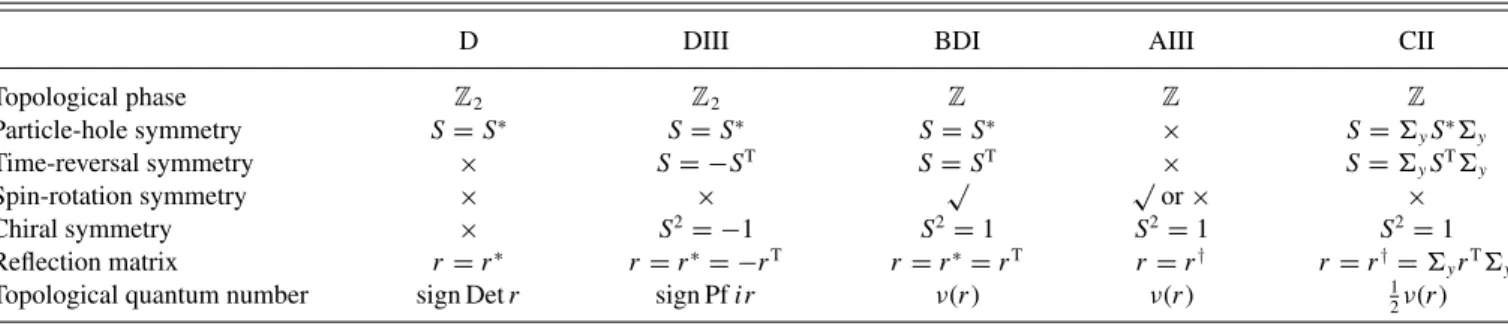
r (which is a subblock of S). Depending on the presence or absence of particle-hole symmetry, time-reversal symmetry, spin-rotation symmetry, and chiral (or sublattice) symmetry, this relation takes the form of a determinant, Pfaffian, or matrix signature (being the number of negative eigenvalues), see Table I. In Sec. III we demonstrate that this Q indeed counts the number of topologically protected end states. The
connection to electrical or thermal conduction is made in Sec. IV, where we contrast the effect of disorder on the conductance in the superconducting and chiral insulating sym-metry classes. We conclude in Sec.Vwith the application to polyacetylene.
II. TOPOLOGICAL QUANTUM NUMBER FROM REFLECTION MATRIX
The classification of topological phases is commonly given in terms of the Hamiltonian of a closed system.14For the open systems considered here, the scattering matrix provides a more natural starting point. In anN-mode wire the scattering matrix
Sis a 2N×2Nunitary matrix, relating incoming to outgoing modes. The presence or absence, at the Fermi energyEF, of particle-hole symmetry, time-reversal symmetry, spin-rotation symmetry, and chiral (or sublattice) symmetry restricts S
to one of ten subspaces of the unitary group U(2N). In a one-dimensional wire geometry, five of these Altland-Zirnbauer symmetry classes15 can be in a topological phase, distinguished by an integer-valued quantum numberQ.
The symmetries of the scattering matrix in the five topologi-cal symmetry classes are summarized in TableI. For each class we have chosen a basis for the incoming and outgoing modes at the Fermi level in which the symmetry relations have a simple form. (In the next section we will be more specific about the choice of basis.) Notice that the chiral symmetry operation is the combination of particle-hole and time-reversal symmetry (if both are present).
Topological phases are characterized by a resonance at the Fermi level, signaling the presence of one or more quasibound states at the endpoints of the wire with vanishingly small excitation energy. (If the wire is superconducting, these excitations are Majorana fermions.5) It is therefore natural to seek a relation between the topological quantum number Q and the reflection matrix, which is an N×N submatrix relating incoming and reflected modes from one end of the wire,
S=
r t
t r
TABLE I. Classification of the symmetries of the unitary scattering matrixSat the Fermi level in anN-mode wire geometry, and relation between the topological quantum numberQand the reflection submatrixr. ForZ2 topological phasesQis given in terms of the sign of the determinant (Det) or Pfaffian (Pf) ofr. ForZandZtopological phases the relation is in terms of the numberνof negative eigenvalues ofr.
D DIII BDI AIII CII
Topological phase Z2 Z2 Z Z Z
Particle-hole symmetry S=S∗ S=S∗ S=S∗ × S=yS∗y
Time-reversal symmetry × S= −ST S=ST × S=
ySTy
Spin-rotation symmetry × × √ √or× ×
Chiral symmetry × S2= −1 S2=1 S2=1 S2=1
Reflection matrix r=r∗ r=r∗= −rT r=r∗=rT r=r† r=r†=
yrTy
Topological quantum number sign Detr sign Pfir ν(r) ν(r) 1
2ν(r)
The wire has two ends, so there are two reflection matricesr
andr. Unitarity ensures that the Hermitian matrix productsrr†
andrr†have the same set of reflection eigenvalues tanh2λn∈ (0,1), numbered by the mode indexn=1,2, . . . N. The real numberλnis the so-called Lyapunov exponent. The transmis-sion eigenvalues Tn=1−tanh2λn=1/cosh2λn determine the conductanceG∝nTnof the wire. (Depending on the system, this can be a thermal or an electrical conductance.)
The topological phases have an excitation gap, so theTn’s are exponentially small in general, except when the gap closes at a transition between two topological phases. A topological phase transition can therefore be identified by a sign change of a Lyapunov exponent.16–19
The Lyapunov exponents are the radial variables of the polar decomposition of the scattering matrix, given by20
S=
O
1 0
0 O2
tanh (cosh)−1
(cosh)−1 −tanh
O3 0
0 O4
, in class D, (2.2a)
S=
O1 0
0 O2
(tanh)⊗iσy (cosh)−1⊗iσy (cosh)−1⊗iσ
y −(tanh)⊗iσy
OT 1 0
0 OT 2
, in class DIII, (2.2b)
S=
O
1 0
0 O2
tanh (cosh)−1
(cosh)−1 −tanh
OT 1 0
0 O2T
, in class BDI, (2.2c)
S=
U1 0
0 U2
tanh (cosh)−1 (cosh)−1 −tanh
U1† 0
0 U2†
, in class AIII, (2.2d)
S =
Q1 0
0 Q2
(tanh)⊗σ0 (cosh)−1⊗σ0
(cosh)−1⊗σ
0 −(tanh)⊗σ0
Q†1 0
0 Q†2
, in class CII, (2.2e)
in terms of a real diagonal matrix=diag (λ1,λ2, . . .) and complex unitary matrices Up (satisfying Up−1=Up†), real orthogonal matrices Op (satisfying Op−1 =Op† =OpT), and quaternion symplectic matricesQp (satisfyingQ−p1=Q†p =
yQTpy). The matrices i=σi⊕σi⊕ · · · ⊕σi are block diagonal in terms of 2×2 Pauli matricesσi(withσ0the 2×2
unit matrix). There are N distinct λn’s in classes D, BDI, and AIII, but onlyN/2 in classes DIII and CII (because of a twofold Kramers degeneracy of the transmission eigenvalues). The transmission eigenvalues only determine the Lyapunov exponents up to a sign. To fix the sign, we demand in class D and DIII that DetOp=1, soOp ∈SO(N). Then theλn’s can be ordered uniquely as19|λ
1|< λ2< λ3<· · ·, so there can be
at most a single negative Lyapunov exponent. In the other three classes there is no sign ambiguity since tanhλnis an eigenvalue
of the reflection matrixritself—which is a Hermitian matrix in classes BDI, AIII, and CII. There is then no constraint on the number of negative Lyapunov exponents.16
If we start from an initial state with allλn’s positive, then the numberQof (distinct) negative Lyapunov exponents in a final state counts the number of topological phase transitions that separate initial and final states. In class D this produces the relationQ=sign Detr from Refs.11and18, relating topo-logical quantum number and determinant of reflection matrix. In class DIII the determinant ofris always positive, but we can use the Pfaffian of the antisymmetric reflection matrix to count the number of negativeλn’s, so we takeQ=sign Pfr. [In view of the identity PfXY XT =(DetX)(PfY), one has Pfr=(DetO1)Pf (⊗iσy)=
ntanhλn.]
equal to the number of negativeλn’s. In class CII we takeQ=
1
2ν(r) to obtain the number of distinct negativeλn’s, because
each eigenvalue is twofold degenerate.
These topological quantum numbers are defined relative to a particular reference state, chosen to have all positive Lyapunov exponents. We would like to relate Qto the number of end states at zero excitation energy, and then chose a reference state such that this relationship takes a simple form. This is worked out in the next section, with the resulting expressions forQgiven in TableI.
III. NUMBER OF END STATES FROM TOPOLOGICAL QUANTUM NUMBER
We consider first the superconducting symmetry classes D and DIII and then the chiral symmetry classes BDI, AIII, and CII. The symmetry class D was treated in detail in Ref.11and is included here for completeness and for comparison with class DIII.
A. Superconducting symmetry classes
Electron-hole symmetry in a superconductor relates the energy-dependent creation and annihilation operators by
γ†(E)=γ(−E). Since therefore γ†=γ at E=0, an ex-citation at zero energy is a Majorana fermion, equal to its own antiparticle. The end states in symmetry classes D and DIII are so-called Majorana bound states.5 In the open systems considered here, where the superconducting wire is connected to semi-infinite normal-metal leads, the end states are actually only quasibound states, but they still manifest themselves as a resonance in a conduction experiment.21,22
The topological quantum number in class D should give the parity of the numberNof Majorana bound states at one end of the wire:N is even (Q=1) in the topologically trivial phase, whileNis odd (Q= −1) in the topologically nontrivial phase. In class DIII all states are twofold Kramers degenerate soN is to be replaced byN/2.
Let us now verify that the determinant and Pfaffian expressions for the topological charge in TableIindeed give this bound state parity. We transform the quasibound states into true bound states by terminating the normal-metal lead at some distance far from the normal-superconductor (NS) interface (see Fig.1). For the same purpose we assume that the superconducting wire is sufficiently long that transmission of quasiparticles from one end to the other can be neglected. The reflection matrix rNS from the NS interface is then an
N×N unitary matrix. The number of modes N =2M is even, because there is an equal number of electron and hole modes.
FIG. 1. Superconducting wire (S) connected to a normal-metal lead (N) which is closed at one end. A bound state at the Fermi level can form at the NS interface, characterized by a unit eigenvalue of the productrNrNSof two matrices of reflection amplitudes (indicated schematically by arrows).
The condition for a bound state at the Fermi level is
Det (1−rNrNS)=0, (3.1)
whererNis the reflection matrix from the terminated
normal-metal lead. In the electron-hole basis the matrix rN has the
block-diagonal form
rN=
UN 0
0 UN∗
. (3.2)
The matrix UN is an M×M unitary matrix of electron reflection amplitudes. The corresponding matrix for hole reflections is UN∗ because of particle-hole symmetry at the Fermi level.
The reflection matrix from the NS interface has also off-diagonal blocks,
rNS=
ree reh
rhe rhh
. (3.3)
Particle-hole symmetry relates the complex reflection matrices
rhe =reh∗ (from electron to hole and from hole to electron) and
ree =rhh∗ (from electron to electron and from hole to hole).
1. Class D
A unitary transformation,
r=rNS†, =
1 2
1 1
−i i
, (3.4)
produces a real reflection matrixr=r∗. This is the so-called Majorana basis used for class D in TableI. The determinant is unchanged by the change of basis, DetrNS=Detr.
The condition (3.1) for a bound state reads, in terms ofr,
Det (1+ONr)=0, (3.5)
withON= −rN†an orthogonal matrix. The numberN of
bound states is the number of eigenvalues−1 of the 2M×2M
orthogonal matrixONr, while the other 2M−N eigenvalues are either equal to+1 or come in conjugate pairse±iφ. Hence DetONr=(−1)N and since DetON=1 we conclude that
Detr=(−1)N, so indeed the determinant of the reflection matrix gives the bound state parity in class D.
2. Class DIII
Time-reversal symmetry in class DIII requires
ANS≡iyrNS= −ATNS, (3.6)
withy=σy⊕σy⊕ · · · ⊕σy. Instead of Eq. (3.4) we now define
r=ANST. (3.7)
(The matrixy acts on the spin degree of freedom, hence it commutes with , which acts on the electron-hole degree of freedom.) In this basis r =r∗ is still real, as required by particle-hole symmetry, while the time-reversal symmetry requirement readsr= −rT. This is the basis used for class
DIII in TableI.
The Pfaffians in the two bases are related by Pfr =
(Det)(PfANS)=(−1)N/4PfA
NS. (Each electron and each
number of modesNis an integer multiple of four.) The relation can be written equivalently as
Pfir=PfANS. (3.8)
This identity is at the origin of the factori appearing in the class DIII expression for the topological quantum number in TableI.
The condition (3.1) for a bound state can be rewritten as
Det (AN−r)=[Pf (AN−r)]2=0, (3.9)
where AN≡(iyrN†)T, as well as r, are antisymmetric orthogonal matrices. In Appendix A we show that the multiplicityN of the number of solutions to Eq. (3.9) satisfies
(−1)N/2=(PfAN)(Pfr). (3.10)
Since, in view of Eq. (3.2),
PfAN =(Det)|Pf (iyUN†)|2=(−1)N/4, (3.11)
we conclude that (−1)N/4Pfr≡Pfir gives the parity of the numberN/2 of Kramers degenerate bound states. This is the topological quantum number for class DIII listed in TableI.
B. Chiral symmetry classes
In the chiral symmetry classes BDI, AIII, and CII we wish to relate the numberν(r) of negative eigenvalues of the reflection matrixrto the number of quasibound states at the end of the wire. As before, we transform these end states into true bound states by terminating the wire and assume that the transmission probability through the wire is negligibly small (soris unitary). While in the superconducting symmetry classes we could choose a normal metal lead as a unique termination, in the chiral classes there is more arbitrariness in the choice of the unitary reflection matrixr0of the termination. Since reflection matrices in the chiral classes are Hermitian (see TableI), we can decompose
r0=U0Sn0U0†, Sn0=
1N−n0 0
0 −1n0
, (3.12)
whereU0is anN×N unitary matrix,n0=ν(r0), and1n0 is
ann0×n0 unit matrix. (Unitarity restricts the eigenvalues to
±1.) Similarly,
r=U1Sn1U
†
1, (3.13)
withν(r)=n1.
Time-reversal symmetry with (without) spin-rotation sym-metry restricts the unitary matricesU0andU1to the orthogonal
(symplectic) subgroup, but to determine the number of bound states we only need the unitarity.
The condition Det (1−r0r)=0 for a zero-energy bound
state takes the form
Det (1−Sn0USn1U
†)=0, (3.14)
withU =U0†U1. We seek the minimal multiplicityN of the
solutions of this equation, for arbitraryU. (There may be more solutions for a special choice ofU, but these do not play a role in the characterization of the topological phase.)
We divideUinto four rectangular subblocks,
U=
MN−n0,N−n1 MN−n0,n1 Mn0,N−n1 Mn0,n1
, (3.15)
whereMn,mis a matrix of dimensionsn×m. Since
1−Sn0USn1U
†=2 0 MN−n0,n1 Mn0,N−n1 0
U†, (3.16)
in view of unitarity of U, the bound state equation (3.14) simplifies to
Det
0 MN−n0,n1 Mn0,N−n1 0
=0. (3.17)
For any matrix Mn,m with n < m there exist at least
m−nindependent vectorsvof rankmsuch thatMn,mv=0. Therefore Eq. (3.17) has at least|n0+n1−N|independent
solutions, hence
N = |ν(r)+ν(r0)−N|. (3.18)
This is the required relation between the topological quantum number Q=ν(r) (in class BDI, AIII) or Q= 12ν(r) (in class CII) and the minimal number of bound states N at one end of the wire, for arbitrary termination of the wire. In the special case of termination by a reflection matrix
r0 = −1N ⇒ν(r0)=N, the relation takes the simple form
N =Q(in class BDI, AIII) andN =2Q(in class CII). So far we considered one of the two ends of the wire, with reflection matrixr. The other end has reflection matrixr= −r
[see Eq. (2.2)], soν(r)=N−ν(r). Termination of that end by a reflection matrixr0 produces a minimal numberN of bound states given by
N= |ν(r)−ν(r
0)|. (3.19)
For r0 =1N⇒ν(r0)=0 we have the simple relation N=Q (in class BDI, AIII) and N=2Q (in class CII).
The (minimal) number of bound states at the two ends is then the same, but in general it may be different, depending on how the wire is terminated.23,24This arbitrariness in the chiral symmetry classes is again in contrast to the superconducting classes, where Majorana bound states come in pairs at opposite ends of the wire.
IV. SUPERCONDUCTING VERSUS CHIRAL SYMMETRY CLASSES
As a first application of our general considerations, we contrast the effect of disorder and intermode scattering on topological phase transitions in the superconducting and chiral symmetry classes. We focus on the symmetry classes D and BDI, which in the single-mode case are identical, so that the effect of intermode scattering is most apparent.
In both these classes there is particle-hole symmetry, which implies that we can choose a basis such that the Hermitian HamiltonianHsatisfies
H∗ = −H. (4.1)
order in momentump= −i¯h∂/∂xthe Hamiltonian then takes the form
H =vFp1N⊗σz+01N⊗σy
+U0[iA(x)⊗σz+iB(x)⊗σx+C(x)⊗σy], (4.2)
with1NtheN×Nunit matrix. TheN×NmatricesAandB
are real antisymmetric, whileCis real symmetric. (ForN=1 this model Hamiltonian was used in Ref.11.)
The Hamiltonian (4.2) respects all the symmetries present in class D, but in class BDI the additional chiral symmetry requires
σxH σx = −H. (4.3)
This implies that the matrixB≡0 in class BDI.
The transfer matrixMrelates the wave function(x) at the two ends of the disordered wire (of length L): (L)= M(0). At the Fermi level (zero energy) M follows upon integration of the wave equation H =0 from x=0 to
x =L,
M=T exp 1
¯
hvF
L
0
dx(−01N⊗σx
+U0[A(x)⊗σ0+iB(x)⊗σy−C(x)⊗σx])
.
(4.4)
The symbol T indicates the ordering of the noncommuting matrices in order of decreasingx.
The Pauli matrices in Eq. (4.4) define a 2×2 block structure for the 2N×2Ntransfer matrix. TheN×Nreflection matrix
r and transmission matrixt follow from this block structure by solving
t
0
=M
1
r
. (4.5)
The reflection matrix gives the topological quan-tum number Q=sign Detr in class D and Q=
ν(r) in class BDI. The transmission matrix gives the conductance
G=G0Trt t†. (4.6)
In class D this is a thermal conductance (with G0 =
π2kB2τ0/6h, at temperatureτ0), while in class BDI this is an
electrical conductance (withG0=2e2/ h).
We model a disordered wire in class D by taking a Gaussian distribution (zero average, unit variance) of the independent matrix elements ofA(x),B(x),C(x), piecewise constant over a series of segments of lengthδLL. In class BDI we use the same model withB ≡0.
In Fig.2we plot the conductance and topological quantum number as a function of0for different values ofU0, calcu-lated in class D and BDI for a single realization of the disorder. A change inQis accompanied by a peak inG, quantized at
G0 if the topological phase transitions are well separated.11
The difference between theZ2 superconducting topological
phase and the Z chiral topological phase becomes evident when conductance peaks merge: In the superconducting class D the conductance peaks annihilate, while in the chiral class BDI a maximum ofN conductance peaks can reinforce each other.
FIG. 2. (Color online) ConductanceG(top panels) and topological quantum numberQ(bottom panels) in the superconducting class D (left panels) and the chiral class BDI (right panels). The black and blue curves are calculated from the Hamiltonian (4.2), for a single disorder realization in a wire withN=5 modes. The red dotted curve shows the universal line shape (4.7) of an isolated conductance peak. Energies
Also shown in Fig.2is that a single isolated conductance peak at 0=c has the same line shape as a function of
δ=(0−c)/ ,
Gpeak(δ)= G0
cosh2δ, (4.7)
in both the superconducting and chiral symmetry classes. (The widthof the peak is not universal.) We have checked that the line shape in the other three symmetry classes also has the same form (4.7), so this is a general statement. One cannot, therefore, distinguish theZ2andZorZtopological phases by
studying a single phase transition. This is a manifestation of the superuniversality of Gruzberg, Read, and Vishveshwara.19
V. APPLICATION TO DIMERIZED POLYMER CHAINS We conclude with an application in a physical system. Such an application was given for the superconducting symmetry class D in Ref.11, so here we concentrate on the chiral classes. We consider a dimerized polymer chain such as polyacetylene, with alternating long and short bonds, described by the Su-Schrieffer-Heeger Hamiltonian.25 This is a tight-binding Hamiltonian, which in the continuum limit takes the form of the class BDI Hamiltonian (4.2).26 Our goal is to obtain the Ztopological quantum number ofN coupled polymer chains from the reflection matrix.
The single-chain electronic Hamiltonian is25–27
H = −
NL
n=1
tn+1,n(c†n+1cn+cn†cn+1), (5.1a)
tn+1,n=t0−α(un+1−un), (5.1b)
witht0andαnearest-neighbor (real) hopping constants andcn the electron annihilation operator at siten. (The spin degree of freedom plays no role and is omitted.) Chiral (or sublattice) symmetry means that H → −H if cn→ −cn on all even-numbered or on all odd-even-numbered sites. We take NL even, so that the chain contains an equal number of sites on each sublattice.
Following Jackiw and Semenoff26we ignore the atomic dy-namics, assuming that the electrons hop in a prescribed atomic displacement field of the dimerized form un=(−1)nu0+
δun. Disorder is accounted for by random displacements
δun, chosen independently on N parallel chains. Nearest neighbors on adjacent chains are coupled by an interchain hopping constant tinter, which we take nonfluctuating for simplicity.
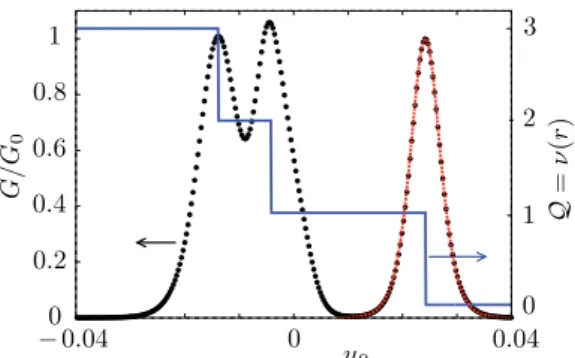
The reflection and transmission matrices r and t were computed from the Hamiltonian (5.1) via the transfer matrix, as outlined in AppendixB. In Fig.3we show the topological quantum number Q [equal to the number ν(r) of negative eigenvalues of the Hermitian reflection matrixr], as well as the electrical conductanceG=G0Trt t†(withG0=2e2/ h).
These two quantities are plotted as a function of the dimeriza-tion parameteru0, to illustrate the topological phase transition,
but unlike the excitation gap0in a superconducting wire this
is not an externally controllable parameter.
The case N =3 plotted in Fig. 3 is a Z topological phase, and each change in the topological quantum number
FIG. 3. Conductance (black dotted line, left axis) and topological quantum number (blue solid line, right axis) of N=3 coupled polymer chains (each containingNL=300 sites). These curves are calculated from the reflection and transmission matrices, obtained from the Hamiltonian (5.1) fort0=1,α=1, andtinter=0.1, for a single realization of the randomδun’s (having a Gaussian distribution with zero average and standard deviation 0.2). The red dotted curve shows the universal line shape (4.7) of an isolated conductance peak. is accompanied by a peak of quantized conductance. The line shape again has the universal form (4.7).
ACKNOWLEDGMENTS
This research was supported by the Dutch Science Founda-tion NWO/FOM and by an ERC Advanced Investigator Grant.
APPENDIX A: CALCULATION OF THE NUMBER OF END STATES IN CLASS DIII
We wish to prove that the multiplicityN of the number of solutions of the bound state equation (3.9) satisfies Eq. (3.10), for arbitrary antisymmetric orthogonal matricesANandr of
dimensionN×N, withN =2MandMan even integer. We use that any antisymmetric orthogonal matrix can be factorized asAN=ONiyONT,r=ONSiyONST , in terms of orthogonal matricesONandONS. These factorizations relate
a Pfaffian to a determinant, PfAN=DetON, Pfr =DetONS.
We seek the multiplicityN of the number of solutions of
[Pf (AN−r)]2=0⇔[Pf (iy−OiyOT)]2=0, (A1)
withO=ONTONSan orthogonal matrix.
We consider the secular equation for the twofold degenerate eigenvaluesznof the matrixiyOiyOT,
0=Det (z−iyOiyOT)=Det (ziy+OiyOT)
=[Pf (ziy+OiyOT)]2=
M
n=1
(z−zn)
2
⇔
0=Pf (ziy+OiyOT)=c M
n=1
(z−zn)=0. (A2)
The value c=1 of the prefactor follows by sending z to infinity. By filling inz=0 we find that
Pf (OiyOT)=DetO= M
n=1
TheN/2 bound state solutions havezn= −1; the remain-ingM−N/2 solutions have eitherzn=1 or conjugate pairs
zn=e±iφ. Hence
M
n=1
zn=(−1)N/2=DetO=(PfAN)(Pfr), (A4)
as we set out to prove.
APPENDIX B: CALCULATION OF THE TOPOLOGICAL QUANTUM NUMBER OF A DIMERIZED POLYMER CHAIN
To simplify the notation we outline the calculation of the topological quantum number for the case N =1 of a single polymer chain, when the transmission matrix r is a scalar and we may take Q=12(1−Q) with Q=signr∈ {−1,1}. [The multichain case, withQ=ν(r)∈ {0,1,2, . . . N}, is analogous.]
From the tight-binding Hamiltonian (5.1) we directly read off the zero-energy transfer matrix ˜Min the site basis,
tn+1,nψn
ψn+1
=Mn˜
tn,n−1ψn−1
ψn
, (B1)
˜
Mn=
0 tn+1,n
−1/tn+1,n 0
. (B2)
The normalization factors in Eq. (B1) have been inserted so that the current operator has the site-independent formI =σy. To obtain the scattering matrix we need to transform from the site basis to a basis of left-movers and right-movers, in which the current operator equals σz rather than σy. This change of basis is realized by the matrix from Eq. (3.4),
Tσy∗=σz. (B3)
Multiplying the transfer matrices we find for the entire chain (containing an even number of sitesNL):
˜
M=MN˜
LMN˜ L−1· · ·M˜2M˜1=
X 0
0 1/X
, (B4)
M=TM˜∗ = 1
2X
X2+1 X2−1
X2−1 X2+1
, (B5)
with the definition
X=(−1)NL/2 NL/2
n=1
t2n+1,2n
t2n,2n−1
. (B6)
We obtain the reflection and transmission amplitudes from Mwith the help of Eq. (4.5). The result is
r= 1−X
2
1+X2, t =
2X
1+X2, (B7)
so the topological quantum number is given by
Q=sign (1−X2)
=sign
N
L/2
n=1
t22n,2n−1−
NL/2
n=1
t22n+1,2n
. (B8)
If all hopping constants are close tot0>0 we may simplify
this expression to
Q=sign
NL/2
n=1
[t2n,2n−1−t2n+1,2n]
. (B9)
In the absence of disorder, when t2n,2n−1=t0−2αu0,
t2n+1,2n=t0+2αu0, this reduces further toQ= −signαu0,
so we recover the original criterion that the dimerized polymer chain has bound states at the ends if the weaker bond is at the end.26
1B. I. Halperin,Phys. Rev. B25, 2185 (1982). 2M. B¨uttiker,Phys. Rev. B38, 9375 (1988).
3D. J. Thouless, M. Kohmoto, M. P. Nightingale, and M. den Nijs,
Phys. Rev. Lett.49, 405 (1982).
4R. Jackiw and J. R. Schrieffer,Nucl. Phys. B190, 253 (1981). 5A. Yu. Kitaev,Phys. Usp.44, 131 (2001).
6X.-L. Qi, T. L. Hughes, and S.-C. Zhang,Phys. Rev. B81, 134508
(2010).
7B. B´eri,Phys. Rev. B81, 134515 (2010).
8P. Ghosh, J. D. Sau, S. Tewari, and S. Das Sarma,Phys. Rev. B82,
184525 (2010).
9A. P. Schnyder and S. Ryu, e-printarXiv:1011.1438.
10T. A. Loring and M. B. Hastings, e-printarXiv:1005.4883; M. B. Hastings and T. A. Loring, e-printarXiv:1012.1019.
11A. R. Akhmerov, J. P. Dahlhaus, F. Hassler, M. Wimmer, and C. W. J. Beenakker,Phys. Rev. Lett.106, 057001 (2011).
12M. Z. Hasan and C. L. Kane,Rev. Mod. Phys.82, 3045 (2010). 13X.-L. Qi and S.-C. Zhang, e-printarXiv:1008.2026.
14S. Ryu, A. P. Schnyder, A. Furusaki, and A. W. W. Ludwig,New J.
Phys.12, 065010 (2010).
15A. Altland and M. R. Zirnbauer,Phys. Rev. B55, 1142 (1997). 16P. W. Brouwer, C. Mudry, B. D. Simons, and A. Altland,Phys. Rev.
Lett.81, 862 (1998);P. W. Brouwer, A. Furusaki, and C. Mudry,
Phys. Rev. B67, 014530 (2003).
17O. Motrunich, K. Damle, and D. A. Huse,Phys. Rev. B63, 224204
(2001).
18F. Merz and J. T. Chalker,Phys. Rev. B65, 054425 (2002). 19I. A. Gruzberg, N. Read, and S. Vishveshwara,Phys. Rev. B71,
245124 (2005).
20In Eq. (2.2) we assumed TrS=0 for the three chiral symmetry classes (BDI, AIII, CII), which means that there is no imbalance between the number of degrees of freedom of opposite chirality (equal number of sites on each sublattice in the case of a bipartite lattice). More generally, S has N+p eigenvalues equal to +1 and N−p eigenvalues equal to −1, so TrS=2p (with p∈
{−N, . . . ,−1,0,1, . . . ,N}). The reflection matricesrandrthen each have|p|fully reflected modes, and the polar decomposition (2.2) applies to the remainingN− |p|modes.
21K. T. Law, P. A. Lee, and T. K. Ng,Phys. Rev. Lett.103, 237001
22M. Wimmer, A. R. Akhmerov, J. P. Dahlhaus, and C. W. J. Beenakker, e-printarXiv:1101.5795.
23P. W. Brouwer, E. Racine, A. Furusaki, Y. Hatsugai, Y. Morita, and C. Mudry,Phys. Rev. B66, 014204 (2002).
24The equalityν(r)+ν(r)=N holds for TrS=0, so for balanced chiralities. More generally, for TrS=2p one hasν(r)+ν(r)=
N−p. If the wire is terminated by reflection matricesr0= −1N,
r0=1N, the number of end states at the two ends differs byp. 25W. P. Su, J. R. Schrieffer, and A. J. Heeger,Phys. Rev. Lett.42,
1698 (1979); Phys. Rev. B22, 2099 (1980).