NEW FORMAT, SAME OLD STORY?: AN ANALYSIS OF TRADITIONAL AND DIGITAL U. S. HISTORY TEXTBOOK ACCOUNTS OF SLAVERY
Jamie L. Lathan
A dissertation submitted to the faculty of the University of North Carolina at Chapel Hill in partial fulfillment of the requirements for the Degree of Doctor of Philosophy in the School of Education.
Chapel Hill 2013
Approved By: Cheryl Mason Bolick
Lynda Stone Suzanne Gulledge
ABSTRACT
JAMIE L. LATHAN: New Format, Same Old Story?: An Analysis of Traditional and Digital U. S. History Textbook Accounts of Slavery
(Under the direction of Cheryl Mason Bolick)
While the distortions and omissions in traditional U. S. history textbook accounts of slavery have been well documented (Alexander, 2002; Brown & Brown, 2010; Banks, 1969; Council on Interracial Books for Children, 1977; Elson, 1964; Gordy & Pritchard, 1995; Kane, 1970; Kochlin, 1998; Washburn, 1997), no study has analyzed digital U. S. history textbooks for those same distortions. Given the digital history affordances of increased accessibility of primary source documents (Lee, 2002), multiple perspectives of historical narratives (Ayers, 1999), flexibility in presentation forms (Cohen &
ACKNOWLEDGEMENTS
I would not have completed this work without the love and grace of God through Jesus Christ – words are not adequate to express my gratitude. There are many others to thank because this accomplishment is not mine alone, but it belongs to all of those people who have loved me and cared for me throughout the process. Lucinda, thank you for your love, support, and constant encouragement. I am so blessed to be your husband. I look forward to spending the rest of our days together. Arthur and Carrie Lathan, thank you for parenting me, loving me, instilling values within me, and believing in me. I am so blessed and proud to be your son. Kenny, thank you brudder for believing in me and never failing to make me laugh. As your older brother, I could not be prouder of the man that you have become. Will, Roney, Immanuel, John, Joe, and Sidney – thank you brothers for your prayers throughout this process.
TABLE OF CONTENTS
LIST OF TABLES………viii
LIST OF FIGURES………..ix
DEFINITION OF TERMS………....x
Chapter I. INTRODUCTION ... 1
Problem Statement ... 7
Theoretical Frameworks ... 9
Methodological Frameworks ... 15
Significance of the Study ... 16
II. LITERATURE REVIEW ... 18
United States History Textbooks ... 18
Challenges of Creating the “Perfect” U. S. History Textbook ... 19
The Multicultural Inclusion Movement for U. S. History textbooks ... 23
Digital History and Digital History Textbooks ... 25
The History of Content Analysis of African American Representation in U. S. History Textbooks... 29
Teaching United States Slavery ... 33
Explanations of Research Design: Qualitative Content Analysis ... 38
Explanation of Research Design: Methods and Theory ... 45
Chapter
III. METHODS ... 53
Research Questions ... 55
Methodology ... 56
Components of Content Analysis ... 58
Primary Source Document Analysis ... 65
Critical Race Theory Textual Analysis ... 66
Historical Narrative Approach ... 68
Webometrics Analysis ... 79
Image Analysis ... 81
Multimedia Analysis ... 82
IV. RESULTS ... 87
General Overview ... 87
Statistical Methods ... 88
Primary Source Document Analysis ... 89
Critical Race Theory ... 98
Historical Narrative Approach ... 111
Webometrics ... 114
Image Analysis ... 125
Interactive Images ... 134
Chapter
V. DISCUSSION ... 150
Review of the Study ... 150
Analysis of the Results... 151
Discussion of The Results ... 177
The Future of Digital Textbooks ... 191
Surprises ... 197
Limitations ... 198
Suggestions for Future Research ... 200
Recommendations for Textbook Publishers, Historians, and K-12 History Teachers ... 200
Conclusion ... 202
APPENDICES………204
LIST OF TABLES Table
1. The Sample of Digital U.S. History Textbooks Used In The Study ………… 61
2. Table for Recording Image Analysis Data……… 82
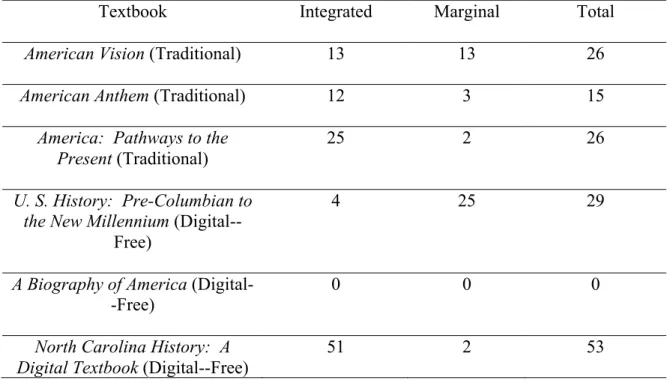
3. Total, Marginal, and Integrated Primary Sources for Each Textbook………….89
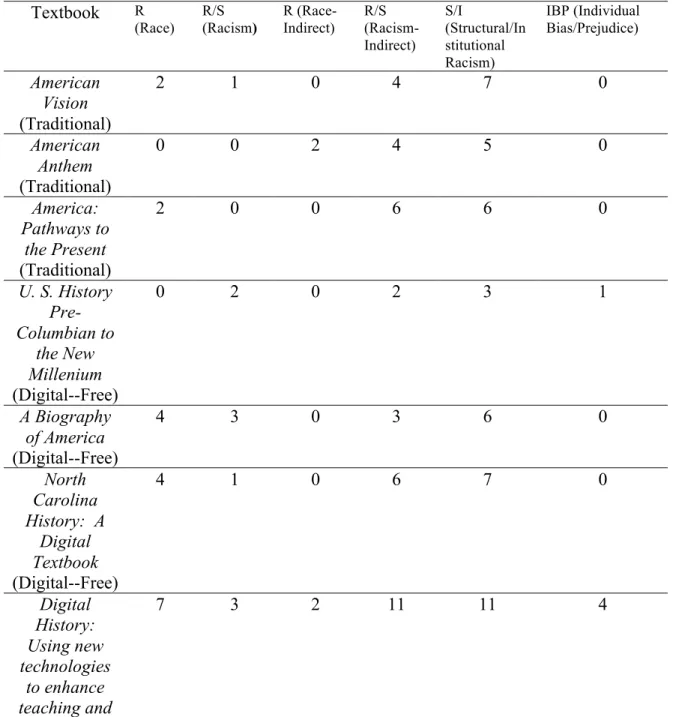
4. Critical Race Theory Textual Analysis Results for Each Textbook...………….98
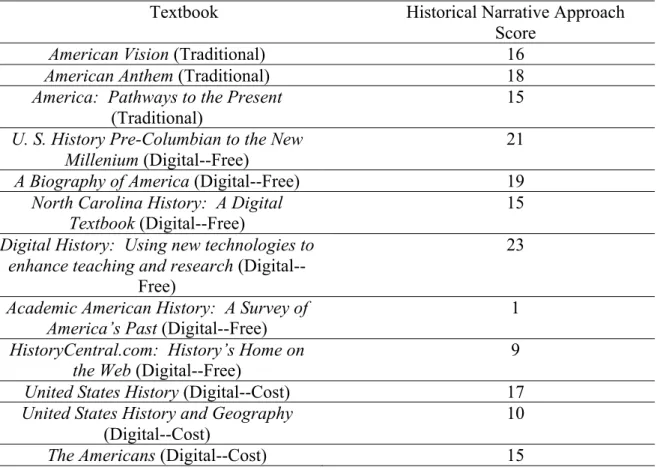
5. Historical Narrative Approach Scores for Each Textbook ……….111
6. Academic Web Popularity of U. S. History: Pre-Columbian to the New Millennium ……….………..114
7. Academic Web Popularity of A Biography of America ……….…….116
8. Academic Web Popularity of North Carolina History: A Digital Textbook…...118
9. Academic Web Popularity of Digital History: Using new technologies to enhance teaching and research ……….……….…….119
10. Academic Web Popularity of Academic American History: A Survey of America’s Past ………..……. 124
11. Academic Web Popularity of HistoryCentral.com: History’s Home on the Web ………..………..125
12. Image Analysis of Each Textbook in the Study ……….125
13. Interactive Images and Digital History Textbooks……...……….134
LIST OF FIGURES Figure
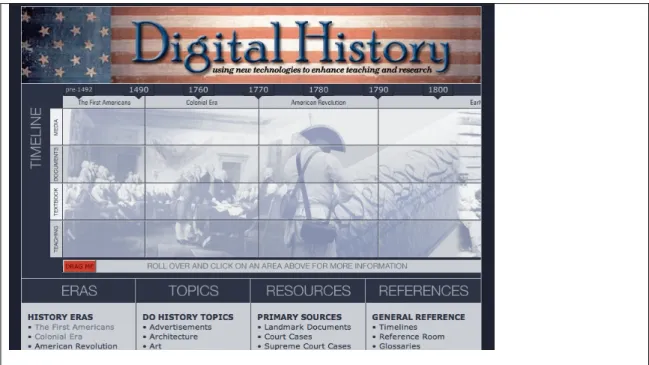
1. The “front page” of Digital History: Using new technologies to enhance teaching and research textbook……….168 2. The “front page” of the U. S. History: Pre-Columbian to the New Millennium
textbook………169 3. The “front page” of the HistoryCentral.org: History’s Home on the Web
DEFINITION OF TERMS
Textbooks: a bound content and instructional manual for a specific course of study.
Digital history textbooks: Internet-based, repositories of primary source documents and original digital historical narratives bound together or structured chronologically, thematically, or interpretively. The boundaries established for digital history textbooks in this study eliminate other digital formats from consideration and affect the recording and enumeration of visual, audial, and textual content for each book. In the “labyrinthine spaces of the Internet, where there are no borders and only flow” (Laspina, 1998, p. 209), digital history textbooks could take many forms and, because of hypertext links, the images, audio recordings, and text included could be infinite.
Backlinks: incoming hypertext links to a website or web page. Backlinks are used in webometrics to measure the popularity of an academic web page, usually a university web page (Aguillo, Ortega, & Fernandez, 2008). In this study, webometrics is used to measure the popularity of the free digital textbooks.
Linus operating system, Amazon will host a frequently-visited website with multimedia content, like a digital history textbook, for an estimated cost of $11.88 per month
(Amazon Web Services, n. d.). With these factors in mind, “space” in digital textbooks is not infinite, rather the monies available to support production and maintenance costs limit it.
Outdated: obsolete and outmoded. In this study, I used the term to describe my interactions towards technology, the U. S. history content about slavery, and the video content included in the digital textbooks. Revealing my own preferences for the “recent” and the “new,” I am aware that “new” does not always mean “best” as it relates to
interactions with technology. However, with the changing nature of U. S. history content and recent findings and interpretations, the “new” in terms of historical scholarship usually means improvements on the traditional accounts. Additionally, the “new” literacies approaches to student learning in the digital age, which facilitate active engagement and learning through videos, games, and interactive images of digital textbooks, may be improvements on the traditional format of videos, which facilitate more passive learning.
Democratization: decentralizing and diffusing knowledge, access to knowledge, and construction of knowledge. This study critiques the claim that digital history
Chapter 1: INTRODUCTION
Thomas J. Sellers may not ever become a household name, but he deserves a place in this digital history textbook analysis. Not because he was a digital historian—in fact, he was an African American newspaper editor in Charlottesville, Virginia in the 1930s—but because his life and his newspaper, The Reflector, represents my initial exposure to the methods and tools of digital history. During the fall semester of 1998, in my third year of undergraduate studies at the University of Virginia, I, along with three classmates, created a digital history project about The Reflector, an African American newspaper in 1930’s Charlottesville, Virginia. Under the direction of Dr. William Thomas III, the then-director of the Virginia Center for Digital History, I interacted with primary source documents and “did” history for the first time in my academic life. Though our class project seems basic now, I was completely engrossed in transcribing newspaper articles, conducting biographical research, and learning and writing html code to create a space on the Internet for Mr. Thomas J. Sellers and his newspaper, The
Reflector.
participated in workshops and wrote lesson plans for the Documenting the American South collections of the University of North Carolina at Chapel Hill. Working directly with digital primary source documents allowed me to hone my historical thinking skills and share those skills and knowledge with my distance-learning and face-to-face students.
During the spring semester of 2010, prompted by my interests and the
proliferation of online K-12 education (Picciano & Seaman, 2009) and digital resources, I took a graduate education class in digital history. Taught by Dr. John Lee at North Carolina State University, the class exposed me to the characteristics and theoretical underpinnings of digital history as a method and field of study. In addition, the class allowed me to learn how to evaluate digital historical resources and create original historical materials by making technological adaptations to existing print materials.
In that same spring semester of 2010, as a graduate student assistant, I wrote lesson plans for North Carolina History: A Digital Textbook. Now, as I conduct this study on digital United States history textbooks, I realize that though I have learned a lot about digital history, there is still much more to learn.
digital history by analyzing digital history textbooks, I now understand that accessibility is just the tip of the iceburg.
Historical accounts of slavery, with the thousands of digital resources in textual, video, and audio formats, provide a great laboratory to test all of the affordances of digital history. As a history teacher interested in taking advantage of computer-aided history texts and projects, I am drawn to the content of slavery because of the numerous possibilities to challenge the dominant narrative of U. S. history. With digital history, the marginalized perspectives and experiences of the enslaved and the events and ideas responsible for the foundation and perpetuation of racism during slavery can be integrated into the historical narrative. Through hyperlinks, digital history textbook accounts of slavery can include the experiences of African Americans in the U. S. historical narrative from the pre-colonial to the Civil War era. In this way, slavery will not just be a topic addressed when discussing the American South or the lead-up to the Civil War, but it will be a topic that is interwoven into the foundational and
developmental narrative of the nation. As an African American teacher, I am drawn to the voices and perspectives of the free and enslaved African Americans made available through digital historical resources. The accessibility of textual and audial primary sources, like the slave narratives of the Federal Writers’ Project, allows enslaved African Americans to speak for themselves without the filter of historians. From these digital resources, I gain an even greater appreciation for the perseverance, courage, and
and method of doing history that can highlight the lived experiences, multiple perspectives, and complexity of slavery in United States history.
With that potential in mind, this study is an effort to construct a description and analysis of accounts of slavery in digital U. S. history textbooks, as compared to traditional U. S. history textbooks, with respect to the experiences of the enslaved, the centrality of race and racism, and recent historical scholarship on slavery. This study also seeks to determine whether U. S. digital history textbook accounts of slavery use the affordances of digital history to integrate more experiences of the enslaved,
race-consciousness, and recent historical scholarship into the history narrative than traditional U. S. history textbooks.
The following research questions and related sub-questions guide the study: 1. How do digital U. S. history textbooks and traditional U. S. history textbooks
describe slavery?
a. How are primary sources from enslaved African Americans used in the digital and traditional textbook accounts of slavery?
i. Do digital U. S. history textbooks have more primary source documents than traditional U. S. history textbooks?
ii. Do digital U. S. history textbooks have different primary source documents than traditional U. S. history textbooks?
b. How is the Critical Race Theory tenet of the centrality of race and racism represented in the digital and traditional textbook accounts of slavery? c. How is recent historical scholarship about slavery used in the digital and
traditional textbook accounts of slavery?
2. Do digital U. S. history textbooks take advantage of the accessibility of primary sources, hypertext links, images, and multimedia presentations to tell a story of the African American slave experience that reflects the marginalized voices of the enslaved, the centrality of race and racism, and the recent historical scholarship on slavery?
For the first sub-question of the first research question, I hypothesized that the number of primary sources would be greater, more varied, and more integrated in the digital U. S. history textbook than the print textbooks. For the second sub-question of the first research question, I hypothesized that the inclusion of more documents from
different perspectives in the digital U. S. history textbooks would make the topics of race and racism more visible than in the traditional textbooks. Regarding the third
sub-question of the first research sub-question, I hypothesized that the inclusion of documents from multiple perspectives and the ability to easily edit and add to digital historical content (Cohen & Rosenzweig, 2005) would make the digital U. S. history textbooks more reflective of the most recent historical scholarship than traditional textbooks.
hypothesized that the primary sources in digital textbooks would include more of the marginalized voices of the enslaved, the centrality of race and racism, and the recent historical scholarship on slavery than in the traditional textbooks. For the hypertext links, I hypothesized that digital U. S. textbook accounts of slavery would have internal and external links. I also hypothesized that those links would allow the digital U. S. history textbooks to include more of the marginalized voices of the enslaved, the centrality of race and racism, and the recent historical scholarship on slavery than the traditional textbooks. For images, I hypothesized that the digital U. S. history textbook accounts of slavery would have more images related to slavery than traditional U. S. history
textbooks. Additionally, I hypothesized that the images in the digital U. S. history textbook accounts of slavery would include more of the marginalized voices of the enslaved, the centrality of race and racism, and the recent historical scholarship on slavery than in the traditional textbooks. Lastly, for multimedia content, I hypothesized that the digital U. S. history textbook accounts of slavery would have multimedia content. I also hypothesized that the multimedia content would include more of the marginalized voices of the enslaved, the centrality of race and racism, and the recent historical
scholarship on slavery than the traditional textbooks.
historical scholarship in the textbooks. In the significance of the study section, I will discuss the influence this study can have on teachers, students, and K-12 digital U. S. history textbook publishers.
Problem Statement
The decline of K-12 traditional (hardback/paperback) textbook sales (AAP, 2011) has prompted textbook publishers to look to digital textbooks as a potential replacement. According to Douglas Levin of the State Educational Technology Directors Association, twenty-two states are moving towards digital textbooks (Lederman, 2012). Even U. S. Secretary of Education, Arne Duncan, on Tuesday, October 2, 2012 called “for the nation to move as fast as possible away from printed textbooks and toward digital ones” (ibid., para. 2). This could be exciting news for history teachers given that digital history textbooks can provide much greater access to primary source documents and other resources than a traditional book. However, history teachers should be concerned about the potential commercial take-over of digital history (Rosenzweig & O’Malley, 1997) by for-profit educational curriculum agencies that are more interested in making money than in portraying an accurate and multicultural history. Corporations and their curriculum specialists, instead of professional historians, will define the curriculum. In this context, greater access means very little if the documents one has access to contain latent
ideologies that privilege elite capitalist interests over historical scholarship (Apple, 2004). Given the prospects of digital history textbooks replacing traditional history
interpretations. Subject to political and economic trends, textbooks often convey a grand narrative determined by the political power of the dominant society (Apple, 2004). Considering these pressures influencing history textbooks, Foster (2006) adds that U. S. history textbooks are inherently conservative and static. Loewen (1995) goes so far as to state that U. S. history textbooks are filled with myths, distortions, and erroneous
depictions of the past.
With promises to “democratize the doing of history” (Bolick, 2006; Cohen & Rosenzweig, 2005; Friedman, 2005) through access to online primary sources that open the vault to untold stories, and promises to help students build historical knowledge through historical context and voices of the participants (Hofner & Swan, 2008), digital history is a potential solution to the mis-education offered by traditional U. S. history textbooks. Supporting the notion of digital history textbooks, Lee (2001) states:
[t]extbook narratives often lack the irresolution and controversy that is an inherent component of historical research and inquiry . . . [w]hen teachers and students use digital historical resources, they embrace the complexities associated with the construction of authentic historical narrative. (para. 48)
While there are many examples of traditional textbook analysis research, the field has not yet progressed to examining digital textbooks. This study, a comparative analysis of traditional and digital U. S. history textbooks, is the first of its kind. Rather than examining a complete textbook historical narrative like Loewen (1995) in Lies My Teacher Told Me: Everything Your American History Textbook Got Wrong, I will take an in-depth look at textbook depictions of United States slavery.
discussions of race and racism. According to Berlin (2004), "[W]herever the issue of slavery has appeared--whether in books, museums, monuments, or classroom
discussions--there have been tense debates over how to present the topic, often
accompanied by charges that interpreters have said too much (why do you dwell upon it?) or too little (why can't you face the truth?)"(p. 1260).
The purpose of the study is to examine and compare how traditional and digital U. S. history textbook accounts of slavery address the experiences of the enslaved, the ideas and experience of race and racism, and the recent historical scholarship on slavery. Additionally, the study will analyze whether U. S. digital history textbook accounts of slavery use the affordances of digital history to tell a narrative that includes more of the marginalized voices of the enslaved, more discussions of race and racism, and more recent historical scholarship than traditional U. S. history textbooks.
Theoretical Frameworks
those functions, and hence, important to this present textbook research, is the centrality of race and racism (Solorzano, 1997).
Race and racism have been a dominant force in United States history. To teach U. S. history is to teach the development of race and racism in the past and present. In fact, a history teacher’s “[f]ailure to engage in critical discussions [with students] about race will only further polarize a nation with increasingly rich racial diversity” (Howard, 2003, p. 30). Race and racism should be essential foci of U. S. history curriculum in schools (ibid.).
The CRT tenet of the centrality of race and racism in contemporary U. S. social, political, and economic inequality and its roots in the history of U. S. slavery should be addressed in United States history textbooks. The values of racism and democracy cannot coexist without tension; in fact, democracy should require dealing with issues of racism and institutional oppression. U. S. history textbooks for too long have followed a “racial script” that trivializes or ignores race or racism (Ladson-Billings, 2003). Gay (2003) refers to this avoidance of discussions of race and racism in curriculum materials as “deracialization.” Both paperback and digital curriculum can become “deracialized” by “de-emphasizing, distorting, excluding, or avoiding elements of race and racism in the presentation of individuals, the analysis of critical events, and the exploration of
sociopolitical issues in educational programs and practices” (ibid., p. 129). For example, Marri (2003), in a content analysis of online social studies lesson plans, demonstrates how “[r]ace is only addressed in lessons that examine the experiences of people of color . . . [and] stories and narratives that capture the continual struggle against racial
history textbooks, whether traditional or digital, should illuminate the development of race and racism in their accounts of slavery.
CRT serves to recognize the ubiquity of racism and unmasks and exposes racism in its various manifestations (ibid.)—in the case of this study, in the textbook accounts of slavery. With this in mind, traditional and digital U. S. history textbooks cannot divorce the history of slavery from race and racism. Omi and Winant (1994) are clear in their statement justifying the need to examine U. S. history within a racial context:
A cursory glance at American history reveals that far from being color-blind, the United States has been an extremely “color-conscious” society. From the very inception of the Republic to the present moment, race has been a profound determinant of one’s political rights, one’s location in the labor market, and indeed one’s sense of “identity.” The hallmark of this history has been racism. (p. 1)
Regarding the traditional and digital textbook accounts of slavery, the CRT tenet of the centrality of race and racism allows the deconstruction and uncovering of historical narratives about racial progress in the U. S. (Delgado & Stefancic, 2001). For example, “CRT challenges the hegemonic narratives of meritocracy and of the centrality of exceptional leaders, rather than collective action, in the push for racial equality”
(Vasquez Heilig, Brown, & Brown, 2012). CRT also analyzes racism “as structural and institutional” (ibid.), rather than as individual acts of prejudice or hate.
Hypertext theory. The origins of hypertext theory can be traced back to the ideas of Vannever Bush, an engineer who served as the Director of the Office of
Scientific Research and Development during World War II. In an essay entitled, “As We May Think,” he describes a machine called a “memex” as an imaginary device that would assist scholars and decision-makers in retrieving, storing, and arranging
For Bush (1945), the “memex” would simulate the workings of the human mind, creating connections between information and ideas and building new knowledge from those connections. George Landow (1992, 1997, 2006), drawing on the idea of the “memex” and the work of critical literary theorists such as Jacques Derrida, Roland Barthes, and Gilles Deleuze, promotes hypertext as tool that enables people to construct knowledge in a non-linear and associative way.
Hypertext is “text composed of blocks of words (or images) linked electronically by multiple paths, chains, or trails in an open-ended, perpetually unfinished textuality described by the terms link, node, network, web, and path” (Barthes, 1974, p. 5-6). The linking of hypertext allows “associative indexing” (Landow, 1997), a process in which users create trails or connections or links between items and sets of items. Because there are no limits to the number of links a user can create within and between texts, the “hypertext [environment] thrives on marginality” (ibid., p. 88), with each text existing in relation to other texts and the boundary of power moving away from the author to the reader. This openness of the text also blurs the distinctions between author and reader. In fact, in hypertext environments, texts can be open-source allowing readers to make their own contributions to works. Known as “writerly” text (Barthes, 1974), this feature of hypertext requires an active reader and contributor to a text, as opposed to “readerly” text (ibid.), which requires a passive reader and consumer of a text.
The implications of these attributes of hypertext for the present textbook study of digital and traditional U. S. history textbook accounts of slavery are numerous.
relationship dynamic; printing out the article and accompanying evidence would render it static" (Robertson, 2006, p. 449). Ayers and Thomas (2003), in their historical scholarly article using hypertext, The Differences Slavery Made, called their approach to hypertext in history, a “prismatic” model, “one that allows readers to explore angles of
interpretation on the same evidentiary and historiographical background" (p. 1299). By linking to multiple texts and creating a web of associated texts and interpretations, hypertext use in history textbooks has the potential to enhance the dominant historical narrative with multiple perspectives and marginalized voices. Additionally,
intertextuality, which is the ability to move instantaneously from one text to another in hypertext, facilitates an understanding of historical context and subtext, a necessary process in developing historical thinking skills (Wineburg, 2001).
The expansiveness and openness of text allowed in hypertext mirrors the complexity and non-linearity of United States history. According to Rommel-Ruiz (2006):
American life does not follow a linear progression like a textbook—it is
polyrhythmic and improvisational, and deserving of a narrative framework that can appropriately recount its multivocality and complexity. Technologically, hypertext and the Internet offer us this opportunity to reconsider how we structure history, one that may be more accurate and representative of the American
experience than the one currently represented via print. (p. 462)
and racism, and recent historical scholarship on slavery equal value and equal placement in the non-linear and non-hierarchical historical narrative of slavery.
New literacies. Given the potential openness of the digital historical narrative through hypertext and the abundance of digital historical resources, the new literacies are needed for understanding, adding to, and critiquing the digital history textbooks. With the exponential growth of digital history texts outpacing pedagogy and curriculum, teachers are in a “post-typographic” era in which “electronic texts are destabilizing previously held conceptions of literacy and are requiring students and teachers to examine assumptions about reading, writing, books, and what we know . . . about
curriculum practice” (Semali, 2001, Section 2). Addressing the foundations of these new literacies to be taught, Leu et al. (2004) defines new literacies as “the skills, strategies, and dispositions necessary to successfully use and adapt to the rapidly changing
information and communication technologies and contexts that continuously emerge in our world” (p. 2). Additionally, the new literacies allow use of the Internet “to identify important questions, locate information, critically evaluate the usefulness of that
For this study, the new literacies will be used to determine whether the digital history textbooks facilitate the location, evaluation, contextualization, and understanding of the historical narrative. Through use of the new literacies, the digital U. S. history textbooks should scaffold student historical thinking by making visible the stances and opinions of authors and the documentary record. According to Wineburg (2001),
[t]extbooks rarely cite the documentary record; if primary material appears, it is typically set off in ‘sidebars’ so as not to interfere with the main text . . . the textbook speaks in the omniscient third-person. No visible author confronts the reader; instead, a corporate author speaks from a position of transcendence, a position of knowing from on high (p. 12-13).
To become critical readers and historical thinkers, students “need to see author biases and evaluate them” (Crismore, 1984, p. 296) as distinct from historical documents.
The new literacies will also frame the analysis and contextualization of visuals (Kuiper & Volman, 2008) in the digital history textbooks. Additionally, the use of multimedia presentations will be evaluated based on new literacies principles of multimedia message design (Mayer, 2008).
Methodological Frameworks
determine whether links to primary source documents are integrated into the historical narrative and whether links are used to “annotate anachronistic language, . . . provide information on a text’s author, or . . . identify passages that reveal a point of view and genre . . . ” (Robertson, 2006, p. 451). With new literacies framing my methodological approach, I counted and described the images related to slavery in the textbooks, and counted and described the video, audio, and interactive graphics about slavery in the digital textbooks. With the new literacies, I also evaluated whether hypertext links were used to scaffold student understanding through annotations (Robertson, 2006).
Additionally, I evaluated the video content based on multimedia message design (Mayer, 2008).
The historical record or narrative informed the methods in this study through the primary source documents. To analyze the experiences of the enslaved in textbook accounts of slavery, I counted and described the primary source documents from the era of African American slavery in the United States.
For the analysis and evaluation of textbook accounts of slavery based on recent historical scholarship, I used the historical narrative approach (Cramer, 2012; Leahy, 2010; Loewen, 1995). Relying on the historical record as a measuring stick, “[t]he principal strength of historical narrative [approach] is that it makes use of leading histories and recent scholarship as a base to critique textbooks; therefore it offers a perspective that is rich in historical detail” (Cramer, 2012, p. 115).
Significance Of The Study
view the openness and nonlinearity of digital, hypertext history as the polar opposite of the closed, linearity of textbooks (Rommel-Ruiz, 2006), this study seeks to find
affordances of digital history within the structure of a digital history textbook. The increased accessibility of primary source documents (Lee, 2002), the multiple
perspectives of historical narratives (Ayers, 1999), the flexibility in presentation forms (Cohen & Rosenzweig, 2005), and the integration of formerly marginalized historical accounts (Bolick, 2006) in digital history makes it possible to radically transform the textbook accounts of slavery. This study reveals whether digital U. S. history textbook accounts of slavery live up to the potential.
The comparative examination of the traditional and digital U. S. history textbook accounts of slavery uncovers whether the historical narrative changes when the format changes from paper to digital. The insights gained from the data collected may lead to both traditional and digital U. S. history textbooks containing an inclusive, multi-perspective narrative that addresses controversial topics.
Lastly, the study could lead to the mobilization of digital historians for the
purposes of writing more digital history textbooks. If this happens, digital historians may grab the digital history textbook market from the hands of the major textbook publishers. With that in mind, textbook publishers could also use the study to improve current digital history textbooks.
Chapter 2: LITERATURE REVIEW
This literature review addresses the role of U. S. history textbooks in history classes and the historical and contemporary factors keeping U. S. history textbook accounts of slavery devoid of primary source documents, discussions of race and racism, and recent historical scholarship. The field and methods of digital history is then
explored as a potential solution to the aforementioned problems with traditional textbook accounts of slavery. A history of representations of African Americans and slavery in U. S. history textbooks and relevant research on teaching about slavery is then presented to situate the current study among the many similar history textbook content analyses. The research design of this study is then explained in the context of related literature and theoretical foundations.
United States History Textbooks
“rhetoric of certainty” (ibid., p. 287) of U. S. history textbooks makes it difficult for teachers to teach critical thinking through the controversies, uncertainties, and alternative and oppositional perspectives in the history of our country. Additionally, through U. S. history textbooks, students are implicitly taught that if a person, place, event, or idea is included in a textbook, then it is true and important; while, conversely, omission from a textbook means that some idea or thing may not be true and is not important (Loewen, 1995). With the uncritical acceptance of textbook accounts by teachers and students, the U. S. history classroom becomes an uncontested terrain of indoctrination. Sewall (2000) stated that U. S. history textbooks have been “the official portraits of our country’s past . . . that are assigned to students with the foreknowledge that these students will someday participate in public affairs” (p. 2). Romanowski (2009) added that U. S. history textbooks “reflect a national consensus regarding cultural knowledge and values that members of society want transmitted to their children” (p. 290). While assimilation to, and appreciation of, United States values should be emphasized in history textbooks, that emphasis should not come at the expense of facilitating critical thinking.
Challenges of Creating the “Perfect” U.S. History Textbook
Although U. S. history textbooks are often presented to students as unbiased, factual accounts of the national narrative, the many ideological and economic influences on the textbook narrative prove that “unbiased” presentation to be false (Loewen, 1995). The ideological and economic nature and purposes of U. S. history textbooks reflect uniformity, profitability, and the contemporary moment in which the history is written. Those factors could hinder whether textbook accounts include primary sources,
According to David Tyack (1999), textbooks are like stone monuments designed to commemorate the past and reflect the public culture. Similar to monuments, textbooks can reveal more about their creators than about the past they represent. Because the values and perspectives of the creators are made legitimate through textbooks, those textbooks reveal not only what knowledge is of most worth, but whose knowledge is of most worth (Apple & Christian-Smith, 1991). With schools tending to serve the interests of the elite, the knowledge transmitted in schools through textbooks is a form of symbolic capital defined and controlled by the elite powerful groups in society (Bourdieu, 1973). Disguised as school knowledge for all students, textbook knowledge is symbolic capital that reinforces the power of dominant groups. In her analysis of United States history textbooks, Anyon (2011) found that textbooks, despite claims of objectivity, expressed dominant groups’ ideologies and legitimized the unequal social and economic relations between dominant and less powerful groups. Particularly, Anyon (2011) found that U. S. history textbooks imposed beliefs and constrained choices defining past “’success’ and ‘failure’ in social, economic, and political matters” (p. 127). Therefore, in terms of the U. S. labor movement, “governmental reform and labor-management cooperation are characterized as successful methods of social recourse, whereas confrontation and strikes are depicted as failures” (ibid., p. 127). In this sense, textbooks explicitly emphasize particular content at the expense of other content while implicitly maintaining the status quo and hierarchy in social class relations (Sleeter & Grant, 1991).
Addressing race, class, gender, and disability in U. S. history textbooks, Sleeter and Grant (1991) found that, by presenting one version or perspective of history,
or privileged in society. Despite the multiculturalism and diversity movements, which led to more inclusion of minority groups in textbooks, their study showed that textbooks continued to legitimate the status of White, able-bodied males (ibid.). Given the
prominence in U. S. schools of a schooling paradigm, which is “designed to provide an ample supply of people who are loyal to the nation-state and who have learned the skills needed to perform the work that is necessary to maintain the dominance of the . . . elite in the social order” (Shujaa,, 1998 p. 10), there is little wonder that history textbooks are its main conduits. Foster (2006), in his analysis of the representations of immigrant groups in U. S. history textbooks, summed up the assimilationist and monocultural attributes of textbooks in this way:
For the most part history textbooks never were intended to promote reflective thought, to stimulate critical analysis, or to celebrate cultural diversity. The function of history in American schools essentially has been to instill in the young a sense of unity and patriotism and veneration for the nation’s glorious heritage. (ibid., p. 157)
Additionally, for Foster (2006), ideological influences make textbooks inherently conservative and static. Textbook accounts continue to perpetuate conservative themes of nationalism, absence of conflict and controversy, and “mentioning” (ibid.). The nationalistic theme of progress and national pride preserves the status quo because if “society constantly is improving little needs to be done to address social ills” (ibid., p. 167). Also, the theme of mentioning “involves adding content to the text without altering the book’s organizing framework or central message” (ibid., p. 169). In this way,
The conservative ideologies inhibiting a historical narrative filled with multiple perspectives through primary source documents, controversial issues, and recent
scholarship are present in the textbook publishing industry through the accountability and standards movement, the state textbook adoption policies, and the economics of selling textbooks. The “invisible hand” of the market, the “political hand” of state textbook adoption (Apple & Christian-Smith, 1991), and the “standardization hand” of the
accountability movement guide textbook publishers. Because of the expense of creating and printing textbooks and the difficulty of predicting whether new books will be
profitable in the market, often textbooks beget textbooks (Tyack, 1999). To minimize risk, textbook publishers “find it wise to copy successes . . . [and] easier to add to the master narrative than to rethink it, easier to incorporate new content into a safe and profitable formula than to create new accounts” (ibid., p. 929). The predominant political climate and culture of the large textbook adopting states of California and Texas, because they have a large market desirable to publishers, shape the textbook content and
curriculum across the nation. So, because of the “Texas” and “California” effect, in which the textbook publishers create content that meet the larger states’ curriculum (Tulley & Farr, 1990), the political climate of those states may necessitate the inclusion or exclusion of content that may not reflect the climate in other states. The infusion of politics in the textbook publishing process is also evident through the influence of
the key people, events, and dates, the standards-based history textbook does not facilitate historical inquiry, critical analysis, or student-centered activities. According to Leahy (2010), “[t]he end result is the production, adoption, and dissemination of textbook narratives scrubbed of controversy, new research, and alternative perspectives, a vital part of historical study and democratic life” (p. 39).
The Multicultural Inclusion Movement for U.S. History Textbooks
Even though the canon of the United States history textbook narratives have mostly included top-down, monocultural accounts, the movement towards multicultural inclusion in textbooks has not necessarily led to a historical narrative featuring accounts from multiple perspectives. Increasing demands for minority representation in textbooks coincided with the growth of “bottom up” social history in the history discipline and the Civil Rights movement of the 1960s (Tyack, 1999). Using the arguments of Dr. Kenneth Clark, the sociologist that conducted the “doll experiments” on African American
children as evidence in the Brown v. Board of Education of Topeka, Kansas (1954) case, many African American civil rights activists argued that racist textbooks were
2006) minorities and celebrates race and diversity, but significantly downplays racism (Zimmerman, 2011). Zimmerman (2011) added that
[w]hen Blacks won new material about their triumphal deeds . . . they cleared the way for other groups to do the same. So textbooks billowed to 700 or even 800 pages, giving every group ‘some history to be proud of’ but diverting them from the painful history they shared. (p. 232)
Conservative critics of the multicultural inclusion movement in U. S. history textbooks call it a “textual affirmative action” (Sewall, 1987, p. 75) that inundates the central historical narrative of the nation’s political and economic development in a sea of political correctness. Sewall (2000) in a later publication added that “old master
narratives in yesteryear’s textbooks – faith in progress and patriotic pride – have
vanished, too rosy and innocent in view” (p. 28). In discussing the “heroes” in new U. S. history textbooks as opposed to the “heroes” in old U. S. history textbooks, Sewall (2000) wrote that new textbooks
advance a civic agenda that highlights and ennobles people of color, peace advocates, anti-colonialists, environmentalists, and wronged women . . . [while] Alexander Hamilton and Henry Clay, Alexander Graham Bell and Thomas Edison . . . do not exactly vanish, but they are not much savored either. (p. 43)
U. S. history textbooks overcome some of the aforementioned ideological and economic barriers.
Digital History and Digital History Textbooks
Digital history holds the potential to completely transform the writing, doing, and teaching of history. As a method and field of study, digital history allows greater
accessibility of primary source documents (Lee, 2002), multiple perspectives of historical narratives (Ayers, 1999), flexibility in presentation forms (Cohen & Rosenzweig, 2005), integration of formerly marginalized historical accounts (Bolick, 2006), student-centered pedagogical approaches (Cohen et al., 2008; Lee, 2002), greater opportunities for
historical thinking (Saye & Brush, 2007), and more opportunities for collaboration (Burton, 2005). According to Wynne (1999), “[the Internet] decentralizes and democratizes access to knowledge bases in ways that used to be impossible . . . [and] democratizes pedagogy because it deals with evidence from a variety of sources to give voice to a range of human endeavors” (p. 25). Consistent with these claims about the transformative power of Internet technologies in the history discipline are the claims that the aforementioned affordances of digital history democratize the telling and doing of history (Bolick, 2006; Cohen & Rosenzweig, 2005; Friedman, 2005).
In this section of the literature review, I provide an overview of digital history and its affordances, and, from that overview and related research, develop a definition of digital history textbooks. According to Professor William Thomas III, digital history “is an approach to examining and representing the past that works with the new
history is written, digital history uses hypertext links to allow readers to connect to multiple and, perhaps, marginalized accounts. This hypertextuality also makes the historical narrative non-linear, but imaginatively open-ended (Cohen et al., 2008). As historians, and not librarians or archivists, digital historians should do a lot more than make more historical documents accessible online. In fact, digital historians should “use computers to do history in ways impossible without the computer” (Burton, 2005, p. 207). Professor Amy Taylor mentioned some of the improved ways to do history:
[t]here’s the ability to access images and video with new efficiency and therefore to make these forms a more central part of historical analysis. There are
possibilities for mapping . . . the plotting of data through GIS maps to see the spatial dimensions of people’s lives or capturing movement through animated maps (as cited in Cohen et al., 2008, p. 484).
The Difference Slavery Made: A Close Analysis of Two American Communities published by Ayers and Thomas in 2003 exclusively for an online readership
demonstrates the benefits of digital history. According to Burton (2005), the article “allowed readers to better learn about and see change over time . . . to browse the historical argument in a nonlinear fashion through hyperlinks . . . to directly reference many of the primary and secondary sources cited in the article, and . . . to provide very detailed and specific claims about evidence the reader is able to see on the spot” (Burton, p. 211). Digital history is also participatory and interactive. Comparing digital history to gaming, Professor Thomas wrote that in digital history, just like in gaming, “users have control over where their characters will go and what they will see and do, but the
student-centered activities facilitating historical thinking and collaboration, is evident in the above examples.
Through its offering of an unmediated history, digital history provides a good solution for those students of history who fear being manipulated by textbook publishers and authors that may distort the past to meet their own needs of commercial greed, political ambition, or cultural prejudice (Rosenzweig & Thelen, 1998). Digital history strips away the layers of mediation and offers readers a more balanced and collaborative role in constructing the past (Cohen et al., 2008). The reader can work directly with “raw” digital history materials compromising “documents, information and
communications that are heterogeneous and that have little, if any, organization” (Cohen, 2004, p. 337). The Atlantic Slave Trade and Slave Life in the Americas: A Visual Record website developed by James S. Handler and Michael L. Tuite, Jr. is a good example of raw digital history because it offers lots of images, but no overall framework or
educational context for the images (Burton, 2005). In response to raw digital history, Thomas stated that “[t]he single largest question . . . was whether we (digital historians) had abdicated our responsibilities to the reader—to guide, inform, interpret, and tell the reader the story, the meaning of the past” (as cited in Cohen et al., 2008, p. 475). Anticipating Thomas’ concern, Cohen (2004) defined “cooked” digital history, in
opposition to “raw”, as “helpful markings and a measure of homogeneity” (p. 337) added to the presentation of historical materials online. While cooked would seem preferable to raw because of the added structure to the disorganized mess of online historical
339) in its structure. To be over-“cooked” is the equivalent of historical commentary on the Internet with few opportunities for historical inquiry; while, to be too “raw” is the equivalent of an unorganized digital historical archive.
A potential compromise between raw and cooked digital history are interpretative digital history web sites. According to Lee (2002a), those sites “contain some
description, explanation, analysis, and/or evaluation of historical primary sources as well as original digital historical narrative or analytical works” (para. 3). In addition, many interpretative digital history sites contain significant numbers of primary sources to be used to facilitate historical inquiry (ibid.). Lastly, the sites tend to be organized around a theme, a time period, or an historical inquiry project. Though the organization,
description, analysis, and overarching historical narrative of these websites are clear evidence of cooked digital history, the inclusion of multiple primary source documents provide a hint of the raw.
Considering the attributes of digital history, along with understandings of raw, cooked, and interpretative digital history materials, digital history textbooks are defined as Internet-based, repositories of primary source documents and original digital historical narratives bound together or structured chronologically, thematically, or interpretively. This definition is used to identify digital U. S. history textbooks analyzed in the study. Additionally, given the possibilities of a limitless number of primary source documents together with the other affordances of digital history, digital U. S. history textbooks have the potential to transform accounts of slavery by including multiple perspectives,
whether that potential is realized. The next section of the literature review includes a history of content analysis for African American representation in U. S. history textbooks.
The History of Content Analysis of African American Representation in U. S. History Textbooks
Content analysis for the purposes of improving history textbook portrayals of African Americans has a long history in educational research. That history is part of the foundation for this current study about digital and traditional U. S. history textbook accounts of slavery.
postsecondary textbooks and found that “textbooks in use throughout the United States [were] distressingly inadequate, inappropriate and even damaging to intergroup relations” (as cited in Kane, 1970, p. 1). In this study, not only were the depictions of African Americans negative and inaccurate, so were the depictions of relationships between African Americans and Whites. Twenty years later, James Banks analyzed thirty-six elementary U. S. history textbooks for their treatment of African Americans and of race relations (Garcia, 1993). Banks (1969) found that many textbooks rarely depicted
violence and often failed to explain prejudice and discrimination. In another study, Elson (1964) analyzed 1000 K-8 textbooks and found that the textbook accounts reproduced the status quo of White male superiority and omitted or distorted the achievements of
minorities and women. Kane (1970) analyzed social studies textbooks and found that the quantity of African American representation in textbooks had improved, but “the
treatment of the black man in most social studies textbooks [was] still far from adequate” (p. 104). More than half of the textbooks that Kane (1970) analyzed contained bias and stereotypes of African Americans.
indicate that textbooks address some of the injustices of slavery, but due to the
marginalization of the perspectives of African Americans and women, textbooks still do not provide students with a “full understanding of racial and gender discrimination inherent in the slave system and the consequences of this discrimination on generations of Americans, both African American and White” (ibid., p. 213). Sadker, Sadker, and Long (1997), in their study, found that textbooks avoid controversial topics like racial discrimination. The authors also found that textbooks tend to relegate minorities and women to the outskirts of the historical narrative, which they refer to as “fragmentation” (ibid.). For Sadker, Sadker, and Long (1997), “[f]ragmentation communicates to readers that women (and minorities) are an interesting diversion but that their contributions do not constitute the mainstream of history and literature” (ibid., p. 134). Washburn (1997) analyzed accounts of slavery in U. S. history textbooks published from 1900 to 1992 and found that those accounts were largely influenced by ideologies dominant at the time of their writing. For Washburn (1997), five patterns emerged from the textbook accounts of slavery, four of which justified slavery’s existence, reflecting the racist ideologies present during the textbook’s construction. From 1900 to 1930, Washburn (1997) found a
pattern of neutral presentations of slavery; from 1930 to 1950, she found a pattern justifying the slave system; from the mid-1940s to the mid-1950s, she found a pattern supporting slavery as a necessary evil; from the late 1960s to 1970s, she found a pattern supporting slavery as un-American; and from 1980 to 1992, she found a pattern
King as a messiah highlights him as the one exceptional leader that initiated and gave vision to the Civil Rights Movement. However, that messianic master narrative “denies students an opportunity to see King as a real person and as a young man who develops into a leader over time. Students also lose the opportunity to study the community leadership in Birmingham before King . . . “ (ibid., p. 667). These kinds of narratives do not present multiple perspectives or student-centered, critical thinking activities. Brown and Brown (2010) examined U. S. history textbooks for accounts of racial violence towards African Americans. While the authors found that incidents of racial violence against African Americans are included in more textbooks today than in the past, the institutional nature and implications of racial violence and privilege are still left unexamined (ibid.). Hilburn and Fitchett (2012) examined voluntary and involuntary immigration in North Carolina history textbooks and found negative stereotypes of African Americans in the early 20th century versions and evidence of “North Carolina slavery exceptionalism” in all of the versions. The false notion of the exceptionalism of North Carolina slavery refers to “the theme throughout the textbooks that North Carolina had few slaves, and that slaves were treated better in North Carolina than in other places” (ibid., p. 56).
contributions and experiences of people of color . . . [they were] almost devoid of discussion of white privilege and its relation to the experiences of Americans” (p. 205).
This research study continues the trend of critique of African American portrayals in U. S. history textbooks. Analyzing both print and digital U. S. history textbooks, this study compares accounts of slavery in both mediums to determine whether the
affordances of the digital medium makes a difference in the textbook historical narrative. In the next section of the literature review, I will examine the role of U. S. history
textbooks in teaching about U. S. slavery. Teaching United States Slavery
Given that United States history textbooks often sanitize accounts of slavery, the effects of those textbooks on teaching U. S. slavery are explored and recommendations for improvements are made in this section of the literature review. The “master script” (Swartz, 1992) of textbook accounts of slavery tends to highlight a few
African-American role models in a biographical approach (ibid.), connect the history of slavery to the narrative of the Civil War (Berlin, 2004), treat slavery as a “temporary aberration” (Loewen, 1995, p. 142) in the progress of American democracy, ignore or minimize the violence of slavery (Ruffins, 2001), ignore the role of race and racism in slavery
(Loewen, 1995), and simplify the historical research, debate, and complexity of slavery (Kolchin, 1998; Kotzin, 2007; Olwell, 2001). The historical development of this master script of textbook accounts of slavery and its influences on teaching are further examined below.
content slaves. In Phillips’ view, it did not make sense for an owner to abuse his slaves because that would damage property and reduce the efficiency of the labor force. Ruffin (2001) suggested that much of the research and scholarship on slavery today is a reaction and response to Phillips’ account. It is important to note that many of the early United States history textbooks mirrored Phillip’s views of slavery (Elson, 1964; Kane, 1970; Washburn, 1997). Teaching this account of slavery presents a simplistic morality lesson from a single perspective. In this moral saga of slavery, “the United States is always intrinsically and increasingly democratic, and slaveholding is merely a temporary
aberration, not part of the big picture” (Loewen, 1995, p. 142). Denial of the lived reality of the enslaved Africans and emphasis on the democratic and economic progression of the nation are the central objectives of these teaching lessons on slavery.
Responding to Phillips’ account as well as negative stereotypes about African Americans during Reconstruction in the U. S., DuBois (1935) challenged historians to write histories “as though Negroes were ordinary human beings” (p. 1). Approaching antebellum slavery as a problem faced by people, teachers can begin “to view the
enslaved as individuals who laughed, loved, wept, and wondered—experiences to which all of us, including our students, can relate” (O’Donovan, 2009, p. 8). When this
Kotzin (2007) asked students to read primary sources describing slave courtship to compare to their own courtship and dating patterns. According to West (2004) in Chains of Love: Slave Couples in Antebellum South Carolina, masters arranged for couples on different plantations to meet, encouraged specific matches within their own plantation, required permission for marriages, rewarded marriages they liked, and presided over wedding ceremonies. With that in mind, Kotzin (2007) helped students emotionally connect with the slaves and better understand the complexities of the paternalistic master-slave relationship by asking them to imagine that their parents or other authority figures interfered in their dating relationships like slave masters did with the slaves.
Similar to the idea of slave autonomy, slave agency is a concept developed by historians to describe the enslaved African Americans as active agents in shaping their own lives (Penningroth, 2009). The agency framework is accurate in the sense that “it was slaves’ actions that launched rebellions, established families, passed down customs, created the ‘sorrow songs’ and field hollers, and did the everyday work that sustained the South’s economy” (p. 17). But, Penningroth (2009) joined Johnson (2003) in warning that slave agency with its “liberal notion of selfhood . . . risks downplaying the
constraints of the system or even ‘whitewashing’ the horrors of slavery” (as cited in Penningroth, 2009, p. 17). Therefore, in teaching about slave agency, educators need to present a balance between the institutional and violent system of slavery and the
resilience and creativity of the enslaved to endure and overcome.
students understand that violence and racism were the norm. So, students can be taught “lessons about the Underground Railroad and the revolt on the Amistad slave ship . . . [which] involve interracial cooperation that successfully frees the slaves” (p. 26). But, they must also be informed that both moments are “highly atypical” (ibid.).
Ultimately, including evidence of racism and interracial cooperation, along with a balanced view of slave agency, helps students better understand the lived experiences of the enslaved. In this sense, comprehending the humanity of slavery does not mean minimizing the inhumanity of the system, rather it means “see[ing] the lives of enslaved people as powerfully conditioned by, though not reducible to, their slavery” (Johnson, 2003, p. 115). Additionally, by teaching students slavery from the perspective of the enslaved through primary source documents, “we are teaching them how to think and read critically, how to tease out meaning, identify assumptions, weigh evidence, and arrive at their own conclusions . . . [and] how to understand the past on its terms and not their own” (O’Donovan, 2009, p. 9).
understood from multiple perspectives. Similarly, educators can place U. S. slavery in the context of a much larger Atlantic world, where everything from individual identity to cultural stimuli stretched beyond the British colonies to include West Africa, Brazil, most Caribbean islands, western Europe, and the lands and waters in between. (Wright, 2003, p. 5)
By establishing the national and international context of slavery, educators can use primary sources and historical narratives to demonstrate to students that slavery and racism were prevalent beyond the borders of the U. S. southern region.
Shifting the focus of teaching slavery to issues of human rights, capitalist
production, globalism, and contemporary implications, Singer (2008) challenged teachers to “think about slavery and racism as global systems shaping the world and creating the powerful institutions that govern today” (p. 6). Citing evidence that 19th century New York City bankers and merchants made huge profits from slavery, Singer (2008)
questioned whether capitalist production for profit, both then and now, could be trusted to protect human rights. Additionally, he encouraged teachers to consider whether human rights violations like slavery, then, or child labor, now, are tragic mistakes or “underlying pillar[s] of capitalist industrial development” (p. 6).
Drawing on Eric Williams’ classic work, Capitalism and Slavery (1944),
McCarthy and Sealy-Ruiz (2010) take a critical pedagogical stance towards teaching the connections between the past and present capitalist system and its consequences for enslaved Africans and their descendants today. This approach gives educators “possible points of departure to teach about an institution that systematically relied on the
are key components of the pedagogical approach.
Explanations of Research Design: Qualitative Content Analysis
Analyzing digital and traditional U. S. history textbook content through an inductive and iterative process involving close reading and interpretation of texts is the general approach to content analysis taken in this study (Krippendorff, 2013). While most quantitative content analysis emphasize objectivity, systematic procedures, and replicability (Holsti, 1969; Krippendorff, 2013), qualitative content analysis purposefully takes into account the subjectivity of the analysts and attempts replicability by explicitly describing the procedural steps taken to reach conclusions (Krippendorff, 2013).
Because the questions that analysts seek to answer are the analyst’s questions, they are potentially at odds with whether others could answer them and how (ibid.). For this reason, the analyst’s subjectivity and positionality are important to understand the findings of qualitative content analysis, even though the potential for replication of the study is limited.
Positionality. The role of the researcher/analyst in any study affects the
questions asked, the research design used, and the way the results are interpreted (Hatch, 2002). Although quantitative content analysis is designed to be an unobtrusive technique that minimizes the researcher’s influence on the data, qualitative content analysis
acknowledges the analyst’s social and cultural positioning or worldview and its effects on the process (Krippendorff, 2013).
Positionality to the researcher is the practice of delineating his or her own position in relation to the study, with the implication that the position may influence the
researcher’s subjectivity is the part of his or her life or experiences that affect how he or she interprets and views the world. My positionality and subjectivity are important in this study for three reasons. First, as the researcher I need to examine and clearly state my subjectivity towards the history of slavery. Based on my years of teaching A. P. U. S. History and African American Studies, I believe that teaching and learning about slavery should emphasize the humanity, resistance, and empowerment of the enslaved. Second, I need to be aware of my subjectivity towards technology. My experiences interacting with technology, my awareness of issues related to the digital divide, and my beliefs about the transformative potential of technology in education all shape how I interpret the content. Third, I need an awareness of my subjectivity towards race and racism. As an African American male U. S. history teacher with direct and vicarious experiences of racial discrimination, my analysis of data about race and racism will be deeply personal. Since this study involves an analysis of textbook accounts of slavery, including an analysis of the presence, or lack thereof, of African American perspectives and race and racism, acknowledgement of the subjectivities and positionalities are critical. Being aware of my subjectivity and its influences on my interpretations, enables me to try to step outside of my subjectivity and take another view of the data, reducing the amount of bias I am consciously and unconsciously placing on the analysis. Additionally, by making my subjectivity explicit, other researchers who examine my study are able to understand my perspectives on the research.
fixed positions are problematic because people have the power to change and notions of race, religion, age, and gender may change in a society (Geiger, 1990; Goodall, 2000), I still think it provides a good framework for analyzing the researcher’s role in the
research. Reflecting upon positionalities allows me to acknowledge the dynamics of where I am and how it affects my viewpoint and the production of knowledge without privileging one particular position over another (Geiger, 1990). All of my positionalities, both fixed and subjective, work together to form a unique lens with different aspects emerging at different times depending on the context of the research.
Fixed positions are “personal facts that might influence how you see your data— your age, gender, class, nationality, race—factors that will not change during the course of the study but are often taken for granted and unexamined in the research process” (p. 57). My fixed positions of race, gender, age, class, and religion will all come into play in the data collection. As an African American who loved learning about history at an early age, I was exposed to school curriculum emphasizing passivity and victimhood in
concept of race as a social construction (Howard, 2003; Ladson-Billings & Tate, 1995) to frame my teaching about, and discussions of race.
Along with the fixed position of race, age and gender will also play a role in my content analysis. As a “digital immigrant” (Prensky, 2001), I may bring outdated
sensibilities to the analysis of digital historical content. For example, while I enjoy using technological applications for learning, I have not yet read an e-book or registered for Facebook or Twitter. While those things are not necessarily functions of age, they do reveal my hesitancy to take a complete nose-dive into technology, which may be due to my age. In terms of gender, my maleness gives me an interpretive lens that sometimes neglects the contributions of women. When learning about, and teaching slavery, I privilege enslaved men’s experiences over enslaved women. Acknowledging this preference may make me overly critical of textbook accounts that reveal the same preference and do not include many experiences of enslaved women.
My fixed position of class will affect my content analysis due to my concerns about the digital divide. Though I belong to the middle class and can afford to do research on, and learn from, digital history textbooks, I have close family members who are in the lower-middle to lower class that have no access to broadband or dial-up Internet services. For this reason, I often wonder whether my research is relevant to the lives and experiences of income students in public schools. Where there are low-income students, there are poorly funded schools with obsolete and minimal