QUANTITATIVE ANALYSIS OF DISTRIBUTED LEADERSHIP IN SCHOOLS USING STATEWIDE TEACHER PERCEPTION SURVEYS
Drew Ware
A dissertation submitted to the faculty at the University of North Carolina at Chapel Hill in partial fulfillment of the requirements for the degree of Doctor of Philosophy in the
Department of Educational Leadership.
Chapel Hill 2019
© 2019 Drew Ware
ABSTRACT
Drew Ware: Quantitative Analysis of Distributed Leadership in Schools Using Statewide Teacher Perception Surveys
(Under the direction of Erick Houck)
Leadership that is intentionally and thoughtfully distributed across many in a school building has the potential to bring about positive change for all students and to empower and engage teachers in such a way that makes them more likely to stay in the classroom. Given the potential of distributed leadership, understanding it more deeply is critical for schools to see the potential benefits. This study has sought to accomplish that goal by first creating two measures of distributed leadership that can be applied to a wide range of schools using a state-wide teacher perception survey. One measure (DL 1) was created using a literature review on distributed leadership to identify questions from the North Carolina Teacher Working Conditions Survey that illustrate this concept. The other measure (DL 2) used confirmatory factor analysis to identify questions from this same survey that were indicators of the underlying factor of distributed
ACKNOWLEDGEMENTS
TABLE OF CONTENTS
LIST OF TABLES ... xi
LIST OF FIGURES ... xiii
LIST OF ABBREVIATIONS ... xiv
CHAPTER I: INTRODUCTION ... 1
Introduction ... 1
Significance of Distributed Leadership ... 4
Problem Statements ... 6
Current Context ... 7
Theoretical Framework of Distributed Leadership ... 8
Conceptual Framework ... 10
Research Questions ... 14
Data ... 15
Methods ... 16
Hypothesis ... 17
Assumptions of This Research Study ... 18
Limitations of This Research Study ... 18
Definition of Terms ... 19
Summary ... 22
CHAPTER II: REVIEW OF THR LITERATURE ... 24
Introduction ... 24
Section I: The Process of Leadership through a Distributed
Perspective ... 26
Overview of Instructional and Transformational Leadership ... 26
Unit of Analysis for Leadership ... 28
Leadership Activity as a Unit of Analysis: A Distributed Perspective ... 29
Section II: Patterns of Distributed Leadership ... 31
Planful Alignment of Distributed Leadership ... 34
Properties of Distributed Leadership ... 36
Research on Distributed Leadership Components ... 39
Section III: Effective Distributed Leadership in Practice in Educational Settings ... 41
Leadership Functions ... 41
Leadership Function in a Distributed Environment ... 46
Setting Direction in a Distributed Environment ... 47
Developing People in a Distributed Environment ... 48
Redesigning the Organization in a Distributed Environment ... 50
Managing the Instructional Program in a Distributed Environment ... 52
Task Complexity ... 53
When to Distribute Leadership ... 54
Who Should Lead? ... 57
Teacher Leaders ... 58
Section IV: Alternate Distributed Leadership Models ... 60
Section V: Empirical Studies on the Effect of Distributed Leadership on Student Achievement ... 62
Summary ... 66
Introduction ... 68
Theoretical Framework of Distributed Leadership ... 69
Research Questions ... 70
Hypothesis ... 71
Data ... 71
Methods ... 77
CFA for Chapel Hill – Carrboro City Schools ... 79
Comparing Distributed Leadership Measures ... 81
Summary ... 83
CHAPTER IV: RESEARCH FINDINGS ... 85
Introduction ... 85
Research Question ... 86
Data ... 86
Methods ... 87
Distributed Leadership Measures ... 87
Correlation Between Distributed Leadership Measures and School Characteristics ... 93
Correlation Between Distributed Leadership Measures and Teacher Turnover Rates Controlling for School Characteristics ... 95
Summary ... 100
CHAPTER V: CONCLUSIONS, IMPLICATIONS, SUGGESTIONS FOR FUTURE RESEACRH ... 101
Introduction ... 101
Research Questions and Hypothesizes ... 101
Data ... 102
Identification of Questions/Indicators for Distributed
Leadership Measures ... 104
Distributed Leadership Measures and School Characteristics ... 110
Distributed Leadership Measures and Teacher Turnover Rates ... 114
Implication for Policy and Practice ... 116
Directions for Future Research ... 118
Conclusion ... 121
LIST OF TABLES
Table 3.1. Questions identified in the North Carolina Teacher Working
Conditions Survey that correlate with distribute leadership. ... 74 Table 3.2. Questions identified in the North Carolina Teacher Working
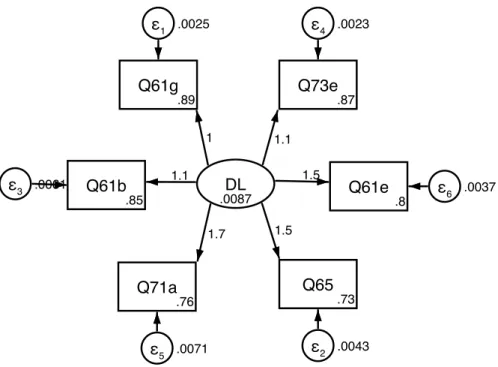
Conditions Survey that fall under multiple factors. ... 75 Table 3.3. Confimatory Factor Anaylyis of indicators of the underlying
factor of Distributed Leadership in the North Carolina Teacher Working
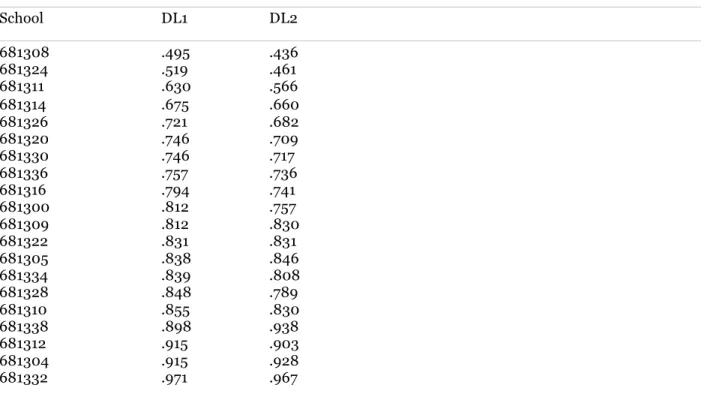
Conditions Survey for 2016 in Chapel Hill – Carrboro City Schools ... 79 Table 3.4. Distributed Leadership Score for each school in CHCCS ... 81 Table 4.1. Questions identified in the North Carolina Teacher Working
Conditions Survey that correlate with distribute leadership. ... 88 Table 4.2. Questions identified through confirmatory factor analysis in the
North Carolina Teacher Working Conditions Survey that correlate with
distribute leadership. ... 89 Table 4.3. Confirmatory Factor Analysis of indicators of the underlying
factor of Distributed Leadership in the North Carolina Teacher Working
Conditions Survey for 2016 ... 90 Table 4.4. Good Fit Indices of a Distributed Leadership Model using the
2016 North Carolina Teacher Working Conditions Survey ... 91 Table 4.5. Measure of Distributed Leadership 2 (DL2) using the North
Carolina Teacher Working Conditions Survey ... 92 Table 4.6. Independent Samples t Test between Distributed Leadership
Measure 1 (DL1) and Distributed Leadership Measure 2 (DL2) ... 92 Table 4.7. Descriptive Statistics for School Characteristics in Public
Schools in the State of North Carolina for 2016 ... 93 Table 4.8. Bivariate Correlation between Teacher Turnover Rates, EDS,
Achievement Scores and EVAAS Growth Scores for Public Schools in the
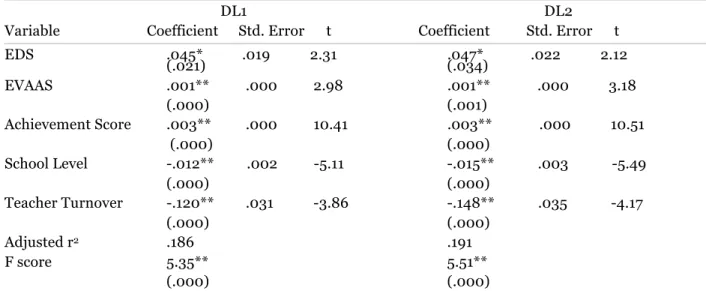
State of North Carolina for 2016 and the Distributed Leadership Measures ... 94 Table 4.9. Multiple Regression between Distributed Leadership Measures
and School Variables ... 95 Table 4.10. Multiple Regression for Individual Districts with a Negative
Table 4.12. Multiple Regression for Individual Districts with a Negative
Correlation with the Distributed Leadership Measure 2 ... 99 Table 4.13. Multiple Regression for Individual Districts with a Positive
Correlation with the Distributed Leadership Measure 2 ... 99 Table 5.1. Questions identified in the Distributed Leadership Model 1 from
the North Carolina Teacher Working Conditions Survey and their
Components. ... 105 Table 5.2. Questions identified in the Distributed Leadership Model 2 from
the North Carolina Teacher Working Conditions Survey and their
Components. ... 106 Table 5.3. Questions identified in the Distributed Leadership Model 1 from
the North Carolina Teacher Working Conditions Survey but not identified
LIST OF FIGURES
Figure 1.1. Leadership Activity ... 9 Figure 1.2. Distributed Leadership Components ... 11 Figure 3.1. Distributed Leadership SEM Model for Chapel Hill – Carrboro
City Schools ... 80 Figure 4.1. Confirmatory Factor Analysis of indicators of the underlying
factor of Distributed Leadership in the North Carolina Teacher Working
LIST OF ABBREVIATIONS CFI comparative fit index
DL distributed leadership
EDS economically disadvantaged percentage EVAAS Education Value-Added Assessment System
NCPTSC North Carolina Professional Teaching Standards Commission PLCs professional learning communities
TELL teaching, empowering, leading, and learning SRMR root mean square residual
CHAPTER I: INTRODUCTION Introduction
Schools and school leaders find themselves in unusual times. I can’t say whether these times are any more unusual than times that have come before, but what I can say is that through my 19 years of experience in public education, and specifically 11 years of experience as a public school administrator, today I am faced with significantly different challenges than when I began as a school leader. From my perspective, the
responsibilities of a school administrator have undoubtedly grown to include ensuring that a principal is both well versed in standards and pedagogy and also still understands the levers of individual and collective human behavior to move a school towards an ever-changing standard of good. School leaders are required to build and maintain systems and structures of an organization so that the “buses run on time” (even though I technically have zero control over whether they actually do). On top of this, school leaders are also increasingly asked to come to terms with schools’ roles in
institutionalized racism, the terrifying impact of breaches to school safety, and the mental health crises afflicting our nation’s youth. The pressure to solve society’s ails while improving test scores for all has continued to increase.
are. The lack of respect for the teaching profession accompanied by insufficient increases in teacher salaries has left us wading into at teacher shortage. When I first became a principal, I would have 100-150 resumes for every job opening. Nowadays, I am lucky to get five to ten applications. The change in the level of interest for open teaching positions is stark and disturbing.
Thus, as a school principal I feel more pressure to do more, I am responsible for more, and I work in a more unstable society that trusts my staff and me less. Given these times, many of my colleagues in the field of school leadership have taken the approach of trying to control more of the entire schooling process as a response to all the pressures of the job. This attempt at creating a teaching-proof environment where curriculum and instruction can be controlled diminishes the importance of teacher quality and is, in my opinion, a folly. This approach will only lead to burned-out school administrators with little long-term change to account for their efforts. A more top-down approach can allow for school leaders to make short-term achievement test gains, move up the chain of command, and thus propagate that same style of leadership. I have decided to take a different approach to bring about the change we want to see in our schools, one of distributed leadership.
The most poignant example of this distributed leadership process involved one of my classroom teachers and her work around equity. I had the fortune of hiring this teacher and working with her for three years. After this teacher’s first year, I asked her to take the lead of our school’s equity team. At the school that I was leading at the time, equity had been discussed for more than fifteen years but little actual change had
occurred. This teacher was excited about the opportunity and enthusiastic about
leading our staff towards a better understanding of race and the impact of racism on all of our students. I met with this teacher on a monthly basis as we planned the work of the equity team and how the team would build a plan for the school as a whole. I was able to help her lead the equity team as they constructed a school-wide plan. I was able to help her plan next steps when members of both the equity team and the staff veered off track. The teacher’s response early on was to continually say that she was not a leader. What I was able to help her see was that she was; with some support, that leadership blossomed.
Through her work, the work of the equity team, and the entire staff, we were able to make significant strides towards addressing race in our school. The equity team provided all staff a baseline for understanding of our equity work through professional development. Then small, differentiated groups worked on the following topics: coded language, model classrooms, building personal equity capacity, and equitable holiday lesson planning. The equitable holiday lesson planning led to a school-wide Juneteenth celebration. The impact of this work positively affected student success, and the school saw a significant drop in major office referrals for our black students.
work involving equity. The decision to empower her to lead, to provide the structure for shared decision making, and to support her as a leader, has impacted numerous
students both at the school and now across the district. I would not have been able to accomplish the work she was able to accomplish on my own. It also helped build a school climate where it was clear that teacher voice was valued and important.
Significance of Distributed Leadership
As mentioned above, school leaders are faced with a dilemma. There are
pressures and a need for systemic change to best meet the needs of the students. At the same time there is a significant teacher shortage such that will only magnify the problem if trends continue (Sutcher, Darling-Hammond & Carver-Thomas, 2016). This demand for teachers is in part coming from an 8% attrition rate across the country where two-thirds of those leaving the teaching profession are doing so before they can retire (Sutcher, et al., 2016). Professionally, I have decided to take on these two challenges through the coordinated distribution of leadership. But why did I make the decision to distribute leadership, and how might it offer a path forward that will lead to school reform and stave off the influx of teachers leaving the profession?
Distributed leadership begins with understanding that leadership is an important social construct and that its application through leadership activity is a function of the interactions between a leader and a follower in a specific context (Spillane, 2005). The analysis of this understanding has led to theories of practice that allow educators to use the concept of distributed leadership in a way that maximizes positive impacts on student learning. The focus of this research is the application of distributed leadership through a plan that is targeted on teaching and learning and implemented in a
leadership that is not haphazard or simply a delegation of tasks, but one where the concept of planful alignment, a type of distributed leadership where a plan is developed to align leadership, optimizes success (Leithwood, Mascall, Strauss, Sacks, Memon & Yashkina, 2007; Harris, 2008).
Distributed leadership is a key component of collective capacity building and organizational learning because it allows for and supports interdependence among stakeholders, which reinforces continuous improvement (Harris, 2013). To influence learning through teaching, school leaders must not only build the skills and dispositions of teachers but must also create mechanisms in the organization to continually drive this improvement through opportunities where staff are able to work collectively to improve their practices and improve the systems and structures at the school (Harris, 2013). A single leader cannot lead in all the interactions in every context across a school. Thus leadership must be effectively distributed to increase the collective capacity of a school, ensure continuous improvement, and prepare students for future success. Distributed leadership can be a key for positive change.
teacher leadership is mixed (Wenner & Campbell, 2017). A literature review conducted by Wenner and Campbell (2016) found that additional training for teacher leaders, the principal’s role in supporting the teacher leader, and building a culture that supports teacher leadership were paramount in the success of the teacher leader. Barriers such as insufficient time, poor collegial relationships with administration and other staff, the school’s climate, the systems and structures at the school, and the personal
characteristics of the teacher leader all had possible negative effects on the success of the teacher leader (Wenner & Campbell, 2017).
Problem Statements
Distributed leadership can help schools become learning organizations that continually improve to best meet the needs of students (Harris, 2013). States across the US have implemented policies to encourage the successful distribution of leadership by school principals to school-based staff (Hallinger & Heck, 2009). North Carolina is one state that has created a tool to evaluate principals and assistant principals to increase distribution of leadership for the very purpose of building dynamic learning
organizations that prepare students for the 21st century (North Carolina School
Executive: Principal and Assistant Principal Evaluation Process, 2012). However, we
do not currently have a way to measure the quality and depth of a distributed model of leadership. Principals and local school districts should have quantifiable feedback in which to help formal leaders grow and improve in this area.
needs further study (Wenner & Campbell, 2016). This research study looks to both create a way to measure the implementation of distributed leadership on a large scale and then use that measure to assess the links between the distribution of leadership and teacher turnover.
Current Context
As work around the theory of distributed leadership has increased, policies around the world have been put in place to encourage continual improvement and have made it the expectation that the principal or formal school leader act as the key lever for change (Hallinger & Heck, 2009; Harris, 2013). In the United States, various states have built the capacity of schools to continually improve through statewide policies with clear expectations that leadership be distributed by the principal to the broader school community (Hallinger & Heck, 2009; Harris, 2013). North Carolina, in particular, has embedded distributed leadership into its principal and assistant principal evaluation process since 2009 (North Carolina School Executive: Principal and Assistant Principal Evaluation Process, 2012).
The North Carolina evaluation process for principals and assistant principals links the need to create schools that are adaptable with actions by the principal to distribute leadership across the school community (North Carolina School Executive:
Principal and Assistant Principal Evaluation Process, 2012). Administrators should
build systems that change the status quo by using the collective capacity of their school, and they should foster deep relationships that help motivate staff towards a shared purpose and set of values (North Carolina School Executive: Principal and Assistant
as it is highlighted as one of the key factors for creating schools that prepare students for success in a 21st century world (North Carolina School Executive: Principal and
Assistant Principal Evaluation Process, 2012). Distributive leadership is embedded
throughout the entire North Carolina principal and assistant principal evaluation process and is an expectation of every non-charter public school in the state.
Theoretical Framework of Distributed Leadership
The basis for the theoretical framework concerning distributed leadership is a shift towards focusing on leadership activity as the primary unit of analysis instead of solely examining the individual formal leader (Spillane, Diamond, & Jita, 2003). In this framework, the leadership activity that is studied is stretched across the leader, the follower, and the situation (Spillane et al., 2003). This leads to two major conclusions. The first, as seen in Figure 1.1, is that the follower and the context in which the
interaction between the leader and the follower occur are critical to understanding leadership (Spillane, 2005). The second is that leadership is not under the purview of one person (Harris & Muijs 2004). Many people lead throughout the organization and everyone has the potential to lead (Harris & Muijs 2004). When examining leadership activity as the unit of analysis, one discovers that all leadership activities are distributed to some extent (Gronn, 2002).
Figure 1.1. Leadership Activity
This figure shows how leadership is spread across the leader, the follower and the specific context of the situation (Spillane, Diamond, & Jita, 2003). The arrows indicated multi-directional influence that the leader, the follower, and the environment have on each other.
organization is equal to the total leadership in that organization (Gronn, 2002). Concertive action is synergistic, and happens when the total leadership in an
organization is greater than the sum of the individual parts (Gronn, 2002). Leithwood expands on these concepts of distributed leadership by introducing the idea of planful alignment (Leithwood et al., 2007). Planful alignment consists of thoughtfully aligning leadership in the organization to optimize success through interdependence and
Leader
Follower
Conceptual Framework
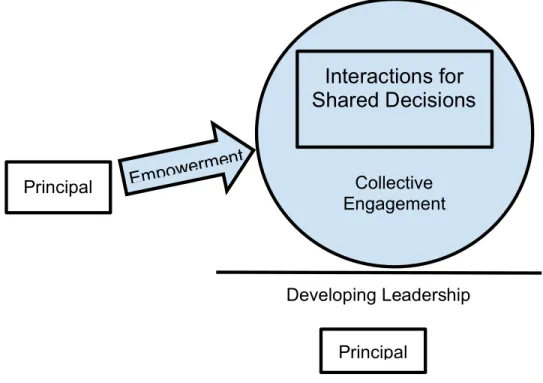
Figure 1.2. Distributed Leadership Components
School administration empowers staff to make meaningful, shared decisions and develops their
leadership capacity to make and enact these decisions Hairon & Goh (2015) . Administration also helps build a space where all are collectively engaged for the same purpose and goal Hairon & Goh (2015) .
A fourth component arises in a study conducted by Hairon & Goh (2015). These researchers found that collective engagement was a key factor in the underlying
construct of distributed leadership (Hairon & Goh, 2015). Collective engagement
involves a formal leader in a school encouraging shared work through a decision-making model (Hairon & Goh, 2015). This decision-making model involves and engages others through systems and structures that support and encourage collaboration among teachers (Hairon & Goh, 2015). As seen in Figure 1.2, collective engagement provides the space for shared interactions to occur, while developing leadership provides the support, and empowerment the impetus.
How these components of distributed leadership are expressed in successful
Interactions for
Shared Decisions
Developing Leadership Collective Engagement
functions, through thoughtful coordination, maximize interdependence and positively impact student achievement. Overall there are four major types of leadership functions that are necessary in any high performing school. These categories are: setting
direction, building people, redesigning the organization, and managing the instructional program (Day, Hopkins, Harris & Ahtaridou, 2009). While these four functions are evident in many effective schools – including those that are distributing leadership and those that are not – research does indicate that specific leadership functions under each of these categories are found in schools with an effective distributive leadership model (Day et al., 2009).
As we look at these functions, research reveals how these general leadership activities are specifically expressed through a distributed model. When setting a direction, schools with effective distributed leadership structures have many people in the organization help to create and maintain high expectations through motivating others towards these expectations (Leithwood, et al., 2007). School administration develops people, building leadership skills and abilities, so that they are able to lead (Day et al., 2009). This capacity building must happen before leadership is effectively distributed (Day et al., 2009). To build this leadership capacity, leaders of schools that have effectively implemented a distributed model build trust (Day et al., 2009). High levels of trust underpin the work of building people and are crucial to the future success of a distributed model (Day et al., 2009).
Administrators in schools that effectively distribute leadership typically
2009). This often involves collective capacity building that occurs when organizational processes are created and leadership is distributed (Day et al., 2009). This leads to informal leaders helping build the capacity of others (Day et al., 2009). Professional Learning Communities are a specific type of collective capacity building (Day et al., 2009). School Administrators also distribute the management of the instructional program (Leithwood et al., 2007). Staff are often assigned to facilitate committees, implement new resources, relay critical information to others, monitor student data and their progress towards goals, monitor the school’s progress towards school
improvement goals, and to select and distribute resources (Leithwood et al., 2007). Through these leadership functions, one can see how the functions of distributed leadership have been specifically expressed in schools implementing a distributed model.
Research Questions
The state of North Carolina promotes the concepts of distributed leadership through the Principals and Assistant Principal evaluation system. The state also has a system that assesses teacher perceptions of their working conditions that includes questions specifically tailored towards their perceptions of if and how leadership is distributed in their individual schools. The research question of this study first asks if there are specific questions in this North Carolina Teaching working condition that indicate an underlying factor of distributed leadership. If distributed leadership is a factor that influences these questions, then can we create a model that effectively
measures the distribution of leadership across a large range of schools in North Carolina using this survey?
Research has examined survey data to identify the underlying components of distributed leadership and the leadership functions that occur in schools that have effectively distributed leadership. Specifically, exploratory and confirmatory factor analysis has been used to identify these components of distributed leadership (Hairon & Goh, 2015). This factor analysis was applied to survey data collected from leaders, both administrators and lead or head teachers (Hairon & Goh, 2015). There has not been a factor analysis focused on distributed leadership of a large statewide teacher survey data set involving all teachers and not just those in formal leadership roles. With a
also has the potential to identify schools where distribution of leadership is happening from the perspective of all staff.
To accomplish this task of identifying distributed leadership across a wide range of schools using specific questions from large data sets of teacher surveys, I created two models and two measures from those models. The basis for the first model of
distributed leadership came from the literature review. The basis for the second model of distributed leadership began with the literature review and then used confirmatory factor analysis to identify the underlying factor of distributed leadership.
There is also a teacher shortage that impacts school and district administrators’ ability to staff classrooms with a high-quality teaching force. If there is an underlying factor of distributed leadership in the North Carolina Teacher Working Conditions survey and a measure of distributed leadership can be created for each non-charter public school in North Carolina, then I will be able to answer the second research question for this study: is there a correlation between the perception of distribution of leadership in a school and the teacher turnover rate at that school? If a link is found, then the effective distribution of leadership could be a possible solution to our current teacher shortage crisis.
Data
Teacher Working Conditions Survey are currently grouped into the following categories: Community Engagement and Support, Teacher Leadership, School Leadership,
Managing Student Conduct, Use of Time, Professional Development, Facilities and Resources, Instructional Practices and Support and New Teacher Support (“About the North Carolina Teacher Working Conditions Survey,” 2018). The survey also collects demographic data. For the purpose of this research, New Teacher Support questions were not used.
To identify the questions from the North Carolina Teacher Working Conditions Survey, I used the study by Hairon & Goh (2015), which marks four major components of distributive leadership: empowerment, developing leadership, interactions for shared decision making, and collective engagement. To compare the perception of distributed leadership at each school with the teacher retention rate, I have collected the turnover rates for each school across the state of North Carolina for 2016. This number will provide the percentage of teachers who left the school by the spring of 2016 that were present in the spring of 2015. Given that I am measuring leadership distributed for the 2015-16 school year, the impact of this measure should be apparent for the attrition rates of teachers during this time. I also collected the percentage of students at a school who were economically disadvantaged (EDS), the EVAAS growth scores for each school, the achievement scores for each school, the school level (elementary, middle, or high), and the district for each school,
Methods
After collecting the data from the North Carolina Teaching Working Conditions Survey, I identified questions from the survey aligned with the components and
created by Hairon & Goh (2015). I then used confirmatory factor analysis to confirm that the questions that were identified are indicators of the latent factor of distributive leadership when used with a larger population and one that includes both
administrators and teachers, not just administrators and teacher leaders. I identified the questions as indicators of the latent factor of distributed leadership as a whole. I then used maximum likelihood and identified the model parameter estimate to find the values that maximize the likelihood of the data that has been observed (Brown, 2014). Following this, I used several goodness of fit indices to determine the overall goodness of fit of the model created (Brown, 2014). Using the questions identified through the literature review and the smaller subset of questions identified through the confirmatory factor analysis, I created two measures of distributed leadership for each non-charter public school with data from the 2016 North Carolina Teacher Working Conditions Survey.
After creating two measures of distributed leadership, I used bivariate correlation analysis to determine the correlation between these two measures and the teacher
turnover rate at schools. I then used a multiple regression analysis to control for the school characteristics of the district, school level, EDS, EVAAS growth and achievement to ensure that the correlation truly exists between the distributed leadership measures and teacher turnover.
Hypothesis
analysis that will be a good fit with the observed data collected using teacher perceptions from the North Carolina Teaching Working Conditions survey. I further hypothesize that due to this good fit, a distributed leadership measure can be assigned to every non-charter public school that participated in the North Carolina Teaching Working
Conditions Survey.
I also hypothesized that when leadership is effectively distributed at a school, it has a positive impact on the teacher retention rate at that school. Using the measure of distributed leadership created for each school and comparing those scores with teacher turnover rates at each school, I calculated a correlation.
Assumptions of This Research Study
I have made the following assumptions that should be considered when analyzing any findings. One assumption is that the stand-in variable of the questions identified in the Teaching Working Conditions survey were high quality surrogates for components necessary for an effective distributed model and specific evidence for a distributed model. Previous research focused on effective implementation of distributed leadership will be used to identify these questions and to increase the likelihood that they will be acceptable surrogates.
Limitations of This Research Study
districts. The questions in the survey also have the potential to be understood in different ways by different participants and thus provide different information. The survey data used was from the 2016 survey.
Definition of Terms
● Bounded Empowerment: a component of distributed leadership where the formal leader grants his or her subordinates control over decision making. This distribution is curtailed by the formal leader often to ensure alignment with the organizational vision and for effective coordination across the organization (Hairon & Goh, 2015).
● Building People: developing members of an organization in their skills and ability so that they can function in such a way that leads the school toward the set goals and the vision (Leithwood et al., 2007).
● Collective Engagement: a component of distributed leadership where multiple staff are involved collaboratively with decision making and teamwork (Hairon & Goh, 2015).
● Confirmatory Factor Analysis: a statistical technique used to measure if the factors identified by an underpinning theory match the observed variables related to that theory (Suhr, 2006).
● Coordination: the management of the mutually-sustaining interdependencies of people in an organization by the creation of a thoughtful plan and the support for leaders as they implement the plan (Gronn 2002).
● Developing Leadership: a component of distributed leadership where leadership abilities and skills are proactively supported and built by a formal leader in his or her subordinates (Hairon & Goh, 2015).
● Distributed Leadership Model: for this research, a model where the principal or formal school leader is responsible for distributing leadership across the school increasing the collective capacity of the organization (Harris & Muijs, 2004). It is evidenced by many staff leading and all staff having the potential to lead (Harris & Muijs, 2004). It is comprised of four components: bounded empowerment, developing leadership, shared decision making, and collective engagement (Hairon & Goh, 2015). Distributed leadership is also described as shared leadership and collective leadership.
● Distributed Leadership Components: the components noted in the literature concerning distributed leadership that together make up the construct of
distributed leadership: empowerment, interactive relations for shared decisions, and developing leadership (Hairon & Goh, 2015).
● Distributed Leadership Functions: specific leadership activities that research shows are implemented by multiple leaders, both formal and informal, in successful schools with a distributed model (Leithwood et al., 2007).
● Empowerment: a component of distributed leadership where the formal leader grants his or her subordinates control over decision making (Hairon & Goh, 2015)
● Interdependence: occurs when two or more people mutually sustain each other's tasks and functions (Gronn, 2002).
● Indicator - an observed measure whose variation is in part due to the latent factor (Brown, 2014)
● Latent Factor: is an unobserved variable that is responsible for the variation in a set of observed measures (Brown, 2014).
● Leadership Activity: the product of the interaction between leaders and followers in specific situations (Spillane, Diamond, & Jita, 2003).
● Leadership Functions: specific leadership activities that research shows are implemented by a leader/leaders in successful schools (Leithwood et al., 2007).
● Managing the Instructional Program: a leadership activity that looks to create a positive environment through systems and structures that support learning in the school. These activities involve staffing, monitoring teaching and learning,
shielding teachers and students from interferences that might distract from teaching and learning, and aligning resources to goals (Leithwood et al., 2007).
● Multiple Regression Analysis: a statistical tool using two or more indicators to predict or control for a variable (Ravid, 2014).
● Planful Alignment: consists of thoughtfully aligning leadership in the
organization to optimize success through interdependence and coordination (Leithwood et al., 2007).
● Regression Analysis: a statistical tool used to make a prediction where the independent variable is used to predict the dependent variable (Ravid, 2014).
● Setting Direction: a leadership activity that requires creating a shared understanding of where the organization currently is functioning, where the organization needs to go, and goals that when completed will allow for this movement from what is to what should be (Leithwood et al., 2007).
● Shared Decision Making: a component of Distributed Leadership that allows the leader to share decision-making power with other staff in the school building (Hairon & Goh, 2015).
Summary
Distributed leadership has the potential to create learning organizations that can help schools continually improve in order to meet the needs of all students. Distributed leadership also has the potential to help mitigate the current teacher shortage crisis by addressing key issues noted by teachers who are leaving the profession. Research studies have described the components of distributed leadership as a construct, and others have noted that there are specific leadership functions that are indicators that leadership has been effectively distributed. As we conjoin these components and functions, suggestions as to a more complete nature of distributed leadership begins to form. At the same time, there are large data sets from teacher perception surveys with specific questions that align with the distribution components and these leadership functions. Can distributed leadership be measured using large statewide teacher
CHAPTER II: REVIEW OF THR LITERATURE Introduction
School-based administrators are faced with being catalysts for change in schools. They are tasked with meeting the changing needs of all students while still retaining high quality teaching staff to implement initiatives that target student success. These two pressures put on school leaders can often work at odds. Distributed leadership offers a potential pathway that can allow for organizational change while creating an environment where teachers and staff feel both supported and valued as professionals. If distributed leadership can bring about the change we need for all our students, how would we go about measuring it across a range of school? If a measure of distributed leadership can be created, would this measure have a link with teacher turnover. The purpose of this study is to see if a model of distributed leadership can be codified using broad teacher perception surveys. The model would then be used to develop a measure of distributed leadership. Finally, in this paper I hope to use the measure created to better understand the correlation between effective distribution of leadership in schools and the teacher turnover rate.
specific focus on planful alignment, and the properties that follow from a planful alignment of distribution. I then review research studies concerning the
operationalization of distributed leadership, defining what a leader coordinates as he or she distributes leadership. This will dovetail into research pertaining to the types of leadership functions that are evident in schools and organizations that have effectively distributed leadership in a coordinated way. I will review types of tasks for which distribution is most effective, who should be empowered and supported in a distributed leadership model, and when, as part of a long range plan of implementation, to
distribute which leadership activities. I will explore other distributed leadership models and then review the research around the impact distributed leadership has on teacher motivation, capacity, work settings, school improvement, and student achievement.
Approach
Distributed leadership is a theory and a concept that is complex and overarching, consisting of theoretical underpinnings and patterns that stem from those
underpinnings. In this chapter I organize the literature review of distributed leadership as follows. Section I provides theoretical information around the process of leadership and the distributed perspective of analyzing leadership. In Section II, I focus on
Section I: The Process of Leadership through a Distributed Perspective Overview of Instructional and Transformational Leadership
Two major conceptual models have been prevalent with school leadership: instructional and transformational (Hallinger, 2003). Transformational leadership is squarely focused on building an organization’s ability to learn and to innovate
(Hallinger, 2003). The leader works as a facilitator who makes his or her impact on students through support of other adults in the building (Leithwood, 1992).
Instructional leadership, on the other hand, focuses on the school administrator being responsible for aligning work towards school goals around curriculum and instruction and then controlling the implementation of those goals (Hallinger, 2003).
Transformational leadership initially came to be in response to instructional leadership, but research has continued to note the necessity of qualities for both in our schools today (Hallinger, 2003; Hulpia and Rosseel, 2009).
Instructional leadership primarily takes a top-down approach to the
implementation of leadership (Hallinger, 2003). The principal or head of school defines and communicates the school mission. The school administrator sets goals that reflect high expectations for both students and teachers (Hallinger, 2003). These goals are also specific and measurable so that the results of the academic focus can be seen (Hallinger, 2003). School leaders with a focus on instruction leadership manage the instructional program by working closely with teachers in the development and implementation of curriculum. A productive instructional leader controls the curriculum so that it is effectively aligned with standards and goals (Hallinger, 2003). He or she then monitors instruction to ensure that the aligned curriculum is effectively implemented to all
approach where leadership is distributed (Hallinger, 2003). Leadership in a
transformational model begins with the assumption that multiple individuals will be involved in the development of the school environment and will not rely solely on the principal (Hallinger, 2003). There are three main goals of the transformational leader (Leithwood, 1992). He or she looks to build a collaborative culture and develop people within that culture so that problem solving is improved (Leithwood, 1992).
Along with being a top-down approach, instructional leadership is also
transactional (Hallinger, 2003). Instructional leaders look to control the behavior of staff in order to meet goals set forth by formal leaders (Hallinger, 2003).
Transformational leadership encourages individuals to engage and think through their own decisions while still providing modeling as a tool to help teachers and staff learn (Hallinger, 2003). The goal is to transform the organization so that it is continually growing and learning. The final major distinction between instructional and
Though instructional and transformational leadership models have several key overarching differences, there are specific similarities as well. Both models require the principal to build a shared vision for the school (Hallinger, 2003). Whether under a transformational or an instructional leader, staff need to know the purpose and the vision of the school is and be willing to work towards the realization of this vision (Hallinger, 2003). The transformational and instructional models both have the
principal ensure that the climate of the school has high expectations focused on teaching and learning (Hallinger, 2003). In both models, the principal ensures that professional learning is provided that pushes adult learning and align any rewards or recognition with school goals (Hallinger, 2003). Finally, both models have principals as highly visible in the school building so that they can model the shared values undergirding the vision and goals (Hallinger, 2003).
Unit of Analysis for Leadership
Given that our educational systems tend to have a hierarchical delineation of power, much of the research around educational leadership has focused on individuals in formal positions of authority (Leithwood et al., 2007). Focusing on the role of the principal is practical because instructional leadership is focused on the school leader and their role in defining, aligning and creating the curriculum at a school and then monitoring the instruction. However, viewing leadership through the lens of an individual leader has tended to cloud our understanding of leadership and has presented a need for more transparency in our analysis (Spillane, Halverson, &
of leadership (Gronn, 2000). As the work of schooling has become increasingly more arduous, roles and tasks delegated to those roles have blurred (Gronn, 2002). A fixed division of labor is no longer an accurate reflection of the modern day school
environment (Gronn, 2002). As roles have become more indistinct, so have the interactions between leaders and followers. The dynamic nature of these reciprocal relationships are not expressed in such a way that leaders always lead and followers always follow. In this sense, leadership involves all those who contribute in the educational community of a school (Harris & Muijs 2004).
Along with leadership involving leaders and followers, there is also
interdependence with the environment (Spillane et al., 2001). The interplay and interactions between the leader and his or her surroundings in any situation makes it difficult to solely analyze the individual without context (Spillane et al., 2001).
Investigating the interactions between a leader and a follower without considering the context puts true understanding out of reach for most situations. Leadership emerges from social interactions, is fluid, and may only exist for a single task (Gronn, 2000). Simplifying these multifaceted interactions decreases a researcher’s potential to garner truth. As the work of schooling has become more complex and the requirements and demands only increase, our understanding of leadership must be flexible and responsive (Harris & Spillane, 2008). The traditional approach to understanding leadership by examining the individual will no longer be sufficient (Harris & Spillane, 2008). A new unit to analyze leadership is needed to inform our thinking and grow our perspective. Leadership Activity as a Unit of Analysis: A Distributed Perspective
the interactions between the leader, the follower, and the situation (Spillane et al., 2004). By making this shift towards analyzing leadership activities, a distributed perspective of leadership emerges: one which connects human agency with structure and environment, but also one where leadership is detached from a person’s role or title (Gronn, 2000; Harris & Muijs 2004; Spillane et al., 2004). Once leadership activity replaces the individual leader as the primary unit of analysis, it opens the opportunity to more fully consider not only formal leaders, but also how leadership might be
distributed among informal leaders and the role they might play in educational change. The theoretical perspective on distributed leadership focuses on leadership
activity instead of the individual formal leader (Spillane et al., 2003). This leadership activity is stretched over the leader, the follower, and the situation (Spillane et al., 2003). By studying leadership activity, researchers are better able to see the reality of multiple leaders working and interacting in a school building (Diamond & Spillane, 2016; Spillane, 2005; Spillane et al., 2003) Through this distributed lens, researchers can recognize the reality that many people in school communities are leaders and all staff, parents, and students have the potential to lead (Harris & Muijs 2004). As we come to understand that many can and do lead, there is an implication of a
Walberg, 2002). These interactions between leaders and this multidirectional flow of power are critical components to understanding leadership practice and leadership activity (Murphy & Walberg, 2002; Spillane, 2005).
Followers also have an important and ever-changing role in a distributed
framework. Through a distributed perspective, leadership is not acted upon a follower (Spillane, 2005). The follower is a part of the triangle of leadership activity, which includes leaders and the situation as well (Spillane, 2005). Followers do not only have some amount of influence over how the leader acts and thinks, but they are an essential element of the leadership activity as a whole (Murphy & Walberg, 2002). Finally, the various situations that arise should be considered as part of this leadership analysis (Spillane et al., 2003). The specific context of a leadership activity is critical in that the interactions between leaders and followers could be markedly different in a different set of circumstances (Spillane et al., 2004). Discerning the context in which the
interactions take place enlightens our understanding and plays an important part in building a complete picture of the leadership activity (Spillane et al., 2004).
Leadership activity as the unit of analysis leads to a distributed perspective and is a way to understand that leadership is what is stretched across leaders, followers, and the situation in a social interaction (Spillane et al., 2003). To comprehend leadership, each of its elements must not only be considered, but also be examined and understood in relationship to the other elements.
Section II: Patterns of Distributed Leadership
on the fact that school leadership can and often does involve multiple people (Spillane et al., 2008). Leader-plus is focused on how leadership is enhanced in an organization through its use by many (Harris, 2014). The leadership practice component is framed “as the product of the interactions of school leaders, followers, and aspects of their situation” (Spillane et al., 2008, p. 191). Distributed leadership examines the process of leadership, or how it is put into practice (Harris, 2014). When studying these leadership activities, a distributed perspective requires more than just measuring various
microtasks of the multiple leaders (Spillane et al., 2001). It is necessary to look more in depth at how these tasks are enacted (Spillane et al., 2001). Analyzing leadership activity requires that we understand how leaders “define, present, and carry out these microtasks,” and how they interact with others through the process of implementation (Spillane et al., 2001, p. 24).
Gronn (2002) like Spillane, organizes distributed leadership into two separate forms, but labels and organizes his categories as numerical and concertive action. In the numerical view of distributed leadership, leadership is diffused among many if not all of the members of an organization, and all members may at some time or another have the opportunity to lead (Gronn 2002). This numerical, or additive, distributed leadership is uncoordinated, often acting in isolation and thus leading to limited
benefits for the growth and development of the organization as a whole (Harris, 2008). With numerical action, the sum of all the leadership in an organization is the total of that leadership for the organization (Gronn, 2002).
individual leadership parts of an organization (Harris, 2008). Gronn notes three particular forms of concertive action: spontaneous collaboration, intuitive working conditions, and institutionalized practices (Gronn 2002). Spontaneous collaboration occurs around groupings of individuals across an organization with potentially
dissimilar knowledge and skill sets to accomplish a task (Gronn 2002). This “burst of synergy” does not imply a continued collaborative effort (Gronn, 2002, p.430). While at times spontaneous collaboration leads to continued work together, more often it ends with the completion of the task (Gronn, 2002; Harris, 2008). Intuitive working conditions are another type of concertive action that emerge from the professional relationships of two or more people working closely together and relying on each other to complete tasks (Gronn, 2002). Finally, institutionalized practice is when the
organization creates formal structures to institutionalize concertive action (Gronn, 2002).
Gronn (2002) considers each of these three types of actions as steps towards institutionalizing concertive action. For each of these forms of distributed action, members involved act cojointly with these collaborative moves and interactions being termed cojoint agency (Gronn, 2002). Cojoint agency, a critical piece of concertive action, has at least two components (Gronn, 2002). One is synergy, which occurs when the total leadership of a group or organization is greater than the sum of the individual parts (Gronn, 2002). Another component of cojoint agency is multi-directional
Planful Alignment of Distributed Leadership
Leithwood et al. (2007) takes Gronn’s ideas of distributed leadership and
expands these concepts by creating four distinct areas of concertive action based on the specific level of thoughtful arrangement used toward aligning cojoint agency and the quality of that alignment: planful alignment, spontaneous alignment, spontaneous misalignment, and anarchic misalignment. Planful alignment is most similar to Gronn’s institutionalized practice (Leithwood et al., 2007). With planful alignment, members of the organization thoughtfully plan leadership activities by considering, designing and aligning tasks and functions with those who will be leading others to completing those tasks and functions (Leithwood et al., 2007). Open lines of communication exist between leaders so that they can determine who is best to lead which task or function (Leithwood et al., 2007). With planful alignment, members typically engage in high-quality discussions and reflection when it comes to decision making. There must be a good deal of trust among colleagues in their ability to lead and execute their function, because there is a clear understanding of the capabilities of other members (Leithwood et al., 2007). There are shared goals and a shared vision, with collaboration being a key lever for success (Leithwood et al., 2007).
Spontaneous alignment occurs when little to no planning goes into the distribution of leadership tasks (Leithwood et al., 2007). Spontaneous alignment is similar to planful alignment in that there is a commitment to common goals and a vision and that members collaborate to accomplish these goals (Leithwood et al., 2007). There is also a trust that is developed between colleagues produced from these shared
spontaneous alignment (Leithwood et al., 2007). A gut feeling is the major component for determining the right course of action and is the key driver in the final decisions of the group (Leithwood et al., 2007). Secondly, although there is trust among colleagues, this trust comes with the potential for an inflated view of other’s leadership abilities (Leithwood et al., 2007). The lack of clarity around what one’s colleagues can or cannot do leaves open the possibility that one may be given a task to lead for which they are ill prepared (Leithwood et al., 2007). In the short term, spontaneous alignment and planful alignment may have similar impacts on an organization's production (Harris, 2008). However, the lack of thoughtful consideration put into the decision making process and the lack of understanding of colleagues’ abilities are likely to limit the capacity of the organization to take on challenges in the future that require high quality leadership (Harris, 2008).
Spontaneous misalignment is comparable to spontaneous alignment, with the key difference being the outcome of this type of distributed leadership (Leithwood et al., 2007). While there is a positive outcome emerging from spontaneous alignment, there are short- and long-term disruptions to an organization's productivity with spontaneous misalignment (Harris, 2008). The negative outcomes of spontaneous misalignment happen differently from its positive outcomes due only to chance (Harris, 2008). Since there is a lack of planning for both, it is difficult to predict whether the productivity of the organization will be positively or negatively impacted with either of these types of concertive action (Leithwood et al., 2007).
structures (Leithwood et al., 2007). There is limited trust between leaders, with a focus being on the well-being of the individual and not on the shared values and vision of the organization (Leithwood et al., 2007). This model highlights the importance of
alignment and planning in how these two elements contribute to the success or failure of distributing leadership (Leithwood et al., 2007). Alignment and planning lead to two major properties that arise out of the patterns of distributed leadership:
interdependence and coordination.
Properties of Distributed Leadership
Interdependence is an emergent property of distributed leadership and occurs when two or more people mutually sustain each other's tasks and functions (Gronn, 2002). There are two types of interdependence. The first occurs when the work of those who are interdependent go beyond and overlap with the work of others (Gronn, 2002). The other type of interdependence occurs when the skills of members complement each other (Gronn, 2002). As there is a greater degree of interdependence in an
organization, there is a higher potential for leadership that is linked to better overall organizational function (Gronn, 2002). As these leaders work with increased
interdependence, the individuals involved learn more and the organization’s learning capacity grows (Pearce & Conger, 2002).
Along with interdependence, coordination is a property that emerges from
thoughtful coordination are two driving forces behind effectively distributing leadership for positive organization change.
How do interdependence and coordination function in accord to produce a model where leadership is effectively distributed? A review of the literature points to three specific components that make up the construct of distributed leadership:
empowerment, interactive relations for shared decisions, and developing leadership (Hairon & Goh, 2015). Empowerment of staff involves the formal leader giving others in the school the opportunity to make decisions (Hairon & Goh, 2015). Harris and Muijs describe this process as follows:
In practice, distributed leadership means giving teachers the opportunity to lead and to take responsibility for the areas of change of most importance to the school….. this form of leadership necessarily requires relinquishing the idea of structure as control and viewing structure as the vehicle for empowering others. (2004, p. 14)
This can involve both the freedom by staff to address issues, questions and concerns with administrators in a school building, and the opportunity to plan for and make decisions that impact the school (Heck & Hallinger, 2009).
and then have a great deal of autonomy in decisions that are made in that designated area (Day et al., 2007). Who is empowered to make decisions and to what control those persons have over the final decision is an important aspect of a distributed model.
As more staff are empowered to make decisions, interactions for shared decisions arise (Hairon & Goh, 2015). In these cases, cojoint agency – where synergy and
multidirectional influence allows multiple people empowered by the formal leader to come together – leads to collaborative decisions (Gronn, 2002). Diamond & Spillane (2016) identify three types of cojoint agency: collaborated, collective, and coordinated properties. Collaborated distribution occurs when multiple members of an organization work together on the same task at the same time (Diamond & Spillane 2016). These members of the organization are available to interact with colleagues in real time (Diamond & Spillane 2016). Collective distribution occurs when two people work in a different space or time, but their tasks are such that they rely on each other for
completion (Diamond & Spillane 2016). Coordinated distribution happens when tasks are performed by multiple people but have to occur in a specific order (Diamond & Spillane 2016). The nature of this ordering of tasks requires people to work in concert (Diamond & Spillane 2016). In environments with an effective distributed model, the formal leader empowers informal leaders to make decisions. Then the cojoint agency that arises from these interpersonal networks works in concert with the empowerment of the formal leader to bring about collaborative decision-making.
working together to make a decision in the best interest of an organization innately involve leadership. The leadership that comes from these interactions can help or not help the decision-making process and lead the decision-making team towards or away from a decision the improves the school. The formal leader can help develop the
leadership capacity of informal leaders and thus support the decision-making across the entire school (Hairon & Goh, 2015).
Distributed leadership consists of multiple people in an organization exercising leadership and leadership activity, or the product that comes from the interactions of leadership being spread across the leader, the follower and the situation (Spillane, Camburn, Pustejovsky, Stitziel Pareja, Lewis, 2008). The action of these individuals working in concert can move towards institutionalized practice where the design from the organization leads to a synergetic co-joint agency (Gronn, 2002). This occurs when leadership is artfully and thoughtfully aligned and thus maximizes the interdependence of an organization through coordination (Gronn, 2002; Leithwood, Mascall, Strauss, Sacks, Memon & Yashkina, 2007). An environment where leadership is effectively distributed shows this planful alignment of interdependence through coordination as the formal leader in a school or organization empowers their staff to make collective decisions and supports this process by intentionally building the leadership capacity of informal leaders throughout the building (Hairon & Goh, 2015).
Research on Distributed Leadership Components
distribute leadership in their buildings? Hulpia and Rosseel (2009) created the Distributed Leadership Inventory (DLI) to measure the characteristics of leadership distribution in secondary schools. This inventory was given to both formal and informal leaders in 46 schools (Hulpia and Rosseel, 2009). After data was collected using the DLI, exploratory and confirmatory factor analysis identified two factors for school leaders: support and supervision (Hulpia and Rosseel, 2009). The support component was made up of items that focused on setting a direction and building people’s capacities (Hulpia and Rosseel, 2009). These elements were linked to transformational leadership and could not be separated into two unique components (Hulpia and Rosseel, 2009). The supervision component dealt mainly with instructional leadership (Hulpia and Rosseel, 2009). It was noted that transformational leadership and instructional leadership are both critical for effective leadership (Hulpia and Rosseel, 2009).
A study by Hairon & Goh (2015) sought to build a conceptualization of
accordingly, understanding the context of the situation, and building a sense of shared responsibility (Hairon & Goh, 2015). The third component involved shared decision making where the authority to make decisions is given to informal leaders in the building (Hairon & Goh, 2015). These decisions were communicated with formal leaders who still maintained some responsibility to ensure that decisions were aligned with the overall school vision and goals (Hairon & Goh, 2015). This relates back to the ability of the formal leader to build the leadership capacity of the informal leaders (Hairon & Goh, 2015). The fourth component was labeled as collective engagement, a term which describes activities where the leader inspired staff involvement or
engagement in the school through systems and structures put in place that allowed for collaborative work towards shared decision making (Hairon & Goh, 2015).
Both of these studies have explored the components of distributed leadership by using factor analysis to examine survey data. They both studied distributed leadership from the perspective of identified leaders in school buildings, which leads to
unanswered questions: what impact does distributed leadership have on all staff in a building, and what could the perceptions of all staff tell us about measuring the components of distributed leadership?
Section III: Effective Distributed Leadership in Practice in Educational Settings
Leadership Functions
an important aspect to consider before delving into which of these functions are best distributed to multiple individuals beyond the formal leaders of a school. The functions examined here are ones that have been proven to be transformational, encapsulating relatively broad categories of good leadership that can be applied in most situations (Leithwood et al., 2007). These categorical functions are setting a direction, building capacity, redesigning the organization, and managing the instructional program (Leithwood et al., 2007).
The first leadership function to be examined is that of setting a direction. This aspect of effective leadership involves creating a shared concept of where the
organization currently is functioning, a shared vision or where the organization is headed, and a collective set of goals that if accomplished will allow the organization to move from its current state in a direction towards its ideal state (Leithwood et al., 2007). This includes articulating the shared vision through effective communication, building a culture that has high expectations, and helping to build momentum towards supporting common goals (Leithwood et al., 2007). Vision setting is the first necessary cog of direction setting. It is critical for building creative tension between the school’s current reality and the vision for where the school should ideally be. Then, to
successfully implement a shared vision, leaders must articulate the vision and encourage school wide support (Leithwood et al., 2007). This buy-in comes in the form of common goals that if met will lead the school along the path towards a shared direction while revealing a commitment to high expectations for all (Leithwood et al., 2007). Leaders should be able to artfully communicate and express both vision and goals to all
While setting a clear, achievable direction is critical for leading a school towards change, other leadership functions are needed to increase the likelihood of success. One of these subsequent leadership functions involves developing members of the school community in their ability to act or work in such a way that leads the organization closer to the goals and the vision set by the direction of the school or district (Leithwood et al., 2007). The leadership functions that are noted as part of this category of building people involve leaders working to offer and improve the professional development provided to all staff (Leithwood et al., 2007). This can be followed by modeling specific practices determined as a focus for the school or through the professional development offerings and modeling the overall values of the organization (Leithwood et al., 2007). Building people also involves offering individual support for staff members and
mentoring as teachers interact with the wide variety of tasks and problems they face on a daily basis (Leithwood et al., 2007).
are learning best practices and pedagogy, with an explicit focus on modeling the appropriate tasks to be implemented (Leithwood et al., 2007).
Along with setting the direction for a school and building the capacity of those in the school community, it is important to consider redesigning the organization as the next leadership function. This set of leadership activities works toward building optimal working conditions where staff can best take advantage of the capacities that are
fostered in the organization (Leithwood, Harris & Hopkins, 2008). Redesigning school organization can be centered around creating and improving collaborative structures (Leithwood et al., 2007; Leithwood, Harris & Hopkins, 2008). Collaborative decision-making processes using school leadership teams, committees and various other teams are all approaches that can help engage many in leadership activities of a school
(Leithwood et al., 2007). Another leadership activity under the category of redesigning the organization is building the community of the school and strengthening its culture (Leithwood et al., 2007). These efforts can be seen as schools build Professional Learning Communities (PLCs) that seek to change the structures around teacher collaboration and collective learning in order to support the process of teacher