Proceedings of PACLIC 19, the 19th Asia-Pacific Conference on Language, Information and Computation.
A Constrained Finite-State Morphotactics for Korean
Eunsok Ju
Department of Language and Information Yonsei University
Minhaeng Lee
Department of Language and Information Yonsei University
Chongwon Park
Department of Composition/English University of Minnesota Duluth
Kiyong Lee
Department of Linguistics Korea University
Abstract
In this paper, we propose a constrained finite-state model, named cfsm, for Korean morphotactics and attempt to show how it can successfully treat some major morphological problems in Korean. As a preliminary descriptive framework, this model adopts the Korean morphological system Komor by Lee (1999) to lay out some basic problems in Korean morphotactics and describe linear approaches to their possible solutions. This descriptive step is then followed by various testing steps executed by using Xerox’s finite-state development tools, namely xfst for creating finite-state networks and lexc specifying natural language lexicons. With Komor’s constraints represented in feature structures and appropriately implmented into xfst and by making Komor run on xfst, the proposed cfsm is expected to fully benefit from the descriptive groundwork of Komor and the finite-state processing power of xfst.
1. Aim and Approach
This work aims at developing a constraint-based finite-state model named cfsm for Korean morphology. For this purpose, it re-implements Lee’s (1999) Korean morphology system Komor, which had been implemented with a C-augmented grammar tools named MALAGA1, by using Xerox’s finite-state development tools, namely xfst for creating finite-state networks and lexc specifying natural language lexicons. With Komor’s constraints represented in feature structures and appropriately implmented into xfst and by making Komor run on xfst, the proposed cfsm is expected to fully benefit from the descriptive groundwork of Komor and the finite-state processing power of xfst.
In designing and implementing our proposed model cfsm, we strictly adhere to the principle of possible continuation that has been advocated by Hausser (1989) and Beesley and Karttunen (2003) in recent years. The main operation in executing cfsm is concatenation (without backtracking), but strictly constrained by some requirement conditions on feature-value matching. In Korean, for instance, noun and verbal stems concatenate with a sequence of their suffixal particles or endings to form well-formed word forms. But this concatenation is often constrained by their particular syllable structure or degree of regularity. For example, a verbal stem ‘먹 mek’ may simply concatenate with a tense marker to form another stem, but its syllable structure may restrict the choice of its ending, thus allowing the stem ‘먹었 mek.ess’ only. This linear approach with necessary constraints is, however, considered adequate especially in treating the morphology of agglutinative languages like Korean.
2. Design and Representation
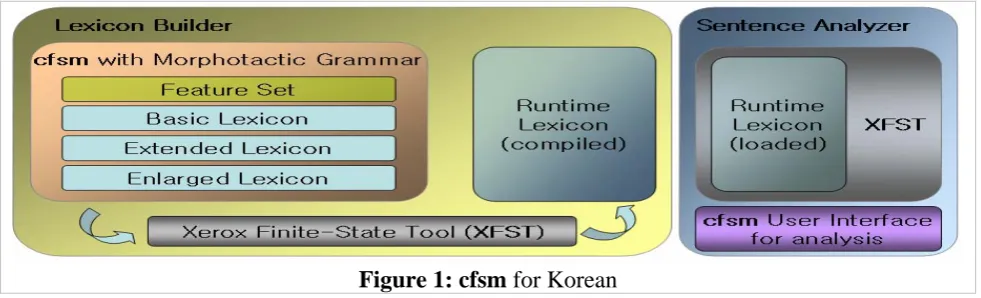
The proposed model cfsm consists of three main modules: (1) Lexicon, (2) Grammar, and (3) Output.
2.1. Lexicon
The Lexicon again consists of three sub-lexicons: (1) Basic Lexicon, (2) Extended Lexicon with allomorphic variations, and (3) Enlarged Lexicon augmented with syllable-complete surface forms. These sub-lexicons are constructed semi-automatically by a preprocessing engine implemented preferably by Java that provides a list of multi-character symbols, a set of lexical definitions and concatenation rules for the execution of Xerox’s morphotactic engines2.
Each lexical item listed in these sub-lexicons is associated with an appropriate feature structure which is represented in a feature-value matrix or an equivalent XML format. For illustration, consider a list of well-formed word forms in Korean like3:
(1) a. 춥다 chwup.ta, (be cold)
b. 추웠다 chwu.wess.ta, (was/were cold)
The feature structure associated with each of these word forms can be represented in a matrix form as follows:
(2) a.
[
]
⎥⎦ ⎤ ⎢
⎣ ⎡
> <state,'being_cold' CONTENT
SEM
chwup.ta' '
SURF 춥다
b.
⎥ ⎥ ⎥
⎦ ⎤
⎢ ⎢ ⎢
⎣ ⎡
⎥ ⎦ ⎤ ⎢
⎣
⎡ < >
past TENSE
' being_cold '
state, CONTENT
SEM
ta' chwu.wess. '
SURF 추웠다
2.1.1. Basic Lexicon
The Basic Lexicon lists basic lexical units, or morphemes, for instance like verbal stems and their suffixal endings with minimally necessary information.
(3) a.
[
]
⎥⎥⎥ ⎥ ⎥
⎦ ⎤
⎢ ⎢ ⎢ ⎢ ⎢
⎣ ⎡
> <state,'being_cold' CONTENT
SEM
class -p FORM
adjective POS
chwup' '
SURF 춥
2
We use the non-commercial version of the Xerox engines that are provided with Beesley and Karttunen (2003).
3
The Yale romanization of Hangul is adopted as is done by most Korean linguists. See Lee (1994).
Proceedings of PACLIC 19, the 19th Asia-Pacific Conference on Language, Information and Computation.
b.
[
]
[
]
⎥⎥⎥ ⎥ ⎥ ⎥
⎦ ⎤
⎢ ⎢ ⎢ ⎢ ⎢ ⎢
⎣ ⎡
adnoun POS
RESULTS
closed SYLLABLE
REQUIRES
wordFinal FORM
ng verbalEndi POS
n' '
SURF 은
2.1.3. Enlarged Lexicon
This Extended Lexicon is then further augmented to the Enlarged Lexicon in two ways: (1) syllable completion and (2) minimal ordering.4 Since Hangul characters, say ‘사랑 sa.rang’, can be analyzed into phonemic units, ‘ㅅ s’, ‘ㅏ a’, ‘ㄹ r’, ‘ㅏ a’, and ‘ㅇ ng’, or into syllables, ‘사 sa’ and ‘랑 rang’, a choice is necessary between phonemic and syllabic analysis for morphological processing.5 The komor system by Lee (1999) chose the phonemic analysis, thus analyzing ‘추웠다 cwu.wess.ta’ into ‘추우/ㅓ/ㅆ/다 chwu.wu/e/ss/ta’. As in Shim and Yang (2002, 2004), on the other hand, the present work has taken the alternative way of analyzing characters into complete syllables, thus resulting in a morphological analysis as in: ‘추웠/다 chwu.wess/ta’ instead of ‘추우/ㅓ/ㅆ/다 chwu.wu/e/ss/ta’.
The second approach reduces the number of the steps of morphological processing. In the given example, that number reduces from three to one. This process, however, requires the pre-processing of surface forms like ‘추웠 chwu.wess’ that combines any syllable-incomplete forms like ‘ㅓㅆ ess’ into syllable-complete forms like ‘웠 wess’. In our case, the Intermediate Lexicon must thus contain both the forms ‘추웠 chwu.wess’ and ‘추운 chwu.wun’, since both the verbal endings ‘ㅓㅆ ess’ and ‘ㄴ n’ are syllable-incomplete.
The Enlarged Lexicon can further be enlarged by containing complex nominal particles like ‘에서부터라도 ey.se.pwu.te.ra.to’ (even from) or complex verbal endings like ‘으시었겠 u.si.ess.keyss) (Bridge+Honorific+Past+Conjectured). These complex particles or endings are found to occur with very low frequency in a very large corpus and to be not worth of being generated by a set of rules. Hence, they can be preprocessed and included in the Enlarged Lexicon. Such a decision reduces the load of ordering rules to a great extent.6
2.2. Grammar
By Grammar here is meant a set of morphotactic rules based on the Enlarged Lexicon. The basic, perhaps sole operation in cfsm for Korean is concatenation and this operation applies linearly in a left-associative manner to a pair of input surface forms to generate a well-formed new string and eventually a well-formed word form through repeated applications. On the basis of the Enlarged Lexicon devised here, our cfsm should be able to analyze or generate the following word forms:
(8) a. 춥다 chwup.ta, (state of being cold)
b. 춥겠다 chwup.keyss.ta (conjectured state of being cold) c. 추웠다 chwu.wess.ta (past state of being cold)
d. 추웠겠다 chwu.wess.keyss.ta (past conjectured state of being cold) e. 추운 (cold)chwu.wun (Adnoun, past state of being cold)
4
Shim and Yang (2002) and Shim and Yang (2004) proposed (1) and Kang (2002) (2), also through personal communication.
5
2.2.1. Preprocessing Complex Verbal Endings
In komor the word form ‘추웠겠다 chwu.wess.keyss.ta’ is analyzed as a series of concatenation as in:
(9) 추우stem + ㅓbridge + ㅆpast + 겠conjecture + 다sfinal
But cfsm analyzes it as:
(10) a. Either 추웠stem,past + 겠conjecture + 다sfinal b. or 추웠겠stem,past,conjecture + 다sfinal
Here we have an option to choose either (a) or (b). Consider the following:
(11) a. 먹었다 mek.ess.ta (eat/Verb+Past)
b. 먹겠다 mek.keyss.ta (eat/Verb+Conjectured)
c. 먹었겠다 mek.keyss.ta (eat/Verb+Past+Conjectured) d. *먹겠었다 mek.keyss.ess.ta
But this list contains an ill-formed word-form, namely ‘먹겠었다 mek.keyss.ess.ta’. To eliminate it, komor uses an ordering constraint so that the past tense verbal ending ‘었 ess’ should precede the conjectural ending ‘겠 keyss’.
Another way to solve this problem is to treat a sequence of verbal endings like ‘었겠’ as a complex verbal ending and list them in the Enlarged Lexicon. Such a decision is statistically motivated, as Kang (2002) claims that the preprocessing of such complex verbal endings must increase the efficiency of morphological processing.
Our proposed Enlarged Lexicon will then contain the following complex verbal endings:
Enlarged Lexicon: Complex Verbal Endings
(12) a.
[
]
⎥ ⎥ ⎥ ⎥ ⎥ ⎥ ⎥ ⎥ ⎥ ⎥
⎦ ⎤
⎢ ⎢ ⎢ ⎢ ⎢ ⎢ ⎢ ⎢ ⎢ ⎢
⎣ ⎡
⎥ ⎦ ⎤ ⎢
⎣ ⎡
d conjecture MODALITY
past TENSE SEM
dark & closed SYLLABLE
REQUIRES
closed SYLLABLE
ng verbalEndi POS
ess.keyss' '
SURF 었겠
Since there is no longer a process of concatenating of ‘었 ess’ and ‘겠 keyss’ in our system, it is necessary to pre-generate verbal stems like ‘추웠겠 chwu.wess.keyss’ in the Enlarged Lexicon to obtain well-formed word-forms like ‘추웠겠다 chwu.wess.keyss.ta’.
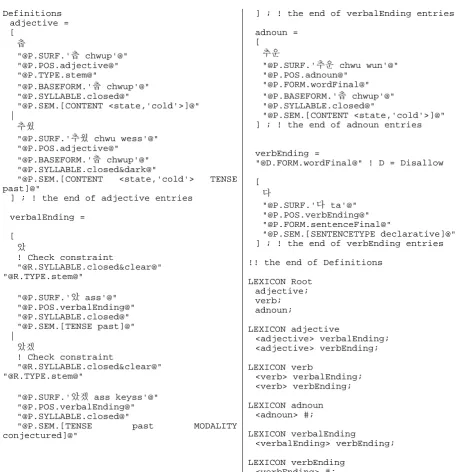
2.2.2. Conforming to the Xerox engines
Proceedings of PACLIC 19, the 19th Asia-Pacific Conference on Language, Information and Computation.
Definitions adjective = [
춥
"@P.SURF.'춥 chwup'@" "@P.POS.adjective@" "@P.TYPE.stem@"
"@P.BASEFORM.'춥 chwup'@" "@P.SYLLABLE.closed@"
"@P.SEM.[CONTENT <state,'cold'>]@" |
추웠
"@P.SURF.'추웠 chwu wess'@" "@P.POS.adjective@"
"@P.BASEFORM.'춥 chwup'@" "@P.SYLLABLE.closed&dark@"
"@P.SEM.[CONTENT <state,'cold'> TENSE past]@"
] ; ! the end of adjective entries
verbalEnding =
[ 았
! Check constraint
"@R.SYLLABLE.closed&clear@" "@R.TYPE.stem@"
"@P.SURF.'았 ass'@" "@P.POS.verbalEnding@" "@P.SYLLABLE.closed@" "@P.SEM.[TENSE past]@" |
았겠
! Check constraint
"@R.SYLLABLE.closed&clear@" "@R.TYPE.stem@"
"@P.SURF.'았겠 ass keyss'@" "@P.POS.verbalEnding@" "@P.SYLLABLE.closed@"
"@P.SEM.[TENSE past MODALITY
conjectured]@"
] ; ! the end of verbalEnding entries
adnoun = [
추운
"@P.SURF.'추운 chwu wun'@" "@P.POS.adnoun@"
"@P.FORM.wordFinal@" "@P.BASEFORM.'춥 chwup'@" "@P.SYLLABLE.closed@"
"@P.SEM.[CONTENT <state,'cold'>]@" ] ; ! the end of adnoun entries
verbEnding =
"@D.FORM.wordFinal@" ! D = Disallow
[ 다
"@P.SURF.'다 ta'@" "@P.POS.verbEnding@" "@P.FORM.sentenceFinal@"
"@P.SEM.[SENTENCETYPE declarative]@" ] ; ! the end of verbEnding entries
!! the end of Definitions
LEXICON Root adjective; verb; adnoun;
LEXICON adjective
<adjective> verbalEnding; <adjective> verbEnding;
LEXICON verb
<verb> verbalEnding; <verb> verbEnding;
LEXICON adnoun <adnoun> #;
LEXICON verbalEnding
<verbalEnding> verbEnding;
LEXICON verbEnding <verbEnding> #; Table 1: Sample Enlarged Lexicon
2.2.3. Compilation
By giving a command apply up or simply up on xfst for ‘추웠다’, we can get the following analysis:
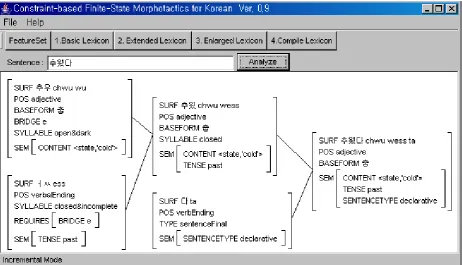
In order to display the results of analysis or generation, cfsm runs an interface that represents each lexical item in a matrix form, showing how they are processed and concatenated step by step. Here is an example.
Figure 3: Analyzing for ’추웠다’ in Constraint-based Finite-State Morphotactics (cfsm) UI
3. Concluding Remarks
Our proposed cfsm is a newborn baby, although its theoretical conception dates back to the beginning of Komor. In this paper we have attempted to find automatic ways of converting Komor into cfsm, thus allowing the use of finite-state tools for morphotactics like Xerox’s xfst and lexc. The primary benefit of this conversion is that the comparatively complete description of the Korean morphology in the rule-based Komor can directly be imported into the proposed cfsm.
4. References
Beesley, Kenneth R. and Lauri Karttunen. 2003. Finite State Morphology. CSLI Publications, Stanford.
Hausser, Roland. 1989. Computation of Language: An Essay on Syntax, Semantics and Pragmatics
in Natural Man-Machine Communication. Springer, Berlin.
Kang, Seung-Shik. 2002. Korean Morphological Analysis and Information Retrieval. Hong-Rung Science Publications, Seoul. [Written in Korean.]
Lee, Kiyong. 1994. Hangul, the Korean writing system, and its computational treatment.
LDV-Forum, 11.2:26.43.
Lee, Kiyong. 1999. Computational Morphology. Korea University Press, Seoul. [Written in Korean].
Shim, Kwangseob and Jaehyung Yang. 2002. Mach: A supersonic Korean morphological analyzer.
Proceedings of the 19th International Conference on Computational Linguistics
(COLING-2002), pages 939.945.