Richard Strauss’s Eine Alpensinfonie:
An Analysis of Origins, Topics, and Symphonic Characteristics
Jonathan Minnick
Honors Thesis, Music Department University of North Carolina, Chapel Hill
2016
Approved by:
_____________________ Adviser
Reader:
PREFACE
This thesis addresses Richard Strauss’s Eine Alpensinfonie’s unsettled program and assesses multiple accounts of the portrayal of the program and the evidence provided by each. In addition, I explore the ideas of landscape in relation to Eine Alpensinfonie and how Strauss manages the alpine landscape as played out through his music. This exploration is substantiated by a thorough melodic analysis of the piece, which has organized themes hierarchically and given them titles based on their arrangement, style, and position within the piece.
There are multiple questions that this thesis addresses in relation to the program and the thematic material of Eine Alpensinfonie. Numerous Strauss scholars have provided suggestions on how the program could be interpreted, though there has not been a definite answer to the question of what the program is for this piece of music. The question that I ask is what are some of the different assertions made about the program of Eine Alpensinfonie and do they hold up to critical analysis of other evidence found throughout my own research. The thematic material in the piece has been analyzed thoroughly by Rainer Bayreuther in his comprehensive work on Eine Alpensinfonie, though I am adding to what he has already generated. The central questions related to the thematic material are, do the themes and motives match or shape the program of the piece and how do ideas on topic theory interact with the structure and how does the thematic material relate to the ideas on topic theory in the 19th and 20th centuries.
fifteen-year period and how an artist, Karl Stauffer-Bern, and Friedrich Nietzsche might have influenced the direction of the program that Strauss was working with. This chapter then explores the significance of each piece of evidence and how they interact with the final publication and their place in the larger discussion on programmatic material within Eine Alpensinfonie.
The second chapter engages with topic theory and how the themes and motives that Strauss uses throughout the piece interact with different topics and how the two ideas are related, though separate entities. In addition, the second chapter will explore the relationship of the program and the music and how the understanding of the program affects our perception of the music, or vice versa. This is accomplished through careful and thorough examination of the individual themes and motives within the piece, as well as their manipulated versions. Some of the titles for the themes are given by the title that is associated with their section (i.e. the Ascent theme first appears during the Ascent section), and others were titled by myself and how I perceived them operating within the piece.
CHAPTER ONE (Program Music)
“I was never revolutionary. The only revolutionary in our time was Strauss.”1 Thus Arnold Schoenberg described Richard Strauss in 1923. We could easily argue against him, citing evidence of the development of a new age of composition after the aesthetic of the Romantic period and the nineteenth century. But Schoenberg directs us to what Strauss did during his own lifetime. Strauss composed across a broad range of genres, from Lieder to opera, tone poems, and numerous solo works. His Lieder embraced a rich, Romantic sound, which he continued to
compose in through the Four Last Songs (1949). His opera was shocking to the public at its first performances (e.g. Salome), though it was later hailed for its masterful creation.
Even though he excelled in other genres, Strauss struggled significantly with the symphony. Strauss learned early that he was ill-suited for composing symphonies, when
Johannes Brahms commented on his Symphony in F minor (1883-4): “Your symphony contains too much playing about with themes.”2 Instead of changing his compositional style entirely in order to fit within the boundaries determined by Brahms, Strauss rebranded himself as a composer of a tone poems, which were one of his more successful genres alongside of his operas. This “playing about with themes” style of composing that Brahms is based in Richard Wagner’s compositional style. Wagner’s music dramas were furnished by a multitude of themes and motifs, each of which had a specific connection to the poetic content associated with the dramas. These Leitmotifs influenced the compositional style that Strauss had adopted in the creation of his tone poems. While Strauss’s themes did not always have definitive associations with distinct poetic content, they still formed an analogous structure, with the music moving from theme to theme, providing a narrative along the way. The use of Wagner’s compositional style and how it affected the narrative within the tone poem was one reason Strauss became one of the most prolific and prominent figure of program music at the end of the nineteenth century. His tone poems contain diverse program topics, ranging from the life of a hero, a domestic household, a fictitious folklore figure and his practical jokes, to the natural elements of the alpine world. Strauss’s final tone poem, Eine Alpensinfonie (1915), has a program that is unspecific. There is substantial room for debate of the work’s programmatic meaning. As is the case for many of his other tone poems, like Till Eulenspiegel, Ein Heldenleben, and Sinfonia Domesitca,
2 Brian Gilliam, “Strauss, Richard, §2: The tone poet, 1885–98,” Grove Music Online, accessed
he did not include a prose or poetic program for the audience to follow with the music. We are left with historical accounts, correspondence, and the musical materials: 22 sections and their titles. We can also interpret the piece in the context of the composer: his life and remarks. In this chapter, I will explore the many different approaches to the program of Eine Alpensinfonie. I will examine closely the 22 titles and how they create the work’s form. I summarize the debates about correspondence with Strauss’s sister and Ludwig Thuille, the work’s evolving title, and how it’s relationship with the biography of the painter Karl Stauffer. Finally I consider the piece’s autobiographical potential.
Table 1: List of Richard Strauss's Tone Poems
Aus Italien, Op. 16 (1886)
Don Juan, Op. 20 (1888)
Macbeth, Op. 23 (1888)
Tod und Verklärung, Op. 24 (1889)
Till Eulenspiegel’s Merry Pranks, Op. 28 (1895)
Also Sprach Zarathustra, Op. 30 (1896)
Don Quixote, Op. 35 (1897)
Ein Heldenleben, Op. 40 (1898)
Sinfonia Domestica, Op. 53 (1903)
Eine Alpensinfonie, Op. 64 (1915)
Rosenkavalier, Ariadne auf Naxos, and Die Frau ohne Schatten.3 He composed two tone poems:
Sinfonia Domestica and Eine Alpensinfonie: the latter was the most expansive tone poem he wrote, being over 50 minutes long and having an orchestration of over 125 instruments.
Composed in 1915, is was provocatively described by Christopher Morris as the bookend to all tone poems of the “nineteenth” century.4 It was written for one of the largest orchestras ever, with over 125 musicians involved and including an off-stage brass section, Wagner tubas, a range of percussion instruments (such as thunder and wind machines), organ, and expanded sections throughout the orchestra. The piece is one movement divided into 22 sections, each with a unique and descriptive heading.(see table).
Eine Alpensinfonie’s program, as suggested in the headings, outlines an adventure through the Alps from sunrise to sunset. Throughout the piece, the musical scenes capture pastoral ideal?s of the Alps: a flowing stream, pastures with farm animals, the mountain summit and the glorious panorama below, a waterfall, as well as a treacherous storm. Strauss began working on Eine Alpensinfonie in 1900, but it took him fifteen years to complete. The final composition was premiered in 1915 in Dresden, Germany.5 Bryan Gilliam has traced this work back to its origins, writing that, “[Eine Alpensinfonie]went through the longest gestation period of any of his symphonic works, dating back to 28 January 1900, when he planned to compose a
3 A majority of these operas used librettos written by Hugo von Hofmannsthal. Their stories are varied,
though some are very intense, like the explicit nature of Salome (not surprising considering the librettist was Oscar Wilde). Ariadne auf Naxos and Der Rosenkavalier were both comedies.
4 I place this in quotations in order to mark that while Morris refers to the work being the bookend for
nineteenth century music, it was composed in the twentieth century and elicits what many at the time referred to as a modernist sound. Morris, Christopher. Modernism and the Cult of Mountains: Music, Opera, Cinema (England: Ashgate, 2012), 49.
5 We can assume from the other works that were composed over this period of time like Feuersnot
(1901), Sinfonia Domestica (1903), Salome (1905), Elektra (1909), Der Rosenkavalier (1911), and
tone poem called Der Sonnenaufgang (The Sunrise).” 6 This first title followed into the compositional process. Strauss had initially conceived of a programmatic piece titled Eine Künstlertragödie (An Artist’s Tragedy) in 1900. It closely mirrored the biography for the painter Karl Stauffer-Bern.7 Karl Stauffer-Bern was a Swiss painter and sculptor during the nineteenth century who is well known for his portraits. His critical acclaim as an artist came to a halt after an affair in Italy caused him to have a nervous breakdown, thus leading to his admission into a hospital for the mentally ill.
This initial conception of the program then transitioned into a Nietzschean narrative. Charles Youmans suggests that it had “obvious parallels with Nietzsche’s essay, Der Antichrist: the descent into insanity, seeking wisdom through contemplation at mountain retreats, [and] rejection by a woman he loved.”8 We next know of further composition from a diary entry by Strauss from 19 May 1911, in which he titled the work Der Antichrist (The Antichrist). Alex Ross notes that this change happened after Mahler’s death, an event which deeply affected Strauss. Ross mentions, “Strauss wondered why Mahler, ‘this aspiring, idealistic, and energetic artist,’ had converted to Christianity.”9 At this point in time, Strauss was strongly anti-religion10, and Ross suggests that the title of Der Antichrist refers directly back to Strauss’s adoration for Nietzsche and Nietzsche’s essay of the same title. Gilliam has suggested that the opposite is true: Strauss did not use the Antichrist essay for his conception of the work, instead drawing
6 Gilliam, Bryan, The Life of Richard Strauss (United Kingdom: Cambridge University Press, 1999), 94. 7 Charles Youmans, Richard Strauss’s Orchestral Music and the German Intellectual Tradition: The
Philosophical Roots of Musical Modernism (Bloomington: Indiana University Press, 2005), 219.
8 Youmans, Richard Strauss’s Orchestral Music and the German Intellectual Tradition: The
Philosophical Roots of Musical Modernism, 219
9 Alex Ross, The Rest is Noise: Listening to the Twentieth Century (London: Fourth Estate, 2008), 31. 10 Strauss commonly commented on how Mahler as a composer was held back by his attachment to
inspiration from the natural surroundings of his home in Garmisch-Partenkirchen.11 The town of Garmisch-Partenkirchen is a small town situated in the Alps in Bavaria. Strauss’s house at the time had a view that looked straight at the Zugspitze, Germany’s highest peak.
Strauss did speak about Der Antichrist, but he was right in the heart of the German Alps and lived among the scenes described within his tone poem. Gilliam’s suggestion speaks more directly to the journey of the program. The third version of the program was titled, Die Alpen. Charles Youmans described this change as an artist’s perception of nature to the point at which it could be used as metaphysical liberation. What this means is that the artist is no longer viewing nature as a part of this earth, but as something which allows them to transcend the life on Earth and explore the vast metaphysical world. This version had four movements with the titles, “Mountain Climb,” “Rustic Joy,” “Dreams and Ghosts,” and “Freedom.” Later the piece had a two-movements, divided into the climb up the mountain, retained from the previous version, and “mankind’s predilection for error as a seeker of God and metaphysical truth.”12
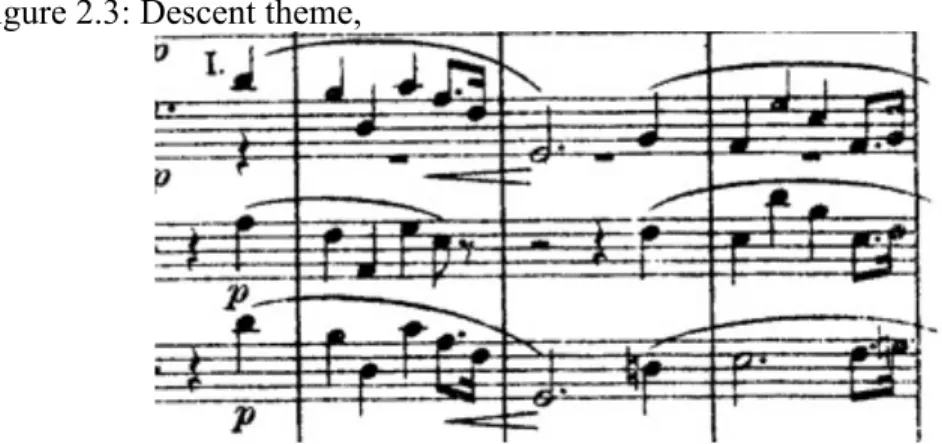
When the piece was published in 1915 it had only one-movement that narrated a climb up and down a mountain. Youmans emphasizes that that though it is technically one movement, there are 22 sections that make up the approximately 50-minute work. Each section corresponds to a different pastoral scene of the alpine journey. Strauss opens with a descending B-flat minor scale into Nacht (Night), followed by the Sonnenaufgang (Sunrise), bursting forth out of
darkness, setting the alpine adventure into motion. He then starts the upward climb, Der Anstieg
(Ascent), continuing to the Eintritt der Wald (Entry into the Forest). From there the piece details many distinct natural structures and phenomenon, such as the twinkling string section during the
Am Wasserfall (At the Waterfall), the traditional pastoral sounds of bleating sheep and chirping
11 Bryan Gilliam, The Life of Richard Strauss (Cambridge: Cambridge University Press, 1999), 95. 12 Youmans, Richard Strauss’s Orchestra Music and the German Intellectual Tradition: The
birds in the Auf der Alm (On the Pastures), and the immense brass climax at Auf dem Gipfel (On the Peak).13 The composition is cyclic in that the work starts during the night, builds up to a sunrise, and ends where it began: with the sun setting and our eventual return to night. Table 2 shows how the piece is organized into 22 sections with their individual titles. These titles assist with the comprehension of the “unwritten” program.14 Since the piece begins and ends with night, with a sunrise and sunset in between, the piece follows a day and night cycle. Within this cycle, Strauss includes guiding titles, like “Ascent” and “On the Summit”. The titles help listeners picture a journey up and down a mountain, with the peak between the ascent and
descent sections. The journey up and down a mountain is a cycle as well, further emphasizing the cyclical nature of this piece. The cycle in relation to the music is explored in chapter two, and, as described, follows closely to the pattern expressed through the program.
13 Gilliam, The Life of Richard Strauss, 95.
14 Technically, writing the titles at the top of each section could be considered a written program, but I am
Table 2: List of titles throughout the work with English translations.
Nacht Night
Sonnenaufgang Sunrise
Der Anstieg Ascent
Eintritt in den Wald Entry into the Forest Wanderung neben dem Bach Wandering by the Brook
Am Wasserfall By the Waterfall
Erscheinung Apparition
Auf blumigen Wiesen On the flowering Meadows
Auf der Alm On the Pastures
Durch Dickicht und Gestrüpp auf Irrwegen Through Thickets and Undergrowth on the Wrong Path
Auf dem Gletscher On the Glacier
Gefahrvolle Augenblicke Dangerous Moment
Auf dem Gipfel On the Summit
Vision Vision
Nebel steigen Mists Arrive
Die Sonne verdüstiert sich allmählich The Sun Gradually Darkens
Elegie Elegy
Stille vor dem Sturm Calm before the Storm Gewitter und Sturm, Aufstieg Tempest and Storm, Descent
Sonnenuntergang Sunset
Ausklang Echo/ Quiet Settles
Nacht Night
I am basing my understanding of program music during the fin-de-siècle on Jonathan Kregor’s recent study, Program Music15. Kregor’s suggests that program music seeks a dialogue with other arts, like poetry, literature, and visual art. The dialogue which he describes calls for the music at hand not only to reference another external art, but to engage with it actively. It represents the art and has the ability to express the emotions created by the one art in the form of music. Program music most often connected with literature, but it was not uncommon for it to approach the other art forms as well16. An example of a piece connected with literature is Strauss’s Also Sprach Zarathustra, whichis based on the writings by the same title by Nietzsche.17 Many new symphonic genres came out of this dialogue: character pieces,
programmatic symphonies, symphonic poems, and tone paintings.18 In order for a piece of music to be programmatic, Kregor writes that it must have something extrinsic to the music which
15 Kregor, Jonathan. Program Music (Cambridge: Cambridge University Press, 2015). 16 Kregor, Program Music, 1-2.
17 Mussorgsky’s Pictures at an Exhibition details musically the paintings that are in a particular gallery.
Hugo Wolf was famous for his relationship to Eduard Mörike and wrote a song cycle based on his poems.
gives the music a deeper meaning, be it “a title, a poem, [or] a person.” I think that his definition suggests that we ask ourselves, as analysts, whether we accept the extrinsic idea that is suggested by the piece or not. If we do accept that this extrinsic idea is fundamental to the piece, then it is our goal to find ways in which to include it in the search for a work’s meaning. One of the centerpieces of programmatic music is its intended ability to represent themes or ideas through musical notation. James Hepokoski writes that:
Essential to the production of programmatic musical scenes is an assumed generic contract between composer and listener whereby musical ideas are agreed to be mappable onto aspects of specific characters or situations: let motives A, B, and C represent narrative-images X, Y, and Z. Without an initial agreement to accept this principle of musical metaphor, the tone-poem premise collapses. To suggest that it might be appropriate to listen to these works as absolute music or that they are adequately comprehensible in terms of pure music alone is to blind oneself to the historically controversial and witty aesthetic game that the tone poems are playing.19
Hepokoski outlines the mechanics of program music in relation with the representation of themes within the music to the extrinsic association. This blueprint of program music builds on Kregor’s model in that it suggests it is no longer the responsibility of the listener to form their own
interpretation of the program (though one could argue that this phenomenon occurs regardless). Instead the responsibility lies with the composer. He must give agency to the music to direct the listener through the path of the program. Without this direction, the listener is lost and distracted from attempted metaphor.
Following Hepokoski, in order for a piece to be distinguished from absolute music, the music must begin to represent “narrative-images.” One example prior to the nineteenth century is Antonio Vivaldi’s Le Quattro Stagioni. The piece was accompanied by a set of sonnets that were possibly written by Vivaldi, and there are many instances of musical representation such as bird
19 Hepokoski, James. “The Second Cycle of Tone Poems,” in The Cambridge Companion to Richard
calls, dogs barking, and a storm.20 While this is just one example, and there are many that are present much earlier in fifteenth and sixteenth century madrigals, these musical representations are indicative of a programmatic work, but, as the complexity of musical composition developed over the centuries leading through the nineteenth century, so did the detail and intricacy of the programs associated with program music.
Towards the middle of the nineteenth century, program music began to develop into what we normally associate with nineteenth century program music, composed by Strauss, Liszt, and Berlioz. Beethoven’s Ninth Symphony expanded the possibilities for many new genres of symphonic music. Composers attempted to find new genres to expand on what Beethoven done. Robert Schumann wrote of four new genres that emerged from the “symphonic crisis”:
Mendelssohn’s symphony-cantata, Berlioz’s programmatic symphony, Liszt’s symphonic poem, and Wagner’s music drama.2122 As the century continued, new composers with innovative ideas began to expand upon the rapid development of the “symphonic crisis”. By the late nineteenth century, Richard Strauss was the prominent figure for programmatic tone poems, which are loosely connected with Liszt’s symphonic poems. Gustav Mahler reshaped the symphony with his groundbreaking and expansive symphonies, lasting over an hour and pushing the size of the orchestra to its limits (especially his Eight Symphony, “Symphony for One Thousand.”). Richard
20 The connection between motivic representations and program music will be further explored in the
second chapter, in which I will analyze all of the major motives throughout Eine Alpensinfonie. 21 Kregor, Program Music, 3.
22 The symphony-cantata was essentially a symphony with a choir added in, similar to the shape defined
Wagner continued to redefined the relationship between the symphony and opera with
hisimmense and maximal music dramas. These composers searched for control of the symphonic genre with their diverse compositions. What resulted was a world of potential interpretations of what program music should look and sound like.23 With this mindset of the nineteenth century, any piece of music connected with an extrinsic idea could be considered program music. Whether that is problematic or not is up to debate. This mindset allows for even the smallest connection with an extrinsic idea could result in a piece of music being categorized as program music, which could be beneficial for the growth of program music as genre. However, what is missing is whether the music uses narrative or it just referencing something outside of music. It does address the fact that program music should connect with something extrinsic to the music, but if the music alludes to something less extravagant, then the piece is somewhat devalued as program music. Over time, the most prized piece of program music employ the use of narrative to bring their pieces to life and tell a story to the audience. Technically both types could be considered program music, though one form is much more strongly revered.
Bryan Gilliam attributes Strauss’s fascination with the genre of the tone poem to his close relationship with Alexander Ritter (1833-1896)24, who was attached to the music of Wagner and Liszt and had a significant impact on Strauss’s compositional approach to narrative through the use of many interrelated themes and motives.25 Ritter spent a considerable amount of time with Strauss during his period in Meiningen as the court music director from October 1885 through April 1886. Ritter introduced him to the symphonic poems of Liszt and the writings and
23 That is, if it is meant to look or sound like anything specific at all.
24 Alexander Ritter was a violinist and composer from Estonia with whom Strauss met frequently during
his time in Meiningen. Ritter took the place of Hans von Bülow, and encouraged Strauss to write his first opera, Guntram.
compositions of Siegmund von Hausegger (1872-1948)26. Before meeting Ritter, Strauss was already deeply entrenched in the study of Richard Wagner’s music dramas. At the age of twelve, Strauss had an undying passion for opera and musical theater. He adored of the first performance he attended of Siegfried in April 1878. He was amazed by the beauty of the piece (though he writes that it did bore him incredibly) and was persuaded to attend the performance of Die Walküre six months later27. Strauss reviewed these operatic experiences to his close friend and fellow composer Ludwig Thuille, who was three years older than Strauss. In his letter about Die Walküre, Strauss wrote: “I have become a Wagnerian.” He praised the beautiful music of Wagner, while at the same time completely dismantling the public opinion of Mozart, writing that, “I don’t even comprehend people who can claim a Mozart might be as beautiful, who can go so far as to do harm to their tongue and their gullet by expressing such a thing.”28 This is a very strong statement from Strauss, as there have been many audiences throughout history who regarded Mozart as one of the best (if not the best) musician in history. This is particularly relevant in that Mozart was a revolutionary composer of his time. While he was successful at times in his life, his music soared to the highest critical claim after his death, and paved the way for composers like Beethoven to continue to break through a stagnant musical world.
Thuille was an orphan and was very close with Strauss and his family—to the extent that he was often considered to be part of the Strauss family. However, Thuille was an
anti-Wagnerite and more musically conservative (as was Strauss’s father Franz), so their relationship could only sustain so much discussion about Wagner.29 Ritter, on the other hand, was also a
26 Hausegger was an Austrian composer and conductor, who wrote a Natursymphonie in 1911. Hausegger
is the son of the famous music writer, Friedrich von Hausegger.
27 Gilliam, Rounding Wagner’s Mountain, 13.
28 Gilliam, Bryan. Richard Strauss and His World (Princeton: Princeton University Press, 1992), 213. 29 Gilliam, Bryan. Rounding Wagner’s Mountain (United Kingdom: Cambridge University Press, 2015),
Wagnerian, who focused his teaching and understanding heavily on the philosophy of Wagner’s music with particular attention to Schopenhauer. Ritter added to Strauss’s understanding and adoration of the elder composer by focusing on the aesthetics and the philosophy of Wagner’s music. Ritter’s main influence upon Strauss as a composer was to introduce him to Liszt’s symphonic poems, which sparked the creation of the tone poem as a response to the symphonies of Brahms.30 However, this fascination with the tone poem was relatively short, as he only composed them from 1886 to 1915, before opera and Lieder dominated the majority of his compositions. Strauss wanted to sustain the programmatic genre: he considered the symphonic poem as championed by Liszt to be the “music of the future.”31 Strauss’s programmatic music has no written programs, only the works’ titles and section headings.32 However, there are still many implied programmatic ideas and stories that fit with the music provided. For example, in
Ein Heldenleben, the listener is able to track the “life of a hero” as he enters battle and faces adversity; in Till Eulenspiegel, we follow a character from German folklore named Till and we hear his adventures as a “trickster,” constantly performing practical jokes; in Sinfonia Domestica, we gain a third-person aural perspective on domestic life within the household. However, the program of Eine Alpensinfonie is highly debated and has a historical background that only confuses the decoding process.
The only written program that Strauss provides for Eine Alpensinfonie are the 22 titles for each section of the piece. One major missing element, which is present in most of his other tone poems, is an implied protagonist or central figure. In Ein Heldenleben, Strauss included the character directly in the title of the work. Till Eulenspiegel’s main character is drawn from a
30 Gilliam, Bryan. Rounding Wagner’s Mountain, 15. 31 Gilliam, “Strauss Richard, §2: The tone poet, 1885-98.”
32 This is a distinct contrast from the program notes that accompanied Hector Berlioz’s Symphonie
trickster out of Germanic folklore. The character can also be inferred from the title of the
composition. Sinfonia Domestica describes family life and there are specific themes and motives for the different members of a family. For Eine Alpensinfonie, however, there is nothing
signifying whether it is a journeyman who makes this trek or if it Strauss himself, writing from the inspiration that he received in his own life. Perhaps the character is that of the
Künstlertragödie. Since the design of the program changed so frequently and it took nearly fifteen years to complete, it is possible, even likely, that the conception of the character changed over time as well.33
Scholars have debated whether EineAlpensinfonie is autobiographical, mirroring Strauss’s own experiences, or if it simply is a work depicting natural panoramas. Peter Höyng suggests that EineAlpensinfonie’s program is based off of an alpine experience that Strauss had when he was young. Strauss wrote a letter to his friend Ludwig Thuille on 26 August 1879, which outlines his adventure in the mountains near Stauffel Lake in a town named Murnau, where he was on vacation with his family. Strauss left his house in the middle of the night to join other hikers. They spent five hours hiking in the dark with only a lantern to light their path. Upon daybreak, the climbers reached the Heimgarten summit, “where they were afforded a panorama of various lakes and peaks, including the Zugspitze.”34 The hikers got lost and wandered around for a couple of hours, only to be caught in a storm while descending the mountain. The group finally returned to Murnau the following day. The story that is told in Strauss’s letter matches very the Alpensinfonie, as indicated by the titles of each section closely. Höyng suggests, “The individual, presumably a male, is one who is allowed to experience an adventurous day in the
33 In any case, there is limited evidence supporting these claims.
34 Peter Höyng, “Leaving the Summit Behind: Tracking Biographical and Philosophical Pathways in
mountains and overcome hindrances so that he can feel in full control of both himself and nature.”35Strauss even mentioned at the end of his letter that, “[he] depicted the whole adventure on the piano…. Of course giant tone painting and all that nonsense.”36 While these factors might indicate a strong connection between this alpine trip and Strauss’s conception of the
Alpensinfonie, Bayreuther argues against the piano transcription, by highlighting that thirty-five years pass between this letter and the completion of the work, and that the relationship between the two is largely unlikely.37
Ernst Krause has also attempted to shape the Alpensinfonie as a biographical work, asking, “who but Strauss guides the listener amongst the peaks of the ‘Alpensinfonie,’ the panorama of his beloved mountains which could be seen from his Garmisch home?”38 Krause’s argument is based on multiple suggestions by Strauss. Strauss wrote, “I don’t see why I
shouldn’t make a symphony about myself. I find myself quite as interesting as Napoleon or Alexander.”39 Strauss is also quoted as having asserted, “poetical content is the content of one’s own life.”40 Such claims add credibility Höyng’s argument, though I would suggest that his evidence—letters by Strauss and his sister—is much more convincing than a few stray quotes that Strauss could have said in any context. There is, for example, the possibility that these quotes were inaccurately attributed to Strauss. In this case, I would trust the letters, written on specific dates and in a particular context, especially with two writers describing the same events. Though the quotations confirm his argument, they would not be able to withstand any critical
35 Höyng, “Leaving the Summit Behind: Tracking Biographical and Philosophical Pathways in Richard
Strauss’s Eine Alpensinfonie,” 242.
36 Höyng, “Leaving the Summit Behind: Tracking Biographical and Philosophical Pathways in Richard
Strauss’s Eine Alpensinfonie,” 232.
37 Höyng, “Leaving the Summit Behind: Tracking Biographical and Philosophical Pathways in Richard
Strauss’s Eine Alpensinfonie,” 233.
38 Ernst Krause, Richard Strauss: The Man and His Work (Boston: Crescendo, 1969), 75. 39 Krause, Richard Strauss: The Man and His Work, 75.
analysis, especially considering they are most likely taken out of context. Without an explicit program for the work, we can maintain the possibility that Strauss could have conceived of the piece autobiographically. The hike was, as he himself described it, “interesting, special, and original to the highest degree.”41
I struggle to hear and understand this piece as biographical. Strauss’s quotations extracted by Krause are weak evidence. Höyng’s argument is more consistent: there is a stronger
connection between this evidence in letters and biography, but the issue with this evidence is historical distance. As Bayreuther stated in his analysis, over 35 years passed between the date of the letter and the work’s completion. While the letter’s highly detailed account parallels the final form of the program. However, Strauss was surrounded by mountains for most of the second half of his career in Garmisch-Partenkirchen and could have been influenced closer to the date of publication. The town of Garmisch-Partenkirchen is a very small town situated in the heart of the German alps in Southern Germany. In 1908 Strauss built a villa in Garmisch-Partenkirchen, and because of its proximity to the Zugspitze, the highest mountain in Germany, one could try to create the connection between his physical surroundings and his composition of Eine
Alpensinfonie.42
Could it be that the Alpensinfonie has no central figure? While many of Strauss’s other tone poems have included characters, or suggest that a figure in some form is implied,
Alpensinfonie lacks any evidence in the score that suggests a journeyman, hiker, or even Strauss himself. In contrast, the main themes that are presented throughout the work allude to natural phenomena and the many titles also rarely mention any human involvement, save the section
41 Höyng, “Leaving the Summit Behind: Tracking Biographical and Philosophical Pathways in Richard
Strauss’s Eine Alpensinfonie,” 232.
42 The dates of when the villa was constructed match up well enough with the publication to potentially
titled, “The Climb,” and “The Descent,” which indicate movement. However, these few section are outnumbered by music that represents nature and natural events such as a storm, waterfall, sunrise, and sunset.
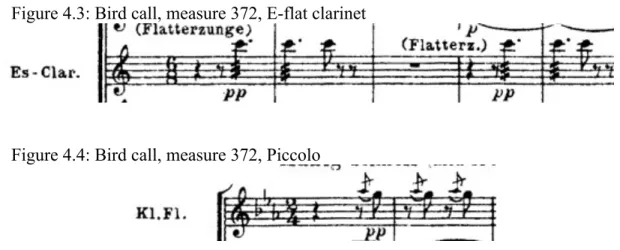
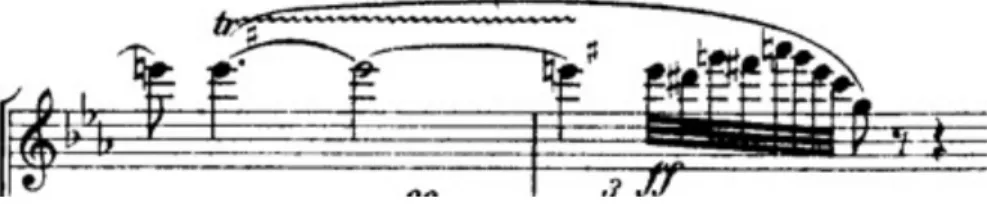
In contrast with the previous claims, I understand Eine Alpensinfonie program to be focused on the natural objects and events of the alpine landscape, with the absence of a main character. Rather than trying to place this work within the same context as Strauss’s other tone poems, I compare it to works such as Beethoven’s Pastoral Symphony or Sibelius’s Fifth Symphony. These symphonies are both centered around nature, and the Pastoral Symphony contains similar narrative material: the fourth movement is titled “Gewitter, Sturm” (Thunder, Storm), and birdcalls occur at the end of the second movement.
Krause would disagree with me. He writes, “This is no musical work of Beethovenian feeling for nature…any comparison with the ‘Pastoral Symphony’ is misleading.”43 I think what Krause is aiming at in this statement is that the two share a nature connection, but Eine
Alpensinfonie’sconception of the natural world is different from the Pastoral. Krause argues for the separation of the two. I think it is okay to keep the pieces separate in some instances,
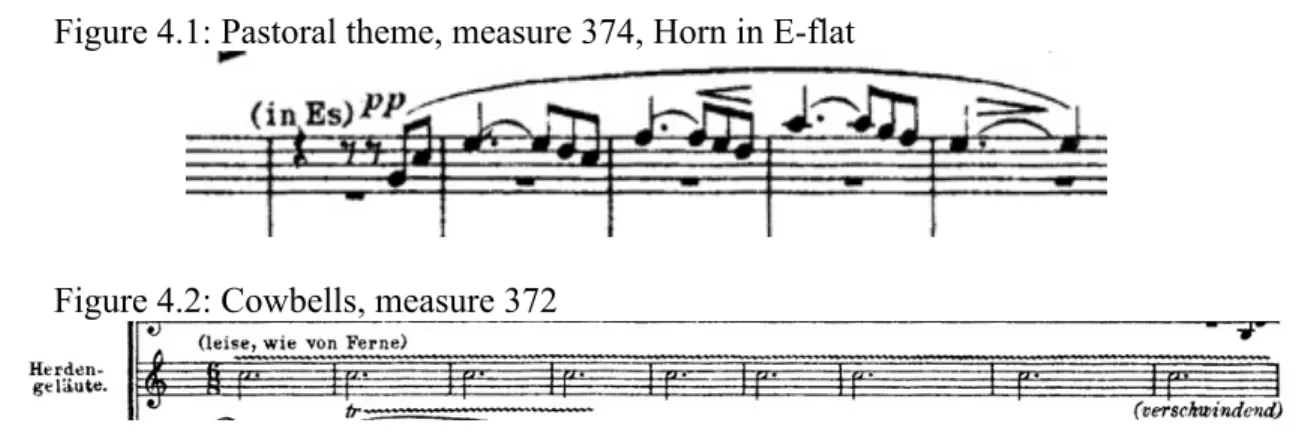
especially considering the Pastoral Symphony and Alpensinfonie are separated by over 100 years. However, there are multiple parallels between the piece, such as the pastoral imagery, various bird calls, and the storm scene that is present in both. The first movement of the Sixth Symphony, though soft and gentle, contains a melody that is simple, in a major key, relies heavily on the harmonies of the fourth and fifth, and matches that of the Pastoral theme in Eine Alpensinfonie, with its simple descending scale, followed by step-wise motion throughout the winds and strings, found in the “Auf der Alm” section. In contrast, the Scene by the Brook from the Pastoral Symphony and the Wandering by the Brook from Eine Alpensinfonie are less
similar. The selection from Beethoven showcases three distinct bird calls, while Strauss’s selection mimics the sound of a stream running by. The comparison for the Scene by the Brook actually comes in the On the Pasture section, where Strauss imitates numerous animal sounds with bleating sheep and ringing cowbells. The storm sections located in both symphonies
compare closely, with the strings swirling up and down scales while the brass play intermittently, heightening the unsettledness and frantic nature of this scene. One major difference is that
Strauss used a thunder machine and wind machine—unavailable to Beethoven, as these instruments had not been invented. These two instruments were originally invented for the purpose of adding sound effects to staged performances (plays, theater). Recognizing their ability to reproduce these natural sounds extremely well, Strauss implemented him in his orchestration: their first appearance with an orchestra. Another difference is compositional style. Following Wagner, Strauss used a variety of short themes and motives that, during the storm scene, are played on top of each other and varied. Beethoven wrote longer melodic passages that developed over the course of each movement.
The connections that exist between the two are compelling, both programmatically and musically. In addition to my arguments, there are range of interpretations of of the Pastoral
scenery (fifth movement).”44Heard this way, the Alpensinfonie and the Pastoral Symphony are similar, with the exception of the explicit programmatic content.
Focusing on the Alpensinfonie, removing a protagonist prompts a new interpretation. We go from following a hiker’s adventures through the Alps and the many natural phenomena that they encounter along their journey to a collection of vignettes that show the natural phenomena without human interaction. The second perspective is pictorial, similar to a collection of
photographs of the Alps organized in such a way that the paintings show a timeline of events. Strauss uses these separate pastoral scenes to create a musical landscape of the Alps. The landscape is meant to transport the listener to the alpine world, which further elucidates his programmatic ideas. Paired with the transportation is the emotions and events that take place within the landscape. We hear woodwinds imitating sheep and birds in stereotypical pastoral scenes (measure numbers for all of the following points of description). A horn-call is heard in the distance. The rustling of strings and percussion immerse the listener deep within a storm, followed by the strings imitating the sun bursting forth from the clouds once more to show the end to the adventure on the mountain. The development of a musical landscape is crucial the program, as is is dependent on a set of pastoral scenes from the Alps. The listener can experience the landscape aurally and operate within it, as the music guides the listener from one musical photograph to the next.
If Strauss intended for there to be a central figure or character in the Alpensinfonie, it would be located at the genesis of the work’s composition. When conceived in 1899, the
Alpensinfonie was originally centered around a Künstlertragödie (An Artist’s Tragedy), which
44 Höyng, “Leaving the Summit Behind: Tracking Biographical and Philosophical Pathways in Richard
was inspired by the paintings of the Swiss painter, Karl Stauffer, mentioned above.45 Stauffer could be the figure that Strauss imagined in his Alpensinfonie: he was a well-accomplished hiker, and he wrote that, for him, climbing mountains had a “psycho-hygienic function,” which is similar to the way that Strauss felt about climbing mountains and being in nature. Stauffer had strong ties with the Alps and his birthplace was right in the middle of them. Strauss takes advantage of this location and makes Stauffer’s birthplace the centerpiece for his descriptions that are used for the program. Strauss wrote, “After everything has been lighted and saturated by mild warmth, the small house where ‘the artist was born’ becomes visible.”46 Writing here again on the Künstlertragödie,Strauss centered the program around Stauffer’s prosperous and
turbulent life, as shown in the sketches for the work. On the back of the sketchbook, Strauss wrote, “Liebestragödie eines Künstlers – dem Andenken Karl Stauffers” (Love tragedy of an artist – in memory of Karl Stauffer).47 In other words, perhaps Strauss imagined early versions of
Alpensinfonie in the context of the biography of Karl Stauffer, allowing another possible central figure of the program. In any regard, this evidence is only reliable to the point at which Strauss decided to shift the program away from the Künstlertragödie and towards the Alps-centered program. After that point, the piece shifts its entire focus from anything that could be related to a biography towards a more natural program, taking place in the alpine landscape. The
biographical relationship is broken, thus rendering this evidence useful to our understanding of how the piece took shape over time and the background of the program’s conception, but not directly helpful with the final publication.
45 Höyng, “Leaving the Summit Behind: Tracking Biographical and Philosophical Pathways in Richard
Strauss’s Eine Alpensinfonie,” 234.
46 Höyng, “Leaving the Summit Behind: Tracking Biographical and Philosophical Pathways in Richard
Strauss’s Eine Alpensinfonie,” 236.
47 Höyng, “Leaving the Summit Behind: Tracking Biographical and Philosophical Pathways in Richard
This discussion surrounding the presence of a central character within Eine Alpensinfonie
allows the possibility for musical narrative to be included into our understanding of the program. Musical narrative, as understood by Jean-Jacques Nattiez, is flexible and subjective to the
individual. The narrative is written each individual audience member and their own personal interaction with the music that they are hearing.48 While this does not rely on evidence to
discover the program to Eine Alpensinfonie, it plays into how we interpret all of the evidence that has been discovered. Musical narrative and a program are separate entities, considering that programs are inferred by the composer and narratives are created by the audience. But, they are related in accordance with our comparison of the two. For example, the scholars provide their evidence for their individual understanding of Eine Alpensinfonie in accordance to the other evidence provided, and I provide my own musical narrative based on what I have read and heard.
I have previously examined the elements of the program which contribute to our understanding of Eine Alpensinfonie, but it is important to go through the same process
following the guidelines provided by Nattiez. Nattiez described musical narrative and how it is comprised of not only plot and story, but also an act or actions to create motion in the narrative.49 According to Nattiez, there are two requisites in order to narrative to be established in music: a minimum of two objects must be presented, regardless if it is living or inanimate, and the objects must be presented in a linear and temporal manner to encourage the audience to create a
relationship between them.50 In the case of Eine Alpensinfonie, even though that I decided that there was not a central character in the final version of this piece, there are still objects and elements within it that allow for the narrative to exist. My understanding of the program removes
48 Jean-Jacques Nattiez, “Can one speak of narrativity in Music?” Journal of the Royal Musical
Association 115, no. 2 (1990), 246.
the human element from the piece, but that does not limit its ability to have musical narrative.
Eine Alpensinfonie contains many different “objects” which fit Nattiez’s first requirement for narrative. The mountain, the sun, the pasture filled with different animals, the storm, and the waterfall are just a few examples of the objects that Eine Alpensinfonie has to offer. The objects within the piece are related in a linear fashion, especially considering the cyclical nature of the music. The piece begins and ends at night, and the music at both ends is similar: a descending B-flat minor scale that cascades through the woodwinds and strings. At the beginning of the piece, the sun rises from the darkness, establishing the time of day. The sun then sets to bring the day to a close. Given the title of the piece, the audience can assume that the music will contain a
temporality of the program, Strauss allows for a well-created musical narrative to develop within the audience. These ideas behind musical narrative add to the strength of this piece within the context of other works during the late 19th century and the early 20th century. It further
emphasizes its great detail and vivid descriptions and credits the structure of the piece and how it specifically relates to the narrative and program as a whole.
The evidence provided by these scholars is substantial and it not to be ignored, especially given the open discourse surrounding the program of Eine Alpensinfonie. All of the claims made by each of the scholars are plausible, though it is important to recognize the limitations of each of the claims in relation to the final composition. The letters and statements from Strauss and his family members indicate a possible autobiographical composition following 1879, mainly focusing on his alpine experiences in his youth. These letters were strikingly similar to the titles of the piece, but the time elapsed from these letters and the final composition is long enough to cause skepticism over their relationship. The connection with Karl Stauffer indicates a
biographical relationship, that he could be the figure guiding the journey. However, that version of Eine Alpensinfonie long predates the finalized version. A fifteen-year gestation period
provides a lot of room for change, as we can see from Strauss changing the title four times. Based on this, the title is a good place to start looking for immediate clues as to if this work could be biographical.
Consider the natural side of the program of the Alpensinfonie in the context of the cultural importance of mountains in Germany. During this period, there was the Heimat
(homeland, or native land) movement, in which there was an increased stress on the individual and cultivation of one’s being.51 The natural connection with the Heimat movement existed
51 Christopher Morris, Modernism and the Cult of Mountains: Music, Opera, Cinema (England: Ashgate,
through the WandervogelGesellschaft (The Wanderers Society). This society was dedicated to reestablishing the love of nature among youths, though its outreach extended across the German society as a whole. Mountains were their “nature of choice” for walking and hiking, an important context for Strauss’s work. In addition to focusing on nature, the society had an “emphasis both within alpinism and the youth movement on healthy living and the ‘return to nature’.” They wanted the people to leave the cities and to branch out into the countryside and explore the beauty and glory of the nature that is around them, especially considering that the southern part of Germany is home to some of the Alps. Christopher Morris suggests the, “‘return to nature’ was rooted in late nineteenth-century German and Swiss reformist attitudes to perceived cultural decline and decadence.” It shows that it was a desirable shift and that one might even say that is was a necessary one in order to sustain a strong culture or to revive a culture that abandoned the mountain vistas. This movement was also sustained by the expansion of the railway system throughout the Alps, which made trips, like the one Strauss made in 1879, much more accessible and realistic.52 This opened up enormous possibilities for the urban middle class. All of the sudden with this increased interest in being in the Alps and the availability of travel to these locations, the arts community responded, turning to a variety of media in which to portray the new obsession. This symphony is a good example of the arts drawing the connection to the Alps. Shortly after the end of World War One, many film directors turned their attention to making art in the Alpine vistas the German population so strongly sought out.
Strauss was an early adopter of the Heimat movement, and many critics of his
Alpensinfonie were progressive in their reviews, noting terms and drawing connections that were sometimes fantastical and beyond the times. Richard Specht wrote in???, stating that the
Alpensinfonie is regarded as “Kinomusik,” (movie music).53 Cinema flourished in the 1920s, and the categorizing it as cinema music speaks to the way which listeners could have been hearing the symphony, though there is a sense that the quotation is slightly derogatory in its use. The quote by Specht could lead one to associate a motion picture with the music and the music matching the picture being shown on the screen.
An interesting contemporary setting of Eine Alpensinfonie comes from Tobias Melle and his Sinfonie in Bildern (Symphony in images, DATE?). Melle is a musician and a photographer who synchronizes symphonies with pictures displayed while the orchestra is performing. The pictures are still and taken with modern equipment in recent years. Perhaps they take away the guess work by the listener and provide images with the audio underneath in order to supplement the imagination. This intriguing project by Melle, even because of its restriction on the program, is a glimpse into what Specht might have meant when he called Strauss’s work cinema music, with its vivid imitation and imagery of the Bavarian Alps. Melle’s work and Specht’s quotation provide another perspective from the pictorial view. One could regard this piece as potentially a “tourist” symphony: a lure for city dwellers, heard in a concert hall in Berlin only to inspire future alpine excursions. Thus, they might have raced off to the trains with the rest of the
German population. It depicts many natural phenomena with strong realism down to the bleating of sheep and the cowbells by in the scene by the pasture, the whipping winds of the storm, the glistening drops of the nearby waterfall, and the numerous hunting calls provided by offstage brass, as if a local group of huntsmen were preparing to take on the wildlife.
Confirming the exact program of Eine Alpensinfonie is approaching the impossible, as there is not enough evidence to make any definitive claims, but there have been many attempts to pin down a potential original story. As I have suggested, the claim that Strauss composed Eine
Alpensinfonie as an autobiographical/biographical work is possible, but there is nothing within the music itself that would support it. The only strong evidence for the biographical argument is the dedication to Karl Stauffer that was written on the back of a sketchbook. However, this was from an early version of the composition, and since there was fifteen years between the start and the finish of the work, the possibility for it to change over time is relatively high (especially considering that Strauss was not working on the composition for 15 years consecutively). The autobiographical claim Peter Höyng makes is at first convincing, considering the anecdotal experience that Strauss had when he was fifteen years old and transcribed his hike at the piano. But even this event struggles to reconcile the time gap, considering that Strauss embarked on this alpine hike in 1879, many years before even the genesis of the conception of Eine Alpensinfonie. Although shared by others, my claim about the natural origins of the program, based within the context of German cultural traditions and the natural inclinations of the population, fits well within the structure and design of the composition. With the numerous form and title changes, the work shifted from potentially a biographical work into a philosophical one as Strauss edited. I hear the final work as based centrally within nature. No longer was Strauss working with his own experiences or creating a memoir, but responding to, and potentially exploiting, the trend of the German people’s attraction to the Alps.
CHAPTER TWO
Music and Meaning: Topics and Representation within Eine Alpensinfonie
Depicting and representing events, natural themes, and emotional sentiments was a cornerstone of program music in the nineteenth century. The literary component of
programmatic music, whether a collection of poems, a set of correspondence, or a paragraph of prose text, is very important, but its effectiveness is limited by the representation within the composition. As Heinrich Christoph Koch defined program music in the Musikalisches Lexikon
(1802):
A category of music, which remains little explored, whereby the composer sets for himself the goal of representing or depicting by tone painting alone certain historical events without the assistance of the poetic arts….for this genre to be afforded due respect, however, the question must first be answered: whether it is within the limits of music to represent historical topics, or at the very least, to what extent a historical event can serve as the basis for expressing musical sentiments without the assistance of the poetic arts.54
For program music to be successful, the two components of an extrinsic, poetic idea, and the depiction and representation of this idea, must coexist and work with one another to produce the desired reaction. From a musical perspective, I consider these representations and depictions in the context of musical topics. Musical topics are “literal and associative, a gateway through which music expresses and creates meaning.”55 One definition of musical topics comes from Leonard G. Ratner, where he writes that topics are simply “subjects for musical discourse.”56 Topics take shape in variety of different ideas and styles, each of which has its own meaning in relation with the music. Since topics can indicate more than direct representation, they are deployed across a wide range of musical genres, but it is especially prevalent in programmatic music.
54 Koch, Heinrich Christoph. Musikalishes Lexikon. Frankfurt am Main: August Hermann, 1802, 1384-5. 55 Kregor, Program Music, 9.
In the 18th century, a frequent topic was the heavy dotted eight-sixteenth note rhythms and a two-part structure that indicated the “French Overture.” In this case, the notes themselves to do not mimic an abstract referent. Instead the distinct rhythm draws attention and is the indicator of the French Overture. The “Sturm und Drang” topic is commonly used to indicate uncertainty, emphasized by a minor key area, wild melodic contours, and dramatic and sudden changes in dynamics, pitch, tempo, and style, such as Haydn’s Symphony no. 39, Tempesta di mare. The pastoral topic is representative of the melancholic countryside and the pasture. It entails horns and woodwinds, with linear and smooth melodies revolving around harmonies of a fourth or fifth. These are just a few examples of topics and how they relate to a music’s effect, but there are many more, and operate in numerous musical and extra-musical functions.
Richard Strauss’s Eine Alpensinfonie can be approached through the lens of topics and representation. Eine Alpensinfonie is a pervasively descriptive, vivid, and imitative piece of music, a kind of expansion on earlier imitation of nature by Beethoven, Liszt, and Sibelius. Some might argue that the listener should not need a written program of any kind in order to follow a suggested narrative. However, in conjunction with the titles, Strauss’s composition contains highly imitative and descriptive music. As I will show by breaking down each section of the symphony into themes and motives: Strauss does not provide much space for multiple
interpretations of the narrative, even though, as I have showed in the first chapter, there are many possible protagonists and frameworks.
about musical works.”57 This quotation explicitly comments on the meaning that is received from the music by the listener. As I have stated earlier, in the context of this historical moment, the music and the program ought to cooperate with one another in order to produce an effective piece of program music. Even with a range of interpretations, especially in the case of Eine Alpensinfonie, the music needs to guide the listener’s thoughts in a way that they can form a cohesive narrative. Agawu writes that for a listener to understand the piece of program music at hand, the listener must be able to compose a narrative that works consistently for their
interpretation of the music. He writes, “The idea that music has the capability to narrate or to embody a narrative, or that we can impose a narrative account on the collective events of a musical composition, speaks not only to an intrinsic aspect of temporal structuring, but to a basic human need to understand succession coherently.”58 What Agawu writes applies to our hearings of program music, but also more broadly. We give narrative to music that we listen to because we have a desire to make sense of what we are hearing.
Jonathan Kregor similarly writes that matching topics with direct meaning “limits their discursive freedom and their interpretive potential.”59 Certain topics are used describe or imitate events and objects, such as the hunting call or the pastoral. Kregor builds on Agawu’s discussion of musical topics, and they both agree that topics should not be limited to fixed interpretations. I think it is productive to take the ideas of both Kregor and Agawu and combine them in order to gain a complete understanding of how program music works and how the narrative and program is framed through the use of topic theory. Kregor discusses topics as he defines program music, and implicitly relates the two, which, in my interpretation, makes topics part of the foundation of
57 Kofi Awagu, Music as Discourse: Semiotic Adventures in Romantic Music, (New York: Oxford
University Press), 4.
program music. Agawu, focusing mostly on topics, gives us a clearer understanding of the topics that Kregor is describing and how each of the topics relate to one another to give the music meaning, and for this case, how it operates within a piece of program music. As I explained in the first chapter, the narrative for program music is vital. The composer’s challenge is to compose in a way that would elicit a specific reaction and let listeners imagine their own interpretation of the music and narrative. Avoiding a specific idea for each topic is beneficial to how we perceive different musical ideas. Some could argue that if a topic or theme is interpreted in many different ways, how can it be given the title that so many scholars tend to do? At a certain point, it would be illogical for one to hear the pastoral topic during a Sturm und drang topic. This example, though extreme, shows that when we allow for discussion to be free, there is the potential for a lack of consensus on the narrative. This is problematic for program music, in which one of the main goals is to express a unified narrative and theme throughout the whole piece.
Plot is not always the goal of program music and topic-saturated music, but rather is something that results most often from an audience attempting to understand the piece of music. Kofi Agawu has written extensively on the ideas of music, meaning, and topic theory. Agawu weighs in on the discussion of topics and how drawing out plot from topics or character pieces results in
sheer indulgence: [plots] are the historically minded analysts’ engagement with one aspect of a work’s possible meaning… Topics then are points of departure, but never “total identities.” In the fictional context of a work’s “total identity,” even their most explicit presentation remains on the allusive level. They are therefore suggestive, but not exhaustive.60
60 Agawu, Kofi. Playing with Signs: a semiotic interpretation of classical? music. Princeton: Princeton
Even though Agawu is writing mostly on 18th century style in this book and how topics and plots interact within these compositions, the concept could still apply music written later in history. This idea of limitless topics and not restricting a work’s “total identity” places a great
responsibility on the composer to not have their audience perceive something that limits their musical experience, such as a plot. Plots are easy for listeners and historically-minded analysts to shape, because they allow this audience to make sense of the work as a whole. From this plot, the analysts use topics as a way to flesh out their own narrative. Each listener or analyst might not perceive the same plot, so the topics and how they relate to the individual plots can differ in meaning. Some composers, aware that their audience may not perceive the program explicitly conceived for the music, might attempt to imitate the images and compose topics that follow their program as closely as possible.
Agawu’s palate of topic interest shifted in one of his later books where he explores 19th century topics and their role in comparison to topics from earlier in music history. In his book
Music as Discourse, Agawu attempts to reconfigure the topics that shaped and structured 18th century music into a 19th century context. In this text, Agawu writes that rather than separating the topics from the two centuries, there is a certain amount of continuity between them that allows certain topics to be reimaged in a more contemporary context.61 However, it is
problematic to assume that this relationship is straightforward and uninhibited by history. The social context shifted so much that examples from the 18th century did not work for topics in the 19th century. One example of a topic whose context changed over time was the march topic. Julian Horton writes in an article from The Oxford Handbook of Topic Theory about the different styles and meanings of the march through the 18th and 19th century. He compares the marches from Haydn’s Military Symphony, with a distinctly militaristic fanfare, including marching
percussion and trumpets, to the fifth movement of Beethoven’s Fifth Symphony, which has its own more triumphant fanfare at the beginning with bright trumpets and percussion. This is then compared to the fourth movement of Berlioz’s Symphonie Fantastique, which breaks rank from the march tradition and establishes an open interpretation of the march as one that could be someone marching to their death at the scaffold.62 Haydn used the march in a more traditional manner, keeping it within the militaristic traditions and maintaining the military sound and stereotypical instrumentation. Beethoven initiated the move away from the military, but kept the traditional timbral quality. Berlioz removed the traditional qualities from the march altogether and replaced it with a new sound and new meaning.
As I will show later on in my analysis, we can no longer use antiquated 18th century topics to understand Eine Alpensinfonie and its 20th century complexities. In order to understand this piece via topics, we have to refocus them into the social and historical context of 1915. The march does not carry with it the militaristic connotations, but is open to a free interpretation, which could include the funeral march from Gustav Mahler’s First Symphony. In the context of
Eine Alpensinfonie, we can revisit the pastoral topic as well as the horn calls and hunting fanfare, and potentially ask whether the storm in the second half of the piece falls under the Strum und drang topic in the 19th or 20th century context.63 In a closer comparison Agawu shows the lexicon of topics from Marta Grabocz and her Mahler topics. From this close comparison, we can use the horn call, the bird call, nature theme, pastoral, and the fanfare.64 These topics are specifically meant for Mahler and his symphonies and Lieder, though Strauss’s Eine Alpensinfonie is not too far removed from Mahler’s era to use similar concepts. The comparison with Mahler is clear,
62 Julian Horton, “Listening to Topics in the Nineteenth Century,” The Oxford Handbook of Topic Theory,
New York: 2014, 242.
though Grabocz’s lexicon for Bartok’s orchestral pieces appear to match more frequently than expected. Her list contains three different forms of nature topics: calm, friendly and radiant, hostile and menacing, and nocturnal. Each of these three nature topics have a specific melodic or harmonic signifier which allows for identification. For example, the hostile and menacing topic is identified by its minor harmonies and use of the chromatic scale. This topic pairs up very well with the hostile and menacing Storm section in Eine Alpensinfonie, with its continuous minor chords in the brass, underpinned by chromatic lines in the strings imitating the sound of the wind. Another direct comparison that exists between Bartok and Strauss is the elegy topic. The elegy topic, as used by Bartok, is identified through its “static or passive atmosphere.” In Eine Alpensinfonie, there is a section titled Elegy, which is one of the most stagnant sections in the whole work, considering its limited harmonic shifts and simple melody. Grabocz’s topic lexicon for Bartok matches extremely well with Strauss’s use of topics, particularly within Eine
Alpensinfonie.65
Before I can begin to explore the relationship of the themes within Eine Alpensinfonie
and how they can compare with the topics as described by Grabocz in the context of Mahler nad Bartok, it is important to discuss the role of imitation and representation in this piece. Imitation and representation are two musical styles that greatly impact our perception of this piece. It transforms the music from being absolute into being vivid, colorful, and descriptive. Three influential composers and writers from this period explained their understanding of imitation and representation in music. Robert Schumann outlined an open description of his ideal program music, writing that program music should avoid a prose program if at all possible.66 However, Schumann does allow for references to extra-musical ideas and poetical content. As a result, I
65 Agawu, Music as Discourse, 49.
66 Schumann, Robert. Gesammelte Schriften über Musik und Musiker. Leipzig: Georg Wigand, 1854,
think that Schumann creates a certain level of respect for the individual interpretations of the music. Hector Berlioz also wrote about direct imitation and the advantages and disadvantages from using this technique, especially as it relates to natural subjects. He writes that this vivid imagery that results from imitation of natural themes is possible, but it should be limited, because music works best as a metaphor. Berlioz writes that music should not be focused so much on imitation, but its own expressiveness and to what extent it conveys emotion and passion.
Berlioz wrote a collection of news articles in the French music journal, Revue et Gazette musicale de Paris that were on Beethoven’s symphonies. In these articles, Berlioz thoroughly examines the symphonies for all of their musical passages and themes, then transitions to discussing how all of these individual parts interact in an expressive manner.67 He regards the
Pastoral Symphony very highly because it contains, “the most powerful of all forms of imitation – the one that reproduces the emotions and passions: expressiveness.”68 Within the article on the symphony, Berlioz is writes, “One would far rather sleep, sleep for months, and in one’s dreams keep living in the unknown realm that a genius has allowed us to glimpse.”69 Even though Berlioz is speaking at this juncture on expressiveness and its relationship to imitation, he weighs in on direct imitation, especially of nature, in an article that he wrote prior to the Pastoral
Symphony review titled, “On Imitation in Music.” In this article, Berlioz does not necessarily support using direct imitation frequently, though he suggests that, while limited, it can help the music achieve a desired sound or to strengthen the scene or emotion it is trying to convey. He argues against Giuseppe Carpani, who had argued for music’s ability to imitate looking at