By
Glenn Lippig-Singewald
Honors Thesis Economics
University of North Carolina
April 7, 2015
Approved:
_ _.,,_
Abstract
This research examines whether rival firms’ market presence influences initial market entry decisions for U.S. fast food firms McDonald’s, KFC and Pizza Hut in Eastern China between 2004 and 2011. It also examines factors influencing the recent increase in local Chinese fast food firms’ initial market entry. The analysis utilizes a firm-and-consumer-learning
theoretical model from Toivanen and Waterson (2005) and a single-spell discrete time hazard empirical model, which are applied to data from the Carolina Population Center’s China Health and Nutrition Survey. This research reveals that the presence of KFC in a given market did not influence McDonald’s initial market entry decisions during 2004 and 2011 (and vice versa). A positive relationship was demonstrated between KFC initial market entry and higher-population, higher-income markets, and the same was demonstrated for McDonald’s initial market entry and urban markets. Also, local Chinese fast food firms entered markets where KFC already existed.
Acknowledgment
This work stands as the product of an incredible journey from inspiration (Fall 2013) to completion (Spring 2015). For the inspiration, I am deeply grateful to Jim Ferguson, Samantha Buckner, and Peter Coclanis for encouraging my initial research into the Chinese food market. Thanks to these generous souls, I was able to undertake a two-week research trip to Beijing and Shanghai during Spring 2014, studying U.S. fast food firms’ strategies for Chinese expansion.
That research inspired my topic for this work, which would not have been possible without the affirming and growth-inducing guidance of Klara Peter and David Guilkey. Dr. Peter and Dr. Guilkey recognized the value of this research from its inception, ensured that I made it through what has turned out to be the most enriching academic experience of my undergraduate career, and are responsible for all worthwhile results of this research. Any mistakes are my own.
I. Introduction
According to McDonald’s Corporation founder Ray Kroc in his autobiography Grinding
It Out: The Making of McDonald’s, Kroc’s most important job as CEO was to choose promising
new locations for McDonald’s franchises. Doing so required Kroc to analyze a myriad of factors
such as community size, fast food competition, and proximity to extant McDonald’s stores. Kroc
even mentions rummaging through competitors’ trash to gauge their sales volume! Although
McDonald’s Corporation’s method for choosing new franchise locations has certainly grown
more sophisticated since Kroc’s reign in the 1950s to 1970s, fast food firms’ choice of market
entry in relation to profit potential and rivals’ presence remains vital (Kroc 1978).
While McDonald’s and fast food competitors like KFC have by now saturated the United
States market, Asian markets (China in particular) remain a promising growth story. Since
KFC’s debut with a Tiananmen Square store in 1987 Beijing, today there are over 4,600 KFCs in
China, making KFC the leading foreign fast food brand (Yum! Brands 2014). KFC’s parent
company, Yum! Brands, also operates 1,200 Pizza Huts in China. Besides KFC, China’s only
other prominent Western fast food player is McDonald’s, which entered in 1992 (ICMR 2014).
The competitive dynamic that saw McDonald’s as the United States’ fast food market “leader”
and KFC as “follower” during late twentieth century America is reversed in China, seeing KFC
as the market leader and more popular amongst Chinese consumers than McDonald’s.
As Yum! Brands and McDonald’s battle amongst each other for market share, of critical
importance will be each firm’s process for choosing which Chinese markets to enter. Whichever
firm can enter the most profitable markets the fastest has a competitive advantage. Thus both
firms’ initial market entry decisions as a function of those markets’ estimated profitability
(gleaned from present market structure) is of great interest. Also of interest is whether KFC and
Pizza Hut, both of which are owned by Yum! Brands, share amongst themselves common initial
market entry processes or profitability forecasts to advance Yum! Brands’ growth.
In the past several years, a new phenomenon has emerged to complicate U.S. fast food
firms’ expansion plans in China: local Chinese fast food firms are emerging en masse. TheWall
Street Journal noted in December 2014 that these local firms are popping up in more rural
markets and catering to localized tastes that U.S. fast food firms presently miss. Thus the factors
determining initial market entry for this new wave of less-experienced, lower-budget local
Chinese fast food firms are also of interest in this research (Abkowitz and Burkitt 2014).
While previous research has applied market-learning industrial organization theory to
empirical analysis of fast food firm entry decisions in relation to market structure, and one study
has even examined such decisions for KFC and McDonald’s in China, no research to date has
examined initial Chinese market entry strategies amongst KFC, McDonald’s, Pizza Hut and
local Chinese fast food firms (Shen and Xiao 2013). I analyze what market structure factors—
such as the presence of rival fast food firms and demographic characteristics like population
density, mean wages, and urbanization—impact fast food firms’ initial entry decisions for
Chinese markets from 2004-2011. My study builds upon existing literature by analyzing an
expanded selection of fast food firms over the most recent time period of any similar research,
and serves as the first research of its kind on China Health and Nutrition Survey (CHNS) data.
The paper will proceed as follows: first an examination of the motivation and importance
of this research; then a literature review of relevant previous theoretical and empirical research,
with attention to industrial organization and firm entry decisions; then the guiding
firm-and-consumer-learning theoretical model will be explained; then an explanation of the single-spell
discrete time hazard empirical model used for this research; an overview of the CHNS data this
research utilizes; and finally, an analysis of the empirical results attained with a conclusion
examining the implications of this research and suggesting areas for further related research.
II. Motivation
This research is motivated by the desire to contribute to understanding of industrial
organization and firm market entry behavior within China. Such motivation arises due to the
importance of initial market entry—both for firms wishing to expand and profit in a fast-growing
Chinese economy with increasingly sophisticated consumers and heightened competition, as well
as for the interesting implications that this study’s differentiating aspects may contribute to
existing literature. This research analyzes McDonald’s and KFC’s Chinese market entry over a
more recent time period (2004-2011) than any comparable study. This research also examines
the initial market entry strategies that fledgling local Chinese fast food firms are utilizing while
attempting to grow and compete with their corporate American rivals in a profitable manner.
III. Literature Review
Theory Literature
The relevant theory for this research encompasses industrial organization market-entry
theory. Specifically, relevant previous research examines the ways in which market structure
(which denotes the presence of own and rival firms operating in a given market, as well as
consumer demographic characteristics of a given market) impacts firm entry decisions.
Economic theory on how market structure affects firm entry traces back to Bain (1951),
who theorized a “one-way” causation chain between market concentration and competition.
Shaked and Sutton (1990) laid further groundwork for traditional industrial organization theory.
By acknowledging the difficulty of generating reliable entry models given multiple potential
equilibria, then proposing a reparameterization of the status quo models to focus on empirically
observable market traits—namely the expansion effect and the competition effect with regards to
firm expansion—Shaked and Sutton formulated testable estimates about the relationship between
market concentration and competition.
While certainly a breakthrough, Shaked and Sutton’s theoretical model left much to be
desired in its ability to explain certain observed market structures, such as a market where there
is observed a positive effect of rival firms’ presence on another firm’s entry. Since it’s assumed
that a firm will only enter a market if expected profits equal or exceed zero, one cannot explain
firm over-saturation in certain markets and total absence of firm presence in other similar
markets. In an economy where firms have perfect information and consumer demand is
exogenous, there’s no reason why one firm would enter a saturated rather than under-served
market.
Thus advances were made in industrial learning theory to better explain firm entry as a
result of market structure. Caplin and Leahy (1998) observed that in reality, firms lack perfect
information and face significant uncertainty about the profitability of a potential market. These
firms can inform and improve their estimations of a market’s profitability by observing the
present performance of rival firms (just as Ray Croc did by rummaging through competitors’
trash in the 1950s). This “firm-learning” model predicts that rival presence can positively affect
own-firm entry. Baum, Li, and Usher (2000) took the firm-learning model a step further by
differentiating between experiential and vicarious learning. Vicarious learning was described
previously as learning through rival firms’ performance; whereas experiential learning involves a
firm learning through its own stores’ performance and imitating successful stores’ entry models.
Yet these learning theories still do not explain why there has been observed in reality a
positive relationship between the market presence of a firm’s own stores and that firm’s
subsequent additional market entry. Assuming exogenous consumer demand, would not opening
further stores in a given market cannibalize the expanding firm’s profits? Toivanen and
Waterson (2005) discuss a “consumer-learning” theory where the market presence of a firm such
as McDonald’s causes consumer habit formation that over time increases demand for the firm’s
goods. This consumer learning explains a positive effect between own-firm presence and entry.
One further theory proposed by Bresnahan and Reiss (1991) may explain why certain
viably profitable markets remain devoid of any firms while other markets are cluttered with
competing firms. Their theory of entry thresholds implies that a certain market size is needed to
support n firms at average entry costs. Entry thresholds prove to be relatively small and once the
entry threshold is reached, additional entrants don’t significantly impact competition. In other
words, firms’ competitive conduct changes noticeably as the second or third firm enters a given
market, but once five firms are reached, the next entrant has little effect on competitive conduct.
Thus firms may prefer entering concentrated markets than building demand in untapped markets
(because rival firms in a saturated market may have grown demand through consumer learning).
In addition to explaining market entry as a function of market structure, theory also
wrestles with explaining the firm entry game itself. Dixit (1979) began the theoretical grappling
match by using game theory to analyze market entry prevention and accommodation. Berry’s
(1992) breakthrough treated the entry of existing firms as different to that of new firms, and
expounded a theoretical model where leader and follower firms make sequential entry decisions.
The follower takes the leader’s decision as given and observes the actual number of rival outlets
in a given period, while the leader accounts for the rival’s optimal response when making its
entry decisions. Thus the market entry game is based on firms accounting for the total number of
entrants, which Berry’s theory demonstrates is a uniquely determined outcome. Chevalier (1995)
and Morton (1999) also treat entry of existing firms as different from new firms’ entry.
Empirical Literature
The empirical modeling of strategic firm entry decisions as a result of market structure
has proven difficult—partly because the equilibrium response of rival firms matters, which
implies a simultaneous-move entry decision that cannot be modeled econometrically; and partly
because there exist multiple potential equilibrium outcomes for a multi-firm market-entry game.
Shaked and Sutton (1990) summarized such difficulty: “outcomes depend on models that
are hard to identify or proxy empirically, so models may seem empirically empty in regard to
predictions about industrial structure.” Shaked and Sutton thus concentrated on observable
variables that could serve as proxies for unobserved variables. This involved assuming a
multi-good case with a sequential model of firm entry decisions. Berry (1992) refined Shaked and
Sutton’s approach with an empirical methodology that used firm entry decisions as indicators of
the underlying profitability functions guiding market structure. Examining firm-specific profit
sources in the vast heterogeneous airline industry, Berry concluded that airport location chiefly
determines airline profitability and competition.
Toivanen and Waterson (2005) built upon Berry’s approach with a static model implying
a two-stage entry game conditional on the actual order of play. In this model, leader and follower
firms make sequential entry moves, which are observed annually. By utilizing the observed
timing of entry, Toivanen and Waterson resolved the need to address firms’ decision
interdependencies and solved for the decision problem of the second entrant. Toivanen and
Waterson’s results empirically supported the theoretical model of “leader” and “follower" firm
entry decisions.
Then there is the empirical question of accounting for firm heterogeneity and product
differentiation. During empirical analysis, the effects of firm learning are not to be mistaken for
demand heterogeneity, in which market-specific unobservables lead to greater or lesser demand
than predicted. However, demand heterogeneity can be controlled for econometrically, as
Toivanen and Waterson (2005) do in their research. Firm and product heterogeneity are taken
into account by the empirical models of Bresnahan and Reiss (1991) as well as Berry (1992).
This is achieved by modeling firms’ expected profits based on revealed market entry decisions.
These authors provide models that allow firms operating in an oligopoly to vary in entry costs,
profit functions, and product offerings, which paves the way for interesting empirical analyses.
IV. Theoretical Model
The theoretical model for this research is based on Toivanen and Waterson’s (2005)
model. The economic agents are firms whose objective function is to maximize profits. With the
decision whether to enter a given market (i.e. open a store) as the dependent variable, the key
explanatory factor is the existing market structure where entry is being considered.
There are several assumptions underlying firms’ entry decisions. One is that firms will
enter a given market so long as expected profits equal or exceed zero, as shown below.
E
(∏
ij) –
Fij
≥ 0
Where E is expected profits for firm i’s entry ∏ into market j given fixed costs F.
Also assumed is that firms have perfect information about their own fixed and variable
cost structures, but have imperfect information about a given market’s profitability when
considering entry. Thus firms form and update their assumptions about a market’s profitability
by observing the performance of existing own-stores and rival firms, as well as market
demographics like mean wages and urbanization. The equation below models a given firm’s
initial market entry decision as a function of profit expectations formed by market structure.
∏
ijt= π
ijt(
Rivaljt
,
Marketjt
) – F
ijt– ɛ
ijt> 0
Where the left-hand initial entry decision Π is modeled as a function of expected profits, based
on rival firm presence (Rival) and market demographics (Market), for firm i in market j during
time period t, accounting for firm i’s fixed costs F and error term ε.
The above theoretical foundation is implied by market-learning theory, which guides
Toivanen and Waterson’s (2005) research as well as my own. Market learning implies a positive
relationship between a firm’s market entry decision and the presence of rival firms in that market
(through the positive spillover effect of vicarious firm learning), as well as a positive relationship
between the market presence of a firm’s own stores and subsequent additional same-market store
entry by that firm (through the induced market expansion resulting from consumer learning).
Toivanen and Waterson’s theory specifically applies to firms in a market duopoly. Thus a
leader-follower model is assumed where the follower firm accounts for the leader’s observed
entry in its entry decisions, and the leader accounts for the follower’s equilibrium response in its
own entry decisions. Entry decisions are also assumed to be made on the basis of existing market
conditions and do not account for expected future market profits. Of course, the assumption
could be made that firms’ profit functions as revealed through prior market entry decisions also
account for future-discounted expected market profits.
The main implications of the firm-and-consumer-learning theoretical model utilized by
this research are to expect a positive relationship between own-firm and rival-firm presence on a
given firm’s decision to enter a market. This would imply that firms are more likely to enter
markets in which that firm or rival firms already operate than a market in which neither firm
currently operates. Also, the incorporation of market structure demographics into firms’ initial
market entry decision functions suggests a positive relationship between profitability-indicating
market demographics (e.g. mean wages, population density) and a firm’s initial market entry.
In the next section, we translate this theory into a testable empirical model.
V. Empirical Model
The persistent difficulties in applying theoretical market entry models to empirical
analysis include a dearth of revealed data to econometricians (e.g. a firm’s cost structure) and
simplifying assumptions about firms’ homogeneity and access to perfect information (Berry and
Reiss 2014).
Thus Toivanen and Waterson decided to treat firms’ entry decisions as revealed
preferences indicating underlying determinants of firm profitability (e.g. fixed and variable
costs). In this case, the number of firms within a given market is treated as an endogenous
variable. Another potential issue with analyzing market entry is multiplicity, since multiple
firms’ entry functions must be considered using the same data. Toivanen and Waterson utilize
the actual timing of firm entry to resolve the need to deal with interdependencies between the
firms’ decisions, thus simplifying the model to deal with individual choices (Levin 2009).
The empirical model for this research assumes that a firm enters a given market when its
expected profits equal or exceed zero, where that firm’s expected profits are a function of market
structure (demographics and the presence of own and rival firms) and the firm’s cost structure.
Since the firm must plan its initial market entries in advance, the empirical model assumes that a
firm’s initial market entry is a function of market structure in the previous observed time period.
Thus the variables comprising market structure will be included as lags in the analysis.
This research utilizes a single-spell discrete time hazard model to analyze probability of
firm entry. The time hazard model measures the conditional probability that a firm will enter a
given market in a given year for the first time (a single-spell occurrence) given that it has not yet
done so. The discrete time hazard will be modeled with a log-odds (or logit)-based logit-hazard
model so that there will not be bounds above 1 and below 0. The discrete time hazard model
works well because a firm’s initial market entry is a one-time event, and since firm entry is only
observed at discrete surveyed time points. Another advantage of the time hazard model is the
inclusion of the time-invariant community error term, which controls against biased estimations
(since there is assumed zero mean error, the inclusion of this error term prevents biased results).
The data contains both left-censored and right-censored firm entry observations. This
means that for certain firms’ entry within certain city markets, a number of firms had already
entered some markets prior to the research start date of 2004 (AKA left-censored), while other
firms never entered a given market during 2004 to 2011 (AKA right-censored). Left-censored
observations are treated as missing and are not analyzed within the model to avoid biased results.
Below is the discrete time hazard model for a fast food firm’s initial market entry (three
distinct versions of this analysis are done, one each for McDonald’s, KFC, and Chinese firms):
𝑙𝑙𝑙𝑙 �𝑃𝑃(𝑌𝑌𝑖𝑖𝑖𝑖𝑖𝑖 = 1 �𝑌𝑌𝑖𝑖−1,𝑖𝑖𝑖𝑖 = 0 𝑃𝑃(𝑌𝑌𝑖𝑖𝑖𝑖𝑖𝑖 = 0 �𝑌𝑌𝑖𝑖−1,𝑖𝑖𝑖𝑖 = 0
�= 𝑋𝑋𝑖𝑖𝑖𝑖𝑖𝑖−1𝛽𝛽+𝛼𝛼1𝑅𝑅𝑖𝑖𝑖𝑖𝑖𝑖−1+𝛼𝛼2𝑀𝑀𝑖𝑖𝑖𝑖𝑖𝑖−1+ 𝜇𝜇𝑖𝑖
Where Y is a firm i’s initial entry into market j during time t, R is a vector of rival fast food firm
presence in market during time t-1, M is a vector of demographic variables for market j during
time t-1, and µ is a time-invariant community error term with assumed mean 0 and variance 𝜎𝜎𝜇𝜇2.
This research includes single-spell discrete time hazard analyses for KFC, McDonald’s,
and other Chinese fast food firms’ initial market entry. The market-entry decisions for each firm
will be represented as a function of the presence of rival firms in a given market (R); and of
market-specific demographics (M) which includes mean wages, population density, urbanization,
total number of fast food restaurants, and whether population is over 1 million. Together, the
vectors R and M constitute a given market’s structure (demographics and rival presence).
The inclusion of these variables stems from the theoretical and empirical models
implemented by Toivanen and Waterson (2005) as adapted to this research, where market
structure denotes the presence of own and rival firms as well as market demographics. The
results attained from the discrete time hazard empirical model are discussed in Section VII.
VI. Data Source
This research utilizes a dataset from the Carolina Population Center’s China Health &
Nutrition Survey. The panel data set surveys several thousand randomly selected individuals
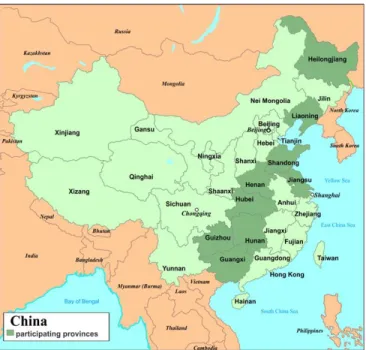
within 216 sampling units across 9 eastern China provinces every 2-4 years between 1989 and
2011. A map of the participating Chinese provinces can be observed below in Figure 1.
Figure 1: CHNS Participating Provinces
Map of provinces participating in the CHNS study, 1989-2011 (CPC)
The CHNS provides individual, household, and community-level information about
demographics (e.g. income, population) and infrastructure (e.g. fast food chains’ market
presence) relating to health and nutrition. The CHNS variables relevant to this research are
aggregated at the community level for 2004, 2006, 2009, and 2011. Listed below in Table 1A
and Table 1B are baseline summary statistics for the relevant variables sorted by year. A more
detailed overall summary of these variables can be observed in Table 2 (Section IX).
Table 1A
Description of Market-Structure Variables by Year
2004 2006 2009 2011
Variable Name Mean Std Dev Mean Std Dev Mean Std Dev Mean Std Dev
Mean Wages (log) 8.687 (0.628) 9.007 (0.587) 9.608 (0.475) 9.898 (0.528)
N of Fast Food Restaurants 0.453 (1.875) 0.519 (2.632) 0.258 (1.543) 0.756 (5.576)
Province 37.333 (9.695) 37.284 (9.721) 37.359 (9.680) 36.045 (12.508)
Urban (binary) 0.333 (0.472) 0.335 (0.473) 0.332 (0.472) 0.397 (0.490)
City Population Over 1 Million (binary) 0.418 (0.494) 0.445 (0.498) 0.470 (0.500) 0.465 (0.500)
City Population Density 1849.235 (8486.994) 972.922 (4639.924) 1835.255 (5121.620) 4779.672 (12769.490)
City Exist McDonald's (binary) 0.097 (0.297) 0.128 (0.335) 0.175 (0.381) 0.233 (0.424)
City Exist KFC (binary) 0.120 (0.326) 0.183 (0.388) 0.230 (0.422) 0.328 (0.470)
City Exist Pizza Hut (binary) 0.042 (0.200) 0.064 (0.246) 0.074 (0.262) 0.164 (0.371)
City Exist Other Chinese (binary) 0.056 (0.230) 0.041 (0.199) 0.143 (0.351) 0.178 (0.383)
Table 1B
Description of Market-Entry Variables by Year
2004 2006 2009 2011
Variable Name Mean Std Dev Mean Std Dev Mean Std Dev Mean Std Dev
City Entry Any (binary) 0.000 (0.000) 0.166 (0.373) 0.213 (0.411) 0.156 (0.364)
City Entry KFC (binary) 0.000 (0.000) 0.073 (0.261) 0.067 (0.251) 0.049 (0.217)
City Entry McDonald's (binary) 0.000 (0.000) 0.040 (0.197) 0.058 (0.234) 0.022 (0.148)
City Entry Other Chinese (binary) 0.000 (0.000) 0.061 (0.239) 0.126 (0.333) 0.067 (0.250)
City Entry Pizza Hut (binary) 0.000 (0.000) 0.024 (0.153) 0.015 (0.121) 0.024 (0.155)
City Entry YUM (binary) 0.000 (0.000) 0.127 (0.334) 0.121 (0.327) 0.094 (0.292)
Number of Observations 1166 1216 1152 1319
Note: There are no initial firm entry observations for 2004 because it cannot be assumed that restaurants which existed in 2004 entered in that year. The discrete time hazard model requires such left-censored observations to be eliminated from analysis.
The strengths of the CHNS data include its reliability and consistent methodology. There
are many pertinent market-structure variables that exist in the dataset, making the CHNS so
comprehensive that no other data sources were needed for the key variables of interest. The
CHNS data provides the most recent time frame for analysis of any previous similar research.
Moreover, the data includes unprecedented data on Pizza Hut and Chinese fast food firms.
Setting aside these prevailing strengths, the drawbacks of the CHNS are its limited
geographic scope (only select communities in Eastern China) and non-comprehensive tallying of
firm entry. Rather than quantifying aggregate firm entry and store count within sampled markets,
the survey only indicates whether a given fast food company operates within a given market.
Also, there were not sufficient Pizza Hut market entries to allow for its rigorous analysis.
Accounting for the particular strengths and weaknesses of the CHNS data, the key
independent variable is initial market entry for McDonald’s, KFC, and other Chinese firms
(which differs from the ideal theoretical independent variable: initial and subsequentmarket
entries by firm). These independent variables were constructed from the dataset by creating a
firm entry variable based on whether a firm existed in a given community from one surveyed
year to another. Although it would have been ideal to use annual entry data instead of biennial,
Shen and Xiao’s similar research found no difference in annual or biennial results (2013).
When utilizing the independent entry variables for these three firm-specific time hazard
analyses, the estimation samples for each firm’s empirical entry model were selected based on
observations that were not left-censored and that contained all relevant dependent variables. The
resulting three estimation samples’ summary statistics can be seen in Figure X (Section IX).
The independent variable of initial market entry for each firm (McDonald’s, KFC, Pizza
Hut, and local Chinese fast food firms) can be observed below by time period in Table 2. These
firms’ initial market entry across various market types (high-population and urban), in addition
to firm entry across time period, can be observed graphically in Figures 2-5 (Section IX).
VII. Results and Findings
Using a single-spell discrete time hazard analysis to determine factors influencing initial
market entry decisions for McDonald’s, KFC, Pizza Hut, and other Chinese fast food firms in
Eastern China during 2004-2011, several interesting conclusions can be drawn, both aligning
with and departing from previous empirical and theoretical research on firm market entry. All
three time-hazard analyses described in this section can be observed in Table 5 (Section IX).
Before interpreting the significant results of each analysis, it is worth noting that the
variance of the time-invariant community error is only significantly different from zero for the
Chinese local fast food firms. Thus neither KFC nor McDonald’s are influenced by fixed
unobservables (to the econometrician) of communities, but Chinese firms are influenced by these
unobservables. This observation may result from Chinese firms’ greater attunement to
(observable and unobservable) local conditions than the globalized corporate fast food firms.
While it is hypothesized that McDonald’s would be more likely to enter markets where
KFC already existed (since McDonald’s is the latecomer to China where KFC dominates), this
could not be proven at a p-value of 0.10, despite previous research’s success doing so (Shen and
Xiao 2013). There is at least one compelling reason why this may be so: this research’s recent
dataset (2006-2011) could examine a time period when McDonald’s had matured from
competitive infancy in China and thus entered markets with more autonomy (and less need to
imitate KFC) than its earlier years. Another reason is that the analysis cannot control for the
endogeneity of McDonald’s decision, which may be correlated with unobservable community
characteristics. The results did indicate with significance that McDonald’s is strongly positively
influenced to initially enter a Chinese market if it is urban, and to a much lesser degree is also
positively influenced by the quantity of fast food restaurants that are already operating in the
market.
When analyzing the factors that influence KFC to initially enter a given Chinese market,
the theoretical model would imply KFC to be more driven by demographic data and experience
than the other firms (since as a “leader” firm, KFC would seek out and enter markets before
“follower” firms). This hypothesis proved true, and the factors that most positively influence
KFC’s market entry are mean market wages and whether the market supports a population over 1
million. These results can be explained by the fact that unlike McDonald’s, KFC has already
exhausted growth in urban markets and thus is driven to find up-and-coming high-population
(but not yet necessarily urbanized or highly developed) markets to enter before its rivals.
When performing an identical time-hazard analysis for Chinese fast food firms’ initial
market entry, these resource-starved firms were expected by theory to “follow” or imitate their
larger Western rivals’ market locations. This hypothesis proved correct, as local Chinese fast
food firms’ initial market entry decisions were highly positively influenced by the existing
market presence of a KFC. More so than the KFC factor, these firms were also inclined to enter
markets with high mean wages. These results can be explained by local Chinese firms’ lack of
experience in profitable market entry combined with their low budgets, thus incentivizing them
to “piggyback” off KFC’s market entry success. As for the tendency of Chinese firms to enter
higher-income markets, perhaps this is because their prices are higher than those of their Western
rivals. Another explanation: demand for local food could be an emerging upper-class trend.
While there were insufficient observations of Pizza Hut market entries and existence
between 2004 and 2011 to perform a discrete time-hazard analysis, it can be observed that 100%
of Pizza Hut entries occurred in markets where KFCs existed, as well as in exclusively urban
markets (Table 3). Theory supports this finding, given that KFC and Pizza Hut are owned by the
same parent company Yum! Brands, and Pizza Hut entered China later than KFC. It’s quite
plausible that KFC shares its market profitability research with Pizza Hut to act on its findings.
Moreover, Pizza Hut may mitigate expansion risk as a “follower” firm by entering only markets
where customers have developed a taste for Western fast food (AKA urban markets with KFCs).
VIII. Conclusion
This research examines factors influencing initial market entry in Eastern China for
Western and local Chinese fast food firms between 2004 and 2011. The results bolster the case
for firm-learning theory by demonstrating that local Chinese fast food firms are imitating KFC’s
market existence when entering new markets. The research results also indicate that McDonald’s
and KFC are driven by distinct factors (urbanization and high-population, respectively) when
determining markets to enter. This leads to the interesting conclusion that McDonald’s may have
matured in its China operations to the point where it no longer emulates KFC’s entry decisions.
Future research that builds upon these findings could employ a comprehensive dataset
(spanning KFC’s initial 1987 China entry to the present) and thus observe whether McDonald’s,
Yum! Brands’, and local Chinese firms’ entry strategies changed over time as market dynamics
shifted. A more comprehensive dataset would also allow a proper time-hazard analysis of
whether and to what degree Pizza Hut emulates KFC’s market entry decisions, which would be
compelling, as both firms operate under Yum! Brands and thus may share information, but still
must compete against or assist one another to grow profits within the same Chinese markets.
Finally, a natural extension of this research would be to examine the same firms’ market
entry in China across the broader time period mentioned, but also examine repeat market entries
as Toivanen and Waterson (2005) did. Doing so would reveal to what degree these firms are
likely to re-enter markets where they already operate versus entering untapped markets, where
potentially higher profit potential exists—but so does risk of costly profitability miscalculations.
IX. Tables and Figures
Table 2A
Description of Market-Structure Variables
Variable Name Mean Std Dev Min Max Obs
Community ID 370879.300 (106419.700) 111101 552304 946
Survey Year 2007.766 (2.753) 2004 2011 946
Year ID 2.613 (1.145) 1 4 938
Mean Wages (log) 9.348 (0.737) 6.534 11.293 942
N of Fast Food Restaurants 0.517 (3.544) 0 90 930
Province 36.934 (10.637) 11 55 938
Urban (binary) 0.353 (0.478) 0 1 938
City Population 1 Million+ (binary) 0.451 (0.498) 0 1 923
City Population Density 2548.763 (8928.925) 8.547 158446.1 911
City Exist McDonald's (binary) 0.164 (0.371) 0 1 938
City Exist KFC (binary) 0.224 (0.417) 0 1 938
City Exist Pizza Hut (binary) 0.092 (0.289) 0 1 938
City Exist Other Chinese (binary) 0.110 (0.313) 0 1 938
Table 2B
Description of Market-Entry Variables
Variable Name Mean Std Dev Min Max Obs
City Entry Any (binary) 0.135 (0.342) 0 1 754
City Entry KFC (binary) 0.047 (0.212) 0 1 764
City Entry McDonald's (binary) 0.030 (0.170) 0 1 808
City Entry Other Chinese (binary) 0.064 (0.244) 0 1 864
City Entry Pizza Hut (binary) 0.016 (0.126) 0 1 866
City Entry YUM (binary) 0.087 (0.281) 0 1 797
Table 3
Summary Statistics for Firm Entry by Key Variables
McDonald's Entry KFC Entry Pizza Hut Entry Other Chinese Firm Entry Key Variables Mean Std Dev Mean Std Dev Mean Std Dev Mean Std Dev
Time Period
2004 0.000 (0.000) 0.000 (0.000) 0.000 (0.000) 0.000 (0.000)
2006 0.040 (0.197) 0.073 (0.261) 0.024 (0.153) 0.061 (0.239)
2009 0.058 (0.234) 0.067 (0.251) 0.015 (0.121) 0.126 (0.333)
2011 0.022 (0.148) 0.049 (0.217) 0.024 (0.155) 0.067 (0.250)
Urban vs. Rural
Urban 0.062 (0.241) 0.079 (0.271) 0.052 (0.223) 0.068 (0.251)
Rural 0.017 (0.130) 0.036 (0.185) 0.000 (0.000) 0.062 (0.241)
High vs. Low-Population
> 1 Million 0.042 (0.201) 0.081 (0.273) 0.036 (0.186) 0.066 (0.249)
≤ 1 Million 0.022 (0.146) 0.026 (0.160) 0.002 (0.045) 0.061 (0.240)
Table 4
Estimation Sample Statistics
Variables (N = 8,956) S = 0
McDonald's Entry (N = 3,745)
KFC Entry (N = 3,549)
Other Chinese Firm Entry (N = 4,544)
Mean Wages (log) 9.348 9.045 9.015 9.057
(0.737) (0.678) (0.672) (0.667)
N of Fast Food Restaurants 0.517 0.366 0.377 0.400
(3.544) (2.121) (2.176) (2.168)
Urban (binary) 0.353 0.265 0.252 0.320
(0.478) (0.442) (0.435) (0.467)
City Population 1 Million+ (binary) 0.451 0.404 0.371 0.428
(0.498) (0.491) (0.483) (0.495)
City Population Density 2548.763 1339.276 1319.951 1423.475
(8928.925) (5955.118) (6090.265) (5876.312)
City Exist McDonald's (binary) 0.164 … 0.020 0.102
(0.371) … (0.139) (0.303)
City Exist KFC (binary) 0.224 0.071 … 0.141
(0.417) (0.257) … (0.348)
City Entry McDonald's (binary) 0.030 0.041 … …
(0.170) (0.199) … …
City Entry KFC (binary) 0.047 … 0.067 …
(0.212) … (0.250) …
City Entry Other Chinese (binary) 0.064 … … 0.093
(0.244) … … (0.291)
Notes: Descriptive statistics for the baseline estimation samples for McDonald's, KFC, and other Chinese firms' respective discrete time hazard entry analyses. Standard deviations are in parentheses.
Table 5
Discrete Time Hazard Analysis of Fast Food Firm Initial City Market Entry
Variables McDonald's
Entry KFC Entry
Other Chinese Firm Entry
City Population Density (lag) 0.000 0.000 -0.000*
(0.000) (0.000) (0.000)
Urban (binary) (lag) 1.779* 0.263 -1.074
(0.924) (0.643) (1.022)
City Population 1 Million+ (binary) (lag) -0.972 1.799** -0.018
(0.755) (0.757) (0.843)
Mean Wages (log) (lag) 1.235 1.933*** 3.208***
(0.754) -0.746 (0.928)
N of Fast Food Restaurants (lag) 0.185** 0.135* 0.158
(0.086) (0.078) (0.119)
City Exist KFC (binary) (lag) 1.246 … 2.776**
(0.951) … (1.259)
City Exist McDonald's (binary) (lag) … 1.474 -0.187
… (1.463) (1.360)
Constant -16.402** -22.740*** -35.512***
(8.209) (7.933) (9.048)
1.219 (1.476) 1.307 (1.113) 3.113 (0.341)
Observations 535 507 568
Number of Communities 199 193 216
Notes: *** Significant at 1%. ** Significant at 5%. * Significant at 10%. Table shows results for single-spell discrete time hazard analysis of initial market entry for McDonald's, KFC, and Chinese firms as a function of market structure. Robust standard errors are in parentheses. The standard error 𝜇𝜇𝑖𝑖 is assumed to have a mean zero and variance 𝜎𝜎𝜇𝜇2.
𝜎𝜎𝜇𝜇2
Figure 2
Number of Initial Market Entries by Firm (Time Period)
0
10
20
30
40
50
N
um
b
er
of
I
ni
ti
al
M
a
rk
et
E
n
tr
ies
2004 2006 2009 2011
Note: Displays number of city markets initially entered by each firm in a given time period.
Eastern China (2004-2011)
Number of Initial Market Entries by Firm
McDonald's KFC
Pizza Hut Other Chinese Firm
Figure 3
Number of Initial Market Entries by Firm (Urban vs. Rural)
0 10 20 30 40 50 N um b er of I ni ti al M a rk et E n tr ies
2004 2006 2009 2011
Note: Displays number of city markets initially entered by each firm in a given time period.
Eastern China (2004-2011)
Number of Initial Market Entries by Firm
McDonald's KFC
Pizza Hut Other Chinese Firm
0 20 40 60 80 N um b er of I ni ti al M a rk et E n tr ies Rural Urban
Note: Displays number of urban versus rural city markets initially entered by each firm.
Eastern China (2004-2011)
Number of Initial Market Entries by Firm
McDonald's KFC
Pizza Hut Other Chinese Firm
Figure 4
Number of Initial Market Entries by Firm (High vs. Low-Population)
0 10 20 30 40 50 N um b er of I ni ti al M a rk et E n tr ies
2004 2006 2009 2011
Note: Displays number of city markets initially entered by each firm in a given time period.
Eastern China (2004-2011)
Number of Initial Market Entries by Firm
McDonald's KFC
Pizza Hut Other Chinese Firm
0 20 40 60 80 N um b er of I ni ti al M a rk et E n tr ies Rural Urban
Note: Displays number of urban versus rural city markets initially entered by each firm.
Eastern China (2004-2011)
Number of Initial Market Entries by Firm
McDonald's KFC
Pizza Hut Other Chinese Firm
0 20 40 60 N um b er of I ni ti al M a rk et E n tr ies
Under 1M Over 1M
Note: Displays number of high vs. low-population city markets initially entered by each firm.
Eastern China (2004-2011)
Number of Initial Market Entries by Firm
McDonald's KFC
Pizza Hut Other Chinese Firm
Appendix
Table A1
Description of Variables
Independent Variables Short name Variable name Long definition
Community ID Community
identifier
Identifies the 190 unique communities surveyed
Survey Year Survey year Identifies year of survey (2004, 2006, 2009, 2011)
Year ID Survey year
identifier
Assigns number ID (1-4) to each of the survey years
Province Province identifier Identifies city province
Mean Wages (log)
Log of mean wages Quantifies log of mean wages for a given community (wages measured in RMB)
Urban (binary) =1 if city is urban Identifies whether a city is classified as urban or rural by the Chinese government
City Population 1 Million+ (binary)
=1 if city population is over 1 million
Identifies whether a city has a population over 1 million
City Population Density
City population density
Quantifies a city's population density by dividing the city's population by area (sq km)
N of Fast Food Restaurants
Number of fast food restaurants
Quantifies total number of fast food restaurants operating in a given city
City Exist McDonald's (binary)
=1 if McDonald's exists in city
Identifies whether at least one McDonald's restaurant exists in a given city
City Exist KFC (binary)
=1 if KFC exists in city
Identifies whether at least one KFC restaurant exists in a given city
City Exist Pizza Hut (binary)
=1 if Pizza Hut exists in city
Identifies whether at least one Pizza Hut restaurant exists in a given city
City Exist Other Chinese (binary)
=1 if Other Chinese Firm exists in city
Identifies whether at least one other Chinese fast food firm exists in a given city
Table A1
Description of Variables (continued)
Dependent Variables Short name Variable name Long definition
City Entry Any (binary)
=1 if any fast food firm initially enters into city
Identifies whether any fast food firm enters a city market for the first time
City Entry KFC (binary)
=1 if KFC initially enters into city
Identifies whether KFC enters a city market for the first time
City Entry McDonald's (binary)
=1 if McDonald's initially enters into city
Identifies whether McDonald's enters a city market for the first time
City Entry Other Chinese (binary)
=1 if Other Chinese Firm initially enters into city
Identifies whether other Chinese fast food firms enter a city market for the first time
City Entry Pizza Hut (binary)
=1 if Pizza Hut initially enters into city
Identifies whether Pizza Hut enters a city market for the first time
City Entry YUM (binary)
=1 if YUM! Brands initially enters into city
Identifies whether YUM! Brands enters a city market for the first time
Notes: All city entry variables are constructed for proper use in a single-spell discrete time hazard analysis. This means that once a firm enters a given market (for a value of 1), the values for that firm's city entry variable in each subsequent year are labeled missing. All data from the China Health and Nutrition Survey (2004-2011).
Bibliography
Abkowitz, Alyssa and Burkitt, Laurie. “In China, Local Dining Chains Bite Into West.” The
Wall Street Journal. December 14, 2014.
Baum, J.A.E., Li, S.X., and Usher, J.M. "Making the Next Move: How Experimental and
Vicarious Learning Shape the Locations of Chains' Acquisitions." Administrative
Science Quarterly. Vol. 45 (2000). pp. 766-801.
Berry, Steven and Peter Reiss. “Empirical Models of Entry and Market Structure.” Handbook
of Industrial Organization, Volume 3. Science Direct, 2014.
http://web.stanford.edu/~preiss/hand-entry.pdf.
Berry, S.T. "Estimation of a Model of Entry in the Airline Industry." Econometrica, Vol. 60
(1992), pp. 889-917.
Bresnahan, TF and Reiss, PE. "Entry and Competition in Concentrated Markets." Journal of
Political Economy, Vol. 99 (1991), pp. 977-1009.
Caplin, A. and Leahy, J. "Miracle on Sixth Avenue: Information Externalities and Search."
Economic Journal, Vol. 108 (199R), pp. 60-74.
Chevalier, J. "Capital Structure and Product Market Competition: Empirical Evidence from
the Supermarket Industry." American Economic Review, Vol. 85 (1995), pp. 415-435.
“China Health and Nutrition Survey.” UNC Carolina Population Center.
http://www.cpc.unc.edu/projects/china. Accessed October 15, 2014.
Dixit. A. "A Model of Duopoly Suggesting a Theory of Entry Barriers." Bell Journal of
Economics, Vol. 10 (1979), pp. 20-32.
ICMR. “McDonald’s in China.” IBS Center for Management Research. Accessed November 14,
2014.
http://www.icmrindia.org/casestudies/catalogue/Business%20Strategy/McDonald%20in.
Kroc, Ray. Grinding it out: the making of McDonald’s. California: Berkeley Publishing Corp.,
1978.
Levin, Jonathan. “Entry and Market Structure.” Stanford University, 2009.
http://web.stanford.edu/~jdlevin/Econ%20257/Entry%20and%20Market%20Structure.pd
f.
Scott Morton, F. "Entry Decisions in the Generic Pharmaceutical Industry." RAND Journal of
Economics, Vol. 30 (1999), pp. 421-440.
Shaked, A. and Sutton, J. "Multiproduct Firms and Market Structure." RAND Journal of
Economics, Vol. 21 (1990), pp. 45-62.
Shen, Qiaowei and Ping Xiao. “McDonald’s and KFC in China: Competitors or Companions?”.
Marketing Science, INFORMS, Articles in Advance (2013), pp. 1-21.
Toivanen, Otto and Michael Waterson. “Market Structure and Entry: Where’s the Beef?”
RAND Journal of Economics. The RAND Corporation, vol.36, 680-699, Autumn 2005.
“YUM! Restaurants China.” Yum! Brands. Accessed August 8, 2014.
http://www.yum.com/brands/china.asp.