the rates of follow-up after abnormal breast cancer screening
mammography using the Carolina Mammography Registry.
Master Thesis: Jacqueline Halladay, M.D. MPH candidate: Health Care and Prevention
An extensive background and methods for a study to determine
the rates of follow-up after abnormal breast cancer screening
mammography using the Carolina Mammography Registry.
Master Thesis: Jacqueline Halladay, M.D. MPH candidate: Health Care and Prevention
July2006
r--Abstract:
Objective: To review the literature on rates follow-up after abnormal medical tests with a particular focus on follow-up after abnormal mammograms and also propose a study using the Carolina Mammography Registry which will 1) determine if the CMR data can be used for this purpose, 2) establish rates of incomplete follow-up after abnormal mammograms in the patients in the CMR data base, 3) compare rates of incomplete follow-up among participating CMR mammography centers, and 4) identify patient and radiological demographics associated with lower rates of follow-up after an abnormal screening mammogram.
Data Sources: Most of the articles in the review portion of the paper were found via Pub-Med searches and reports published by the Institute of Pub-Medicine.
Design: The proposed study is a descriptive study using patients in the CMR who had an abnormal mammogram requiring follow-up between 1998 and 2003. The number of women without follow-up divided by the total number who had abnormal mammograms requiring follow-up will define the rate of incomplete followed-up.
Setting: The CMR is a member of the National Cancer Institutes Breast Cancer Surveillance Consortium. The CMR sites include mainly community based mammography facilities representing hospital-based, private radiology and multi-specialty facilities in 39 counties in North Carolina. As of 2004, data on over 1,450,000 records on more that 460,000 NC women are included in the database.
Patients: The study will include all women in the CMR aged 40 years old and older without personal histories of breast cancer who had abnormal screening mammograms by Breast Imaging and Reporting Data System (BI-RADS®) assessment in between January 1998 and December 2003. Those who received follow-up within three months and those who did not receive follow-up within three months will be compared. Demographic data to be extracted include: race, age, education level, family history of a first-degree relative with breast cancer, personal history of breast procedures, time interval since the last mammogram, BIRADS assessment code, recommended follow- up procedure, and radiology facility. Follow-up interval will be established by assessing the number of days in between the mammogram reading and first date pertaining to follow-up information. The follow-up date will be abstracted from pathology specimen laboratory information, date of return to a follow-up facility as ascertained by the mammography sites, the Lineberger Comprehensive Cancer Center's Rapid Case Ascertainment system, the North Carolina Cancer Registry or from other patient information supplied to a CMR site.
Main outcome measure: Overall rates of abnormal screening mammograms that are not resolved within 3 months after the index abnormal MMG. This will be established for the CMR in the 1998-2003 interval and for individual radiology practices.
Results: Rates of follow-up for the CMR will be calculated as well as rates of each particular mammography site. Bivariate analysis will be used to examine the relationship between lack of follow-up and patient and radiographic characteristics. Multivariate logistic regression will be performed to find the set of risk factors that best predict the probability of not returning for follow-up. Associations between demographic characteristics and the probability of not following up will be presented as adjusted odds ratios with 95% confidence intervals.
"Serious and widespread quality problems exist throughout American medicine. These problems occur in small and large communities alike, in all parts of the country, and with approximately equal frequency in managed care and fee for service systems of care. Very large numbers of Americans are harmed as a result': 1
IOM National Roundtable on Health Care Quality. JAMA 1998.
Introduction:
The Institute of Medicine (IOM) 1 has published reports outlining the quality problems in the US healthcare system. One of the problems is the inadequacy of systems to secure appropriate follow-up for abnormal medical tests. Such quality issues have captured the attention of the public, press, politicians and others charged with improving the status quo. This paper discusses the broader quality problems with medical testing, follow-up, and specifically describes the extent of this problem with breast cancer screening mammography. Selected reports by the 10M are reviewed for background into the follow-up problem while other publications are reviewed that provide information on what patient populations, medical care settings and study designs comprise some of the literature on this subject. Published recommendations to improve the quality of follow-up include implementing tracking and/or reminder systems. thus background information on aspects of these systems are also reviewed. Finally to add to the literature and provide information relevant to
1
The !OM was chartered in 1970 to serve as adviser to the nation to improve health. It provides a service by working outside the framework of government to ensure scientifically informed analysis and independent guidance. The Institnte provides information and advice concerning
health and science policy to policy-makers, professionals, leaders in every sector of society, and
patients involved in a large mammography data registry in North Carolina, we propose to evaluate the Carolina Mammography Registry (CMR) for its ability to generate overall abnormal follow-up rates for its total population and to generate follow-up rates for its participating mammography sites. The CMR is potentially a model intervention to lower rates of abnormal flu as it has the capability to generate automated reminders to patients and health care providers and can be used by the CMR staff and participating radiology sites to electronically track patients with unresolved breast imaging abnormalities. The short-term intent of this project is to reveal aspects of the CMR that may need improvements and provide feedback to the individual participating sites on their rates of follow-up. However, if it we find that the CMR system works well in supporting appropriate follow-up, details of the CMR can be shared with others involved in quality improvement efforts. The ultimate intent is to improve the quality of follow-up of all abnormal medical testing for broader populations.
Background
10M Reports
The 10M convened the National Roundtable on Health Care Quality in
even causing preventable complications. '· 2 Evidence from the literature
indicates serious problems in all three categories 1.2_ Inappropriate follow-up, the focus of this paper, falls under the "misuse" category. The 10M address this quality problem and provides strategies to reduce errors specific to misuse in several of their publications discussed below. 24
In a 1999 10M report, To Err Is Human: Building a Safer Health System, the strategies by which health care providers, government, industry and consumers can reduce preventable medical errors are provided. One of the reports' main conclusions is that individuals rarely cause errors in medicine. They are more often caused by faulty systems, processes and conditions that lead people to make mistakes or fail to prevent them4. One of the authors of this
committee's subsequent work, Crossing the Quality Chasm, gives human memory as an example of a pervasive and systematic safety problem that can influence the quality of follow-up in our health care system.
"Suppose
a
patient gets hurt whena
piece of information gets lost. If itturns out that the work design requires that someone, doctor or anyone else human, prevent that injury by remembering information, then we are relying on memory for safety. That is an element of design. But we know from decades of research in human factors, human cognition, and human memory, that memory
is
a
terribly unreliable function .... If the heath care process relies on memory tofunction well, it will fail sometimes, no matter how hard the people in that system
try to not forget. 2
The 10M's National Cancer Policy Board 2 specifically deals with this quality issue in relation to cancer screening in their report Fulfilling the Potential of Cancer Prevention and Early Detection5.They outline the necessary operational items needed in the provider's office setting to ensure appropriate screening procedures. Among these are time, skills, personnel, equipment, adequate reimbursement, and information systems. They encourage the use of efficient systems that recognize patients in need of screening, enhance referral communication networks, and track patients and medical data to ensure the receipt, interpretation, reporting and appropriate follow-up of test results.
" Tracking systems are necessary to indicate when results of screening tests have not been returned and to ensure the prompt and appropriate action is taken for patients with abnormal results" 5
Of note, the National Cancer Policy Boards does not recommend trying to make changes at the individual patient level, but to make improvements at organizational levels such as the physician practice level, in order to see the greatest gains in follow-up quality. This strategy is based upon a RAND corporation review of 187 studies that evaluated various interventions used to increase the rates of colorectal, breast and cervical cancer screening services-"
Literature Review:
Most of the articles in the literature pertaining to the quality of follow-up after abnormal screening tests describe rates of follow-up in their respective settings and, like those of the IOM above, stress the need for tracking systems to improve care quality. As most are small studies on specific population groups, a
2
large review article is presented first to demonstrate published ranges of follow-up rates after cancer screening. This comprehensive review also details many of the demographic variables addressed in published studies that have been evaluated for associations with follow-up rates. A few small studies are presented that reflect much of what is the available in the literature specific to breast cancer screening follow-up. The most recent and largest population study to date is then reviewed. Finally articles that address reminder systems, purported to be an important part of the solution to inadequate follow-up rates, are reviewed for content and information on how they may influence physician behavior and patient outcomes.
Review Article
The largest review that describes the percentages of people who do not get follow-up after abnormal cancer screening tests was done by Yabroff et al. in 2003. These authors warn that despite increased rates of cancer screening, many people are still facing late-stage diagnoses, and suggest that the cause of this lies in a systematic problem between screening procedures and appropriate follow-up.7
. The authors use the term "diagnostic resolution" to describe the
These authors detailed many demographic and health care system variables that are often, but not consistently, associated with higher or lower rates of follow-up. In their review, white race was usually associated with better follow-up rates than those of African-Americans, Native Americans, Asians, and Hispanics. However, the authors warn that other factors such as health insurance status and economic level may complicate the true effect of race/ethnicity.7). The variables
Individual Articles
index mammogram, income, or education levels. They felt that for incompletely understood reasons, their system was less successful in helping patients get appropriate follow-up compared to other health care settings. Based on their observations, the authors challenged all HMO's to develop monitoring systems to assess the timely occurrence of follow-up and design programs to investigate barriers to follow-up.
Kerner et al. performed a descriptive study that identified and interviewed 184 both symptomatic and asymptomatic black, non-Hispanic women from Harlem and Queens, NY who had abnormalities on either clinical breast exam or mammogram. The author's main outcome measure was to establish their system's follow-up rates. The participating clinics included 2 sites in the Harlem community (one free standing mammography center, the Breast Examination Center of Harlem), and one public hospital (Harlem Hospital's Cancer Control Center of Harlem). The other site was a non-profit hospital in Queens, NY(Catholic Medical Center). All settings cared for medically underserved populations. The system's method for contacting patients with abnormal mammogram results included using follow-up letters and phone calls. Women are then seen for follow-up appointments 1 to 3 weeks after receiving their results. The study's authors identified variables associated with appropriate follow-up in their population. In this paper the mammographic abnormality studied was more serious than in other publications 9• Initially women were
out of 184 (39%) of the sample lacked diagnostic resolution within this interval and 27.7% remained unresolved at the end of the study (180 days). Variables associated with better follow-up rates included having a more serious abnormality on BI-RADS® reading (0,4,5)3
, patient's ability to recall receipt of
results or recall being told what was to happen next after the abnormality was discussed and patient recollection of asking questions during the index mammogram. Factors associated with lower rates of follow-up included a history of having a previous breast biopsy or breast abnormality and higher cancer anxiety scores. Multiple other variables assessed did not have statistically significant associations with follow-up rates. Some in particular were education level, family history of breast cancer, presence of health insurance, socio-economic-status (SES), and method of results notification. Of note, these authors felt that the lack of SES influence in their particular study was due to a patient navigation system that started just prior to patient accrual, which may have negated an influence they originally expected to find. These authors suggest that certain communication factors at the time of a mammogram, which encourage patients to ask questions and improve the chance that a woman may recall the recommendations, may be an important area of focus to improve rates of diagnostic resolution.
In a descriptive intervention trial by Robertson et al. the authors not only attempted to describe the rates of follow-up in patients with abnormal mammograms, but simultaneously started a new intervention which increased
3
follow-up and stated the importance of a reminder system to support a successful breast cancer screening program.
One of the limitations in many of the studies on this subject is the inability to generalize results or recommendations to larger or other populations. In an attempt to disentangle the effects of race, socioeconomic status, health beliefs, behaviors, and health care access factors on follow-up of abnormal mammograms, Yabroff et al. used a sample of 1,901 women from the 2000 National Heath Interview Survey (NHIS)4 to identify characteristics associated
with completion of follow-up after a reportedly abnormal test.11
• All women in the
sample were 30 years of age or older and were asked if they ever had an abnormal mammogram. They were then asked to list all additional test or procedures they received after the abnormal exam which were then coded into the following categories: additional imaging; clinical examination or surgical consult; biopsy or fine needle aspiration; breast or lump removed; or no follow-up. Eighty-eight percent of the sample was white, 52.5% had at least some college education, 97.8% had a usual source of medical care and only 5.5% stated having no health insurance coverage. In this group 8.6% (95% Cl 7.2-10.0%) of the respondents reported having no follow-up after having an abnormal mammogram. Although this rate is lower than most of the other published studies, it translates into approximately 1 million US women who had abnormal mammograms and did not receive follow-up. Patient demographic variables in their multivariate analysis associated with better follow-up included higher socioeconomic levels in a "dose-response pattern" (measured by education level
4 NHIS; annual multistage household survey conducted in-person using self report. Information on
or income}, better health status levels, greater cancer risk profiles, and the presence of private health insurance. In contrast to other studies mentioned in the review above, women younger than 50 were less likely to complete follow-up compared to those ;:, 65. In the bivariate analysis Black, non-Hispanic, and
Hispanic women were less likely to report follow-up than whites. However, in an "intermediate multivariate model" (mentioned but not detailed in the paper}, the association was no longer statistically significant once other demographic characteristics were included.
This particular paper's authors called for future research into breast cancer screening processes. The authors specifically mention mammography registries such as those in the Breast Cancer Surveillance Consortium (BCSC} as potential data registries for researchers to study screening processes and to evaluate how the screening process relates to patient behaviors and stages of disease at diagnosis. The CMR, described below, is largest of the databases in the BCSC thus is may serve as a good source for data on follow-up quality issues in breast cancer screening. (See "proposed study"}
test results available electronically to all stake holders for enhanced coordination of care, 2) offering computerized decision support to supply up-to-date guidelines and reminders for screening tests and other preventive measures, 3) having electronic communication and connectivity available to facilitate communication between patient, physicians, and other health care partners, 4) providing patient support/education, and 5) having reporting capabilities to assist in population health management. 12• The true effectiveness of such systems is presently
speculative. However, there are data supporting improved practice performance with certain aspects of existing electronic systems. For example, Balas et al. reported a meta-analysis of randomized controlled trials reviewing the impact of prompting physicians on 16 preventive care procedures, one of which was mammography screening.13. Although the studies varied widely in design and type of reminder prompt used (e.g. electronic or paper signals to physicians about over-due tests, deviation from standards of care, and treatment recommendations}, the overall conclusion was that appropriate medical care actions increased with the use of reminder prompts. Although none of the prompts were specific to follow-up after abnormal screening tests, the study does give credence to the potential for such systems to improve follow-up care via the presence of computerized prompts.
Kralj et al. did a similar study on oncology patients whose physicians were electronically reminded of laboratory data indicating low hemoglobin levels during chemotherapy treatments 14• They assessed the impact of an electronic
where patients with low hemoglobin levels were seen. One randomly selected community oncology practice (n=3862 patients visits) assigned to the intervention and a second practice which served as a control {n=7,782 patient visits) were compared for erythropoietin prescribing habits by their physicians. Baseline prescribing behaviors were similar for the two groups, but after implementation of the reminder system, the likelihood of an anemic patient receiving erythropoetin treatment increased significantly in the intervention arm. In fact in the non-intervention arm, prescribing rates actually decreased, despite widespread acceptance of the practice at that time. These authors felt that reminders were successful and challenged researchers to continue to test other computer-based quality interventions to provide physicians with accurate information about the effectiveness of computer aids.
Hunt et al. performed a systematic review of controlled trials performed since 1992 on computer based clinical decision support systems and their influence on physician performance and patient outcomes.15There were 19 trials that focused on preventive care systems, six targeting cancer prevention. All 6 -cancer prevention studies revealed enhanced practitioner performance with reminder systems.
prompts appeared on the physician's EMR at the time of a patient visit for a group of patients aged 70 and over. One center carried out the computer reminder pilot project (n=602). Three other similar sites were assigned to the control/usual care arm (n=1989). Five primary care preventive health tests were compared. There was a statistically significant increase in physician ordering of all 5 screening tests in the intervention arm. Based on their findings, the authors suggested that prompts do positively affect physician testing behavior16 Of note, the authors suggest that electronic reminders may be particularly effective when newer testing protocols emerge compared to older tests, thereby significantly impacting the delay that often occurs between proven and effective newer practice recommendations and actual physician practice.
Although one may assume the embracement of electronic records would systematically improve the quality of testing follow-up, a study was done in a unique practice setting in the US where the electronic record system used by primary care providers provides full access to all laboratory data performed at 2 medical centers17• Two hundred-sixty two internal medicine physicians practicing
respondents reported reviewing at least 1 test result they wished they had known about "earlier" (defined as knowing the result within the a 2 month interval prior to actually seeing the result). Eighteen-percent of these physicians reported this problem occurring 5 or more times in the same interval. Only 41% felt satisfied with the way they managed test results. Those dissatisfied were so because of lack of timely review, lack of systems to track orders, and inability to detect if a patient failed to obtain a test. The study authors also surveyed physicians for what they wanted most out of electronic systems. These included a warning system to detect whether a patient had missed a test, listing abnormal tests before normal tests, and automated letter writing. The authors emphasize that expecting physicians to be more vigilant or spend more time on processing test results is unlikely to yield significant improvements in quality as already they or their representative spend an average of 70 minutes a day managing and processing test results.5 Therefore, although some technologies are in existence, significant strides and modifications of such systems are needed to improve the quality of follow-up even in electronically sophisticated US systems.
Summary
In summary a major quality problem identified by the 10M and multiple authors is that patients who have abnormal results on medical tests often do not have appropriate follow up. These studies involve many different patient populations and health care systems and suggest that large numbers of patients are not receiving adequate care. Most call for more research into the problem using larger populations to try to unravel conflicting demographic influences that
5 Tests needing review per week averaged 800 data points from chemistry and hematology reports, 40
may be responsible for different rates of follow-up. Likewise, the authors call for improvement interventions where problems are identified. Researchers and medical organizations offer similar solutions that center around tracking and reminder systems, often those that ideally are electronic. One such system to consider is the Carolina Mammography Registry (CMR) which is an electronic mammography screening database that has patient and physician reminder capabilities. The study below proposes to evaluate if the CMR can be used to study abnormal follow-up rates and to determine how well the CMR system performs in patients with abnormal screening mammograms. If such a system is found to have better follow-up data than what is published, aspects of the CMR operations may help guide the design of other computerized medical information systems. Likewise the researchers involved in the CMR and its partners comprising the Breast Cancer Surveillance Consortium can be approached to help answer cancer screening follow-up concerns and other process questions such as those suggested in this paper's background section by Yabroff et al.11•
Proposed study
establish if there are specific areas in which we should to focus future improvements on, and 5) to evaluate patient and radiological characterictics that may influence rates of follow-up after abnormal screening mammograms.
Data Source and Population
The Carolina Mammography Registry is a member of the National Cancer Institute's Breast Cancer Surveillance Consortium (BCSC). The BCSC was established in 1994 to study the performance of mammography screening in community practice. The consortium was created in response to a legislative mandate, the Mammography Quality Standards Act (1992), which granted the authority to devise surveillance systems to provide comprehensive data on the performance of breast cancer screening. The Act also required mammography facilities to meet quality standards and receive accreditation certificates. 18
beginning of each imaging visit. This questionnare is often completed with the help of a technologist. The mammography technologist and radiologist record the reason for the patient visit, the imaging provided, breast density and assessment of the mammogram via Breast Imaging and Reporting Data System (81-RADS®) category, and recommendations for future evaluations. Final patient pathological diagnoses and causes of death are provided from pathology settings, the North Carolina Cancer Registry, the Lineberger Comprehensive Cancer Center's Rapid Case Ascertainment program (RCA) and North Carolina death records. The computer software provided to the participating mammography sites provides tracking and reminding functions that can alert the radiology group's staff members about abnormal mammograms that are unresolved. Staff members can view electronic information on outstanding patients that includes the patient name, contact information, medical record number, X-ray identification numbers, 81-RADS® assessment code, radiologist's code, follow-up recommendations, and date that the next screening exam is due.
participating facilities to help train new employees responsible for data entry and to provide on-sight problem solving.
All data entered into the CMR database undergo extensive quality control at various stages of data collection and management. All identifying information concerning patients, radiologists and mammography sites is removed before analyses are performed. Protection of identifying information is strictly adhered to as outlined by Carney.20 The Internal Review Board at UNC-Chapel Hill approves CMR annually. IRS's of participating hospitals likewise are involved in the approval process. CMR holds a Public Health Service (PHS) certificate of confidentiality.
Patient selection
We will identify women seen for screening mammograms, who have abnormal results and do not return within three months. We plan to use the CMR data base to identify all women 40 years of age and over who presented for at least one screening mammogram in between 1998 and 2003 who had no record of follow-up concerning the index abnormal mammogram in the subsequent 3 months. The patient visit will be considered a screening visit if they had a screening 2-view imaging procedure of both breasts and were asymptomatic at the time of the study. Subjects will be excluded if they have a history of breast cancer. Follow-up information will then be abstracted from the database as described below in the measures. If there was no follow-up information recorded within 3 months of the index abnormal mammogram, the database will then be searched for any subsequent visit up to 13 months from the abnormal
L
mammogram. We expect that there will be some patients who had abnormal mammograms, had follow-up at a non-participating CMR sites, and then returned to a CMR site for subsequent screening. In this case, the subsequent mammogram information will be searched for information suggesting procedures or consultations completed since the abnormal exam. These will then serve as a proxy for follow-up. Those without any subsequent visit will be considered to not have any follow-up.
Measures
If the radiologist's assessment of the screening mammogram was abnormal by BIRADS 6 category 0, 4, 5 or a 3 with a radiologist recommendation for immediate follow-up, the mammogram will be identified as an abnormal mammogram. We will define the date of follow-up via several mechanisms: date of repeat visit to a CMR facility, date of pathology specimen entered via a pathology lab, date of pathology diagnosis as ascertained by the North Carolina Central Cancer Registry or via information from the Rapid Case Ascertainment system. Lack of follow-up within thirteen months will be identified if there are no other entries in the database representing a return to a CMR facility for another mammogram or other procedure, or a reported date from surgical pathology specimens. If a patient has more than one abnormal mammogram in this interval, the first one will be used in the analysis. If there are women who had an abnormal mammogram, but then had only a screening entry within the subsequent thirteen months, the subsequent mammogram visit notation will be
queried for patient documentation of new procedures listed since their index
mammogram. Notations of procedures will then be used as a proxy for diagnostic
follow-up as measured from the above data sources. The numbers of women
with abnormal mammograms who have not followed up will be compared to the
total number of women who had abnormal mammograms in each facility. This
figure will be defined as the percentage of women without follow-up by facility. A
missing response will be coded as a negative response to questions about
personal and family history of breast cancer. A woman's history of having prior
mammograms will be based on self report if there are no mammograms in the
database assigned to her. Patients will be excluded if the BI-RADS® assessment
code is missing. There are extensive measures taken when collecting and
entering data into the CMR thus we do not expect to find many missing values in
the variables for which we are interested.
Covariates
The study will address the relationship between lack of follow-up after an
abnormal screening mammogram and various demographic and mammogram
testing variables in all women in the CMR database who meet the above criteria.
The main independent outcome variable is lack of follow-up within three months
following an abnormal mammogram. Factors to be examined for association with
the outcome include the following patient demographic variables: age
(continuous), race (Black, White, Asian, American Indian, Hispanic, other)
education level (less than 12'" grade, > or = high school), family history of breast cancer (yes,no), personal history of previous breast needle or surgical procedure
no previous). The factors pertaining to the screening facility and mammogram results include: screening assessment BIRADS® code (0,1,2,3,4,5), specific follow- up procedure recommended (imaging, aspiration/surgical consult/biopsy, or clinical exam) and mammography site. Other mammography site demographics can be evaluated in a secondary analysis. These may include number of mammograms read in one year/number of physicians reading mammograms in the facility, full service vs. screen-only practices, and in-house reading vs. sites that send out their mammograms to be read by an off-site radiologist.
Analysis
Univariate/bivariate
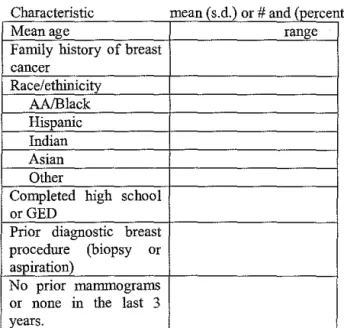
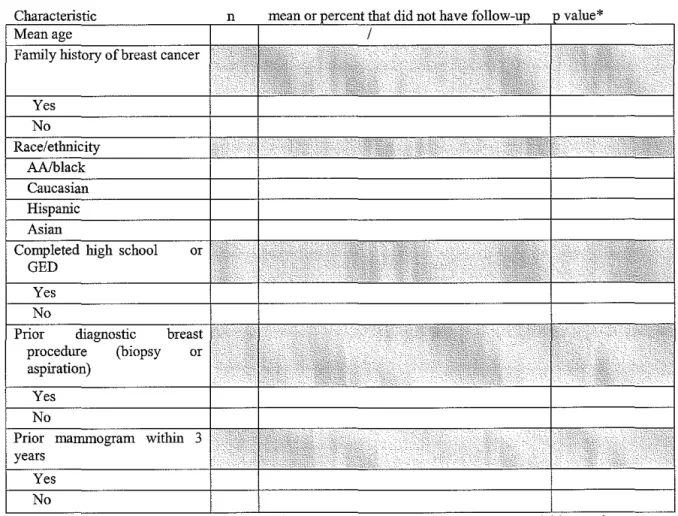
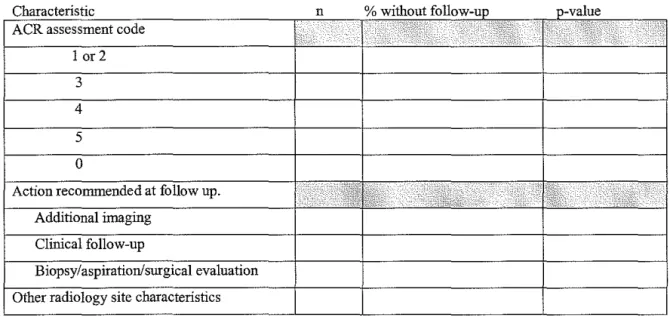
We will initially examine the characteristics of the sample with univariate analyses to assess the distribution of the variables as well as assess any impact of missing data or extreme values. The mean, range, and standard deviation will be calculated for patient age and frequencies will be generated for the categorical variables. Next, we will use bivariate analysis to examine the relationship between lack of follow-up after an abnormal mammogram and each of the independent variables. Chi square tests will be used to compare categorical data while age will be compared to the outcome via t-tests. The tables (TABLE 1-4) represent what data will be collected and compared.
Multivariate
TABLES
A. Univariate statistics
Table I. Population Characteristics
Ch aractenst1c mean ( d) s .. or an (,_percent # d( )
Mean age range
Family history of breast
cancer Race/ethinicity AA/Biack Hispanic Indian Asian Other
Completed high school orGED
Prior diagnostic breast
procedure (biopsy or aspiration)
No prior mammograms
or none in the last 3
years.
Table 2. Radiology Facility Infonnation
Ch aractenstic Nmb u er an (percent d( )
ACR assessment code
·
~,,J;;u._
.. i<i •• _ .-. lor23 4
5
0
Action reconunended at follow up.
r•
·--.·,-
..
~--...
_-...
Additional imagingClinical follow-up
B.Bivariate Statistics
Table 3. Bivariate associations between characteristics of the population and lack of follow-up
after an abnormal mammogram
n mean or that did not have
tests based on t-test continuous variables and
Table 4. Bivariate comparisons of radiology site/assessment/recommendation and follow-up after
an abnormal mammogram.*
Char ac ens c t ti n oWl OU o ow-up p-va ue
ACR assessment code
>: . ... ..,,,, . . < .. '[~\
··.··.····.·
'~i',;
I or 2
3
4
5
0
· ....
..
Action recommended at follow up.
-
''i,L~'J•·· ....
~···
....
;~'····
Additional imaging
Clinical follow-up
Biopsy/aspiration/surgical evaluation
C. Multivariate Analysis:
Table 5.
Probability of NOT receiving follow-up after an abnormal mammogram
Logistic Regression Estimates
Odds Ratio C Mean age
Family history ofbreast cancer
t· .•
~···.·<-···-.•·t·:;i~
Yes No Race/ethnicity .···-···.···-·.···· ...••.... ·.· _·. · ...··
. . • .. ·· .·· AA!black Hispanic Asianl high school orGED ••. : .•.. · ...•. -••. ·.··•· ·.·.· .... ·.. > > Yes
No
Prior breast
.,
,e···-·~··
...
m.:;l
'b1opsy orYes
No
Prior mammograms
..
·. . • .. •--
_
... , ...•... _
.;.~.·?~ YesNo
AC:Rassessmentcode
•• ••••• •••
··---·-·. • .;s .
I or 2
3
4
5
0
Actinn . at follow up.
'J~b
.. - },
...••..••...
_.·--· ····.-···_ ..Additional imaging
]inica\ .vuv ~-up
-,
Expected Findings
The rates of follow-up after abnormal mammograms have never been documented using the CMR database and its participating facilities. Any estimates of what these may be are purely speculative. Due to the support systems provided by mammography site's participation in the CMR, we may find that rates of follow-up in this system are higher than what is seen in less supported sites quoted in the background literature.
We may find some patient demographic differences in rates of follow-up as is reported in the literature 7. There may be lower rates of follow-up in patients
with lower education levels, older ages, and possibly among those of different races or ethnicities, however disparities in utilization often reflect socioeconomic influences, not actual racial differences. We may find that women with a history of mammography use or a family history of breast cancer adhere more strictly with follow-up recommendations. It is difficult to speculate how the different radiological variables may affect follow-up rates. Higher risk BI-RADS scores may be associated with higher rates of follow-up as was reported by Kerner et a!. 91t may be that those with follow-up recommendations that imply a greater
Strengths/Limitations
The main strength of this study is the large sample size that is available by using the CMR data. As well, this database involves a large population where screening is done at the community level, thus the results are potentially more generalizable than those done at large academic sites. The data is collected over many years thus may uncover important features of the process of breast cancer screening and follow-up compared to other studies that evaluated systems over smaller time intervals.
Another potential limitation is that CMR facilities in close proximity to non-participating sites may appear to have lower follow-up rates. Non-CMR affiliates may offer second opinions or diagnostic procedures in significant numbers of patients originally seen at specific CMR sites, thereby making their follow-up data appear inferior when compared to other full service facilities. Except for loss of patient follow-up information in the large academic centers, this is not likely to be a large problem.
Different radiology sites may have changed their practice patterns over the years. Some that once offered only screening mammograms have altered their practice structures to provide more comprehensive diagnostic capabilities. Therefore, the rates of documented follow-up at these sites may vary over the years. We have the capability to run yearly rates of follow-up and can assess for trends if appropriate. Patient specific factors that are not captured by the database may influence certain site's rates, potentially affecting how one site's rates compare to another with different patients. There may also be differences in medical culture among sites. Primary care or sub-specialty physicians in certain locations may take more responsibility for following and documenting patient follow-up compared to other areas where the radiology sites assume this role. As with the other factors mentioned above, such variations may affect measured follow-up rates.
The Carolina Mammography Registry rates of non-diagnostic resolution have never been evaluated in this manner. Performing this study will help us determine if this database will be able to be used via the measures proposed to establish diagnostic resolution rates for our overall system and that of our individual practices. If it is capable of generating this information, then under separate funding from the Komen Foundation, a sample of women who did not receive follow-up will be invited to participate in a short mailed survey preceded by an introductory letter from their respective radiology practices and the CMR research staff. The goal of the survey would be to identify why patients did not return for follow-up or if they did, what the follow-up process entailed. We will explore the demographic variables associated with lower follow-up rates. Such information can be used by researchers interested in screening quality to better focus efforts on at-risk populations. Researchers interested in testing alternate forms of communications with patients (eg. patient navigators, lay-health advisors, E-mail or web based systems) may also benefit from our findings. We plan to bring significant findings to our partners in the Breast Cancer Surveillance Consortium. This may encourage other investigators to apply similar methods to their databases and increase the amount of follow-up information available on other or larger populations.
rates of abnormal follow-up such as of barriers they have with using the available software. Communication breakdowns may be of particular interest. The role of the primary care physician in patient adherence to follow-up is of particular interest to one of our investigators and may be the focus of future research.
Alternatively, the findings may assist in designing higher quality tracking processes. Many of the CMR practices are currently making decisions about new electronic systems used by hospitals or other organizations with which they interface. Data from our study may assist them while weighing decisions about proposed data systems. The results from the study may also be important for the radiology groups to share with various stakeholders like director's boards, managed care groups or government agencies.
providing information used to design safer systems to address this critical quality
problem in US health care system.
REFERENCES
1. Chassin MR, Galvin RW. The urgent need to improve health care quality.
institute of medicine national roundtable on health care quality. JAMA.
1998;280: 1000-1005.
2. Berwick D. Crossing the quality chasm (2003). The Richard and Hinda
Rosenthal Lectures Spring 2001. National Academies of Sciences; 2003:1--38
Accessed may 16, 2006.
3. Committee on Quality Health Care in America, I OM. Crossing the Quality
Chasm: A New Health System for the 21st Century. Washington, DC: National
Academy Press; 2001.
4. IOM committee on quality of health care in America. To err is human: Building
a safer health care system. Washington, DC: National Academy of Sciences;
1999:1--8. Available from:
http://www.iom.edu/Object.File/Master/4/117/ToErr-8pager.pdf.
5. National Cancer Policy Board. Fulfilling the potential of cancer prevention and
early detection: Washington, DC: National Academies of Sciences; 2004:1-542.
6. Systems, Technical, and analytic Resources Group. Health care financing
administration. 2001. active projects report: Research and demonstrations in
health care financing. Wahington, DC: US Department of health and Human
Services; 2001. Available from: www.nap.edu. Accessed June 8, 2006.
7. Yabroff KR, Washington KS, Leader A, Neilson E, Mandel blatt J. Is the
promise of cancer-screening programs being compromised? quality of follow-up
care after abnormal screening results. Med Care Res Rev. 2003;60:294-331.
8. Burack RC, Simon MS, Stano M, George J, Coombs J. Follow-up among
women with an abnormal mammogram in an HMO: Is it complete, timely, and
efficient? Am J Manag Care. 2000;6:11 02-1113.
9. Kerner JF, Yedidia M, Padgett D, et al. Realizing the promise of breast cancer
screening: Clinical follow-up after abnormal screening among black women. Prev
Med. 2003;37:92-101.
10. Robertson C, Kopans D. Communication problems after mammographic
screening. Radiology. 1989;172:443-444.
11. Yabroff KR, Breen N, Vernon SW, Meissner HI, Freedman AN,
Ballard-Barbash R. What factors are associated with diagnostic follow-up after abnormal
mammograms? findings from a U.S. national survey. Cancer Epidemiol
Biomarkers Prev. 2004;13:723-732.
12. Committee on Data Standards for Patient Safety. Key capabilities of an
electronic health record system. Washington, DC: The National Academies Press;
13. Balas EA, Weingarten S, Garb CT, Blumenthal D, Boren SA, Brown GD.
Improving preventive care by prompting physicians. Arch Intern Med.
2000; 160:301-308.
14. Kralj B, Iverson D, Hotz K, Ash bury FD. The impact of computerized clinical
reminders on physician prescribing behavior: Evidence from community oncology
practice. Am J Med Qual. 2003;18:197-203.
15. Hunt DL, Haynes RB, Hanna SE, Smith K. Effects of computer-based clinical
decision support systems on physician performance and patient outcomes: A
systematic review. JAMA. 1998;280:1339-1346.
16. Toth-Pal E, Nilsson GH, Furhoff AK. Clinical effect of computer generated
physician reminders in health screening in primary health care--a controlled
clinical trial of preventive services among the elderly. lnt J Med Inform.
2004;73:695-703.
17. Poon EG, Gandhi TK, Sequist TD, Murff HJ, Karson AS, Bates DW. "I wish I
had seen this test result earlier!": Dissatisfaction with test result management
systems in primary care. Arch Intern Med. 2004;164:2223-2228.
18. The Breast Cancer surveillance Consortium Investigators, Dr.
Ballard-Barbash. Evaluating screening performance in practice NIH publication no.
04-5490. Bethesda, MD: National Cancer Institute, National Institutes of Health, U.S.
Department of Health and Human Services; 2004:1--75. Available from:
19. Bonnie Yankaskas, PhD. Prinipallnvestigator Carolina Mammography
Registry. 2006;personal communications.e-mail and conversation Accessed
June 8, 2006.
20. Carney PA, Miglioretti DL, Yankaskas BC, et al. Individual and combined
effects of age, breast density, and hormone replacement therapy use on the