L.S. degree. April, 2014. 47 pages. Advisor: Denise Anthony.
This study describes an electronic questionnaire survey of reference archivists
who are members of the Reference, Access, and Outreach Section of the
Society of American Archivists. The purpose of this study was to investigate
the education and training received by archivists in reference services and the
extent to which they are prepared for their work. Although the majority of
respondents attended a higher education program in library science or archival
studies with a reference course as a degree requirement, very few had the
option or possibility of taking a class specific to archival reference. Most
respondents cited work experience and on-the-job training as the effective
means of learning to do reference in archival institutions. However, many
respondents also noted that aspects of their general reference course were
transferable to archival reference. Further studies should be conducted to
examine the efficacy of archival-centered reference courses.
Headings:
Archivists -- Education
Archivists -- Training of
Archivists -- Societies, etc.
Archives reference services
Archives surveys
TRAINING AND EDUCATION IN ARCHIVAL REFERENCE
by Claire Radcliffe
A Master's paper submitted to the faculty of the School of Information and Library Science of the University of North Carolina at Chapel Hill
in partial fulfillment of the requirements for the degree of Master of Science in
Library Science.
Chapel Hill, North Carolina
April, 2014
Approved by:
________________________
List of Tables ... 2
Introduction ... 3
Literature Review... 11
Rethinking Archival Reference ... 11
Developments in Archival Education... 15
Reference Education for Librarians ... 19
Archival Reference Education and Training ... 21
Methodology ... 26
Survey Administration ... 27
Population ... 29
Findings... 32
Conclusions and Further Research ... 38
Bibliography ... 41
List of Tables
Table 1. Experience in Archival Reference ... 30
Table 2. Attendance of Higher Education Program in LIS or archival studies ... 31
Table 3. How archivists learned reference work ... 32
Table 4. Mandatory Reference Courses in Higher Education ... 33
Introduction
In recent years, archivists have emphasized the public service aspect of their
profession more and more, a shift away from the former notion of the archivist as
gatekeeper which prevailed early in the profession. This shift in the field has increased
the attention on archival reference services as an area of study and research, although not
to the same level as other issues in the field. Archival reference education is still a largely
neglected topic, both in terms of courses taught at accredited library science programs
and in terms of scholarship and study. Most research on reference education is confined
to library settings, and while some results can be generalized to the archival field, the
differences in collection types and research practices place limits on the applicability of
such studies. Similarly, research on archival reference focuses largely on the user and the
reference interaction while neglecting the archivist’s experience and background.
Reference archivists need to be prepared to meet the challenges of future generations of
researchers.
In her foundational text on archival principles and practices, Laura Millar defined
three ‘pillars’ of archival work: to acquire, preserve, and make archives available for
use.1 Rand Jimerson used a somewhat more colorful metaphor to describe the functions
of an archival repository, crafting a description of the archives as a simultaneous temple,
prison, and restaurant. In Jimerson’s metaphoric image, the temple represents the
1 Laura A. Millar, Archives: principles and practices (New York: Neal-Schuman Publishers, Inc.,
archivist’s authority and power to shape social memory, while the prison represents
control over the records in terms of preservation and security. The restaurant element
stands for the archivist’s role as “interpreter and mediator between records and users.”2
After the researcher makes their way through the ornate intimidation of the temple’s
entrances and the barriers and policies of the prison, they enter the restaurant to receive
the intellectual nourishment they have come for:
“‘What do you want?’ the waitress asks. The menu she hands me does not list food items, only the names of food creators—General Mills; Vlasic Foods
International; Kraft Foods; Hormel. ‘May I suggest a Cajun specialty?’ She pulls down a menu for Touch of the Bayou, Inc. It lists a series of categories, including the Bayou Magic brand. ‘Bring me some Bayou Magic, please,’ I request politely.
Soon a cart arrives laden with several boxes. My food must be inside. I open one box at a time—correspondence, reports, and financial ledgers. In the last box are recipes. Gumbo. Crawfish étouffé. Jambalaya. No food, only the promise of food. The waitress recommends Gumbo. She brings me a box filled with okra, cayenne peppers, onions, garlic, tomatoes, and other primary sources of nutrition. After all this, I still have to cook my own meal.3”
In Jimerson’s metaphorical scenario the waitress stands in for the reference
archivist, assisting the researcher through a series of steps to receive the end result.
However, unlike a restaurant, the final product in Jimerson’s example is fully dependent
on the efforts of the researcher. Research in archives can be a highly involved and
complicated process, and many potential users do not understand the possibilities of the
collections. The use of manuscripts and archives usually requires mediation and guidance
from the reference staff.4 Jimerson pointed out that one of the challenges that archivists
2 Randall C. Jimerson, Archives Power: Memory, Accountability, and Social Justice (Chicago:
Society of American Archivists, 2009), 3.
3 Jimerson, 1.
face is that many potential users “do not even know that these repositories have the types
of information they seek...[while] other potential users think that archival research will be
too time consuming, that archives are not open to them, or that the process is daunting.”5
These challenges represent the unique relationship that reference staff members of
archival repositories have with users and collections, in a manner quite distinctive from
library settings.
The aforementioned turn towards public services in archives has increased the
importance of reference and facilitating use. This is only magnified by the increased
interest in advocacy within the profession in recent years. In times of economic difficulty,
archival institutions face increased pressure to justify themselves and their activities.
Millar’s first two pillars create what Jimerson called potential societal value, but unless
records are “accessible and used for evidence, accountability, or research there is no true
benefit to society. Reference and access services provide the essential link between
records and people.”6
More than any other aspect of archival functions, use and access
are “the heart of the matter... [and] our reason for being. And, if archives are properly
explained and made readily accessible, they will be used and likely be funded.”7
In order to fulfill this mandate of advocacy, a good reference archivist must
prioritize the human element of archival work. Some archivists might be happy to sit in a
back room all day processing collections, but that processing work is without purpose if
no researcher ever makes use of the materials. Providing access to records is really the
5 Jimerson, 17.
6
Jimerson, 314.
7 Elsie Freeman Finch, Advocating Archives: An Introduction to Public Relations for Archivists
whole point; archivists collect, preserve, and organize records to be of use to visitors and
the community. In that light, a consistent interest in the needs and research of visitors is a
fundamental aspect of this type of customer service. A failure to engage with the interests
of the visitor will produce lackluster results, and discourage future visits. An archive
without visitors is not much more than a warehouse, and has little chance of long term
survival.
Because of the importance of promoting use, reference service has particular
value in archival situations. Unlike libraries, archives do not lend themselves to browsing
as a means of discovery, and the arrangement of collection materials in an archival
institution is often confusing to those unfamiliar with this type of research. However, this
service is constantly changing. Millar points out that in today’s world of constant
information access, archivists face a new set of challenges in making materials available
“to a different, broader, and more remote research public” with changing users, archives,
and tasks.8 Digital means of searching archival collections facilitate access in new ways,
but reference archivists still serve as valuable intermediaries.
Serving the public in a reference capacity requires particular knowledge and
training on the archivist’s part. In an appendix to her text on archival reference, Pugh
identifies several areas of knowledge associated with good reference service. These
include subject matter, research needs, reference services, and outreach and public
programs. Of these, all are viable topics to be addressed in courses on archival reference
apart from subject matter knowledge, which Pugh defines as including “the subject areas
of an institution’s holdings, and how they relate to holdings in other repositories,
including knowledge of records creators.”9
These subjects, including the functions of the
parent organization and record creators or the scope of collections and acquisition policy,
are specific to individual repositories and would need to be part of initial job training;
however, some aspects—recordkeeping technologies, dating conventions, and
terminologies used in documents—could easily be learned in courses or professional
development.
In addition to training related to providing reference services to patrons, it is
important to ensure that reference archivists are cognizant of the potential difficulties and
responsibilities surrounding their professional roles. Although in the past the
“gatekeeper” mentality of archival work also assumed a level of neutral passivity,
archivists have become increasingly aware of their role in shaping the archival record and
the extent to which cultural norms and personal biases influence their work. While this is
commonly discussed in terms of processing and appraisal, it is important for reference
archivists to recognize that “just as archivists insert their own values into the creation of
finding aids and indexes, usually without even realizing it, so too do they intrude into the
reference process.”10
This unconscious intrusion by the archivist can turn problematic, given that the
difficulty of archival research can lead researchers to rely overmuch on the archivist
without factoring in this influence on materials and research processes. While researchers
peruse manuscripts and form conclusions independently, the summaries and index terms
compiled by archivists at the repository sometimes invite or allow researchers “to be lazy
9
Mary Jo Pugh, Providing Reference Services for Archives and Manuscripts (Chicago: The Society of American Archivists, 2005), 331.
in their own work and rely wholly on the information provided for them without
questioning its omniscience and exploring the documents on their own.”11
Researchers
fail to realize when they are “passively relinquishing the power to interpret history to
archivists,” ignoring the biases and viewpoints that go into the various archival processes
involved in collecting, processing, and making available archival materials.12 Like
archivists of the past, researchers have accepted the idea of archivists as passive
gatekeepers, ignoring the ways in which archivists shape their collections.
In addition to recognizing the ways that they insert themselves into the research
process, reference archivists also need to be aware of ethical implications to their work in
terms of access and social justice. In the past, archivists could and did limit access to
archival resources to those they deemed scholars or serious researchers. Most
professional archivists have abandoned those sorts of discriminatory practices, but when
they persist, there are serious societal implications. For example, the Truth and
Reconciliation Commission in South Africa made a forceful case “for an open and
accessible archive as fundamental for social justice,” given that access to archival records
“provides one of the many necessary safeguard for securing social justice, particularly in
countries that have experienced extremes of oppression.”13
Convinced that reference and
access services archivists should permit “the freest possible use of their records,” Tom
Nesmith argued for a broader conception of reference service that reflected a “heightened
11 Rainbow L. Koehl, “What Lies Beneath: How Description in Archival Finding Aids Mirrors
Our Society’s Values: A Case Study of Four Repositories,” (master’s thesis, Western Washington University, 2006): 56-58, quoted in Randal C. Jimerson, Archives Power: Memory, Accountability, and Social Justice. Chicago: Society of American Archivists, 2009.
12 Koehl, 56-58.
awareness of the call of justice” to provide fair and equitable services to all researchers.14
At the same time, the idea of justice may necessitate unequal services for individuals who
“do not know how to conduct archival research or to read sources against the grain to
uncover the truth, particularly when victims seek to redress past injustices.”15
All of these issues and areas of knowledge could be addressed during professional
development or continuing education opportunities, or as part of on the job training.
However, an advanced degree has become increasingly necessary in the archival
profession, a de facto if unstated requirement for most positions. Many emerging
professionals opt for a variant of a library or information science master’s degree and
concentration in archival studies. Although some sort of reference training is a
requirement of most library science degrees, and reference services and reference
education in library settings have received significant attention, the differing needs of
archival and library users may limit the use of this training in archival settings. Many
introductory archives courses discuss archival reference, but very few LIS programs have
a course dedicated to the topic.
This lack of formal educational opportunities means that new reference archivists
enter their first positions in the field with a decided imbalance of knowledge.
Consequently, it is important to understand the ways that this imbalance impacts the early
effectiveness of new professionals. For instance, do new reference professionals who
have received specific training in archival reference as part of their formal education feel
more confident in their abilities and provide better service to archival patrons than those
14
Tom Nesmith, “Reopening Archives: Bringing New Contextualities into Archival Theory and Practice,” Archivaria 60 (Fall 2005): 268.
who have had general library-focused training? Or are neither of these as helpful as
practical experience and on-the-job training? What do archivists say is the best method
for becoming effective at reference? This is a multifaceted and complex area to study, but
nevertheless valuable in improving our understanding of the best ways to educate and
Literature Review
Rethinking Archival Reference
In the past few decades, the archival profession and the position of reference work
within it have shifted. As the field becomes more user-oriented and focused on public
services, reference acquires greater significance. Before the mid-1980s reference was
rarely a topic of interest, and even through the late 1990s as a research topic it paled “in
comparison to other aspects of the archival endeavor.”16 Dearstyne noted that in the past
many programs regarded reference as “a reactive function—the archivist [had to respond]
to the people who happen to call, write, or visit.”17
He suggested that archivists needed to
find ways to reach out to researchers to ensure use, since that “should be among any
archival program’s top priorities.”18
Another component of change in reference came about due to emerging
technologies. In the context of the information or communication revolution, both the
sorts of records users could access in archives and the ways that archivists could interact
with users altered. Cross noted that “the intuitive knowledge of users that archivists relied
upon was likely to break down with the reduction of face-to-face encounters.”19
Similarly, Mary Jo Pugh felt that "current practice relies too heavily on the subject
knowledge and memory of the individual archivist, and is too dependent on the
16 James Edward Cross, “Archival Reference: State of the Art,” The Reference Librarian 26:56
(1997): 11.
17 Bruce W. Dearstyne, “Archival Reference and Outreach: Toward a New Paradigm,” The
Reference Librarian 26:56 (1997): 189.
18 Dearstyne, 189.
personalities of the researcher and the archivist," leaving too much of the quality of
reference service up to variable chance.20
Studies of archival reference have largely focused on interactions between the
archivist and the researcher/user/patron. Such research can be extremely valuable in
illuminating the ways that archivists interact with the public and how they can improve
their attempts to serve that public. Mary Jo Pugh discussed the role of the reference
archivist in relation to subject and information retrieval, noting that in archival theory
there was a prevailing assumption that the current archival system was “predicated on
interaction between the user and the archivist” in a way that made the archivist
“necessary, even indispensable, for subject retrieval;” she maintained that problems of
subject access could only be solved if archival professionals "clearly identify the
assumptions underlying our activities and specify our needs precisely and
imaginatively."21
From the mid-1990s the terms ‘researcher’ and ‘public services’ became
increasingly popular, terms which placed the active research use of archival records and
manuscripts “at the heart of what the archival community does”—namely, identifying,
acquiring, arranging, describing, and preserving archival materials “in order that they
may be used by people with information needs.”22
Jimerson noted that all archival
repositories needed to “identify and understand their user clientele in order to provide
effective service” especially since the increasing popularity of genealogy and local
20 Mary Jo Pugh, “The Illusion of Omniscience: Subject Access and the Reference Archivist,”
American Archivist 45:1 (Winter 1982): 38.
21
Pugh “Illusion of Omniscience,” 36, 44.
history, as well as “greater recognition of the possible uses of archival materials for legal,
investigative, administrative, and other types of research, [makes] archivists now
recognize that they serve a broad array of clients.”23
Ciaran Trace offered an
ethnographic analysis of archival reference work, exploring the nature of the interaction
and relationship between researcher and reference archivist and what makes a successful
relationship during the reference process. Trace found the reciprocity of reference work
significant—the “constant exchange of information back and forth between the two as
both learned from each other.”24
Similarly, Yakel examined reference as a knowledge management process to
assist organizations and individuals in “the knowledge creation and organizational
learning processes.”25
Yakel noted changes in both the centrality of the reading room as
the “primary container” of user services and in the timing of references services, which
can now take place at all hours—they were no longer “temporally contained during
business hours.”26
Reference archivists needed to think of their services as an information
ecology, reconsidering some of their options for delivering this service.27 In a later
article, Yakel explored the relationship between archivists and users in terms of access
tools and user education, noting that archivists and researchers often lacked common
23
Jimerson, 16.
24 Ciaran B. Trace, “For Love of the Game: An Ethnographic Analysis of Archival Reference
Work,” Archives and Manuscripts 34:1 (2006): 133.
25 Elizabeth Yakel, “Thinking inside and outside the Boxes: Archival Reference Services at the
Turn of the Century,” Archivaria 49 (2000): 140.
26 Yakel “Thinking inside,” 142.
reference points and that archival user education needed “to come out of its black box.”28
The more that reference archivists understand of how users understand and approach
materials, the better able they will be to form mutually beneficial partnerships for
research.
Marquis also addressed the relationship between archivists and researchers, where
the reference archivist controlled access to the records in ways that could become
antagonistic. Marquis advocated the use of mediation in reference interactions, building a
research team and empowering users by working cooperatively.29 Similarly, Duff and
Fox found in their study of archival reference from the archivist’s point of view that the
archivists often saw their role as teaching the researchers enough to be able to work
independently, going through information together and often collaborating with other
colleagues.30
Overall, research on reference and use in archives has increased dramatically in
recent years. For example, in Conway’s analysis of North American archival research
articles, 18 out of 40 articles on archival functions related to reference and use. Similarly,
research on archival education has increased throughout the last decade, although
archival reference education is still a neglected topic.31
28
Elizabeth Yakel, “Listening to Users,” Archival Issues 26:2 (2002): 122.
29 Kathleen Marquis, “Not Dragon at the Gate but Research Partner: The Reference Archivist as
Mediator,” in Archives, Documentation, and Institutions of Social Memory: Essays from the Sawyer Seminar, ed. Francis X. Blouin, Jr. and William G. Rosenberg (Ann Arbor: The University of Michigan Press, 2006), 38.
30
Wendy M. Duff and Allyson Fox, “‘You’re a Guide Rather Than an Expert’: Archival
Developments in Archival Education
Graduate level archival education did not exist in the United States until after the
1940s, when Ernst Posner launched the first formal archival education course at
American University. After the war, the profession and Posner’s program continued to
expand. However, when Posner retired in 1961 the program he had developed gradually
became less broad. Although there were several other archivists around this time offering
courses through history departments and library schools, by the end of the 1970s there
were still only seven full-time archival educators in the United States. Despite the
emphasis on formalized training and educational programs that emerged in the 1960s,
archivists still entered the field “through a remarkably unstructured and unregulated
apprenticeship mechanism that... minimized its ability to constitute a profession based on
a shared method of socialization, education, or practice.” 32
However, in the 1980s other
graduate programs began to develop more comprehensive curricula.33
In 1990, James O’Toole looked back on a decade of attention to archival
education with the concern that, despite the level of attention being paid to the topic, the
“advancement of archival education was more apparent than real.”34
O’Toole blamed the
31 Brenda S. Banks, Paul Conway, Nancy Zimmelman Lenoil, and Michael F. Suarez, S. J., “The
View From Here: Perspectives on Educating About Archives,” American Archivists 74 (2011): 306:9-306:10.
32 Richard J. Cox, Elizabeth Yakel, David Wallace, Jeanette Bastian, and Jennifer Marshall,
“Educating archivists in library and information science schools,” Journal of Education for Library and Information Science 42:3 (2001): 228-231.
33 Jeanette Bastian and Elizabeth Yakel, “‘Are We There Yet?’ Professionalism and the
development of an archival core curriculum in the United States,” Journal of Education for Library and Information Science 46:2 (2005): 135.
34 James M. O’Toole, “Curriculum Development in Archival Education: A Proposal,” American
“workshop mentality” that broke archival subjects into discreet blocks that obscured
interconnections between archival tasks as well as emphasizing practicality only.35 He
was concerned that the profession had been “less interested in getting [students and new
professionals] to think like archivists than we have in getting them to act like archivists”
and hoped to “shift attention from action to knowledge.”36 Similarly, Ericson expressed
concern that professional archival organizations such as Society of American Archivists
(SAA) acted to develop archival education programs from a too narrow perspective,
without due attention to how their efforts aligned with those of regional archival
organizations or graduate programs. He noted that since not all archivists attended
academic programs, the responsibilities of professional associations in relation to such
programs were unclear.37
In order to counteract the workshop mentality, O’Toole proposed developing
what he termed “real” courses, ones which included a formal structure of “regular class
meetings, assigned readings, class discussion, as well as student research and written
work,” and then creating clusters of courses in broad, defined areas of archival
knowledge.38 However, Ericson emphasized that survey courses could not provide
sufficient knowledge to become an archivist, despite their importance as building blocks.
He proposed that professional associations should adopt as their most important goal
filling gaps that exist in preappointment education, serving archivists who are “already on
35 O’Toole, 462.
36 O’Toole, 463.
37
Timothy L. Ericson, “Professional associations and archival education: a different role or a different theater?” American Archivist 51 (Summer 1990): 300.
the job, regardless of their background or educational pedigree.”39
Ericson identified
several education gaps, despite the efforts of the SAA to provide guidelines for archival
graduate programs. Gaps come about for several reasons—because ideas of importance
the field can only be gradually incorporated into programs, because students face limited
offerings, or because certain subjects “are not widely taught or are taught inadequately at
the graduate level.”40
A decade later, Elizabeth Yakel presented a new survey of graduate level archival
education, determining that the Guidelines for the Development of a Curriculum for a
Master of Archival Science Degree had raised the basic standards for graduate level
archival education, that more programs had hired full-time tenure-track faculty, and that
there were more students in graduate archival education programs.41 Since that time, a
series of articles have focused on educating archivists within library and information
science schools. Cox et al., under the auspices of the KALIPER project, studied changes
in archives and records management education in LIS schools, trying to determine
whether archival education should be considered an academic field or a specialization.
They concluded that although archival studies programs are “firmly ensconced within
graduate LIS schools, both in terms of faculty and course numbers,” archival students
with more available archival courses take fewer and fewer library courses.
Much attention has also been given to the idea of a developing archival core
curriculum. Bastian and Yakel found that “archival programs in the United States and
39 Ericson, 301.
40 Ericson, 302.
Canada have developed around a standard set of courses and base knowledge that is
conveyed through courses, topics within courses and core literature,” although core
literature was not consistent among similar courses.42 More recently, archival programs
have also been attached to the newly emerging information or iSchools, opening up new
possibilities “in a time when archivists increasingly are facing working with digitized or
digitally born documents.”43
In her case study of the classroom/workplace collaboration for implementing a
course on archival arrangement and description, Donghee Sinn examined the benefits of
combining a practical processing experience with other traditional course components
such as class readings, discussion participation, and a final literature review paper.44 Sinn
noted that “learning through practice can be an effective pedagogical method for
advancing professional education.”45 Students in the class were excited by having the
opportunity “to learn professional practices and sample actual work in preparation for
their first jobs.”46
42
Bastian and Yakel, 149.
43 Richard J. Cox and Donald L. Larsen, “iSchools and archival studies,” Arch Sci 8 (2008): 308.
44
Donghee Sinn, “Collaborative Education between Classroom and Workplace for Archival Arrangement and Description: Aiming for Sustainable Professional Education,” The American Archivist 76:1 (Spring/Summer 2013): 246-254.
45 Sinn 257.
Reference Education for Librarians
Studies of archival reference have frequently been attached to library reference.
For example, Malbin’s early study focused on the archival reference interview and “the
value of explaining the uniqueness of their holdings to prospective users.”47
She also
noted that there needed to be “closer cooperation in the training of archivists and
librarians in order to provide the full access that unique archival and special collections
deserve.”48
The library world shares enough similarity to the archival field in some
aspects that comparisons can prove useful. In their 2011 article, Agosto, Rozaklis,
MacDonald and Abels examined the reference and information service process from an
educators’ perspective, focusing particularly on the move from traditional print sources
into the electronic world. This study noted an ongoing shift “toward a more interactive,
collaborative, reference model, in which both the reference librarian and reference user
play the roles of information seeker, information receiver, and even information
creator.”49
This is true of both librarians and archivists navigating the new digital age.
Library reference education has been a topic of several studies. For example,
Hauptman described education for reference work as a five-part procedure, beginning
with the formal sequence of courses in a library science degree. However, he expressed
concern that those hours “represent only a small percentage of... graduate work and at
47 Susan L. Malbin, “The Reference Interview in Archival Literature,” College & Research
Libraries (1997): 75.
48 Malbin, 76.
49 Denise E. Agosto, Lily Rozaklis, Craig MacDonald, & Eileen G. Abels, “A Model of the
best only touch here and there” among many important topics.50
Similarly, Bolfing, a
library student training to be a reference librarian, developed personalized training goals
for herself because of her awareness that “finishing graduate school in December will not
magically make [her] better at [her] job.”51
Bolfing relied on the knowledge acquired
both during her graduate courses and an internship experience.
Sproles, Johnson, and Farison evaluated the syllabi of forty-five MLIS programs
to determine the prevalence of reference and instruction education in coursework. They
found that 72% of MLIS programs had a required reference course, and 85% of the
programs had a course focused on instruction. Additionally, the authors noted that 66%
of reference courses exposed students to the concept of information literacy instruction, a
vital aspect of modern library reference work. These numbers all represented significant
increases over past studies.52
Part of the literature on library reference and training has focused on the reference
interview. Jennerich and Jennerich’s text in 1997 included a chapter on teaching the role
of the reference librarian centered on interviewing. The authors provided guidelines for
teaching interviewing techniques and evaluating student interviewers.53 Later in the text,
the authors also discussed valuable characteristics of reference librarians, noting that
“even though a student or librarian does not have the skills innately, the traits of
50
Robert Hauptman, “Education for Reference Work,” The Reference Librarian 11 (1990): 521.
51 Trina Rachael Bolfing, “Training for the Reference Olympics,” The Reference Librarian 53:1
(2011): 113.
52 Claudene Sproles, Anna Marie Johnson, and Leslie Farison, “What the teachers are teaching:
How MLIS programs are preparing academic librarians for instructional roles,” Journal of Education for Library and Information Science 49:3 (2008): 203.
53 Elaine Z. Jennerich and Edward J. Jennerich, The Reference Interview as a Creative Art
commitment to service and willingness to learn will help them to master and adopt
interviewing skills rather quickly.”54
Beth Woodard provided a broader overview of
library reference training aimed at the improvement of reference services through staff
orientation, training, and continuing education. Woodard offered a series of sample
orientation and training materials for use in libraries. She pointed out that unplanned
on-the-job training “may result in ill-trained, unmotivated employees [and] that necessary
skills may not be learned or that undesirable methods and approaches will be reinforced
and low standards set.”55
Archival Reference Education and Training
In the bibliographic essay in her text Providing Reference Services for Archives
and Manuscripts for the Archival Fundamental Series, Mary Jo Pugh only includes two
pieces of literature related to the education of reference archivists, articles by Janice E.
Ruth and Terry Eastwood.56 Janice Ruth’s article was one of the earliest to specifically
address archival reference education; she noted that although archival education had
become a popular topic of study, the recent literature emphasized "technical rather than
theoretical aspects" of archival work.57 However, articles like Pugh's recognized the
variety of variables that influenced reference interactions and that "archival reference
54 Jennerich and Jennerich, 35-39.
55 Beth S. Woodard, “Reference Service Improvement: Staff Orientation, Training, and
Continuing Education,” in Reference and Information Services: An Introduction, ed. by Richard E. Bopp and Linda C. Smith, 210-244 (Englewood, CO: Libraries Unlimited, Inc, 2001), 235-236.
56
Pugh 2005, 311.
57 Janice E. Ruth, “Educating the reference archivist,” The American Archivist 51 (Summer 1988):
theory is predicated on several unrealistic assumptions."58 Ruth claimed that graduate
level courses on archival reference could address misconceptions, allowing students to
"learn the essential theoretical dimensions of archival reference and acquire the skills
needed to become better reference specialists."59
Eastwood discussed the terminology of public and reference services, pushing to
broaden the narrow sense of reference services in archival education. He noted that
“consideration of reference services and public programming of all kinds need to be
integrated to understand how to provide the broad range of users with tools to understand
and exploit archives according to their interests.”60
Eastwood outlined several objectives
for a course on public services. These included understanding the principles of the
archivist’s duty to make holdings accessible, understanding the use and users of archives,
appreciating the ethical dimensions of reference services, how to develop and implement
programs, and understanding the social dynamic, organization, and provision of reference
service.61 Ruth also identified several topics she thought should be covered in a course on
archival reference, including: the interaction between archivists and researchers, the need
for user surveys, educating the researcher, access tools and the archival literature on
description, and teaching communication and research skills.62
58 Ruth, 269.
59 Ruth, 267.
60 Terry Eastwood, “Public Services Education for Archivists,” The Reference Librarian 26:56
(1997): 29-30.
61 Eastwood, 30-34.
Although her article was not included in Pugh’s bibliographic essay, perhaps
because it does not explicitly address reference services, Freeman advocated the
development of archival training that reflected a user-oriented, public service mindset.63
Freeman tied her advocacy of a public service orientation to the ongoing development of
archival professionalism, stating that “until we are willing to focus our educational and,
therefore, our workplace activities on our clientele, not on the sophistication of our
computers or the elegance of our bureaucracies or the unassailability of traditional
practices, we have not arrived as professionals.”64
She expressed concerns that archival
training was “self-serving, not client serving; records oriented, not information oriented;
tradition and task oriented, not market oriented,” and stated that archival training was not
“equipping us to understand and respond to client needs.”65
Similarly, Ruth posited that given the variety of users conducting archival
research, archivists "must be willing to become educators... [which] entails an evaluation
of the training archivists receive and of the types of reference tools and skills necessary
for conveying information to archival users."66 She suggested seeking out related
research in libraries and other communications studies to help improve knowledge, as
well as implementing role-playing exercises and simulated reference experiences. For
example, given the prevalence of genealogists among archival researchers, Ruth
suggested having students engage in a project tracing their family history to build
63 Elsie T. Freeman, “Soap and Education: Archival Training, Public Service and the Profession—
An Essay,” The Midwestern Archivist 16:2 (1991): 87-88.
64 Freeman, 91.
65 Freeman, 89; 93.
experience in and understanding for that strain of research. Ruth described her ideal
course as “a balanced mix of archival and library readings, practical assignments, and
classroom simulations,” a course which would be a requirement for all archival students
and followed up a practicum “involving work in a reference setting or conducting a user
study.”67
Even though interest in both reference services and archival education has grown
in recent years, contemporary studies of archival reference education are limited. In
presenting the conclusions of her dissertation, Anthony briefly discussed the implications
of her findings on educating and training of new archivists. She noted that even though
the importance of educating reference archivists was a common theme in recent
literature, educational programs had not sufficiently integrated reference topics into
formal education.68 Trace and Ovalle examined syllabi for archival reference and access
courses in a number of LIS graduate programs to produce a profile of important topics,
readings, and assignments. They noted that while students had more opportunities than in
the past to engage with the topic more extensively, the fact that archive-specific reference
courses were rarely available and never required could indicate that “archival educators,
whether for pragmatic or pedagogical reasons, do not always see the necessity of
offering...a distinct archival course on this topic.”69
Duff, Yakel, and Tibbo created a model of archival reference knowledge (ARK)
based on three broad types of knowledge: research knowledge, collection knowledge, and
67
Ruth, 276.
68 Denise Anthony, “Beyond Description: An Exploration of Experienced Archivists’ Knowledge
and Sharing Skills” (PhD diss., University of Michigan, 2006): 130-131.
69 Ciaran B. Trace and Carlos J. Ovalle, “Archival Reference and Access: Syllabi and a Snapshot
interaction knowledge. After considering these categories, the authors examined various
education guidelines produced by archival associations and the implications of their ARK
model, noting that “little emphasis has been placed on reference knowledge in formal
archival education.”70 The effects of this education gap have not been properly examined.
Anthony discussed the components of an archival education program, including
one that had been neglected in earlier studies: the ability to evaluate resources. Anthony
found that like reference librarians, experienced archivists “evaluate the usefulness of
their archive’s collections in terms of accuracy, quality and comprehensiveness of the
contents, the coverage or completeness of the collection and its form or format,” a skill
which could be incorporated into formal education. Anthony acknowledged the utility of
practicums in reference settings as a learning tool, but also noted that “archivists’
expertise was achieved within the context of a specific archive.”71
She posited that new
archivists entering new work environments with a better understanding of
information-finding knowledge and how expertise in locating archival information is achieved would
be able to learn more quickly, especially if paired with an experienced mentor.
70
Wendy M. Duff, Elizabeth Yakel, and Helen Tibbo, “Archival Reference Knowledge.” The American Archivist 76:1 (2013): 90.
Methodology
This survey is intended as an exploratory study rather than a definitive statement
on the current state and future of archival reference education and training. As such, it
seemed reasonable to limit distribution of the survey to a single professional
organization, the Society of American Archivists (SAA) and in particular the Reference,
Access, and Outreach Section, rather than trying to reach a more far-flung representation
of the profession. SAA was founded in 1936 and is the largest and oldest North American
archival professional association. At present, SAA has almost six thousand registered
members, representing a wide range of repository types and career paths.72 The Society’s
website notes four main services that they provide to members, namely information,
education, advocacy, and community.73 Part of this commitment to community has led
SAA members to create sections and roundtables, volunteer-driven groups dedicated to
areas of interest and expertise to members of SAA as well as diverse areas of concern.
Members have the option to join up to two sections as well as unlimited
roundtables. They are able to participate in working meetings at the organization’s annual
conference and engage with other members throughout the year by various means. Each
section maintains a website and listserv for the purpose of exchanging information and
ideas.74 The Reference, Access and Outreach Section, which has over 900 members
listed in their online roster, provides “a forum for archivists who work with the users of
72 Society of American Archivists, “About SAA,” http://www2.archivists.org/about (accessed
March 1, 2014).
73 Society of American Archivists, “An Introduction to SAA,”
http://www2.archivists.org/about/introduction-to-saa (accessed March 1, 2014).
archives, particularly those with reference responsibilities and those who integrate
archival and manuscript materials into exhibits and other public programs.”75 The
underlying interests of this section align well with the third strategic priority of the SAA,
public awareness and advocacy.76
Survey Administration
The instrument used to collect the data was a survey asking questions about the
educational experiences of reference archivists. The survey also asked questions about
how long the archivist has been working in reference and how much of their time each
week is spent in reference, items which might correlate with how they learned and what
aspect of their learning/education was most helpful. The goal of the survey was to
produce insights about the profession as a whole, by collecting data that could be
analyzed in the context of relevant literature and developments in the field.
The first page of the survey asked about the experience of the respondent as a
reference archivist, determining how long they have been doing archival reference work
and the extent to which it was a focus of their time, given that many archivists wear
several hats. It also asked respondents how they learned reference work, with several
possible options as well as a comment box for further explanations. The second page
asked if the respondent attended a higher education program in library science or archival
studies or management. There were three possible ‘yes’ responses, corresponding to a
75 Society of American Archivists. “List of SAA Sections.”
http://www2.archivists.org/governance/handbook/section9/list-of-saa-sections (accessed March 1, 2014).
76 In 2005, the governing council of SAA began a process of continuing reexamination of the
graduate program, an undergraduate program, or a two year associates program. If the
respondent chose no they were directed to the last page of the survey, where they were
asked in a free-response question which aspect of their education or training they believe
best prepared them for doing reference. If the respondent chose one of the ‘yes’ options
or the ‘other’ option they were directed to a series of questions on courses. They were
asked if their program included a mandatory or an optional reference course, and whether
the course had an archival focus or a more general library focus. The next page asked if
the program offered any courses focused on archival reference, or if archives were
incorporated into a general library reference course. They were then directed to the final
page with the free-response question. (See Appendix)
The survey was created and administered using Qualtrics, an online survey
software package available from the Odum Institute at the University of North Carolina
Chapel Hill via a grant from Qualtrics, Inc. Only the researcher received the results,
without any means of identifying the individual participants. Qualtrics allows users to
enable a setting called "Anonymize Responses" which removes the participants’ IP
addresses from the results of responses gathered with the Anonymous Link. All responses
were therefore entirely anonymous, and none of the questions asked for information that
could be used to identify individual participants or in any way cause psychological,
social, economic, legal, or physical harm. Consent was given by participants at the
beginning of the online survey after reading a fact sheet.
The survey was originally distributed via the listserv for Reference, Access, and
Outreach Section of SAA. The section has 955 members listed on their roster. However,
many a general notification of the members would reach. However, it seemed reasonable
to expect at least 75 responses, a number which would provide satisfactory insights.
When the survey was distributed, it received 54 responses in the first six days,
significantly below the expected response level. Moreover, 45 of those responses were
received in the first two days of distribution, and five of the responses on the fifth and
sixth days were submitted without responses to any of the questions, leaving 49 useful
responses. Upon consideration, the author realized new section members default to
non-subscription for the listserv, and must actively register for the listserv to receive
notifications. This meant that a relatively small portion of the members might receive it.
With this consideration, the author took a random sample of two hundred members on the
roster and sent the survey to them via email. This effort resulted in an additional 39
responses, one of which was blank, before the author closed the survey five days later,
representing a 19.5% response rate. However, it is impossible to tell what overlap may
have occurred between those who received the discrete email distribution and those who
received and/or responded to the survey through the listserv. In total, the survey received
93 responses or 87 usable responses. Of these, 44% were received from the listserv
distribution and 56% were received after the secondary email distribution.
Population
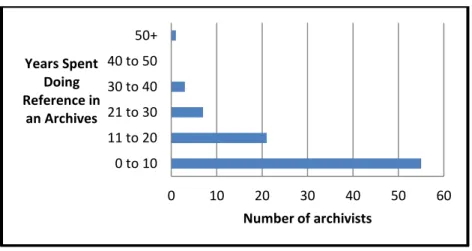
Of the 87 usable responses, the length of careers in archival reference ranged from
six months to 52 years. The average career length was 10.96 years, while the most
been working in archival reference for 4 to 6 years.77 Sixty-three percent had been doing
reference work for less than ten years. Thirty-two respondents (37%) had been working
in archival reference for 5 years or less. Four respondents had been working in archival
reference for more than thirty years.
Table 1. Experience in Archival Reference
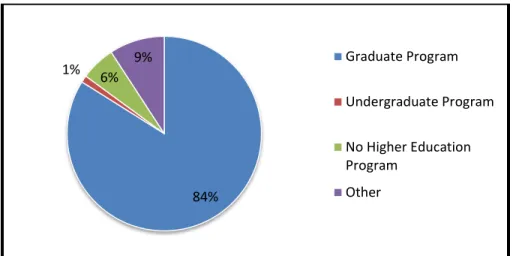
In terms of education, 73 respondents or 84% attended a graduate program in
library science or archival studies, one attended an undergraduate program, and five did
not attend a higher education program in library science or archival studies (see Table 2).
One respondent chose ‘Other’ and clarified that they were currently halfway through an
MLIS. Of the responses remaining, three attended graduate programs in public history,
one attended a graduate program in history and museum studies, and three attended
graduate programs in history.
77 Twenty-four respondents gave 4, 5, 5.5, or 6 years as the length of time they had been working
in archival reference, thus 27.59% of respondents.
0 10 20 30 40 50 60
0 to 10 11 to 20 21 to 30 30 to 40 40 to 50 50+
Number of archivists Years Spent
Doing Reference in
Table 2. Attendance of Higher Education Program in LIS or archival studies
84%
1% 6% 9% Graduate Program
Undergraduate Program
No Higher Education Program
Findings
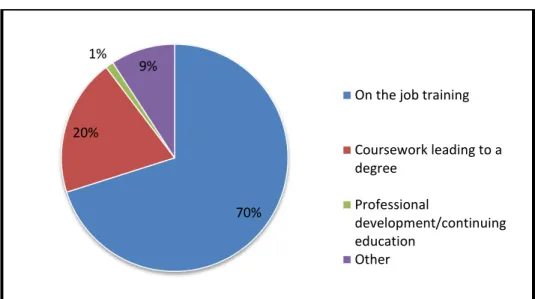
When asked to choose which option described how they learned reference work,
70% of respondents chose on the job training while only 21% chose coursework or
professional development/continuing education (see Table 3).
Table 3. How archivists learned reference work
For respondents who attended a higher education program, 64% had some type of
mandatory reference course as a requirement of their degree. Of the remaining 36% of
survey respondents without a mandatory reference course as part of their program, 46%
did have access to an optional reference course; all in all, approximately eighty percent of
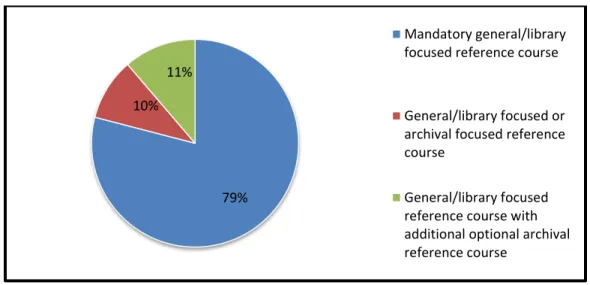
the archivists who responded had access to a class in reference. The vast majority of
respondents who had access to a reference course took a mandatory general or
library-focused reference course. Of the rest, 10% had a choice between a mandatory general
reference course and an archival reference course, while 11% had the option to take an
additional course related to archival reference (see Table 4). For 89% of respondents, no 70%
20% 1%
9%
On the job training
Coursework leading to a degree
Professional
development/continuing education
archival reference course was offered through the advanced degree program. In these
instances, only about a quarter of respondents felt that archives were incorporated into the
general reference course.
Table 4. Mandatory Reference Courses in Higher Education
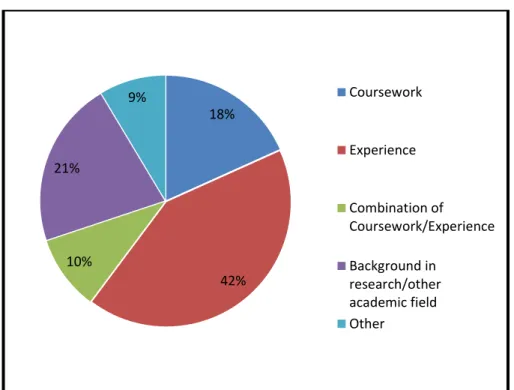
The open-response question, asking which aspect of training or education the respondents
thought had best prepared them for archival reference, elicited a wide range of opinions
on the value of the various elements of reference training and education. Correlating the
free response answers to a few broad categories, it emerged that 42% of respondents
found experience or on the job training the most valuable element for future success in
archival reference. Eighteen percent gave responses related to coursework, while 10%
credited a combination of coursework and experience. Interestingly, 21% felt that a
background in research or another academic field best prepared them for working in
archival reference. (See Table 5)
Multiple respondents specifically mentioned the value of learning how to conduct
reference interviews. Some cited learning the reference interview as the most valuable 79%
10% 11%
Mandatory general/library focused reference course
General/library focused or archival focused reference course
preparation for their reference careers. Others mentioned the reference interview as one
of the assets of a general reference class, a skill which could easily be transferred from
library settings to archival ones. Interestingly, multiple respondents also remarked on the
performance-like nature of the reference interview. One credited their general reference
class with "helping me learn the skill of performing the reference interview," and another
mentioned the value of discussing and role-playing reference interviews in class. Their
conception of and experience with the interview reflects the idea of the reference
interview as creative art posited in Jennerich and Jennerich's text.
Table 5. Best Preparation for Reference Work
A number of respondents referred to practica, internships or assistantships as the
best way to learn reference work although they generally reckoned it as experience or on
the job training rather than coursework. Many graduate programs require internships,
field experiences or practica, either as a part of a larger course or as an independent 18%
42% 10%
21%
9% Coursework
Experience
Combination of
Coursework/Experience
study. Students often support themselves with assistantships or paid internships during
the school year, providing both income and practical experience. Respondents noted that
such experiences gave them confidence that they could do well, and that actually
handling reference requests was the best way to become familiar with reference
processes.
Unlike entry-level positions, internships necessitate a more formalized
relationship with an experienced archivist who guides the student through real work
situations. The SAA's ''Best Practices for Internships as a Component of Graduate
Archival Education'' described internships as "partnerships among students, archives
programs, and the sites hosting interns," and specified that the work of interns "must be
educational and provide students with hands-on experience. The work of interns must not
replace the work of professional staff," although the internship should balance the needs
and goals of all partners. Still, the internship is ultimately meant to benefit emerging
professionals, allow graduate students "to gain new insights into the nature of archival
practice by engaging meaningful work under the mentorship of experienced and
knowledgeable archives professionals."78
Respondents also noted a variety of external experiences that they found valuable
for reference work. The largest number of these involved their own experiences in doing
research for other fields. For example, one respondent noted that as a communications
major focusing in journalism, "research was a big part of what I did in college and in the
field." Others cited secondary degrees in English or history as the most useful experience
78 SAA Council, “Best Practices for Internships as a Component of Graduate Archival Education,”
they brought to reference work; others simply referred to research skills or research
experience. One respondent noted that experience in conducting research helps reference
archivists "to understand how best to approach responding [to] and referring researchers
regarding their reference questions." Another felt that conducting research as a historian
gave them "insights into archival research that translates extremely well into helping
others to locate the information they seek." On a similar note, several respondents
referred to their subject matter expertise; having a background in a repository's focal
areas lends context to reference requests that is very valuable to archivists. Others cited
past experience in customer service positions as an asset in performing archival
reference.
Although most respondents did not take a class specific to archival reference,
many did find value in general reference courses or other archives-related courses. As
mentioned above, reference techniques such as reference interviews can be adapted from
libraries to archives. Some respondents saw library-centered reference courses as a good
foundation for their later experiences in archives, especially in terms of acquiring the
skills to work well with researchers. More general archival classes were also useful in
teaching future reference archivists about repository descriptive practices, gaining
intellectual control of collections, and other archival policies and processes. One archivist
admitted that the coursework became valuable in retrospect; skills and theory covered in
the general reference class "didn't 'click'" until they had to be put into practice.
At the same time, many of the archivists who responded dismissed the idea that
reference work could be adequately taught in a classroom setting. One claimed that “good
education, but practical experience has had a greater effect in the long term.” Even a
respondent who had taken an archival reference course found it difficult “to translate into
on the job practicality.” These respondents emphasized learning from other archivists and
from the researchers; many cited interacting with researchers as the best way to pick up
reference skills. They also focused on specific repository knowledge—knowing the
collections is essential to performing reference work, and performing reference work
helps an archivist learn about the collections. Often, archivists felt that the necessity of
collection-specific knowledge limited the efficacy of classroom-based reference training.
They felt that the training they received from other members of staff at their specific
Conclusions and Further Research
Most of the archivists who participated in this study indicated that they found
work experience and practical training the most useful elements of preparation for
working in archival reference. However, the majority of these archivists had access to
only a general, library-focused reference course with no option to participate in a course
on archival reference either in lieu of or in addition to the general course. There are
certainly elements of this type of reference education which are applicable to archival
settings. For instance, participating archivists found topics such as conducting reference
interviews useful in archival settings, and many noted that having a general background
in reference helped them learn archival reference more easily. However, the nature of
research and reference in library settings is vastly different than in archival repositories or
special collections. Archivists participating in reference and research services face a
unique set of challenges, interacting with users whose goals and methods are often very
different than those of library users.
For archivists entering the field today, it is an expectation if not an actual
requirement for most jobs that they will obtain an advanced degree, most commonly a
master’s in library or information science. The vast majority of participants in this study
attended a graduate program in library science or archival studies, and those who did not
almost all attended an advanced degree program in history or public history. However,
given how few of these had access to an archival reference course, it is difficult to
determine how useful they would judge coursework in relation to experience if they had
participated in a more pertinent reference course. Over half of the respondents had been
representative of the experience and mindsets of new professionals, whose careers have
aligned with trends emphasizing public service and promoting access.79
Although much of the success of archival reference interactions depends on the
collaboration of the researcher and on knowledge of the individual repository’s
collections, a reference course distinct from the library-focused courses common in
graduate programs today could provide a better theoretical foundation for new reference
professionals. New professionals who receive specific training in archival reference as
part of their formal education may feel more confident in their abilities and provide better
service to archival patrons without a lengthy introductory period. Given the high
percentage of reference archivists who attribute their skills to prior experience in research
or knowledge of research techniques and strategies, it is clear that a course which could
help archival students gain expertise in that area would be an asset to them as they begin
working with researchers in archives.
Further studies should be conducted to examine the efficacy of archival-centered
reference courses, to determine whether such courses should be more widely incorporated
into archival tracks or concentrations and how research services departments should
approach hiring and training new reference staff. Such studies will also lead to a better
understanding of archival reference knowledge by pinpointing the elements that create a
stable base of knowledge for new professionals. Past research on archival reference
focuses largely on the user and the reference interaction while neglecting the archivist.
We need to clarify the value of courses specific to archival reference practices and
79 The theory of More Product Less Process (MPLP), for example, was first presented in papers at
improve the education and training of reference archivists entering the field. The
increasing focus on public service as the primary mission of archival institutions puts
reference archivists at the forefront, and they need to be prepared to meet the challenges
Bibliography
Agosto, Denise E., Lily Rozaklis, Craig MacDonald, and Eileen G. Abels. “A Model of the Reference and Information Service Process: An Educators’ Perspective.” Reference & User Services Quarterly 50:3 (2011): 235-244.
Anthony, Denise. “Beyond Description: An Exploration of Experienced Archivists’ Knowledge and Sharing Skills.” PhD diss., University of Michigan, 2006.
Banks, Brenda S., Paul Conway, Nancy Zimmelman Lenoil, and Michael F. Suarez, S. J. “The View From Here: Perspectives on Educating About Archives.” American Archivists 74 (2011): 306:1-32.
Bastian, Jeanette, and Elizabeth Yakel. “‘Are We There Yet?’ Professionalism and the development of an archival core curriculum in the United States.” Journal of Education for Library and Information Science 46:2 (2005): 95-114.
Bolfing, Trina Rachael. “Training for the Reference Olympics.” The Reference Librarian 53:1 (2011): 113-121.
Cox, Richard J, and Donald L. Larsen. “iSchools and archival studies.” Arch Sci 8 (2008): 307-326.
Cox, Richard J., Elizabeth Yakel, David Wallace, Jeanette Bastian, and Jennifer Marshall. “Educating archivists in library and information science schools.” Journal of Education for Library and Information Science 42:3 (2001): 228-241.
Cross, James Edward. “Archival Reference: State of the Art.” The Reference Librarian 26:56 (1997): 5-25.
Dearstyne, Bruce W. “Archival Reference and Outreach: Toward a New Paradigm.” The Reference Librarian 26:56 (1997): 185-202.
Duff, Wendy M., and Allyson Fox. “‘You’re a Guide Rather Than an Expert’: Archival Reference from an Archivist’s Point of View.” Journal of the Society of Archivists 27:2 (2006): 129-153.