Sharif University of Technology
Scientia IranicaTransactions F: Nanotechnology http://scientiairanica.sharif.edu
Residual strain in graphene: Study of temperature and
crack eect
M. Motamedi
a;and A. Esfandiarpour
ba. Faculty of Engineering, University of Shahreza, Isfahan, P.O. Box 86149-56841, Iran. b. Faculty of Basic Sciences, University of Shahreza, Isfahan, P.O. Box 86149-56841, Iran. Received 2 May 2018; received in revised form 19 July 2018; accepted 13 October 2018
KEYWORDS Graphene;
Stress-strain curve; Molecular dynamics; Residual strain; Center cracked.
Abstract. Graphene is a thin sheet with special properties and complicated mechanical behavior. It is important to study graphene experimentally and theoretically. Stone-Wales defects, cracks, and atom vacancy are popular defects in carbon allotropes, especially in graphene. In this paper, residual strain in graphene was discussed. At rst, stress-strain curve of non-defected graphene sheet was obtained using molecular dynamics simulation, and eect of temperature on mechanical properties of graphene was obtained. Then, four dierent cracks at the center of graphene sheets were considered. Stress-strain curves of defected graphene sheets with dierent tension strain rates were plotted. The results showed that cracks would lead the graphene to fracture sooner. In addition, increasing temperature leads to a decrease in the Young's modulus of graphene and graphene fracture at lower strain. On the other hand, residual strain of non-defected and cracked graphene increased by increasing temperature from 200 K to 1200 K. It means that graphene is subject to more plasticity behavior in case of temperature increase.
© 2019 Sharif University of Technology. All rights reserved.
1. Introduction
After years of graphene exploration, researchers are still showing increasing interest in the study of graphene due to its unique properties, such as high thermal conductivity (5000 W/mk) [1], large sur-face area (2600 m2/g) [2], and high elastic modulus
(1000 GPa) [3], and it is recognized as one of the key materials for creating electronic devices in the future [4]. Moreover, single-layer graphene layers are widely used for developed materials and nanocomposites [5]. Studying mechanical properties of graphene is inter-esting for researchers. Lee at al. [6] found Young's modulus of graphene with 0.335 nm thickness, about 1 0 TPa, and mechanical strength of 130 10 GPa.
*. Corresponding author. Tel.: +98 315 3238380
E-mail address: [email protected] (M. Motamedi). doi: 10.24200/sci.2018.50901.1906
Results show that Stone-Wales defect and vacancy defect exist in graphene and carbon nanotubes. These defects can be created because of stress or during production and can aect mechanical properties of these carbon allotropes. Therefore, it is very important to study the defect eect on mechanical behavior of graphene sheets [7-11]. For this purpose, Jiang et al. [12] used Molecular Dynamics (MD) simulation and nite-element method to investigate the eect of crack on graphene sheets. Le and Batra [13] proved that the initial length of the crack and the loading speed were eective in the growth rate of the cracks. Fan et al. [14] used numerical methods to investigate the fracture behavior of graphene sheets. Theodosiou and Saravanous [15] studied the crack eect on graphene using nonlinear nite-element simulation. This study focused on the crack path in the graphene, and dierent states were examined. Theoretical method and, then, the continuum molecular mechanics method were used in Tuleubekov and Volokh [16] work. They pulled
graphene in two directions to study the eect of cracks on graphene. Wang et al. [17] studied eect of Stone-Wales defects on strength of graphene. Their results indicated a relative decline in graphene strength. Lia-Jin et al. [18] studied center cracks in graphene using continuum mechanics. They could determine strain en-ergy release in graphene by applying graphene tensions. The eect of temperature on graphene has been studied by some researchers. Yong et al. [19] studied the eect of temperature on mechanical properties of graphene. The results showed that increasing temper-ature signicantly changed the strength of graphene. Li and Chou [20] studied non-cracked graphene sheet experimentally and found Young's modulus and failure strength of graphene. Dewapriya et al. [21] studied the eect of temperature on free-edged graphene sheet using molecular dynamic simulation. Their results showed that higher temperature led to lower Young's modulus.
In this paper, residual strain of graphene sheet at dierent temperatures is studied. In addition, the eect of the temperature on center cracked graphene and without-cracked graphene is investigated. For this purpose, four dierent cracks are created on the graphene sheets; for each crack, the graphene sheet is stretched with three dierent strain rates. Eect of temperature on mechanical properties of graphene (at dierent strain rates) is investigated using molecular dynamics method.
2. Molecular dynamics simulation
Initially, using the molecular dynamics method, we study the eect of the center crack on the mechan-ical properties of the graphene. For this purpose, The AIREBO (Adaptive Intermolecular Reactive Em-pirical Bond-Order) potential function is considered. AIREBO works at a cut-o distance less than rmax
ij (for
C-C bond, rmax
ij is equal to 2 A). Each pair of atoms
with covalent bonding operates under the following potential [22]:
EREBO
ij = VijR(rij) + bijVijA(rij); (1)
where VR
ij and VijAare repulsion and attraction
poten-tial which act between i, j atoms, and bij is bond-order
term of potential function. The total potential energy is obtained through the following equation:
E =1 2 X i X j6=i 2 4EREBO
ij +EijLJ+
X k6=i;j X l6=i;j;k Etors ijkl 3 5;(2) where ELJ
ij is Lennard-Jones potential for non-bonded
atoms, and Etors
ijkl is torsional interaction potential:
Etors
ijkl=fc(rij) fc(rik) fc(rjl)"
256 405cos10
2 0:1 ; (3) where fc is bond-weight terms, " is the depth of the
potential well in Lennard-Jones function, and is the Dihedral angle.
In order to block the eects of size on graphene properties, graphene sheet was considered as 9:997 9:947 nm2 dimensions [23]. Molecular dynamics
sim-ulation was conducted using LAMMPS package and AIREBO potential function. This potential enjoys high accuracy in atomic interactions and reformation of atoms.
For covering the area round the crack in AIREBO potential function, the cut-o distance was considered as 2 A [24]. To measure the mechanical properties of graphene sheet, an axial tensile test was used, which can be performed on the basis of deformation control or force control. In the deformation control method, the strain applies to one graphene side, while the opposite side is considered completely xed. The strain rate has great eect on the mechanical properties of graphene and crack growth. Therefore, three dierent strain rates were considered to apply to graphene sheet including 0.0005, 0.005, and 0.05 ps 1, and the time
step was 0.001 ps for each one. All simulation steps were carried out at four dierent temperatures of 200, 500, 800, and 1200 K.
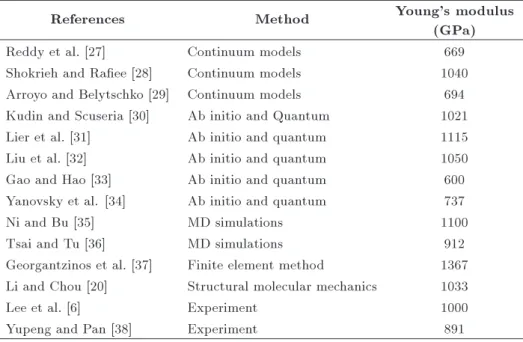
The Young's modulus was reported in experimen-tal results between 0.5 to 2 TPa [25]. However, most research studies have reported on Young's modulus close to 1 TPa [26]. The value of Young's modulus has been reported in various papers, as shown in Table 1.
In this paper, the stress-strain curve for graphene was obtained using molecular dynamics method (Fig-ure 1) according to the slope of the curve; the value of the Young's modulus was obtained as about 870 GPa (Figure 2). This value is in good agreement with that in other experimental and theoretical researches; it is particularly in agreement with the value obtained from experimental work of Zhang et al. (891 GPa) [38].
Table 1. The value of Young's modulus reported in various papers.
References Method Young's modulus
(GPa)
Reddy et al. [27] Continuum models 669
Shokrieh and Raee [28] Continuum models 1040 Arroyo and Belytschko [29] Continuum models 694 Kudin and Scuseria [30] Ab initio and Quantum 1021
Lier et al. [31] Ab initio and quantum 1115
Liu et al. [32] Ab initio and quantum 1050
Gao and Hao [33] Ab initio and quantum 600
Yanovsky et al. [34] Ab initio and quantum 737
Ni and Bu [35] MD simulations 1100
Tsai and Tu [36] MD simulations 912
Georgantzinos et al. [37] Finite element method 1367 Li and Chou [20] Structural molecular mechanics 1033
Lee et al. [6] Experiment 1000
Yupeng and Pan [38] Experiment 891
Figure 2. Slope of stress-strain curve.
2.1. Eect on temperature on graphene sheet strength
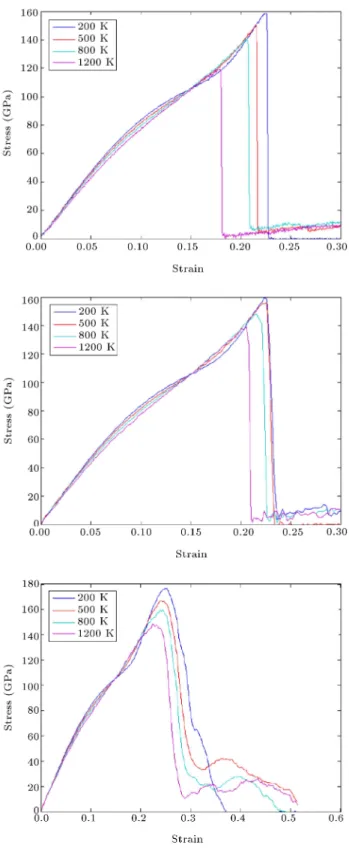
The eect of temperature on stress-strain curve of graphene was studied at four temperatures of 200, 500, 800, and 1200 K. For each temperature, three strain rates were considered: 0.0005, 0.005, and 0.05 ps 1.
The results are shown in Figure 3.
As shown in Figure 3, increasing temperature leads graphene to failure at lower strain. By calculating the Young's modulus of graphene in each temperature, it can be found that increasing temperature leads to a decrease in strength of graphene (Table 2). A comparison of these results with other studies' results shows good agreement. Yong et al. [19] studied temper-ature eect on mechanical properties of graphene. The results showed that increasing temperature changed the strength of graphene, signicantly. In addition, Zhang and Pan [38] and Dewapriya et al. [21] studied eect of temperature on free-edged graphene sheet using
Table 2. Eect of temperature on Young's modulus of graphene.
Young's modulus
Temp. (K) 0.0005 ps 1 0.005 ps 1 0.05 ps 1 200 0.92023 0.93002 0.93989 500 0.89607 0.90576 0.92307 800 0.87107 0.88469 0.90186 1200 0.84139 0.85679 0.87101
molecular dynamic simulation. Their results showed that higher temperature led to lower Young's modulus. As the strain rate increases, the Young's modulus shows an increasing trend with the strain rate. In addition, the strain rate eect is more obvious at higher temperature. For example, at 200 K, the Young's modulus increases by about 2% for strain rate variation from 0.0005 ps 1 to 0.05 ps 1. However, at 800 K, the
Young's modulus increases by about 3.5% for strain rate variation from 0.0005 ps 1 to 0.05 ps 1. This
is the reason why, at a higher strain rate, graphene has shorter relaxation time to experience the thermal uctuation and, thus, the graphene is harder.
2.2. Center cracked graphene sheets
To investigate the eect of temperature on mechanical properties of center-cracked graphene, four types of cracks were considered in dierent sizes. The cracks are located at the center of the graphene sheet and are visible in Figure 4. The size of graphene sheet is 9:997 9:947 nm, and the cracks are located at the center of sheet, with the respective length and width of 0.7 and 0.6 for Crack 1, 0.7 and 0.8 for Crack 2, 0.7 and 1.95 for Crack 3, and 0.7 and 3.16 for Crack 4.
Figure 3. Eect of temperature on stress-strain curve of graphene sheet with strain rates of 0.0005, 0.005, and 0.05 ps 1, respectively.
The eect of temperature on stress-strain curve of center-cracked graphene was studied at four tures of 200, 500, 800, and 1200 K. For each tempera-ture, three strain rates were considered: 0.0005, 0.005, and 0.05 ps 1. The stress-strain curves for Crack 1
Figure 4. Graphene sheets with center cracks.
Table 3. Eect of temperature on Young's modulus of cracked graphene.
Young's modulus
Temp. (K) 0.0005 ps 1 0.005 ps 1 0.05 ps 1 200 0. 90591 0.91090 0.92047 500 0.88028 0.89167 0.90584 800 0.85923 0.86373 0.87997 1200 0.82048 0.83190 0.84432
are shown in Figure 5. It can be found that increasing temperature leads to a decrease in strength of center-cracked graphene (Table 3).
As observed, temperature changed the strength of center-cracked graphene. By changing temperature from 200 K to 1200 K, the Young's modulus increases by about 10%.
In addition, by comparing Tables 2 and 3, it can be concluded that Crack 1 (in Figure 4) reduces the Young's modulus by about 2.5%. In addition, the failure occurs at lower strain at high temperatures. Figure 6 shows the stress-strain curves of four cracked graphenes compared with non-cracked one.
Some curves continue to uctuate after failure, because energy is accumulated in the graphene in the pulling process that is being released.
Li and Chou [20] studied non-cracked graphene sheet experimentally and found Young's modulus and failure strength of graphene about 1 TPa and 130 GPa, respectively. In addition, Zhang and Pan [39] obtained fracture strength of graphene sheet about 140 GPa. In this work, fracture strength of graphene sheet was obtained about 155 GPa, which has good agreement with the mentioned experimental works.
Figure 7 depicts dierent frames from graphene initial loading to failure. A brittle fracture occurs without noticeable deformation and is characterized by rapid crack propagation (Figure 7(d)). The direction of crack is perpendicular to that of tensile strain and results in a relatively at fracture surface.
2.3. Eect of temperature on residual strain of graphene
Residual strain is the strain at which the graphene does not return to its original size after the deforming force has been removed. Some parameters, such as temperature, strain rate, and crack, have an important
Figure 5. Eect of temperature on stress-strain curve of cracked graphene sheet with Strain rates of 0.0005, 0.005, and 0.05 ps 1, respectively.
role in residual strain. In this work, the eect of temperate and center crack was studied on residual strain graphene.
To this end, the eect of temperature on graphene strain was studied at four temperatures of 200, 500, 800, and 1200 K. The graphene was pulled to 0.2 strain by 0.0005 ps 1 strain rate; then, the pulled
Figure 6. Eect of center crack on stress-strain curve of graphene at 500K.
Figure 7. Dierent frames of graphene loading from the beginning to the nal failure.
Figure 8. Eect of temperature on residual strain of graphene.
force was removed. Figure 8 shows the residual strain of graphene at dierent temperatures. By increasing temperature, the slope of stress-strain curve decreased; however, the residual strain increased. In other words, the residual strain increased from 0.01 to 0.028 when the temperature changed from 200 to 1200 K.
Therefore, it can be concluded that graphene at high temperatures experiences more plasticity behavior.
In addition, the eect of temperature on residual strain of center-cracked graphene was studied. For this aim, the graphene with Crack 1 (in Figure 4) was pulled at four dierent temperatures of 200, 500, 800, and 1200 K ( Figure 9). As previously concluded, increasing temperature increased residual strain, too. However, as discussed before, cracked graphene has low residual strain because it is fractured at lower strain.
Figure 9. Eect of temperature on residual strain of center-cracked graphene.
3. Conclusion
This study investigated the eect of temperature on the residual strain of graphene. For this aim, the eect of temperature on graphene strain was studied at four temperatures of 200, 500, 800, and 1200 K. The result showed that residual strain increased from 0.01 to 0.028 when the temperature changed from 200 to 1200 K. Therefore, it can be concluded that graphene at high temperatures experienced more plasticity behavior. In addition, the properties of graphene and the eect of center cracks were investigated using molecular dynamics. For this purpose, at rst, the properties of graphene were obtained using the molecular dynamics method, and the results were compared with experi-mental and theoretical researches. Young's modulus and strength fracture of graphene sheet were obtained as 870 GPa and 155 GPa, respectively, which had good agreement with those of other works. Then, the mechanical properties of graphene with center crack were investigated. The results showed that Young's modulus of graphene decreased by increasing the crack length, and the fracture also occurred in lower tensile strain.
References
1. Xin, G., Yao, T., Sun, H., et al. \Highly thermally conductive and mechanically strong graphene bers", Science, 349, pp. 1083-1087 (2015).
2. Kianpour, B., Salehi, Z., and Fatemi, S. \Highly en-hanced loading quality of curcumin onto carboxylated folate graphene oxide", Scientia Iranica, In Press, (2018).
3. Xiang, R., Hu, K., Grant, A.M., et al. \Ultrarobust transparent cellulose nanocrystal-graphene membranes with high electrical conductivity", Advanced Materials, 28, pp. 1501-1509 (2016).
4. Rezania, H., Goli, S., and Jazideh, A. \Electrical conductivity of doped armchair graphene nanoribbon
in the presence of gap parameter", Scientia Iranica, 25(3), pp. 1808-1814 (2018).
5. Mohammadzadeh Honarvar, F., Pourabbas, B., Salami Hosseini, M., Kharazi, M., and Erfan-Niya, H. \Molec-ular dynamics simulation: The eect of graphene on the mechanical properties of epoxy based photoresist: SU8", Scientia Iranica, 25(3), pp. 1879-1890 (2018).
6. Lee, C., Wei, X., Kysar, J.W., and Hone J. \Measure-ment of the elastic properties and intrinsic strength of monolayer graphene", Science, 321, pp. 385-388 (2008).
7. Shuaiwei, W. and Baocheng. Y. \Large-scale molecular simulations on the mechanical response and failure behavior of a defective Graphene: Cases of 5-8-5 defects", Scientic Reports, 5, 14957 (2015).
8. Iinchun, H., Siusiu, G., and Jincheng, L. \The eect of stone-thrower-Wales defects on mechanical properties of graphene sheets - A molecular dynamics study", Carbon, 75, pp. 124-132 (2014).
9. Rajasekaran, G., Prarthana, N., and Avinash, P. \Eect of point and line defects on mechanical and thermal properties of graphene: A review", Critical Reviews in Solid State and Materials Sciences, 41, pp. 47-71 (2016).
10. Liu, L., Qing, M., and Wang, Y. \Defects in graphene: Generation, healing, and their eects on the properties of graphene: A review", Journal of Materials Science & Technology, 31, pp. 599-606 (2015).
11. Yoon, K., Ostadhossein, A., and Van Duin, A. \Atomistic-scale simulations of the chemomechanical behavior of graphene under nanoprojectile impact", Carbon, 99, pp. 58-64 (2016).
12. Jiang, Z., Lin, R., Yu, P., and Liu, Y. \The chirality-dependent fracture properties of single-layer graphene sheets: Molecular dynamics simulations and nite element method", Journal of Applied Physics, 122, 025110 (2017).
13. Lea, M. and Batra, R.C. \Single-edge crack growth in graphene sheets under tension", Computational Materials Science, 69, pp. 381-388 (2013).
14. Fan, N., Ren, Z., and Jing, G. \Numerical investiga-tion of the fracture mechanism of defective graphene sheets", Materials, 10(2), p. 164 (2017).
15. Theodosiou, T.C. and Saravanous, D.A. \Numerical simulation of graphene fracture using molecular me-chanics based nonlinear nite elements", Computa-tional Materials Science, 82, pp. 56-65 (2014).
16. Tuleubekov, K. and Volokh, K.Y. \Strength of graphene in biaxial tension", European Journal of Mechanics A/Solids, 39, pp. 291-297 (2013).
17. Wang, M.C., Yan, C., and Ma, L. \Eect of defects on fracture strength of graphene sheets", Computational Materials Science, 54, pp. 236-239 (2012).
18. Jia-Lin, T., Shi-Hua, T., and Yu-Jen, T. \Charac-terizing the fracture parameters of a graphene sheet using atomistic simulation and continuum mechanics",
International Journal of Solids and Structures, 47, pp. 503-509 (2010).
19. Yong, G., Hong-Xiang, S., Yi-Jun, G., and Gan-He, Z. \Finite temperature eect on mechanical properties of graphene sheets with various grain boundaries", Chin. Phys. B., 25(6), p. 066104 (2016).
20. Li, C. and Chou, T.W. \A structural mechanics approach for the analysis of carbon nanotube", Int. J. Solids Struct., 40, pp. 2487-2499 (2003).
21. Dewapriya, M., Srikantha Phani, A., and Rajapakse, R. \Inuence of temperature and free edges on the mechanical properties of graphene", Modelling Simul. Mater. Sci. Eng., 21, p. 065017 (2013).
22. Stuart, S.J., Tutein, A.B., and Harrison, J.A. \A re-active potential for hydrocarbons with intermolecular interactions", J. Chem. Phys., 112, pp. 6472-6486 (2000).
23. Zhao, H., Min, K., and Aluru N. \Size and chirality dependent elastic properties of graphene nanoribbons under uniaxial tension", Nano Lett., 9(8), pp. 3012-3015 (2009).
24. Shenderova, O.A. and Brenner, D.W \Atomistic mod-eling of the fracture of polycrystalline diamond", Phys. B., 61(6), pp. 3877-3888 (2000).
25. Daniel Cooper, R. \Experimental review of graphene", Condensed Matter Physics, p. 501686 (2012).
26. Kelly, B.T. \Physics of graphite", Applied Science, 1st Edn., Springer, London, UK, pp. 321-377 (1981).
27. Reddy, C.D., Rajendran, S., and Liew, K.M. \Equilib-rium conguration and continuum elastic properties of nite sized graphene", Nanotechnology, 17, pp. 864-870 (2006).
28. Shokrieh, M.M. and Raee, R. \Prediction of Young's modulus of graphene sheets and carbon nanotubes us-ing nanoscale continuum mechanics approach", Mater. Des., 31, pp. 790-795 (2010).
29. Arroyo, M. and Belytschko, T. \Finite crystal elasticity of carbon nanotubes based on the exponential Cauchy-Born rule", Phys. Rev. B, 69, p. 115415 (2004).
30. Kudin, K.N. and Scuseria, G.E. \C2F, BN, and C nanoshell elasticity from ab initio computations", Phys. Rev. B., 64, p. 235406 (2001).
31. Lier, G.V., et al. \Ab initio study of the elastic proper-ties of single-walled carbon nanotubes and graphene", Chem. Phys. Lett., 326, pp. 181-185 (2000).
32. Liu, F., Ming, P., and Li, J. \Ab initio calculation of ideal strength and phonon instability of graphene under tension", Phys. Rev. B, 76, ID. 064120 (2007).
33. Gao, Y. and Hao, P. \Mechanical properties of mono-layer graphene under tensile and compressive loading", Physica E, 41, pp. 1561-1566 (2009).
34. Yanovsky, Y.G. et al. \Quantum mechanics study of the mechanism of deformation and fracture of graphene", Phys. Mesomech., 12(5-6), pp. 254-262 (2009).
35. Ni, Z. and Bu, H. \Anisotropic mechanical properties of graphene sheets from molecular dynamics", Physica B., 405, pp. 1301-1306 (2010).
36. Tsai, J.L. and Tu, J.F. \Characterizing mechanical properties of graphite using molecular dynamics simu-lation", Mater. Des., 31, pp. 194-199 (2010).
37. Georgantzinos, S.K., Giannopoulos, G.I., and Anifan-tis, N.K. \Numerical investigation of elastic mechan-ical properties of graphene structures", Mater. Des., 31, pp. 4646-4654 (2010).
38. Zhang, Y. and Pan, C. \Measurements of mechanical properties and number of layers of graphene from nano-indentation", Diamond & Related Materials, 24, pp. 1-5 (2012).
39. Zhang, Y.Y. and Gu, Y.T. \Mechanical properties of graphene: Eects of layer number, temperature and isotope", Computational Materials Science, 71, pp. 197-200 (2013).
Biographies
Mohsen Motamedi is an Assistant Professor of Mechanical Engineering at University of Shahreza, Isfa-han, Iran. He received his PhD degree from University of Tehran (2015). His research interests include nano-mechanics, nite-element method, molecular dynamics simulation, composite and nano-composite materials, and fracture mechanics.
Amin Esfandiarpour received the BS degree in Solid State Physics from Zanjan University, Zanjan, Iran in 2007, MSc degrees in Molecular-Atomic Physics from the University of Isfahan, Iran in 2010, and PhD from Payame Noor University (The Center of Graduate Study), Tehran, Iran, in 2015, and Post-doc in Physics from the University of Isfahan in Iran in 2018. His research interests include identifying mechanical and thermal properties of novel material based on molecular dynamics simulation and Density Function Theory (DFT).