Charles House-Yorktown Eldercare Home: A Program and Evaluation Plan
By Maria F. D’Souza
A Master’s Paper submitted to the faculty of the University of North Carolina at Chapel Hill
in partial fulfillment of the requirements for the degree of Master of Public Health in
the Public Health Leadership Program
Chapel Hill 2014
_____________________________________ Advisor:
_____________________________________ Date
_____________________________________ Second Reader:
ABSTRACT
With the aging of the American population and the rising prevalence of chronic disease and disability, there will be increasing numbers of older Americans in need of long-term care in the coming decades. Unfortunately, many current models of residential long-term care are
associated with suboptimal quality of life for residents and high levels of caregiver burden among their family caregivers. The Charles House-Yorktown Eldercare Home is a small care home that was started in 2011 in Chapel Hill, North Carolina in response to the need for holistic residential eldercare expressed by local families caring for elder relatives in the community, and its overarching goal is to provide high quality residential elder care in a community context. The program provides person-centered residential care to 6 elders in a small, home-like setting in a suburban neighborhood and purposefully involves family caregivers in care and household life. As a next step in community involvement, the Eldercare Home plans to reach out to neighbors and other stakeholders to learn how it might better support and enhance the neighborhood and its needs. The purpose of the following program and evaluation plan is to outline the program’s development to date and its future directions, formally articulate its goals, and plan for
evaluation, towards program improvement and dissemination. The program’s logic model provides a framework for linking goals and activities, and is accompanied by a detailed implementation plan. A mini-systematic literature review provides insight into evaluation methods reported in the literature by similar programs. The focus of evaluation plans is elucidated through consideration of resources and rationale for undertaking evaluation.
Table of Contents
Introduction ………...4
Program Plan: Past, Current and Future Program Development Overview of the plan………..…………9
Context of the program …….……….………10
Relevant program theories……….14
Goals and objectives………...17
Logic model………..18
Program Implementation………19
Systematic Literature Review: Informing the Evaluation Plan Introduction………..……….22
Methods………..……..22
Results……….….…23
Discussion………...34
Systematic Review Summary Table……….36
Evaluation Plan: Looking Towards Program Improvement Introduction ………..39
Rationale and Approach to the Evaluation ………...39
Evaluation Study Design ………...42
Evaluation Methods ………43
Evaluation Planning Tables ………..…45
Institutional Review Board considerations ……….……….…49
Dissemination Plans ………..49
Discussion………...51
Acknowledgements………52
References ………..53
Appendices Budget………...…58
Organizational Chart………...60
INTRODUCTION
The American population is undergoing a dramatic demographic shift, as the "baby boomer" generation (encompassing adults born between 1946 and 1964) ages. The baby boomers began turning 65 in 2011, and the segment of the population over age 65 will double to 20 percent of the population by 2030, or around 72 million people, and will reach 89 million by 2050 (Centers for Disease Control and Prevention, 2013).
As the aging population expands, there is an increasing need for adequate capacity and quality of residential long-term care options for the growing population of older adults who are unable to live on their own due to chronic health problems that impair their ability to perform daily activities. According to the American Hospital Association, more than sixty percent of baby boomers will suffer from more than one chronic condition by 2030 (American Hospital
Association, 2007). However, concerns exist about the quality of life of residents of traditional residential long-term care settings, and about caregiver burden among family members of older adults requiring long-term care, both of which are increasingly recognized to represent
significant public health problems.
Nursing homes are the traditional mainstay of residential long-term care and provide full room and board, as well as supervision and nursing care 24 hours a day. A report issued by the Institute of Medicine in 2001 about the quality of long-term care identified persistent serious problems with quality of care and quality of life among nursing home residents despite progress made after a similar report issued in 1986 (Institute of Medicine, 2001). Widespread
Assisted living is a type of residential care characterized by less intensive services than nursing homes, and these settings typically provide room and at least two meals per day, with unscheduled nursing oversight 24 hours a day. In recent years, assisted living has grown significantly, by as much as 97% during the 1990s (Harrington, Chapman, Miller, Miller, & Newcomer, 2005). While assisted living was initially developed to embody a social model of care and to offer only limited medical services and staff in contrast to the medical model of nursing homes, the industry has undergone significant changes as it has grown in order to accommodate preferences for aging in place while meeting the needs of residents with declining health and physical function. These changes include adaptations of the physical structure and culture that have at times rendered them increasingly similar to nursing homes. Similar to findings of suboptimal quality of life in nursing homes, some studies indicate residence in assisted living is associated with a suboptimal fit for some residents (Morgan et al, 2014).
In addition to the problem of suboptimal quality of life in traditional residential long-term care settings, a related problem is that of informal caregiver burden, which refers broadly to the toll exacted on the family and friends who care for elders. Caregiving has been increasingly recognized as a serious and growing public health problem in recent decades, affecting the physical and mental health and well-being of caregivers (Talley & Crews, 2007). There are an estimated 44.4 million caregivers aged 18 and older in the U.S. (21% of the adult U.S.
residential care setting such as nursing home or assisted living, and that caregiver stress can occur at equally significant levels in these caregivers (Stull, Cosbey, Bowman, & McNutt, 1997), although there is a shift in its nature (George, 1984). New sources of burden include financial strains (Moody, 2002), coping with guilt (George, 1984), working to maintain the relative’s sense of dignity in the new setting, and interactions with formal care providers in the new setting (Chen, Sabir, Zimmerman, Suitor, & Pillemer, 2007; Brody, Dempsey, & Pruchno, 1990).
In light of the expansion of the aging population and the suboptimal quality of life experienced by many residents of traditional residential care settings and their family caregivers, there is a strong need for new residential long-term care options that seek to improve quality of life for both elders and their families. Successful strategies might aim to enhance residents’ quality of life by preserving important aspects of the social model of care while acknowledging and negotiating inevitable health decline, and to enhance family caregivers’ quality of life by purposefully and holistically involving family caregivers in care, towards minimizing caregiver burden. Community-based models are particularly needed, as the vast majority of older adults express preferences to remain in their local communities for as long as possible (Keenan, 2010).
Small care homes have been identified as a promising strategy to provide higher quality of life than that of traditional residential eldercare settings. Small care homes arose out of the culture change movement and provide person-centered care in small-scale, home-like
(Zimmerman & Cohen, 2010). The study by Zimmerman and Cohen (2010) identified Green Houses as possessing 6 essential elements: physical structure (small, housing no more than 12 residents; private rooms and bathrooms; access to outdoors), dining (non-institutional,
residential style kitchen), staffing (consistent assignment, universal role within self-managed teams, clinical staffing nearby), diverse and stable elder case mix, elder centered care (not according to fixed schedules), and normalized social engagement rather than organized
activities. Green Houses are most often licensed as nursing homes and situated on the grounds of larger traditional nursing homes with which they are affiliated.
Charles House-Yorktown Eldercare Home bears many similarities to the Green House model and is an independent small care home that was established in Chapel Hill, North Carolina in 2011 in response to the need for holistic residential eldercare expressed by local families caring for elder relatives in the community. The program was started by the Charles House Association, a nonprofit community organization that operates a long-standing adult day care program in the Chapel Hill area, and whose organizational mission is to enrich the lives of seniors, support their caregiving families, and represent the community’s commitment to its elders (Charles House Association, 2014). Following an invitation by the Heritage Hills neighborhood association to locate in an abandoned private residence, Charles House partnered with the association to develop the Yorktown Eldercare Home. While not affiliated with the Green House network, the program incorporates the same essential elements described above that typify Green Houses. Licensed for up to 6 individuals in a purposefully renovated ranch-style home in the suburban neighborhood, the home uses a household staffing model and holistic care philosophy. Program staff work with families to shape their continued important role as caregivers and to incorporate them into household life. Neighbors and
A second eldercare home is slated to open in Chapel Hill in August 2014, with the goal of further development throughout other neighborhoods, creating a decentralized network of community-based long-term care settings (Sloane, Zimmerman, & D’Souza, in press). The program
leadership became interested in conducting an evaluation of the program when the opportunity arose to collaborate with researchers at the University of North Carolina-Chapel Hill, with the purposes of program improvement and potential dissemination of the program’s model.
The purpose of the following program and evaluation plan for the Charles House-Yorktown Eldercare Home is therefore to formally articulate the basis of the program, optimize its ongoing development and future directions, and plan for evaluation. This document consists of a program and evaluation plan in 3 parts:
1. Program Plan: The Program Plan outlines the program’s development to date, as well as future directions for development. It includes discussion of the contextual factors surrounding the program’s creation, identification of relevant theoretical frameworks in support of the program’s activities, gleaning of goals and objectives of the program, depiction of a logic model, and description of the program’s
implementation.
2. Literature Review: The literature review is a mini-systematic review that identifies evaluation methods undertaken by similar programs, for the purpose of informing the development of the evaluation plan, and it includes a summary table of evidence. 3. Evaluation Plan: The evaluation plan outlines an evaluation plan to assess areas for
PROGRAM PLAN: PAST, CURRENT AND FUTURE PROGRAM DEVELOPMENT OVERVIEW OF THE PLAN
Charles House-Yorktown Eldercare Home is a small care home that was established in Chapel Hill, North Carolina in 2011 in response to the need for holistic residential eldercare expressed by local families caring for elder relatives in the community. The program was started by the Charles House Association, a nonprofit community organization that operates a long-standing adult day care program in the Chapel Hill area, and whose organizational mission is to enrich the lives of seniors, support their caregiving families, and represent the community’s commitment to its elders (Charles House Association, 2014). Following an invitation by the Heritage Hills neighborhood association to locate in an abandoned private residence, Charles House partnered with the association to develop the Yorktown Eldercare Home. Licensed for up to 6 individuals in a purposefully renovated ranch-style home in the suburban neighborhood, the home uses a household staffing model and holistic care philosophy. Program staff work with families to shape their continued important role as caregivers and to incorporate them into household life. Neighbors and community partners also are involved in life at the home,
informally and through service-learning partnerships. As a next step in community involvement, the Eldercare Home plans to reach out to neighbors to learn how it might better support and enhance the neighborhood and its needs. A second eldercare home is slated to open in Chapel Hill in August 2014, with the goal of further development throughout other neighborhoods, creating a decentralized network of community-based long-term care settings (Sloane, Zimmerman, & D’Souza, in press).
CONTEXT OF PROGRAM PLAN
In planning a program, it is important to examine various contextual factors surrounding the development and implementation of the program, in order to anticipate challenges and potential solutions (Issel, 2009). Factors that were relevant to the development of Charles House-Yorktown Eldercare Home are discussed here.
The Political Environment
The political environment surrounding the program’s inception, at the national, state, local, neighborhood and organizational levels must be considered. At a national level, a major health care reform priority is to reduce healthcare costs and improve quality, including
preventing unnecessary hospitalizations, emergency room visits and hospital re-admissions, much of which is federally financed by Medicare. Users of the long-term care system are among those most affected by these issues, resulting in intense interest in new models of long-term care that have the potential to influence health care utilization. The Eldercare Home’s holistic philosophy, which emphasizes a social model of care (Charles House, 2014), and which might be expected to result in optimal healthcare utilization patterns, is therefore very much in line with national priorities for new models of long-term care.
components that can be translated to settings that are accessible to a broader usership (Lawton, 2001). This is an important point in light of the pressing societal priority to recognize and eliminate racial and ethnic disparities in health services (Institute of Medicine, 2002).
An additional aspect of the state political environment that is relevant to the planning of a long-term care program is that North Carolina has Certificate of need (CON) laws, which require state approval prior to the creation of new healthcare facilities, dependent on whether the state deems that a sufficient level of need exists. In 2001, adult care homes of seven or more beds were brought under CON regulations in North Carolina (North Carolina Division of Health Service Regulation, 2010). Thus, developing the Eldercare Home to serve a maximum of 6 residents, operating as a family care home, enables the program to avoid being reliant on unpredictable CON approval.
The most important political considerations for the program’s feasibility are perhaps at the local and neighborhood levels. Locally, there is strong community support for the Charles House Association, and the Eldercare Home is generally perceived as meeting an important need in the community. The Eldercare Home is situated in a house in the Heritage Hills neighborhood in Chapel Hill, North Carolina, which was selected in close partnership with the Heritage Hills Neighborhood Association, whose support is very necessary for the program’s success. The program must continue to work closely with the neighborhood over its lifetime to ensure a continued mutually positive relationship; neighborhood opposition at any point could represent a political obstacle to the program’s sustainability.
Consistency with Local, State and National Priorities
A proposed program’s consistency with local, state, and national priorities increases the likelihood of the program receiving support from key stakeholders at these levels. Expanding long-term care options is a priority at each of these levels. For example, improving the health, function and quality of life of older adults is the overarching goal of the new "Older Adults" topic area in Healthy People 2020 (U.S. Department of Health and Human Services, 2010). At the state level, health priorities set forth in Healthy North Carolina 2020 do not yet explicitly include the health of older adults, although this might be expected in the future, reflecting trends at the national level (North Carolina Institute of Medicine, 2011).
There is specific emphasis on improving dementia care as a national priority, per the high visibility National Alzheimer’s Plan and the Healthy Brain Initiative (U.S. Department of Health and Human Services, 2013; Alzheimer’s Association & Centers for Disease Control and Prevention, 2013).
Acceptability to Providers and Recipients
The Charles House Eldercare Home is expected to be extremely desirable to program recipients and their families, based on widely acknowledged preferences for more home-like environments and person-centered care than what is currently available in traditional skilled nursing facilities. Cost will be a barrier to many, however.
closer relationships with residents and the ability to deliver better care. Physicians are not directly involved in the program’s operation or significantly affected by its existence, but their opinions can be influential. Thus, it is favorable that geriatric medicine physicians are strong supporters of the “culture change” movement in long-term care, of which the Eldercare Home is a part, and it is also favorable that there is physician representation on the Charles House Board of Directors.
Financial Constraints and Resources
There are no significant financial constraints for the program’s initiation. The program’s parent organization, Charles House Association, is well-established and fiscally sound, and was able to finance the program’s start-up costs. After start-up, the program is financially
self-sustaining, through collection of participant fees.
Technical and Administrative Feasibility
The program plan is highly feasible from a technical and administrative standpoint. Robust administrative infrastructure exists within the parent organization, Charles House Association, which has easily accommodated administrative oversight of the Eldercare Home program. This infrastructure includes the Board of Directors, Executive Director, Administrative Director, Activities Director and clerical staff. Furthermore, a pool of nursing assistants trained in the Charles House philosophy of person-centered care already exists at Charles House, from whom to recruit staff for the Eldercare Home, and who are also instrumental in the training of new nursing assistants. A final comment about feasibility is that descriptions of the processes of similar small-house residential care programs have been published and their feasibility
RELEVANT PROGRAM THEORIES
Successful programs are guided by established, evidence-based theoretical frameworks throughout the program planning, implementation, monitoring and evaluation cycle (Dickens, 2008). Various program theories were examined for their relevance and applicability to support the activities of the Charles House Eldercare Home. The overarching healthcare needs that the program aims to address are the need for improving the quality of life of elders receiving
residential long-term care and the need to reduce caregiver burden and to improve the quality of life of family caregivers. Applying an ecological perspective to these problems, theories relevant to the individual, interpersonal, organizational and community levels were identified, and lend support to the program’s likelihood for effectiveness.
Ecological Perspective
Applying an ecological perspective to a healthcare problem entails analyzing the problem and identifying causal factors at multiple levels, from individual to community, in order to target solutions effectively. Factors operating at the individual, interpersonal and
organizational levels that contribute to poor quality of life for nursing home residents include an “institutional” physical and social environment, lack of choice and autonomy, isolation from family and community, and lack of adequate meaningful social connections. A significant underlying factor at the community and societal level is that of ageism, resulting in neglect of frail elders in residential long-term care settings.
Caregiver burden is also a target for improvement by the program, primarily in family members of the residents of the eldercare home and secondarily in caregivers in the
social isolation (Tebb, 2000). By extension, the absence of social norms for community support of caregiving families may contribute to caregiver burden at the community and societal level. The need for community support of caregiving is all the more pronounced in an era when family structure is more diverse than in prior generations, traditional support networks have changed, families are often geographically dispersed, and many women work outside the home.
Social Cognitive Theory
The interpersonal causes of poor quality of life for nursing home residents and of caregiver burden described above represent targets for intervention by the program. Social cognitive theory is a widely known theoretical framework that operates at the interpersonal level and asserts that person factors, environmental factors and human behavior are interrelated in an ongoing, dynamic manner (National Cancer Institute, 2005). Tailoring the physical
environment to be home-like can influence personal attitudes and quality of life, according to the key construct of reciprocal determinism. Giving residents autonomy and choice by delivering person-centered care can influence quality of life, attitudes and behaviors through the
constructs of expectations and self-efficacy. Encouraging family and community presence and interaction with residents, as well as facilitating family caregivers’ continued meaningful relationships and involvement in care for residents, can promote quality of life through the constructs of reciprocal determinism, self-efficacy and reinforcement.
Community Organization Theory
Community organization theories are useful for targeting interventions to the etiological factors described above that operate at the community level, most notably including the lack of community support for caregiving families who experience high levels of isolation and stress. Community organizing strategies can be integrated with social cognitive theory-based
PROGRAM GOALS AND OBJECTIVES
The following goals and objectives are being articulated from the perspective of ideal goals and objectives at the time of the program’s initiation (i.e., retrospectively).
Short-term Objectives (1-3 years)
GOAL 1: Enable optimal quality of life and health for Eldercare Home residents
Objective 1a: Achieve equivalent or higher quality of life for Eldercare Home residents than would be expected in a traditional nursing home, after 12 months of residence.
Objective 1b: Meet national benchmarks for selected health-related quality indicators for Eldercare Home residents, after 12 months of residence.
Strategy for 1a & 1b: By delivering person-centered residential long-term care (LTC) in a small care home
Objective 1c: Achieve high levels of social connectedness as measured by weekly frequency of meaningful contacts in the last two weeks, for all Eldercare home residents.
Strategy: By caregiver and community involvement program components
GOAL 2: Enable optimal quality of life for family caregivers of Eldercare Home residents Objective 2a: Achieve lower levels of caregiver burden for primary family caregivers of Eldercare Home residents, as compared with caregivers of nursing home residents or with baseline measurements in Eldercare Home caregivers, after 12 months.
Objective 2b: Achieve lower levels of caregiver depression for primary family caregivers of Eldercare Home residents, as compared with caregivers of nursing home residents or with baseline measurements in Eldercare Home caregivers, after 12 months.
Objective 2c: Achieve higher levels of quality of life for primary family caregivers of Eldercare Home residents, as compared with caregivers of nursing home residents or with baseline measurements in Eldercare Home caregivers, after 12 months.
Strategy: By developing a protocol of education and activities to facilitate family
caregivers’ transition to a modified caregiving role during and after their relative’s relocation to the Eldercare Home, and to ensure the ongoing meaningful involvement of family caregivers
Long-term Objectives (3-5 years)
GOAL 3: Engage the Heritage Hills Neighborhood with the Eldercare Home in mutually beneficial ways.
Objective 3: By 5 years of operation, indicators will show increased neighborhood engagement between the Eldercare Home and the Heritage Hills Neighborhood as compared to baseline. Strategy: During the 4th year of operation, conduct focus groups to elicit perspectives and priorities of Heritage Hills Neighborhood residents, Eldercare Home residents and their family caregivers, and program staff and leadership, with an emphasis on identifying
LOGIC MODEL FOR CHARLES HOUSE-YORKTOWN ELDERCARE HOME
PROGRAM IMPLEMENTATION
The following implementation plan is articulated retrospectively, from the perspective of the
program’s initiation.
Activities
Short-term objectives To fulfill the short-term objectives of enabling optimal quality of life and
health for elders who need residential long-term care, the program will deliver person-centered
residential care to 6 elders in the Eldercare Home. To fulfill the short-term objectives of
improving caregiver burden, caregiver depression and caregiver quality of life, the program will
implement protocols to facilitate caregivers’ transition to their new caregiving roles and to
facilitate their continued meaningful involvement in their family’s members’ care.
Long-term objectives To fulfill the long-term objective of engaging the Heritage Hills
Neighborhood and the Eldercare Home in mutually beneficial ways, the program will conduct
focus groups, in partnership with researchers at the University of North Carolina-Chapel Hill, to
elicit perspectives from neighborhood residents, Eldercare Home residents and family
caregivers, direct care staff and program leadership. The program will then utilize results from
the focus groups to plan activities to engage the Heritage Hills Neighborhood and the Eldercare
Home in mutually beneficial ways (e.g. efforts or activities initiated by the Eldercare Home that
involve members of both the Eldercare Home and the Heritage Hills neighborhood, and which
center around interests valued by both).
Sustainability
Throughout the implementation of the program, program staff will conduct activities to
ensure its continued sustainability, most notably including building community support by
5-Year Budget Justification
The following section explains and provides justification for the proposed 5-year budget
for the initial operation of the Yorktown Eldercare Home program (Appendix). Start-up costs
have already been funded and accomplished, including purchase, renovation and furnishing of
the Eldercare Home; hiring and training of staff; recruiting participants.
Income: Total: $2,020,950
The program takes in $404,190 annually in occupancy fees, charging a cost of $67,365 annually
for each of the six residents (equivalent to $185/day). Fees are largely private pay at this time,
and cover the cost of room and board, activities, personal care, and oversight by a registered
nurse. Not covered: physician/health care, medications. The total 5-year income is $2,020,950,
with net income $88,820, to be applied to construction of the next Eldercare Home.
Expenses: Total: $1,932,130
Personnel: Total: $1,472,880
Personnel are listed in the organizational chart (Appendix). Total 5-year personnel costs,
including salaries and benefits, constitute the largest expense category, at a cost of $1,472,880.
These personnel are critical components of the program’s success, to conduct the activities of
person-centered care for elders and implementation of activities engaging neighborhood elders
and caregivers. Community members who volunteer on the Charles House Association Board of
Directors approve the budget and activities. The Charles House Association Executive Director
and Administrative Director administer the program and oversee the part-time registered nurse,
the full-time household coordinator, 14 full-time and part-time nursing assistants, and activities
director. Program evaluation will be undertaken as an academic partnership by this author, a
graduate student at the University of North Carolina-Chapel Hill School of Public Health, and
Building: Total: $138,385
Expenses related to the building operation, maintenance and mortgage total $138,385 and are
detailed in the appendix. Mortgage and interest totals $82,440 over 5 years, and property
maintenance and utilities total $55,945.
Insurance: Total: $77,115
Required insurance costs include professional liability ($3274 per year), workman’s
compensation ($6380 per year) and North Carolina unemployment ($5769 per year), for an
annual total of $15,423.
Eldercare Home Expenses: Total: $131,135
Eldercare home expenses include all costs related to providing room and board for the resident
elders apart from building expenses, at an annual cost of $26,227. The main expense is kitchen
and dietary, including annual grocery cost of $16,880. Other expenses include
cable/phone/internet, medication and pharmacy, equipment and garden/newspaper/general.
Activity supplies are donated by local businesses.
Administrative: Total: $18,180
Administrative costs include office supplies ($54), postage ($9), bank charges ($36), telephone
($613), mileage/vehicle ($2439), staff appreciation/events ($170), and professional
dues/licensure ($315), for an annual cost of $3636.
SYSTEMATIC REVIEW: INFORMING THE EVALUATION PLAN
INTRODUCTION
A mini-systematic literature review was conducted as a preliminary step in developing
the program evaluation plan, with the aim of identifying evaluations undertaken by similar or
related programs, towards avoiding duplication of efforts, anticipating evaluation challenges,
and identifying gaps in knowledge and practice. Longitudinal studies were sought over
cross-sectional studies for their greater rigor.
Two research questions guided this literature review: (1) What types of longitudinal
evaluations have been reported of small scale residential long-term care programs for elders?
(2) What information exists on their processes and outcomes in terms of quality of care and
quality of life?
METHODS
I conducted several preliminary searches in the PubMed database to identify and hone
in on appropriate search terms and MeSH terms. Ultimately, I performed a search of PubMed
through January 27, 2014 using the following search terms and an English language filter:
("Residential Facilities/organization and administration"[Majr] AND ("Quality of Life"[Mesh]) AND
"Aged"[Mesh]) AND "Longitudinal Studies"[Mesh]. This search yielded 24 references, which I
reviewed for relevance using the further inclusion criteria of being completed studies rather than
protocols of planned studies, focusing on small scale residential long-term care facility for elders
as the intervention and focusing on quality of life as a primary outcome. Studies of programs
aimed primarily at individuals with stroke or psychiatric illness were excluded. Using these
criteria, I identified two studies: a study by Kane et al. (2007), evaluating health and quality of
Molony, Evans, Jeon, Rabig, & Straka (2011) evaluating trajectories of at-homeness and health
in residents of small house nursing homes versus traditional nursing homes.
In order to find evaluations of programs implemented specifically in assisted living
settings rather than in nursing homes, which may not have been captured in the initial search
using the MeSH major topic search term "Residential Facilities/organization and administration,”
I performed an additional search of PubMed through January 27, 2014, using the terms
(((assisted living facilities[MeSH Terms]) AND quality of life[MeSH Terms]) AND aged[MeSH
Terms]) AND longitudinal studies[MeSH Terms], which yielded 8 references, some of which
were identified by the initial search and some of which were not. Applying identical additional
inclusion and exclusion criteria to select relevant studies from the search, I identified 1 trial by
Reimer, Slaughter, Donaldson, Currie, & Eliasziw (2004), that compared residents of small
scale special care residences to residents of traditional facilities, with quality of life as the main
outcome.
Finally, I consulted a faculty member at the University of North Carolina-Chapel Hill who
is an expert in the field to recommend literature relevant to this project. Based on the input I
received, I also included a cross-sectional study by Davis et al. (2000) about specialized
dementia programs in residential care settings in multiple states. Thus, I will be analyzing a total
of 4 papers and then summarizing conclusions.
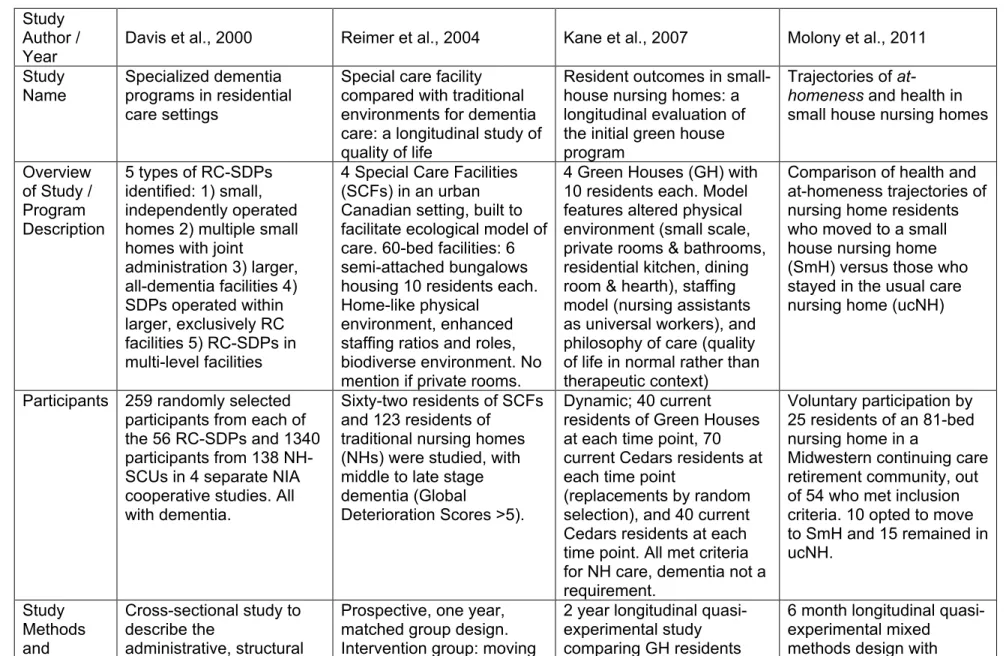
RESULTS (see Table 1)
Resident outcomes of the initial Green House program (Kane et al., 2007)
Program Description
The Green House Model is an innovative “small-house nursing home” that was
purposefully developed as an alternative to the traditional nursing home model, with the
principles of the nursing home culture-change movement at its core. The model was first
traditional nursing home physical, organizational and philosophical structures. Specifically, the
model promotes a smaller scale, self-contained and more home-like physical environment for
seven to ten residents (private rooms and bathrooms, residential kitchen, dining room and
hearth); a staffing model that empowers the direct care workers, reinventing certified nursing
assistants as “universal workers” called Shabhazim with duties extending to include household
tasks such as food preparation and laundry and who report to an administrator called a “Guide”;
and a philosophy of care that reflects a fully person-centered orientation, with resident quality of
life and personhood in a “normal” rather than “therapeutic” context as paramount. Eligible
residents are usual nursing home eligible residents, with or without dementia. The Green
Houses exist as a cluster of small houses on a campus or scattered throughout a neighborhood,
which are licensed as a nursing home (although some assisted living models also exist), and
which are subject to usual state Medicaid reimbursement rates (Rabig et al., 2006).
Evaluation Method
Kane and colleagues undertook a 2 year longitudinal quasi-experimental study to
compare outcomes between Green House residents and two groups of traditional nursing home
residents, from Cedars, the “sponsoring” non-profit nursing home that operated the Green
House, and Trinity, a nursing home in another part of the state with a similar campus and the
same owners. Quality of care and quality of life were the primary outcomes, as measured by
various Minimum Data Set (MDS) indicators for quality of care, and by self-report instruments
for quality of life, emotional well-being, satisfaction, health and functional status. Data were
collected through interviews with staff, residents and family members at baseline and at 3
six-month follow-up intervals. Residents were not able to be randomized; half of the initial Green
House residents were relocated from the locked dementia unit at Cedars based on prior
agreement, and the remaining Green House residents were voluntarily recruited. Multivariate
Evaluation Outcomes
Results overall favored Green House as a promising model, and supported the study
hypothesis of higher quality of life and at least equivalent quality of care at Green Houses in
comparison to traditional nursing homes. The sample was dynamic at all three sites, with new
residents replacing those who died or moved away, and time in the residence was accounted
for as a variable in the analysis. Green House and Trinity occupancy size at each time point was
targeted for 40 participants each, and for Cedars was targeted at 70 participants. At baseline,
more Green House than nursing home residents were African-American (25% versus 5%), and
Green House residents were younger (mean age 81 years versus 87 years and 89 years at
Cedars and Trinity) and had resided at the sponsoring nursing home for less time than the
Cedars residents who did not relocate to a Green House. Functional and cognitive abilities were
similar among the groups.
Quality of life in Green House residents was superior to Cedars residents in 9 of 11
domains and to Trinity residents in 4 of 11 domains. There were no differences in self-reported
health and function among the groups. Emotional well-being scores were higher for Green
House participants than Cedars residents, and satisfaction scores were higher than Cedars
residents for 2 of 3 items, and higher than Trinity residents for 1 of 3 items. Green House
residents were found to have less involvement in organized activities but to participate in more
off-campus outings than Cedars and Trinity residents. With regard to quality of care as
measured by 24 quality indicators from the MDS, in comparison to Cedars, Green House
residents had lower prevalence of residents on bed rest, fewer residents with little or no activity,
and lower incidence of decline in late-loss ADLs; and in comparison to Trinity, Green House
residents had lower prevalence of depression and lower incidence of decline in late-loss
activities of daily living (ADLs). Sample size was inadequate to evaluate fractures, dehydration,
Critical Appraisal
A strength of the study is that broad and relevant outcomes for quality of care and quality
of life were used, including instruments validated in dementia and for use with proxies. The
quasi-experimental design of this study is a limitation, and voluntary relocation to Green Houses
poses a high likelihood of the presence of unmeasured factors that could not be controlled for
between the groups. Furthermore, baseline differences in racial composition between the
groups do not appear to have been adjusted for in the regression analyses, and could certainly
bias assessments of quality of life as well as quality of care. Inability to perform blinded data
collection poses problematic measurement bias. Finally the authors point to the likely existence
of a “Hawthorne effect,” whereby Green House participants and staff may have exhibited
modified behaviors attributable to media attention, and potentially resulting in artificially more
positive Green House outcomes. The results of this study are of limited generalizability, owing
primarily to small sample size, Hawthorne effect, and inadequate information about important
baseline characteristics such as socioeconomic indicators and comorbidities.
Reimer et al., 2004: Quality of life in special care facilities for dementia care
Program Description
In this study, Reimer and colleagues longitudinally compared quality of life over one year
in individuals with middle to late stage dementia residing in special care facilities (SCF) versus
in traditional nursing homes over the course of one year (Reimer et al., 2004). The SCFs were
comprised of 60-bed purpose-built facilities with 10 people living in 6 semi-attached bungalows,
having home-like physical environments arranged like a typical home. Modified staff roles were
described, integrating personal care, leisure and rehabilitation functions. An ecologic model of
care was operative, that is “responsive to unique interplay of each person and the environment,
Evaluation Method
The study used a prospective, matched-group design over one year, with data collection
at baseline and at 3, 6, 9 and 12 month intervals. Individuals expected to move into any of four
newly created SCFs were compared with two control groups, matched with SCF residents on
the basis of function (Global Deterioration [GDS] scores) and age-adjusted comorbidity score.
The first control group was comprised of residents of 28 multiple traditional institutional facilities
(MTIFs) in an urban center in Western Canada who were expected to relocate to another one of
these facilities, to compare the intervention group with similar residents also undergoing
relocation. Individuals in both groups could have come from home or from a facility setting prior
to their move. The second control group was comprised of residents of a single traditional
institutional facility (STIF) who were not expected to move. Quality of life (QOL) was measured
through assessment of 5 domains identified in the literature as important for measuring QOL in
individuals with dementia, incorporating both interactive and observational measures: cognition
(Brief Cognitive Rating Scale [BCRS]), ADL function (functional assessment staging [FAST]),
behavior (Cohen-Mansfield Agitation Inventory [CMAI]), social function (Multidimensional
Observation Scale of Elderly Subjects [MOSES] and Apparent Affect Rating Scale [AARS]), and
affect (Pleasant Events Scale-Alzheimer’s disease). Analysis of covariance (ANCOVA) was
carried out.
Evaluation Results
Overall, quality of life was concluded to be the same or better for older adults with middle
to late stage dementia residing in SCFs as compared with traditional nursing homes after one
year. Sixty-two residents of SCFs and 123 residents of traditional NHs were studied.
Participants had similar baseline characteristics, with a mean age of 81.8 years (SD 7.5), 73.5%
female, mean Charlson Comorbidity Index score 4.5 (SD 1.4), and middle to late stage
decline in most axes of the BCRS over time, except in the functioning and self-care axis, for
which MTIF residents experienced the least decline and SCF residents were in the middle (p =
.012). In the function domain, FAST scores deteriorated significantly over time for all groups,
with the intervention group experiencing less decline than the control groups (p = .016). In the
behavior domain, there was decline in all groups by the CMAI, and no statistically significant
between-group differences. In the social function domain, all groups experienced increased
withdrawal from social activity, with no difference between groups on the MOSES, but there was
significant between-group variation in engagement in pleasant events over time (p = .025), with
all groups declining on this scale at 12 months, and STIF participants demonstrating most
decline across time.
Critical Appraisal
A strength of the study is its design and sample size, both of which are more robust than
many other studies in the literature by being prospective, longitudinal, quasi-experimental, and
of moderate size, although it is nonetheless a major limitation that the sampling was
non-random, allowing the possibility of selection bias. Another strength is that the outcome of quality
of life was well-studied, through a multi-dimensional approach that evaluated five different
domains and used both interactive and observational assessments, although it is
simultaneously a limitation that it is difficult to study the subjective construct of quality of life in
individuals with middle and late stage dementia. Data collection was unblinded, introducing the
possibility of measurement bias. Finally, external validity is somewhat difficult due to the lack of
information about the socioeconomic characteristics of the population.
Specialized dementia programs in residential care settings (Davis et al., 2000)
Overview
assisted living residences that provide specialized dementia care (residential care-specialized
dementia programs, or RC-SDPs), with the goal of describing the characteristics of such
residences and their residents, and comparing them with nursing homes providing dementia
care in special care units (nursing home-special care units, NH-SCUs) and their residents.
RC-SDPs were identified and recruited via telephone survey from seven states (California, Kansas,
Maine, Michigan, Minnesota, North Carolina, and Washington), and site visits were conducted
for data collection. Data were collected about administrative, physical/structural and resident
characteristics via observation, chart review and interviews with staff. These cross-sectional
data were compared with existing data about the same parameters in NH-SCUs and their
residents in the same seven states, from cooperative studies conducted by the National Institute
on Aging (NIA) in the early 1990s. Additionally, they developed a classification scheme for
RC-SDPs based on their size and administrative structure, which allowed for descriptive
comparisons to be made between them.
Results of Comparison
Comparison revealed that RC-SDPs were overall more home-like and had larger
staff-to-resident ratios than NH-SCUs, but had similar processes of care and lower private pay costs
while caring for an overlapping population of patients cared for in NH-SCUs. Fifty-six RC-SDPs
and 259 randomly selected RC-SDP residents were analyzed and compared with 138 NH-SCUs
and 1340 randomly selected NH-SCU residents. A modified NIA questionnaire was used to
assess administrative characteristics. The Therapeutic Environment Screening Scale (TESS)
and Special Care Unit Environment Quality Scales were used to assess the physical
environment and processes of care. The Minimum Data Set (MDS) Cognitive Scale and an
MDS-based index of activities of daily living (ADL) were used to assess resident characteristics.
RC-SDPs were statistically significantly less likely to have bedrooms opening into a long hallway
visual stimulation to residents than at NH-SCUs (23% vs 7%, p <0.001 and 59% vs 37%, p
<0.001, respectively). RC-SDPs reported similar total staff hours per resident per week (46.2
hours, SD 30.4) as NH-SCUs (47.8 hours, SD 74.0), which was a statistically significant
difference, however (p < 0.004). There was no statistically significant difference between
RC-SDPs and NH-SCUs in process of care indicators of resident involvement in organized activities
and observed staff interaction. Percentage of residents paying privately at RC-SDPs was 79%
and at NH-SCUs was 49% (p < 0.001), with private pay rate for a private room averaging
$75.20 per day at RC-SDPs and $104.80 per day at NH-SCUs (p < 0.001). Differences in
resident characteristics were observed as follows: there was a greater proportion of residents
with severe dementia in NH-SCUs than in RC-SDPs (65% vs 45%, p <0.001), while RC-SDPs
cared for a greater proportion of patients with moderate dementia than in NH-SCUs (41% vs
13%, p <0.001); greater proportions of dependency in certain ADLs were seen in NH-SCU than
RC-SDP residents, with 47% and 29%, respectively, requiring assistance with toileting, and
21% vs 9%, respectively, requiring assistance with eating; and greater proportion of behavioral
disturbance evidenced in NH-SCU residents than RC-SDP residents (30% vs 15%, p <0.001).
RC-SDP Typology
The authors developed a typology classifying RC-SDPs into 5 types, based on their size
and administrative structure, which were found to underlie distinct differences in facility culture
and care. Type I facilities included small, independently operated homes with 10 or fewer
residents. Type II facilities consisted of multiple, small homes with joint administration, also
having 10 or fewer residents. Type III facilities included large facilities, devoted exclusively to
dementia care, with more than 10 residents. Type IV facilities were those in which the RC-SDP
was part of a larger assisted living facility that also housed individuals without dementia. Finally,
Type V facilities were RC-SDPs that were part of multi-level, continuing care facilities, which
(>10 residents) RC-SDPs, but small homes reported greater staff hours per resident per week
and more home-like environment, but less resident involvement in organized activities.
Critical Appraisal
An important strength of this study is its use of valid measurement instruments and its
sufficiently large sample size for drawing statistical comparisons between characteristics of
RC-SDPs and NH-SCUs and their residents. The main limitation of this study is its cross-sectional
design, which is useful for descriptive comparisons and hypothesis generation, but does not
allow for causal inference about relationship of facility characteristics and resident outcomes.
Furthermore, the internal validity of this study is threatened by significant possibility for selection
bias, as participation by RC-SDPs was voluntary, and by the fact that the NH-SCU comparison
data were drawn from a cohort about which little information is provided, thus preventing
assessment of the appropriateness of this cohort as a comparison group. External validity is
strengthened in that the facilities studied were chosen from multiple, diverse states. The study’s
observation that RC-SDPs deliver similar processes of care to a population similar to (or at least
overlapping with) that of NH-SCUs, but at lower cost to consumers and in a more home-like
environment, is germane to the widely held concern that increasing state regulation of
RC-SDPs, as seen in nursing homes, may lead to the loss of these advantageous characteristics.
Trajectories of At-Homeness and Health in Small House Nursing Homes (Molony et al., 2011)
Overview
Molony et al. (2011) noted that while the Green House model was associated with many
positive outcomes in the initial evaluation study by Kane et al. (2007), it was unclear what
aspects of the model contributed to these outcomes, nor did the study characterize individual
experiences of residents, which is relevant to the concept of person-centered care. Molony and
key element in health and quality of life outcomes. In this study, the authors sought to
investigate at-homeness as a potential contributing factor to the positive outcomes experienced
by residents of small house nursing homes by replicating the longitudinal quasi-experimental
design of the prior study, and adding additional measures, as well as a mixed methods
approach, to better understand contributing factors both between and within groups.
Evaluation Methods
The study was carried out at a Midwestern continuing care retirement community where
residents of the community’s nursing home were being offered the choice to relocate to one of
five new small house nursing homes (SmH) being created by the facility 15 miles away, or to
remain in the usual care nursing home (ucNH). Of the nursing home’s 81 residents, 44 residents
met inclusion criteria, based on speaking English, having adequate hearing and cognitive ability
to participate and consent, and 28 residents consented to participate. Complete baseline data
was able to be obtained from 25 residents, of whom 10 opted to stay in the ucNH and 15 opted
to move to a SmH. This mixed methods study entailed data collection at baseline and at 1, 3,
and 6 months after moving to the SmH, or equivalent for non-movers. Quantitative measures
included demographic characteristics, levels of at-homeness (measured by a slightly modified
Experience of Home [EOH] Scale), self-rated health, medical comorbidity (Charlson Comorbidity
Index), physical dependency (Minimum Data Set [MDS] 2.0), self-reported activities of daily
living ( Katz ADLs), cognitive function (MMSE), depressive symptoms (Geriatric Depression
Scale [GDS-15]), and social support (Norbeck Social Support Questionnaire [NSSQ]).
Person-environment fit was furthered measured through various question items, and qualitative
interviews were also undertaken at each time wave. Analytic methods consisted of a mixed
model to examine all possible interactions between time and covariates, and interview texts
Evaluation Outcomes
The sample was all White (100%), mostly female (84%) and most had graduated high
school or had some college education (72%). Baseline health and function characteristics
between the two groups were similar (including mean MMSE score for both groups 22.9, mean
Charlson Index 8.2 and 8.1, and mean age 84.9 and 82.7 for SmH and ucNH, respectively)
except for significant differences in baseline depressive symptoms and at-homeness, with the
SmH group reporting more depressive symptoms (mean GDS-15 3.7 vs 2.2, p = .05) and less
at-homeness (mean EOH 0.7 vs 0.9, p = .0475) than the ucNH group. Regarding trajectories of
at-homeness, most residents who chose to stay at the ucNH had high baseline EOH scores and
maintained these over the next 6 months, and all residents who chose to move to the SmH had
increases in their EOH scores over time. A difference in functional trajectories was also seen
between groups, with the SmH group experiencing improved ADL function over time, whereas
the ucNH group only maintained their function (mean MDS-ADL score decline of 8.8 vs 1.5, p =
.0383). There were no significant differences within groups in depressive symptoms over time.
Qualitative findings identified factors that contributed to at-homeness in both groups,
including closeness and involvement with family, relationships with staff members who “really
cared,” having fun (with staff or other residents), and having attentive health care. In both
groups, high levels of at-homeness were associated with perceptions of freedom, and private
room and bathroom were highly valued. The authors conclude that the relationships between
perceived self-efficacy, functional performance and the small house environment are complex,
and that an individualized approach is necessary to optimize at-homeness for residents in any
location, rather than assuming a “one size fits all” approach to small house nursing homes.
Furthermore, they suggest the need for smooth integration of the “social model” and the
“medical model” in relation to at-homeness, versus an artificial dichotomy that is often
Critical Appraisal
Overall, this is a fair quality study. The quasi-experimental longitudinal design permits
evaluation of certain independent associations between variables, but the small sample size
yields insufficient power for full multivariate modeling and analysis. Furthermore, the
non-random sampling strategy allows significant possibility for bias. Characteristics of and reasons
for non-participation by the moderate number of eligible residents of the ucNH who chose not to
participate are not elucidated. Additionally, the authors do not provide adequate details about
the intervention, such as the size of the small house nursing homes and the eligibility criteria set
by the facility for nursing home residents to move to a small house, to determine degree of
similarity or dissimilarity to the prototype Green House model of a small house nursing home
and confidently establish external validity.
The significant strength of this study is its qualitative depth and richness, which enabled
valuable contextual interpretation of the quantitative findings and furthered the understanding of
the complexity of the at-homeness construct, as well as added to the limited data on small
house nursing homes.
DISCUSSION
The studies analyzed in the systematic review above yielded many valuable insights
applicable to the program design and evaluation planning for Charles House-Yorktown
Eldercare Home. With regard to the program design, the studies by Kane et al. and Reimer et
al. provided useful descriptive details about the Green House model and about Special Care
Facilities, respectively, including details about physical layout and environment, staffing mix and
organizational hierarchy, care processes and philosophy of care. The studies by Reimer et al.
and Molony et al. highlighted the complexity of person-environment fit for quality of life and
at-homeness, including the importance of facilitating perceptions of freedom towards maximizing
particularly insightful in the elucidation of factors associated with at-homeness, including
closeness and involvement with family, relationships with staff members who “really cared,”
having fun (with staff or other residents), and having attentive health care. Of note, the studies
included participants with mild dementia (Molony et al.) through moderate and late stage
dementia (Kane et al., Reimer et al.), consistent with the spectrum of dementia severity in
individuals eligible for care at Charles-House Yorktown Eldercare Home, although the program
is not being planned to care exclusively for individuals with dementia. Many of these concepts
have already been incorporated into the Eldercare Home’s design and processes on an intuitive
basis, and the findings in this literature support their continued application and future
enhancement. These findings will be useful to consider in the ongoing program improvement of
the Eldercare Home.
Information from the studies was also valuable for generating ideas for the evaluation
plans for the Eldercare Home. The cross-sectional study of RC-SDPs by Davis et al. is
potentially most applicable for evaluation planning for the Eldercare Home, given the
parameters for the scope of evaluation, which will be discussed in the Evaluation Plan section of
this paper. The instruments for measuring aspects of the environment could be particularly
useful, including the Therapeutic Environment Screening Scale (TESS) and Special Care Unit
Environment Quality Scales, to assess the degree to which the program is able to provide an
environment in line with its goals. Finally, the studies of quality of life and at-homeness by
Reimer et al. and Molony et al. revealed the importance of assessing quality of life through
various different domains and through qualitative techniques in order to gain optimally
Table 1: SUMMARY TABLE OF THE EVIDENCE
Study Author / Year
Davis et al., 2000 Reimer et al., 2004 Kane et al., 2007 Molony et al., 2011
Study Name
Specialized dementia programs in residential care settings
Special care facility compared with traditional environments for dementia care: a longitudinal study of quality of life
Resident outcomes in small-house nursing homes: a longitudinal evaluation of the initial green house program
Trajectories of
at-homeness and health in small house nursing homes
Overview of Study / Program Description
5 types of RC-SDPs identified: 1) small, independently operated homes 2) multiple small homes with joint
administration 3) larger, all-dementia facilities 4) SDPs operated within larger, exclusively RC facilities 5) RC-SDPs in multi-level facilities
4 Special Care Facilities (SCFs) in an urban Canadian setting, built to facilitate ecological model of care. 60-bed facilities: 6 semi-attached bungalows housing 10 residents each. Home-like physical
environment, enhanced staffing ratios and roles, biodiverse environment. No mention if private rooms.
4 Green Houses (GH) with 10 residents each. Model features altered physical environment (small scale, private rooms & bathrooms, residential kitchen, dining room & hearth), staffing model (nursing assistants as universal workers), and philosophy of care (quality of life in normal rather than therapeutic context)
Comparison of health and at-homeness trajectories of nursing home residents who moved to a small house nursing home (SmH) versus those who stayed in the usual care nursing home (ucNH)
Participants 259 randomly selected participants from each of the 56 RC-SDPs and 1340 participants from 138 NH-SCUs in 4 separate NIA cooperative studies. All with dementia.
Sixty-two residents of SCFs and 123 residents of
traditional nursing homes (NHs) were studied, with middle to late stage dementia (Global
Deterioration Scores >5).
Dynamic; 40 current residents of Green Houses at each time point, 70 current Cedars residents at each time point
(replacements by random selection), and 40 current Cedars residents at each time point. All met criteria for NH care, dementia not a requirement.
Voluntary participation by 25 residents of an 81-bed nursing home in a
Midwestern continuing care retirement community, out of 54 who met inclusion criteria. 10 opted to move to SmH and 15 remained in ucNH.
Study Methods and
Cross-sectional study to describe the
administrative, structural
Prospective, one year, matched group design. Intervention group: moving
2 year longitudinal quasi-experimental study comparing GH residents
Measures and resident
characteristics of RC-SDPs in comparison to NH-SCUs in 7 states. Administrative
characteristics: modified NIA questionnaire. Structural characteristics (physical environment and process of care):
Therapeutic Environment Screening Scale (TESS) and Special Care Unit Environmental Quality Scale. Resident
characteristics: facility staff interview and chart review for MDS Cognitive Scale and MDS-based index of activities of daily living. NH-SCU data obtained from NIA cooperative studies.
to SCF from any
environment. Control group 1: relocating with multiple traditional institutional facility (MTIF) to another, Control group 2: remaining in a single traditional institutional facility (STIF). Quality of life measured across 5 domains: cognition (Brief Cognitive Rating Scale), function (Functional Assessment Staging [FAST]), behavior (Cohen-Mansfield Agitation Inventory), social function (Pleasant Events Scale-Alzheimer’s disease, Multidimensional Observation Scale of
Elderly Subjects), and affect (Apparent Affect Rating Scale [AARS]).
with residents at 2
comparison nursing homes using baseline data and three 6 month follow-up intervals. Measures: Quality of life (scales for 11
domains), emotional well-being, satisfaction, self-reported health and
functional status. Quality of care: 24 quality indicators from MDS.
repeated measures at baseline and 1, 3 and 6 months. Quantitative measures included self-rated health, functional dependence (MDS 2.0), self-reported function (Katz ADLs), depressive
symptoms (Geriatric Depression Scale-15), at-homeness (Experience of Home [EOH] scale). Qualitative data collection involved interviews at each wave of data collection.
Results Higher proportion of participants with severe dementia and ADL dependency in NH-SCU than RC-SDP. Higher proportion of private pay participants in RC-SDP. Similar processes of care and overlap of participant population, but at lower cost for private pay consumers, and with greater flexibility and more
Residents of SCFs had less functional decline than both control groups as measured with FAST scale, more sustained interest in the environment as measured by the AARS, with
increased interest and less anxiety/fear. All groups demonstrated declines over time in cognition (including concentration and
orientation), behavior,
Green House residents younger and higher proportion African -American. Compared to Cedars, GH participants scored higher in most quality of life domains, satisfaction, emotional-wellbeing, and had less bed rest, less ADL decline. Compared to Trinity, GH participants scored better in some quality of life
Residents who opted to move to SmH had lower at-homeness on EOH scale and higher depressive symptoms at baseline than residents who stayed in ucNH. Residents of ucNH maintained their high EOH scores over 6 months and all SmH residents had improved EOH scores over time. SmH residents
home-like environment in RC-SDPs. Small RC-SDPs reported greater staff hours per resident per week and more home-like environment than large RC-SDPs, but less resident involvement in organized activities.
depression and social withdrawal, without significant between group differences.
domains, and in 1 of 3 satisfaction items, no difference in emotional well-being, and had less
depression, less ADL decline, more incontinence. No difference in
self-reported health or function between the groups. GH residents participated less in organized activities, but more off-campus outings.
dependence after moving, whereas ucNH residents maintained same function. Qualitative findings
highlight complexity and individualized nature of at-homeness; social
relationships and
perception of freedom were important in both locations.
Internal Validity
Cross-sectional design prevents causal
inferences. Voluntary participation and vague definition by RC-SDPs creates strong possibility for selection bias.
Inadequately powered for comparisons between the RC-SDPs subtypes.
Longitudinal,
quasi-experimental design more robust than many others in literature, but still
suboptimal and sampling bias very possible. Measurement bias also possible due to unblinded data collection.
Quasi-experimental design rather than randomized controlled trial; selection bias, as GH residents were voluntary; confounding by age and race possible, and by other unmeasured factors such as
socioeconomic status; measurement bias, as data collectors were non-blinded.
Threats to internal validity in both groups include environmental changes at both the SmH’s and the ucNH, more similar to each other over time. Non-random sampling introduces strong possibility of bias. Small sample size prevented full multivariate modeling. External
Validity
Aggregate data not readily generalizable to individual state contexts.
No information on socioeconomic
characteristics of residents; reasonable generalizability to diverse state contexts.
No information on socioeconomic characteristics and
comorbidities of residents; difficult to generalize.
Inadequate information about SmH nursing homes to enable generalization with other SmHs or compare with ucNH
EVALUATION PLAN: LOOKING TOWARDS PROGRAM IMPROVEMENT
INTRODUCTION
This section consists of an evaluation plan for the Charles House-Yorktown Eldercare
Home program, including the rationale for and approach to the evaluation, discussion of
evaluation study design and methods, evaluation planning tables, discussion of institutional
review board considerations and dissemination plans.
RATIONALE AND APPROACH TO THE EVALUATION
Purpose of Evaluation
The Executive Director of the Charles House Association (CHA) and researchers at the
University of North Carolina-Chapel Hill are interested in conducting an evaluation of the
Charles House-Yorktown Eldercare Home to understand lessons learned and to disseminate
the program’s model. The primary focus of the evaluation is on improving the program and
informing a planned upcoming local replication of the program by CHA. There is a secondary
focus on potential dissemination of the program, to share findings about effective program
elements and program challenges in response to intense societal interest in innovative models
of long-term care. The primary intended user of the evaluation is therefore CHA itself, and
secondary users include a potential dissemination audience comprised of other program
developers, advocates, researchers and policymakers interested in eldercare.
The Charles House-Yorktown Eldercare Home program has been operating for three
years, and evaluation at this stage will enable determination of how well the program is
achieving its intended goals. There is particular interest in assessing the effectiveness and
outcomes of certain novel program elements. In addition to assessing the program’s outcomes,
the evaluation will also focus attention on the program’s processes. Process evaluation includes
questions about whether there are gaps in the process or areas that need improvement, and