Acknowledgements
First and foremost, I offer my sincerest gratitude to my advisor, Dr. Joe Caddell, for his patience and guidance throughout this process. Without his passion, his expertise, and his encouragement, I would not have completed this project. I would also like to thank the Peace, War and Defense Department and the Gillian T. Cell Honors Thesis Research Award Fund that sponsored my trips to Washington, D.C. This funding was critical to my research and I am sincerely appreciative.
My deep gratitude also goes to retired Brigadier General Feroz Khan. I thank him for his enthusiasm for my research and also his constant willingness to answer my many questions. Without our discussions, my understanding of Pakistani politics and the Pakistani nuclear weapons program would be incomplete. His insight was truly irreplaceable.
I could not have finished this paper without the support of Jackie Gorman. She is the best part of the Peace, War and Defense Department and I am so thankful for her friendship. I would also like to thank Jacob Forest for editing portions of this thesis.
Acknowledgements………...1
Table of Contents………...2
List of Acronyms………..….………..…3
Timeline of Nuclear Events and Changes in Leadership…...………...4
List of Pakistani Leaders and Chiefs of Army Staff………...5
INTRODUCTION………...7
CHAPTER I. Historical Context 1947-1958: An Unstable Democracy and A Powerful Military...16
CHAPTER II. The Nuclear Decision: The Military Dictatorship of General Ayub Khan from 1958-1971………...…….22
CHAPTER III. The Nuclear Decision: Civilian Autonomy over the Nuclear Program from 1971-1977………...……….35
CHAPTER IV. 1977-1993: Military Presidency and Exclusion of Civilian Involvement in the Nuclear Program………...………..51
CHAPTER V. 1993-1999: The Decision to Test A Nuclear Device and The Kargil War………....……….66
CHAPTER VI. Nuclear Command Infrastructure……….82
CONCLUSION………..94
List of Acronyms
ACDA Arms Control and Disarmament Affairs CAS Chief of Air Staff
CD Combat Directorate
CIA Central Intelligence Agency
CJCSC Chairman of the Joint Chief of Staff Committee CNS Chief of Naval Staff
COAS Chief of Army Staff
CTBT Comprehensive Test Ban Treaty DCC Defense Committee of the Cabinet DCC Development Control Committee
DGCD Director General of the Combat Directorate DGSPD Director General of the Strategic Plans Division DTD Directorate of Technical Development
ECC Employment Control Committee ERL Engineering Research Laboratories GHQ General Headquarters
HEU Highly Enriched Uranium
IAEA International Atomic Energy Agency ISI Inter-Services Intelligence
JCSC Joint Chiefs of Staff Committee KANUPP Karachi Nuclear Power Plant KRL Khan Research Laboratories NCA National Command Authority NPT Nonproliferation Treaty
PAEC Pakistan Atomic Energy Commission
PINSTECH Pakistan Institute of Nuclear Science and Technology PML Pakistan Muslim League
PNL Pakistan National Alliance PPP Pakistan People’s Party SPD Strategic Plans Division
Timeline of Nuclear Events and Changes in Leadership Bold print indicates a change in leadership
1947 Partition of British Indian Empire
1955 The United States agrees to share nuclear energy technology with Pakistan 1956 Pakistan establishes the Pakistan Atomic Energy Commission (PAEC)
1958 President Ayub Khan takes power via a military coup d’état
1960s Pakistan accumulates a variety of nuclear technologies for peaceful purposes. Pakistani leadership encourages the nation’s top scientists to study abroad and gain expertise.
1965 Indo-Pakistan War of 1965
1970 Pakistan declines to sign the Nuclear Nonproliferation Treaty 1971 Indo-Pakistan War of 1971 results in the creation of Bangladesh
1971 Zulfiqar Bhutto of the Pakistan People’s Party becomes prime minister
1972 Prime Minister Bhutto meets with top scientists in Multan and concludes that Pakistan will pursue a nuclear weapons program
1974 India detonates “Smiling Buddha” in its first nuclear test 1974 A.Q. Khan contacts Prime Minister Bhutto about the program 1975 The PAEC began its initiative to produce highly enriched uranium 1976 The PAEC and Engineering Research Laboratories split
1977 COAS General Muhammad Zia-ul-Haq overthrows Prime Minister
Bhutto in a military coup d’état
1979 The U.S. announces that it will cut aid to Pakistan due to the nation’s questionable nuclear activities
1983 Pakistan cold tests a nuclear device in the Kirana Hills
1984 A.Q. Khan declares that Pakistan achieved highly enriched uranium 1988 General Zia-ul-Haq dies in a controversial plane crash
1988 Benazir Bhutto of the Pakistan People’s Party is elected
1989 Prime Minister Benazir Bhutto travels to the U.S. to confirm that Pakistan does not intend to build a nuclear weapon
1990 Nawaz Sharif of the Pakistan Muslim League is elected to power
1993 Prime Minister Nawaz Sharif and President G.I. Khan are dismissed 1993 President G.I. Khan gives the military control of the nuclear weapons
program as he leaves office
1993 Benazir Bhutto is elected for a second term
1997 Nawaz Sharif is elected for a second term
1998 Both India and Pakistan detonate nuclear devices in a demonstration of nuclear capability
1999 The Kargil War breaks out between India and Pakistan in the first conflict since both nations obtained an operational deterrent
1999 COAS General Musharraf overthrows Prime Minister Nawaz Sharif
in a military coup d’état
2000 President Musharraf establishes the National Command Authority
Pakistani Presidents, Prime Ministers and Chiefs of Army Staff
Bold indicates a military administration
Term Chief Executive Prime Minister Chief of Army Staff (COAS)
1947-1948 Mohammad Ali Jinnah Liaquat Ali Khan (1947-1951)
General Sir Frank Messervy 1948-1951 Khwaja Nazimuddin Liaquat Ali Khan
(1947-1951)
General Sir Douglas Gracy
1951-1955 Ghulam Mohammad Khwaja Nazimuddin (1951-1953) Mohammad Ali Bogra
(1953-1955)
General Mohammad Ayub Khan
1955-1956 Iskander Mirza Chaudry Mohammad Ali (1955-1956)
General Mohammad Ayub Khan 1956-1958 Iskander Mirza Husain Shaheed
Suharwardy (1956-1957) Iftikhar Chundrigar
(Interim) Feroz Khan Noon
(1957-1958)
General Mohammad Ayub Khan
1958-1969 General Mohammad
Ayub Khan None
General Agha Mohammad Yahya
Khan 1969-1971 General Agha
Mohammad Yahya Khan
None Mohammad Yahya General Agha Khan 1971-1973 Zulfiqar Ali Bhutto
None Lt. General Gul Hassan Khan General Tikka Khan 1973-1978 Fazal Elahi Chaudhry Zulfiqar Ali Bhutto
(1973-1977)
General Tikka Khan; General Mohammad
1978-1988 General Mohammad Zia-ul-Haq
Mohammad Khan Junejo (1985-1988)
General Mohammad Zia-ul-Haq 1988-1993 Ghulam Ishaq Khan Benazir Bhutto
(1998-1990) Ghulam Mustafa Jatoi
(Interim) Moeenuddin Qureshi
(Interim)
General Mirza Aslam Beg
General Asif Nawaz Janjua
1993-1997 Farooq Khan Leghari Benazir Bhutto (1993-1996) Malik Meraj Khalid
(Interim)
General Abdul Waheed General Jehangir
Karamat
1997-2001 Rafiq Tarar Mian Mohammad Nawaz Sharif (1997-1999) General Jehangir Karamat General Pervez Musharraf 2001-2008 General Pervez
Musharraf
Zafarullah Jamali (2002-2004) Chaudry Shujaat Hussain
(Interim) Shaukat Aziz
(2004-2007)
General Pervez Musharraf General Ashfaq Pervez
Kayani
2008-2013 Asif Ali Zardari Yusuf Raza Gilani (2008-2012) Raja Pervez Ashraf
(2012-2013)
General Ashfaq Pervez Kayani
2013- present
Mamnoon Hussain Nawaz Sharif (2013-present)
INTRODUCTION
The Pakistani nuclear weapons program represents decades of sacrifice, sanctions and scientific development. Condemned by the international community and its rival, India, the program has also been controversial. For Pakistanis, it embodies the resolve of the Pakistani leadership and scientific community to produce one of the greatest
technological feats of the 21st
century: an atomic bomb. However, developing a bomb was not without its challenges. This thesis analyzes the relationship between civilian leaders and the military throughout the evolution of the program. While the nuclear program began under a civilian leader, the program did not remain under civilian control. This thesis argues that the inability of the Pakistani political system to produce legitimate democratic leadership led the military to assume de facto responsibility for the nuclear arsenal and the perceived survival of the nation.
Much of the existing literature agrees that the Pakistani military dictates nuclear policy, development and management. This thesis analyzes Pakistani civil-military relations since partition and examines how this relationship between civilian leaders and military officials influenced the development and management of the nuclear arsenal. Investigating the historical narrative of Pakistani civil-military relations and the Pakistani nuclear weapons program is critical to understanding how the military came to possess de facto control of the arsenal.
discord ultimately led to military control of the nuclear weapons program. The final chapter examines the current de jure nuclearcommand and control structure with the Prime Minister as chairman. However, despite the de jure authority of civilian leaders, an unstable and unreliable political environment led to the military’s de facto control of the arsenal.
Pakistan was ethnically and politically fragmented from the time of partition from India in 1947. In point of fact, “Pakistan” is an amalgamation of the Muslim-dominated provinces stitched together. Journalist Christopher Hitchens claims that “Pakistan” is an acronym for the provinces: Punjab, Afghania, Kashmir, Indus and Sind with “tan” derived from Baluchistan.1
If his explanation is correct, the very name “Pakistan” is a tangible representation of the ethnic and regional loyalties that perpetuate the country’s domestic challenges. As a relatively young nation, these rivalries caused the political system to consistently fail to produce legitimate leadership transitions.
Historic affiliations created a political system plagued by relentless opposition to prime ministers. Internal unrest has been inherent to Pakistani politics and, as a result, the military frequently intervenes to restore control. Civilian leaders are often accused of corruption and inefficiency, while the military claims to be a guarantor of stability.2
As a nuclear-armed state, the effectiveness of the relationship between civilian leaders and military officials is vital.
While a civilian leader initiated nuclear development, his rule was the only period when a democratically elected leader had autonomous control over the program. Zulfiqar
1
Christopher Hitchens, “Pakistan is the Problem,” Slate, September 15, 2008.
http://www.slate.com/articles/news_and_politics/fighting_words/2008/09/pakistan_is_the 2
Ali Abbas Hasanie, Democracy in Pakistan: Crises, Conflicts and Hope for a Change
Ali Bhutto led the nation from 1971 until he was overthrown in a military coup d'état in 1977. He justified the creation of a nuclear program after blaming the Pakistani military for a defeat at the hands of Indian military power. In 1971, the Indian armed forces dealt the Pakistani military a humiliating defeat and separated East Pakistan from West Pakistan. After the war, Prime Minister Bhutto shamed the military by reducing its
budget and intentionally delaying efforts to retrieve prisoners of war from India. He could not depend on the military’s conventional strength and sought an alternate security
solution: a nuclear weapon.
In an interview with the Manchester Guardian on March 11, 1965 when he was the Pakistani Foreign Minister, Zulfiqar Bhutto declared that:
If India makes an atom bomb, then even if we have to feed on grass and leaves— or even if we have to starve—we shall also produce an atom bomb as we would be left with no other alternative. The answer to an atom bomb can only be an atom bomb.3
Subsequently, India built the bomb and Prime Minister Bhutto’s promise was fulfilled. After the Indian test of “Smiling Buddha,” the nation’s first detonation of a nuclear device on May 18, 1974, Pakistan intensified its efforts to build a nuclear weapon. True to Prime Minister Bhutto’s statement, Pakistan overcame many obstacles and made great sacrifices to produce a bomb. Unfortunately for the Prime Minister, his friction with the military ultimately led to his overthrow and a death sentence from the Chief of Army Staff (COAS), General Muhammad Zia-ul-Haq.4
3
Patrick Keatley, “The Brown Bomb,” Guardian (Manchester), March 11, 1965, cited in Dennis Kux, The United States and Pakistan, 1947-2000: Disenchanted Allies
(Baltimore: Johns Hopkins University Press, 2001), 212.
4
During President Zia’s term, from 1977 until 1988, he led the military and the country. Serving as both the COAS and President allowed Zia to exclude civilian involvement from the nuclear program. His rule included the first “cold test” conducted by Pakistan in 1983.5
A cold test, or subcritical test, assesses the design of a nuclear device, but does not create an atomic explosion.
While his leadership achieved this level of development, his military leadership also created problems for the nuclear program. In a departure from the British-influenced style of secular rule, President Zia introduced Sharia law, or Islamic law, to Pakistan.6
His recruitment of military officers based on their loyalty to Islam led to an Islamization of the armed forces. In the context of nuclear management, however, this radicalism is a danger to the security of the arsenal.
After President Zia-ul-Haq died in a mysterious plane crash in 1988, Pakistan returned to democratically elected civilian leadership. The daughter of former Prime Minister Zulfiqar Bhutto, Benazir Bhutto, was in power from 1988 to 1990 and again from 1993 to 1996. During her first term as the Prime Minister, Ghulam Ishaq Khan was the President. But despite the new leader, the nuclear command and control system established during her predecessor’s term continued. The military maintained its authority over nuclear decision-making. President Zia-ul-Haq’s eleven-year tenure had allowed the military to manage the arsenal and it was not willing to concede its role to the
5
Feroz Hassan Khan, Eating Grass: The Making of the Pakistani Bomb (Stanford: Stanford University Press, 2012),189.
6
new leader. The COAS General Aslam Beg and President G.I. Khan monopolized nuclear decision-making and often excluded Prime Minister Benazir Bhutto.7
The military’s refusal to include her in nuclear policy making raised questions about the legitimacy of Pakistani nuclear management. The military believed itself the most competent institution to make decisions and President G.I. Khan’s years of experience with the program gave him unrivaled access to this decision-making. In a meeting with American officials during her first term in 1993, Prime Minister Benazir Bhutto was blindsided by U.S. intelligence reports that proved General Beg and President G.I. Khan were actively omitting her from nuclear decisions.8
Prime Minister Nawaz Sharif led the nation from 1990 to 1993 and from 1996 to 1998. Notorious for his poor relationship with the military, Prime Minister Sharif
experienced friction with all five of his Chiefs of Army Staff. He quarreled with General Mirza Aslam Beg and General Asif Nawaz and his first term ended when General Abdul Waheed dismissed him and President G.I. Khan in 1993 from government.9
Their removals resulted in President G.I. Khan officially giving the military control of the nuclear arsenal.10
From President Zia establishing military control in between 1977 and 1993, the military had retained its power over the nuclear program. The military control became formal after both civilian leaders, Prime Minister Sharif and President G.I. Khan, were dismissed from government in 1993.
7 Gurmeet Kanwal, “Command and Control of Nuclear Weapons in India,” Strategic
Analysis: A Monthly Journal of the IDSA 23, no. 10 (2000).
8
Seymour Hersh, “On the Nuclear Edge,” New Yorker, March 29, 1993, accessed February 13, 2015, http://www.newyorker.com/magazine/1993/03/29/on-the-nuclear-edge.
9
Feroz Hassan Khan, Eating Grass, 324.
When Prime Minister Sharif returned to power in 1996, he soon faced a new threat. In 1998, India conducted five nuclear tests between May 11 and May 13 at its Pokhran test site. Prime Minister Sharif responded bluntly: “As a sovereign and
independent nation, Pakistan will make its own decisions on the steps to be taken towards its sovereignty and defense.”11
He initiated these steps in a meeting with the Defense Committee Cabinet (DCC). In an interview, he described how Chief of Army Staff General Jehangir Karamat was hesitant to respond with a Pakistani test.12
Prime Minister Sharif and COAS Karamat ultimately approved the test of Pakistani nuclear devices between May 28 and May 30, 1988.
In 1999, civil-military relations reached a new low when Prime Minister Sharif traveled to the U.S. in the midst of the Kargil War to ask for U.S. assistance to diffuse the conflict. Instead, U.S. officials presented him with intelligence indicating that the
Pakistani military, under COAS General Pervez Musharraf, was readying nuclear weapons for use against India.13
While COAS Musharraf denies this claim,14
Prime Minister Sharif had been so excluded from nuclear decision-making that he could neither confirm nor deny the allegations. The U.S. leveraged the resulting discord between Sharif and COAS General Musharraf and convinced the Prime Minister that he knew very little about the operation of his own military. The U.S. ultimately forced Prime Minister Sharif to accept an unconditional withdrawal from the Kargil War, ending the first conflict
11
“1998: India explodes nuclear controversy,” BBC On This Day 1950-2005, accessed January 25, 2015,
http://news.bbc.co.uk/onthisday/hi/dates/stories/may/11/newsid_3664000/3664259.stm 12
Shuja Nawaz, Crossed Swords: Pakistan, Its Army and the Wars Within (New York: Oxford University Press, 2009), 493.
13
Nawaz, 133-134.
14
between India and Pakistan during which both nations possessed an operational deterrent.15
After the Kargil War, both COAS General Musharraf and Prime Minister Sharif blamed each other for the Pakistani military’s embarrassing defeat by the Indian armed forces. Prime Minister Sharif and his supporters sensed that the military was poised to seize control by October 1999. To avoid a military coup d'état, the Prime Minister
refused to allow General Musharraf’s plane to return to Pakistan from a trip to Sri Lanka. Ultimately, airport officials permitted the plane to land and COAS General Musharraf overthrew the Sharif government. While Musharraf’s rule from 1999 to 2008 was a severe setback to democracy, he oversaw a variety of improvements to the nuclear program.
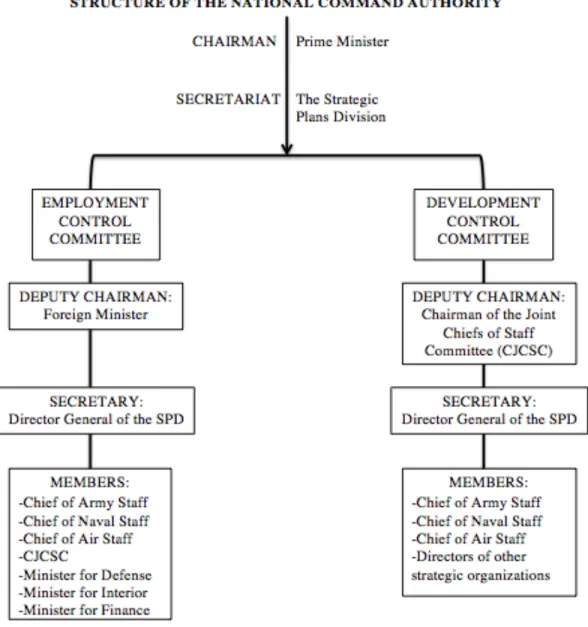
One of Musharraf’s most notable contributions was the establishment of the National Command Authority (NCA) in 2000. The NCA includes both civilian leaders and military representatives with the sole purpose of managing the Pakistani nuclear weapons program. The Prime Minister is the chairman and oversees two committees, the Employment Control Committee (ECC) and the Development Control Committee (DCC).16
The ECC includes both civilian and military leaders, while the DCC is composed of solely military leaders and directors of strategic scientific organizations.17
While the NCA includes civilian leaders, civilian involvement in nuclear
decision-making is restricted by the military. The NCA’s secretariat, the Strategic Plans
15
Feroz Hassan Khan, Eating Grass, 314.
16
Ibid., 334.
17
Division (SPD), is the military organization charged with executing NCA policies.18
Given the military’s familiarity with the program beginning with President Zia’s term, it sees itself as the most experienced institution in Pakistan to control the arsenal. The military is also responsible for the physical control of weapons and oversees the logistics of the program, which furthers its involvement in nuclear decisions.19
As the former Director of Arms Control and Disarmament Affairs (ACDA) within the SPD, retired Brigadier Feroz Khan explains in an interview with the author, “the military is the strongest organization in the country, the most viable organization, the most disciplined. And this is their job.”20
As the Director of ACDA, he represented Pakistan in a variety of arms control negotiations. After serving in the Pakistani military for over thirty years, Brigadier Khan moved to the United States where he held positions at research organizations, such as the Woodrow Wilson Center and the Brookings Institution. He is currently a lecturer at the Naval Postgraduate School in Monterey, California. He believes that until Pakistan can bring cohesion to its chaotic political environment and commit to legitimate civil-military roles, the military is likely to retain
de facto control of the arsenal.
Many scholars, including Brigadier Khan, agree that the military is the most qualified institution in Pakistan to manage the nuclear arsenal. This paper accepts the current de facto command and control system, but analyzes how the military’s de facto
control developed. While the civilian leadership possesses de jure control, the military’s
de facto authority was a product of a turbulent and unreliable political environment.
18
Feroz Hassan Khan, Eating Grass, 328-332.
19
Ibid., 331.
20
CHAPTER 1- HISTORICAL CONTEXT 1947-1958: AN UNSTABLE
DEMOCRACY AND A POWERFUL MILITARY
The nation of Pakistan became independent fifty years before it exploded its first nuclear weapon in May of 1998. On August 14, 1947, the independence of British India became official, but it produced two new nations, India and Pakistan, as independence was followed immediately with partition. However, in the following months, dividing the resources of the British Indian Empire between the two countries proved problematic. The objective of this chapter is to examine the formative years of Pakistani democracy. It will discuss how Pakistan struggled to develop with limited resources and ultimately failed to create framework for legitimate democracy.21
The historically strong military presence in Pakistan filled the void, but eventually hindered political evolution.
A weak Pakistani political infrastructure stemmed from an unequal division of resources at the time of partition in 1947. The final Viceroy of India, Lord Louis
Mountbatten, hurried the division of British Indian so rapidly that partition was complete ten months before the original deadline.22 The original plan was for the partition process
to take an entire year, from June 1947 to June 1948.23
Under Lord Mountbatten’s hasty direction, the partition of the subcontinent took just over two months. In the opinion of scholar Anas Malik, “the rushed British departure and inadequately transferred and apportioned political authority likely contributed to the violence that ensued.”24
21
Nawaz, 31.
22
Ibid., 27.
23
Ibid.
24
The disproportionate division of resources was a consequence of the hurried partition. The unequal division of these resources was mostly due to their location within the newly drawn Indian border, and not due to any willful Indian effort to deny resources to Pakistan. However, the scarcity of military assets was a challenge to the fledgling Pakistani nation. According to Shuja Nawaz, brother of the late Chief of Army Staff General Asif Nawaz (COAS from 1991-1993) and former Director of the International Atomic Energy Agency:
Out of the 46 [British Indian Army] training establishments that existed in pre-partition India, only 7 were in Pakistan…The three command workshops of the British Indian army that helped maintain armoured fighting vehicles, radar repairs, and crystal cutting, were all left in India, at Secunderabad, Kirkee, and Agra. Of the 40 ordnance depots, only 5 small retail depots were located in
Pakistan.… Similarly, there were twelve engineer stores depots in British India, of which only three small depots came to Pakistan. Even the munitions industry that was expanded during the Second World War came to reside primarily in India, with only 3 of the 18 ordnance factories located in Pakistan. In short, even with the greatest willpower and determination of its fighting forces, Pakistan began life with a weak logistical infrastructure and serious dependence on Indian goodwill to transfer assets to it.25
The Pakistani military also faced manpower and staffing challenges. For example, at partition Pakistan assumed control of 6 of the 14 armored regiments, 8 of the 40
artillery regiments and half of the infantry regiments and the majority of soldiers that comprised the fledgling Pakistani military were from the Punjab province. 26
At the time of independence in 1947, Punjabis dominated the ranks of both the military and
bureaucratic institutions. Of the Army’s posts, Punjabis held 80% of them. Punjabis also occupied 55% of bureaucratic and administrative positions.27
25
Nawaz, 31.
26
Ibid., 32.
27
The Punjab province was historically crucial to British India. As a recruiting ground for the British Army, it became one of the most powerful provinces.28
Such high percentages of Punjabis in the British Indian force granted servicemen in the region special privileges. The British Indian Army rewarded Punjabi military officers with land grants, high salaries, and pensions.29
The British Raj also employed Punjabi rural elites as military contractors or liaisons between civilians and the forces.30
Almost every Punjabi was involved in some aspect of the military, either directly as a serviceman or indirectly as an administrative support official.31
The British recruitment from the Punjab province fostered a strong military culture in the region that continued throughout the early years of Pakistani maturity.
The development of civilian government began with Mohammad Ali Jinnah, the first leader of Pakistan. He held the title of Governor-General from 1947-1948. The Governor-General was the Pakistani head of state while under British rule and Pakistan continued the position after partition.32
The position existed until 1956 when the nation became a republic and replaced it with the role of President.33 Governor-General Jinnah
was also the director of the Muslim League, a political advocacy group for Pakistani independence.34
Unlike India that possessed the enduring political infrastructure of the
28 Ibid., 40. 29
Ibid., 54.
30
Ibid.
31
Ibid., 55.
32
Devendra Panigrahi, India’s Partition: The Story of Imperialism in Retreat (New York: Routledge, 2004), 39.
33
Charles H. Kennedy, “Constitutional and Political Change in Pakistan: The Military-Governance Paradigm,” in Prospects for Peace in South Asia, ed.Rafiq Dossani and Henry S. Rowen (Stanford: Stanford University Press, 2005),39.
34
British Indian Empire, Pakistan established a relatively new political system.35
Governor-General Jinnah sought to establish a strong central government and encouraged
democracy.36
However, political cohesion in Pakistan was evasive. At partition, many Pakistani citizens emphasized their loyalty to their province, rather than the nation.37
This provinciality was anchored in historical ethnic and regional affiliations that challenged Governor-General Jinnah’s ability to unite the nation. On March 21, 1948 he addressed Pakistan:
You belong to a nation now; you have now carved out a territory, vast territory, it is all yours; it does not belong to a Punjabi or a Sindhi, or a Pathan, or a Bengali; it is yours. You have your central government where several units are represented. Therefore, if you want to build yourself into a nation, for God’s sake give up this provincialism.38
Governor-General Jinnah sensed that Pakistani instability tempted the military to intervene into politics. On June 14, 1948, he clarified the military’s role in a speech to officers. He began by reading the oath taken by Pakistani officers pledging their allegiance to the constitution. He continued:
As I have said just now, the spirit is what really matters. I should like you to study the Constitution which is in force in Pakistan at present and understand its true constitutional and legal implications when you say that you will be faithful to the Constitution of the Dominion … the executive authority flows from the Head of the Government of Pakistan, who is the Governor-General and, therefore, any command or orders that may come to you cannot come without the sanction of the Executive Head.39
35
Ganguly and Pardesi, 39.
36 Ibid., 51. 37
Ashok Kapur, Pakistan in Crisis (London: Routledge, 2006), 8.
38
Nawaz, 77.
Just a few months later, on September 11, 1948, Governor-General Jinnah passed away. According to Kathleen Malley-Morrison, a conflict resolution scholar, “Jinnah was perhaps the only leader who could have ensured development of democratic institutions in Pakistan.… no other politician emerged with vision, political acumen and resilience equaling that of Jinnah’s.”40
Though he never saw the modern, secular Pakistan that he envisioned, Governor-General Jinnah attempted to establish the framework for a sustainable democracy.
After Jinnah’s death, Pakistan had a variety of leaders who continued to struggle with centralizing government until 1958. Over the span of nine years from 1947-1956, Pakistan had four individuals fill the position of Governor-General. The first Indian Prime Minister Jawaharlal Nehru once commented that the “government in Pakistan changes before I change dhoti [pants].”41
While Pakistan struggled to enforce legitimate governance, newly independent India developed with significantly more resources and infrastructure.42
Much of the Pakistani narrative today faults India for maliciously depriving Pakistan of resources. While this may be an exaggeration, Pakistan did face resource deficiencies that challenged its development.
As early as 1951, three years after Governor-General Jinnah’s death, there was friction between the Pakistani military and the civilian leadership. Prime Minister Liaquat Ali Khan, Governor-General Jinnah’s successor, informed COAS Ayub Khan that
various military officers had plotted against the Prime Minister in a scheme in early 1951
40
Kathleen Malley-Morrison, State Violence and the Right to Peace: Western Europe and North America (Santa Barbara: ABC-CLIO, LLC, 2009), 33.
41
Shahidur Rehman, “Dr. A.Q. Khan: Nothing Succeeds like Success,” Long Road to Chagai, (Islamabad: Printwise Publications, 1999), 23.
to overthrow his government.43
While Prime Minister Khan focused on prosecuting the perpetrators, he neglected other political duties, such as overseeing the creation of a Pakistani constitution. According to Nawaz, the years immediately following Governor-General Jinnah’s death were crucial to establishing the military’s powerful presence. Nawaz said, “A weak and dithering central authority gave both the bureaucrats and the Pakistan Army a chance to assert their role in shaping policy nationwide.”44
The Chief of Army Ayub Khan was involved in another civil-military disturbance in October of 1958. General Ayub Khan and his forces replaced President Iskander Mirza in the country’s first military coup d'état. However, according to the Statesman, a daily Pakistani newspaper, both Khan and Mirza orchestrated the incident. In a dispatch published on October 11, 1958, the following exchange occurred between COAS Ayub Khan, President Mirza, and Statesman reporter Patrick Sergeant. Sergeant describes his discussion with the two leaders:
“There is a two men’s regime. We make policies together and it is my job to carry out,” in these words Ayub [Khan] the big, heavy Pakistan’s Army Commander-in-Chief told me over tea this afternoon how this Commonwealth country will be run for at least some time … Said Ayub [Khan] sternly: “The Army has the ultimate responsibility; that Army takes that responsibility as if the President does not react to a situation” … The President was sitting with us when [Ayub Khan] said that their relations seemed cordial.…
Ayub [Khan] said: “We both came to the conclusion that the country was going to the dogs and I said to the President—Are you going to act or are you not. It is your responsibility to bring about a change. If you do not which Heaven forbid, we shall force a change. The President took the actual decision to make a change.”
The President said: “We have known each other for ages. [Ayub Khan] was the only person I talked to. This was a joint decision in which I took the initiative. If anybody made the revolution, it was me.”45
43 Ibid., 83. 44
Nawaz, 84.
45
Many Pakistanis were optimistic that the military could bring stability to the politically fragmented nation. On October 10, 1958, Dawn, a well-known English
language daily newspaper in Pakistan, commented, “now that a break has been made with the past system and [a] new one has been ushered in … the peaceful revolution [might have been] the answer from heaven.”46
After experiencing four leaders in just ten years, Pakistani leadership sought to recentralize its government and allay the political chaos that threatened democracy. Chief of Army Staff General Khan became President Khan and led the nation until 1969. During this time, he initiated a nuclear energy program and was the first Pakistani leader to consider a nuclear weapons program.47
46
Dawn, editorial, October 10, 1958 cited in Feroz Khan, Eating Grass, 35; see also Altaf Gauhar, Ayub Khan: Pakistan’s First Military Ruler (Lahore: Sang-e-Meel Publications, 1994), 159.
47
Charles K. Ebinger, “Pakistan,” in Energy and Security in the Industrializing World,
CHAPTER II- THE NUCLEAR DECISION: THE MILITARY DICTATORSHIP
OF GENERAL AYUB KHAN FROM 1958-1971
This chapter discusses President Ayub Khan’s refusal to develop nuclear weapons for Pakistan. Despite being a military officer, he rejected the ultimate weapon, an atomic bomb, for the following reasons: 1) concern over international reaction, 2) worry that Pakistani proliferation would cause an arms race, and 3) the belief that Pakistan could buy a nuclear weapon if it needed one. During his tenure, relations between President Ayub Khan and his civilian subordinates, including Foreign Minister Zulfiqar Ali Bhutto, worsened due to disagreements over a nuclear program.
On October 8, 1958, in his first speech as martial law administrator, President Ayub Khan criticized the nation’s politicians for their inefficient and corrupt policies. In an address to the nation, he warned, “for the disruptionists, political opportunists,
smugglers, black marketeers, and other social vermins, sharks and leeches … the soldiers and the people are sick of the sight of you.”48
In his book Friends Not Masters, President Khan condemned the failed governance of the past. He claimed that the 1956 Pakistani Constitution was “an unholy wedlock of the executive, legislative and political functions of the state in which the ultimate power for good government remained illusive,
undefined and, therefore, unoperated [sic].”49
After years of political chaos, President Khan sought to bring cohesion to disparate Pakistani policies. Claiming to be disenchanted with politicians and the
48
Mohammad Ahmed, My Chief Field-Marshal Mohammad Ayub Khan (London: Longman, Green & Co., 1960), 110-111.
49
muddled parliamentary system, President Ayub Khan strengthened the central government. He appointed former military colleagues to cabinet positions and encouraged them to contribute to the decision-making process.50
He was hesitant to return democracy to Pakistan. In a radio talk in October of 1958, he said:
Let me announce in unequivocal terms that our ultimate aim is to restore democracy but of the type that people can understand and work. When the time comes your opinion will be freely asked. But when that will be, events alone can tell. Meanwhile, we have to put this mess right and put the country on an even keel.51
In a speech broadcast over Pakistani radio on September 2, 1959, President Khan further discussed the prospect of democracy in Pakistan. He said, “Without going to the hard core of our nation, at a really intimate lavel [sic], every system of democracy in our country is bound to become a farce, as it did in the past.”52
Despite his promises to return Pakistan to democratic rule, he never restored the democratic system.
President Khan’s rule was also defined by the relationship he built with the United States. As Chief of Army Staff (COAS) from 1951-1958, he leveraged Pakistani geography in exchange for economic and military assistance from the United States. Focused on the Soviet threat, the U.S. was eager to establish forward bases in Pakistan in exchange for American weapons and financial aid. 53
Just a few years after the 1947 partition, Pakistan was scrambling to match Indian military power. When General Khan
50
Hasan Askari Rizvi, “Pakistan: civil-military relations in a Praetorian state,” in
Comparative Politics: The politics of Asia, ed. Howard Wiarda (London: Routledge, 2004), 307.
51
G.W. Choudhury, Documents and Speeches on the Constitution of Pakistan (Dacca: Green Book House, 1967), 789.
52
Ibid., 560.
53
met with American leaders in 1954, he emphasized the Pakistani need for military assistance to counteract the growing Indian conventional superiority.54
General Khan also persuaded the Americans that military aid to Pakistan could halt the Soviet advance into the region. He convinced U.S. officials that increased military assistance could prevent the Soviets invading Pakistan and snatching a “ripe but undamaged plum into the Soviet paw.”55
American Vice President Richard Nixon spoke highly of the mutually beneficial relationship when he said that, “Pakistan is a country I would do anything for.”56
Bruce Riedel, a former White House advisor on South Asia, called the alliance “a long Nixon romance with Pakistan”57
and dubbed Pakistan America’s “most allied ally.”58
Pakistani relations with the U.S., however, weakened during Khan’s rule as president in the late 1950s and 1960s. They reached a new low when the Soviet Union shot down an American U-2 spy plane on May 1, 1960. Shortly after the incident, the Soviets cautioned Pakistan against allowing the U.S to conduct clandestine operations from its bases. In an attempt to deny involvement, Army Chief Khalid Mahmud Arif stated that, “Pakistan felt deceived because the U.S. had kept her in the dark about such clandestine spy operations launched from Pakistani territory.”59
54 Ibid., 54. 55 Ibid., 54. 56
Ibid.
57
Ibid.
58
Ibid., 55.
59
According to Christine Fair, a South Asian political and military affairs expert, the U-2 incident was also a warning to the Pakistanis that its alliance with the U.S. could be hazardous:
[The U-2] episode, perhaps more than any other preceding it, demonstrated to the Pakistanis that the alliance with the United States might entail significant risks. Ayub began to distance himself from the United States, realizing that Pakistan might have cultivated an unhealthy reliance on an unreliable partner.60
With a deteriorating relationship with the Americans, Pakistan was suddenly more vulnerable to Indian aggression. Some of General Khan’s cabinet members encouraged him to pursue alternative security solutions. Foreign Minister Zulfiqar Ali Bhutto was one of those advisors. Over the course of his term as Foreign Minister, Bhutto relentlessly advocated for a nuclear weapons program because he believed an atomic bomb was the ultimate guarantor of Pakistani survivability. Bhutto advocated that the nation could negate India’s conventional superiority by possessing a nuclear deterrent.61
Foreign Minister Bhutto persistently tried to convince President Ayub Khan that nuclear weapons were critical for Pakistani survival.62
He steadfastly believed that Pakistani vulnerability required the security provided by a nuclear weapon. He
encouraged individuals within the Foreign Ministry, such as Agha Shahi, to convince the President of the value of an atom bomb. On one occasion, Shahi spoke with one of President Ayub Khan’s golf partners, Defense Secretary Nasir Rana. Shahi requested that Nasir emphasize the urgency of proliferation by pleading, “We are moving into the nuclear age. India is going to develop nuclear weapons and it is happening.” In response,
60
Christine Fair, Fighting to the End: The Pakistan Army’s Way of War (New York: Oxford University Press, 2014), 182.
61
Bhumitra Chakma, Strategic Dynamics and Nuclear Weapons Proliferation in South Asia: A Historic Analysis (Bern: Peter Lang AG, 2004), 136.
President Ayub Khan responded with frustration, “Why is the Foreign Office so jittery? What will India do with nuclear weapons? How will they deliver the nuclear system?”63
Members of his cabinet mirrored President Khan’s skepticism. Foreign Minister Manzur Qadir and Army Chief General Musa Khan were among those on his staff who preferred to avoid proliferation.64
Some cabinet members were not against the security benefits of a nuclear deterrent, but emphasized the challenges proliferation would present to their respective organizations. According to Brigadier Khan, they “all saw national interest through the lens of their own organizational interests. Most notable in their caution were the country’s finance and economic managers.”65
In the case of Finance Minister Mohammad Shoaib, the concern was the exorbitant cost of maintaining a weapons program.66
President Khan had observed how the nuclear programs of the U.S. and the Soviet Union had drained them of resources that could be better devoted to helping developing nations. He criticized the two superpowers’ extravagant spending on their nuclear programs and claimed that the arms race between the nations compromised the well-being of the entire world. In his diary, Khan wrote that “another ruinous nuclear
armament race is in sight between America and Russia. … This would be a terrible waste as this expenditure, or portion of it, spent on the needy world could change the history of mankind … wasteful and purposeless.”67
63
Feroz Hassan Khan, Eating Grass, 65.
64
Ibid., 60.
65
Ibid., 65.
66
Ibid.
67
President Khan also understood the dangers of widespread proliferation in nations less prepared to handle the responsibility of a nuclear program. Skeptical that India could establish an operational nuclear arsenal, he believed Pakistan did not need nuclear
weapons. Countries like the U.S. and the USSR were world superpowers, equipped with the resources, expertise, and manpower to effectively manage their arsenals. In Khan’s opinion, Pakistan lacked experience with strategic competition and decision-making. Unable to predict what would transpire over the following decades, he worried about a hazardous world where “even smaller countries might have [nuclear weapons]. In that case the world will be a very, very dangerous place to live in … because nuclear weapons and territorial nationalism are incompatible and [a] deadly danger to the survival of the human race.”68
Meanwhile, the Foreign Minister, Zulfiqar Bhutto, worried that Pakistan was wasting valuable time. Even before there was definitive evidence that India was building an atom bomb, Bhutto warned the President that Pakistan needed one of its own.69
He believed a nuclear deterrent would provide the necessary security for a nation facing a variety of challenges; most notably, he worried about Indian aggression. Brigadier Feroz Khan cited three specific issues that confronted Bhutto when he assumed the role of Foreign Minister in the early 1960s: negotiations with the U.S. and United Kingdom, negotiations with China on the disputed border areas, negotiations with India over the
68
Ibid.
69
mountainous, demarcated area of Kashmir.70
Both India and Pakistan claim the land and it has been a source of conflict since partition.
The diplomatic challenges on Bhutto’s agenda were a tangible representation of the vulnerable security environment. The nation faced border disagreements with two neighbors and they believed the U.S. was becoming an unreliable ally. When Pakistan badly lost the 1965 war with India, Pakistani security concerns became a reality. Pakistan was unable to leverage its relationship with the U.S. to counter Indian aggression when the United States halted aid to both India and Pakistan as a result of the conflict.71
Without American military assistance, Pakistan rushed to address India’s military superiority in manpower, weaponry, and readiness.
There was also Pakistani concern that India had initiated a nuclear weapons program. Munir Ahmed Khan, a technical advisor for the Pakistan Atomic Energy Commission (PAEC) since the early 1950s, claimed that the Indian nuclear program was rapidly progressing.72
As a nuclear scientist himself, Munir Khan may have desired a similar program in Pakistan. In October of 1965, Bhutto and Munir Ahmed Khan met in Vienna, Austria and Bhutto urged Munir to explain the success of the Indian program to President Ayub Khan.73
Foreign Minister Bhutto encouraged Munir to meet with
President Ayub Khan a few months later to explain the necessity of a Pakistani weapons program.
70
Feroz Hassan Khan, Eating Grass, 41.
71 Fair, 182. 72
Feroz Hassan Khan, Eating Grass, 62.
President Ayub Khan and Munir met on December 11, 1965 at the Dorchester Hotel in London.74
Munir explained that he had travelled to the Bhabha Atomic Research Center outside of Trombay in 1964 and witnessed India’s CIRUS research reactor.75
Munir Khan recalls that:
I told him that there were no restrictions on nuclear technology, it was freely available, India was soaking it up, so was Israel. The cost estimates at that time, because things were less expensive, were not more than 150 million dollars. I must say Ayub Khan listened to me very patiently, but at the end he said that Pakistan is too poor to spend that much money. Moreover, if we need the bomb, we will buy it off the shelf. Subsequent attempts to persuade him … failed completely. We lost several long years and many windows of opportunity.76
Despite President Ayub Khan’s aversion to nuclear weapons, Bhutto soon declared the Pakistani intent to pursue the atomic bomb. In a 1965 interview with a British newspaper, the Manchester Guardian, he boldly stated that “if India makes an atom bomb, then even if we have to feed on grass and leaves—or even if we have to starve—we shall also produce an atom bomb as we would be left with no other alternative. The answer to an atom bomb can only be an atom bomb.”77
It is possible that India’s conventional superiority following the 1965 war and new suspicions of a nuclear weapons program fueled his statement. His declaration could also be a warning to India that Pakistan was willing to match its rival in development of the technology.
74
Ibid., 62.
75
Ibid., 61.
76
“Mr. Munir Ahmad Khan’s Speech Delivered on March 20 1999 at PINSTECH Auditorium, Changhi Medal Award Ceremony,” Nuclear Files, accessed January 30, 2015,
http://www.nuclearfiles.org/menu/key-issues/nuclear-
weapons/issues/policy/pakistani-nuclear-policy/munir%20ahmad%20khan%27s%20speech.html
77
After the disastrous 1965 war with India, President Ayub Khan’s domestic popularity was at an all-time low. Meanwhile, Bhutto had grown in popularity since the early 1960s for two main reasons: his fiery desire to express Third World complaints; and his portrayal of India’s reluctance to negotiate on Kashmir as an immature and petty position. As a spokesperson for the Pakistani people on these issues, the former Foreign Minister was able to harness the frustrations of the citizens and position himself to take control.78
The Tashkent Agreement in January of 1966 was the beginning of President Ayub Khan’s downfall. This agreement required that Pakistan abandon strategic passages in disputed territories between India and Pakistan. While many international observers agreed that a treaty was inevitable, the agreement was wildly unpopular in Pakistan.79
Bhutto opportunistically distanced himself further from his former boss. According to Jyotindra Nath Dixit, former Indian Foreign Secretary:
Bhutto disowned its results immediately after returning from Tashkent, calling it a “surrender and a betrayal” of Pakistani interests.… Bhutto was a prime mover in this enterprise and in disowning the Tashkent Agreement. He had strongly opposed the signing of the Declaration and Ayub Khan had overruled him. Now he fully utilized the groundswell of public criticism to question the motivation and performance of Ayub.80
Frustrated with Bhutto’s defiance, the President requested that Bhutto depart Pakistan for a leave of absence due to “health concerns.”81
In reality, Bhutto had exhausted Khan’s patience. His audacious personality clashed with his role as Foreign Minister. Rather than cooperating in an advisory capacity, Bhutto relentlessly challenged
78
Feroz Hassan Khan, Eating Grass, 41.
79
J.N. Dixit, India-Pakistan in War & Peace (London: Routledge, 2002), 153.
80 Ibid., 154.
his decisions and did so publicly. At President Khan’s encouraging, Bhutto departed from Pakistani government.
As President Khan’s popularity and health declined during the late 1960s, Bhutto formed a political party of his own. In 1966, Bhutto finished a socialist manifesto
outlining founding principles of a new political party: “Islam is our faith, democracy is our policy, socialism is our economy, all power to the people.”82
The following year in 1967, he founded the Pakistan People’s Party (PPP). According to Ali Abbas Hasanie, a columnist for The Lahore Times, Bhutto sought revenge against President Khan for his leadership failures.83
Bhutto’s campaign motto emphasized transforming Pakistani politics to refocus on the nation’s citizens. The first pillar of his campaign was a new socialist economic structure. Bhutto appealed to the Pakistani youth and working class people who were enamored with socialist ideals. Many citizens were frustrated with the wealth of President Khan and his family while the rest of the country suffered. In the words of Air Marshal Asghar Khan:
He has not curbed the members of his family sufficiently and he has permitted them to amass wealth.… The point is that the bureaucracy in a country like ours controls who gets rich through its licensing authority. Ayub’s attitude has been that of a benign, sympathetic family man who tells you how clever his boys are. He has shut an eye to everything. We are a poor country, you know, and people simply cannot stomach this in the midst of so much poverty and misery.84
82
Amina Yaqin, “Variants of Cultural Nationalism in Pakistan: A Reading of Faiz Ahmad Faiz, Jamil Jalibi, and Fahmida Riaz,” in Shared Idioms, Sacred Symbols and the Articulation of Identities in South Asia, ed. Kelly Pemberton and Michael Nijhawan (New York: Routledge, 2009), 120.
Next, Bhutto harnessed the insecurity and anger among Pakistani citizens after the 1965 war with India. He claimed that President Ayub Khan’s policies were weak and had failed to address Pakistani security concerns. Bhutto was unapologetically harsh in his criticism of his former boss. He characterized President Khan as an inefficient leader that left Pakistan defenseless against Indian aggression.85
Bhutto’s opportunity to take power came in 1969 when President Ayub Khan’s military administration disintegrated. Bhutto’s popular revolution garnered widespread support among the masses. He convinced many Pakistani citizens that Khan did not have Pakistani interests in mind. Shortly after Khan’s government fell in March 1969, General Yahya Khan became the nation’s martial law administrator. With the military’s support, he reorganized the Pakistani electoral system to ensure fair elections. He established a system where each individual cast a ballot and the popular vote determined the nation’s leader. According to Brigadier Khan, “to date [in 2012], the 1970 elections are reputed to have been the most free and fair elections in the nation’s history.”86
However, Zulfiqar Bhutto’s PPP did not win the elections. Ironically, the Awami League, based in East Pakistan, won the popular vote. Of the 56,941,500 registered voters in Pakistan, over thirty million of them hailed from East Pakistan. While the Awami League only won 39.2% of the popular vote, it was enough to bring the presidency to East Pakistan. The PPP only claimed 18.6% of the vote, but leaders in West Pakistan were unwilling to concede power to the Awami League.87
85
Ibid., 68.
86
Feroz Hassan Khan, Eating Grass, 69.
87
“Election 1970: Polls in full swing,” Dawn, December, 31, 2011,
The martial law administrator, President Yahya Khan, refused to pass the
presidency to Sheikh Mujibur Rahman, leader of the Awami League. Tensions grew as a military operation named Operation Searchlight targeted East Pakistani students and protestors for causing unrest. According to Sumit Ganguly, a scholar of India and the subcontinent:
Focused on the Bengali population of Dacca and its environs, [Operation
Searchlight’s] purpose was to decimate the likely sources of political opposition to the military regime in West Pakistan. The brutality and scale of this military operation against a civilian population was unparalleled in the history of South Asia. For example, the army killed substantial members of defenceless students on the campus of Dacca University, which was perceived to be a hotbed of resistance to the military regime.88
In response to Operation Searchlight and years of oppression from West Pakistan, East Pakistan declared independence and a war between the two regions broke out on March 26, 1971. After India entered the conflict on December 3, 1971, to support East Pakistan, the Pakistani armed forces surrendered in East Pakistan on December 16, 1971. India’s superior conventional forces had forced a dramatic disintegration of the West Pakistani military capability. After the war, East Pakistan declared independence to become Bangladesh and, in Pakistan, President Yahya passed power to Zulfiqar Bhutto on December 20, 1971.
On the night of December 20, 1971, Prime Minister Bhutto promised to represent the interests of the people in an address to the nation:
I make a solemn pledge that I will serve you with all my heart and will, I will serve even if it kills me. I know what the people of Pakistan want.… I am simply
88
nobody. I cannot be carried on a gun or a bayonet. I can only be carried in your heart. I will never deceive you. I will never betray you.89
Without the nuclear restraint demonstrated by President Ayub Khan, Bhutto prioritized initiating a nuclear weapons program. The next portion of this paper discusses his motivations for desiring an atomic bomb and how he rallied the scientific community behind him. It will also discuss his poor relationship with the military and how he
ultimately avoided military involvement in the project.
89
CHAPTER III- THE NUCLEAR DECISION: CIVILIAN AUTONOMY OVER
THE NUCLEAR WEAPONS PROGRAM FROM 1971-1977
In contrast to later coup d’états when the military seized power from civilian leaders, Bhutto’s civilian government took power from President Ayub Khan’s military leadership. In the wake of the devastating results of the 1971 war with India, Bhutto sought to punish the military for its defeat. Though the army was already financially depleted and substantially weakened in manpower, Bhutto cut the defense budget even further and reduced the percent of external aid from other nations going to the military.90
Over 90,000 prisoners of war remained in India after the Pakistani surrender and Bhutto purposefully delayed negotiating their release.91
He further shamed the military by reorganizing their ranks and appointing Lieutenant-General Gul Hassan Khan, a close friend, as the next Chief of Army Staff.92
His poor relationship with the military was likely why he excluded them in early decisions about the nuclear program. This chapter examines Bhutto’s unrelentless pursuit of an atomic bomb and how he recruited help from the scientific community. Until the 1974 Indian nuclear test, he wholly omitted the military from the project. After the test, the military’s technical expertise is necessary. First, this chapter addresses Bhutto’s primary concern, India, and why the nation was a contributing factor, if not the deciding factor, in initiating a nuclear weapons program.
According to S. Paul Kapur, a South Asian and nuclear proliferation scholar, the 1971 war changed the dynamic between India and Pakistan:
90
Ganguly and Pardesi, 645.
91
Ibid., 646.
The 1971 Bangladesh War greatly strengthened India’s conventional military position relative to Pakistan. India had always enjoyed conventional military superiority on the subcontinent. However, while it was significant, Indian military superiority had not been perceived as overwhelming.… In the wake of such a catastrophic Pakistani defeat, India’s military superiority was plain for all to see, and Pakistani leaders could no longer rest assured that war with India would at worst result in a stalemate. Rather, it was now clear that fighting a war with India could put Pakistan in mortal peril.93
Embarrassed by the military’s humiliating defeat in the 1971 war, Bhutto was determined to find alternate security solutions for Pakistani vulnerability. Less than a month after taking control, Bhutto scheduled a meeting in Multan to gather scientists from the Pakistan Atomic Energy Association (PAEC). Prior to the meeting, a collection of scientists sent a telegram to newly elected Prime Minister Bhutto. According to Sultan Bashiruddin Mahmood an expert on civilian nuclear power at Karachi Nuclear Power Plant (KANUPP), the Association of Nuclear Engineers for a Nuclear Pakistan contacted the Prime Minister encouraging him to pursue nuclear weapons. Mahmood said that, “we were the bomb lobby. So I sent a telegram to Bhutto, saying that I represent the engineers of the Atomic Energy Commission at [the Pakistan Institute of Nuclear Science and Technology (PINSTECH)], and we should be given a chance to speak [at the meeting in Multan].”94
On January 24, 1972, Bhutto met with the nation’s top fifty scientists in Multan. He held the meeting at the personal residence of Nawab Sadiq, a PPP supporter.95
While the country’s nuclear program began in the 1950s with research programs, its nuclear weapons program did not begin until this meeting. Bhutto began the meeting by reaffirming his support for the Pakistani nuclear scientists and then made an
93
S. Paul Kapur, Dangerous Deterrent: Nuclear Weapons Proliferation and Conflict in South Asia (Singapore: NUS Press, 2009), 17.
94
Feroz Hassan Khan, Eating Grass, 85.
announcement about leadership changes at PAEC. He declared his decision to name his own appointee to the PAEC chair, removing the current chairman, Ishrat Hussain Usmani, from the position.96
Usmani was likely removed as PAEC Chairman because he requested patience and prudence from Bhutto on the topic of acquiring an atomic bomb. He was cautious and judicious in his analysis of proliferation. He foresaw a ripple effect; if some nations developed nuclear weapons programs, every country would want to do so.97
However, Usmani doubted the Pakistani ability to embark on such a program. He said in an interview that, “Bhutto had asked me to take our nuclear program to its logical conclusion. But I refused. Pakistan just didn’t have the infrastructure for that kind of nuclear program. I’m not talking about the ability to get ten kilograms of plutonium. I’m talking about the real infrastructure.”98
Bhutto replaced him with a close friend and less hesitant leader, Munir Ahmed Khan.99
At this meeting, Mahmood also approached Bhutto about initiating a Pakistani nuclear program. He challenged Bhutto to transform the Pakistani desire for regional security into a tangible product: a bomb. He stood up in the meeting and said:
So far the people who have come, they have said that you are a very great man. But nobody has talked about what we should do. Perhaps the conductor of the bus who takes us to PINSTECH knows better than them. When the bus stops there, the bus conducter [sic] shouts, ‘Nilore bomb factory, Nilore bomb factory.’ This is the public impression of what is happening in that building, but we know that there is no program like that and what Pakistan needs today is to make a bomb.100
96
Feroz Hassan Khan, Eating Grass, 85.
97
Ibid., 91.
98
Herbert Krosney and Steve Weissman, The Islamic Bomb (New York: Times Books, 1981), 46.
99
Feroz Hassan Khan, Eating Grass, 88.
Later in the meeting, Bhutto spoke about acquiring a nuclear bomb. According to his press secretary, Khalid Hasan, “[Prime Minister Bhutto] had great charisma and he really moved those people. They cheered him and they said they could do it. Everyone believed him [him].”101
Prime Minister Bhutto noted that “[Pakistan] is fighting a thousand year war with India and we will make an atomic bomb even if we have to eat grass. So in how many years can you get it?”102
PAEC scientists gave an optimistic estimate of 3-5 years.
Mahmood, a nuclear scientist at the Karachi Nuclear Power Plant (KANUPP), described the enthusiasm at the meeting:
There was excitement; with some saying five years, some seven, some said ten. People were raising their hands. Someone was jumping. There was shouting, like in a fish market. Bhutto said, ‘OK, OK, five years.’ Then someone shouted three years.103
While it would take scientists far longer than these estimates, Bhutto had instilled an interest for nuclear weapons within the scientific community. Reflecting on his
involvement in the early years of the program, Bhutto said, “When I took charge of Pakistan’s Atomic Energy Commission, it was no more than a sign board of an office. It was only a name. Assiduously and with granite determination, I put my entire vitality behind the task of acquiring nuclear capability for my country.”104
The PAEC became the sole Pakistani institution to pursue nuclear weapons. Perhaps still bitter over the 1971 war, Bhutto did not include the military in planning the weapons program.
101 Nawaz, 339. 102
Feroz Hassan Khan, Eating Grass, 87.
103
Ibid.