Original Research Article
Demonstrate observe assist perform versus video assisted teaching in
teaching deep tendon reflexes to medical students: a comparative study
Sundeep S.
1, Swapna K. Pillai
2*
INTRODUCTION
Examination of Deep tendon reflexes is a reliable and reproducible method, for testing the integrity of afferent and efferent pathways and their higher connections. It is an important component of Central Nervous system examination. It helps to differentiate between upper motor neuron lesion and lower motor neuron lesion. It is an effective technique for CNS localization. It is
important to become skilled in the technique for eliciting deep tendon reflexes both for examination purpose and for further clinical practice.
Students should be taught in an interestingly way, to assess deep tendon reflexes systematically. Medical education in India needs to be revamped with the introduction of newer teaching methods.
1Department of General Medicine, Travancore Medical College Kollam, Kerala, India
2Department of Paediatrics, Sree Gokulam Medical College and Research Foundation, Venjarammoodu,
Thiruvananthapuram, Kerala, India
Received: 05 December 2019
Revised: 27 December 2019
Accepted: 31 December 2019
*Correspondence:
Dr. Swapna K Pillai,
E-mail: [email protected]
Copyright: © the author(s), publisher and licensee Medip Academy. This is an open-access article distributed under the terms of the Creative Commons Attribution Non-Commercial License, which permits unrestricted non-commercial use, distribution, and reproduction in any medium, provided the original work is properly cited.
ABSTRACT
Background: Clinical examination of Deep tendon reflexes is a skilled technique that should be taught in an interesting way. Newer teaching learning methods like Video assisted teaching can be utilized to facilitate self-directed and long term learning and to cultivate enhanced interest in the study.
Method: Among 120 students are divided into 6 groups. Each group is divided into two batches of 10 members each. 6 batches are taught deep tendon reflexes separately by DOAP. 6 batches are taught deep tendon reflexes separately by video assisted teaching. At the end of teaching and 2 weeks later, each batch is assessed by OSCE . Objective Structured Clinical Examination checklist marks are systematically entered in an excel sheet and was analysed using unpaired t-test .The perception to each teaching learning method was assessed by feedback Questionnaire using Likert Scale.
Results: On comparing between the effectiveness of video assisted teaching and clinical demonstration of the examination of deep tendon reflexes , students taught by video assisted teaching scored higher marks in the evaluation after two weeks, which was statistically significant. Regarding perception, students favoured both teaching methods for their effectiveness. For clarifying doubts, students favoured DOAP method. For reproducibility and better retaining of memory, students favoured video assisted teaching.
Conclusion: Video assisted teaching was equally effective as DOAP in teaching deep tendon reflexes to medical students. For reproducibility and better retaining of memory, Video assisted teaching was perceived better as reflected in the better mean scores two weeks after the teaching sessions.
Key words: Deep tendon reflex, Demonstrate observe assist perform, Medical education, Structured evaluation, Teaching learning methods, Video assisted teaching
Newer teaching-learning methods using audio-visual aids can contribute much in teaching medical students.1,2 Video-assisted teaching can be given to a large group and it is reproducibleand helps to compensate for the lack of faculties and lack of time.3,4 The advantages of the use of
video assisted teaching are that it allows for more retention and repetition. It also facilitates long term learning. It is essential to evaluate the effectiveness of newer techniques before recommending them as a teaching learning method.
In this study, the effectiveness of video assisted teaching versus DOAP(Demonstrate Observe Assist Perform) in teaching Deep tendon reflexes is assessed.
Examination of Deep tendon reflexes is important to localize neurological lesions. Medical students have to be skilled in eliciting Deep tendon reflexes correctly. Apart from traditional teaching, more effective teaching-learning methods like DOAP and Video-assisted teaching can be used to teach deep tendon reflexes.
Aim of this study
• To compare video assisted teaching and DOAP in teaching deep tendon reflexes to the medical students.
• To assess the perception of students to video assisted teaching and DOAP.
METHODS
The Present study was Interventional study conducted at Travancore Medical College, Kollam which is a tertiary care teaching hospital in Kollam, Kerala, during the period from June 2, 2019 - August 18, 2019 by Phase 2 MBBS students. 120 students were selected for the study with Convenient sampling technique.
Inclusion criteria
• Phase II medical students who are willing to participate after getting an informed consent.
Exclusion criteria
• Phase II medical students who are not willing for the study.
Intervention
The students were taught by Video assisted teaching and DOAP.
Study tool OSCE Checklist will be provided for assessment. The perception will be assessed using a Likert Scale based Feedback Questionnaire.
Data collection 120 students were selected for the study. The students were divided into 6 groups of 20 students each. Each group is further divided into two batches of 10 members each.
In this study 6 batches were taught deep tendon reflexes separately by DOAP. 6 batches were taught deep tendon reflexes separately by video assisted teaching.
At the end of the teaching, each batch is assessed by OSCE. After two weeks of teaching, each batch is again assessed by OSCE. Objective Structured Clinical Examination checklist marks are entered in an excel sheet.
A feedback questionnaire was also given to the students the perception will be assessed by feedback Questionnaire using a Likert Scale. There will be a crossover of the batches after the conclusion of the study for ethical reasons.
Statistical analysis
Data was collected and entered in a Microsoft excel sheet and analyzed using unpaired t-test by SPSS 16 software.
RESULTS
Among 60 students were taught about deep tendon reflexes by video assisted teaching whereas 60 students were taught the same topic by clinical demonstration. For the first group, the mean marks obtained was 6.4 with standard deviation of .836. For the second group, the mean marks obtained was 6.242 with standard deviation of 0.7507.
The t value was 1.149. The p value obtained was 0.253. There was no statistically significant difference in the mean marks obtained by students, taught by the two techniques at the end of teaching (Table 1).
Table 1: The association between the effectiveness of video assisted teaching and clinical demonstration of the examination of deep tendon reflexes at the end of teaching.
Variable Group N Mean SD t value p value
Examination of deep tendon reflexes
Video assisted teaching 60 6.408 0.8361
1.149 0.253* Clinical demonstration 60 6.242 0.7507
Table 2: The association between the effectiveness of video assisted teaching and clinical demonstration of the examination of deep tendon reflexes after two weeks of teaching.
Variable Group N Mean SD t value p value
Examination of deep tendon reflexes Video assisted teaching 60 6.783 0.8895
5.943 0.001* Clinical demonstration 60 5.817 0.8924
*p<0.05.
Table 3: The perception of students to video assisted teaching of examination of deep tendon reflexes.
Parameters Strongly
disagree Disagree Neutral Agree
Strongly Agree The session was interesting 0(0.0%) 0(0.0%) 4(3.3%) 69(57.5%) 47(39.2%) The tests were well appreciated 0(0.0%) 0(0.0%) 18(15.0%) 98(81.7%) 4(3.3%) Understanding and following the subject was
better 0(0.0%) 0(0.0%) 5(4.2%) 110(91.7%) 5(4.2%)
Continuity in the learning maintained 0(0.0%) 0(0.0%) 9(7.5%) 105(87.5%) 6(5.0%)
Doubts were clarified 0(0.0%) 0(0.0%) 29(24.2%) 86(71.7%) 5(4.2%)
Helps to retain the memory 0(0.0%) 0(0.0%) 6(5.0%) 1(0.8%) 113(94.2%)
Helps to boost the performance 0(0.0%) 0(0.0%) 0(0.0%) 59(49.2%) 61(50.8%) This method helps reproducibility 0(0.0%) 0(0.0%) 2(1.7%) 40(33.3%) 78(65.0%) Can be adopted for teaching other subjects 0(0.0%) 0(0.0%) 6(5.0%) 73(60.8%) 41(34.2%) Overall this method was effective and beneficial
to me 0(0.0%) 0(0.0%) 0(0.0%) 4(3.3%)
116(96.7%)
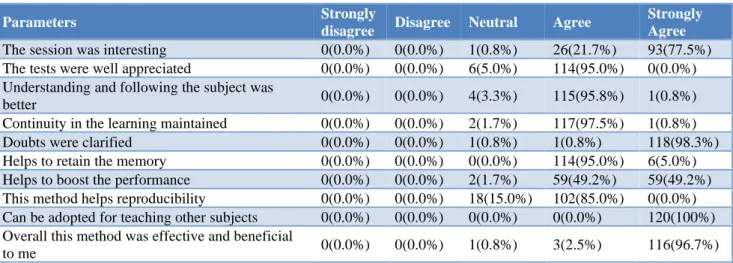
Table 4: The perception of students to the clinical demonstration of examination of deep tendon reflexes.
Parameters Strongly
disagree Disagree Neutral Agree
Strongly Agree
The session was interesting 0(0.0%) 0(0.0%) 1(0.8%) 26(21.7%) 93(77.5%)
The tests were well appreciated 0(0.0%) 0(0.0%) 6(5.0%) 114(95.0%) 0(0.0%) Understanding and following the subject was
better 0(0.0%) 0(0.0%) 4(3.3%) 115(95.8%) 1(0.8%)
Continuity in the learning maintained 0(0.0%) 0(0.0%) 2(1.7%) 117(97.5%) 1(0.8%)
Doubts were clarified 0(0.0%) 0(0.0%) 1(0.8%) 1(0.8%) 118(98.3%)
Helps to retain the memory 0(0.0%) 0(0.0%) 0(0.0%) 114(95.0%) 6(5.0%)
Helps to boost the performance 0(0.0%) 0(0.0%) 2(1.7%) 59(49.2%) 59(49.2%) This method helps reproducibility 0(0.0%) 0(0.0%) 18(15.0%) 102(85.0%) 0(0.0%) Can be adopted for teaching other subjects 0(0.0%) 0(0.0%) 0(0.0%) 0(0.0%) 120(100%) Overall this method was effective and beneficial
to me 0(0.0%) 0(0.0%) 1(0.8%) 3(2.5%) 116(96.7%)
The students taught by video assisted teaching were given a copy of the video used for teaching. The knowledge of the students was assessed at the end of 2 weeks by objective structured evaluation questionnaire. For the first group of students who were taught by video assisted teaching, the mean marks obtained was 6.783 and standard deviation was 0.8895. For the second group of students who were taught by direct demonstration, the mean marks obtained was 5.817 and standard deviation was 0.8924.The above table showed that there was a statistically significant difference in the mean marks obtained by students and the students taught by video assisted teaching scored higher marks in the evaluation after two weeks (Table 2).
A feedback questionnaire was administered to the students taught by video assisted technique. 77.5% strongly agreed that the session was interesting. 95.8% agreed that understanding and following the subject was better. 97.5% agreed that continuity in the learning was maintained 98.3% strongly agreed that doubts were clarified. 85% strongly agreed that it helps to boost the performance. 85% agreed about reproducibility. 100% agreed that the technique can be used for other subjects as well. 96.7% students strongly agreed that the technique was beneficial to them. None of the students had a disagreement regarding the utility of this teaching method. Taking everything together, both the techniques were useful to the students.
DISCUSSION
Neurology teaching should be done in an interesting way to improve the clinical skills of students.5 Assessment of neurology should cover all the domains of learning.6
Both traditional and video assisted teaching method was found to be equally effective in improving the knowledge of undergraduate students on neurological assessment.7 OSCE can be used as a tool for the assessment of the students after the intervention using different teaching-learning methods.8
In our study, there was no statistically significant difference in the mean marks obtained by students, taught by the two techniques at the end of teaching. But at the end of two weeks when OSCE was conducted, there was a statistically significant difference in the mean marks obtained by students, taught by the two techniques. This may be attributed to the better reproducibility of the teaching method (video assisted teaching) which was utilized for self-directed learning. This may have helped in retaining the memory. Understanding and following the subject was better with video assisted teaching for 91.7% and with clinical demonstration for 95.8%.
Regarding perception, students favoured both teaching methods for their effectiveness. For clarifying doubts, students favoured the DOAP method. For reproducibility and better retaining of memory, students favoured video assisted teaching. P Raiijmakers in his study found that Video assisted teaching is an efficient tool in teaching reflexes to medical students.9 K Bhoumik et al, in his study on the assessment of perception of medical students to different teaching-learning methods shows that students prefer individualised teaching.10 According to the study done by Bhagat PR et al, 73.8% teachers favoured a change in teaching with introduction of newer techniques and skill based assessments.11 Study by Girimallesh et al found that electronic resources are quite useful to medical students.12 Study by Morgan et al found
that both video assisted and simulator type of faculty-facilitated education offer a valuable learning experience.13 Study by Sood et al and Solanki et al found
that redesigning the curricula with stricter implementation and improved teaching and assessment
methodologies will generate efficient medical graduates and consequently better health care delivery, and resulting in desired change within the system.14,15
The limitations of this study are that examination of deep tendon reflexes was the only topic selected for this comparative study. So, this study cannot be generalized to all topics in the medical curriculum.
CONCLUSION
The Video assisted teaching was equally effective as DOAP (Demonstrate Observe Assist Perform) in teaching deep tendon reflexes to medical students. For reproducibility and better retaining of memory, Video assisted teaching was perceived better as reflected in the better mean scores two weeks after the teaching sessions.
Implementation of video assisted teaching as a teaching method, with proper planning and training of faculty, can tackle the issues of shortage of faculties and time.
Innovative teaching methods using audio-visual aids like video assisted teaching may be used in teaching Deep tendon reflexes to the medical students as it encourages self-directed learning and e-learning. Combination of techniques can also be used for grasping the subject in a better manner and for making the topic more interesting.
Funding: No funding sources Conflict of interest: None declared
Ethical approval: The study was approved by the Institutional Ethics Committee clearance was taken before commencing the study on 20-06-2019.IEC.No:-058/19.
REFERENCES
1. Ananthakrishnan N. Medical education in India: Is it still possible to reverse the downhill trend? Natl Med J India. 2010;23(3):156-60.
2. Sood R. Medical education in India. Med Teach. 2019 May 9;30(6):585-91.
3. Smith TL, Ruocco A, Jansen BJ. Digital video in education. Proceedings of the ACM Computer science education conference, New Orleans. 1999:122-6.
4. Beswick W, Cooper D, Whelan G. Videotape demonstration of physical examination: evaluation of its use in medical undergraduate teaching. Med Edu. 1982 Jul;16(4):197-201.
5. Pakpoor J, Handel AE, Disanto G, Davenport RJ, Giovannoni G, Ramagopalan SV. National survey of UK medical students on the perception of neurology. BMC Meical Edu. 2014 Dec;14(1):225. 6. Yoshii F, Rinsho S. Advanced OSCE in neurology.
Clin Neurol. 2007 01 Nov;47(11):897-9.
7. Harden RM, Gleeson FA. Assessment of clinical competence using objective structured clinical examination(OSCE). Med Edu. 1979;13:41-54. 8. Prabhu S. Comparison of traditional versus
undergraduate nursing students. NUJHS. 2013 June;3(2):29.
9. Raijmakers PG, Cabezas MC, Smal JA, Van Gijn J. Teaching the Plantar Reflex. Clin Neurol. Neurosurg. 1991;93(3):201-4.
10. Bhoumick K, Assesment of perception of 1st MBBS students in India about a teaching-learning activity, South-east Asia J Med Edu. 2009;3(2):28-34. 11. Bhagat PR, Trivedi KY. A study of perception of
medical teachers regarding education in ophthalmology in Western India. J Health Res. 2018;5;270-5.
12. Girimallesh HN. Use of Electronic resources by students of SDM College of Medical Sciences and Hospital, Dharwad: A case study. IJIRMPS. 2019 Sep 8;7(5).
13. Morgan PJ, Cleave-Hogg D, McIlroy J, Devitt JH. Simulation technology: a comparison of experiential
and visual learning for undergraduate medical students. Anesthesiology. 2002 Jan;96(1):10-6. 14. Sood R, Paul VK, Mittal S, Adkoli BV, Sahni P,
Kharbanda OP, et al. Assessment in Medical Education: Trends and Tools. New Delhi: KL Wig CMET; 1995.
15. Solanki A, Kashyap S. Medical education in India: Current challenges and the way forward. Medical teacher. 2014 Dec 1;36(12):1027-31.