Open Access
R E S E A R C H
BioMed
Central
© 2010 Hermsdorff et al; licensee BioMed Central Ltd. This is an Open Access article distributed under the terms of the Creative Com-mons Attribution License (http://creativecommons.org/licenses/by/2.0), which permits unrestricted use, distribution, and reproduc-tion in any medium, provided the original work is properly cited.Research
Fruit and vegetable consumption and
proinflammatory gene expression from peripheral
blood mononuclear cells in young adults: a
translational study
Helen Hermana M Hermsdorff, María Ángeles Zulet, Blanca Puchau and José Alfredo Martínez*
Abstract
Background: Fruits and vegetables are important sources of fiber and nutrients with a recognized antioxidant capacity, which could have beneficial effects on the proinflammatory status as well as some metabolic syndrome and cardiovascular disease features. The current study assessed the potential relationships of fruit and vegetable
consumption with the plasma concentrations and mRNA expression values of some proinflammatory markers in young adults.
Methods: One-hundred and twenty healthy subjects (50 men/70 women; 20.8 ± 2.6 y; 22.3 ± 2.8 kg/m2) were enrolled.
Experimental determinations included anthropometry, blood pressure and lifestyle features as well as blood biochemical and inflammatory measurements. The mRNA was isolated from peripheral blood mononuclear cells (PBMC) and the gene expression concerning selected inflammatory markers was assessed by quantitative real-time PCR. Nutritional intakes were estimated by a validated semi-quantitative food-frequency questionnaire.
Results: The highest tertile of energy-adjusted fruit and vegetable consumption (>660 g/d) was associated with lower plasma concentrations of C-reactive protein (CRP) and homocysteine and with lower ICAM1, IL1R1, IL6, TNFα and NFκB1 gene expression in PBMC (P for trend < 0.05), independently of gender, age, energy intake, physical activity, smoking, body mass index, systolic blood pressure and circulating non-esterified fatty acids. In addition, plasma CRP,
homocysteine and TNFα concentrations and ICAM1, TNFα and NFκB1 gene expression in PBMC showed a descending trend as increased fiber intake (>19.5 g/d) from fruits and vegetables (P for trend < 0.05). Furthermore, the participants within the higher tertile (>11.8 mmol/d) of dietary total antioxidant capacity showed lower plasma CRP and mRNA values of ICAM1, IL1R1, IL6, TNFα and NFκB1 genes (P for trend < 0.05). The inverse association between fruit and vegetable consumption and study proinflammatory markers followed the same trend and remained statistically significant, after the inclusion of other foods/nutrients in the linear regression models.
Conclusion: A higher fruit and vegetable consumption was independently associated not only with reduced CRP and homocysteine concentrations but also with a lower mRNA expression in PBMC of some relevant proinflammatory markers in healthy young adults.
Background
A low-chronic inflammatory status is a recognized link between excessive adiposity and metabolic syndrome fea-tures, diabetes, and atherosclerosis [1,2]. In fact, a num-ber of studies has demonstrated an increased expression
of transcription nuclear factors such as nuclear-factor-kappa-B (NFκB) as well as of interleukins (IL) and tumor necrosis factor-alpha (TNFα) in obese subjects [1,3]. These changes appear to involve a higher production of proinflammatory and pro-atherogenic molecules such as C-reactive protein (CRP), homocysteine, selectins and adhesion molecules as well as some cytokines [1,3]. Fur-thermore, circulating peripheral blood mononuclear cells * Correspondence: [email protected]
1 Department of Nutrition, Food Science, Physiology and Toxicology, University
of Navarra, Pamplona, Spain
(PBMC) may have an important role in all these complex inflammatory processes, which are mediated by tran-scriptional nuclear-factors, cytokines and other pro-atherogenic molecules [4].
In turn, fruits and vegetables contain components such as plant proteins, potassium, magnesium, fiber, and oth-ers compounds with antioxidant capacity, whose con-sumption may reduce the risk of suffering metabolic syndrome manifestations [5-8]. Thus, the intake of fruits and vegetables has been related to marked reductions in proinflammatory and oxidative stress markers [9-12]. These previous findings indicate that a targeted emphasis on fruit and vegetable consumption could potentially help individuals in preventing and/or reducing the onset of cardiovascular diseases and metabolic syndrome com-plications by means of a beneficial modulation of low-grade inflammation and oxidative stress mediated pro-cesses.
In this context, nutrigenomic studies have demon-strated the healthy effect of specific nutrients and calorie-restriction on PBMC proinflammatory gene expression [13,14]. However, the effect of fruit and vegetable con-sumption on the expression of proinflammatory-related molecules in PBMC has not yet been apparently investi-gated.
Overall, the present study assessed the potential associ-ation of fruit and vegetable consumption with plasma concentrations of CRP, homocysteine, IL6, and TNFα as well as gene expression profiles, which were assessed through messenger RNA (mRNA) levels of genes encod-ing intercellular adhesion molecule-1 (ICAM1), interleu-kin-1 receptor-type 1 (IL1R1), interleukin-6 (IL6), tumor necrosis factor-alpha (TNFα), subunit-1 or p50 (NFκB1) and subunit-3 or p65 (RELA) of NFκB in PBMC, from young adults.
Methods
Subjects
One hundred twenty (50 men/70 women) subjects with a mean age of 20.8 ± 2.6 (range 18-30) years old and mean body mass index of 22.3 ± 2.8 (range 18.5-30.5) kg/m2
participated in this study. The volunteers were recruited through magazines, radio, web page and intranet tools from the University of Navarra. Exclusion criteria included previous inflammatory, heart, and respiratory diseases, hormonal treatment or drug use that affect glu-cose metabolism, alcohol and drug dependence, history of diets for weight loss or unstable weight in the last three months as examined by a trained physician. Each partici-pant signed a written informed consent, which was previ-ously approved by the Investigation Ethics Committee of the Clínica Universidad de Navarra (79/2005), in accor-dance with the principles of the Helsinki Declaration.
Dietary intake assessment
Assessment and information about dietary intake were obtained by the questionnaire of the Seguimiento Univer-sidad de Navarra (SUN) Study [15]. This semi-quantita-tive food frequency questionnaire, which is validated for Spanish people [16], includes 136 items, considering 13 fruit items (oranges, banana, apple, pear, strawberry, grapefruit, peach/apricot/nectarine, cherry/plum, water-melon, water-melon, mango, papaya, and kiwi) and 11 vegetable items (spinach, lettuce, cauliflower/broccoli, tomatoes, carrots, green beans, peppers, cabbage, aubergines, asparagus, and 'gazpacho') related to fruit and vegetable consumptions, respectively. Also, natural orange juice and other natural fruit juices were also separately accounted in the questionnaire.
Nutrient intake was estimated using an ad hoc com-puter program specifically developed for this aim [15]. A dietitian updated the nutrient data bank using the latest available information included in the food composition tables for Spain [17,18]. Nutrient intake was calculated as frequency × nutrient composition of each portion size for each consumed food item, where frequencies were mea-sured in nine frequency categories (6+/d, 4 to 6/d, 2 to 3/ d, 1/d, 5 to 6/wk, 2 to 4/wk, 1/wk, 1 to 3/mo, never or almost never) for each food item. This questionnaire has been successfully applied to estimate dietary intake and specific nutrients in relation to proinflammatory out-comes [19-21].
Furthermore dietary total antioxidant capacity (TAC), expressed as mmol/d, was calculated by a proxy previ-ously validated to this food-frequency questionnaire [20].
Clinical and biochemical assessments
Anthropometrical measurements were performed according to previously described procedures [19]. Thus, BMI was calculated by the quotient between weight (kg) and the squared height (m2), which was applied to
cate-gorize normal-weight (18.5-24.9 kg/m2), overweight
(25-29.9 kg/m2), and obesity (BMI ≥ 30 kg/m2) subjects,
according to the Spanish Society for Obesity Study crite-ria [22]. Blood systolic and diastolic pressures were mea-sured according to WHO criteria [23].
Roche, Basel, Switzerland). Serum fasting insulin was measured by an ELISA kit (Mercodia, Uppsala, Sweden). Insulin resistance was estimated by the HOMA-IR, which was calculated as follows: HOMA-IR = [fasting glucose (mmol/l) × fasting insulin (μIU/l)]/22.5 [24]. Plasma con-centrations of CRP, high-sensitive IL6 (hs-IL6), and TNFα (hs-TNFα) were measured by ELISA kits using an automated analyzer system (Triturus, Grifols, Barcelona, Spain). CRP was measured by using an Immundiagnostik AG kits, (Bensheim, Germany) and the cytokines by Quantikine immunoassay kits (hs-IL6 and hs-TNFα) from R&D Systems (Minneapolis, USA). In our labora-tory, all the inter- and intra-assay variabilities were <10% selected for determinations.
PBMC were isolated by differential centrifugation (450
g, 30 min, at 20°C) by using PMN medium (Robbins Sci-entific Corporation, Sunnyvale, CA, USA), and total RNA from PBMC was extracted and subsequently purified by DNase treatment (DNA-free kit, Ambion/Applied Bio-systems, Austin, TX, USA) as previously described [25]. Quantitative real-time PCR was performed by using an ABI PRISM 7000 HT Sequence Detection System as described by the manufacturer (Applied Biosystems, Fos-ter City, CA, USA). Taqman probes for genes (ICAM1,
IL1R1, IL6, TNFα, NFκB1, RELA) were also supplied by
Applied Biosystems (Foster City, CA, USA). Gene expres-sion levels were assessed and normalized by using 18s rRNA as internal control following previously described protocols [26,27]. The fold change (2-ddCt) in the target
genes, normalized to 18S and relative to the lowest expression profile, was calculated for each sample accord-ing to the manufacturer's guidelines (Applied Biosystems, Foster City, CA, USA).
Other variables assessment
Regarding to other covariables, the SUN questionnaire also was used for collecting the information about life-style details as smoking status (never, former, and current smokers) and physical activity practice (Yes/No and vol-ume of activity). To quantify the volvol-ume of activity, an activity metabolic equivalent (MET) index was computed by assigning a multiple of resting metabolic rate (MET score) to each activity [28]. Metabolic equivalents were estimated as the ratio of energy expended during each specific activity to resting metabolic rate and they are independent of body weight. Time spent in each of the activities was multiplied by the MET score specific to each activity, and then interpreted over all activities obtaining a value of overall weekly MET/h [29].
Statistical analysis
Results are shown as mean ± standard deviations (SD). The Shapiro-Wilk test was used to determine variable distribution. Comparisons between three groups were
performed by ANOVA one-factor tests, while the post-hoc Tukey test was used concerning multiple compari-sons. Dietary intakes were adjusted for the daily energy intake by the residuals method, applying separate models among women and men [30]. To assess the associations of fruit and vegetable consumption with plasma concen-tration and mRNA expression of proinflammatory mark-ers, we categorized the participants by tertiles of food-group consumption. Means and SD were calculated for each related variable within each tertile of fruit and vege-table consumption. Linear trends were assessed by assigning the median value to each tertile of fruit and vegetable consumption, and modeling these values as a continuous variable. Data in the models were controlled for gender, age (years), BMI (kg/m2), daily energy intake
(kcal/d), physical activity during leisure time (METs-hour per week), smoking (never, former, and current smokers), systolic blood pressure (mmHg), and non-esterified fatty acid concentration (mmol/l). The same procedure was performed in order to analyze the relationships of dietary TAC and dietary fiber (from fruit and vegetable intake) with proinflammatory markers. In addition, we catego-rized the participants by quintiles of fruit and vegetable consumption, and the ratios between the mean values of selected proinflammatory marker concentrations (CRP, homocysteine, IL6 and TNFα), computed as the quotient between fifth and first quintiles of this food-group con-sumption were calculated.
Furthermore, we used stepwise multiple regression [30] to identify the main variability food-items concerning fruit and vegetable consumption of participants of this study. Finally, statistical analyses were performed with SPSS 15.0 software (SPSS Inc., Chicago, IL, USA) for Windows XP (Microsoft, USA). A P-value < 0.05 was considered as statistically significant.
Results
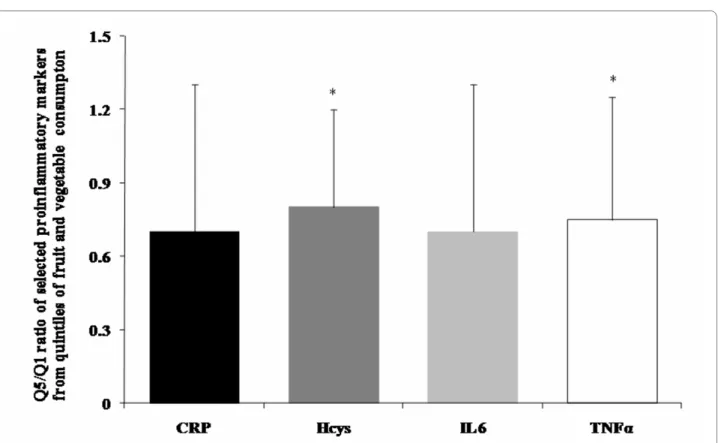
0.05) reached for homocysteine and TNFα concentra-tions.
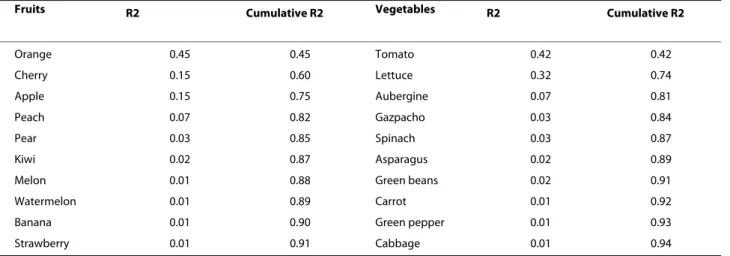
Moreover, those participants who were included in the third tertile also presented higher intake values for vege-table protein, potassium, magnesium, and vitamin C, as compared with subjects in the lowest tertile of fruit and vegetable consumption. Interestingly, fiber and dietary TAC also were statistically higher in those individuals included in the highest tertile of fruit and vegetable con-sumption (Table 2). Moreover, the more consumed fruit and vegetable by the participants were oranges and toma-toes (R2 = 0.45 and 0.42, respectively). Other important contributing food items to the dietary intake are listed in the Table 3, which explained 91 and 94% of total variabil-ity in fruit and vegetable intake, respectively.
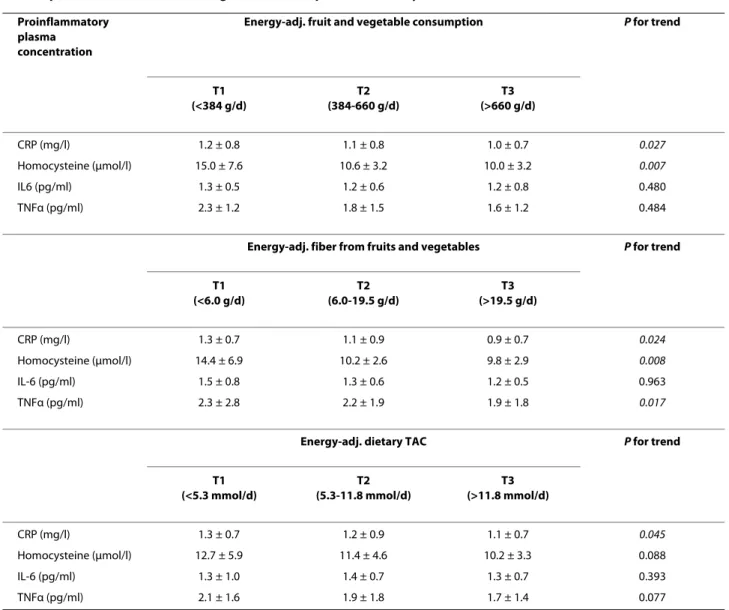
Regarding proinflammatory markers, individuals on the highest tertile of fruit and vegetable consumption had statistically lower (P for trend < 0.05) values to plasma concentration of CRP and homocysteine (Table 4), after adjusting for several covariates. Interestingly, the concen-trations of CRP, homocysteine, and TNFα were signifi-cantly lower (P < 0.05) across tertiles of fiber intake from fruits and vegetables, while levels of CRP were also lower across tertiles of increasing dietary TAC values (Table 4).
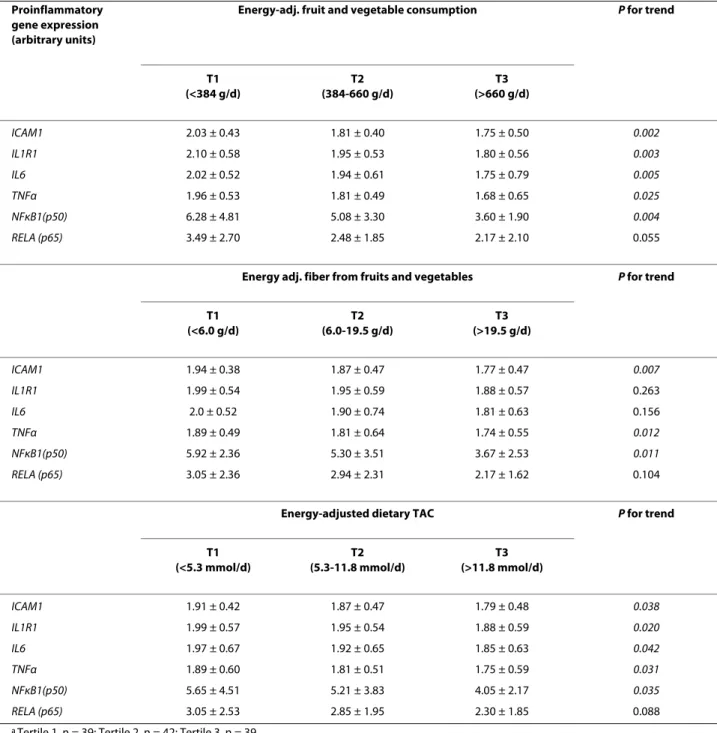
Interestingly, individuals on the highest tertile of fruit and vegetable consumption had statistically lower (P for trend < 0.05) values to mRNA expression of ICAM1,
IL1R1, IL6, TNFα, and NFκB1(p50) in PBMC,
indepen-dent from assumed confounding factors (Table 5). In addition, ICAM1, IL1R1, IL6, TNFα, and NFκB1(p50) Table 1: Anthropometrical, clinical and metabolic characteristics of participants, according to tertiles (T) of energy-adjusted fruit and vegetable consumption (n = 120)
Energy-adj. fruit and vegetable consumption
T1 (n = 39) < 384 g/d
T2 (n = 42) 384-660 g/d
T3 (n = 39) > 660 g/d
P-valuea
Age (y) 21 ± 2b 21 ± 3 21 ± 3 0.509
Body mass index (kg/m2) 22.6 ± 3.0c 22.4 ± 2.8 21.7 ± 2.89 0.028
Waist circumference (cm) 76.8 ± 8.3c 74.3 ± 8.8 70.9 ± 8.3 0.025
Systolic BP (mmHg) 117 ± 11c 115 ± 11 111 ± 10 0.015
Diastolic BP (mmHg) 67 ± 7c 66 ± 7 63 ± 8 0.018
Glucose (mg/dl) 85.8 ± 7.6 85.4 ± 9.4 85.2 ± 7.3 0.155
Insulin (μIU/l) 7.2 ± 2.9 8.2 ± 3.9 7.4 ± 3.5 0.966
HOMA-IR 1.6 ± 0.7 1.8 ± 0.9 1.6 ± 0.7 0.662
Total cholesterol (mg/dl) 175 ± 26 179 ± 26 169 ± 29 0.294
LDL-c (mg/dl) 102 ± 21 104 ± 23 101 ± 27 0.824
HDL-c (mg/dl) 60 ± 15 61 ± 12 56 ± 12.3 0.242
Triglycerides (mg/dl) 67 ± 29 71 ± 27 63 ± 23 0.385
NEFA (mmol/l) 0.43 ± 0.22 0.37 ± 0.14 0.32 ± 0.22 0.116
CRP (mg/l) 1.3 ± 0.8 1.1 ± 0.8 1.0 ± 0.7 0.217
Homocysteine (μmol/l) 15.0 ± 7.6c 12.6 ± 3.2 10.0 ± 3.2 0.013
IL6 (pg/ml) 1.3 ± 0.5 1.2 ± 0.6 1.2 ± 0.8 0.607
TNFα (pg/ml) 2.3 ± 1.2 1.8 ± 1.5 1.6 ± 1.2 0.577
Self-reported PA n, (%) 21 (61.5) 24 (50) 25 (66) 0.237
MET (h-week) 35.7 ± 32.7 38.2 ± 27.3 42.7 ± 27.5 0.480
Smoking Never n, (%) 22 (56.4) 28 (66.7) 27 (71.1) 0.269
Former n, (%) 4 (10.3) 5 (11.9) 3 (7.9)
Current n, (%) 13 (33.3) 9 (21.4) 8 (21.1)
aP-value from ANOVA test or χ2 test, for continuous or categorical variables, respectively.
bContinuous variables are presented as mean values ± standard deviation, while categorical variables are presented as absolute number and
frequencies.
c P < 0.05, T1 vs. T3; from post hoc Tukey test to correct for multiple comparisons.
gene expressions were significantly lower in the subjects included in the highest tertile of dietary TAC (Table 5), while mRNA levels of ICAM1, TNFα, and NFκB1(p50)
genes were markedly reduced in the third tertile of dietary fiber from fruit and vegetable consumption (Table 5).
Furthermore, other analyses were performed in order to evaluate the association of fruit and vegetable con-sumption and proinflammatory markers. Since fruit and vegetable consumption correlated with other foods/ nutrients, the association between fruit and vegetable consumption (as independent variable) and proinflam-matory markers (as outcomes) were analyzed, using lin-ear regression models, additionally adjusted for vegetable protein, potassium, magnesium, total fat, polyunsatu-rated fatty acid or satupolyunsatu-rated fatty acid intake as well as for dietary TAC and fiber, as continuous variables. The inverse association between fruit and vegetable intake and proinflammatory markers remained statistically sig-nificant (data not shown). Moreover, we performed addi-tional analyses including fruit juices in the categories of fruit and vegetable consumption, which did not change the interpretations. In this context, we separately ana-lyzed the fruit juice consumption (natural orange and
other natural fruit juices). The CRP and homocysteine concentrations as well as mRNA expression of IL1R1, IL6,
and TNFα genes were statistically significant (P for trend
< 0.05) lower in those subjects included in the third tertile of energy-adjusted fruit juice consumption (> 100 ml/d), adjusting for gender, age, BMI, energy intake, smoking habit, physical activity counts, NEFA concentration, and systolic blood pressure.
In addition, the separate regression analyses of the influence of the smoking status (never, former, and cur-rent smokers) or including the smoking habit categorized by number of cigarettes/day (1) 0-5 or ≥ 5 cigarettes/d; 2) 0-10 or ≥ 10 cigarettes/d) as covariates, produced the same outcome concerning the inflammatory markers. Finally, when we performed linear regression analysis, including the waist circumference as independent vari-able, the results followed the same trends and remained statistically significant (data not shown).
Discussion
A high intake of fruits and vegetables has been inversely associated with metabolic syndrome features [5,6], car-diovascular diseases [31,32], and total mortality [33], while greater values of proinflammatory markers such
acute-phase proteins, cytokines, and adhesion molecules have been directly associated with chronic disorders [2,3]. In this context, the potential relationships between specific dietary factors and proinflammatory markers are being currently investigated [19-21,34]. In this context, nutrigenomic approaches have been performed as a potential useful tool to increase fundamental knowledge concerning the interactions between diet and gene expression [13,14]. Thus, this study found, apparently for first time, that healthy adults with a high consumption of fruits and vegetables had lower ICAM1, IL1R1, IL6, TNFα, and NFκB1(p50) gene expression in PBMC.
An altered expression of ILs, TNFα, ICAM1 genes and of their respective receptors in adipose tissue as well as in PBMC has been implicated in the higher risk of suffering metabolic syndrome and cardiovascular disease [3,4,35]. In addition, NFκB is a redox-sensitive transcription factor implicated in the transmission of different signals from the cytoplasm to the nucleus, which are involved in the
regulation of inflammatory and immune genes, apopto-sis, and cell proliferation [36]. In this regard, the activa-tion of this transcripactiva-tion factor has been involved in atherosclerosis [37]. Therefore, the reported inverse asso-ciation between fruits and vegetable consumption and the selected proinflammatory gene expression measure-ments suggest a new clinically relevant mechanism con-cerning the prevention of subclinical inflammation status in healthy adults by a high intake of fruits and vegetables. In this study, we also found a statistically significant inverse association of fruit and vegetable consumption with CRP and homocysteine concentrations. These results are consistent with some earlier cross-sectional studies carried out on children and adolescents [38,39] as well as middle-age adults [7,40]. Moreover, in a random-ized crossover study, the addition of vegetables to the diet has been able to reverse the increase in circulating vascu-lar adhesion molecule-1 (VCAM1), ICAM1, IL6, and TNFα levels, as induced by a single high-fat (saturated)
Table 2: Food and nutrients consumption, according to tertiles (T) of energy-adjusted fruit and vegetable consumption (n = 120)
Energy-adj. fruit and vegetable
consumption
T1 (n = 39) < 384 g/d
T2 (n = 42) 384-660 g/d
T3 (n = 39) > 660 g/d
P-valuea
Energy intake (kcal) 2645 ± 1110 2573 ± 899 2749 ± 920 0.703
Carbohydrate (% EI) 41.8 ± 6.5 43.0 ± 5.2 44.1 ± 6.5 0.207
Protein (%EI) 16.4 ± 2.5b 17.2 ± 2.6 18.0 ± 2.4 0.012
Vegetable protein (g) 29.9 ± 15.4b 31.6 ± 12.2 38.2 ± 11.8 0.001
Lipid (%EI) 40.4 ± 5.9b 38.2 ± 4.5 37.0 ± 7.2 0.025
PUFA (%EI) 6.1 ± 2.0b,c 5.2 ± 1.4 5.2 ± 1.4 0.017
MUFA (%EI) 16.9 ± 3.3 16.2 ± 3.2 16.2 ± 4.5 0.576
SFA (%EI) 14.8 ± 3.4b 13.4 ± 1.9 12.5 ± 2.8 0.001
Alcohol (g/d) 5.5 ± 8.1 5.3 ± 5.5 3.8 ± 4.6 0.339
Fruit juices (ml/d) 48.4 ± 70.0 79.3 ± 125.5 99.6 ± 116.8 0.076
Cereals (g/d) 197.5 ± 116.7 180.9 ± 106.6 174.8 ± 71.6 0.537
Legumes (g/d) 18.5 ± 13.4 27.4 ± 27.2 23.6 ± 17.9 0.119
Nuts (g/d) 11.7 ± 28.2 15.7 ± 6.1 15.6 ± 29.1 0.135
Meats (g/d) 205.0 ± 95.5 201.4 ± 101.9 213.4 ± 128.1 0.865
Dairy products (g/d) 335.1 ± 303.0 221.3 ± 177.6 238.9 ± 225.5 0.056
Olive oil (g/d) 15.8 ± 13.9 18.9 ± 17.6 20.6 ± 18.1 0.385
Potassium (g/d) 3.8 ± 1.7b 4.6 ± 1.3d 6.1 ± 2.0 <0.001
Magnesium (mg/d) 369.7 ± 163.1b 406.4 ± 124.2d 504.7 ± 163.4 <0.001
Vitamin C (mg/d) 153.2 ± 83.3b,c 253.4 ± 108.0d 381.2 ± 150.1 <0.001
Dietary fiber (g/d) 17.6 ± 10.3b,c 24.7 ± 10.3d 34.12 ± 13.3 <0.001
Dietary TAC (mmol/d) 6.0 ± 3.6b,c 8.0 ± 2.8d 11.4 ± 4.8 <0.001 aP-value from ANOVA test.
bP < 0.05, T1 vs. T3; cP < 0.05, T1 vs. T2; dP < 0.05, T2 vs. T3, from post hoc Tukey test to correct for multiple comparisons.
meal consumption [11]. Furthermore, in a randomized controlled 4-week trial, a high consumption (eight vs. two servings/day) of fruits and vegetables also significantly reduced CRP levels [12].
The anti-inflammatory mechanisms related to fruit and vegetable consumption are still unclear. Fruits and vege-tables are sources of essential nutrients, which could be implicated in inflammation and oxidative stress reduc-tions [10,41]. For example, the intake of folate, vitamin C, and magnesium, for those fruits and vegetables have rele-vant content, have been associated with lower homo-cysteine, CRP, IL6 and E-selectin concentrations [42-44]. Fruits and vegetables also are important sources of dietary fiber, which appears to have an anti-inflammatory role [10,41]. Also, dietary fiber intake could participate in weight control and favor weight loss, hypoglycemic actions and hypolipidemic effects [45]. In addition, butyrate production after the consumption of dietary fiber could have an inhibitory effect on the NFκB and a stimulatory effect on PPAR-α activation, with subsequent lower expression of ICAM1 and VCAM1 genes [46], although this mechanism deserves further research. Fur-thermore, fruits and vegetables contain several flavonoids and carotenoids with recognized antioxidant properties, which may play a role in the inverse relationship between intake of fruits and vegetables and inflammatory status [9,38,47]. In fact, several in vitro studies have evidenced an anti-inflammatory effect of flavonoids and carote-noids, by an inhibition of NFκB activity, through sup-pressing the activation-related phosphorylation, and inhibiting the nuclear translocation [48-50].
In this study, we also found inverse associations of dietary fiber and TAC with plasma concentrations and the gene expression of certain proinflammatory markers, suggesting a participation of these specific dietary factors in the beneficial effect of fruit and vegetable consump-tion. The gene expression of investigated
proinflamma-tory markers had statistically significant lower values across tertiles of fruit and vegetable consumption, inde-pendently of dietary fiber and dietary TAC. In addition, the inverse associations of fruit and vegetable consump-tion with proinflammatory gene expression maintained the trend and the statistical significance after including others specific dietary factors such as plant protein, potassium, magnesium, total fat, polyunsaturated fatty acid and saturated fatty acid. In this context, our findings suggest that additive and synergistic effects of bioactive compounds provided by fruits and vegetables as respon-sible for the antioxidant and anti-inflammatory activities of these foods.
Interestingly, we found lower values to BMI, waist cir-cumference, and blood pressure in those participants who were in the highest tertile of fruit and vegetable con-sumption. These results are in accordance with findings obtained in the SUN Study [5,51] and in The Dietary Approaches to Stop Hypertension (DASH) trial [52,53]. In turn, it has been also reported a positive association of proinflammatory marker concentrations and gene expression in PBMC with body fat distribution [54] in healthy young adults. Thus, the relationships between fruit/vegetable consumption and proinflammatory mark-ers could be biased by body fat composition. When we controlled our analyses by these potential confounding factors, including BMI or waist circumference as continu-ous independent variables, the hypothesized associations between fruit and vegetable consumption and proinflam-matory markers maintained the trend and the statistical significance, suggesting that the effects of fruit and vege-table consumption that we found in this study were not totally explained by differences in body fat variables. Our study had certain limitations. First, since the nature of this study is cross-sectional, we cannot prove that the reported associations are causal because residual con-founding may have affected the observed associations.
Table 3: Main fruit and vegetable items consumed by participants (n = 120)
Fruits R2 Cumulative R2 Vegetables R2 Cumulative R2
Orange 0.45 0.45 Tomato 0.42 0.42
Cherry 0.15 0.60 Lettuce 0.32 0.74
Apple 0.15 0.75 Aubergine 0.07 0.81
Peach 0.07 0.82 Gazpacho 0.03 0.84
Pear 0.03 0.85 Spinach 0.03 0.87
Kiwi 0.02 0.87 Asparagus 0.02 0.89
Melon 0.01 0.88 Green beans 0.02 0.91
Watermelon 0.01 0.89 Carrot 0.01 0.92
Banana 0.01 0.90 Green pepper 0.01 0.93
However, we controlled for the more important known factors that affect proinflammatory gene expression. Sec-ond, dietary exposures can be misclassified despite the good correlation between food frequency questionnaires and usual diet [55] but the dietary questionnaire is vali-dated [16], and has been successfully applied to investi-gate the relationship between dietary factors and inflammatory markers [19-21]. Third, a higher consump-tion of oranges and tomatoes as well as the contribuconsump-tion of the remaining food items to the fruit and vegetable consumption could be influenced by the season in which the questionnaires were completed [56], although the SUN food-frequency questionnaire has presented a good
reproducibility [55] in different circumstances. Fourth, although the sample size is adequate from the standpoint of initial association discovery, further replication in independent and larger samples will be convenient for a future translational application at a population level.
Conclusion
In this translational study, the fruit and vegetable con-sumption was inversely associated with mRNA expres-sion of certain proinflammatory markers from PBMC in healthy young adults, suggesting a beneficial effect of high fruit and vegetable consumption on decreasing proinflammatory status and providing new light for the
Table 4: Proinflammatory plasma concentration with respect to tertiles (T)a of energy-adjusted fruit and vegetable
consumption, fiber from fruit and vegetable consumption and dietary TAC (n = 120)
Proinflammatory plasma
concentration
Energy-adj. fruit and vegetable consumption P for trend
T1 (<384 g/d)
T2 (384-660 g/d)
T3 (>660 g/d)
CRP (mg/l) 1.2 ± 0.8 1.1 ± 0.8 1.0 ± 0.7 0.027
Homocysteine (μmol/l) 15.0 ± 7.6 10.6 ± 3.2 10.0 ± 3.2 0.007
IL6 (pg/ml) 1.3 ± 0.5 1.2 ± 0.6 1.2 ± 0.8 0.480
TNFα (pg/ml) 2.3 ± 1.2 1.8 ± 1.5 1.6 ± 1.2 0.484
Energy-adj. fiber from fruits and vegetables P for trend
T1 (<6.0 g/d)
T2 (6.0-19.5 g/d)
T3 (>19.5 g/d)
CRP (mg/l) 1.3 ± 0.7 1.1 ± 0.9 0.9 ± 0.7 0.024
Homocysteine (μmol/l) 14.4 ± 6.9 10.2 ± 2.6 9.8 ± 2.9 0.008
IL-6 (pg/ml) 1.5 ± 0.8 1.3 ± 0.6 1.2 ± 0.5 0.963
TNFα (pg/ml) 2.3 ± 2.8 2.2 ± 1.9 1.9 ± 1.8 0.017
Energy-adj. dietary TAC P for trend
T1 (<5.3 mmol/d)
T2 (5.3-11.8 mmol/d)
T3 (>11.8 mmol/d)
CRP (mg/l) 1.3 ± 0.7 1.2 ± 0.9 1.1 ± 0.7 0.045
Homocysteine (μmol/l) 12.7 ± 5.9 11.4 ± 4.6 10.2 ± 3.3 0.088
IL-6 (pg/ml) 1.3 ± 1.0 1.4 ± 0.7 1.3 ± 0.7 0.393
TNFα (pg/ml) 2.1 ± 1.6 1.9 ± 1.8 1.7 ± 1.4 0.077
a Tertile 1, n = 39; Tertile 2, n = 42; Tertile 3, n = 39.
Table 5: mRNA levels of proinflammatory gene expression from PBMC with respect to tertiles (T)a of energy-adjusted fruit
and vegetable consumption, fiber from fruit and vegetable consumption and dietary TAC (n = 120)
Proinflammatory gene expression (arbitrary units)
Energy-adj. fruit and vegetable consumption P for trend
T1 (<384 g/d)
T2 (384-660 g/d)
T3 (>660 g/d)
ICAM1 2.03 ± 0.43 1.81 ± 0.40 1.75 ± 0.50 0.002
IL1R1 2.10 ± 0.58 1.95 ± 0.53 1.80 ± 0.56 0.003
IL6 2.02 ± 0.52 1.94 ± 0.61 1.75 ± 0.79 0.005
TNFα 1.96 ± 0.53 1.81 ± 0.49 1.68 ± 0.65 0.025
NFκB1(p50) 6.28 ± 4.81 5.08 ± 3.30 3.60 ± 1.90 0.004
RELA (p65) 3.49 ± 2.70 2.48 ± 1.85 2.17 ± 2.10 0.055
Energy adj. fiber from fruits and vegetables P for trend
T1 (<6.0 g/d)
T2 (6.0-19.5 g/d)
T3 (>19.5 g/d)
ICAM1 1.94 ± 0.38 1.87 ± 0.47 1.77 ± 0.47 0.007
IL1R1 1.99 ± 0.54 1.95 ± 0.59 1.88 ± 0.57 0.263
IL6 2.0 ± 0.52 1.90 ± 0.74 1.81 ± 0.63 0.156
TNFα 1.89 ± 0.49 1.81 ± 0.64 1.74 ± 0.55 0.012
NFκB1(p50) 5.92 ± 2.36 5.30 ± 3.51 3.67 ± 2.53 0.011
RELA (p65) 3.05 ± 2.36 2.94 ± 2.31 2.17 ± 1.62 0.104
Energy-adjusted dietary TAC P for trend
T1 (<5.3 mmol/d)
T2 (5.3-11.8 mmol/d)
T3 (>11.8 mmol/d)
ICAM1 1.91 ± 0.42 1.87 ± 0.47 1.79 ± 0.48 0.038
IL1R1 1.99 ± 0.57 1.95 ± 0.54 1.88 ± 0.59 0.020
IL6 1.97 ± 0.67 1.92 ± 0.65 1.85 ± 0.63 0.042
TNFα 1.89 ± 0.60 1.81 ± 0.51 1.75 ± 0.59 0.031
NFκB1(p50) 5.65 ± 4.51 5.21 ± 3.83 4.05 ± 2.17 0.035
RELA (p65) 3.05 ± 2.53 2.85 ± 1.95 2.30 ± 1.85 0.088
a Tertile 1, n = 39; Tertile 2, n = 42; Tertile 3, n = 39.
nutrigenomic involved-mechanisms as well as new tools for the assessment of nutrient-gene interactions.
Abbreviations
BMI: Body mass index; CRP: C-reactive protein; DASH: The Dietary Approaches to Stop Hypertension; ICAM1: intercellular adhesion molecule-1; IL1R1: inter-leukin-1 receptor-1; IL: interleukin; MET: activity metabolic equivalent; mRNA: messenger RNA; NEFA: non-esterified fatty acid; NFκB1: nuclear factor-nuclear-kappa-B (p50); PBMC: peripheral blood mononuclear cells; RELA: nuclear fac-tor-nuclear-kappa-B (p65); SUN: Seguimiento Universidad de Navarra; TAC: total antioxidant capacity; TNFα: tumor necrosis factor-alpha.
Competing interests
The authors declare that they have no competing interests.
Authors' contributions
HHMH: Design, field work, data collection, analysis, and writing of the manu-script. BP: Design, field work, and data collection. MZ: project co-leader, design, financial management, and editing the manuscript. JAM: project leader, gen-eral coordination, design, financial management, and editing of the manu-script. All authors read and approved the final manumanu-script.
Acknowledgements
We wish to thank our physician Blanca E. Martínez de Morentin, our nurse Salo-mé Pérez, and our technician Verónica Ciaurriz for excellent technical assis-tance. This work was supported by Health Department of the Government of Navarra (22/2007) and by Línea Especial about Nutrition, Obesity and Health (University of Navarra LE/97). The Capes Foundation, Ministry of Education of Brazil as well as IBERCAJA and ADA fellowships scheme of the University of Navarra also provided research grants to HHM Hermsdorff (no. 3756/05-0) and B Puchau, respectively.
Author Details
Department of Nutrition, Food Science, Physiology and Toxicology, University of Navarra, Pamplona, Spain
References
1. Hajer GR, van Haeften TW, Visseren FL: Adipose tissue dysfunction in obesity, diabetes, and vascular diseases. Eur Heart J 2008, 29:2959-2971. 2. Zulet MA, Puchau B, Navarro C, Marti A, Martínez JA: [Inflammatory
biomarkers: the link between obesity and associated pathologies].
Nutr Hosp 2007, 22:511-527.
3. Van Gaal LF, Mertens IL, De Block CE: Mechanisms linking obesity with cardiovascular disease. Nature 2006, 444:875-880.
4. Ghanim H, Aljada A, Hofmeyer D, Syed T, Mohanty P, Dandona P: Circulating mononuclear cells in the obese are in a proinflammatory state. Circulation 2004, 110:1564-1571.
5. Alonso A, de la Fuente C, Martin-Arnau AM, de Irala J, Martínez JA, Martínez-González MA: Fruit and vegetable consumption is inversely associated with blood pressure in a Mediterranean population with a high vegetable-fat intake: the Seguimiento Universidad de Navarra (SUN) Study. Br J Nutr 2004, 92:311-319.
6. Deshmukh-Taskar PR, O'Neil CE, Nicklas TA, Yang SJ, Liu Y, Gustat J, Berenson GS: Dietary patterns associated with metabolic syndrome, sociodemographic and lifestyle factors in young adults: the Bogalusa Heart Study. Public Health Nutr 2009, 12:2493-2503.
7. Esmaillzadeh A, Kimiagar M, Mehrabi Y, Azadbakht L, Hu FB, Willett WC: Fruit and vegetable intakes, C-reactive protein, and the metabolic syndrome. Am J Clin Nutr 2006, 84:1489-1497.
8. Rodriguez MC, Parra MD, Marques-Lopes I, De Morentin BE, Gonzalez A, Martínez JA: Effects of two energy-restricted diets containing different fruit amounts on body weight loss and macronutrient oxidation. Plant Foods Hum Nutr 2005, 60:219-224.
9. Porrini M, Riso P, Oriani G: Spinach and tomato consumption increases lymphocyte DNA resistance to oxidative stress but this is not related to cell carotenoid concentrations. Eur J Nutr 2002, 41:95-100.
10. Crujeiras AB, Parra MD, Rodriguez MC, Martínez de Morentin BE, Martínez JA: A role for fruit content in energy-restricted diets in improving
antioxidant status in obese women during weight loss. Nutrition 2006, 22:593-599.
11. Esposito K, Nappo F, Giugliano F, Giugliano G, Marfella R, Giugliano D: Effect of dietary antioxidants on postprandial endothelial dysfunction induced by a high-fat meal in healthy subjects. Am J Clin Nutr 2003, 77:139-143.
12. Watzl B, Kulling SE, Moseneder J, Barth SW, Bub A: A 4-wk intervention with high intake of carotenoid-rich vegetables and fruit reduces plasma C-reactive protein in healthy, nonsmoking men. Am J Clin Nutr
2005, 82:1052-1058.
13. Crujeiras AB, Parra D, Milagro FI, Goyenechea E, Larrarte E, Margareto J, Martínez JA: Differential expression of oxidative stress and
inflammation related genes in peripheral blood mononuclear cells in response to a low-calorie diet: a nutrigenomics study. OMICS 2008, 12:251-261.
14. Goyenechea E, Parra D, Crujeiras AB, Abete I, Martínez JA: A nutrigenomic inflammation-related PBMC-based approach to predict the weight-loss regain in obese subjects. Ann Nutr Metab 2009, 54:43-51. 15. Sánchez-Villegas A, Delgado-Rodriguez M, Martínez-González MA, De
Irala-Estevez J: Gender, age, socio-demographic and lifestyle factors associated with major dietary patterns in the Spanish Project SUN (Seguimiento Universidad de Navarra). Eur J Clin Nutr 2003, 57:285-292. 16. Martín-Moreno JM, Boyle P, Gorgojo L, Maisonneuve P,
Fernandez-Rodriguez JC, Salvini S, Willett WC: Development and validation of a food frequency questionnaire in Spain. Int J Epidemiol 1993, 22:512-519. 17. Mataix J: Tabla de composición de alimentos 5th edition. Granada:
Universidad de Granada; 2009.
18. Moreiras O, Carbajal A, Cabrera L, Cuadrado C: Tabla de composición de alimentos 10th edition. Madrid: Ediciones Pirámide; 2006.
19. Hermsdorff HHM, Zulet MA, Puchau B, Bressan J, Martínez JA: Association of retinol-binding protein-4 with dietary selenium intake and other lifestyle features in young healthy women. Nutrition 2009, 25:392-399. 20. Puchau B, Zulet MA, González de Echavarri A, Hermsdorff HHM, Martínez
JA: Dietary total antioxidant capacity is negatively associated with some metabolic syndrome features in healthy young adults. Nutrition
2010, 26:534-41.
21. Zulet MA, Puchau B, Hermsdorff HHM, Navarro C, Martínez JA: Dietary selenium intake is negatively associated with serum sialic acid and metabolic syndrome features in healthy young adults. Nutr Res 2009, 29:41-48.
22. Salas-Salvadó J, Rubio MA, Barbany M, Moreno B, SEEDO GCdl: Consenso SEEDO 2007 para la evaluación del sobrepeso y la obesidad y el establecimiento de criterios de intervención terapéutica. Med Clin (Barc) 2007, 128:184-196.
23. Whitworth JA, Chalmers J: World health organisation-international society of hypertension (WHO/ISH) hypertension guidelines. Clin Exp Hypertens 2004, 26:747-752.
24. Matthews DR, Hosker JP, Rudenski AS, Naylor BA, Treacher DF, Turner RC: Homeostasis model assessment: insulin resistance and beta-cell function from fasting plasma glucose and insulin concentrations in man. Diabetologia 1985, 28:412-419.
25. Puchau B, Hermsdorff HHM, Zulet MA, Martínez JA: DDAH2 mRNA expression is inversely associated with some cardiovascular risk-related features in healthy young adults. Dis Markers 2009, 27:37-44. 26. Livak KJ, Schmittgen TD: Analysis of relative gene expression data using
real-time quantitative PCR and the 2(-Delta Delta C(T)) Method.
Methods 2001, 25:402-408.
27. Milagro FI, Campion J, Martínez JA: 11-Beta hydroxysteroid
dehydrogenase type 2 expression in white adipose tissue is strongly correlated with adiposity. J Steroid Biochem Mol Biol 2007, 104:81-84. 28. Ching PL, Willett WC, Rimm EB, Colditz GA, Gortmaker SL, Stampfer MJ:
Activity level and risk of overweight in male health professionals. Am J Public Health 1996, 86:25-30.
29. Martínez-González MA, López-Fontana C, Varo JJ, Sánchez-Villegas A, Martínez JA: Validation of the Spanish version of the physical activity questionnaire used in the Nurses' Health Study and the Health Professionals' Follow-up Study. Public Health Nutr 2005, 8:920-927. 30. Willett WC: Nutritional Epidemiology 2nd edition. New York: Oxford
University Press; 1998.
31. Dauchet L, Amouyel P, Hercberg S, Dallongeville J: Fruit and vegetable consumption and risk of coronary heart disease: a meta-analysis of cohort studies. J Nutr 2006, 136:2588-2593.
Received: 23 March 2010 Accepted: 13 May 2010 Published: 13 May 2010
This article is available from: http://www.nutritionandmetabolism.com/content/7/1/42 © 2010 Hermsdorff et al; licensee BioMed Central Ltd.
This is an Open Access article distributed under the terms of the Creative Commons Attribution License (http://creativecommons.org/licenses/by/2.0), which permits unrestricted use, distribution, and reproduction in any medium, provided the original work is properly cited.
32. Wannamethee SG, Lowe GD, Rumley A, Bruckdorfer KR, Whincup PH: Associations of vitamin C status, fruit and vegetable intakes, and markers of inflammation and hemostasis. Am J Clin Nutr 2006, 83:567-574. quiz 726-567
33. Agudo A, Cabrera L, Amiano P, Ardanaz E, Barricarte A, Berenguer T, Chirlaque MD, Dorronsoro M, Jakszyn P, Larranaga N, et al.: Fruit and vegetable intakes, dietary antioxidant nutrients, and total mortality in Spanish adults: findings from the Spanish cohort of the European Prospective Investigation into Cancer and Nutrition (EPIC-Spain). Am J Clin Nutr 2007, 85:1634-1642.
34. Hermsdorff HHM, Zulet MA, Abete I, Martínez JA: Discriminated benefits of a Mediterranean dietary pattern within a hypocaloric diet program on plasma RBP4 concentrations and other inflammatory markers in obese subjects. Endocrine 2009, 36:445-451. doi:410.1007/s12020-12009-19248-12021
35. Hotamisligil GS: Inflammation and metabolic disorders. Nature 2006, 444:860-867.
36. de Winther MP, Kanters E, Kraal G, Hofker MH: Nuclear factor kappaB signaling in atherogenesis. Arterioscler Thromb Vasc Biol 2005, 25:904-914.
37. Kutuk O, Basaga H: Inflammation meets oxidation: NF-kappaB as a mediator of initial lesion development in atherosclerosis. Trends Mol Med 2003, 9:549-557.
38. Holt EM, Steffen LM, Moran A, Basu S, Steinberger J, Ross JA, Hong CP, Sinaiko AR: Fruit and vegetable consumption and its relation to markers of inflammation and oxidative stress in adolescents. J Am Diet Assoc 2009, 109:414-421.
39. Qureshi MM, Singer MR, Moore LL: A cross-sectional study of food group intake and C-reactive protein among children. Nutr Metab (Lond) 2009, 6:40.
40. Oliveira A, Rodriguez-Artalejo F, Lopes C: The association of fruits, vegetables, antioxidant vitamins and fibre intake with high-sensitivity C-reactive protein: sex and body mass index interactions. Eur J Clin Nutr
2009, 63:1345-1352.
41. Bressan J, Hermsdorff HHM, Zulet MA, Martínez JA: [Hormonal and inflammatory impact of different dietetic composition: emphasis on dietary patterns and specific dietary factors]. Arq Bras Endocrinol Metabol 2009, 53:572-581.
42. Helmersson J, Arnlov J, Larsson A, Basu S: Low dietary intake of beta-carotene, alpha-tocopherol and ascorbic acid is associated with increased inflammatory and oxidative stress status in a Swedish cohort. Br J Nutr 2008:1-8.
43. Ma Y, Griffith JA, Chasan-Taber L, Olendzki BC, Jackson E, Stanek EJ, Li W, Pagoto SL, Hafner AR, Ockene IS: Association between dietary fiber and serum C-reactive protein. Am J Clin Nutr 2006, 83:760-766.
44. Stea TH, Mansoor MA, Wandel M, Uglem S, Frolich W: Changes in predictors and status of homocysteine in young male adults after a dietary intervention with vegetables, fruits and bread. Eur J Nutr 2008, 47:201-209.
45. Galisteo M, Duarte J, Zarzuelo A: Effects of dietary fibers on disturbances clustered in the metabolic syndrome. J Nutr Biochem 2008, 19:71-84. 46. Zapolska-Downar D, Siennicka A, Kaczmarczyk M, Kolodziej B,
Naruszewicz M: Butyrate inhibits cytokine-induced VCAM-1 and ICAM-1 expression in cultured endothelial cells: the role of NF-kappaB and PPARalpha. J Nutr Biochem 2004, 15:220-228.
47. Pan MH, Lai CS, Dushenkov S, Ho CT: Modulation of inflammatory genes by natural dietary bioactive compounds. J Agric Food Chem 2009, 57:4467-4477.
48. Bai SK, Lee SJ, Na HJ, Ha KS, Han JA, Lee H, Kwon YG, Chung CK, Kim YM: beta-Carotene inhibits inflammatory gene expression in
lipopolysaccharide-stimulated macrophages by suppressing redox-based NF-kappaB activation. Exp Mol Med 2005, 37:323-334.
49. Crespo I, Garcia-Mediavilla MV, Gutierrez B, Sanchez-Campos S, Tunon MJ, Gonzalez-Gallego J: A comparison of the effects of kaempferol and quercetin on cytokine-induced pro-inflammatory status of cultured human endothelial cells. Br J Nutr 2008, 100:968-976.
50. Ruiz PA, Braune A, Holzlwimmer G, Quintanilla-Fend L, Haller D: Quercetin inhibits TNF-induced NF-kappaB transcription factor recruitment to proinflammatory gene promoters in murine intestinal epithelial cells.
J Nutr 2007, 137:1208-1215.
51. Bes-Rastrollo M, Martínez-González MA, Sanchez-Villegas A, de la Fuente Arrillaga C, Martínez JA: Association of fiber intake and fruit/vegetable
consumption with weight gain in a Mediterranean population.
Nutrition 2006, 22:504-511.
52. Appel LJ, Moore TJ, Obarzanek E, Vollmer WM, Svetkey LP, Sacks FM, Bray GA, Vogt TM, Cutler JA, Windhauser MM, et al.: A clinical trial of the effects of dietary patterns on blood pressure. DASH Collaborative Research Group. New England Journal of Medicine 1997, 336:1117-1124. 53. Ascherio A, Hennekens C, Willett WC, Sacks F, Rosner B, Manson J,
Witteman J, Stampfer MJ: Prospective study of nutritional factors, blood pressure, and hypertension among US women. Hypertension 1996, 27:1065-1072.
54. Hermsdorff HHM, Puchau B, Zulet MA, Martínez JA: Association of body fat distribution with proinflammatory gene expression in peripheral blood mononuclear cells from young adult subjects. OMICS 2010, 14:1-11. doi:10.1089/omi.2009.0125
55. de la Fuente-Arrillaga C, Vazquez Ruiz Z, Bes-Rastrollo M, Sampson L, Martinez-Gonzalez MA: Reproducibility of an FFQ validated in Spain.
Public Health Nutr 2010:1-9. doi:10.1017/S1368980009993065
56. Capita R, Alonso-Calleja C: Differences in reported winter and summer dietary intakes in young adults in Spain. Int J Food Sci Nutr 2005, 56:431-443.
doi: 10.1186/1743-7075-7-42
Cite this article as: Hermsdorff et al., Fruit and vegetable consumption and