AUSTRALIAN JOURNAL OF BASIC AND
APPLIED SCIENCES
ISSN:1991-8178 EISSN: 2309-8414 Journal home page: www.ajbasweb.com
Open Access Journal
Published BY AENSI Publication
© 2017 AENSI Publisher All rights reserved
This work is licensed under the Creative Commons Attribution International License (CC BY). http://creativecommons.org/licenses/by/4.0/
To Cite This Article: Loveleen Gaur, Gurinder Singh, Vivek Gupta1Kunal Jain., Measuring Efficiency of Digital Mediums used in Banking Industry: An Application of Utility Tool. Aust. J. Basic & Appl. Sci., 11(8): 39-48, 2017
Measuring Efficiency of Digital Mediums used in Banking Industry: An
Application of Utility Tool
Loveleen Gaur, Gurinder Singh, Vivek Gupta1Kunal Jain 1Amity University, Noida, UP, PIN- 201 301, India
Address For Correspondence:
1Loveleen Gaur 1Gurinder Singh 1Vivek Gupta1Kunal Jain , 1Amity University, Noida, UP, PIN- 201 301, India. E-mail: [email protected], [email protected]
A R T I C L E I N F O A B S T R A C T Article history:
Received 18 February 2017 Accepted 15 May 2017
Available online 18 May 2017
Keywords:
Analytical Hierarchical Process, Utility Tool, Multi Criteria Decision Making, Banking, Digital Media
Background: According to a survey done by the Boston Consulting Group, use of digital mediums in countries like UK and USA is about 20%. The penetration of online banking has been at peak in Netherlands (95% in 2015). Digital transactions via digital mediums have grown up by 70%. While, In India, 470 million banking users are there among which only 60 million (around 13%) use digital banking mediums. Around 10% of them use both, digital and traditional banking. And, only 1% customers use digital mediums as their primary medium for banking. Although, digital mediums have become more advanced as compared to they were a decade ago, there exist a lot of challenges in growing need of Banking Services digitally. To confront these challenges, it is important to know the level of penetration of digital mediums in India with reference to banking sector as well as which digital medium possesses the highest growth potential. Objective: Find out the effective digital medium for Indian audience with reference to banking sector using Multi Criteria Decision Making (AHP). Results: This mechanism is done in two steps: Firstly, the view point of Digital Marketing Experts and Top Level Management, involved in planning Digital Marketing strategies for banks is taken into consideration. Secondly, the users’ point of view is also taken into consideration for final evaluation of the prevalent digital mediums. Conclusion: If the top level management in Banking Industry who formulates the digital Marketing strategies know the Digital Mediums affecting Indian consumer’s banking usage behavior and how they interact with these Digital Mediums, then it can help in making better strategies for marketing.
INTRODUCTION
Indian Banking Industry consists of: Public Sector
Banks
Private Sector Banks
Foreign Banks Regional Rural Banks
Urban Cooperative Banks
Rural Cooperative Banks
26 20 43 56 1,589 93,550
Source: Banking sector in India, IBEF
Traditionally, Indian economy has always been a cash driven economy. Earlier, going cashless has been a challenge due to various reasons which consists of tax evasion, less access to formal financial services and lagging digital infrastructure and its connectivity (According to PWC).
Over the time, Indian government and its policymakers have invested a lot in promoting needful digital infrastructure in the country. Providing easy access to finance, has been a prime objective of Indian government. Digital financing is an innovative step which is promoting digital mediums. It has been supported by four action framework.
Source: Logging into digital banking, PWC
Source: Logging into digital banking, PWC
Source: Digital and Beyond, By BCG, FICCI and IBA
Today, customers have started using multiple digital channels to find aboutvarious financial products& services available, manage their accounts, resolve issues related to their banking and receive notifications for the same. Today, banking customers can interact with their financial institution through more channels than ever, and these channels can have a significant impact on bank revenues as well as customer satisfaction. The key role for banks is to determine the optimal channel mix whichcan maximize revenue (or reduce costs) without significantly reducing customer satisfaction or engagement.
Literature Review:
Review of literature related to this research shows to an what extent digital mediums has penetrated in India as well as how likely customers are taking it with references to banking industry.
BCG, FICCI and Indian Banks’ Association conducted a survey on how well corporates are using digital mediums and their willing to adopt the new digital offerings. In the coming five years, banking activities through mobile are expected to increase three times. Boston Consulting Group, FICCI and India’s Banking Association, found over last year digital transactions in banks have increased by 70%, while banks are still more focused towards their physical branches. Private Banks are rapidly trying to increase their physical existence which has gone up by 20%. Only 23% people among those having internet access, use digital banking services (2016. “Productivity in Indian Banking).
According to PWC, social connectivity is increasing among customers because of digital mediums. Banks need to cope up with these digital upgradations in customers’ lives. Indian government has already taken initiatives for Digitalization like Digital wallets, Digital lockers, Unified Payment Interface, RuPay Debit card, BHIM (Mobile App) and so on (Accessed on 2017).
Henk Broeders and Somesh Khanna stated globally, consumes are adopting digital mediums for banking services and in the same manner, banks also needs to shift more towards digital banking. Banks need to take care of various aspects like speed, security and ease of use of digital mediums (2015. “Logging into Digital Banking).
According to an eBook published by Marketo, less than 15% of banks have effective digital marketing strategies which is very less. Financial institutions are not that fast in adopting new digital mediums and take more time in taking such initiative. Rather than innovating financial products, there is a need to improve customers’ experience over digital mediums. Their social media presence attracts most of the younger audience (Henk Broeders & Somesh Khanna, 2015).
According to USTGlobal, providing the banking services, through every possible medium has become a must have strategy for each and every bank, to their customers. Many companies like Infosys, USTGlobal, Accenture, they are shifting towards Artificial Intelligence and making all financial verticals, digital. Similar is the case with consulting firms like Bain and McKinsey. They are also moving towards digitalization of their banking operations (Susan Marshall, 2016).
PWC says, there exist a huge middle class population in India which has already started digital mediums and this shift demands growth. Digital connectivity is expected to increase from 15% in 2014 to 80% in 2034 (2016).
of medium to be used to communicate with the customers. According to the survey of Fiserv, different companies utilizes different strategies for digital mediums. Some businesses are not perfectly aligned with the customers’ preferences while some are taking more calculated and slow steps to migrate onto the digital mediums (2017. “Banking Sector in India).
According to a research done by Loveleen Gaur, Gurinder Singh, P.K. Kapur, Jeyta & Shubhankar Kumar, for marketing of any business it is important to have digital presence. A website is one of the important digital channel (2017).
According to a research done by C. Liu and K. Arnett, website is another way of providing information and services to the customers which shows that digital presence of any business is an important aspect (Kapur, P.K.,).
According to a research done by P. Zhang and G. Dran, in the emerging digital world customer centric websites are gaining more and more importance because they ensures the quality of experience for the customers. It also contributes to the need and importance of digital presence (Liu, C., K. Arnett, 2000).
Digital Transformation In Indian Banks:
According to PwC’s report Future of India: The Winning Leap, internet access has increased by 58% in rural area and this report has also stated that only 200 million people are educated beyond 8th standard but, 250 million people have actually accessed internet for different-different purposes. It shows India is shifting towards Digitalization. Earlier, people have no choice but to visit physical branches of banks for all their queries, requirements and needs related to banking. But, the time has shifted to an era where various digital mediums are available through which they can avail their banking services.
Since, India is shifting from cash driven to cashless economy, it is necessary for banks also to be available at every medium possible for a customer. A customer should be able to access his bank through any digital medium. Similarly, a bank should be able to reach its customers through every digital medium. A combination of various digital mediums should be used in order to formulate an effective Digital Marketing strategy. A carefully developed Digital Marketing strategy would be of a huge advantage to the bank. It is important to be available on every digital medium where your customer is present. If the customer is more advanced, then the bank has to be on his mobile phone, if the customer is less advanced, you have to be there on a radio. The strategy should be formed in such a way that the funds allocated to various digital mediums can be used in an effective manner.
Digital Transformation has its own pros and cons in banking, but there exist ample opportunities for growth due to Digitalization in India. Digital wallets, digital lockers, Unified Payment Interface are the latest revolutionary steps taken in banking sector by government to support Digitalization.
Source: Strategic choices for banks in the digital age, McKinsey
The Digital Channels Used By Banking Industry:
The 9 Digital Channels whose efficiency will be measured, to determine a suitable Digital Marketing strategy, are as follows,
4.1 Mobile Application:
In the recent past, banks have launched mobile websites and banking apps for providing their services through mobile. Mobile banking is a term used for performing banking transactions, payments, etc. with mobile devices. The main reason of increasing in trend of m-banking is that it helps to perform banking activities at anytime and anywhere. M-banking ensures customers in clearing and settlement of transactions through nationwide and enabling real fund transfer in any bank account and operated by users using mobile banking services of any operators. The convenience of use of mobile, people can take advantage of banking services 24 hours a day and wherever he needs. It not only saves time for costumers but also reduce cost for banks.
4.2 Website:
A website is comprised of webpages which is accessible through internet. Each bank, nowadays, has a website for their customers as well as ensuring their digital presence. Customers can easily perform various banking tasks through website.
4.3 E-Mail:
E-mail is one the easiest and cheapest Digital Medium used by the Banks. Banks can e-mail their customers about various offers like a fall in Interest rates or an increase in Saving Interest rates. It can also be used to convey the customer’s information regarding safety of their account.
4.4 Social Media:
It is a digital medium which is used for social connectivity among people. Since, various social platforms are gaining attention these days, it is another medium via which banks are trying to engage themselves with the existing as well as prospect customers. Facebook, Twitter, YouTube are some of its examples.
4.5 TV:
Television is one of the biggest and widely used Digital Medium in India. More than 50% of households have a television set. Ads on television act as a one of the most impactful ads when it comes to the Indian Market. TV should be able to convey the Bank’s message in both International and regional languages because India is a land of diversity.
4.6Digital Billboards:
Digital billboards or banners are the advertisements on websites. Its objective is to attract traffic. These animated ads are created to attract customers who are active on internet. Their function is same as that of traditional way of marketing. It includes affiliate marketing, Pay per click and many more techniques.
4.7 Blogs:
Ablog is also a website, but it is maintained by a single person. Regularupdates, descriptions of events, or other information and materialslikepicturesand videos, are made available here for the viewers. Any person on internet can watch it.The blogs are descriptive in nature. Generally, the latest post or update comes at the top of the web page. Using the in house experts, reinforcing value to the customers, keeping social media pipeline full, improve search engine ranking and site traffic, cross promoting products and services are few of the benefits of blogging.
4.8 Radio:
Radio channel is used to advertise in audio format. It is a medium to reach out a large size of audience. There are various radio channels like Big FM (92.7 MHz), Red FM (93.5 MHz), Fever 104 (104 MHz), Hit FM (95 MHz), AIR FM Rainbow (102.6 MHz), AIR FM Gold (106.4 MHz) etc.
4.9 SMS:
Methodology:
5.1 Problem Conceptualization:
To ward off any sort of waste in time as well as efforts, the term Efficiency is used.A digital marketing expert or a person of authority at top level management of a banking sector would like to allocate funds to various digital channels available (here, 9 mediums are available in this paper). These funds are to be allocated and utilized in such a way that a larger number of audience can be targeted. The analysis of these 9 mediums will be done in order to decide which of the mediums are most effective. This paper will help strategists, working in the Banking Industry, to formulate their Digital Marketing Strategies which are effective in acquiring more customers.
5.2 Samples and Measures:
To measure the efficiency of these 9 mediums, the research tool in the form of questionnaire was developed and was circulated to 82 banking users. The information is gathered individually.The sample involves data accumulated from end users of Banking Services who understand all these Digital mediums . We assumed that these userspossessan accurate knowledge of these Digital Mediums.
To ensure that taken responses are realistic, following steps were followed:
Carefully identify the digital marketers of banks and explaining them how to fill in the AHP Matrix.
To get the response from end users, a questionnaire was given to them which collected their responses.
It was ensured that none of the respondents could consult each other to avoid any kind of influential factor.
5.3 Steps Employed:
To measure the efficiency of digital mediums in banking sector, following steps has been followed,
Identify the various digital mediums used by Banking Industry.
Determine the research tool for measuring their efficiency.
Take the view point of digital marketers of banks and end users.
Computing the priorities of these mediums as well as their effectiveness and analyzing them to provide
a suggestion to digital marketers of banks in strategy formulation.
Data Analysis
6.1 Multi Criteria Decision Making (AHP):
Multi criteria decision making method is a tool to find out the effectiveness of a particular factor is computed among the various other factors of same category.
It does pair wise comparisons and determine the consistency level in the judgments. Here, this method has been utilized to decide the overall weights of the determined factors.
AHP reduces the issue involved in making a choice among various choices under an assurance where we trade off numerous factors in spite of knowing all the data.It helps in concluding the weightage of factors and ranking them, accordingly.
Table 6.1.1: Criteria Matrix
Mobile
App
Website Blog TV E-Mail SMS Social
Media
Radio Digital Billboards
Mobile App 1.00 0.33 5.00 3.00 3.00 3.00 3.00 5.00 7.00
Website 3.00 1.00 5.00 3.00 3.00 3.00 3.00 9.00 9.00
Blog 0.20 0.20 1.00 0.20 0.33 0.33 0.33 1.00 1.00
TV 0.33 0.33 5.00 1.00 0.33 0.33 3.00 3.00 3.00
E-Mail 0.33 0.33 3.00 3.00 1.00 1.00 3.00 3.00 3.00
SMS 0.33 0.33 3.00 3.00 1.00 1.00 3.00 3.00 3.00
Social Media 0.33 0.33 3.00 0.33 0.33 0.33 1.00 3.00 3.00
Radio 0.20 0.11 1.00 0.33 0.33 0.33 0.33 1.00 1.00
Digital Billboards
0.14 0.11 1.00 0.33 0.33 0.33 3.00 1.00 1.00
SUM 5.88 3.09 27.00 14.20 9.67 9.67 19.67 29.00 31.00
Table 6.1.2: Normalized Matrix
Mobile
App
Website Blog TV E-Mail SMS Social
Media
Radio Digital Billboards
Weight of factors (W)
Mobile App 0.17 0.11 0.19 0.21 0.31 0.31 0.18 0.17 0.23 20.78
Website 0.51 0.32 0.19 0.21 0.31 0.31 0.18 0.31 0.29 29.21
Blog 0.03 0.06 0.04 0.01 0.03 0.03 0.02 0.03 0.03 3.39
TV 0.06 0.11 0.19 0.07 0.03 0.03 0.18 0.10 0.10 9.62
E-Mail 0.06 0.11 0.11 0.21 0.10 0.10 0.18 0.10 0.10 11.90
SMS 0.06 0.11 0.11 0.21 0.10 0.10 0.18 0.10 0.10 11.90
Social Media
0.06 0.11 0.11 0.02 0.03 0.03 0.06 0.10 0.10 6.97
Radio 0.03 0.04 0.04 0.02 0.03 0.03 0.02 0.03 0.03 3.18
Digital Billboards
0.02 0.04 0.04 0.02 0.03 0.03 0.02 0.03 0.03 3.07
After getting the normalized values, weight of each factor is calculated which gives an idea of, how much importance level these factor possesses.
6.2 Utility Measure:
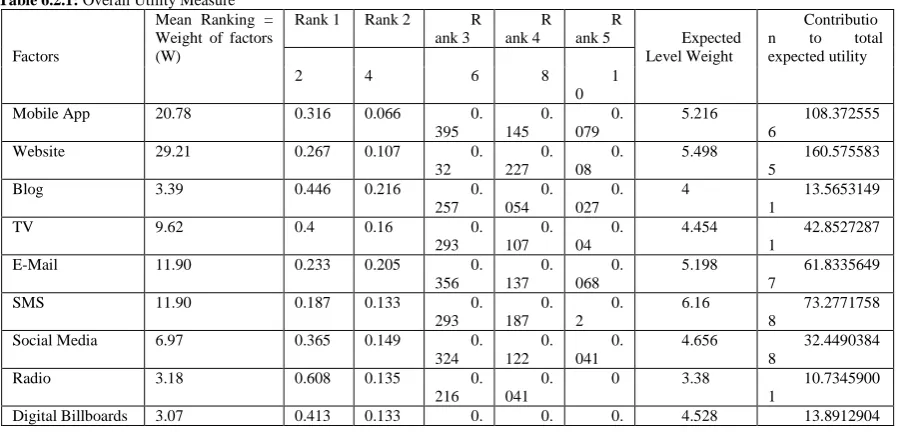
After getting Expert opinion, the responses of the users is collected and hence it affirmsthe utility of these digital mediums.The utility is computed to synthesize experts’ view point and that ofend users of banks. The strategists can utilize these factors intheir marketing strategies, and canusethe best combination of them. The user's point of viewhelps in analyzing these digitalchannels in detail and strategize their marketing activities, accordingly.
These digital mediums (factors) are ranked as either 1,2,3,4 or 5. Rank 5 signifies the highest importance of that medium for users, while Rank 1 signifies the least importance for users, ranks are given indices of 10, 8, 6, 4 and 2 which shows their importance level.
The probabilities in Table 3 showthe opinion of the 82 end users of banks for all the digital channels (factors). The overall utility is computed as,
Expected Level Weight=∑10 𝑖 ∗ (𝑎
𝑖=2 /100)
Where, i is the indices 2,4,6,8 and 10, and, a is the percentage of users who gave i rank to the digital medium (factor)
Contribution to Total Utility = Assumed Weight * Expected Weight
Total Utility = ∑ Contribution to total utility
This process focuses on end users’ view point towards each digital channel. If the strategists find that the actual (calculated) utility is lower than the desired level, then attemptscan be made to acquire the required level.
Table 6.2.1: Overall Utility Measure
Factors
Mean Ranking = Weight of factors (W)
Rank 1 Rank 2 R
ank 3
R ank 4
R
ank 5 Expected
Level Weight
Contributio n to total expected utility
2 4 6 8 1
0
Mobile App 20.78 0.316 0.066 0.
395
0. 145
0. 079
5.216 108.372555
6
Website 29.21 0.267 0.107 0.
32
0. 227
0. 08
5.498 160.575583
5
Blog 3.39 0.446 0.216 0.
257
0. 054
0. 027
4 13.5653149
1
TV 9.62 0.4 0.16 0.
293
0. 107
0. 04
4.454 42.8527287
1
E-Mail 11.90 0.233 0.205 0.
356
0. 137
0. 068
5.198 61.8335649
7
SMS 11.90 0.187 0.133 0.
293
0. 187
0. 2
6.16 73.2771758
8
Social Media 6.97 0.365 0.149 0.
324
0. 122
0. 041
4.656 32.4490384
8
Radio 3.18 0.608 0.135 0.
216
0. 041
0 3.38 10.7345900
1
28 12 053 6
Overall Utility Measure
Total Utility Measure
517.551842
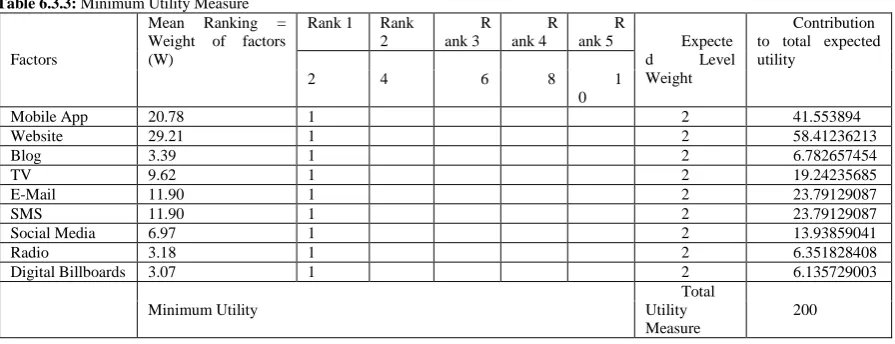
6.3 Maximum, Threshold and Minimum Utility Measure:
The overall utility measure signifies overall effectiveness of the determined digital factors however it is unable to set a benchmark/acceptable level of utility. So in order to set that benchmark, ideal, average and worst case scenarios are taken in account.
Maximum Utility Measure:
In this case, it is assumed that all respondents give Rank 5 to all mediums, which signifies expected level weight for every medium is 10. Adding the contribution of all the factors, the maximum utility value comes out to be 1000.
Table 6.3.1: Maximum Utility Measure
Factors
Mean Ranking = Weight of factors (W)
Rank 1
Rank 2 R
ank 3
R ank 4
R
ank 5 Expecte
d Level
Weight
Contribution to total expected utility
2 4 6 8 1
0
Mobile App 20.78 1 10 207.76947
Website 29.21 1 10 292.0618106
Blog 3.39 1 10 33.91328727
TV 9.62 1 10 96.21178426
E-Mail 11.90 1 10 118.9564544
SMS 11.90 1 10 118.9564544
Social Media 6.97 1 10 69.69295207
Radio 3.18 1 10 31.75914204
Digital Billboards 3.07 1 10 30.67864501
Maximum Utility
Total Utility Measure
1000
Threshold Utility Measure:
In this case, it is assumed that all respondents give Rank 3 to all mediums, which signifies expected level weight for every medium is 6. Adding the contribution of all the factors, the threshold utility value comes out to be 600.
Table 6.3.2: Threshold Utility Measure
Factors
Mean Ranking = Weight of factors (W)
Rank 1 Rank 2 Rank 3 Rank 4 Rank 5
Expected Level Weight
Contribution to total expected utility
2 4 6 8 10
Mobile App 20.78 1 6 124.661682
Website 29.21 1 6 175.2370864
Blog 3.39 1 6 20.34797236
TV 9.62 1 6 57.72707056
E-Mail 11.90 1 6 71.37387261
SMS 11.90 1 6 71.37387261
Social Media 6.97 1 6 41.81577124
Radio 3.18 1 6 19.05548523
Digital Billboards 3.07 1 6 18.40718701
Threshold Utility
Total Utility Measure 600
Minimum Utility Measure:
Table 6.3.3: Minimum Utility Measure
Factors
Mean Ranking = Weight of factors (W)
Rank 1 Rank 2
R ank 3
R ank 4
R
ank 5 Expecte
d Level
Weight
Contribution to total expected utility
2 4 6 8 1
0
Mobile App 20.78 1 2 41.553894
Website 29.21 1 2 58.41236213
Blog 3.39 1 2 6.782657454
TV 9.62 1 2 19.24235685
E-Mail 11.90 1 2 23.79129087
SMS 11.90 1 2 23.79129087
Social Media 6.97 1 2 13.93859041
Radio 3.18 1 2 6.351828408
Digital Billboards 3.07 1 2 6.135729003
Minimum Utility
Total Utility Measure
200
Conclusion:
Since, India is under transition from traditional to digital world, Banks also need to shift themselves from the same pace. Digital mediums may cost a hell lot of money, if spent, without any understanding of market. So, strategizing for digital media marketing is as important as conventional marketing done by banks in India.
This paper determines the usage of utility of factors alone and taken together and compare the results with the AHP to authenticate the significance of factors in order to enhance the allocation of resources and maximize the outcomes from the use of different digital channels in Banking industry. The top level management need to efficiently allocate the funds to achieve high level of output from the digital media. In such a scenario where overall suitability of the selected factors in augmenting the outcome is to be given high significance, our proposed model based on overall utility derived from the utilization of combination of these factors, helps top management to not only defer relatively less important factors but also efficiently plan out this combination of factors taking into account the total utility derived from them. The factors obtaining lesser utility value turn out to be of immense information to the management as a way to bring about alteration in planning the digital media usage to increase overall efficiency. In considering the overall effectiveness of all the factors together assists in explaining both the perception of users and the top level management.
According to expert’s opinion it was found that Website possess the maximum weightage and mobile app comes on second position. After getting responses from end users, overall utility comes out to be 517.55 which is below the threshold (average) utility measure. It shows that Indian banks need to give more importance to these digital mediums and come out with a strategy which can help in converting potential customers into active ones.
Customers’ responses also shows they are more exposed to SMS along with website and mobile app and least exposed to Radio. Since, SMS is a one to one digital marketing medium, it is of great importance for banks.
REFERENCES
2016. “Productivity in Indian Banking - DIGITAL AND BEYOND: New Horizons in Indian Banking”, Boston Consulting Group, FICCI and Indian Banks’ Association.
Accessed on 2017. from http://indiainbusiness.nic.in/newdesign/upload/Productivity-in-indian-banking-2016-digital-and-beyond-new-horizons-in-indian-banking.pdf
2015. “Logging into Digital Banking - Create access, transforming lives”, PWC, Accessed on March 7, 2017, from https://www.pwc.in/assets/pdfs/publications/2015/logging-into-digital-banking.pdf
Henk Broeders & Somesh Khanna, 2015. “Strategic choices for banks in the digital age”, McKinsey&Company, Financial Services, Accessed on, from http://www.mckinsey.com/industries/financial-services/our-insights/strategic-choices-for-banks-in-the-digital-age
Susan Marshall, 2016. “5 Digital Marketing Trends in Banking for, The Financial Brand. Accessed on March 8, 2017, from https://thefinancialbrand.com/54885/2016-digital-marketing-trends-in-banking/
2016. “DIGITAL BANKING TRENDS AND INNOVATIONS”, USTGlobal. Accessed on March 9, 2017,
from
http://www.ust-global.com/sites/default/files/BFSI%20-%20Innovations%20in%20Digital%20Banking.pdf
2017. “Future of India: The Winning Leap”, PWC India. Accessed, form
https://www.pwc.in/assets/pdfs/future-of-india/future-of-india-the-winning-leap.pdf
2017. “Banking Sector in India”, IBEF. Accessed on March 9, 2017, form
2017. “The Evolution to Digital Communications”, Fiserv. Accessed, from https://www.fiserv.com/resources/418-13-19132_Evolution_to_Digital_Communications_Final_2.12.14.pdf
Loveleen Gaur, Gurinder Singh, P.K. Kapur, Jeyta & Shubhankar Kumar, 2016. “Measuring Efficiency of Retail website using Utility Tool”
Kapur, P.K., Sunil K. Khatri, Nitin Sachdeva and AnshulTickoo, “Measuring Software Testing Efficiency UsingTwo- Way Assessment Technique”
Liu, C., K. Arnett, 2000. Exploring the factors associated with web site success in the context of electronic commerce. Information and Management, 38: 23-33.