DATABASE
CSgator: an integrated web platform
for compound set analysis
Sera Park
1, Yeajee Kwon
2, Hyesoo Jung
1, Sukyung Jang
1, Haeseung Lee
1and Wankyu Kim
1,2*Abstract
Drug discovery typically involves investigation of a set of compounds (e.g. drug screening hits) in terms of target, disease, and bioactivity. CSgator is a comprehensive analytic tool for set-wise interpretation of compounds. It has two unique analytic features of Compound Set Enrichment Analysis (CSEA) and Compound Cluster Analysis (CCA), which allows batch analysis of compound set in terms of (i) target, (ii) bioactivity, (iii) disease, and (iv) structure. CSEA and CCA present enriched profiles of targets and bioactivities in a compound set, which leads to novel insights on under-lying drug mode-of-action, and potential targets. Notably, we propose a novel concept of ‘Hit Enriched Assays”, i.e. bioassays of which hits are enriched among a given set of compounds. As an example, we show its utility in revealing drug mode-of-action or identifying hidden targets for anti-lymphangiogenesis screening hits. CSgator is available at
http://csgat or.ewha.ac.kr, and most analytic results are downloadable.
Keywords: Compound set analysis, Drug target, Bioactivity profile, Bioassay, Compound network
© The Author(s) 2019. This article is distributed under the terms of the Creative Commons Attribution 4.0 International License (http://creat iveco mmons .org/licen ses/by/4.0/), which permits unrestricted use, distribution, and reproduction in any medium, provided you give appropriate credit to the original author(s) and the source, provide a link to the Creative Commons license, and indicate if changes were made. The Creative Commons Public Domain Dedication waiver (http://creat iveco mmons .org/ publi cdoma in/zero/1.0/) applies to the data made available in this article, unless otherwise stated.
Introduction
During the early phase of drug discovery, it is common to identify multiple hit compounds by high-throughput screening (HTS) [1, 2]. It is critical to survey their known targets, activities, and disease indications to avoid poten-tial toxicity or side-effects, to understand structure-activity relations (SAR), and to direct medicinal chemistry for lead generation. Active exploitation of polypharmacology (e.g. dual inhibitors) or drug combination has also been con-sidered as a viable strategy to overcome drug resistance or tumor heterogeneity in cancer therapy [3]. Although sci-entists have access to many chemogenomic databases, they are not comprehensive enough individually, nor suitable or convenient for batch analyses of a compound set [4– 8]. Recent explosion of bioassay datasets (e.g. PubChem and ChEMBL [9, 10]) made rich information available on diverse aspects of bioactivities, but such data have been used only limitedly in drug discovery. Several integrated compound-target DBs are available, but are limited in analytic functions [11, 12]. There were several works on
predictive analyses based on bioactivity profiles or finger-prints, most of which did not fully exploited bioactivity data available [13, 14], or were difficult to use for research-ers without programming skills [15].
Here, we developed CSgator (Compound Set navigator), a web platform that provides a comprehensive interpreta-tion of compound set. It is equipped with unique analytic features of Compound Set Enrichment Analysis (CSEA) and Compound Cluster Analysis (CCA). Particularly, we pro-vide unique analytic functions such as HEA analysis (Hit Enrichment Analysis) that provide novel insights or clues on drug mode-of-action, or underlying targets of pheno-typic screening hits (e.g. lymphangiogenesis) as described in the following sections with an example case.
Materials and methods
Standardization of compound IDs and gene names
In order to avoid redundancy, CSgator amassed a con-solidated set of compounds from public chemical data-base such as PubChem, ChEMBL, ChEBI, and DrugBank [5, 7, 10, 16]. We then merged different isotopic, (un) charged, and (de)protonated forms of the same molecule into a single compound ID. For example, lovastatin, a HMG-CoA reductase inhibitor falls into 62 PubChem CIDs, all of which would show essentially the same or
Open Access
*Correspondence: [email protected]
1 Ewha Research Center for Systems Biology, Department of Life Science,
Division of Molecular and Life Sciences, Ewha Womans University, Seoul, Korea
highly similar biological activity. All the compounds were mapped to a unified compound ID based on IUPAC InChIKey (IUPAC International Chemical Identifier Key) using Open Babel v.2.3 [17] by converting SMILES or MOL format to InChIKey strings as well as by manual mapping of compound names where necessary. Gene IDs were standardized using the gene names given by Uni-ProtKB and NCBI Gene [18, 19].
Collection of compound‑target interaction data
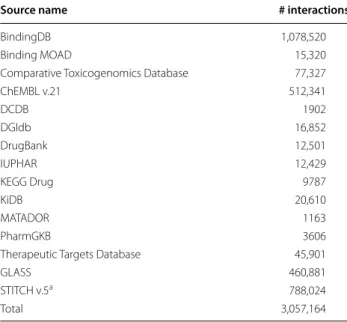
We collected compound-target interaction data from 15 public databases: CTD, DCDB, DrugBank, MATA-DOR, TTD, BindingDB, ChEMBL, KiDB, KEGG Drug, PharmGKB, IUPHAR, Binding MOAD, DGIdb, GLASS, STITCH [4, 6–8, 10, 20–29]. After ID standardization of compounds and genes, a total of > 3 mil. compound-tar-get interactions are collected (Table 1).
Classification of targets and diseases
Compounds and targets were classified by four different annotations: (I) Protein family classes by ChEMBL ver-sion 21, (II) Gene Ontology (GO) terms on Biological Process (BP) [30], (III) Disease Ontology (DO) terms that cross reference with MeSH (Medical Subject Headings), ICD (International Classification of Diseases), NCI’s the-saurus, SNOMED (Systemized Nomenclature of
Medi-cine) and OMIM [31], and (IV) MeSH Disease term
provided by NLM (U.S. National Library of Medicine) [32].
Bioassay data from PubChem Bioassay and ChEMBL
Bioassay data include information for diverse aspects of compound bioactivities. We collected over 1.2 mil. bio-assay dataset for > 2 mil. compounds from PubChem Bioassay and ChEMBL [9, 10]. Some of the bioassay dataset were not in a standardized format and required further processing such as ordering compounds by activ-ity, assignment of hit/non-hit compounds, and target ID standardization for targeted bioassays. We assigned com-pounds as hit by applying one of the three criteria. First, PubChem Bioassay and ChEMBL provide active/inac-tive information for ~ 22% of the total assays (~ 270,000 bioassays), and accordingly, we took the information to assign hit or non-hit compounds. For the remaining bioassays without active/inactive annotation, the cut-off of Z score ≥ 2 or the top 1% were applied as the second and the third criteria, and took the union of the result-ing compound sets as hits. Because only a small fraction of the assays were annotated to a specific target, we also performed a manual curation to assign bioassays to a specific target whenever target information is available in the assay title or description. As a result, ~ 10.3% of the total assays were assigned to a specific target.
Generation of structural properties
We calculated structural and physicochemical properties of all the compounds, which can be exploited for char-acterization or filtering of a compound set using Open Babel toolbox [17]. The physicochemical properties were calculated such as molecular weight, FP2 fingerprint, logP (Partition coefficient), topological polar surface area (TPSA), and hydrogen bond donor and acceptor. Additionally, we generate predictors for lead-likeness, i.e. Lipinski’s the rule, and QED (quantitative estimation of drug-likeness) by Gregory Gerebtzoff (Roche, Switer-land) implemented in Silico-it package [33].
Utility and discussion System overview
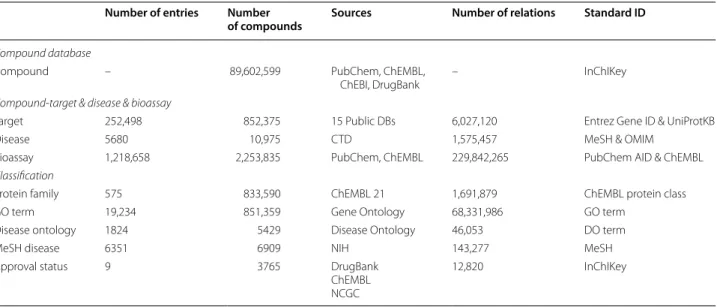
CSgator includes information on ~ 90 million compounds after merging redundant entries, > 6 million compound-target relations from 15 public databases (Table 1), ~ 1.6 million compound-disease associations, and > 230 mil-lion bioactivity points collected from > 1.2 milmil-lion bioassay data set. Whenever available, compounds and targets were annotated by protein family, functional annotation by Gene Ontology [30], and disease categories by Disease Ontology and MeSH [31, 32]. As described in the following sections, these annotations are crucial to interpret the character-istics of input compound set, and provide novel clues on drug mode-of-action, and will be expanded as more infor-mation accumulate. Data sources and current statistics are listed in Table 2. These data may be available elsewhere, but
Table 1 Compound-target interaction data from 15 public databases
a STITCH provides scores for protein–chemical interactions, we filtered that interactions on two conditions: experimental score ≥ 700 and database score ≥ 700
Source name # interactions
BindingDB 1,078,520 Binding MOAD 15,320 Comparative Toxicogenomics Database 77,327 ChEMBL v.21 512,341
DCDB 1902
DGIdb 16,852
DrugBank 12,501
IUPHAR 12,429
KEGG Drug 9787
KiDB 20,610
MATADOR 1163
PharmGKB 3606
Therapeutic Targets Database 45,901
GLASS 460,881
STITCH v.5a 788,024
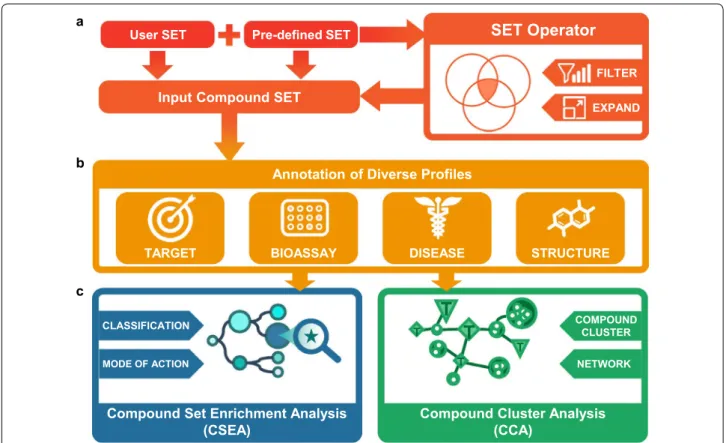
CSgator is unique for its comprehensiveness, clean map-ping between different resources, and full data accessibility. The analytic workflow of CSgator consists of three steps of (i) generation of input compound set, (ii) tabular list-ing of annotations for the input compound set, and (iii) compound set analysis step as depicted in Fig. 1. First, input compound set can be generated in three different ways: (a) by Compound ID Search using SMILES, InChI, InChIKey, CAS Registry Number, and other IDs includ-ing PubChem, ChEMBL, ChEBI, and DrugBank, (b) by Compound Structure Search for compounds with spe-cific scaffolds or by structural similarity, and (c) by Com-pound Set Selection, where the precompiled compound set is selected. Precompiled compound sets were built in various ways, e.g. by target or target family, approval status by FDA and other countries, and disease indica-tion. Notably, users can also freely generate a new com-pound set by applying Set Operator to precompiled or input compound sets, and by filtering compounds based on physicochemical properties. Second, CSgator inter-nally gathers all the annotations of input compounds that are grouped into four categories: (i) target, (ii) bioassay, (iii) disease, and (iv) structure. All the annotations are listed and downloadable in a tabular format. Third, user can investigate collective information of a compound
set, which is not available in other related databases. The
two unique analyses in CSgator are CSEA (Compound
Set Enrichment Analysis) and CCA (Compound Cluster Analysis), which will be further explained in the following sections.
Compound Set Enrichment Analysis (CSEA)
Similarly to Gene Set Enrichment Analysis (GSEA [34]), Compound Set Enrichment Analysis (CSEA) refers to investigating enriched annotations for a compound set. Varin et al. [35] applied CSEA to identify active scaffolds enriched in primary screening data. We extend CSEA even further to annotations on target, disease, and bio-assay hits. Particularly, we propose a novel concept of Hit Enriched Assays (HEAs) as bioassays of which hits are enriched among the compound set of interest. Since bioassays generally have intended targets and biological processes, HEAs can provide non-obvious links to the underlying targets and drug mode-of-actions enriched in the input compound set such as phenotypic screening hits. Similarly, it also shows enriched targets or diseases in a tree format, i.e. Target Enrichment Tree (TET), and Disease Enrichment Tree (DET). The degree of enrich-ment, or Enrichment Score (ES) is calculated as log likeli-hood ratio (LLR) for HEAs, and odds ratio for TET and DET.
ESHEA=LLR=log2
|Q∩H|/|QC∩H| |Q|/|QC|
ESTET or DET =Odds Ratio=log2
|Q⊗H|/|QC⊗H| |Q⊗HC|/|QC⊗HC|
|Q⊗H| :The number of interactions between Q(compound set)and H(target or disease),
Table 2 Data sources and statistics collected in CSgator Number of entries Number
of compounds Sources Number of relations Standard ID
Compound database
Compound – 89,602,599 PubChem, ChEMBL,
ChEBI, DrugBank – InChIKey
Compound-target & disease & bioassay
Target 252,498 852,375 15 Public DBs 6,027,120 Entrez Gene ID & UniProtKB Disease 5680 10,975 CTD 1,575,457 MeSH & OMIM
Bioassay 1,218,658 2,253,835 PubChem, ChEMBL 229,842,265 PubChem AID & ChEMBL
Classification
Protein family 575 833,590 ChEMBL 21 1,691,879 ChEMBL protein class GO term 19,234 851,359 Gene Ontology 68,331,986 GO term
Disease ontology 1824 5429 Disease Ontology 46,053 DO term MeSH disease 6351 6909 NIH 143,277 MeSH Approval status 9 3765 DrugBank
ChEMBL NCGC
where Q is the input or query compounds, and QC is the compounds that do not belong to Q. H is the compounds of interest, e.g. hit compounds for HEA, ligands for a target or target family for TET, and compounds related to a disease for DET analysis. In calculating ES for TET (or DET), we assume compounds not in the query QC do NOT interact with the target or target family (or disease) although more interactions may exist, but not yet dis-covered in any test. These missing information may skew the results of TET (or DET), which should be cautiously interpreted. Later, we show an example case of CSEA in interpreting anti-lymphangiogenesis screening hits in the ‘Case Study’ section below.
Compound Cluster Analysis (CCA)
Structurally similar compounds tend to share the same or structurally similar targets [36]. With the purpose to investigate this aspect, CSgator first generates Com-pound Clusters (CCs) of structurally similar subgroups by k-means clustering. It then shows Compound Cluster Network (CC-Network), showing connections among the compound clusters with target family or disease classes. Similarly to CSEA, the degree of enrichment for each CC is also calculated as odd ratio, where R represent the compounds of each cluster (CC), and RC is the all other compounds in the database. Therefore, CC-Network pro-vides information on how a structurally similar cluster of compounds (CC) would be significantly associated to a specific target family or disease class compared to all other compounds as background.
ESCCA=Odd Ratio=log2
|R⊗H|/|RC⊗H| |R⊗HC|/|RC⊗HC|
|R⊗H| :The number of interactions between R(compound cluster)and H(target or disease)
SET Operator
Compound Set Enrichment Analysis (CSEA)
CLASSIFICATION
Compound Cluster Analysis (CCA)
NETWORK COMPOUND
CLUSTER
Annotation of Diverse Profiles
STRUCTURE
TARGET BIOASSAY DISEASE
T
T
T T
T Input Compound SET
MODE OF ACTION
User SET Pre-defined SET
EXPAND FILTER
a
b
c
A case study on interpreting phenotypic screening hits
Here, we show the utility of the two main analytic func-tions in CSgator using a case study in interpreting phenotypic screening hits. We took the high-content phenotype-based assay data for screening inhibitors of lymphangiogenesis [37]. Schulz et al. screened FDA approved 1280 drugs (Library of Pharmacologically Active Compounds or LOPAC library from Sigma), resulting in identifying 31 hits (hit rate of 2.4%). The 31 hits were mapped to 40 unique compound IDs in CSga-tor. But this screening dataset alone does not provide information on the underlying targets or drug mode-of-action. With the 40 compounds as an input set, we performed CSEA and CCA analyses implemented in CSgator as described in the following section.
CSEA (Compound Set Enrichment Analysis)
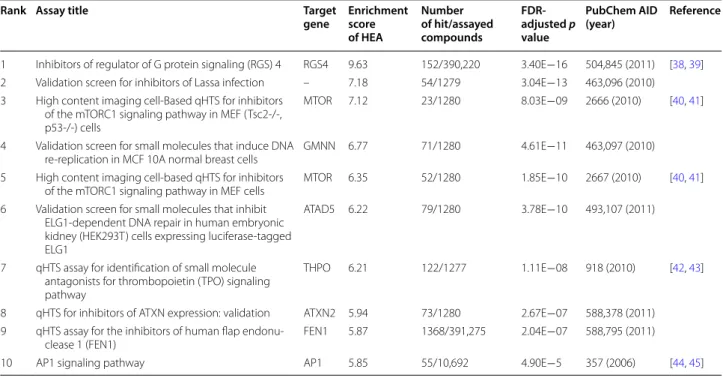
CSEA investigates enriched annotations in terms of tar-get, disease, and bioactivities. In HEA analysis, CSgator listed 146 bioassays, where the 40 input compounds were significantly enriched as hits. We took the list of HEAs that have explicit information on their intended targets with high enrichment score (ES > 5) as listed in Table 3. The targets of the top ranked HEAs include many genes that were known to be involved in lymphangiogenesis.
The top ranking HEA (ES = 9.75) screened for RGS4
(Regulator of G-protein signaling 4) inhibitors. Indeed, RGS4 plays a key role in regulating tubulogenesis includ-ing lymphangiogenesis by antagonizinclud-ing MAPK and
VEGF signaling [38, 39]. The third and fifth HEA
tar-geted mTOR (ES = 7.12), which generally known to
control lymphangiogenesis [40, 41]. Thrombopoietin (TPO) is the regulator of thrombocyte production, and recent studies provide evidence for the critical role of the thrombocytes in lymphangiogenesis in human malignant tumors [42, 43]. A bioassay targeting TPO was ranked at the top 7th with ES = 6.21. Vascular endothelial growth factor D (VEGF-D) has been implicated in the key role of lymphangiogenesis. TNF-α induces AP-1 binding to the VEGF-D promoter, and increase VEGF-D expres-sion through TNF-α/ERK1/2/AP-1 pathway, which pro-motes lymphangiogenesis and lymphatic metastasis [44, 45]. The 10th HEA (ES = 5.85) targeted AP1 signaling. In summary, five out of the top 10 HEAs provided direct links to the known genes associated to lymphangiogene-sis. Accordingly, other targets of high ranking HEAs may be also involved in lymphangiogenesis, such as GMNN, ATAD5, ATXN2, and FEN1 (Table 3).
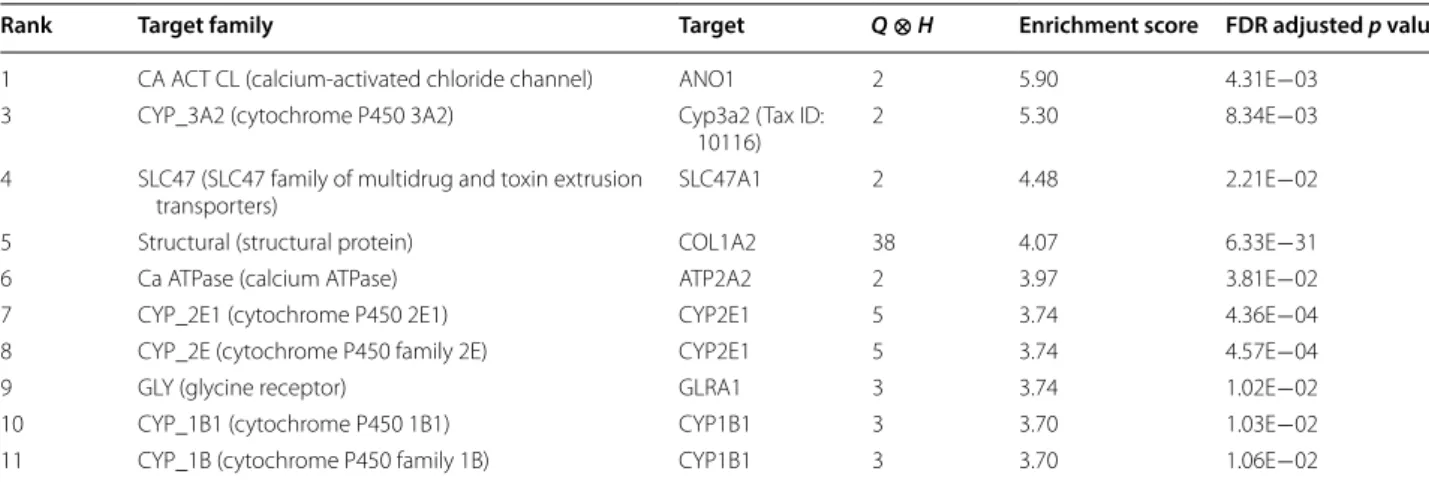
Similarly, we performed Target Enrichment Tree (TET) analysis to get useful clues to underlying targets of phe-notypic screening assays. CSgator listed target protein families prioritized by enrichment score (Table 4). The top ranked target family was calcium-activated chlo-ride channel family (ES = 5.90), of which key role was reported in lymph node remodeling by induction of
lym-phangiogenesis [46]. Among the 40 input compounds,
only 2 compounds are known to interact with the targets of the family members in our dataset. It demonstrates the
Table 3 HEAs (Hit Enriched Assays) from lymphangiogenesis hits
Rank Assay title Target
gene Enrichment score of HEA
Number of hit/assayed compounds
FDR‑ adjusted p value
PubChem AID
(year) Reference
1 Inhibitors of regulator of G protein signaling (RGS) 4 RGS4 9.63 152/390,220 3.40E−16 504,845 (2011) [38, 39] 2 Validation screen for inhibitors of Lassa infection – 7.18 54/1279 3.04E−13 463,096 (2010) 3 High content imaging cell-Based qHTS for inhibitors
of the mTORC1 signaling pathway in MEF (Tsc2-/-, p53-/-) cells
MTOR 7.12 23/1280 8.03E−09 2666 (2010) [40, 41]
4 Validation screen for small molecules that induce DNA
re-replication in MCF 10A normal breast cells GMNN 6.77 71/1280 4.61E−11 463,097 (2010) 5 High content imaging cell-based qHTS for inhibitors
of the mTORC1 signaling pathway in MEF cells MTOR 6.35 52/1280 1.85E−10 2667 (2010) [40, 41] 6 Validation screen for small molecules that inhibit
ELG1-dependent DNA repair in human embryonic kidney (HEK293T) cells expressing luciferase-tagged ELG1
ATAD5 6.22 79/1280 3.78E−10 493,107 (2011)
7 qHTS assay for identification of small molecule antagonists for thrombopoietin (TPO) signaling pathway
THPO 6.21 122/1277 1.11E−08 918 (2010) [42, 43]
8 qHTS for inhibitors of ATXN expression: validation ATXN2 5.94 73/1280 2.67E−07 588,378 (2011) 9 qHTS assay for the inhibitors of human flap
current lack of enough compound-target data even after the integration of 15 publicly available datasets. There-fore, the utility of TET or DET analysis may be limited at the moment compared to HEA analysis. In spite of this limitation, it showed significant enrichment (FDR-adjusted p value = 0.00431). We were able to identify other target families potentially associated to lymphangi-ogenesis. The families related to cytochrome P450 were found frequently within the top 10 ranks (five out of the
ten families). It may be associated that oxygen released by oxidoreduction in lymph tissue causes expansion of lym-phatic vessels [47]. If we use a larger input set and col-lect more compound-target dataset, TET analysis may become more useful with better statistical power.
CCA (Compound Cluster Analysis)
Certain properties of a compound set may be evident only in structurally similar subgroups. CCA allows
Table 4 Target enrichment tree results from lymphangiogenesis hits
Rank Target family Target Q⊗H Enrichment score FDR adjusted p value
1 CA ACT CL (calcium-activated chloride channel) ANO1 2 5.90 4.31E−03 3 CYP_3A2 (cytochrome P450 3A2) Cyp3a2 (Tax ID:
10116) 2 5.30 8.34E−03 4 SLC47 (SLC47 family of multidrug and toxin extrusion
transporters) SLC47A1 2 4.48 2.21E−02 5 Structural (structural protein) COL1A2 38 4.07 6.33E−31 6 Ca ATPase (calcium ATPase) ATP2A2 2 3.97 3.81E−02 7 CYP_2E1 (cytochrome P450 2E1) CYP2E1 5 3.74 4.36E−04 8 CYP_2E (cytochrome P450 family 2E) CYP2E1 5 3.74 4.57E−04 9 GLY (glycine receptor) GLRA1 3 3.74 1.02E−02 10 CYP_1B1 (cytochrome P450 1B1) CYP1B1 3 3.70 1.03E−02 11 CYP_1B (cytochrome P450 family 1B) CYP1B1 3 3.70 1.06E−02
identification of enriched features in structurally simi-lar clusters of compounds. In CSgator, we obtained three compound clusters (CC #1–#3) in the 40 input compounds by setting the number of clusters, k = 3. Then, a network of CCs and disease classes is generated (Fig. 2). This network showed the distribution of their original indications, and several notable connections were observed. CC #2 was linked to several diseases including viral infectious disease. There are several studies that herpes virus-triggered immune response drives lymphangiogenesis [39, 48, 49]. Both CC #2 and #3 were strongly connected to cancer, which may be expected because inhibition of lymphangiogenesis has emerged as a promising strategy for cancer therapy [47, 50].
Conclusions
CSgator is a highly comprehensive and integrated analytic system for compound set analysis in terms of targets, bioactivity profiles, structural properties, and disease indications. Such information is crucial to interpret a set of compounds such as high-throughput screening hits, avoid potential side effects or toxicity, and investigate polypharmacology profiles for drug dis-covery and development. It provides unique functions such as CSEA and CCA, which are not available in other similar tools and databases. It showed that CSga-tor can give novel clues on drug mode-of-action and the underlying targets for phenotypic screening hits, as shown in the example case of interpreting the anti-lymphangiogenesis screening hits.
Abbreviations
CSEA: Compound Set Enrichment Analysis; CC: Compound Cluster; CCA : Compound Cluster Analysis; HEA: Hit Enriched Assay; ES: enrichment score; LLR: log likelihood ratio; OR: odds ratio; MDS: multidimensional scaling; HTS: high-throughput screening; SAR: structure–activity relation; InChI: Interna-tional Chemical Identifier; ID: identification; DB: database; CTD: Comparative Toxicogenomics Database; MeSH: Medical Subject Headings; NIH: National Institutes of Health; NCGC : NCATS Chemical Genomics Center; QED: quantita-tive estimation of drug-likeness; logP: partition coefficient; Tc: Tanimoto coef-ficient; GO: gene ontology; DO: Disease Ontology; CAS: Chemical Abstracts Service; qHTS: quantitative high-throughput screening.
Authors’ contributions
WK designed the study, and SP, YK, HJ, SJ, HL collected data and performed the analysis, and SP implemented the web site. SP and WK wrote the manu-script. All authors read and approved the final manumanu-script.
Author details
1 Ewha Research Center for Systems Biology, Department of Life Science,
Divi-sion of Molecular and Life Sciences, Ewha Womans University, Seoul, Korea.
2 KaiPharm, Seoul, Korea.
Acknowledgements
We thank Seungmin Kang for helpful discussions and comments.
Competing interests
The authors declare that they have no competing interests.
Availability and data and materials
The web platform can be accessible at http://csgat or.ewha.ac.kr.
Funding
This work was funded by Grants from National Research Foundation of Korea (NRF-2017R1A2B4007855, and NRF-2017M3C9A5028690) and from Institu-tion for InformaInstitu-tion and communicaInstitu-tions Technology PromoInstitu-tion(IITP) (No. 2016-0-00289).
Publisher’s Note
Springer Nature remains neutral with regard to jurisdictional claims in pub-lished maps and institutional affiliations.
Received: 25 July 2018 Accepted: 26 February 2019
References
1. Bleicher KH, Böhm H-J, Müller K, Alanine AI (2003) Hit and lead gen-eration: beyond high-throughput screening. Nat Rev Drug Discov 2:369–378. https ://doi.org/10.1038/nrd10 86
2. Macarron R, Banks MN, Bojanic D et al (2011) Impact of high-throughput screening in biomedical research. Nat Rev Drug Discov 10:188–195. https ://doi.org/10.1038/nrd33 68
3. Antolin A, Workman P, Mestres J, Al-Lazikani B (2017) Polypharmacology in precision oncology: current applications and future prospects. Curr Pharm Des 22 (46):6935–6945
4. Chen X, Ji ZL, Chen YZ (2002) TTD: therapeutic target database. Nucleic Acids Res 30:412–415
5. Degtyarenko K, de Matos P, Ennis M et al (2008) ChEBI: a database and ontology for chemical entities of biological interest. Nucleic Acids Res 36:D344–D350. https ://doi.org/10.1093/nar/gkm79 1
6. Gunther S, Kuhn M, Dunkel M et al (2007) SuperTarget and Matador: resources for exploring drug-target relationships. Nucleic Acids Res 36:D919–D922. https ://doi.org/10.1093/nar/gkm86 2
7. Law V, Knox C, Djoumbou Y et al (2014) DrugBank 4.0: shedding new light on drug metabolism. Nucleic Acids Res 42:D1091–D1097. https ://doi. org/10.1093/nar/gkt10 68
8. Sharman JL, Benson HE, Pawson AJ et al (2013) IUPHAR-DB: updated database content and new features. Nucleic Acids Res 41:D1083–D1088.
https ://doi.org/10.1093/nar/gks96 0
9. Wang Y, Suzek T, Zhang J et al (2014) PubChem BioAssay: 2014 update. Nucleic Acids Res 42:D1075–D1082. https ://doi.org/10.1093/nar/gkt97 8
10. Bento AP, Gaulton A, Hersey A et al (2014) The ChEMBL bioactivity database: an update. Nucleic Acids Res 42:D1083–D1090. https ://doi. org/10.1093/nar/gkt10 31
11. Irwin JJ, Sterling T, Mysinger MM et al (2012) ZINC: a free tool to discover chemistry for biology. J Chem Inf Model 52:1757–1768. https ://doi. org/10.1021/ci300 1277
12. Roider HG, Pavlova N, Kirov I et al (2014) Drug2Gene: an exhaustive resource to explore effectively the drug-target relation network. BMC Bioinformatics 15:68. https ://doi.org/10.1186/1471-2105-15-68
13. Cheng T, Li Q, Wang Y, Bryant SH (2011) Identifying compound-target associations by combining bioactivity profile similarity search and public databases mining. J Chem Inf Model 51:2440–2448. https ://doi. org/10.1021/ci200 192v
14. Helal KY, Maciejewski M, Gregori-Puigjané E et al (2016) Public domain HTS fingerprints: design and evaluation of compound bioactivity profiles from PubChem’s bioassay repository. J Chem Inf Model 56:390–398. https ://doi.org/10.1021/acs.jcim.5b004 98
15. William T, Backman H, Girke T (2016) bioassayR: cross-target analy-sis of small molecule bioactivity. J Chem Inf Model 9:99. https ://doi. org/10.1021/acs.jcim.6b001 09
•fast, convenient online submission •
thorough peer review by experienced researchers in your field • rapid publication on acceptance
• support for research data, including large and complex data types •
gold Open Access which fosters wider collaboration and increased citations maximum visibility for your research: over 100M website views per year •
At BMC, research is always in progress.
Learn more biomedcentral.com/submissions
Ready to submit your research? Choose BMC and benefit from:
17. O’Boyle NM, Banck M, James CA et al (2011) Open Babel: an open chemi-cal toolbox. J Cheminform 3:33. https ://doi.org/10.1186/1758-2946-3-33
18. Magrane M, UniProt Consortium (2011) UniProt Knowledgebase: a hub of integrated protein data. Database (Oxford) 2011:bar009. https ://doi. org/10.1093/datab ase/bar00 9
19. Maglott D, Ostell J, Pruitt KD, Tatusova T (2011) Entrez gene: gene-centered information at NCBI. Nucleic Acids Res 39:D52–D57. https ://doi. org/10.1093/nar/gkq12 37
20. Liu Y, Wei Q, Yu G et al (2014) DCDB 2.0: a major update of the drug combination database. Database (Oxford) 2014:bau124. https ://doi. org/10.1093/datab ase/bau12 4
21. Davis AP, Grondin CJ, Johnson RJ et al (2017) The Comparative Toxicog-enomics Database: update 2017. Nucleic Acids Res 45:D972–D978. https ://doi.org/10.1093/nar/gkw83 8
22. Gilson MK, Liu T, Baitaluk M et al (2016) BindingDB in 2015: a public database for medicinal chemistry, computational chemistry and systems pharmacology. Nucleic Acids Res 44:D1045–D1053. https ://doi. org/10.1093/nar/gkv10 72
23. Benson ML, Smith RD, Khazanov NA et al (2008) Binding MOAD, a high-quality protein-ligand database. Nucleic Acids Res 36:D674–D678. https ://doi.org/10.1093/nar/gkm91 1
24. Wagner AH, Coffman AC, Ainscough BJ et al (2016) DGIdb 2.0: mining clinically relevant drug-gene interactions. Nucleic Acids Res 44:D1036– D1044. https ://doi.org/10.1093/nar/gkv11 65
25. Chan WKB, Zhang H, Yang J et al (2015) GLASS: a comprehensive data-base for experimentally validated GPCR-ligand associations. Bioinformat-ics 31:3035–3042. https ://doi.org/10.1093/bioin forma tics/btv30 2
26. Szklarczyk D, Santos A, von Mering C et al (2016) STITCH 5: augmenting protein–chemical interaction networks with tissue and affinity data. Nucleic Acids Res 44:D380–D384. https ://doi.org/10.1093/nar/gkv12 77
27. Thorn CF, Klein TE, Altman RB (2013) PharmGKB: the pharmacogenom-ics knowledge base. Methods Mol Biol 1015:311–320. https ://doi. org/10.1007/978-1-62703 -435-7_20
28. Kanehisa M, Furumichi M, Tanabe M et al (2017) KEGG: new perspectives on genomes, pathways, diseases and drugs. Nucleic Acids Res 45:D353– D361. https ://doi.org/10.1093/nar/gkw10 92
29. Roth BL, Lopez E, Patel S, Kroeze WK (2000) The multiplicity of serotonin receptors: uselessly diverse molecules or an embarrassment of riches? The Neuroscientist 6:252–262. https ://doi.org/10.1177/10738 58400 00600 408
30. Gene Ontology Consortium (2015) Gene ontology consortium: going forward. Nucleic Acids Res 43:D1049–D1056. https ://doi.org/10.1093/nar/ gku11 79
31. Schriml LM, Arze C, Nadendla S et al (2012) Disease ontology: a backbone for disease semantic integration. Nucleic Acids Res 40:D940–D946. https ://doi.org/10.1093/nar/gkr97 2
32. Erwin PJ, Perkins WJ (2007) Medline: a guide to effective searching in Pub-Med & other interfaces, 2nd Edition. Anesthesiology 107:360–361.
https ://doi.org/10.1097/01.anes.00002 71865 .33903 .be
33. Bickerton GR, Paolini GV, Besnard J et al (2012) Quantifying the chemical beauty of drugs. Nat Chem 4:90–98. https ://doi.org/10.1038/nchem .1243
34. Subramanian A, Tamayo P, Mootha VK et al (2005) Gene set enrichment analysis: a knowledge-based approach for interpreting genome-wide expression profiles. Proc Natl Acad Sci USA 102:15545–15550. https ://doi. org/10.1073/pnas.05065 80102
35. Varin T, Gubler H, Parker CN, Zhang J-H, Raman P, Ertl P, Schuffenhauer A (2010) Compound set enrichment: a novel approach to analysis of primary HTS data. J Chem Inf Model 50 (12):2067–2078
36. Martin YC, Kofron JL, Traphagen LM (2002) Do structurally similar molecules have similar biological activity? J Med Chem. https ://doi. org/10.1021/JM020 155C
37. Schulz MMP, Reisen F, Zgraggen S et al (2012) Phenotype-based high-content chemical library screening identifies statins as inhibitors of in vivo lymphangiogenesis. Proc Natl Acad Sci USA 109:E2665–E2674.
https ://doi.org/10.1073/pnas.12060 36109
38. Albig AR, Schiemann WP (2005) Identification and characterization of regulator of G protein signaling 4 (RGS4) as a novel inhibitor of tubulo-genesis: RGS4 inhibits mitogen-activated protein kinases and vascular endothelial growth factor signaling. Mol Biol Cell 16:609–625. https ://doi. org/10.1091/mbc.e04-06-0479
39. Aguilar B, Choi I, Choi D et al (2012) Lymphatic reprogramming by Kaposi sarcoma herpes virus promotes the oncogenic activity of the virus-encoded G-protein-coupled receptor. Cancer Res 72:5833–5842. https :// doi.org/10.1158/0008-5472.CAN-12-1229
40. Chen H, Guan R, Lei Y et al (2015) Lymphangiogenesis in gastric cancer regulated through Akt/mTOR-VEGF-C/VEGF-D axis. BMC Cancer 15:103.
https ://doi.org/10.1186/s1288 5-015-1109-0
41. Ekshyyan O, Moore-Medlin TN, Raley MC et al (2013) Anti-lymphang-iogenic properties of mTOR inhibitors in head and neck squamous cell carcinoma experimental models. BMC Cancer 13:320. https ://doi. org/10.1186/1471-2407-13-320
42. Bertozzi CC, Hess PR, Kahn ML (2010) Platelets: covert regulators of lym-phatic development. Arterioscler Thromb Vasc Biol 30:2368–2371. https :// doi.org/10.1161/ATVBA HA.110.21728 1
43. Schoppmann SF, Alidzanovic L, Schultheis A et al (2013) Thrombo-cytes correlate with lymphangiogenesis in human esophageal cancer and mediate growth of lymphatic endothelial cells in vitro. PLoS ONE 8:e66941. https ://doi.org/10.1371/journ al.pone.00669 41
44. Hong H, Jiang L, Lin Y et al (2016) TNF-alpha promotes lymphangiogen-esis and lymphatic metastasis of gallbladder cancer through the ERK1/2/ AP-1/VEGF-D pathway. BMC Cancer 16:240. https ://doi.org/10.1186/ s1288 5-016-2259-4
45. Lin W, Jiang L, Chen Y et al (2012) Vascular endothelial growth factor-D promotes growth, lymphangiogenesis and lymphatic metastasis in gall-bladder cancer. Cancer Lett 314:127–136. https ://doi.org/10.1016/j.canle t.2011.09.004
46. Jordan-Williams KL, Ramanujam N, Farr AG, Ruddell A (2016) The lym-phatic endothelial mCLCA1 antibody induces proliferation and growth of lymph node lymphatic sinuses. PLoS ONE 11:e0156079. https ://doi. org/10.1371/journ al.pone.01560 79
47. Stacker SA, Achen MG (2008) From anti-angiogenesis to anti-lym-phangiogenesis: emerging trends in cancer therapy. Lymphat Res Biol 6:165–172. https ://doi.org/10.1089/lrb.2008.1015
48. Sessa R, Chen L (2017) Lymphangiogenesis: a new player in herpes simplex virus 1-triggered T-cell response. Immunol Cell Biol 95:5–6. https ://doi.org/10.1038/icb.2016.108
49. Wuest TR, Carr DJJ (2010) VEGF-A expression by HSV-1-infected cells drives corneal lymphangiogenesis. J Exp Med 207:101–115. https ://doi. org/10.1084/jem.20091 385