Describing the Acquisition of the Passive Voice by a Child Learner of Japanese as a Second Lan‑
guage from a Processability Theory Perspective
Junko Iwasaki1, Rhonda Oliver2
1School of Arts and Humanities, Edith Cowan University, 2 Bradford Street, Mt Lawley WA 6050, Australia
2School of Education, Faculty of Humanities, Curtin University, Kent Street, Bentley, WA 6845, Australia
Corresponding Author: Junko Iwasaki,, E-mail: [email protected]
ABSTRACT
This longitudinal case study reports on the acquisition of Japanese as a second language (L2) by a child learner with English as his first language (L1) who was acquiring Japanese naturalistically. In particular this study focusses on the acquisition by the child of a non-canonical mapping structure, namely the passive voice in relation to canonical mapping structures (e.g., the active voice) within the framework of the Unmarked Alignment Hypothesis (UAH) and the Lexical Mapping Hypothesis (LMH). These hypotheses are two of the main pillars of the extended Processability Theory (PT) (Pienemann, Di Biase & Kawaguchi, 2005). When compared to a large body of studies on the L1 acquisition of the passive voice, there have been only few theoretically motivated studies on the L2 acquisition of this structure, and further no studies to date have been undertaken using L2 child informants. The results of the earlier PT-based research (e.g., Wang, 2009) found that the acquisition of the passive voice by adult L2 learners occurred later than did the active voice. The results of the current child Japanese L2 study confirmed this, supporting Kawaguchi’s (2007) claim that the learner’s choice of a syntactic structure is restricted by developmental skills in argument-function mapping as predicted by UAH and LMH. Further, the results indicate that, prior to the emergence of the passive voice, a developmental period for the child to attempt non-canonical mapping existed and that the passive verbal morphology often appeared in a non-target like way until the end of the observation period.
Key words: The Acquisition of the Passive Voice, Child Second Language Learner, Japanese as a Second Language, Processability Theory
INTRODUCTION
When mature L2 learners are engaged in communication in their target language they rely on both their linguistic and pragmatic competence to maintain an effective conversation. However, if learners have not achieved an adequate level of competence, they may fail to add a pragmatically prefera-ble nuance to their speech. This may happen because they have not been able to use an appropriate grammatical struc-ture even though they may want to choose it. One aspect of particular semantic importance in Japanese discourse is choosing whether to use the active or passive voice. How-ever, Kawaguchi (2005) suggests that the pragmatic ability to successfully choose is constrained by learners’ develop-mental syntax.
Kawaguchi’s claim accords with the extended version of the Processability Theory (PT) (Pienemann, Di Biase & Kawaguchi, 2005) which indicates that the acquisition of the passive voice is developmental. This theory, however, is largely based on cross-sectional research mostly undertaken with L2 adult learners. Therefore the aim of the current study was to test the veracity of the extended PT by exploring the
Published by Australian International Academic Centre PTY.LTD.
Copyright (c) the author(s). This is an open access article under CC BY license (https://creativecommons.org/licenses/by/4.0/) http://dx.doi.org/10.7575/aiac.ijalel.v.7n.5p.247
acquisition of the passive voice and comparing the emer-gence of the passive voice with that of canonical mapping structures, including the active voice, in the interlanguage of a naturalistic child learner of Japanese as a second lan-guage (JSL). The primary question was: Does the passive voice emerge later than canonical mapping structures in the interlanguage of a child acquiring JSL naturalistically? The data for this case study were collected longitudinally and an-alysed using both quantitative and qualitative methods.
Studies on the Acquisition of the Passive Voice
There has been considerable amount of research undertaken into the acquisition of the passive voice in the L1 context. For example, a large body of evidence suggests that the pro-duction and comprehension of the passive voice by English speaking children is delayed in comparison to that of other syntactic structures, particularly the active voice (e.g., Har-wood, 1959; Horgan, 1978; Borer & Wexler 1987, 1992; Maratsos, Fox, Becker & Chalkley 1985). Although children appear to be able to use the active voice by the age of three ARTICLE INFO
Article history
Received: March 01, 2018 Accepted: May 10, 2018 Published: September 01, 2018 Volume: 7 Issue: 5
Advance access: July 2018
or younger, they do not have enough capacity to comprehend the passive voice until four or even older (e.g., Baldie, 1976; Beilin, 1975 cited in Hakuta, 1982). In addition, the results of a range of psycholinguistic experiments (Bever, 1970; Maratsos, 1974; de Villiers & de Villiers, 1973; Strohner &
Nelson, 1974) show that when English L1 children perform
comprehension tasks they have trouble with patientive
SUB-J(ect)s, often assuming that the first noun in a sentence, be it
active or passive, was the agent. It has been proposed that the late acquisition of the passives occurs because of learners’ reliance on canonical mapping: They assign the role of agent to that noun in the primary SUBJ position (Wang, 2009).
A similar situation occurs in children acquiring Japanese as their L1: The passive voice is rarely produced by Japanese children aged two to three years (e.g., Sugisaki, 1997). Ha-kuta (1982) investigated Japanese children’s acquisition of word order from the ages of two to six years using an elicita-tion task and found that “the overwhelmingly majority of the sentences produced were subject-object-verb (SOV)/actives. There were very few passives produced, and all were in the
SOV order” (p. 71). The children tended to mark the first
noun in either an SOV or OSV sentence with the nominative
particle –ga. Similar results from earlier Japanese L1 studies
also suggest that under the age of six years the passive is
much more difficult than the active voice and that children
acquire it later than other grammatical features (e.g., Koku-ritsu Kokugo Kenkyujo, 1977, Takahashi, 1975).
In the field of second language acquisition (SLA), despite
the fact that many L2 teachers perceive the passive voice as one of the most challenging structures to teach (Hinkel, 2002) there have been very few studies on the grammatical development of this form. There is a similar paucity of stud-ies on the acquisition of the passive in JSL, again despite the common brief that the passive voice is said to be one of
the most difficult structures to acquire (e.g., Sawetaiyaram,
2008).
Of those studies that have investigated the acquisition of passives, most are either based on corpus studies or on error analysis of written data. In short, a developmental perspec-tive has rarely been explored and few longitudinal studies have been undertaken in SLA (Wang, 2010). It is unclear whether the under-use of the passive by L2 learners can be explained solely by the learner’s preference or because of possible developmental constraints. As Taguchi (2001)
in-dicates, those mechanisms that contribute to the difficulty in acquiring the passive voice have not been sufficiently ex -plored.
With regard to the characteristics of the passive voice in Japanese, Tanaka (e.g., 1996, 2005) suggests that, unlike En-glish, Japanese people tend to use the passive voice with the speaker placed in the patientive SUBJ position rather than using an active voice with her/him placed in the patientive OBJ(ect) position. Therefore, the acquisition of the passive in Japanese allows the speaker to express this peculiarly Jap-anese viewpoint and to abide by the cultural norms of the voice system. Thus, from a pedagogical perspective, Tanaka emphasises the importance to JSL learners of understanding and learning this.
Among the few longitudinal studies, Matsumoto (2010) examined the acquisition of various Japanese grammatical structures by a nine year old boy who had Chinese as his L1. Unlike previous research this study was theoretically moti-vated, based within the framework of the original version of PT (Pienemann, 1998). The researcher analysed, among
other features, such structures as verbal inflection, V-te V structures and passive constructions and compared her re-sults with those of other PT based JSL studies (Di Biase & Kawaguchi, 2002; Iwasaki, 2008). The data were collected while the boy attended mainstream classes in the two year and nine months period from his arrival. Although the order of the acquisition of these three verbal structures paralleled that found in the previous studies, Matsumoto reported only two instances of passive structures being observed and only toward the end of the data collection period. This result is similar to that of Ito (1997)’s study about the order of ac-quisition of different syntactic structures by an eight year old Russian boy who was learning Japanese naturalistically upon his arrival in Japan. She found that no passive forms were produced by the boy during the 20 month data collec-tion period.
Although these few JSL studies do provide some in-teresting insights into the order of acquisition of different
structures, particularly passives, it is difficult to draw a direct
comparison between them because of the differences in the methods of analysis that were used. Working within the pa-rameters of PT does seem to provide a useful mechanism for establishing consistency in this type of research.
Extended Processability Theory (PT)
PT is claimed to be a universal SLA theory that can be ap-plied across languages because it characterises language acquisition in terms of cognitive processability of linguistic structures and because it is based on a typologically plausible grammar theory called Lexical Functional Grammar (LFG) (e.g., Bresnan, 2001). A number of researchers have applied it to various L2s. This includes earlier work with Italian, Jap-anese (Di Biase & Kawaguchi, 2002) and Swedish (Piene-mann & Håkansson, 1999) languages to more recent work once again including Japanese (Kawaguchi, 2015), and also Russian (Artoni & Magnani, 2015) and Spanish (Di Biase & Hinger, 2015). The focus of this latter research was to
identify language specific outcomes fitting into the general
developmental hierarchy as proposed by the extended PT. According to the original version of PT the hierarchical or-der of language development is (1) lemma access, (2) cate-gory procedure, (3) phrasal procedure, (4) S-procedure, and, – if applicable (5) subordinate clause procedure (Pienemann, 1998, p. 7).
Unmarked Alignment Hypothesis (UAH) and the Lexical Mapping Hypothesis (LMH)
Unlike the original PT (Pienemann, 1998), where the mech-anisms of morphological and syntactic development are
both based on LFG’s feature unification (Bresnan, 2001),
beyond a phrase/clause, the extended PT (Pienemann et al.,
2005) propounds the view that the development of syntax1
should be explained by mappings between the three par-allel structures, namely argument-structure (a-structure), functional-structure (f-structure) and constituent-structure (c-structure). Further, in relation to argument and functional mapping, it is claimed that the universal thematic and gram-matical hierarchies play an important role. For instance, ac-cording to Bresnan (2001, p. 307) the hierarchy is as follows:
Agent > Beneficiary > Experiencer/Goal > Instrument >
Patient/Theme > Locative
Such a hierarchy suggests that the further to the left, the higher the prominence. Therefore, when comparing Agent and Patient in an active sentence, the agent role stays in the
speaker/listener’s mind more prominently2 than the patient
role (Kawaguchi, 2005).
In a similar manner, the grammatical functions can be ordered hierarchically in Figure 1:
According to the principles of UAH (Pienemann, et al.,
2005, p. 229) as learners first map the most prominent themat -ic role (Agent) onto the grammat-ical SUBJ, they are placed in the most prominent position. This results in the production of sentences involving canonical mapping, i.e., SOV
(agen-tive SUBJ + patien(agen-tive OBJ + Verb3) for the active voice in
the case of Japanese. Because word order is quite flexible
and ellipsis of constituent(s) is allowed in Japanese, OSV,
SV and OV are other possible word orders, but the verb fi -nal rule must be maintained (Shibatani, 1987, p. 142). In the extended PT, this canonical word order is considered as the unmarked, canonical syntactic alignment. As a consequence, beginning learners have no alternative but to opt for this type of canonical mapping even in contexts where the use of the passive voice is pragmatically preferable. An example of this
mapping is shown using the active utterance, hachi-ga inu-o
sas-u (bee-NOM dog-ACC sting: The bee stings the dog)
Figure 2 below:
As explained by Kawaguchi (2005), while canonical mapping continues to be available, as learners develop they establish more advanced ways of mapping. For example, they can map the less prominent thematic role (patient) onto the grammatical SUBJ (promotion), and at the same time map the most prominent thematic role (agent) onto the AD-J(unct) position (demotion). Together these lead to the re-alignment of the constituents which in turn means that more advanced learners are able to manipulate the mappings ac-cording to the demands of the discourse. Acac-cording to LMH, the production of sentences involving non-canonical word order, such as the passive voice, is realised by this type of non-canonical mapping. An example of this in Japanese is
the following passive sentence, inu-ga hachi-ni sas-are-ru
(dog-NOM bee-DAT sting-PASS: The dog is stung by the
bee) shown in Figure 3:
Figure 1. Relational hierarchy (Keenan and Comrie, 1977 cited in Bresnan, 2001, p. 96)
Figure 2. Canonical mapping for the active voice.
The acquisition of canonical sentences such as the active voice which involves canonical mapping is hypothesised to occur at an earlier stage than that of non-canonical word order involving non-canonical mapping (e.g., Kawaguchi, 2007).
PT Extension Based Studies on the Acquisition of Passive Structures
Recently a number of studies examining the acquisition of the passive voice and based on PT have been undertaken. For example, Keatinge and Keßler (2009) investigated the devel-opmental sequence of the passive voice in adults acquiring English as a second language (ESL). They did this using the
FishFilm (Tomlin, 1995, 1997) an online animated cartoon task that was developed to elicit passive constructions. The results of the study demonstrated that Stage 4 of PT is the prerequisite stage for learners to comprehend passives and also to begin non-canonical patient-to-SUBJ mapping, al-though their passive morphology still tends to be
non-tar-get-like (NTL). By Stage 5 they found that learners were
able to produce passives with agentive ADJ accompanying
the preposition from, although the passive morphology was
often NTL, and that finally the acquisition of the fully con -trolled passive structures occurred at Stage 6.
Wang (2009) also used FishFilm in his research on the
acquisition of the English passives by six adult Mandarin
speakers of three different proficiency levels. Working with -in the LMH framework his results -indicated that, while be-ginner ESL learners consistently used the active structure in spite of the contextual and instructional cues given to elic-it the passive structure, the advanced learners did achieve native-like performance. In contrast, the late intermediate learners appeared to resort to the use of an alternative strat-egy. Wang suggests this is developmental and occurs be-cause of processing constraints and learners’ sensitivity to discourse-pragmatic contexts which interacts with their L2 syntax.
In a range of longitudinal and cross-sectional JSL stud-ies, Kawaguchi (2005, 2007, 2009) explored the acquisition of non-canonical mapping structures including the passive voice. She applied the UAH and LMH to JSL and predict-ed that passives, causatives, and benefactives emerge at a
later point than canonical word order structures, i.e., SOV
or SV (with verb final). Her empirical data taken from the
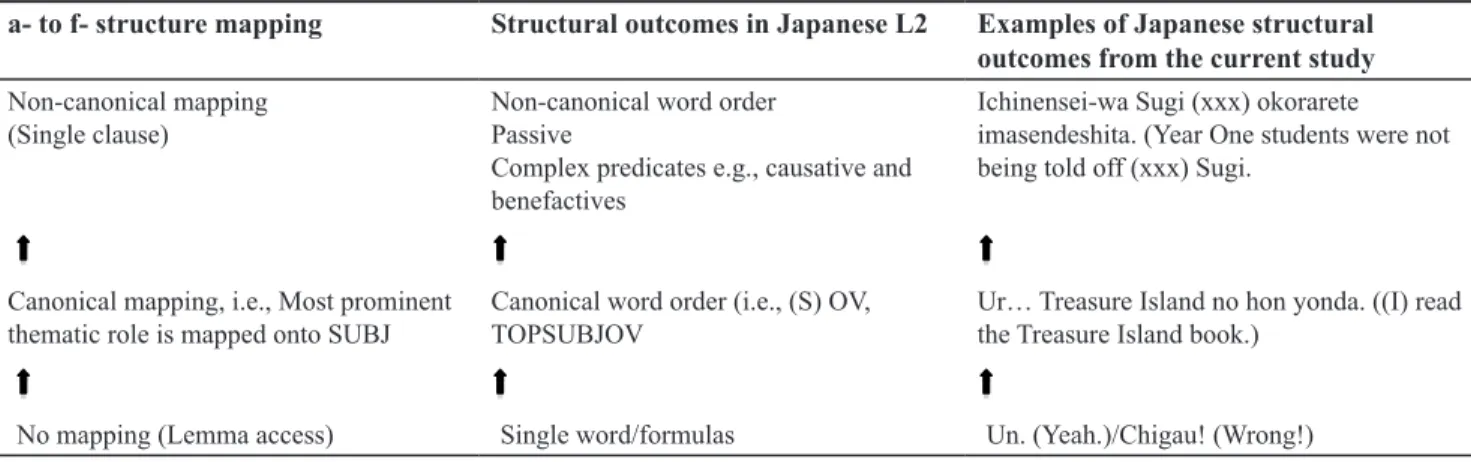
adult informants who were learning Japanese as a foreign language (JFL) in an Australian university supported the pre-dictions of the UAH and LMH. In these studies, valid cases of the passive structure were counted depending on whether patientive SUBJ and/or agentive ADJ were overtly encoded with appropriate nominal morphology, whereas invalid cases were those where argument was wrongly marked. Based on UAH and LMH the developmental stages of the two differ-ent mapping skills which are hypothesised to occur after the initial lemma access stage (word/formulas) in Japanese are summarised in Table 1 below.
In conclusion, the validity of the UAH and LMH appears to be supported by empirical studies on the acquisition of non-canonical mapping structures, including the passive voice when learners acquire English and Japanese as an L2. However, these investigations have been undertaken with adult learners, in the main using cross sectional approaches.
Clearly there is a need to test these findings with other types
of learners (namely children) using alternative approaches (e.g. longitudinal studies) to provide further corroborating support for the extended PT.
Research Questions
Using longitudinal data from a younger learner this study seeks to test the extended PT, particularly UAH and LMH, and answer the following research questions:
(1) Does the passive voice emerge later than canonical mapping structures in the interlanguage of a child ac-quiring JSL naturalistically?
(2) How does the passive voice develop from NTL to TL
use in the child language?
THE STUDY The Informant
The informant of the current study, John4, is an Australian
born English speaking child who was acquiring JSL in Aus-tralia at the time of the study. At the commencement of data collection John was 7 years old and had been enrolled as a Year One student at a primary school for Japanese
chil-Table 1. Developmental stages for Japanese L2 syntax based on UAH and LMH
a‑ to f‑ structure mapping Structural outcomes in Japanese L2 Examples of Japanese structural outcomes from the current study Non-canonical mapping
(Single clause) Non-canonical word orderPassive
Complex predicates e.g., causative and benefactives
Ichinensei-wa Sugi (xxx) okorarete imasendeshita. (Year One students were not being told off (xxx) Sugi.
Canonical mapping, i.e., Most prominent
thematic role is mapped onto SUBJ Canonical word order (i.e., (S) OV, TOPSUBJOV Ur… Treasure Island no hon yonda. ((I) read the Treasure Island book.)
No mapping (Lemma access) Single word/formulas Un. (Yeah.)/Chigau! (Wrong!)
dren for nine months. This school had been established to provide an education in line with the curriculum of the Jap-anese Ministry of Education and Science for the children of Japanese nationals living in Australia. All the children at the school, including John, were taught all subjects in Japanese.
On enrolment John’s proficiency in Japanese was virtu -ally zero. He was not able to speak or understand Japanese at all with an exception of a couple of formulaic expressions (e.g. greetings). He did not receive any explicit grammar in-struction at school and, therefore, his acquisition occurred in an immersion context.
Research Design
The child was visited at home fortnightly and audio-record-ings of his speech were made over a 21 month period. The recordings of all 26 sessions were transcribed and, out of the 26 sessions, data from 17 sessions were used for
analy-sis. These were the first four fortnightly sessions, the subse -quent monthly sessions and the last two follow-up sessions that were undertaken four months and nine months later. In each of these John performed between two to four different communicative tasks with other Japanese speakers. These tasks included free conversation, story telling, a sponta-neous role play, and, a card game. The primary purpose for using the tasks was to maximise John’s natural oral pro-duction, although it was also hoped that some tasks might elicit the use of particular syntactic structures such as the passive voice.
Coding and Data Analysis
All utterances were transcribed and then formulaic or echoic
clauses were excluded from analysis. Next, in order to exam -ine instances of canonical mapping structures, those clauses
with a lexical verb5 involving one or two core grammatical
arguments (i.e., SUBJ and/or OBJ) were separated from the entire corpus. In terms of word order, these clauses repre-sent SOV, OSV, SV, and OV. It should be noted that when
SUBJ is topicalised with the particle -wa, it is realised as
TOP(ic)SUBJ. Then, depending on whether or not the
nomi-nal particles (i.e., –ga or -wa to SUBJ or TOPSUBJ and/or –o
to OBJ)were attached to the argument(s), and whether the
assignment of the particles was NTL, all cases of one or two
argument clauses were coded accordingly.
In order to determine the emergence of the passive voice, based on Kawaguchi (2007), clauses with a passive verb were categorised depending on whether they were accom-panied by SUBJ (Patient) and/or ADJ (Agent) and whether these arguments were assigned with the appropriate nominal particles. The following criteria were used and all passive verbs were coded accordingly:
1) Sufficient evidence: cases where a passive verb accom
-panied SUBJ/TOPSUBJ marked with the target-like (TL)
particle -ga/-wa and/or agentive ADJ marked with the
TL particle6 -ni.
2) Positive but insufficient evidence: cases where a passive
verb accompanied SUBJ/TOPSUBJ and/or agentive ADJ
marked with null particle.
3) Negative evidence: cases where a passive verb
accompanied SUBJ/TOPSUBJ and/or agentive ADJ
marked with the NTL particle(s).
4) Verb morphology: cases where a passive verb only was supplied.
Based on Pienemann (1998), the first production of a
syntactic rule was considered as validation that the rule had emerged.
RESULTS AND DISCUSSION
This section presents and discusses the results of the analysis for the acquisition of the passive voice by a child learner of Japanese L2 in relation to the acquisition of canonical
map-ping structures. The section consists of four parts. The first
and second parts (3.1 and 3.2) present and discuss the oc-currences of canonical mapping structures such as the active voice found in the child language, and those of the passive voice respectively. The third part (3.3) then provides a sum-mary of the comparison of the emergence of the two struc-tures, namely canonical mapping structures and the passive voice, and answers RQ1. The last part (3.4) provides a
sum-mary of the child’s NTL and TL uses of the passive voice to
answer RQ2.
Occurrences of Canonical Mapping Structures
From the data obtained, 984 instances of canonical mapping
structures were identified and were divided into eight cat -egories depending on how or if particles were assigned to an argument(s). Their distribution across the 17 sessions is outlined below (see Table 2):
From Table 2, it appears that canonical mapping struc-tures had already emerged and had done so mainly in the form of one argument clauses in Session 1. It also appears that one-argument clauses (SUBJ or OBJ + V) outnumbered two-argument clauses (SUBJ and OBJ + V) and TL use of
particles outnumbered NTL use. To illustrate this, examples
of the occurrences of the canonical mapping structures in earlier sessions are discussed in detail below.
Session 1:
One-argument clauses involving either an intransitive or transitive verb, were typical in John’s speech. Most were in the form of SV with the correct assignment of the
nomina-tive particle -ga to the SUBJ as in (1).
(1) inu-ga janpu shi-te sorede bottle squashed (English)
dog-NOM jump-COMP and then
“The dog jumped, and then the bottle squashed.” There was also one case of OBJ with the correct
assign-ment of the accusative particle -o as in (2):
(2) xxx-ga sofutobooru
xxx sign up (English)-o shi-ta
Unfortunately, the part marked by the nominative
parti-cle -ga was inaudible and therefore it is not clear what was
meant. Therefore, this utterance was counted as OV.
Two utterances also appeared in the form OV as in (3). In these cases, no morphological marking for the OBJs was given (i.e., null particle):
(3) un sorede ikko akachan-ø tot-te, [pause]
yeah then one baby-ø take-COMP
“Yeah. Then, (the boy) took a baby, and then…” Two instances of OV where OBJs were marked
incor-rectly by a nominal particle -ga were observed. One of them
is the following utterance produced while John was talking about a TV program:
(4) *bideo-no Simpsons (English)-ga mi-ta
video-GEN (TV program)-NOM watch-PAST
*“The Simpsons on video watched.”
Intended: “(I) watched the Simpsons on video.” There was one occurrence of a two-argument clause, but
it was realised as OSV. John supplied OBJ, last bat (English),
which was not encoded with the accusative particle -o. Even
when he rephrased the English words with the Japanese
de-monstrative pronoun sore (that), it was not accompanied
by -o. However, for the second argument the SUBJ was
cor-rectly marked by the nominative particle -ga.
(5) ast bat
(English)-ø sore-ø Homer Simpson (English)-ga yat-ta tot-te, [pause]
last bat-ø that-ø (animated TV
character)
-NOM
do-PAST take- COMP
“Homer Simpson did the last bat, that.”
Based on these examples it appears that by session 1 (representing nine months of his immersion in Japanese) John was successfully encoding the agentive role onto SUBJ
and the patientive role onto OBJ, although some NTL use of
the particle did occur. Session 2:
Two cases of the clause involving two arguments (SOV) were observed. However, while SUBJ was correctly marked
with -ga, OBJ in the second position was also marked
with -ga as shown below. Together with examples (4) from
Session 1 this suggests an overuse of the nominative
parti-cle -ga.
(6) *maya-ga kumo-ga mot-te ki-te ne [pause] (Person
name)-NOM spider- NOM have- COMP come- COMP FP
* “Maya, a spider brought, right? And then…”
Intended: “Maya brought a spider, right? And then…”
In fact, the three cases of the NTL use of a particle in Ses
-sion 2 all involved the overuse of -ga for OBJ. In this session
there were only two cases of the production of –o, compared
to 15 of -ga, including the three cases of overuse.
Session 3
There were three SOV utterances in which both nomina-tive and accusanomina-tive particles were assigned in a TL way. For example:
Table
2.
Occurrences of canonical mapping structures in John’
s interlanguage Session # 1 2 3 4 6 8 10 12 14 15 16 18 20 22 24 25 26 Total One - ar gument clause
SUBJ or OBJ with a
TLP + V 11 15 26 22 34 26 49 39 38 24 64 52 32 67 41 37 58 635
SUBJ or OBJ with null
P + V 2 3 10 2 13 2 8 7 21 20 28 9 9 10 13 8 22 187
SUBJ or OBJ with an NTLP
+ V 2 1 4 3 1 1 1 1 1 1 16 Two - ar gument clause
SUBJ & OBJ with a
TLP
each +
V 3 2 4 6 6 10 3 7 9 4 9 7 5 8 15 98
SUBJ & OBJ: one with a
TLP
& the other with null
P + V 1 2 1 1 2 2 4 4 3 3 2 2 1 3 31
SUBJ & OBJ with null Ps +
V 1 1 1 2 1 1 7
SUBJ & OBJ: one with a
TLP
& the other with a
NTLP + V 2 1 2 1 1 1 1 9
SUBJ & OBJ with NTLPs +
(7) sorede okasan-ga jibun-no petto-o tot-ta
Then mother-NOM self-GEN pet-ACC take-PAST
“Then the mother took her own pet.”
However, John also produced a two-argument utterance without a particle:
(8) sorede boku-ø picchaa-ø su-ru
Then I-ø pitcher-ø do-PAST
“Then I do a pitcher.”
In summary, it appears that John had already developed canonical mapping skills at the beginning of the data col-lection period. The production of canonical mapping struc-tures consistently occurred in large quantities throughout the observation period. Whether the utterance was made up of one or two arguments, in most cases TL particles were used and such TL clauses (n=733) accounted for 74.49% of the total number of canonical mapping clauses produced throughout the 17 sessions (n=984). There were a small
number of cases of clauses where an NTL particle was
assigned to at least one argument (n=26), accounting for only 2.64% of the total number of clauses. The remaining 22.87% was for clauses containing at least one argument with null particle.
Occurrences of Passive Structures
During the data collection period John only produced nine utterances in the passive voice (see Table 3). These included
five clauses involving patientive SUBJ and/or agentive ADJ,
but in one of the cases, no particle was attached to the SUBJ
(therefore representing positive but insufficient evidence).
The remaining four utterances were with a passive verb only (i.e. verb morphology). Thus it is clear that the production of the passives which requires non-canonical mapping was scarce compared to that of canonical mapping structures.
Beginning at Session 10, during which time it appears that the passive voice begun to emerge, examples of the oc-currences of the structures are discussed in detail below.
Session 10:
During this session there were four attempts by John at passive constructions. There were also many times when John did not use the passive form, even though potentially it could have been used. For example, when John played the card game with his school friend, Taro, in contrast to the intended purpose of the game (i.e., to elicit the use passives), John mostly used an active voice to describe the boy pictured on his cards. In the following example (9), he is describing a boy wearing a T-shirt with the name “John” printed on it and Taro was looking for the same picture.
(9)
J: dareka-ø boku-no kutsu-ø ashi-ni fun-deru.
Someone-ø I-GEN shoe-ø foot-on step-DUR
“Somebody is stepping on my shoe, foot.” T: ashi-ø fun-deru?
foot-ø step-DUR
“(Is he/she) stepping on your foot?”
J: un.
“Yeah.” Table
3.
Occurrences of the passive voice in John’
s interlanguage
1
2
3
4
6
8
10
12
14
15
16
18
20
22
24
25
26
Total
No ar
gument
Passive verb morphology only
1
2
1
7
4
One Ar
gument
Clause
SUBJ or
ADJ with a
TLP
+ PV
1
1
2
SUBJ or
ADJ with null
P
+
PV
1
1
SUBJ or
ADJ with an NTLP
+ PV
Two Ar
gument
Clause
SUBJ &
ADJ each with a
TLP
+ PV
SUBJ &
ADJ: one with a
TLP
& the other with null
P
+
PV
1
1
SUBJ &
ADJ with null Ps + PV
SUBJ &
ADJ: one with a
TLP
& the other with a NTLP
+ PV
SUBJ &
ADJ both with NTLP
+ PV
1
1
Total
4
2
1
1
1
T: kuruma-ga?
car-NOM
“A car?”
J: dareka-ø onnanoko-ga [pause]
somebody-ø girl-NOM
“Somebody, a girl…” T: onnanoko-ø [pause] niban.
girl-ø No.2
“A girl…No. 2.”
J: atari
“You are right!”
Instead of using the indirect passive voice such as “Boku-ga
dareka-ni ashi-o fum-are-ta (I-NOM someone-DAT foot-ACC
step-PASS-PAST: I had my shoe stepped on by someone, i.e. My foot was stepped on by someone), John produced the
active utterance as shown in the first line of the example. How
-ever, this was sufficient for Taro to understand and to locate the
correct picture. This could be what Wang (2010) calls “the later intermediate learner’s use of an alternative strategy” or simply can be explained as occurring because this communicative task does not force players to use the passives.
Further into the card game John produced the passive
form twice, first just a passive verb and later the same verb
accompanied by SUBJ marked with null particle (i.e.
pos-itive but insufficient evidence) as in (10). The TL form of
the active verb “to tell off” is “okoru”, and its TL passive
form is “okor-are-ru” (tell off-PASS). It can be assumed that
by adding the meaning of progressive aspect, John
intend-ed to say “okor-are-teru” (tell off-PASS-PROG: I am being
told off). However, he produced the NTL passive morpheme
“-at-” instead of “-are-”, resulting in the utterance, “*
okor-at-teru” twice: (10)
J: etto okor-at-teru.
tell off-PASS-PROG
“Let me see, (I) am being told off.” T: kyuu ban.
“No. 9.”
J: bubbu.
“Wrong.”
T: uso
“No way (lit., a lie)!”
J: boku-ø o kor-at-teru. haato-ga kowashi-teru.
I-ø tell off-PASS-PROG heart-NOM break-PROG
“I am being told off. The heart was breaking.” T: go ban. Ichiichi okot-teru. de tsugi-wa?
No.5 each time tell off-PROG then next-TOP “No. 5. [Someone] is angry each time. And next?”
During a short conversation that followed, John, Taro and the researcher talked about the story they were to recite for their homework. John got out his textbook and began telling
the story about a fish called “Suimii”. Coincidentally there was an utterance in the story containing a passive utterance: “Ookina sakana-ni tabe-rare-te shima-u yo (big fish-DAT
eat-PASS-COMP complete FP: You will end up with being
eaten by big fish!)”.
Interestingly John had difficulty reading the passive mor
-pheme embedded in a V-te V structure, i.e., “taberarete
shi-mau”. He tried to use its contracted form, “tabe-rare-chau”
but could not produce the passive affix -rare- correctly,
resulting in a double consonant after “-ra” as in “
tabe-rac-chau” as he did for “okor-at-teru” as shown in Example (10).
It was only when the researcher modelled the passive affix that he could form the inflection correctly.
(11)
J: ookina sakanatachi-ni tabe-rac-chau [pause]
tab-era [pause] ra [pause]
big fish-DAT eat-PASS-PERF
eat-INT INT
You will end up with being eaten by big fish….being
eaten…en” R: rete [pause]
[part of PASS-COMP] (eat)en, and…
J: [pause] rete shima-u yo
[part of PASS-COMP] complete FP
“(you) will end up being (eaten).”
Since this was an echoic production, it was not counted as the production of a passive. However, this incident
sig-nifies an important point of change in John’s interlanguage.
After John had read the story, the researcher asked him
a question as to why all of the fish grew bigger. John then
produced a passive with ADJ to say “Because they are
(In-tended: were) not eaten by this big fish” as in (12). Although the passive morpheme was NTL (i.e. he used -rawa- instead of -rare-) and the non-past tense (-nai) was overused in what
should have been a past tense context (-nakatta), the passive
form accompanied ADJ marked with the dative particle -ni:
(12)
J: e kono sakana-ni tabe-rawa-nai kara.
This fish-DAT eat-PASS-NE because
“Hmm? Because they are (intended: were) not eaten by
this fish.
Although this meets the criterion for sufficient evidence
for the passive, it is somewhat problematic to conclude that John produced the patientive ADJ marked with the dative
particle -ni, i.e., “kono sakana-ni (by this fish)” with full rec
-ognition of lexical mapping. This is due to the timing of the production – given that it occurred straight after the recitation
and it contained the same lexical verb “taberu (eat)” as the
text. It is also important to note that John was still struggling to
produce a TL form of the passive morpheme, -rare-,
suggest-ing problems at the phonological and/or morphological level. The next task performed was storytelling and again a pas-sive was produced as in (13):
(13)
J: *sorede hachi-ga….
then bee-NOM
“And then, the bees… R: un
Hmm.
J: etto [pause] inu-ni sas-are-te to omot-te i-te [pause]
dog-DAT sting-PASS-COMP QUOT think-COMP exist-COMP
Despite the fact that in the story a dog was nearly stung by bees, as a result of reversed particles (i.e., the
nomina-tive marker -ga and the dative marker -ni) John’s utterance
was ill-formed. This is clearly a case of negative evidence demonstrating that he did seem to have trouble with argu-ment-functional lexical mapping which is necessary for the production of a passive utterance. Therefore, although it
ap-pears that sufficient evidence exists in the data as in (12), it
is premature to conclude that Session 10 is the point of emer-gence for the acquisition of passives. It is possible that his production was the result of remembering a similar utterance he had read immediately prior to this.
In Sessions 12 and 14, although the story telling task was used, there was not one occurrence of a passive form.
Session 15
In this session there was just one turn in which John pro-duced a passive - “be stung”. It was propro-duced without the patientive SUBJ or the agentive ADJ. While it was TL in
terms of verb inflection, i.e., “sas-are-ta (got stung-PASS-PAST)”, when John attempted to say it again this resulted in
a completely different lexical item (i.e, the verb “sasayai-ta”
[whisper-PAST]). This verb sounds similar to “sas-are-ta”,
suggesting John’s possible lexical or phonological confusion of the word. See the interaction below.
(14)
J: kumanbachi-ø [pause] wasp-ø
“Wasp.
R: un kumanbachi-ga do shi-ta no
yeah wasp-NOM what do-PAST EP
“Yeah. What happened to the wasp?
John-wa do shi-ta no
John-TOPSUBJ what do-PAST EP
“What happened to you, John?”
J: unto sas-are-ta [pause] sasayai-ta.
sting-PASS-PAST whisper-PAST
“Hum, (I) was stung…I whispered (intended: [I] was stung) R: a so ka. OK. Juu-ni ban desho.
“Oh, I’ve got it. OK. It is No. 12, isn’t it?”
It can be seen that in the two passive utterances the TOP-SUBJ “boku (I)” is missing. However, it did seem that the
SUBJ was “boku (I)” because the researcher had provided
TOPSUBJ, when saying “John-wa do shita no? (As for John,
what happened to him?) in her utterance in the previous turn. It can be assumed that he shared the established topic “John” with the researcher and therefore omitted it, suggesting that John comprehended the notion of lexical mapping in relation to passives.
Session 16
Again in this session only one passive verb form was observed and it appeared during the spontaneous teacher/ student role play. Because John had previously said that his class had often been noisy, he was asked by the researcher whether or not his real school teacher growled at them that day. He answered using a polite past progressive negative form for the passive even though the researcher had used the
active voice in her question, i.e., “Sensei wa kyo wa
okori-mashita ka? (Did your teacher tell off [class] today?):
(15)
J: un okot-tenai desu.
tell off-PAST.NEG COP
“Hum, (he) did not tell off (class).
ichinensei-wa Sugi xxx okor-are-te i-masendeshita
yr 1-TOPSUBJ (name) [inaudible] tell off-PASS-COMP
exist-POL.PAST.NEG
“Year One students were not being told off (by) Sugi [inau-dible].”
This example is close to a full passive sentence and
pro-vides sufficient evidence of the emergence of a non-canon -ical mapping structure. Although part of the utterance was unfortunately inaudible, John clearly provided the
patien-tive SUBJ in the form of TOP, “ichinensei-wa”. In addition,
the word just before the inaudible part was his teacher’s name “Tsugi”. Although he pronounced this as “Sugi”, because he
was sometimes troubled with the sound “tsu” placed at the
beginning of a word, the missing part and the particle could be “sensei-ni (by Mr [Lit., Teacher] Tsugi)” and as such this could be counted as the agentive ADJ without the dative
par-ticle –ni (i.e., positive but insufficient evidence in the same
utterance).
In Session 18, 208, 22 and 24 no passives were produced,
even though the story telling task was used in both Sessions 18 and 22.
Session 25:
While telling the “Tortoise story” in Session 25, John de-scribed the scene where the dog was chased by the bees in a way that appeared to be an attempt at the use of a passive as in (16).
(16)
J: sorede mada inu-wa sas-at-te i-masen.
then not yet dog-TOPSUBJ sting-PASS-COMP
exist-NEG
“Then, the dog has not been stung yet.”
His utterance includes “sasatte imasen” possibly from the
intransitive verb “sasar-u” meaning “stick in”. Therefore, it
literally sounds like “the dog has not stuck in (the bee) yet”. Given that John had previously described the same picture
using the passive form, i.e. “sas-are-ru (sting-PASS)” from
the transitive verb “sas-u (sting)”, albeit with some lexical
or phonological difficulty, it is reasonable to assume that he
intended to say “the dog has not been stung yet”. In
addi-tion, it is most likely that, just as he produced “okor-at-teru”
instead of “okor-are-teru” in Session 10, he still tended to
use a double consonant “-at-(te)” as in“sas-at-te” instead of
“-are-” as in “sas-are-te” when producing the passive
mor-pheme. Therefore, although patientive SUBJ supplied was
clearly marked with the TOP marker -wa, this was coded as
positive but insufficient evidence.
In the final Session 26 there was no incidence of passives.
that there is sufficient evidence to suggest that John acquired
non-canonical mapping to produce passives (i.e., in Session
169). According to Pienemann (1998), unlike the emergent
point of verbal morphology which requires more stringent criteria to distinguish it from memorised chunks, one case of
the production of a syntactic structure is sufficient to justify
the emergence of that rule. Based on this rule of emergence,
John’s production of passives suggests sufficient evidence
of acquisition.
Emergence of Canonical Mapping Structures and the Passive Voice
RQ1: Does the passive voice emerge later than canonical mapping structures in the interlanguage of a child acquiring JSL naturalistically?
For the purpose of comparison, total numbers of occur-rences of these structures in each session in Tables 2 and 3 are combined in Table 4 below. The dotted lines show that the canonical mapping structures such as the active voice emerged earlier than the passive voice as a non-canonical mapping structure.
The table clearly shows that there were differences in the production between these two kinds of structures in terms of the quantity and the emergence point. The results indicate that in John’s use of Japanese the acquisition of canonical sentences such as the active voice occurred much earlier and in larger quantities than that of the passive voice involving non-canonical mapping. This result is consistent with earlier research (e.g. Kawaguchi, 2007) suggesting that the learn-er’s choice of a syntactic structure is constrained by his/her developmental skills in argument-function mapping as pre-dicted by UAH and LMH. Therefore, regardless of age or context, there is evidence to support these two hypotheses predicting the order of acquisition of canonical and non-ca-nonical mapping structures.
NTL and TL Productions of the Passive Voice
RQ2: How does the passive voice develop from NTL to TL
use in the child language?
To answer this research question, not only quantitative but qualitative analyses using examples of the passive voice in John’s language was undertaken.
The results of this study clearly show that the passive voice was acquired at a much later point in time, namely in Session 16, when compared to canonical mapping structures such as the active voice (in Session 1), but that between these
emergent points, some interlanguage structures, i.e. NTL and
TL use of the passive voice were observed, hence there ap-pears to be a developmental sequence of the passive voice in terms of accuracy.
Table 4 shows that whereas canonical mapping structures were present from the beginning through to the end of the data collection period, the passive voice, which demands more advanced mapping, i.e., non-canonical mapping,
be-gan occurring in both TL and NTL ways in Session 10. This session where sufficient evidence, insufficient evidence and
negative evidence of the acquisition of the passives were all Table
4.
Occurrences of the canonical mapping structures and passive voice in John’
s development
1
2
3
4
6
8
10
12
14
15
16
18
20
22
24
25
26
Total
Passives
1/1/1
(1)
(2)
1/0/0
(1)
0/1/0
5
(4)
Canonical mapping structures
16
21
46
31
54
35
66
61
68
57
106
70
53
86
60
54
100
984
1.
The figure before the first slash means the number of cases of suf
ficient evidence;
2.
The figure before the second slash means the number of cases of positive but insuf
ficient evidence;
3.
The figure after the second slash means the number of cases of negative evidence;
4.
The blank cell means that no evidence was available.
present could be considered to be what Keatinge and Keßler (2009) call a prerequisite stage. The use of an alternative strategy, namely the use of the active voice in the passive context (Wang, 2009) was also observed during the same session. It was only in Session 16 that the near full passive
sentence containing patientive TOPSUBJ marked by the topic
particle -wa, finally emerged. Furthermore, and similar to the
results of the study by Keatinge and Keßler (2009), in the current study the passive verb morphology of the child was unstable throughout the data collection period.
CONCLUSION
The main aim of this study was to test the veracity of the extended PT, and particularly with reference to UAH and LMH, by exploring the acquisition of the passive voice by a child learner of Japanese L2. The goal of the study was to compare the emergence of the passive voice with that of canonical mapping structures, including the active voice, in the interlanguage of the naturalistic child learner. The results of the study show that the child acquired the passive voice much later than canonical mapping structures. This devel-opmental sequence follows the stages based on the extend-ed PT, demonstrating that the learner’s choice of a syntactic structure is restricted by developmental skills as predicted by the UAH and LMH. The results of the current study match those of earlier research with regard to the acquisi-tion of non-canonical mapping structures by adult learners (e.g. Kawaguchi, 2007). Further, the current study shows that as with the adult ESL learners in the study by Keatinge and Keßler (2009), the child JSL learner appeared to have a “prerequisite” stage in the acquisition of the passive voice where he resorted to the use of an alternative structure, namely the active voice, but also attempted to produce the passive voice. After that prerequisite stage, he was able to produce the passive voice in a TL manner by successfully synchronising his advanced linguistic skills with pragmatic competence. However, overall his passive morphology was
NTL until the end of the data collection period.
Finally, although the strength of this study comes from the use of a theory, namely the extended version of PT, read-ers should be reminded of the limitations of the study too: this is a case study of a single informant acquiring JSL in Australia. Therefore more PT-based longitudinal studies on the development of the passive voice need to be conducted in the future to provide evidence for the validity of USH and LMH. Such research would also serve to establish whether or not a prerequisite stage in the acquisition of the passive voice is common in a variety of L2 learning contexts.
ACKNOWLEDGEMENTS
The authors would like to thank John and his parents for their support of this research.
ENDNOTES
1. The other main Hypothesis describing the development of syntax and underpinned by the extended PT is the
Topic Hypothesis (TH) which more recently has been updated to the Prominence Hypothesis (PH) (Bettoni
& Di Biase, 2015; Kawaguchi, 2015). Note, however,
both the TH and PH are outside the scope of the current study.
2. Because the term ‘prominence’ was previously used in LMH, Kawaguchi (2015) warns readers not to confuse LMH with the Prominence Hypothesis (Bettoni & Di Biase, 2015; Kawaguchi, 2015). However, as this study does not deal with the PH and focuses on comparing canonical (UAH) and non-canonical (LMH) mapping structures, in this paper we use the term ‘prominence’ based on Kawaguchi (2005, 2007, 2009).
3. If V is an intransitive verb, the sentence is SV. Contrary to Platzack (1996) who claims that SVO is the universal canonical word order across languages, the UAH (Pi-enemann et al., 1995) takes a stance that canonical word
order is language specific.
4. The names of the informant and his interlocutor in this paper are pseudonyms.
5. In this study, this includes a lexical or main verb in the
V-teV structure.
6. TLP is used in the table below to represent target-like particle and NTLP non-target like particles.
7. The word used by John was “nigerareta”, but it is not
clear whether this was a case of passive or potential verb
morphology as the verb “nigeru (escape)” is a
vow-el-stem verb which conjugates in the same way for both passives and potentials.
8. See Endnote 8. This case is ambiguous.
9. Aside from the passives, there are two other syntactic structures that require canonical mapping in Japanese: the causatives and benefactives (Kawaguchi, 2007). Al-though this paper does not touch upon the acquisition of these structures, they both emerged after the passives, that is, the emergence point of non-canonical mapping structures as a whole in John’s language was indeed Session 16.
REFERENCES
Artoni. D, & Magnani, M. (2015). Acquiring case marking in Russian as a second language: an exploratory study on subject and object. In C. Bettoni, and B. Di Biase,
(Eds.), Grammatical Development in Second
Languag-es: Exploring the Boundaries of Processability Theory. (pp.213-242). Italy: European Second Language Asso-ciation.
Baldie, R. (1976). The acquisition of the passive voice.
Jour-nal of Child Language, 3, 331-348.
Beilin, H. (1975). Studies in the cognitive basis of language
development. San Diego, CA: Academic Press.
Bettoni, C. & Di Biase, B. (2015). Processability Theory: theoretical bases and universal schedules. In C. Bettoni, and B. Di Biase, (Eds.), In C. Bettoni, and B. Di Biase,
(Eds.), Grammatical Development in Second
Bever, T. G. (1970). The cognitive basis for linguistic
struc-tures. In J. R. Hayes (ed.), Cognition and the
develop-ment of language. New York: Wiley.
Borer, H., & Wexler, K. (1987). The maturation of syntax.
In T, Roeper & E. Williams (Eds.), Parameter setting.
(pp. 123-172). Dordrecht: Reidel.
Borer, H., & Wexler, K. (1992). Bi-unique relations and
the maturation of grammatical principles. Natural
Lan-guage & Linguistic Theory, 10(2), 147-189.
Bresnan, J. (2001). Lexical-Functional syntax. Malden, MA:
Blackwell.
de Villiers, J. & de Villiers, P. (1973). A cross-sectional study of the acquisition of grammatical morphemes in child
speech. Journal of Psycholinguistic Research,2, 267-78.
Di Biase, B. & Hinger, B. (2015). Exploring the acquisi-tion of differential object marking (DOM) in Spanish as a second language. In C. Bettoni, and B. Di Biase,
(Eds.), Grammatical Development in Second
Languag-es: Exploring the Boundaries of Processability Theory. (pp.213-242). Italy: European Second Language Asso-ciation.
Di Biase, B. & Kawaguchi, S. (2002). Exploring the typo-logical plausibility of Processability Theory: language
development in Italian L2 and Japanese L2. Second
Lan-guage Research, 18 (3), 274-302.
Harwood, F. W. (1959). Quantitative study of the speech of
Australian children. Language and Speech, 2, 236-270.
Hakuta, K. (1982). Interaction between particles and word order in the comprehension and production of simple
sentences in Japanese children. Developmental
Psychol-ogy, 18(1), 62-76.
Hinkel, E. (2002). Why English passive is difficult to teach
(and learn). In E. Hinkel & S. Fotos (Eds.), New
Per-spectives on Grammar Teaching in Second Language Classrooms. (pp. 233-260). Lawrence Erlbaum Associ-ates.
Horgan, D. (1978). The development of the full passive.
Journal of Child Language, 5(1), 65-80.
Ito, S. (1997). Nenshoosha nihongo gakushuusha no
koobun shuutoku: Juudanteki jiree kenkyuu. Hokkaidoo
Daigaku Ryuugakusei Sentaa Kiyoo,1, 68-82.
Iwasaki, J. (2008). Acquiring Japanese as a Second Language (JSL) in a naturalistic context: A longitudinal study of a young child from a Processability Theory (PT)
perspec-tive. In J. Philp, R. Oliver & A. Mackey, (Eds), Second
Language Acquisition and the Younger Learner: Child’s play? (pp.231-253). Amsterdam: John Benjamins. Kawaguchi, S. (2005) Argument structure and
syntac-tic development in Japanese as a second language. In
M. Pienemann. (ed.). Cross-linguistic aspects of
Pro-cessability Theory. Amsterdam and Philadelphia: John Benjamins.
Kawaguchi, S. (2007) Lexical mapping in Processability Theory: A case study in Japanese. COMP. Mansouri
(Ed.), Second Language Acquisition Research:
The-ory-construction and testing. (pp. 39-80). Newcastle
Upon Tyne: Cambridge Scholars.
Kawaguchi, S. (2009). Acquisition of non-canonical order in Japanese as a second language: the case of causative
structure. In J-U. Kessler & D. Keatinge (Eds.).
Re-search in second language acquisition: Empirical evi-dence across languages. (pp. 213-240) Newcastle Upon
Tyne: Cambridge Scholars.
Kawaguchi, S. (2015). The development of Japanese as a second language. In C. Bettoni, and B. Di Biase, (Eds.),
In C. Bettoni, and B. Di Biase, (Eds.), Grammatical
De-velopment in Second Languages: Exploring the Bound-aries of Processability Theory. (pp.149-172). Italy: Eu-ropean Second Language Association.
Keenan, E. O., & Comrie, B. (1977). “Noun phrase accessi
-bility and Universal Grammar.” Linguistic Inquiry, 8(1),
63-99.
Keatinge, D. & Keßler, J-U. (2009). The acquisition of the passive voice in L2 English: Perception and production.
In J-U. Kessler & D. Keatinge (Eds.). Research in
sec-ond language acquisition: Empirical evidence across languages. (pp. 67-92). Newcastle Upon Tyne: Cam -bridge Scholars.
Kokuritsu Kokugo Kenkyusho [National Institute for Japa
-nese Language and Linguistics]. (1977). Yoji no bunpo
noryoku. Tokyo: Tokyo Shoseki
Matsumoto, K. (2010). Lexical Functional Grammar o
mo-chiita nenshousha no nihongo bunkouzou shuutoku ken-kyu: 2 nen 9 kegetsu no juudan hatsuwa shiryou ni yoru Processability Theory no kenshou. Unpublished PhD
thesis. Nanzan University, Nagoya.
Maratsos, M. (1974). Children who get worse at
understand-ing the passive: A replication of Bever. Journal of
Psy-cholinguistic Research, 3(1), 65-74.
Maratsos, M., Fox, D., Becker, J., & M. Chalkley. (1985).
Semantic restrictions on children’s passives. Cognition
19, 167-91.
Pienemann, M. (1998). Language processing and second
language development: Processability Theory. Amster-dam: John Benjamins.
Pienemann, M., Di Biase, B., & Kawaguchi, S. (2005). Extending processability theory. In M. Pienemann (Ed.), Cross-linguistic aspects of processability theory (pp. 199-251). Amsterdam: John Benjamins.
Pienemann, M. & Håkansson, G. (1999). A unified approach
towards the development of Swedish as L2: A
process-ability account. Studies in Second Language
Acquisi-tion, 21, 383-420.
Platzack, C. (1996). The initial hypothesis of syntax: A min-imalist perspective on language acquisition and attrition.
In H. Clahsen (ed.), Generative perspectives on
lan-guage acquisition. Amsterdam: John Benjamins. Sawetaiyaram, T. (2008). Taijin nihongo gakuushusha no
uke-mi no shuutoku [The acquisition of the passive voice by
Thai learner of Japanese.] Kokoba to bunka, 9, p.187-204.
Nagoya University. Retrieved on July 2011 from http://
www.lang.nagoya-u.ac.jp/nichigen/issue/pdf/9/9-11.pdf
Shibatani, M. (1987). Japanese. In The Major Languages
of East and South-East Asia, B. Comrie (ed.), 127-170. London: Routledge.
event probability, nonverbal context, syntactic form, and
strategies. Child Development, 45, 567-576.
Sugisaki, K. (1997). Japanese passives in acquisition. Pa-per presented at the Sophia Linguistic Society 17.
[Published in UCONN Working Papers in Linguistics,
10 (1999), 145-156.]
Taguchi, K. (2001). Burajirujin jido no ukemi, shieki hyogen no shutoku ni kansuru jirei kenkyuu: nihonjin jido, yoji to no hikaku o toshite [A case study: Brazilian children and their acquisition of Japanese passive and causative
expressions: A comparison with Japanese children].
Ac-quisition of Japanese as a second language, 4, 116-133. Takahashi, T. (1975). Yojigo no keitairontekina bunseki:
doshi, keiyoshi, jutsugo meeshi. Kokuritsu Kokugo
Ken-kyusho Hokoku, 55.
Tanaka, M. (1996). Shiten, voisu no shutoku - bunseisei
te-suto ni okeru odanteki oyobi jyudanteki kenkyu.
Nihon-go Kyoiku, 88, 104-116.
Tanaka, M. (2005). The preliminary study on acquisition or-der of viewpoint-related voice in Japanese as a foreign/
second language. Studies in language science, 4,
205-226. Tokyo: Kuroshio.
Tomlin, R. S. (1995). Focal attention, voice, and word order: an experimental, cross-linguistic study. In P. Downing &
M. Noonan (Eds), Word order in discourse, pp. 517-554. Amsterdam: John Benjamins.
Tomlin, R. S. (1997). Mapping conceptual representations into linguistic representations: the role of attntion in
grammar. In J. Nuyts & E. Pederson (Eds), Language and conceptualization, pp. 162-189. Cambridge: Cam-bridge University Press.
Wang, K. (2009). Acquiring the passive voice: Online pro-duction of the English passive construction by Man-darin speakers. In J-U. Kessler & D. Keatinge (Eds.).
Research in second language acquisition: Empirical ev-idence across languages. (pp. 93-117). Newcastle Upon
Tyne: Cambridge Scholars.
Wang, K. (2010). The acquisition of English passive construc-tions by Mandarin speakers: A developmental perspective. Unpublished PhD thesis. University of Western Sydney.
APPENDIX. LIST OF ABBREVIATIONS
ACC accusative
COP copula
COMP complementiser
DAT dative
DUR durative
EP extended predicate
FP final particle
GEN genitive
INT intermediate (form)
NEG negative
NOM nominative
P particle
PASS passive
PAST past
PERF perfective
POL polite
PROG progressive
QUOT quotative