305
© 2017 by the Serbian Biological Society How to cite this article: Schweiggert RM, Ziegler JU, Metwali EMR, Mohamed FH, Almaghrabi OA, Kadasa NM, Carle R. Carotenoids in mature green and ripe red fruits of tomato (Solanum lycopersicum L.) grown under different levels of irrigation. Arch Biol Sci. 2017;69(2):305-14.
Carotenoids in mature green and ripe red fruits of tomato (
Solanum lycopersicum
L.)
grown under different levels of irrigation
Ralf M. Schweiggert1,*, Jochen U. Ziegler1, Ehab M.R. Metwali2,3,4, Fouad H. Mohamed5, Omar A.
Almaghrabi2,3, Naif M. Kadasa2,3 and Reinhold Carle1,2
1Institute of Food Science and Biotechnology, Plant Foodstuff Technology and Analysis, University of Hohenheim,
70599 Stuttgart, Germany.
2Biological Science Department, Faculty of Science, King Abdulaziz University, 21589 Jeddah, Saudi Arabia.
3Biological Science Department, Faculty of Science, University of Jeddah, 21959 Jeddah, Saudi Arabia.
4Botany Department, Faculty of Agriculture, Suez Canal University, 41522 Ismailia, Egypt.
5Horticulture Department, Faculty of Agriculture, Suez Canal University, 41522 Ismailia, Egypt.
*Corresponding author: [email protected]
Received: March 8, 2016; Revised: June 12, 2016; Accepted: June 20, 2016; Published online: October 31, 2016
Abstract: The effect of water deficit on concentrations of carotenoids was investigated in ripening tomatoes using HPLC-PDA. Fifteen different tomato cultivars were grown under three levels of water supply and unripe and fully-ripe fruits were harvested at different stages. Water deficit significantly affected several morphological and fruit yield-related parameters. In unripe tomato fruits, the relative concentrations of xanthophyll cycle carotenoids, e.g., violaxanthin and antheraxanthin, were significantly increased at the expense of β-carotene upon limiting the water supply. In ripe fruits, nutritionally-relevant lycopene, β-carotene and lutein levels were broadly independent of water deficit when considering all 15 cultivars, although significant variations were observed among fruits from different genotypes. Our study highlights the importance of careful genotype selection for the production of tomatoes rich in nutritionally-relevant compounds like lycopene and β-carotene.
Key words: antioxidants; β-carotene; lycopene; lutein; vitamin A
INTRODUCTION
Facing a rapidly growing world population, an in-creased production of high-quality foods with reduced inputs is urgently needed, but also highly challeng-ing due to global environmental changes. The current breeding focus is often on traits potentially increas-ing yield, but the continuous selection of elite germ-plasm has led to a narrowing of the available genetic diversity, particularly for some crops like soybeans and peanuts [1]. With regard to tomato (Solanum ly-copersicum L.formerly Lycopersicon esculentum Mill.), the availability of a large germplasm including numer-ous wild species served to be useful for introgressing resistances against many diseases as well as tolerances against soil salinity and drought [2]. Recently, Blanca et al. [3] provided a comprehensive overview and analysis of genomic variations in over a thousand
to-mato accessions, including Solanum pimpinellifolium
Besides novel irrigation strategies, the availability of drought-tolerant genotypes may help to intensify or, at least, maintain the current tomato production in such arid regions. Previous studies on plants ex-posed to water deficit and other stress factors have reported that growth rates are often suppressed, but fruit quality was often enhanced due to increased sugar and acid levels [7-9]. In contrast, the pigment content of red ripe tomato fruits, i.e. mostly the ca-rotenoids lycopene and β-carotene, were shown to be diminished by abiotic stress factors in several studies [10-12]. Contrary findings have also been described [13,14] and may highlight the inconsistency of these results. Nevertheless, it is widely accepted that carot-enoids play an important role in the plant defense against abiotic stress due to their potent antioxidant properties and their function in the xanthophyll cycle [15]. The latter protects the photosynthetic apparatus from excessive oxidative stress, occurring in plants exposed to chilling, heat, senescence or salinity stress [16]. To date, the effect of water deficit on carotenoids involved in the xanthophyll cycle of plants has not been studied much.
Since the abovementioned carotenoids also rep-resent potentially health-promoting micronutrients, high levels are desirable quality attributes from both horticultural and nutritional standpoint. Therefore, the present study aimed at investigating the
influ-ence of three different water supply treatments on the carotenoid patterns of fruits from 15 tomato cul-tivars. While several morphological features are also reported, a particular focus was on the xanthophyll cycle carotenoids, violaxanthin, antheraxanthin, and zeaxanthin, in unripe but mature green fruits. In addi-tion, the fruits at a fully red-ripe stage mostly contain-ing β-carotene and lycopene should be also examined in detail.
MATERIALS AND METHODS
Plant material and reagents
The seeds of 15 tomato (Lycopersicon esculentum
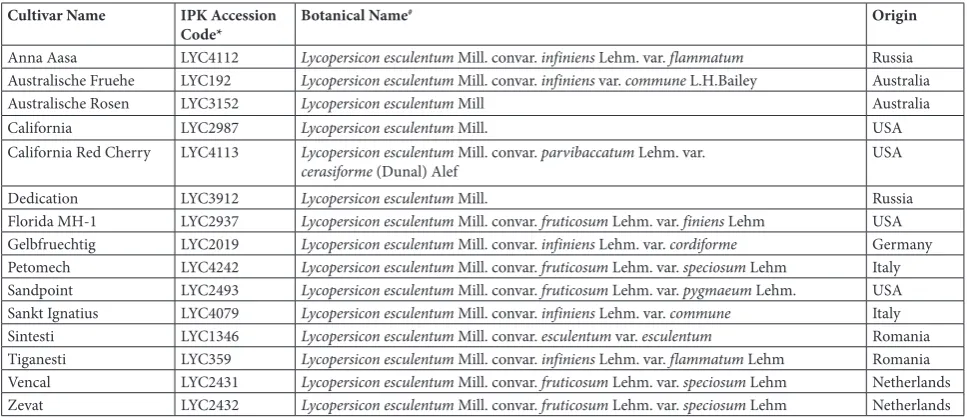
Mill.) cultivars were kindly provided by the Leibniz Institute of Plant Genetics and Crop Plant Research (IPK), Gatersleben, Germany. Cultivar names, their botanical name and their geographical origins are shown in Table 1. All experiments were carried out from September 2014 to March 2015 in greenhouses of the Suez Canal University.
The plants were prepared by sowing the seeds in a nursery (beginning of September 2014) in a special agricultural flinty loam, with 40 holes (10-cm deep) per cultivar filled with peat moss and vermiculite at a ratio of 1:1. After 28 days (mid October 2015), the
Table 1. Commercial Name, IPK Accession Code, Botanical Name, and Origin of the 15 Studied Tomato Genotypes Cultivar Name IPK Accession
Code* Botanical Name
# Origin
Anna Aasa LYC4112 Lycopersicon esculentum Mill. convar. infiniens Lehm. var. flammatum Russia Australische Fruehe LYC192 Lycopersicon esculentum Mill. convar. infiniens var. commune L.H.Bailey Australia
Australische Rosen LYC3152 Lycopersicon esculentum Mill Australia
California LYC2987 Lycopersicon esculentum Mill. USA
California Red Cherry LYC4113 Lycopersicon esculentum Mill. convar. parvibaccatum Lehm. var.
cerasiforme (Dunal) Alef USA
Dedication LYC3912 Lycopersicon esculentum Mill. Russia
Florida MH-1 LYC2937 Lycopersicon esculentum Mill. convar. fruticosum Lehm. var. finiens Lehm USA Gelbfruechtig LYC2019 Lycopersicon esculentum Mill. convar. infiniens Lehm. var. cordiforme Germany Petomech LYC4242 Lycopersicon esculentum Mill. convar. fruticosum Lehm. var. speciosum Lehm Italy Sandpoint LYC2493 Lycopersicon esculentum Mill. convar. fruticosum Lehm. var. pygmaeum Lehm. USA Sankt Ignatius LYC4079 Lycopersicon esculentum Mill. convar. infiniens Lehm. var. commune Italy Sintesti LYC1346 Lycopersicon esculentum Mill. convar. esculentum var. esculentum Romania Tiganesti LYC359 Lycopersicon esculentum Mill. convar. infiniens Lehm. var. flammatum Lehm Romania Vencal LYC2431 Lycopersicon esculentum Mill. convar. fruticosum Lehm. var. speciosum Lehm Netherlands Zevat LYC2432 Lycopersicon esculentum Mill. convar. fruticosum Lehm. var. speciosum Lehm Netherlands *: Accession code of the Leibniz Institute of Plant Genetics and Crop Plant Research (IPK)
tomato plants were transplanted to the greenhouse, i.e., 27 plants per cultivar were grown in pots of 30 cm diameter (total volume 10 L) filled with a mixture of peat moss and quartz sand at a ratio 1:3. The pots were set up in rows and a split-plot combination of treatments was performed following a randomized complete block design (RCBD) with three replicates. Three levels of water supply were applied to the main plots, and tomato cultivars were assigned to subplots. Each subplot consisted of three pots with one plant each. In the control experiment (T1,no water deficit), plants were supplied with 600 mL of water, twice a week during the first month in the greenhouse and subsequently every other day until the end of the experiment. After two weeks with full water supply (600 mL per watering), two levels of water deficit were induced by reducing the water amount to 400 and 200 mL (T2 and T3, respectively), following the same schedule as described above. Upon starting the water deficit treatment, all genotypes were still in the vegetative stage before flowering, having reached a height of 30-40 cm with at least the 8th leaf in the main
stem unfolded (BBCH Code for solanaceous plants according to Feller et al. [17] was >108, growth stage 1). The moisture contents of the freshly watered soils, as measured by gravimetric determination after dry-ing for 24 h at 100°C, were 19.6, 11.1, and 5.9% (v/v) for T1, T2, and T3, respectively. After 110-130 days from transplanting, mature green fruits were har-vested and prepared for analyses. After 130-150 days from transplanting, ripe red fruits were harvested and the plants’ root length (RL), shoot length (SL), root fresh weight (RFW), shoot fresh weight (SFW), root dry weight (RDW), shoot dry weight (SDW), shoot/ root length (S/RL), root/shoot dry weight (R/SDW), number of leaves (NL), leaf fresh weight (LFW), leaf dry weight (LDW), number of branches (NB), number of inflorescences (NI), number of fruits (NF), fruit fresh weight (FFW), and yield (Y) were determined. All ripe fruits were stored at 25°C for up to 2 weeks before analysis.
Extraction of carotenoids
Tomato fruits were both frozen and ground with liq-uid nitrogen prior to extraction. All procedures de-scribed below were carried out under dim light. An aliquot of 200-250 mg of ground tomato fruit sample
was combined with 250 mg of calcium carbonate (CaCO3) and extracted with 2 mL of extraction sol-vent (acetone with 1 g/L butylated hydroxytoluene, BHT) using the ultrasonic homogenizer Sonopuls HD 3100 with an MS 72 microtip (Bandelin electronic, Berlin, Germany). After centrifugation, the extrac-tion solvent was collected and extracextrac-tion was repeated 2-4 times until the solid residue was colorless. After drying with Na2SO4, the combined organic extracts were evaporated to dryness under a gentle nitrogen stream and stored at -80°C until high-performance liquid chromatography (HPLC) analysis. Prior to HPLC, the dried extracts were redissolved in 250 µL of methyl tert-butyl ether (MTBE). Subsequently, the samples were briefly sonicated in a water bath to enhance dissolution, followed by the addition of 250 µL of methanol and membrane-filtration (PTFE, 0.45 µm) into amber HPLC vials.
HPLC-PDA analyses
For HPLC analyses, a Waters separation module 2695 (Waters, Milford, MA, USA) with a Waters 2996 pho-todiode array detector (PDA) was equipped with a YMC C30 reversed phase column (150×3.0 mm i.d., 5 μm particle size, YMC Europe, Dinslaken, Germany) protected by a YMC C30 guard column of the same material. As previously used by Kopec et al. [18], HPLC solvents consisted of methanol/water (80:20, v/v, eluent A) and methanol/MTBE/water (20:78:2, v/v/v, eluent B), both containing 0.4 g/L of ammo-nium acetate. The elution gradient was as follows: from 100% to 0% A for 24 min, isocratic at 0% A for 1 min, from 0% to 100% A in 1 min, and isocratic at 100% A for 2 min. Total run time was 28 min at a flow rate of 1.2 mL/min and a column temperature of 35°C. Injection volume was 20 µL. Carotenoids were monitored at 450 nm.
Individual carotenoids were identified by compar-ing retention times and UV/Vis absorption spectra to those of authentic standards. Standards of (all-E )-α-carotene, (all-E)-antheraxanthin, (all-E)-β-carotene, (all-E)-lutein, (all-E)-mutatoxanthin (mixture of two isomers), (all-E)-neoxanthin, (all-E)-violaxanthin, and (all-E)-zeaxanthin were obtained from CaroteNature (Ostermundingen, Switzerland). Chlorophylls a and
β-carotene and violaxanthin (Z)-isomers were identi-fied according to their DB/DII ratios, which were ob-tained as described by Britton [22] and then compared to those found in literature [19-21].
Prior to quantitation by HPLC-PDA, concentra-tions of stock soluconcentra-tions of the authentic standards mentioned above were verified spectrophotometri-cally. The specific absorption coefficients reported by Britton [22] were used to establish linear calibration curves. Linear calibration curves of authentic stan-dards were used, except for the quantitation of the detected violaxanthin (Z)-isomer and the β-carotene (Z)-isomer, where the violaxanthin and β-carotene calibrations were used, respectively.
Statistical analyses
All analyses were carried out in duplicate. Analysis of variance (ANOVA), Tukey’s HSD (honestly significant difference), and Duncan’s test were used for determi-nation of significantly different means (P<0.05) using the procedure GLM of SAS 9.1 (SAS Institute, Cary, USA). All values are reported as means±standard de-viation. Correlations (Pearson’s correlation coefficient) were calculated using the software “R” version 2.10.0 (R Foundation for Statistical Computing, 2012, avail-able at www.r-project.org).
RESULTS AND DISCUSSION
Influence of water deficit on morphological growth parameters
In our study, 15 tomato cultivars were grown under normal water supply, i.e. providing 600 mL per wa-tering and plant (T1), and under two levels of water deficit (400 mL (T2) or 200 mL (T3) per watering and plant). Fig. 1 shows the cultivar ‘Vencal’ grown under T1, T2 and T3.
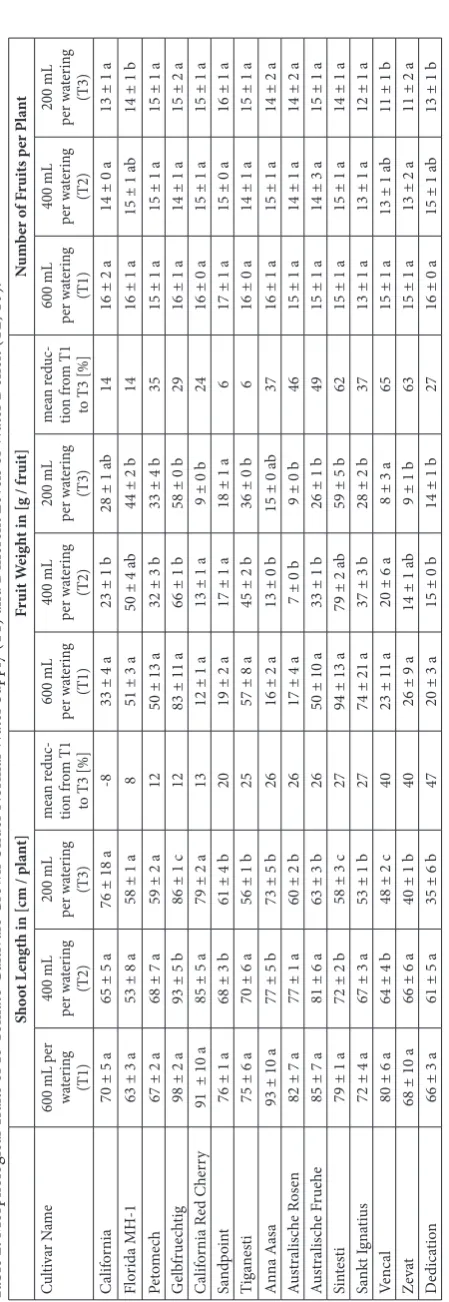
The shoot length of five cultivars was significantly affected when grown under intermediate water defi-cit (T2) as shown in Table 2, while differences were insignificant at T2 for most cultivars. The severe wa-ter deficit (T3) had a more pronounced impact on shoot length, leading to significantly smaller plants for most cultivars, except for the cultivars California,
Florida MH-1, Petomech, and California Red Cherry (P<0.05; Table 2). By analogy, water deficit at level T3 resulted in significantly smaller fruits for most culti-vars (except for California, Sandpoint, Anna Aasa, and Vencal). Although being inconsistent for a few cultivars, a weak correlation between the mean re-duction in shoot length and the mean rere-duction in fruit weight was observed (r=0.59). Similar findings were previously obtained by Mitchell et al. [8] and De Pascale et al. [10] who reported a negative effect of water deficit on tomato plant growth and fruit yield. In contrast, Atkinson et al. [12] found that a compa-rably mild water deficit did not influence individual fruit weights. For inducing the water deficit, the au-thors supplied 80% of the water received by their well-watered control plants, while the water deficit applied in our study was substantially more rigid, providing only 66% (T2) and 33% (T3) of the water supply of the well-watered control (T1). Plant growth and yield parameters such as fruit weight and plant height were apparently only affected when a certain level of water deficit was reached.
Influence of water deficit on carotenoids in mature green and ripe red fruits
In our study, carotenoids were analyzed in mature green and ripe red tomato fruits. In agreement with previous reports, the carotenoid profile drastically changed when fruit color turned from green to red
(Fig. 2A and B). The predominant carotenoids pres-ent in green tomato fruits were lutein (39-49% of total carotenoids), violaxanthin and neoxanthin (20-29%) and β-carotene (6-30%), while ripe red tomatoes contained mostly lycopene (59-91% of total carotenoids), β-carotene (6-32%) and lutein (3-18%). This change in the carotenoid profile was previously observed during tomato fruit ripening [23-26]. It is noteworthy that the carotenoid pro-file found in green tomato fruits is typical for those of green tissues in higher plants, being specific for photosynthetically active chloroplasts [27]. Dur-ing color-break in the course of tomato ripenDur-ing, chloroplast-specific plastid structures like grana and stroma thylakoids disintegrate and large crystalloid chromoplasts appear due to the massive accumula-tion of lycopene [28,29].
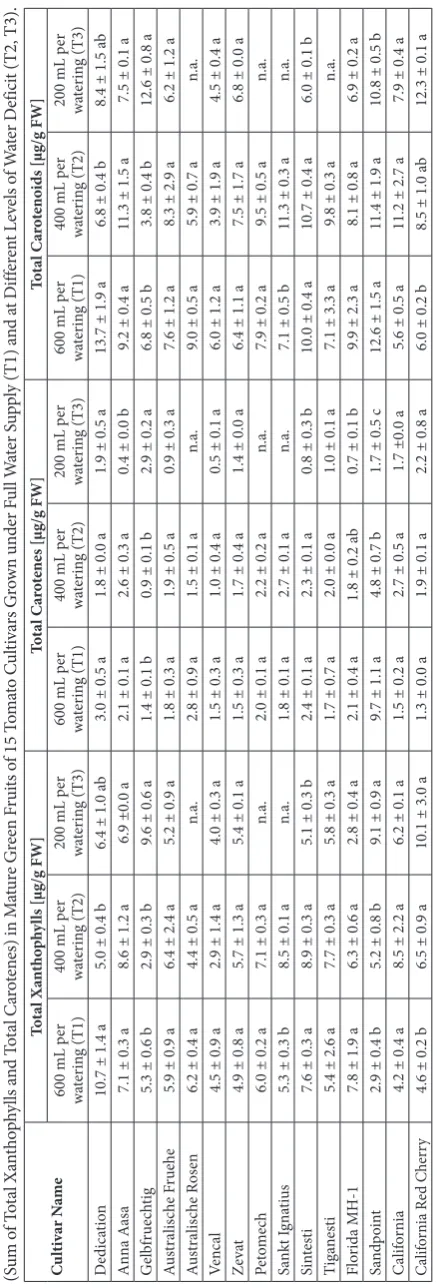
Regarding mature green fruits, significant variations in total carotenoid concentrations were detected among the different cultivars when well-watered (T1). The cultivars standing out by their high total xanthophyll concentrations in mature green fruits were cvs. Dedication (10.7 μg/g FW), Florida MH-1 (7.8 μg/g FW), Sintesti (7.6 μg/g FW) and Anna Aasa (7.1 μg/g FW), as shown in Table 3.
Ta bl e 2. M or ph olog ic al T ra its o
f 15 T
om at o C ul tiva rs G ro w n U nder N or m al W at er S up pl
y (T1) a
nd Dif fer en t L ev els o f W at er D ef ici
t (T2, T3).
Sho
ot L
en
gth in [cm / p
la nt] Fr ui t W eig
ht in [g / f
rui t] N um be r o f F rui ts p er P la nt Cu lti va r N am e
600 mL p
er wa ter in g (T1) 400 mL per wa ter in g (T2) 200 mL per wa ter in g (T3) m ea n r ed uc -tio n f ro m T1
to T3 [%]
600 mL per wa ter in g (T1) 400 mL per wa ter in g (T2) 200 mL per wa ter in g (T3) m ea n r ed uc -tio n f ro m T1
to T3 [%]
600 mL per wa ter in g (T1) 400 mL per wa ter in g (T2) 200 mL per wa ter in g (T3) Ca lif or ni a
70 ± 5 a
65 ± 5 a
76 ± 18 a
-8
33 ± 4 a
23 ± 1 b
28 ± 1 a
b
14
16 ± 2 a
14 ± 0 a
13 ± 1 a
Flo
rid
a MH-1
63 ± 3 a
53 ± 8 a
58 ± 1 a
8
51 ± 3 a
50 ± 4 a
b
44 ± 2 b
14
16 ± 1 a
15 ± 1 a
b
14 ± 1 b
Pet
om
ec
h
67 ± 2 a
68 ± 7 a
59 ± 2 a
12
50 ± 13 a
32 ± 3 b
33 ± 4 b
35
15 ± 1 a
15 ± 1 a
15 ± 1 a
G elb fr ue ch tig
98 ± 2 a
93 ± 5 b
86 ± 1 c
12
83 ± 11 a
66 ± 1 b
58 ± 0 b
29
16 ± 1 a
14 ± 1 a
15 ± 2 a
Ca lif or ni a R ed C her ry
91 ± 10 a
85 ± 5 a
79 ± 2 a
13
12 ± 1 a
13 ± 1 a
9 ± 0 b
24
16 ± 0 a
15 ± 1 a
15 ± 1 a
Sa
nd
po
in
t
76 ± 1 a
68 ± 3 b
61 ± 4 b
20
19 ± 2 a
17 ± 1 a
18 ± 1 a
6
17 ± 1 a
15 ± 0 a
16 ± 1 a
Tiga
nes
ti
75 ± 6 a
70 ± 6 a
56 ± 1 b
25
57 ± 8 a
45 ± 2 b
36 ± 0 b
6
16 ± 0 a
14 ± 1 a
15 ± 1 a
A
nn
a A
as
a
93 ± 10 a
77 ± 5 b
73 ± 5 b
26
16 ± 2 a
13 ± 0 b
15 ± 0 a
b
37
16 ± 1 a
15 ± 1 a
14 ± 2 a
Au stra lis ch e R os en
82 ± 7 a
77 ± 1 a
60 ± 2 b
26
17 ± 4 a
7 ± 0 b
9 ± 0 b
46
15 ± 1 a
14 ± 1 a
14 ± 2 a
Au stra lis ch e F rue he
85 ± 7 a
81 ± 6 a
63 ± 3 b
26
50 ± 10 a
33 ± 1 b
26 ± 1 b
49
15 ± 1 a
14 ± 3 a
15 ± 1 a
Sin
tes
ti
79 ± 1 a
72 ± 2 b
58 ± 3 c
27
94 ± 13 a
79 ± 2 a
b
59 ± 5 b
62
15 ± 1 a
15 ± 1 a
14 ± 1 a
Sa nk t I gn at iu s
72 ± 4 a
67 ± 3 a
53 ± 1 b
27
74 ± 21 a
37 ± 3 b
28 ± 2 b
37
13 ± 1 a
13 ± 1 a
12 ± 1 a
Ven
ca
l
80 ± 6 a
64 ± 4 b
48 ± 2 c
40
23 ± 11 a
20 ± 6 a
8 ± 3 a
65
15 ± 1 a
13 ± 1 a
b
11 ± 1 b
Ze
va
t
68 ± 10 a
66 ± 6 a
40 ± 1 b
40
26 ± 9 a
14 ± 1 a
b
9 ± 1 b
63
15 ± 1 a
13 ± 2 a
11 ± 2 a
D
edic
at
io
n
66 ± 3 a
61 ± 5 a
35 ± 6 b
47
20 ± 3 a
15 ± 0 b
14 ± 1 b
27
16 ± 0 a
15 ± 1 a
b
13 ± 1 b
Dif fer en t let ter s in dic at e sig nif ic an t dif fer en ces o f m ea ns w
ithin a r
ow o
f a p
ara
m
et
er (P < 0.05).
The lowest concentrations were found in cvs. Sand-point (2.9 μg/g FW), California (4.2 μg/g FW) and California Red Cherry (4.6 μg/g FW). Similar rank-ings were found when considering total carotene and total carotenoid concentrations, except for cv. Sandpoint, which had ripened exceptionally early and, thus, had accumulated a certain amount of lycopene when harvested at the date when other cultivars were harvested at mature green stages. Al-though not always reaching statistical significance (Table 3), fruits of the abovementioned cultivars with low carotenoid concentrations in T1 (600 mL per watering) revealed higher carotenoid concen-trations under water deficits T2 and T3, whereas an inverse relationship may be suggested for cul-tivars with high carotenoid concentrations in T1 (Table 2). Total xanthophylls, total carotenes and total carotenoids did not correlate with morpho-logical parameters such as shoot length, fruit size or number of fruits.
While the influence of water deficit on total carotenoid concentrations was inconsistent and remained unclear, concentrations of several ca-rotenoids and their variances were significantly influenced by water deficit treatments. The con-centration ratios of violaxanthin, neoxanthin, antheraxanthin, lutein and β-carotene shown in Fig. 3 were previously reported to be typical for unstressed green plant tissues, commonly ranging between 20-25% for β-carotene, 40-45% for lutein, 10-15% for violaxanthin and 10-15% for neoxan-thin [30]. In contrast, the mean relative concen-trations of the xanthophylls violaxanthin/neoxan-thin, antheraxanthin and lutein were significantly higher (P<0.05) when the plants had been stressed by maximum water deficit (T3). Xanthophyll con-centrations apparently increased at the expense of β-carotene (Fig. 3), which was present at a signifi-cantly lower (P<0.05) share of ca. 15-20% of total carotenoids (25-75th percentiles). Furthermore,
higher variances were observed when water stress was increased (Fig. 3). Similar effects have been previously observed when exposing tomatoes to excessive illumination, most likely being associ-ated with the photoprotective role of violaxanthin, antheraxanthin and zeaxanthin in the course of the xanthophyll cycle [31]. Since the illumination conditions were identical for all treatments (grown
Ta bl e 3. C on cen tra tio ns of To ta l Xa nt ho ph yl ls (A nt he raxa nt hin, Lu tein, N eo xa nt hin, Vio laxa nt hin, Ze axa nt hin), To ta l C ar ot en es (β-C ar ot en e, α-C ar ot en e), an d To ta l C ar ot en oid s (S um o f T ot al X an th op hyl ls an d To ta l C ar ot en es ) i n M at ur e G re en F ru its o f 1 5 To m at o Cu lti va rs G ro w n un de r F ul l W at er Su pp ly (T 1) an d at D iff er en t L ev els o f W at er D ef ici t ( T2 , T 3) . Cu ltiva r N ame To ta l X an tho ph yl
ls [µg/g FW
] To ta l C ar ot
enes [µg/g FW
] To ta l C ar ot eno
ids [µg/g FW
]
600 mL p
er
wa
ter
in
g (T1)
400 mL p
er
wa
ter
in
g (T2)
200 mL p
er
wa
ter
in
g (T3)
600 mL p
er
wa
ter
in
g (T1)
400 mL p
er
wa
ter
in
g (T2)
200 mL p
er
wa
ter
in
g (T3)
600 mL p
er
wa
ter
in
g (T1)
400 mL p
er
wa
ter
in
g (T2)
200 mL p
er wa ter in g (T3) D edic at io n
10.7 ± 1.4 a
5.0 ± 0.4 b
6.4 ± 1.0 a
b
3.0 ± 0.5 a
1.8 ± 0.0 a
1.9 ± 0.5 a
13.7 ± 1.9 a
6.8 ± 0.4 b
8.4 ± 1.5 a
b A nn a A as a
7.1 ± 0.3 a
8.6 ± 1.2 a
6.9 ±0.0 a
2.1 ± 0.1 a
2.6 ± 0.3 a
0.4 ± 0.0 b
9.2 ± 0.4 a
11.3 ± 1.5 a
7.5 ± 0.1 a
G elb fr ue ch tig
5.3 ± 0.6 b
2.9 ± 0.3 b
9.6 ± 0.6 a
1.4 ± 0.1 b
0.9 ± 0.1 b
2.9 ± 0.2 a
6.8 ± 0.5 b
3.8 ± 0.4 b
12.6 ± 0.8 a
Au stra lis ch e F rue he
5.9 ± 0.9 a
6.4 ± 2.4 a
5.2 ± 0.9 a
1.8 ± 0.3 a
1.9 ± 0.5 a
0.9 ± 0.3 a
7.6 ± 1.2 a
8.3 ± 2.9 a
6.2 ± 1.2 a
Au stra lis ch e R os en
6.2 ± 0.4 a
4.4 ± 0.5 a
n.a.
2.8 ± 0.9 a
1.5 ± 0.1 a
n.a.
9.0 ± 0.5 a
5.9 ± 0.7 a
n.a.
Ven
ca
l
4.5 ± 0.9 a
2.9 ± 1.4 a
4.0 ± 0.3 a
1.5 ± 0.3 a
1.0 ± 0.4 a
0.5 ± 0.1 a
6.0 ± 1.2 a
3.9 ± 1.9 a
4.5 ± 0.4 a
Ze
va
t
4.9 ± 0.8 a
5.7 ± 1.3 a
5.4 ± 0.1 a
1.5 ± 0.3 a
1.7 ± 0.4 a
1.4 ± 0.0 a
6.4 ± 1.1 a
7.5 ± 1.7 a
6.8 ± 0.0 a
Pet
om
ec
h
6.0 ± 0.2 a
7.1 ± 0.3 a
n.a.
2.0 ± 0.1 a
2.2 ± 0.2 a
n.a.
7.9 ± 0.2 a
9.5 ± 0.5 a
n.a. Sa nk t I gn at iu s
5.3 ± 0.3 b
8.5 ± 0.1 a
n.a.
1.8 ± 0.1 a
2.7 ± 0.1 a
n.a.
7.1 ± 0.5 b
11.3 ± 0.3 a
n.a.
Sin
tes
ti
7.6 ± 0.3 a
8.9 ± 0.3 a
5.1 ± 0.3 b
2.4 ± 0.1 a
2.3 ± 0.1 a
0.8 ± 0.3 b
10.0 ± 0.4 a
10.7 ± 0.4 a
6.0 ± 0.1 b
Tiga
nes
ti
5.4 ± 2.6 a
7.7 ± 0.3 a
5.8 ± 0.3 a
1.7 ± 0.7 a
2.0 ± 0.0 a
1.0 ± 0.1 a
7.1 ± 3.3 a
9.8 ± 0.3 a
n.a.
Flo
rid
a MH-1
7.8 ± 1.9 a
6.3 ± 0.6 a
2.8 ± 0.4 a
2.1 ± 0.4 a
1.8 ± 0.2 a
b
0.7 ± 0.1 b
9.9 ± 2.3 a
8.1 ± 0.8 a
6.9 ± 0.2 a
Sa
nd
po
in
t
2.9 ± 0.4 b
5.2 ± 0.8 b
9.1 ± 0.9 a
9.7 ± 1.1 a
4.8 ± 0.7 b
1.7 ± 0.5 c
12.6 ± 1.5 a
11.4 ± 1.9 a
10.8 ± 0.5 b
Ca
lif
or
ni
a
4.2 ± 0.4 a
8.5 ± 2.2 a
6.2 ± 0.1 a
1.5 ± 0.2 a
2.7 ± 0.5 a
1.7 ±0.0 a
5.6 ± 0.5 a
11.2 ± 2.7 a
7.9 ± 0.4 a
Ca lif or ni a R ed C her ry
4.6 ± 0.2 b
6.5 ± 0.9 a
10.1 ± 3.0 a
1.3 ± 0.0 a
1.9 ± 0.1 a
2.2 ± 0.8 a
6.0 ± 0.2 b
8.5 ± 1.0 a
b
12.3 ± 0.1 a
n.a.: n ot a va ila ble . Dif fer en t let ter s in dic at e sig nif ic an t dif fer en ces o f m ea ns w
ithin a r
ow o
f a c
ul tiva r a nd p ara m et
at the same location), our findings may indicate that stressed tomato plants had increased the concentra-tions of specific “xanthophyll cycle” carotenoids (such as violaxanthin and antheraxanthin) due to the water deficit, in order to cope with the increased oxidative stress when exposed to suboptimal growth conditions. The function of the xanthophyll cycle is believed to be mostly related to preventing oxidative damage of membranes [32]. In the course of the xanthophyll cycle, violaxanthin is enzymatically de-epoxidized to antheraxanthin and then to zeaxanthin. Under low light conditions or darkness, zeaxanthin is epoxidized to regenerate antheraxanthin and violaxanthin [33]. Notably, in our study the levels of zeaxanthin were much lower than expected, mostly being non-quan-tifiable. Most likely, initially present stress-induced zeaxanthin might have been rapidly epoxidized back to antheraxanthin and violaxanthin. Nevertheless, the notably higher concentration of these “xanthophyll cycle” carotenoids clearly indicated an effect of water deficit on the plant’s stress response. However, a corre-lation of the significantly increased concentrations of xanthophyll cycle carotenoids with an increased ability of the tomato plants to cope with water deficit (e.g., as expressed by unaffected morphological parameters) should not be deduced from our study.
A correlation between the total carotenoid con-centrations in mature green fruits and those of ripe
red fruits was not observed. However, total carotenoid levels in red ripe fruits (on average 33.0±12.2 μg/g FW) were approximately 4-fold higher than those in green fruits (8.2±2.9 μg/g FW).
Regarding carotenoids of ripe red fruits, the cul-tivars Florida MH-1, Australische Fruehe, and Cali-fornia produced the fruits richest in total carotenoids when grown under T1, i.e. with full water supply (52.2, 49.1 and 43.1 μg/g FW, respectively). The low-est carotenoid concentrations were found in fruits of the cultivars Sankt Ignatius, Gelbfruechtig and Dedi-cation (18.0, 24.5, and 26.6 μg/g FW, respectively). The dependence of the total carotenoid and lycopene concentrations on the cultivar is in agreement with a previous study on two tomato cultivars, Corfú and Lunarossa [34]. When comparing total and individual carotenoid concentrations in fruits of T1 with those of T2 and T3, establishing a clear-cut relationship be-tween water deficit and carotenoid concentrations was impossible. The fruits of several cultivars (Sandpoint, Australische Fruehe) contained higher lycopene and total carotenoid concentrations when grown under water deficit (Table 4), while carotenoid concentra-tions in fruits of other cultivars (Florida MH-1, Cali-fornia) were diminished when the water supply was limited. Such inhomogeneous results were also previ-ously described regarding the effect of water deficit on lycopene concentrations in tomato. In several studies [35-38], lycopene contents in fruits of several culti-vars were shown to decrease when water deficit was more severe. In contrast, lycopene contents in two cherry tomato cultivars increased when grown under water deficit conditions [35-38]. The effect might be cultivar-dependent, which may explain the findings of our study, being as inconsistent as previous literature reports. Therefore, further studies on carotenoid con-centrations in different cultivars grown in multi-year or multi-site settings might be helpful for elucidating a potential genetic factor. As shown in Fig. 4, water deficit had an impact on the variability of total ca-rotenoids in ripe red fruits, while the effect on total lycopene was less pronounced.
To summarize, water deficit clearly exerted cul-tivar-dependent effects on the morphological traits of tomato plants, leading to shorter shoot lengths, slightly reduced fruit weights and lower numbers of fruits per plant. Modulating total carotenoid
trations in ripe red tomato fruits by providing full or limited water supply seems to be unpromising due to our highly heterogeneous findings, and the selection of appropriate cultivars appears to be crucial. A comprehensive review on tomato breeding for increased lycopene contents was re-cently published by Baranksi et al. [39]. Due to the effect of water deficit on relative carotenoid concentrations in green fruits, altered concen-tration ratios might allow estimating the stress level of tomato plants in the future, requiring further study prior to deducing potential clear-cut relationships. Several genotypes were found to increase their xanthophyll cycle carotenoid concentrations more than others when exposed to water deficit, and, thus, further investigations in a larger growing set-up should clarify if these genotypes also adapt better to abiotic stress con-ditions, such as water deficit. In the future,
grow-Ta bl e 4. C on cen tra tio ns of Lu tein, β-C ar ot en e, Ly co pen e, an d To ta l C ar ot en oid s in Ri pe Re d Fr ui ts of 15 To m at o Cu lti va rs G ro w n U nder Fu ll W at er Su pp ly (T1) an d at Dif fer en t Le ve ls o f W at er D ef ici
t (T2, T3).
Cu lti va r N am e Lu te
in [µg/g FW
]
β-C
ar
ot
ene [µg/g FW
]
Ly
co
pe
ne [µg/g FW
] To ta l C ar ot eno
ids [µg/g FW
]
600 mL p
er wa ter in g (T1)
400 mL p
er wa ter in g (T2)
200 mL p
er wa ter in g (T3)
600 mL p
er wa ter in g (T1)
400 mL p
er wa ter in g (T2)
200 mL p
er wa ter in g (T3)
600 mL p
er wa ter in g (T1)
400 mL p
er wa ter in g (T2)
200 mL p
er wa ter in g (T3)
600 mL p
er wa ter in g (T1)
400 mL p
er wa ter in g (T2)
200 mL p
er wa ter in g (T3) D edic at io n
3.1 ± 0.1 a
4.6 ± 0.4 a
2.6 ± 0.3 a
5.8 ± 0.3 a
3.9 ± 0.3 b
3.8 ± 0.0 b
17.7 ± 2.9 b
0.2 ± 0.5 c
32.6 ± 1.5 a
26.6 ± 3.3 b
8.6 ± 1.2 c
38.9 ± 1.3 a
A
nn
a A
as
a
3.3 ± 0.1 a
2.8 ± 0.1 a
b
2.1 ± 0.2 b
11.2 ± 0.2 a
9.5 ± 2.9 a
8.0 ± 0.7 a
20.5 ± 0.4 b
23.8 ± 3.7 b
38.2 ± 2.3 a
34.9 ± 0.2 b
36.2 ± 0.7 b
48.3 ± 1.4 a
G elb fr ue ch tig
2.0 ± 0.3 b
1.9 ± 0.1 b
3.7 ± 0.1 a
4.4 ± 0.8 a
3.7 ± 0.1 a
3.4 ± 0.0 a
18.2 ± 4.9 a
26.2 ± 1.7 a
8.0 ± 0.3 b
24.5 ± 5.9 a
31.8 ± 1.8 a
15.1 ± 0.4 a
Au stra lis ch e F rue he
2.0 ± 0.0 b
3.8 ± 0.1 a
3.7 ± 0.7 a
7.3 ± 0.0 a
7.3 ± 0.1 a
6.1 ± 0.8 a
33.8 ± 0.8 a
31.5 ± 1.3 a
40.1 ± 9.8 a
43.2 ± 0.8 a
42.6 ± 1.1 a
50.0 ± 11.3 a
Au stra lis ch e R os en
1.8 ± 0.2 a
1.5 ± 0.1 a
1.4 ± 0.2 a
6.4 ± 0.4 a
5.3 ± 0.4 a
5.3 ± 0.6 a
29.0 ± 1.0 a
36.9 ± 2.4 a
35.0 ± 0.6 a
37.3 ± 0.3 a
43.8 ± 2.8 a
41.7 ± 1.4 a
Ven
ca
l
1.9 ± 0.1 a
2.7 ± 0.2 a
2.2 ± 0.2 a
5.9 ± 0.2 a
4.5 ± 0.1 b
2.7 ± 0.2 c
34.2 ± 0.5 a
14.5 ± 0.3 b
12.9 ± 0.7 b
42.0 ± 0.3 a
21.7 ± 0.0 b
17.8 ± 1.1 c
Ze
va
t
1.9 ± 0.2 a
1.3 ± 0.1
1.5 ± 0.3 a
5.0 ± 0.5 a
3.6 ± 0.2 b
3.8 ± 0.6 b
27.6 ± 1.1 a
31.6 ± 1.5 a
27.3 ± 0.4 a
34.6 ± 1.9 a
36.5 ± 1.8 a
32.5 ± 1.3 a
Pet
om
ec
h
1.3 ± 0.1 a
2.2 ± 0.1 a
1.9 ± 0.4 a
4.3 ± 0.2 a
b
5.0 ± 0.2 a
3.2 ± 0.3 b
36.4 ± 1.9 a
36.6 ± 1.7 a
15.2 ± 1.8 b
42.0 ± 1.7 a
43.8 ± 2.0 a
20.3 ± 2.5 b
Sa nk t I gn at iu s
1.7 ± 0.2 a
2.1 ± 0.2 a
2.0 ± 0.1 a
4.0 ± 0.4 a
4.3 ± 0.2 a
3.2 ± 0.0 a
12.4 ± 1.6 a
16.1 ± 0.4 a
9.7 ± 0.1 b
18.0 ± 2.1 a
22.4 ± 0.8 a
14.9 ± 0.0 a
Sin
tes
ti
2.4 ± 0.0 a
2.8 ± 0.3 a
2.6 ± 0.1 a
6.1 ± 0.1 a
5.3 ± 0.3 a
5.0 ± 0.4 a
29.6 ± 0.4 a
26.6 ± 0.7 a
12.4 ± 0.8 b
38.1 ± 0.5 a
34.7 ± 0.1 a
20.0 ± 1.3 b
Tiga
nes
ti
2.9 ± 0.2 a
3.0 ± 0.3 a
2.1 ± 0.0 a
6.5 ± 0.3 a
4.6 ± 0.1 b
4.0 ± 0.0 b
26.1 ± 1.6 a
9.0 ± 0.0 b
8.1 ± 0.1 b
35.6 ± 2.1 a
16.6 ± 0.4 b
14.2 ± 0.1 b
Flo
rid
a MH-1
1.5 ± 0.1 a
1.4 ± 0.3 a
1.2 ± 0.1 a
3.4 ± 0.1 a
2.7 ± 1.0 a
3.2 ± 0.2 a
47.4 ± 3.6 a
21.7 ± 8.7 b
29.9 ± 0.0 b
52.2 ± 3.8 a
25.9 ± 9.9 b
34.3 ± 0.4 a
b Sa nd po in t
2.7 ± 0.1 b
3.5 ± 0.2 a
2.3 ± 0.1 b
9.1 ± 0.3 a
8.6 ± 0.2 a
6.4 ± 0.0 b
29.2 ± 2.9 a
40.4 ± 6.7 a
47.1 ± 4.3 a
40.9 ± 3.3 a
52.5 ± 6.7 a
55.7 ± 4.5 a
Ca
lif
or
ni
a
4.7 ± 0.3 a
2.7 ± 0.1 b
2.3 ± 0.0 b
8.8 ± 0.3 a
5.3 ± 0.2 b
4.6 ± 0.1 b
35.6 ± 1.5 a
19.5 ± 0.3 b
16.2 ± 0.6 b
49.1 ± 0.8 a
27.5 ± 0.4 b
23.1 ± 0.7 b
Ca lif or ni a R ed Ch er ry n.a.
2.7 ± 0.0 a
2.2 ± 0.1 a
n.a.
8.0 ± 0.1 a
7.1 ± 0.2 a
n.a.
21.4 ± 1.9 a
22.0 ± 0.7 a
n.a.
32.1 ± 2.0 a
31.3 ± 1.0 a
n.a.: n ot a va ila ble . Dif fer en t let ter s in dic at e sig nif ic an t dif fer en ces o f m ea ns w
ithin a r
ow o
f a c
ul tiva r a nd c ar ot en
oid (P < 0.05)
ing high-quality tomato fruits with high carotenoid concentrations might become economically feasible in arid countries such as Egypt and Saudi Arabia when selecting appropriate cultivars and granting a suffi-cient minimum water supply.
Acknowledgments: The project was funded by the Deanship of Scientific Research (DSR), King Abdulaziz University, Grant No. 5-965-35-HiCi. The authors acknowledge with thanks the DSR for technical and financial support. The Leibniz Institute of Plant Genetics and Crop Plant Research (IPK, Gatersleben, Germany) is acknowledged for generously providing the seeds of the tomato cultivars.
Authors’ contribution: RMS, RC, and EMRM designed the re-search. JUZ conducted the HPLC-PDA-FLD analyses. JUZ, RC and RMS substantially contributed to the evaluation and inter-pretation of the results on carotenoids. FHM, EMRM, OAA, and NMK conducted the cultivation of tomato plants and contributed to the evaluation of the morphological data. RMS wrote the manu-script. All authors have revised and approved the final manumanu-script. Conflict of interest disclosure: None of the authors has a conflict of interest to disclose.
REFERENCES
1. Tester M, Langridge P. Breeding technologies to increase crop production in a changing world. Science. 2010;327(5967):818-22.
2. Hajjar R, Hodgkin T. The use of wild relatives in crop improvement: A survey of developments over the last 20 years. Euphytica. 2007;156(1-2):1-13.
3. Blanca J, Montero-Pau J, Sauvage C, Bauchet G, Illa E, Díez MJ, FrancisD,Causse M, van der Knaap E, Cañizares J. Genomic variation in tomato, from wild ancestors to contemporary breeding accessions. BMC Genomics. 2015;16(1):1-19.
4. FAOSTAT database of the Food and Agriculture Organiza-tion of the United NaOrganiza-tions. ProducOrganiza-tion Crops. [Internet doc-ument]. Food and Agriculture Organization of the United Nations. 2015 - [cited in 2016]. Available from: http://faostat. fao.org/site/567/default.aspx#ancor.
5. Rinaldi M, Garofalo P, Rubino P, Steduto P. Processing toma-toes under different irrigation regimes in Southern Italy: Agronomic and economic assessments in a simulation case study. J Agrometeorol. 2011;3(3):39-56.
6. Mao Y, Nijssen B, Lettenmaier DP. Is climate change impli-cated in the 2013-2014 California drought? A hydrologic perspective. Geophys Res Lett. 2015;42(8):2805-13. 7. Ripoll J, Urban L, Staudt M, Lopez-Lauri F, Bidel LPR, Bertin
N. Water shortage and quality of fleshy fruits-making the most of the unavoidable. J Exp Bot. 2014;65(15):4097-117. 8. Mitchell JP, Shennan C, Grattan SR, May DM. Tomato fruit
yields and quality under water deficit and salinity. J Amer Soc Hort Sci. 1991;116(2):215-21.
9. Oliveira AB, Moura CFH, Gomes-Filho E, Marco CA, Urban L, Miranda MRA. The impact of organic farming on quality of tomatoes is associated to increased oxidative stress during fruit development. PLoS ONE. 2013;8(2):1-6.
10. De Pascale S, Martino A, Raimondi G, Maggio A. Compara-tive analysis of water and salt stress-induced modifications of quality parameters in cherry tomatoes. J Hort Sci Biotech-nol. 2007;82(2):283-289.
11. Riggi E, Patané C, Ruberto G. Content of carotenoids at dif-ferent ripening stages in processing tomato in relation to soil water availability. Aust J Agric Res. 2008;59(4):348-53. 12. Atkinson NJ, Dew TP, Orfila C, Urwin PE. Influence of
com-bined biotic and abiotic stress on nutritional quality param-eters in tomato (Solanum lycopersicum). J Agric Food Chem. 2011;59(17):9673-82.
13. Pernice R, Parisi M, Giordano I, Pentangelo A, Graziani G, Gallo M, Fogliano V, Ritieni A. Antioxidants profile of small tomato fruits: Effect of irrigation and industrial process. Sci Hortic-Amsterdam 2010;126(2):156-63.
14. Pék Z, Szuvandzsiev P, Daood H, Neményi A, Helyes L. Effect of irrigation on yield parameters and antioxidant profiles of processing cherry tomato. Centr Eur J Biol. 2014;9(4):383-95.
15. Strzalka K, Kostecka-Gugala A, Latowski D. Carotenoids and environmental stress in plants: Significance of carotenoid-mediated modulation of membrane physical properties. Russ J Plant Physiol. 2003;50(2):168-72.
16. Latowski D, Kuczynska P, Strzalka K. Xanthophyll cycle - a mechanism protecting plants against oxidative stress. Redox Report. 2011;16(2):78-90.
17. Feller C, Bleiholder H, Buhr L, Hack H, Hess M, Klose R, Meier U, Stauss R, van den Boom T, Weber E. Phänologische Entwicklungsstadien von Gemüsepflanzen: II. Fruchtgemüse und Hülsenfrüchte. Nachrichtenbl. Deut. Pflanzenschutzd. 1995;47:217-32.
18. Kopec RE, Schweiggert RM, Riedl K, Carle R, Schwartz SJ. Comparison of HPLC-MS/MS and HPLC-DAD for the quantitation of carotenoids, retinyl esters, α-tocopherol, and phylloquinone in chylomicron-rich fractions of human plasma. Rapid Comm Mass Spec. 2012;27(12):1393-402. 19. Meléndez-Martínez AJ, Stinco CM, Liu C, Wang XD. A
simple HPLC method for the comprehensive analysis of cis/trans (Z/E) geometrical isomers of carotenoids for nutri-tional studies. Food Chem. 2013;138(2-3):1341-50. 20. Molnár P, Szabolcs J. (Z/E)-photoisomerization of
C40-carotenoids by iodine. J Chem Soc, Perkin Transactions. 1993;2(2):261-66.
21. Aschoff JK, Kaufmann S, Kalkan O, Neidhart S, Carle R, Schweiggert RM. In vitro bioaccessibility of carotenoids, fla-vonoids, and vitamin C from differently processed oranges and orange juices [Citrus sinensis (L.) Osbeck]. J Agric Food Chem. 2015;63(2):578-7.
24. Bramley PM. Regulation of carotenoid formation dur-ing tomato fruit ripendur-ing and development. J Exp Bot. 2002;53(377):2107-13.
25. Fraser PD, Truesdale MR, Bird CR, Schuch W, Bramley PM. Carotenoid biosynthesis during tomato fruit development (evidence for tissue-specific gene expression). Plant Physiol. 1994;105(1):405-13.
26. Choi SH, Lee SH, Kim HJ, Lee IS, Nobuyuki K, Levin CE, Friedman M. Changes in free amino acid, phenolic, chloro-phyll, carotenoid, and glycoalkaloid contents in tomatoes during 11 stages of growth and inhibition of cervical and lung human cancer cells by green tomato extracts. J Agric Food Chem. 2010;58(13):7547-56.
27. Schweiggert RM, Carle R. Carotenoid deposition in plant and animal foods and its impact on bioavailabil-ity. Crit Rev Food Sci Nutr. Forthcoming 2017. DOI: 10.1080/10408398.2015.1012756.
28. Simpson DJ, Baqar MR, McGlasson WB, Lee TH. Changes in ultrastructure and pigment content during development and senescence of fruits of normal and rin and nor mutant tomatoes. Aust J Plant Physiol. 1976;3:575-87.
29. Harris WM, Spurr AR. Chromoplasts of tomato fruits. II. The red tomato fruit. Amer J Bot. 1969;56(4):380-9. 30. Britton G. Functions of intact carotenoids. In: Britton G,
Liaaen-Jensen S, Pfander H, editors. Carotenoids. Vol. 4: Natural functions. Basel: Birkhäuser Verlag; 2008. p. 189-236. 31. Rabinowitch HD, Budowski P, Kedar N. Carotenoids
and epoxide cycles in mature-green tomatoes. Planta. 1975;122(1):91-7.
32. Davison PA, Hunter CN, Horton P. Overexpression of ß-car-otene hydroxylase enhances stress tolerance in Arabidopsis. Nature. 2002;418(6894):203-6.
33. Pieters AJ, Tezara W, Herrera A. Operation of the xantho-phyll cycle and degradation of D1 protein in the inducible CAM plant, Talinum triangulare, under water deficit. Ann Bot. 2003;92(3):393-9.
34. Fanasca S, Colla G, Maiani G, Venneria E, Rouphael Y, Azzini E, Saccardo F. Changes in antioxidant content of tomato fruits in response to cultivar and nutrient solution composition. J Agric Food Chem. 2006;54(12):4319-25. 35. Naphade AS. Effect of water regimes on the quality of
tomato. Mah J Hort 1993;7(2):55-60.
36. Dumas Y, Dadomo M, Di Lucca G, Grolier P. Effects of envi-ronmental factors and agricultural techniques on antioxidant content of tomatoes. J Sci Food Agric. 2003;83(5):369-82. 37. Matsuzoe N, Zushi K, Johjima T. Effect of soil water
defi-cit on coloring and carotene formation in fruits of red, pink, and yellow type cherry tomatoes. J Jap Soc Hort Sci. 1998;67(4):600-6.
38. Zushi K, Matsuzoe N. Effect of soil water deficit on vitamin C, sugar, organic acid, amino acid and carotene contents of large-fruited tomatoes. J Jap Soc Hort Sci. 1998;67(6):927-33. 39. Baranksi R, Goldman I, Nothnagel T, Scott JW. Improving