Research Article
a
August
2017
Computer Science and Software Engineering
ISSN: 2277-128X (Volume-7, Issue-8)
Performance Enhancement of MANET Using Modified
AODV Protocol for Congestion Avoidance
Anil Kumar
Reserch Scholar at Punjab College of Engineering and Technology, Punjab, India
Manasvi Mannan
Assistant Prof at Punjab College of Engineering and Technology, Punjab, India
DOI: 10.23956/ijarcsse/V7I6/0333
Abstract: MANET is a field of networking that deals with communication of the nodes using ad-hoc networking. In this process intermediate nodes have been utilized for packet forwarding. In this paper a novel approach has been proposed for congestion avoidance in MANET so that better performance can be achieved. Modified AODV protocol has been designed that computes queue limit at each interval of packet transmission. On the basis of queue limit and threshold values packet has been transmitted through possible path so that data can be transmitted to destination successfully. Proposed approach provides various merits in MANET communication. On the basis of results analysis we can say that proposed approach provide much better results than previous approach.
Keywords: MANET, AODV, DSR, RED and Congestion
I. INTRODUCTION 1.1 MANET’S
MANET is a set of remote versatile hubs which is used to shaping the self sufficient system. One hubs talk with another hub without the mediation of concentric access which is focusing on the base station. Portable ad hoc hub is the quick hub which is used to becoming innovation from the previous last 20 years. The addition in their notoriety is a result of the simplicity of arrangement, foundation less and their element nature. For the actualization MANET made another set of request &give effective better to end to end.
1.2Classification of Routing Protocols:
Routing protocols define a set of rules which governs the journey of message packets from source to destination in a network. In MANET, there are different types of routing protocols each of them is applied according to the network circumstances
Proactive Routing Protocols: Proactive routing protocols are also called as table driven routing protocols. In this every node maintain routing table which contains information about the network topology even without requiring it. This feature although useful for datagram traffic, incurs substantial signaling traffic and power consumption. The routing tables are updated periodically whenever the network topology changes. Proactive protocols are not suitable for large networks as they need to maintain node entries for each and every node in the routing table of every node. These protocols maintain different number of routing tables varying from protocol to protocol. There are various well known proactive routing protocols. Example: DSDV, OLSR, WRP etc. Reactive Routing Protocols: Reactive routing protocol is also known as on demand routing protocol. In this
protocol route is discovered whenever it is needed Nodes initiate route discovery on demand basis. Source node sees its route cache for the available route from source to destination if the route is not available then it initiates route discovery process. The on- demand routing protocols have two major components Ex: DSR, DSDV, AODV.
1.3 Energy-aware routing protocols:
The mobile nodes in MANET usually need to be undeterred, and are thus powered by batteries which provide limited energy. In the absence of central controlling entity like a base station, each node have to participate in distributed protocol(s) for building routes, causing them to spend more energy. In the past few years, many energy-aware protocols have been proposed for wireless MANET and sensor networks. They are aiming at solving different goals as described below. The first set of protocols tries to minimize broadcast traffic, and the energy thus spent. BIP and LMST are based on minimum-energy broadcasting using Minimum Spanning Tree (MST) development. Similarly, uses Shortest Path Tree development. There has also been some work done on the formation of a virtual backbone, like Connected Dominating Sets and other forms of clustering algorithms for routing purposes.
1.4Congestion in MANET
ISSN(E): 2277-128X, ISSN(P): 2277-6451, DOI: 10.23956/ijarcsse/V7I6/0333, pp. 252-256
corruption and waste time and vitality on congestion recuperation .In Internet when congestion happens it is regularly focused on a single switch, because of the imparted medium of the MANET congestion won't over-burden the versatile hubs yet has an impact on the whole scope area. When the routing protocols in MANET are definitely not conscious about the congestion, it brings about the accompanying issues.
1.5 Algorithms Used:
Dynamic Destination-Sequenced Distance-
DSDV developed on the basis of bellman ford routing protocol. The ford routing protocol is recognized with some modification. Each mobile node in the network keeps a routing table. Every routing table contains the list of available destinations & the number of hops required. Each table entry is tagged with a sequence number, which is originated by the destination node. Periodic transmissions of updates of the routing tables help maintaining the topology information of the network. If there is any new significant change for the routing information, the updates are transmitted immediately. So the routing information updates might either be periodic or event driven. DSDV protocol requires each mobile node in the network to advertise its own routing table to its current neighbors.
Cluster Gateway Switch Routing Protocol (CGSR):This routing protocol is used routing scheme & this is same as DSDV protocol. it has the same overhead as DSDV. However, it modifies DSDV by using a hierarchical cluster-head-to-gateway routing approach to route traffic from source to destination. Gateway is the node which is within the range of communication of two or more cluster heads. Packet send by the cluster head to the another cluster headuntil the cluster head of the destination node is reached. The packet is then transmitted to the
Ad Hoc on-Demand Distance Vector Routing (AODV): AODV is basically an improvement of DSDV. But, AODV is a reactive routing protocol instead of proactive. It minimizes the number of broadcasts by creating routes based on demand, which is not the case for DSDV. When any source node wants to send a packet to a destination, it broadcasts a route request (RREQ) packet. The neighboring nodes in turn broadcast the packet to their neighbors and the process continues until the packet reaches the destination. During the process of forwarding the route request, intermediate nodes record the address of the neighbor from which the first copy of the broadcast packet is received. This record is stored in their route tables, which helps for establishing a reverse path.
II. REVIEW OF LITERATURE
SaritaSimaiyaet. al. [1] “IRED Algorithm for Improvement in Performance of Mobile Ad Hoc Networks” In Mobile Ad hoc networks (MANET) traditionalcongestion control mechanism RED encounters with new challengessuch as high packet drop ratio, degradation of throughput andfrequent link failures. Congestion in a network occurs when thedemand on the network resources is greater than the availableresources and due to increasing mismatch in link speeds caused byintermixing of heterogeneous network technologies. Active Queuemanagement provides a mechanism for protecting individual flowsfrom congestion. One of the technique which uses Active QueueManagement technique is RED. The basic idea behind RED queuemanagement is to detect incipient congestion early and to conveycongestion notification to the end hosts. The basic philosophy behind IRED is to prevent congestion.
Narendra Shanna et. al. [2] “Simulation for Congestion-Less Losses Control over MANET using TCP Scheme” Mobile Ad hoc Network (MANET) is a collection of independent mobile nodes that show its mobility nature. Due to this nature, the network congestion has been occurred. Since, TCP is the most popular connection oriented transport layer protocol used in the current internet. Whenever TCP Scheme applied over MANET, TCP found new challenges in respect of network congestion and non-congestion. We are concentrating to overcome non-congestion losses in the network. There are many researches to distinguish between congestion and non-congestion losses. In this paper we implement various performance parameters for identifying and overcome non-congestion losses of TCP in MANET and their effects on the network. In accumulation to that we are concentrating on the non-congestion control mechanism of the TCP scheme Sneha V. Sangolliet. al. [3] “An Efficient Congestion Control Scheme Using Cross-Layered Approach and Comparison of TCP Variants for Mobile Ad-hoc Networks (MANETs)” MANETs are wireless networks consisting ofdynamic nodes that are self-configurable and infrastructure-less.The traditional layered architecture is designed for wired networks, and it runs into performance issues when deployed for Ad-hoc networks. Research focus has shifted towards cross layered architecture to break the traditional layered architecture. This paper proposes a joint optimization of Transport and Network layers by collaborating with physical layer to procure information such as signal power and battery level. NeelamPhateet. al. [4] “Minimizing Congestion and Improved QoS of AODV using Clustering in Mobile Ad Hoc Network” With the increase in traffic in the network congestion increases, congestion unawareness in mobile ad hoc networks (MANETs) may lead to long delay, high overhead and packet loss which decreases the performance of ad hoc network. Many routing protocols are not congestion aware and this becomes the main design requirement of the routing protocol, which will tackle the problem of congestion and energy usage. This paper proposes an enhancement to the AODV routing protocol that consists of a cluster-based mechanism for supporting congestion control in MANET which provides a QoS aware path.
ISSN(E): 2277-128X, ISSN(P): 2277-6451, DOI: 10.23956/ijarcsse/V7I6/0333, pp. 252-256
problems of TCP over wireless networks. In this researchwork, we proposed to develop the Effective TCP CongestionControl AODV routing which consists of congestion monitoringon the basis of queue length and rate control. The overallcongestion status is measured in congestion monitoring.
BijenderBansal, Malay RanjanTripathyet. al. [6] “Improved Routing Protocol for MANET”Mobile ad-hoc network is defined as the nodes are communicated with each other without any fixed network. Here nodes are itself act as the router. In MANET nodes are in movable format that means they change network topologies time to time as they change their position. In MANET congestion is main issue. When many number of nodes transmitted packets across the network then network increases congestion which may leads to packets losses. In the existing work there are no phenomena to handle the congestion effectively. The proposed system modifies the existing AODV algorithm by using congestion control phenomena. In this system the node waits for acknowledgement for the threshold period of time. If the acknowledgement not received with in threshold period then the node broadcast again to select alternate path. This paper discusses the congestion control using EAODV. Here we analyze the performance of proposed system which is better than existing system by using various performance parameters on different number of nodes namely packet delivery ratio, end to end delay, packet loss ratio.
III. METHDOLOGY
MANET is the networking area which is used for the purpose of the communication between the different nodes without the use of external devices. This node is used to transfer the data from source to destination using the intermediate node. Various types of routing protocols are used for these purposes which are on demanding routing protocols.
In the process of on demand routing protocols sender nodes broadcast a request message and intermediate nodes that are one hop neighbor receives request and generate a path to destination and reply back to source node on the basis of route request and route reply path has been elected that have minimum number of intermediate nodes available in the path. This flowchart is use to represent the flow of the work which carried out for the MANET generation & transfer the information from source node to destination node in a reliable manner. In the purposed work MANET has been initialized by definingdifferentparameters for initialization of network.
Generation of MANET: This is developed by the location of the nodes in a particular area. All these node provide a location in that area & define the mobility model for nodes. These nodes is configured by defining the routing protocol, antenna, MAC type, Queue Type, Queue Length and link layer configuration & on the basis of that parameters node has been initialized.
Route Discovery Process: Data has been forwarded to source to the destination by using the intermediate node with the help of the routing protocols. Here source node broadcast the route request message node &nodes in the transmission range receive that request & match the destination. if destination ID is matched then route reply message has been revert back to source else this node forward RREQ to other one-hop neighbor nodes. Other nodes matched ID until a path is not available to transmit data.
Congestion Avoidance: This is a major issue in the wireless network. In this nodes receive more data that it can forward more data. In the process of congestion control IRED algorithm has been purposed that utilize minimum and maximum threshold. On the basis of this approach congestion in MANET has been avoided so that delay can be decreased and throughput of the system can be increased.
IV. RESULTS
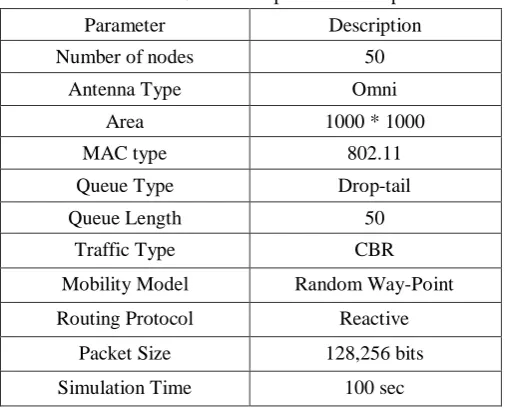
Table 4.1 Simulation parameter setup
Parameter Description
Number of nodes 50
Antenna Type Omni
Area 1000 * 1000
MAC type 802.11
Queue Type Drop-tail
Queue Length 50
Traffic Type CBR
Mobility Model Random Way-Point
Routing Protocol Reactive
Packet Size 128,256 bits
Simulation Time 100 sec
ISSN(E): 2277-128X, ISSN(P): 2277-6451, DOI: 10.23956/ijarcsse/V7I6/0333, pp. 252-256
Fig 4.1 Packet delivery ratio
This figure represents packet delivery ratio in MAET using purposed approach and previous approach that is IRED approach. Packet delivery ratio has been measured for efficiency evaluation of purposed model. In this ratio between total numbers of packet properly delivered has been measure to total number of packets transmitted.
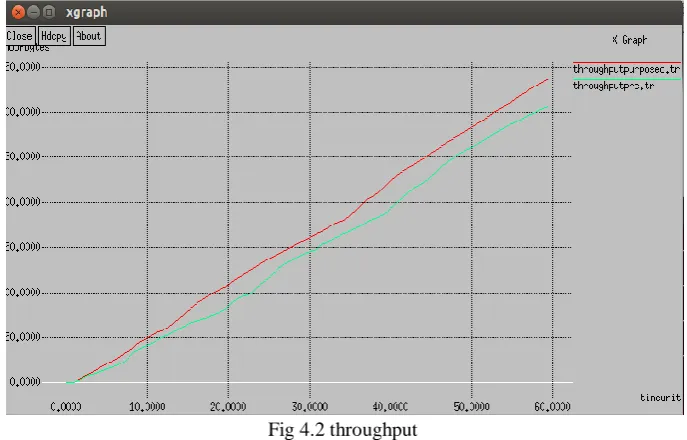
Fig 4.2 throughput
This figure represents throughput in MAET using purposed approach and previous approach that is IRED approach. Throughput has been measured for effective efficiency to transmit number of bits by the network. It is computed by ratio between total number of bits successfully transmit to per unit of time.
ISSN(E): 2277-128X, ISSN(P): 2277-6451, DOI: 10.23956/ijarcsse/V7I6/0333, pp. 252-256
This figure represents congestion in MAET using purposed approach and previous approach that is IRED approach. Congestion is measured to check overall performance of the network. In the purposed work congestion window that occurred in the network has been measured.
V. CONCLUSION& FUTURE SCOPE
Mobile ad-hoc network is branch of networking that deals with communication between nodes without interference of any external device Congestion is the main factor that degrades performance of the network so minimum amount of data has been transmitted over the network. In the proposed work queue size has been divided into three different values that is used for selection of best route for data transmission over the network. In the proposed work minimum, maximum average queue size has been used with weightage function and threshold value. If the queue size is greater than threshold value then immediate marking probability has been defined that has been used for selection of possible routes. If the current queue size is greater than mid queue and threshold value then on the basis of weightage function accumulative drop probability has been defined that has been used for extraction of possibility of occurrence of congestion and packet drop probability. On the basis of probability of marking and dropping various packets ratios have been defined that has been used for extraction of possible paths for data transmission over the network. In the proposed work path that contains minimum packet drop rate, that has been selected for data transmission using source and destination node.
In future reference proposed model can be extended to study the robustness of Wireless Ad Hoc Networks for all types of protocols, conducted on the relationship between the average congestion occurrence and the mobility of the nodes, to avoid traffic fluctuation, randomness can be introduced into route determination&to reduce packet drop due to route changes.
REFRENCES
[1] SaritaSimaiya “IRED Algorithm for Improvement in Performance of Mobile Ad Hoc Networks”, Fourth International Conference on Communication Systems and Network Technologies, 2014, PP 23-30.
[2] Narendra Shanna “Simulation for Congestion-Less Losses Control over MANET using TCP Scheme”, Issues and Challenges in Intelligent Computing Techniques (ICICT), 2014, PP 410 – 415.
[3] Sneha V. Sangolli “An Efficient Congestion Control Scheme Using Cross-Layered Approach and Comparison of TCP Variants for Mobile Ad-hoc Networks (MANETs)”, Networks & Soft Computing (ICNSC),, 2014, PP 30 – 34.
[4] NeelamPhate “Minimizing Congestion and Improved QoS of AODV using Clustering in Mobile Ad Hoc Network” , IEEE International Conference on Recent Advances and Innovations in Engineering, 2014, PP 45-50.
[5] Hemant Kumar “TCP Congestion Control with Delay Minimization in MANET”, IEEE Conf. on ICICES, 201`4, pp 56-70.
[6] BijenderBansal 1, Malay RanjanTripathy “Improved Routing Protocol for MANET”, Fifth International Conference on Advanced Computing & Communication Technologies, 2015, pp 21-30.
[7] Bandana Bhatia “Performance Analysis of AODV Based Congestion Control Protocols in MANET”, 1st International conference on futuristic trend in computational analysis and knowledge management (ABLAZE 2015), 2015, pp 45-53.
[8] PravinRanjan “Optimized Local Route Repair and Congestion Control in Mobile Ad hoc Network”, Computing and Communications Technologies, 2015, pp 328 – 333.
[9] Istikmal,“Performance Analysis of Routing and Congestion Control Cooperation in Wireless Mobile Ad Hoc Networks” , International Conference on Control, Electronics, Renewable Energy and Communications (ICCEREC), 2015, pp 789-790.
[10] Moradi, Z., Teshnehlab, M., Rahmani, A.M. (2011) “Implementation of neural networks for intrusion detection in MANET”, International Conference on Emerging Trends in Electrical and Computer Technology (ICETECT), pp. 1102–1106.
[11] Dong-Li Zhang, Wen-cheng Jiao, ZhengJian-Ling “Research and improvement of DSR protocol in Ad Hoc Network”, Industrial and Information Systems (IIS), vol.1, pp. 242-244, IEEE, 2010.