PROJECT-BASED LEARNING: PANACEA FOR CHANGE OR OLD WINE
IN NEW BOTTLES?
D. Scholtz*
Faculty of Business and Management Sciences e-mail: [email protected]
M. Bester*
Curriculum Development Unit
Fundani Centre for Higher Education Development e-mail: [email protected]
*Cape Peninsula University of Technology Cape Town, South Africa
ABSTRACT
One of the key characteristics of vocational higher education is the incorporation of work-integrated learning (WIL) where students draw on theoretical principles to deal with workplace dynamics and solve problems within workplace contexts. While workplace-based learning (WPBL) was the default modality for diploma qualifications at this institution, a curriculum revision process revealed a shift from workplace-based learning to project-workplace-based learning (PJBL). This study explored the reasons for the shift to PJBL as the preferred WIL modality in four diploma qualifications. Curriculum Officers were interviewed to establish the rationale for shifting to PJBL as well as how PJBL would be structured as pedagogy for learning in and outside the workplace. The interview data were subjected to content analysis to extract themes based on the core questions of the interview protocol. Curriculum documents were analysed to determine whether interview data were validated with documented evidence. The second generation of activity theory components provided a theoretical lens for data analysis and discussion. The findings showed that the prevailing view was that PJBL would provide an improved and more effective learning experience, but attention to detail as to how PJBL would be operationalized were scant. Although PJBL holds the promise of positive change, the absence of project details might scupper any envisaged successes. Since this shift towards PJBL is groundbreaking given the legacy of WPBL in diploma qualifications at universities of technology, this study will provide insights into the merits of current and future WIL practices for diploma qualifications.
Keywords: project-based learning; workplace-based learning; experiential learning; vocational higher education
INTRODUCTION
at various stages during the completion of the academic programme as part of professional development. The workplace provides an affordance for learning by integrating classroom learning within an authentic work environment. The importance of workplace-based learning (WPBL) has found traction in many qualifications and disciplines of study and currently most universities offer work placements as part of professional degree programmes. One of the primary advantages of WPBL is to ease the transition from the classroom to the workplace. As noted by Le Maistre and Paré (2004, 44), “the chief aim of professional education is to prepare new practitioners ... to ease the passage to professional practice by recreating it under controlled conditions in school or in practicum”. The default workplace-based learning practice for diploma qualifications was that students would be placed in appropriate companies and organisations for a period of time to be acculturated into professional practice. However, the promulgation of the Higher Education Qualifications Sub-Framework (DHET 2013) signalled a wide-spread change in the work placement modality at this institution. The HEQSF (DHET 2013) presented opportunities to revise diploma qualifications and more importantly, to re-design programme structure and pedagogic practices. Since these National Diploma programmes were categorised as Category B qualifications in terms of the categorisation process announced by the Council on Higher Education (CHE) in 2011, it implied that the curricula could be amended, but with less than 50 per cent change. This process of curriculum renewal resulted in academic departments reflecting on the efficacy of workplace-based learning as currently practised and proposed the introduction of project-based learning (PJBL) within a workplace context. This disruption of WPBL as the entrenched legacy practice for the past 30 years, to be replaced by PJBL, purports to have far reaching implications for more structured teaching, learning and assessment in both classroom and workplace contexts. In responding to the need for curriculum renewal, improved student learning and increased employability prospects, PJBL is envisaged as a more profound pedagogic practice than WPBL thereby contributing to the well-being of graduates’ cognitive and affective prospects for work preparedness. The proposed project would be conducted in authentic workplace contexts and would be monitored and evaluated primarily by lecturers with input from workplace supervisors. The need for change was identified through reflection of current workplace-based learning that does not, in all instances, seem to fulfil its true mandate of providing a nexus between theory and praxis. The proposed project-based learning in workplace contexts contributes to the debate on enacting curriculum change for both the public good (work places) and for reframing student success in terms of the possibilities that this curriculum renewal project has to offer.
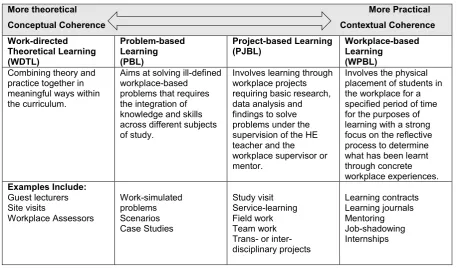
According to the CHE Work-integrated Learning: Good Practice Guide (2011), WIL is the over-arching term for all practice-based learning modalities (refer to Table 1), while WPBL refers specifically to work placements in industry, which is one modality of WIL.
OVERVIEW OF STUDY
The purpose of this study was threefold: firstly, to determine Curriculum Officers’1
understandings of WIL and how these understandings might influence the shift to project-based learning; secondly, to explore the rationale for the transition to project-based learning, and thirdly, to seek insights as to the ramifications that a workplace project might hold in the learning continuum from university to professional practice.
The theoretical framework draws on the conceptual framework outlined in the CHE Work-integrated Learning: Good Practice Guide (2011) with specific emphasis on the use of WIL modalities as key pedagogic strategies to enhance student learning and employability of graduates. Engeström’s (2001) second generation of activity theory (AT) provided an analytical lens to explore the shift from WPBL to PJBL as described by the research participants. AT was considered instructive in revealing the mutual and dynamic relationships between the components of the activity system. The analysis and discussion are located within the framework of how each component is interrelated within this activity system. The findings show that while PJBL in workplace contexts was unequivocally adopted as the WIL modality in the revised curricula, the details of the project, its implementation, monitoring and evaluation were scant in all four departments. Since this is a work in progress with the implementation date for the first cohort of students being 2020, the community (i.e. lecturers, workplace supervisors, placement officers, employers) need to engage in planning to ensure a seamless transition from work placements to project-based learning. The shift from WPBL to completing a structured project in the workplace is ground-breaking given the legacy of three decades of WPBL in mainly the final year of diplomas. This article provides insights into the merits of current WIL practices (i.e. WPBL) and envisaged practices (i.e. project-based learning in workplace contexts) based on interview data and document analysis of four diplomas in three faculties.
THE CURRICULUM OFFICER (CO) FORUM: AN INSTITUTIONAL ACADEMIC DEVELOPMENT INITIATIVE
a shift in the focus of CO Forum to capacity building on curriculum development. The forum started with six Curriculum Officers (COs) and currently stands at 55 COs, one CO per department(s) across six faculties. The HEQF (DoE 2007) and the HEQSF (DHET 2013) required significant changes to qualifications and the qualification structure of mainly UoTs offering diploma qualifications. For example, a joint CHE/Department of Higher Education and Training (DHET)/ South African Qualifications Framework (SAQA) communiqué of August 2008 noted that:
“the implementation of the HEQF will result in a number of important changes in purposes and characteristics of qualifications such as credit values, levels, nomenclature and designation of many qualifications.”
To this end, the monthly CO Forum meetings included discussions and presentations on approaches and theories on curriculum development. “Curriculum” was discussed in its broadest conception of incorporating curriculum structure, curriculum content, and all facets of curriculum implementation. With work-integrated learning (WIL) being integral to all qualifications at this UoT, various CO Forum meetings were devoted to developing conceptual and theoretical understandings of WIL and WIL modalities appropriate to vocational educational contexts. The relevance of the CO Forum to this study was that the research participants were COs who were tasked with facilitating curriculum revision (i.e. Diplomas) and curriculum development of new qualifications (i.e. Advanced Diplomas and Post-Graduate Diplomas) in their respective departments. In the previous “convenor technikon” system, “selected institutions were given increasing responsibility for leading curriculum development initiatives for specific programmes [and were] instrumental in driving the initiatives that culminated in the interim registration of qualifications with SAQA” (Cooke, Naidoo and Sattar 2010, 151). While the convenorship system of the technikon era “was well intentioned with regard to the greater good of the UoTs” it resulted in the “disempowerment of academic staff at institutional level with regard to input into, and changes to, the curriculum” (Cooke, Naidoo and Sattar 2010, 151). It is against this background of the HEQSF (DHET 2013) and the convenor technikon system, that the CO Forum was instrumental in building staff capacity for curriculum development. This article relates specifically to the shift from WPBL to project-based learning in curriculum.
WORKPLACE-BASED LEARNING AT UoTS
characteristic of, and synonymous with diploma qualifications in SA. These work placements form part of the curriculum structure of the three-year diplomas and, where applicable, are aligned with professional body requirements to ensure accreditation of the qualification as well as the accreditation of graduates. Work-integrated learning (not workplace-based learning exclusively) is defined in the HEQSF (DHET 2013, 9) as follows:
“WIL is characteristic of vocational and professionally-oriented qualifications, and may be incorporated into programmes at all levels of the HEQSF. In the HEQSF, WIL may take various forms including simulated learning, work-directed theoretical learning, problem-based learning, project-based learning and workplace-based learning. The selection of appropriate forms of work-integrated learning depends on the nature and purpose of the qualification type, programme objectives and outcomes, the NQF level at which the WIL component is pegged, institutional capacity to provide WIL opportunities, and the structures and systems that are in place within professional settings and sites of practice to support student learning.”
The HEQSF (DHET 2013) definition views WIL as integral to the academic structure of the qualification and needs to align with the purpose and outcomes at both subject and qualification level. The type of WIL modality in industry, is however, the prerogative of the institution depending on the capacity to offer the selected WIL type(s) relative to the qualification type and purpose. Prior to January 2018, WPBL was the preferred industry-related WIL modality at this institution, of which 37 National Diplomas included a credit-bearing WPBL component ranging from 120 SAQA credits (1 full academic year) to 12 SAQA credits (Bester 2016). In some qualifications WPBL is a credit-bearing subject and in other qualifications it is additional to the academic structure. Of import here is that credit-bearing subjects accrue subsidy from the DHET, while non-credit bearing components do not attract government subsidy impacting on the viability of programmes. The issue of funding emerged as one of the reasons why departments adopted project-based learning as the workplace learning modality.
WIL AS PEDAGOGIC PRACTICE
According to Billett (2009), WIL is a pedagogical practice whereby students come to learning from the integration of knowledge and experience in educational and workplace settings. Integrating disciplinary knowledge with workplace experience provides students with an opportunity to combine theory and practice in a real-world environment as well as foster personal and professional growth. The significance of WIL as a pedagogical practice to facilitate the transition from higher education into the world of work has been widely accepted by employers and the higher education sector. Some of the advantages for students are:
interdisciplinary thinking and increased motivation to learn;
• Personal benefits such as increased communication skills, team work, leadership and co-operation;
• Career benefits such as the development of a professional identity, increased opportunities for employment and career progression, increased understanding of work values and ethics, and;
• Skills development including increased competence and technical capabilities (CHE, HE Monitor 12 2011, 6). (Refer also to Billett 2002; Fuller 2007; Walsh 2007; Cooper, Orrell and Bowden 2010; Fung 2017; Vande Wiele et al. 2017.)
The term “workplace-based learning” is often used interchangeably with terms such as “cooperative education”, “experiential learning” and “internship” yet they all resort under the broad concept of work-integrated learning. WIL is defined as “an umbrella term to describe curricular, pedagogic and assessment practices, across a range of academic disciplines that integrate formal learning and workplace concerns” (CHE 2011, 4). WIL specifically describes an approach to career-focused education that includes classroom-based and workplace-based knowledge gained through immersion in a work or professional context (CHE 2011, 4). Drawing on the pedagogic device of Bernstein, the theoretical framework described in this CHE Good Practice Guide (2011) distinguished between forms of occupation and professional knowledge, namely:
• The academic discipline or field: Academic staff in their roles as researchers, develop new knowledge and thinking in their field of specialism.
• The education field consisting of curricular, pedagogic and assessment practices: HE teachers select topics and concepts for their students to study and devise methods of teaching and assessment.
• The occupational/professional practice: Professionals transfer/transform the knowledge learned at university in their field of practice.
Table 1: WIL Typologies (CHE Guide 2011, 21‒22)
More theoretical More Practical Conceptual Coherence Contextual Coherence Work-directed Theoretical Learning (WDTL) Problem-based Learning (PBL) Project-based Learning
(PJBL) Workplace-based Learning
(WPBL)
Combining theory and practice together in meaningful ways within the curriculum.
Aims at solving ill-defined workplace-based problems that requires the integration of knowledge and skills across different subjects of study.
Involves learning through workplace projects requiring basic research, data analysis and findings to solve problems under the supervision of the HE teacher and the workplace supervisor or mentor.
Involves the physical placement of students in the workplace for a specified period of time for the purposes of learning with a strong focus on the reflective process to determine what has been learnt through concrete workplace experiences. Examples Include: Guest lecturers Site visits Workplace Assessors Work-simulated problems Scenarios Case Studies Study visit Service-learning Field work Team work Trans- or inter-disciplinary projects Learning contracts Learning journals Mentoring Job-shadowing Internships
PROJECT-BASED LEARNING AS WORKPLACE PEDAGOGY
“locus of learning shifts from the teacher to the learner” where the teacher facilitates learning by “guiding learners’ construction of knowledge” (Kumar 2006, 256).
Billett (2002, 478) views workplace participation as learning experiences and affordances for learning, the latter being “the kinds of activities individuals are able to engage in and the kinds of guidance they can access through these experiences”. The incorporation of PJBL as a workplace activity and the propensity of PJBL to “contribute to learners’ development” may serve to “reinforce, refine and extend learners’ knowledge”. Workplace pedagogy, according to Billett (2002, 478), should embody learning experiences “which can provide a critical base for thinking about workplaces ... and account for the ways in which workplaces afford opportunities for learning”. He posits that “learning is an on-going process of engagement ... mediated by participatory practices ... through participation in guided learning strategies” (Billett 2002, 478). PJBL presents itself as a “participatory practice” and a “guided learning-strategy” that facilitates the transition to the world of work, depending on the effectiveness of the project itself (Billett 2002, 478). One of the premises of workplace-based learning is the continuity of learning from the classroom to the workplace which offers different kinds of learning and assessment opportunities when compared with classroom learning. The application of knowledge and skills within a real time, actual work environment presents a dimension of immediacy that would serve students well when transitioning into the world of work. Furthermore, Powell (2007, 16) contends that “the implementation of project-based learning would address a number of concerns regarding the quality of work-integrated assessments [that] are not adequately applied”.
ACTIVITY THEORY AS AN ANALYTICAL LENS
This article draws on Engeström’s second generation of activity theory (AT) that evolved from Vygotsky’s first “triangular model of action” (Bakhurst 2009, 199). For this study, the second generation of AT serves as a theoretical framework for analysing an activity system that focuses on project-based learning as an outcome for a revised experiential learning model. An activity system is dynamic in nature and is bound to change over time where different subjects, rules and division of labour, for example, might result in modified outcomes and objects. Each of the components that constitute an activity system are relational to one another and have a bearing on how the activity of one component impacts another, both within a specific period of time and over a period of time. AT as a theoretical framework is acknowledged as a tool for analysis, with contradictions both in and outside the model, and as such Bakhurst’s (2009, 207) caveat “to be alive to the limits of the model itself” is heeded.
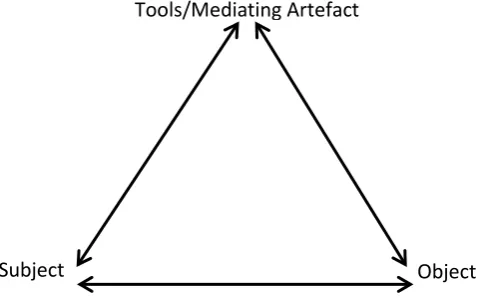
elements in any activity system, namely: subject, object and tools/instruments which concentrates mainly on the individual actor or agent operating tools or instruments. (Refer to Figure 1.) The subject is the individual or sub-group engaged in an activity, “whose point of view is adopted in the analysis” (Konkola et al. 2007, 215). In the context of this article, the subject is the CO and his/her conceptions of work-integrated learning in career-focused education. The object is the “raw material ... to which the activity ... is oriented towards a particular goal and is transformed to produce outcomes” (Konkola et al. 2007, 215). The object is more than just raw stimuli: it is a “culturally formed object with a history, however short or long” (Russell 2002, 69). In any activity system, the motive is linked to the object as it shapes the overall outcome of the activity. The object in this study is the WIL modality, i.e. project-based learning, to facilitate the transition from classroom-project-based disciplinary knowledge to workplace practice. Tools are mental, conceptual and/or material mediating instruments that mediate or facilitate subjects’ activities. Examples could include a concept, a computer, or a text. The tools for this activity system include the various resources available to lecturers to mediate and facilitate their understanding of, and transition to the object. These tools include the CHE Work-integrated Learning: Good Practice Guide (2011) and institutional, faculty and departmental workshops, such as the CO Forum.
Figure 1: First generation activity theory’s (Vygotskian) model of action (Bakhurst 2009, 200)
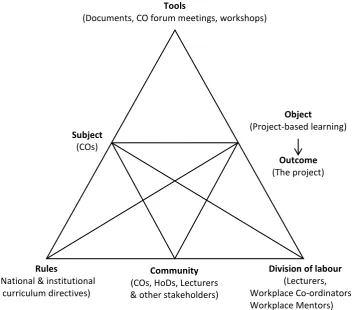
The second generation of activity theory (Refer to Figure 2), according to Bakhurst (2009), emerged from the work of Alexei Leontiev, who differentiated between an “action” as conducted by a person or group to achieve a goal, and an “activity” which includes an object and a motive, said to be undertaken by a community. The second generation is referred to by Engeström, as an activity system where the dynamics of the system emanate from “contradictions” between the elements that constitute the system (Engeström 2001; Bakhurst 2009). The second generation is characterised by applying the components of the triangle to
Tools/Mediating Artefact
concrete examples such that each component has a specific interpretation contingent on the context and case under scrutiny.
Figure 2: Activity system triangle (second-generation activity theory (Based on Engeström 1987, in Garraway 2011)
For the second generation, Engeström (2001) expands the framework to examine systems of activity at the macro level. The importance of this shift is that it foregrounds interrelations between the individual subject and his/her community of which he/she is a member. The community is the larger group interacting in the activity of which the subject is a part. In the activity system presented here, the community involved in the shift to project-based learning includes the CO, head of department (HoD), lecturers involved with curriculum revision and the advisory committees for the respective qualifications. The division of labour refers to the role specialisation and power relations that might lead to contradictions in the system. In this case, the division of labour relates to the lecturers tasked with developing and planning the object (i.e. the project), as well as role-players tasked with the outcomeof the activity system (i.e. the implementation. monitoring and assessment of the project). The division of labour for the outcome would be the community as noted above, including the departmental Workplace Co-ordinators and workplace supervisors. Rules operating in any activity are broadly
Tools
(Documents, CO forum meetings, workshops)
Community (COs, HoDs, Lecturers & other stakeholders)
Division of labour (Lecturers, Workplace Co-ordinators Workplace Mentors) Rules
(National & institutional curriculum directives)
Subject (COs)
Object
(Project-based learning)
understood as not only formal and explicit rules governing behaviour but also those that are unwritten and tacit, often referred to as norms, routines, habits, values and conventions (Engeström 1996; Russell 2002). Examples of rules relevant to this activity system are curriculum directives such as subject credits, SAQA (2012) level descriptors, institutional and departmental assessment rules and regulations, HEQSF (DHET 2013) WIL requirements and industry rules for placement and project implementation.
This article presents an activity system that relates to the second generation of activity theory as illustrated in Figure 2. The data and discussion focus on two aspects:
• Firstly, a discussion of the components that constitute the second generation of an activity system, and
• Secondly, the tensions, dynamics and contradictions between the components were explored.
RESEARCH DESIGN AND METHOD
not considered generalisable across all diplomas since each field of study and the dynamics of curriculum revision differ from one department to another.
FINDINGS AND DISCUSSION
Understandings of WIL and the shift to PJBL
The research participants were all COs in their respective departments, having assumed this role for different time periods, ranging from one year to six years. This impacted directly on how knowledgeable and how confident the CO was to facilitate curriculum revision with staff in his/her department. The analysis and discussion below are based on verbatim excerpts from transcribed interview data which appear as quotations or between inverted commas.
As the subjects in this activity system, the COs were asked to explain their understandings of WIL to determine the extent to which these understandings might influence the outcome of the activity system, i.e. the conception and description of the proposed project. WIL was described as “bringing the workplace into the classroom”, “experiential learning”, bringing workplace learning into the class and the “purpose of WIL is to relate theory directly with practice”. Although there were commonalities in understandings of WIL, i.e. aligning classroom learning with workplace practice, there seemed to be different nuances of meaning. For example, the CO for Management viewed WIL as:
“bringing the workplace into the classroom ... through case studies, projects, allowing the student to make sense of what’s happening in the world of work by using their understanding of theoretical concepts ... learnt in different subjects.”
This suggests a praxis approach where practice draws on theory and theory informs practice. The pedagogy of aligning classroom learning with the world of work through various WIL modalities speaks to integration on two levels: (1) integration of different subject knowledge fields, skills and attributes, and, (2) integration of classroom-based knowledge and practice in professional workplace contexts. WIL is explained as the nexus of what has been learnt in different subjects. With reference to Public Relations (PR), the CO perceived WIL as:
“It’s the integration of the learning that still takes place in the class and how that is applied to the place of work but also, how the place of work fits into the learning ... where after the learning the student is placed at the work or at industry to see how they can apply the work.”
of WIL was to “relate theory directly with practice”. These two interpretations suggest that the workplace is not necessarily viewed as an extension of the learning space and dynamics for learning, but rather as a space to apply classroom-based theoretical knowledge to practice. The transfer of classroom learning to the workplace is not necessarily a seamless transition given the different ways that knowledge, skills and attributes are applied in professional practice (Billett 2002; Le Maistre and Paré 2004; Tynjälä 2008). One of the premises of workplace-based learning is the continuity of learning from the classroom to the workplace that offers different kinds of learning and assessment affordances (Billett 2002) when compared with classroom learning.
The object or the focus of the activity system is PJBL in the workplace context. This shift was brought about through reflection and questioning the effectiveness of current practices in achieving the desired outcomes of the workplace-based learning experiences. Avis (2007, 168) notes that “system change and transformation call upon participants within and across activity systems to question taken-for-granted practices”. For example, where students were previously placed in industry and supervised mainly by workplace supervisors, the revised curriculum for these diplomas envisages a project (i.e. the outcome), to be completed while in the workplace. The “system change and transformation” from WPBL to PJBL (Avis 2007, 168) was brought about primarily because WPBL was not previously funded in these four National Diplomas, and to propose a more purposeful, structured workplace experience. Workplace-based learning did not always achieve its desired outcomes. According to the CO in Management, students “were sometimes doing menial tasks and it’s not adding value”. Similarly, difficulties with placement, monitoring and assessment of WPBL were noted as possible reasons to revisit WPBL as the preferred WIL modality at the institution. The excerpt from the CO in Agriculture below explains the shift to PJBL as follows:
“You do what the employer tells you to do and you are a worker on his farm. Whereas, project-based learning is, I think it’s much more structured that you have specific outcomes that you aspire to and that you need to sift through all the information and actions that you do to make it relevant to the specific project ....”
The shift from work placements to include a project in the workplace was mediated by the
tools that the subjects used in the capacity building process for curriculum revision. The CO Forum meetings had a noteworthy influence on COs understanding of WIL, and was lauded as being “incredibly valid” (Journalism), “extremely enriching” and “empowering” (Public Relations). Aspects of the CHE WIL Good Practice Guide (2011) were discussed at several CO Forum meetings and presentations from different departments on workplace practices opened up new vistas of thinking about how best to structure a meaningful workplace learning experience. Departmental discussions on WIL, informed by the broader institutional and faculty discussions, resulted in the final decision that project-based learning would be the preferred workplace learning modality.
The community consisted of staff members in departments who contributed to discussions on curriculum and adopted project-based learning as the structured WIL modality. These staff members were the CO, the HoD, lecturers in the department and the Workplace Co-ordinators. In certain diplomas such as Management, the Advisory Committee for the qualification and industry were consulted and, according to the CO, were in agreement that “students needed to come into the organisation and do a specific task”. With reference to rules, curriculum practices and the academic structure of qualifications are governed by national, institutional and departmental rules such as the HEQSF (DHET 2013) directives for qualification types, credit allocations, SAQA (2012) level descriptors, institutional and departmental teaching, learning and assessment procedures.
Contradictions in the activity system
Le Maistre and Paré (2004, 49) affirm the “need to help students move from the general (book knowledge, theories, abstractions) to the particular (real clients) as they move from the university to actual practice situations”. Incorporating a structured project into workplace learning would achieve this ideal, provided there is “a concomitant ... collaboration between the agencies involved in preparing and welcoming the new professionals into a community of practice” (Le Maistre and Paré 2004, 49). However, the “agencies involved” might not collaborate to achieve the envisaged outcome, which leads to contradictions in the activity system, either within specific components, i.e. (primary contradictions) or between components (i.e. secondary contradictions) (Garraway 2011). Examples of contradictions that emerged in the activity systems of the four departments include: limited collaboration and power struggles in the community; doubts about the project-based learning as the outcome; industry (un)preparedness for the revised WIL modality; differences in credit allocation to work-integrated learning components, yet no change in the actual time spent in industry; the ability or capability of workplace supervisors to support the student, and monitor and evaluate the project, and more intensive lecturer involvement in work placements than is currently the case. These contradictions are explicated below.
Limited collaboration and power struggles in the community
Curriculum development should ideally be a collective, collaborative departmental effort, involving the relevant lecturers with strong leadership from the HoD. This was the case in two departments. The other two departments experienced dynamics of power struggles in owning the curriculum revision process. The CO in Public Relations noted that, “it was the domain of one or two individuals ... and they don’t want anyone’s involvement”, and as a result “staff members were not involved”. Eventually the HoD and the CO contributed and as they “communicated what we were doing, people started sharing ideas”. Similarly, in Journalism the shift to PJBL was a decision taken by a CO who had left the department. This department has a legacy project that needs to be planned and implemented in the absence of the CO who mooted the need for change. It is worthwhile noting that in the two departments where collaborative efforts resulted in departmental decisions being taken, the HoDs spear-headed the process.
Doubts about the outcome
proposed changes, stating that “what they mean to do with it I’m not quite sure” and that some of the proposed changes “defies all logic”. The Management CO remarked that “we [the department] haven’t actually discussed the concept of project-based learning with our Advisory Board ... we’ve mentioned it and they’ve agreed but we haven’t gone into detail”. Of import here is the influence that the subjects in an activity system have on the object and the outcome, and if these were not granted due reflection and consideration the outcome might not have the desired success in terms of a structured project within a workplace context.
Industry (un)preparedness for PJBL
The Journalism CO was sceptical of the media industry’s acceptance of PJBL. He was of the opinion that “industry would seriously re-consider its relationships with institutions”. He noted that industry was unaware of “what will be expected, what their responsibilities will be ... it’s also quite concerning that I think our industry like many are ones that are subject to rapid change”. No evidence was provided in any of the diplomas that industry was consulted on the revised WIL modality, yet industry would be called upon to support students through to project completion. Industry, should ideally have been part of the community in decision-making as well as in the division of labour, yet this was not evidenced in the data.
Reduced credits but duration in industry remains the same
In Agricultural studies students are currently placed for a full academic year (120 credits) during the third year of study. In the revised curriculum, WPBL will be replaced with integrated project-based learning located in five subjects at third year level, with 30 credits of workplace-based learning. However, students will still be placed for a full academic year while doing projects “after hours” and compiling a portfolio of evidence on their WIL experience. The CO explained that:
“we re-packaged it [project-based learning] in subjects, we decreased the formal work place based learning to 30 credits, which will be a project, a portfolio of learning and reflection by the student with an oral and the other subjects are then – the other credits went to the subjects themselves.”
on students for their final year of study. Although there was no change in the duration in industry, the rules of the object and outcomes had changed significantly.
Workplace mentors
One of the concerns raised was whether workplace mentors (i.e. actors in the division of labour) had the capacity to supervise a project in collaboration with subject lecturers. According to institutional requirements, the project, at Level 6, would require the workplace supervisor to have a requisite formal qualification to be eligible to assist students appropriately. Often workplace supervisors have passed through the ranks in professional practice and might not be able to assist with formal academic projects that will be located in two or more subjects as proposed for the Management and Agriculture diplomas.
More intensive lecturer involvement
Current practice dictates that students are placed, supervised and assessed by the Workplace Co-ordinators. Lecturers are currently not involved in work placements by any measure. The introduction of PJBL would necessitate that lecturers plan, monitor and assess the integrated project, with actual placements still being the domain of the Workplace Co-ordinators. PJBL will undoubtedly impact the division of labour in all academic departments, and lecturers are not aware of how their workloads might change. The uncertainty of how lecturers might respond to additional responsibilities was summed up by the Management CO as follows:
“I think this is also going to have a total mind shift on lecturers’ part because there’s going to be quite a lot of engagement, much more than when it’s the normal contact. And I think that is going to pose challenges on its own.”
The introduction of PJBL calls for greater commitment and involvement of lecturers. Powell (2007, 17) avers that “the successful implementation of alternative approaches like project-based programme design and implementation will, to some extent, depend on academics’ understanding of the essence of change, their ownership of it, their commitment to an involvement in the process”.
CONCLUDING THOUGHTS
curriculum decision-making and project planning. David (2008, 82) cautions that:
“To use PJBL effectively, teachers must fully understand the concepts embedded in the projects and be able to model thinking and problem-solving strategies effectively. Worthwhile projects require challenging questions that can support collaboration, as well as methods measuring the intended learning outcomes.”
The common sense maxim portends that the success of any project resides in thorough planning, continuous monitoring and transparent evaluation, of which the community is fully apprised, and the division of labour is fair and distinct. Being remiss at this might well translate to an outcome that might not meet its intended goals of WIL as pedagogy and project-based learning as a first foray into authentic professional practice. The merits of project-based learning as pedagogy and practice would no doubt be an improvement to current WPBL placements and assessments. However, the paucity of detail and limited understanding on the part of academics and industry partners of how project-based learning will be operationalised might well result in reverting to the default position of work placements. The caveat presented here is that project-based learning might result in WIL by another name in which current practices are maintained under a new guise. The point to be made is that proper planning, implementation, monitoring and assessment is necessary to guard against pouring old wine in new bottles.
ACKNOWLEDGEMENTS
The authors wish to thank the anonymous reviewers for their insights and comments to improve this article.
This study was funded by an institutional research initiative, i.e. Research and Innovation Fund for Teaching and Learning (RIFTAL).
NOTE
1. Curriculum Officers are academic staff members who facilitate curriculum development in their respective departments and faculties at this institution.
REFERENCES
Avis, J. 2007. Engeström’s version of activity theory: a conservative praxis? Journal of Education and Work 20(3): 161‒177.
Bakhurst, D. 2009. Reflections on activity theory. Educational Review 61(2): 197‒210.
Bester, M. 2016. South African Technology Network (SATN) integrated learning audit project. Report commissioned by the South African Technology Network (SATN) on work-integrated learning audit project. Pretoria: SATN.
Billett, S. 2009. Realising the educational worth of integrating work experiences in higher education. Studies in Higher Education 34(7): 827‒843.
Cooke, L. A., D. Naidoo and K. Sattar. 2010. External regulation and the universities of technology. In Universities of technology‒ Deepening the debate, ed. R. Townsend, 145‒163. Pretoria: Council in Higher Education.
Cooper, L., J. Orrell and M. Bowden. 2010. Work integrated learning. A guide to effective practice. Oxon: Routledge.
CHE see Council on Higher Education.
Council on Higher Education, Department of Education and South African Qualifications Authority. 2008. Joint communiqué on the implementation of the Higher Education Qualifications Framework. Pretoria: CHE, DoE and SAQA.
Council on Higher Education. 2011. Work-Integrated Learning: Good Practice Guide. HE Monitor No. 12. Pretoria: Council on Higher Education.
David, J. L. 2008. What research says about project-based learning. Educational Leadership/February,
80‒82.
Department of Education. 2007. The Higher Education Qualifications Framework. Government Gazette no. 30353, 5 October.
Department of Higher Education and Training. 2013. Publication of the General and Further Education and Training Qualifications Sub-framework and Higher Education Qualifications Sub-framework of the National Qualifications Framework. Government Gazette no. 36721, 2 August.
DHET see Department of Higher Education and Training. DoE see Department of Education.
Engeström, Y. 1987. Learning by expanding: An activity-orientated approach to developmental research. Cambridge: Cambridge University Press.
Engeström, Y. 1996. Perspectives on activity theory, Cambridge University Press, Cambridge.
Engeström, Y. 1999. Activity theory and individual and social transformation. In Perspectives on activity theory, ed. Y. Engeström, R. Miettinen and R-L. Punamäki, 19‒38. Cambridge: Cambridge University Press.
Engeström, Y. 2001. Expansive learning at work: Toward an activity theoretical reconceptualization. Journal of Education and Work 14(1): 133–156.
Fuller, A., L. Unwin, A. Felstead, N. Jewson and K. Kakavelis. 2007. Creating and using knowledge: An analysis of the differentiated nature of workplace learning environments. British Educational Research Journal 33(5): 745‒759.
Fung, D. 2017. A connected curriculum for higher education. London: UCL Press.
Garraway, J. 2011. University and work: Curriculum enquiry from an activity theory perspective. In Curriculum enquiry in higher education, ed E.Bitzer and N. Botha, 195‒212. Stellenbosch: SUN Press.
Konkola, R., T. Tuomi-Gröhn, P. Lambert and S. Ludvigsen. 2007. Promoting learning and transfer between school and the workplace. Journal of Education and Work 20(3): 211‒228.
Kumar, M. 2006. Constructivist epistemology in action. The Journal of Educational Thought 40(3): 247‒261.
Le Maistre, C. and A. Paré. 2004. Learning in two communities: The challenge for universities and workplaces. Journal of Workplace Learning 16(1/2): 44‒52.
Powell, P. 2007. Arguments for implementing project-based learning. The Journal of Independent Learning and Teaching (2): 13‒21.
SAQA see South African Qualifications Authority.
South African Qualifications Authority. 2012. Level descriptors for the South African Qualifications Framework. Pretoria: SAQA.
Tynjälä, P. 2008. Perspectives into learning at the workplace. Educational Research Review (3): 130– 154.
Vande Wiele, P., D. Morris, V. Ribièra and J-L. Ermine. 2017. Project-based learning for professional identity: A case study of collaborative industry projects in Marketing. The Independent Journal of Teaching and Learning 12(2): 44‒63.