International Journal Advances in Social Science and Humanities
Available online at: www.ijassh.com
RESEARCH ARTICLE
Investigation of Teacher Candidates’ Career Adaptabilities in Terms of
Several Variables
Kosterelioglu Meltem A*
Amasya University, Faculty of Education, Department of Educational Science. Amasya/Turkey.
*Corresponding Author: Email: [email protected]
Abstract
The current study aimed to investigate teacher candidates’ career adaptabilities in terms of several variables. The research was undertaken with 362 teacher candidates (N=362) attending Primary School Education Department of Amasya University in Faculty of Education in the fall semester of 2012-2013 academic year. Career Adapt-Abilities Scale (CAAS) adapted to Turkish and Personal Information form developed by the researcher were utilized as data collection tools in the study which used the survey model. In addition to descriptive statistics, t-test and ANOVA were used in data analysis. Research results show that confidence was the dimension in which career adaptability competencies were perceived at the highest level followed by control, concern and curiosity dimensions. It was also identified that teacher candidates’ career adaptability competencies showed significant differences only in the concern dimension regarding variables of gender, year and whether they selected the career willingly.
Keywords:Career, Career Adapt-Ability, Teacher Candidates.
Introduction
New approaches in education have caused the traditional teacher roles and functions to change with the impact of social, economic and technological developments. Expectations from the teaching profession and expectations regarding what teachers should know and do always change and are dynamic. Societies are undergoing an unplanned and complex transformation process and this transformation is changing how people work, how they communicate, how they live and how they learn. Social transformation visibly affects schools. Students can reach various information sources easily by using the new technologies and as a result, it becomes imperative to assess and update the schools’ and teachers’ traditional role and functions [1]. In this context, teachers in the 21st century should be aware of the requirements of the era, prepare themselves to meet these requirements and be willing to change and develop themselves [2]. According to [3], it is emphasized in the new approach that teaching takes precedence over knowledge transmission and teaching should be perceived as a career and not only as a profession.
Career is generally defined as progressing in a chosen field of work and carrying responsibility,
gaining status and prestige as a result [4]. According to another definition, it is the development of activities, responsibilities, attitudes and behaviors of individuals in their work lives [5]. The term career is not only related to vertical mobility, i.e. the changes in job conditions caused by moving up to higher rungs in the corporation. Although the majority of the personnel struggle to rise in their jobs, some of them may be content with their current positions and tasks and may not want to advance in their careers [6]. In this sense, we should remind that the concept of career has a wider framework of inference. The concept includes the personnel who are currently content with their positions but would like to develop their knowledge, skills and competencies and personnel who present horizontal development in order to have access to different positions in the same level. In this framework, career is not only related to individuals with higher status who have had chances for rapid progress but to organizations which are active in different fields of the profession and to different tasks as well [7].
Krasel as a central construct for adult career development [8] and has been used as an important competence for career achievement since then [9]. This concept refers to the psycho-social resources individuals possess in order to cope with societal changes and to adapt to the environment. Today’s globalization reshapes the career preferences and career developments of adults and especially points to the impact of the new generation [10]. It was put into practice in association with concepts such as career adaptability, career decisions self-competence and career preference commitment [11], career planning and school identity [12].
Career adaptability competence is regarded as the basic construct that includes the attitudes, competences and behaviors necessary for young individuals to adapt to their professions and changing job conditions in their career development processes [13]. Savickas and Porfeli address the resources of career adaptability competences in four dimensions which are concern, control, curiosity and confidence. Concern is based on individuals’ awareness of their competences regarding the profession and making plans accordingly. Control is based on individuals’ decision making about their professional futures and having feelings of self-management. Curiosity is related to tendency to research and confidence is related to feelings of self-sufficiency to solve career related problems [Cited in: 14].
Career adaptability competence refers to individuals’ readiness to overcome unpredictable changes in work conditions by preparing for the predictable tasks and participating in occupational roles that the job requires [15]. Individuals are expected to have skills that allow them to easily adapt to various conditions in a changeable environment. Reorganization skills and adaptation competences that individuals should have are rather important in overcoming
hardships that occur as a result of the changeable environment [16]. Considering the speed and permanence of the changes that occur in education systems it can be argued that career adaptability is an important concept for the teaching profession. In this context, the research problem was selected to be the following question: “What are the career adaptability competences of teacher candidates?”
Purpose
The purpose of the study was to investigate career adaptability competences of teacher candidates in terms of several variables. Answers to questions below were sought with this aim;
What are the career adaptability competences of teacher candidates?
Do the career adaptability competences of teacher candidates show significant differences according to
Gender
Year at school
Whether they have chosen the profession willingly?
Method
The research utilized survey method which is used to present the existing situation. Survey method is an approach that aims to describe a past or present situation or event as is.
Universe-Sample
The universe of the study was composed of 2321 teacher candidates that attended University of Amasya, Faculty of Education and Primary School Education Department of in the fall semester of 2012-2013 academic year. The sample of the study consisted of 362 teacher candidates (N=362) randomly selected by simple random sampling form the universe. Table 1 presents the demographic characteristics of the participants.
Table1:Demographic Characteristics of Participants
Variables f % Variables f %
Gender Female 189 52,2
Class Level/Year
1 85 23,5
Male 173 47,8 2 92 25,4
Total 362 100,0 3 90 24,9
Selected the
profession willingly
Yes 246 68,0 4 95 26,2
No 116 32,0 Total 362 100,0
Table 1 shows that 52,2% of the participants were females and 47,8% were males; 68% selected teaching profession willingly whereas 32%
Data Collection Tool
Personal Information Form developed by the researcher was used in the study to identify personal characteristics of teacher candidates along with career adaptabilities scale as data collection tools. Personal Information Form was composed of questions that aimed to collect information about teacher candidates’ personal information. Career Adapt-Abilities Scale (CAAS) which was called “International Career Adapt-Abilities Scale” in Savickas and Porfeli’s study and developed by 18 researchers form 13 countries and adapted to Turkish by [14] was used to assess career adaptabilities competences. The scale has a total of 24 items under the dimensions of concern (6 statements, α = .61), control (6 statements; α=.77), curiosity (6 statements; α=.79) and confidence (6 statements; α=.81). These statements were translated to Turkish by one lecturer and two instructors with good level of business English and necessary changes were undertaken after the pilot implementation. A five-point Likert type scale with equal intervals (1= Completely disagree and 5= Completely agree) was used in the answers.
Data Analysis
Descriptive statistics including percentages, frequencies and arithmetic means was used to identify teacher candidates’ career adaptabilities. t-test and ANOVA were utilized to determine the relationships between personal characteristics and career adaptabilities.
Findings
Findings Regarding the First Sub Problem Table 2 presents teacher candidates’ perceptions regarding their career adaptability competences on the basis of dimensions based on arithmetic means and standard deviation values.
Examination of Table 2 shows that based on arithmetic means, the highest perceptions of teacher candidates were in Confidence with a
X=26,18 means followed by Control with X=25,29, Concern with X=25,03 and Curiosity
with X=23,42. Examination of the statements in
Confidence dimension showed that feeling competent and feeling confident in solving career related problems and developing themselves are high which is pleasing. Statements that form the other dimensions show that all statements centered on “Completely agree” and “Agree” options. According to this finding, it can be argues that teacher candidates have high tendencies in being aware of their competences for their professional future, planning, making decisions regarding their professional future, managing themselves and doing research about their careers.
Table 2: Perceptions of teacher candidates
regarding their career adaptabilities
Dimension N X SS
Concern 362 25,0305 2,96960
Control 362 25,2901 3,21636
Curiosity 362 23,4278 3,48979
Confidence 362 26,1828 2,90972
Findings regarding the second sub problem In this part, teacher candidates’ perceptions regarding their career adaptability competences were examined on the basis of variables of gender, school year, whether they selected the profession willingly.
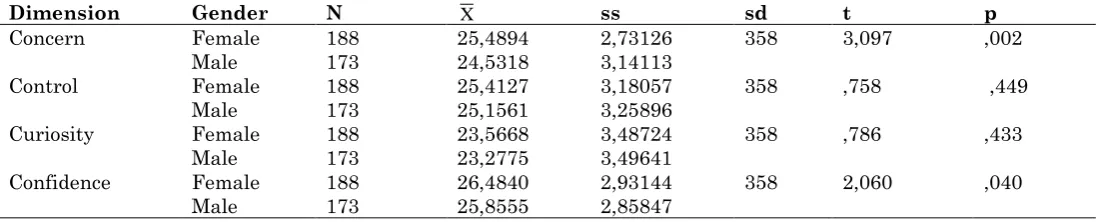
Table 3 presents the findings regarding teacher candidates’ perceptions about their career adaptability competences based on gender.
Table 3: t-test results for teacher candidates’ perceptions about their career adaptability competences
based on gender
Dimension Gender N X ss sd t p
Concern Female 188 25,4894 2,73126 358 3,097 ,002
Male 173 24,5318 3,14113
Control Female 188 25,4127 3,18057 358 ,758 ,449
Male 173 25,1561 3,25896
Curiosity Female 188 23,5668 3,48724 358 ,786 ,433
Male 173 23,2775 3,49641
Confidence Female 188 26,4840 2,93144 358 2,060 ,040
Male 173 25,8555 2,85847
p<.05
Examination of table 3 shows that teacher candidates’ perceptions regarding their career adaptability competences presented significant differences in the dimensions of concern and confidence based on gender variable (p<.05).
planning for professional future and feeling
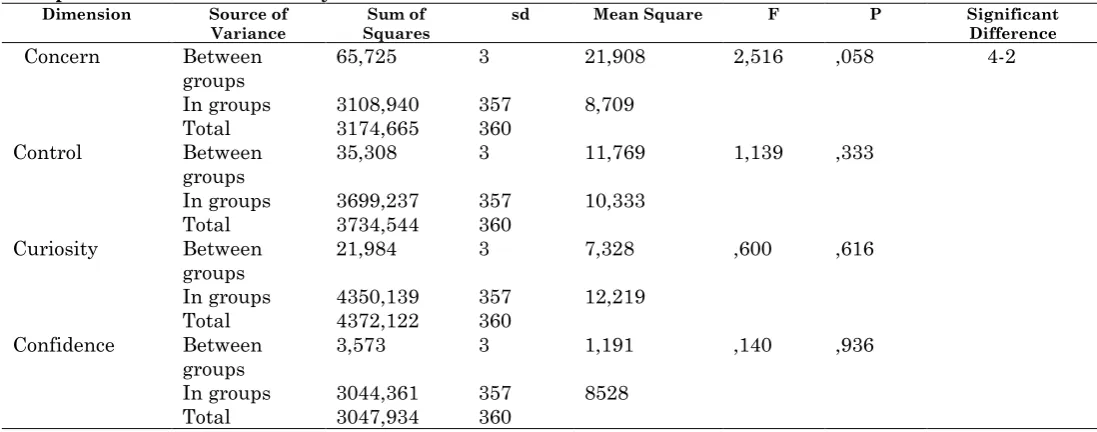
self-confident in solving career problems. Table 4 presents the findings regarding teacher candidates’ perceptions about their career adaptability competences based on school year.
Table 4: ANOVA test results for teacher candidates’ perceptions about their career adaptability
competences based on school year
Dimension Source of
Variance Squares Sum of sd Mean Square F P Significant Difference
Concern Between
groups 65,725 3 21,908 2,516 ,058 4-2
In groups 3108,940 357 8,709
Total 3174,665 360
Control Between
groups 35,308 3 11,769 1,139 ,333
In groups 3699,237 357 10,333
Total 3734,544 360
Curiosity Between
groups 21,984 3 7,328 ,600 ,616
In groups 4350,139 357 12,219
Total 4372,122 360
Confidence Between
groups 3,573 3 1,191 ,140 ,936
In groups 3044,361 357 8528
Total 3047,934 360
p<.05
According to Table 4, significant differences were observed in concern dimension. Tukey test showed that significance was observable between second and fourth year students and means showed that the means of fourth year students (X=25,61) were higher than those of second year
students (X=24,45). This shows that levels of
concern felt by fourth year teacher candidates are higher than those of second year students. When we say concern here, we mean the tendency of being aware of competences and being able to plan for the future. Here, the high levels of
concern in fourth year students compared to second year students may be caused by the fact that they will face the reality sooner since they complete school in a year and be assigned to work as teachers.
Table 5 presents the findings regarding teacher candidates’ perceptions about their career adaptability competences based on whether they selected the profession willingly.
Table 5: t-test results for teacher candidates’ perceptions about their career adaptability competences
based on whether they selected the profession willingly
Dimension Willingness N x ss sd t p
Concern Yes 245 24,5431 2,91356 358 2,156 ,032
No 116 25,2612 3,04000
Control Yes 245 25,4431 2,84333 358 1,320 ,188
No 116 24,9655 3,88516
Curiosity Yes 245 23,5369 3,31890 358 ,860 ,309
No 116 23,1983 3,82945
Confidence Yes 245 26,2531 2,76417 358 ,666 ,506
No 116 26,0345 3,20307
p<.05
Examination of Table 5 shows that that teacher candidates’ perceptions regarding their career adaptability competences presented significant differences only in the dimension of concern based on whether they selected the profession willingly (p<.05). Arithmetic means values show that the means of teacher candidates who stated they did not select the profession willingly (X=25,2612) were higher than those who were
willing to be teachers all along (X=24,5431). This
can be interpreted as higher levels of concern experienced by teacher candidates who selected the profession unwillingly.
It is observed that teacher candidates’ career adaptability competences were perceived in confidence dimension at the highest level which was followed by control, concern and curiosity dimensions. It was also found in a study by [17] that teacher candidates had high levels of self-confidence.
Teacher candidates’ career adaptabilities displayed significant differences in concern and confidence dimensions in favor of female teacher candidates. According to this finding, compared to male teacher candidates, female teacher candidates have higher levels of positive perceptions in being aware of their competences and planning for their future profession in the concern dimension and in feeling confident in solving problems in confidence dimension. However, a study by [18] found that female teacher candidates’ concern levels were higher than those of male teacher candidates.
Another finding of the study presented that teacher candidates’ career adaptabilities were in favor of fourth year students only in concern dimension in terms of year of schooling. This finding may have been resulted from the fact that the fourth year students will being working in a year. A study by [19] also shows that fourth year
teacher candidates have concerns regarding their assignments.
Another finding of the study points to the fact that teacher candidates’ career adaptabilities displayed significant differences in only concern dimension regarding the willingness to select the profession of teaching. Teacher candidates who selected the profession unwillingly were found to have higher levels of concern.
Suggestions below may be presented according to research results;
Teacher candidates can be provided with guidance to increase and encourage research regarding their careers in their profession in order to increase curiosity during undergraduate studies. Teacher candidates can be provided with guidance about decision making about their professional futures and self-management in order to increase their control levels [20].
Teacher candidates should be provided with guidance about being aware of their competences and planning for the future in order to generate more positive perceptions in the concern dimension.
References
1. World Bank (2005) Learning to teach in the
knowledge society. Final Report. By Task Manager Juan Manuel World Bank.
2. Tutkun Ö, Aksoyalp Y (2010) 21 Century
dimensions of teacher training education program. Selcuk University Institute of Social Sciences Journal 24 / 2010.
3. Dillon J, Ve Maguire M (1998) Becoming a teacher.
Buckingham: Open University Press.
4. Taştepe H (2001) Evaluation of career management,
Unpublished Master Thesis, Institute of Social Sciences of the University of Sakarya, Sakarya.
5. Savickas ML , Porfeli EJ (2012) The career
adapt-abilities scale: construction, reliability, and measurement equivalence across 13 countries. Journal Of Vocational Behavior, 80: 661-73.
6. Güzel, T. (2005) Training and development In.
Cengiz Demir (Editor) Human Resource Management in Hospitality, Nobel, S.122-23.
7. Can H, Akgün A , Kavuncubaşı S (1998) Public and
private sector human resource management, 4th Edition, Political Publications, Ankara.
8. Savickas ML (1994) Measuring career development:
current status and future directions. The Career Development Quarterly. 43: 54-62.
9. O'Connell DJ, Mcneely E, Hall DT (2008)
Unpacking personal adaptability at work. Journal Of Leadership And Organizational Studies. 14:248-59.
10.Buchholz D, Hofäcker M, Mills H, Blossfeld K, Kurz
H(2009) Hofmeister life courses in the globalization process: the development of social inequalities in modern societies. European Sociological Review. 25 (1):53–71.
11.Duffy RD,Blustein DL (2005) The relationship
between spirituality, religiousness, and career
adaptability. Journal Of Vocational
Behavior.67:429-40.
12.Kenny ME,Bledsoe M (2005) Contributions of the
relational context to career adaptability among
urban adolescents. Journal Of Vocational
Behavior.66:257-72.
13.Yousefi Z, Abedi M, Baghban I, Eatemadi O, Abedi
A (2011) Personal and situational variables, and career concerns: predicting career adaptability in young adults. The Spanish Journal Of Psychology. 14(1):263-71.
14.Kanten S (2012) Career Adaptabilities Scale: A
15.Savikas ML (1997) Career adaptability:An integrative construct for life span- life span theory. The career Development Quarterly. 45:247-59.
16.Rossıer J, Zecca G, Stauffer SD, Maggıorı C,
Dauwalder JP (2012) Career adapt-abilities scale in a frenchspeaking swiss sample: psychometric properties and relationships to personality and work engagement. Journal Of Vocational Behavior. Article Doi:10.1016/J.Jvb.2012.01.004, 2012.
17.Yesilyurt E (2011) General qualifications of
prospective teachers towards teaching profession
efficacy. Journal of Turkish Educational Sciences Winter. 9(1):71-100.
18.Dursun,S.& Karagün,E.(2012). Investigation of
prospective teachers' career anxiety level: kocaeli
19.University of physical education and sports school
the last class a research on students. kocaeli University Journal of Social Sciences. 2012, 24:93-112
20.Saban A Korkmaz İ,Akbaşlı S (2004) Career
concerns of prospective teachers. Eurasian Journal Of Educational Research.17 .