Graph Computation Models
Selected Revised Papers from the
Third International Workshop on
Graph Computation Models (GCM 2010)
Coinductive Graph Representation: the Problem of Embedded Lists
Celia Picard and Ralph Matthes
24 pages
Guest Editors: Rachid Echahed, Annegret Habel, Mohamed Mosbah Managing Editors: Tiziana Margaria, Julia Padberg, Gabriele Taentzer
Coinductive Graph Representation: the Problem of Embedded Lists
Celia Picard and Ralph Matthes
Institut de Recherche en Informatique de Toulouse (IRIT), Université de Toulouse and C.N.R.S., France
Abstract: When trying to obtain formally certified model transformations, one may want to represent models as graphs and graphs as greatest fixed points. To do so, one is rather naturally led to define co-inductive types that use lists (to represent a finite but unbounded number of children of internal nodes). These concepts are rather well supported in the proof assistant Coq. However, their use in our intended applications may cause problems since the co-recursive call in the type definition occurs in the list parameter. When defining co-recursive functions on such structures, one will face guardedness issues, and in fact, the syntactic criterion applied by the Coq system is too rigid here.
We offer a solution using dependent types to overcome the guardedness issues that arise in our graph transformations. We also give examples of further properties and results, among which finiteness of represented graphs. All of this has been fully formalized in Coq.
Keywords:coinduction/corecursion, guardedness, theorem proving, dependent types, metamodels
1
The Problem: Explanation on an Example
It is recognized that the on-going engineering effort for modeling and meta-modeling has to be backed by rigorous formal methods. In this context, we aim at performing certified model transformations. In a first time, certification should be done by interactive theorem proving. This presupposes the representation of models and metamodels in the language of the theorem prover. We chose to represent models and metamodels as graphs and to use the Coq system1 as a specification and verification tool. The Coq system offers a language with a rich notion of inductive and co-inductive types, i. e., data types that arise as least and greatest solutions of fixed-point equations, respectively.
This led us to represent node-labeled graphs with co-inductive types (in order to represent the infinite navigability in loops). The idea we had was that each node would have a label (of a type T) and a finite list of sons (graphs themselves). This type can be created through the following constructor:
Definition 1(Graph, Viewed Coinductively)
mk_Graph:T→list (Graph T)→Graph T
mk_Graph t l constructs a graph from the labeltof typeT and the list of graphsl. Since this is the greatest fixed point, no assumption about finite generation throughmk_Graphis made. The empty list hides the base case.
Remark1 (Lists) For lists we use theCaml notation: []for the empty list, [a1;a2;. . .]for an
explicit enumeration anda::lfor the cons operation.
Remark2 (Rose trees) What we represent here are actually potentially infinite “rose trees” that may have cycles. They can be considered as a dual version of rose trees although the lists are not dualised. Finite rose trees form a well-known example for datatypes in the community around the Haskell programming language (see [Bir01] for example).
Remark3 Here we deal (at first sight at least) with single-rooted connected graphs because they correspond best to co-inductive types. A more general solution is presented inSubsection 4.1, still within the expressive power of Coq.
Remark4 (Notations) In the rest of the paper we will use the following notation:
• T,U for types andtfor elements of typeT,
• n,mandkfor natural numbers (informally, but also for elements of type nat),
• landqfor lists and elements ofilist, defined inSection 2
• f for functions,
• gfor elements ofGraph,
• Rfor equivalence relations (ifRis a relation on typeT it has typeT →T →Prop),
• Pfor predicates (ifPis over typeT it has typeT →Prop)
• ifor elements ofFin n, defined inSection 2
Remark5 (Examples) In all the examples that will be given in this paper, we will use natural numbers as labels of nodes, i. e.,T =nat.
Example1 (A simple example that does not use co-recursion: just a leaf)
Leafn:=mk_Graph n[]
Example2 (Example of a finite graph) The graph ofFigure 1can be represented as a term of typeGraphwith the following co-recursive definition:
Finite_Graph:=mk_Graph0[mk_Graph1[Finite_Graph]]
0
1
Figure 1: Example of a finite graph
Example3 (Example of an infinite graph) To represent the graph ofFigure 2as a term of type
Graph, we first define a family of infinite graphs, parameterized by the label of the first node:
Infinite_Graphn:=mk_Graph n[Infinite_Graphn+1]
The graph ofFigure 2corresponds toInfinite_Graph0.
0 1 2 . . .
Figure 2: Example of an infinite graph
Remark7 This graph is infinite and unfolds into an infinite irregular tree.
The previous definitions and examples are well-defined in Coq. However, problems arise when trying to apply a transformation on a graph. For example, it is forbidden to define the following co-recursive functionapplyF2G:∀T U,(T→U)→Graph T→Graph Uthat applies a function
f to each label of a graph:
Definition 2 applyF2G f (mk_Graph t l):=mk_Graph(f t) map(applyF2G f)l
Remark8 Here,mapis the usual mapping function that maps a function over all the elements of a list, i. e.,map f [a1;a2;. . .] = [f a1;f a2;. . .].
Basically, the idea of the guardedness condition is to ensure that potentially infinite objects are computable. This means that we can always obtain more information on the structure of the object in a finite amount of time. Consider the example of streams that are always infinite. The application of a filter on streams is actually a problem since we cannot ensure that the next “good” element will be found in a finite amount of time. But here the problem is quite different in nature: it is not about finding the next constructor but about the indirection of the co-recursive call throughmap. However, in the case ofmap, this indirection is harmless (we would only have to inspect in parallel the elements of that list).
So, Coq’s guardedness condition forbids us to write semantically well-formed definitions: guard-edness restrictions go beyond syntactic well-formguard-edness and normal typing constraints but are still of a syntactic nature and thus only approximate the semantic notion of productivity that guarantees well-definedness.
In this article, we offer and study a solution to overcome the problem with the guardedness condition for definitions involving graphs. InSection 2we explain the solution, and we will see how it solves our problem inSection 3. Finally, inSection 4we present two extensions that bring us closer to a real metamodel representation.
Even though this article is not written in the formal language of the Coq system, all the work pre-sented here has been formally proved in Coq (version 8.3). The whole development is available in [PM11].
2
The Solution:
ilist
We develop here a solution that allows us to bypass the guardedness condition.
2.1 The Idea
The idea to solve the problem is to use a function that mimics the behaviour of lists (this idea has also been mentioned by Chlipala in [Chl10]). Lists can easily be seen as functions. If T is the type parameter, then a list can be considered as a function that associates to each element of a set ofnelements (nbeing the length of the list) an element of type T. An element of the definition domain represents the position of the associated element in the list.
Example4 The list[10 ; 2 ; 5]can be transformed into the function ofFigure 3.
p1 p2 p3
10 2
5
nat
But to be able to represent such a function, we need to have a set ofnelements.
2.2 Fin– a Family of Types for Finite Index Sets
It is trivial to get an inductive type withnelements, for n=0,1,2, . . .but it is not for an inde-terminaten. Here we neednto be a parameter of the type. To represent a set ofnelements, we have chosen to use the representation that has also been used by Altenkirch in [Alt93] and by McBride and McKinna in [MM04]. We actually represent a family of sets parameterized by the number of elements they contain (in our case, the length of the list). This family is calledFin. Finhas typenat→Set. It is defined through the two following constructors:
Definition 3(Fin, Viewed Inductively)
first n: Fin(n+1)
succ n: Fin n→Fin(n+1)
Remark9 Finis a Generalized Algebraic Data Type (GADT). Those data types are also avail-able in current implementations of the Haskell programming language.
Remark 10 The first argument n tosucc is determined by the type of the second argument. Therefore, we tend to omit this first argument.
First of all, we want to prove thatFin nindeed is a set ofnelements.
Remark11 We usecardto represent the cardinality of the set in an informal way.
Lemma 1 ∀n, card{i|i:Fin n}=n.
Proof (by induction).
[Case 0] No constructor allows to create an element of typeFin0. Thereforecard{i|i : Fin0} = 0
[Case n+1] With the constructorsucc, we can construct as many elements ofFin(n+1)as there are inFin n. The constructorfirstallows us to construct one more element ofFin(n+1). Therefore,card{i|i:Fin(n+1)}=card{i|i:Fin n}+1=n+1, using the induction hypothesis.
Remark 12 This informal proof cannot be formalized in Coq because there is no suchcard
operation. With thecardoperation the following result would have been a triviality.
Lemma 2 ∀n m, n=m⇔Fin n=Fin m.
Proof.
[Direction⇐] This direction is much trickier than the first one. Indeed, the first idea we had was to show that all the elements ofFin nare inFin mtoo, doing a type rewrite on the type of the elements. However, that does not seem to work in Coq (at least, we did not find a way to do it).
In order to prove this property, we defined the type of segments of natural numbers (let’s call itNatSeg):NatSeg n:={m|m < n}. We proved that if there is a bijection between NatSeg nandNatSeg n0thenn=n0. The proof is not straightforward, but at least we could do it2. Then we could prove that there is a bijection betweenFin nandNatSeg nand that therefore,∀n m, Fin n=Fin m⇒n=m.
Remark13 One may wonder why we did not use directlyNatSeginstead ofFinto represent a set ofnelements. The reason is that it is much more comfortable to have an inductive type (with concrete finite elements). The elements ofNatSeg ncontain a proof ofm<n, and we consider
Finmore elementary.
2.3 ilistImplementation
Using the preceding definition of the domain of the functions to be used, we can define the type of functions itself (let’s call itilistn).
2.3.1 The Type of Functionsilistn
It has two parameters: the type of the elements of the list and its length. It is defined as follows:
Definition 4 ilistn T n:=Fin n→T
Elements ofilistn“mimic” lists. To each element of a set ofnelements, it associates an element of type T. However, one problem remains. Indeed, as we said,ilistnneeds two parameters. But for a list, the length is not one of its parameters, it is inherent to it.
2.3.2 The List Counterpart,ilist
To solve this problem, we create a new type that combines the length of the list and the corre-spondingilistn. We call itilist:
Definition 5 ilist T:=Σn:nat.ilistn T n
Here, we use the dependent pair that is generically denoted asΣx:A.B(x). Elements of this type
consist of an elementaof typeAand an elementbof typeB(a).
The two projection functions onilistare calledlgti(which stands for the length of an element ofilist) andfcti(which stands for the function in an element ofilist). If we noteh. . . , . . .ithe con-structor for elements of typeΣx:A.B(x), then an elementlof typeilist T can be “reconstructed” ashlgti l, fcti li.
2.3.3 An Equivalence onilist
It is very useful to be able to compare two elements of the same type. Here, of course, we would like to be able to compare two elements ofilist. ForFinthere was no problem, it is inductive and does not have any type parameter, so Leibniz equality is fine. To recall, Leibniz equality is the propositional equality that allows the replacement of Leibniz-equal elements in any context. In this paper (as in Coq), it is denoted by the infix “=” symbol or the prefixeqrelation symbol. Here, the problem is different. We intuitively see that in order to compare elements ofilist, we will have to compare two different things: the two parts of its definition. The first one, its length, is the easy one: it is a natural number, no problem here. But the second one is trickier. Indeed, we have to make sure that the two elements ofilistwe are comparing are equivalent element-wise. And we have no insurance that they are comparable w. r. t. Leibniz equality (actually, in our graph representation, they are not, they are only comparable through bisimulation). We thus define an inductive proposition (let’s call itilist_relbecause it is the lifting of ilistto relations) that relates two elements ofilist. Apart from the elements of ilist we are comparing and the type parameter (let’s call itT), the proposition needs a given base relationRon typeT. Then, ilist_rel Rhas typeilist T →ilist T→Prop.
Intuitively, we would like to defineilist_relsuch that:
∀l1l2:ilist T,ilist_rel R l1l2⇔lgti l1=lgti l2∧ ∀i:Fin(lgti l1),R(fcti l1i) (fcti l2i)
However, this expression is not well-typed. Indeed,fcti l2 has typeFin(lgti l2)→T andihas type Fin(lgti l1). We know that lgti l1 = lgti l2 but the types Fin (lgti l1) andFin (lgti l2) are still syntactically different. Therefore, we must convertito typeFin(lgti l2)(the hypothesis lgti l1 = lgti l2 andLemma 2“⇒” ensure that we have the right to do it). In Coq, there is a special pattern matching feature that allows us to make this type rewrite. We do not detail it here, for more information see [TCDT, Chapter 1.2.13 and 4.5.4].
In a context whereh:lgti l1=lgti l2 andi:Fin(lgti l1), we calli0hthe result of convertingito
typeFin(lgti l2).
With this we can properly write our definition forilist_rel:
Definition 6(ilist_rel)
∀l1l2:ilist T,ilist_rel R l1l2⇔ ∃h:lgti l1=lgti l2, ∀i:Fin(lgti l1),R(fcti l1i) (fcti l2i0h)
Using advanced dependently typed pattern matching techniques, one can show thatilist_rel Ris an equivalence relation ifRis one which we assume throughout.
Remark14 In the sequel, we will put argumentR as an index toilist_rel, i. e., we will write
ilist_relRforilist_rel R, and we will do so in all similar cases.
through bisimulation. Therefore, we would have needed to define a relation on lists parameter-ized by a relation on the type of its elements and prove that it is an equivalence relation (which is rather easy to do).
Definition 7(list_rel)
∀(l1l2:list T),list_relRl1l2⇔
or l1 = []∧l2 = []
∃t1t2q1q2, l1=t1::q1∧l2=t2::q2∧R t1t2∧list_relRq1q2
It is easy to prove thatlist_releql1l2⇔l1=l2, but it is not provable forilist_relsince our type
theory is not extensional.
2.3.4 Bijection Betweenilistand Lists
In order to show that there is a bijection between ilistand lists, we define the two following functions that respectively transform an element ofilistinto a list (ilist2list) and a list into an element ofilist(list2ilist).
To defineilist2list, we proceed in two steps. First we create a list containing all the “indices” of theilist(i. e., containing all the elements ofFin(lgti l). For example, forlgti l=2 this list will be[first1 ; succ(first0)]). To do so, we write the functionmakeListFin, that takes as argument a natural number n and that returns the list of all the elements of Fin n. Then, we apply the function part of theilistto all the elements of this list.
Definition 8(makeListFin)
makeListFin0 : list (Fin0):= []
makeListFin(n+1): list (Fin(n+1)):= (first n)::(map succ(makeListFin n))
It is easy to prove the following lemma onmakeListFin:
Lemma 3 ∀n,length(makeListFin n) =n.
Definition 9(ilist2list)
ilist2list T l: list T := map(fcti l) (makeListFin(lgti l))
To definelist2ilist, we also proceed in two steps. First we must define a method that gives us the “ith” element of the list. We do not detail it here because the problems that arise are more Coq-related (technical) than theoretical. We call this functionlist2FinT. It takes a listland an elementiofFin(length l)as parameters and returns the ithelement ofl. It is characterized by the following assertions:
∀t q,list2FinT (t::q) (first(length q)) =t ∀t q i,list2FinT (t::q) (succ i) =list2FinT q i
Lemma 4
∀(l:list T) (f :T →U) (i:Fin(length(map f l))),
list2FinT (map f l)i= f (list2FinT l i0h)
where h is a proof that length(map f l) =length l, which is trivial.
Lemma 5
∀(l: ilist T) (i: Fin(length(makeListFin(lgti l)))), list2FinT(makeListFin(lgti l))i=i0h
where h is a proof that length(makeListFin(lgti l)) =lgti l, which is an instance ofLemma 3.
Actually, list2FinT is the function part of the ilist we want to create in list2ilist. list2ilist is defined as follows:
Definition 10(list2ilist)
list2ilist T l: ilist T := hlength l,list2FinT li
To show that there is a bijection betweenilistand lists, we need to prove that the compositions ilist2list◦list2ilistandlist2ilist◦ilist2listare both extensionally equal to the identity, i. e., only pointwise and only with respect toilist_relwhen comparing elements ofilist.
We first define the following two lemmas to help us with the proofs mentioned above. The proofs of those lemmas are straightforward and not detailed here.
Lemma 6 ∀T l,lgti(list2ilist(ilist2list l)) = lgti l.
Lemma 7 ∀T l,length(ilist2list(list2ilist l)) = length l.
And now we can prove the bijection betweenilistand lists.
Theorem 1(list2ilist◦ilist2list=id) ∀T l,ilist_releql(list2ilist(ilist2list l)).
Proof. UsingDefinition 6we have that
ilist_releql(list2ilist(ilist2list l)) ⇔ ∃h:lgti l=lgti(list2ilist(ilist2list l)),
∀i:Fin(lgti l), fcti l i=fcti(list2ilist(ilist2list l))i0h
We obtainhthanks toLemma 6. Therefore, we now only have to prove that:
∀i:Fin(lgti l), fcti l i=fcti( list2ilist(ilist2list l)
| {z }
hlength(ilist2list l),list2FinT( ilist2list l
| {z }
map(fcti l) (makeListFin(lgti l)) )i
)i0h
| {z }
list2FinT(map(fcti l) (makeListFin(lgti l)))i0h
| {z }
fcti l(list2FinT(makeListFin(lgti l)) (i0h)0h0
| {z }
i
)
Remark 16 Obviously, the statement of Theorem 1is then also valid for any other reflexive relationRthaneqsinceilist_relis monotone in its relation argument.
Theorem 2(ilist2list◦list2ilist=id) ∀T l,l=ilist2list(list2ilist l).
Proof (by induction on l).
[Case[]] Applying the definitions ofilist2listandlist2ilist, we get as goal[] = [], which is true.
[Caset::q] The induction hypothesisIHisq=ilist2list(list2ilist q). ilist2list(list2ilist(t::q))reduces in the following way:
(ilist2list( list2ilist(t::q)
| {z }
hlength q+1, list2FinT(t::q)i ))
| {z }
map(list2FinT(t::q)) ( makeListFin(length q+1)
| {z }
first(length q)::map succ(makeListFin(length q)) )
| {z }
list2FinT(t::q) (first(length q))::map((list2FinT(t::q))◦succ) (makeListFin(length q))
For this last simplification, we have used the following property ofmap:
∀l f g, map f (map g l) =map(f◦g)l
According to the characterization oflist2FinT, the first expression before :: reduces tot, and the last expression after :: finally reduces tomap(list2FinT q) (makeListFin(length q)) because the result of applyingmap f only depends on the extension of f (the pointwise behaviour).
We actually only need to prove that:
t::q=t::map(list2FinT q) (makeListFin(length q))
| {z }
ilist2list hlength q, list2FinT qi
| {z }
list2ilist q
| {z }
q (according toIH)
This proves that there is a bijection between lists andilist, and it validates our definition ofilist.
2.3.5 Functions onilist
As we have a bijection between lists andilist, we can redefine any function f that has lists as parameters and/or lists as result type. In particular that means that all the usual functions (and higher order functions) on lists have their counterpart on ilist. For example, the well-known filterfunction on lists has an analogue onilist(forPa predicate on the type of elements):
And in general, any function f:list T →list T can be translated toilistas a function f0 of type ilist T →ilist T. The function f0is defined as follows :
f0:=list2ilist◦f◦ilist2list
However, this is only anecdotal as we embed f into another function and therefore we do not solve the guardedness issue. For example, if we defined an analogue of themapfunction (let’s call itimap) with this method, we would have:
Definition 12(imap, First Try)
imap:(T →U)→ilist T →ilist U imap f l:=list2ilist(map f (ilist2list l))
But this does not solve our problem since the function f(which in our example is the co-recursive call) would still be embedded into themapfunction, which as we saw does not work.
2.3.6 imap
We have to redefine themapfunction directly. This is actually quite easy since the part of the ilistthat is affected by themapis the function part (ilistn). So in fact, theimapfunction is little more than a composition of functions. What we have to do is to compose the function part of theilistwith the function we have to apply and then recreate theilist. The result has the same natural numbers part (lgti l) and a new function part f◦(fcti l):
Definition 13(imap, Suitable for Guarded Definitions) imap f l:=hlgti l, f◦(fcti l)i
Here, the function f (and therefore in our example the co-recursive call) is directly under the constructorh. . . , . . .i. This satisfies the guardedness restriction and solves our problem. So we see that the use of function spaces is considered less critical than the use of inductive types because they are more primitive. They are even part of the logical framework. This could not have been done on lists since they are defined inductively and so should be the functions that manipulate them. There is no other way than recursion to definemapon lists. All such higher-order functions add a layer between the constructor and the function given as a parameter. In the case this function is a co-recursive call, it can create, as we saw, a conflict with the guardedness conditions. As theimapfunction is not defined recursively, there is no layer added and as we said, in case of a co-recursive call the guardedness condition is satisfied.
2.3.7 Universal Quantification
For further definitions (seeSection 3) we need to define a property onilistthat expresses that all the elements of anilistsatisfy a predicateP. We call itiall(it is the counterpart to thefor_all function in Caml). It is defined as follows:
2.3.8 Manipulation ofilistin List Fashion
What we wanted to do when we createdilist was to have functions that would mimic list be-haviour. Thus, we want to be able to manipulateilistin a similar way as we manipulate lists. There are two constructors of list: nil ([]) that allows to create an empty list, andcons(infix ::) that allows to insert an element at the head of a list. Thus, we have written the two following functions that allow, respectively, to create an emptyilistand to append an element at the head of anilist.
To defineinil, we need an element ofilistn T 0, i. e., a function of typeFin0→T. AsFin0 is empty, all theilistn T 0 are equivalent (and are inhabited for all T). Let’s callinilnone of those. We defineinilthe following way:
Definition 15(inil) inil T :=h0, iniln Ti
For the sake of clarity, we will also define the function part oficonsseparately.
Definition 16(iconsn)
iconsn:∀T n,T →ilistn T n→ilistn T (n+1) iconsn T n t ln(first n):=t
iconsn T n t ln(succ n i0):=ln i0
Definition 17(icons) icons T t l:=hlgti l+1, iconsn t(fcti l))i
The basic notions on lists are the head and the tail. Therefore, to be able to manipulate elements ofilistas lists we need functions that allow us to get the head and the tail of an element ofilist. These functions are defined as follows:
Definition 18(ihead) In this definition, the parametertof typeTrepresents the default element returned byiheadin case theilistparameter is empty.
ihead:∀T,ilist T→T →T ihead T h0, lnit:=t
ihead T hn+1,lnit:=ln(first n)
Definition 19(itail) In case theilistparameter is empty,itailreturns an emptyilist(inil).
itail:∀T,ilist T →ilist T itail T h0, lni:=inil T
itail T hn+1,lni:=hn,ln◦succi
It is easy to show, in order to validate our definitions, that:
∀T l t,lgti l>0→ilist_releq l(icons(ihead l t) (itail l))
suited forilist, although one is usually more used to it. Indeed, the notions of head and tail, basic for list, are not well adapted forilist. Elements ofilistare basically functions and it is not easier to get the first element than any other. Actually, the basic notion onilistis the notion ofith
element while it is not a basic notion on lists. In the same fashion, adding an element to anilist
(icons) is a quite complex operation, while on lists it is done by a constructor.
The conclusion of this is that even though lists andilist are equivalent, the respective natural ways to manipulate them are quite different.
Remark18 (Notation) In the rest of this paper, we will use list-like notations for elements of
ilist. In particular, we will writeJKforinilandJx;y;z;...Kfor successive applications oficonsto
inil.
3
The Refined Definition of Graph Representation
Now, we can redefine the typeGraphusingilistand define various functions and properties on it.
3.1 Definitions ofGraphandapplyF2G
The definition ofGraphis identical to the previous one, except that lists are replaced byilist. We define it through the following constructor:
Definition 20(Graph, Viewed Coinductively) mk_Graph:T →ilist(Graph T)→Graph T
Now we can define the functionapplyF2Gso that it respects the guardedness condition:
Definition 21 applyF2G f (mk_Graph t l):=mk_Graph(f t) imap(applyF2G f)l
We calllabelandsonsthe two functions onGraphthat return respectively the element ofT and theilistpart of aGraph. They are such that the following lemma is correct:
Lemma 8 ∀g, g=mk_Graph(label g) (sons g).
Remark19 Here we have the right to use Leibniz equality to compare two elements ofGraph
as they are definitionally equal for anygof the formmk_Graph t l(and not only bisimulated).
We can redefineExample 2andExample 3with our new definition ofGraphusing the notations introduced inRemark 18.
Example5 (Redefinition ofFinite_Graph)
Finite_Graph:=mk_Graph0Jmk_Graph1JFinite_GraphKK
Example6 (Redefinition ofInfinite_Graphn)
3.2 An Equivalence onGraph
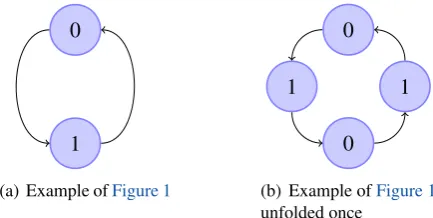
We can also define all the other tools we need. In particular, we can define an equivalence relation onGraph. Indeed, as elements of Graphare coinductive, Leibniz equality cannot be used here (it is just too fine-grained and cannot be established by coinduction), we need bisimulation. To illustrate this,Figure 4shows a situation where two graphs are not Leibniz equal while we want them to be equivalent. Indeed, those two graphs are different (graphically this is evident) but they unfold into the same infinite tree. So they actually represent the same element but have different (syntactic) representations. If one wanted to differentiate the 0 (resp. 1) nodes, one would have to use a richer type than only natural numbers.
0
1
(a) Example ofFigure 1
0
1
0 1
(b) Example ofFigure 1
unfolded once
Figure 4: Example graphs that are equivalent but not equal
To relate two elements of Graph, we need (as we did for ilist) to relate their two parts. The label part is compared through an equivalence relation R on type T. For the sons part, that is represented by an ilist, we will use the equivalence relation defined on ilist: ilist_rel (see Subsubsection 2.3.3). As the type parameter for the ilist is itself Graph, ilist_rel needs the equivalence relation on Graph as argument. So this relation must be defined coinductively. Finally, we can define the equivalence relation onGraph(let’s call itGeq) as follows (defined co-inductively):
Definition 22(Geq)
∀T R g1g2,GeqRg1g2⇔R(label g1) (label g2) ∧ ilist_relGeqR (sons g1) (sons g2)
It is possible to show thatGeqis an equivalence relation using the same style of reasoning as for ilist_rel.
Example7 (Equivalence of the graphs ofFigure 4) The graph ofFigure 4(b)can be defined in our definition ofGraphas follows:
Finite_Graph_Unfolded:=
mk_Graph0Jmk_Graph1Jmk_Graph0Jmk_Graph1JFinite_Graph_UnfoldedKKKK
Remark20 To be equivalent, two elements ofGraphhave to be constructed in the same way. Therefore, the two graphs of Figure 1andFigure 5are not equivalent even though we might wish them to be, if we disregard roots. We are working on the design of a coarser relation for this purpose.
1
0
This graph is represented by the following expression usingDefinition 20: Finite_Graph0:=mk_Graph1Jmk_Graph0JFinite_Graph0KK
Figure 5: Other representation of the graph ofFigure 1, disregarding roots
3.3 Universal Quantification onGraph
As we did withilist(seeSubsubsection 2.3.7), we define a property of universal quantification on Graph. It will be useful, in particular inSubsection 3.4. This property expresses that a predicate P:Graph T →Propon Graph is satisfied by an element g ofGraph and all its descendants (sons, sons of its sons, and so on). As Graph is co-inductive, this property must be defined co-inductively too. We call itG_alland it is defined as follows:
Definition 23(G_all) ∀P g, G_all P g⇔P g ∧ iall(G_all P) (sons g)
3.4 Finiteness ofGraph
Another interesting property onGraphis finiteness. It would be interesting for example to prove thatExample 2andExample 3indeed are respectively finite and infinite. Saying that an element gofGraphis finite means that it contains a finite number of elements ofGraph, up to bisimilarity. This can be expressed by the fact that all the elements ofGraphcontained ingcan fit into a finite list. This is the way we choose to define the finiteness of aGraph. We call the finiteness property G_finite. To define it, we need a predicate (let’s call itelement_of) to check whether an element gofGraphis included in a list of graphs. By included we mean that there is an element of the list that is related through bisimulation (GeqR for the chosenR) withg. We use∈to say that an element is in a list.
Definition 24 element_ofRl g:=∃y, y∈l ∧ GeqRg y
Thanks to it we can defineG_finite.
3.5 Proofs of Finiteness and Infiniteness
We want here to prove thatExample 2andExample 3 are respectively finite and infinite. The equivalence relation on labels used here is Leibniz equality as the labels are natural numbers. First we prove thatExample 2is finite.
Lemma 9(Finite_GraphIs Finite) G_ finiteeqFinite_Graph.
Proof (by co-induction). The proof here is quite easy. We must give a list l with all the ele-ments of Graph contained in Finite_Graph and show that they are actually all included inl. There are only two elements of Graph contained in Finite_Graph: Finite_Graph itself and mk_Graph1JFinite_GraphK. The provided list is:[Finite_Graph;mk_Graph1JFinite_GraphK].
Now, we only have to prove thatFinite_Graph is contained in the list (but it was designed for it!); that its sons are (it only has one son: mk_Graph 1JFinite_GraphK, so it is in the list) and that the sons of its son are in the list too (this isFinite_Graphitself, so we use the co-inductive hypothesis).
Similarly, we want to prove thatInfinite_Graphnis not finite.
Lemma 10(Infinite_GraphnIs Infinite) ∀n,¬G_ finiteeq Infinite_Graphn.
To prove this we prove a general lemma that we will then instantiate to say that if theGraph is finite then its labels are bounded (Lemma 12). The general lemma says that for any function f of typeGraph T →nat and for any elementgofGraph, ifg is finite then the image of the set of nodes ofgby f is bounded. Actually, to prove this lemma we need a property that says, basically, that f is a morphism, i. e., that∀g1g2,GeqRg1g2⇒ f g1= f g2. We abbreviate this propertyMorphR(f).
Lemma 11 ∀ f g,MorphR(f)∧G_ finiteRg⇒ ∃m,G_all(λg0.f g0≤m)g.
Proof. The proof here is based on a simple idea: asgis finite, there exists a listlcontaining all the nodes ofg(seeDefinition 25). Therefore, the image of the set of nodes ofgby fcan actually be represented bymap f l(possibly containing duplicates). Aslis finite,map f lalso is. What is more,map f lhas typelist nat, therefore, the values contained in it are bounded. We callmax the maximum. As all the nodes contained ingare also inl, we can show (by co-induction ong) thatG_all(λg0.f g0≤max)g.
Now, we can prove the following lemma (forT =nat):
Lemma 12 ∀g,G_ finiteeqg⇒ ∃m,G_all(λx.label x≤m)g.
Proof. This lemma is actually just an instantiation ofLemma 11with f =label. We directly have the property that∀g1g2,Geqeqg1g2⇒ f g1= f g2thanks to the definition ofGeq.
are unbounded, we show that∀m,m≥n⇒Infinite_Graphm⊆Infinite_Graphn.
Remark21 We informally use the notation⊆to say that aGraphis included in another.
With this, it is easy to show that the labels are unbounded (since the first label ofInfinite_Graphn isn).
Remark22 In a similar way, we have that if thenumber of sonsin aGraphis unbounded, then theGraphis infinite. However, it is also possible to construct elements of Graphin which the out-degree of a node is bounded and so are the labels and that are still infinite, seeFigure 6for an example. Here, the proof of infiniteness is much more difficult (it is part of [PM11]).
0 1 0 0 1 0 0 0 1 . . .
Figure 6: Example of an infinite graph with bounded number of sons and bounded labels
3.6 GraphinGraph
We will need to represent the property asserting that an elementginofGraphis (strictly) included
in another elementgout ofGraph(seeSubsection 3.7). We split the situation into two different
cases: gin is part of sons gout or gin is included in one of gout’s sons. In Coq, the following
definition is represented as an inductive property with two constructors.
Definition 26(GinG)
∀T R gingout,GinGR gingout⇔
∃i,GeqRgin(fcti(sons gout)i) or ∃i,GinGRgin(fcti(sons gout)i)
We can prove thatGinGRis transitive ifRis transitive.
3.7 Cycles inGraph
It may also be useful to define a property about the existence of a cycle in an element ofGraph. To do so, we use the propertyGinGdefined above.
First of all, we define a property saying that an elementgofGraphis itself a cycle (i. e., there is a non-empty path from the root to the root). This means thatgis itself included ing. Therefore the definition ofisCycleis straightforward.
Definition 27(isCycle) ∀T R g,isCycleRg⇔GinGR g g
element ofsons ghas a cycle. As before, in Coq this is defined through two constructors of an inductive definition.
Definition 28(hasCycle) ∀T R g,hasCycleRg⇔
isCycleRg or ∃i,hasCycleR(fcti(sons g)i)
For a finite element ofGraph, it is quite easy to prove the existence or non-existence of a cycle (for example, it is straightforward to prove thatExample 5 has a cycle). However, if there are many nodes, the proof might be long. Indeed, the proofs are constructive, that is, one will have to exhibit the cycle to prove that it exists or to look into each different path to show that there is none. This last operation may be tedious.
4
Towards Metamodel Representation
As we have explained inSection 1, our final goal is to represent metamodels and then perform transformations on these models. Until now, we only have shown graph representation. It is a first step towards metamodel representation, but metamodels have other properties that we can not represent withGraphas it is. We present here two extensions of our development that bring us closer to metamodel representation. The first one is a representation of non-connected graphs and the second one a representation of multiplicities. Another problem that arises and that is not treated here is the representation of inheritance.
4.1 A Representation of a Wider Class of Graphs
As we have said inRemark 3, the typeGraph only represents single-rooted connected graphs. However, there might be some cases where a more general graph representation could be neces-sary. For instance, a metamodel may not be connected or not single rooted. We present here a graph representation that allows to represent non-connected and non-single-rooted graphs.
The idea is to add fictitious nodes to our previous definition of Graph in order to be able to represent in only one structure non-connected graphs.
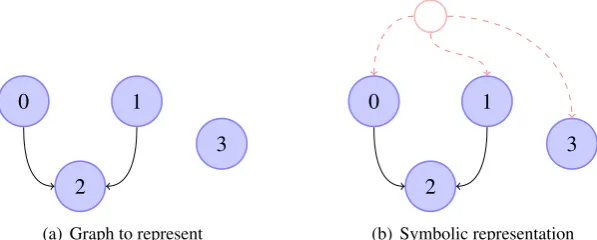
Example 8 To illustrate this, and before giving the formal definition, here is an example of what we might want to represent (Figure 7(a)) and an example of its representation with fictitious nodes (Figure 7(b)).
We are going to represent those fictitious nodes with the usual option type of functional lan-guages. When the label associated to a node is of the formSome t, the node is a “real” node (and its label ist) and when it is of the formNone, it is a fictitious node. Therefore, we see that we can actually represent this extension ofGraphas an instance ofGraph.
Definition 29(AllGraph) AllGraph T :=Graph(option T)
0 1
2
3
(a) Graph to represent
0 1
2
3
(b) Symbolic representation
Figure 7: Representation of a non-connected graph
withDefinition 29:
let g2:AllGraph nat:=mk_Graph(Some2)JKin
mk_Graph NoneJmk_Graph(Some0)Jg2K; mk_Graph(Some1)Jg2K;
mk_Graph(Some3)JKK
As we use the previous definition ofGraph to defineAllGraph, all the definitions and lemmas onGraphare still valid onAllGraph. For instance, we can useGeqto compare two elements of AllGraph, for which we typically lift the relationRonT canonically to a relation onoption T.
4.2 Multiplicity
In this section, we present an extension ofilistto represent multiplicities in metamodels repre-sentation. For this, we have extended the concept ofilistto take into account multiplicity, i. e., an interval constraint on the out-degree.
Remark 23 Here we deviate a little from the graph representation of this article. Indeed, in graphs (at least as we have represented them here), the labels of all the nodes have the same type. But in metamodel representation, this is not true. That is why we cannot useGraphin the rest of this section.
4.2.1 Presentation of the Problem on an Example
To illustrate the usefulness of multiplicities, consider the following example ofFigure 8. To represent this using the tools we currently have at our disposal, we would defineA,BandC (simultaneously) as follows (these definitions are to be interpreted co-inductively):
mk_A:ilist B→ilist C→A mk_B:C→B
mk_C:B→B→C
A
B C
∗ 1..10
1 2
Figure 8: Example of a metamodel with multiplicities
• to represent the 1..10 multiplicity of the edge A to C, we might explicitly enumerate all possibilities with increasing numbers of arguments but this is heavy for large numbers and even impossible for indeterminate bounds. Since list is not an option, we see no other good choice than usingilist. However, we lose the bounds (takingilist Cis equivalent to a multiplicity∗) and therefore, information,
• the representation is not homogeneous. Here, there are two different ways to represent an edge with multiplicity:
– anilistfor a variable multiplicity (e. g.,∗or 1..10)
– a sequence ofT →T →. . .→T for a fixed multiplicity (e. g., 2)
Hence, an extension ofilistthat allows to take into account multiplicities would solve these two issues. This is what we present now.
4.2.2 Implementation of Multiplicities
First we need a property (let’s call itPropMult) to say whether a number is between the two specified bounds of the multiplicity condition. The inferior bound (let’s call itinf) always exists (it can be 0 but always has a value). Therefore it has typenat. On the opposite, the superior bound (let’s call itsup) may not exist (multiplicity “∗”). Therefore it has type option nat(constructor Someif it exists, constructorNoneif not). The property is expressed as follows:
Definition 30(PropMult) ∀inf sup k,
[Casesup=Some s] k≥inf∧k≤s [Casesup=None] k≥inf
Thanks to this property we can refine ourilistn(that was the set of functions of typeFin n→T) to keep only the ones whosensatisfiesPropMult.
Definition 31 ilistnMult T inf sup n:={ln:ilistn T n|PropMult inf sup n}
Remark 24 Elements of ilistnMult are pairs formed by an element of ilistn and a proof of
PropMult inf sup n, hence the type is empty ifPropMult inf sup ndoes not hold.
Definition 32 ilistMult T inf sup:=Σn:nat.ilistnMult T inf sup n
We can define a relation and functions onilistMultvery much the same way as we did onilist. Therefore we do not present them here again.
We can also show that there is a bijection between ilistMult T 0 Noneand list (we do it the same manner we did for ilist, defining ilistMult2list and list2ilistMult and showing that their compositions are extensionally equal to the identity).
Remark 25 The multiplicities0 andNone are explained by the fact that a list may have no element (empty list, soinf =0) or a finite but unbounded number of elements (i. e., multiplicity “∗”, sosup=None).
Combining the lemmas about bijection between lists,ilistandilistMult, we obtain that there is a bijection betweenilist T andilistMult T 0None.
The important result is that all definitions written withilist T can be written equivalently with ilistMult T 0None. In particular, the following definition ofGraphMultis equivalent toGraph:
Definition 33(GraphMult) mk_GraphMult:T→ilistMult Graph0None→Graph
With this definition ofilistMult, the example ofFigure 8would be represented as follows (A,B andCare still defined simultaneously and co-inductively):
mk_A:ilistMult B0None→ilistMult C1(Some10)→A mk_B:ilistMult C1(Some1)→B
mk_C:ilistMult B2(Some2)→C
These definitions are homogenous and complete (no information is lost).
5
Related Work and Conclusion
The work presented here shares concerns with other work. Among them, we can cite the work by Bertot and Komendantskaya in [BK08]. In their paper they treat the problem of representing streams as functions, to overcome guardedness issues in Coq. The main difference is that we need a finite definition set (Fin n) whereas they can just usenat. Recall that our problem was with the embeddedinductivetype of lists and not the co-inductive streams. In [Dam10], Dams proposes an alternative solution to our problem in Coq. He defines everything co-inductively (so instead of lists, he has streams of sons) and then restricts what needs to be finite by a property of finiteness. In that approach, programming is done with a bigger datatype and the proofs have to be carried out for the “good” elements. In [Niq08], Niqui describes a general solution for the representation of bisimulation in Coq using category theory. However, as we tried to apply his theory, it seemed that only co-inductive embedded types could be treated (streams but not lists) with the given solution. Moreover, it did not seem possible to parameterize the bisimulation by an equivalence relation over the types of the elements.
in Agda3, another proof assistant based on predicative type theory. We studied the way guard-edness issues are addressed in Agda. Danielsson describes it in [Dan10] (see also the extended case study with Altenkirch in [DA10]). The solution used is to redefine the types (for example the types of lists) adding a constructor for each problematic function (for example,map). How-ever, this is based on a mixture of inductive and co-inductive constructors for a single datatype definition, which is not admissible in Coq and of experimental status even in Agda.
About graph representation in functional languages, we can mention the work by Erwig. [Erw01] proposes a way to represent directed graphs using inductive types, where, in the inductive step, a new node is added, together with all its edges to and from previously introduced nodes. Being "new" or "previously introduced" is not part of the inductive specification but only of a more re-fined implementation. Moreover, there is no certification of these invariants for graph algorithms, although this might be interesting future work in expressive systems such as Coq. However, the main conceptual difference to our work is that in his representation, all nodes are represented at the same level (they are more or less elements of a list) while we actually wanted, for our own needs, to build into the construction navigability through the graph, including its loops.
To conclude, in this paper, we have developed a complete solution to overcome Coq’s guarded-ness condition when mixing the inductive type of lists with co-inductive types. The Coq devel-opment corresponding to this work is available in [PM11]. This framework can be extended with new features as needed. For the results we wanted to obtain, it worked well. Clearly, it would have been easier if a more refined guardedness criterion had been available in Coq but the last ten years have shown that getting the criterion right is a quite subtle issue. Another solution would have been to use another proof assistant instead of Coq. Nevertheless, for further developments, we needed a system based on type theory. Furthermore, despite the guardedness restrictions, coinductive types in Coq are quite practical to use. They are an addition to the original CIC, hence a part of the kernel. As such, they are subject to discussion about justification and opti-mization, and there is quite some on-going scientific work around them in the Coq community. However, we would now be interested in a more general solution to overcome the guardedness condition with any embedded inductive type (not only lists). But we realized that to do so, we needed to be more abstract. In particular, we think that we could draw inspiration from category theory. The work by Niqui in [Niq08] might be a good start.
Moreover, the work we present has to be seen as part of a larger project where we are interested in a co-inductive representation of metamodels (seeSubsection 4.2). We have solved the problem of multiplicity and non-connected graphs but the problem of inheritance/subtyping remains. This is difficult since we look for an extensible way to represent metamodels (they may vary over time). Poernomo’s work on type theory for metamodels in [Poe08] is relevant here. The work by Boulmé on FOCAL [Bou00] that has been realized with Coq, will probably help in treating the inheritance problem. Finally, and still within the aim of representing metamodels, we are working on the design of a more liberal equivalence relation onGraph.
Acknowledgements: This development was initiated by the original idea of Jean-Paul Bode-veix to useilist to overcome the guardedness condition. We are grateful for several interesting suggestions by Silvano Dal Zilio and for the careful reading of a preliminary version by Martin
Strecker. We are grateful for the feedback we got for the preliminary version presented at the workshop GCM’10 [PM10].
Bibliography
[Alt93] T. Altenkirch. A Formalization of the Strong Normalization Proof for System F in LEGO. In Bezem and Groote (eds.), Typed Lambda Calculi and Applications, Inter-national Conference, TLCA 1993. Lecture Notes in Computer Science 664, pp. 13–28. Springer, 1993.
[BDd09] S. Berardi, F. Damiani, U. de’Liguoro (eds.).Types for Proofs and Programs, Interna-tional Conference, TYPES 2008, Torino, Italy, March 26-29, 2008, Revised Selected Papers. Lecture Notes in Computer Science 5497. Springer, 2009.
[Bir01] R. S. Bird. Maximum marking problems.J. Funct. Program.11(4):411–424, 2001.
[BK08] Y. Bertot, E. Komendantskaya. Using Structural Recursion for Corecursion. Pp. 220– 236 in [BDd09].
[Bou00] S. Boulmé. Specifying in Coq inheritance used in Computer Algebra. Research report, LIP6, 2000. Available onwww.lip6.fr/reports/lip6.2000.013.html.
[Chl10] A. Chlipala. Posting to Coq club in the thread “Is Coq being too conservative?”. January 2010.
http://logical.saclay.inria.fr/coq-puma/messages/d71fd3954d860d42# msg-285229ea3f28adef
[Coq93] T. Coquand. Infinite Objects in Type Theory. In Barendregt and Nipkow (eds.),Types for Proofs and Programs, International Conference, TYPES 1993. Lecture Notes in Computer Science 806, pp. 62–78. Springer, 1993.
[DA10] N. A. Danielsson, T. Altenkirch. Subtyping, Declaratively. In Bolduc et al. (eds.), Mathematics of Program Construction (MPC’10). Lecture Notes in Computer Sci-ence 6120, pp. 100–118. Springer, 2010.
[Dam10] C. Dams. Posting to Coq club in the thread “Is Coq being too conservative?”. January 2010.
http://logical.saclay.inria.fr/coq-puma/messages/d71fd3954d860d42# msg-7946fd74eb4de604
[Dan10] N. A. Danielsson. Beating the Productivity Checker Using Embedded Languages. In Bove et al. (eds.), Proceedings Workshop on Partiality and Recursion in Interactive Theorem Provers. EPTCS 43, pp. 29–48. 2010.
[GC07] E. Giménez, P. Castéran. A Tutorial on [Co-]Inductive Types in Coq. 2007. www.labri.fr/perso/casteran/RecTutorial.pdf
[MM04] C. McBride, J. McKinna. The view from the left.J. Funct. Program.14(1):69–111, 2004.
[Niq08] M. Niqui. Coalgebraic Reasoning in Coq: Bisimulation and the lambda-Coiteration Scheme. Pp. 272–288 in [BDd09].
[PM10] C. Picard, R. Matthes. Coinductive graph representation: the problem of embedded lists. In Echahed et al. (eds.),GCM 2010, The Third International Workshop on Graph Computation Models. Pp. 133–147. 2010. Online available at the workshop’s website http://gcm2010.imag.fr/.
[PM11] C. Picard, R. Matthes. Formalization in Coq for this article. 2011.www.irit.fr/~Celia. Picard/Coq/Coind_Graph/.
[Poe08] I. Poernomo. Proofs-as-Model-Transformations. In Vallecillo et al. (eds.), Interna-tional Conference on Model Transformation, ICMT 2008. Lecture Notes in Computer Science 5063, pp. 214–228. Springer, 2008.
![Figure 3: Representation of the function corresponding to the list [10 ; 2 ; 5]](https://thumb-us.123doks.com/thumbv2/123dok_us/7807804.2085439/5.595.203.393.625.698/figure-representation-function-corresponding-list.webp)