Research Article
a
December
2017
Computer Science and Software Engineering
ISSN: 2277-128X (Volume-7, Issue-12)
Problem Resolution and Operational Resource to Optimize
Resource Allocation
Marwane Smaiti, Dr. Mostafa Hanoune
Université Hassan II, Faculté Des Sciences Ben M'Sik, BP 7955 Casablanca, Morocco
Abstract— The distribution of resources is a key to the success of a given production process and its maintenance. Indeed, companies can gain a decisive and immediate competitive advantage. We aim to model the allocation of resources in a power type production unit proposing improvements at a later stage. A model: workers, resources, tasks will be adopted as part of our model. Once developed, this model can be the starting point for further optimization efforts for the entire value chain component of any production process. CAPEX: Reduction of operating costs by dynamic elimination of losses. To our previous efforts, we add a problem resolution framework rendering it easier for the user to identify resource importance and resource leakage.
Keywords-allocation, ressources, production unit, optimization of resources, RocDel.
I. INTRODUCTION
The allocation of resources is of paramount importance in the production process. Resources are intrinsically limited. Therefore, their distribution needs to be optimized in order to meet the following challenges :
1. Minimize capital expenditure gold Capital expense, CAPEX) [1,2].
2. Optimize permanent (non-depreciable) expenses in terms of variable cost of production (operating expense, Operating expenditure, Operational expense, Operational expenditure gold Opex) [3,4,5]. 3. Improve performance in terms of HSE (Health, Safety and Environment) [6,7]
In this work, we focus on modeling the allocation of resources in a typical production unit. The objective of this paper is to maximize production by considering the following model : a given number of workers, use a given number of resources, in order to be able to perform a given number of tasks. Tasks can vary from production to maintenance or support functions. Our goal is to introduce the novice user to a problem of optimizing limited resources by using the standard tools of operations research in a simple and comprehensive approach. The experienced reader is endowed throughout this report with a manageable interactive tool that can be made even more sophisticated by increasing the number of variables and variabilities. It should be noted that a considerable effort has been made so that mathematicians and interested parties far from the field of the studied application can find in our work a scientific matter formulated in a simple way. Experts from production units may object to the validity of a number of assumptions. We invite them to contact the authors.
II. PRESENTATION OF THE MODELS
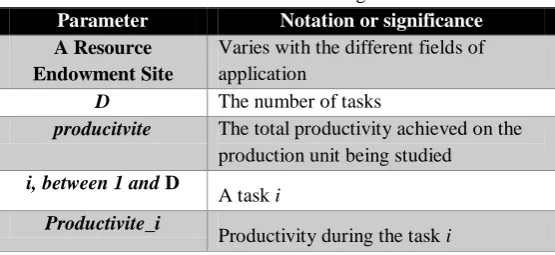
We perform the optimization on the interval of a work station (between 8hr and 12hr) and summarize the parameters used in our approach, as well as their notation in Table 1 :
Table 1: Les variables et leur signification.
Parameter Notation or significance
A Resource Endowment Site
Varies with the different fields of application
D The number of tasks
producitvite The total productivity achieved on the production unit being studied
i, between 1 and D
A task i
Productivite_i
ISSN(E): 2277-128X, ISSN(P): 2277-6451, pp. 5-10 M The number of resources in the
production unit being studied.
j, between 1 and M A Resource Endowment Site j N_ij The number of workers assigned
between the place of performance of the task i and the resource endowment j l, between 1 and n_ij Worker l Assigned between the task
place i and the resource endowment location j.
C_l Capacity in terms of worker l
productivity
N_ijl The productivity achieved by the worker l which is assigned the place of
performance of the task i and the resource endowment j.
C_ijl The cycle carried out by the worker l, Which is assigned the place of performance of the task i and the resource endowment j .
D_ijl The distance traveled (it is possible to include the various difficulties to be overcome in order to be able to carry out
a given task [8,9]) by the worker l The place where the task was carried out i and the resource endowment j.
T_p Duration of the workstation (typically 8hr for three shifts per day, or 12hrs for two shifts per day)
v Mean velocity (one can include the
operative efficiency [10,11,12]) of the workers in the production unit studied
III. OBJECTIVE OF OPTIMIZATION
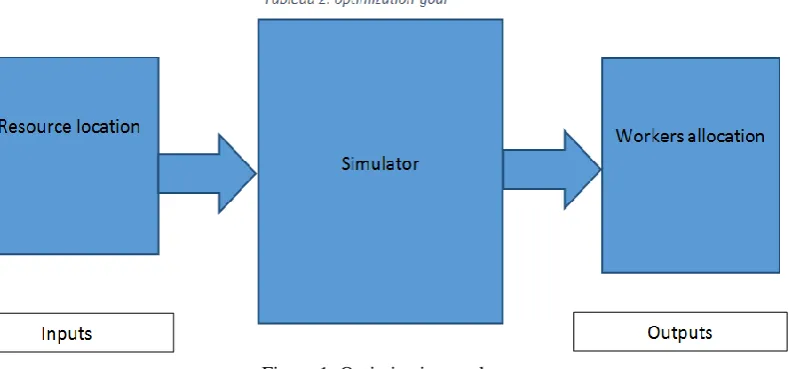
The optimization routine takes as input the places where the tasks are performed, the places where resources are endowed, and the workers with their characteristics, and aims to give as output the optimal assignment. It should be noted that our approach will allow an exchange between unknowns and parameters according to the need of the user: this is outside the perimeter of the report [13,14,15].
We illustrate the approach as follows :
ISSN(E): 2277-128X, ISSN(P): 2277-6451, pp. 5-10
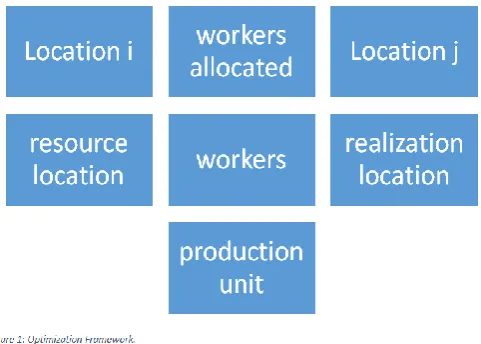
We schematize the optimization problem in question as follows :
Figure 2: Actors in the model
IV. FORMULATION
In the discussion cited above, we explained that our objective is to maximize the function productivity which can be represented as following:
Where:
n: Number of tasks.
The producitivite_i associated with the place of performance of tasks i, comes from all resource endowment sites j. Moreover, between the place where tasks are carried out i and a place for performing tasks j performed by the affected workers. Each worker between a given place of performance of tasks and a place of realization of tasks carried a total number of tasks and has a given capacity. Therefore, producitivite_i can be written as follows:
The number of tasks carried out by the worker l, which is assigned between the place where tasks are carried out and the place where tasks are carried out, can be written according to the cycle as follows :
In addition, the cycle of the said worker, can also be written as follows :
Thus, the “producitivite” in question can be written as follows :
In the end, our objective producivity can be written as follows :
V. IMPLEMENTATION (ROCDEL) : PHENOMENOLOGIC PROCEDURE
ISSN(E): 2277-128X, ISSN(P): 2277-6451, pp. 5-10 A. The industry strategy is divided into two components: Strategic, and Tactical.
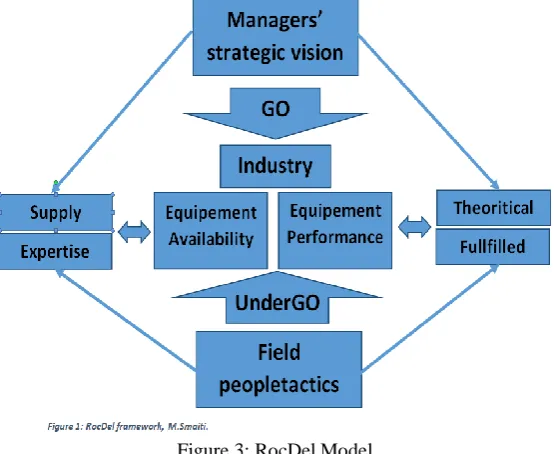
a. The Strategic side is based on top management decisions. In the field, people “do not have the hand on” top managers’ thoughts. They have to “UnderGO”. Another aspect of RocDel I am currently developing focuses on how to make of the framework a tool to assist top managers: how senior and top managers can avoid being disconnected from what is happening in the field (I think this is a challenge most managers face)? How they can trigger profitable initiatives based on actually happening facts? How the hierarchy can play innovative roles other than tell superiors what subordinates are doing (this traditional process accuracy is subjective and subject to several uncertainties)? This is a cultural dilemma which I call: Manager Field Awareness versus Operator
Hierarchy Rule Recognition. How can we marry operators’ skills and managers’ vision?
b. The Tactical side is mostly controlled by field people (RocDel Field people = Production + Maintenance teams. The current version of RocDel neglects support functions: this is another area of improvement for future work). Here we are talking about daily operations’ management. For instance, we try to bring grounded answers to the following questions: how can we adapt maintenance schedule to match production objectives? How to ensure the neuralgic machines availability during production peaks? How to plan long-term maintenance operations during low-production seasons? In a word, how to get the maintenance involved in production to ensure equipment quality, and how production teams can get the best performance of an available equipment [16,17,18].
In this component, several issues are discussed: spare parts supply, equipment stoppage schedule, performance forecast and monitoring, and technical expertise evaluation.
B. RocDel models the activity as follows: Result = Availability x Performance. The availability is computed in terms of the working hours (typically 6500 hours per year per equipment), and the performance is measured in terms of Result per hour (tones per hour, meters per hour, liters per hour, and times per hour). Availability is utilized to monitor maintenance and Performance to monitor production. I assert the following points are the heart of success of any industrial activity:
i. For how long are you performing?
ii. When you perform, how is your performance?
iii. How can your operators suggest ways to improve their performance?
We present a simplified version of RocDel as follows:
Figure 3: RocDel Model
A question one can ask here: how can operators evaluate their performance (auto-evaluation)? Here comes the rule of field managers to set goals and interactively challenge what has been done. To answer this question, it is recommended to use modeling to estimate the objectives that have to be targeted. For instance, the RocDel framework has been utilized in a minning context, and field people have used Matlab to calculate objectives. We are not allowed to show data, however, we present some success results after employing the RocDel framework:
ISSN(E): 2277-128X, ISSN(P): 2277-6451, pp. 5-10
ii. The cost reduction is made a continuous process since the framework, besides being user-friendly, is interactive and dynamic: a field operator can improve it.
iii. There was no additional investiment on OPEX.
iv. The investment in CAPEX was maintained to 7% of the previous year OPEX.
The overall outcome of RocDel can be represented as follows:
Figure 4: RocDel roles.
VI. PROBLEM RESOLUTION FRAMEWORK
In this section, we aim to guide the user to identify the possible issues within its organization in terms of leakage and sub-optimal resource allocation. This step can be viewed in one of the following ways:
i. A preliminary step to identify problems before applying the above-explained framework ii. A final step to validate the findings of the modeling and deal with any not-considered problems.
The framework can be detailed as followed:
Figure 5: RocDel preparation/validation
VII. CONCLUSION
In this work, we successfully modeled the ressources allocation in a typical production unit. This acheivement can have the following uses:
- Reduce costs by eliminating leaks and losses. - Easily evaluate workers on quantifiable basis. - Develop software to solve the optimization problem.
- Automatically allocate resources in a ressource-short environment.
In future work, we aim to implement our method in user-friendly software and apply it to real data. Preliminary results have shown a significant reduction of OPEX without a need to heavy investment in CAPEX.
ISSN(E): 2277-128X, ISSN(P): 2277-6451, pp. 5-10
REFERENCES
[1] "capital expenditure (CAPEX)". BusinessDictionary. Retrieved 11 July 2017.
[2] "What is a Capital Expenditure (CAPEX)?". My Accounting Course. Retrieved 11 July 2017.
[3] Harry I. Wolk, James L. Dodd, Michael G. Tearney. Accounting Theory: Conceptual Issues in a Political and Economic Environment (2004). ISBN 0-324-18623-1.
[4] Angelico A. Groppelli, Ehsan Nikbakht. Finance (2000). ISBN 0-7641-1275-9.
[5] Barry J. Epstein, Eva K. Jermakowicz. Interpretation and Application of International Financial Reporting Standards (2007). ISBN 978-0-471-79823-1.
[6] Stephan, Constantin (2012), Industrial Health, Safety and Environmental Management, epubli, Berlin, 3rd edition 2012, ISBN 978-3-7418-7478-9
[7] "Environmental Leader Is Your Source For Energy, Environmental & Sustainability News". Environmental Leader.
[8] Fehlauer, R., Die Sicherheitsanalyse, ein Merkbuch zu ihrer Durchführung {L'analyse de la sécurité du travail, manuel pratique). Édit. : Hüttenwerk Salzgitter AG.
[9] lndustriegewerkschaft Metall für die Bundesrepublik Deutschland {Syndicat industriel des métallurgistes de la République fédérale allemande) : Sicherheitsanalyse {L'analyse de la sécurité du travail), numéro 6, Schriftenreihe Arbeitssicherheit, Francfort-sur-le-Main. Pas d'indication d'année.
[10] Nutzhorn, H., RKW Leitfaden der Arbeitsanalyse {Principes de l'analyse du travail), Édit. : Rationalisierungskuratorium der deutschen Wirtschaft, Bad Harzburg, Francfort-sur-le-Main, 1964.
[11] Rijksarbeidsbureau, Handleiding voor de Functieanalyse {Manuel de l'analyse des fonctions), Handboek van het Rijksarbeidsbureau, La Haye, 1954.
[12] Trilling, L. (2006). Aide `a la d´ecision pour le dimensionnement et le pilotage de ressources humaines mutualis´ees en milieu hospitalier. PhD thesis, INSA de Lyon.
[13] Val´erio de Carvalho, J. (1999). Exact solution of bin-packing problems using column generation and branch-and-bound. Annals of Operations Research, 86 :629–659.
[14] Krichen, S. and Dahmani, N. (2010). A particle swarm optimization approach for the biobjective load balancing problem. Electronic Notes in Discrete Mathematics, 36 :751– 758.
[15] Labed, S., Gherboudj, A., and Chikhi, S. (2012). A modified hybrid particle swarm optimization algorithm for solving the travelling salesmen problem. Journal of Theoretical and Applied Information Technology, 39(2) :132–138.
[16] Mallo y Merlo, “Control de gestión y control presupuestario” Mc Graw Hill, Madrid 1995.
[17] Mallo, C, Kaplan, R, Melgem,S y Gimenez, C, “Contabilidad de costos y estratégica de gestión”, Prentice Hall, Madrid, 2000.
[18] Saez Torrecilla, Fernandez Fernandez, Gutierrez Díaz, “Contabilidad de Costes y Contabilidad de Gestión” Mc Graw Hill, Madrid 1996.
[19] Shank, J y Govindarajan, V, “Gerencia estratégica de costos” Editorial Norma, Barcelona, 1995 - Smolje, A. y otro, “Outsourcing: Herramienta para el análisis económico y estratégico” Revista Costos y Gestión, Año VII, nº 25.