International Journal of Advances in Social Science and Humanities
Available Online at: www.ijassh.com
REVIEW ARTICLE
The Talent Management Strategies
Hanady Al-Zagheer
Associate Professor, Head of management information systems Department, Applied Science private University, Amman, Jordan.
Abstract
The development of management and business in recent years has developed new concepts, terminology, managerial and organizational concepts in the field of human resources, human capital, management and planning of resources and managerial talent. One of the most important new concepts is the concept or term of Talent Management. The selection and recruitment process began with the development of management in general and the management of individuals or the management of human resources, which varied and diversified in terms of diversity and multiple functions, objectives and methods, Finally, attention has grown that focus on the concept of attention to abilities, talents and effective skills in human resources, so this paper mention the important of the talent management strategy and programs in HR which aim to develop the culture of talent focus as a source of competition and to provide these resources with the help of employees to achieve their best abilities and talents, talent management strategy also help businesses to respond to challenges, enter new markets and move forward for competition and competition.
Keywords:Human Resource Management, Talent Management, Business Environment, Strategy.
Introduction
The contemporary world is rapidly changing both economically and commercially At the technological and cognitive level, the rapid and startling development It is known and defined by communications and the Internet and its uses in various economic fields was the result of globalization and, In this ruthless situation, a fundamental question arises to self-absorbed and sunken business organizations affected by a non-economic environment, the appropriateness of relying on human resources to turn the situation and enter the arena of conflict in its broadest.
Human resources are therefore an important element in reaching the goals and objectives ,Its importance lies in its effective role in raising the efficiency of the Organization's governance and their effectiveness in the performance of their functions and activities as a final outcome of efficiency and effectiveness , The organization itself and its ability to excel and compete internally and externally All this is achieved if the polarization, selection and appointment are better Competent competencies are qualified
and trained and then carefully planned and taken care of Maintain and maintain them, and establish a fair system of salaries and bonuses ,Incentives and adoption of objectivity in promotion decisions in accordance with fair considerations and standards For all and a degree of transparency.
Human resources management plays an important role in meeting the requirements for excellence this has given human resources management special importance and vitality which has changed its nature and operations, The development of information technology has led to an increase in the demand for technical professions, which requires a different qualification.
Traditional for leading positions in information management as well as the need to introduce modern technology and rely on them in the activities and functions of
human resources management from
played by human resources management is clear Organizations to provide the necessary
manpower with competence and
specialization Perform many tasks and responsibilities such as planning, attracting and training
Put standards for fair wages, bonuses and incentives.
Human Resources Management
Human resources management is defined as all selection and training procedures and policies, Workers and their treatment at all levels and work to organize the workforce within the enterprise, increase its confidence in the administration's fairness and the creation of a cooperative spirit among them and to reach the highest level of the institution Human productivity. There are many other definitions. Through these definitions, we have several levels of human resource management:
Human resources management as a practice and activity.
Human resources management as a profession.
Human resources management as an administrative unit in the organization. Human resources management as a field of
law.
The importance of human resources management stems from the fact that they play a major Role in the development and implementation of plans. The strategy should be integrated with the overall strategy Of the Organization and other functional strategies. , In a study prepared by Huselid in [1], it was found that the strategy of human resources management was played essential role to improve the performance of the companies studied through:
Improving the quality of employees' performance.
Reduce production costs.
Improve customer service and customers. High customer satisfaction.
High productivity. Talent Management
Talent is a distinctive force for the
management and leadership of the
organization, which gives it an edge of excellence and leadership dealing with the
opportunities, risks and challenges of its current and future environment. Although talent is special Human resources are managers, leaders and subordinates, but they are reflected within the fabric of the organization's culture and their cognitive structure. Talent holds an inherent and inherited aspect of strategic learning,
Organizational and administrative, a
capacity and capacity to grow and expand with the attraction of human resources to the organization, General, specialized and
self-training programs contribute to
development events.
The term was first used by Watkins in 1998, in an article published the same year. The concept, concept and process of talent management in the 1990s, which was adapted and used by many companies, were discovered. And that it should be the center of operations, which leads the business to success and profit. Many international companies have been ambitious to plan and develop their human resources and talents, and developed the concept of its operations and methods in managing the resources and talents of its employees.
Talent management could also define as a set of processes that seek to formulate a strategy that focuses on planning and mobilizing the immediate and future needs of the organization and identifying the level and quality of the talents currently available in the organization at all organizational levels to develop and enrich their knowledge
by adopting objective criteria and
sustainable development programs on the one hand And work to maintain and retain talented people by providing them with
favorable conditions and encouraging
incentives to support and manage their careers.
Talent management is the implementation of integrated strategies or systems designed to improve the recruitment and development of people and retain the required skills and readiness to meet current and future organizational needs.
Talent Management Strategy
strategies of dealing with talent management in organizations in the modern era, which is the responsibility of human resources management in providing all sections, units and departments of the company to achieve the strategic objectives of the Organization as a whole, including the following:
Attraction Talent Strategy
The Talent Attraction Strategy is based on attracting the most talented individuals (those who can achieve the company's
strategy, possess the appropriate
competencies and abilities, and are suitable for the culture and nature of the company) to be most suited to the current and future employment needs and who are capable of adaptation, and high productivity within the company.
This strategy in organizations has become one of the key features of organizational capacity-building for continuous competitive advantage. Therefore, the company must invest in resources that can be attracted, used, maintained and developed because they are considered talented and have a good competitive advantage.
Attracting external talent depends on the values of the company and the vision of potential employees of the organization; the brand is also one of the most important things that can attract external talent easily. It is clear that all talent seeks growth and progress; looking for reputable companies, and hiring the right people require strategic thinking for human resources. The formulation of special and smart conditions for choosing real talent differs from the normal conditions of regular employment.
Development Talent Strategy
In order to achieve high potential in organizations, it requires the achievement of talent potential. The potential of talent is to attract and recruit these talents in the company with further development of their abilities, abilities, skills and knowledge
through continuous education plans
(courses, conferences and seminars). To develop talent, organizations need both formal and informal learning and education programs, as well as skills and knowledge.
Talent development depends on
performance, perception or behavior
variables. It is therefore necessary to rely on a strategy to constantly develop talent to
achieve high levels of performance
commensurate with the potential of the job to be filled, knowledge of gaps in the knowledge possessed by the incumbent, and implementing initiatives to enhance and retain competencies.
Despite the company's development,
training, qualification and evaluation programs, most talented individuals are still
unknown or not disclosed within
organizations; organizations therefore need to implement effective development and evaluation strategies that can lead to identifying opportunities as the key element in talent management to achieve Mission. Retaining Talent Strategy
The strategies to attract and retain talent are the basic necessities of talent management and that these talents must be trained and developed to create the feeling that the leaders of the company give them sufficient care to achieve loyalty and commitment to work and therefore does not stop the company with great attention to the subject of retention is a result, Direct return from investing in talent, many of the international organizations in developed countries rely on strategies to retain talent and develop either to stimulate their passion, such as Brazil, France and the Netherlands, including the application of the law firmly with the confidence and respect such as Japan, and it depends on the performance evaluation procedures such as Italy, and depends on the satisfaction of talent and methods of motivation and benefits provided to them such as retirement and long-term replacement methods as in Canada.
Sequencing Talent Strategy
There are different views on how to plan for career change, but all have common roots. Some consider succession or replacement planning as a team of senior staff is selected for the next period, while others see it as planning to provide a large base of appropriate talent used by the company to recruit within Company. While suggested that career replacement strategy is limited
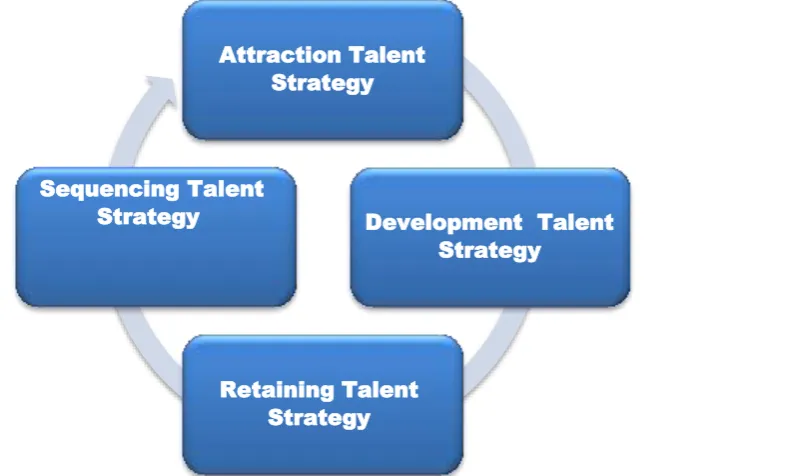
to developing And the classification of the internal workforce which has high potential and is a vital source of some of the positions or leadership positions in the company, and gives the real opportunity to fill the basic positions with talented staff with the abilities and skills and knowledge necessary to perform these functions, the Talent strategies illustrated in figure (1).
Figure 1: Talent Management Strategies
The Organization the Role in Retaining Talent
The senior management of human resources development develops plans, initiatives, and processes through the adoption of the system and the provision of the required resources, the following are major considerations role of the organization in retaining talents:
Determine the strategic directions of the company to extract the capabilities and skills needed by the company in the period between 2017 and 2022.
There should be clear descriptions of the functions of the leaders, updated from time to time according to what is expected of those leaders to reach results.
The capacity development programs should include programs for preparing and qualifying the company's members for leadership positions.
There should be external training grants for advanced countries that specialize in
training the company's leaders in the technical and strategic leadership and in order to prepare them to occupy leadership positions.
There should be setting strategic objectives for selecting, attracting and developing leaders.
Develop a good system to stimulate the outstanding competencies of the company members and administrators.
Establish a department that will be
responsible for following up the
performance of the company's talents. Allocate of part of the company's budget
for the care and development of distinguished competencies.
Stand on the level of satisfaction of candidates for jobs to lead periodically. There is a good system to follow up
performance levels at the level of scientific and administrative departments.
Attraction Talent Strategy
Development Talent Strategy
Retaining Talent Strategy Sequencing Talent
There is a clear and advertised system for the promotion of higher jobs according to outstanding performance standards.
Continuous self-evaluation of performance and identification of aspects characterized by outstanding performance.
Conclusion
Human resources contribute significantly to the improvement of management systems in general, when the administrative problems facing organizations are exacerbated, and the strategic direction of human resources Is to make long-term decisions on system staff at all organizational levels, Where the direction of management is under the umbrella of the senior management of the organization, which reflects the general trend to achieve its strategic objectives (long term) and achieve excellence through its
human resources Which contribute to its efforts in organizing the work and activities of the Organization.
Organizations of all types, especially those with high technology, need to update their human resources-related practices and strategies on an ongoing basis because of their importance in achieving High performance levels and thus excellence compared to competitors of operating companies In the same sector, which requires organizations to recognize the nature of HR practices and what these practices can affect institutional excellence, so this paper highlight the difference between human resources management and talent management and suggested the strategies to handle with talent staff in organizations [1-23].
References
1 Huselid MA (1991) The impact of human resource management practices on turnover, productivity, and corporate financial performance", Academy of Management Journal, 38:635-72.
2 AY Areiqat, T Abdelhadi, HA Al-Tarawneh , Interdisciplinary Journal of Contemporary Research in Business 2 (2):329-341.
3 Aswathappa, K, (2002), Human resource management.3th edition, New York U.S.A.: Tata McGraw-Hill Publishing Company. 4 Bae J, Lawler JJ (2000) Organizational and
HRM strategies in Korea: impact on firm performance in an emerging economy, Academy of Management Journal, 43:502-17. 5 Baker, David (1999) Strategic human resource
management: performance, alignment, management", Librarian Career Development, 7(5):51-63.
6 Boxall P, Purcell J (2000) Strategic human resource management: where have we come from and where should we be going?" International Journal of Management Reviews, 2(2):183-203.
7 Byars L, Rue L (2006) Human resource management. 8th edition, New York U.S.A. McGraw-Hill.
8 Byham William (2003) Developing dimension/competency-based human resource systems", development dimensions internatonal, p.1-33.
9 Chang, W, Huang T (2005) Relationship between strategic human resource
management and firm performance", international journal of manpower, 26(5):434-449.
10 Dubois D, Rothwell W (2004),competency-based human resource management, Davies-black publishing,U.S.A
11 French Wendell (2003) Human resource management", 5th edition, Houghton Mifflin company, USA.
12 Hussain Z, Wallace J, Cornelius (2006) The use and impact of human resource information systems on human resource management professionals", science direct information and maanhgemt, 44:74-89.
13 Ivancevich, John (2001) Human resource management", 8th edition, McGraw-Hill Irwin, USA.
14 Lawler EE, Mohrman, SA " HR as a strategic partner: what does it take to make it happen?"Human Resource Planning 26(3):15-29.
15 Macmillan D, Tampoe M (2005) Strategic Management Process, Content,And Implementation. Great Britain: Oxford University Press.
16 Patterson S (2002) Lack of money, staff and time: toughest part of managing HRIS", Human Resource Department Management Report, 2(12):3-5.
18 Huselid Mark A (1995) The Impact of Human Resource Management Practices on Turnover, Productivity, and Corporate Financial Performance.” Academy of Management Journal, 38(3):635–672. 20.
19 Kim Jungin (2010) Strategic Human Resource Practices: Introducing Alternatives for Organizational Performance Improvement in the Public Sector”, Public Administration Review.