ISSN-L: 2501 - 1235 Available on-line at: www.oapub.org/edu
Copyright © The Author(s). All Rights Reserved. doi: 10.5281/zenodo.2428054 Volume 5 │ Issue 2 │ 2018
THE EFFECT OF 8-WEEK EXERCISE PROGRAM
ON SOME HEMATOLOGICAL PARAMETERS
IN OBESE CHILDREN
Serkan Pancari,
Onur Tokgöz, Hüseyin Topçu
Uludag University, Faculty of Sport Sciences, Bursa, Turkey
Abstract:
The aim of this study was to investigate the effects of eight weeks exercise program on some hematological parameters in obese and overweight children. A total of 44 boys aged 14-16 were included in the study. The obese group was divided into two groups as 22, and overweight group 22. Body mass index (BMI) values were used to determine obesity in the formation of groups. The children who participated in the study were selected activities according to the branches which lasted 60 minutes in 3 days a week for 3 weeks and the walking program was increased. Blood samples taken at rest and at the end of the study; WBC (leukocyte), RBC (erythrocyte), hemoglobin (HGB), hematocrit (HCT), platelet (PLT), mean platelet volume (MPV) and platelet distribution width (PDW) levels were analyzed. SPSS 22.0 statistical program (SPSS Inc., Chicago, Illinois, USA) was used for the statistical analysis of the data. Independent Samples T test for comparison of binary groups; Paired Samples T tests were used to analyze the difference between pre-test and post-test groups. At the end of the exercise, statistically significant differences were found in body weight, MCV, MPV and PDW values between the pre-test and post-test of the measured values of obese subjects (p <0.05). The body weight, BMI, RBC, HGB, HCT, MPV and PDW values of the overweight group were statistically significant (p<0.05). There was no significant difference between the groups in obese and overweight groups (p>0.05). As a result, it can be said that the obese and overweight group caused changes in hematological parameters and the overweight group was more likely to be affected by the exercise than the obese group.
Keywords: effect of 8-week exercise program, hematological parameters, obese children
1. Introduction
Obesity, which is a health problem worldwide, has an epidemic effect also affects the age group of children (WHO, 2000). It is well known that obesity is associated with many diseases in the short and long term and in the majority of adult obese patients, the onset of this condition extends to childhood (Mo-suwan et al. 2000). Physical inactivity is the most important reason for the development of obesity. Conducting jobs with less energy in modern societies, especially spending more time in front of television in the childhood causes the body to accumulate this energy, which it cannot use. As the human organism remains stationary, its physical activity capacity is reduced and it loses its fitness. The muscles are weakened and the function of the joints is reduced and the obesity starts with weight gain due to insufficient use of energy sources (Taras at al., 1989; Buchowski at al. 1996).
Physical activity is an important function of living systems and affects many systems simultaneously (Yılmaz at al., 2016; Mahmood at al. 2017; Pancar at al. 2016; Özer at al, 2017; Pancar at al. 2018). Many systems are affected by exercise diversity and practices (Özdal 2015; Özdal, 2016), also affect biochemical parameters (Gencer at al. 2018; Çınar at al. 2017; Çınar at al. 2017; Selçuk at al. 2018; Pancar at al, 2017; Pancar at al, 2018). It is also known that biochemical levels vary depending on the type, severity and duration of the exercise (Akmakçı and Pulur, 2008; Pancar at al. 2018). In addition to these, the importance of childhood is emphasized in many studies and it has been suggested to be done in every age group to individuals with activity play form (Pancar at al, 2017; Alıncak, 2016; Alıncak at al. 2016; Alıncak, 2017; Bilgiç at al. 2016).
2. Materials and Methods
2.1 Selection of Subjects
The study included 44 boys, between the ages of 14-16, divided into two groups: one an obese group consisting of 22 boys, and the other, an overweight group also consisting of 22 boys. In order to determine obesity and to form the groups, Body Mass Index (BMI), which is calculated by dividing the individual’s body weight (kg) by the square of his height (m) (BMI=kg/m2), was used. The subjects participating in the study were informed about the physical activity program and the laboratory tests that would be performed. Informed consent forms and written confirmation for participation in the study were obtained from the parents of the children that were included in the study.
2.2. Experimental Design
(erythrocytes), HGB (hemoglobin), HCT (hematocrit), PLT (platelet), MPV (mean platelet volume) and PDW (platelet distribution width) levels were determined.
2.3. Procedure
The children who participated in the study were included in a three-day-a-week program for 8 weeks. This consisted of 60 minutes of selected sports games and a walk that gradually increased in duration. The physical activity program was prepared by considering the age and condition of children to achieve a heart rate during vigorous activity of between120-140 (Pancar, 2018).
1.day 2.day 3.day
1.week 30 min. walk 45 min. walk 60 min. walk
2.week 30 min. walk 45 min. walk 60 min. walk
3.week 15 min. warming/ 15 dk basketball
15 min. warming/ 20 dk basketball
15 min. warming/ 25 dk basketball
4.week 15 min. warming/ 15 dk basketball
15 min. warming/ 20 dk basketball
15 min. warming/ 25 dk basketball
5.week 15 min. warming/ 30 dk football
15 min. warming/ 5 dk football
15 min. warming/ 60 dk football
6.week 15 min. warming/ 30 dk football
15 min. warming/ 5 dk football
15 min. warming/ 60 dk football
7.week 45 min. walk 60 min. walk 75 min. walk
8.week 45 min. walk 60 min. walk 75 min. walk
2.4. Blood Testing Procedure
Venous fasting blood samples from the right arm were obtained from the children that participated in the study between 9:00-10:30 am at the Central Laboratory of the pediatric hospital, one day before and one day after the eight -week physical activity program.
2.5. Statistical Analysis
Statistical analysis of the data obtained in the study was performed using SPSS package program SPSS 22.0 statistics software (SPSS Inc., Chicago, Illinois, USA). The Independent Samples T test was used to compare the two groups and the Paired Samples T test was used to analyze the difference between the pre-tests and post-tests of the groups.
3. Results
Table 1: Analysis of the values measured in obese subjects (n=22) between pre and post-tests
Mean Std. Dev. t p
Weight Pre-test 79,47 9,636 8,216 0,001
Post-test 76,55 8,993
BMI Pre-test 28,75 2,147 1,325 0,212
Post-test 27,85 3,154
WBC Pre-test 7,642 1,721 0,075 0,942
Post-test 7,599 2,404
RBC Pre-test 4,972 ,9271 0,132 0,898
Post-test 4,936 ,4108
HGB Pre-test 13,28 ,8980 0,987 0,345
Post-test 13,86 1,700
HCT Pre-test 39,86 7,391 -0,883 0,396
Post-test 41,74 2,929
MCV Pre-test 80,48 5,908 -3,557 0,004
Post-test 84,46 7,361
PLT Pre-test 276,7 74,87 -1,202 0,255
Post-test 303,3 82,41
MPV Pre-test 9,450 1,108 5,100 0,001
Post-test 7,343 1,329
PDW Pre-test 14,62 5,376 -2,440 0,033
Post-test 18,27 4,274
When the pre-test and post-test values of obese children were examined, it was determined that the exercise program changed the body weight, MCV, MPV and PDW values and it was statistically significant (p<0.05).
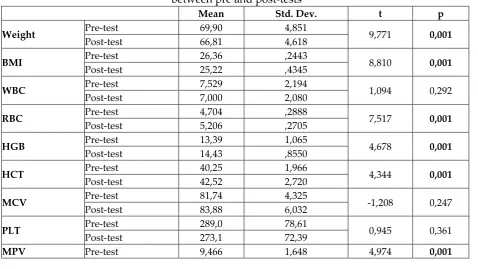
Table 2: Analysis of the values measured in overweight subjects (n=22)
between pre and post-tests
Mean Std. Dev. t p
Weight Pre-test 69,90 4,851 9,771 0,001
Post-test 66,81 4,618
BMI Pre-test 26,36 ,2443 8,810 0,001
Post-test 25,22 ,4345
WBC Pre-test 7,529 2,194 1,094 0,292
Post-test 7,000 2,080
RBC Pre-test 4,704 ,2888 7,517 0,001
Post-test 5,206 ,2705
HGB Pre-test 13,39 1,065 4,678 0,001
Post-test 14,43 ,8550
HCT Pre-test 40,25 1,966 4,344 0,001
Post-test 42,52 2,720
MCV Pre-test 81,74 4,325 -1,208 0,247
Post-test 83,88 6,032
PLT Pre-test 289,0 78,61 0,945 0,361
Post-test 273,1 72,39
Post-test 7,301 ,8957
PDW Pre-test 16,46 4,458 -2,132 0,050
Post-test 18,67 3,189
The body weight, BMI, RBC, HGB, HCT, MPV and PDW values of overweight children were statistically significant (p<0,05). No significant value was found in intergroup analysis of obese and overweight groups. (p>0,05).
4. Conclusion and Discussion
In this study, which investigated the effects of eight week exercise program on some hematological parameters in obese and weight-limiting boys, it was found that the obese group changed the body weight, MCV, MPV and PDW values and it was found statistically significant. The body weight, BMI, RBC, HGB, HCT, MPV and PDW values of the overweight group were found to be statistically significant. Studies have shown that there may be changes in hematological parameters depending on the type, severity and duration of the exercises. In hematological values during and after intense exercise, there may be changes due to differences such as training status, sex, age of persons (Tuzcuoğulları at al. 2017), environmental conditions and nutrition (Çınar at al.2016). It is emphasized in the studies that hematological changes in athletes due to long-term exercises (Beydağı at al. 1994; Beydağı at al. 1993). Leukocytes (WBC) are active units of the body's protection system and have the task of protecting the body against microorganisms. When the researches on hematological studies are examined, the researchers; WBC levels in individuals who do sports and do not, short-term and long-term exercise in individuals, different branches of WBC levels in the results of the study found no significant (Yeh at al. 2006; Banfi at al. 2006; Ergün at al. 2006). In our study, no significant difference was found in terms of WBC levels in both obese and overweight groups.
In studies on the effects of exercise on RBC values; in girls who do exercise and not (Arslan at al. 1997); young men who do sports and do not (Baltacı at al., 1998); also found that RBC (erythrocyte) levels were found to be higher in the groups who exercise physical activity in favor of the groups who exercise (Moğulkoç at al., 1997). In our study, RBC values were found to be high in the overweight group in the posttest and this was statistically significant (p<0,05). Erythrocytes are the cells that carry oxygen from the lungs with the help of the iron contained in the blood and carry the carbon dioxide accumulated in the tissues by carrying them to the lung. The most important function of erythrocytes is to carry hemoglobin from oxygen to tissues (Özdal at al. 2017; Gannong, 1995; Tahhan at al. 2018). Erythrocytes form the majority of shaped elements. The shape of the erythrocytes corresponds to the main task of gas reception efficiency, since a plate bounded by two concave surfaces is considered to be most suitable for gas diffusion (Dane, 2002).
to exercise exercises. In previous studies, it was observed that hemoglobin and hematocrit values were decreased in athletes who applied intensive exercise program (Büyükyazı, at al. 2002) in high-intensity interval studies (Green at al. 1991) during short periods of campus (Mashiko at al. 2004). When the hemoglobin amount is examined, it is seen that there is a difference of up to 20% in normal conditions according to race, age, gender, nutrition status, individual characteristics, environment (from sea level to height and lowness), and also by means of muscular work, mental state, seasons, barometric pressure, life and life style also emphasized that decreases and increases according to diseases (Yılmaz, 2000). In our study, MPV and PDW values of obese and overweight groups were found to be significant. This change was thought to result from the exercise and the physical difference of the group. These cells form the blood clotting proteins and are the cells that help to clot and stop bleeding by stopping bleeding. In the studies; after chronic aerobic exercise (Ünal, 1998), after chronic exercise applied to sedentary subjects (Büyükyazı at al. 2002), no significant difference was found in the values of coagulation proteins.
In conclusion, it can be said that the exercise program which is made in eight
weeks caused a change in some hematological parameters of the obese and overweight group, and that the overweight group was more affected than the obese group and it was more affected by the exercise.
References
Akmakçı E. ve Pulur A. Milli Takım Kamp Döneminin Bayan Taekwondocularda Bazı Biyokimyasal Parametreler Üzerine Etkileri, S.Ü. Bes Bilim Dergisi, 2008 Cilt 10, Sayı 1, 39-47.
Alıncak, F. Attitudes of secondary school students including physical activity involving playing games. European Journal of Physical Education and Sport Science, 2016;2(3):1-14.
Alıncak, F. Attitudes of primary school teachers towards playing games that involve physical activity. European Journal of Education Studies, 2017;3(1):202-216. Alıncak, F., Uğurlu, F.M., Abakay, U., Ayan, S. Remarks of class teachers on game and
physical activities lesson in terms of disabled students. International Journal of Sport Studies, 2016, 6.7: 460-467.
Arslan, C., Bingölbalı, A., Kutlu, M., Baltacı, A.K., Voleybol ve atletizm sporunun kız çocukların h Sporunun Kız Çocukların Hematolojik ve Biyokimyasal Parametrelerine etkisi, Gazi Üniv., Beden Eğt. Ve Spor Y.O., Beden Eğt.ve Spor Bilimleri Dergisi, 11:2 , 28-34, 1997.
Banfi G, Del Fablo M., Mauri C., Corsi M.M., Melegati G., et all, Hematological Parameters İn Highly Elite Rugby Players During A Competitive Season.Jun Pub Med –İndexed For Medline , , 28( 3):183-8, 2006.
Baltacı, A.K., Moğulkoç, R., Üstündağ, B., Koç, S., Özmerdivenli, R., Sporcu genç kızlarda bazı hematolojik parametreler ile plazma proteinleri ve serum çinko, kalsiyum, fosfor düzeyleri, Gazi Üniv Bed Eğt Spor Bil Derg, 3, 21 – 30, 1998. Beydağı, H., Çoksevim, B., Temoçin, S., Spor yapan ve yapmayan gruplarda bazı
eritrositer parametrelere egzersizin etkisi, Gaziantep Üniversitesi Tıp Fak Derg, 5, 21-28, 1994.
Beydağı, H., Çoksevim, B., Temoçin, S., Akar, S., Akut submaksimal egzersizin spor yapan ve yapmayan kişilerde lökositlere etkisi, Spor Hek Derg, 28, 52-62, 1993. Bilgiç M., Pancar Z., Şahin F.B., Özdal M. Sedanter Çocuklarda İki Farklı Anaerobik Güç
Testi Arasındaki Korelâsyonun İncelenmesi. Gaziantep Üniversitesi, Spor Bilimleri Dergisi, 2016: 1(2), 40-48.
Büyükyazı G., Karadeniz G., Kutlu N., Çabuk M., Ceylan C., Özdemir E. Ve Seven S,et all, Kronik Antrenmanın Yaşlılarda Serum Demir, Magnezyum, Hematolojik Ve
Lipit Parametreleri Üzerine Etkisi. Spor Hek. Der, ,37, 51-59. 2002
Çınar V, Akbulut T, Sarıkaya M. Effect of Zinc Supplement and Weight Lifting Exercise on Thyroid Hormone Levels. Indian J Physiol Pharmacol 2017; 61(3):232-236. Çınar V., Talaghir L.G., Akbulut T., Turgut M., Sarıkaya M. The Effects Of The Zınc
Supplementatıon And Weight Trainings On The Testosterone Levels. Human, Sports, Medicine. 2017: 17(4), pp. 58-63.
Çınar V., Akbulut T., Öner S., Pancar Z., Karaman M.E. An Investigation of Healty Life Style Behaviors of Turkish Wrestling Federation Coaches. International Refereed Academic Journal of Sports, Health and Medical Sciences. 2016: (21), 119-136. Dane S. Fizyoloji Laboratuvar Kitabı, Aktif yayınevi, 2002, 71-72.
Ergün M., Tengız I., Türk U. , Senısık S., Alıoglu E., Yüksel O., Ercan E., Islegen C., et al, The Effect Of Long Term Regular Exercise On Endothelial Functions, Inflammatory And Thrombotic Activity İn Middle Aged, Healthy Men .Journal of Sports Science and Medicine, 266 – 275 2006
Gannong W.F. Gannong Physiology, By Appleton Lange, 1995, 23-26.
Gencer Y.G., Coskun F., Sarikaya M., Kaplan S. Investigation on the Effects of 12 Days Intensive Competition on Some Blood Parameters of Basketball Players. Journal of Education and Training Studies 2018: 6 (4), 79-83.
Mahmood M.H., Özdal M., Mayda M.H., Biçer M. Acute Effects of Anaerobıc Exercise with Different Intensıties on Dynamıc Balance Performance. European Journal of Education Studies. 2017: 3(8), 357-370.
Mo-suwan L., Tongkumchum P., Puetpaiboon A. Determinants of overweight tracking from childhood to adolescence: a 5 y follow-up study of Hat Yai schoolchildren. Int J Obes Relat Metab Disord 2000;24:1642-7.
Özer Ö., Bozdal Ö., Pancar Z., Acute Effect Of Cırcuıt Aerobıc And Tradıtıonal Aerobıc Traınıng On Hamstrıng Flexıbılıty In Sedentary Women. European Journal of Physical Education and Sport Science. 2017:3(12), 268-275.
Özdal M. Acute effects of aerobic and two different anaerobic exercises on respiratory muscle strength of well-trained men. European Journal of Sport and Exercise Science, 2015: 4(4), 7-12.
Özdal M. Effect of core training on inspiratory muscle strength in well-trained men. Journal of Biology of Exercise, 2016: 12(1), 23-32.
Özdal M., Pancar Z., Çınar V., Bilgiç M., Effect of Smoking on Oxygen Saturation in Healthy Sedentary Men and Women. Ec Pulmonology and Respıratory Medıcıne. 2017: 4(6) 178-182.
Pancar Z., Özdal M., Pancar S., Biçer M., Investıgatıon Of Vısual And Audıtory Simple Reaction Tıme Of 11-18 Aged Youth. European Journal of Physical Education and Sport Science, 2016: 2(4),145-152.
Pancar Z., Bozdal Ö., Biçer M., Akcan F., Acute Effect Of Anaerobıc Exercıse On Dynamıc Balance Of Sedentary Young Boys. European Journal of Physical Education and Sport Science, 2017: 3(12), 229-237.
Pancar Z., Özdal M., Çınar V., The Effect Of 4-Weekly Low Intensıty Physıcal Actıvıty Program In Thyroıd Hormone Levels In Obese And Overweıght Chıldren. European Journal of Physical Education and Sport Science. 2017: 3(11), 1-8.
Pancar Z., Özdal M., Sarıkaya M., Çınar V., Effect of Physical Activity Program on Iron and Iron-Binding Capacity in Obese Children. Sch. J. Arts Humanit. Soc. Sci. 2018; 6(6): 1299-1303.
Pancar Z., Özdal M., Vural M., The Effect of a Four-Week Physical Activity Program on Liver Enzyme Levels, Uric Acid, Urea and Creatine Kinase Activity in Obese and Overweight Children. Scholars Journal of Arts, Humanities and Social Sciences, 2018; 6(7): 1485-1489.
Pancar Z., Do Active Sports and Games Affect Hemoglobin and Hematocrit Levels in Overweight Children?, Scholars Journal of Arts, Humanities and Social Sciences, 2018; 6(11): 2145-2148.
Pancar Z., Biçer M., Özdal M., Effect Of 8-Week Plyometrıc Traınıng On Selected Strength Parameters Of 12-14 Aged Woman Handball Players. Journal of Sports and Performance Researches 2018;9(1):18-24.
Selçuk M., Çınar M., Sarıkaya M., Öner S. Reviewing the Effect of 10 Days of Intense Exercise Period on Certain Blood Parameters of Tennis Players. Journal of Education and Training Studies, 2018: 6(11), 95-98.
Tahhan A.M.A.A., Özdal M., Vural M., Pancar Z., Influence Of Aerobıc And Anaerobıc Exercıse On Oxygen Saturatıon. European Journal of Physical Education and Sport Science. 2018: 4(2), 188-196.
Tuzcuoğulları Ö.T., Pancar Z., Bozdal Ö., A Research on the Role of Relative Age Effectiveness in Sports Termination. European Journal of Physical Education and Sport Science. 2017: 3(12), 461-469.
Ünal, M., Aerobik ve Anaerobik Akut-Kronik Egzersizlerin Immun Parametreler Üzerindeki Etkileri, İ.Ü. Sağlık Bilimleri Enstitüsü, 20, İstanbul, 1998.
WHO. Obezity Preventing and Managing the Global Epidemic. Report of WHO Technical Report Series 894. Geneva: World Health Organization, 2000.
Yeh S.-H., Chuang H., Lin L.-W., Hsiao C.-Y. , Eng H.L. ;Regular Tai Chi Chuan Exercise Enhances Functional Mobility And Cd4cd25 Regulatory T Cells British Journal of Sports Medicine;40:239-243; 2006.
Yılmaz B. Hormonlar ve Üreme Fizyolojisi, Feryal Matbaa, Ankara, 2000, 1.Basım, 247– 371.
Yılmaz A.K., Kabadayı M., Mayda M.H., Birinci M.C. Examination of Isokinetic
Strength Rates Of Knee Joınt (H/Q) In Football Players. Journal of Socıal Sciences
Creative Commons licensing terms