Teachers’ Self- and Collective Efficacy: The
Case of Novice English Language Teachers
Azadeh Zakeri
Tehran Azad University of Science & Research, Iran
Ramin Rahmany Azad University of Takestan, Iran
Elizabeth Labone
Australian Catholic University, Australia
Abstract—This paper studies the relationship between EFL teachers’ self-efficacy and collective efficacy among 55 novice EFL teachers from Milad Language Institute in Tehran, Iran. The participants were asked to complete the Teachers’ Sense of Efficacy Scale (Tschannen-Moran and Woolfolk Hoy, 2001), and the short version of Collective Teachers’ Efficacy Instrument (CTEI) (Goddard and Goddard, 2001). Data analysis revealed that there is a significant relationship between the teachers’ self-efficacy and their collective efficacy. To investigate which components of self-efficacy might have more predictive power in predicting teachers' collective efficacy, regression analysis was run. The first subscale of self-efficacy, i.e., self-efficacy for students' engagement, was found to be a good predictor of teachers' self-efficacy. The paper presents possible differences in the sources of collective efficacy and teacher self-efficacy and the interaction between teachers’ self-efficacy and collective efficacy. The conclusions and implications of the research are discussed with reference to Bandura's (1977) social cognitive theory and the earlier findings.
Index Terms—collective efficacy, self-efficacy, teachers' beliefs, efficacy expectations
I. INTRODUCTION
Teacher efficacy is recognised as an important psychological construct in effective teaching. Teacher efficacy is theoretically based on Social Cognitive Theory (Bandura 1977; 1997) which maintains that self-efficacy, defined as "people's beliefs about their capabilities to exercise control over their own level of functioning and over events" (Bandura, 1993, p.118), is a key determinate of future behavior. When applied to teaching, teacher efficacy is the teacher’s assessment his/her capability to organize and execute teaching and learning processes (Bandura, 1997). According to Tschannen-Moran and Hoy (2001), "in these days of hard-nosed accountability, teachers’ sense of efficacy is an idea that neither researchers nor practitioners can afford to ignore" (p.803). Some scholars have even argued reforms that do not address teachers' efficacy may be doomed (e.g., Sarason, 1990).
The importance of teacher efficacy lies in its strong link to quality practices. As Ashton & Webb (1986) reveal, those self-efficacious teachers have been found to be less critical of students’ mistakes, to deal more with struggling students (Gibson & Dembo, 1984), to be more desirous to take risks (Ross, Cousins, & Gadalla, 1996), to be more willing to experiment with new methods to better meet the needs of their students (Ghaith & Yaghi, 1997), to exhibit greater levels of planning and organization (Allinder, 1994), to be more enthusiastic for teaching (Allinder, 1994), to show greater commitment to teaching (Evans & Tribble, 1986) and to be more able to continue teaching career (Milner, 2002). Moreover, teachers with strong sense of self efficacy lead students to better achievement (Ashton & Webb, 1986), motivation (Midgley, Feldlaufer, & Eccles, 1989), and self-efficacy (Anderson, Greene, & Loewen, 1988) than students of less efficacious teachers.
While there is now a well established link between teacher efficacy and individual teacher practice, in more recent years there is increasing focus on the relationship between teacher efficacy and school context. Until recently the school context had been largely ignored by efficacy researchers (Labone, 2004). The focus on individual teacher efficacy has been predicated by the assumption that teachers generally work independently within the classroom, yet as noted by Tschannen-Moran, Woolfolk Hoy, and Hoy (1998) “teaching is typically performed in a group context. In fact, many problems teachers face require that they work together to change the lives of their students” (p. 241).
individual’s perceptions of the efficacy of the organization within which they work. While this association between personal efficacy and collective efficacy for teachers has received very limited attention in the research, studies that have investigated this association have found support for this, all be it a correlational association (Lee, Dedrick & Smith, 1991; Newmann Rutter & Smith, 1989). This research aims to further understanding of the association between individual and collective efficacy by investigating the relationship between these two constructs. The first step in this process however must be the development of an understanding of the theoretical connection between individual teacher efficacy and collective efficacy. This paper discusses the theoretical relationship between personal teaching efficacy, possible sources of collective efficacy and then suggests aspects of cognitive processing of efficacy information through which the interrelationship may operate.
Relationship between individual and collective efficacy
Studies teacher efficacy, in the main, have considered collective efficacy and personal teacher efficacy independently. While studies of collective efficacy are relatively recent, investigation of collective efficacy has focused on organizational factors associated with collective efficacy such as job satisfaction (Klasses, Usher & Bong 2011; Skaalvik & Skaalvik, 2010) or the impact of collective efficacy on teacher or leader practice (Ciani, Summers & Easter, 2008; Leithwood & Jantzi, 2008) or student performance (Bandura, 1993). Yet, as Bandura (1997) notes, theoretically the constructs are connected and to some extent have a reciprocal impact on each other. This interrelationship between individual teacher efficacy and collective efficacy has not been thoroughly considered in efficacy research. This oversight stems from the lack of theoretical analysis of key processes in the operation of personal efficacy and collective efficacy, specifically, the sources of efficacy and the cognitive processes used to translate this source information into efficacy beliefs.
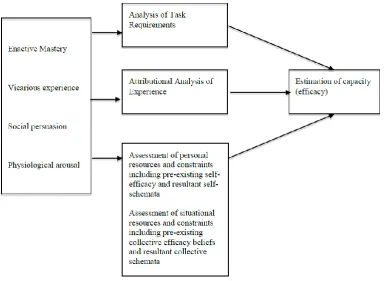
Researchers within the field of organizational psychology have provided more specific analysis of the processes in the formation of efficacy beliefs. Gist and Mitchell (1992) (see Figure 1) suggest three processes in the formation of efficacy beliefs: Analysis of task requirements – what is necessary to perform this task well; Attributional analysis of experience, in which an individual may ask themselves why a particular level of performance occurred in a prior experience (enactive mastery), the validity of information involved in social persuasion, or the similarity between themselves and a model observed through vicarious experience; and assessment of personal and situational resources. It is within this third process that individual efficacy beliefs and collective efficacy beliefs may interact. A teacher may consider collective efficacy of the school organization as a situational resource or constraint, similarly preexisting levels of individual teacher efficacy will be considered as a personal resource or constraint. As Klassen, Tze, Betts and Gordon (2011) note
“When teachers experience challenges and failures that may lower their individual motivation, these setbacks may be ameliorated by beliefs in their colleagues’ collective capacity to effect change. Teachers’ collective efficacy beliefs, then, are related to teachers’ self-efficacy beliefs” (p.23).
Sources of collective efficacy.
Collective efficacy may be sourced in the same way as other types of efficacy. The four sources of efficacy postulated by Bandura (1997) are mastery experiences, vicarious experiences, social persuasion and physiological and affective states. Mastery experience has been recognized as the most influential source of efficacy. For collective efficacy mastery experience may include prior school performance, as demonstrated in research showing the significant impact of prior school achievement on collective efficacy (Bandura, 1993).
When learning occurs vicariously by observing models performance vicarious experience is gained. When the model performs well, the efficacy of the observer is enhanced. When the model performs poorly, and the observer perceives themselves to have similar attributes to the model, the efficacy expectations of the observer decrease. At a collective level, observing successful performances of colleagues within the group to which the observer belongs may enhance efficacy. This is demonstrated in the work of Zeldin and Pajares (2000) who found vicarious experience of the success of other women working in the traditionally male-dominated fields of Mathematics and Science, was a critical source of self-efficacy for the women in the study. While this example is not related directly to an organization, the collective nature of the efficacy is related to a sense of belonging to a gender-based collective. Alternatively the experience of observing in another similar institution, for example visiting another school may inform collective efficacy. This is clearly demonstrated in research by Takahashi (2011) who explored sources of collective efficacy in interviews with teachers. She quotes one teacher who had visited another high school in which she assessed the standards of work to be below her own school and as a result concluded “So I think that the work we are doing here as teachers is effective” (p739). This demonstrates that vicarious experiences that inform collective efficacy may not only occur within a teachers own school environment but that experience of other schools may be particularly important for collective efficacy, as they serve as anchor values against which to assess collective efficacy.
Social persuasion entails performance feedback. The potency of persuasion depends on the credibility, trustworthiness, and expertise of the persuader. As Milner & Hoy (2003) puts it, social persuasion such as verbal feedback and encouragement can help to create a supportive social environment, while lack of feedback and non-responsiveness can create an unsupportive environment” (p.265). For collective efficacy, comments from both colleagues within the organization or others outside the organization can impact on collective efficacy. Most people have had an experience within their workplace of others criticizing their organization, which prompts the individual to question the efficacy of their organization, or alternatively positive appraisals of their organization may bolster perceptions of collective efficacy.
Finally, the level of arousal, either of excitement or anxiety, adds to the feeling of mastery or incompetence. Positive organizational climates should translate to more positive teacher affect, while negative climates my undermine affect. Hongyun, Qingmao and Lei (2004) found that, for teachers in high collective efficacy schools, the collective efficacy moderated the effect of stressors on teachers’ internal motivation. Furthermore, Salanova, Llorens and Schaufeli, (2011) found that efficacy beliefs influence activity engagement through their impact on positive affect and that this in turn influences subsequent efficacy beliefs. They suggest that the interaction between efficacy beliefs and positive group affect can give rise to an upward spiral which they term a “ positive group affect spiral” (p 270). This suggests that positive personal efficacy beliefs may induce a positive organization climate which enhances perceptions of collective efficacy and this can create an upwards spiral.
Interaction of teacher efficacy and collective efficacy in the cognitive processing of efficacy information
In theorizing the relationship between individual teacher efficacy and collective efficacy it is necessary to consider how efficacy information is processed and integrated and what cognitive processes may support the relationship between personal teaching efficacy and collective efficacy.
Bandura (1997) notes that there are two distinct tasks in the processing of efficacy information; the first is related to the type of information people attend to; the second is how the information is weighted and integrated. While individual efficacy and collective efficacy would independently glean information from the four sources, individual and collective efficacy would also inform each other as discussed earlier.
When processing enactive mastery experience Bandura (1997) maintains that people attend to pre-existing self-schemata in choosing to attend to information. Bandura notes that people are more likely to attend to efficacy information that is consistent with their self-schemata. This is demonstrated again in the research of Takahashi (2011) in which one teacher dismisses the schools poor test scores because they are inconsistent with her perceived efficacy of the teacher group. This may suggest that teachers hold a collective schemata which informs the type of information that they attend to in assessing efficacy beliefs. Teachers with high perceptions of the collective efficacy of their school may be more likely to attend to information consistent with that collective schemata and therefore pay more attention to their positive performances. Furthermore, self-schemata for personal teacher efficacy may interact with the collective schemata. Teachers with high personal efficacy or a positive self-schemata efficacy, may be more likely to attend to positive collective efficacy information because it is more consistent with their perception of themselves as contributors to that group. Conversely, teachers with high collective efficacy may attend more to personal successes in assessing their personal efficacy because they perceive themselves to be members of an effective group.
efficacy may be lowered if the performance is judged as unsuccessful, and enhanced when the performance is successful. The difficulty of the task has been found to be assessed using normative information (Harackiewicz, Sansone & Manderlink, 1985). Perceptions of collective efficacy may provide some normative information against which teachers judge their personal efficacy as suggested in the findings of Zeldin and Pajares (2000). Hence the two beliefs may be interdependent. Contextual conditions are also considered in the assessment of efficacy information. Contexts seen as internally controlled are more likely to sustain or enhance efficacy (Bandura (1997). Teachers with high personal efficacy may feel in more control of their environment and this may translate to more positive perceptions of their work context, hence collective efficacy, conversely teachers who feel in less control of their context may feel less confident in the organizations capabilities as they may feel displaced or unable to contribute effectively to the group.
In the attending to and processing vicarious experiences Bandura (1997) suggests that people consider their similarity to the attributes and performance of models as well as levels of model competence. Bandura suggests that models convey comparative information; when the observer sees a model fail whom they perceive to be similar to themselves, they may become convinced of their inefficacy as it confirms their existing self-schemata. Conversely, viewing positive modeling can buffer the impact of a “failure experiences and sustain effort” (Bandura, 1997 p 88). This may suggest that a staff that performs well may induce positive beliefs of collective efficacy and provide positive vicarious experiences that may be protective and buffer negative judgments about personal experience. This is consistent with Klassen et al. (2011)
Social persuasion may also contribute reciprocally to each type of efficacy. Bandura (1997) considers that social persuasion is most useful when used with analysis of enactive mastery experiences. The impact of social persuasion is dependent on the framing the persuasion, the credibility of the persuader and degree of disparity between the persuasion and the recipients preexisting self-schemata (Bandura 1997). When processing either teacher efficacy information or collective efficacy information a teacher will therefore attend more to positive feedback delivered by credible persuaders, but importantly they will evaluate this information against preexisting self-schemata and collective schemata. It may be that the information that is most influential is that which is consistent with both of these schemata. This may suggest that internal consistency between the self-schemata and collective schemata may be important in attending to and processing efficacy information.
Furthermore, as high teacher efficacy is related to greater enthusiasm for, and commitment to, teaching this may impact on the affective state of organization and subsequent collective efficacy as demonstrated in the work of Salanova et al (2011).
Building upon these theoretical propositions this present study aims to examine the relationship between teachers’ self-efficacy and collective efficacy. In exploring this notion this research seeks to investigate the relationship between individual efficacy and collective efficacy. Bandura (1993) found both teacher efficacy and collective efficacy contributed independently to student achievement, but furthermore, found that collective efficacy contributed to academic achievement even when individual teacher efficacy was controlled. He therefore concludes that these attainments are produced by staff working both independently and collectively. This research seeks to build on this work builds on by considering how teacher efficacy and collective efficacy might interact. The study focuses specifically on novice teachers at the early stages of the teaching career; because, as Tschannen-Moran, Woolfolk Hoy, and Hoy (1998) observed ‘‘the effect of collective efficacy may be especially pronounced for novice teachers as they are socialized into the teaching profession’’ (p. 221). Focusing on novice teachers may be specially revealing because some research into changes in teachers’ self-efficacy from entry into a teachers’ preparation program through the first year (Hoy & Spero, 2005) has found significant increases in efficacy during student teaching, but significant declines during the first year of teaching, a drop attributed to the level of support received.
II. METHODOLOGY
Participants
The data were collected from 55 novice English teachers teaching at Milad language center in Tehran. The participants were male and female with an age range of 20 to 25. They were guaranteed anonymity and received credit at their workplace. The criterion for selecting novice teachers was six months of teaching experience or less. All the teachers had taken teacher training courses before starting their profession and had been admitted into their teaching positions after passing the same licensing criteria, and were teaching within the uniform teaching system.
III. INSTRUMENTS
items and the Cronbach’s alpha for the questionnaire was 0.57, guaranteeing an acceptable level of reliability.
IV. RESULTS
Self-Efficacy Questionnaire
The Self-Efficacy questionnaire aimed to examine three constructs, i.e. efficacy for learners' engagement, self-efficacy for classroom management, and self-self-efficacy for instructional strategies. Table 1 presents the descriptive statistics for the participants' answers to the items of the self-efficacy questionnaire.
TABLE 1
DESCRIPTIVE STATISTICS FOR THE PERFORMANCE ON THE SELF-EFFICACY QUESTIONNAIRE N Minimum Maximum Mean Std. Deviation Self-Efficacy 55 3.75 8.33 6.74 1.13
Table 2 shows the descriptive statistics for the participants' answers to the items of the three subscales of the self-efficacy questionnaire. As can be seen, the respondents performed slightly better on self-efficacy for class management, followed by efficacy for instructional strategies and efficacy for students' engagement.
TABLE 2
DESCRIPTIVE STATISTICS FOR THE PERFORMANCE ON THE SELF-EFFICACY QUESTIONNAIRE AND ITS COMPONENTS Minimum Maximum Mean Std. Deviation Efficacy for Students’ Engagement 2.50 9.00 6.62 1.48 Efficacy for Classroom Management 4.00 8.50 6.89 1.18 Efficacy for Instructional Strategies 3.50 8.75 6.67 1.32
Collective Efficacy Questionnaire
Table 3 presents descriptive statistics for the responses of the participants to the items of the collective efficacy questionnaire.
TABLE 3
DESCRIPTIVE STATISTICS FOR THE PERFORMANCE ON THE COLLECTIVE EFFICACY QUESTIONNAIRE N Minimum Maximum Mean Std. Deviation Collective Efficacy 55 2.40 8.40 5.28 0.97
The Relationship between Teachers’ Self- and Collective Efficacy
The present study aimed at determining the degree of relationship between teachers’ self-efficacy and teachers’ collective efficacy. The results of Pearson product-moment correlation coefficient analysis showed that there is a moderate and positive relationship between English instructors' self-efficacy and their collective efficacy (r-observed = 0.466, p < 0.01).
The Relationship between Collective Efficacy and Self-Efficacy Subscales
Further analysis was run to determine the relationship between the three subscales of English instructors' self-efficacy and their collective efficacy. The results of Pearson product-moment correlation analysis showed a moderate and positive relationship between the participants' collective efficacy and their self-efficacy for students' engagement (r-observed = 0.512, p < 0.000), a low and positive relationship between the participants' collective efficacy and their efficacy for classroom management (r-observed = 0.301 p < 0.026), and a low and positive relationship between the participants' collective efficacy and their self-efficacy for instructional strategies (r-observed = 0.398, p < 0.003).
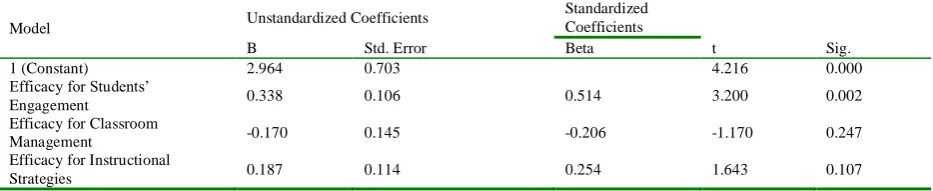
In order to investigate which components of self-efficacy might have more predictive power in predicting teacher’s collective efficacy, a regression analysis was run. As Table 4 illustrates, the first subscale of self-efficacy – efficacy for students’ engagement – was found to be a good predictor of the dependent variable, i.e., collective efficacy.
TABLE 4
THE RESULTS OF REGRESSION ANALYSIS FOR TEACHERS’ COLLECTIVE EFFICACY AND THEIR SELF-EFFICACY.
Model Unstandardized Coefficients
Standardized Coefficients
t Sig.
B Std. Error Beta
1 (Constant) 2.964 0.703 4.216 0.000
Efficacy for Students’
Engagement 0.338 0.106 0.514 3.200 0.002
Efficacy for Classroom
Management -0.170 0.145 -0.206 -1.170 0.247
Efficacy for Instructional
Strategies 0.187 0.114 0.254 1.643 0.107
a. Dependent Variable: Collective efficacy
is 0.55 which shows the multiple correlation coefficients between the components of teachers’ self-efficacy and their collective efficacy.
TABLE 5 R2
TABLE FOR SELF-EFFICACY AS THE PREDICTOR OF TEACHERS’ COLLECTIVE EFFICACY. Model R R2 Adjusted R2 Std. Error of the Estimate 1 0.550a 0.302 0.261 0.83753
a. Predictors: (Constant), Efficacy for Students’ Engagement, Efficacy for Classroom Management, Efficacy for Instructional Strategies
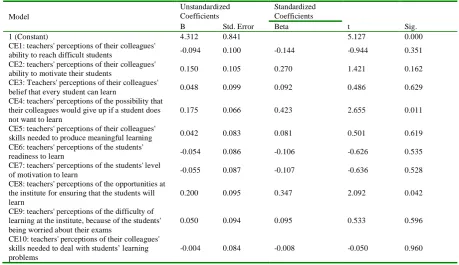
In order to investigate which components of collective efficacy might have more predictive power in predicting teachers' self-efficacy, a regression analysis was run. As Table 6 illustrates, none of the subscales of collective efficacy was found to be a good predictor of the dependent variable, i.e., self-efficacy.
TABLE 6
THE RESULTS OF REGRESSION ANALYSIS FOR TEACHERS’ THEIR SELF-EFFICACY AND COLLECTIVE EFFICACY.
Model
Unstandardized Coefficients
Standardized Coefficients
t Sig.
B Std. Error Beta
1 (Constant) 4.312 0.841 5.127 0.000
CE1: teachers' perceptions of their colleagues'
ability to reach difficult students -0.094 0.100 -0.144 -0.944 0.351 CE2: teachers' perceptions of their colleagues'
ability to motivate their students 0.150 0.105 0.270 1.421 0.162 CE3: Teachers' perceptions of their colleagues'
belief that every student can learn 0.048 0.099 0.092 0.486 0.629 CE4: teachers' perceptions of the possibility that
their colleagues would give up if a student does not want to learn
0.175 0.066 0.423 2.655 0.011
CE5: teachers' perceptions of their colleagues'
skills needed to produce meaningful learning 0.042 0.083 0.081 0.501 0.619 CE6: teachers' perceptions of the students'
readiness to learn -0.054 0.086 -0.106 -0.626 0.535 CE7: teachers' perceptions of the students' level
of motivation to learn -0.055 0.087 -0.107 -0.636 0.528 CE8: teachers' perceptions of the opportunities at
the institute for ensuring that the students will learn
0.200 0.095 0.347 2.092 0.042
CE9: teachers' perceptions of the difficulty of learning at the institute, because of the students' being worried about their exams
0.050 0.094 0.095 0.533 0.596
CE10: teachers' perceptions of their colleagues' skills needed to deal with students’ learning problems
-0.004 0.084 -0.008 -0.050 0.960
a. Dependent Variable: Self-efficacy
Table 7 displays the model summary statistics. The results indicate that the model containing all components of collective efficacy can predict 18% of the dependent variable, i.e., teachers’ self-efficacy. The R value is 0.57 which shows the multiple correlation coefficients between teachers’ self-efficacy and the components of collective efficacy.
TABLE 7 R2
TABLE FOR COLLECTIVE EFFICACY AS THE PREDICTOR OF TEACHERS’ SELF-EFFICACY. Model R R2 Adjusted R2 Std. Error of the Estimate 1 .579a .335 .184 1.02778
a. Predictors: (Constant), CE10, CE3, CE7, CE1, CE8, CE5, CE4, CE6, CE9, CE2
V. DISCUSSION
This study addressed the relationship between English teachers' self-efficacy and collective efficacy as well as the relationship between the three subscales of self-efficacy and their collective efficacy. As predicted, a significant relationship was found both between English instructors' self-efficacy and their collective efficacy and between the three subscales of their self-efficacy and collective efficacy. Initially, this finding is consistent with the results obtained by Goddard and Goddard (2001) who observed a significantly positive relationship between teachers’ collective efficacy and their self-efficacy. This confirms Bandura's (2001) contention that teachers cannot ignore the other colleagues’ contribution to their capabilities in judging their personal efficacy.
interdependency among employees in performing tasks and achieving organizational outcomes. The analysis of the relationship between the two types of efficacy suggests that efficacy for student engagement is, of the three dimensions of efficacy measured in the TSES scale, most strongly related to collective efficacy. When reflecting on items used to measure efficacy for student engagement it is apparent that, of the three dimensions, this dimension is most dependent on school level factors. For example, these items tend to ask how much a teacher can do to motivate students who are disinterested in learning, teach students to value learning and assist families. These skills are to some extent dependent on the organizations ethos, academic values and family support. The other two dimensions are much more related to classroom level instruction and management skills, hence are less dependent on collective capabilities. The results of the regression analysis of the predictive value of the collective efficacy items on self-efficacy found that two items had some significant predictive value: CE4: teachers' perceptions of the possibility that their colleagues would give up if a student does not want to learn and CE8: teachers' perceptions of the opportunities at the institute for ensuring that the students will learn The first of these suggests that collective efficacy provides normative information about what is expected in the role of the teacher, it serves as an anchor value against which teachers might judge their self-efficacy. The second suggests that teachers consider the contextual conditions when evaluating their own efficacy. This latter item is also consistent with Gist and Mitchell’s (1992) proposition that people assess situational resources and constraints in making efficacy judgments. In doing so these results may also provide initial evidence that the variation between language centers in terms of teachers’ self-efficacy may be explained by the teachers’ collective efficacy at the centers. Moreover, the finding shows that building collective efficacy in language centers may offer a new possibility for raising teachers’ self-efficacy (Tschannen-Moran, Woolfolk Hoy, & Hoy, 1998).
The findings of the present study provide further support for Bandura's social cognitive theory of sources of efficacy expectations, as well as preliminary support for the reciprocal influence of the two types of efficacy in sourcing and processing of efficacy information. The positive relationship between collective and teachers' self-efficacy can be theoretically addressed in terms of mastery experiences, vicarious experiences, social persuasion and physiological and affective states. As for the first source of efficacy expectations, i.e., mastery experiences, one can argue that when a school as a whole brings about students' achievement, it is plausible to consider that one or more teachers have done their jobs successfully. In other words, considering collective mastery experience, one or more teachers are involved in a school. Thus, mastery is considering both the individual and collective levels. In this sense, self- and collective efficacy may attend to both preexisting self-schemata and collective-schemata in attending to and processing efficacy information. This seems to be some extent evident in the finding that self-efficacy predicts 30% of collective efficacy. The results also add some weight to the proposition that that teachers assess contextual conditions in processing efficacy enactive mastery information. The finding that the collective efficacy item CE8: teachers' perceptions of the opportunities at the institute for ensuring that the students will learn significant (though weak) predicts self-efficacy suggests that teacher assess the organization’s efficacy when making judgments about their personal efficacy. This provides preliminary support for the proposition of Klassen et al (2011) that “..setbacks may be ameliorated by beliefs in their colleagues’ collective capacity to effect change.” (p.23)
Secondly, Bandura (1997) suggests that models convey comparative information. The findings of this study to some extent provide preliminary support for the importance of this normative information in informing self-efficacy. This findings that the collective efficacy item CE4: teachers' perceptions of the possibility that their colleagues would give up if a student does not want to learn significantly predicted self-efficacy, suggests that observing colleagues commitment may provide normative information about role expectation in terms of what is achievable. This information may then be used to buffer a teacher’s self-efficacy beliefs. In other words, the thinking might be “my colleagues would not give up on this so nor should I” or alternatively “my colleagues can achieve this student learning so I can too as I am similar to the group”. This provides preliminary support for the proposition of Klassen et al (2011) that “..setbacks may be ameliorated by beliefs in their colleagues’ collective capacity to effect change.” (p.23)
The third way in which the positive relationship between collective and teachers' efficacy can be discussed is in terms of social persuasion. Social persuasion includes feedback, help, encouragement to persist, and a supportive environment. Teachers' actions are judged by group standards which give the members some control over the actions of others since those actions have consequences for the group (Coleman, 1990). Thus, a teacher’s actions are influenced by group members. The group standard or collective schemata could be seen as a form of persuasion that either encouraged persistence or permitted giving up. In sum, collective norms are regarded as the effect of social persuasion on teachers’ individual efficacy perceptions. Teachers “are not social isolates immune to the influence of those around them” (Bandura 1997, p. 469). Specifically, when teachers tend to think highly of the collective capability of the faculty, they may sense an expectation for successful teaching and, thus, work to be successful themselves.
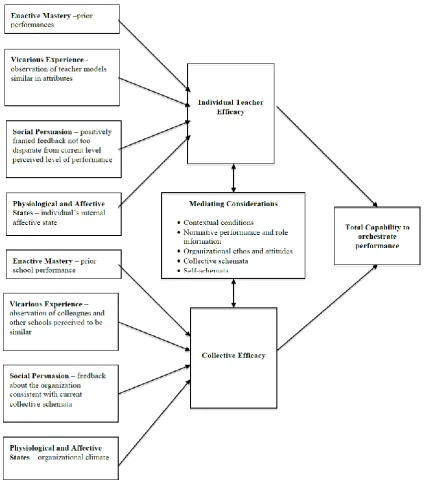
in the association between the dimension of efficacy for student engagement and collective efficacy; and finally the existing collective schemata and self schemata which influence the attention to and processing of efficacy information. This model, however requires much more rigorous empirical confirmation which could be the subject of further research.
A further point which is noteworthy is that the participants in our study showed a high level of self-efficacy, an observation which is in contrast with studies that have reported a high level of teachers’ efficacy before and during the teachers’ preparation program for preservice teachers but a significant drop after the beginning of real teaching (Hoy &Woolfolk, 1990).
Figure 2: Hypothesized model of sources of and interaction between Individual Teacher Efficacy and Collective Effica cy
VI. IMPLICATIONS AND CONCLUSIONS
experience and verbal persuasion as resources to enhance their level of efficacy. Authentic classroom contexts encourages teachers and enhances their confidence for performing the same tasks in the future. Putting prospective teachers in group settings where the members provide support for each other is also of great importance. This is corroborated by studies that have reported a significant role for school–university collaboration in increasing preservice teachers’ level of efficacy (Pohan & Dieckmann, 2005) as well as studies that reported the great contribution to teaching efficacy with the emotional and pedagogical support received from prospective teachers as well as the preparation program (Tschannen-Moran, Hoy, & Woolfolk, 2007).
The findings of the study can help promote language learning and teaching by making language teachers aware of the correlation between perceived self-efficacy and collective efficacy in education. The findings point to the need for developing special programs to enhance language teachers' sense of efficacy and teachers’ collective efficacy, and in implementing teachers’ self-efficacy enhancing instruction in teachers’ training centers.
The results indicate the benefits of high teachers’ self-efficacy with the hope of designing training plans so as to emphasize not only language proficiency, but also teachers' sense of self and collective efficacy. In closing, the results from this study serve to expand previous findings on teachers’ self-efficacy and clarify the relationships between teachers' self-efficacy and their collective efficacy beliefs in prospective teachers, extending prior work conducted primarily in the West to the EFL setting in Iran.
VII. QUESTIONS FOR FURTHER RESEARCH
Many categories of teachers’ self-efficacy beliefs merit attention, including teachers’ efficacy beliefs about teaching various subject matters. Further research may study whether changes in collective efficacy lead to changes in teachers’ efficacy. Future researchers might wish to examine conditions under which a teacher comes to feel efficacious. Similarly, it is important to study the efficacy beliefs of experienced versus inexperienced teachers. Future research may address whether teachers’ efficacy is enhanced for teachers who join schools with relatively high collective efficacy.
In closing, it should be noted that observing correlation between teachers' self-efficacy and their collective efficacy does not mean a causal relationship by any means. Moreover, the findings of the current study must be treated with caution. To the best of the researchers' knowledge, this is the first attempt to explore the relationship between novice language teachers’ self-efficacy and their collective in an institutional context. Thus, this study should be replicated to find out whether similar results can be obtained elsewhere. In addition, since this study was conducted only in a private language center, further research needs to be carried out at other educational settings in order to compare the results.
REFERENCES
[1] Allinder, R. M. (1994). The relationship between efficacy and the instructional practices of special education teachers and
consultants. Teacher Education and Special Education, 17, 86-95. doi:10.1177/088840649401700203.
[2] Anderson, R., Greene, M., & Loewen, P. (1988). Relationships among teachers’ and students’ thinking skills, sense of efficacy
and student achievement. Alberta Journal of Educational Research, 34, 148-165.
[3] Ashton, P., & Webb, R. B. (1986). Making a difference: Teachers’ sense of efficacy and student achievement. New York:
Longman.
[4] Bandura. (2001). Social cognitive theory: An agentic perspective. Annual. Review of Psychology, 52, 1-26. doi:
10.1146/annurev.psych.52.1.1.
[5] Bandura, A. (1997). Self-efficacy: The exercise of control.New York: Freeman. doi:10.1037/0033-295X.84.2.191.
[6] Bandura, A. (1993). Perceived self-efficacy in cognitive development and functioning. Educational Psychologist, 28, 117-148.
doi:10.1207/s15326985ep2802_3.
[7] Bandura, A. (1977). Self-efficacy: Toward a unifying theory of behavioral change. Psychological Review, 84, 191–215.
[8] Ciani, K. D., Summers, J. J., & Easter, M. A. (2008). A “top-down” analysis of high school teacher motivation. Contemporary
Educational Psychology, 28 (6), 627-641. doi:10.1080/01443410802084792.
[9] Coleman, J. S. (1990). Foundations of social theory. Cambridge, Mass: Harvard University Press.
[10] Evans, E. D., & Tribble, M. (1986). Perceived teaching problems, self-efficacy and commitment to teaching among preservice
teachers. Journal of Educational Research, 80 (2), 81-85. doi:10.1080/00220671.1986.10885728.
[11] Ghaith, G., & Yaghi, H. (1997). Relationships among experience, teacher efficacy and attitudes toward the implementation of
instructional innovation. Teaching and Teacher Education, 13, 451-458. doi:10.1016/S0742-051X(96)00045-5.
[12] Gibson, S., & Dembo, M. H. (1984). Teacher efficacy: A construct validation. Journal of Educational Psychology, 76, 569-582.
doi:10.1037/0022-0663.76.4.569.
[13] Gist, M. E., & Mitchell, T. R. (1992). Self-efficacy: A theoretical analysis of its determinants and malleability. Academy of Management Review, 17 (2), 183-211.
[14] Goddard, R. D. (2000). Collective efficacy and student achievement. Paper presented at the annual meeting of the American
Educational Research Association, New Orleans.
[15] Goddard, R. D., Hoy, W. K., & Woolfolk, A. (2000). Collective teacher efficacy: Its meaning, measure, and impact on student
achievement. American Educational Research Journal, 37(2), 479–507. doi:10.3102/00028312037002479.
[16] Goddard, R. D., & Goddard, Y. L. (2001). A multilevel analysis of the relationship between teacher and collective efficacy in
urban schools. Teaching and Teacher Education, 17, 807-818. doi: 10.1016/S0742-051X(01)00032-4.
[17] Harackiewicz, J. M., Sansone, C., & Manderlink, G. (1985). Competence, achievement orientation and intrinsic motivation: A
[18] Hongyun, L., Qingmao, M., & Lei, Z. (2004). Teachers’ collective efficacy and self efficacy as moderators of the impact of
work stress: A multi-level study. Psychological Science (China), 25(5), 1073-1076.
[19] Hoy, W. K., & Woolfolk, A. E. (1990). Socialization of student teachers. AmericanEducational Research Journal, 27, 279-300.
doi:10.3102/00028312027002279.
[20] Hoy, A. W., & Spero, R. B. (2005). Changes in teacher efficacy during the early years of teaching: A comparison of four
measures. Teaching and Teacher Education, 21, 343-356. doi:10.1016/j.tate.2005.01.007.
[21] Klassen, M. K., Tze, V. M. C., Betts, S. M., & Gordon, K. A. (2011). Teacher efficacy research 1998–2009: Signs of progress
or unfulfilled promise? Educational Psychology Review, 23, 21-43. doi:10.1007/s10648-010-9141-8.
[22] Klassen, R. M., Usher, E. L., & Bong, M. (2010). Teachers’ collective efficacy, job satisfaction, and job stress in cross-cultural
context. Journal of Experimental Education, 78, 464-486. doi:10.1080/00220970903292975.
[23] Labone, E. (2004). Teacher efficacy: Maturing the construct through research in different paradigms. Teaching and Teacher
Education, 20 (4), 341-359. doi:10.1016/j.tate.2004.02.013.
[24] Lee, V. E., Dedrick, R. G., & Smith, J. B. (1991). The effect of the social organization of schools on teachers' efficacy and
satisfaction. Sociology of Education, 64, 190-208. doi:10.2307/2112851.
[25] Leithwood, K., & Jantzi, D. (2008). Linking leadership to student learning. Educational Administration Quarterly, 44(4),
496-528. doi:10.1177/0013161X08321501.
[26] Midgley, C., Feldlaufer, H., & Eccles, J. (1988). The transition to junior high schools: Beliefs of pre- and post-transition
teachers. Journal of Youth and Adolescence, 17,543–562. doi:10.1007/BF01537831.
[27] Milner, H.R. (2002). Affective and social issues among high-achieving African American students: Recommendations for
teachers and teacher education. Action in Teacher Education, 24(1),81-89. doi:10.1080/01626620.2002.10463269.
[28] Milner, H. R., & Hoy, A. W. (2003). A case study of an African American teacher’s self-efficacy, stereotype threat, and
persistence. Teaching and Teacher Education, 19, 263-276. doi:10.1016/S0742-051X(02)00099-9.
[29] Newmann, F. M., Rutter, R. A., & Smith, M. S. (l989). Organizational factors that affect school sense of efficacy, community,
and expectations. Sociology of Education, 62, 221-238. doi:10.2307/2112828.
[30] Pohan, A.C., & Dieckmann, J. (2005). Preservice partnerships create classroom leaders: On-site classes benefit schools and
teachers. Learning & Loading with Technology, October, 22-24.
[31] Ross, J. A., Cousins, J. B., & Gadalla, T. (1996). Within-teacher predictors of teacher efficacy. Teaching and Teacher
Education, 12(4), 385-400. doi:10.1016/0742-051X(95)00046-M.
[32] Salanova, M., Llorens, S., & Schaufeli, W. B. (2011). “Yes, I can, I feel good, and I just do it!” On gain cycles and spirals of
efficacy beliefs, affect and engagement. Applied Psychology, 62, (2), 255-285. doi:10.1111/j.1464-0597.2010.00435.x ␣␣.
[33] Sarason, S. B. (1990). The predictable failure of educational reform.San Francisco: Jossey-Bass.
[34] Skallvik, E. M., & Skallvik, S. (2010). Teacher self-efficacy and teacher burnout: A study of relations. Teaching and Teacher
Education, 26, 1059-1069. doi:10.1016/j.tate.2009.11.001.
[35] Takahashi, S. (2011). Co-constructing efficacy: A “communities of practice” perspective on teachers’ efficacy beliefs.
Teaching and Teacher Education27(4), 732-741. doi:10.1016/j.tate.2010.12.002.
[36] Tschannen-Moran, M., & Woolfolk Hoy, A. (2001). Teacher efficacy: Capturing an elusive concept. Teaching and Teacher
Education, 17, 783–805. doi: 10.1016/S0742-051X(01)00036-1.
[37] Tschannen-Moran, M., & Woolfolk Hoy, A. (2007). The differential antecedents of self-efficacy beliefs of novice and
experienced teachers. Teaching and Teacher Education23, 944-956. doi:10.1016/j.tate.2006.05.003.
[38] Tschannen-Moran, M., Woolfolk Hoy, A., & Hoy, W. K. (1998). Teacher efficacy: Its meaning and measure, Review of
Educational Research,68 (2), 202–248. doi:10.3102/00346543068002202.
[39] Zeldin, A. L, & Pajares, F. (2000). Against the odds: Self-Efficacy beliefs of women in mathematical, scientific, and
technological careers. American Educational Research Journal, 37(1), 215-246. doi:10.3102/00028312037001215.
Azadeh Zakeri is a Ph.D. candidate in TEFL at Tehran Azad University of Science & Research. She has been actively involved in teaching English, training English teachers, mentoring, and supervising English teachers at prominent language teaching centers in Tehran. One of her publications co-authored with Rahmany concerns “M.A. Preparation Reference Book” published by Rahnama
Publications in 2010. She is also a lecturer at Azad University of Takestan. She completed her M.A. thesis on the relationship
between teachers’ knowledge, teachers’ self-efficacy, and teachers’ collective efficacy.
Ramin Rahmany is a Ph.D. holder in teaching English as a foreign language from Tehran University, Iran. Currently, he is an assistant professor in Azad University of Takestan, Iran. His major interests are language and acquisition, computer assisted language learning, and psycholinguistics. He has taught several courses at university like Language methodology and discourse analysis . He has published several articles in language learning acquisitions e.g. Acquisition of English Relative Clauses by Persian EFL Learners published by Journal of Language and Linguistic Studies in October 2009.