JPRHC
Research Article
JPRHC Volume 3 Issue1
Page
15-21
FORMULATION AND IN VITRO EVALUATION OF ARAUCARIA BIDWILLI GUM-BASED SUSTAIN RELEASE MATRIX TABLETS OF DICLOFENAE SODIUM
J. ASHOK KUMAR 1*, M.RAJESH 1, S.MYTHIESH KUMAR 2, T. GIRIRAJ KULKARNI 2, V. GOPAL.3
For Author affiliations see end of the text
This paper is available online at www.jprhc.in
ABSTRACT
A gel forming Polysaccharide gum obtained form the bark of Araucaria bidwilli was employed as a matrix sustained release tablet formulation of Diclofenac sodium (a non steroidal anti inflammatory agent). The effect of Araucaria bidwilli gum (Natural) and Synthetic polymer Hydroxypropyl methyl cellulose (HPMC K4 M) on the release of Diclofenac sodium was studied. The FT-IR spectroscopic studies of drug, gum and mixture indicated no chemical interaction. Six formulations were prepared by wet granulation method containing Araucaria bidwilli gum powder concentration 10% 20% & 30% w\w and 10% 20% &30% w\w of HPMC K4 M with sufficient volume of granulating agent Polyvinyl pyrrolene (PVP K 30), Avicel pH101 as diluents, Magnesium stearate and Aerosil is used lubricant and glidant respectively.This study was carried
out to find out the difference between synthetic and natural gum and whether synthetic gum can be replaced by natural gums. Physical and technological studies of granules and tablets were compliance with Pharmacopoial standards.The drug release increased with Araucaria bidwilli gum when compared to synthetics polymer concentration .The value of release exponent were found to be almost straight line and regression coefficient value between 0.938 and 0.998.This implies that the release mechanism is diffusion. Formulation F3 ( contained 30% w\w Araucaria bidwilli
gum) met the desired requirements for a sustained release dosage form.
Keywords : Diclofenac sodium, Araucaria bidwilli, HPMC K4 M, Wet granulation, Sustained release
INTRODUCTION:
Apart from drugs and biologically active compounds, the plants also play an important role in pharmaceutical preparation like tablets,capsules,lotion,suspension,syrup and ointment etc1.The most common excipients of plant origin include acacia, tragacanth, sodium alginate, starch and cellulose,which have wide variety of application in pharmaceutical dosage form. Recent trend towards the use of the plant and nontoxic products demands the replacement of synthetic additives with natural one.
Araucaria bidwilli gum provide appropriate solution to the current problem. In view of the easy availability of the plant and the high demand on the gum through out the world, the gum obtained from Araucaria bidwilli was investigated for its application as a release modifier.
Araucaria bidwilli (Araucariaceae) is a large evergreen tree, native of Australia2-3. Various experimental reports indicared diclofenac sodium as a good candidate for sustained release SR formulation 4-5. The present study was undertaken to find out the potential of gum from Araucaria bidwilli to act as a release modifier in SR matrix tablet formulation.
MATERIALS AND METHODS:
Materials:
Diclofenac sodium was obtained as a gift sample from Dr.Reddy,s Laboratories, Hyderabad,India. Araucaria bidwilli bark gum was collected from places in and around Ooty (Tamilnadu) .The plant was originally authenticated by Department of pharmacognosy. A herbarium sample of this plant is preserved at the Department of pharmacognosy, JSS college of pharmacy Ooty. Hydroxy propyl methyl cellulose (HPMC K4-M), Polyvinyl pyrrolene (PVP K30) ,Microcrystalline cellulose (Avicel pH 101), Magnesium stearate and Aerosil were procured from SD Fine chemicals,Mumbai,India.
Isolation of gum:
JPRHC
Research Article
JPRHC Volume 3 Issue1
Page
15-21
for 2 hours, made into fine powder, passed though sieve number 100 and stored for further use in desiccators 6-7. Identification of gum:
In freshly prepared coralline soda, the sample was mounted and covered with coverslip. After few seconds it was irrigated with 25% Sodium carbonate solution. The polysaccharide gum power was stained pink colour.
Physicochemical properties of gum:
The physicochemical properties such as solubility, loss on drying and total ash content were determined according to Indian pharmacopoeial procedure 8 using air dried powder of gum. The pH of the gum was determined using digital pH meter 9. The viscosity of 1% gum solution was determined at 250C using Oswald’s viscometer after 24 hours of hydration.
Compatibility studies:
FT-IR spectra matching approach was used for detection of any possible chemical interaction between the drug and gum. The individual and physical mixture (1:1) of drug and gum powder was prepared and mixed with suitable quantity of potassium bromide. About 50 mg of this mixture was compressed to form a transparent pellet using a hydraulic press at 15 tons pressure. It was scanned from 4000 - 400 cm-1 in a Perkin Elmer FTIR spectrophotometer. The IR spectrum of the physical mixture was compared with those of pure drug and matching was done to detect any appearance or disappearance of peak.
Placebo tablet formulation:
Tablets were prepared using Avicel pH101 (quantity varied with concentration of gum), 10 % PVP K-30 as a binder and 2% Magnesium stearate as lubricant. Araucaria bidwilli powder gum was used as a release modifier in the concentration range of 10-30 % for preparation of granules.
Granulation:
Wet granulation technique used for the preparation of granules. All the excipient passed through to 80 mesh. Required quantity of Diclofenac sodium, Avicel pH101 and
Araucaria bidwilli powder gum (120#) were mixed thoroughly and add sufficient quantity of granulation agent (PVP K 30 in water was added slowly) to obtained a damp mass suitable for granulation. The dump mass was passed through 8 mesh and granules were allowed to dry at 40 0C for 3-4 hours then shifted through 22 mesh.
Preformulation studies of granules:
Preformulation work is an important aspect of formulation ,which is monitored by requisite parameters, such as angle of repose, percentage compressibility, percentage drug content and percentage of fine etc. Performulation work was carried out on granules prepared using Araucaria bidwilli gum the result obtained were compared with those of HPMC K4 M 10-11 . The sample were graded as
excellent, good ,fair or meager if the angel of repose was found to be is the range of 30-32,32-35,35-37 or 37-45 respectively by fixed funnel method. Carrs index (percentage compressibility ), percentage drug content were calculated using standard formulae 12-13.
Tabletting:
The granules were homogenised with 0.5% Aerosil and lubricated with 2% Magnesium stearate .The tablet of average weights 200 mg were prepared on 10 stations rotary compression machine(Rimek,Ahamedabad ,India) using 8 mm diameter standard concave punch set. The batch size prepared was of 250 tablets. The compressed tablets were stored in a closed container for 15 days, no significant evidence of chemical change was observed. The tablets formulation using different concentration of
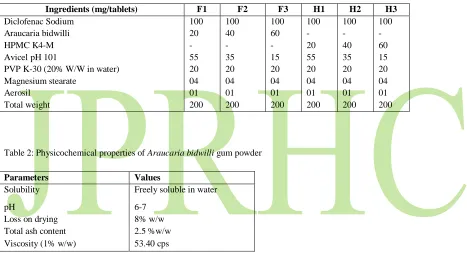
Araucaria bidwilli gum and HPMC K4 M were given in Table 1. (For each one tablet) as F1,F2&F3 denoting natural gum and H1,H2,&H3 as synthetic gum.
Tablets Evaluation:
The compressed tablets were evaluated for physical parameters such as average weight, content uniformity, hardness, friability using standard formulae 14-15. Swelling index of the formulated sustained release matrix tablets of
Araucaria bidwilli gum was determined. A single tablet (Initial weight W1) was placed in 6.8 pH buffer in a petri
dish and the different time intervals the tablets was withdrawn. Excess buffer on the surface of the tablets was blotted with filter paper and reweighed (W2).Swelling
index was calculated using the formula 16-17. Swelling index (%) = [(W1-W2)100]/W1
In vitro drug releases studies of compressed tablet were carried out in USP XXIII tablet dissolution test apparatus-II (Electrolab) employing a paddle stirrer rotating at 50 rpm, 900 ml pH 6.8 phosphate buffer was used as a dissolution medium. The temperature of the dissolution medium was maintained at 37 ±0.50C throughout the experiment
18-19
.One tablet was used in each test,5 ml of sample of dissolution medium was withdrawn. The sample were filtered through 0.45 μm membrane filter at specified intervals of time for period of 8 hours and was immediately replaced with fresh medium. Te sample was analysed for drug release by measuring the absorbance at 274 nm using UV-visible spectrophotometer(Techcom 2310 model) after suitable dilution.The content of drug and cumulative percentage drug release was calculated using an equation obtained from standard curve.
Kinetic modeling of drug release:
The dissolution profile of all the batches was fitted to various models such as Zero order, First order 20Higuchi
21and Korsmeyer peppas 22-23 to ascertain the kinetic
JPRHC
Research Article
JPRHC Volume 3 Issue1
Page
15-21
Accelerated Stability Studies:
Stability study was carried out to observe the effect of temperature and relative humidity on optimized formulation (F3), by keeping room temperature (28oC) and at 40 ± 20C, in airtight container for three month, at RH 75±5 %. Physical evaluation and invitro drug release was carried out after every one month.
RESULTS AND DISCUSSION:
Many natural gums are found to possess high viscosity which can be useful as release modifier in the preparation of sustained release(SR) formulation. Where as high viscosity nature could be helpful in the formulation of gel layer around the matrix system through which it can act as release modifier. A pharmaceutical technologist should be very careful in optimizing the concentration of gum in the formulation based on the dosage form requirement.
In our preliminary studies, we observed that the natural gum gave positive result with polysaccharides test. Gum obtained from the Araucaria bidwilli bark was an amorphous free flowing powder with a light brown colour. It exhibited good solubility in water and gave viscous solution on standing. It has pH between 6-7 with acceptable limit loss on drying (LOD) and total ash content as shown in Table 2. In this present work Fig 1,2 &3 shows the IR spectra of Diclofenac sodium, Araucaria bidwilli gum and physical mixture of Diclofenac sodium and Araucaria bidwilli gum were performed. All the characteristic absorption bands of the pure drug and Araucaria bidwilli
gum in the spectra of the formulation, without any shift in their position. It clearly suggests that the drug and the gum
Araucaria bidwilli have not undergone any chemical change hence there was no interaction between Diclofenac and Araucaria bidwilli gum. The prepared granules are evaluated for angle of repose, percentage compressibility, percentage drug content and percentage of fine results are tabulated in Table 3 .The flow property of granules was determined by angle of repose and it was found that values were between 23-260C.It was found that natural gum and synthetic granules exhibited excellent flow properties, as there is no significant difference between percentage drug content and percentage fine.
The percentage compressibility (Carrs index) of Araucaria bidwilli gum granules comparatively less than that of HPMC K4 M granules. The values of carrs index between 11-15 indicant that the granules prepared using natural gum exhibit excellent flow property. Then the granules were compressed to tablets.
The evaluation of tablet formulation using natural gum and synthetic were based on quality control parameters which include average weight of the tablet (weight variation) hardness, percentage friability, uniformity content and swelling index. The results are indicated in Table 4, all the batches of tablets prepared fulfilled the official (IP) requirement for uniformity of weight. Hardness of the tablets in all the batches was found to be in the range of 5-5.5.kg /m2 and was satisfactory. The percentage friability of tablets prepared using natural gum ranged between 0.4-0.7 %, which is almost equal to that of synthetic polymer used. The percent weight loss in the friability test from all formulation was found to be with in pharmacopoeial limit. All the tablets prepared were found to contain the medicament with 100 ± 5% of labeled claim.
Higher swelling index was found for tablets of F3 batch containing 30% of Araucaria bidwilli gum .Thus, the concentration of natural gum had major influence on swelling process and matrix integrity. Hence from the above result, it can be concluded the linear relationship between swelling process and concentration of natural gum ratio is as shown Figure 4.
Figure 5 and Figure 6 The invitro dissolution profile of using natural gum and synthetic polymer tablets formulated. Dissolution study showed that the drug releases from the tablets containing 10 to 20 %w/w of natural gum and 10 to 20% w/w of synthetic polymer was more than 50% release after 8 hours. The tablets at 30% w/w gum shown more optimum result as release modifier. The drug releases from the tablets decreases with the increases in gum concentration.
The result of dissolution data from dissolution profile fitted to various drug release kinetic equation of zero order, first order, Higuchi plot and Korsmeyer peppas having ‘R2’, ‘n’ and ‘k’. ‘R2’ is value of correlation coefficient ‘k’ is a release rate constant and ‘n’ is the diffusional release exponent.
The different release mechanism as n= 0.5 (Fikian diffusion), 0.5 < n < 1 (Anomalous transport), n=1 (case II transport i.e. Zero order release) and n>1 (super case II transport).
JPRHC
Research Article
JPRHC Volume 3 Issue1
Page
15-21
Korsmeyer peppas model found to be best fitted in all six formulation (F1, F2, F3, H1, H2 & H3).
The correlation coefficient values between 0.938 to 0.998 followed by first order kinetic drug release equation and the value of ‘n’ was found to range from 0.300 to 0.605 shown in Table 5.Which indicate that the release mechanism shifted in the direction of anomalous transport (except H1&H2) and diffusion mechanism with erosion. The result
of invitro dissolution studies of formulation F3 (30%w/w of
Araucaria bidwilli gum) was found to be ideal for the formulation of SR matrix tablets , at it provides desired sustaining effect. Stability studies(40 ± 20C /RH 75±5 %)revealed that there was no significant change in hardness, friability, drug content and dissolution profile of selected batch for 6 months indicate that Araucaria bidwilli
was stable in matrix SR table of Diclofenac sodium.
Table 1: Composition Diclofenac sodium sustained release matrix tablets
Ingredients (mg/tablets) F1 F2 F3 H1 H2 H3
Diclofenac Sodium 100 100 100 100 100 100
Araucaria bidwilli 20 40 60 - - -
HPMC K4-M - - - 20 40 60
Avicel pH 101 55 35 15 55 35 15
PVP K-30 (20% W/W in water) 20 20 20 20 20 20
Magnesium stearate 04 04 04 04 04 04
Aerosil 01 01 01 01 01 01
Total weight 200 200 200 200 200 200
Table 2: Physicochemical properties of Araucaria bidwilli gum powder
Parameters Values
Solubility Freely soluble in water
pH 6-7
Loss on drying 8% w/w
Total ash content 2.5 %w/w
Viscosity (1% w/w) 53.40 cps
Table 3: Preformulation studies of prepared granules (wet granulation)
Parameters F1 F2 F3 H1 H2 H3
Angle of repose 23.50 24.69 25.46 24.44 23.49 23.48
Carss index 12 13.1 13.1 19.1 22.00 18.00
% Drug content 98.65 99.87 98.54 97.85 96.32 99.64
JPRHC
Research Article
JPRHC Volume 3 Issue1
Page
15-21
Table 4: Physical properties of Diclofenac sodium sustained release matrix tablets
Table 5: Kinetic values obtained from in vitro release profile for matrix tablets of Diclofenac sodium (Higuchi’s and Korsmeyer peppa’s models) regressions coefficient and release exponent values
Figure 1: FT-IR Spectrum of Diclofenac sodium
Parameters F1 F2 F3 H1 H2 H3
Average weight 199.45 202.00 204.23 196.88 201. 91 203. 09
Hardness (Kg/m2) 05.10±1 05.20±1.5 05.50±1.4 05.40±1.1 05.50±1.2 05.50±1.1
Friability (%) 0.50 0.57 0.47 0.46 0.78 0.34
Content uniformity(%) 99.76±0.6 98.04±0.7 99.03±0.5 97.56±0.3 99.42±0.4 100.35±0.4
Polymer Batch code Pappa’s plot Higuchi’s
‘ R2’ ‘n’ ‘ R2’ ‘n’
AB gum
F1 0.997 0.559 0.998 0.576
F2 0.994 0.549 0.997 0.552
F3 0.992 0.598 0.990 0.584
HPMC
H1 0.941 0.361 0.938 0.345
H2 0.985 0.300 0.994 0.426
JPRHC
Research Article
JPRHC Volume 3 Issue1
Page
15-21
Figure 2: FT-IR Spectrum of Araucaria bidwilli gum
JPRHC
Research Article
JPRHC Volume 3 Issue1
Page
15-21
0 20 40 60 80 100 120 140
0.5 1 3 6
F1 F2 F3
Figure 4 : Swelling index of Araucaria bidwilli gum tablets (Formulation F1,F2&F3)
0 20 40 60 80 100 120
0.5 1 1.5 2 3 4 6 8
F1 F2 F3
Figure 5: In vitro release profile of Diclofenac sodium from matrices containing different percentages of Araucaria bidwilli gum
0
10
20
30
40
50
60
70
80
0.5
1
1.5
2
3
4
6
8
H1
H2
H3
JPRHC
Research Article
JPRHC Volume 3 Issue1
Page
15-21
CONCLUSION:
The present study revealed that Araucaria bidwilli gum appears to be suitable for use as a release modifier in the manufacture of once daily sustained release matrix tablets because of its good swelling index, good flow and suitability for matrix formulations. It could be concluded that Araucaria bidwilli gum can be used as an effective matrix former in the release of diclofenac sodium for sustained period of time.
ACKNOWLEDGEMENT:
The author is grateful to Dr Reddy’s Laboratories, Hyderabad, India for providing the pure sample. JSS College of pharmacy Ooty and PRIST University Thanjavur for providing facilities and encouragement to carry out this research work very successful.
REFERENCES:
1.Pawar H, Dmello P.M. Isolation of seed gum from cassia tora and preliminary studies of its application as a binder for tablets. Indian Drugs August 2004; 41(8): 465- 468 2. Haines R.J. Embryo development and anatomy in
Araucaria Juss.Australian journal of botany 1983;31:125-140.
3.Haines R.J. Seed development in Araucaria
Juss.Australian journal of botany 1983;31: 255-267 4. Munday D.L and Cox P.J. Int. Journal of Pharm.2000;200:179
5.Nochodchi A,Farid D.J, Najdfi M and Adrangui M. Drug develop.Ind.Pharm,1997;23:1019
6. Gangurta A.B. To evaluate gum of Azadirachta indica (Neem) as a binder for Pharmaceutical dosage forms. IJPER 2008; 344
7. Baveja S.K, Ranga Rao K.V and Arora J. Indian journal of pharm.sci. 1-8-; 51:115
8. Indian Pharmacopoeia. Vol II, Ministry of health and family welfare, Govt of India, New Delhi,1985;A-73,A-88 9.Panda D.S. To find out the potential of gum from Moringa olifera to act as a binder and release retardant in tablet formulation. Research paper 2008;70: 614-618 10.Gobel M.C, Jogani P.D and Bariya S.H. Development of agglomerated directly compressible diluent consisting of
brittle and ductile materials.
Pharm.Dev.Tech.,2003:(2)8:143-151
11. Talukdar M.M , Vinekier I, Modenaer P and Kinget R. Rheological characterization of Xanthan gum and hydroxypropyl methyl cellulose with respect to cotrolled release drug delivery. J.Pharm.sci 1996; 85:537-540 12. Subrahmanyam C.V.S. Text book of Physical Pharmaceutics. 2 nd edi. Vallabh prakashan. New Delki
2000;226-228
13. Gordon R.E, Rashanke T.W, Fonner D.E,Anderson N.R and Banker G.S In: Lachman L,Liberman H.H,Schwartz J.B. Pharmaceutical dosage forms:Tablets vol. 2,Marcel Dekker,Newyork 1999; 245-335
14.USP 23/NF 18, United State Pharmacopoeial convention Inc , Rockville M.D . Asian Edi, 1995;1041
15. Lachman L, Liberman H.A and Kanig J.L. The theory and practice of industrial pharmacy,3 rd edi. Varghese publishing house,Mumbai. 1987;88
16. Talukdar M.M and Kinget R. Swelling and drug release behavior of Xantham gum matrixtablets. Int. J.Pharm. 1995;120: 63-72
17. Srisagul Sungthongjeen ,Ornlaksana Paeratakul, Santaya Limmatvapirat. Preparation and invitro evaluation of a multiple-unit floating drug delivery system based on gas formation technique.International journal of Pharmaceutics 2006;324:136-143
18. Talukdar M.M , Michoel A , Rombaut P and Kinget R. Comparitive study on Xanthan gum and hydroxypropyl methyl cellulose as matrices for controlled release drug delivery. I. Compartion and invitro drug release behaviour. Int.J.Pharm. 1996; 120: 231-241
19. United States Pharmacopoeia.25 th ed NF 20: United States Pharmacopoeial convention,Inc,Rockville:2002,1142 20.Wagner J.G Interpretation of percent dissolved from invitro testing of conventional tablets and capsules J.Pharm.Sci.1969; 58:1253-1257
21. Hguchi T. Mechanism of sustained action medication theoretical analysis of rate release of solid drug dispersed in solid matrices. J. Pharm.sci. 1963; 52:1145-1140
22.Peppas N.A. Analysis of Fickian and non Fickian drug release from polymer.Pharm. Acta Heln . 1985;60:110-111 23. Harland R.S, Gazzaniga A, Sangali M.E, Colombo P,Peppas N.A. Drug/ Polymer matrix swelling and dissolution. Pharma. Res.1988;5:488-404
AUTHORS AFFILIATIONS AND ADDRESS FOR CORRESPONDENCE
1. Faculty of Pharmacy, PRIST University university, Thanjavur,Tamilnadu-614904 .
2. Department of Pharmaceutics,JSS college of Pharmacy,Ooty,Tamilnadu -643001