ISSN-L: 2501 - 1235 Available on-line at: www.oapub.org/edu
doi: 10.5281/zenodo.2631923 Volume 5 │ Issue 7 │ 2019
EPIDEMIOLOGY OF LOWER LIMB INJURIES
IN UNIVERSITY LEVEL FOOTBALL AND HOCKEY
PLAYERS OF PUNJAB, INDIA
Sarika1,
Umesh Kumar Maurya2i,
Shweta Shenoy3
1Assistant professor, MYAS-GNDU Department of Sports Sciences and Medicine
Guru Nanak Dev University, Amritsar, Punjab, India
2Research Scholar, MYAS-GNDU Department of Sports Sciences and Medicine
Guru Nanak Dev University, Amritsar, Punjab, India 3Head & Dean, Prof. Dr., MYAS-GNDU Department of Sports Sciences and Medicine
Guru Nanak Dev University, Amritsar, Punjab, India
Abstract:
The aim of the study was to find out the effects of epidemiology of lower limb injuries in university level football and hockey players of Punjab aged between 18 to 25 years. The sampling of this study confined to a group of 129 hockey players and 147 football players, (total 276 players) belonging to the state of Punjab. A thorough review of literature was done to develop a questionnaire on the basis of demographic data, predisposing factors, training profiles and extent of injury. Since the questionnaire was originally in English and local language so players were interviewed personally. Mean, standard deviation and percentile were calculated. Statistical significance was set up at p value ≤0.05. This study illustrates that ankle & foot were most affected sites (34.0% football, 36.4% hockey), the most common injuries were sprains (59.2% football, 48.8% hockey), strains (25.9% football, 29.5% hockey) and extent of injury was commonly moderate (51.7% football, 56.6% hockey). This study might be helpful for the players as well as trainers, coaches to formulate effective and appropriate training protocols with minimal risk of injuries.
Keywords: survey, questionnaire, lower limb injuries, football players, hockey players
1. Introduction
One defined injury as any condition that caused a player to be removed from a game, miss a game, or to be disabled enough to come to the medical tent (Kibler, W. B., 1993). An injury is defined as any pain that prevented the player from completing that particular match, practice, or training session and caused the player to seek medical attention. Acute injuries is those of rapid onset, chronic injuries were of longer duration involving very slow changes, and acute or chronic injuries is of longer duration and involved gradual changes, but were brought about by movements causing rapid onset (A. Grimm et al., 2007). Football and Hockey are the most popular sports in the world. Football is played in 203 countries, first in popularity and team sports games (Stubbe J., et al., 2015). Football and hockey players are exposed to various injuries during starting, turning, twisting, slopping, jumping and kicking to greater risk of lower limb injuries (Waston A., 1993).
Football and hockey are marked by physical contact and performance of specific sports actions such as running, jumping, landings, acceleration, slowdown, abrupt changes of direction, and tramping are the extrinsic causative factors related to the occurrence of sports injuries. Among other features, height, body weight and flexibility level of the athlete are the potential internal risk factors to the occurrence of sports injuries (Hoff J., 2005). In football lower extremity injuries accounted for 67% to 88% of all injuries reported in men. In women’s body part ankle, knee and thigh, Groins, ACL, ankle sprain are common injuries (Alfredson et al., 2000, Giza E., et al., 2005, K. Soderman., et al., 2001). In hockey the most common lower limb injuries are patellofemoral pain, patellar tendinitis, iliotibial band friction syndrome and medialtibial stress syndrome (Michelle R. Devan., et al., 2004). Many studies have reported the frequency of injuries and examined selected risk factor that affects the football and hockey players. However, none of these studies have relationship of the epidemiological lower limb injuries of the interuniversity football and hockey players of the Punjab. So the purpose of this study was to determine the prevalence of different types of lower limb injuries in the university level Football and hockey players of Punjab.
2. Materials and Methods
2.1Samples
Table 1: Descriptive Statistics of anthropometric variable, playing years, frequency & duration of training and days lost due to injury
Descriptive Statistics
Hockey (N=129)
Football (N=147)
Overall (N=276) Mean SD Mean SD Mean SD
Age 19.33 1.26 19.64 1.58 19.50 1.44
Height 168.38 8.92 174.20 7.68 171.48 8.76
Weight 57.80 9.16 62.33 6.25 60.21 8.05
BMI 20.32 2.25 20.58 2.13 20.46 2.19
Years of Playing 4.58 1.55 5.55 2.71 5.10 2.29
Frequency of Training (times/week) 6.00 0.00 5.79 .61 5.89 .46 Duration of Training (per day) 6.00 0.00 5.15 1.03 5.55 .86 Days Lost Due to Injury 20.47 43.86 34.10 83.14 27.73 67.91
2.2 Procedure
The type of sampling was stratified random sampling. The investigator personally established contact with the players and coaches of the university and the purpose of the study was explained to them. The self-administered questionnaire developed in the pilot study was used, to collect information about sports profile injuries, participation in warm up and cool down, frequency of training (times/week), type of playing surface, position of playing during injury, site of injury, extent of injury. The sample included only injured players of lower limb which signify the risk of injury to the players who are involved in those particular sports. Mean scores, standard deviation and percentage were calculated and utilized to identify the nature, site and extent of injury in football and hockey players.
3. Results and Discussion
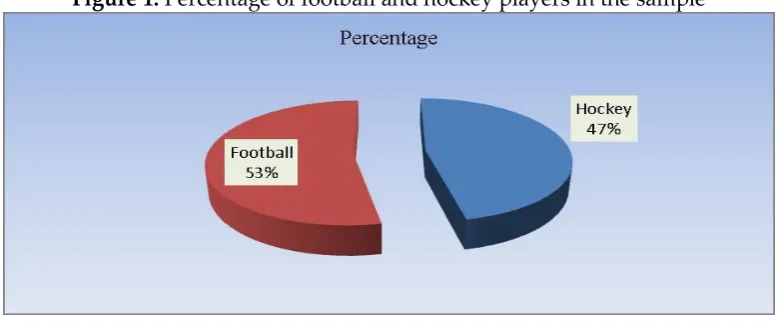
A total of 276 players (129 hockey players and 147 football players) belonging to state of Punjab.
Table 2: Percentage distribution of warm up and cool down sessions of football and hockey players
Frequency (%) Hockey Football
N Percentage N Percentage
Warm Up Yes 129 100.0% 147 100.0%
No 0 0.0% 0 0.0%
Cool Down Yes 129 100.0% 147 100.0%
No 0 0.0% 0 0.0%
Table 2 showed that all the players were performing warm up and cool down sessions.
Table 3: Percentage distribution of nature of playing surface of football and hockey players
Frequency (%) Hockey Football
N Percentage N Percentage
Type of Playing Surface
Grass 76 58.9% 147 100.0%
Concrete 0 0.0% 0 0.0%
Asphalt 0 0.0% 0 0.0%
Artificial Turf 129 100.0% 0 0.0%
Table 3 showed that football players were playing on grassy surface (100%) where as hockey players were playing on both grass (58.9) and artificial turf (100%).
Table 4: Percentage distribution of playing positions of football and hockey players when got injured
Frequency (%) Football
N Percentage
Position of Playing while Injury
Goal Keeper 20 13.6%
Defenders 42 28.6%
Mid Fielders 39 26.5%
Wingers 17 11.6%
Strikers 29 19.7%
Frequency (%) Hockey
N Percentage
Position of Playing while Injury
Goal Keeper 18 14.0%
Defenders 40 31.0%
Mid Fielders 26 20.2%
Forward 45 34.9%
injured field hockey players would be forwards or defenders, who spend more time near the goal area.
Table 5: Percentage distribution of site of injury of football and hockey players
Frequency (%) Hockey Football
N Percentage N Percentage
Site of Injury
Hip & Pelvic 7 5.4% 19 12.9%
Anterior Thigh 12 9.3% 12 8.2%
Posterior thigh 16 12.4% 16 10.9%
Knee 29 22.5% 39 26.5%
Leg 18 14.0% 11 7.5%
Ankle & Foot 47 36.4% 50 34.0%
Figure 2: Shows percentage distribution of site of injury of football and hockey players
Table 5 showed most common sites of injury were ankle & foot (34.0% football, 36.4% hockey) followed by knee (26.5 % football, 22.5% hockey). Kumar et al., (2008) illustrated that the most commonly injured anatomical site in footballers was found to be the region of ankle (29.62%) followed by knee (17.59%). Garrick JC, (1977), Rose CP, (1981), Torg J, (1982) also revealed that ankle is the most frequent area in the body accounted for 27% of all reported injuries in hockey. Fox N. (1981) suggests that the stooped position used when dribbling the ball may be an unsound position for fast locomotion and could contribute to lower limb injury.
Table 6: Percentage distribution of classes of injuries in football and hockey players
Frequency (%) Hockey Football
N Percentage N Percentage
Class of Injury
Fracture 8 6.2% 2 1.4%
Dislocation 1 .8% 0 0.0%
Strain 38 29.5% 38 25.9%
Sprain 63 48.8% 87 59.2%
Abrasion 6 4.7% 3 2.0%
Table 6 showed most common classes of injury were sprain (59.2% football, 48.8% hockey) followed by strain (25.9% football, 29.5% hockey). Dick. R., Hootman et al., (2007), Hootman & Vela. L., (2007) also explained that in football more than 15% of all injuries in lower extremity were sprain because of the twisting movement of the ankle joint. (Fong, et al., (2007) also explained that studies on sports injury from year (1977- 2005) showed that ankle sprain was one of the major injuries in field hockey.
Table 7: Percentage distribution of extent of injuries in football and hockey players
Frequency (%) Hockey Football
N Percentage N Percentage
Extent of Injury
Mild 27 20.9% 22 15.0%
Moderate 73 56.6% 76 51.7%
Severe 29 22.5% 49 33.3%
Table 7 showed moderate injuries were more common (51.7% football, 56.6% hockey). Which were followed by severe injuries (33.3% football, 22.5 hockey). S. Schmidt-Olsen, et al., (1985) revealed that moderate injury which requires medical care, but no hospitalization and for which advice of reduced activity is given and also suggested the active players 5.2% suffered from a soccer injury, 2.6% had moderate and/or severe injuries; 0.4% had serious injuries.
Table 8: Percentage distribution on the basis of diagnosis in football players
Frequency (%) Football
N Percentage
Diagnosis
Hamstring Strain 15 10.2%
Adductor Strain 7 4.8%
Quadriceps Contusion 4 2.7%
Miniscus Injury 4 2.7%
Inguinal Hernia 1 .7%
Lateral Ankle Sprain 49 33.3%
Acl Injury 11 7.5%
Others 56 38.1%
Table 8 showed diagnosis of most common injuries were ankle sprain (38.1%) in football players. Garrick JC (1977) & Mohammad Hassabi, et al., (2010) also explained that ankle sprain occurred to the professional soccer players with a percentage of 45%.
Table 9: Percentage distribution on basis of diagnosis in hockey players
Frequency (%) Hockey
N Percentage
Diagnosis
Hamstring Strain 15 11.6%
Adductor Strain 5 3.9%
Calf Muscle Tear 7 5.4%
Shin Splint 4 3.1%
Achilles Tendinopathy 1 .8%
Lateral Ankle Sprain 38 29.5%
Acl Injury 9 7.0%
Others 50 38.8%
Figure 4: Show percentage distribution on the basis of diagnosis in hockey players
Table 9 showed diagnosis of most common injuries were ankle sprain (29.5%) in hockey players. Agel J., Dompier et al., (2007), Hootman, J. M. et al., (2007) & Murtaugh, K. (2001) concluded that ankle sprain is most prevalent diagnosis of injuries in the field hockey game.
Table 10: Percentage distribution of physiotherapy treatment taken by the football and hockey players
Frequency (%) Hockey Football Overall
N Percentage N Percentage N Percentage Physiotherapy Treatment taken Yes 68 52.7% 77 52.4% 145 52.5%
Figure 5: Shows percentage distribution of physiotherapy treatment taken by the football and hockey players
Table 10 showed that percentage of players who took physiotherapy treatment was only 52.5%. It was also observed that 46.83% of footballers got their injuries treated by medical practitioners followed by 29.11% who went to physiotherapist and 11.79% who went to sports masseur for treatment (Kumar et al., 2008). The study also observed that medical treatment was preferred in comparison to physiotherapy management.
4. Conclusion
From the findings of present study it might be calculated that most injuries of football and hockey players are sustained in lower limb; ankle & foot and knee injuries are common among football and hockey players, where ankle injuries being the most common. Regarding the class of injury in lower limb, ankle sprain was common in both football and hockey players. Regarding the position of playing most commonly injured players were defenders in football and forwards in hockey. The extent of injury was moderate in both football and hockey players.
Acknowledgement
Authors are thankful to the various sports authorities of Punjab state, India, coaches and participants football and hockey players of the University for their Cooperation in collecting the data.
References
A., Grimm K., Kirkendall D. (2007) Medical report from the 2006 FIFA World Cup Germany. British Journal of Sports Medicine, 41, 578-581.
Alfredson, H., Soderman, K., Werner, S., Pietila, T., Engstrom, B., (2000). Balance board training: prevention of traumatic injuries of the lower extremities in female soccer players? Knee surgery, sports traumatology, arthroscopy, 8(6), 356-363. Arnason, A., Gudmundsson, A., Dahl, H. A., & Johannsson, E. (1996). Soccer injuries in
Iceland. Scandinavian journal of medicine & science in sports, 6(1), 40-45.
Dick, R., Hootman, J. M., Agel, J., & Vela, L. (2007). Descriptive epidemiology of collegiate women's field hockey injuries: National Collegiate Athletic Association
Injury Surveillance System, 1988-1989 through 2002-2003. Journal of athletic
training, 42(2), 211.
Fong, D. T. P., Hong, Y., Chan, L. K., Yung, P. S. H., & Chan, K. M. (2007). A systematic review on ankle injury and ankle sprain in sports. Sports medicine, 37(1), 73-94. Fox N. (1981). Risk in field hockey. In: Sports fitness and sports injuries. T. Reilly (Ed.)
Boston: Faber and Faber; pp.112-7.
Garrick J. G. (1977). The frequency of injury, mechanism of injury and epidemiology of
ankle sprain. American Journal of Sports Medicine; 1977; 5: 241-2 doi.
10.1177/036354657700500606
Giza E., Micheli L. J. (2005). Soccer Injuries. Medical Sports Science. 140-169. doi: 10.1159/000085395
Hoff J. (2005). Training and testing physical capacities for elite soccer players. Journals of Sports Science, 23(6), 573-582. doi: 10.1080/02640410400021252.
Hootman, J. M., Dick, R., & Agel, J. (2007). Epidemiology of collegiate injuries for 15
sports: summary and recommendations for injury prevention initiatives. Journal
of athletic training, 42(2), 311.
Kerstin Soderman, Hakan Alfredson, Tom Pietila, Suzanne Werner., (2001). Risk factors for leg injuries in female soccer players: a prospective investigation during one out-door season. Knee Surg, Sports Traumatol, Arthrosc; 9: 313–321. doi. 10.1007/001670100228.
Kibler, W. B. (1993). Injuries in adolescent and preadolescent soccer players. Medical Sciences Sports Exercise, 25, 1330-1332.
Kumar, S. S., Jadhav, K. G., & Pagare, S. (2008). A pilot study examining injuries in relation to field position of competitive football players. Journal of Exercise Science and Physiotherapy, 4(1), 50.
Michelle R. Devan, Linda S. Pescatell, Pouran Faghri, Jeffrey Anderson ., (2004). A prospective study of overuse knee injuries among female athletes with muscle imbalances and structural abnormalities. Journal of Athletic Training, 2004; 39(3):263-267.
Mohammad Hassabi, Seyed Mohammad-Javad Mortazavi, Mohammad-Reza Giti, Majid Hassabi, Mohammad-Ali Mansournia, Sara Shapouran, (2010). Injury profile of a professional soccer team in the premier league of Iran. Asian Journal of Sports Medicine, Vol1 (No4); 201-208.
Rose C. P. (1981). Injuries in women’s field hockey: a four year study. The Physician and Sports Medicine; 9(3): 97-100.
S. Schmidt–Olsen, L. K. H. Bunemann, V. Lade, J. O. K. Brassoe (1985). Soccer injuries of youth. Brit. J. Sports Med. 1985, 19: 161-164. doi: 10.1136/bjsm.19.3.161.
Stubbe, J. H., van Beijsterveldt, A. M. M., van der Knaap, S., Stege, J., Verhagen, E. A., Van Mechelen, W., & Backx, F. J. (2015). Injuries in professional male soccer
players in the Netherlands: a prospective cohort study. Journal of athletic training,
50(2), 211-216.
Torg J. (1982). Ankle and foot problems in the athlete. Clinical Sports Medicine; 1: 77-84. Turbeville, S. D., Cowan, L. D., Owen, W. L., Asal, N. R., & Anderson, M. A. (2003). Risk factors for injury in high school football players. The American journal of sports medicine, 31(6), 974-980.
Creative Commons licensing terms