A New Third-Order Derivative Free method for
Solving Nonlinear Equations
J. P. Jaiswal
DepartmentofMathematics,MaulanaAzadNationalInstituteofTechnology,Bhopal-462051,M.P.India
∗Corresponding Author: [email protected]
Copyright c⃝2013 Horizon Research Publishing All rights reserved.
Abstract
In the present paper, by approximating the derivatives in the Newton-Steffensen third-order method by central difference quotient, we obtain a new modification of this method free from derivatives. We prove that the method obtained preserves their order of convergence, without calculating any derivative. Finally, numerical tests confirm that our method give the better performance as compare to the other well known derivative free Steffensen type methods.Keywords
Nonlinear Equations, Order of Convergence, Simple Root, Central Difference, Derivative Free MethodMathematics Subject Classification (2000). 65H05, 65H10, 41A25
1
Introduction
A large number of papers have been written about iterative methods for the solution of the nonlinear equations. In this paper, we consider the problem of finding a simple root x∗ of a functionf :D⊆ ℜ −→ ℜ, i.e. f(x∗) = 0 andf′(x∗)̸= 0. The famous Newton’s method for finding x∗ uses the iterative method
xn+1=xn−
f(xn)
f′(xn)
,
starting from some initial value x0. The Newton’s method is an important and basic method which converges
quadratically in some neighborhood of simple root x∗. However, when the first order derivative of the function
f(x) is unavailable or is expensive to compute, the Newtons method is still restricted in practical applications. In order to avoid computing the first order derivative, Steffensen in [1] proposed the following derivative-free method. It is well known that the forward-difference approximation forf′(x) atxis
f′(x)≈ f(x+h)−f(x)
h .
If the derivativef′(xn) is replaced by the forward-difference approximation withh=f′(xn) i.e.
f′(xn)≈
f(xn+f(xn))−f(x)
f(xn)
,
the Newton’s method becomes
xn+1=xn−
f(xn)2
f(xn+f(xn))−f(xn)
,
Jain [7] presented the third-order method (Jain Method):
yn = xn−
f(xn)2
f(xn+f(xn))−f(xn)
,
xn+1 = xn−
f(xn)3
{f(xn+f(xn))−f(xn)}{f(xn)−f(yn)}
. (1.1)
Dehghan et al. [8] proposed two third-order Steffensen type method (Dehghan Method I):
yn = xn−
2f(xn)2
f(xn+f(xn))−f(xn−f(xn))
,
xn+1 = xn−
2f(xn){f(xn) +f(yn)}
f(xn+f(xn))−f(xn−f(xn))
. (1.2)
and (Dehghan Method II)
yn = xn+
2f(xn)2
f(xn+f(xn))−f(xn−f(xn))
,
xn+1 = xn−
2f(xn){f(yn)−f(xn)}
f(xn+f(xn))−f(xn−f(xn))
. (1.3)
Again Dehghan et al. [9] introduced a new third-order Steffensen type method (Dehghan Method III):
yn = xn+
2f(xn)2
f(xn+f(xn))−f(xn−f(xn))
,
xn+1 = xn−
2f(xn)
f(yn)f(u) +f(xn)f(v)
, (1.4)
wheref(u) =f(xn+f(xn))−f(xn−f(xn))
andf(v) =f(yn+f(yn))−f(yn−f(yn)).
Recently Cordero et al. [2] presented a fourth-order Steffensen type method (Cordero Method):
yn = xn−
2f(xn)2
f(xn+f(xn))−f(xn−f(xn))
,
xn+1 = xn−
2f(xn)2
f(xn+f(xn))−f(xn−f(xn))
. f(yn)−f(xn)
2f(yn)−f(xn)
. (1.5)
Other Steffensen type methods and their applications are discussed in [[3], [4], [5], [6]].
The purpose of this paper is to develop a new third-order derivative-free method and give the convergence analysis. This paper is organized as follows. In Section 2, we present a new two-step third-order iterative method for solving nonlinear equations. In this method we approximate the derivative of the function by central difference quotient. The new method is free from derivative. We prove that the order of convergence of the new method is three. Numerical examples show better performance of our method in section 4. Section 5 is a short conclusion.
2
Development of the method and analysis of convergence
Let us consider the third-order Newton-Steffensen method [10]:
yn = xn−
f(xn)
f′(xn)
,
xn+1 = xn−
f(xn)2
f′(xn)[f(xn)−f(yn)]
. (2.1)
Approximating the derivativef′(xn) in (2.1) by the central-difference
f′(xn)≈
f(xn+f(xn))−f(xn−f(xn))
2f(xn)
,
we obtain a new method free from derivatives, that we call the modified Newton-Steffensen method free from derivative (MNSDF):
yn = xn−
2f(xn)2
f(xn+f(xn))−f(xn−f(xn))
,
xn+1 = xn−
2f(xn)3
{f(xn+f(xn))−f(xn−f(xn))}{f(xn)−f(yn)}
, (2.2)
Theorem 2.1 Let x∗ ∈ I be a simple zero of a sufficiently differentiable function f : I ⊆ ℜ → ℜ in an open interval I. Ifx0is sufficiently close tox∗, then the modified Newton-Steffensen method free from derivative defined by (2.2) has order of convergence three and satisfies the error equation(2.9).
By applying the Taylor series expansion theorem and taking accountf(x∗) = 0, we can write
f(xn) =c1en+c2e2n+c3e3n+c4e4n+c5e5n+c6e6n+c7e7n+c8e8n+O(e 9
n), (2.3)
whereck= f
k(x∗)
⌊k , k = 1,2, ...anden be the error inxn afterniterations i.e. en =xn−x∗;
f(xn+f(xn)) = (c21+c1)en+ (c2c21+ 3c2c1+c2)e2n
+ (c3c31+ 3c3c21+ 2c1c22+ 4c3c1+ 2c22+c3)e3n
+ (c4 +c2(c22+ 2c1c3) + 5c1c4+ 5c2c3+ 6c21c4
+4c31c4+c41c4+ 6c1c2c3+ 3c21c2c3)e4n
+ O(e5n). (2.4)
and
f(xn−f(xn)) = (−c21+c1)en+ (c2c21−3c2c1+c2)e2n
+ (−c3c31+ 3c3c21+ 2c1c22−4c3c1−2c22+c3)e3n
+ (c4 +c2(c22+ 2c1c3)−5c1c4−5c2c3+ 6c21c4
−4c31c4+c41c4+ 6c1c2c3−3c21c2c3)e4n
+ O(e5n). (2.5)
Further more it can be easily find
2.f(xn)2
f(xn+f(xn))−f(xn−f(xn))
= en+ (−c2/c1)e2n+ ((2c 2 2)/c
2
1−(2c3)/c1−c1c3)e3n
+(c2c3−4c1c4−(3c4)/c1−(4c32)/c31+ (7c2c3)/c21)e4n
+O(e5n). (2.6)
By considering this relation and expression ofyn in the equation (2.2), we obtain
yn = x∗+ (c2/c1)e2n−((2c 2 2)/c
2
1−(2c3)/c1−c1c3)e3n
−(c2c3−4c1c4−(3c4)/c1−(4c32)/c 3
1+ (7c2c3)/c21)e 4 n
+O(e5n). (2.7)
At this time, we should expandf(yn) around the root by taking into consideration (2.7). Accordingly, we have
f(yn) = c2e2n+c1(c1c3+ (2c3)/c1−(2c22)/c 2 1)e
3 n
+(c1(4c1c4−c2c3+ (3c4)/c1+ (4c32)/c 3
1−(7c2c3)/c21) +c 3 2/c
2 1)e
4 n
+O(e5n). (2.8)
By using (2.3), (2.8), (2.4) and (2.5) in the last expression of (2.2), we obtain
en+1= (c22/c 2 1)e
3 n+O(e
4
3
Numerical Tests
In this section, in order to compare the our new method with Steffensen method, Jain method, Dehghan method I, Dehghan method II, Dehghan method III and Cordero method, we give some numerical examples. For this consider the following functions:
Table 1. Test functions and their roots.
Non-linear functions Roots
f1(x) = sin2(x)−x2+ 1 1.404492
f2(x) =x2−ex−3x+ 2 0.257530
f3(x) =cos(x)−x 0.739085
f4(x) = cos(x)−xex+x2 0.639154
f5(x) =ex−1.5−arctan(x) 0.767653
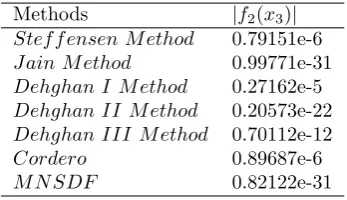
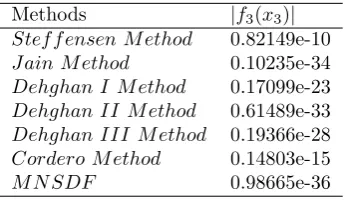
Table 2-6 shows the comparison of these methods for these functions. All the numerical computations have been carried out using MATHEMATICA 8. The numerical results show that the our proposed method is efficient.
Table 2. Errors Occurring in the estimates of the root of functionf1(x) = sin2(x)−x2+ 1 after third iteration by the method
described with initial guessx0= 1.
Methods |f1(x3)|
Stef f ensen M ethod 0.27307e-3
J ain M ethod 0.15974e-11
Dehghan I M ethod 0.12208e-3
Dehghan II M ethod 0.27058e-7
Dehghan III M ethod 0.23473e-9
Cordero M ethod 0.16292e-9
[image:4.595.42.216.451.551.2]M N SDF 0.22293e-12
Table 3. Errors Occurring in the estimates of the root of function f2(x) = x2−ex−3x+ 2 after third iteration by the method
described with initial guessx0= 0.7.
Methods |f2(x3)|
Stef f ensen M ethod 0.79151e-6
J ain M ethod 0.99771e-31
Dehghan I M ethod 0.27162e-5
Dehghan II M ethod 0.20573e-22
Dehghan III M ethod 0.70112e-12
Cordero 0.89687e-6
Table 4. Errors Occurring in the estimates of the root of functionf3(x) =cos(x)−xafter third iteration by the method described
with initial guessx0= 1.
Methods |f3(x3)|
Stef f ensen M ethod 0.82149e-10
J ain M ethod 0.10235e-34
Dehghan I M ethod 0.17099e-23
Dehghan II M ethod 0.61489e-33
Dehghan III M ethod 0.19366e-28
Cordero M ethod 0.14803e-15
M N SDF 0.98665e-36
Table 5. Errors Occurring in the estimates of the root of functionf4(x) = cos(x)−xex+x2 after third iteration by the method
described with initial guessx0= 1.
Methods |f4(x3)|
Stef f ensen M ethod 0.46704e-2
J ain M ethod 0.15915e-10
Dehghan I M ethod 0.85626e-2
Dehghan II M ethod 0.40435e-7
Dehghan III M ethod 0.15970e-5
Cordero M ethod 0.19461e-2
M N SDF 0.53152e-12
Table 6. Errors Occurring in the estimates of the root of functionf5(x) =ex−1.5−arctan(x) after third iteration by the method
described with initial guessx0= 1.
Methods |f5(x3)|
Stef f ensen M ethod 0.78069e-3
J ain M ethod 0.99920e-15
Dehghan I M ethod 0.43288e+0
Dehghan II M ethod 0.11102e-15
Dehghan III M ethod 0.21494e-10
CorderoM ethod 0.55888e-13
M N SDF 0.11102e-15
REFERENCES
[1] D. Kincaid and W. Cheney: Numerical Analysis , Second Edition, Brooks/Cole, Pacific Grove, CA (1996).
[2] A. Cordero, J. L. Hueso, E. Martinez and J. R. Torregrosa: Steffensen type methods for solving non-linear equations, Journal of Computational and Applied Mathematics, 236 (2012), 3058-3064.
[3] Z. Liu, Q. Zheng, and P. Zhao: A variant of Steffensens method of fourth-order convergence and its applications. Appl. Math. Comput., 214 (2010) 1978-1983.
[4] H. Ren, Q. Wu, and W. Bi: A class of two-step Steffensen type methods with fourth-order convergence. Appl. Math. Comput., 209 (2009) 206-210 .
[5] Q. Zheng, P. Zhao, and F. Huang: A family of fourth-order Steffensen-type methods with the applications on solving nonlinear ODEs. Appl. Math. Comput., 217 (2011) 8196-8203 .
[6] M. S. Petkovi´c, and S. Ili´c, and J. Dˇzuni´c: Derivative free two-point methods with and without memory for solving nonlinear equations. Appl. Math. Comput., 217 (2010) 1887-1895 .
[7] P. Jain: Steffensen type methods for solving nonlinear equations, Applied Mathematics and Computation, 194 (2007) 527-533.
[8] M. Dehghan and M. Hajarian: Some derivative free quadratic and cubic convergence iterative formulas for solving nonlinear equations, Computational and Applied Mathematics, 29 (2010) 19-30.
[9] M. Dehghan and M. Hajarian: On derivative free cubic convergence iterative methods for solving nonlinear equations, Computational Mathematics and Mathematical Physics, 51 (2011) 513-519.