Sharif University of Technology
Scientia IranicaTransactions C: Chemistry and Chemical Engineering www.scientiairanica.com
Stability of binary and ternary copper (II) complexes of
2((4-methyl-5-nitro-6-(pyrrolidine-1-yl)pyrimidine-2-yl)amino) propionic acid in aqueous
solution
S.A.A. Sajadi
a;, G. Bagherzadeh
b, M. Khaleghian
aand M. Kermani
b a. Institute of Water & Energy, Sharif University of Technology, Tehran, P.O. Box 11155-8639, Iran. b. Department of Chemistry, Birjand University, Birjand, Iran.Received 22 April 2013; received in revised form 28 December 2013; accepted 15 March 2014
KEYWORDS Ternary complexes; Divalent metal ions; Potentiometric titration;
Acidity and stability constants.
Abstract.The acidity and stability constants of M (MNPPAP) (MNPPAP: 2((4-methyl-5-nitro-6-(pyrrolidine-1-yl)pyrimidine-2-yl)amino)propionic acid) M: Cu2+, Cu (Bpy)2+
(Bpy: 2,20-Bipyridine), or Cu(Phen)2+ (Phen: 1,10-Phenanthroline) complexes were
determined by potentiometric pH titration. It is shown that the stability of the binary Cu (MNPPAP) complex is determined by the basicity of the carboxylate group on one side and amine group on the other side. It is demonstrated that the equilibrium, Cu(Har)2+(Har:
Heteroaromatic ligand such as Bpy or Phen) + Cu(MNPPAP) Cu(Har)(MNPPAP) + Cu2+, is displacement due to the well known experience that mixed ligand complexes
formed by a divalent 3d ion, a heteroaromatic N base, and an O donor ligand possessing increased stability. The other part of this displacement amounts, on average, to no increased stability of the mixed ligand Cu (Bpy)(MNPPAP) and Cu(Phen)(MNPPAP) complexes. The stability constants were determined by potentiometric pH titration in aqueous solution. The order of the stability constants was reported. A comparative investigation between ternary complexes of MNPPAP, Trp (Trp: L-Tryptophan) and Gly (Gly: Glycine) is made. The comparison of stability constants of these ternary complexes show that Cu (Har) (MNPPAP) and Cu (Har) (Gly) exist in open form, but Cu (Har)(Trp) is found near 100% in closed form. The dierences between the above mentioned stability constants are based on stacked form of Cu (Har) (Trp), and provide increased stability compared with Cu (Har)(MNPPAP).
c
2014 Sharif University of Technology. All rights reserved.
1. Introduction
Peptides interact with metal ions primarily through side chain functional groups, although there are many examples of peptide amide nitrogens functioning as donor atoms with certain metal ions. Many physio-logically important peptides function as metal com-plexes [1,2]. The chemical structure of MNPPAP
*. Corresponding author.
E-mail address: [email protected] (S.A.A. Sajadi)
is shown in Figure 1. MNPPAP contains identical chemical structure like amino acids, so that we expect similar chemical properties [3].
Among the side chains of amino acids, the indole moiety is the most potent electron donor [4]. Indeed, charge-transfer-type interactions between tryptophan or other indole derivatives and nucleosides or nu-cleotides occur in aqueous solution [5-9]. Based on the above mentioned essential role of amino acids, it is interesting to study the interaction of other metal ions with MNPPAP. Because of the essential roles of
Figure 1. Chemical formula of MNPPAP (a,b), L-Tryptophan (c,d) and Glycine (e,f).
amino acids in biological systems, it is important to in-vestigate their interactions with dierent ternary metal ion complexes and the regarding complex binding.
The importance of noncovalent interactions for the shape of macromolecules, and the selectivity in natural system are generally accepted, and especially hydrophobic and stacking interactions have been con-sidered in mixed ligand complexes [8-10].
It is interesting to investigate the complex build-ing of ternary systems with MNPPAP. We would like to determine the thermodynamic constants of ternary complexes such as Cu(Har)(MNPPAP).
2. Experimental 2.1. Materials
Copper(II) nitrate trihydrated, sodium nitrate, potas-sium hydrogen phthalate and standard solutions of sodium hydroxide (titrasol), 2,20-bipyridyl,
1,10-phenanthroline, nitric acid, EDTA and the buer solutions of pH 4.0, 7.0 and 9.0 were purchased from Merck company, Darmstadt. MNPPAP was prepared by Bagherzadeh [10] whose purication was carried out carefully and was about 98%. All the starting materials
were pro analysis and used without further purication. Water was puried by Mili-Q water purication system, deionized and distillated.
2.2. pH titrations
Reagents: Carbonate-free sodium hydroxide 0.03 M was preparated and standardized against sodium hy-drogen phthalate and a standard solution of nitric acid 0.5 mM. Copper (II) nitrate solution (0.03 M) was prepared in water and calibrated with standard solution of EDTA 0.1 M (triplex).
2.3. Apparatus
All pH titrations were performed using a Metrohm 794 basic automatic titrator (Titrino), coupled with a Hero thermostating bath at 25C (0:1C) and a Metrohm
combined glass electrode (Ag/AgCl). The pH meter was calibrated with Merck standard buer solutions (4.0, 7.0 and 9.0).
2.4. Procedure
For the determination of acid dissociation constants of the ligand MNPPAP, an aqueous solution (0.3 mM) of the protonated ligand was titrated with 0.03 M NaOH at 25C under nitrogen atmosphere and ionic
strength of 0.1 M, NaNO3. For the determination
of binary (one ligand and Cu2+) and ternary systems
(Cu2+, one of the other L ligand (Har) and MNPPAP),
the ratios used were 1:1:1, Cu (II): MNPPAP: Har, 0.3 mM. This solution was titrated with 0.03 M NaOH under the same conditions mentioned above. Each titration was repeated seven times in order to check the reproducibility of the data (Figure 2).
2.5. Calculation
The acid dissociation constants, KH
H2(MNPPAP) and
KH
H(MNPPAP) for H2(MNPPAP) were calculated by an
algebraic method [11,12]. The equilibria involved in the
Figure 2. pH titration of acid, MNPPAP, Cu,
Cu(MNPPAP), Cu(Bpy), Cu(Bpy)(MNPPAP), Cu(Phen), Cu(Phen)(MNPPAP).
formation of 1:1 complex of MNPPAP and a divalent metal ion will be discussed below.
The stability constants KM
M(MNPPAP) for the
metal ions M2+complexes were calculated with a
com-puter connected to a printer for each pair of titrations by taking into account the species H+, H2(MNPPAP),
H(MNPPAP) , MNPPAP2 , M2+, and M(MNPPAP).
Throughout, the data were collected (every 0.1 pH unite) from about 10% complex formation to a neu-tralization degree of about 90% or the beginning of the hydrolysis of M2+
(aq), the latter was evident from
the titration without MNPPAP. The values calculated individually for KM
M(MNPPAP) showed no dependence
on pH or on the excess amount of M2+.
2.5.1. Acidity constants
MNPPAP can accept one proton on carboxalate group for which the deprotonation equilibriums reads:
H2(MNPPAP) H++ H(MNPPAP) ; (1a)
KH
H2(MNPPAP)=[H(MNPPAP) ][H+]
=[H2(MNPPAP)]: (1b)
MNPPAP can release one other proton from amine group according to the deprotonation equilibrium:
H(MNPPAP) H++ MNPPAP2 ; (2a)
KH
H(MNPPAP)=[MNPPAP2 ][H+]
=[H(MNPPAP) ]: (2b) Also the two protons in H2(MNPPAP) are certainly
bound at the terminal acetate group and amine group, i.e. it is released from -CO2H or -NH- according to
equilibriums (1) and (2). These values are as accepted, close to the pKa values of -CO2H which is 2.92 [8].
2.5.2. Stability of binary and ternary complexes If we abbreviate for simplicity Cu2+, Cu(Bpy)2+, and
Cu(Phen)2+ with M2+, one may write the following
two equilibriums:
M2++ H(MNPPAP) M(H; MNPPAP)+; (3a)
KM
M(H;MNPPAP)=[M(H; MNPPAP)+]
=[M2+][H(MNPPAP) ]; (3b) M2++ (MNPPAP)2 M(MNPPAP); (4a)
KM
M(MNPPAP)=[M(MNPPAP)]
=[M2+][MNPPAP2 ]: (4b)
The experimental data of the potentiometric pH titra-tions may be analyzed by considering the above men-tioned equilibriums (1) through (4), if the evaluation is not carried into the pH range where hyrdroxide complex formation occurs.
The stability of ternary complexes may be evalu-ated by the equilibrium:
mA + nB + qM + rH AmBnMqHr; (5a)
where M is the metal ion, H is the proton, A and B are the ligands. The global stability constants for the ternary complexes may be represented as following:
log pqrs= [AmBnMqHr]=[A]m[B]n[M]q[H]r: (5b)
It is possible to dene the stability constants for ternary complexes in relation to their binary ones [9], represented by:
M + L1 ML1; (6a)
KM
M(L1)= [ML1]=[M][L1]; (6b)
ML1+ L2 ML1L2; (7a)
KM
M(L1L2)= [ML1L2]=[ML1][L2]: (7b)
Dierences between the stability constants of the ternary and binary complexes show the tendency of the formation of ternary species [10]. This could be expected by Eq. (8):
log K = log KML1
M(L1L2) log KM(L2)M ;
= log KM(L1L2)ML2 log KM
M(L1): (8)
The dierence between the constant obtained from experimental data and those calculated statistically using Eq. (8) indicates the possibility of ligand-ligand interaction.
3. Results and discussion 3.1. Potentiometric analyses
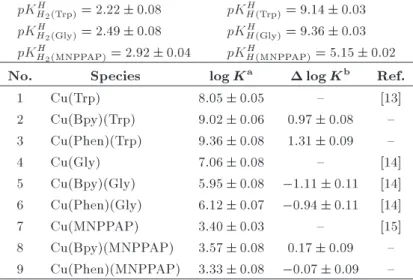
The model of species for these ternary systems that was used in superquad program includes all the species of Table 1 as well as the hydrolysis of Cu2+ [11,12]. The
stability constants of the binary complexes were rened separately using the titration data of this system in a 1:1 and 1:2 ligand: Cu2+ ratio in the same conditions
of temperature and ionic strength. They were xed and, consequently, only ternary species were rened in ternary model of the species. The results are summarized in Table 1 and Figure 2.
As we can use from Figure 2, the rst and second curves belong to acid and ligand (MNPPAP). The
Table 1. Logarithm of the stability constants of binary and ternary complexes of M2+at 25C, 0.1 M, NaNO 3.
pKH
H2(Trp)= 2:22 0:08 pKH(Trp)H = 9:14 0:03
pKH
H2(Gly)= 2:49 0:08 pKH(Gly)H = 9:36 0:03
pKH
H2(MNPPAP)= 2:92 0:04 pKH(MNPPAP)H = 5:15 0:02
No. Species log Ka log Kb Ref.
1 Cu(Trp) 8:05 0:05 { [13]
2 Cu(Bpy)(Trp) 9:02 0:06 0:97 0:08 { 3 Cu(Phen)(Trp) 9:36 0:08 1:31 0:09 {
4 Cu(Gly) 7:06 0:08 { [14]
5 Cu(Bpy)(Gly) 5:95 0:08 1:11 0:11 [14] 6 Cu(Phen)(Gly) 6:12 0:07 0:94 0:11 [14]
7 Cu(MNPPAP) 3:40 0:03 { [15]
8 Cu(Bpy)(MNPPAP) 3:57 0:08 0:17 0:09 { 9 Cu(Phen)(MNPPAP) 3:33 0:08 0:07 0:09 {
: The given errors are three times the standard error of the mean value
or the sum of the propabable systematic errors;
a: according to Eq. (4); b: according to Eq. (8).
comparison of these both curves shows the delayed deprotonation of ligand. The buer depression of the ligand-curve is higher than acid curve. This means that the basicity of ligand in this region is much higher than acid. The regarding calculation of this dierence provides us with the acidity constants of the ligand. The third curve represents the titration of copper (II) ion and as we can see, the formation of hydroxo complex is distinguishable when pH > 5:5. This means for us, that the received data upper than 5.5 cannot use for the calculation of the stability constants. The fourth curve shows the titration of copper (II) in present of ligand. This means that the interaction between copper (II) ion and ligand can take place when pH < 5.5. Also similar to the last case, the fth and seventh curves show the titration of Cu(bpy)2+ and
Cu(phen)2+ without ligands. Identical to the third
curve, the formation of hyroxo complex takes place when pH > 5.5. The sixth and eighth curves show the titration of Cu(bpy)2+and Cu(phen)2+in the presence
of ligand (MNPPAP). The interaction between two systems Cu(bpy)2+and Cu(phen)2+with ligand for the
formation of ternary complexes is considered when pH < 5.5. The received data in this region is summarized and calculated for determination of complex stability constants (Section 2.5). The last mentioned constants represent the thermodynamic data of inter- and in-tramolecular interaction in these ternary complexes.
The order of the resulted stability constants are Cu2+ < Cu(Bpy)2+ < Cu(Phen)2+ for Trp and Cu2+
Cu(Bpy)2+ Cu(Phen)2+ for MNPPAP. Figure 3
shows schematic structures of the species with interac-tions according to equilibrium relainterac-tionships (4) and (7) for Cu(Phen)(Trp). The dierence between stability
Figure 3. Schematic structures of the species with interactions according to equilibrium relationships (4) and (7) for Cu(Phen)(Trp). The structure in the right part of the gure was drawn with the program CS Chem 3D, version 3.5, from Cambridge Software Corporation.
constants according to Eq. (8) show that mixed ligand complexes [16-19] formed by a divalent 3d ion, a heteroaromatic N base and an O donor ligand possess increased stability. It has to be further emphasized that the basicity of the carboxylate group in aqueous solution is very low and consequently this also applies to the coordinating properties of this group.
Comparison of the stability constants for the Cu(Bpy)(MNPPAP) and Cu(Phen)(MNPPAP) com-plexes in Table 1 with the corresponding values for Cu(MNPPAP) indicates no increased stability of the mixed-ligand species. It is well known for a num-ber of Cu(Har)(L) complexes that there is no
in-tramolecular stack between the aromatic ring sys-tems of 2,20-Bipyridine and 1,10-phenanthroline and
the heteroaromatic ring of MNPPAP (opened form $ closed form) [10]. The dierence between the above mentioned constants, if exists, demostrates the experimentally ligand-ligand stack interaction in the Cu(Har)(MNPPAP) complexes.
As seen from the experimentally results from Table 1, there is no increased stability constants in case of Cu(Har)(Gly), meaning that there is no indication of intramolecular stack interactions. For this reason, we can use the stability constants of Cu(Har)(Gly) as opened form in our next calculations.
By employing Eq. (8), the following denition may be adopted:
log K = log Kcl log Kop
= log KCu(Phen)(MNPPAP)
log KCu(Phen)(Gly); (9)
where cl represents the closed form of Cu(Phen) (MNPPAP), and op stands for the open form of Cu(Phen)(MNPPAP).
It is evident that the coordination spheres of Cu2+
ions on both sides of this equilibrium are identical, consequently the value for logK is a true reection of the extent of the intramolecular hydrophobic or stacking interaction in Cu(Har)(MNPPAP) complexes. The corresponding results are listed in the fourth column of Table 2.
Now we can dene the intramolecular and thus dimensionless equilibrium constant KI which for the
open and closed forms is given by
KI = [Cu(Phen)(L)]cl=[Cu(Phen)(L)]op: (10)
The observed increased complex stability is linked to
KI by:
KI = 10 log K 1: (11)
Knowledge of KIallows calculation of percentage of the
macrochelated form according to [10]:
%Cu(Har)(L) = 100 KI=(1 + KI): (12)
The results of the calculations of the above mentioned equations are summarized in Table 2.
Comparison of the percentage of the macro-chelated form, according to Eq. (12), in Table 2 shows the high stacking tendency of Trp based on hetero-aromatic structure of indole moiety [5].
The distinctive structural characteristic of trypto-phan is that it contains an indole functional group. It is an essential amino acid as demonstrated by its growth eects on rats [2,3]. Now it is interesting to investigate the complex building of ternary systems with Trp. The comparison of stability constants of these ternary complexes show that Cu(Har)(Gly) exists in open form but Cu(Har)(Trp) is found near 100% in closed form (the last column in Table 2). The dierences between the stability constants are based on evidence of no stacked form of Cu(Har)(MNPPAP). Based on the structural properties of MNPPAP, there is evidently no possibility for intramolecular interactions referred to as the stack in Cu(Har)(MNPPAP). The reported results in Table 2 provide evidence for this conclusion. This is interesting, because the ternary complexes of Trp indicate activity in biological systems. This might be used, for example in the case of cell separa-tion. The inhibition of DNA cleavage and blocking of cell divisions can be inuenced by strong stack building of Har and Trp with nucleotide bases.
4. Conclusion
MNPPAP contains identical chemical structure like amino acids, so that we expect similar chemical
prop-Table 2. Extent of intramolecular stack formation in ternary Cu(Har)(L) complexes as calculated from stability constants (Eq. (7)). Intramolecular and dimensionless equilibrium constant KI(Eq. (11)) and percentage of stacked Cu(Har)(L)cl
species (Eq. (12)) in aqueous solution at 25C, 0.1 M, NaNO 3.
No. Speciesa log Kb log Kc Kd
I %Cu(Har)(L)ecl
1 Cu(Bpy)(Trp) 0:97 0:08 2:08 0:14 119:23 38:76 99:17 0:27 2 Cu(Phen)(Trp) 1:31 0:09 2:25 0:14 176:83 57:34 99:44 0:18
3 Cu(Bpy)(Gly) 1:11 0:11 { { {
4 Cu(Phen)(Gly) 0:94 0:11 { { {
5 Cu(Bpy)(MNPPAP) 0:17 0:09 { { {
6 Cu(Phen)(MNPPAP) 0:07 0:09 { { {
: The given errors are three times the standard error of the mean value or the sum of the propabable
systematic errors.
a: From Table 1;b: According to Eq. (8);c: According to Eq. (9); d: According to Eq. (11);e: According to Eq. (12).
erties. In contrast to amino acids, MNPPAP contains a secondary amine group. Secondary amine groups are normally inhibited groups for easy coordination. On the other hand, it is possible that a metal ion simultaneously coordinates to carboxyl group and the N(3) pyrimidine ring, thus forming a macrochelate. References
1. IUPAC-IUBMB Joint Commission on Biochemical Nomenclature. Recommendations on Organic & Bio-chemical Nomenclature, Symbols & Terminology etc. http: //www.chem.qmul.ac.uk/iupac/AminoAcid/. Retrieved 2007-05-17. Gollnick, P., Babitzke, P., Antson, A. and Yanofsky, C. \Complexity in regulation of tryptophan biosynthesis in Bacillus subtilis", Annu. Rev. Genet., 39, pp. 47-68 (2005).
2. Moat, A.C., Jackson, J.V., Moss, M.S. and Widdop, B., Clarke's Isolation and Identication of Drugs, The Pharmaceutical Press, London, UK, pp. 1056-1060 (1986).
3. a) Fiorucci, A.R. and Cavalheiro, E.T.G. \The use of carbon paste electrode in the direct voltammetric determination of tryptophan in pharmaceutical formu-lations", J. Pharm. Biomed. Anal., 28, pp. 909-915 (2002).
b) Young, V.R. \Adult amino acid requirements: The case for a major revision in current recommendations", J. Nutr., 124(8), pp. 24-28 (1994).
4. Hussey, H.H. \Sleep inducement by L-tryptophan", J. Am. Chem. Soc., 87, pp. 1126-1128 (1974).
5. Cioni, P. and Strambini, G.B. \Tryptophan phospho-rescence and pressure eects on protein structure", Biochim. Biophys. Acta, 1595, pp. 116-130 (2002). 6. Liang, Y.D. and Song, J.F. \Flow-injection
chemilu-minescence determination of tryptophan through its peroxidation and epoxidation by peroxynitrous acid", J. Pharm. Biomed. Anal., 38, pp. 100-106 (2005). 7. Altria, K.D., Harkin, P. and Hindson, M.G.
\Quan-titative determination of tryptophan enantiomers by capillary electrophoresis", J. Chromatogr. Biomed., 686, pp. 103-110 (1996).
8. Weast, R.C., Handbook of Chem. & Physics, 55th Ed., pp. 129-130, CRC Press (1975).
9. Miranda, J.L. and Felcman, J. \Study on guanidino-carboxylate interactions in copper(II) ternary com-plexes of guanidinoacetic acid with glutamic and as-partic acids", Polyhedron, 22, pp. 225-233 (2003). 10. a) Bakavoli, M., Bagherzadeh, G. and Rahimizadeh,
M. \Synthesis of optically active imidazo[1,2-a]pyrimidin-3(2H)-ones", Mendeleev Communications, 15(4), pp. 145-146 (2005).
b) Sigel, H. \Mixed ligand complexes", Metal Ions in Biological Systems, 2, pp. 3-10, Marcel Dekker, New York (1973).
11. a) Martel, A.E., Critical Stability Constants of Metal Complexes, 26 (2006).
b) Chabereck, S. and Martel, A.E. \Stability of metal chelates. VII. N,N0-ethylenediamine-dipropionic acid
and N,N0-ethylenediaminetetrapropionic acid", J. Am.
Chem. Soc., 75(19), pp. 4814-4818 (1953).
c) Felcman, J. and Miranda, A. \A potentiometric study of Ni(II), Cu(II), Zn(II), Cd(II) and Pb(II), J.L", J. Braz. Chem. Soc., 8, pp. 575-580 (1997).
12. a) Taqui Khan, M.M. and Martel, A.E. \Metal ion and metal chelate catalyzed oxidation of ascorbic acid by molecular oxygen. I. Cupric and ferric ion catalyzed oxidation", J. Am. Chem. Soc., 89, pp. 5585-5590 (1967).
b) Sigel, H. and Zuberbueler, A.D. \Comments on potentiometric pH titrations and the relationship be-tween pH-meter reading and hydrogen ion concentra-tion", Analy. Chim. Acta, 255, pp. 63-72 (1991). c) Sigel, H., Massoud, S.S. and Corfu, N.A. \Compar-ison of the extent of macrochelate formation in com-plexes of divalent metal ions withguanosine (GMP2 ), inosine (IMP2-), and adenosine 50-monophosphate
(AMP2-). The crucial role of N-7 basicity in metal ion-nucleic base recognition", J. Am. Chem. Soc., 116, pp. 2958-2971 (1994).
d) Sigel, R.K.O., Song, B. and Sigel, H. \Stabilities and structures of metal ion complexes of adenosine 50
-O-thiomonophosphate (AMPS2 ) in comparison with
those of its parent nucleotide (AMP2 ) in aqueous
solution", J. Am. Chem. Soc., 119, pp. 744-755 (1997). e) Sigel, H., Chen, D. and Gregan, F. \Metal- ion-coordinating properties of various phosphonate deriva-tives, including 9-[2-(phosphonylmethoxy) ethyl] ade-nine (PMEA) - an adenosine monophosphate (AMP) analogue) with antiviral properties", Helv. Chim. Acta, 75, pp. 2634-2656 (1992).
f) Miller Frey, C. and Stuehr, J.E. \Interactions of divalent metal ions with inorganic and nucleotide phosphates. I. Thermodynamics", J. Am. Chem. Soc., 94, pp. 8898-8904 (1972).
g) Sigel, H. \Comparison of the stabilities of binary and ternary complexes of divalent metal ions with the 50-triphosphates of adenosine, inosine, guanosine,
cytidine, uridine and thymidine", Inorg. Nucl. Chem., 39, pp. 1903-1911 (1977).
h) Kiss, T., Soago, I. and Martin, R.B. \A13+binding
by adenosine-50-phosphates: AMP, ADP and ATP", J.
Am. Chem. Soc., 111, pp. 3611-3614 (1989).
13. Sigel, H., Zuberbuehler, A.D. and Yamauchi, O. \Comments on potentiometric pH titrations and the relationship between pH-meter reading and hydrogen ion concentration", Anal. Chim. Acta, 63, pp. 255-257 (1991).
14. Sajadi, S.A.A. and Mirzai, M. \Ternary complexes of glycine in aqoeous solution", 4th Intern. Conf. Drug Discovery & Therapy, Dubai, in press (2012).
15. Sajadi, S.A.A., Bagherzadeh, G., Kermane, M. and Khaleghian, M. \Complex bilding behavior
of 2((4-methyl-5-nitro-6-(pyrrolidine-1-yl)pyrimidine-2-yl)amino)propionic acid in aqueous solution", Open Journal of Inorganic Non-metallic Materials, 3, pp. 6-9 (2013).
16. Sajadi, S.A.A., Song, B. and Sigel, H. \Ternary complexes in solution. Intramolecular stacking in-teractions in mixed ligand complexes formed by copper (II), 2,20-bipyridyl or 1,10-phenanthroline
and a pyrimidine-nucleoside 50-diphosphate (CDP3 ,
UDP3 , dTDP3 )", Inorg. Chim. Acta, 283, pp.
193-201 (1998).
17. Sajadi, S.A.A., Song, B., Gregan, F. and Sigel, H. \Acid-base and metal ion-coordinating properties of pyrimidine- nucleoside 50-diphosphate (CDP, UDP,
dTDP) and of several sample diphosphate monoesters. Establishment of relations between complex stability and diphosphate basicity", Inorg. Chem., 38(3), pp. 439-448 (1999).
18. Sajadi, S.A.A., Song, B., Gregan, F. and Sigel, H. \Ternary complexes in solution: Intramolecular hy-drophobic and stacking interactions in mixed ligand complexes formed by copper(II) 2,20-Bipyridyl or
1,10-phenanthroline, and n-butyl diphosphate (BuDP3 )
or phenyl diphosphate (PhDP3 )", Bull. Chem. Soc.
Ethiop., 11(2), pp. 121-130 (1997).
19. Sajadi, S.A.A., Bastian, M. and Sigel, H. \Stabilities of metal Ion complexes of adenosine 50-diphosphate
(ADP3 ) and uridine 50-diphosphate (UDP3 )", J.
Inorg. Biochem., 59(2,3), p. 139 (1995).
Biographies
Seyed Ali Akbar Sajadi is a Professor (1997) at Sharif University of Technology, Tehran, Iran, where he has been Dozent since 1997. He earned his PhD (1997) from Institute of Inorganic Chemistry of the University of Basel, Basel, Switzerland, with Prof. H. Sigel. His research interests focus on the industerial and inorganic materials, recycling methods, stability, structure, and reactivity of simple and mixed ligand metal ion complexes of nucleic acids and amino acids, and other ligands of biological interest. He is a member of American Chemical Society.
Ghodsieh Bagherzadeh is a Professor (2005) at Birjand University, Birjand, Iran, where she has been Dozent since 2005. She earned his PhD (2004) from Department of Chemistry, Ferdowsi University of Mashhad, Mashhad, Iran. Her major research interest is the discovery, characterization, and application of natural products that have potential uses for organic synthesis and biochemistry.
Marzieh Khaleghian received her Bachelor degree in pure chemistry at Al-Zahra University. She studied analytical chemistry and received her Master degree at the same university.
Massoud Kermani received his Bachelor degree in pure chemistry at Birjand University. He studied organic chemistry and received his Master degree at Birjand University, Birjand, Iran.