R
ICHARDM. F
ELDERDepartment of Chemical Engineering North Carolina State University
R
EBECCAB
RENTEducation Designs, Inc.
A
BSTRACTStudents have different levels of motivation, different attitudes about teaching and learning, and different responses to specific classroom environments and instructional practices. The more thoroughly instructors understand the differences, the better chance they have of meeting the diverse learning needs of all of their students. Three categories of diversity that have been shown to have important implications for teaching and learning are differences in students’ learning styles (characteristic ways of taking in and processing information), approaches to learning (surface, deep, and strategic), and intellectual development levels (attitudes about the nature of knowledge and how it should be acquired and evaluated). This article reviews models that have been developed for each of these categories, outlines their pedagogical implications, and suggests areas for further study. Keywords:learning styles, approaches to learning, intellectual development
Instruction begins when you, the teacher, learn from the learner. Put yourself in his place so that you may understand what he learns and
the way he understands it. (Kierkegaard)
I. T
HREEF
ACETS OFS
TUDENTD
IVERSITY Declining interest in engineering among high school students in recent years has led to steep enrollment decreases in many engineer-ing programs. Although the problem has been exacerbated by high student dropout rates that have characterized engineering cur-ricula for decades, many engineering faculty members continue to view the attrition positively, believing the dropouts are mainly weak students who are unqualified to become engineers. This belief is wrong. In their classic study Talking about Leaving [1], Seymour and Hewitt showed that grade distributions of students who leave technical curricula are essentially the same as the distributions of those who stay in. While many of those who drop out do so because of academic difficulties, many others are good students who leave because of dissatisfaction with their instruction, a fact made graphically clear in comments quoted by Seymour and Hewitt.Faculty complaints about students who remain in engineering through graduation are also commonly heard, with many of the complaints being variations of “They can memorize and plug
num-bers into formulas but they don’t know how to think!” And yet, most engineering departments have one or more faculty members who manage to get many of those same students to perform at re-markably high levels, displaying first-rate problem-solving and crit-ical and creative thinking skills. Skill deficiencies observed in engi-neering graduates must therefore also be attributable in part to what instructors are doing or failing to do.
An implication of these observations is that to reduce enroll-ment attrition and improve the thinking and problem-solving skills of engineering graduates, engineering schools should attempt to improve the quality of their teaching, which in turn requires under-standing the learning needs of today’s engineering students and de-signing instruction to meet those needs. The problem is that no two students are alike. They have different backgrounds, strengths and weaknesses, interests, ambitions, senses of responsibility, levels of motivation, and approaches to studying. Teaching methods also vary. Some instructors mainly lecture, while others spend more time on demonstrations or activities; some focus on principles and others on applications; some emphasize memory and others under-standing. How much a given student learns in a class is governed in part by that student’s native ability and prior preparation but also by the compatibility of the student’s attributes as a learner and the in-structor’s teaching style.
This is not to say that instructors should determine their stu-dents’ individual learning attributes and teach each student exclu-sively in the manner best suited to those attributes. It is not possi-ble to discover everything that affects what a student learns in a class, and even if instructors could, they would not be able to figure out the optimum teaching style for that student—the task would be far too complex. Moreover, even if a teacher knew the optimum teaching styles for all students in a class, it would be im-possible to implement them simultaneously in a class of more than two students.
If it is pointless to consider tailoring instruction to each individual student, it is equally misguided to imagine that a single one-size-fits-all approach to teaching can meet the needs of every student. Un-fortunately, a single approach has dominated engineering education since its inception: the professor lectures and the students attempt to absorb the lecture content and reproduce it in examinations. That particular size fits almost nobody: it violates virtually every principle of effective instruction established by modern cognitive science and educational psychology [2–5]. Any other approach that targets only one type of student would probably be more effective, but it would still fail to address the needs of most students. It follows that if com-pletely individualized instruction is impractical and one-size-fits-all is ineffective for most students, a more balanced approach that attempts to accommodate the diverse needs of the students in a class at least some of the time is the best an instructor can do.
Diversity in education usually refers to the effects of gender and ethnicity on student performance. Those effects are important and are considered elsewhere in this journal issue [6]. This article exam-ines three other important aspects of student diversity:
● Learning Styles.Learning styles are “characteristic cogni-tive, affeccogni-tive, and psychological behaviors that serve as relatively stable indicators of how learners perceive, interact with, and respond to the learning environment” [7]. The concept of learning styles has been applied to a wide variety of student attributes and differences. Some students are com-fortable with theories and abstractions; others feel much more at home with facts and observable phenomena; some prefer active learning and others lean toward introspection; some prefer visual presentation of information and others prefer verbal explanations. One learning style is neither preferable nor inferior to another, but is simply different, with different characteristic strengths and weaknesses. A goal of instruction should be to equip students with the skills asso-ciated with every learning style category, regardless of the students’ personal preferences, since they will need all of those skills to function effectively as professionals.
● Approaches to Learning and Orientations to Studying. Students may be inclined to approach their courses in one of three ways [8]. Those with a reproducing orientation tend to take a surface approach to learning, relying on rote memoriza-tion and mechanical formula substitumemoriza-tion and making little or no effort to understand the material being taught. Those with a meaning orientation tend to adopt a deep approach, probing and questioning and exploring the limits of applicability of new material. Those with an achieving orientation tend to use a strategic approach, doing whatever is necessary to get the high-est grade they can, taking a surface approach if that suffices and a deep approach when necessary. A goal of instruction should be to induce students to adopt a deep approach to subjects that are important for their professional or personal development. ● Intellectual Development.Most students undergo a
devel-opmental progression from a belief in the certainty of knowl-edge and the omniscience of authorities to an acknowledg-ment of the uncertainty and contextual nature of knowledge, acceptance of personal responsibility for determining truth, inclination and ability to gather supporting evidence for judgments, and openness to change if new evidence is forth-coming. At the highest developmental level normally seen in college students (but not in many of them), individuals dis-play thinking patterns resembling those of expert scientists and engineers. A goal of instruction should be to advance students to that level by the time they graduate.
In this article, we outline models of student learning style prefer-ences, orientations to studying, and levels of intellectual develop-ment; review the implications of the models for engineering educa-tion; and suggest promising avenues for future study. Before doing so, we briefly discuss the topic of assessment instrument validation, a research issue central to all three of these diversity domains.
II. A N
OTE ONV
ALIDATIONMuch of this paper describes assessments of various student at-tributes and inferences that have been drawn from the data. Before too much stock is placed in such inferences, the instrument used to collect the data should be shown to be reliable (consistent results are obtained in repeated assessments) and valid (the instrument mea-sures what it is intended to measure).
In another paper in this issue, Olds, Moskal, and Miller [9] offer a good introduction to reliability and validity analysis. Some of the measures of reliability and validity they discuss that are applicable to instruments of the types we will describe are these:
● Test-retest reliability: the extent to which test results for an in-dividual are stable over time.
● Internal consistency reliability: the homogeneity of items in-tended to measure the same quantity—that is, the extent to which responses to the items are correlated.
● Scale orthogonality: the extent to which the different scales of the instrument (if there are two or more scales) are independent. ● Construct validity: the extent to which an instrument actually
measures the attribute it purports to measure. The instru-ment scores are said to have convergent validity if they corre-late with quantities with which they should correcorre-late and di-vergent or discriminant validity if they fail to correlate with quantities with which there is no reason to expect correlation. Reliability and validity data of these types are readily obtainable for some of the instruments to be discussed, while for others (no-tably several of the learning style assessment instruments) they are difficult or impossible to find. At the end of each of sections III (Learning Styles), IV (Approaches to Learning), and V (Levels of Intellectual Development), we offer lists of potential research ques-tions. To each list might be added the following two-part question: If an assessment instrument is used to study any of the preceding ques-tions, what reliability and validity data support its use (a) in general, and (b) for the population studied?
III. L
EARNINGS
TYLESStudents are characterized by different learning styles, preferen-tially focusing on different types of information and tending to op-erate on perceived information in different ways [10, 11]. To reduce attrition and improve skill development in engineering, instruction should be designed to meet the needs of students whose learning styles are neglected by traditional engineering pedagogy [12–14].
Several dozen learning style models have been developed, five of which have been the subject of studies in the engineering education literature. The best known of these models is Jung’s Theory of Psy-chological Type as operationalized by the Myers-Briggs Type Indi-cator (MBTI). Strictly speaking, the MBTI assesses personality types, but MBTI profiles are known to have strong learning style implications [14–16]. This instrument was the basis for a multi-campus study of engineering students in the 1970s and 1980s and a number of other engineering-related studies since then [17–24]. Other models that have been applied extensively to engineering are those of Kolb [12, 14, 25–31], and Felder and Silverman [13, 14, 32–40]. We discuss these three models in the sections that follow. Two other models that have been used in engineering are those of Herrmann [14, 41–43], and Dunn and Dunn [44–46]. Relatively little assessment has been performed on the applicability of these models to instructional design in engineering, and we do not discuss the models further in this paper. For information about them, see the cited references.
Before we look at specific models, we should note that the con-cept of learning styles is not universally accon-cepted. The simple men-tion of the term arouses strong emomen-tional reacmen-tions in many mem-bers of the academic community (notably but not exclusively the
psychologists), who argue that learning style models have no sound theoretical basis and that the instruments used to assess learning styles have not been appropriately validated. On the other hand, the studies summarized in the sections that follow paint a clear and con-sistent picture of learning style differences and their effects on stu-dent performance and attitudes. Additionally, instruction designed to address a broad spectrum of learning styles has consistently proved to be more effective than traditional instruction, which focuses on a narrow range of styles. We therefore propose taking an engineering approach to learning styles, regarding them as useful heuristics for understanding students and designing effective instruction, and con-tinuing to use them until demonstrably better heuristics appear.
A. The Myers-Briggs Type Indicator
People are classified on the Myers-Briggs Type Indicator® (MBTI) according to their preferences on four scales derived from Jung’s Theory of Psychological Types [15]:
● extraverts (try things out, focus on the outer world of people) or introverts (think things through, focus on the inner world of ideas).
● sensors (practical, detail-oriented, focus on facts and proce-dures) or intuitors (imaginative, concept-oriented, focus on meanings and possibilities).
● thinkers (skeptical, tend to make decisions based on logic and rules) or feelers (appreciative, tend to make decisions based on personal and humanistic considerations).
● judgers (set and follow agendas, seek closure even with in-complete data) or perceivers (adapt to changing circum-stances, postpone reaching closure to obtain more data). Lawrence [15] characterizes the preferences, strengths, and weak-nesses of each of the 16 MBTI types in many areas of student functioning and offers numerous suggestions for addressing the learning needs of students of all types, and Pittenger [16] re-views research based on the MBTI.
Most engineering instruction is oriented toward introverts (lec-turing and individual assignments rather than active class involve-ment and cooperative learning), intuitors (emphasis on science and math fundamentals rather than engineering applications and opera-tions), thinkers (emphasis on objective analysis rather than interper-sonal considerations in decision-making), and judgers (emphasis on following the syllabus and meeting assignment deadlines rather than on exploration of ideas and creative problem solving). In 1980, a consortium of eight universities and the Center for Applications of Psychological Type was formed to study the role of personality type in engineering education. Predictably, introverts, intuitors, thinkers, and judgers generally outperformed extraverts, sensors, feelers, and perceivers in the population studied [19, 21]. In work done as part of this study, Godleski [20] reported on grades in four sections of the introductory chemical engineering course at Cleve-land State University taught by three different instructors. The em-phasis in this course is on setting up and solving a wide variety of problems of increasing complexity, with memory and rote substitu-tion in formulas playing a relatively small role. Intuitors would be expected to be at an advantage in this course, and the average grade for the intuitors in all sections was indeed higher than that for sen-sors. Godleski obtained similar results for other courses that em-phasized intuitive skills, while in the few “solid sensing” courses in the curriculum (such as engineering economics, which tends to be formula-driven) the sensors scored higher.
In a longitudinal study carried out at the University of Western Ontario by Rosati [22, 23], male introverts, intuitors, thinkers, and judgers at the low end of the academic spectrum were found to be more likely to succeed in the first year of the engineering curriculum than were their extraverted, sensing, feeling, and perceiving coun-terparts. Rosati also observed that the introverts, thinkers, and judgers in the low-performance male population were more likely than the extraverts, feelers, and perceivers to graduate in engineer-ing after four years, although the sensors were more likely than the intuitors to do so. No statistically significant type differences were found for academically strong male students or for female stu-dents.
As part of another longitudinal study, Felder [24] administered the MBTI to a group of 116 students taking the introductory chemical engineering course at North Carolina State University. That course and four subsequent chemical engineering courses were taught in a manner that emphasized active and cooperative learn-ing, and type differences in various academic performance measures and attitudes were noted as the students progressed through the curriculum. The results were remarkably consistent with expecta-tions based on type theory:
● Intuitors performed significantly better than sensors in courses with a high level of abstract content, and the converse was observed in courses of a more practical nature. Thinkers consistently outperformed feelers in the relatively impersonal environment of the engineering curriculum, and feelers were more likely to drop out of the curriculum even if they were doing well academically. Faced with the heavy time demands of the curriculum and the corresponding need to manage their time carefully, judgers consistently outperformed perceivers.
● Extraverts reacted more positively than introverts when first confronted with the requirement that they work in groups on homework. (By the end of the study, both groups almost unanimously favored group work.)
● The balanced instruction provided in the experimental course sequence appeared to reduce or eliminate the perfor-mance differences previously noted between sensors and in-tuitors and between extraverts and introverts.
● Intuitors were three times more likely than sensors to give themselves top ratings for creative problem-solving ability and to place a high value on doing creative work in their careers.
● The majority of sensors intended to work as engineers in large corporations, while a much higher percentage of intu-itors planned to work for small companies or to go to gradu-ate school and work in research. Feelers placed a higher value on doing socially important or beneficial work in their careers than thinkers did.
Very few results failed to confirm expectations from type theory, and most of the failures involved type differences that might have been expected to be significant but were not. The conclusion was that the MBTI effectively characterizes differences in the ways engineer-ing students approach learnengineer-ing tasks, respond to different forms of in-struction and classroom environments, and formulate career goals.
B. Kolb’s Experiential Learning Model
In Kolb’s model, students are classified as having a preference for (a) concrete experience or abstract conceptualization (how they take
information in) and (b) active experimentation or reflective observa-tion (how they process informaobserva-tion) [12, 25]. The four types of learners in this classification scheme are:
● Type 1 (concrete, reflective)—the diverger. Type 1 learners re-spond well to explanations of how course material relates to their experience, interests, and future careers. Their charac-teristic question is “Why?” To be effective with Type 1 stu-dents, the instructor should function as a motivator.
● Type 2 (abstract, reflective)—the assimilator. Type 2 learners respond to information presented in an organized, logical fashion and benefit if they are given time for reflection. Their characteristic question is “What?” To be effective, the instruc-tor should function as an expert.
● Type 3 (abstract, active)—the converger. Type 3 learners re-spond to having opportunities to work actively on well-defined tasks and to learn by trial-and-error in an environ-ment that allows them to fail safely. Their characteristic question is “How? ” To be effective, the instructor should function as a coach, providing guided practice and feedback in the methods being taught.
● Type 4 (concrete, active)—the accommodator. Type 4 learners like applying course material in new situations to solve real problems. Their characteristic question is “What if ?” To be effective, the instructor should pose open-ended questions and then get out of the way, maximizing opportunities for the students to discover things for themselves. Problem-based learning is an ideal pedagogical strategy for these students. Preferences on this scale are assessed with the Learning Style In-ventory® (McBer and Company, Boston) or the Learning Type Measure® (About Learning Inc., Wauconda, Ill.). Most studies of engineering students based on the Kolb model find that the majori-ty of the subjects are Types 2 and 3. For example, Sharp [26] reports that of 1,013 engineering students she tested, 40 percent were Type 3, 39 percent Type 2, 13 percent Type 4, and 8 percent Type 1. Bernold et al. [27] found that of the 350 students in their study, 55 percent were Type 3, 22 percent Type 2, 13 percent Type 4, and 10 percent Type 1.
Traditional science and engineering instruction focuses almost exclusively on lecturing, a style comfortable for only Type 2 learners. Effective instruction involves teaching around the cycle—motivating each new topic (Type 1), presenting the basic information and methods associated with the topic (Type 2), providing opportuni-ties for practice in the methods (Type 3), and encouraging explo-ration of applications (Type 4).
A faculty training program based on the Kolb learning style model was initiated at Brigham Young University in 1989 [28]. About a third of the engineering faculty was trained in teaching around the cycle. The volunteers implemented the approach in their courses, reviewed videotapes of their teaching, and discussed their successes and problems in focus groups. Many courses were redesigned; instructors—including a number who did not partici-pate in the original training—used a variety of teaching methods in addition to formal lecturing; discussions about teaching became a regular part of department faculty meetings; and several faculty members presented and published education-related papers. Arti-cles describing the program do not indicate the extent to which the modified instruction led to improved learning.
Bernold et al. [27] describe an experiment at North Carolina State University in which one group of students was subjected to
teaching around the cycle (in their term, “holistic instruction”), an-other was taught traditionally, and the course grades earned by the two groups were compared. Although the results were not conclu-sive, they appeared to indicate that Types 1 and 4 students were more likely to get low grades than the more numerous Types 2 and 3 students when teaching was traditional, and that holistic instruction may have helped a more diverse group of students to succeed. Spurlin et al. [29] report on an ongoing study comparing freshman engineering students of the four Kolb types. Their preliminary re-sults also show Types 2 and 3 students doing better academically, and they are conducting further studies intended to pinpoint rea-sons for the relatively poor performance and high risk of attrition of the Types 1 and 4 students.
Julie Sharp of Vanderbilt University has used the Kolb model in several ways as the basis for instructional design. Her work includes the development of a variety of “writing to learn” assignments that should be effective for each of the four Kolb types [30] and applica-tions of the model to instruction in communicaapplica-tions and teamwork [26, 31].
C. The Felder-Silverman Model
1) Model Categories. According to a model developed by Felder and Silverman [13, 32], a student’s learning style may be de-fined by the answers to four questions:
1. What type of information does the student preferentially per-ceive: sensory (sights, sounds, physical sensations) or intuitive (memories, thoughts, insights)? Sensing learners tend to be concrete, practical, methodical, and oriented toward facts and hands-on procedures. Intuitive learners are more comfortable with abstractions (theories, mathematical models) and are more likely to be rapid and innovative problem solvers [47]. This scale is identical to the sensing-intuitive scale of the Myers-Briggs Type Indicator.
2. What type of sensory information is most effectively per-ceived: visual (pictures, diagrams, flow charts, demonstra-tions) or verbal (written and spoken explanademonstra-tions)?
3. How does the student prefer to process information: actively (through engagement in physical activity or discussion) or re-flectively (through introspection)? This scale is identical to the active-reflective scale of the Kolb model and is related to the extravert-introvert scale of the MBTI.
4. How does the student characteristically progress toward un-derstanding: sequentially (in a logical progression of incre-mental steps) or globally (in large “big picture” jumps)? Se-quential learners tend to think in a linear manner and are able to function with only partial understanding of material they have been taught. Global learners think in a systems-oriented manner, and may have trouble applying new material until they fully understand it and see how it relates to material they already know about and understand. Once they grasp the big picture, however, their holistic perspective enables them to see innovative solutions to problems that sequential learners might take much longer to reach, if they get there at all [48]. More detailed descriptions of the attributes of the different model categories and the nature and consequences of learning and teaching style mismatches are given by Felder and Silverman [13] and Felder [32]. Zywno and Waalen [36] report on the develop-ment and successful impledevelop-mentation of hypermedia instruction de-signed to address the learning needs of styles less favored by
traditional instruction, and Sharp [40] describes an instructional module based on the Felder-Silverman model that makes students aware of differences in learning styles and how they may affect per-sonal interactions, teamwork, interactions with professors, and learning difficulties and successes.
2) The Index of Learning Styles.The Index of Learning Styles® (ILS) is a forty-four-item forced-choice instrument devel-oped in 1991 by Richard Felder and Barbara Soloman to assess preferences on the four scales of the Felder-Silverman model. In 1994 several hundred sets of responses to the initial twenty-eight-item version of the instrument were collected and subjected to fac-tor analysis. Items that did not load significantly on single facfac-tors were discarded and replaced by new items to create the current ver-sion, which was put on the World Wide Web in 1997 [49]. The ILS is available at no cost to individuals who wish to assess their own preferences and to instructors or students who wish to use it for classroom instruction or research, and it may be licensed by non-ed-ucational organizations.
Learning style preferences of numerous students and faculty members have been determined using the Index of Learning Styles,
with results summarized in Table 1 [50]. Unless otherwise indicat-ed, the population samples shown in Table 1 are undergraduates. Thus, for example, of the 129 undergraduate engineering students who completed the ILS in a study conducted at Iowa State Univer-sity, 63 percent were classified as active (A) learners (and by impli-cation 37 percent were classified as reflective learners), 67 percent were sensing (S) learners (33 percent intuitive learners), 85 percent were visual (Vs) learners (15 percent verbal), and 58 percent were sequential (Sq) learners (42 percent global).
Table 1 illustrates several of the mismatches described by Felder and Silverman [13] between learning styles of most engineering un-dergraduates and traditional teaching styles in engineering educa-tion. Sixty-three percent of the undergraduates were sensors, while traditional engineering instruction tends to be heavily oriented to-ward intuitors, emphasizing theory and mathematical modeling over experimentation and practical applications in most courses; 82 percent of the undergraduates were visual learners, while most engineering instruction is overwhelmingly verbal, emphasizing written explanations and mathematical formulations of physical phenomena over demonstrations and visual illustrations; and 64
percent of the students were active, while most engineering courses other than laboratories rely almost exclusively on lectures and read-ings as the principal vehicles for transmitting information.
Table 1 also shows that 60 percent of the students assessed were sequential and traditional engineering education is heavily sequen-tial, so this dimension does not involve the same type of mismatch observed for the others. Global students constitute a strong and im-portant minority, however. They are the multidisciplinary thinkers, whose broad vision may enable them to become, for example, skilled researchers or chief executive officers of corporations. Unfor-tunately, traditional engineering education does little to provide students with the systemic perspective on individual subjects they need to function effectively, and the ones who take too long to get it by themselves are at risk academically.
Section II briefly discussed the issue of instrument validation. The Index of Learning Styles is one of the few instruments men-tioned in this paper for which reliability and validity data have been collected for engineering student populations [37,50,54]. We will not provide details of the reliability analyses here; suffice it to say that all three of the studies just cited conclude that the ILS meets or exceeds accepted reliability standards for an instrument of its type. Felder and Spurlin [50] summarize results from several studies that provide evidence of both convergent and divergent construct validi-ty. Profiles of engineering students at different institutions show a high degree of consistency with one another and differ substantially and in a predictable manner from profiles for engineering faculty and humanities students (see Table 1). Another indication of con-vergent validity is that preferences for sensing and active learning measured on the ILS were found to correlate with preferences for sensing and extraversion measured on the Myers-Briggs Type Indicator [33].
As noted previously, the conventional lecture-based teaching approach in engineering education favors intuitive, verbal, reflec-tive, and sequential learners. In yet another demonstration of the construct validity of the ILS, Zywno and Waalen [36] found that on average the performance in conventionally taught courses of each of the favored types was superior to that of the less favored types, and they also found that the use of supplemental hypermedia instruction designed to address the needs of all types decreased the performance disparities. Felder and Spurlin [50], Livesay et al. [37], and Zywno [54] conclude that the ILS may be considered reliable and valid for assessing learning styles, although all three pa-pers recommend continuing research on the instrument.
D. Pedagogical Implications and Potential Misuses of Learning Styles
Studies have shown that greater learning may occur when teach-ing styles match learnteach-ing styles than when they are mismatched [11, 13, 62, 63], but the point of identifying learning styles is not to label individual students and tailor instruction to fit their preferences. To function effectively as engineers or members of any other profes-sion, students will need skills characteristic of each type of learner: the powers of observation and attention to detail of the sensor and the imagination and abstract thinking ability of the intuitor; the abilities to comprehend information presented both visually and verbally, the systematic analysis skills of the sequential learner and the multidisciplinary synthesis skills of the global learner, and so on. If instruction is heavily biased toward one category of a learning style dimension, mismatched students may be too uncomfortable to learn effectively, while the students whose learning styles match the
teaching style will not be helped to develop critical skills in their less preferred learning style categories [13, 14]. The optimal teaching style is a balanced one that sometimes matches students’ prefer-ences, so their discomfort level is not too great for them to learn ef-fectively, and sometimes goes against their preferences, forcing them to stretch and grow in directions they might be inclined to avoid if given the option.
The preceding paragraph suggests what we believe to be the most important application of learning styles, which is to help in-structors design a balanced teaching approach that addresses the learning needs of all of their students. Designing such an approach does not require assessing the students' learning style preferences: it is enough for instructors to select a model and attempt to address all of its categories (in Kolb model terms, to teach around the cy-cle), knowing that every class probably contains students with every preference [14]. Assessing the learning style profile of a class with an instrument such as the Myers-Briggs Type Indicator, the Kolb Learn-ing Style Inventory, or the Index of LearnLearn-ing Styles—without beLearn-ing overly concerned about which students have which preferences— can provide additional support for effective instructional design. For example, knowing that a large majority of students in a class are sensing and visual learners can—and should—motivate the instruc-tor to find concrete and visual ways to supplement the presentation of material that might normally be presented entirely abstractly and verbally. Many specific suggestions for designing instruction to ad-dress the full spectrum of learning styles are given by Felder and Sil-verman [13] and Lawrence [15].
What about identifying individual students' learning styles and sharing the results with them? Doing so can provide them with valu-able clues about their possible strengths and weaknesses and indica-tions of ways they might improve their academic performance. Pre-cautions should be taken if students are told their learning styles, however. The instructor should emphasize that no learning style in-strument is infallible, and if the students’ perceptions of how they learn best differ from what the instrument says, they should not dis-count their own judgment. They should also be assured that their learning style preferences are not reliable indicators of what they are and are not capable of doing, and that people with every possible learning style can succeed in any profession or endeavor. If a student is assessed as, say, a sensing learner, it says nothing about his or her intu-itive skills (or sensing skills, for that matter); it does not mean that he or she is unsuited to be an engineer or scientist or mathematician; and it does not excuse the low grade he or she made on the last exam. In-structors or advisers who use learning styles as a basis for recommend-ing curriculum or career choices are misusrecommend-ing the concept and could be doing serious disservices to their students and advisees.
E. Questions for Further Study
As previously noted, learning styles are controversial, with ques-tions commonly being raised regarding their meaning and even their existence. Much work needs to be done to resolve these ques-tions and also to determine the validity of different learning style models for engineering students and to confirm or refute claims re-garding the effectiveness of a balanced teaching approach. The fol-lowing questions merit investigation:
1. Does an assessed learning style preference indicate (a) the type of instruction a student is most comfortable with or (b) the type of instruction most likely to lead to more effec-tive learning? To what extent are the two coincident?
2. Do any learning style preferences depend on students’ eth-nic and cultural backgrounds? Which preferences, and what are the nature and extent of the dependences?
3. To what extent does teaching exclusively to a student’s learning style preference lead to (a) greater student satisfac-tion, (b) improvement in skills associated with that prefer-ence, (c) lack of improvement in skills associated with the opposite preference?
4. Does a curriculum heavily biased toward a particular learn-ing style increase the incidence of dropouts of students with conflicting styles? To what extent does more balanced in-struction reduce attrition and improve academic perfor-mance of those students?
5. Is the provision of choice over learning tasks an effective strategy for accommodating different learning style prefer-ences? How much choice should be provided and what kind? 6. How effective is instructional technology that provides al-ternative pathways through a body of material, with the pathways being designed to appeal to different learning style preferences?
7. How should learning style preferences be incorporated in advising? How effective are interventions that take learning style into account?
8. Does mixing learning styles when forming project teams lead to better team products? Does it lead to increased in-terpersonal conflict? If the answer to each question is “yes,” do the improved products compensate for the greater con-flict risk? Does making team members aware of their learn-ing style differences lower the potential for conflict? 9. How helpful to students is discussion of learning styles in
class?
10. To what extent are preferences on comparable scales of dif-ferent instruments correlated?
11. To what extent do the answers to any of the preceding questions depend on the strength of students’ learning style preferences?
IV. A
PPROACHES TOL
EARNING ANDO
RIENTATIONS TOS
TUDYINGA. Definitions and Assessment
Marton and Säljö [64] define three different approaches to learning—a surface approach, a deep approach, and a strategic approach.
Students who adopt a surface approach to learning memorize facts but do not try to fit them into a larger context, and they follow routine solution procedures without trying to understand their ori-gins and limitations. These students commonly exhibit an extrinsic motivation to learn (I’ve got to learn this to pass the course, to graduate, to get a good job) and an unquestioning acceptance of everything in the textbook and in lectures. To them, studying means scouring their texts for worked-out examples that look like the homework problems so they can simply copy the solutions. They either ignore the text outside of the examples or they scan through it with a high-lighter, looking for factual information that the instructor might consider important, which they will attempt to memorize before the exam.
Students who take a deep approach do not simply rely on mem-orization of course material but focus instead on understanding it.
They have an intrinsic motivation to learn, with intellectual curiosi-ty rather than the possibilicuriosi-ty of external reward driving their efforts. They cast a critical eye on each statement or formula or analytical procedure they encounter in class or in the text and do whatever they think might help them understand it, such as restating text passages in their own words and trying to relate the new material to things they have previously learned or to everyday experience. Once the information makes sense, they try to fit it into a coherent body of knowledge.
Students who adopt a strategic approach do whatever it takes to get the top grade. They are well organized and efficient in their studying. They carefully assess the level of effort they need to exert to achieve their ambition, and if they can do it by staying superficial they will do so, but if the instructor’s assignments and tests demand a deep approach they will respond to the demand.
A student may adopt different approaches to learning in differ-ent courses and even for differdiffer-ent topics within a single course. An orientation to studying is a tendency to adopt one of the approaches in a broad range of situations and learning environments [5, 8]. Stu-dents who habitually adopt a surface approach have a reproducing orientation; those who usually adopt a deep approach have a mean-ing orientation; and those inclined to take a strategic approach have an achieving orientation. The Lancaster Approaches to Studying Questionnaire (LASQ) [65] is a sixty-four-item questionnaire that involves twelve subscales relevant to the three orientations and four additional subscales. Shorter forms of the LASQ that provide less detailed information are referenced by Woods et al. [66], and an al-ternative to the LASQ is the Study Process Questionnaire devel-oped by Biggs [67].
Woods et al. [66] report on a study in which one of the short forms of the LASQ was administered to 1,387 engineering stu-dents. The strongest inclination of the students was toward a strate-gic approach, followed in order by a surface approach and a deep approach. Bertrand and Knapper [68] report LASQ results for stu-dents in other disciplines. Chemistry and psychology stustu-dents went from a preference for strategic learning in their second year to a preference for deep learning in their fourth year, with both groups displaying consistently low inclinations toward a surface approach.
Bertrand and Knapper [68] also report on three groups of stu-dents in two multidisciplinary curricula—stustu-dents in the second and fourth years of a project-based environmental resource studies program and students in a problem-based program on the impact of new materials. All three groups showed relatively strong inclina-tions toward a deep approach. There was little difference in the pro-files of the second- and fourth-year students, suggesting that the re-sults might reflect the orientations of the students selecting into the programs more than the influence of the programs.
There are similarities between orientations to studying and learning styles. Both represent tendencies that are situationally de-pendent, as opposed to fixed traits like gender or handedness that always characterize an individual. Just as a student who is a strong intuitor may function like a sensor in certain situations and vice versa, a student with a pronounced meaning orientation may under some circumstances adopt a surface approach to learning, and a strongly reproducing student may sometimes be motivated to dig deep. Similarly, just as students may be reasonably balanced in a learning style preference, frequently functioning in ways character-istic of, say, both sensors and intuitors, some students may be al-most equally likely to adopt deep and surface approaches in
different courses and possibly within a given course. We will shortly say more about instructional conditions that influence the choice.
B. Effects of a Deep Approach on Learning Outcomes
Researchers have assessed student approaches to learning and correlated the results with various learning outcomes [3, 5, 69]. In studies cited by Ramsden [5], students who took a deep approach to reading created comprehensive and integrated summaries of mater-ial they had read, interpreting the information rather than simply repeating it, while those who took a surface approach were more likely to recite fragments of the reading content almost randomly. The deep approach also led to longer retention of information— presumably because the information was learned in context rather than by rote memorization—and to consistently higher grades on examinations and in courses.
For example, Prosser and Millar [70] examined first-year physics students’ understanding of force concepts before and after their introductory mechanics course. Eight out of nine students who took a deep approach and only two of twenty-three who used a surface approach showed significant progress in understanding force concepts, moving away from Aristotle and toward Newton. Meyer et al. [71] found that engineering students who adopted a deep approach in a course were very likely to pass the course (in fact, none of their subjects in this category failed), while students who adopted a surface approach were very likely to fail. The students who adopted a deep approach also generally expressed greater satis-faction with their instruction.
C. Motivating a Deep Approach to Learning
The approach a student might adopt in a particular situation de-pends on a complex array of factors. Some are intrinsic to the stu-dent (e.g., possession of prerequisite knowledge and skills and moti-vation to learn the subject), while others are determined more by the instructional environment (e.g., the content and clarity of the instructor’s expectations and the nature and quality of the instruc-tion and assessment).
Biggs [3] proposes that achieving desired learning outcomes re-quires constructive alignment of the elements just listed. Alignment means that the factors under the instructor’s control are all consis-tent with the goal: the desired outcomes are clearly communicated to the students as expectations, instructional methods known to favor the outcomes are employed and methods that work against them are avoided, and learning assessments (homework, projects, tests, etc.) are explicitly directed toward the outcomes. Constructive means that the instructional design adheres to the principle of con-structivism, which holds that knowledge is constructed by the learner, as opposed to being simply transmitted by a teacher and ab-sorbed. The teacher’s job is to create conditions that lead students to construct accurate representations of the concepts being studied, first abandoning prior misconceptions if any exist.
Certain features of classroom instruction have been found to be constructively aligned with the adoption of a deep approach to learning, while other features have the opposite effect [3, 5, 69]:
1. Interest in and background knowledge of the subject encour-age a deep approach; lack of interest and inadequate back-ground discourage it.
2. Clearly stated expectations and clear feedback on progress encourage a deep approach; poor or absent feedback discour-ages it.
3. Assessment methods that emphasize conceptual understand-ing encourage a deep approach; methods that emphasize re-call or the application of routine procedural knowledge dis-courage it.
4. Teaching methods that foster active and long-term engage-ment with learning tasks encourage a deep approach. 5. Opportunities to exercise responsible choice in the content
and method of study encourage a deep approach.
6. Stimulating and caring teaching encourages a deep approach; apathetic or inconsiderate teaching discourages it. A corollary is that students who perceive that teaching is good are more likely to adopt a deep approach than students with the oppo-site perception.
7. An excessive amount of material in the curriculum and an unreasonable workload discourage a deep approach.
8. Previous experiences with educational settings that encour-aged deep approaches further encourage deep approaches . A similar statement can be made regarding surface approaches. Well-established instructional strategies can be used to achieve these conditions. Inductive teaching methods such as prob-lem-based and project-based learning [72–77] can motivate students by helping to make the subject matter relevant to their prior ex- perience and interests (addressing item #1 above) and they al- so emphasize conceptual understanding and de-emphasize rote memorization (item #3). An excellent way to make expectations clear (item #2) is to articulate them in the form of instructional ob-jectives [78–80]—statements of observable actions students should be able to do (define, explain, calculate, derive, model, design) once they have completed a section of a course.
Several student-centered teaching approaches accomplish the goal of actively involving students in learning tasks (item #4), no-tably active learning (engaging students in class activities other than listening to lectures) and cooperative learning (getting students to work in small teams on projects or homework under conditions that hold all team members accountable for the learning objectives asso-ciated with the assignment) [81–84]. Trigwell et al. [85, 86] found a positive correlation between an instructor’s use of such instructional methods and students’ adoption of a deep approach to learning. Other references provide numerous examples of teaching in a stim-ulating caring manner (item #6), providing clear feedback by, among other ways, designing appropriate tests (item #2), and pro-viding choice in learning tasks (item #5) [4, 87–91]. Several of the references cited in this paragraph and the preceding one also summarize research connecting the instructional methods men-tioned with a variety of positive learning outcomes [72, 82, 84].
D. Questions for Further Study
Of the three diversity domains discussed in this paper, ap-proaches to learning may be the one with the most solid research base [3, 5, 69, 92]. However, little has been done thus far to apply and extend the research to engineering. Following are some of the questions that might profitably be studied:
1. What percentages of students in traditional engineering cur-ricula are characterized by reproducing, meaning, and achiev-ing orientations to studyachiev-ing?
2. Do approaches to learning and orientations to studying de-pend on students’ ethnic and cultural backgrounds? What are the nature and extent of the dependences?
3. Does the adoption of a deep approach to learning in an engi-neering course lead to improved learning as it has been shown to do in other disciplines? If so, for which learning outcomes can improvements be demonstrated?
4. Do the instructional conditions and methods (e.g., active learning, cooperative learning, and problem-based learning) that purportedly motivate the adoption of a deep approach do so in engineering? How and to what extent can students with a reproducing orientation be motivated to adopt a deep approach?
5. Would one need to reduce the content or extend the length of the engineering curriculum to reduce the heavy time de-mands on students that have been shown to discourage the adoption of a deep approach?
6. How do students with meaning, reproducing, and achieving orientations to learning compare in high-level thinking skills, such as critical thinking and creative thinking?
7. Might discussing approaches to learning with students pro-mote their adoption of a deep approach?
V. L
EVELS OFI
NTELLECTUALD
EVELOPMENT Many students enter college in what Kroll [93] refers to as a state of “ignorant certainty,” believing that knowledge is certain, beliefs are either right or wrong, the authorities (e.g., their professors and the authors of their textbooks) have the answers, and their job is to memorize those answers and repeat them on tests. As they gain ex-perience, most gradually progress toward a state of (again in Kroll’s terminology) “intelligent confusion,” in which they recognize that all knowledge is contextual, take responsibility for making their own judgments on the basis of evidence rather than relying on the word of authorities, and become relatively sophisticated at gather-ing and interpretgather-ing evidence from a wide range of sources. In other words, those who attain that state (which relatively few do by the time they graduate) come to think like expert scientists and engi-neers. This progression has been referred to as intellectual (or cogni-tive or epistemological) development.Different levels of intellectual development constitute the third category of student diversity to be discussed here. In this section we review several models of intellectual development, discuss their applicability to engineering education, survey existing applica-tions, and suggest areas for further exploration. Much of the ma-terial presented is drawn from a pair of articles recently pub-lished in this journal [94, 95].
A. Models of Intellectual Development
Four models of intellectual development are described in the lit-erature. The first, Perry’s Model of Intellectual Development [96,97], is the only one that has had widespread application in engi-neering education [98–106]. The low and intermediate levels of Perry’s model are almost identical to the low and intermediate levels of the King-Kitchener Model of Reflective Judgment [97, 107, 108], which may be the most widely used and validated of the four models outside engineering education. (The two models diverge at their highest levels, which are rarely attained by college students.) In Women’s Ways of Knowing, Belenky et al. [109] suggest that Perry’s model largely characterizes men (its formulation was based almost entirely on interviews with male students) and propose an
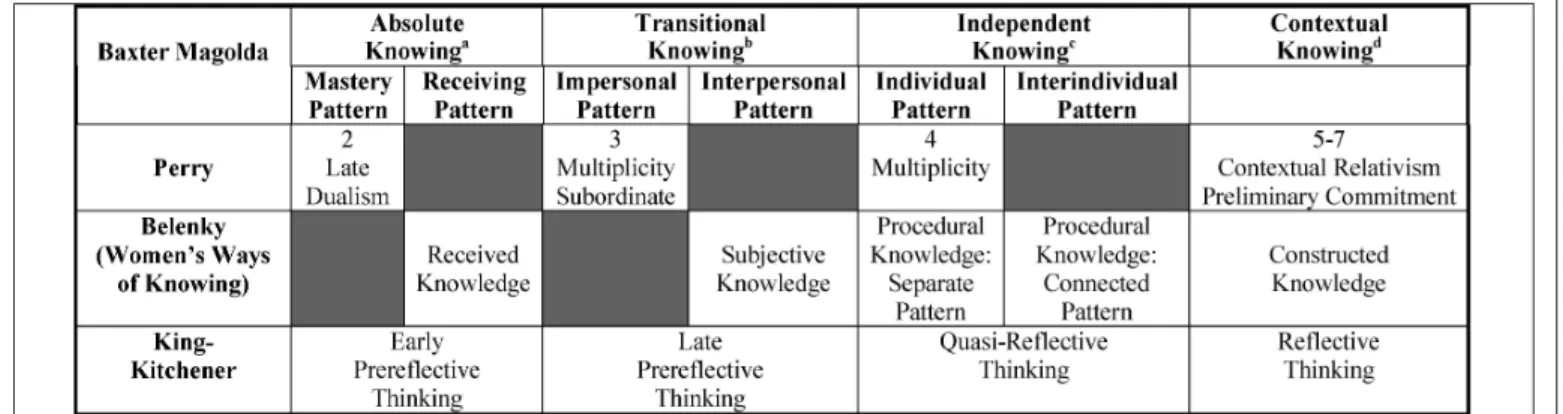
alterna-tive progression of stages intended to characterize women’s devel-opment. Baxter Magolda’s Model of Epistemological Develop-ment [97, 110] integrates the preceding models by defining alterna-tive patterns for all levels but the highest one, with one pattern characterizing more men than women and the other more women than men. Table 2 shows the levels and patterns of the Baxter Magolda model and the correspondences between that model and the other three. The paragraphs that follow discuss primarily the models of Baxter Magolda and Perry.
The developmental pattern described by all four models has the following general form. Students at the lowest levels (Baxter Magolda’s absolute knowing and Perry’s dualism) believe that every intellectual and moral question has one correct answer and their professors (at least the competent ones) know what it is. As the stu-dents confront challenges to their belief systems in their courses and through interactions with peers, they gradually come to believe in the validity of multiple viewpoints and concurrently decrease their reliance on the word of authorities (Baxter Magolda’s transitional and independent knowing and Perry’s multiplicity). Baxter Magolda’s highest level, contextual knowing, which parallels Perry’s contextual relativism (Level 5) and the early stages of commitment in the face of uncertainty (Level 6 and perhaps Level 7), is characterized by final rejection of the notions of the certainty of knowledge and the omni-science of authorities. Contextual knowers take responsibility for constructing knowledge for themselves, relying on both objective analysis and intuition and taking into account (but not accepting without question) the ideas of others whose expertise they ac-knowledge. They move away from the idea commonly held by independent knowers (Level 4 on the Perry scale) that all opin-ions are equally valid as long as the right method is used to arrive at them, and they acknowledge the need to base judgments on the best available evidence within the given context, even in the face of uncertainty and ambiguity.
B. Assessment of Development
In the method traditionally used to assess developmental levels, trained interviewers conduct structured open-ended interviews, the interviews are transcribed, and trained raters analyze the transcripts and assign levels to the interviewees. While this method is univer-sally considered the most valid and reliable approach to assessment, the cost of implementing it has motivated the design of pencil-and-paper instruments that can be more easily administered and scored. The Measure of Intellectual Development (MID) for the Perry model [111] and the Measure of Epistemological Reflection (MER) for the Baxter Magolda model [112, 113] call for students to write essays on topics derived from the interview protocols, and the essays are rated in the same manner as the interview transcripts. The Learning Environment Preferences (LEP) questionnaire [114] and Reflective Thinking Appraisal [115] are Likert-scale instru-ments for assessing levels on the Perry and King-Kitchener models, respectively.
While pencil-and-paper instruments are easier and faster to ad-minister than interviews, the ratings obtained tend to be one to two positions lower than ratings obtained with interviews and correlate moderately at best with interview ratings [100, 104]. To improve the correlation, Pavelich, Miller, and Olds [104] developed an on-line tool called Cogito, which asks questions about scenarios related to four controversial issues, asks follow-up questions based on the responses, and uses a neural net to identify response patterns and
assign levels to them. The neural net is trained on a set of responses submitted by individuals with known levels on the Reflective Judg-ment and Perry models (based on structured interviews). In initial tests, the maximum correlation coefficient of about 0.5 between the interview-based levels and the Cogito-assigned levels was indeed higher than the best values obtained for the pencil-and-paper in-struments, but was still well below the desired minimum value of 0.8. The authors speculated that 0.5–0.6 might be an upper bound to the correlation coefficient between ratings obtained using inter-views and objectively-scored instruments.
C. Levels of Development of Engineering Students
Table 3 summarizes results of two studies in which the Perry levels of beginning and advanced engineering undergraduates were measured. Pavelich’s study [102] was carried out to assess the effect on intellectual development of the strong experiential learning envi-ronment at the Colorado School of Mines. The study by Wise et al. [106] was intended to determine the effect of a first-year project-based design course at Penn State. The studies are remarkably con-sistent in their assessments of the initial and final average levels of
the subjects. Most of the entering students were near Perry Level 3, only beginning to recognize that not all knowledge is certain and still relying heavily on authorities as sources of truth. The average change after four years of college was one level, with most of the change occurring in the last year. Neither instructional approach met its goal of elevating a significant number of students to Level 5. As discouraging as these results might seem, one could speculate that a curriculum lacking such features as the experiential learning environment at Mines or the project-based first-year experience at Penn State (in Wankat’s term, a “dualistic curriculum” [91]) would lead to even less growth than was observed in the two studies in question.
Wise et al. [106] also report Perry ratings of eight male engi-neering students and eight female engiengi-neering students who com-pleted the first-year project-based design course. There was initially no appreciable difference between the two groups in average Perry rating or SAT scores. At the end of the first year, the average Perry rating was 3.50 for the men and 3.16 for the women; at the end of the third year the ratings were 3.50 (men) and 3.00 (women); and at the end of the fourth year the ratings were 4.00 (men) and 4.50
Table 3. Perry levels of engineering students. Table 2. Models of intellectual development [94].
(women). None of the differences were statistically significant although the differences for the third year came close (p0.054). The lack of significance could be an artifact of the small sample size. To the extent that the observed differences are real, they support the contentions of Belenky et al.[109] and Baxter Ma-golda [110] that men and women exhibit different patterns of development.
D. Promoting Intellectual Development
A necessary condition for students’ intellectual growth is chal-lenge to the beliefs that characterize their current developmental lev-els. An absolute knower who is never confronted with open-ended questions that have multiple solutions cannot be expected to accept the reality of multiplicity and move to transitional knowing sponta-neously. Similarly, an independent knower who is not challenged for inadequate use of evidence in making judgments is not likely to make the shift to contextual knowing.
The challenge cannot be too great, however. If students are con-fronted with tasks that call for thinking too far above their current developmental level (in Vygotsky’s term, outside their Zone of Proximal Development [116]), they may not be capable of under-standing what is being required of them. Moreover, challenge alone—even at an appropriate level—may not be sufficient to move students to higher levels of development. Students confronted with challenges to their fundamental beliefs may feel threatened and ei-ther persist at their current developmental levels or retreat to even lower levels. To avoid these outcomes, instructors should provide appropriate support to help their students meet the challenges.
Felder and Brent [95] propose five instructional conditions that should provide the balance of challenge and support needed to pro-mote intellectual growth and suggest numerous ways to establish the conditions. The conditions are listed in Table 4. Most of the methods suggested in [95] are supported by extensively cited refer-ences on teaching and learning [2, 3, 5, 87, 88, 90, 91], and the student-centered approaches of Condition D have repeatedly been shown to have positive effects on a wide variety of learning out-comes [119–123]. However, until a researcher implements the rec-ommendations and assesses the intellectual development of the subjects (ideally comparing their growth with that of a control group that goes through a traditionally taught curriculum), the ef-fectiveness of the conditions in Table 4 at promoting growth will remain speculative.
E. Questions for Further Study
The study of the intellectual development of engineering stu-dents is still in a preliminary stage, with many basic questions as yet unaddressed. Several of the questions follow.
1. What intellectual development level distributions character-ize most engineering students at different stages of the cur-riculum? Are there differences between students at different types of schools? Do levels vary with demographic or socio-logical factors or academic predictors such as SAT scores, and if so, how? Do levels correlate with course grades? Are the contrasting gender-related patterns of Baxter Magolda’s model observed for engineering students? What levels and patterns characterize engineering faculty?
2. To what extent do levels on the different models of intellec-tual development acintellec-tually correspond in the manner shown in Table 2? (Those correspondences are based entirely on the descriptions of the levels and not on comparative data.) 3. To what extent do the instructional conditions listed in Table
4 promote intellectual development? What other instruction-al conditions or methods do so, and to what extent?
4. Is Vygotsky’s Zone of Proximal Development a reality in the context of intellectual development? In other words, are as-sertions that students cannot cope with instruction more than (say) one Perry level above their current developmental level valid, or can suitable support enable them to bridge broader cognitive gaps?
5. What are the effects of introducing students to the concept of intellectual development? For example, would being able to identify their own attitudes in the context of developmental levels promote their intellectual growth, or might explicit de-scription of the different stages of development lead to resent-ment and increased resistance from students at lower levels?
VI. T
EACHING TOA
DDRESSA
LLT
HREEF
ORMS OFD
IVERSITYTeaching strategies have been recommended to help instructors meet the needs of the full spectrum of learning styles [13, 15, 26], induce students to adopt a deep approach to learning [3, 5, 69], and promote students’ intellectual development [95]. The prospect of implementing three different teaching approaches simultaneously to achieve all three goals could be intimidating to instructors, but commonalities among the three diversity domains and the instruc-tional methods that address them make the task manageable. The basis of the discussion that follows is the set of recommendations for promoting intellectual development presented in Table 4.
Assigning a variety of learning tasks (part of Condition A of Table 4) is foremost among the methods that have been recom-mended to address learning goals in all three diversity domains. Variation enables instructors both to challenge the beliefs about knowledge and its acquisition that characterize different develop-mental levels and to ensure that students are confronted with some assignments that require a deep approach to learning. Variety in as-signments is also a cornerstone of recommendations for addressing the full spectrum of learning styles, with some problems emphasiz-ing practical considerations and requiremphasiz-ing careful attention to details (sensing strengths) and others calling for theoretical interpretation and mathematical modeling (intuitive strengths), some involving
Table 4. Instructional conditions that facilitate intellectual growth [95].
individual efforts (reflective) and others requiring teamwork (active), and so on.
A clear similarity exists between the characteristics of a deep ap-proach to learning and the defining attributes of Baxter Magolda’s contextual knowledge level of intellectual development (Perry Level 5 and above). Both a deep approach and contextual knowing involve taking responsibility for one’s own learning, questioning authorities rather than accepting their statements at face value, and attempting to understand new knowledge in the context of prior knowledge and experience. A reasonable assumption is that conditions known to promote a deep approach should also promote intellectual growth. As we noted in section IV-C, Conditions A3, B, C, D1, D2, and E1 of Table 4 have been shown to encourage a deep approach.
Inductive instructional approaches such as problem-based learn-ing (Condition D of Table 4) should also be effective for addresslearn-ing the learning goals associated with all three domains. Open-ended problems that do not have unique well-defined solutions pose a seri-ous challenge to students’ low-level beliefs in the certainty of knowl-edge and the role of instructors as providers of knowlknowl-edge. Such problems by their very nature also require a deep approach to learn-ing (rote memorization and simple algorithmic substitution belearn-ing clearly inadequate strategies for them), and solving them eventually requires skills associated with different learning styles: the imagina-tion and capacity for abstract thinking of the intuitor and the atten-tion to detail of the sensor; the holistic vision of the global learner and the systematic analytical approach of the sequential learner.
Requiring students to modify their fundamental beliefs about the nature of knowledge can be unsettling or threatening, as can calling on them to adopt a deep approach to learning when they are inclined to a surface approach or to complete assignments that call for abilities not normally associated with their learning style prefer-ences. It is reasonable to speculate that the conditions in Table 4 in-volving support for students should help students respond success-fully to these types of challenges. Offering a choice of learning tasks (part of Condition A of Table 4), explicitly communicating expec-tations (Condition B), modeling and providing practice and feed-back on high-level tasks (Condition C), and showing respect for students at all levels of development (Condition E) are all ways to provide support.
While these linkages among the domains may appear logical, they must be considered speculative in the absence of rigorous con-firmatory analysis. Here, then, is our final list of suggested questions to explore.
1. How strong is the hypothesized link between orientation to studying and level of intellectual development? Put another way, to what extent does a student’s level of intellectual devel-opment correlate with his or her tendency to adopt a deep ap-proach to learning?
2. What correlations exist between learning styles and ap-proaches to learning and/or levels of intellectual develop-ment? For example, are intuitors more likely than sensors and global learners more likely than sequential learners to adopt a deep approach? Are there developmental level differences be-tween students with different learning style preferences? 3. Are there gender-related patterns in learning style
prefer-ences or orientations to studying comparable to the patterns in Baxter Magolda’s Model of Epistemological Develop-ment? Are there cultural differences in any of the three diver-sity categories?
4. To what extent do each of the conditions listed in Table 4— including the use of student-centered instructional models such as cooperative learning and problem/project-based learning—promote intellectual growth, the adoption of a deep approach, and the development of skills associated with different learning styles in engineering students? Are there instructional methods or conditions not covered in Table 4 that would achieve the same goals?
VII. S
UMMARYStudents differ from one another in a wide variety of ways, in-cluding the types of instruction to which they respond best (learn-ing styles), the ways they approach their studies (orientations to studying and approaches to learning), and their attitudes about the nature of knowledge and their role in constructing it (levels of intel-lectual development). While much has been written about all three categories of diversity in the general education literature, relatively little solid research specific to engineering education has been per-formed. We have suggested a number of promising areas for study:
● Validating instruments used to assess learning styles, orientations to study, and levels of intellectual development of engineering stu-dents. Most of the instruments listed in this paper have been subjected to reliability and validity analysis, but few of the validation studies involved engineering student populations. While results obtained with an instrument that has not been rigorously validated may be informative (especially if they are consistently replicated in independent studies), conclusions can be made and generalized with much greater confidence if the instrument has been shown to be reliable and valid for the population being studied.
● Characterizing students. Learning style profiles, orientations to study, and levels of intellectual development of engineer-ing students should be assessed and analyzed. Differences in any of the three should be identified among (a) students at different levels of a single engineering curriculum, (b) stu-dents in different branches of engineering, (c) stustu-dents at dif-ferent types of schools (research-intensive and teaching-in-tensive, public and private, small and large), (d) engineering students and students in other disciplines, and (e) students and faculty.
● Establishing correlations among the three diversity domains. Correlations among learning styles, orientations to study, and levels of intellectual development should be identified. Correlations could be useful for instructional design—so that, for example, if the anticipated correlation between a meaning orientation to study and a contextual knowing level of development on Baxter Magolda’s scale (Perry Level 5) is verified, instructors wishing to promote the intellectual de-velopment of their students could feel more confident in using methods known to promote a deep approach to learn-ing. Moreover, confirming the existence of anticipated corre-lations would support the construct validity of the instru-ments used to assess the positions or preferences being compared.
● Evaluating the effectiveness of instructional methods and pro-grams. Most engineering faculty would agree that to be effec-tive, instruction should address the needs of students across
![Table 1 illustrates several of the mismatches described by Felder and Silverman [13] between learning styles of most engineering un-dergraduates and traditional teaching styles in engineering educa-tion](https://thumb-us.123doks.com/thumbv2/123dok_us/8414903.2237066/5.918.73.843.49.725/illustrates-mismatches-described-silverman-engineering-dergraduates-traditional-engineering.webp)