Two-Objective Stacking Sequence Optimization
of a Cylindrical Shell Using Genetic Algorithm
M.H. Yas
1, M. Shakeri
and M. Ghasemi-Gol
2In this paper, the stacking sequence optimization of a laminated cylindrical shell has been studied for obtaining maximum natural frequency and buckling stress, simultaneously. An anisotropic cylindrical shell has a nite length with simply supported conditions at both ends. Three-dimensional elasticity approaches are used for free vibration analysis and the buckling stress function is based on the theory of classic shells. A genetic algorithm is used for optimization and, regarding the two-objective problem, a Pareto-optimally curve is used to help determine the best way to simultaneously satisfy all objectives. Finally, numerical results are presented for the optimization of a six-layer cylindrical shell.
INTRODUCTION
Laminated cylindrical shells are widely used in in-dustries as structural elements and their vibration characteristics are important, in view of the current interest in designing with composite materials. The greatest advantage of laminated composite materials, in addition to high strength to weight properties, is that they provide designers with the ability to tailor the directional strengths and stinesses of the material to the given loading environment of the structure. There-fore, laminated composite constructions oer many opportunities for engineers and designers to optimize structures for a particular, or even multiple, tasks. The problem is often formulated as a continuous op-timization problem, with the thickness and orientation of the plies as the design variable [1], but for most particular problems, laminate thicknesses are xed and orientations are limited to a set of angles, so the design problem becomes a stacking sequence optimization. Haftka and Walsh solved the stacking sequence problem for buckling load maximization [2]. The nonlinear problem, resulting from using ply thicknesses as design variables, is linearized by using ply- orientation identity variables and then solved using a branch and bound
1. Department of Mechanical Engineering, Razi University, Kermanshah, I.R. Iran.
*. Corresponding Author, Department of Mechanical Engi-neering, Amir Kabir University, Tehran, I.R. Iran.
2. Department of Mechanical Engineering, Maleke Ashtar University, Lavizan, Tehran, I.R. Iran.
algorithm. Nagendra solved a similar problem with the additional strain constraints, once again introducing non-linearities to the problem. This problem was solved by using a sequence of linear integer program-ming techniques [3]. The design space usually contains many local extrema, even singular ones and, also, many near optima designs may exist. Thus, there is a need for optimization techniques that can identify multiple and singular exterma. Optimization methods based on Genetic Algorithms (GA), have been applied to structural problems [4]. In the area of composite structural design, a GA is used to optimize the stacking sequence of laminated plates for buckling loads [5], to design stiened composite cylindrical shells against buckling [6] and optimized tailoring problems [7]. A GA is the probabilistic optimization method that works on the population of design [8]. In genetic algorithm approaches, the solution is called a chromosome or string. A genetic search requires a population of chro-mosomes, each representing a combination of features from the set of features. In recent years, genetic algorithms have been successfully applied to large, non-convex, integer programming problems [9,10]. Thus, it was obvious that genetic algorithms would be well suited for the design and optimization of laminated composite plates. Early works include Callahan, who used genetic algorithms for the stacking sequence optimization of composite plates [11]. Negendra did extensive work with genetic algorithms and stiened composite panels [12,13]. The optimization problem utilized a single objective frequency of a composite laminated cylindrical shell. For multi-constraint
prob-lems, since the best single objective usually doesn't imply that the other objective(s) is simultaneously optimized, the concept of Pareto-optimality is often used to help determine the best way to simultaneously satisfy all objectives to the greatest extent possible. In this case, each string represents an alternative stacking sequence of a laminated cylindrical shell. A genetic algorithm is devised for designing composite laminates comprised of one material only. The genetic algorithm procedure, which is referred to as GA-I, will be used for maximization of the lowest natural frequency of a laminated cylindrical shell with strength and ply contiguity constraints.
Shakeri et al. studied the stacking sequence optimization of a laminated cylindrical shell, based on natural frequency [14]. They used the genetic algorithm procedure for maximization of the lowest natural frequency with strength and ply contiguity constraints. Grosset et al. considered the optimization of a composite laminated plate made from two mate-rials [15]. The multi-objective optimization problem requires the construction of a Pareto trade-o curve. This paper uses genetic algorithms to optimize the natural frequency and buckling load simultaneously. For this purpose, by solving a series of optimization problems combining the two objective functions, the Pareto set is generated by optimizing a combination of the two objectives and, nally, the best stacking sequence is obtained. The free vibration solution is based on Shakeri et al. [16] and, for buckling load, Tasi's work [17] is used. In the end, numerical results are presented for a six layer composite cylindrical shell.
PROBLEM FORMULATION
A laminated composite hollow cylindrical shell is con-sidered of length L with MN constituent monoclinic laminate. The mean radius and the thickness of layers are denoted byRandh, respectively. The material axis of any orthotropic layer is not necessarily aligned in the
xanddirections, hence, the constitutive equations of a layer are, as follows:
8 > > > > > > < > > > > > > : x r r xr x 9 > > > > > > = > > > > > > ; = 2 6 6 6 6 6 6 4
C11 C12 C13 0 0 C16
C12 C22 C23 0 0 C26
C13 C23 C33 0 0 C36
0 0 0 C44 C45 0
0 0 0 C45 C55 0
C16 C26 C36 0 0 C66 3 7 7 7 7 7 7 5 8 > > > > > > < > > > > > > : "x " "r r xr x 9 > > > > > > = > > > > > > ; ; (1)
The equations of motion in the absence of body forces are:
ij;j =ui: (2)
The strain-displacement relations are written as:
"ij= 12(ui;j+uj;i): (3)
By combining Equations 1 with 3 for axisymmetric loading and substituting into Equation 2, one can obtain the governing equations in terms of the displace-ment components (ur,u, ux). The coecients of the
obtained governing equations are a function of variable
r, which makes the solution formidable. To circumvent this diculty, the following changes of variable are used:
k =RkK;r1 = 1Rk(1 k);
1
r2 = 1R 2
k(1 2k): (4)
The local coordinate is used, ask=r Rk. Each layer
is assumed to be thin (k=Rk <<1). By substituting
Equation 4 into the equations of motion, the equations of motion, with constant coecients for each layer, are obtained:
Ck
33
@2u
r
@2 +C
k
33
@ur
@ +C55k R 2
k@
2u
r
@x2 C
k
22
ur
r2
+Rk
"
(C36 C45 C26)
@u0
@x +(C36+C45)
@2u
@@x
+ (Ck
13 C
k
12)
@ux
r@x + (C13k +C
k
55)
@2u
x
@x@
#
=kR2
k@
2u
r
@t2 ;
Rk
"
(2Ck
45+C
k
26)
@ur
@x + (C45k +C
k
36)
@2u
r
@x@
#
+Ck
44
@2u 0
@2 +C
k
44
@u0
@ C44ku 0+R
2
kC66
@2u 0
@x2
+Ck
45
@2u
x
@2 + 2C
k
45Rk
@ux
r@x +R2
kC16k
@2u
x
@x2
=kR2
k@
2u 0
Rk
"
(C11k +C
k
55)
@ur
@x + (C13k +C
k
55)
@2u
r
@x@
#
+Ck
45
@2u 0
@2 +C
k
16
@2u 0
@2 +C
k
11
@2u
x
@x2
+Ck
55
@2u
x
@2 +
@ux
@
=kR2
k@
2u
x
@t2 : (5)
For simply supported conditions, one has:
r(;x;t) = 0; = h1
2R1
; xr(;x;t) =r(;x;t) = 0;
= h1
2R1
; 2hRMM: (6) To study the free vibrations, the inner and outer surfaces are traction free:
r=r=xr= 0: (7)
Moreover, the conditions of continuity of displacements and inter-laminar stresses should be imposed on the solution. These conditions are, as follows:
uki
x; h2Rkk
=uk+1
r
x; hk+1
2Rk+1
; ki
x; h2Rkk
=k+1
r
x; hk+1
2Rk+1
; i=r;x;; kr
x; h2Rkk
=k+1
r
x; hk+1
2Rk+1
: (8)
SUCCESSIVE APPROXIMATE SOLUTION
The solutions to Equations 5, which identically satisfy the boundary conditions on the two ends, are consid-ered, as follows:
ur=Ar(k)cos(pmx)exp(i!t);
u=A(k)sin(pmx)exp(i!t);
ux=Ax(k)sin(pmx)exp(i!t); (9)
wherepm=m=L.
The substitution of Equations 9 into Equations 5 yields a system of homogeneous ordinary dierential equations, the solutions to which are, as follows:
Ar(k) =u
re;
A(k) =u
e;
Ax(k) =u
xe: (10)
Upon inserting Solution 10, one arrives at a system of homogeneous algebraic equations, which may be written in matrix form, as follows:
[A]fUg= 0;
where:
fUg=fu
r;u
;u
x): (11)
The condition for Equation 11 to have a nontrivial solution is that the determinant of matrix A should vanish. This leads to the following sixth order algebraic equation:
A06+B05+C04+D03+E02+F0+G0= 0:
(12) The mode shapes may be obtained, which are a function of natural frequency. By substituting the roots of Equation 12 into Equation 11, one nally obtains the displacement components, as follows:
ur=XX
Kmjecos(Pmx)exp(i!t);
u=XX
Kmjesin(Pmx)exp(i!t);
ux=XX
Qmjesin(Pmx)exp(i!t): (13)
Substituting Equations 13 into the traction free con-ditions (Equation 7) and the continuity requirements (Equations 8), leads to a system of 6MN (MN is the number of layers) homogeneous algebraic equations, which are represented in the following matrix form:
[H]fKg= 0; (14)
where fKgare the mode shapes. The components of
[H], which are a 6MN*6MN matrix, are a function of natural frequency. From Equation 14 one has:
jHj= 0: (15)
Equations 12 and 15 should be solved simultaneously by a successive approximate procedure to obtain the rst few natural frequencies. To obtain the buckling stress function, one proceeds as follows:
["] = [a]:[N] [b]T:[];
[M] = [b]:[N] [d]:[]; (16) where [N] and [M] are resultant force and moment components, respectively, [] is curvature matrix and:
[a] = [A 1]; [b] = [B][a]; [d] = [D] [b][B];
[A], [B] and [D] are obtained from the stiness matrix of each layer, as follows:
[A] =
Z
[C]dz; [B] =
Z
[C]z dz;
[D] =
Z
[C]z2dz: (18)
Finally, the buckling load, based on the Donnel ap-proach, is resulted, as follows [17]:
Nxx=
a22
a11
0:5
1
2
d22
R2
n2 1+
NR2
d22
+ (n2 3+R
2(a 22d22)
0:5)2
n2 2
:
(19) Complete calculations for obtaining the buckling load have been described in [17]. For this relation, the coecients description is, as follows:
= (2=n2)(a 22=a11)
0:5;
1=
4+ 20:52+ 1;
2=
4+ 22+ 1;
3=
4+ 22+&;
= (a12+ 0:5a66)=(a11+a22) 0:5;
= (d12+ 2d66)=(d11+d22) 0:5;
= (d11a11)=(a22a22);
=b21=(a11d22) 0:5;
= (0:5(b11+b22) b66)=(a22d22) 0:5;
&= (b12=a22)(a11=d22)
0:5: (20)
GENETIC ALGORITHM
A GA is a guided random technique that works on a population of design. An initial population of a genetic string, with randomly chosen genes, is carried rst. The size of the population used in this paper remains constant throughout the genetic optimization. Various genetic operators are applied at given probabilities to generate new laminates. In order to form successive generations, parents are chosen from the current population, based on their tness. Parent selection is accomplished, using a roulette wheel concept. This method of selection diers from other evolutionary algorithms because it gives every member
of the population a chance to become a parent. Before parent selection can begin, all laminates must be ranked from best to worst, according to the value of each laminate's objective function. Children are created by combining a portion of each parent's genetic string in an operation called a one-point crossover. To determine the crossover point, a uniformly distributed random number is chosen and then multiplied by one less than the maximum number of non-empty genes in the two parents. The integer ceiling value of this product determines the crossover point. The gene string is then split at the same point in both parents. The left piece from parent 1 and the right piece from parent 2 are combined to form a child laminate. After a child is created, the operations of adding, deleting or mutating genes occur with small probabilities. These operators make up genetic mutation. When adding a ply stack, a uniform random number is chosen to determine the orientation. To delete a ply stack, a random number is chosen and the corresponding stack is removed from the stacking sequence by replacing it with a 0 gene. The laminate is then re-stacked, so that all empty plies are pushed to the outer edge of the laminate. The ply swap operator is implemented by randomly selecting two genes in the string and switching their positions. Ply swap can be eective for problems where certain parts of the laminate stacking sequence get set up faster than others. For example, if the optimal stacking sequence for the outer section of the laminate has been determined rst, the ply swap operator may help the GA determine the optimal orientations for the inner part of the laminate by swapping plies from each section. The genetic algorithm procedure, referred to as GA-I (genetic algorithm for designing composite laminates comprised of one material only) is used. For the GA-I algorithm, one string of genes is used to represent one half of a symmetrical laminated composite cylindrical shell. The length of the gene string is kept xed throughout the optimization process. Each gene in the string is represented by an integer value between 0 and 10 and determines whether the ply stack location is empty or occupied with a 3-ply stack, which may be oriented at any angle between 0 and 90, in increments of 10. The tness calculation usually involves function values that are determined from separate analysis subroutines or packages. Next, the crossover mutation and ply swap operators are applied to create child designs, which are, helpfully, better suited to their environment than their parents. The child population is then analyzed and ranked. To complete the generation cycle, a selection scheme is implemented that determines which laminates from the child and parent populations will be placed in the next generation. One generation after another is created until some stopping criterion is met.
MULTI-OBJECTIVE OPTIMIZATION
As mentioned earlier, optimization is carried out for both buckling strength and natural frequency simulta-neously. For this purpose, a genetic algorithm is used for optimization. To obtain a Pareto set of designs, the inuence of buckling load and natural frequency on the overall tness function of a shell conguration is adjusted from one extreme to the other by varying the weight factor accordingly.
F = Fitness function =(Buckling load=100)
+ (1 )(Frequency=100): (21)
This allows the general conguration of the genetic algorithm to be maintained, since the stiness of each laminate design is still based on a single value that is comprised of both buckling load and natural frequency.
RESULTS AND DISCUSSION
It is assumed that laminates are constructed from graphite-epoxy with the properties given in Ta-ble 1. Numerical results are presented for a six-layer cylindrical shell with L=R = 10 and three dierent values, h=R = 0:1, 0.05, 0.02. A genetic algorithm is used to optimize the stacking sequence of layers. The population size is six and the present selection is accomplished using a roulette wheel. An elitist method (EL) ranks the child population and present population of the laminates separately.
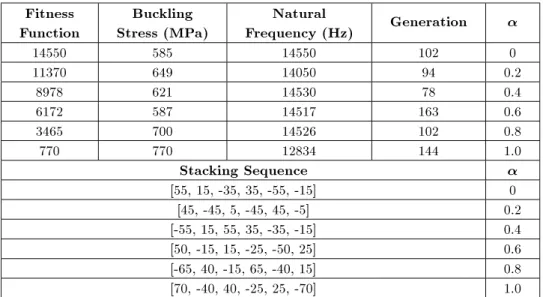
In order to construct the Pareto front, the weight-ing factor,, is varied from 0.0 to 1.0 and the composite objective function, (F), is maximized using a genetic algorithm. The optimum designs, obtained as their frequency and buckling load, are summarized in Table 2 for a thin composite cylindrical shell. As observed from this table, for thin cylindrical shells, natural frequency values are very close for dierent values of the weighting factor and, thus, the buckling stress is the determining parameter for the optimization of thin composite cylindrical shells.
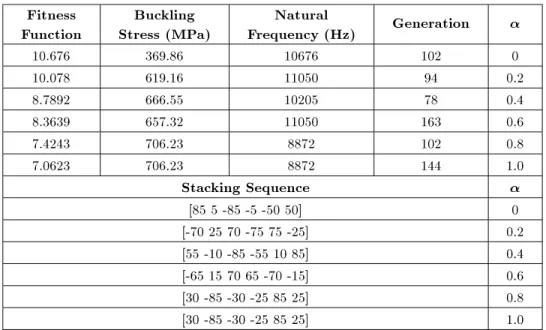
Tables 3 and 4 show optimized frequency and buckling load for h=R ratios higher than similar ones given in Table 2. As noticed, natural frequency has more eect on the optimization. Therefore, buckling stress and natural frequency are of similar importance for the ratiosh=R= 0:05 andh=R= 0:1.
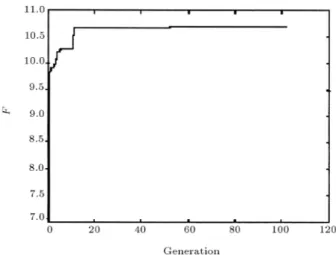
Convergency of the stiness function has been shown in Figures 1 to 4 for h=R = 0:1 and dierent
Figure 1.
Convergency ofF for= 0.Figure 2.
Convergency ofF for= 0:4.Figure 3.
Convergency ofF for= 0:6.Table 1.
Properties of the composite material.Density [kg/m
3]
E 11
[pa]
E 22
[pa]
v 12
v 21
G 12
=E 11
G 23
=E 11
Table 2.
Optimized Frequency and buckling load withh=R= 0:02.Fitness
Function
Stress (MPa)
Buckling
Frequency (Hz)
Natural
Generation
14550 585 14550 102 0
11370 649 14050 94 0.2
8978 621 14530 78 0.4
6172 587 14517 163 0.6
3465 700 14526 102 0.8
770 770 12834 144 1.0
Stacking Sequence
[55, 15, -35, 35, -55, -15] 0
[45, -45, 5, -45, 45, -5] 0.2
[-55, 15, 55, 35, -35, -15] 0.4 [50, -15, 15, -25, -50, 25] 0.6 [-65, 40, -15, 65, -40, 15] 0.8 [70, -40, 40, -25, 25, -70] 1.0
Table 3.
Optimized Frequency and buckling load withh=R= 0:05.Fitness
Function
Stress (MPa)
Buckling
Frequency (Hz)
Natural
Generation
13967 517 13967 101 0
8965 626 11050 129 0.2
6783 569 10926 87 0.4
4732 551 11003 100 0.6
2678 631 10867 79 0.8
648 648 7014 100 1.0
Stacking Sequence
[-75, 70, -20, 75, -70, 20] 0
[-60, 20, 80, 60, -80, -20] 0.2 [65, -15, -80, 80, 15, -65] 0.4 [-70, 20, 70, 80, -20, -80] 0.6 [65, -15, -65, -80, 80,15] 0.8 [55, -50, 50, -55, -50, 50] 1.0
Figure 4.
Convergency ofF for= 1.weighting functions. As observed, the convergency speed is faster and, also, the stiness function increases when decreases. The search has been stopped after a minimum of 50 generations, with no improvement in the tness function.
The eective parameters, on increasing the con-vergency performance, including the size of the rst population, parent population and dierent genetic operators, have been studied by the authors in de-tail [14]. Figure 5 shows the Pareto front obtained for = 0:6 and h=R = 0:1. The Pareto trade-o curve can be used to help the designer determine the optimal conguration for this problem. The nal choice of the best design will depend on additional information that will enable him to assign priorities to the two objectives. There is no single best design.
Table 4.
Optimized Frequency and buckling load withh=R= 0:1.Fitness
Function
Stress (MPa)
Buckling
Frequency (Hz)
Natural
Generation
10.676 369.86 10676 102 0
10.078 619.16 11050 94 0.2
8.7892 666.55 10205 78 0.4
8.3639 657.32 11050 163 0.6
7.4243 706.23 8872 102 0.8
7.0623 706.23 8872 144 1.0
Stacking Sequence
[85 5 -85 -5 -50 50] 0
[-70 25 70 -75 75 -25] 0.2
[55 -10 -85 -55 10 85] 0.4
[-65 15 70 65 -70 -15] 0.6
[30 -85 -30 -25 85 25] 0.8
[30 -85 -30 -25 85 25] 1.0
Figure 5.
Pareto set for natural frequency and buckling load optimization.Table 5.
Three dierent optimal congurations.Optimized Point
Stacking Sequence
A [-65 15 65 65 -65 -15] B [-70 15 65 70 -65 -15] C [65 -15 -65 -75 15 75]
the choice will be dierent. For example, for= 0:6 in Tables 3 and 4, natural frequency and buckling load are of similar importance. Finally, three dierent optimal congurations have been chosen from Figure 5 and brought into Table 5. These points are A, B and C, corresponding to = 0:65, 0.3, 0.2. As mentioned earlier, the nal choice depends on additional informa-tion.
CONCLUSION
A stacking sequence optimization with GA is done to maximize the natural frequency and buckling strength of a six-layer cylindrical shell, simultaneously. It is concluded that, for thin shells, buckling strength is the determining parameter for optimization while, for thick ones, both natural frequency and buckling strength are of the same importance for optimization. It is also concluded that the convergency speed is faster and, also, the stiness function higher when
decreases. Pareto trade-o can be used to help designers determine optimal conguration. The nal choice of the best design will depend on additional information that will enable the designer to assign priorities to the two objectives. However, there is no single best design.
REFERENCES
1. Schmit, L.A. and Farshi, B. \Optimum design of lam-inated ber composite plates", Int. J. for Numerical Methods in Engineering,
11
, pp 623-640 (1979). 2. Haftka, R.T. and Walsh, J.L. \Stacking sequenceop-timization for buckling of laminated plates by integer programming",Int. J. AIAA,
30
, pp 814-819 (1992). 3. Nagendra, S., Haftka, R.T. and Gurdal, Z. \Stackingsequence of simply supported laminated with stability and strain constraints", Int. J. AIAA,
30
, pp 2132-2137 (1992).4. Sandgren, E. and Jensen, E. \Topological design of structural components using genetic optimization method",J. of Analysis Optimum Numerical Method,
115
, pp 31-43 (1990).5. Le Riche, R. and Haftka, R.T. \Optimization of lami-nate stacking sequence for buckling load maximization
by genetic algorithm", Int. J. AIAA,
31
, pp 951-956 (1993).6. Negendra, S., Jestin, D., Gurdal, Z., Haftka, R.T. and Watson, L.T. \Improved genetic algorithm for design of stiened composite panel", Int. J. Computer and Structures,
58
, pp 543-555 (1996).7. Sadagopan, D. and Pitchmani, R. \Application of genetic algorithm to optimal tailoring of composite materials", J. of Composite Science and Technology,
58
, pp 571-589 (1998).8. Holland, J., Adaptation in Natural and Ratication System, University of Michigan Press (1975).
9. Hajela, P. \Genetic search - An approach to the non-convex problem", Int. J. AIAA,
28
, pp 1205-1210 (1990).10. Rao, S.S., Pan, T.S. and Venkayya, V.B. \Optimal placement of actuators inactively controlled structures using genetic algorithms",Int. J. AIAA,
29
, pp 942-943 (1990).11. Collahan, K.J. and Week, G.E. \Optimum design of composite laminates using genetic algorithm", J. Composite Engineering,
2
, pp 149-160 (1992). 12. Nagendra, S., Haftka, R.T. and Gurdal, Z. \Designof blade stiened composite panel by a genetic
algo-rithm",Proc. 34th. Structural Dynamics and Materials Conf., Lajolla, CA, pp 2418-2436 (1993).
13. Nagendra, S. \Optimal stacking sequence design of stiened composite panel with cutouts", Ph.D. Dis-sertation, Virginia Polytechnic Institute and State University (1993).
14. Shakeri, M., Yas, M.H. and Ghasemi Gol, M. \Optimal stacking sequence of laminated cylindrical shells using genetic algorithm", Int. J. Mechanics of Advanced Materials and Structures,
12
(4), pp 305-312 (2005). 15. Grosset, L., Venkataraman, S. and Haftka, R.T.\Genetic optimization of two-material composite lam-inates", University of Florida (2000).
16. Shakeri, M., Eslami, M.R. and Yas, M.H. \Elasticity solution and free vibrations analysis of laminated anisotropic cylindrical shells",The International Jour-nal of Structural Engineering and Mechanics,
7
(2), pp 181-202 (1999).17. Tasi, J. \Eect of heterogeneity on the stability of composite cylindrical shells under axial compression",