
Further experiments on the fertilization of a sea loch (Loch Craiglin). The effect of different plant nutrients on the phytoplankton
20
0
0
Full text
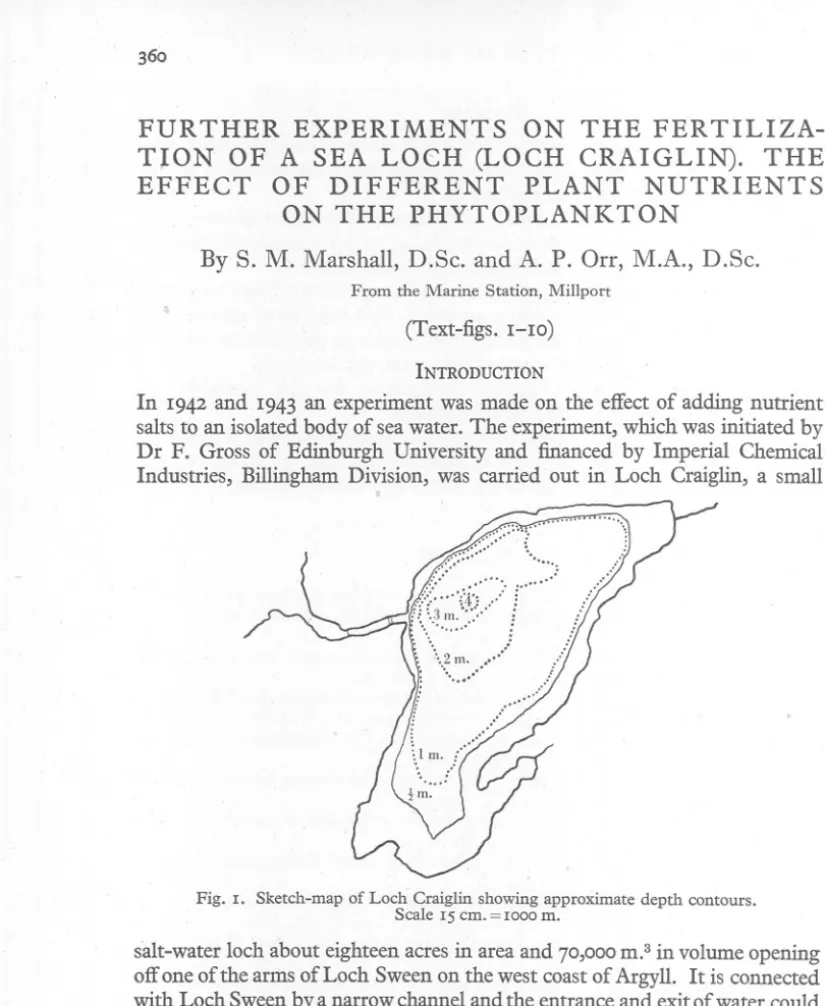
(2) THE FERTILIZATION. OF A SEA LOCH. 36r. The plankton and hydrographic results from the first two years' work have already been described (Marshall, 1947; Orr, 1947) and it was shown that the addition of nutrients sometimes caused an immediate increase in the phytoplankton. In the early work the effect of the nutrients was assessed during visits made at about fortnightly intervals. The present paper deals mainly with a series of experiments in which the effect of added nutrients, both on the phytoplankton and on the hydrographic conditions, was followed from day to. day.. '. We should like to express our thanks to Imperial Chemical Industries for their support, and also to our colleagues Dr F. Gross, Prof. J. E. G. Raymont, Dr D. T. Gauld and Mr S. R. Nutman for help in taking samples. METHODS. The methods of chemical analysis and for sampling the plankton were the ~ame as those described in the earlier papers. There was considerable interference, with the accuracy of the estimations of phosphorus and nitrogen compounds, both because of the richness in . phytoplankton organisms and the presence offrees:wphide in the deep water. To avoid damage to the glass electrode pH readings were not taken at3 m. when hydrogen sulphide was present. During the fertilization experiments the number of fL-flagellatesin all water samples was counted daily on a haemocytometer slide without concentration. However, the fluctuations from day to day were so great that although some of the increases in numbers may be related to fertilizations, others were not and it is felt that a further study of the methods of counting and of the normal seasonal and diurnal variations in numbers is needed before any conclusions can be drawn. The numbers were, however, high when compared with counts from elsewhere, varying from a few hundred to several thousand per mm.3 Pump samples were taken on each visit in 1944 and once during each fertilization in 1945. The zooplankton on the whole was rather poor except for rotifers, and as might be expected showed no direct relation to' fertilization. Oithona (chiefly O. nana) was the most abundant of the copepods. Fertilizers were distributed by mixing up the solids with a large excess of loch water in a rowing boat and baling out the supernatant' liquid into the loch. This was repeated until all had been distributed. It was spread as evenly as possible by rowing across the loch in a series of parallel lines while baling, but owing to wind and weather it was not always possible to keep accurate lines. Most of the nitrogen compounds dissolved readily but the superphosphate was not easily soluble and some of it certainly went to the bottom as solid.. 24-2.
(3) 362. S. M. MARSHALL AND A. P. ORR FERTILIZATION. EXPERIMENTS. During the whole of the autumn and winter of 1943-44 the loch was rich in phytoplankton, mainly dinoflagellate, although there was a short outburst of diatom growth found on 26 November and II December. The dinoflagellate plankton consisted mainly of Peridinium triquetra and Gymnodinium spp., the diatoms of a minute form, Chaetoceros simplex, which Miss M. V. Lebour kindly identified. The numbers of dinoflagellates continued to rise at the surface and at I m. throughout December 1943 and January 1944 (Figs. 2,3).' A fertilization was made on 18 January with the usual quantities of sodium nitrate (142 lb.) and superphosphate (44 lb.) which is sufficient to raise the nitrogen and phosphorus from zero to well above normal winter sea values. The plankton was not examined again until 31 January when diatoms (minute Chaetoceros sp.) were very abundant and dinoflagellates had increased once more. They were almost entirely Peridinium triquetra and at the surface had reached a figure of 235° per mi. By 9 February diatoms had almost disappeared but dinoflagellates were still increasing. P. triquetra now numbered 35°° per mi. at ° and I m. and 1125 per mi. at 2 m. A fertilization was made on II February using nearly three times the usual quantities of sodium nitrate (336 lb. ) and superphosphate (112 lb.) and the plankton was sampled on 19 February. The P. triquetra had increased to over 6000 per mi. at the surface and 173° at 3 m. but diatoms were practically absent. Seventeen days later on 7 March, P. triquetra had reached its maximum in the surface layer, 8165 per mi., but was scarce in deeper water. and diatoms were still absent.. .. To find the amount of photosynthesis going on, samples of the phytoplankton-rich surface water were suspended in bottles at different depths on 20 February with similar controls kept in the dark. In spite of the enormous numbers of dinoflagellates, however, the oxygen production in these bottles. over 24 hr. was negligible at all depths. The numbers of dinoflagellatesremained high, over 1000per mi., until the middle of June although the species present altered as time went on. On 9 April Gymnodiniumspp. outnumbered Peridiniumtriquetra,though both were abundant. On 27April this changehad gone stillfurther and Gymnodiniumspp. had risen to 2435per mi. at the surface,while Peridiniumtriquetrahad declined to 13° per mi. Gymnodiniumremained predominant in May and June but at the beginning of' July dinoflagellateshad decreased to figures of 3° or 4° per mi. At the end of June there was a sudden and short-lived increase in diatom numbers, again the minute Chaetocerossp. The number of 3° or 4° dinoflagellatesper mi. would be considered very high in normal sea plankton; it is low only in comparison with the extraordinarily high figuresthroughout the winter and spring in Loch Craiglin. The '.
(4) Unuer Depth in metres 0. nC:J. 100500. r::::::::J500-. U. 1000. [[]. 10002000. m. EmE 4000ImEI 8000. 2000-. l:I:::I:::I4000. II. Over 8000. ceHs/inl.. 1944 I I I I I I I I I I I I I I I I I. I I "I I I I I I I I I I I I I I I I I. I. I. , I I. ,. ,I. I I. ,. I I. :,,. " I. , ,, , I. '.I. I. I. I. I. 2. ,,. ,,. ,. I I I I I. II I I I 1. , I I. I I I. \. \ , '-'. ,. I. I. "I I I. ,. ,. I , I I. ...... 'I:'"' ....... N :;J> ..., ....... 0. Z 0 'Tj. .,,. :;J>. I. I:'"' 0 () :r:. I, ,, , I I. ,, Diatoms. I, ,,. ..., :r: tI1 'Tj tI1 ~ ...,. ,, ,I ,I. CI:! tI1 :;J>. W 0\ W.
(5) D Depth in metres. Under 100. D. 100-. [J]. U2.50. Q:!1 500-. 250500. a:a:E 1000-. m:ttI5000. I::HJ 1000. .. Over 5000. cells/ml.. \jJ 0\ .j>.. 1944. a. fIJ. ~ ~ > ::0 CIJ :I: > t""' t""' > Z tj ?-> ~;o 0 ::0 ::0. 2. 3 March. I. April. I. May. I. Junc. I. July. Fig. 3. Number of dinoflagellates at Station I, Loch CraigIin, during 1944..
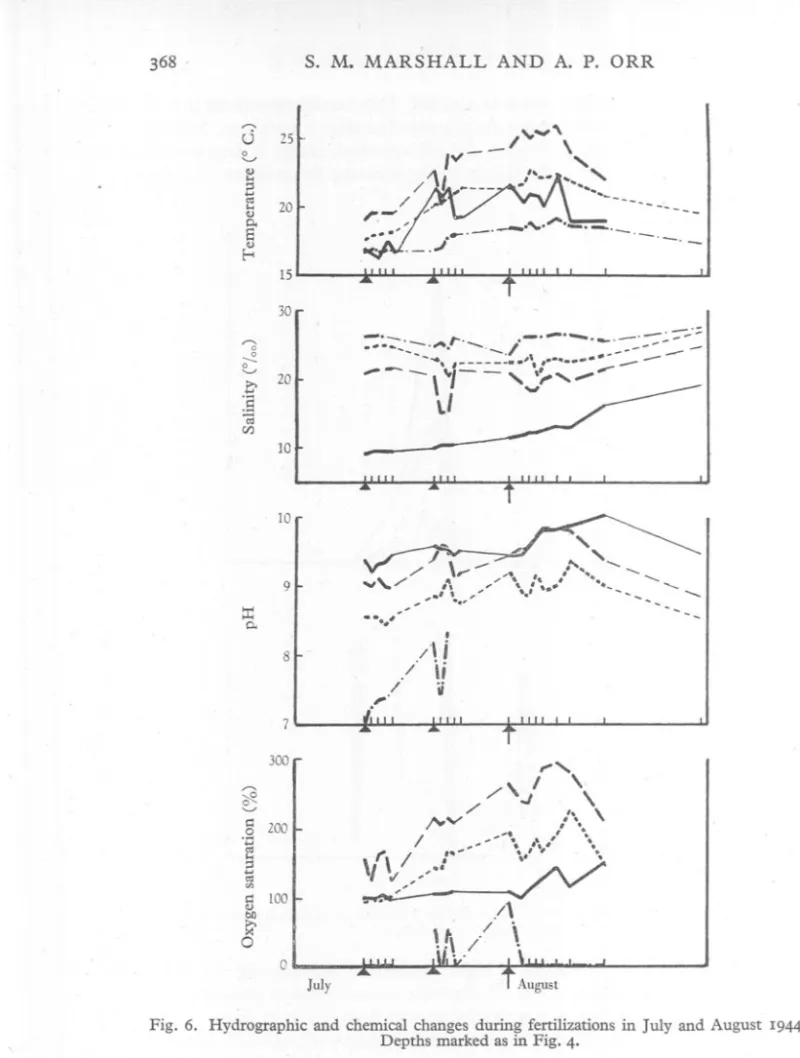
(6) THE FERTILIZATION. OF A SEA LOCH. 365. most abundant species, Peridiniumtriquetra,usually has a summer maximum and it is a form which, under favourable conditions such as in the polluted waters of the inner Oslo Fjord (Braarud, 1945),is capable of increasing until it forms a 'waterbloom' or 'red water'. The maximum number recorded elsewhere, however, is a little below 3000 per mI.; in Loch Craiglin it rose to over 8000 per mI. on two occasions.and remained above 2000 per mI. for weekson end. The water in the loch had during this period a distinct brownish red tinge. There are several interesting points about these winter fertilizations. The first of them, on 18 January, was followed by a great increase of diatoms but dinoflagellate numbers, very high already, showed no comparable increase. On the other hand, the second fertilization on II February was follow~dby a decided increase in dinoflagellatenumbers but had no effect on diatoms although the fertilizer added was nearly three times the usual amount. As a general rule in the open sea dinoflagellatesfollow diatoms in .their times of maximum abundance and they are said (Barker, 1935)to be able to use lower concentrations of nutrients than the former. It is therefore surprising to find an increase of diatoms (19 June) followingimmediately upon the dying away of dinoflagellates. The plankton in Sailean More, the open arm of Loch Sween with which Loch Craiglin is connected, showed no comparable changes; dinoflagellates were scarce throughout and, although there was a great rise in diatom numbers in April (over 2000 per mI. at I m. on 27April), the form was a Leptocylindrus sp. The minute Chaetocerossp. so characteristic of Loch Craiglin did not appear in Sailean More. A curious feature of the spring of 1944in Loch Craiglin was that the phytoplankton remained rich throughout the spring months when, in other years, fertilizations at that time had little or no effect on the phytoplaDktonbecause the attached vegetation seemed to have first call on the nutrients. In July and August a seriesof fertilizationswasbegun and eachwas followed up by sampling at short intervals, usually I or 2 days (Figs. 4-6). The first fertilization was made with superphosphate alone, the second with nitrate alone and the third with ten times the usual quantity of both. During these months there was a rich vegetation, consistingpartly of algae (chiefly F;nteromorphaand Cladophora) and partly of Zostera and Ruppia, round the shores and this interfered considerably with the experiments. On 10 July, 66 lb. superphosphate was added. This caused a rise in soluble phosphate chiefly at the surface which lasted for only 2 or 3 days. The pH and percentage oxygen saturation rose after the fertilization, in agreement with the utilization of the soluble phosphate, though the highest figure for oxygen (15° % saturation) was at I m. At the surface equilibrium of oxygen with the air seems to be reached rapidly. Nitrate was present down to 2 m. and although it was only in small quantities it does not seem probable that it was a limiting factor..
(7) S, M. MARSHALL. 366. AND A. p, ORR. This fertilization had no visible effect on the phytoplankton, Dinoflagellates were present in fair numbers but diatoms were absent. This suggests that. r-. 1-0 .~"'--S OJ . :;: < 0. '" (:1 -'--' ~{j 0, 5 '" :;: ..::'" 0 '" (:1::3 .~ 0 Q-S. '~'. 0. ~ -~. 50 Surface LIIl. 2 Ill. 3 Ill.. r-. 40. :[0 .8'". "!j. ,..'. 30. fij <n ::3 0 ..c: .... .S. S 0. , " , , , , ,, ,, , ,',. ,:. 20. , : , , ,,. .... '". is. : ,. 10. '.. ,. " , ~, ,. " ,. 0. r-. ,g. .!<: '" :ij :E uu OJ CIJ. 0. 2 3. 19. 29. Jlil~ Fig. 4, Effect on the phytoplankton and the transparency of the water of fertilizations during July and August 1944. Triangles below show dates of fertilizations.. the vegetation round the shore and in shallow water was absorbing all the nutrients..
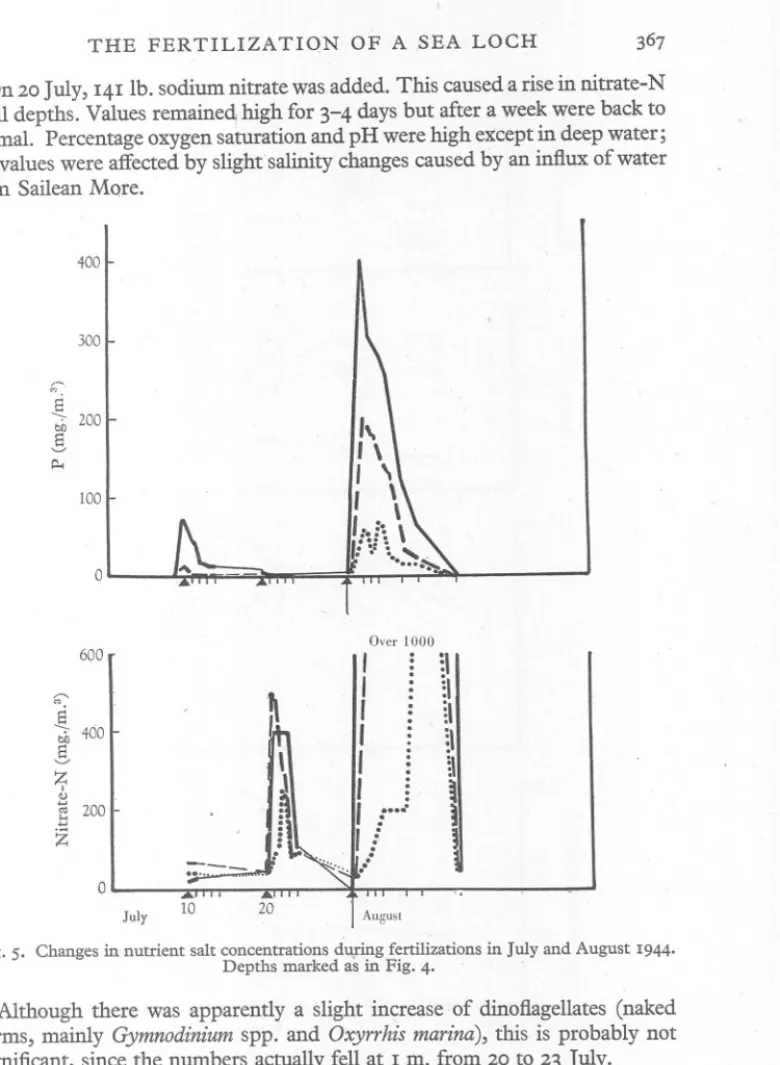
(8) THE FERTILIZATION. OF A SEA LOCH. 367. On 20 July, 141lb. sodium nitrate was added. This causeda rise in nitrate-N at all depths. Values remainedrhigh for 3-4 days but after a week were back to normal. Percentage oxygen saturation and pH were high except in deep water; the values were affected by slightsalinity changes caused by an influx of water from Sailean More.. 400. 300. ;;: 8. ~. 5. 200. ~ 100. I<'\.. 0. 1= I. Over 1000. 600. ,--.. ". s ~. 5 ~. h. '. 400. ... <1>. .,. t;.... 200. ~ :1. ..... L --..... Z. :,. I. ~. ~\. :. ~,. :. ~. :\. I. ~. I:. roo'. .;f. ~,. l. .:~ . """'"I l. 0 July. 10. 20. Augusl. Fig. 5. Changes in nutrient salt concentrations du.ring fertilizations in July and August 1944. Depths marked as in Fig. 4.. .. Although there was apparently a slight increase of dinoflagellates (naked forms, mainly Gymnodinium spp. and Oxyrrhis marina), this is probably not significant, since the numbers actually fell at 1 m. from 20 to 23 July. The fertilization with about ten times the usual quantity of nutrients (1344 lb. sodium nitrate and 448 lb. superphosphate) was done on 1 August. This raised the dissolved phosphate up to 400 mg./m.3 at the surface and to high.
(9) S. M. MARSHALL AND A. P. ORR. 368 .. r-. c.5 0 '-' f:: E a! .... Q). 25. 20. S. Q) E-<. 15 30. r-.0 0 '-'. ;::.::::::=. -:;:::-.,..r ,,. l '\t.'..-"--- :.--- -. - - - \\.1..,- -. 20. :9 c;;. ,...;,..,...... CIJ. 10. 10. ./--\,. /'. ""''' -'...,,,-. 9. :I:. 0... .,'. /. ..."". ,.' '..-"",. .."'~. \.:'. /. <f2-. '-'. ZOO. /. j'¥v/. '" d Q) 100 bJ). 0. /. ,..,. J. -". \,'\f! I /.1 ,.--, ...,'. .... a!. '. :. ii. /\1. a!. ...... ~"'- --""'........... ;. 300. d. ,. ii. r-.. .!a ..... '. .. /\. 8. ..,. ,'\. /'. \ /\ \ ",. ..l .,'. /. /\. , °..... .. .. \. 0 July. Fig. 6. Hydrographic and chemical changes during fertilizations in July and August 1944. Depths marked as in Fig. 4..
(10) THE FERTILIZATION. OF A SEA LOCH. 369. values in deeper water also. Utilization was rapid and in less than a fortnight values were back to normal. A rise in pH and percentage oxygen saturation coincided with the utilization of the soluble phosphate. Nitrate-N, very high immediately after fertilization, fell to normal wi~ a fortnight. Phytoplankton was very poor on the day of fertilization and for severaldays after, but on the seventh day after fertilization, diatoms were present in large numbers at all depths. There was a curious and unexplained fall in numbers (not confirmed by Secchi disk readings) on 9 August, but on t):le 14th the numbers were very high indeed (just over 5°,000 cells/mI.) and thereafter fell rapidly. Three species took part in the increase, Chaetocerossimp/ex,a minute Naviculid and the triradiate form of Nitzschia closterium. Dinoflagellatesalso became abundant. Their numbers rose from 31 July to 4 August and again from the 4th to the 9th after which they fell. Exuvie//a marinawas the commonest form, but Gymnodiniumspp. also increased. Compared with the first two fertilizations this one did produce a large increase in the phytoplankton, but only after a lapse of 4 days for dinoflagellatesand of 7 days for diatoms. The results of these three fertilizations suggestthat only when the needs of the attached algae have been satisfied can the phytoplankton lJ-tilizeany remaining nutrients. During the nitrate fertilization, however, the very low phosphate may have been a limiting factor. It is also possiblethat some of the nutrients are adsorbed by the mud or by non-living material suspended in the water. This would explain their very rapid disappearance. The above experiments, as well as earlier work in this loch (Marshall, 1947; Orr, 1247),indicate that when shore-livingalgaeare growing,fertilization does not result in an increase in phytoplankton except when very large quantities of nutrients are used. During the winter the attached algaeare absent or dormant but there is still enough light to permit photosynthesis in the shallow water of Loch Craiglin. A series of experiments was therefore carried out during the.winter months to find whether other forms of inorganic phosphorus and nitrogen besides nitrate and superphosphate could be used by the phytoplankton (Figs. 7-9). The following combinations were tested: (1) Superphosphate and sodium nitrate as normally. (2) Superphosphate and ammonium sulphate. (3) Superphosphate and ammonium nitrate. (4) Mono-ammonium phosphate and ammonium sulphate. The salts used were all availablecommerciallyas fertilizers, but were nevertheless of high quality. Ammonium salts were chosen both because of the biological interest of testing whether ammonia-nitrogencould be used directly by the phytoplankton and because it is one of the commonest artificialfertilizers applied to land and so availablein large quanticles. AmmoniUmnitrate is used as an explosiveand.
(11) .-d"": S '" " --.. 5-0. "'d0 ~'--" 2'5 ~.¥j ~1;j 0",. .9. ;------. g. Q.g. 0. -. 250. Surface. ---1m.. 2m.. ""'. 3m.. :g 0 200 E'" "tj 1;j. gj 150. ].... .9. S 100 0. ..... '". Q 50. 0. """""'". ":::"'}::-::""~""-"~"~"""'". .,. s. .;., -5,-, u "", CI'J. ~,~. :LL. .. 1\ I. \ .. ;. 6. I. s:. .§ ""d. c." .....0"' u ,D" <0 u. i.. 4. \. \ .\. ,. .. .. \//. ~1 0.. .. 2. 0. -. February. Fig. 7. Effect on the phytoplankton. March. April. and the transparency of the water of fertilizations during February to April 1945..
(12) 8,5. 8.0 :r: 0. 7'5 , I. ~ ~-. '-. ~ -'---"--. , ..."------' '-,,;. /,./ ,---,.,.,". 7,0 r-. "'';;' .S. I-. 100. \-=---~. I , I 50. O .... co on. ". ""'J ,---. ""';'''. .I. / ,, ,,. t'\...-._....----... a. ""'-.---. ,. ,:/'''''.. 100. .\ I!o,'. .§. M. g. 50. .,.---. '. i :\::-:::. .'". >"'*-:-'. .r---'---';~."":. Ai a-. ",. ------'. ,. 1. .t,'. '.~ \ ,. 0. ZI"'.r-.. 1000. .§. ... . .'::: Z'-' 500. S. 0. Z1'-". 1000. A. co'". '. iq. -S 0--S. so'"'<". 8M. 85. 500. '. ".. ..:::. /-. /\. \. u. ..-. ... ,,\. .. ---".. ". "'". 1\ ". . I. '-,~-0 February. .. March. ' April. Fig. 8. Changes in nutrient salts and other chemical factors during fertilizations in February to April I945. Depths marked as in Fig. 7..
(13) S. M. MARSHALL AND A. P. ORR. 372. might at times be availablefor disposalin considerablequantities. In addition it has a high percentage of nitrogen and would therefore be less expensive to transport. Mono-ammonium phosphate is much more readily soluble than superphosphate and also contains a much higher percentage of phosphorus quite apart from the ammonia-nitrogen present.. C] 10. :::; ~ ~. 0 "-". <I). B. '" tp. 5 8<I). """. ..'. .. , - --. ~~.'" - ']to.. .--'. .=~ ~.--=-~:.:.::.-:::..:.::..::.:::.::'::"~ -.-.-.-.--. E-<. 0. 30. g--. 0 » .<;::2 ;§ '" 0. ~~-=-~='--=-~. \. -.-. ~':=-=:"~'=='=-=~-=-~=-':""""'=-:"--='--=~:::'':::'~:-' _. . " -,-... \. CIJ. ,\. \. ---=. V. ,". =. ~~-. '-.----. '\. \1. 10 February Fig. 9. Hydrographic. I. March. I April. changes during fertilizations in February to April 1945. Depths marked as in Fig. 7.. Each of them was tested on diatom cultures in the laboratory by Miss F. A. Stanbury of the Technical College, Plymouth, who used them as a source of nutrients in the following culture material: (a) (b) (c) (d). Nitzschia closterium pure. Almost pure Achnanthes longipes. Amphipleura Spa A mixture culture of (a), (b) and (c), with other forms.. None of them proved toxic even in relatively high concentrations (up to 25 mg.j!.) and growth was as good as, or better than, that in controls in 'aged' or nutrient-enriched sea water. We are indebted to Miss Stanbury for carrying out these tests and for her permission to quote the results. In each fertilization the same amount of phosphorus and nitrogen, namely 3'4 and 23 lb. respectively,was added to Loch Craiglin, This was roughly.the same as in the normal fertilizations with sodium nitrate and superphosphate ..
(14) THE FERTILIZATION. OF A SEA LOCH. 373. and was enough to raise the concentration to well above average winter sea values. During the winter the dam was open to allowinterchangewith the main loch outside, and aeration of the deep water was fairly good. The dam was closed on 5 February I945 and the normal amounts offertilizers added that afternoon in the form of sodium nitrate and superphosphate. Phosphate was initially high at I, 2 and 3 m. and after the fertilization rose at all depths. The day following fertilization, however, soluble phosphate dropped to zero at the surface and 3 days later was absent at I m. Nitrate gave winter values at the surface before fertilization and increased afterwards only at the surface. The following day it fell abruptly at the surface and 2 days later values were only slightly above normal winter concentrations. During the course of the experiment changes in salinity showed that the surface and I m. layers had mixed. This affectedthe pH and percentageoxygen saturation values at these depths. Diatoms (Chaetocerossimplex)were abundant in the loch before fertilization (5300 cells/mI. at the surface and 22,500cells/mI.at I m.), and increased afterwards to I49,000 per mI. at the surface on the I Ith. Dinoflagellateswere scarce and showed no significantchange. This enormous production affected the transparency of the water considerably. The Secchi disk which initially was visible down to 2t m. was visible only to It m. on the 9th. Measurements of the absorption coefficientwith the Pulfrich absorptiometer showed a rise from I'7 and I'3 at 0 and I m. on the 5th to 3'5 and 3'7 on the 9th. In'deeper water there was little change (Fig. 7). On 26 February the loch was fertilized again with 42 lb. superphosphate and no lb. ammonium sulphate. In spite of this addition no phosphate appeared at the surface or I m. although there was a rise below this at 2 and 3 m. where the phosphate value had in any case remained high since the previous fertilization. This immediate disappearance of added nutrients was found on several occasionsand is not understood. The rapidity suggests that absorption either by the phytoplankton and fixed algae, or else adsorption by dead particulate matter, is responsible. The added ammonium sulphate did cause an increase, though a small one, in the ammonia present at the surface and I m. as well as a greater increase at 2 and 3 m, Nitrate remained low. All the nutrients had fallen to their original level in 2 days, At no other time was a fertilization made when phytoplankton was initially so abundant. Although numbers had fallen at the surface from n February, they had risen at I m. and at both these depths were very high indeed (77,000 cells of Chaetocerossimplexper mI, at the surface and I33,000 at I m.). These high numbers rose still further on succeedingdays; on 28 February there were over 200,000and on 2 March nearly 300,000cells/mI. down to I m. At 2 and 3 m. numbers were much lower (I8,000 and 24,000 cells/mI. resp~cti.vely)..
(15) 374. S. M. MARSHALL AND A. P. ORR. Dinoflagellates were relatively unimportant but did show a slight increase. Oxyrrh£smar£nawas the most abundant species. Accompanyingthe great increase in diatoms there was a sharp rise in pH in the surface layers~from7"6 to 8"3, and there was a slight effect even at 2 m. The change, however, in percentage oxygen saturation was small. The transparency of the water, which was initially the sameas at the end of the previous fertilization, showed an abrupt decrease,especiallyat the surface and 1 m. By 1 March the water was very turbid indeed, the absorption coefficientbeing 6"2 and 5"8at 0 and 1 m. respectively. The results of this fertilization.confirm the findings in the laboratory of Harvey (1933) and ZoBell (1935) that ammonium salts can be used directly . by the phytoplankton. In Loch Craiglin (of which the greater part is less than 2 m. in depth) photosynthesis can go on down to the bottom even in winter providing there is a sufficiencyof plant nutrients, and the mere closing of the dam might be enough to start offa phytoplankton increaseby cutting down interchange with the outside loch and enclosing, in winter, nutrient-rich water. In an attempt to test this, the dam was left open from 2 to II March. It was closed that day and samples were taken then and 3 days later. The hydrographic data show, however, that there had been very little interchange with outside owing to poor tides and there was also no significant change in the phytoplankton in the 3 days although it had decreased greatly from the maximum on 2 March. The experiment therefore failed in its object. .. On 22 March a fertilization was made using 42 lb. superphosphate. and. 67 lb. ammonium nitrate. The added phosphate had, as after the previous fertilization, disappeared before samples were taken the following day. Ammonia and nitrate, however, showed an increase at the surface which lasted for 2 days. Diatom numbers had fallen still further from 14 March and continued to do so in spite of the fertilization, although there were still between 10,000 and 30,000 per ml. present at the surface and 1 m. Dinoflagellates on the other hand showed a distinct increase at the surface. The form causing it was a Gymnod£n£umsp. and Oxyrrh£smar£nawas numerous on the 26th at 2 and 3 m. That appreciable photosyntl;tesishad taken place was shown by the abrupt rise in pH at the surface and 1 m. immediately following fertilization. The attached algae were noted as just beginning to grow and, since the rapid rise in pH and the disappearance of the nutrients are much more than could.be accounted for by the comparatively small numbers of diatoms and dinoflagellates present, it is probable that the attached algae were responsible. This is confirmed also by the transparency measurements which show only a slight decrease when compared with previous fertilizations. On 2April afertilizationwasmadeusing 12'41b.mono-ammoniumphosphate and 103~b. of ammonium sulphate. Neither the phosphat~ nor the ammonia.
(16) THE FERTILIZATION. OF A SEA LOCH. 375. showed any appreciable inc~easewhen.the loch was sampled the followingday. Hydrographic conditions were not very stable but there was a marked rise in pH. Diatom numbers had fallen still further since the last fertilization and remained steady at about 10,000cells/ml. Chaetocerossimplexstill predominated although Thalassiosiranana was also numerous. Dinoflagellates had increased at the surfaceand decreasedat 1 m. sincethe lastvisit but fertilization resulted in a marked rise at both depths, up to nearly 5000and 3400 cells/ml. at 0 and 1 m. respectively. Gymnodiniumspp. were again mainly responsible. On this occasionthe Pulfrich absorptiometer was not availableand the transparency was measured by the Secchi disk only; it showed a slight decrease. In the earlier fertilizations there was a good agreement between the phytoplankton and the Secchi disk readings (Fig. 4). By now, April, the attached algae were obviously competing successfully with the phytoplankton for nutrients and the testing of the remaining nitrogen. . salts. (ammonium. chloride and urea) 'was deferred till the following winter. The. algae remained rich during the summer of 1945and were still abundant in the autumn so that it was not till January 1946that it was considered safe to do further fertilizations. The loch was then in a condition very different from what it had been in 1945. Phytoplankton was very scarce with numbers of only 10 or 20 cells/ml. as against the thousands of the previous year. In addition plant nutrients, though not abundant, were present in sufficient quantity to allow plant growth. As in 1944-45, the dam had been opened during the autumn months and was closed at the end of December so that the great difference in the quantity of plankton in the 2 years cannot be explained thus. A fertilization was made on 10 January with 42 lb. superphosphate and 112 lb. ammonium chloride and another on 23 January with A.2lb. superphosphate and 56 lb. urea. At neither time was there any increase in the phytoplankton, nor was there any important increase in the amounts of nutrients in the water although there was a short-lived rise in soluble phosphorus at the surface after the second fertilization. At the time of the first fertilization the loch level was unusually high and it fell rapidly during the followingdays; it was estimated that the loss during the period of this fertilization amounted to about a third of the total volume of Loch Craiglin. Some of the fertilizer must undoubtedly have been lost in this way and it may partly account for the lack of any increasein nutrients. During the second fertilization there was no appreciable change in loch level. The reason for the failure of these two fertilizations to produce a phytoplankton increase is not known, but several suggestions can be made. Compared with 1945 there was an insignificantnumber of diatoms present initially and although the shore algae appeared to be negligible,the proportion of diatoms to attached alga~ may still have been too small for the diatoms to compete successfully for the nutrients. On the other hand, the fact that . JOURN. MAR. BIOL. ASSOC. vol.. XXVII, 1948. 2S.
(17) 376. S. M. MARSHALL AND A. P. ORR. nutrients were present before fertilization seems-against this explanation. The considerable fall in loch level'may have carried away both the nutrients and the phytoplankton. The weather was unfavourable for diatom growth; during the first experiment the loch was frozen over several times and the light thus cut down; during the second it was overcast, wet and stormy. In view of the success of Miss Stanbury's tests which were made on these fertilizers also, it seems unlikely that they were at fault, though she noted a delay in diatom growth with urea as a source of nitrogen when compared with the others. It must be admitted, however, that none of these explanations is very convincing and that there may be other factors, of which nothing is known, playing a more important part. Diurnal variation. In shore pools there is normally a considerable diurnal fluctuation in hydrographic conditions and it was thought that this might be true in Loch Craiglin also. In conjunction with an experiment on the vertical migration of Euglena(see below), samplesof the water were taken at a seriesof depths every 4 hr. over 24 hr. in August. The weather was calm and bright. During the period of the experiment a high tide in Sailean More caused an influx of open loch water which would affect the results. There was an appreciable diurnal temperature range at ~e surface which was still noticeable at I m. The changesin pH value and percentage oxygen saturation are, however, not related to light and dark at Station I as was expected. Samples taken closeinshore where Ruppia was growing luxuriantly did show a rise in pH during the day up to nearly 10. A point of interest was the peak in oxygen saturation at 4 p.m. at 2 m. which may be related to the abundance of Euglenaat that depth. Occurrenceof Euglena. Occasionallyin Loch Craiglin very large numbers of .a species of Euglena(kindly identified by Prof. F. E. Fritsch as E. proxima) were present. These were comparativelylarge (about 70ft long) and might be present in such numbers that the water sampleswere bright green. Although holotrophic they never appeared in numbers at the surface and were usually most common at or near the boundary between oxygenated and oxygen-free water. They were often found richest in samplessmellingof hydrogen sulphide but the numbers fluctuatedwidelyfrom onedepth to another and from dayto day so that they apparently occupied a rather narrow zone. They occurred both in winter and in summer although the highest numbers (4°,000-54,000 per mI.) were in summer. Because of this peculiar depth distribution it was thought that their light requirements might be low and that they might migrate towards the surface at dusk and dawn. A series of pump samples was therefore taken at four depths at 4-hr. intervals, from 8 a.m. on 4 August to 4 a.m. on 5 August 1944. To ensure that the whole water column was sampled fairly evenly, the mouth ofthe hosein taking eachsamplewasrapidly raisedand loweredbetween.
(18) THE FERTILIZATION. OF A SEA LOCH. 377. 0 and I, I and 2, 2 and 3 or 3 and 4 m. until an adequate amount (about 7 1.) had been taken from each depth. This was well shaken and a subsample drawn off and preserved. The results (Fig. 10 and Table I) were unexpected and are not easy to explain. At no time did the Euglena appear in numbers in the water above 2 m. They were always most numerous between 2 and 3 m. except at 4 a.m. when there were slightly more between 3 and 4 m. than between 2 and 3 m. During the course of the experiment there was a slight increase in total numbers at 12 noon but a steady decrease thereafter so that at 4 a.m. there were only a little more than a third of the maximum number. 0. a.m.. 8. 12. p.m.. 4. 8. 12. a.m. 4. "...., 1. g ..c::. 2. 0. Q). 0. 3 4 4-5 August1944. -. Time CoMoTo. = 10,000 Euglena. Fig. 10. Vertical distribution of Euglenaproxima over a 24-hr. period 4-5 August 1944. TABLE I. Depth mrn. 0-1 1-2 2-3 3-4. DIURNAL VARIATION IN NUMBERS OF EUGLENA , 8a.rn. 25 5 24,500 10,500. (NO./ML.). Time "--12 noon Lost 5 26,000 12,000. 4p.rn. 10 0 21,500 7,000. 8p.rn. 25 5 16,000 10,000. 12 midnight 50 15 13,000 7,500. 4a.rn. 25 15 6,250 7,500. The Euglenids obviously do not carry out any appreciable diurnal vertical migration but it is difficultto understand the variation in numbers. They may occur in swarms and a small differencein position may make a large difference in numbers. . Since in spite of their green colour they live so deep in the water, an opportunity was taken when they were numerous of measuring their respiration and photosynthesis. On 23 July 1944 a large sample of water from 3 m. containing 22,400 Euglena/mI.was thoroughly stirred to oxygenate it and the changes in oxygen content both in light and dark measured over a period of 4 hr. in the afternoon (12.15-4.15 p.m. G.M.T.)at a depth of I m. Samplesfor the initial oxygen content were drawn off and the samples for.light and dark exposure put in bottles, the latter enclosed in opaque black cloth. The bottles in the light showed an oxygenrise of about 0'31 mI. O2/1.whereasthose in the dark showed a consumption of 1'83 mI. O2/1.This is equivalent to a total oxygen production of 0'024 mI. oxygen per hour per million Euglena. It is 25-2.
(19) 378. S. M. MARSHALL AND A. P. ORR. obvious that although this Euglenadoes carry on photosynthesis, the oxygen thus produced even at a depth of I m. is much exceeded by that used up in respiration. Over the whole day, at the depth where they normally occur, photosynthesis must play only a very small part in their metabolism. This was - confirmed by an experiment done the previous day when samples of water from each depth (0, 1,2 and 3 m.) were shaken well to oxygenatethem and the oxygen utilization in the dark measured after 24 hr. The utilization was small at the surface (0"14mI"!!.),slightly greater at I and 2 m. (0"18and 0"38mI.!!.) and rose suddenly to 1"74mI.!!. in the 3 m. sample which was slightly green with Euglena.The Euglenaundoubtedly are at tlmes partly responsible for the oxygen lack in the deeper water of Loch Craiglin. Concentrations of Euglenalimosahave been described on the surface of tidal mud in the estuary of the Avon (Bracher, 1919)and, since this mud is rich in organic matter and smells strongly of hydrogen sulphide when disturbed it might be expected that the Euglenawould behave similarly to those in Loch Craiglin. Their reactions are, however, very different. Euglenalimosais very responsive to light and whe,ntidal conditions are suitable comes up to lie on the surface during the brightest hours of the day. It is able to survive lack of oxygen for 3 days but not for a week. SUMMARY AND CONCLUSIONS. Loch Craiglincannot be consideredas merely an isolatedbasin of Loch Sween. Its shallowness,the great growth of vegetationround the shore and the fluctuations in salinity make it atypical. On the more complete isolation of the loch with the making of the dam, these conditions led to a lack of circulation, a consequent development of hydrogen sulphide in the deep water and very high pH values near the surface. One could not therefore expect the plankton to be very similar to that in the outside loch (see, however, Marshall, 1947). Unfortunately there are no records of seasonal variation before fertilization was begun. In spite of these drawbacks Loch Craiglin was a convenient and manageable area for small-scaleexperiments on fertilization. The experiments may be .divided into two groups, those which were not followed up in detail and those in 'whichthe plankton and hydrographic .results were followed from day to day. The former, made during the earlier stages of the work, are mainly described in the previous papers and led to the conclusion that the richness in phytoplankton of Loch Craiglin in 1943 was probably causedto a large extent by fertilization. Those of the second group, described above, were niade to test specialpoints and different fertilizers. Two experiments made during the summer of 1944had apparently no effect on the phytoplankton but a third in which a very large excessof fertilizer (ten times the normal quantity) was added, gave a good increase after an initial lag. At that time the attached algaewere abundant and their needs apparently had to be satisfied before any nutrients .couldbe used by the phytoplankton..
(20) -~--. --. THE FERTILIZATION. OF A SEA LOCH. 379. The remaining experiments, which were therefore made during the winter, showed that commercial ammonium sulphate, ammonium nitrate and monoammonium phosphate could replace the sodium nitrate and superphosphate used hitherto. Two further experiments in the following spring using ammonium chloride and urea did not, however, prove effective. All the salts used had been found in laboratory tests by Miss F. A. Stanbury to be suitable for diatom growth, and the reason for the failure of these two in the loch is unknown. The utilization of the nutrients was extremely rapid even in winter but it is probable that their disappearanceis not entirely caused by the phytoplankton or bottom-living algae but partly by adsorption on the bottom mud or by suspended matter. On one occasionit may have been caused by a serious fall in loch level. The zooplankton which during the first year of fertilizationswas richer in Loch Craiglin than in the outside loch diminished in the second year and remained poor thereafter in spite of, or perhaps because of, the intensive fertilizations. The dense phytoplankton and other vegetation raised the pH at times to levels dangerous to animal life. REFERENCES BARKER, H. A., 1935. The culture and physiology of the marine dinoflagellates. Archiv. j. Mikrobiol., Bd. 6, pp. 157-81. . BRAARUD,T., 1945. A phytoplankton survey of the polluted waters of inner Oslo Fjord. Hvalrddets Skrifter, No. 28. BRACHER, R., 1919. Observations on Euglena deses.Ann. Bot., Vol. CXXIX, pp. 93-108. HARVEY,H. W., 1933. On the rate of diatom growth. Journ. Mar. BioI. Assoc., Vol. XIX,pp. 253-76. MARsHALL,S. M., 1947. An experiment in marine fish cultivation. III. The plankton of a fertilized loch. Proc. Roy. Soc. Edinburgh, Vol. LXIII, pp. 21-33. ORR,A. P., 1947. An experiment in marine fish cultivation. II. Some physical and chemical conditions in a fertilized sea loch (Loch Craiglin, Argyll). Proc. Roy. Soc. Edinburgh, Vol. LXIII, pp. 3-20. ZOBELL,C. E., 1935. The assimilation of ammonium nitrogen by Nitzschia closterium and other marine phytoplankton. Proc. Nat. Acad. Sci., Vol. 21, pp. 517-22..
(21)
Figure

+5




Related documents
Pithawalla College Of Eng... Institute
So, this study aims to know the level of customers’ acceptance of IBP that are offered by the Dual Banking system among the non-Muslims and the relationship between acceptance and
Based on the findings above the study concluded that Organizational subculture, organizational structure, organizational leadership capacity and organization rewarding
The purpose of this paper is to develop a methodology to evaluate the magnitude of the impacts of agricultural activities on the status of biodiversity inside
This research aimed to understand Minnesota Muslim girls' experiences and perceptions of current school sports uniforms and their preferences for the design of culturally
In addition, employ- ing Genevès et al.’s approach that requires encoding target documents to binary trees, modeling the problem as a logical formula, and using a special solver
WIP MEMORY CARD Saffiano bonded leather bookmark with page marker and pocket for 4GB USB key or credit card... WIP MEMORY KEY Saffiano bonded leather bookmark with 4GB
Fleet pilots will record the time for which they are the PIC of record on a particular aircraft by using the OAS-2 form to record the start date and start/stop meter times..
