AN ICF-CY BASED CONTENT ANALYSIS OF THE BEHAVIOR ASSESSMENT SYSTEM FOR CHILDREN, THIRD EDITION (BASC-3)
Wakako Sogo
A dissertation submitted to the faculty of the University of North Carolina at Chapel Hill in partial fulfillment of the requirements for the degree of Doctor of Philosophy in the School of
Education (School Psychology).
Chapel Hill 2019
iii ABSTRACT
WAKAKO SOGO: An ICF-CY Based Content Analysis of the Behavior Assessment System for Children, Third Edition (BASC-3)
(Under the direction of Rune J. Simeonsson)
The International Classification of Functioning, Disability and Health for Children and Youth (ICF-CY) provides a universal and standard taxonomy to describe functioning and
disability of children and youth. Using the ICF-CY taxonomy, a content analysis of the Behavior Assessment System for Children, Third Edition (BASC-3) was conducted through the linking procedure which allowed the identification of the ICF-CY functionality domains covered by the BASC-3. The study also aimed to explore the application of the ICF-CY to school psychology practice. A total of 278 items from the BASC-3 parent and teacher forms at three age levels were linked to the ICF-CY codes by a primary coder and two secondary coders who were
knowledgeable about the BASC-3 and the ICF-CY. The linking procedure followed a qualitative content analysis approach and established linking rules. Two sets of inter-rater reliability
analyses were calculated using Cohen’s kappa. Results indicated most of the BASC-3 items were linked either to Body Functions or Activities and Participation. No item was linked to
iv
v
TABLE OF CONTENTS
LIST OF TABLES ... vii
LIST OF FIGURES ... viii
LIST OF ABBREVEATIONS ... ix
CHAPTER 1: INTRODUCTION ... 1
CHAPTER 2: REVIEW OF LITERATURE ... 5
The ICF-CY: A New Dimensional Classification of Functioning... 5
Development of the ICF-CY. ... 5
The ICF-CY conceptual framework. ... 7
The ICF-CY coding system. ... 13
Application of the ICF-CY ... 18
Application of the ICF-CY in health and education services. ... 19
Application of the ICF-CY as a reference taxonomy for linking assessment measures. ... 24
Application of the ICF-CY to Enhance Assessment Practice in School Psychology ... 29
Significance of Present Study ... 34
Behavior Assessment System for Children (BASC). ... 35
Research questions. ... 36
CHAPTER 3: METHOD ... 38
Study Design ... 38
vi
Instruments ... 40
Linking Rules ... 41
Procedures ... 44
CHAPTER 4: RESULTS ... 49
Inter-Rater Reliability ... 49
Research Question 1 ... 50
Research Question 2 ... 56
Research Question 3 ... 61
CHAPTER 5: DISCUSSION ... 70
Findings... 70
Challenges and Limitations... 76
Implications for School Psychology ... 77
vii
LIST OF TABLES
Table 1. List of Chapters in the ICF-CY ... 15
Table 2. Examples of the ICF-CY Numeric Coding System ... 16
Table 3. ICF-CY Universal Qualifiers ... 16
Table 4. Summary of the BASC-3 PRS and TRS Scales ... 41
Table 5. Refined ICF Linking Rules (Cieza et al., 2016) ... 43
Table 6. Cohen's Kappa Between Primary and Secondary Coders for ICF-CY Chapters ... 50
Table 7. BASC-3 Items Linked to the ICF-CY Codes ... 52
Table 8. Distribution of the ICF-CY Codes by Components ... 52
Table 9. Distribution of the ICF-CY Codes by Chapters ... 55
Table 10. Percantage of the ICF-CY Chapter Codes Assigned to the Adolescent BASC-3 Composite Scales ... 58
Table 11. Percentage of the ICF-CY Chapter Codes Assigned to the Child BASC-3 Composite Scales ... 59
Table 12. Percentage of the ICF-CY Chapter Codes Assigned to the Preschool BASC-3 Composite Scales ... 60
Table 13. Percentage of the ICF-CY Chapter Coder Linked to the BASC-3 Clinical and Adaptive Scales on the PRS Adolescent Form ... 64
Table 14. Percentage of the ICF-CY Chapter Codes Linked to the BASC-3 Clinical and Adaptive Scales on the PRS Child Form ... 65
Table 15. Percentage of the ICF-CY Chapter Codes Linked to the BASC-3 Clinical and Adaptive Scales on the PRS Preschool Form ... 66
Table 16. Percentage of the ICF-CY Chapter Codes Linked to the BASC-3 Clinical and Adaptive Scales on the TRS Adolsecent Form ... 67
Table 17. Percentage of the ICF-CY Chapter Codes Linked to the BASC-3 Clinical and Adaptive Scales on the TRS Child Form ... 68
viii
LIST OF FIGURES
ix
LIST OF ABBREVEATIONS
ADHD Attention-deficit/hyperactivity disorder BASC Behavior Assessment System for Children
DSM Diagnostic and Statistical Manual of Mental Disorders FIC Family of International Classifications
ICD-10 International Classification of Diseases, 10th Revision
ICF International Classification of Functioning, Disability and Health ICF-CY International Classification of Functioning, Disability and Health for
Children and Youth
ICHI International Classification of Health Interventions
ICIDH International Classification for Impairment, Disability, and Handicap IDEA Individuals with Disabilities Education Act
IEP Individualized Educational Program
PRS Parent Rating Scales
RtI Response to Intervention
TRS Teacher Rating Scales
1
CHAPTER 1: INTRODUCTION
School psychology practice in the United States is traditionally characterized by the activities of individual assessment and classification of students, which frequently involve the administration of standardized and norm-referenced measures of ability and performance (Fagan & Wise, 2007; Filter, Ebsen, & Dibos, 2013; Merrell, Ervin, & Peacock, 2011; Wnek, Klein, & Bracken, 2008). Internationally, school psychology has considerable varying professional
2
Individuals with Disabilities Education Act (IDEA), it was predicted that the amount of time spent in assessment activities and the nature of those assessments would change, moving school psychologists away from the traditional gatekeeper role (Bramlett et al., 2002; Merrell et al., 2011). However, a national survey conducted by the National Association of School
Psychologists (NASP) in 2010 discovered no significant changes to this trend: Practicing school psychologists, on average, reported that 47% of their work time was dedicated to evaluation activities (Castillo et al., 2012). Similarly, another recent study showed that practicing school psychologists continued to spend a significant amount of their professional time on intellectual ability testing and report writing, although they indicated that they prefer to spend considerably less time on these activities (Filter et al., 2013).
3
Furthermore, many criticize the medical model approach that the traditional assessment practice founded on the medical model does not adequately inform interventions and instructions (Filter et al., 2013; Gutkin, 2012; Sheridan & Gutkin, 2000). A primary purpose of school psychology assessment is to determine if a child has one of the 13 specific disability conditions defined by the IDEA. Reflecting Kratochwill and Stoiber’s (2000) statement that “a major assessment function of school psychologists has been diagnostic/classification services” (p.593), traditional diagnostic systems such as the Diagnostic and Statistical Manual for Mental Disorders (DSM) were integrated into school psychology assessment practice (Kratochwill & Stoiber, 2000). With the “eligibility-focused” orientation towards assessment that is grounded in the medical model, such assessment collects detailed information on dysfunction or disorders in support of the assignment of a child to one of the IDEA diagnostic categories. However, this type of
information to support diagnostic categories generally has not been seen as useful in gathering functional data on the child for the purposes of developing effective interventions in school settings (Gutkin, 2012; Sheridan & Gutkin, 2000).
The shortcomings of the diagnostic focus of the medical model approach to assessment support the importance of exploring alternative options to the traditional assessment model to expand the potential of school psychology practice and its impact. Merrell and colleagues (2011) urged school psychologists to develop a broader view of assessment and consider assessment as a part of problem-solving process instead of seeing it as merely the administration of
4
(WHO), have been recommended as frameworks for assessment and intervention planning in health and human service professions (Castro & Palikara, 2018; Mpofu & Oakland, 2009; Simeonsson, 2009; Simeonsson et al., 2006; Simeonsson & Lee, 2018).
5
CHAPTER 2: REVIEW OF LITERATURE
The ICF-CY: A New Dimensional Classification of Functioning
Development of the ICF-CY. The International Classification of Functioning, Disability and Health for Children and Youth (ICF-CY) was published by the World Health Organization (WHO) in 2007 to classify dimensions of functioning and disability of children and youth below the age of 18 years (WHO, 2007). The primary object of the ICF-CY is to provide a universal and standard language and a conceptual framework for the description of functioning and disability associated with both physical and mental health related conditions for children and youth (Lollar & Simeonsson, 2005; WHO, 2007). The ICF-CY does not diagnose children and youth with disabilities, but it rather illustrates the functioning of children and youth in each specific environment that could change over time. The ICF-CY was an expansion of the main version, the International Classification of Functioning, Disability and Health (ICF), which was first introduced by WHO in 2001 (WHO, 2001). Although the ICF was recognized as a valuable tool to classify components of functioning and disability for adults, its coverage of
6
WHO in 2001 to develop a version of the ICF for children and youth. By revising or expanding descriptions of codes in the ICF and adding new contents to capture developmental
characteristics specific to children and adolescents, the Task Force developed the ICF-CY, which is structurally compatible with the ICF (Lollar & Simeonsson, 2005). The process also involved an exhaustive item-by-item analysis of the ICF and international field trials. In addition, in order to modify the ICF for children and adolescents, the Task Force gave considerable attention to Bronfenbrenner and Ceci’s (1994) bioecological model that recognizes the influence of the interaction between the child and the surrounding environments on the child’s functioning (Lee, 2011).
The ICF and the ICF-CY are part of the WHO’s Family of International Classifications (FIC) that includes the International Classification of Diseases, 10th Revision (ICD-10) and the International Classification of Health Interventions (ICHI). The ICF was derived from its predecessor, the International Classification for Impairment, Disability, and Handicap (ICIDH), originally published by WHO as a research document in 1980 (Lollar & Simeonsson, 2005; Simeonsson et al., 2003). By providing the information on a person’s physical, psychological, and social functioning status, the ICF was intended to complement the ICD-10 and other classifications of diseases such as the Diagnostic and Statistical Manual of Mental Disorders (DSM) that provide codes for diagnosis because diagnostic information, though helpful in identifying causes and prognosis, tells little about the functioning characteristics of a person (Bilbao et al., 2003; Lollar & Simeonsson, 2005; Üstün, Chatterji, Bickenbach, Kostanjsek, & Schneider, 2003). Instead of providing diagnostic information, the ICF and the ICF-CY provide a dimensional and holistic view of an individual in that they describe discrete aspects of
7
(Castro & Grande, 2018). Thus, the same disorder may differ in terms of the person’s functioning depending on developmental history, age, gender, and environmental factors including availability of health care and support systems. As the ICF and the ICF-CY can
identify differences in functioning within the same diagnostic categories (Castro et al., 2013), the ICF and the ICF-CY can provide useful information in determining the nature and type of
interventions a person requires and in tracking the efficacy and effectiveness of the interventions and treatments (Lollar & Simeonsson, 2005; Üstün et al., 2003). This suggests that clinicians and researchers can diagnose and identify diseases in the ICD-10 and then classify and describe associated functioning characteristics using the ICF and the ICF-CY. In fact, in order to ensure an accurate and meaningful description of a person’s health status, the WHO recommends the combined use of the ICD-10 and the ICF whenever appropriate (Bilbao et al., 2003; Lollar & Simeonsson, 2005; Üstün et al., 2003). Results from an analytic study (Simeonsson,
Scarborough, & Hebbeler, 2006), for example, supported the combined use that using the ICD-10 and the ICF jointly can offer a coherent system to organize information on characteristics of children in early intervention.
8
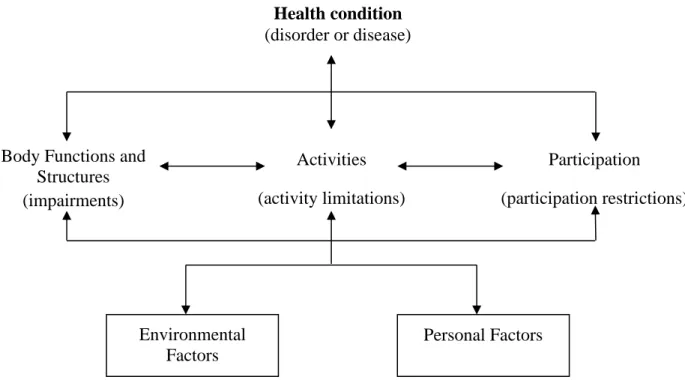
the 1970s, emerged from dissatisfaction with the traditional medical model of illness (Engel, 1977; McDougall et al., 2010; Wade & Halligan, 2017). By recognizing the influence of
interactions between physical, psychological, and social factors on health conditions, the model tried to promote a holistic approach to medicine and psychiatry. Thus, the ICF and the ICF-CY conceptual framework, which identifies the interactive influence of relevant factors, views disability as “the outcome of a mismatch between a person’s abilities, performance demands, and supports available in the environment” (Gleason & Coster, 2012, p. 285) and acknowledges the importance of maximizing the person’s participation in everyday life through modifications of the person’s environment as well as the need for medical treatment.
9
2007). The severity of the disability in certain functionality dimension is defined by the
application of universal qualifiers within the ICF/ICF-CY coding system. In particular, the extent of problems in the Activities and Participation component is described by performance and capacity qualifiers. The performance qualifier refers to what an individual does in his or her current environment, whereas the capacity qualifier refers to an individual’s ability to execute a task or an action or the highest probable level of functioning that an individual may reach. Accordingly, the use of the two qualifiers can clarify the effect of environmental factors on an individual’s ability to perform a task.
The other part of the ICF/ICF-CY, Contextual Factors, consists of two components: Environmental Factors and Personal Factors. The Environmental Factors component refers to the physical, social and attitudinal environments in which people live and could be assessed at two different levels, individual (e.g., home, workplace, school, family, acquaintances, and peers) and societal (e.g., community activities, government agencies, laws and regulations, formal and informal rules, attitudes, and ideologies). The Personal Factors component includes one’s age, race, gender, religion, values, lifestyle, social status, and life experiences. Thus, the ICF/ICF-CY conceptual model depicts the manifestation of functioning and disability as the result of the dynamic interactions between multiple elements of health conditions and contextual factors and provides a systematic way of understanding the interrelationships that underlie human
10
The publication of the ICF and the ICF-CY represents significant achievements in the classification of disability (Lollar & Simeonsson, 2005; Simeonsson et al., 2003). First, the ICF and the ICF-CY reflect a changing view of disability and a paradigm shift from a medical model to a biopsychosocial model of disability (e.g., Castro, Coelho, & Pinto, 2016; McDougall et al., 2010; Üstün et al., 2003). Prior to the ICF and the ICF-CY, the most widely used systems to classify disability such as the ICD and the DSM were based on the reductionistic medical model approach. In contrast to these traditional classification systems that focus primarily on etiology and symptomatology of diseases, the ICF and the ICF-CY offer a holistic description of human functioning by expanding their coverage to include health and health-related domains and everyday activities (e.g., education, social interaction, and community involvement) that are important for overall well-being beyond diseases. Second, along with the paradigm shift, the ICF
Health condition (disorder or disease)
Body Functions and Structures (impairments)
Participation (participation restrictions) Activities
(activity limitations)
Environmental Factors
Personal Factors
11
and the ICF-CY replaced negative and pathology-oriented language with neutral language to describe functioning and disability of individuals (Lollar & Simeonsson, 2005). Moving away from the traditional negative view towards disability, the use of neutral language in the ICF and the ICF-CY reflects universal nature of disability and promotes conceptualization of disability as a “natural experience of living” (Lollar & Simeonsson, 2005, p. 324). Third, the ICF and the ICF-CY reflect a multidimensional model of disability that allows descriptions of functioning at different levels: body functions and structures, activities, and participation. As these components of functioning cannot be analyzed separately (McDougall et al., 2010), the multidimensional perspective offers an integrative and comprehensive profile of an individual instead of unidimensional information on functioning. Fourth, the ICF and the ICY-CY framework
replaced a traditional linear approach with a dynamic interactional model (Lollar & Simeonsson, 2005; McDougall et al., 2010). Whereas the linear model assumes linear and unidirectional progression from impairments caused by health conditions to disabilities, the interactional model represents dynamic interactions among health conditions and dimensions of human functioning within contexts to describe the consequences of health conditions (Lollar & Simeonsson, 2005; Simeonsson, Lollar, Hollowell, & Adams, 2000; Üstün et al., 2003). Finally, a significant achievements of the ICF and the ICF-CY is the recognition of the role of environmental factors as essential components in describing human functioning and disability (Lollar & Simeonsson, 2005; Üstün et al., 2003). The recognition of environmental factors reflects the paradigm shift that the ICF and the ICF-CY conceptualize disability as a product of person-environment interaction rather than an attribute of individuals (Simeonsson, 2009). By identifying
12
at the body, person, and societal level. Furthermore, the recognition of environmental factors bears considerable significance for children and adolescents because they experience
increasingly complex environment changes across the developmental stages of infancy, early childhood, middle childhood, and adolescents (Simeonsson et al., 2003).
13
De Polo, Bortolot, & Pradal, 2015; Salghetti et al., 2009). In the realm of policy development, the ICF and the ICF-CY carries great potential for developing social policy for individuals with disabilities (Üstün et al., 2003). As the ICF and the ICF-CY can document the public health information of conditions associated with disability, countries such as Brazil, Italy, and Taiwan have adopted the ICF/ICF-CY to initiate new national public policies and social programs (Madden & Bundy, 2018).
The ICF-CY coding system. The ICF-CY classification system organizes information into four mutually exclusive components: Body Functions, Body Structures, Activities and Participation, and Environmental Factors. Although the ICF-CY proposes the presence of personal factors in its conceptual model, the classification system does not include a formal domain for personal factors for the stated reason of large cultural and social variabilities associated with them (Krasuska et al., 2012; Üstün et al., 2003). Further, as there is no formal domain of personal factors, there are no codes, only a list of descriptors, and should therefore not be used (Simeonsson et al, 2014).
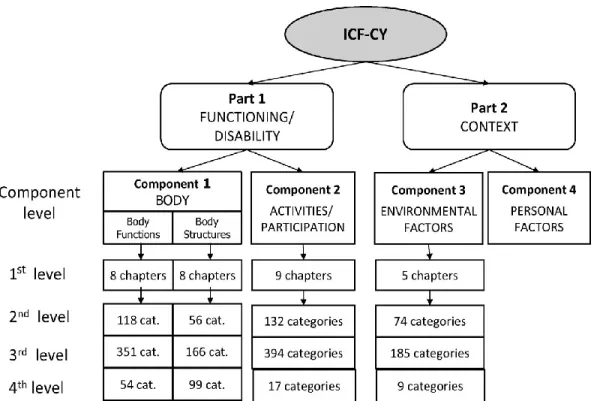
For the four domains with codes, information is arranged in a hierarchical order and is further classified into smaller categories (see Figure 2). The first level of the ICF-CY hierarchy is comprised of chapters. The Body Functions and Body Structures components are organized according to the body systems and each has eight chapters. The Activities and Participation component includes nine chapters that cover a full range of life areas. The Environmental Factors component contains five chapters that cover physical, social and attitudinal
14
two digits represent the second level category number. Two additional single-digits could be applied for the third and fourth level category subdivisions if needed (see Table 2). Following the category codes, a numerical scale, qualifier, should be added to indicate the severity of
impairment after a decimal point. The ICF/ICF-CY codes are only complete with the presence of a qualifier. The numeric scale ranges from 0 representing “no impairment” to 4 representing “complete impairment” (see Table 3). In addition, numerals 8 and 9 can be used to indicate “not specified” and “not applicable” conditions. For the Environmental Factors chapters, the qualifier can be used to describe environmental factors either as barriers or facilitators. Whereas the decimal point is used to denote a barrier, a plus sign replaces the decimal point to represent a facilitator.
15 Table 1
List of Chapters in the ICF-CY
Body Functions Body Structures
b1 Mental functions s1 Structures of the nervous system b2 Sensory functions and pain s2 The eye, ear and related structures b3 Voice and speech functions s3 Structures involved in voice and speech b4 Functions of the cardiovascular,
hematological, immunological and respiratory systems
s4 Structures of the cardiovascular, immunological and respiratory systems
b5 Functions of the digestive, metabolic and endocrine systems
s5 Structures related to the digestive, metabolic and endocrine systems
b6 Genitourinary and reproductive functions s6 Structures related to the genitourinary and reproductive systems
b7 Neuromusculoskeletal and movement-related functions
s7 Structures related to movement b8 Functions of the skin and related structures s8 Skin and related structures
Activities and Participation
d1 Learning and applying knowledge d2 General tasks and demands d3 Communication
d4 Mobility d5 Self-care d6 Domestic life
d7 Interpersonal interactions and relationships d8 Major life areas
d9 Community, social and civic life
Environmental Factors
e1 Products and technology
e2 Natural environment and human-made changes e3 Support and relationships
e4 Attitudes
16 Table 2
Examples of the ICF-CY Numeric Coding System
Levels Codes Description
First Level d7 Interpersonal interactions and relationships Second Level d710 Basic interpersonal interactions
Third Level d7104 Social cues in relationships Fourth Level d71040 Initiating social interactions
Table 3
ICF-CY Universal Qualifiers Qualifiers Classification
xxx.0 NO problem
xxx.1 MILD problem
xxx.2 MODERATE problem
xxx.3 SEVERE problem
xxx.4 COMPLETE problem
xxx.8 Not specified xxx.9 Not applicable
The ICF Core Sets. As a comprehensive classification system of functioning, the ICF/ICF-CY consists of 1685 classification categories (Schiariti et al., 2018). Consequently, the exhaustiveness of the ICF/ICF-CY that comes with complexity makes its application in daily clinical work challenging (Schiariti et al., 2018; Selb et al., 2015; Yen et al., 2014). In order to address the issue, the ICF Research Branch initiated the ICF Core Sets Project in 2001 and have developed more than 30 ICF Core Sets for specific health conditionsthrough a
scientifically-rigorous multi-step process (Bickenbach et al., 2012; Selb et al., 2015). An ICF Core Set is a limited list of categories from the full ICF classification that are considered necessary to describe
functioning of a person with a specific disability. The Core Sets are user-friendly and
purpose-oriented tools that are aimed at facilitating the application of the ICF/ICF-CY in daily clinical
17
documentation tool (www.icf-core-sets.org) to promote the use of the ICF Core Sets (WHO, 2012). Every ICF Core Set has two different versions, Brief and Comprehensive, which differ in
the number and specificity of the ICF categories (Selb et al., 2015). There are currently three ICF
Core Sets for childhood-onset disabilities: cerebral palsy, autism, and
attention-deficit/hyperactivity disorder (ADHD; Schiariti et al., 2018). Unlike the Core Sets for adult population, the Brief Core Sets for cerebral palsy, autism and ADHD have age-specific Core
Sets. Schiariti and colleagues (2018) conducted a comparative content analysis of the Core Sets
for cerebral palsy, autism, and ADHD to examine if the separate Core Sets are necessary. They
reported that, though commonalities across the Core Sets were discovered, the separate Core Sets
capture a unique functioning profile of each group and supported the use of a
“condition-specific” ICF Core Sets when possible. However, little empirical data is currently available for
the three Core Sets and disagreement exits regarding the validity and utility of the three Core
Sets among scholars (e.g., Kraus de Camargo, 2018; Schiariti et al., 2018; Schiariti, Selb, Cieza, & O’Donnell, 2015; Wright, 2015). For example, Kraus de Camargo (2018) and Wright (2015) acknowledged that the use of the Core Sets in clinical practice is a good starting point, especially
for clinicians who are not familiar with the ICF/ICF-CY, but they expressed concerns regarding
the application of the “diagnostic-specific” Core Sets that they are too restrictive and create a
risk of omitting important information. They also criticized the development process of the Core
Sets for possible selection biases and questioned the global validity of the available Core Sets.
Furthermore, as Wright (2015) pointed out that the ICF Core Sets highlight what needs to be
measured, but do not address how to measure those areas of functioning, there is a need to link
elements of the Core Sets with exiting measurement tools. Recently, Schiariti and colleagues
18
there will be similar resource tools for the measurements of autism and ADHD (Schiariti et al.,
2018). Thus, studies on the application of the ICF Core Sets in psychological practice and
assessment are yet to come.
Application of the ICF-CY
19
Application of the ICF-CY in health and education services. As the ICF-CY has become internationally recognized as a useful tool to document a child’s functioning and
disability, there has been an increasing interest in the application of the ICF/ICF-CY framework to clinical practice and research. Scholars from different disciplinary fields, including
rehabilitation services (e.g., McDougall & Wright, 2009; Vargus-Adams & Majnemer, 2014), speech-language pathology (e.g., Campbell & Skarakis-Doyle, 2007; McLeod, 2004; McLeod & Threats, 2008; Washington, 2007), occupational therapy (Cramm et al., 2012), physical therapy (Darrah, 2008; Goldstein et al., 2004), and school psychology (Benson & Oakland, 2011), have published conceptual papers on how the ICF/ICF-CY framework could be applied to their fields and specifically their work with children and adolescents. In addition to the conceptual papers, the ICF-CY has been applied to the clinical work of speech language pathologists with children with Down syndrome (Deckers, Van Zaalen, Stoep, Van Balkom, & Verhoeven, 2016),
preschoolers with speech impairments (McCormack, McLeod, Harrison, & McAllister, 2010; McLeod, 2006), and children in need of augmentative and alternative communication devices (Pless & Granlund, 2012; Rowland et al., 2012; Simeonsson, Björck-Åkessön, & Lollar, 2012).
20
(Bonanni et al., 2009), visual impairment (Rainey et al., 2014), specific learning disability (Riva & Antonietti, 2010), and other disabilities and health conditions (e.g., Darcy et al., 2015;
Gordon, 2014; Kovac & Simeonsson, 2014; Leonardi et al., 2012).
As the number of applied research studies are increasing, there is growing evidence that the ICF/ICF-CY framework can serve as a valuable tool in implementing services for children and adolescents with disability. For instance, analyzing contributing factors to communication performance in six children with Down syndrome, Deckers et al. (2016) found that their diverse ICF-CY based profiles of impairments in body structures, body functions, activities and
participations, and environmental factors, may lead to similar communication performance among children with Down syndrome and vice versa, indicating the importance of obtaining a holistic view of the child when planning speech and language interventions. In addition, applied studies have reported that the use of the ICF-CY, which allowed shared understanding of goals and interventions, improved communication among multidisciplinary team members and the quality of teamwork in rehabilitation settings (e.g., Martinuzzi et al., 2015; Salghetti et al., 2009). Furthermore, beyond the communication within the multidisciplinary teams, these studies found that the implementation of the ICF-CY framework enhanced the communication and service coordination between the multidisciplinary teams and caregivers.
21
developing an individualized educational plan, and progress monitoring, (b) provide descriptions of child functioning within the Body Function, Body Structure, and Activities and Participation components, (c) document school environmental factors that serve as a facilitator or a barrier to functioning, (d) define functional limitation of the child in the school environment and identify the levels and extent of special education support that the child needs to meet the demands of the school environment, (e) document changes and progress of the child’s functioning overtime with the use of the ICF-CY universal qualifiers, and (f) guide the selection of measurements for eligibility determination and progress monitoring. In addition to these applications to actual practice, the ICF-CY holds great promise to guide educational policy and promote policy
changes that support the inclusive education of children with disability in school (Ellingsen et al., 2018). In fact, the countries of Portugal and Switzerland have adopted the ICF/ICF-CY as a guiding framework in their national educational policies (Ellingsen et al., 2018).
Although the application of the ICF-CY in education appears to be slower than in other fields (Aljunied & Frederickson, 2014; Moretti et al., 2012) with most of the existing empirical studies conducted in Europe, the belief that the ICF-CY can serve as a valuable tool in providing special education services has contributed to an increasing number of recent pilot studies on the application of the ICF-CY in school settings (e.g., De Polo, Pradal, Bortolot, Buffoni, &
22
special education (e.g., Sanches-Ferreira et al., 2014; Silveira-Maia et al., 2017) and early intervention services (Castro, Pinto, & Simeonsson, 2014).
In a study commissioned by the Portuguese Ministry of Education, Sanches-Ferreira et al. (2013) examined the influence of the implementation of the ICF in determining special education eligibility by reviewing standard documents used to record the identification and assessment process of students referred for special education services. The study found that the sources of information collected during the assessment process varied depending on the roles of
23
information on the severity of limitations and restrictions observed in the Activities and
Participation codes can facilitate the development of individualized goals and interventions that are most appropriate for the student.
Several studies conducted in Portugal examined Portuguese Individualized Educational Programs (IEPs) based on the ICF/ICF-CY framework. Castro, Pinto, and Simeonsson (2014) examined the IEPs for preschool students diagnosed with autism spectrum disorder. The study specifically analyzed the description of assessment results and intervention goals in the IEPs within the ICF-CY framework. The ICF-CY based content analysis revealed that the majority (62.8%) of the concepts identified in the IEPs were linked to the Activities and Participation codes, whereas only a small number of concepts were linked to the Environmental Factors codes. The results also indicated that no actual IEPs reflected environmental factors in addressing intervention goals. Additionally, the study found that only 23.1 % of the concepts identified in the IEPs were included both as assessment data and intervention goals, showing very limited correspondence between the assessment data and the intervention goals. In another study, Silveira-Maia and colleagues (2017) compared IEPs for the same students developed before and after the mandatory ICF-CY implementation. The study found that utilizing an ICF-CY based functioning profile rather than depending on a clinical diagnosis enabled multidisciplinary
24
education assessment and intervention planning was generally perceived as a positive change by the multidisciplinary special education team members.
In Italy, a study was conducted to examine the utility of the ICF-CY framework to document child’s functioning and promote the communication among different service providers during the IEP development process (De Polo et al., 2009). The study asked school teachers to describe students’ participation in school activities using the ICF-CY codes from the Activities and Participation chapters and developed IEPs using the ICF-CY language. The findings revealed that the use of the ICF-CY language and codes led to an integration of various documents used by multidisciplinary team members, allowing the team members to develop comprehensive and holistic profiles of children with special needs.
Application of the ICF-CY as a reference taxonomy for linking assessment
measures. In addition to the studies that applied the ICF and the ICF-CY to facilitate practices in clinical and educational services for children, an application of growing interest is its use as a reference taxonomy to analyze the content and scope of assessment measures. This has taken the form of reviewing the items of an assessment measure and determining if it can be matched to one or more ICF/ICF-CY codes, a process described as “linking” by Cieza et al. (2002). Briefly, the process involves defining instrument items and questions of an assessment measure or
inventory into meaningful concepts and assigning each of these concepts to a corresponding code from the ICF/ICF-CY. The specific steps of this process have been defined by Cieza and
colleagues (Cieza et al., 2002; Cieza, Fayed, Bickenbach, & Prodinger, 2016; Cieza et al., 2005) and have served as the basis for studies of linking measures across various disciplines.
25
existing measurements (Castro et al., 2016). This information could be useful in developing new assessment and screening tools that are aligned with a biopsychosocial approach (Castro et al., 2014). Second, linking studies enable comparisons of the contents of multiple assessment instruments, which helps clinicians and researchers identify and select a most appropriate instrument for specific clinical practice or research studies (Fayed et al., 2012; Stucki et al., 2008). Third, linking studies bring a multidimensional view of functioning in examining current assessment measures. With the multidimensional model, the ICF-CY enables capturing aspects of functioning in multiple domains, which assists clinicians in obtaining a holistic functional profile of a child (Castro & Grande, 2018). Lastly, as the ICF-CY provides information on child’s mental, affective, social, behavioral, and adaptive functioning, linking studies can identify whether or not measurements linked provide a functional profile of the child that is necessary to develop program goals and interventions. In other words, aligning the content of assessments with the ICF-CY can ensure that an assessment produces treatments and
interventions that are individualized based on the child’s strengths and special needs. Thus, using measurement tools that are aligned with the ICF/ICF-CY could further bring a change to the traditional medical model approach to the assessment of children with disabilities in which the primary goal of an assessment is to determine an IDEA eligibility category or a DSM-type diagnosis.
26
Maia, 2011; Castro & Grande, 2018). One study was conducted to link three autism measures, the Autism Diagnostic Observation Schedule (ADOS), the Childhood Autism Rating Scale (CARS), and the Autism Diagnostic Interview Revised (ADI-R), with the ICF-CY (Castro et al., 2013). The findings showed that the majority of the meaningful concepts identified in the three autism assessment instruments were linked with the Body Functions and the Activities and Participation components. Out of the 44 meaningful concepts identified in the ADOS, 48% were linked to Body Functions and 43 % were linked to Activities and Participation. Out of the 55 meaningful concepts identified in the CARS, 96% were linked with Body Functions and 43 % were linked with Activities and Participation. Out of the 214 meaningful concepts identified in the ADI-R, 31% were linked with Body Functions and 29% were linked with Activities and Participation. Although the study identified more meaningful concepts in the ADI-R, which has an interview format, the ADI-R included a high percentage (39 %) of the “non-definable” concepts. Thus, this linking study made it possible to compare the contents covered by the three different autism diagnostic measures. Overall, the linking results indicated that the ADOS and the ADI-R cover more Activity and Participation dimensions, whereas the CARS has a strong focus on the Body Functions aspects. The study suggested that the ADOS and the ADI-R may have better ability to identify and describe more specific functioning of the child beyond their primary utility as diagnostic instruments. Furthermore, the findings revealed that the
communication domain under the Activities and Participation component was covered more extensively by the ADOS and the ADI-R compared to the CARS. Similarly, the domain for interpersonal interactions and relationships under the Activities and Participation component was more extensively covered by the ADOS compared to the ADI-R and the CARS. No
27
these measures are focused on child characteristics and oriented towards diagnosis (Castro et al., 2013). Based on the results of the linking, Castro et al. (2013) suggested that using the diagnostic measurements along with the ICF-CY may better assist professionals in developing an
individualized functional profile of the child that could be differ from one another.
In another study, Castro and colleagues (2016) linked two developmental measures, the Griffiths Mental Developmental Scales (GMDS) and the Schedule of Growing Skills-II (SGS-II), to the ICF-CY. The study linked each sub-scale of the GMDS to the ICF-CY codes. The results indicated that 28% of the items on the GMDS were linked to the Body Functions codes and more than 100% of the items were linked to the Activities and Participation codes, indicating some items were linked to more than one Activities and Participation code. Similarly, 66% and 100% of the items on the SGS-II were mapped to the Body Functions codes and the Activities and Participation codes, respectively. The study found that these two measures assess a wide range of the child’s development within the Activities and Participation and Body Functions components though they collect the information on the child’s capacity rather than performance. Neither of the assessments was found to contain aspects of the child’s environment.
Gleason and Coster (2012) examined the degree of linkage between the Vineland
Adaptive Behavior Scales-II (VABS-II) and the Activities and Participation chapters of the ICF-CY. The study found that 69 % (n = 855) of the 1,231 meaningful concepts identified in the VABS-II were linked with the Activities and Participation codes, whereas 31% (n = 376) were linked with the Body Functions codes. Although Gleason and Coster (2012) reported that many chapters within the Activity and Participation component were well represented by the VABS-II items, they also found that some of the Activity and Participation chapters were not well
28
areas that are closely related to the child’s participation in everyday activities. Combined with another finding that no VABS-II concepts were linked to the Environmental Factors codes, Gleason and Coster (2012) concluded that the VABS-II is not sufficient to measure the child’s participation in everyday activities. In addition, the study highlighted another shortcoming of the VABS-II in describing the functioning of children with disability; compared to the ICF-CY coding system which allows practitioners and clinicians to record the child’s performance with and without assistance, the VABS-II does not provide methods to record performance with or without assistance.
29
Interactions and Relationships chapter, were represented more in the LoRDIA. The study revealed specific challenges of linking items from the mental health questionnaire that has a strong focus on the relationships between people and social interactions because many of these items were related to more than one ICF-CY domain. For example, latent constructs related to interactions and relationships can be linked either to the Interpersonal Interactions and
Relationships chapter under the Activities and Participation component or the Support and Relationships chapter under the Environmental Factors component. As one way to solve the issue of overlap between the content in different ICF-CY domains, Augustine et al. (2018) reported that identifying whether body, activity and participation, or environment is in focus was essential. Furthermore, in order to link a latent construct to a most representative ICF-CY code, they suggested that it is important to “explicitly identify what the item was originally intended to measure and then search the ICF-CY code that incorporates as many aspect/meaning units as possible in the item” (Augustine et al., 2018, p. 2297).
Application of the ICF-CY to Enhance Assessment Practice in School Psychology Whereas the ICF-CY has important implications for the assessment practice of school psychologists as a universal language to document functioning and disability of the children and their surrounding environment (Carlson et al., 2010), only a few studies have addressed the issue of applying the ICF-CY framework to the work of school psychologists in assessment and identification of children with special needs in school settings (Aljunied & Frederickson, 2014; Benson & Oakland, 2011; Carlson et al., 2010). Furthermore, there are no existing studies in the field of school psychology that have examined the content of assessment tools within a
30
Traditional school psychology assessment practice, which is profoundly influenced by the medical model, is designed mostly to assign an IDEA diagnosis and determine eligibility for special education services for referred children with academic, behavioral, emotional and health problems (Kratochwill & Stoiber, 2000). An important feature of the eligibility-oriented
assessment process involves using conventional standardized and norm-referenced assessment measures to document the degree of discrepancy from age or grade expectations in separate ability domains, including intellectual, academic, behavioral, social, emotional and adaptive behavior. This strong emphasis on eligibility determination and a heavy reliance on conventional measures have been criticized over the past few decades in the field of school psychology, especially for the disconnect between assessment and intervention (e.g., Farrell, 2010; Reschly, 1988, 1997, 2008; Reschly & Ysseldyke, 1995, 2002; Sheridan & Gutkin, 2000).
As there has been an increasing demand for evidence-based practice and accountability (Reschly, 2008; Reschly & Ysseldyke, 2002), serious concerns about shortcomings of the conventional assessment measures have been raised within the field. First, although the conventional measures are known to have strong psychometric properties, Gutkin (2012) criticized the pathology-oriented medical model assessment approach that the reliability and validity of IDEA- or DSM- type diagnoses driven from such assessment is “often highly questionable” (p.6). Gutkin (2012) further argued, with weak reliability and validity of the diagnoses, the information obtained from the conventional assessment measures are less likely to create effective interventions. Second, as Zeinder (2001) stated that content domains of the conventional assessment measures are generally narrow, most assessment instruments used in the school psychology practice have specific or limited focus on only one ability domain. In
31
the ability domain” (Zeinder, 2001, p.4) and “performance of specific tasks rather than aspects of functioning such as attending, learning, and problem-solving that underlie such achievement” (Simeonsson & Lee, 2013, p.214). Thus, conventional standardized and norm-referenced assessment tools are likely to overlook the individual’s strengths and differences on a variety of dimensions (Zeinder, 2001). In order to address the complexities of child development and provide a holistic understanding of the child evaluated, assessment instruments used to determine eligibility for special education services need to include a comprehensive array of ability
domains. Third, the conventional assessment measures tend to have very limited functional content that represents essential skills necessary for the child to participate in daily life activities (Macy et al., 2015). As Bagnato, Neisworth, and Pretti-Frontczak (2010) argued, the traditional medical model approach focuses too much on nonfunctional content such as scores and
diagnoses obtained from conventional standardized and norm-referenced assessments and
overlooks functional information that refers to competencies and assets necessary for the child to navigate through the challenges in daily life including accessing education and participating in learning activities. For example, Macy, Bagnato, Macy, and Salaway (2015) found that most of the standardized and norm-referenced tests of early development frequently used to determine early intervention eligibility in the United States do not contain functional content.
32
and intervention. The concern regarding the lack of functional content is echoed by another criticism that the conventional assessment measures generally have weak treatment validity (Ellingsen et al., 2018; Reschly & Ysseldyke, 1995; Vanderwood, 2013). Treatment validity or treatment utility is defined as the degree to which assessment contributes to decision-making in developing effective interventions and programs (Bagnato & Neisworth, 1994; Hayes et al., 1987). In fact, a number of researchers in the field (e.g., Gutkin, 2012; Reschly, 2002; Reschly & Ysseldyke, 2002; Sheridan & Gutkin, 2000) have criticized the traditional school psychology assessment practice that the practice had failed to inform effective treatments and interventions. For example, in a commentary published in the School Psychology Review (SPR), the NASP’s major journal, Reschly (1997) criticized the continued use of conventional assessment measures in the school psychology practice without documented benefits to the children and argued that school psychologists should “refrain from the use of instruments from which benefits are dubious” (p.239).
The issues concerning the quality and effectiveness of conventional standardized and norm-referenced measures pose a question if the current school psychology assessment practice, which is characterized with the heavy usage of conventional measures of intellectual ability and academic achievement and diagnostic tools for social, emotional, and behavior concerns, is effective in helping children who are referred for special education evaluations. Although the concerns about the traditional school psychology assessment practice, especially the issue of disconnect between assessment and intervention, gave rise to a call for reform or a paradigm shift in the field of school psychology (Reschly, 2002; Reschly & Ysseldyke, 2002), there
33
The lack of research reflects the historical tradition in the field that most of the assessment research conducted in school psychology are psychometric studies whose primary object is to verify psychometric properties of assessment instruments that instruments are normed on a representative sample and reliable and valid for specific purposes. Thus, whereas psychometric issues are central in psychological assessment in school psychology (e.g., Merrell et al., 2011; Wilson & Reschly, 1996), the taxonomic basis for measurement has been the focus of less study. Moreover, despite a long and rich history of assessment research in the field, the usefulness of assessment instruments in creating interventions remains unclear (Burns, 2012). As assessment without implication for interventions is not good enough and ineffective (Das & Naglieri, 2001; Reschly, 1988, 2004), assessment measures utilized in school psychology should contribute to developing effective interventions. The psychometric studies are useful by themselves, but have limited utility in identifying how much functional content is covered by an assessment tool. As Reschly (1997) urged that assessment research in school psychology needs to shift its focus from psychometric properties of instruments to “systematic consideration of what happens to
individuals as a result of individual ability measurement” (p. 234), the long-standing lack of research on the benefits of standardized and norm-referenced assessment measures to children indicates the need to examine these measures from a different perspective and develop
34 Significance of Present Study
Linking assessment measures utilized in school psychology practice to the ICF-CY classification system can offer a scientific basis to analyze contents of these measures from a new perspective and within a biopsychosocial approach. Moreover, as the ICF-CY provides information on child’s functioning that is essential in developing interventions, aligning the content of assessments with the ICF-CY could bridge the gap between assessment and intervention that the traditional assessment approach often ignores. That is, linking current assessment measures to the ICF-CY can provide the information on the nature of functioning they address rather than the information on their psychometric properties.
The fact the ICF and the ICF-CY are not assessment instruments, but an universal language to describe functioning has contributed to a number of linking studies because of a need to develop assessment tools that are aligned with the content of the ICF/ICF-CY (Castro et al., 2016; Rowland et al., 2016; Simeonsson et al., 2003). Previous studies have linked a number of health-related measures such as the KIDSCREEN-52, the KINDL-R, the Pediatric Quality of Life Inventory (Gandhi et al., 2014), short-stature youth questionnaire (QoLISSY; Sommer, Bullinger, Rohenkohl, Quitmann, & Brütt, 2015), Haemo-QoL (Krasuska et al., 2012), and the ACTIVLIM (Raggi & Leonardi, 2009). Several measures of general development have also been linked to the ICF/ICF-CY including the Vineland Adaptive Behavior Scales-II (VABS-II;
35
utilized by school psychologists in the United States were examined through the linking process. The limitations of conventional assessment measures used in school psychology practice and the need to examine these assessment measures based on the benefit to individual children indicate more study is needed to analyze existing assessment measures using the ICF/ICF-CY linking process. Furthermore, the fact that measures utilized in school psychology practice are often completed by multiple respondents offers an opportunity to apply the linking process to compare the nature and scope of content across respondents.
The Behavior Assessment System for Children (BASC) is one of the most widely used behavior rating scales that takes multimethod and multidimensional approach (Matazow & Kamphaus, 2001) and was reviewed for the linkage with the ICF-CY in the current study. Given the behavioral focus of the BASC, the review for the linkage involved the Body Functions, Activities and Participation, and Environmental Factors components.
36
adolescents by clinical and school psychologists (Cashel, 2002; Gladman & Lancaster, 2003; Kamphaus et al., 2000; Karr & Garcia-Barrera, 2017; Koonce, 2007). In addition, the BASC has earned significant popularity in research setting over the years, making it the tool of choice for a number of clinical studies of child psychopathology (Gladman & Lancaster, 2003; Kamphaus et al., 2000; Karr & Garcia-Barrera, 2017).
The BASC has several features that give advantages over other existing measures (Flanagan, 1995; Gladman & Lancaster, 2003). First, the BASC provides a multimethod rating system that contains the following five components: Teacher Rating Scales (TRS), Parent Rating Scales (PRS), Self-Report of Personality (SRP), Student Observation System (SOS), and
Structured Developmental History (SDH). They may be used individually or in any combination. The multimethod system allows clinicians to collect information in different ways (e.g., rating
scales, interview, and direct observation) and from multiple people (e.g., parents, teachers, and
children themselves), which provides information on children’s functioning in multiple contexts.
In addition, the BASC is a multidimensional tool; unlike other behavior rating scales, the BASC can examine adaptive behavior simultaneously with psychopathology. Finally, the BASC covers a wide age range of children and adolescents, which permits repeated assessments across
development. For example, the TRS and PRS have three different forms including Preschool (ages 2 through 5), Child (ages 6 through 11), and Adolescent (ages 12 through 21) to cover age-appropriate content.
37
aimed to identify the extent to which the BASC-3 items can be linked to the selected ICF-CY components, chapters, and codes, and analyze the extent to which the linkage to the ICF-CY reflects similar contents. In keeping with the aims of the study, the following research questions were formulated:
1. To what extent can the BASC-3 items on the PRS and TRS forms for the three
different age groups be linked to the Body Functions, Activities and Participation, and Environmental Factors components of the ICF-CY and their chapters?
2. Are there any differences between the PRS and TRS forms in the coverage of the ICF-CY codes by the BASC-3 composite scales?
38
CHAPTER 3: METHOD
Study Design
The study utilized the “linking” procedure which incorporates a qualitative content analysis approach and an application of the ICF specific liking rules developed by Cieza and colleagues (Cieza et al., 2002, 2005, 2016). The linking procedure has been used in previous studies to connect contents of assessment measures to the ICF/ICF-CY classification system (e.g., Augustine et al., 2018; Castro & Grande, 2018; Castro et al., 2011; Fayed et al., 2011). Qualitative content analysis is a research method used to systematically analyze text data by organizing material into explicit categories (e.g., Elo & Kyngäs, 2008; Hsieh & Shannon, 2005; Schreier, 2012). It has become a widely used method of analyzing textual data in health studies in recent years (Elo & Kyngäs, 2008; Hsieh & Shannon, 2005). Although the approach is primarily qualitative in nature, qualitative content analysis could be discussed under the label of mixed methods design because it consists of both qualitative and quantitative steps (Mayring, 2015). The qualitative step, which involves assigning categories to text, is followed by the
39 Trustworthiness
Trustworthiness is a widely accepted term that refers to rigor in qualitative research. Lincoln and Guba (1985) argued that conventional trustworthiness criteria, such as reliability and validity, are not appropriate within the axioms of qualitative research and replaced them with new criteria that include four aspects of trustworthiness: credibility, transferability,
dependability, and confirmability. A fifth criterion, authenticity, was later added by Lincoln and Guba (Cope, 2014). The criteria proposed by Lincoln and Guba have been most frequently used to evaluate qualitative research studies (Cope, 2014; Shenton, 2004). Establishing the
trustworthiness in a qualitative study, although challenging, is essential to the usefulness and integrity of the findings. As Amankwaa (2016) recommended the development of protocols and procedures and documentation of them to ensure trustworthiness when conducting a qualitative study, a checklist developed by Elo et al. (2014) for evaluating trustworthiness of qualitative content analysis was reviewed during the planning phase in the present study. In addition, a series of strategies and procedures introduced by Lincoln and Guba (1985) that could strengthen the trustworthiness in qualitative research were utilized. These include triangulation, member checking, reflexivity, inquiry audit, and audit trail (e.g., Amankwaa, 2016; Cope, 2014; Lincoln & Guba, 1985; Shenton, 2004). Credibility was achieved through triangulation with the use of multiple coders, member checks, and peer debriefing among the coders. Thick descriptive data was provided to assure transferability. In order to increase dependability, inquiry audits were conducted through supervisions provided by one of the dissertation committee members who has extensive knowledge and expertise with regard to the ICF/ICF-CY. Confirmability was
40 Instruments
41 Table 4
Summary of the BASC-3 PRS and TRS Scales
Forms Composite Scales Externalizing Problems Internalizing Problems School Problems
Adaptive Skills Behavioral Symptoms
Index PRS-P − Hyperactivity
− Aggression
− Anxiety − Depression − Somatization
− Adaptability − Social Skills − Functional
Communication − Activities of
Daily Living
− Hyperactivity − Aggression − Depression − Attention
Problems − Atypicality − Withdrawal PRS-C,
PRS-A
− Hyperactivity − Aggression − Conduct
Problems
− Anxiety − Depression − Somatization
− Adaptability − Social Skills − Functional
Communication − Leadership − Activities of
Daily Living
− Hyperactivity − Aggression − Depression − Attention
Problems − Atypicality − Withdrawal TRS-P − Hyperactivity
− Aggression
− Anxiety − Depression − Somatization
− Adaptability − Social Skills − Functional
Communication
− Hyperactivity − Aggression − Depression − Attention
Problems − Atypicality − Withdrawal TRS-C,
TRS-A
− Hyperactivity − Aggression − Conduct
Problems
− Anxiety − Depression − Somatization
− Learning Problems − Attention Problems
− Adaptability − Social Skills − Functional
Communication − Leadership − Study Skills
− Hyperactivity − Aggression − Depression − Attention
Problems − Atypicality − Withdrawal Note. PRS-P = Parent Rating Scales-Preschool; PRS-C = Parent Rating Scales-Child; PRS-A = Parent Rating Adolescent, TRS-P = Teacher Rating Preschool; TRS-C = Teacher Rating Scales-Child; and TRS-A = Teacher Rating Scales-Adolescent.
Linking Rules
42
strictly apply the linking rules were reported in previous linking studies (e.g., Augustine et al., 2018), a systematic literature review of the ICF linking studies published between 2001 and 2008 found that 58 out of 109 linking studies used Cieza’s linking rules (Fayed et al., 2011). Despite the fact that the linking rules were originally developed to link health status measures to the ICF, Cieza et al. (2005) indicated that the rules could be applied to clinical measures and
43 Table 5
Refined ICF Linking Rules (Cieza et al., 2016)
Linking Rules
1. Acquire good knowledge of the conceptual and taxonomical fundamentals of the ICF, as well as of the chapters, domains and categories of the detailed classification, including definitions before starting to link meaningful concepts to the ICF categories.
2. Identify the purpose of the information to be linked by answering the question What is this piece of information about? or What is this item about?
3. Identify any additional concepts contained in the piece of information in addition to the main concept(s) already identified in the previous step.
4. Identify and document the perspective taken on within a certain piece of information when linking it to the ICF.
5. Identify and document the categorization of the response options.
Note: this rule applies only to instruments, questionnaires, assessments or tests that contain response options.
6. Link all meaningful concepts, the most relevant and additional ones, to the most precise ICF category.
7. Use ‘‘other specified [8]’’ or ‘‘unspecified [9]’’ ICF categories as appropriate. ‘‘8’’ is to be used when the concept is not contained within any of the other specific categories at the respective level of a chapter. The additional information is
documented after the ICF code.
‘‘9’’ is used when the concept to be linked fits within a given chapter but there is not sufficient information at hand to assign it to a specific ICF category.
8. If the information provided by the meaningful concept is not sufficient for making a decision about the most precise ICF category, assign the concept to nd (not
definable).
9. If the meaningful concept is not contained in the ICF, but is clearly a personal factor as defined in the ICF, assign the meaningful concept to pf (personal factors).
10. If the meaningful concept is not contained in the ICF, assign this meaningful concept to nc (not covered) Further specifications: Meaningful concepts referring to a diagnosis or health condition are assigned to nc-hc (not covered-health condition).
Meaningful concepts referring to quality of life or life in general are assigned nc-qol
44 Procedures
One of the essential components in qualitative content analysis is its systematic and rule guided analysis (Mayring, 2000). Although there are no universal rules for conducting qualitative content analysis (Elo & Kyngäs, 2008), Mayring (2000) suggested that all qualitative content analysis needs to follow preparation steps to identify or define important concepts related to content analysis. Among the critical elements discussed by Graneheim and Lundman (2004), the following elements were identified in the present study: unit of analysis, content area, meaning unit, and meaningful concept. The preparation of content analysis starts with selecting a unit of analysis which refers to objects of a study (Elo & Kyngäs, 2008). The entire battery of the
BASC-3 PRS and TRS forms served as a unit of analysis in the present study. The content area is a part of an instrument that focuses on a specific issue. The BASC-3 clinical and adaptive scales were selected as content areas. The meaning unit that refers to a set of words connected to the same concept in the current study was each item on the BASC-3 PRS and TRS forms. Each item on the BASC-3 PRS and TRS forms also served as a meaningful concept because the BASC-3 items are very short in length, usually containing less than 10 words.
The coding procedure followed the steps similar to those taken by the previous linking studies in which clinical measures were linked to the ICF-CY (e.g., Castro et al., 2016, 2013; Gleason & Coster, 2012). A coding manual for the current study was developed by the author and reviewed by a dissertation committee member who has extensive knowledge about the ICF-CY. As outlined in the linking rules, performing liking requires a good understanding of
45
ICF-CY taxonomy and received training specific to the linking procedures of this study: They reviewed the ICF online educational tool provided by WHO (https://www.icf-elearning.com/) and performed practice coding using selected items from the Vineland Adaptive Behavior
Scales-II with the primary coder. All the coders have received training on the BASC-3. The steps that were taken in the present study are summarized below.
Step 1: Following the Linking Rule 2 (Cieza et al., 2016), the primary coder and the secondary coders discussed the purpose of the linking and identified the purpose of the
46
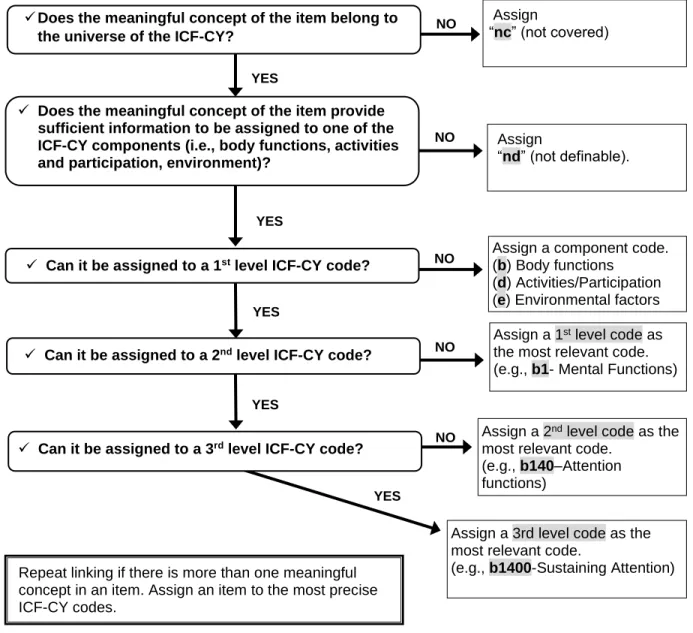
Step 2: The coders assigned corresponding codes from the ICF-CY to each BASC-3 item independently following the linking decision tree (see Figure 3). When the information an item aims to capture is not contained in the ICF-CY, the item was coded with not-covered (nc). When an item does not provide sufficient information to be linked to a most precise ICF-CY
component, the item was coded with non-definable (nd). For the items that can be assigned to an ICF-CY component, the coders first assigned the item to one of the selected ICF-CY
YES
Assign a 1st level code as
the most relevant code.
(e.g., b1- Mental Functions)
✓ Can it be assigned to a 2nd level ICF-CY code? NO
YES
✓ Can it be assigned to a 1st level ICF-CY code?
Assign a component code.
(b) Body functions
(d) Activities/Participation
(e) Environmental factors
NO YES
Assign a 3rd level code as the most relevant code.
(e.g., b1400-Sustaining Attention)
Assign a 2nd level code as the
most relevant code.
(e.g., b140–Attention
functions)
✓ Can it be assigned to a 3rd level ICF-CY code? NO
YES
NO Assign
“nd” (not definable).
✓ Does the meaningful concept of the item provide sufficient information to be assigned to one of the ICF-CY components (i.e., body functions, activities and participation, environment)?
Assign
“nc” (not covered)
✓Does the meaningful concept of the item belong to the universe of the ICF-CY?
YES
NO
Repeat linking if there is more than one meaningful concept in an item. Assign an item to the most precise ICF-CY codes.
47
components. For the current linking study, the Body Structure component was not included as part of the ICF-CY taxonomy based on the results of the previous linking studies (e.g., Augustine et al., 2018; Castro et al., 2016, 2013; Gleason & Coster, 2012). After assigning an ICF-CY component, the coders assigned a first level ICF-CY code (i.e., chapter code) and then a second level ICF-CY code or the most precise code. Whenever possible, third level ICF-CY codes were assigned to the BASC-3 items. If appropriate, more than one ICF-CY code was assigned to a single BASC-3 item. Other Specified or Unspecified codes were not used in the present study.
Step 3: After linking was completed by the primary and secondary coders, the levels of agreement between the primary coder and each secondary coder were calculated at the ICF-CY chapter level using unweighted Cohen’s Kappa coefficient (Cohen, 1960). Introduced in 1960 by John Cohen, Cohen’s kappa is the most popular index of inter-rater agreement when responses are nominal (McHugh, 2012; Mukherjee, Sinha, & Chattopadhyay, 2018). Cohen’s kappa value can range from -1 to +1, where 0 indicates the observed agreement is due to random chance, and 1 indicates perfect agreement between raters. Kappa values below 0 are possible, but unlikely in practice (McHugh, 2012). Several researchers provided guidelines for interpreting the kappa coefficient. For example, Landis and Koch (1977) provided the following criteria: ≤ 0 as poor, 0.01- 0.20 as slight, 0.21- 0.40 as fair, 0.41-0.60 as moderate, 0.61 – 0.80 as substantial, and 0.81-1.00 as almost perfect. Similarly, Fleiss, Levin, and Paik (2003) suggested that values greater than 0.75 may be considered as excellent agreement, values below 0.4 may be considered as poor agreement, and values between 0.4 and 0.75 may be considered as fair to good
agreement.
48