fmicb-11-00658 April 20, 2020 Time: 19:12 # 1
REVIEW
published: 24 April 2020 doi: 10.3389/fmicb.2020.00658
Edited by:
Lu Lu, Fudan University, China
Reviewed by:
Jasper Fuk Woo Chan, The University of Hong Kong, Hong Kong Susan Baker, Loyola University Chicago, United States
*Correspondence:
Ralph S. Baric [email protected]
Specialty section:
This article was submitted to Virology, a section of the journal Frontiers in Microbiology
Received:11 November 2019
Accepted:23 March 2020
Published:24 April 2020
Citation:
Tse LV, Meganck RM, Graham RL and Baric RS (2020) The Current and Future State of Vaccines, Antivirals and Gene Therapies Against Emerging Coronaviruses. Front. Microbiol. 11:658. doi: 10.3389/fmicb.2020.00658
The Current and Future State of
Vaccines, Antivirals and Gene
Therapies Against Emerging
Coronaviruses
Longping V. Tse
1, Rita M. Meganck
2, Rachel L. Graham
1and Ralph S. Baric
1,3*
1Department of Epidemiology, The University of North Carolina at Chapel Hill, Chapel Hill, NC, United States,2Curriculum in Genetics and Molecular Biology, The University of North Carolina at Chapel Hill, Chapel Hill, NC, United States,
3Department of Microbiology and Immunology, The University of North Carolina at Chapel Hill, Chapel Hill, NC, United States
Emerging coronaviruses (CoV) are constant global public health threats to society.
Multiple ongoing clinical trials for vaccines and antivirals against CoVs showcase the
availability of medical interventions to both prevent and treat the future emergence
of highly pathogenic CoVs in human. However, given the diverse nature of CoVs
and our close interactions with wild, domestic and companion animals, the next
epidemic zoonotic CoV could resist the existing vaccines and antivirals developed,
which are primarily focused on Severe Acute Respiratory Syndrome Coronavirus
(SARS-CoV) and Middle East Respiratory Syndrome Coronavirus (MERS CoV). In late
2019, the novel CoV (SARS-CoV-2) emerged in Wuhan, China, causing global public
health concern. In this review, we will summarize the key advancements of current
vaccines and antivirals against SARS-CoV and MERS-CoV as well as discuss the
challenge and opportunity in the current SARS-CoV-2 crisis. At the end, we advocate
the development of a “plug-and-play” platform technologies that could allow quick
manufacturing and administration of broad-spectrum countermeasures in an outbreak
setting. We will discuss the potential of AAV-based gene therapy technology for
in vivo
therapeutic antibody delivery to combat SARS-CoV-2 outbreak and the future
emergence of severe CoVs.
Keywords: coronavirus (CoV), vaccine, antivirals, adeno-associate virus, passive immunization strategy, MERS-and SARS-CoV, 2019 nCoV
INTRODUCTION
The zoonotic transmission and subsequent adaptation to humans of emerging RNA viruses
is a global public health concern. In the 21st century alone, coronaviruses (CoV) have been
responsible for two separate endemics, the severe acute respiratory syndrome (SARS) and Middle
East Respiratory Syndrome (MERS) CoVs (
de Wit et al., 2016
). In late Dec 2019, a novel SARS-like
CoV designated 2019 nCoV emerged in Wuhan China, causing
>
60,000 cases and over 1350 deaths
in an ongoing epidemic (
Hui et al., 2020
). Other highly pathogenic threat viruses that have emerged
in the 21st century include influenza viruses, Ebola viruses, flaviviruses and paramyxoviruses
(
Mackenzie and Jeggo, 2013
). The high mutation and recombination rate of RNA viruses
fmicb-11-00658 April 20, 2020 Time: 19:12 # 2
Tse et al. Vaccines and Antivirals Against CoVs
drives the emergence of new viral strains that can rapidly adapt to
new and changing ecologies (
Drake and Holland, 1999
;
Lauring
and Andino, 2010
). Furthermore, industrialization, globalization
and traditional cultural habits potentiate the likelihood of
zoonotic transmission and facilitate the spread of viruses in
the human population. While new outbreaks from emergent
viruses are inevitable, scientists, epidemiologists, and the health
care industry are racing to develop new technologies to better
predict and minimize the impact of an outbreak by employing
global viral surveillance programs and developing vaccines and
antivirals (
Lipkin and Firth, 2013
). A major challenge of vaccine
and antiviral development is the elusive nature of the emerging
viruses, which oftentimes emerge from highly heterogeneous
populations of virus strains that circulate in animal reservoirs
(
Lauring and Andino, 2010
). Therefore, to prepare for future
outbreaks, vaccines and antivirals will need to be both potent
and broadly effective against multiple potential emerging viruses
within and across virus families. Additionally, in order to control
and prevent viral spread, treatments must be readily available
to affected populations and have a fast response time. In this
review, we will focus our discussion on the challenges, as well as
current development, of vaccines and antivirals for SARS-CoV
and MERS-CoV. At the end, we will also discuss the potential use
of AAV-based gene therapy as a quick response to prevent and
treat emerging viral infections in the current SARS-CoV-2 and
future outbreak situations.
Endemic and Emerging Coronaviruses
Coronaviruses are a diverse group of positive-stranded RNA
viruses which infect a wide range of animals from birds to
mammals, causing a variety of diseases (
Perlman and Netland,
2009
;
Woo et al., 2009
;
Peck et al., 2015
). Based on sequence
identity of the spike protein or the non-structural proteins
(nsp), CoVs are classified into four different sub-groups,
alphacoronaviruses
,
betacoronaviruses
,
gammacoronaviruses,
and
deltacoronaviruses
(
Figure 1
). Human coronaviruses (hCoVs),
such as 229E, OC43, NL-63 and HKU-1 are highly transmissible
respiratory viruses which are responsible for around 10-20%
of common cold cases annually (
McIntosh et al., 1970
;
Cabeça
et al., 2013
). HCoV-related illness is often self-limited in immune
competent individuals but may cause more severe upper and
lower respiratory tract infections in the young and elderly
population (
Woo et al., 2005
;
Lau et al., 2006
). In addition, highly
pathogenic CoVs may emerge through zoonotic reservoirs. In
the past two decades, SARS-CoV and MERS-CoV emerged
from bats and spread to humans through intermediate hosts
including civet cats and camels, respectively (
Raj et al., 2014
).
SARS-CoV and MERS-CoV belong to the sub-groups 2b and
2c of the
Betacoronavirus
genus (
Peck et al., 2015
). The latest
CoV outbreak is the SARS-CoV-2, a
Betacoronavirus
2b which
emerged from bats and spread to humans (
Lu et al., 2020
).
The mortality rate of these viruses range from 10 to 40% but
can exceed 50% in the elderly (
Min et al., 2004
;
Li et al., 2005
;
Bolles et al., 2011b
;
Raj et al., 2014
;
Sharif-Yakan and Kanj, 2014
;
World Health Organization [WHO], 2018
). The unusually high
mortality rate is linked to disease progression leading to acute
respiratory distress syndrome (ARDS) which causes hypoxemia,
pulmonary edema, and infiltration of inflammatory immune cells
in the lung (
Cabeça et al., 2013
;
Gralinski and Baric, 2015
). If
unresolved, the diseases progress to late phase ARDS, leading to
end-stage lung disease and death (
Ding et al., 2003
). Currently,
no vaccines or antiviral drugs are approved to prevent or treat
severe CoV infection.
The Challenge for Vaccine Development
The CoV
S
-protein is the major envelope glycoprotein and
the main determinant of protective immunity. The
S
-protein
is composed of two principle subunits, S1 and S2; S1 governs
receptor binding and S2 is responsible for membrane fusion
(
Li, 2016
). Similar to other class I fusion proteins,
S
-protein
undergoes a major conformational change between pre-fusion
and post-fusion which also presents different antigenic epitopes.
While able to bind to both conformations, Abs targeting the
post-fusion form are not necessary neutralizing; in contrast,
Abs targeting the pre-fusion form of the
S
-protein correlate
better with neutralization. In particular, vaccines and neutralizing
antibodies (nAbs) which target the receptor binding domain
(RBD) of the
S
-protein can effectively neutralize the virus (
Zhu
et al., 2007
;
Tang et al., 2014
). However, due to high selective
pressure and tropism determinants,
S
-protein is the most diverse
region of CoV. For instance, the
S
-proteins from SARS-CoV and
MERS-CoV share only 44% sequence identity (
Kandeel, 2018
).
The majority of differences between
S
-proteins is in the S1 region,
which is further separated into the N-terminal Domain (NTD)
and RBD. The diverse nature of the RBD between SARS-CoV and
MERS-CoV is reflected in the use of different entry receptors,
either angiotensin I converting enzyme 2 (ACE2) or dipeptidyl
peptidase 4 (DPP4), respectively (
Li et al., 2003
;
Raj et al., 2013
).
The diversity of
S
-protein also renders vaccines and nAbs unlikely
to be cross-protective between existing and emerging CoVs.
Surveillance and experimental data have identified multiple
animal SARS- and MERS-like CoVs that have significant diversity
in
S
-protein and are able to replicate in human cells without
adaptation (
Menachery et al., 2015, 2016
;
Luo et al., 2018
).
Once transmitted to human population, such variation between
S
-protein between the previous and the new emerging CoVs will
pose a major challenge on the progress of vaccine development.
CRITERIA FOR GENERATING EFFECTIVE
VACCINE FOR CoVs
Vaccine Criteria for SARS and
MERS-CoV Viruses
The surface glycoproteins are the main target for vaccine
development. In CoV infection, Abs against
S
-protein were
shown to be protective in multiple animal studies. Furthermore,
in a passive immunization study in camel, the nAb level is directly
correlated to lung pathology and survival (
Zhao et al., 2015
).
As such, one of the main goals for CoV vaccines in humans is
the ability to elicit a strong humoral immune response against
the
S
-protein. Particularly, the pre-fusion form of the
S
-protein
is an attractive target for Abs to confer protective immunity.
fmicb-11-00658 April 20, 2020 Time: 19:12 # 3
Tse et al. Vaccines and Antivirals Against CoVs
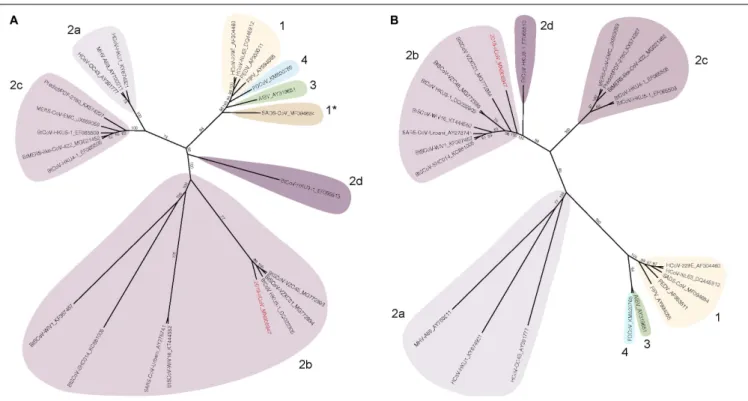
FIGURE 1 |Spike and nsp12 phylogeny of representative coronaviruses. The Spike(A)and nsp12(B)protein sequences of selected coronaviruses were aligned and phylogenetically compared. Coronavirus genera are grouped by classic subgroup designations (1, 2a-d, 3, and 4). In the Spike tree in(A), SADS-CoV is designated as 1* because of its distinctive grouping compared with more conserved proteins (e.g., nsp12, see(B)). Branches in each tree are labeled with consensus support values (in %). Sequences were aligned using free end gaps with the Blosum62 cost matrix, and the tree was constructed using the neighbor-joining method based on the multiple sequence alignment in Geneious Prime. Numbers following the underscores in each sequence correspond to the GenBank Accession number. The SARS-CoV-2 is highlighted in red. The radial phylogram was exported from Geneious and then rendered for publication using Adobe Illustrator CC 2020.
In order to “lock” the
S
-protein in its antigenic optimal pre-fusion
form, two mutations, V1060P and L1061P, were introduced into
the MERS-CoV
S
-protein (
Pallesen et al., 2017
). The resulting
MERS S-2P is able to elicit both RBD and non-RBD binding
nAbs (
Pallesen et al., 2017
). The same strategy was also shown
to work in the SARS-CoV-2
S
-protein (
Wrapp et al., 2020
).
Other structural proteins such as E and M and the nsp N also
contribute to viral protection and clearance (
Channappanavar
et al., 2014
;
Zhao et al., 2016
;
Deng et al., 2018
). Similarly to
other respiratory viruses such as influenza, mucosal IgA plays a
major role in disease protection and has a synergistic effect with
IgG (
Belshe et al., 2000
;
Plotkin, 2010
). In order to elicit a strong
mucosal IgA immunity, the route of vaccine administration
is important. Studies have shown that intranasal inoculation
of a recombinant RBD vaccine can elicit greater mucosal IgA
production than intramuscular or subcutaneous injection (
Ma
et al., 2014a
). However, the duration of mucosal antibodies
is typically shorter lived than systemic IgG responses and the
longest longitudinal study of MERS-CoV IgA responses ended
after 6 months (
Hapfelmeier et al., 2010
;
Ma et al., 2014a
). In
comparison, in a natural infection case study, SARS-targeting
systemic memory B cells were present up to 6 years for
SARS-CoV (
Oh et al., 2012
;
Tang et al., 2019
); and up to 34 months post
infection for MERS-CoV (
Payne et al., 2016
). Another important
consideration for SARS-CoV and MERS-CoV vaccination is the
T cell response against the virus, specifically the N proteins,
which is important for viral clearance (
Zhao et al., 2010
;
Channappanavar et al., 2014
). A study has shown that adoptive
transfer of viral specific T-cells to SCID mice enhances survival
and reduces lung titer after SARS-CoV infection (
Zhao et al.,
2010
). Moreover, intranasal vaccination of N protein using the
VEEV replicon system elicits CD4+ memory T-cells responses
in the airway. Upon challenge, the airway CD4+ memory T cells
secrete IFN-
γ
, which subsequently enhances the innate immune
response as well as coordinates the CD8+ T cell priming and
migration which protects mice from lethal disease, but not weight
loss or virus titers under carefully controlled conditions (
Zhao
et al., 2016
). Interestingly, Rag
−
/
−
mice are able to clear
SARS-CoV infection, suggesting innate immunity is sufficient for viral
clearance (
Zhao et al., 2010
). However, the mechanism of this
viral clearance is still unknown. Another important aspect of
emerging CoV vaccine is the breadth of protection. As mentioned
previously, the antigenic variation in the
S
-protein between
CoVs limits the breadth of cross protection against multiple
emerging CoVs, and is especially true for
S
-protein only vaccines
(
Wang et al., 2018, 2019
).
Learning from natural infection, MERS-CoV specific CD4+
and CD8+ T cells are detected in PBMCs in MERS-CoV infected
survivors (
Zhao et al., 2017
). Therefore, a balance of B cell and T
cell responses is generally considered the gold standard to prevent
and resolve MERS-CoV and SARS-CoV infection. Multiple
strategies have been developed to elicit long lasting B and T
fmicb-11-00658 April 20, 2020 Time: 19:12 # 4
Tse et al. Vaccines and Antivirals Against CoVs
cell responses for SARS-CoV and MERS-CoV. These include
the traditional live attenuated, inactivated, and subunit vaccines,
and newer development of nanoparticles, vectorized vaccines,
and RNA/DNA vaccines. In this review, we have selected only
the vaccine studies that have an
in vivo
challenge model and
have summarized the different parameters, including vaccine
components, dosage, challenge conditions, animal models and
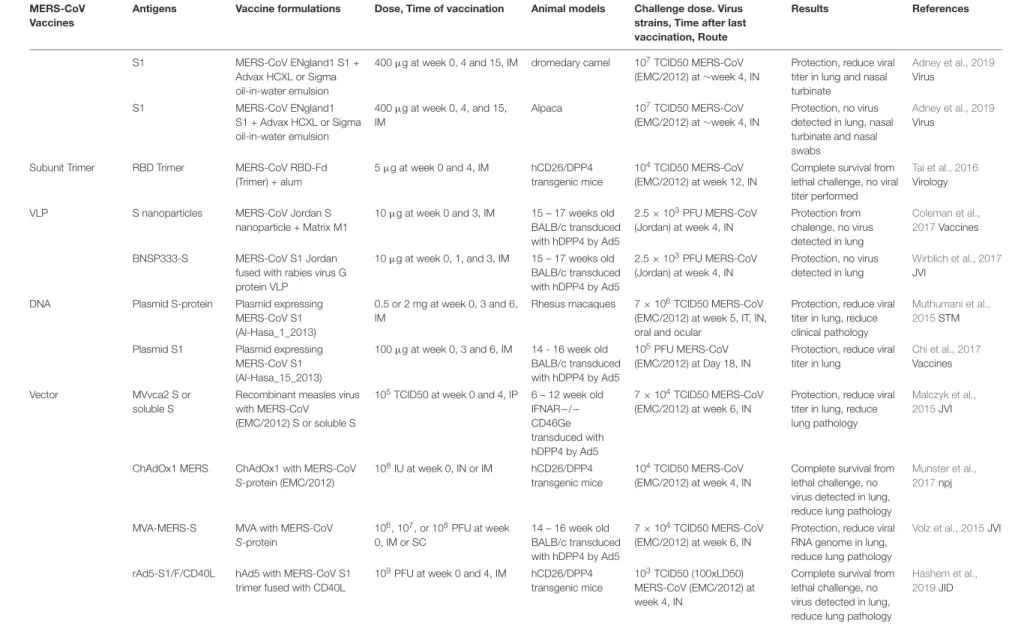
the study outcome in
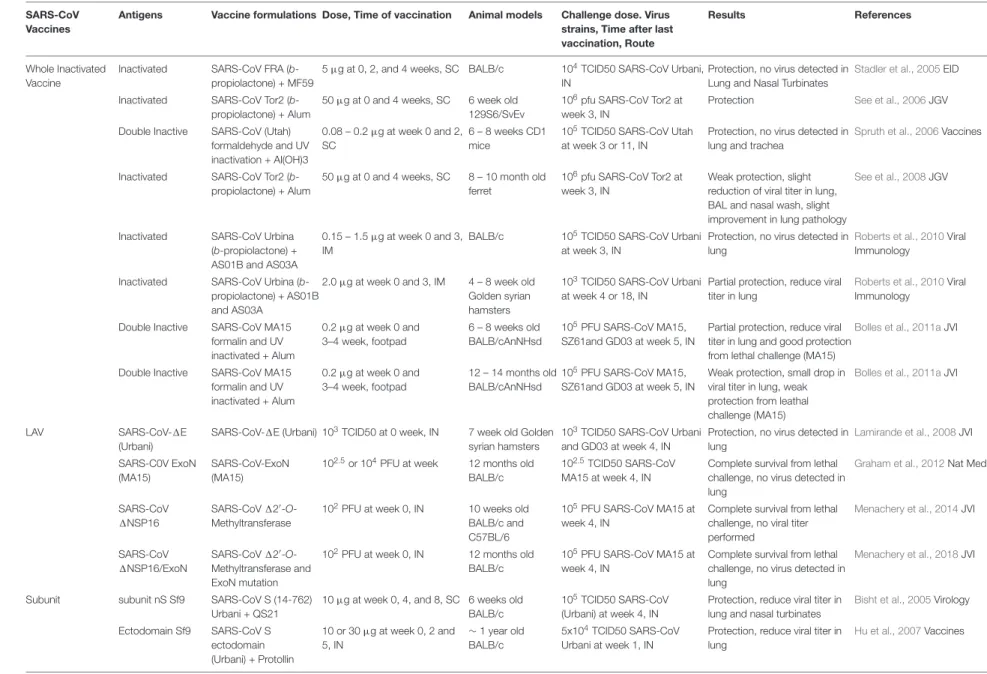
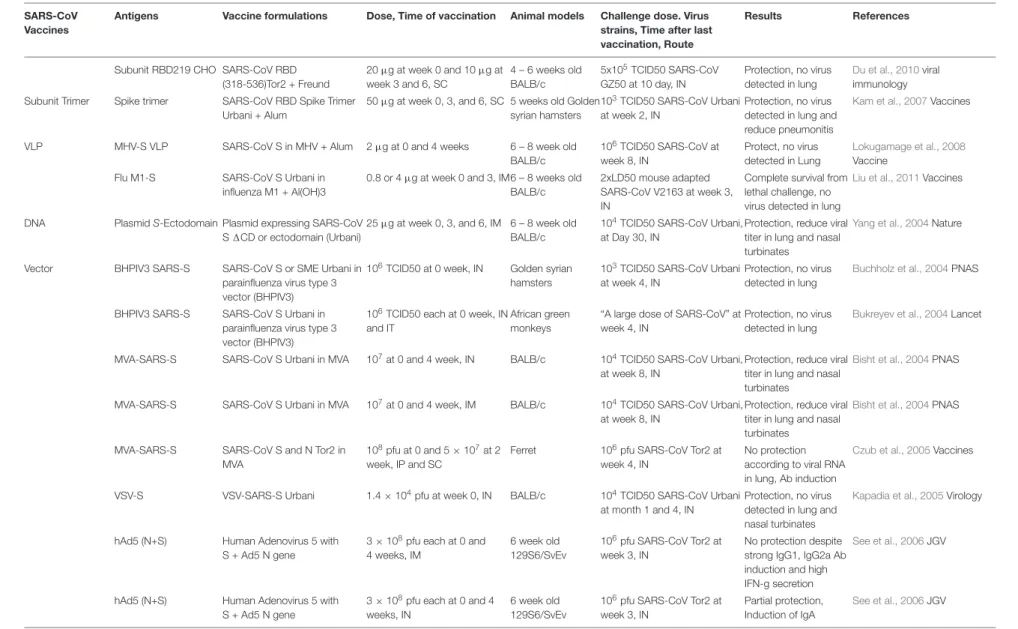
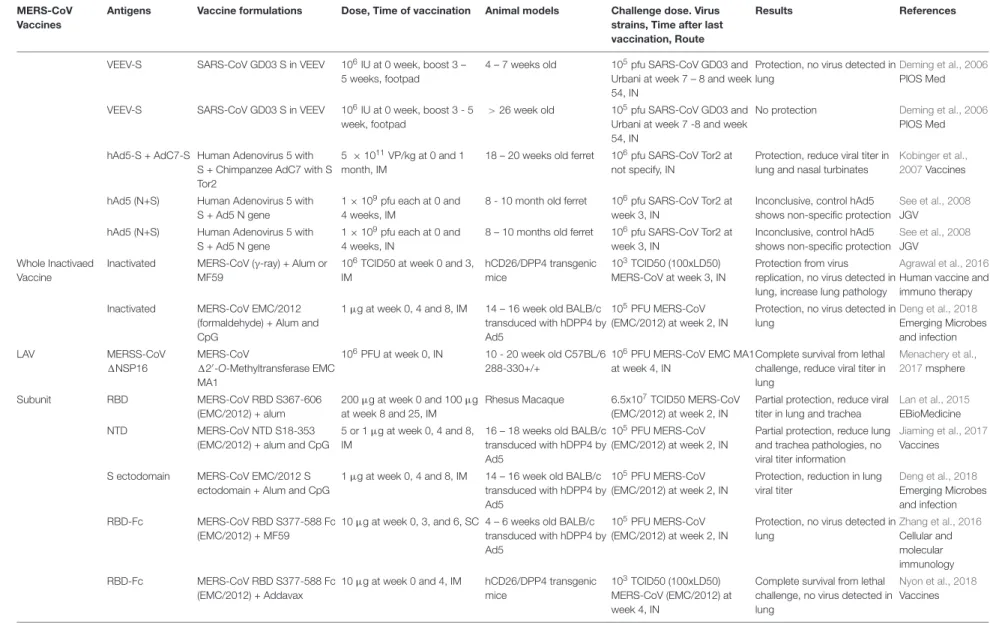
Table 1
. We will also discuss each type of
vaccine strategy and focus on the finished clinical trial targeting
SARS-CoV and the 3 ongoing clinical trials targeting
MERS-CoV using DNA (
Martin et al., 2008
;
Modjarrad et al., 2019
)
and vectorized vaccines. Other comprehensive reviews on CoV
vaccine development can be found elsewhere (
Zhang et al., 2014
;
Du and Jiang, 2015
;
Perlman and Vijay, 2016
;
Schindewolf and
Menachery, 2019
;
Yong et al., 2019
).
Current Vaccine Strategies
Inactivated vaccines are the quickest option for vaccine
development in an outbreak situation. Multiple chemical and
physical methods have been applied singly or in combination
to inactivate CoVs, including
β
-propiolactone, formalin,
formaldehyde and UV. While multiple studies have shown the
efficacy of inactivated vaccines in hamster, ferret and multiple
mouse challenge models (
Stadler et al., 2005
;
See et al., 2006,
2008
;
Spruth et al., 2006
;
Roberts et al., 2010
), one study suggested
a potential vaccine enhanced pathologies (
Bolles et al., 2011a
).
In this study, double inactivation (DIV) of SARS-CoV using
formalin and UV+alum elicits a Th2 skewed response and is
only partially protective to young mice (6–8 weeks-old) and not
protective to experimentally aged mice (12–14 weeks-old) (
Bolles
et al., 2011a
). Furthermore, upon challenge, DIV vaccinated mice
show increased infiltration of eosinophils, neutrophils and other
inflammatory cell populations in the lung, likely due to the N
specific immune response (
Bolles et al., 2011a
). Further studies
have suggested that by replacing alum with TLR agonists such as
Poly I:C, Poly U or LPS as adjuvants, the skewed Th2 responses
can be alleviated and may reduce the infiltration of eosinophils
in the lung (
Iwata-Yoshikawa et al., 2014
).
Gamma-ray inactivated whole MERS-CoV (WIV) with alum
or M59 also suffers from the Th2 skewed immune response and
pulmonary eosinophilia upon challenge, suggesting a potential
risk of using inactive virus for CoV vaccination (
Agrawal et al.,
2016
). Interestingly, formaldehyde inactivated MERS-CoV
co-administered with alum and CpG shows a more balanced
Th1/Th2 response and is able to protect mice from a challenge
model (Ad5 transduced hDPP4) with reduction in lung viral titer
and improved lung pathology. There is no observable
vaccine-induced lung pathology or infiltration of eosinophils upon
challenge (
Deng et al., 2018
). The difference in vaccine outcomes
indicates an incomplete understanding of the effect of adjuvants
on the inactivated SARS and MERS-CoV vaccines. In respiratory
syncytial virus (RSV) vaccines, formalin inactivated vaccines
presents the post-fusion form predominately and fail to elicit
protective immune responses. Whether the same phenomenon
exists in inactivated CoV is still unknown, although it could
explain the discrepancy between reports. The inconsistent results
from different vaccine models also underscores the host genetic
elements affecting vaccine outcome. Nevertheless, inactivated
vaccine is still one of the most straightforward methods for
vaccine development and has the quickest response time in an
outbreak situation.
Live attenuated viral vaccines are the closest mimic of
natural infection and generally elicit strong B and T cell
responses (
Zhao et al., 2017
). Multiple strategies have been
used to genetically attenuate SARS-CoV and MERS-CoV by
either deleting or mutating structural, non-structural or accessory
proteins. Intranasal immunization of a SARS-CoV lacking E
protein (rSARS-CoV-
1
E) has shown complete protection from
pulmonary replication in a Golden Syrian hamster model
(
Lamirande et al., 2008
). A similar virus has been generated in
the MERS backbone, creating a conditional mutant that requires
trans expression of E for productive replication (
Almazán
et al., 2013
). Mutations of the DEDD motif of the 3
0to 5
0exonuclease (ExoN-nsp14) “proof-reading protein” on a
mouse-adapted SARS-CoV attenuated the virus both
in vitro
and
in vivo
.
A single intranasal immunization is able to elicit strong nAbs
(
>
6-fold protective titers) and completely protect against lethal
challenges in an aged mouse model (12 months-old BALB/c)
(
Graham et al., 2012
). Mutations in the nsp 16 (NSP16), a 2
0O
-methyltransferase, in both SARS-CoV and MERS-CoV have also
been shown to attenuate the viruses and to protect BALB/c
and CRISPR-Cas humanized DPP4-288-330 mice from lethal
challenge (
Menachery et al., 2014, 2017, 2018
). Moreover, these
attenuation strategies can be multiplexed, leading to highly
stable live attenuated vaccines with limited capability to undergo
recombination and reversion repair (
Graham et al., 2018
;
Menachery et al., 2018
). Although the live attenuated vaccine is
effective in small animal models, there remain safety concerns
about potential revertants and recombination with natural CoVs
which hinders their usage in the clinical setting. Furthermore, live
attenuated vaccines often require greater time for development
and safety testing which lessens utility in an outbreak situation.
Protein-based subunit vaccines are considered the safest
format of vaccine. However, the low immunogenicity of subunit
vaccines dictates a heavily reliance on adjuvants. Different forms
of the
S
-protein, including the S1 RBD, RBD-Fc (RBD with
human IgG Fc fusion), and N-terminal domain (NTD), have
demonstrated various degrees of nAb responses and protection in
multiple animal models including non-human primates (NHP)
(
Lan et al., 2015
;
Zhang et al., 2016
;
Jiaming et al., 2017
;
Wang
et al., 2017
;
Deng et al., 2018
;
Nyon et al., 2018
;
Adney et al.,
2019
). For instance, the SARS-CoV S1 subunit vaccine produced
from sf9 cells and with the adjuvant saponin or protollin are able
to reduce lung viral titer in young or aged mice after challenge,
respectively (
Bisht et al., 2005
;
Hu et al., 2007
). An RBD subunit of
SARS-CoV produced from Chinese hamster ovarian (CHO) cells
with Freund’s adjuvant is able to protect young BALB/c mice from
infection (
Du et al., 2010
). MERS-CoV-S1 with adjuvants MF59
or Advax HCXL is able to protect alpacas and dromedary camels
against MERS-CoV challenge (
Adney et al., 2019
). Adjuvant
selection can affect the vaccine outcome, and combinations of
adjuvants can have synergistic effects on the strength of the
response. For instance, rRBD with adjuvants alum and CpG ODN
together elicits a stronger humoral and cellular T cell response
fmic b-11-00658 April 20, 2020 T ime: 19:12 # 5 Tse et al. V accines and Antivirals Against CoVs
TABLE 1 |Summary of SARS-CoV and MERS-CoV vaccines studies
SARS-CoV Vaccines
Antigens Vaccine formulations Dose, Time of vaccination Animal models Challenge dose. Virus strains, Time after last vaccination, Route
Results References
Whole Inactivated Vaccine
Inactivated SARS-CoV FRA (b -propiolactone) + MF59
5µg at 0, 2, and 4 weeks, SC BALB/c 104TCID50 SARS-CoV Urbani, IN
Protection, no virus detected in Lung and Nasal Turbinates
Stadler et al., 2005EID
Inactivated SARS-CoV Tor2 (b -propiolactone) + Alum
50µg at 0 and 4 weeks, SC 6 week old 129S6/SvEv
106pfu SARS-CoV Tor2 at week 3, IN
Protection See et al., 2006JGV
Double Inactive SARS-CoV (Utah) formaldehyde and UV inactivation + Al(OH)3
0.08 – 0.2µg at week 0 and 2, SC
6 – 8 weeks CD1 mice
105TCID50 SARS-CoV Utah at week 3 or 11, IN
Protection, no virus detected in lung and trachea
Spruth et al., 2006Vaccines
Inactivated SARS-CoV Tor2 (b -propiolactone) + Alum
50µg at 0 and 4 weeks, SC 8 – 10 month old ferret
106pfu SARS-CoV Tor2 at week 3, IN
Weak protection, slight reduction of viral titer in lung, BAL and nasal wash, slight improvement in lung pathology
See et al., 2008JGV
Inactivated SARS-CoV Urbina (b-propiolactone) + AS01B and AS03A
0.15 – 1.5µg at week 0 and 3, IM
BALB/c 105TCID50 SARS-CoV Urbani at week 3, IN
Protection, no virus detected in lung
Roberts et al., 2010Viral Immunology
Inactivated SARS-CoV Urbina (b -propiolactone) + AS01B and AS03A
2.0µg at week 0 and 3, IM 4 – 8 week old Golden syrian hamsters
103TCID50 SARS-CoV Urbani at week 4 or 18, IN
Partial protection, reduce viral titer in lung
Roberts et al., 2010Viral Immunology
Double Inactive SARS-CoV MA15 formalin and UV inactivated + Alum
0.2µg at week 0 and 3–4 week, footpad
6 – 8 weeks old BALB/cAnNHsd
105PFU SARS-CoV MA15, SZ61and GD03 at week 5, IN
Partial protection, reduce viral titer in lung and good protection from lethal challenge (MA15)
Bolles et al., 2011aJVI
Double Inactive SARS-CoV MA15 formalin and UV inactivated + Alum
0.2µg at week 0 and 3–4 week, footpad
12 – 14 months old BALB/cAnNHsd
105PFU SARS-CoV MA15, SZ61and GD03 at week 5, IN
Weak protection, small drop in viral titer in lung, weak protection from leathal challenge (MA15)
Bolles et al., 2011aJVI
LAV SARS-CoV-1E
(Urbani)
SARS-CoV-1E (Urbani) 103TCID50 at 0 week, IN 7 week old Golden syrian hamsters
103TCID50 SARS-CoV Urbani and GD03 at week 4, IN
Protection, no virus detected in lung
Lamirande et al., 2008JVI
SARS-C0V ExoN (MA15)
SARS-CoV-ExoN (MA15)
102.5or 104PFU at week 12 months old BALB/c
102.5TCID50 SARS-CoV MA15 at week 4, IN
Complete survival from lethal challenge, no virus detected in lung
Graham et al., 2012Nat Med
SARS-CoV 1NSP16
SARS-CoV120
-O -Methyltransferase
102PFU at week 0, IN 10 weeks old BALB/c and C57BL/6
105PFU SARS-CoV MA15 at week 4, IN
Complete survival from lethal challenge, no viral titer performed
Menachery et al., 2014JVI
SARS-CoV 1NSP16/ExoN
SARS-CoV120-O
-Methyltransferase and ExoN mutation
102PFU at week 0, IN 12 months old BALB/c
105PFU SARS-CoV MA15 at week 4, IN
Complete survival from lethal challenge, no virus detected in lung
Menachery et al., 2018JVI
Subunit subunit nS Sf9 SARS-CoV S (14-762) Urbani + QS21
10µg at week 0, 4, and 8, SC 6 weeks old BALB/c
105TCID50 SARS-CoV (Urbani) at week 4, IN
Protection, reduce viral titer in lung and nasal turbinates
Bisht et al., 2005Virology
Ectodomain Sf9 SARS-CoV S ectodomain (Urbani) + Protollin
10 or 30µg at week 0, 2 and 5, IN
∼1 year old BALB/c
5x10⁴TCID50 SARS-CoV Urbani at week 1, IN
Protection, reduce viral titer in lung
Hu et al., 2007Vaccines
fmic
b-11-00658
April
20,
2020
T
ime:
19:12
#
6
Tse
et
al.
V
accines
and
Antivirals
Against
CoVs
TABLE 1 |Continued
SARS-CoV Vaccines
Antigens Vaccine formulations Dose, Time of vaccination Animal models Challenge dose. Virus strains, Time after last vaccination, Route
Results References
Subunit RBD219 CHO SARS-CoV RBD (318-536)Tor2 + Freund
20µg at week 0 and 10µg at week 3 and 6, SC
4 – 6 weeks old BALB/c
5x10⁵TCID50 SARS-CoV GZ50 at 10 day, IN
Protection, no virus detected in lung
Du et al., 2010viral immunology
Subunit Trimer Spike trimer SARS-CoV RBD Spike Trimer Urbani + Alum
50µg at week 0, 3, and 6, SC 5 weeks old Golden syrian hamsters
103TCID50 SARS-CoV Urbani at week 2, IN
Protection, no virus detected in lung and reduce pneumonitis
Kam et al., 2007Vaccines
VLP MHV-S VLP SARS-CoV S in MHV + Alum 2µg at 0 and 4 weeks 6 – 8 week old BALB/c
106TCID50 SARS-CoV at week 8, IN
Protect, no virus detected in Lung
Lokugamage et al., 2008 Vaccine
Flu M1-S SARS-CoV S Urbani in influenza M1 + Al(OH)3
0.8 or 4µg at week 0 and 3, IM6 – 8 weeks old BALB/c
2xLD50 mouse adapted SARS-CoV V2163 at week 3, IN
Complete survival from lethal challenge, no virus detected in lung
Liu et al., 2011Vaccines
DNA PlasmidS-Ectodomain Plasmid expressing SARS-CoV S1CD or ectodomain (Urbani)
25µg at week 0, 3, and 6, IM 6 – 8 week old BALB/c
104TCID50 SARS-CoV Urbani, at Day 30, IN
Protection, reduce viral titer in lung and nasal turbinates
Yang et al., 2004Nature
Vector BHPIV3 SARS-S SARS-CoV S or SME Urbani in parainfluenza virus type 3 vector (BHPIV3)
106TCID50 at 0 week, IN Golden syrian hamsters
103TCID50 SARS-CoV Urbani at week 4, IN
Protection, no virus detected in lung
Buchholz et al., 2004PNAS
BHPIV3 SARS-S SARS-CoV S Urbani in parainfluenza virus type 3 vector (BHPIV3)
106TCID50 each at 0 week, IN and IT
African green monkeys
“A large dose of SARS-CoV” at week 4, IN
Protection, no virus detected in lung
Bukreyev et al., 2004Lancet
MVA-SARS-S SARS-CoV S Urbani in MVA 107at 0 and 4 week, IN BALB/c 104TCID50 SARS-CoV Urbani, at week 8, IN
Protection, reduce viral titer in lung and nasal turbinates
Bisht et al., 2004PNAS
MVA-SARS-S SARS-CoV S Urbani in MVA 107at 0 and 4 week, IM BALB/c 104TCID50 SARS-CoV Urbani, at week 8, IN
Protection, reduce viral titer in lung and nasal turbinates
Bisht et al., 2004PNAS
MVA-SARS-S SARS-CoV S and N Tor2 in MVA
108pfu at 0 and 5×10⁷at 2 week, IP and SC
Ferret 106pfu SARS-CoV Tor2 at week 4, IN
No protection according to viral RNA in lung, Ab induction
Czub et al., 2005Vaccines
VSV-S VSV-SARS-S Urbani 1.4×10⁴pfu at week 0, IN BALB/c 104TCID50 SARS-CoV Urbani at month 1 and 4, IN
Protection, no virus detected in lung and nasal turbinates
Kapadia et al., 2005Virology
hAd5 (N+S) Human Adenovirus 5 with S + Ad5 N gene
3×10⁸pfu each at 0 and 4 weeks, IM
6 week old 129S6/SvEv
106pfu SARS-CoV Tor2 at week 3, IN
No protection despite strong IgG1, IgG2a Ab induction and high IFN-g secretion
See et al., 2006JGV
hAd5 (N+S) Human Adenovirus 5 with S + Ad5 N gene
3×10⁸pfu each at 0 and 4 weeks, IN
6 week old 129S6/SvEv
106pfu SARS-CoV Tor2 at week 3, IN
Partial protection, Induction of IgA
See et al., 2006JGV
(Continued)
Fr
ontiers
in
Micr
obiology
|
www
.fr
ontiersin.org
6
April
2020
|
V
olume
11
|
Article
fmic b-11-00658 April 20, 2020 T ime: 19:12 # 7 Tse et al. V accines and Antivirals Against CoVs
TABLE 1 |Continued
MERS-CoV Vaccines
Antigens Vaccine formulations Dose, Time of vaccination Animal models Challenge dose. Virus strains, Time after last vaccination, Route
Results References
VEEV-S SARS-CoV GD03 S in VEEV 106IU at 0 week, boost 3 – 5 weeks, footpad
4 – 7 weeks old 105pfu SARS-CoV GD03 and Urbani at week 7 – 8 and week 54, IN
Protection, no virus detected in lung
Deming et al., 2006 PlOS Med
VEEV-S SARS-CoV GD03 S in VEEV 106IU at 0 week, boost 3 - 5 week, footpad
>26 week old 105pfu SARS-CoV GD03 and Urbani at week 7 -8 and week 54, IN
No protection Deming et al., 2006 PlOS Med
hAd5-S + AdC7-S Human Adenovirus 5 with S + Chimpanzee AdC7 with S Tor2
5 ×10¹¹VP/kg at 0 and 1 month, IM
18 – 20 weeks old ferret 106pfu SARS-CoV Tor2 at not specify, IN
Protection, reduce viral titer in lung and nasal turbinates
Kobinger et al., 2007Vaccines
hAd5 (N+S) Human Adenovirus 5 with S + Ad5 N gene
1×10⁹pfu each at 0 and 4 weeks, IM
8 - 10 month old ferret 106pfu SARS-CoV Tor2 at week 3, IN
Inconclusive, control hAd5 shows non-specific protection
See et al., 2008 JGV
hAd5 (N+S) Human Adenovirus 5 with S + Ad5 N gene
1×10⁹pfu each at 0 and 4 weeks, IN
8 – 10 months old ferret 106pfu SARS-CoV Tor2 at week 3, IN
Inconclusive, control hAd5 shows non-specific protection
See et al., 2008 JGV
Whole Inactivaed Vaccine
Inactivated MERS-CoV (γ-ray) + Alum or MF59
106TCID50 at week 0 and 3, IM
hCD26/DPP4 transgenic mice
103TCID50 (100xLD50) MERS-CoV at week 3, IN
Protection from virus replication, no virus detected in lung, increase lung pathology
Agrawal et al., 2016 Human vaccine and immuno therapy
Inactivated MERS-CoV EMC/2012 (formaldehyde) + Alum and CpG
1µg at week 0, 4 and 8, IM 14 – 16 week old BALB/c transduced with hDPP4 by Ad5
105PFU MERS-CoV (EMC/2012) at week 2, IN
Protection, no virus detected in lung
Deng et al., 2018 Emerging Microbes and infection
LAV MERSS-CoV
1NSP16
MERS-CoV
120-O-Methyltransferase EMC
MA1
106PFU at week 0, IN 10 - 20 week old C57BL/6 288-330+/+
106PFU MERS-CoV EMC MA1 at week 4, IN
Complete survival from lethal challenge, reduce viral titer in lung
Menachery et al., 2017msphere
Subunit RBD MERS-CoV RBD S367-606
(EMC/2012) + alum
200µg at week 0 and 100µg at week 8 and 25, IM
Rhesus Macaque 6.5x10⁷TCID50 MERS-CoV (EMC/2012) at week 2, IN
Partial protection, reduce viral titer in lung and trachea
Lan et al., 2015 EBioMedicine
NTD MERS-CoV NTD S18-353
(EMC/2012) + alum and CpG
5 or 1µg at week 0, 4 and 8, IM
16 – 18 weeks old BALB/c transduced with hDPP4 by Ad5
105PFU MERS-CoV (EMC/2012) at week 2, IN
Partial protection, reduce lung and trachea pathologies, no viral titer information
Jiaming et al., 2017 Vaccines
S ectodomain MERS-CoV EMC/2012 S ectodomain + Alum and CpG
1µg at week 0, 4 and 8, IM 14 – 16 week old BALB/c transduced with hDPP4 by Ad5
105PFU MERS-CoV (EMC/2012) at week 2, IN
Protection, reduction in lung viral titer
Deng et al., 2018 Emerging Microbes and infection
RBD-Fc MERS-CoV RBD S377-588 Fc (EMC/2012) + MF59
10µg at week 0, 3, and 6, SC 4 – 6 weeks old BALB/c transduced with hDPP4 by Ad5
105PFU MERS-CoV (EMC/2012) at week 2, IN
Protection, no virus detected in lung
Zhang et al., 2016 Cellular and molecular immunology
RBD-Fc MERS-CoV RBD S377-588 Fc (EMC/2012) + Addavax
10µg at week 0 and 4, IM hCD26/DPP4 transgenic mice
103TCID50 (100xLD50) MERS-CoV (EMC/2012) at week 4, IN
Complete survival from lethal challenge, no virus detected in lung
fmic
b-11-00658
April
20,
2020
T
ime:
19:12
#
8
Tse
et
al.
V
accines
and
Antivirals
Against
CoVs
TABLE 1 |Continued
MERS-CoV Vaccines
Antigens Vaccine formulations Dose, Time of vaccination Animal models Challenge dose. Virus strains, Time after last vaccination, Route
Results References
S1 MERS-CoV ENgland1 S1 +
Advax HCXL or Sigma oil-in-water emulsion
400µg at week 0, 4 and 15, IM dromedary camel 107TCID50 MERS-CoV (EMC/2012) at∼week 4, IN
Protection, reduce viral titer in lung and nasal turbinate
Adney et al., 2019 Virus
S1 MERS-CoV ENgland1
S1 + Advax HCXL or Sigma oil-in-water emulsion
400µg at week 0, 4, and 15, IM
Alpaca 107TCID50 MERS-CoV (EMC/2012) at∼week 4, IN
Protection, no virus detected in lung, nasal turbinate and nasal swabs
Adney et al., 2019 Virus
Subunit Trimer RBD Trimer MERS-CoV RBD-Fd (Trimer) + alum
5µg at week 0 and 4, IM hCD26/DPP4 transgenic mice
104TCID50 MERS-CoV (EMC/2012) at week 12, IN
Complete survival from lethal challenge, no viral titer performed
Tai et al., 2016 Virology
VLP S nanoparticles MERS-CoV Jordan S
nanoparticle + Matrix M1
10µg at week 0 and 3, IM 15 – 17 weeks old BALB/c transduced with hDPP4 by Ad5
2.5×10³PFU MERS-CoV (Jordan) at week 4, IN
Protection from chalenge, no virus detected in lung
Coleman et al., 2017Vaccines
BNSP333-S MERS-CoV S1 Jordan fused with rabies virus G protein VLP
10µg at week 0, 1, and 3, IM 15 – 17 weeks old BALB/c transduced with hDPP4 by Ad5
2.5×10³PFU MERS-CoV (Jordan) at week 4, IN
Protection, no virus detected in lung
Wirblich et al., 2017 JVI
DNA Plasmid S-protein Plasmid expressing MERS-CoV S1 (Al-Hasa_1_2013)
0.5 or 2 mg at week 0, 3 and 6, IM
Rhesus macaques 7×10⁶TCID50 MERS-CoV (EMC/2012) at week 5, IT, IN, oral and ocular
Protection, reduce viral titer in lung, reduce clinical pathology
Muthumani et al., 2015STM
Plasmid S1 Plasmid expressing MERS-CoV S1 (Al-Hasa_15_2013)
100µg at week 0, 3 and 6, IM 14 - 16 week old BALB/c transduced with hDPP4 by Ad5
105PFU MERS-CoV (EMC/2012) at Day 18, IN
Protection, reduce viral titer in lung
Chi et al., 2017 Vaccines
Vector MVvca2 S or
soluble S
Recombinant measles virus with MERS-CoV
(EMC/2012) S or soluble S
105TCID50 at week 0 and 4, IP 6 – 12 week old IFNAR−/− CD46Ge transduced with hDPP4 by Ad5
7×10⁴TCID50 MERS-CoV (EMC/2012) at week 6, IN
Protection, reduce viral titer in lung, reduce lung pathology
Malczyk et al., 2015JVI
ChAdOx1 MERS ChAdOx1 with MERS-CoV S-protein (EMC/2012)
108IU at week 0, IN or IM hCD26/DPP4 transgenic mice
104TCID50 MERS-CoV (EMC/2012) at week 4, IN
Complete survival from lethal challenge, no virus detected in lung, reduce lung pathology
Munster et al., 2017npj
MVA-MERS-S MVA with MERS-CoV S-protein
106, 107, or 108PFU at week 0, IM or SC
14 – 16 week old BALB/c transduced with hDPP4 by Ad5
7×10⁴TCID50 MERS-CoV (EMC/2012) at week 6, IN
Protection, reduce viral RNA genome in lung, reduce lung pathology
Volz et al., 2015JVI
rAd5-S1/F/CD40L hAd5 with MERS-CoV S1 trimer fused with CD40L
109PFU at week 0 and 4, IM hCD26/DPP4 transgenic mice
103TCID50 (100xLD50) MERS-CoV (EMC/2012) at week 4, IN
Complete survival from lethal challenge, no virus detected in lung, reduce lung pathology
Hashem et al., 2019JID
Selection criteria: Only animal studies with a challenge model are included. LAV, live attenuated vaccine; VLP, virus like particle; RBD, receptor binding domain; IM, intramuscular; IN, intranasal; SC, subcutaneous; IP, intraperitoneal.
Fr
ontiers
in
Micr
obiology
|
www
.fr
ontiersin.org
8
April
2020
|
V
olume
11
|
Article
fmicb-11-00658 April 20, 2020 Time: 19:12 # 9
Tse et al. Vaccines and Antivirals Against CoVs
(
Lan et al., 2014
). Additionally, rNTD with alum is able to reduce
lung pathology in a non-lethal MERS-CoV challenge (
Jiaming
et al., 2017
). Instead of adjuvants alone, immune enhancers such
as an Fc fragment, which increases the protein half-life when
fused with the RBD, can also elicit a stronger IgG nAb and
cellular immune response in multiple experimental animals (
Du
et al., 2013
;
Ma et al., 2014b
;
Tang et al., 2015
;
Nyon et al.,
2018
). RBD-Fc fusion subunit vaccine is able to protect a lethal
challenge of MERS-CoV in adenovirus transduced hCD26/DPP4
mice (
Zhang et al., 2016
;
Wang et al., 2017
). While a large amount
of work concerning the subunit vaccines has been done in
conjunction with different adjuvants, the effect of each adjuvant is
not well understood and multi-adjuvant systems (combinatorial
admixes) have not been rigorously tested. A more systematic
method of studying the effect of different adjuvants on CoV
vaccines will be valuable for vaccine development, perhaps using
genetic reference populations that more accurately phenocopy
human genetic variation (
Leist and Baric, 2018
).
Trimeric forms of the
S
-protein and RBD have been
developed using the T4 trimerization domain to mimic the
native conformation of the spike RBD (
Kam et al., 2007
;
Tai
et al., 2016
). The trimeric RBD antigens are able to elicit a
robust nAb response and protect 80% of hDPP4 transgenic mice
from lethal MERS-CoV challenge, although most animals still
experienced slight weight loss (
Tai et al., 2016
). Alternatively, the
MERS-CoV
S
-protein has been structurally designed to remain
in perfusion state by mutating V1060 and L1061 at the tip of
the central helix to proline (S-2P) (
Kirchdoerfer et al., 2016
;
Pallesen et al., 2017
). The MERS S-2P protein retains the receptor
binding properties of the wild-type S and elicits nAbs against
at least 3 different S domains, including RBD, NTD, and S2.
Intramuscular injection of the MERS S-2P elicits nAb responses
in mice comparable to the monomeric S1 and trimeric
S
-protein
antigens. (
Pallesen et al., 2017
).
Similar to subunit vaccines are the viral like particle (VLP)
and nanoparticle vaccines. VLP and nanoparticles provide
multivalent binding similar to actual viruses without the potential
safety concerns. In SARS-CoV, multiple systems were used to
generate
S
-protein VLPs, including the mouse hepatitis virus
(MHV) and influenza matrix 1 (M1). In the chimeric MHV
system, the SARS-CoV protein is co-expressed with the MHV
E, M and N proteins to produce MHV-S VLP. Mice vaccinated
with the MHV-S VLP and alum have inhibited viral replication
in lung after a homologous strain challenge (
Lokugamage et al.,
2008
). Instead of using MHV structural proteins, the influenza
system express the SARS-CoV
S
-protein with influenza virus M1
proteins in Sf9 cells to create the M1-S VLP. Immunization of
M1-S VLP with aluminum hydroxide can protect mice from
a lethal challenge of SARS-CoV (
Liu et al., 2011
). In
MERS-CoV, expression of S, E, and M proteins using the baculovirus
system produces VLPs that are morphologically similar to the
actual virus (
Coleman et al., 2014
;
Wang et al., 2017b
). Other
methods such as CPV-based (
Wang et al., 2017a
), rabies virus
(MV)-based (
Wirblich et al., 2017
), ferritin-based (
Seong, 2018
),
and
S
-protein aggregates (
Coleman et al., 2014
) are all able
to elicit immune responses and reduce viral replication in a
mouse model when co-administered with Matrix M1 adjuvant
(
Coleman et al., 2017
). Although all show different degree of
immune response in animal, only one study showed a reduction
of viral titer
in vivo
via an adenovirus transduced hCD26/DPP4
mouse model (
Coleman et al., 2017
).
Clinical Trials for SARS- and MERS-CoV
Vaccines
A finished phase 1 clinical trial for a SARS-CoV vaccine is a DNA
vaccine that encodes the ectodomain of the SARS-CoV
S
-protein
(NCT00099463). DNA vaccines rely on a continuous expression
of antigen from a DNA plasmid that is injected intramuscularly
and electroporated (
Muthumani et al., 2015
;
Wang et al.,
2015
;
Chi et al., 2017
). In pre-clinical studies, 3 doses of an
intramuscular plasmid injection was able to reduce viral titer in
both lung and nasal turbinate in a BALB/c challenge model (
Yang
et al., 2004
). The phase 1 trial showed favorable results; after 3
doses of DNA vaccine, all subjects showed CD4+ T cell responses,
while 80% of subjects had nAbs and 20% of subjects showed
CD8+ T cell responses. However, there has been no follow-up
in the vaccine development, likely due to the end of the
SARS-CoV outbreak (
Martin et al., 2008
). One MERS-CoV vaccine
that is currently undergoing clinical trials (NCT03721718) is
a DNA-based vaccine (
Modjarrad et al., 2019
). GLS-5300 is a
DNA vaccine based on a consensus full-length
S
-protein from
MERS-CoV under the control of a CMV promoter. In preclinical
studies, the vaccine was electroporated into mice, camel and
rhesus monkeys three times within 1 month. The vaccine elicited
B cell responses in all animals at 1 month post vaccination,
and extracted IgG was able to neutralize multiple strains of
MERS-CoV including England/2/2013, and Al-Hasa/1/2013 and,
surprisingly, a group 1b CoV NL63 and a group 2a CoV HKU1
using the pseudotype neutralization assay (
Muthumani et al.,
2015
). T cell responses were assessed in mice and monkeys, with
both demonstrating T cell responses as indicated by the presence
of IFN-
γ
, TNF
α
and IL2-secreting CD4+ and CD8+ T cells
after peptide stimulation. Rhesus monkeys were also protected
from challenge of the vaccine strain with lower viral titers and
lung pathology as assessed by radiography and pathology studies
(
Muthumani et al., 2015
). Currently, GLS-5300 has completed
Phase I clinical trials (safety). Three doses (0.67, 2, and 6 mg)
of GLS-5300 were electroporated intramuscularly at weeks 0,
4, and 12. Ninety-four percent of subjects were seroconverted
and nAbs were detected in 50% of the individuals. Seventy-six
percent of subjects developed T-cell responses against peptides
derived from MERS-CoV
S
-proteins (
Modjarrad et al., 2019
).
Other than a full
S
-protein DNA vaccine, different designs also
show promising results in preclinical mouse models. Notably, a
DNA vaccine composed of only the S1 domain showed efficacy
when paired with different adjuvants (
Chi et al., 2017
). Hybrid
strategies using a DNA vaccine paired with a protein booster also
showed promising results in eliciting more balanced Th1 and Th2
responses (
Wang et al., 2015
;
Al-Amri et al., 2017
).
Vector-Based Vaccines
Two out of the three clinical trials for MERS vaccines are
vectorized vaccines. Viral vector-based vaccines have multiple
fmicb-11-00658 April 20, 2020 Time: 19:12 # 10
Tse et al. Vaccines and Antivirals Against CoVs
advantages over the generic protein or DNA-based subunit
vaccines. Firstly, as viral vectors utilize a defined viral entry
mechanism, they are more efficient at delivering DNA into cells.
Second, the vector itself can serve as an adjuvant which in turn
elicits both B- and T-cell responses (
Ura et al., 2014
). Finally, a
wide variety of vector systems including measles viruses (
Malczyk
et al., 2015
;
Bodmer et al., 2018
), Venezuelan equine encephalitis
virus (VEEV) replicon system (
Deming et al., 2006
;
Agnihothram
et al., 2014
;
Zhao et al., 2016
), adeno-associated virus (AAV) (
Du
et al., 2008
), parainfluenza type 3 (BHPIV3) (
Buchholz et al.,
2004
;
Bukreyev et al., 2004
), human and chimpanzee adenovirus
(hAd5 and ChAdOx1) (
See et al., 2006, 2008
;
Kobinger et al.,
2007
;
Kim et al., 2014
;
Guo et al., 2015
;
Hashem et al., 2019
) and
modified vaccinia virus Ankara (MVA) (
Bisht et al., 2004
;
Czub
et al., 2005
;
Kapadia et al., 2005
;
Haagmans et al., 2016
) have been
previously established for use as vaccine platforms for multiple
infectious diseases. Herein, we will focus on the three systems
that have been or are currently under clinical trial; all others are
summarized in
Table 1
.
Replication-defective adenovirus vectors are one of the most
effective choices to deliver vaccine antigens. Human adenovirus
5 (hAd5) and enteric adenovirus type 41 (Ad41) have both
been used to deliver MERS-CoV S or S1 proteins. Intramuscular
inoculation of the vaccine elicits both B-cell (nAb titer) and
T-cell (IFN-
γ
secreting splenocytes and pulmonary lymphocytes)
responses (
Guo et al., 2015
). However, pre-existing nAbs against
hAd5 and 41 in the human population have limited their
usage to dromedary camels instead of humans (
Chirmule et al.,
1999
). The pre-existing nAb problem against hAd5 can be
circumvented by using a chimpanzee adenovirus. One such
platform is ChAdOx1, wherein the adenovirus E1 gene is replaced
by a MERS-CoV
S
-protein with an N-terminal secretion peptide
from human plasminogen activator (tPA) driven by a CMV
promoter. Intramuscular inoculation of the vector successfully
elicits nAbs against
S
-protein as quickly as 14 days post infection.
Splenic CD8+ T-cells secreting IFN-
γ
, TNF-
α
and IL-17 are also
present at 28 days post infection (
Alharbi et al., 2017
). A single
intranasal or intramuscular inoculation of ChAdOx1-MERS is
able to protect a human DPP4 transgenic mouse from lethal
challenge by MERS-CoV, and the vaccine (
Munster et al., 2017
) is
currently under phase 1 clinical trial (NCT03399578). CHAdOx1
has also shown effective protection for Rift Valley Fever Virus in
dromedary camels (
Warimwe et al., 2016
).
The modified vaccinia virus Ankara (MVA) vector is
another effective platform for MERS-CoV vaccine development.
S
-protein is inserted into the MAV genome at deletion site III
driven by the viral P11 promoter. After a single intramuscular
injection, BALB/c mice produce nAbs against both the RBD
and S2, as tested
in vitro
(
Song et al., 2013
). A follow-up
study identified IFN-
γ
secreting splenocytes after peptide S291
stimulation at 56 days post infection, suggesting the vaccine is
able to elicit memory CD8+ T cell responses. The vaccine is also
able to protect a hDDP4-transduced BALB/c mouse model. RNA
genomes in the lungs and lung pathology are drastically reduced
compared to mock vaccination (
Volz et al., 2015
). The MAV
based MERS-CoV vaccine has also been tested on dromedary
camels and elicits induction of nAbs in sera and nasal swabs.
Vaccinated camels also show reduced RNA genomes and gross
pathology. The Phase I clinical trial has just been completed and
the results are pending (NCT03615911).
ANTIVIRALS
The Challenge for Treatment Windows
The average incubation period for SARS-CoV and MERS-CoV
is around 5 days (
Zumla et al., 2015
;
de Wit et al., 2016
)
and the main site of viral replication is the lower respiratory
tract (
Corman et al., 2015
;
Petrovsky, 2016
). At 7–10 days after
symptomatic onset, viral RNA titer peaks in the upper respiratory
tract (
Drosten et al., 2004
;
Corman et al., 2015
). For terminal
cases, disease lasts for an average of 12 days post symptomatic
onset for MERS-CoV and 24 days for SARS-CoV (
Zumla et al.,
2015
). Interestingly, severe symptoms begin as the viral titer is
decreasing, suggesting that severe CoV pathogenesis is due to
immune complications and the inability to resolve inflammation
(
Peiris et al., 2003a
;
Wang et al., 2004
). SARS-CoV upregulates
pro-inflammatory cytokine production in the lung, including
IL1, IL6, IL8, IL10, CXCL10 and TNF-
α
production (
Binnie
et al., 2014
). Compared to SARS-CoV infected patients with
mild diseases, patients with ARDS fail to induce interferon (IFN)
expression and the subsequent IFN-stimulated genes (ISGs) that
are indicative of adaptive immune responses (
Cameron et al.,
2007
;
Binnie et al., 2014
). The inability to switch from an innate
immune response to the adaptive immune response may lead to
uncontrollable inflammation and severe end stage lung disease.
Given the rapid progression of symptoms to terminal illness,
there is only approximately a 1 week treatment window after
the onset of symptoms for antiviral and medical intervention
(
Widagdo et al., 2017
). This treatment window could further
compromised by delays in virus diagnosis, causing a challenge
for timely medical intervention administration when the virus
titers and pathological symptom are relatively mild (
Corman
et al., 2015
;
Ahmed, 2019
). Unlike humans, experimental animal
models have a compressed disease course (
<
7 days), and it is
difficult to differentiate between early and late phase of infection.
It would be beneficial for clinical studies to separate the
early-(
<
10 days) and late-phase (
>
10 days) patients to determine
differences in patient response between the groups.
The Challenge for Therapeutic
Development
Despite of the presence of a 3
0to 5
0exoribonuclease (exoN)
proofreading enzyme, their large genome size (28–30 kb)
means that CoVs remain in the category of highly mutating
viruses (
Eckerle et al., 2007, 2010
;
Denison et al., 2011
). The
high mutation rate poses a considerable challenge for antiviral
development as drug resistant viruses could arise or already
exist within the quasispecies in nature or from an infected
individual (
Briese et al., 2014
). For instance, after a prolonged
period of nAb or drug treatments, the CoV can acquire mutations
which confer resistance to the therapeutics (
Zumla et al., 2016a
).
The appearance of these “escape viruses” has been confirmed
in multiple mouse model studies in well-contained laboratory
fmicb-11-00658 April 20, 2020 Time: 19:12 # 11
Tse et al. Vaccines and Antivirals Against CoVs
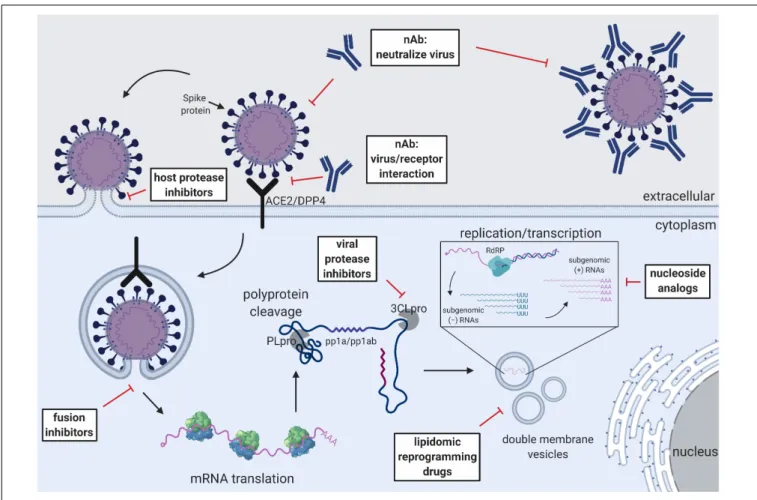
FIGURE 2 |Schematic of the CoV replication cycle and key steps for antiviral targets. White text boxes indicate the subtype of antivirals that work either extracellularly or intracellularly. Different steps of the CoV replication cycle are illustrated in cartoon form, including receptor binding, membrane fusion, viral RNA replication, sub-genomic RNA transcription and translation.
settings as well as in nature (
Neuman et al., 2006
;
Ter Meulen
et al., 2006
;
Huang et al., 2008
;
Jiang et al., 2014
;
Tang et al., 2014
;
Tai et al., 2017
;
Kleine-Weber et al., 2019
). Fortunately, some of
the mutations that confer drug resistance also compromise viral
fitness and attenuate the virus (
Deng et al., 2014
;
Agostini et al.,
2018
). Another therapeutic intervention is the use of immune
modulators, such as IFN-
α
2a/2b, IFN-
β
1b and corticosteroids in
treating CoVs (
Loutfy et al., 2003
;
Peiris et al., 2003b
;
Sung et al.,
2004
). Although multiple studies have shown efficacy of
IFN-α
2a/2b and IFN-
β
1b singly or in combination with off-labeled
antivirals such as ribavirin, lopinavir (LPV) and ritonavir (RTV)
in treating SARS- and MERS-CoV in mouse, rhesus monkey and
marmoset models (
Haagmans et al., 2004
;
Barnard et al., 2006b
;
Falzarano et al., 2013b
;
Chan et al., 2015
), clinical studies have
shown inconclusive results (
Momattin et al., 2013
;
Mo and Fisher,
2016
). Currently, a randomized controlled trial is underway to
determine the efficacy of a combination of LPV/RTV and
IFN-β
1b in treating MERS-CoV infection (NCT02845843).
Convalescent Plasma and Monoclonal
Antibodies
Although there is no approved drug to treat severe CoV
infection, multiple strategies have shown promising results in
an experimental setting (
Figure 2
). Convalescent plasma (CP)
is derived from patients who have recovered from SARS-CoV
and MERS-CoV infection and contains high titer nAbs (
Hsueh
et al., 2004
;
Al Kahlout et al., 2019
;
Shin et al., 2019
). Some data
suggest that CP use against SARS-CoV infection is safe and, when
administered at an early time point, may reduce mortality (
Mair-Jenkins et al., 2015
). CP neutralizing titers
>
1:80 may have a
positive impact on infected MERS-CoV patients with respiratory
failure (
Ko et al., 2018
). Unfortunately, CP from convalescent
patients is difficult to obtain in large quantities and the Ab titer is
too low to have beneficial effects, making it difficult to be used as a
main stream therapeutic or for clinical testing (
Arabi et al., 2016
).
As such, no systematic, well-designed clinical trial has formally
demonstrated the efficacy of CP in emerging CoV infection.
Rather, a clinical trial for testing CP against MERS-CoV infection
was withdrawn prior to patient enrollment (NCT02190799).
Although CP from convalescent patients is difficult to obtain,
the active component (neutralizing antibodies) can be isolated
and subsequently produced in large quantity using recombinant
technology (
Corti et al., 2016
). Passive infusion of neutralizing
monoclonal Abs (mAbs) has been used for several diseases with
success, including RSV and Ebola virus (
Graham and Ambrosino,
2015
;
Zumla et al., 2016b
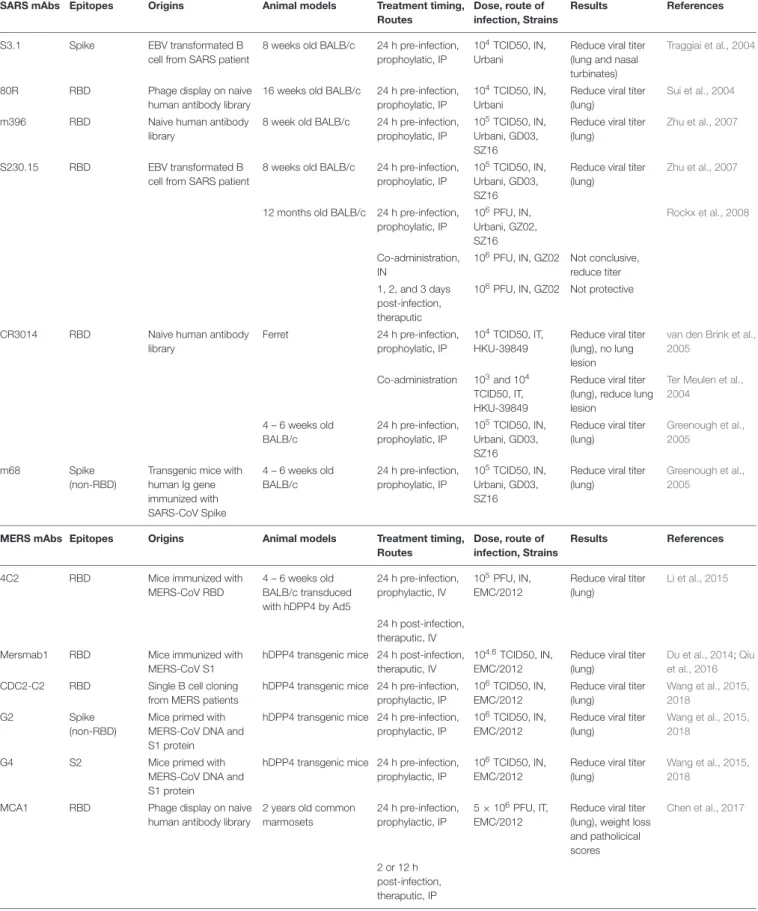
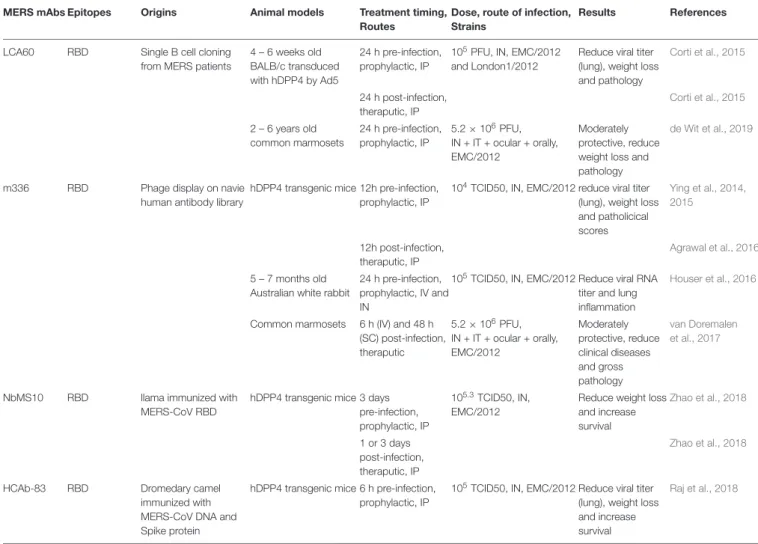
). Numerous highly potent mAbs against
fmicb-11-00658 April 20, 2020 Time: 19:12 # 12
Tse et al. Vaccines and Antivirals Against CoVs